Asphalt milling is the controlled removal of an existing pavement surface to a specified depth using cold planing equipment, restoring commercial properties to proper grade without full reconstruction.
This guide covers milling fundamentals and equipment, the step-by-step milling process, depth selection and site preparation, material recycling and environmental impact, and scheduling, cost, and climate considerations.
Cold milling machines use rotating drums with carbide-tipped teeth to grind pavement at precise depths while conveyors load reclaimed material into haul trucks. Support vehicles including dump trucks, water trucks, skid steers, and sweepers keep operations continuous and ensure clean surfaces for overlay adhesion.
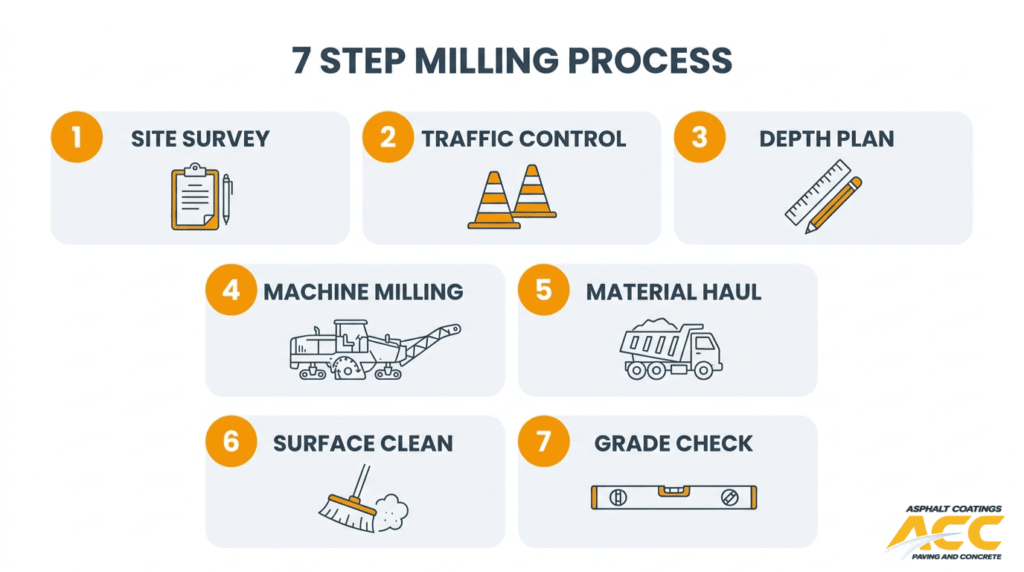
The milling process follows seven sequential steps: site surveying, traffic control setup, depth and pattern determination, machine milling, material hauling, surface cleaning and inspection, and grade verification. Each step builds on the previous one to deliver a uniform profile ready for repaving.
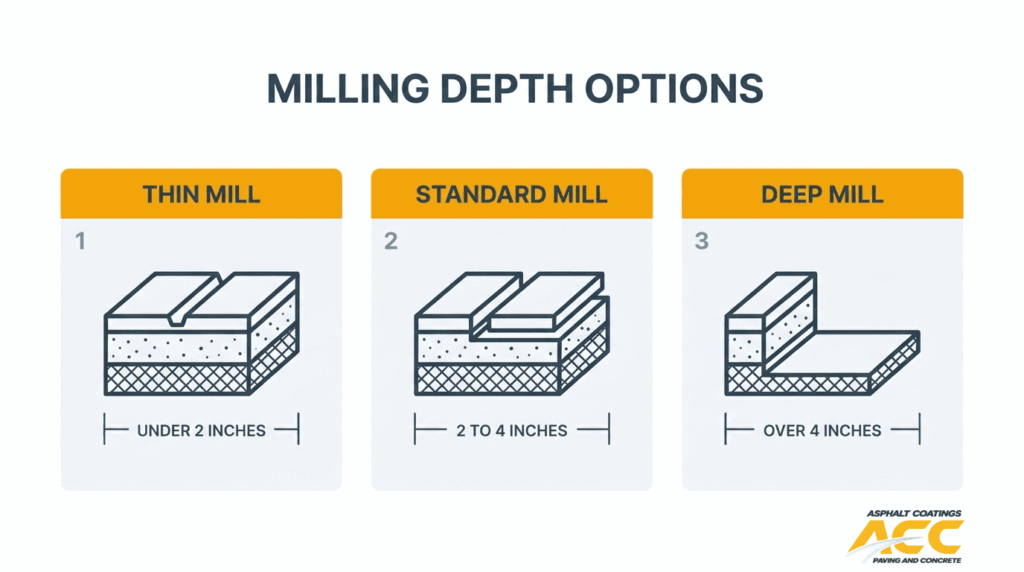
Depth selection ranges from thin surface mills under two inches for minor wear corrections, to standard mills of two to four inches for binder-layer rehabilitation, to deep mills exceeding four inches when the entire asphalt section has failed. Matching depth to pavement condition prevents over-milling into the base while controlling costs.
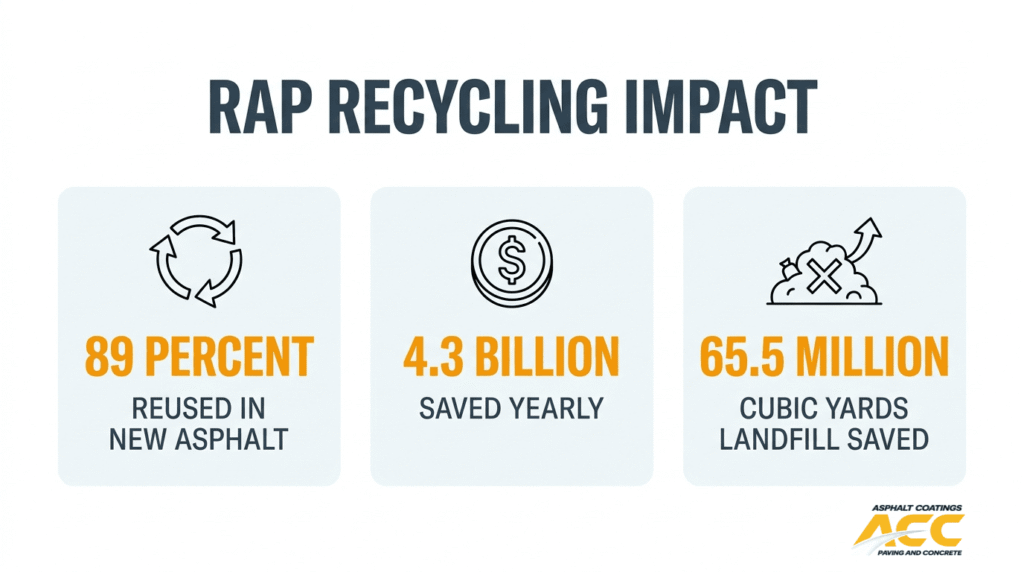
Reclaimed asphalt pavement re-enters the supply chain rather than filling landfills. Nationally, approximately 89% of milled material is reused in new asphalt mixtures, saving billions annually and reducing greenhouse gas emissions significantly.
Project cost depends on square footage, milling depth, and site access complexity. Freeze-thaw cycles and UV exposure influence scheduling windows, making early planning with a qualified commercial paving partner essential for protecting both budget and pavement performance.
What Is Asphalt Milling and Why Is It Used on Commercial Properties?
Asphalt milling is the controlled removal of an existing pavement surface to a specified depth using specialized cold planing equipment. Commercial properties rely on milling to correct surface defects, restore proper drainage, and prepare pavement for overlays without full reconstruction.
What Problems Does Milling Solve on Commercial Pavement?
Milling solves a wide range of structural and surface-level pavement defects common on commercial properties. According to RoadResource.org, cold planing addresses issues such as raveling, bleeding, rutting, corrugations, shoving, removal of deteriorated or aged asphalt, poor ride quality caused by swells, bumps, sags, and depressions, and diminished curb reveal heights.
For commercial sites like parking lots and access roads, these problems directly affect safety, ADA compliance, and property value. Milling corrects uneven surfaces that cause tripping hazards or pooling water without the cost and disruption of tearing out the entire pavement structure. For most property managers, addressing these issues early through targeted milling is far more cost-effective than waiting for conditions to worsen into base failures.
How Does Milling Differ from Full-Depth Removal?
Milling differs from full-depth removal in scope, method, and impact on the underlying pavement structure. Cold planing removes only the surface layers to a controlled depth, typically between one and four inches, while preserving the existing base. According to the Federal Highway Administration, full depth reclamation pulverizes the entire pavement thickness and a portion of the underlying material, then stabilizes the blended material with cement, lime, or asphalt to create a new base layer.
This distinction matters for commercial project planning:
- Milling preserves the existing subbase and requires shorter closure times.
- Full-depth removal rebuilds the foundation and suits severely failed pavement.
- Milling produces reusable reclaimed asphalt pavement; full-depth reclamation produces stabilized base material.
When the base remains structurally sound, milling followed by an overlay delivers a like-new surface at a fraction of the cost and timeline of full reconstruction. Understanding this distinction helps commercial property teams move forward with the right equipment and process steps.
What Equipment Is Used in the Asphalt Milling Process?
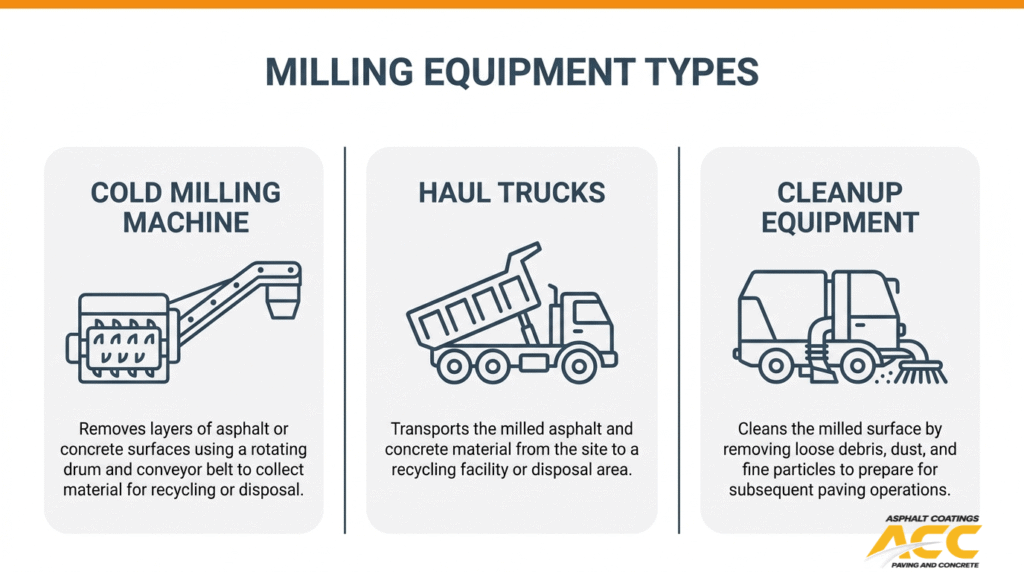
The equipment used in the asphalt milling process includes cold milling machines, dump trucks, skid steers, and sweepers. Each machine serves a specific role during and after pavement removal.
What Does a Cold Milling Machine Do?
A cold milling machine removes existing asphalt pavement to a specified depth using a rotating drum fitted with carbide-tipped cutting teeth. The drum grinds the surface at a controlled grade while a conveyor system loads the milled material directly into haul trucks.
According to the Wirtgen Group, the W 220 F i cold milling machine handles surface layer rehabilitation, complete pavement removal, and fine milling with cutting widths of 7 ft 3 in, 8 ft 2 in, or 12 ft 6 in through its Multiple Cutting System. Integrated leveling systems like LEVEL PRO ACTIVE ensure precise height control across each pass. For commercial parking lots and roadways, this precision eliminates guesswork and delivers the uniform profile that overlay success depends on.
What Support Vehicles Are Needed During Milling Operations?
The support vehicles needed during milling operations are dump trucks, water trucks, and material transport trailers. Dump trucks position directly ahead of the milling machine to receive reclaimed asphalt pavement from the conveyor belt, cycling continuously to keep production uninterrupted. Water trucks supply the milling drum’s spray system, which cools the cutting teeth and suppresses dust throughout the cut.
On large commercial sites, maintaining a steady rotation of three to five dump trucks prevents the milling machine from stopping. Any gap in haul capacity creates idle time that extends project duration and increases labor costs.
What Role Do Skid Steers and Sweepers Play After Milling?
Skid steers and sweepers play a cleanup and detail role after milling is complete. Skid steers equipped with broom or bucket attachments remove loose millings from corners, curb lines, and areas the conveyor system cannot reach. Mechanical sweepers then make a final pass to clear fine debris from the milled surface, ensuring a clean substrate for tack coat adhesion.
This post-milling cleanup is often underestimated, yet it directly affects bond strength between the milled surface and the new overlay. Residual loose material trapped beneath fresh asphalt creates weak points that lead to premature delamination.
Understanding the equipment involved clarifies what happens during each phase of the milling process itself.
What Are the Steps of the Asphalt Milling Process?
The steps of the asphalt milling process include site surveying, traffic control setup, depth determination, machine milling, material hauling, surface cleaning, and grade verification.
How Is the Site Surveyed and Assessed Before Milling?
The site is surveyed and assessed before milling through a combination of visual inspection, pavement coring, and elevation measurements. Crews identify distresses such as rutting, cracking, and drainage failures to determine which areas require removal. According to RoadResource.org, cold planing addresses issues including raveling, bleeding, rutting, corrugations, shoving, and poor ride quality caused by swells, bumps, sags, and depressions. Core samples reveal pavement layer thickness and base condition, which directly informs the milling plan. On commercial properties, surveyors also note utility locations, ADA-compliant features, and any areas requiring protection during the milling operation.
How Is Traffic Control and Site Preparation Handled?
Traffic control and site preparation are handled by establishing temporary traffic control (TTC) zones that comply with federal standards. According to the Federal Highway Administration, the Manual on Uniform Traffic Control Devices (MUTCD) defines the standards used by road managers nationwide to install and maintain traffic control devices on all streets, highways, and pedestrian facilities. For commercial sites, preparation tasks include:
- Placing signage, cones, and barricades to redirect vehicles and pedestrians
- Coordinating phased lane closures to maintain partial site access
- Clearing the work zone of parked vehicles, debris, and movable obstructions
- Verifying underground utility markings to prevent accidental strikes
How Is Milling Depth and Pattern Determined?
Milling depth and pattern are determined based on pavement condition, project goals, and the required finished grade. Engineers select from three general depth categories: micro milling up to 2 inches for surface corrections, medium-depth milling of 2 to 4 inches for structural rehabilitation, and full-depth milling of 3 to 5 inches when the entire asphalt section must be removed. Pattern selection depends on whether the project requires a uniform cut, variable-depth tapers near curbs and transitions, or localized deep cuts at failed areas. Proper depth selection prevents over-milling into the aggregate base while ensuring enough material is removed to resolve the pavement deficiency.
How Does the Cold Milling Machine Remove the Asphalt Surface?
The cold milling machine removes the asphalt surface by rotating a drum fitted with carbide-tipped cutting teeth across the pavement at a controlled speed and depth. According to the Wirtgen Group, the W 220 F i cold milling machine features the LEVEL PRO ACTIVE leveling system for precise height control and the MILL ASSIST system, which automatically selects the best ratio between performance and costs. The machine advances steadily while its conveyor system transfers milled material directly into haul trucks. Water sprays cool the cutting teeth and suppress dust throughout the operation.
How Is Milled Material Loaded and Hauled Away?
Milled material is loaded and hauled away using the cold milling machine’s integrated conveyor, which deposits reclaimed asphalt pavement (RAP) into dump trucks positioned ahead of or beside the machine. According to the National Asphalt Pavement Association, in 2023 more than 108 million tons of RAP were recycled into new asphalt pavements and other civil engineering applications, saving 65.5 million cubic yards of landfill space. Truck rotation is coordinated so the milling machine operates continuously without stopping to wait for empty vehicles.
How Is the Milled Surface Cleaned and Inspected?
The milled surface is cleaned and inspected by sweeping loose material, fines, and dust from the textured profile using mechanical brooms and vacuum sweepers. Crews then visually inspect the exposed surface for soft spots, unexpected base failures, or areas where the milling depth deviated from specification. Any localized issues discovered during inspection are flagged for additional removal or base repair before paving proceeds. A clean, uniform milled surface ensures proper tack coat adhesion and overlay bond strength.
How Is Grade and Drainage Verified After Milling?
Grade and drainage are verified after milling by surveying the finished surface with string lines, laser levels, or automated grade-control sensors. Crews confirm that cross-slopes meet minimum drainage requirements so water flows toward catch basins and away from building foundations. According to ADA.gov, accessible parking spaces require a maximum slope of 1:48 in all directions, making post-milling grade checks essential on commercial properties with ADA features. Any high or low spots are corrected before overlay placement begins.
With grade and drainage confirmed, the milled surface is ready for the next phase of pavement rehabilitation.
What Milling Depths Are Appropriate for Commercial Projects?
Milling depth depends on the severity of pavement distress and the project’s structural goals. The three standard depth categories are thin surface mills under two inches, standard mills of two to four inches, and deep mills exceeding four inches.
When Is a Thin Surface Mill Under Two Inches Needed?
A thin surface mill under two inches is needed when distress is limited to the wearing course. Surface-only issues like minor rutting, raveling, or texture loss can be corrected without cutting into structural layers. According to the Asphalt Recycling & Reclaiming Association (ARRA), micro milling is a surface treatment only, with a maximum cut of approximately 50 mm (2 inches), and should not be used for deep asphalt removal. This depth works well for parking lots requiring smoothness corrections or ride quality improvements before a thin overlay. Production rates at this depth are high, often reaching 17,000 square yards per day under typical conditions.
When Is a Standard Mill of Two to Four Inches Required?
A standard mill of two to four inches is required when deterioration extends beyond the surface course into the binder layer. Commercial properties with moderate cracking, localized base failures, or drainage corrections typically need this depth range. According to Michigan Paving & Materials Co., medium-depth milling at two to four inches typically costs $5.00 to $8.00 per square yard. This range addresses most commercial overlay projects where the existing base remains structurally sound but the upper pavement layers have exceeded their service life. For property managers balancing budget against longevity, this depth offers the best compromise between structural restoration and cost control.
When Is a Deep Mill Over Four Inches Necessary?
A deep mill over four inches is necessary when full-depth pavement failure, severe base contamination, or grade adjustments require removing the entire asphalt section. Full-depth milling removes all three to five inches of asphalt, including both the binder and surface layers. Deep milling at four or more inches typically costs $8.00 to $12.00 per square yard, according to Michigan Paving & Materials Co. Commercial sites with widespread alligator cracking, subgrade moisture damage, or the need for significant elevation changes benefit most from this approach.
Understanding how depth selection relates to site preparation helps ensure the milling crew arrives ready.
How Should a Commercial Site Prepare for Asphalt Milling?
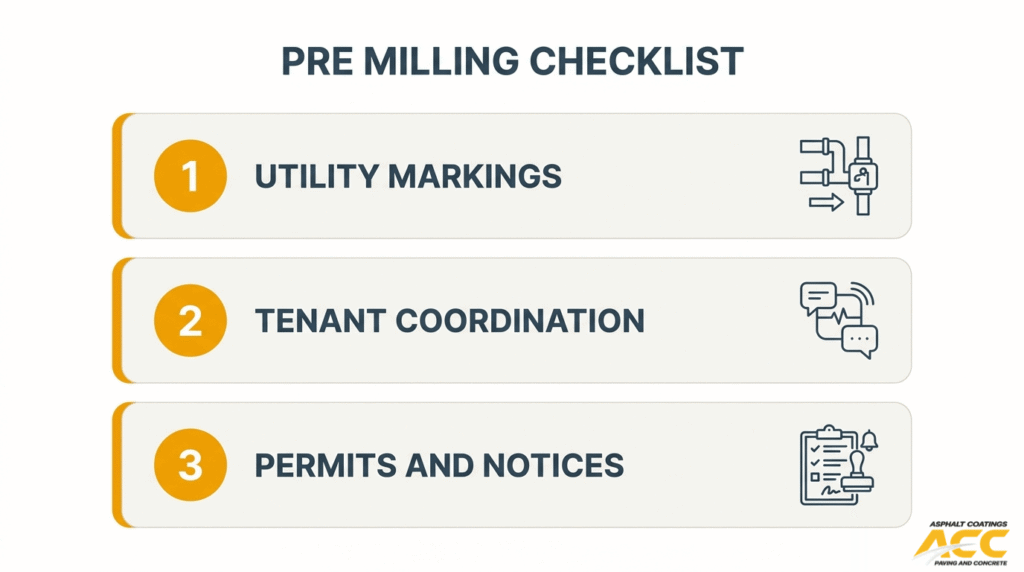
A commercial site should prepare for asphalt milling by completing utility markings, coordinating tenant and traffic management, and securing necessary permits. These three preparation steps prevent delays and protect underground infrastructure.
What Utility Markings and Clearances Are Required?
The utility markings and clearances required before asphalt milling include locating and marking all underground lines, such as gas, electric, water, sewer, and telecommunications. Property managers must contact 811 (the national call-before-you-dig line) to initiate utility locates, which are then marked with color-coded paint on the pavement surface.
According to the Federal Highway Administration, the Manual on Uniform Traffic Control Devices (MUTCD) defines the standards used nationwide to install and maintain traffic control devices on all streets, highways, and pedestrian facilities. Clearance zones around marked utilities must be established before milling equipment enters the site to prevent accidental strikes on shallow lines.
How Should Tenants and Traffic Be Managed During Work?
Tenants and traffic should be managed during milling work through advance communication, phased scheduling, and temporary traffic control plans. Notify all tenants at least two weeks before work begins, specifying affected parking areas, alternate routes, and expected timelines.
Key management steps include:
- Phasing the project so portions of the lot remain accessible to customers and employees at all times.
- Deploying signage, cones, and barricades that comply with FHWA temporary traffic control (TTC) standards outlined in Part 6 of the MUTCD.
- Assigning flaggers or traffic control personnel for high-volume commercial entrances.
- Coordinating delivery schedules with tenants to avoid conflicts with milling equipment and haul trucks.
For most commercial properties, splitting work into overnight or weekend phases minimizes business disruption while keeping production rates high.
What Permits or Notifications Are Typically Needed?
The permits or notifications typically needed for commercial asphalt milling include local municipality work permits, right-of-way encroachment permits (if milling extends to public roads), and ADA compliance documentation. Local codes or permits that might affect asphalt paving work include municipality-specific regulations and ADA compliance standards.
Common requirements are:
- A grading or construction permit from the local building department.
- Right-of-way or lane closure permits when work borders public streets.
- Stormwater management notifications if milled material could enter drainage systems.
- Written notice to adjacent property owners when required by local ordinance.
Submitting permit applications early prevents scheduling conflicts, since approval timelines vary by municipality from a few days to several weeks.
With preparation complete, the milling crew can begin work efficiently.
What Happens to Reclaimed Asphalt Pavement After Milling?
Reclaimed asphalt pavement (RAP) is transported to asphalt plants where it is processed and reused in new pavement mixtures or civil engineering applications. The recycling process involves crushing, screening, and blending RAP with virgin materials to produce cost-effective, high-performance asphalt.
According to a 2025 National Asphalt Pavement Association (NAPA) report, 96.1 million tons of RAP are used annually in new asphalt pavement construction in the United States. Approximately 89% of RAP is reused in new asphalt mixtures, while about 11% serves other civil engineering applications such as unbound aggregate bases. Nationally, RAP is utilized at an average rate of 21.9% in new asphalt mixtures.
The environmental and economic benefits are substantial. In 2023, more than 108 million tons of RAP were recycled into new pavements and civil engineering applications, saving 65.5 million cubic yards of landfill space. The use of RAP saves $4.3 billion every year, making it 50 to 75% cheaper than new hot mix asphalt. From 2009 to 2023, the net reduction of greenhouse gas emissions from RAP use was estimated at 31.7 million tonne CO2e, equivalent to the annual emissions from approximately 460,000 passenger vehicles.
For commercial property managers, RAP recycling means milling is not a wasteful process. Every ton of material removed from a parking lot or access road re-enters the supply chain, reducing both project costs and environmental impact. Understanding this closed-loop lifecycle helps property owners see milling as an investment rather than an expense, which becomes especially relevant when evaluating project timelines.
How Long Does Asphalt Milling Take on a Commercial Site?
Asphalt milling on a commercial site typically takes one to three days, depending on project size, milling depth, and site access conditions. The following subsections break down timelines for parking lots and commercial roadways.
How Long Does Milling a Parking Lot Take?
Milling a parking lot takes one to two days for most commercial properties. According to Wisconsin Department of Transportation production rate data, thin milling (0 to 2 inches) achieves typical rates of 17,000 square yards per day, while thick milling (2 inches or more) produces approximately 14,000 square yards per day. A standard 50,000-square-foot parking lot (roughly 5,556 square yards) can often be milled in a single shift under ideal conditions.
Factors that extend parking lot timelines include:
- Phased work to maintain tenant access
- Obstacles such as islands, curbs, and drainage structures
- Tight turning areas that require smaller equipment passes
For most commercial property managers, scheduling milling during off-peak hours or weekends minimizes business disruption while keeping production rates high.
How Long Does Milling a Commercial Roadway Take?
Milling a commercial roadway takes one to three days depending on lane-miles, depth, and traffic control requirements. According to Arizona Department of Transportation data, milling projects with unfettered access (no traffic control issues or roadway closures limiting movement) achieve production rates of 250 to 350 cubic yards per hour. When a roadway is fully closed to traffic, crews can complete longer stretches in a single mobilization.
Roadway projects often require more time than parking lots because of:
- Lane-by-lane phasing to maintain traffic flow
- Coordination with adjacent businesses and intersections
- Longer haul distances for milled material removal
Commercial roadway milling benefits significantly from early planning and clear communication with tenants, which is why experienced contractors build detailed phasing plans before mobilizing equipment. With cost and scheduling closely linked, understanding what drives milling expenses helps property managers budget accurately.
What Factors Affect the Cost of Commercial Asphalt Milling?
The cost of commercial asphalt milling depends on project square footage, milling depth, and site access conditions. Each factor shifts pricing in measurable ways.
How Does Project Square Footage Impact Milling Cost?
Project square footage impacts milling cost through economies of scale. Larger commercial sites reduce the per-unit cost because equipment mobilization, traffic control setup, and crew deployment are fixed expenses spread across more area. A small parking lot under 5,000 square yards absorbs these fixed costs at a higher rate per square yard than a 50,000-square-yard distribution center lot. According to the Arizona Department of Transportation, milling projects with unfettered access can achieve production rates of 250 to 350 cubic yards per hour, meaning larger sites allow crews to maintain peak efficiency longer without repositioning. For most commercial property managers, consolidating phased work into a single mobilization is the simplest way to lower per-square-yard costs.
How Does Milling Depth Affect Pricing?
Milling depth affects pricing because deeper cuts require more machine passes, increased fuel consumption, greater drum wear, and higher hauling volumes. According to Michigan Paving & Materials Co., medium-depth milling of 2 to 4 inches typically costs $5.00 to $8.00 per square yard, while deep milling of 4 or more inches costs $8.00 to $12.00 per square yard. This price increase reflects the additional material tonnage generated and slower production rates at greater depths. Thin surface mills under 2 inches cost less because they remove minimal material and allow faster machine speeds.
How Do Site Access and Obstacles Influence Cost?
Site access and obstacles influence cost by reducing production efficiency and requiring additional labor or equipment. Factors that increase milling costs include:
- Narrow entry points that limit the size of milling machines and haul trucks.
- Utility structures, manholes, and valve boxes requiring hand work around each obstacle.
- Active tenant traffic that forces phased operations and repeated setup of traffic control zones.
- Grade changes, curb islands, and irregular lot geometry that demand frequent repositioning.
When crews cannot maintain continuous forward movement, production rates drop significantly below the typical 14,000 square yards per day benchmark for thick milling. Each stop, repositioning, and hand-milling segment adds time and cost that straightforward open-lot projects avoid.
Understanding these cost variables helps property managers budget accurately before overlay work begins.
How Does Weather and Climate Affect the Milling Process?
Weather and climate affect the milling process by influencing pavement condition, equipment performance, and project scheduling. Freeze-thaw cycles and high-altitude UV exposure are two key factors that shape when milling should occur.
How Do Freeze-Thaw Cycles Influence Milling Timing?
Freeze-thaw cycles influence milling timing by dictating when pavement is stable enough for controlled removal. Water seeps into asphalt cracks, freezes, expands, then thaws, progressively widening damage with each cycle. According to Doctor Asphalt LLC, freeze-thaw cycles can take a serious toll on asphalt, leading to cracks, potholes, and costly repairs.
Milling during active freeze-thaw periods risks inconsistent cut depths because the pavement structure shifts between frozen and softened states. Scheduling milling after spring thaw stabilization, once ground temperatures remain consistently above freezing, produces cleaner cuts and more predictable surface grades. For commercial sites in climates with harsh winters, this narrow scheduling window makes early planning essential.
Why Does High-Altitude UV Exposure Matter for Scheduling?
High-altitude UV exposure matters for scheduling because intensified ultraviolet radiation accelerates asphalt binder oxidation, making pavement surfaces brittle faster than at lower elevations. This accelerated aging increases the likelihood of raveling and surface cracking, which can complicate milling depth consistency if left unaddressed too long.
Scheduling milling before severe oxidation penetrates deeper into the pavement allows contractors to remove only the degraded surface layer rather than requiring deeper, more costly cuts. Since hot mix asphalt needs to be laid at temperatures between 270°F and 325°F, according to Sunrise Asphalt AZ, coordinating milling with favorable overlay weather windows is equally important. Pairing milling timing with post-overlay conditions ensures the full project sequence stays on track.
What Comes After Milling on a Commercial Pavement Project?
What comes after milling depends on the condition of the base and the structural needs of the pavement. The two primary paths are an asphalt overlay or full reconstruction.
When Is an Overlay Placed After Milling?
An overlay is placed after milling when the existing base remains structurally sound and only the surface layers need replacement. Once the milled surface is cleaned, inspected, and confirmed to have proper grade and drainage, a tack coat is applied followed by hot mix asphalt. According to the Federal Highway Administration, the total cost of milling and overlay (including tack, overlay placement, and traffic control) for a 1.5-inch thick overlay is approximately $8.00 per square foot. For most commercial properties with surface-level deterioration such as rutting, raveling, or poor ride quality, an overlay after milling delivers a cost-effective solution without the expense of rebuilding the entire pavement structure.
When Is Full Reconstruction Needed Instead of an Overlay?
Full reconstruction is needed instead of an overlay when the pavement base has failed or subgrade instability makes resurfacing insufficient. Signs that indicate reconstruction include widespread alligator cracking, deep base failures, and standing water caused by compromised drainage layers. According to the FHWA, Full Depth Reclamation pulverizes the existing full pavement thickness and underlying material, then stabilizes it with cement, lime, or foamed asphalt to create a new high-quality base. Although reconstruction costs significantly more than milling and overlay, it remains the only viable option when structural deficiencies extend below the asphalt surface into the aggregate base or subgrade.
Choosing the right post-milling approach protects long-term pavement performance and budget.
How Should You Approach Asphalt Milling with a Commercial Paving Partner?
You should approach asphalt milling with a commercial paving partner by selecting a contractor that manages every phase, from site assessment and permitting through milling, hauling, and repaving.
Can Asphalt Coatings Company Handle Milling and Repaving for Commercial Properties?
Yes, Asphalt Coatings Company can handle milling and repaving for commercial properties. Asphalt Coatings Company provides mill and pave services using in-house crews across Colorado’s Front Range, including Denver and Colorado Springs. With 39 years of experience on commercial sites, Asphalt Coatings Company manages subgrade preparation, ADA-compliant concrete work, parking lot construction, sealcoating, and crack sealing as part of a single-source solution. This eliminates coordination between multiple subcontractors and keeps projects on schedule. Property managers, industrial complex owners, and shopping center managers benefit from a partnership approach that addresses Colorado-specific challenges, such as freeze-thaw damage and high-altitude UV exposure, within a unified project scope.
What Are the Key Takeaways About Asphalt Milling Process Steps for Commercial Sites?
The key takeaways about asphalt milling process steps for commercial sites are that success depends on proper sequencing, depth selection, and coordination with a qualified contractor. Cold planing removes deteriorated pavement to a specified grade using specialized equipment, and the milled material becomes reclaimed asphalt pavement that re-enters new mixes. According to the National Asphalt Pavement Association, 96.1 million tons of RAP are used annually in new U.S. asphalt pavement construction, saving $4.3 billion per year.
Commercial property owners should prioritize these actions:
- Confirm milling depth matches the pavement condition, whether micro milling under two inches or full-depth removal of three to five inches.
- Verify ADA compliance for ramp slopes and parking surface grades before overlay placement.
- Schedule milling when pavement temperatures support proper overlay bonding.
- Secure required local permits and coordinate tenant traffic management in advance.
- Partner with a contractor that handles site assessment, traffic control, milling, hauling, and paving under one scope.
Choosing a single experienced paving partner simplifies every step and protects your pavement investment long term.