Choosing a commercial asphalt contractor in Colorado Springs is the process of verifying credentials, local experience, climate expertise, and project accountability before signing a paving contract.
This guide covers licensing and insurance requirements, local experience verification, climate-driven material considerations, the estimate and bid comparison process, and red flags that should eliminate a contractor from consideration.
Colorado law requires workers’ compensation coverage for all employers, and standard commercial general liability policies in urban areas carry minimum limits of $1,000,000. We break down exactly which documents to request and how to confirm they are current before any work begins.
Verifying local experience means confirming a contractor’s Front Range tenure, reviewing completed projects that match your specific property type, and contacting references you can cross-check against the Pikes Peak Regional Building Department’s permit database.
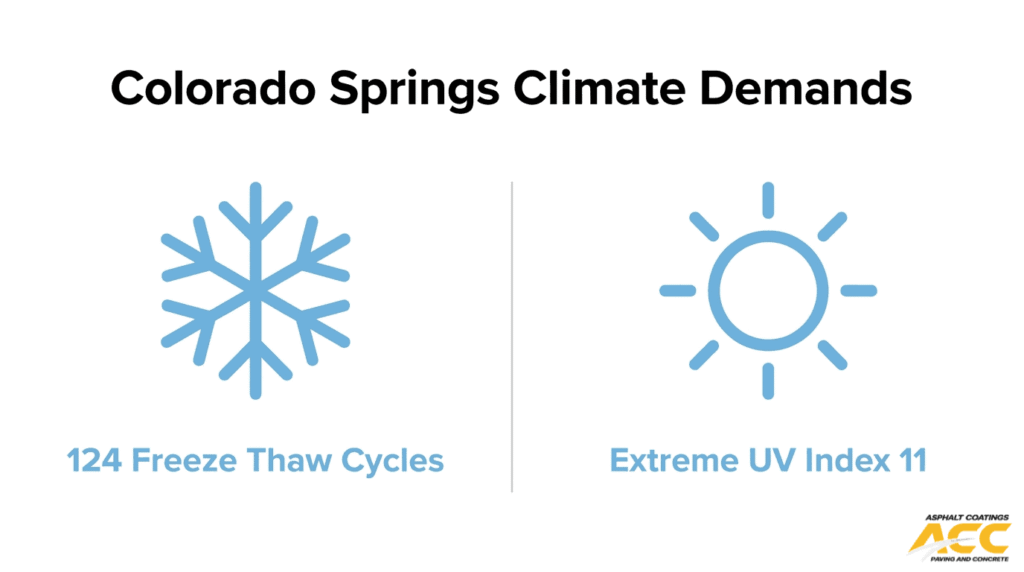
Colorado Springs averages 124 freeze-thaw cycles annually, and peak summer UV levels reach an extreme index of 11. These conditions demand altitude-specific binder grades like PG 58-28 or PG 58-34 and proactive sealcoating schedules. We explain what separates a contractor who understands these factors from one who does not.
The estimate evaluation sections cover on-site assessments, itemized cost breakdowns, written warranty terms, crew structure, and equipment ownership. We also detail how to standardize scope across multiple bids so pricing differences reflect actual value rather than hidden omissions.
Finally, we identify disqualifying red flags, explain how to spot fake reviews across platforms like Google Business and BBB, and outline why a full-service paving partner simplifies long-term maintenance across your property’s entire lifecycle.
Why Does Choosing the Right Commercial Asphalt Contractor Matter?
Choosing the right commercial asphalt contractor matters because the decision directly affects pavement lifespan, property value, legal liability, and long-term maintenance costs. A poorly chosen contractor can lead to premature pavement failure, safety hazards, and expensive repairs that far exceed the original project budget.
Commercial asphalt paving costs typically range between $4 and $10 per square foot for large-scale projects like parking lots or access roads, according to Asphalt Repair Solutions. At that investment level, the gap between a qualified contractor and an unqualified one translates into thousands of dollars in potential rework or early deterioration. A well-constructed commercial parking lot can last 15 to 20 years with proper maintenance, but inferior installation cuts that lifespan dramatically.
Beyond cost, poorly maintained or improperly installed pavement creates serious liability exposure. Slip-and-fall accidents on damaged surfaces represent one of the most significant legal threats to commercial property owners. Cracked, uneven, or deteriorating lots also undermine curb appeal, which can derail lease negotiations and reduce property values for retail, office, and industrial spaces.
Colorado Springs adds another layer of complexity. With 124 freeze-thaw cycles annually, extreme UV exposure, and altitude-specific material requirements, commercial paving here demands contractors who understand local conditions. The wrong mix design or improper compaction equipment will fail faster in this environment than in lower-altitude, milder climates. For most property managers, the contractor’s regional knowledge is just as important as their technical capability.
Vetting a contractor thoroughly before signing a contract is the single most effective way to protect your investment. The sections that follow provide a structured checklist covering credentials, local experience verification, climate expertise, estimate evaluation, and red flag identification.
What Credentials Should a Colorado Springs Asphalt Contractor Have?
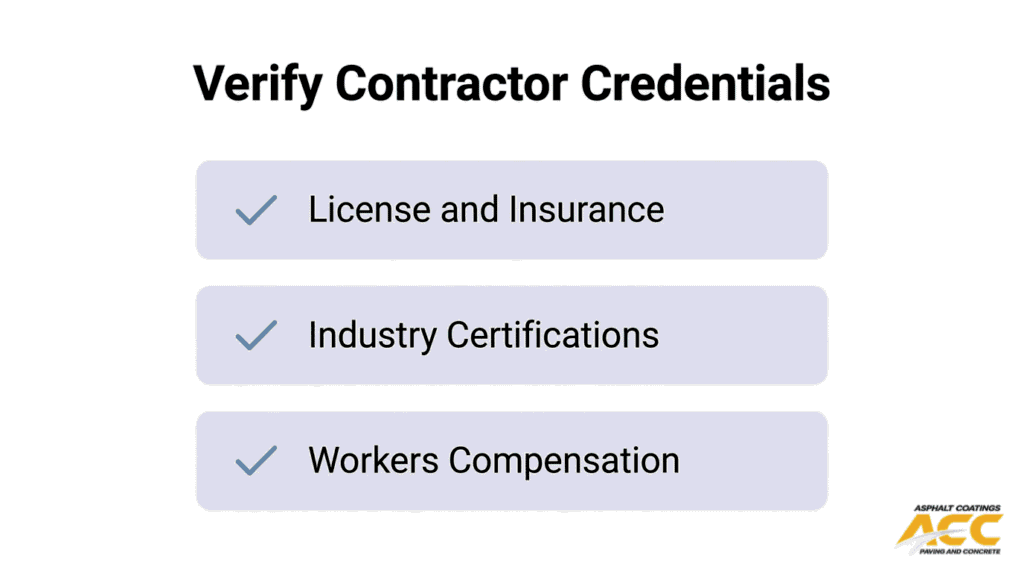
A Colorado Springs asphalt contractor should have a valid state license, commercial general liability insurance, relevant industry certifications, and proof of workers’ compensation coverage. The following subsections break down each credential to verify before signing a contract.
Is the Contractor Licensed and Insured in Colorado?
The contractor should be both licensed and insured in Colorado before starting any commercial paving work. Colorado does not issue a single statewide contractor license; instead, licensing requirements vary by municipality and project type. In Colorado Springs, contractors performing commercial work must comply with local permitting through the Pikes Peak Regional Building Department.
Insurance is equally critical. According to Next Insurance, standard commercial general liability insurance for contractors in urban Colorado areas typically requires a minimum policy limit of $1,000,000. Ask for a current certificate of insurance naming your property as an additional insured. Any contractor who hesitates to provide this documentation should be removed from consideration immediately.
Does the Contractor Hold Any Industry Certifications?
The contractor should hold industry certifications that demonstrate adherence to quality standards beyond basic licensing. The NAPA Diamond Quality Commendation, awarded by the National Asphalt Pavement Association, recognizes best practices in asphalt production and paving with a focus on quality management and material standards.
Other relevant credentials include:
- APWA Certified Public Works Professional designations for public infrastructure experience.
- OSHA safety training certifications for commercial job site compliance.
- CDOT-approved material and mix design qualifications for state-specification work.
Certifications alone do not guarantee quality, but they signal a contractor who invests in professional development. For commercial projects in Colorado Springs, prioritizing certified contractors significantly reduces the risk of substandard materials or improper installation techniques.
Can the Contractor Provide Proof of Workers’ Compensation Coverage?
Yes, the contractor can and must provide proof of workers’ compensation coverage for any commercial project. Colorado law requires all employers to carry workers’ compensation insurance covering employees injured during work-related activities, according to Berg Hill Greenleaf Ruscitti LLP.
Request a current workers’ compensation certificate before work begins. Without this coverage, property owners face direct liability for on-site injuries. Verify the policy is active, not expired, by contacting the insurer listed on the certificate.
Verifying these core credentials sets a solid foundation for evaluating a contractor’s hands-on experience in your local market.
How Do You Verify a Contractor’s Local Experience in Colorado Springs?
You verify a contractor’s local experience in Colorado Springs by confirming their Front Range tenure, reviewing completed projects matching your property type, and contacting local references.
How Many Years Has the Contractor Worked on the Front Range?
The contractor has worked on the Front Range for a duration you can confirm by requesting a company history, checking business registration dates, and reviewing past project timelines. Years of regional experience matter because Colorado Springs averages 124 freeze-thaw cycles annually, according to the National Centers for Environmental Information (NOAA). A contractor without sustained exposure to these conditions is unlikely to understand the subgrade failures, frost heave patterns, and seasonal paving windows that define Front Range work. Ask specifically how many Colorado Springs winters the crew has paved through; anything under five years should prompt closer scrutiny. Longevity in this market signals familiarity with local soils, drainage challenges, and municipal permitting requirements that newer firms simply have not encountered.
Has the Contractor Completed Projects in Your Specific Property Type?
The contractor has completed projects in your specific property type if they can show a portfolio with work matching your commercial category. Parking lots for shopping centers, apartment complexes, office parks, and industrial facilities each present distinct challenges in traffic load, drainage design, and ADA compliance. A contractor experienced in retail parking lots may not understand the heavy-vehicle turning radii required for distribution warehouses. Ask for project examples that mirror your property’s size, use case, and layout complexity. Asphalt Coatings Company has delivered specialized paving solutions for diverse commercial property types across Colorado’s Front Range since 1986, from shopping centers and office parks to industrial distribution warehouses and healthcare facilities, ensuring each project meets the unique demands of its use case. According to Rose Paving, full-service paving partners offer a single point of contact across the entire pavement lifecycle, which only works when the contractor has handled your property type before.
Can the Contractor Provide Local References You Can Contact?
Yes, the contractor can provide local references you can contact, and any reputable firm will do so willingly. Request at least three references from commercial property managers in Colorado Springs who can speak to workmanship quality, schedule adherence, and post-project responsiveness. The Pikes Peak Regional Building Department provides a searchable permit database where you can independently verify a contractor’s local project history. Cross-referencing permit records with the references a contractor supplies reveals whether their claimed experience is accurate. If a contractor hesitates to share references or cannot point to verifiable local work, that reluctance should weigh heavily against them.
With local experience confirmed, the next step is evaluating how well a contractor understands Colorado Springs climate demands.
Why Does Colorado Springs Climate Expertise Matter for Asphalt Work?
Colorado Springs climate expertise matters for asphalt work because the city’s extreme freeze-thaw cycles, intense UV radiation, and rapid temperature swings demand region-specific paving strategies. These unique environmental demands often inform the detailed requirements and federally funded paving specifications property managers must navigate. The following sections cover freeze-thaw damage, high-altitude UV exposure, and temperature-driven mix design requirements.
How Should a Contractor Address Freeze-Thaw Cycle Damage?
A contractor should address freeze-thaw cycle damage by selecting crack-resistant mix designs, ensuring proper drainage, and scheduling timely sealcoating. According to the National Centers for Environmental Information (NOAA), Colorado Springs experiences an average of 124 freeze-thaw cycles annually, which significantly impacts pavement durability.
Each cycle forces water into pavement cracks, where it expands upon freezing and widens the damage. Over a single winter, this repetitive stress can turn hairline cracks into potholes. For localized issues like these, infrared asphalt repair offers an efficient, seamless solution, particularly for low spots and ponding. A qualified contractor will specify adequate base depth for drainage, use flexible binder grades that resist thermal cracking, and recommend preventive crack sealing before fall. For commercial properties in Colorado Springs, overlooking freeze-thaw planning is one of the costliest mistakes a property manager can make.
What Should a Contractor Know About High-Altitude UV Exposure?
A contractor should know that high-altitude UV exposure in Colorado Springs accelerates asphalt oxidation and binder degradation far faster than at lower elevations. According to Weather2Travel, the maximum UV index in Colorado Springs reaches 11, classified as “Extreme,” during peak summer months like June and July.
At 6,035 feet of elevation, pavement absorbs significantly more ultraviolet radiation than in cities closer to sea level. This intense exposure causes the asphalt binder to dry out, become brittle, and lose its flexibility, often within just a few years if unprotected. Knowledgeable contractors recommend proactive sealcoating schedules and UV-resistant surface treatments calibrated to local conditions. Without this altitude awareness, even a well-installed parking lot will show premature raveling and surface erosion.
How Do Rapid Temperature Swings Affect Asphalt Mix Design?
Rapid temperature swings affect asphalt mix design by demanding binder grades and gradations that perform across a wide thermal range. Colorado Springs can experience temperature shifts of 40°F or more within a single day, placing extraordinary stress on pavement that must expand and contract without cracking.
High-altitude areas in Colorado require softer Performance Grade binders, such as PG 58-28 or PG 58-34, to prevent low-temperature cracking while still resisting summer heat. According to 2023 CDOT Standard Specifications, hot mix asphalt designs must be prepared per Colorado Procedure 52, including specific job-mix gradations tailored to each project. A contractor unfamiliar with these regional specifications risks installing pavement that cracks in winter or ruts during summer paving. This is precisely where local mix design knowledge separates experienced Colorado Springs contractors from out-of-state crews.
Understanding these climate factors sets the foundation for asking the right technical questions during the estimate process.
What Questions Should You Ask During the Estimate Process?
The questions you should ask during the estimate process cover on-site assessments, itemized cost breakdowns, and written warranty terms. These three areas reveal how thorough and transparent a contractor truly is.
Does the Contractor Perform an On-Site Assessment Before Quoting?
Yes, the contractor should perform an on-site assessment before quoting. A reliable commercial asphalt contractor will never provide an accurate estimate from photos or phone descriptions alone. According to Central Asphalt, on-site inspections are critical for accurate paving quotes because they allow contractors to identify potential drainage issues, layout constraints, and existing pavement conditions.
For Colorado Springs properties specifically, an in-person visit lets the contractor evaluate:
- Subgrade soil composition and stability
- Existing pavement deterioration patterns
- Drainage grading and water flow paths
- Access constraints for commercial equipment
Any contractor willing to quote a commercial project sight unseen is cutting corners before the work even begins.
Does the Estimate Itemize Materials, Labor, and Timelines?
Yes, the estimate should itemize materials, labor, and timelines as separate line items. A transparent commercial paving estimate breaks costs into distinct categories so you can compare bids accurately and understand exactly what you are paying for.
A properly itemized estimate includes:
- Material specifications, including asphalt mix type, tonnage, and thickness
- Labor costs separated from material costs
- Site preparation work such as grading, milling, or subgrade repair
- Project start date and estimated completion timeline
- Mobilization and equipment fees
Vague lump-sum estimates make it impossible to identify where a contractor may be cutting material quality or skipping preparation steps. Insisting on itemization protects your investment and simplifies any future dispute resolution.
What Warranty Terms Does the Contractor Include in Writing?
The warranty terms a contractor includes in writing should cover both materials and workmanship with clearly defined durations and conditions. Verbal guarantees hold no enforceable value; only written warranties protect commercial property owners.
Key warranty details to confirm in writing include:
- Coverage duration for materials and workmanship
- Specific defects or failures the warranty addresses
- Exclusions, such as damage from third-party utility cuts or acts of nature
- The process for filing a warranty claim
Standard limited guarantees for commercial asphalt paving often cover both materials and workmanship for up to five years, according to Beckage Sealcoating. For Colorado Springs properties facing harsh freeze-thaw conditions, written warranty terms become especially critical because premature failures are more likely without proper mix design and installation practices.
With estimate details clarified, evaluating the contractor’s crew and equipment reveals whether they can deliver on those promises.
How Do You Evaluate a Contractor’s Crew and Equipment?
You evaluate a contractor’s crew and equipment by confirming whether they use in-house labor and own the machinery required for commercial-scale paving. The sections below cover workforce structure and equipment ownership.
Does the Contractor Use In-House Crews or Subcontractors?
The contractor uses either in-house crews, subcontractors, or a combination of both. In-house crews give the contractor direct control over training, quality standards, and daily scheduling. Subcontracted labor, while common in the industry, introduces additional liability exposure. According to industry discussions on contractor risk, some firms require subcontractors to carry their own insurance policies totaling $5M to $7M in coverage to offset that exposure.
When a paving company employs its own workers, accountability stays centralized. Communication is simpler, and the crew’s familiarity with the company’s processes tends to produce more consistent results across commercial projects. For Colorado Springs property managers vetting contractors, asking this single question reveals a great deal about how a company manages risk and quality on the jobsite.
Does the Contractor Own Commercial-Grade Paving Equipment?
The contractor should own commercial-grade paving equipment rather than relying entirely on rentals or third-party operators. Ownership of pavers, rollers, and milling machines signals a company’s investment in its commercial capabilities. Equipment that is properly sized for the project also affects finished quality; rollers weighing between 1.5 and 4 tons are considered ideal for commercial applications such as parking lots, sidewalks, and walking paths.
A contractor who owns and maintains its own fleet can mobilize faster and avoid rental availability delays that push projects off schedule. Ask to see the equipment list during the estimate process. If a contractor cannot specify the machines designated for your project, that gap should factor into your evaluation.
With crew structure and equipment confirmed, the next step is identifying red flags that should disqualify a contractor entirely.
What Red Flags Should Disqualify a Commercial Asphalt Contractor?
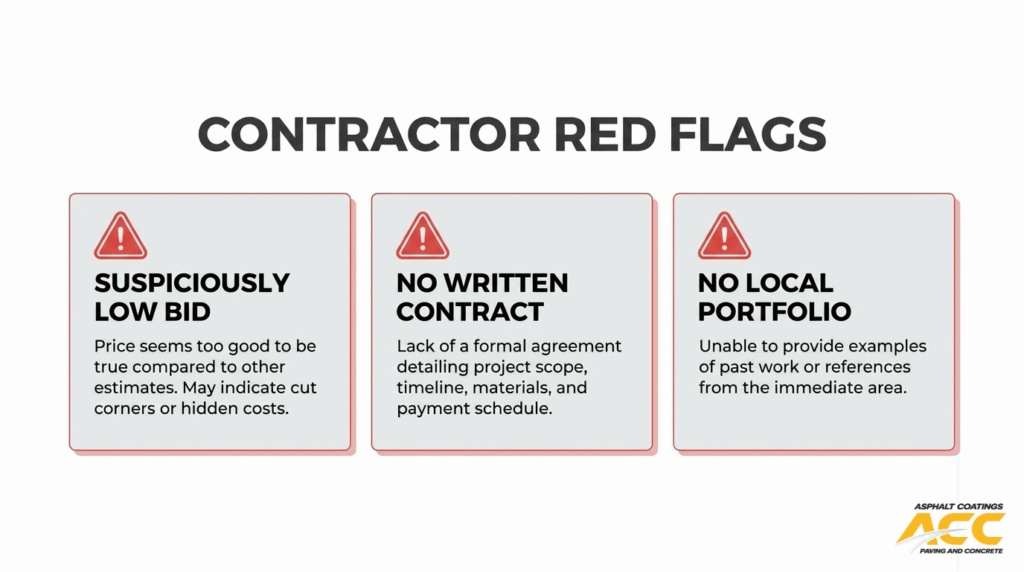
Red flags that should disqualify a commercial asphalt contractor include suspiciously low bids, refusal to provide a written contract, and an absence of verifiable local work. Each warning sign points to deeper problems with quality, accountability, or experience.
Why Is an Unusually Low Bid a Warning Sign?
An unusually low bid is a warning sign because it typically means the contractor has excluded critical work or plans to use substandard materials. According to Alpha Paving, asphalt industry experts emphasize that the lowest bid often excludes essential base preparation or uses inferior material thickness, leading to premature pavement failure. A bid that undercuts competitors by a wide margin rarely accounts for proper subgrade work, adequate asphalt thickness, or compliant drainage. Contractors offering “leftover asphalt” from a nearby job at a steep discount are another common scam tactic. For Colorado Springs properties, where freeze-thaw cycling punishes thin or poorly compacted surfaces, cutting corners on installation virtually guarantees expensive repairs within just a few years.
What Does a Missing Written Contract Tell You?
A missing written contract tells you the contractor is unwilling to commit to a defined scope, price, timeline, or warranty in a legally enforceable way. Without a signed agreement, property managers have no recourse if work is incomplete, materials are substituted, or the project timeline is ignored. A legitimate commercial asphalt contract should itemize materials, labor, site preparation, drainage provisions, and warranty terms. It should also specify insurance coverage, change-order procedures, and a clear payment schedule tied to milestones. Any contractor who resists putting these details in writing is either disorganized or deliberately avoiding accountability. In either case, the risk to your investment is too high to proceed.
Should You Worry About a Contractor With No Local Portfolio?
Yes, you should worry about a contractor with no local portfolio. Colorado Springs presents specific challenges, including extreme freeze-thaw cycling, high-altitude UV exposure, and municipal permitting through the Pikes Peak Regional Building Department. A contractor without verifiable projects in the area likely lacks familiarity with these conditions and local compliance requirements. According to a CDOT report, short-term materials and workmanship warranties for hot mix asphalt pavements typically make the contractor responsible for correcting defects caused by elements within their control. A contractor unwilling or unable to back local work with such a warranty raises serious concerns about long-term reliability.
Recognizing these red flags early protects your budget when comparing bids from multiple contractors.
How Do You Compare Multiple Asphalt Contractor Bids Fairly?
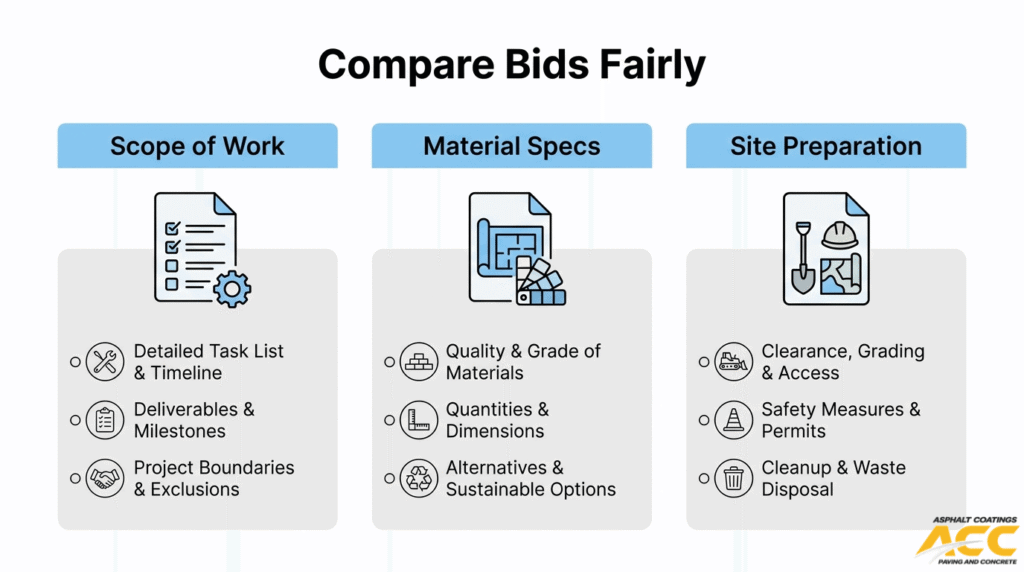
You compare multiple asphalt contractor bids fairly by standardizing what each bid covers before comparing price. The key areas to align are scope of work, material specifications, and site preparation standards.
Are You Comparing the Same Scope of Work Across Bids?
You are comparing the same scope of work across bids only when every proposal covers identical project elements. Bids that appear cheaper often exclude line items that others include, making a direct price comparison misleading. To ensure a fair evaluation, verify that each bid addresses:
- Total square footage of paving or resurfacing
- Number of asphalt lifts and compacted thickness per lift
- Striping, marking, and ADA-compliant features
- Drainage grading and stormwater management
- Project timeline with start and completion dates
- Cleanup, mobilization, and traffic control provisions
Any missing line item inflates the apparent cost gap between contractors. According to Alpha Paving, asphalt industry experts emphasize that the lowest bid often excludes critical base preparation or uses inferior material thickness, leading to premature failure. Requesting a standardized scope template from each bidder eliminates this problem before you ever compare dollar amounts.
How Do Material Specifications Differ Between Bids?
Material specifications differ between bids in asphalt grade, binder type, aggregate source, and mix design compliance. These differences directly affect pavement longevity, especially in Colorado Springs where freeze-thaw cycling and UV exposure accelerate deterioration. When reviewing bids, confirm that each specifies:
- Performance Grade (PG) binder suited to local climate
- Hot mix asphalt (HMA) mix design reference, such as CDOT Colorado Procedure 52
- Aggregate type and source quarry
- Compacted lift thickness in inches
- Sealcoat product type and application rate
A bid listing only “asphalt paving” without these details leaves too much room for substitution. In my experience, contractors who specify materials upfront are far more likely to stand behind their warranty, because they have already committed to a measurable standard.
Does Each Bid Include the Same Site Preparation Standards?
Each bid includes the same site preparation standards only when every contractor specifies identical subgrade and drainage work. Site prep is the most commonly omitted or underspecified section in commercial bids, yet it determines whether the finished pavement lasts 5 years or 20. Verify each proposal includes:
- Subgrade compaction method and density requirement
- Removal and disposal of existing pavement or debris
- Base course material type and minimum thickness
- Grading plan for proper water runoff
- Soil stabilization measures if subgrade conditions require it
On-site inspections are critical for accurate paving quotes, as they allow contractors to identify potential drainage issues, layout constraints, and existing pavement conditions, according to Central Asphalt. A contractor who quotes without visiting the site cannot accurately scope preparation work. Once site prep standards are aligned across all bids, pricing differences reflect true value rather than hidden shortcuts.
Understanding how to compare bids sets the stage for evaluating what past clients say about each contractor online.
What Role Do Online Reviews and Reputation Play in Your Decision?
Online reviews and reputation serve as peer-based verification that supplements license checks, reference calls, and bid comparisons. The subsections below cover where to check reviews for Colorado Springs contractors and how to identify fake or incentivized feedback.
Where Should You Check Reviews for Colorado Springs Contractors?
You should check reviews for Colorado Springs contractors across multiple platforms that provide peer-based reputation data. The most relevant platforms include:
- Google Business Profile for overall star ratings and project-specific feedback.
- Better Business Bureau (BBB) for complaint history and resolution records.
- Yelp for detailed customer narratives about commercial paving experiences.
- Houzz for project photos paired with client testimonials.
- Angi for verified hiring data and service ratings.
Beyond review platforms, the Pikes Peak Regional Building Department maintains a searchable permit database that verifies a contractor’s local project history. Cross-referencing permit records with online reviews reveals whether a company’s claimed experience aligns with documented work in Colorado Springs. A contractor with strong reviews but no verifiable permits deserves closer scrutiny.
How Do You Spot Fake or Incentivized Reviews?
You spot fake or incentivized reviews by examining specific patterns that distinguish genuine feedback from manufactured ratings. According to a TDCAA consumer protection report, identifying fake reviews often involves checking for repetitive phrasing, accounts with only one review, or a sudden surge of positive ratings in a short period.
Key warning signs to watch for include:
- Multiple reviews using nearly identical language or sentence structure.
- Reviewer accounts created recently with no other review history.
- A cluster of five-star ratings posted within days of each other.
- Vague praise without specific project details, timelines, or locations.
- Reviews that never mention commercial-scale work like parking lots or access roads.
Genuine commercial asphalt reviews typically reference measurable outcomes: square footage completed, project duration, crew professionalism, or how the contractor handled drainage challenges. For Colorado Springs property managers evaluating contractors, prioritizing reviews that describe specific local conditions provides far more decision-making value than generic star counts alone.
With reputation verified, partnering with a full-service paving contractor streamlines long-term maintenance.
How Should You Approach Commercial Asphalt Vetting With a Full-Service Paving Partner?
You should approach commercial asphalt vetting with a full-service paving partner by prioritizing contractors who handle paving, repair, and sealcoating under one roof. The sections below cover how consolidated services simplify maintenance and summarize the key takeaways for choosing a contractor in Colorado Springs.
Can a Contractor Offering Paving, Repair, and Sealcoating Simplify Long-Term Maintenance?
Yes, a contractor offering paving, repair, and sealcoating can simplify long-term maintenance significantly. Full-service paving partners provide a single point of contact for the entire pavement lifecycle, from design and installation to maintenance and repair. This consolidated approach eliminates the coordination headaches that arise when separate vendors handle each phase.
A well-constructed commercial asphalt parking lot typically lasts 15 to 20 years with proper maintenance and regular sealcoating. When one contractor manages the full scope, they understand the original materials and methods used, which leads to more effective commercial asphalt repair over time. Be cautious of crews that go door-to-door offering “leftover asphalt” from a nearby job at a discount; according to Purpose Contracting Asphalt, this is a major red flag signaling an unreliable operator.
For property managers overseeing multiple facilities, having a single trusted partner reduces administrative burden and ensures consistent quality across every surface.
What Are the Key Takeaways for Choosing a Commercial Asphalt Contractor in Colorado Springs?
The key takeaways for choosing a commercial asphalt contractor in Colorado Springs center on credentials, local expertise, and accountability. Commercial asphalt contractors are distinguished from residential ones by their ability to handle large-scale logistics, specialized equipment, and safety protocols. This includes expertise in various asphalt rehabilitation methods for industrial lots, such as mill and overlay versus full-depth reconstruction, which demand different approaches.
Prioritize contractors who meet these criteria:
- They carry commercial general liability insurance with minimum limits of $1,000,000 per occurrence, as required by the Colorado Department of Transportation.
- They use in-house crews rather than subcontractors, reducing liability exposure.
- They offer written warranties covering materials and workmanship for up to 5 years.
- They own commercial-grade equipment, including rollers weighing between 1.5 and 4 tons for parking lot applications.
- They demonstrate verified Colorado Springs project history and climate-specific knowledge.
Asphalt Coatings Company has served Colorado’s Front Range since 1986, offering full-service commercial paving, repair, and sealcoating with in-house crews across the Front Range, including offices in Aurora and Colorado Springs.