Summer sealcoating is the application of a protective asphalt sealer during warm, dry months when temperature, humidity, and daylight conditions allow the material to cure fully and bond tightly to the pavement surface.
This guide covers Fort Collins’ summer climate advantages for sealcoating, how a summer-applied sealcoat extends pavement life, operational benefits for property managers, winter threat preparation, optimal scheduling windows, lot preparation steps, common application mistakes, maintenance service sequencing, and working with a commercial asphalt contractor.
Fort Collins’ summer temperatures consistently hold within the 55–90°F range that sealant manufacturers require, while July humidity averages 49% and roughly 300 days of annual sunshine provide reliable curing windows. Predictable afternoon thunderstorms after 2:00 PM make morning application straightforward rather than limiting.
Sealcoating applied in summer blocks UV radiation that is 20–30% more intense at Fort Collins’ 5,000-foot elevation, seals hairline cracks before winter moisture infiltration begins, and achieves stronger mechanical and chemical adhesion through warm-weather evaporation.
Property managers gain scheduling flexibility by aligning projects with slower summer traffic periods, phasing lot closures across sections, and using early morning or evening hours to keep businesses accessible during curing.
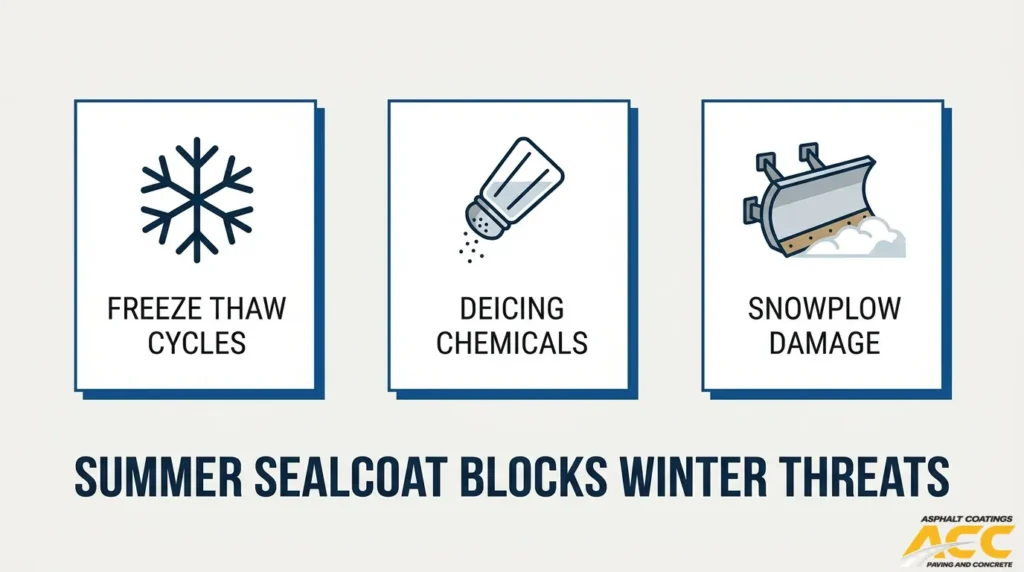
Northern Colorado’s freeze-thaw cycles, deicing salt exposure, and snowplow operations compound pavement damage from November through March. A fully cured summer sealcoat creates the moisture barrier that prevents this seasonal deterioration.
Proper sequencing of crack sealing before sealcoating, followed by ADA-compliant line striping 48–72 hours after cure, ensures each maintenance service reinforces the next within a structured long-term pavement management plan.
How Does Fort Collins’ Summer Climate Make Sealcoating More Effective?
Fort Collins’ summer climate makes sealcoating more effective by delivering consistent warmth, low humidity, and extended daylight within the exact range sealant manufacturers require. The sections below cover temperature, humidity, daylight, and thunderstorm timing.
How Do Warm Temperatures in Fort Collins Help Sealcoat Cure Properly?
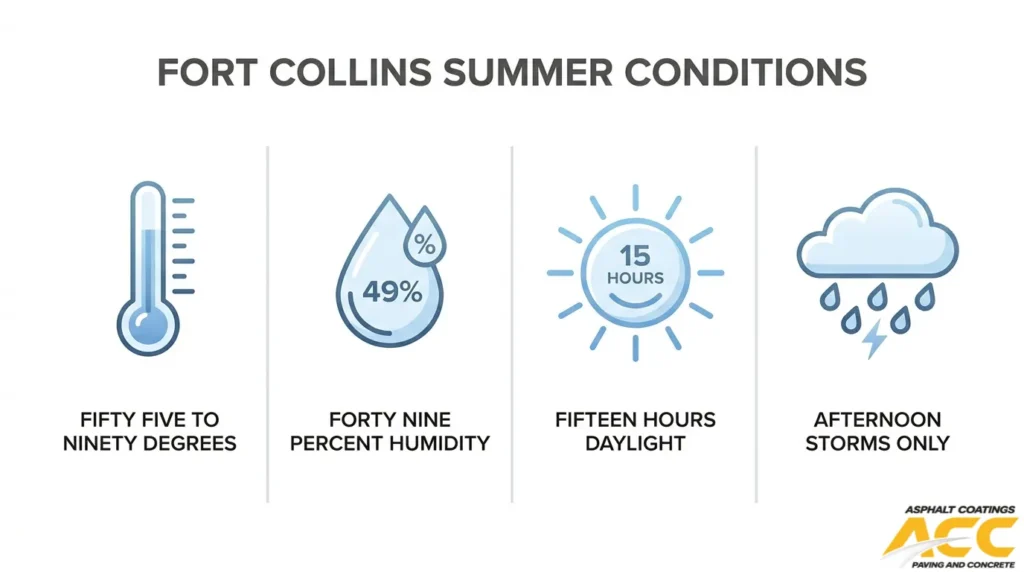
Warm temperatures in Fort Collins help sealcoat cure properly by keeping ambient conditions within the optimal 55–90°F application range throughout June, July, and August. July averages a high of 89°F and a low of 58°F, while June and August hold similar patterns well within manufacturer specifications.
Sealcoating requires temperatures at or above 50°F with no drop below that threshold for 24–48 hours after application. Fort Collins’ summer nights rarely dip below the mid-50s, so the curing window remains uninterrupted. According to Seal-Rite, temperatures above 95°F can bake the sealcoat before it properly adheres to the pavement, but Fort Collins’ averages stay safely below that ceiling.
Ideal conditions between 70–85°F accelerate evaporation without premature drying, which is why this region’s summer temperatures represent a near-perfect balance for commercial sealcoating projects.
Why Does Low Summer Humidity in Fort Collins Improve Sealcoat Performance?
Low summer humidity in Fort Collins improves sealcoat performance by promoting faster water evaporation from the sealant emulsion, which strengthens the bond between sealer and asphalt. According to Time and Date climate data, July humidity in Fort Collins averages 49%, falling just below the 50% threshold that sealant manufacturers identify as ideal for application.
When humidity climbs above 50%, evaporation slows and the sealant remains tacky longer, increasing the risk of adhesion problems and dust contamination. Fort Collins’ semi-arid climate naturally eliminates this concern during peak summer months. Combined with approximately 300 days of sunshine per year, the dry air and consistent solar exposure create reliable drying windows from June through August.
For commercial property managers, this climate advantage translates directly into shorter project timelines and more predictable curing outcomes.
How Do Longer Daylight Hours in Summer Benefit Commercial Sealcoating Schedules?
Longer daylight hours in summer benefit commercial sealcoating schedules by extending the available window for both application and curing within a single day. Fort Collins receives roughly 15 hours of daylight near the summer solstice, giving contractors a wide morning-to-evening timeframe.
Sealcoat material requires direct sunlight for the majority of its drying time. Extended daylight allows crews to begin early, complete application by midday, and still leave several hours of sun-driven curing before evening. This makes it feasible to sealcoat larger commercial lots in fewer sessions, reducing overall project duration and business disruption.
How Do Afternoon Thunderstorms in Fort Collins Impact Summer Sealcoating Plans?
Afternoon thunderstorms in Fort Collins impact summer sealcoating plans by introducing a predictable but manageable moisture risk during June through August. According to the Colorado Climate Center, thunderstorms typically develop after 2:00 PM, with late July and August being particularly prone to these events.
Morning and midday hours before 2:00 PM typically remain clear and dry, providing reliable application windows. Experienced contractors schedule sealcoating during these early hours so the material achieves initial cure before any afternoon moisture arrives. This predictable storm pattern, rather than being a limitation, actually makes planning straightforward compared to regions with all-day rain events.
Understanding this local weather rhythm is essential when coordinating the other maintenance tasks that follow a fresh sealcoat application.
Why Does Sealcoating a Commercial Parking Lot in Summer Extend Pavement Life?
Sealcoating a commercial parking lot in summer extends pavement life by blocking UV degradation, sealing out moisture before winter, and allowing optimal bond strength during warm, dry conditions. The subsections below cover UV protection, bonding chemistry, and crack prevention.
How Does Summer Sealcoating Protect Asphalt From UV Damage at High Altitude?
Summer sealcoating protects asphalt from UV damage at high altitude by creating a barrier that blocks ultraviolet radiation from reaching the binder. According to Boulder Community Health, Colorado residents at 5,000 feet or higher experience 20–30% more UV exposure than those at lower elevations. This intensified radiation accelerates photo-oxidative degradation, causing asphalt molecules to undergo isomerization, condensation, and polymerization that makes the binder brittle. Once brittleness sets in, the rigid surface layer transfers greater stress into joints and weak seams during load cycles. Sealcoating applied in summer, when the optimal temperature range of 55–90°F supports proper adhesion, slows oxidation on the exposed face and keeps the binder network flexible for longer service windows.
How Does Warm Weather Help Sealcoat Penetrate and Bond to Existing Asphalt?
Warm weather helps sealcoat penetrate and bond to existing asphalt by accelerating evaporation of water or solvent carriers within the emulsion. Sealcoating achieves adhesion through two mechanisms: mechanical interlocking with surface irregularities and chemical bonding with the asphalt binder. Both processes depend on a clean, dry surface and sustained warmth. Direct sunlight during extended summer daylight hours promotes faster evaporation, which drives the sealant deeper into the pavement texture before it sets. In cooler or humid conditions, slow evaporation traps moisture beneath the coating, weakening adhesion. For commercial parking lots with heavy traffic loads, this strong summer bond is what separates a coating that lasts three to five years from one that peels within months.
How Does Timely Summer Sealcoating Prevent Small Cracks From Worsening Over Winter?
Timely summer sealcoating prevents small cracks from worsening over winter by sealing surface pores and hairline fissures before moisture infiltration begins. Unprotected cracks allow water to penetrate the pavement structure; when temperatures drop, that water expands as ice and generates internal pressure that widens cracks with each freeze-thaw cycle. Deicing salts compound this damage by increasing osmotic pressure and creating more aggressive refreeze cycles. The Federal Highway Administration estimates that every $1 spent on pavement preservation saves up to $6 in future repair costs. Addressing minor surface distress in summer, while conditions support full sealant cure, is consistently the most cost-effective strategy for protecting a commercial lot through Northern Colorado winters.
What Operational Advantages Do Property Managers Gain by Sealcoating in Summer?
Property managers gain scheduling flexibility, reduced tenant disruption, and extended work windows by sealcoating in summer. The subsections below cover minimizing downtime, coordinating parking changes, and leveraging off-peak hours.
How Can Summer Sealcoating Minimize Business Disruption and Downtime?
Summer sealcoating minimizes business disruption and downtime by aligning the project with naturally slower traffic periods. Many commercial properties experience reduced customer and tenant activity during summer months compared to fall and spring retail seasons. This lower volume creates ideal scheduling windows for lot closures without significant revenue impact.
Property managers can further reduce disruption by:
- Scheduling application early morning (before 7:00 AM) or late afternoon (after 6:00 PM).
- Providing written tenant notice at least two to four weeks before work begins.
- Using clear signage with project timelines and parking restrictions.
- Offering alternative parking arrangements during curing periods.
For most commercial lots, coordinating sealcoating around seasonal slowdowns is the single most effective way to protect pavement without interrupting daily operations.
Why Is Summer Often Easier for Coordinating Tenant and Customer Parking Changes?
Summer is often easier for coordinating tenant and customer parking changes because predictable weather and extended daylight give property managers more control over project timing. Contractors can phase the work across sections of the lot, keeping portions accessible while sealed areas cure. Consistent dry conditions reduce the risk of weather delays that force last-minute schedule changes.
Weekly tenant communication during the project helps maintain satisfaction and reduces complaints. Emphasizing long-term benefits, such as extended pavement life, improved safety, and enhanced curb appeal, builds tenant cooperation. According to eWorkOrders’ commercial property maintenance checklist, sending weekly updates to tenants regarding maintenance activities is a recommended best practice for managing expectations.
How Can Weekend or Evening Summer Sealcoating Help Keep Lots Open for Customers?
Weekend or evening summer sealcoating helps keep lots open for customers by shifting application to hours when most businesses are closed or experiencing minimal traffic. Fort Collins summer evenings remain warm enough for proper curing well past 6:00 PM, and weekend mornings provide uninterrupted access to the full lot surface.
This approach gives the sealcoat several overnight hours to begin curing before the next business day. Longer summer daylight also means evening applications still receive direct sunlight during initial drying. For retail centers and office parks that cannot afford weekday closures, off-peak scheduling is the most practical strategy to maintain both pavement protection and customer access.
Understanding these operational advantages prepares property managers to address the specific winter threats that make summer timing so critical.
How Do Colorado Winters Make Summer Sealcoating Especially Important?
Colorado winters make summer sealcoating especially important because freeze-thaw cycles, deicing chemicals, and snowplow operations create compounding damage that unprotected asphalt cannot withstand. The following sections cover how each winter threat degrades pavement and why a summer-applied sealcoat is the critical defense.
How Do Freeze–Thaw Cycles in Northern Colorado Damage Unprotected Asphalt?
Freeze-thaw cycles in Northern Colorado damage unprotected asphalt by forcing water expansion inside cracks and pores, generating internal pressure that fractures the pavement structure from within. This process repeats from November through March as temperatures fluctuate above and below freezing. Each cycle compounds the previous damage, progressively weakening the pavement matrix.
According to a 2022 study published by PMC (National Center for Biotechnology Information), freeze-thaw cycles can lead to severe degradation of the mechanical performance of concrete and asphalt pavement and reduce its service life. Beyond ice expansion, snowplow operations inflict direct mechanical damage through blade scarring, edge fracturing, and surface gouging. Without a sealcoat barrier, these combined forces accelerate deterioration far faster than property managers typically expect.
Why Is It Critical to Sealcoat Before Exposure to Deicing Chemicals and Snow Plows?
Sealcoating before exposure to deicing chemicals and snow plows is critical because these winter maintenance methods actively accelerate asphalt deterioration. Deicing salts, primarily sodium chloride, lower water’s freezing point but create more aggressive freeze-thaw cycling as the salt solution refreezes repeatedly during temperature fluctuations. Salt ions also penetrate the pavement structure, increasing internal osmotic pressure and causing accelerated oxidation.
Unprotected asphalt allows salt-laden water to infiltrate deeply, compounding structural failure season after season. A sealcoat applied during summer creates a moisture barrier that limits salt and water penetration. For commercial lots that receive frequent plowing and heavy salt application, this protective layer is the difference between manageable maintenance and costly structural repairs.
How Does Summer Sealcoating Help a Parking Lot Survive the Coming Winter Season?
Summer sealcoating helps a parking lot survive the coming winter season by sealing surface pores and hairline cracks before moisture, salt, and mechanical stress can exploit them. The warm, dry conditions of a Fort Collins summer allow the sealant to cure fully and bond tightly to the asphalt substrate, creating maximum protection before the first freeze.
Once cured, this barrier reduces water infiltration that drives freeze-thaw damage, limits chemical penetration from deicing salts, and cushions the surface against snowplow blade contact. Post-sealcoating, parking lot markings must be reapplied promptly to maintain ADA compliance before winter operations begin. Timing sealcoating in summer ensures the entire system, from sealed surface to fresh striping, is winter-ready well before November.
With winter protection in place, the next consideration is choosing the right window within summer to schedule the work.
When in Summer Is the Best Time to Schedule Commercial Sealcoating in Fort Collins?
The best time to schedule commercial sealcoating in Fort Collins is late spring through early fall, with morning application hours offering the most reliable results. The subsections below cover seasonal timing, optimal time of day, and how site-specific conditions influence scheduling.
Why Is Late Spring to Early Fall Typically Ideal for Sealcoating in Fort Collins?
Late spring to early fall is typically ideal for sealcoating in Fort Collins because this window delivers consistent warmth, low humidity, and enough lead time before winter. Fort Collins’ average July humidity of 49% falls just below the 50% threshold that sealant manufacturers recommend for proper evaporation and adhesion.
Crack sealing should precede any sealcoat application, and mild spring or fall temperatures provide optimal conditions for crack filler adhesion. The recommended sequence is:
- Inspect and document all cracks.
- Clean cracks of debris and vegetation.
- Apply hot-melt or cold-applied crack filler.
- Allow crack sealant to cure fully.
- Apply sealcoat one to two weeks after crack sealing.
Scheduling crack sealing in late spring positions the sealcoat application for early-to-mid summer, when curing conditions peak. For property managers planning around Fort Collins’ afternoon thunderstorm season, according to the Colorado Climate Center, afternoon thunderstorms are common from June to August, typically occurring in the late afternoon and early evening. Starting projects early in the day avoids this disruption.
What Time of Day Is Best for Applying Sealcoat on a Commercial Parking Lot?
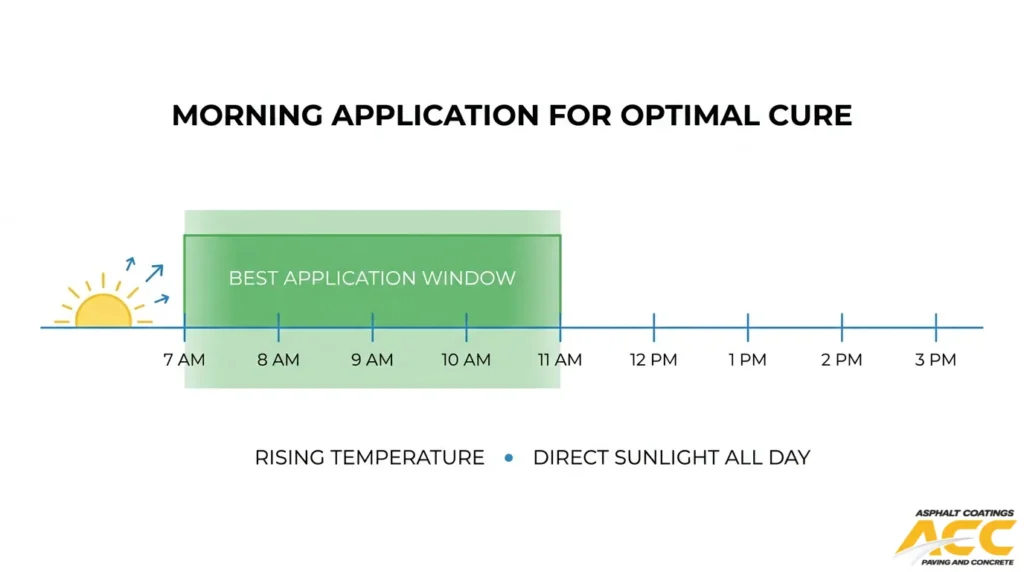
The best time of day for applying sealcoat on a commercial parking lot is morning, typically between 7:00 AM and 11:00 AM. Temperatures are rising during this window, humidity remains low, and the freshly applied material receives direct sunlight through the afternoon for maximum curing. According to DB Kriegs Inc., sealcoat material must have direct sunlight for the majority of drying time to achieve best performance.
Avoiding application during peak afternoon heat (12:00 PM to 3:00 PM) prevents premature baking before the sealant properly bonds. For large commercial lots, an early start also provides a buffer if sections need additional drying time before evening.
How Do Shade, Building Orientation, and Microclimates Affect Summer Scheduling?
Shade, building orientation, and microclimates affect summer scheduling by creating uneven curing conditions across a parking lot. Areas in full sun cure significantly faster than shaded zones. North-facing sections receive less direct sunlight throughout the day, which can extend drying time and delay reopening.
Contractors should prioritize south-facing, sun-exposed sections first, then schedule shaded areas for later in the day or on subsequent days. Multi-story buildings, trees, and adjacent structures all create microclimates where temperatures and sunlight exposure differ from the open lot. Accounting for these variables during project planning prevents inconsistent adhesion and helps property managers set accurate reopening timelines. Experienced commercial contractors like Asphalt Coatings Company account for these site-specific variables during project planning, using their Colorado Front Range expertise to sequence applications for consistent curing across complex parking lot layouts.
Understanding site conditions like these is essential before beginning the surface preparation steps that make sealcoating effective.
How Should Fort Collins Property Managers Prepare a Parking Lot for Summer Sealcoating?
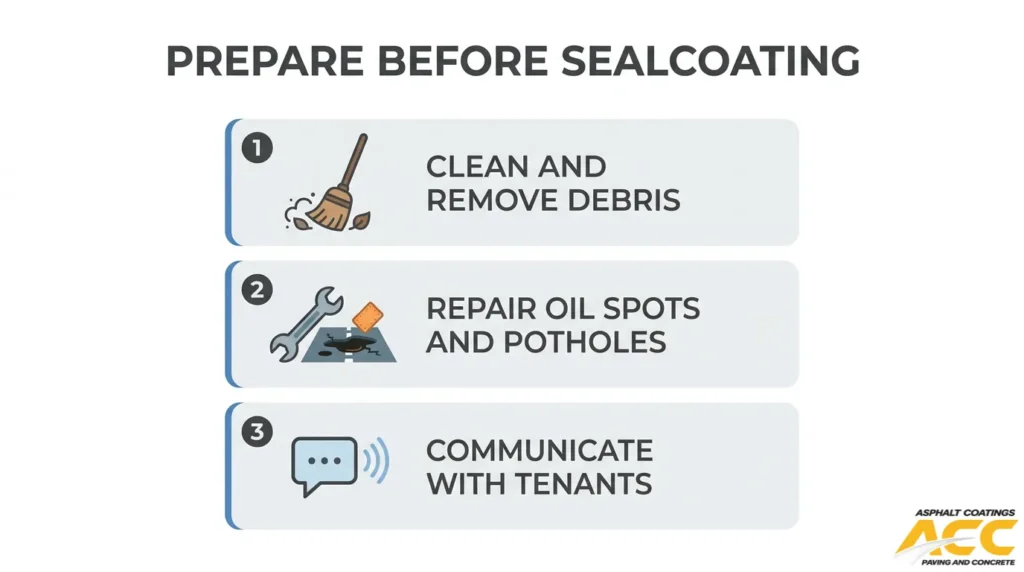
Fort Collins property managers should prepare a parking lot for summer sealcoating by completing three critical steps: thorough surface cleaning, repairing structural damage, and coordinating tenant communication well in advance.
Why Is Thorough Cleaning and Debris Removal Essential Before Sealcoating?
Thorough cleaning and debris removal is essential before sealcoating because sealant requires direct contact with the asphalt surface to achieve proper mechanical adhesion and chemical bonding. Dirt, leaves, gravel, and loose aggregate create a barrier that prevents the sealer from penetrating surface irregularities in the pavement.
Property managers should complete these cleaning steps before the contractor arrives:
- Power sweep the entire lot to remove loose debris and sediment.
- Pressure wash stained or heavily soiled areas.
- Clear vegetation from cracks, expansion joints, and lot edges.
- Ensure the surface is completely dry before application begins.
Even a thin layer of dust can compromise bonding, so cleaning is not optional; it is foundational to a lasting result.
How Should Oil Spots, Potholes, and Structural Damage Be Addressed First?
Oil spots, potholes, and structural damage should be addressed first because sealcoating cannot adhere to contaminated surfaces or bridge structural failures. Oil penetrates asphalt binder and softens it, so affected areas need treatment with an oil-spot primer or, in severe cases, removal and patching of the contaminated pavement.
Potholes and alligator cracking indicate base-layer failure. These require:
- Cutting out the damaged section and compacting new hot-mix asphalt for potholes.
- Filling individual cracks with hot-melt crack filler and allowing full cure before sealing.
- Addressing drainage issues that caused the deterioration in the first place.
Skipping structural repairs before sealcoating wastes material, since the sealer will crack or delaminate over compromised pavement within months. Asphalt Coatings Company conducts comprehensive pavement assessments before any sealcoating project, identifying oil stains, structural damage, and crack patterns that require repair to ensure the sealcoat performs as intended.
How Can Property Managers Communicate Summer Sealcoating Plans to Tenants and Customers?
Property managers can communicate summer sealcoating plans to tenants and customers by starting written outreach two to four weeks before the project begins. Initial notices should include project scope, scheduled dates, parking restrictions, and alternative parking arrangements.
According to eWorkOrders’ Commercial Property Maintenance Checklist, property managers should send weekly communication to tenants regarding updates, events, or maintenance activities. Effective communication includes:
- Distributing written notices with clear dates and expected disruption timelines.
- Posting signage at lot entrances showing phased closure schedules.
- Providing designated overflow parking locations during each phase.
- Sending weekly updates as the project progresses.
Emphasizing the long-term benefits of sealcoating, such as extended pavement life and improved safety, helps tenants understand why temporary inconvenience is worthwhile.
With the lot cleaned, repaired, and tenants informed, the next step is avoiding common application mistakes that can undermine even the best preparation.
What Common Mistakes Should Be Avoided When Sealcoating in Summer?
The common mistakes that should be avoided when sealcoating in summer include applying in extreme heat, rushing cure time, and using DIY methods on commercial lots. Each of these errors compromises the protective barrier sealcoating is designed to provide.
Why Is Applying Sealcoat in Extreme Heat or Direct Midday Sun Risky?
Applying sealcoat in extreme heat or direct midday sun is risky because temperatures above 95°F (35°C) cause the material to bake prematurely before it can properly adhere to the asphalt surface. This premature drying results in poor bonding, uneven coverage, and rapid failure that often requires costly reapplication.
Extreme heat also accelerates solvent evaporation, which prevents the sealcoat from leveling and penetrating surface irregularities. Contractors must monitor ambient temperatures throughout the application day and cease work if conditions exceed the manufacturer’s maximum threshold. Scheduling application during morning hours, when temperatures are rising but still within the 55–90°F optimal range, avoids this problem entirely.
How Can Rushing Cure Time Before Reopening the Lot Cause Long-Term Problems?
Rushing cure time before reopening the lot causes long-term problems because traffic on uncured sealcoat creates tire marks, surface scuffing, peeling, and material tracking. These defects are permanent; once embedded, they compromise the protective barrier and accelerate deterioration.
According to Seal-Rite, sealcoat requires at least 24–48 hours to cure before reopening to traffic. In cooler or humid conditions, this window extends to 48–72 hours. Property managers should use barricades and clear signage to prevent premature access. For commercial lots with high tenant activity, this is often the most underestimated step in the entire process.
Why Should DIY Sealcoating Be Avoided for Commercial Parking Lots?
DIY sealcoating should be avoided for commercial parking lots because retail-grade sealers lack the durability of professional-grade products. Professional-grade sealer with direct-fire rubber lasts 3+ years, and these commercial formulations are not available at retail stores. Proper crack filling and surface preparation are also essential for commercial lots, requiring specialized equipment most property managers do not own.
Common DIY failures include overapplication, uneven edges, and sealing over unfilled cracks. For commercial properties that must maintain ADA compliance and consistent curb appeal, professional application ensures the full protective benefit of sealcoating is achieved.
Avoiding these mistakes sets the stage for integrating sealcoating with other maintenance services.
How Does Summer Sealcoating Interact With Other Parking Lot Maintenance Services?
Summer sealcoating interacts with other parking lot maintenance services through careful sequencing of crack sealing, line striping, and long-term preservation planning. The subsections below cover timing for each service.
How Should Crack Sealing Be Timed Relative to Summer Sealcoating?
Crack sealing should be timed before summer sealcoating, ideally during spring or fall when pavement temperatures allow optimal adhesion. According to The Asphalt Pro, crack sealing should be performed in the spring or fall when cracks are neither completely open (as in summer) nor completely closed (as in winter). Sealcoating alone cannot fill existing cracks; unsealed cracks allow water infiltration that undermines the protective barrier. The recommended sequence is to clean and fill all cracks with hot-melt or cold-applied filler, allow full cure, then apply sealcoat one to two weeks later. Completing crack sealing in late spring positions the lot perfectly for a summer sealcoating application.
When Should Line Striping and ADA Markings Be Reapplied After Summer Sealcoating?
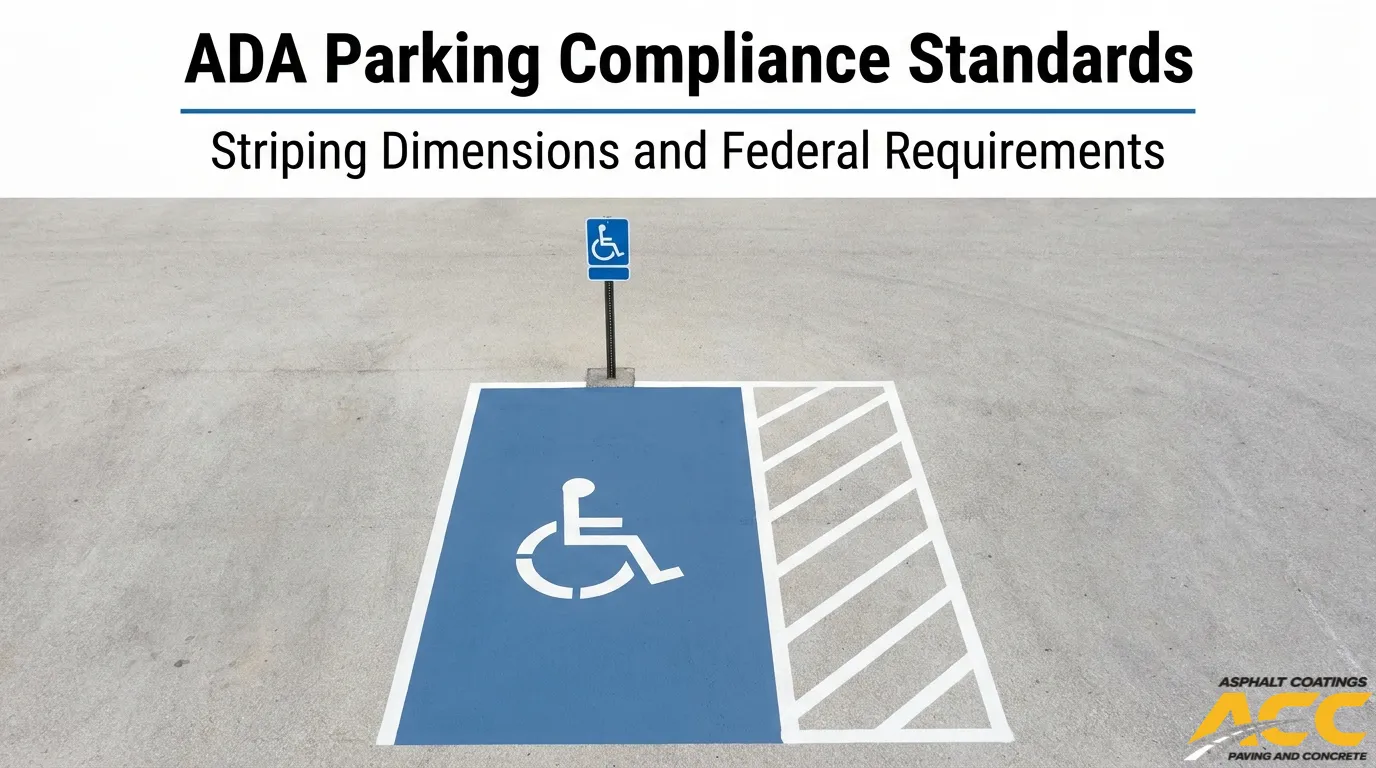
Line striping and ADA markings should be reapplied 48 to 72 hours after summer sealcoating, once the surface has fully cured. Applying striping too soon causes poor adhesion and premature paint failure. Waiting too long allows traffic, dust, and debris to contaminate the sealed surface. According to Pavement Solutions, standard ADA parking spaces must be at least 8 feet wide with a 5-foot access aisle, and van-accessible spaces require either 11 feet with a 5-foot aisle or 8 feet with an 8-foot aisle.
Key ADA restriping requirements include:
- Access aisles must be marked with diagonal lines at 45-degree angles.
- All signage must be mounted at least 5 feet above ground level.
- Lots with 1 to 25 spaces require at least 1 accessible space; 26 to 50 spaces require at least 2.
Thermoplastic paint provides superior durability for ADA markings compared to standard acrylic. Failing to reapply markings promptly after sealcoating creates ADA non-compliance risk and potential legal liability, making this step one of the most overlooked yet consequential parts of the entire project.
How Can Summer Sealcoating Fit Into a Long-Term Parking Lot Maintenance Plan?
Summer sealcoating fits into a long-term parking lot maintenance plan as a recurring treatment within a structured pavement management program. Commercial properties require ADA compliance, professional contractors, and multi-year planning to maximize pavement lifespan. A practical three-year cycle distributes costs evenly: crack sealing and spot repairs in year one, sealcoating in year two, and line striping with ADA compliance review in year three. Most competitors treat sealcoating as a standalone project, but integrating it into a lifecycle plan prevents reactive, emergency-driven spending. Property managers who adopt this framework avoid the costly cycle of neglect and major rehabilitation that shortens pavement service life.
With a coordinated maintenance sequence in place, choosing the right contractor ensures each service is executed correctly.
How Should You Approach Summer Sealcoating With a Colorado Commercial Asphalt Contractor?
You should approach summer sealcoating by partnering with a commercial asphalt contractor that uses professional-grade sealers, handles proper surface preparation, and ensures ADA compliance. The following sections cover how Asphalt Coatings Company executes summer sealcoating in Fort Collins and the key takeaways from this guide.
How Can Asphalt Coatings Company Plan and Execute Summer Sealcoating for a Commercial Parking Lot in Fort Collins?
Asphalt Coatings Company plans and executes summer sealcoating for commercial parking lots in Fort Collins by combining Colorado-specific expertise with commercial-grade materials and proven application methods. Fort Collins sits at approximately 5,000 feet elevation, where commercial properties experience 20–30% more UV exposure than those at lower elevations. This heightened UV intensity accelerates asphalt degradation, making professional pavement sealing essential rather than optional.
Asphalt Coatings Company addresses these conditions through a structured process:
- Conducting a full pavement assessment to identify cracks, oil stains, and structural damage before any sealer is applied.
- Completing crack sealing and surface preparation using CDOT-approved materials and commercial equipment.
- Applying sealcoat at consistent thickness with commercial-grade products unavailable at retail stores.
- Coordinating tenant communication, signage, and phased lot closures to minimize business disruption.
- Reapplying ADA-compliant line striping and parking markings after full cure.
With sealcoating costs ranging from $0.18 to $0.36 per square foot in the Fort Collins area, professional application delivers far greater longevity than DIY alternatives. For commercial property managers, this investment protects against Colorado’s intense UV exposure, winter freeze-thaw cycles, and deicing chemical damage in a single summer project.
What Are the Key Takeaways About Why Summer Is the Best Time to Sealcoat a Commercial Parking Lot in Fort Collins We Covered?
The key takeaways about why summer is the best time to sealcoat a commercial parking lot in Fort Collins are rooted in climate, cost efficiency, and operational timing. Fort Collins’ summer conditions, including July average highs of 32°C (89°F) according to Time and Date, low humidity, and extended daylight, create the ideal curing environment for asphalt sealcoating.
Here are the most actionable conclusions from this guide:
- Summer temperatures in Fort Collins consistently fall within the optimal 55–90°F sealcoating range, promoting proper bonding and cure.
- Scheduling sealcoating before 7:00 AM or after 6:00 PM, and coordinating with tenants 2–4 weeks in advance, reduces business disruption during slower summer traffic periods.
- Professional sealcoating lasts 3–5 years, while DIY attempts typically fail within 1–2 years due to uneven application and inferior materials.
- Completing sealcoating before winter protects pavement from freeze-thaw damage, deicing salt penetration, and snowplow scarring.
- A structured maintenance sequence of crack sealing, sealcoating, then line striping maximizes pavement life and maintains ADA compliance.
For commercial property managers in Fort Collins, summer sealcoating is the single most cost-effective preventive maintenance step available. Asphalt Coatings Company brings 39 years of Colorado Front Range experience to every commercial sealcoating project, from initial assessment through final striping.