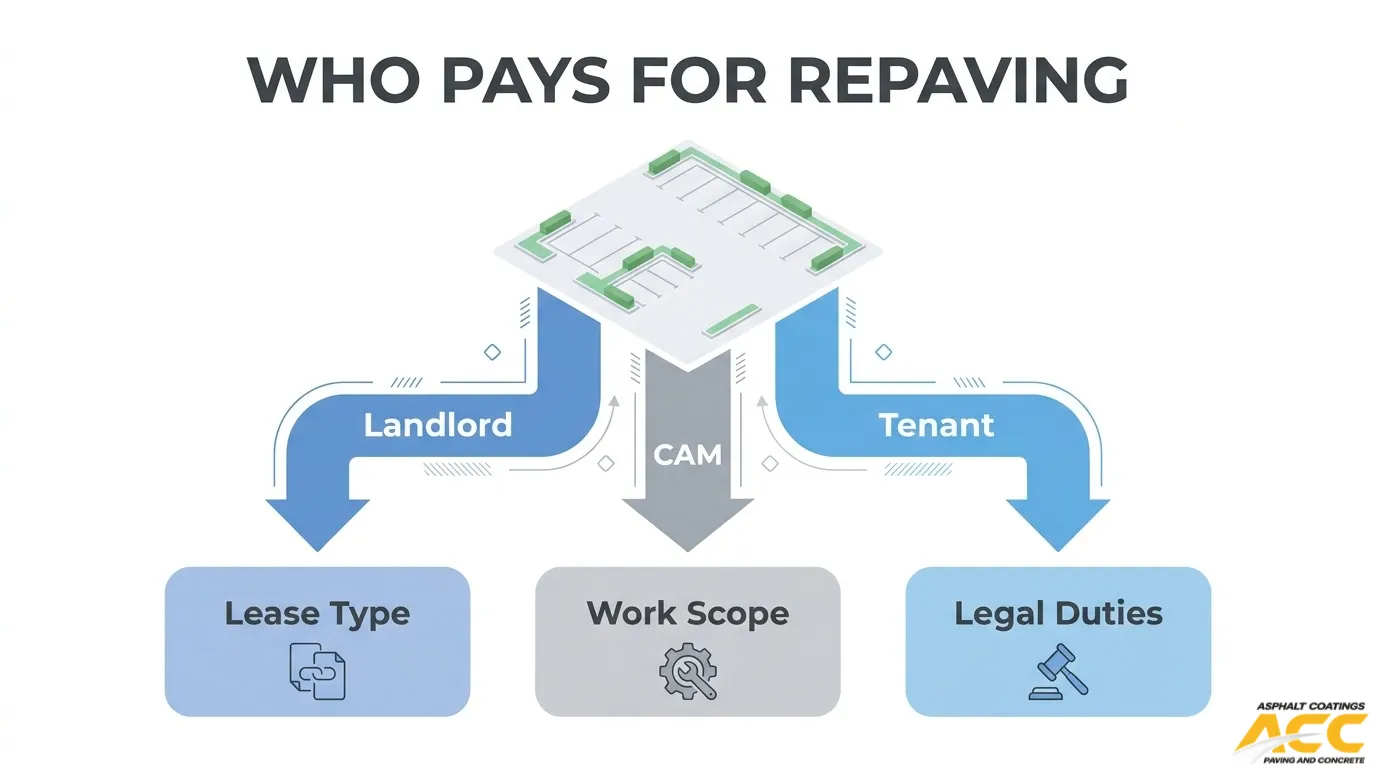
Parking lot repaving responsibility in commercial real estate is determined by the lease structure, the physical scope of the work, and the legal obligations each party holds. The lease controls whether costs flow through Common Area Maintenance (CAM) charges, fall to the landlord, or land on the tenant.
This guide covers how CAM charges function for parking lots, when landlords versus tenants bear repaving costs, how leases should define and allocate these expenses, the distinction between routine maintenance and capital improvements, how property type and legal factors shift responsibility, and how preventive maintenance and contractor selection protect both parties financially.
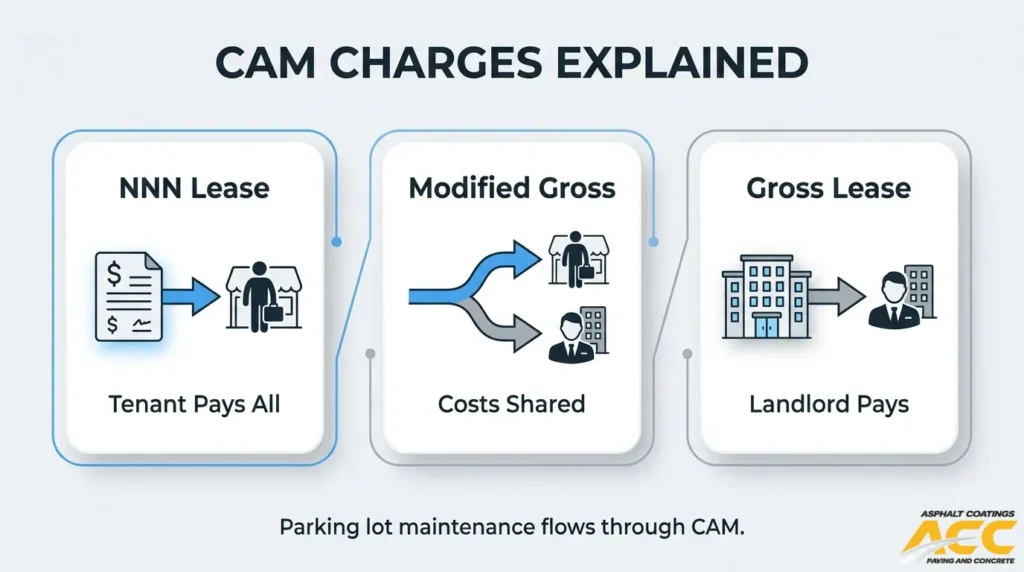
CAM charges represent the annual tenant expense covering shared spaces like parking lots, sidewalks, and common areas. How these charges are structured varies by lease type; triple-net leases pass nearly all maintenance costs to tenants, while gross leases bundle them into the landlord’s base rent.
Landlord liability for repaving increases under gross lease structures, short-term tenancies where the pavement outlasts the lease, and situations where deferred maintenance caused the deterioration. Tenants absorb repaving costs most directly under NNN leases, with allocation among multiple tenants following pro rata square-footage formulas that anchor tenants often negotiate separately.
Lease language separating “maintenance,” “repair,” and “capital improvement” prevents the most common disputes. Sealcoating and crack filling typically qualify as routine CAM expenses, while full-depth reconstruction triggers capital classification with different accounting, depreciation, and funding implications.
Property type shapes cost allocation significantly. Shopping centers rely on tenant CAM pools, office parks favor modified gross structures, and industrial facilities face accelerated wear from heavy vehicles. ADA requirements, premises liability exposure, and local codes add mandatory costs that apply regardless of lease terms.
Preventive maintenance strategies, including sealcoating cycles, pavement condition inspections, and reserve fund planning, keep repaving costs predictable. Selecting a qualified contractor with transparent, itemized invoicing supports accurate CAM reconciliation and reduces tenant disputes.
How Do Common Area Maintenance (CAM) Charges Typically Work for Parking Lots?
Common area maintenance (CAM) charges work for parking lots by requiring tenants to pay an annual expense that covers upkeep of shared spaces not designed for lease. These charges fund parking lot repairs, sealcoating, striping, and related maintenance. The specifics depend on lease type and property structure.
CAM charges represent the annual expense paid by the tenant to maintain common areas that are not designed for lease, including parking lots, sidewalks, landscaped areas, hallways, and public restrooms, according to the City of Falls Church, Virginia’s Office/Retail Income and Expense Survey. Parking lots typically consume a significant share of these charges because they require ongoing upkeep to remain safe and functional. A study published in the Journal of Safety Research found that 206 work-related fatalities per year occur in parking lots, underscoring why regular maintenance is not optional.
How CAM charges are structured varies by lease type. Under a modified gross lease, the tenant’s base rent is inclusive of all costs, including the landlord’s cost for insurance, common area charges, maintenance, and repairs of the premises and building, including any parking structures, as described in the UC Standard Form Lease. The tenant pays only separately metered utilities directly. This approach bundles parking lot maintenance into predictable monthly payments.
Lease agreements also shape the standard of care parking lots receive. Landlords may specify minimum acceptable maintenance standards, such as requiring parking lots to be repaved and restriped at specified intervals, according to the Commercial Real Estate Development Association (CREDA). These provisions ensure that CAM-funded maintenance follows a defined schedule rather than being deferred until pavement failures become costly emergencies.
For most commercial tenants, CAM charges are the primary mechanism through which parking lot maintenance costs flow. Understanding how your specific lease allocates these expenses is the first step toward controlling long-term occupancy costs and avoiding unexpected assessments when major work becomes necessary.
When Is the Landlord Responsible for Paying for Parking Lot Repaving?
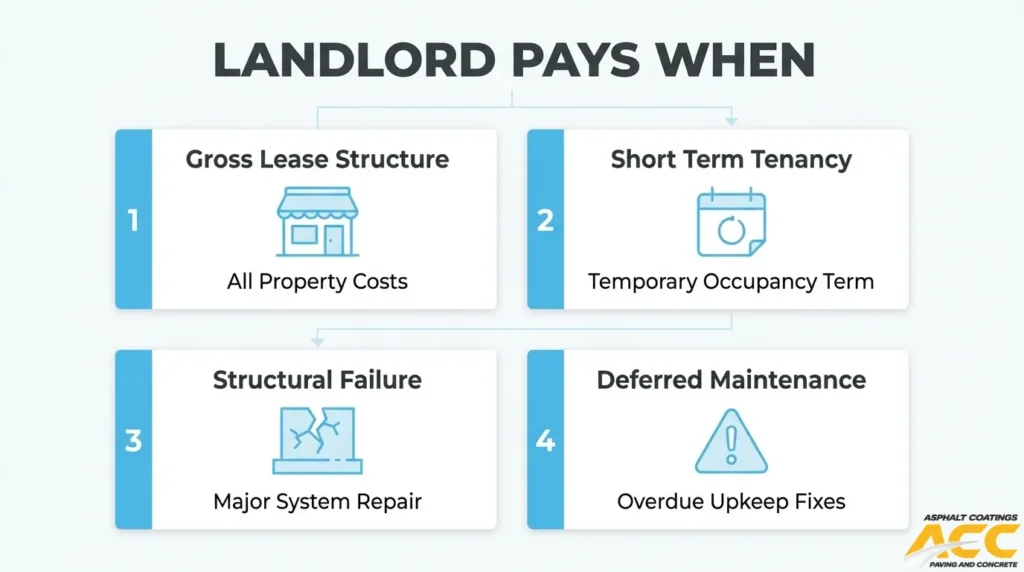
The landlord is responsible for paying for parking lot repaving when the lease structure, term length, or the landlord’s own negligence places that obligation on the property owner. Gross leases, short-term tenancies, and deferred maintenance each shift repaving costs to the landlord in distinct ways.
How Do Triple-Net (NNN) Leases Affect When Landlords Pay for Repaving?
Triple-net (NNN) leases affect when landlords pay for repaving by limiting the landlord’s financial role to structural repairs or new installations. Under a standard NNN agreement, the tenant pays taxes, insurance, and maintenance on top of base rent, which typically includes parking lot upkeep.
However, landlords still retain responsibility for structural components. If repaving involves correcting a foundational failure, subgrade collapse, or drainage deficiency beneath the pavement, that work often falls under the landlord’s structural obligation. According to the Commercial Real Estate Development Association (CREDA), landlords under NNN leases may specify minimum maintenance standards, such as requiring parking lots to be repaved and restriped at specified intervals.
For most property managers, the practical takeaway is straightforward: review whether the NNN lease explicitly names parking lot resurfacing as a tenant or landlord duty, because ambiguous language creates disputes.
In What Situations Do Gross or Full-Service Leases Make Landlords Cover Repaving Costs?
Gross or full-service leases make landlords cover repaving costs when the lease bundles all property expenses into the tenant’s fixed rent. As defined by Virginia Tech’s Real Estate Glossary, a gross lease requires the landlord to pay all property expenses, including taxes, insurance, utilities, and repairs, with those costs factored into the rent.
Under this structure, the landlord absorbs repaving as an operating expense. Modified gross leases shift some responsibilities to the tenant, but parking lot repairs frequently remain on the landlord’s side. Even in modified arrangements with base-year escalation clauses, the initial repaving cost typically belongs to the landlord; tenants only pay their pro rata share of increases above the established baseline. This distinction matters because a major repaving project during the base year sets a higher benchmark, reducing future tenant exposure while concentrating current costs on the property owner.
How Do Long-Term vs. Short-Term Leases Change a Landlord’s Repaving Obligations?
Long-term vs. short-term leases change a landlord’s repaving obligations by affecting who benefits from the investment and who bears the cost. In short-term leases of five years or less, landlords rarely succeed in passing full repaving costs to tenants, because the pavement’s useful life far exceeds the lease term. A tenant occupying space for three years has little incentive to fund a project that serves the property for two decades.
Long-term leases of ten years or more create room to amortize repaving costs across the tenancy through CAM charges or scheduled rent adjustments. When the tenant’s occupancy aligns with the pavement’s service life, shared responsibility becomes easier to negotiate. In practice, landlords holding short-term tenants should expect to fund repaving directly and recover the cost through higher base rents or reserve contributions built into future lease negotiations.
When Does Negligence or Deferred Maintenance Make the Landlord Fully Liable for Repaving?
Negligence or deferred maintenance makes the landlord fully liable for repaving when the parking lot deteriorates because the landlord failed to perform reasonable upkeep. Regardless of lease type, a landlord who ignores visible cracking, drainage failures, or pothole formation for years cannot later shift the resulting full repaving bill to tenants through CAM charges.
Courts have consistently held that landlords owe a duty of care to maintain safe premises. When deferred maintenance allows minor surface issues to escalate into structural failure requiring complete reconstruction, that cost becomes the landlord’s sole responsibility. Tenants can argue, often successfully, that timely sealcoating or crack repair would have prevented the need for repaving entirely. Proactive maintenance programs protect landlords from this exposure far more effectively than any lease clause written after the damage is done.
Understanding when landlord liability applies helps both parties structure lease terms that account for repaving before disputes arise.
When Do Tenants End Up Paying for Parking Lot Repaving Through CAM Charges?
Tenants end up paying for parking lot repaving through CAM charges when their lease structure assigns common area costs to tenants, most commonly under triple-net (NNN) agreements. The subsections below cover how NNN leases pass these costs, how allocation works among multiple tenants, whether anchor tenants pay differently, and when tenants can dispute or audit repaving-related CAM charges.
How Do Triple-Net (NNN) Leases Pass Parking Lot Repaving Costs to Tenants?
Triple-net (NNN) leases pass parking lot repaving costs to tenants by making tenants responsible for all property operating expenses, including common area maintenance, on top of base rent. Under a NNN structure, the landlord assumes no costs other than structural repairs or new installations; everything else flows through to the tenant.
The financial impact can be substantial. According to the International Council of Shopping Centers, quoting Corey Bialow, CEO of Bialow Real Estate, CAM costs range from $2 to $3 per square foot in a small neighborhood center to upward of $50 per square foot in an upscale lifestyle center. When a major repaving project hits, tenants under NNN leases absorb their proportionate share directly.
How Are Repaving Costs Typically Allocated Among Multiple Tenants in a Property?
Repaving costs are typically allocated among multiple tenants using a pro rata share based on each tenant’s occupied square footage relative to the total leasable area. A tenant occupying 10% of the building’s leasable space would generally pay 10% of the parking lot repaving bill.
Some leases use a “gross-up” calculation that adjusts operating expenses as though the property were fully occupied, preventing existing tenants from subsidizing vacant spaces. The specific allocation formula should be defined clearly in the lease. Tenants who negotiate effectively may secure exclusions for areas they do not use, such as loading docks serving other businesses. Without precise lease language, allocation disputes become common during large capital events like full-lot repaving.
Can Anchor Tenants or Big-Box Stores Be Charged Differently for Repaving Than Inline Tenants?
Yes, anchor tenants or big-box stores can be charged differently for repaving than inline tenants, and they frequently are. Anchor leases often contain separate CAM provisions, reduced contribution rates, or complete exclusions from common area cost pools that smaller tenants participate in.
In a Minnesota Tax Court opinion (Eden Prairie Mall LLC v. Hennepin County), an appraiser stated that mall CAM expenses “are what’s being reported for the in-line tenancy of the mall. It has nothing to do with the anchor department stores,” and the court agreed with that distinction. This means inline tenants may shoulder a disproportionate share of repaving costs. For smaller tenants, reviewing whether anchor exclusions inflate their per-square-foot CAM burden is one of the most important due diligence steps before signing a lease.
When Can a Tenant Dispute or Audit CAM Charges Related to Parking Lot Repaving?
A tenant can dispute or audit CAM charges related to parking lot repaving when the lease includes an audit right, when charges exceed the defined scope of recoverable expenses, or when the landlord fails to provide required reconciliation documentation.
Key situations that support a dispute include:
- The lease classifies repaving as a capital improvement excluded from CAM, yet the landlord bills it as maintenance.
- The landlord charges tenants for expenses not included in the lease’s CAM definition.
- Annual reconciliation statements are missing, late, or lack supporting invoices.
- The tenant’s pro rata allocation appears inconsistent with the lease formula.
Some lease structures build in formal audit protections. According to U.S. Department of State lease guidelines (15 FAM 350), landlords submit operating-expense receipts to an independent accounting firm for audit in the first month of each tax year; any tenant underpayment is payable, while any excess collected is credited or refunded. Tenants without explicit audit clauses have far less leverage, which makes negotiating this right before lease execution critical.
Understanding when CAM charges are disputable helps tenants protect themselves; the next step is ensuring the lease itself spells out repaving responsibilities clearly.
How Should a Commercial Lease Spell Out Who Pays for Parking Lot Repaving?
A commercial lease should spell out who pays for parking lot repaving by defining specific CAM terms, separating maintenance from capital work, and including cost caps. The following subsections cover landlord must-haves, tenant negotiation points, definitional clarity, and protective financial limits.
What Key Parking Lot and CAM Terms Should Landlords Insist on Including in the Lease?
The key parking lot and CAM terms landlords should insist on including in the lease are explicit repair obligations, defined maintenance standards, and unambiguous language assigning responsibility for parking lot upkeep. Vague phrasing creates costly disputes. In Kallman v. RadioShack Corp., the Seventh Circuit held that lease language requiring the lessee to keep improvements in good repair and making the lessee liable for “any structural failure of the building” encompassed parking lot repairs. Landlords should specify:
- Parking lot maintenance tasks covered by CAM, such as sealcoating, striping, and patching.
- Inspection frequency and condition benchmarks that trigger repair obligations.
- Which party manages contractor selection and project oversight.
- How pro rata shares are calculated for multi-tenant properties.
Leaving these terms open to interpretation hands leverage to whichever party did not draft the lease.
What CAM and Repaving Clauses Should Tenants Negotiate or Push Back On?
The CAM and repaving clauses tenants should negotiate or push back on include open-ended capital expense pass-throughs, uncapped annual CAM increases, and vague definitions of “common area.” Tenants benefit from requesting these protections:
- A capital expenditure exclusion that prevents full repaving costs from being billed as routine CAM.
- An annual CAM increase cap, typically 3% to 5%, to prevent unpredictable year-over-year spikes.
- Audit rights allowing independent review of CAM reconciliation statements.
- Amortization requirements so that large repaving projects are spread across their useful life rather than charged in a single year.
Tenants who accept boilerplate CAM language without negotiation often absorb costs that should fall to the landlord or be amortized over time.
How Should a Lease Define “Maintenance,” “Repair,” and “Capital Improvement” for Parking Lots?
A lease should define “maintenance,” “repair,” and “capital improvement” for parking lots using clear, scope-based criteria tied to the physical nature of the work. Without these distinctions, either party can reclassify costs to shift financial burden. According to Davenport University’s Facilities Best Practice guidelines, the minimum service life for a new parking lot is 20 years, which provides a useful benchmark for separating routine upkeep from capital-level work.
Effective lease definitions typically distinguish:
- Maintenance: Recurring, low-cost tasks like sealcoating (recommended every three to five years), sweeping, and striping.
- Repair: Targeted fixes such as pothole patching, crack sealing, or localized overlay of failed sections.
- Capital improvement: Full-depth removal and replacement, structural overlay, or subgrade reconstruction that extends the lot’s useful life beyond its original expectancy.
Tying each category to specific physical scope prevents ambiguity when invoices arrive.
How Can Caps, Floors and Exclusions on CAM Protect Both Parties on Repaving Costs?
Caps, floors, and exclusions on CAM can protect both parties on repaving costs by creating predictable financial boundaries that prevent surprise assessments for tenants while ensuring landlords recover legitimate operating expenses. Effective mechanisms include:
- Annual caps that limit total CAM increases to a fixed percentage, shielding tenants from one-time repaving spikes.
- Floors (base years) that establish a minimum CAM threshold so landlords are not subsidizing costs that tenants contractually share.
- Capital exclusions that remove large repaving projects from the annual CAM pool entirely, requiring landlords to fund them separately or amortize over the asset’s useful life.
- Amortization schedules that spread qualifying capital work across 10 to 20 years at a reasonable interest rate, keeping annual tenant charges manageable.
Both parties benefit most when these provisions are negotiated before signing rather than disputed after a repaving invoice lands.
Understanding how leases allocate repaving costs makes it easier to classify the work itself as routine CAM or a capital improvement.
Is Parking Lot Repaving a CAM Expense, a Capital Improvement, or Both?
Parking lot repaving can be a CAM expense, a capital improvement, or both, depending on the physical scope of the work. Minor repairs typically flow through operating budgets, while full reconstruction is capitalized. The following subsections break down routine maintenance treatment, capital classification triggers, accounting and depreciation effects, and how lenders evaluate these costs.
In What Cases Is Repaving Treated as Routine CAM Maintenance?
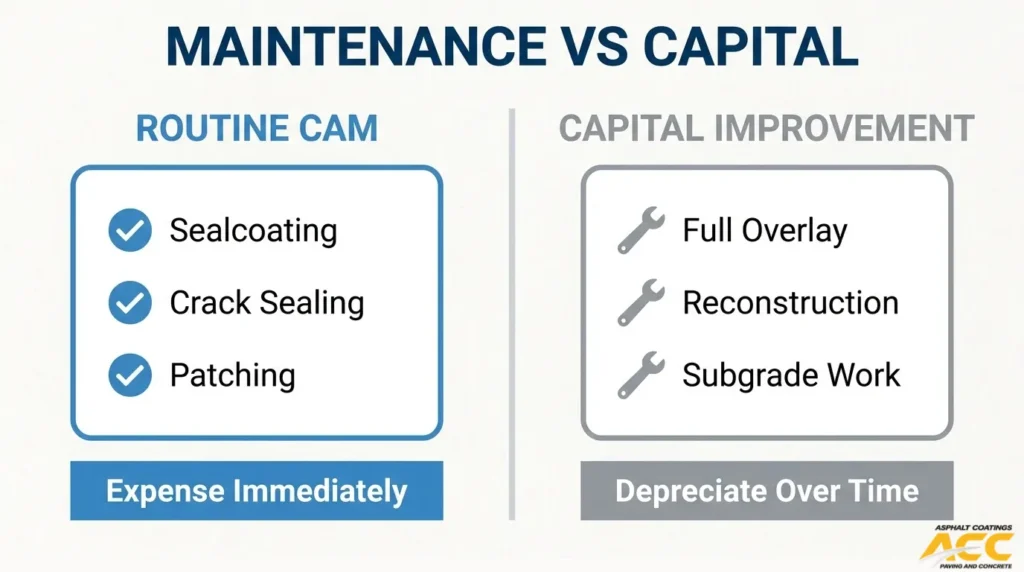
Repaving is treated as routine CAM maintenance when the work preserves the parking lot’s existing condition without altering its structure or extending its useful life. Small-scale patching, crack filling, sealcoating, and localized surface repairs fall into this category.
The City of Alexandria’s commercial income and expense survey instructions draw a clear line: include “calendar year expenses for minor amounts of parking lot and paving repairs,” but “do not include any major repaving or other capital improvements.” This distinction matters because routine maintenance costs pass directly through CAM reconciliation to tenants, while capital work typically does not.
For property managers, the practical test is straightforward: if the work maintains rather than restores or upgrades the pavement, it belongs in operating expenses.
When Is a Parking Lot Overlay or Full Reconstruction Considered a Capital Expense?
A parking lot overlay or full reconstruction is considered a capital expense when the project restores failed pavement, extends the lot’s useful life, or changes its structural capacity. The physical scope of the work determines the classification, not simply the dollar amount.
According to the IRS Capitalization of Tangible Property Audit Technique Guide, an asphalt parking lot restored by removing failed asphalt, stabilizing the underlying material, and replacing the pavement required capitalization as an improvement under the restoration analysis. That distinction separates surface preservation from structural rehabilitation.
Property owners funding these projects often use reserve strategies. The Government Finance Officers Association recommends “annually setting aside 20% of a five-year asset’s replacement costs so that funding is available when replacement is necessary.” Under full-service gross or modified gross leases, structural repairs and operating expenses are split between tenant and landlord through base rent, which means the lease structure itself shapes who absorbs capital repaving costs.
How Do Accounting Rules and Depreciation Affect Classification of Repaving Costs?
Accounting rules and depreciation affect classification of repaving costs by determining whether the expenditure is expensed immediately or capitalized and recovered over multiple years. The distinction hinges on whether the work maintains existing function or creates a betterment, restoration, or adaptation.
The Federal Reserve’s Financial Accounting Manual states the principle directly: repairs and maintenance costs incurred to maintain an asset at its current level of operation are not capitalizable and should be charged to expense. When repaving does qualify as a capital improvement, it enters the depreciation schedule. Under 26 U.S.C. § 168, the applicable recovery period for nonresidential real property is 39 years, though parking lots classified as land improvements may qualify for a shorter 15-year recovery period using the 150-percent declining-balance method.
Misclassifying a capital project as an operating expense inflates CAM charges tenants pay in one year, while misclassifying routine maintenance as capital delays legitimate deductions.
How Do Lenders and Investors View Large Parking Lot Repaving Projects in CAM vs Capital Budgets?
Lenders and investors view large parking lot repaving projects as capital expenditures that should be funded through reserves rather than passed through annual CAM charges. This classification directly affects net operating income, property valuation, and loan underwriting.
Fannie Mae’s Multifamily Guide requires borrowers to maintain sufficient replacement reserves to “equal or exceed the anticipated costs of all necessary capital item replacements and major maintenance needs and repairs.” When a major repaving project is expensed through CAM instead, it temporarily inflates operating costs, depresses NOI, and can trigger covenant concerns or lower appraisal values.
From an investor’s perspective, properties with funded capital reserves and clearly separated maintenance budgets signal disciplined management. Lumping a six-figure reconstruction into a single year’s CAM reconciliation raises red flags during due diligence, because it obscures the property’s true operating cost baseline.
Understanding how classification affects both tax treatment and property valuation helps landlords structure repaving projects in ways that satisfy lenders, protect tenant relationships, and reflect accurate financials.
How Do Different Property Types Change Who Pays for Parking Lot Repaving?
Different property types change who pays for parking lot repaving based on lease structures, tenant mix, and how common areas are shared. Shopping centers, office parks, industrial facilities, and mixed-use properties each allocate costs differently.
How Do Shopping Centers and Retail Strips Typically Handle Parking Lot Repaving Costs?
Shopping centers and retail strips typically handle parking lot repaving costs through CAM charges passed to tenants on a pro rata basis, with the landlord coordinating the work. The landlord funds the project upfront, then recovers costs from tenants based on each tenant’s leased square footage relative to the total leasable area.
CAM rates vary dramatically by center type. According to the International Council of Shopping Centers (quoting Corey Bialow, CEO of Bialow Real Estate), CAM costs range from $2 to $3 per square foot in small neighborhood centers to upward of $50 per square foot in upscale lifestyle centers. Anchor tenants often negotiate separate CAM arrangements, leaving inline tenants absorbing a disproportionate share. Tenants should review how repaving is classified before signing, because a capital improvement exclusion could shift the entire cost back to the landlord.
How Are Repaving Responsibilities Handled for Office Parks and Business Campuses?
Repaving responsibilities for office parks and business campuses are handled according to the prevailing lease type, which is most often a modified gross or full-service gross structure. Under these arrangements, the landlord bundles parking lot maintenance into base rent or operating expense escalations rather than billing tenants through itemized CAM reconciliation.
In multi-building campuses, operating expenses are typically pooled across the entire property and allocated by occupied square footage, with a gross-up provision adjusting costs to reflect full occupancy. Single-tenant office buildings on NNN leases shift all repaving responsibility to the tenant. Because office parks generally see lighter vehicle traffic than retail centers, repaving cycles tend to be longer, but landlords still bear the obligation to maintain safe, accessible surfaces for employees and visitors.
What Is Different About Industrial, Warehouse and Distribution Center Parking Lot Cost Sharing?
What is different about industrial, warehouse, and distribution center parking lot cost sharing is the heavier pavement load and the prevalence of NNN lease structures. Heavy truck traffic, forklift operations, and trailer staging accelerate pavement deterioration far beyond what standard passenger vehicles cause, making repaving more frequent and more expensive per square foot.
Most industrial leases are triple-net, placing maintenance, insurance, and tax obligations squarely on the tenant. A single-tenant warehouse lessee typically bears full repaving responsibility. In multi-tenant distribution parks, costs are allocated by square footage, though tenants operating loading docks or heavy-vehicle lanes may negotiate weighted cost-sharing formulas. Subgrade failures from repeated heavy loads can push projects into capital improvement territory, potentially shifting costs back to the landlord depending on lease definitions.
How Do Multifamily or Mixed-Use Properties Allocate Parking Lot Repaving Among Users?
Multifamily or mixed-use properties allocate parking lot repaving among users through a combination of operating budgets, reserve funds, and separate CAM pools for different user classes. The allocation method depends on whether the property blends residential, retail, and office components under one ownership structure or separate condominium-style parcels.
In apartment complexes, the property owner funds repaving from operating income or replacement reserves, then recovers the cost indirectly through rent. Mixed-use developments with ground-floor retail and upper-floor residential often maintain separate CAM pools: commercial tenants pay pro rata CAM charges, while residential costs flow through the building’s operating budget. Fannie Mae’s multifamily guidelines require borrowers to maintain replacement reserves that equal or exceed anticipated capital replacement costs, ensuring funds are available when repaving becomes necessary.
Understanding how each property type structures repaving responsibility helps landlords and tenants negotiate lease terms that reflect actual use and wear.
How Do Legal, Insurance and Risk Factors Impact Who Pays for Parking Lot Repaving?
Legal, insurance, and risk factors impact who pays for parking lot repaving by shifting financial responsibility based on liability exposure, insurance coverage, code compliance triggers, and documented evidence. The sections below cover premises liability, insurance applicability, ADA and code obligations, and protective documentation.
How Can Premises Liability and Slip-and-Fall Claims Influence Repaving Decisions?
Premises liability and slip-and-fall claims influence repaving decisions by creating direct financial consequences for property owners who fail to maintain safe parking surfaces. Property owners owe visitors a duty of reasonable care, and deteriorated pavement with potholes, cracks, or pooling water can establish negligence.
According to the CDC’s National Center for Injury Prevention and Control, over 14 million, or 1 in 4, older adults report falling every year. When falls occur on commercial property, juries have returned substantial verdicts. Key liability risk factors include:
- Potholes with standing water during business hours
- Poor lighting below the 0.2 foot-candle minimum for basic parking conditions
- Unrepaired surface deterioration despite documented complaints
For landlords and tenants alike, the cost of a single premises liability verdict often dwarfs the expense of proactive repaving.
When Can Insurance Help Cover Part of a Parking Lot Repaving Project?
Insurance can help cover part of a parking lot repaving project when the damage results from a covered peril, such as a storm, vehicle impact, or fire, rather than normal wear and deterioration. Standard commercial property policies typically exclude gradual degradation, meaning routine resurfacing falls outside coverage.
However, if a sudden event causes structural pavement failure, the property insurance claim may offset a significant portion of reconstruction costs. A New York court found that photographs and the totality of evidence established a parking lot was dangerous generally, with a pothole and water present during business hours constituting a hazard. Such documented conditions strengthen both liability claims and insurance submissions.
Landlords should also understand that repaving classified as a capital improvement may qualify for a 15-year depreciation recovery period under IRS section 168(e), which affects long-term cost recovery even when insurance does not apply.
How Do Local Codes and ADA Requirements Affect Repaving Obligations and Cost Allocation?
Local codes and ADA requirements affect repaving obligations and cost allocation by triggering mandatory accessibility upgrades whenever parking surfaces are altered. ADA Title III regulations require that any alteration to a commercial facility be made so the altered portions are readily accessible to individuals with disabilities, to the maximum extent feasible.
The U.S. Access Board specifies that “alterations” includes resurfacing of vehicular ways. This means a simple overlay or repaving project can require:
- Installation or reconstruction of ADA-compliant parking spaces
- Construction of compliant curb ramps prior to or concurrently with resurfacing
- Signage, slope, and access aisle upgrades to current standards
These added costs change the repaving budget significantly and must be allocated according to the lease. Tenants should verify whether their CAM obligations include ADA-triggered work, while landlords should anticipate compliance costs before scoping any resurfacing project.
What Documentation Should Landlords and Tenants Keep to Protect Themselves in Repaving Disputes?
The documentation landlords and tenants should keep to protect themselves in repaving disputes includes inspection records, photographic evidence, maintenance logs, contractor invoices, and lease correspondence. Proper records establish who knew about pavement conditions, when they knew, and what actions were taken.
Essential documents for both parties include:
- Dated photographs of pavement condition taken at regular intervals
- Written inspection reports with severity ratings
- Contractor proposals, signed scopes of work, and change orders
- Proof of CAM reconciliation statements and payment history
- Copies of all maintenance requests and landlord responses
Courts rely heavily on photographic and documentary evidence when evaluating parking lot negligence claims. Without consistent records, the party lacking documentation typically bears the greater burden in disputes over responsibility and cost allocation.
Proactive documentation not only protects against litigation; it also provides the foundation for accurate budgeting and fair CAM allocation when repaving becomes necessary.
How Can Landlords and Tenants Budget and Plan Ahead for Parking Lot Repaving?
Landlords and tenants can budget and plan ahead for parking lot repaving by combining regular condition inspections, dedicated reserve funds, phased maintenance strategies, and clear communication about upcoming costs.
How Often Should Commercial Parking Lots Be Inspected and Rated for Condition?
Commercial parking lots should be inspected and rated for condition on a cycle ranging from annually to once every three years, depending on traffic volume, pavement age, and environmental exposure. Each inspection should assign a Pavement Condition Index (PCI) score, a numerical rating between 0 and 100 derived from a visual survey of surface distresses such as cracking, rutting, and potholes. PCI scores sort lots into actionable bands: preventive maintenance, major rehabilitation, or reconstruction. Conditions like inadequate lighting and drainage failures should also be documented during inspections. In Alqadhi v. Standard Parking, Inc., the Illinois Appellate Court held that expert testimony about a hazardous parking lot condition created a triable question of fact, reinforcing why written inspection records matter for liability protection.
What Reserve or Sinking Fund Strategies Help Prepare for Future Repaving?
Reserve or sinking fund strategies help prepare for future repaving by setting aside annual contributions that accumulate before the work is needed. According to the Government Finance Officers Association, reserves can proactively manage capital assets by annually setting aside a percentage of an asset’s replacement cost so that funding is available when replacement becomes necessary. For parking lots, this means estimating the total repaving cost, dividing it across the remaining useful life of the pavement, and depositing that amount into a dedicated account each year. Lease agreements should specify whether reserve contributions flow through CAM charges or remain a landlord-only obligation, so tenants understand exactly how their payments fund future capital needs.
How Can Phased Repairs, Overlays and Sealcoating Spread Out Repaving Costs Over Time?
Phased repairs, overlays, and sealcoating spread out repaving costs over time by addressing deterioration in stages rather than requiring a single large expenditure. A pavement management system tracks distresses over time and, as the University of Kentucky Highway Knowledge Portal notes, lets property owners move beyond a one-year action plan to a three-to-five-year plan. Sealcoating preserves surface integrity at a fraction of full repaving cost. Overlays add structural life to pavement that still has a sound base. Phased approaches also help landlords align major spending with lease renewal cycles and CAM reconciliation periods. The key is ensuring replacement reserves equal or exceed anticipated capital maintenance costs, so phased work never stalls due to funding gaps.
How Should Owners Communicate Upcoming Repaving Work and CAM Impacts to Tenants?
Owners should communicate upcoming repaving work and CAM impacts to tenants through written notices that outline scope, timeline, cost estimates, and the anticipated effect on monthly CAM charges. Providing this information at least 90 days before work begins gives tenants time to adjust their own budgets and plan for operational disruptions. Effective communication includes sharing inspection reports and PCI ratings so tenants understand why the work is necessary. During and after the project, owners should provide updated cost breakdowns tied to the annual CAM reconciliation process. Transparency at every stage reduces disputes, builds trust, and makes tenants more willing to support maintenance investments that protect the property they occupy.
With a clear budget and inspection plan established, selecting the right contractor ensures those plans translate into quality results.
How Do Preventive Maintenance and Repair Choices Influence Future Repaving Costs and CAM?
Preventive maintenance and repair choices influence future repaving costs and CAM by extending pavement life, keeping expenses classified as routine operating costs, and reducing the frequency of capital-level projects that spike tenant charges. The subsections below cover sealcoating, crack sealing, drainage, and lease standards.
How Can Regular Sealcoating Reduce Long-Term Repaving Frequency and Tenant CAM Burden?
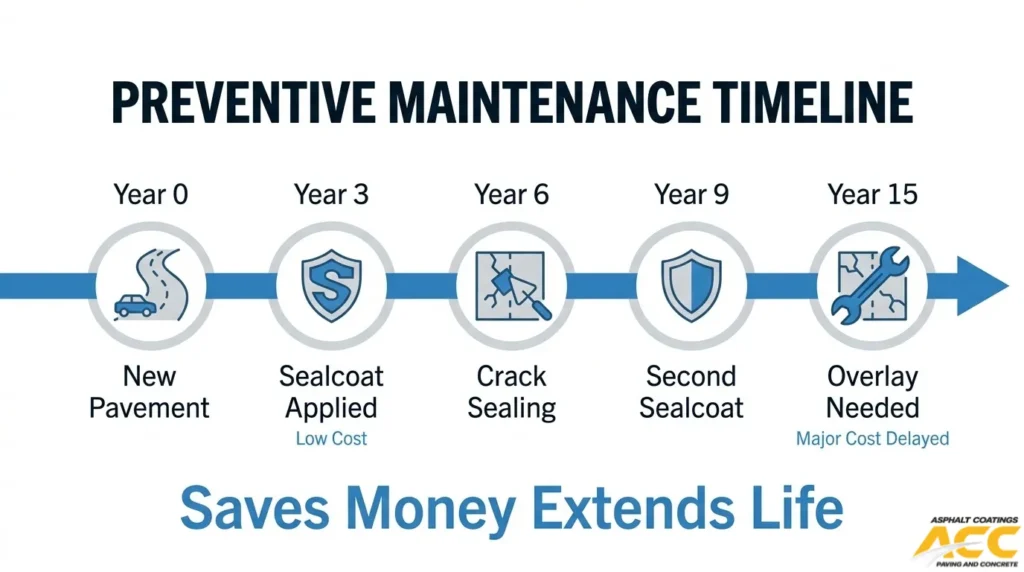
Regular sealcoating reduces long-term repaving frequency and tenant CAM burden by shielding asphalt from UV degradation, water infiltration, and oxidation that accelerate structural failure. Under a triple-net lease, tenants pay all maintenance costs, so every year of extended pavement life directly lowers their cumulative CAM obligation. Kentucky’s airport pavement program classifies surfaces with a Pavement Condition Index of 70 to 100 as eligible for preventive maintenance rather than major rehabilitation, according to the Kentucky Department of Aviation. Keeping a parking lot within that band through timely sealcoating avoids the jump to costlier rehabilitation work. Because accounting rules treat maintenance-level expenditures as current-year expenses rather than capitalized improvements, sealcoating passes through CAM as a smaller, predictable line item instead of a large capital assessment.
When Does Crack Sealing or Patching Make More Sense Than Full Repaving?
Crack sealing or patching makes more sense than full repaving when isolated distresses threaten pavement integrity but the overall surface remains structurally sound. According to the City of Woodland’s road report, crack sealing costs $0.48 per linear foot for in-house crews and $0.55 per linear foot through a contractor. The expected life extension from crack sealing is typically two to five years, as reported by the National Center for Asphalt Technology at Auburn University. Compared to overlay costs that can reach several dollars per square foot, targeted sealing offers significant savings. Each tenant’s share of these minor repairs stays proportional to the space they occupy exclusively, keeping pro rata CAM allocations manageable. For property managers, this approach buys time to plan and budget for eventual full repaving without shocking tenants with a sudden capital charge.
How Does Proactive Drainage and Subgrade Repair Help Avoid Major Repaving Bills?
Proactive drainage and subgrade repair helps avoid major repaving bills by eliminating the moisture infiltration that causes base failure, the single most common trigger for full reconstruction. Standing water penetrates cracks, softens the subgrade, and creates voids that lead to potholes and widespread alligator cracking. Once the base layer fails, surface treatments alone cannot restore structural capacity, and the only option becomes removal and replacement at capital-improvement pricing. Addressing drainage deficiencies early, through regrading, catch basin maintenance, or French drain installation, preserves the subgrade and keeps the pavement in the preventive-maintenance PCI band. This distinction matters for CAM because repairs that maintain an asset at its current level of operation are expensed rather than capitalized, according to Federal Reserve accounting guidance. Neglecting drainage converts a routine expense into a capital project that reshapes the entire CAM budget.
How Can Clear Maintenance Standards in the Lease Minimize Future Disputes Over Lot Condition?
Clear maintenance standards in the lease minimize future disputes over lot condition by defining inspection frequency, acceptable condition thresholds, and responsibility triggers before deterioration begins. The Florida DOT Pavement Condition Survey Unit conducts annual surveys of the entire state highway system, using crack, ride, and rut data to predict rehabilitation needs. Borrowing this structured approach for commercial leases means specifying annual or biennial pavement inspections with documented PCI scores. Leases should list which treatments, such as sealcoating, crack sealing, and patching, qualify as routine maintenance versus capital improvements. They should also state the PCI threshold at which full repaving becomes mandatory and identify which party funds each category. Without these definitions, landlords and tenants inevitably disagree over whether deferred work constitutes neglect or normal wear, a dispute that often escalates into costly litigation.
With maintenance strategies defined, selecting the right paving contractor ensures those standards translate into quality work and defensible CAM documentation.
How Should Property Managers Evaluate and Select an Asphalt Contractor for CAM-Funded Repaving?
Property managers should evaluate and select an asphalt contractor for CAM-funded repaving by verifying qualifications, requiring adequate insurance, collecting multiple detailed bids, and demanding transparent invoicing. The following subsections cover contractor credentials, bid scope, invoicing for reconciliation, and scheduling.
What Qualifications and Insurance Should You Require From a Parking Lot Paving Contractor?
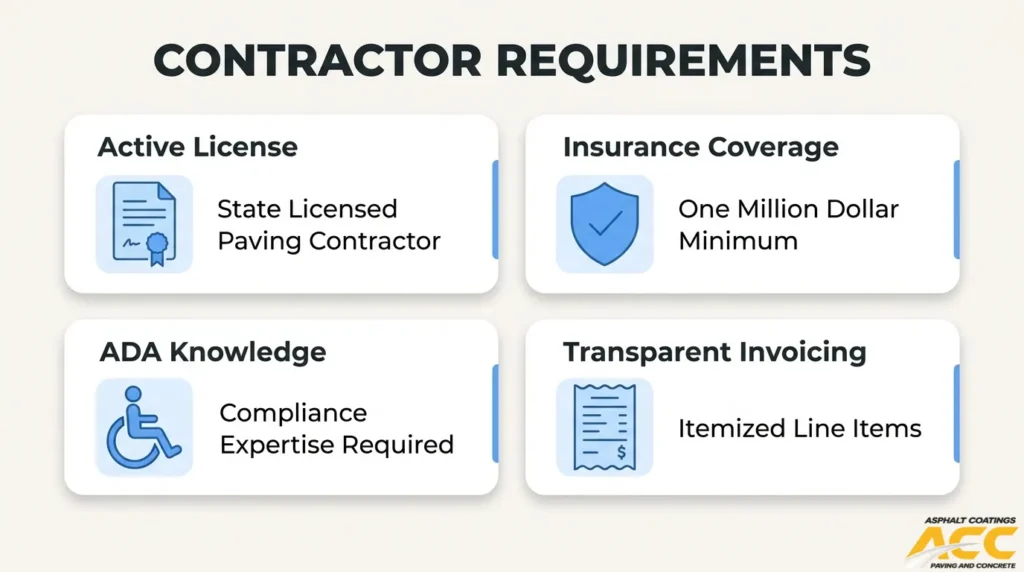
The qualifications and insurance you should require from a parking lot paving contractor include active state licensure, prequalification documentation, ADA compliance expertise, and commercial general liability coverage at appropriate minimums.
Prequalification is a proven vetting mechanism. California law allows public agencies to require licensed contractors to “pre-qualify” using a customizable Department of Industrial Relations questionnaire that meets all legal provisions. Virginia’s public-procurement law similarly requires prequalification applications to state evaluation criteria and request only information “appropriate for an objective evaluation.”
Key contractor requirements to verify:
- Active paving contractor license in the project’s state.
- Commercial general liability insurance with minimum limits of $1,000,000 per occurrence, $1,000,000 general aggregate, and $1,000,000 products and completed operations aggregate, following standards like Colorado DOT’s requirements.
- Workers’ compensation and auto liability certificates naming the property as additional insured.
- Demonstrated ADA knowledge, since the U.S. Access Board confirms that resurfacing of vehicular ways qualifies as an “alteration” triggering accessible-space requirements.
- Written change-order protocols with detailed pricing for labor, materials, equipment, and markups.
How Many Bids and What Level of Scope Detail Should You Seek for a Repaving Project?
You should seek a minimum of three competitive bids, each based on an identical, detailed scope of work that specifies square footage, pavement section design, drainage corrections, ADA upgrades, and striping.
Vague scopes invite change orders and make CAM reconciliation difficult. Every bid package should itemize unit prices for milling, overlay thickness, subgrade repair, and curb work. According to the City of Columbus ADA Rules and Regulations, the scope for any resurfacing project that includes roadway with sidewalk “shall include compliant curb ramps,” constructed prior to or concurrently with resurfacing. Including ADA line items upfront prevents surprise costs that tenants may challenge during reconciliation. Standardized scope documents also allow property managers to compare bids on an apples-to-apples basis, which strengthens defensibility if tenants audit the selected contractor’s pricing.
How Can You Ensure Transparent Invoicing That Supports CAM Reconciliation and Tenant Trust?
You can ensure transparent invoicing that supports CAM reconciliation and tenant trust by requiring itemized invoices, tying each line item to the original bid scope, and aligning payment milestones with the lease’s reconciliation timeline.
Most commercial leases require landlords to deliver an Annual Expense Reconciliation within 120 days after each lease year, comparing estimated CAM payments with actual expenses. Overpayments are credited and deficiencies become payable. Invoices that lump repaving into a single figure make this reconciliation nearly impossible to defend.
Effective invoice requirements include:
- Separate line items for mobilization, milling, paving, striping, ADA ramp work, and drainage.
- Unit quantities matching the original bid (square feet paved, tons of asphalt, linear feet of curb).
- Date-stamped progress photos documenting completed phases.
- Lien waivers submitted with each payment application.
This level of detail also satisfies ADA Title III documentation needs when alterations trigger accessibility upgrades.
What Scheduling and Phasing Questions Should You Ask to Minimize Tenant Disruption?
The scheduling and phasing questions you should ask to minimize tenant disruption focus on sequencing, traffic management, and coordination with tenant operating hours.
Property managers should require contractors to submit a written phasing plan before work begins. Essential questions include:
- Can the project be phased so at least 50% of parking remains accessible at all times?
- Will paving occur during off-peak hours or overnight to reduce customer impact?
- What is the expected cure time before vehicles can use newly paved sections?
- How will temporary striping, signage, and pedestrian routing maintain ADA access during construction?
- What weather contingency plan exists for rain or temperature delays?
Proactive scheduling prevents tenant complaints that can escalate into CAM disputes. For most multi-tenant properties, a phased approach costs marginally more but preserves tenant revenue, making it far easier to justify the expense during reconciliation.
With the right contractor selected and project terms locked down, Asphalt Coatings Company can help translate these standards into a concrete plan.
How Should You Approach Parking Lot Repaving Responsibilities With a Contractor Like Asphalt Coatings Company?
You should approach parking lot repaving responsibilities by partnering with a contractor that understands CAM structures, lease obligations, and long-term pavement strategies. The sections below cover how Asphalt Coatings Company supports CAM-friendly maintenance plans and the key takeaways from this guide.
How Can Asphalt Coatings Company Help With CAM-Friendly Parking Lot Maintenance, Sealcoating and Repaving Plans?
Asphalt Coatings Company helps with CAM-friendly parking lot maintenance, sealcoating, and repaving plans by combining 39 years of Colorado-specific expertise with a partnership approach designed for commercial property managers. Asphalt Coatings Company serves property managers, shopping centers, office parks, industrial complexes, and apartment communities across Colorado’s Front Range, including Denver and Colorado Springs.
Asphalt Coatings Company offers services that align directly with the maintenance tiers discussed throughout this article:
- Sealcoating protects existing pavement and extends intervals between full repaving, keeping recurring CAM costs lower.
- Crack sealing with CDOT-approved materials addresses early-stage distress before it escalates into capital-level reconstruction.
- Asphalt repair and patching targets localized failures, allowing phased spending that fits annual CAM budgets.
- Mill and pave services provide structural overlays when preventive treatments are no longer sufficient.
- ADA-compliant concrete work ensures curb ramps and accessible spaces meet federal requirements triggered by resurfacing projects.
- Subgrade preparation and grading addresses drainage problems that accelerate pavement failure.
Asphalt Coatings Company uses in-house crews rather than subcontractors, which simplifies invoicing and supports the transparent documentation landlords need for CAM reconciliation. For property managers balancing lease obligations with tenant expectations, that single-source accountability makes budgeting and audit compliance far more straightforward.
What Are the Key Takeaways About Who Pays for Parking Lot Repaving With CAM Charges, Landlords and Tenants?
The key takeaways about who pays for parking lot repaving with CAM charges, landlords, and tenants center on one principle: the lease controls everything.
- Lease type determines default responsibility. Triple-net leases pass maintenance costs, including repaving, to tenants. Gross leases bundle these expenses into the landlord’s base rent. Modified gross leases split obligations based on negotiated terms.
- The line between CAM expense and capital improvement matters. Routine sealcoating and patching typically qualify as operating expenses passed through CAM. Full reconstruction or structural overlays often fall under capital improvements, which landlords usually fund separately.
- Pro rata allocation formulas must be explicit. Multi-tenant properties require clear square-footage ratios, and anchor tenants frequently negotiate different CAM terms than inline tenants.
- Preventive maintenance reduces everyone’s long-term costs. Regular sealcoating, crack sealing, and drainage repairs extend pavement life and keep CAM charges predictable for tenants.
- Documentation protects both parties. Pavement condition assessments, itemized contractor invoices, and annual CAM reconciliation statements are essential for avoiding disputes.
- ADA and local code triggers add mandatory costs. Resurfacing a parking lot can require accessible-space upgrades regardless of what the lease says about who pays.
The most effective approach combines clear lease language with a proactive maintenance plan and a qualified contractor who provides transparent, audit-ready documentation. Waiting until pavement fails turns a manageable CAM line item into a capital expenditure that strains landlord-tenant relationships.