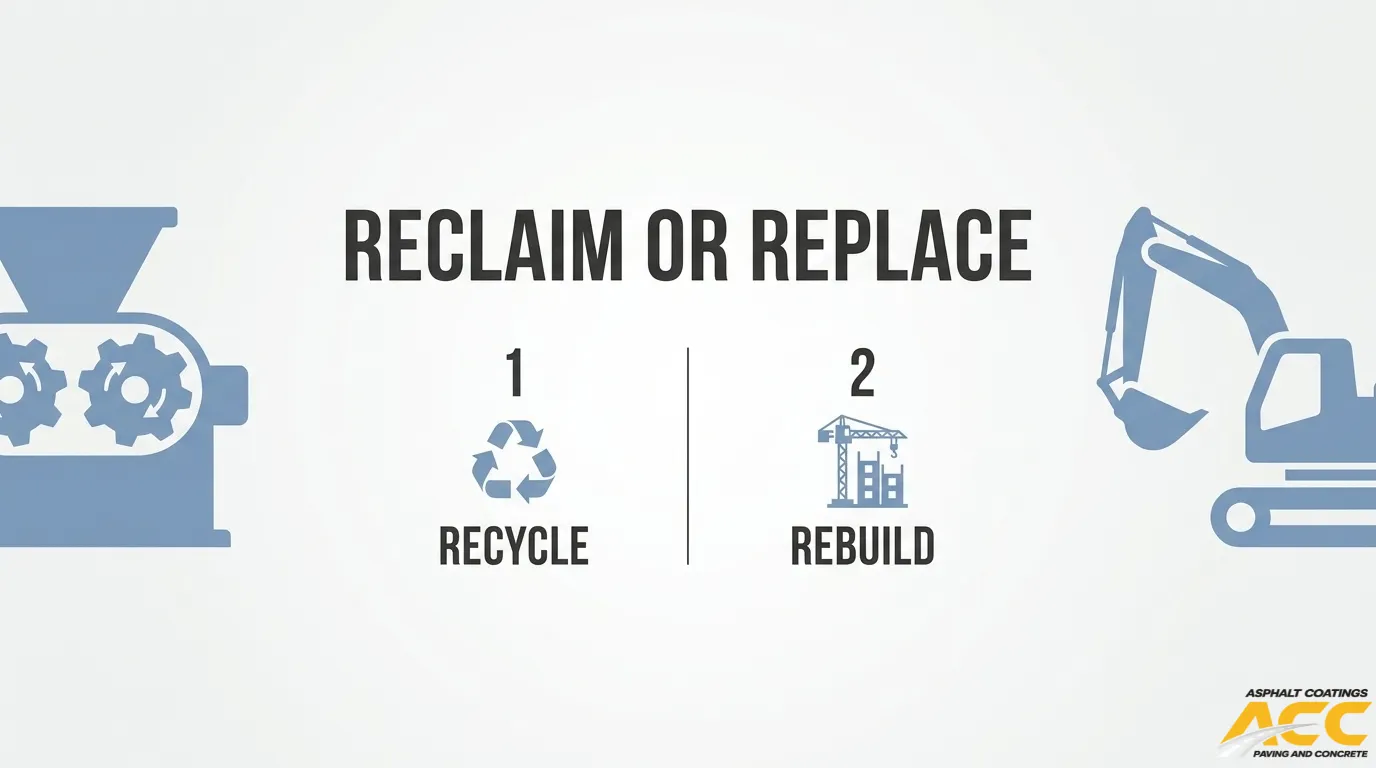
Full-depth reclamation (FDR) is a pavement rehabilitation method that pulverizes existing asphalt and base materials in place, blends them with stabilizing additives, and compacts the mixture into a strengthened foundation. Full replacement removes the entire pavement structure and rebuilds it from the subgrade up. Choosing between these two approaches depends on what lies beneath the surface and what the property requires going forward.
This guide covers how each method works and when it applies, the site conditions and distress patterns that determine candidacy, cost differences across construction and long-term maintenance, construction impacts and operational downtime, structural performance and durability under harsh climates, environmental and sustainability trade-offs, and design code and ADA compliance factors.
FDR follows five core steps (pulverization, additive introduction, shaping, compaction, and wearing course application) and works to depths of 4 to 12 inches using the existing pavement as its raw material. Full replacement involves demolition, hauling, subgrade preparation, new base installation, paving, and striping in sequential phases that typically require weeks longer to complete.
Candidacy hinges on distress type, base and subgrade condition, drainage adequacy, traffic loads, and repair history. Lots with surface-layer fatigue over a sound subgrade favor reclamation; widespread subgrade failure, severe ponding, or ADA slope deficiencies often demand full replacement.
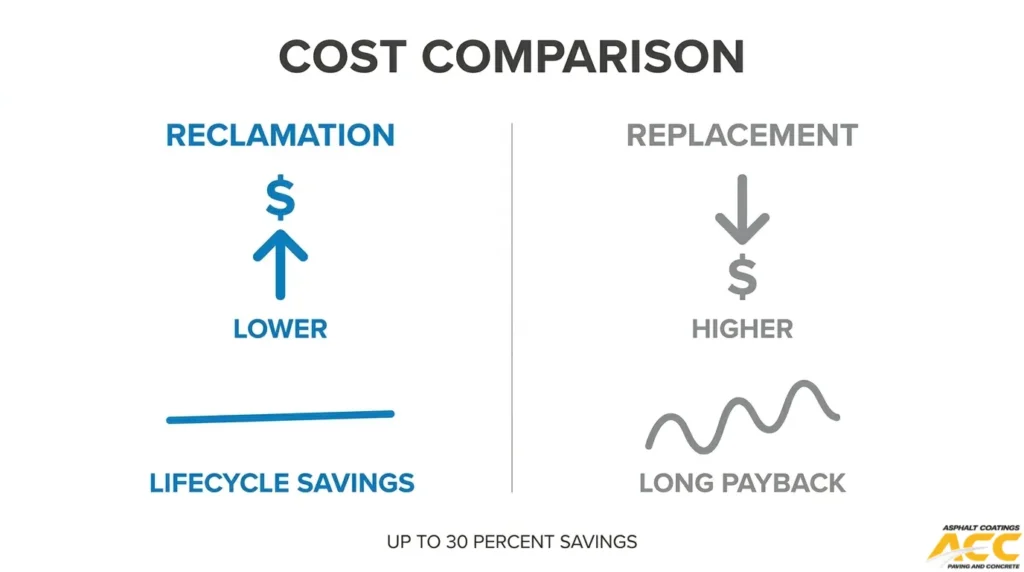
FDR delivers lower life-cycle costs, reduced material hauling, and shorter construction windows, while full replacement provides complete structural and grading control when existing conditions are too compromised to reclaim.
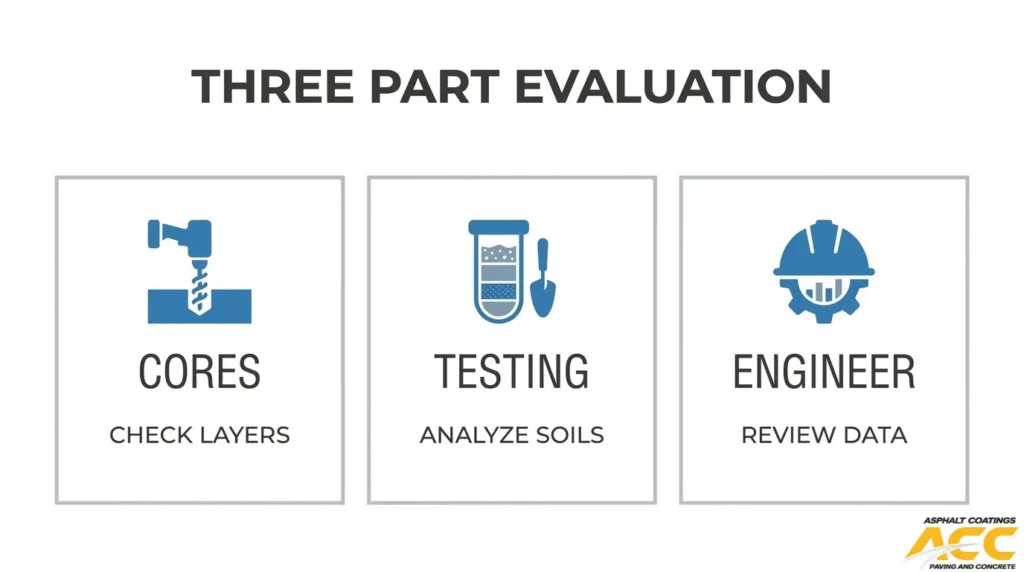
Freeze-thaw exposure, expansive soils, and compressed paving seasons in mountain-state climates add further weight to the decision, making pavement cores, geotechnical testing, and qualified engineering input essential before either method begins.
What Does Full-Depth Reclamation Involve for a Failing Parking Lot?
Full-depth reclamation involves pulverizing existing asphalt and base materials, blending them with stabilizing additives, and compacting the mixture into a strengthened foundation. The subsections below cover the step-by-step process, ideal candidate conditions, typical timelines, climate performance, and post-project maintenance.
How Does the Full-Depth Reclamation Process Work Step by Step?
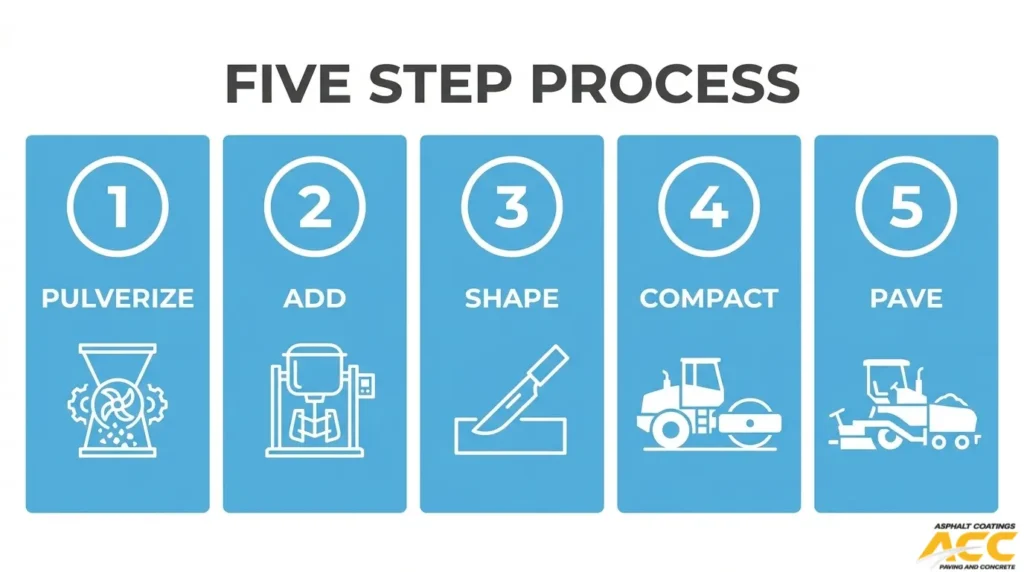
The full-depth reclamation process works by recycling the existing pavement structure in place rather than hauling it away. According to the Federal Highway Administration, this method is normally performed to a depth of 100 to 300 mm (4 to 12 inches) and follows five main steps:
- Pulverization of the existing asphalt surface and underlying base into uniform aggregate.
- Introduction of additives, such as portland cement, fly ash, lime, calcium chloride, or asphalt emulsions, to improve base strength.
- Shaping of the blended material to the required grade and cross-slope.
- Compaction to achieve target density and structural integrity.
- Application of a wearing course, typically hot-mix asphalt, as the final driving surface.
Because no material leaves the site during pulverization, the process eliminates most trucking and disposal costs associated with traditional removal.
What Existing Pavement and Base Conditions Make Full-Depth Reclamation a Good Candidate?
The existing pavement and base conditions that make full-depth reclamation a good candidate include widespread surface distress with a structurally sound subgrade. Parking lots showing fatigue cracking, moderate rutting, or failed overlays often qualify because the deterioration is concentrated in the asphalt layers rather than deep in the soil.
FDR is less suitable when water infiltration has already caused severe base failures. As the Pennsylvania Department of Transportation notes, water introduced to a pavement leads to potholes and base failures. Lots with isolated soft spots or drainage deficiencies need those issues corrected separately before reclamation can succeed. A thorough geotechnical investigation confirms whether the existing base can be recycled into a stable platform.
How Long Does Full-Depth Reclamation Typically Take for Commercial Parking Lots?
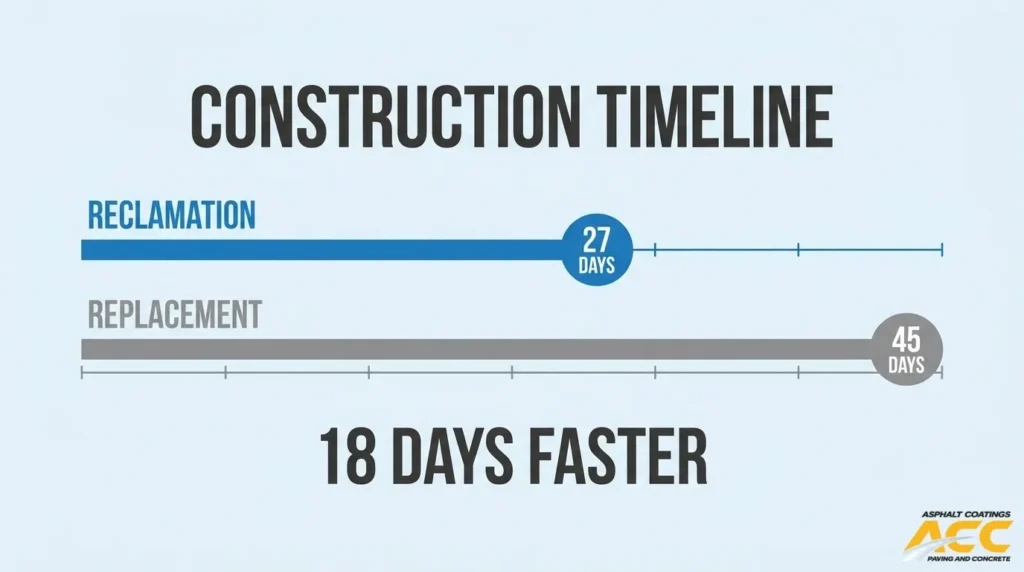
Full-depth reclamation typically takes significantly less time than full removal and reconstruction for commercial parking lots. Pulverization, stabilization, compaction, and paving can often be completed in a continuous sequence over days rather than weeks. For a comparable project, one Iowa State University analysis estimated the FDR approach would shorten the schedule by 18 days versus complete removal and reconstruction. Smaller commercial lots generally finish faster because equipment mobilization and curing occupy a fixed baseline regardless of area. Phased scheduling allows sections to reopen progressively, further reducing total operational downtime.
How Does Full-Depth Reclamation Perform in Freeze-Thaw and High-Altitude Conditions?
Full-depth reclamation performs well in freeze-thaw and high-altitude conditions when proper stabilization and curing protocols are followed. A Minnesota Department of Transportation study concluded that there was no significant loss of resilient modulus due to freeze-thaw conditioning for tested FDR samples. This resilience makes reclamation a practical option in mountain-state climates where pavement endures hundreds of freeze-thaw cycles annually.
Timing is critical, however. FDR with cement should not be placed when freezing temperatures are anticipated within seven days of completion, since premature freezing compromises hydration and long-term strength gain. For high-altitude regions with short construction windows, scheduling reclamation between late spring and early fall maximizes curing reliability.
What Are the Typical Lifespan and Maintenance Needs After Full-Depth Reclamation?
The typical lifespan after full-depth reclamation ranges from 15 to 20 years or more when the stabilized base is properly constructed and maintained. Routine maintenance still applies: crack sealing, sealcoating, and periodic overlay preserve the wearing course above the reclaimed base.
One critical early-stage step is microcracking. According to the California Department of Transportation, the FDR-C surface is typically microcracked 46 to 56 hours after compaction to mitigate shrinkage cracking. This controlled process reduces reflective cracking at the surface without compromising long-term stiffness. After curing, maintenance follows the same intervals as conventionally paved lots: crack sealing every one to two years and sealcoating every three to five years. Proactive upkeep protects the investment and extends service life well beyond minimum expectations.
Understanding what reclamation involves clarifies when full replacement becomes the better alternative.
How Do You Know If a Parking Lot Is a Good Candidate for Full-Depth Reclamation vs. Full Replacement?
You know if a parking lot is a good candidate for full-depth reclamation vs. full replacement by evaluating distress types, base condition, drainage, traffic loads, and repair history. Each factor narrows the viable option.
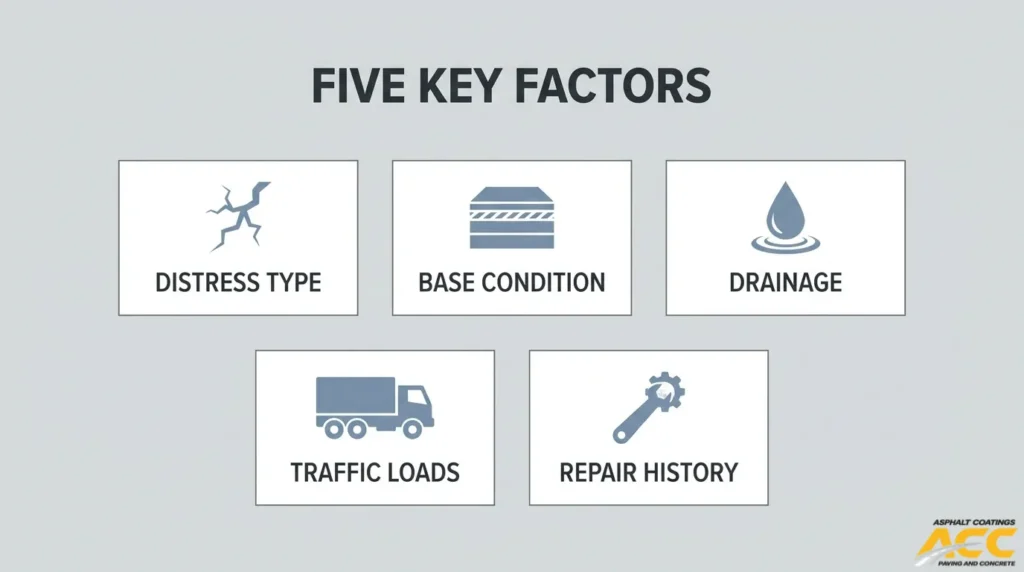
How Do Pavement Distress Types (Cracking, Rutting, Potholes) Influence the Best Option?
Pavement distress types influence the best option by revealing whether damage is confined to the surface or has compromised the full pavement structure. Surface-level alligator cracking and moderate rutting often indicate base fatigue that full-depth reclamation can correct by pulverizing and restabilizing the existing material. Widespread potholes, severe block cracking, and deep structural rutting, on the other hand, typically signal that both the surface and underlying layers have failed beyond what in-place recycling can address. In those cases, full replacement provides a completely new structural section. The critical distinction is depth: distress limited to the upper pavement layers favors reclamation, while distress that extends into or originates from the base points toward full removal.
How Does the Condition of the Base and Subgrade Affect Whether Reclamation Will Work?
The condition of the base and subgrade affects whether reclamation will work because FDR relies on the existing base material to form a stabilized structural layer. If the aggregate base is contaminated, too thin, or inconsistent in composition, the pulverized blend may not achieve adequate strength. Subgrade problems present an even harder constraint. According to the Federal Highway Administration’s Federal Lands Pavement Design and Management Manual, FDR does not address localized subgrade or drainage problems, and these areas should be identified during the pavement investigation with solutions developed to address the cause. When subgrade failures are isolated, targeted excavation and replacement of those zones can occur alongside reclamation. Widespread subgrade instability, however, typically demands full replacement.
How Do Drainage and Grading Problems Impact the Choice Between Reclamation and Replacement?
Drainage and grading problems impact the choice between reclamation and replacement by determining whether the existing lot geometry can be preserved or must be redesigned. Full-depth reclamation maintains the general grade profile of the original surface. If ponding results from inadequate cross-slopes or missing drainage infrastructure, reclamation alone cannot fix those deficiencies. Full replacement allows engineers to regrade the subbase, install new catch basins, and establish proper slope profiles from scratch. Soil conditions compound this challenge. As noted by Colorado State University Extension, along Colorado’s Front Range many soils are clayey and compact readily, and these soils may have poor drainage, which may lead to salt problems. For lots built on such soils with persistent water issues, full replacement paired with improved drainage design is often the more reliable path.
How Do Traffic Loads and Vehicle Types (Cars vs. Heavy Trucks) Shape the Right Structural Solution?
Traffic loads and vehicle types shape the right structural solution by dictating how thick and strong the pavement section must be. Parking lots serving primarily passenger cars generate relatively low equivalent single-axle loads, making them well-suited candidates for reclamation with cement or emulsion stabilization. Lots that regularly accommodate delivery trucks, garbage haulers, fire apparatus, or distribution vehicles face significantly higher load demands. These heavier loads require thicker base sections and surface courses that may exceed what a reclaimed layer can provide. When a parking lot must support mixed-use traffic with frequent heavy vehicles, full replacement with an engineered structural design offers greater confidence in long-term load-bearing performance. Underestimating traffic loads is one of the most common mistakes in rehabilitation decisions, and it often leads to premature failure regardless of which method is chosen.
How Do Prior Repairs and Overlays Influence Whether Reclamation or Replacement Is More Appropriate?
Prior repairs and overlays influence whether reclamation or replacement is more appropriate by changing the composition and uniformity of the material that the reclaimer would pulverize. A lot with one or two consistent asphalt lifts over a clean aggregate base produces a predictable blend ideal for stabilization. Multiple patch repairs using different mix designs, fabric interlayers, or thick overlays stacked over decades create an inconsistent material profile. This variability makes it difficult to achieve uniform stabilization depth and additive distribution during reclamation. Extensive prior work can also mask underlying base contamination or subgrade issues that only become apparent during milling. When a parking lot’s repair history is complex or poorly documented, full replacement eliminates the uncertainty by starting with a verified subgrade and freshly engineered structural section.
With candidacy factors evaluated, comparing costs for each method helps property managers align the technical recommendation with their budget.
How Do Costs Compare Between Full-Depth Reclamation and Full Replacement?
Costs between full-depth reclamation and full replacement differ across upfront construction, life-cycle maintenance, project scale, unforeseen conditions, and long-term capital planning. The sections below break down each cost factor.
How Do Upfront Construction Costs Differ Between Full-Depth Reclamation and Full Replacement?
Upfront construction costs for full-depth reclamation are typically lower than full replacement because FDR reuses existing pavement materials on-site, eliminating hauling and new aggregate expenses. Full replacement requires complete demolition, removal, disposal, new base import, and fresh asphalt installation. According to Iowa State University’s Guide to Full-Depth Reclamation with Cement, the FDR approach can reduce surface pavement thickness requirements due to increased base strength, further lowering material costs. However, unexpected site conditions frequently trigger change orders during construction, adding unplanned expenses to either method. For parking lots with predictable base conditions, FDR consistently delivers meaningful savings on day-one construction budgets.
How Do Life-Cycle and Long-Term Maintenance Costs Compare for Each Option?
Life-cycle and long-term maintenance costs favor full-depth reclamation over conventional rehabilitation. A 2024 study by the Colorado Department of Transportation and University of Colorado Boulder found that FDR pavements average $178,243 per lane-mile less in life-cycle costs than overlay pavements, a potential saving of 30%. The strengthened base that FDR creates reduces the frequency of crack sealing, patching, and overlay cycles over the pavement’s service life. Full replacement can match FDR longevity, but its higher initial investment extends the payback period. For most commercial property managers, FDR’s lower total cost of ownership makes it the stronger financial choice when base conditions support it.
How Do Project Size and Phasing Affect Per-Square-Foot Pricing for Each Method?
Project size and phasing affect per-square-foot pricing by influencing mobilization costs, equipment utilization, and scheduling efficiency. Key factors include:
- Larger projects spread fixed mobilization and equipment costs across more square footage, reducing the per-unit price for both FDR and full replacement.
- FDR benefits more from scale because the reclaimer operates continuously across open areas without pausing for material hauling.
- Phased projects increase per-square-foot costs since crews must mobilize multiple times and work around active traffic areas.
- Full replacement phasing requires repeated demolition and paving setups, compounding mobilization expenses beyond what FDR typically incurs.
Consolidating phases into fewer, larger stages is one of the most practical ways to control costs regardless of method.
How Do Subgrade Issues or Unforeseen Conditions Change the Total Cost for Each Approach?
Subgrade issues and unforeseen conditions change the total cost for each approach by triggering unplanned excavation, material import, and schedule delays. The U.S. Department of Transportation’s Volpe Center identifies unexpected site conditions as a common cause of construction change orders, including differing subsurface conditions discovered during field work. For FDR, soft subgrade pockets or contaminated soils may require localized removal before reclamation can proceed. Full replacement exposes the entire subgrade, which can reveal:
- Clay pockets requiring stabilization or over-excavation.
- Inadequate drainage layers needing new stone or geotextile installation.
- Buried utilities or debris demanding rerouting or removal.
Thorough geotechnical investigation before construction remains the most effective way to minimize cost surprises with either approach.
How Do Budget Constraints and Capital Planning Influence Which Option Makes More Financial Sense?
Budget constraints and capital planning influence which option makes more financial sense by determining whether a property can absorb a larger one-time expense or needs a lower initial outlay. FDR suits tighter capital budgets because it delivers structural rehabilitation at a fraction of full replacement cost, preserving cash for other property improvements. Full replacement requires a larger upfront commitment but resets the pavement’s service life entirely, which may align better with long-term hold strategies or refinancing timelines. Properties pursuing sustainability certifications should also factor in that recycled-content materials from FDR can contribute toward LEED credit thresholds. Matching the rehabilitation method to the property’s financial timeline, not just the pavement’s condition, leads to the strongest return on investment.
Understanding total project costs sets the stage for evaluating how construction impacts and downtime differ between each method.
How Do Construction Impacts and Downtime Differ Between Full-Depth Reclamation and Full Replacement?
Construction impacts and downtime differ significantly between full-depth reclamation and full replacement. Reclamation consolidates steps on-site, while replacement involves demolition, hauling, and new material delivery. The sections below compare operational downtime, phasing strategies, and noise and dust levels for each method.
How Much Operational Downtime Should Property Managers Expect with Full-Depth Reclamation?
Property managers should expect significantly less operational downtime with full-depth reclamation than with full replacement. FDR pulverizes existing asphalt and base in place, eliminating the need for demolition removal and new aggregate import. According to a guide published by Iowa State University’s Institute for Transportation, analysis of a pavement project indicated that the FDR approach would shorten the construction schedule by 18 days compared to complete removal and reconstruction. This compressed timeline translates directly into fewer days of restricted parking and reduced revenue disruption for commercial tenants. For most retail and healthcare properties, that difference can mean staying partially operational throughout the project rather than closing entire zones for weeks.
How Much Operational Downtime Should Property Managers Expect with Full Replacement?
Property managers should expect substantially longer operational downtime with full replacement. Full replacement requires sequential phases: sawcutting, demolition, material hauling to landfill, subgrade proof-rolling, new aggregate base installation, asphalt paving, and striping. Each phase introduces its own equipment mobilization and curing windows. The same Iowa State analysis estimated that complete removal and reconstruction of an equivalent pavement section would require roughly 45 to 50 days of downtime. Unexpected site conditions, such as soft subgrade pockets discovered during proof-rolling, frequently trigger change orders that extend schedules further. For properties that depend on daily foot traffic, this extended closure period demands careful financial planning and tenant communication well before construction begins.
How Can Phasing and Staging Minimize Disruption for Tenants, Patients, and Shoppers?
Phasing and staging can minimize disruption by dividing the parking lot into work zones completed sequentially, keeping a portion of the lot accessible at all times. Effective phasing strategies include:
- Splitting the lot into halves or thirds so tenants retain parking during each construction phase.
- Scheduling high-noise work during off-peak business hours.
- Establishing clearly signed temporary access routes for customers and deliveries.
- Designating overflow parking with wayfinding signage to maintain visibility for open businesses.
As required by the New York City Department of Buildings’ Tenant Protection Plan framework, any anticipated disruption of services, the length of disruption, steps taken to minimize it, and alternate arrangements must be specified, and all affected tenants must be notified. Applying this principle to commercial lot projects protects tenant relationships and reduces complaint escalation.
How Do Noise, Dust, and Access Limitations Compare Between the Two Methods?
Noise, dust, and access limitations are generally more intense and prolonged during full replacement than during full-depth reclamation.
- Noise: FDR uses a single reclaimer pass and compaction rollers. Full replacement adds concrete sawcutting, jackhammering, and repeated heavy truck traffic for hauling and delivery. OSHA requires hearing conservation programs when construction exposures exceed 90 dBA, a threshold more easily reached during demolition-heavy replacement work.
- Dust: Both methods generate airborne particulates, but full replacement produces more dust from demolition debris, exposed subgrade, and aggregate stockpiling. CDC/NIOSH evaluations have identified lack of dust control during construction as a key factor affecting indoor environmental quality in adjacent occupied buildings.
- Access: Replacement projects block larger areas for longer periods because each phase requires full-depth excavation. FDR zones can often reopen to traffic sooner since the reclaimed base is compacted in place without deep excavation.
For property managers balancing construction needs with tenant satisfaction, FDR’s reduced noise footprint and shorter zone closures make it the less disruptive option in most commercial settings.
How Do Performance, Durability, and Risk Differ Between Full-Depth Reclamation and Full Replacement?
Performance, durability, and risk differ between full-depth reclamation and full replacement based on climate exposure, structural capacity, surface distress behavior, failure modes, and warranty terms. The following subsections compare each factor.
How Do Freeze-Thaw Cycles in Mountain and High-Altitude Climates Affect Each Option?
Freeze-thaw cycles in mountain and high-altitude climates affect each option by accelerating moisture-related damage through repeated expansion and contraction within the pavement structure. According to the Minnesota Department of Transportation’s Investigation of Performance Requirements of Full-Depth Reclamation (Report 2016-09), researchers concluded there was no significant loss of resilient modulus due to freeze-thaw conditioning for tested FDR samples, with effects only significant at low confining pressures. Full replacement sections face their own vulnerabilities; freeze-thaw damage can cause surface spalling, and developed cracks facilitate water penetration that compounds deterioration over successive winter seasons. Cement-stabilized reclamation requires careful scheduling, since placement should not occur when freezing temperatures are anticipated within seven days. For Colorado properties above 5,000 feet, both options demand freeze-thaw-conscious design, but properly stabilized FDR has demonstrated resilient modulus retention that many property managers underestimate.
How Do Load-Bearing Capacity and Structural Strength Compare Between Reclaimed and New Sections?
Load-bearing capacity and structural strength compare differently between reclaimed and new sections because each derives structural integrity from distinct mechanisms. Cement-stabilized FDR creates a monolithic base that can achieve unconfined compressive strengths of 175 psi or higher after seven-day moist curing. Full replacement builds strength through engineered aggregate layers topped with new hot-mix asphalt. One critical distinction often overlooked: as noted by the Indiana Department of Transportation, during a PCI inspection only the top layer of the pavement is examined and no direct measure is made of the structural capacity of the pavement system. This means surface appearance alone cannot confirm whether a reclaimed or replaced section delivers adequate load-bearing performance. Deflection testing and pavement cores provide far more reliable structural assessments than visual surveys for either method.
How Does Each Option Handle Future Cracking, Raveling, and Surface Distress?
Each option handles future cracking, raveling, and surface distress through different mechanisms tied to base stability and surface course quality. Reclaimed sections benefit from microcracking protocols performed 46 to 56 hours after compaction, which reduce transverse crack propagation at the surface. Research from the Virginia Transportation Research Council found that microcracking led to reduced transverse crack development, and early-age stiffness reductions mostly or fully recovered over time. Full replacement sections rely on properly compacted new aggregate base and quality hot-mix asphalt to resist raveling and thermal cracking. As referenced in the Ohio Department of Transportation’s Pavement Design Manual, specifications include a two-year warranty providing remedial action for surface defects such as debonding, raveling, and bleeding. Regardless of method, timely crack sealing remains essential because water infiltration accelerates every form of surface distress.
What Are the Main Risks of Premature Failure for Full-Depth Reclamation vs. Full Replacement?
The main risks of premature failure for full-depth reclamation vs. full replacement stem from different vulnerabilities in each approach. FDR faces premature failure when:
- Unidentified subgrade or drainage problems persist beneath the reclaimed layer.
- Cement content is improperly proportioned, producing insufficient compressive strength.
- Placement occurs too close to freezing temperatures, preventing adequate curing.
- Inadequate compaction fails to reach the minimum 96% modified Proctor density target.
Full replacement risks premature failure when:
- Soft subgrade pockets go undetected during proof-rolling.
- Unexpected site conditions trigger costly change orders and compromised construction quality.
- Poor drainage design allows water to undermine the new base structure.
Both methods share one fundamental risk: skipping thorough geotechnical investigation before construction begins.
How Do Warranty Expectations Typically Differ Between Reclaimed and Fully Rebuilt Lots?
Warranty expectations typically differ between reclaimed and fully rebuilt lots in scope, duration, and what triggers remedial action. FDR warranties commonly cover the stabilized base layer’s structural performance, while surface course warranties address defects visible at the wearing course level. Full replacement warranties tend to encompass the entire pavement section from subgrade preparation through final surface. Standard specifications often include a two-year warranty period covering surface defects such as debonding, raveling, and bleeding. Property managers should negotiate warranties that clearly define covered distresses, response timelines, and inspection protocols for both options. In practice, the warranty is only as valuable as the contractor’s willingness and financial capacity to honor it.
Understanding how performance and risk compare between these two methods sets the stage for evaluating their environmental trade-offs.
How Do Environmental and Sustainability Considerations Compare Between Full-Depth Reclamation and Full Replacement?
Environmental and sustainability considerations between full-depth reclamation and full replacement differ primarily in material reuse, hauling volume, fuel consumption, and eligibility for green building credits. The following subsections cover landfill diversion, emissions, environmental footprint, and available incentives.
How Does Full-Depth Reclamation Reduce Material Hauling and Landfill Waste?
Full-depth reclamation reduces material hauling and landfill waste by recycling the existing asphalt and base in place, eliminating the need to remove and transport old pavement off-site. According to the Minnesota Department of Transportation’s Greenhouse Gas Analysis Process, FDR directly reduces emissions through decreased fuel use and indirectly through materials reuse, meaning less processing and transport of new materials. Because the pulverized material stays on-site and becomes the new stabilized base, truck trips to landfills and aggregate quarries drop significantly. Full replacement, by contrast, generates large volumes of demolition debris that must be hauled away. For most commercial parking lots, this single difference in material handling represents the largest environmental advantage FDR holds over full replacement.
How Do Fuel Use and Equipment Emissions Differ Between Reclamation and Replacement?
Fuel use and equipment emissions differ substantially because reclamation consolidates multiple construction phases into fewer passes with a single reclaimer unit, while full replacement requires separate equipment for demolition, hauling, grading, and repaving. Key factors that increase fuel consumption and emissions during full replacement include:
- Jackhammers or milling machines to remove existing pavement.
- Loaded dump trucks making repeated round trips to disposal sites and material suppliers.
- Separate deliveries of new aggregate base and hot-mix asphalt.
FDR minimizes these trips by processing materials on-site in a single mobilization. Fewer truck miles translate directly into lower diesel consumption and reduced carbon output per square foot of rehabilitated parking lot.
How Does Recycling and Reusing Existing Materials Affect the Project’s Environmental Footprint?
Recycling and reusing existing materials affects the project’s environmental footprint by shrinking the demand for virgin aggregate, reducing quarry extraction, and lowering dust and emissions generated during material production. When pavement is pulverized and stabilized in place, the entire existing section becomes a structural asset rather than waste. A CDC/NIOSH evaluation of construction projects found that a lack of dust control and the use of high-emission building materials were common issues affecting environmental quality during renovation work. FDR sidesteps much of this concern because it reprocesses materials at ambient temperatures rather than requiring hot-plant production of new asphalt. Keeping old material in the pavement structure rather than sending it to a landfill is one of the most straightforward ways to reduce a rehabilitation project’s total environmental burden.
Are There Incentives or Credits for Choosing More Sustainable Pavement Rehabilitation Methods?
Yes, there are incentives and credits for choosing more sustainable pavement rehabilitation methods. The LEED BD+C rating system awards Recycled Content credits (MRc4) when the sum of postconsumer recycled content plus half of preconsumer content reaches at least 10% or 20% of total material value. FDR projects can contribute toward this threshold because the reclaimed base qualifies as recycled content. Beyond LEED, the federal Carbon Reduction Program funded through the Bipartisan Infrastructure Law has unlocked $6.4 billion in formula funding over five years for states and localities to develop carbon reduction strategies. Property managers pursuing sustainability certifications or applying for public infrastructure grants should document the recycled material percentages in their FDR specifications to maximize eligibility.
With environmental benefits established, the next step is understanding how design codes and ADA requirements shape the final decision.
How Do Design, Code, and ADA Considerations Affect the Choice Between Full-Depth Reclamation and Full Replacement?
Design, code, and ADA considerations affect the choice between full-depth reclamation and full replacement by determining whether existing grades, slopes, and layouts can remain or must be rebuilt. The subsections below cover slope and drainage deficiencies, grade and ponding corrections, ADA-specific requirements, and striping or signage updates.
When Is Full Replacement Needed to Correct Slopes, Drainage, and Layout Deficiencies?
Full replacement is needed to correct slopes, drainage, and layout deficiencies when the existing subgrade profile cannot achieve code-compliant grades through surface-level work alone. According to the Illinois Department of Transportation, the minimum cross slope on a parking lot should be 1.0%, and the maximum should not exceed 5.0%. When current grades fall outside these thresholds, or when the drainage infrastructure itself requires relocation, reclamation cannot reestablish the necessary flow paths. Lots with ponding caused by settled subgrade, misaligned catch basins, or outdated layouts typically require full removal so engineers can regrade from the subbase up and reposition drainage structures. For properties built decades ago, this is often the only path to meeting current stormwater and accessibility codes simultaneously.
Can Full-Depth Reclamation Alone Address Grade, Cross-Slope, and Ponding Issues?
Full-depth reclamation alone can address grade, cross-slope, and ponding issues only when deviations are minor and the underlying subgrade is structurally sound. Because the process pulverizes and reshapes existing material, crews can adjust surface profiles within a limited range during the shaping phase. However, the Federal Highway Administration notes that FDR does not address localized subgrade or drainage problems; those areas must be identified during investigation with separate solutions developed. Longitudinal slopes below 0.5% often cause ponding and debris accumulation, a condition reclamation may not fully correct if the root cause sits beneath the reclaimed depth. Minor cross-slope adjustments are feasible, but significant regrading demands excavation that exceeds reclamation’s scope.
How Do ADA Parking, Ramps, and Accessible Routes Factor into Reclamation vs. Replacement Decisions?
ADA parking, ramps, and accessible routes factor into reclamation vs. replacement decisions by imposing strict slope tolerances that the chosen method must achieve. The U.S. Department of Justice specifies that van-accessible parking spaces must have no more than a 1:48 (2.08%) slope in all directions. Accessible routes require running slopes no steeper than 1:20 per the U.S. Access Board’s Chapter 4 guidelines. When an existing lot already meets these tolerances, reclamation can preserve compliant areas while refreshing the pavement structure. If accessible spaces, ramps, or routes fall outside required slopes, full replacement provides the subgrade control needed to rebuild these zones to specification. Overlooking ADA compliance during rehabilitation is one of the costliest mistakes a property manager can make, since retrofitting after paving is far more expensive than building it right the first time.
How Can Striping, Signage, and Layout Changes Be Incorporated into Either Approach?
Striping, signage, and layout changes can be incorporated into either approach because both reclamation and full replacement conclude with a fresh asphalt surface course that accepts new pavement markings. The key differences involve timing and scope:
- Full replacement allows complete reconfiguration of stall dimensions, traffic flow arrows, ADA signage placement, and fire lane markings during the design phase before any paving begins.
- Full-depth reclamation accepts new striping and signage after the wearing course is applied, though layout changes are limited to what the existing footprint and grades support.
- Both methods accommodate updated ADA-compliant parking symbols, van-accessible signage, and directional markings as part of the final scope.
For properties that need only refreshed markings on a structurally sound layout, reclamation keeps costs lower while still delivering a clean surface for striping. Properties requiring wholesale layout redesigns benefit from the blank-slate flexibility that full replacement provides.
Understanding these code and accessibility requirements helps property managers scope their next rehabilitation project accurately.
How Should Property Managers in Harsh-Climate Regions Evaluate Full-Depth Reclamation vs. Full Replacement?
Property managers in harsh-climate regions should evaluate full-depth reclamation vs. full replacement by weighing local freeze-thaw severity, soil conditions, long-term cost performance, and engineering data. The subsections below cover Colorado-specific climate factors, cost-versus-performance trade-offs, testing protocols, and essential contractor questions.
How Do Colorado’s Freeze-Thaw Cycles and Soils Influence the Best Rehabilitation Strategy?
Colorado’s freeze-thaw cycles and soils influence the best rehabilitation strategy by determining how well a reclaimed or replaced base will hold up over time. According to NOAA Climate.gov, Boulder’s freeze risk does not drop below 50 percent until May 6, compressing the reliable paving window into late spring through early fall. Along the Front Range, many soils are clayey and compact readily, creating poor drainage that accelerates frost-related damage. The Colorado Geological Survey identifies the California Bearing Ratio swell test as a primary design test for expansive soils under roads. When expansive clay is present, full replacement with engineered subgrade correction often outperforms reclamation, which cannot resolve deep soil instability on its own.
How Should Owners Balance Short-Term Savings Against Long-Term Performance in Mountain States?
Owners should balance short-term savings against long-term performance in mountain states by factoring freeze-thaw degradation into life-cycle cost projections, not just initial bid prices. A review by Luo, Bai, Guo, Wei, and Ma on freeze-thaw impacts found that repeated cycles cause surface spalling and crack propagation, allowing water and harmful ions to penetrate and accelerate structural decline. Choosing a lower upfront cost that ignores this reality often leads to premature failure and costlier repairs within five to ten years. For most mountain-state properties, investing in the method that produces a stronger, freeze-resistant base yields better total cost of ownership, even when the initial expense is higher.
How Can Pavement Cores, Geotechnical Testing, and Engineer Input Inform the Decision?
Pavement cores, geotechnical testing, and engineer input inform the decision by revealing subsurface conditions that visual inspection alone cannot detect. Cores show remaining asphalt thickness, base composition, and layer bonding quality. Geotechnical borings identify clay content, moisture levels, and bearing capacity. According to the Indiana Department of Transportation, a PCI inspection only examines the top pavement layer and makes no direct measure of the structural capacity of the pavement system. Combining PCI scores with core data and a licensed engineer’s analysis gives property managers the evidence needed to determine whether the existing base supports reclamation or whether full replacement is necessary.
What Questions Should Property Managers Ask Contractors When Comparing Bids?
The questions property managers should ask contractors when comparing bids include:
- What subsurface testing or core sampling have you performed, and what did the results show?
- Does your bid include geotechnical analysis, or is that an additional cost?
- What stabilization agent do you recommend for our soil conditions, and why?
- How will you handle unexpected subgrade problems discovered during construction?
- What is your proposed construction schedule, and how will phasing minimize tenant disruption?
- What warranty terms do you offer for surface defects and structural performance?
- Can you provide references from comparable projects completed in freeze-thaw climates?
Requesting detailed answers to these questions exposes whether a contractor understands local conditions or is simply quoting a generic price.
With regional climate and testing factors clarified, the right paving partner can translate this evaluation into a durable, cost-effective solution.
How Should You Approach Failing Parking Lots with Asphalt Coatings Company’s Services?
You should approach failing parking lots with Asphalt Coatings Company’s services by leveraging site-specific evaluation, full-service paving capabilities, and nearly four decades of Colorado expertise to determine whether full-depth reclamation or full replacement best fits your property.
How Can Asphalt Coatings Company’s Paving, Reconstruction, and Maintenance Services Help You Choose Between Full-Depth Reclamation and Full Replacement?
Asphalt Coatings Company’s paving, reconstruction, and maintenance services help you choose between full-depth reclamation and full replacement by combining hands-on pavement assessment with comprehensive construction capabilities under one roof. Asphalt Coatings Company performs subgrade preparation, grading, asphalt paving, concrete flatwork, ADA-compliant installations, crack sealing, and sealcoating with in-house crews across Colorado’s Front Range. This single-source approach means the same team evaluating your base conditions also executes the repair, eliminating gaps between diagnosis and execution. With 39 years of experience navigating freeze-thaw cycles and Front Range soils, Asphalt Coatings Company can identify whether your lot’s distress patterns call for reclamation or complete reconstruction, then phase the work to minimize tenant disruption.
What Are the Key Takeaways About Full-Depth Reclamation vs. Full Replacement for Failing Parking Lots We Covered?
The key takeaways about full-depth reclamation vs. full replacement for failing parking lots are:
- Full-depth reclamation recycles existing asphalt and base in place, reducing material hauling, landfill waste, and construction timelines when the subgrade remains structurally sound.
- Full replacement is necessary when subgrade failure, severe drainage deficiencies, or ADA slope corrections require complete reconstruction from the ground up.
- Pavement cores, geotechnical testing, and distress surveys determine which method fits; surface inspections alone cannot measure structural capacity.
- Life-cycle costs, freeze-thaw durability, and traffic loads should carry equal weight alongside upfront pricing in any decision.
- Phased construction and clear tenant communication minimize operational downtime regardless of which method you select.
Choosing the right rehabilitation strategy starts with an honest assessment of what lies beneath the surface. Asphalt Coatings Company partners with commercial property managers across Denver, Colorado Springs, and the broader Front Range to deliver that evaluation and the construction solution that follows.