Fuel-resistant paving is a pavement system engineered to withstand chronic exposure to gasoline, diesel, motor oil, and hydraulic fluids without the binder dissolution, raveling, and structural failure that standard asphalt and concrete suffer in fueling environments.
This guide covers chemical damage mechanisms, material and mix design options, site layout and installation, protective sealers and coatings, climate-specific performance, maintenance protocols, regulatory compliance, cost analysis, and project planning.
Petroleum products dissolve standard asphalt binder on contact, softening the mixture and producing progressive distress like pitting and aggregate loss. Gasoline, diesel, motor oil, and de-icing chemicals each attack pavement differently, and UV radiation, heat, and freeze-thaw cycles compound the damage when surfaces are already compromised.
Material selection spans fuel-resistant asphalt with highly modified binders and low design air voids, reinforced concrete for heavy static-load zones, polymer-modified specialty mixes, and protective sealers including epoxy, polyurethane, and penetrating silane systems. Each performs best in specific exposure conditions.
Effective site design places the most chemically resistant materials in high-drip zones, grades surfaces to shed spills toward oil-water separators, and details joints with fuel-compatible sealants. Installation requires strict compaction targets, contamination-free substrates, and controlled curing conditions.
Climate factors like freeze-thaw cycling, intense UV at altitude, and snow plow abrasion accelerate fuel-related deterioration, making region-specific design and joint drainage critical to long-term performance.
Ongoing maintenance (prompt spill cleanup, quarterly inspections, early crack sealing, and scheduled recoating) consistently costs less than reactive reconstruction. Compliance with EPA stormwater rules, ADA slope standards, and spill containment requirements shapes every material and grading decision across the site.
Why Do Gas Stations and Fleet Yards Need Fuel-Resistant Paving?
Gas stations and fleet yards need fuel-resistant paving because routine fuel spills, chemical exposure, and heavy vehicle loads degrade standard pavement rapidly, creating safety hazards, environmental liability, and costly repairs. The specific risks span chemical degradation, fire and safety concerns, environmental enforcement, and financial consequences.
Fuel-resistant paving addresses a combination of chemical, structural, and regulatory pressures unique to fueling environments. Standard asphalt and concrete cannot withstand chronic petroleum contact without accelerated failure. Every operational day introduces new exposure through drips at dispensers, overfills during tanker deliveries, and hydraulic leaks from fleet vehicles.
Fuel oil dissolves asphalt binder on contact, softening the mixture and producing distress such as raveling and pitting, according to a peer-reviewed study published in the journal Sustainability. This dissolution process is not occasional; it is continuous at any active fueling site. Without chemical resistance engineered into the pavement surface, property owners face a compounding cycle where each spill weakens the surface further, allowing the next spill to penetrate deeper and faster.
The safety dimensions are equally pressing. Between 2014 and 2018, local fire departments responded to an estimated average of 4,150 fires annually on service or gas station properties, causing an average of three civilian deaths, 43 civilian injuries, and $30 million in direct property damage per year, according to National Fire Protection Association research. Damaged, porous pavement that absorbs fuel vapors increases ignition risk, while uneven surfaces from pavement failure create trip hazards for customers and employees.
Environmental regulations add another layer of urgency. The U.S. EPA reports that over 581,000 underground storage tank releases had been confirmed as of September 2025. Responsible parties are legally obligated to pay for cleanups themselves, and any spill quantity above the reportable threshold that contacts soil or has potential to impact state waters triggers mandatory remediation. Pavement that allows fuel to migrate through cracks into the subgrade transforms a surface spill into a soil contamination event, dramatically escalating cleanup costs and regulatory exposure.
From a financial perspective, degraded pavement at fueling sites costs significantly more to address reactively. Delaying maintenance and rehabilitation until a pavement structure has seriously degraded can cost three to four times more than applying treatment earlier in the pavement’s life cycle, according to the Georgia Department of Transportation’s Airport Pavement Management System report. For gas station owners and fleet managers, fuel-resistant paving is not a premium upgrade; it is the baseline investment that prevents exponentially higher costs from structural failure, environmental fines, and liability claims.
The practical reality is that standard paving was never designed for chronic chemical assault. Choosing fuel-resistant materials from the outset is the single most effective way to protect the investment, maintain regulatory compliance, and keep fueling operations running safely.
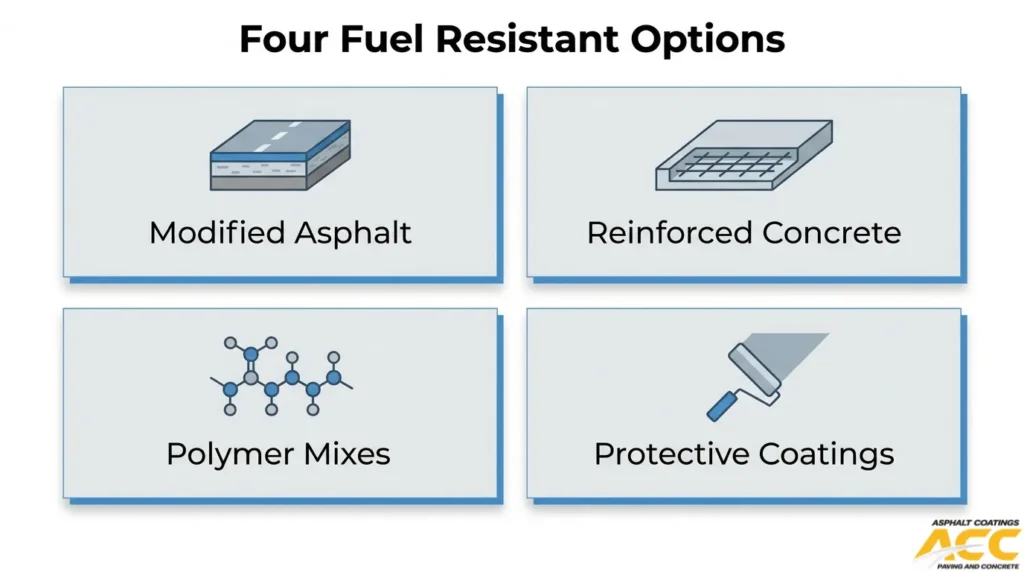
What Materials Are Commonly Used for Fuel-Resistant Paving?
The materials commonly used for fuel-resistant paving include modified asphalt, reinforced concrete, polymer-modified specialty mixes, and protective sealers or coatings. Each performs differently depending on traffic volume, fuel exposure frequency, and budget.
How Does Fuel-Resistant Asphalt Perform in Gas Stations and Fleet Yards?
Fuel-resistant asphalt performs well in gas stations and fleet yards when mix design and compaction meet strict standards. According to the National Asphalt Pavement Association, field compaction is the single most important construction property for long-term asphalt performance; a well-compacted dense-graded mixture becomes impermeable to water and air, resisting environmental aging.
Key performance factors include:
- Aggregate voids must be approximately 70 percent filled with asphalt cement for adequate durability under moderate traffic levels.
- Dense-graded mixes with sufficient binder content reduce permeability, limiting fuel penetration into the pavement structure.
- Asphalt preservation methods, such as micro surfacing and thin overlays, extend service life at significantly lower cost than full reconstruction.
For high-exposure fueling lanes, fuel-resistant asphalt remains one of the most cost-effective solutions when properly compacted and maintained.
When Is Fuel-Resistant Concrete a Better Choice?
Fuel-resistant concrete is a better choice when pavement faces continuous, heavy fuel exposure combined with high static loads. Concrete resists petroleum-based solvents more effectively than standard asphalt because its Portland cement binder does not dissolve on contact with gasoline or diesel.
Situations that favor concrete include:
- Fueling pads directly beneath dispensers, where drips are constant.
- Fleet maintenance bays with prolonged hydraulic fluid and oil contact.
- Heavy-load areas where trucks idle or park for extended periods.
Concrete’s higher upfront cost is offset by its chemical inertness in fuel zones. For sites with intermittent exposure, asphalt often provides better value, but concentrated spill areas benefit from concrete’s inherent resistance.
What Are Polymer-Modified or Specialty Fuel-Resistant Mixes?
Polymer-modified or specialty fuel-resistant mixes are asphalt formulations enhanced with polymer additives to resist chemical degradation from petroleum products. These mixes combine highly modified binders with tighter void structures to minimize fuel absorption.
The primary types include:
- Styrene-butadiene-styrene (SBS) modified asphalt: Improves elasticity and fuel resistance in high-traffic fueling areas.
- Fuel-resistant hot mix asphalt (P-404): Designed for airfields and adaptable to commercial fueling zones.
- Semi-flexible pavement: Uses a cementitious grout to fill voids in open-graded asphalt, creating a hybrid surface that resists fuel penetration.
Polymer-modified mixes consistently outperform standard penetration-grade asphalt in fuel immersion tests. For fleet yards with diesel and jet fuel exposure, these specialty formulations offer measurably longer service life than conventional options.
How Do Fuel-Resistant Sealers and Coatings Protect Existing Pavement?
Fuel-resistant sealers and coatings protect existing pavement by forming a chemical barrier between fuel spills and the underlying binder or concrete surface. They are the most practical option when full repaving is not warranted.
Common sealer and coating types include:
- Penetrating sealers: Absorb into concrete pores, blocking fuel and chloride intrusion without changing surface texture.
- Epoxy-resin coatings: Provide strong chemical resistance and maintain binder properties over time.
- Polyurethane-resin coatings: Offer shorter cure times than epoxies, allowing faster return to traffic.
- Acrylic sealers: Suitable for lighter exposure areas with less aggressive chemical contact.
According to the U.S. Bureau of Reclamation’s Guide to Protective Coatings, coatings should only be applied when substrate temperature is at least 5°F above the dew point. Proper surface preparation and application timing determine whether sealers deliver lasting fuel resistance or fail prematurely.
Understanding which materials suit each zone of a fueling site sets the stage for examining how spills and chemicals actively damage unprotected pavement.
How Do Fuel Spills and Chemicals Damage Standard Asphalt and Concrete?
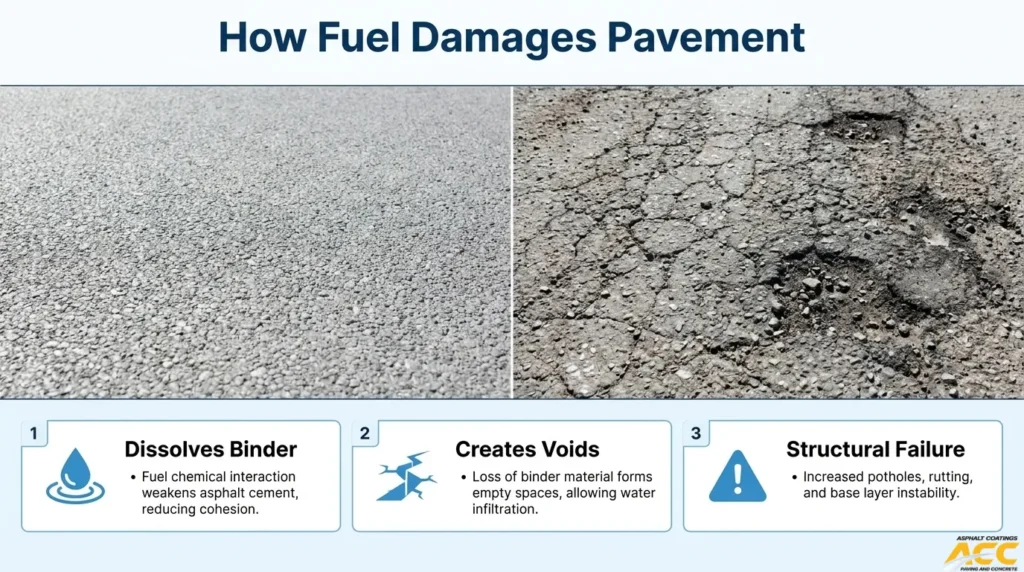
Fuel spills and chemicals damage standard asphalt and concrete by dissolving binders, softening surface layers, and accelerating structural deterioration. Fuel oil leaked onto asphalt pavement dissolves the binder, softens the mixture, and results in distress such as raveling and pitting. The sections below cover how specific substances and environmental factors compound this damage.
How Do Gasoline and Diesel Affect Asphalt Surfaces Over Time?
Gasoline and diesel affect asphalt surfaces over time by acting as solvents that dissolve the asphalt binder holding aggregate together. Once the binder softens, the pavement loses cohesion and develops raveling, pitting, and surface crumbling. Prolonged contact accelerates the process significantly. According to a study at The University of Akron on the effect of chemical solvents on asphalt binder rheology, solvents vary in aggression; TCE dissolved binder fastest, followed by nPB, with toluene requiring much more time.
This is why limiting contact time matters. Even brief fuel exposure initiates binder dissolution, and repeated spills in the same area create cumulative weakening that no standard sealcoat can reverse. Coal-tar-based sealcoats contain 35,000 to 200,000 mg/kg PAHs, roughly 1,000 times more than asphalt-based alternatives, making product selection critical for both durability and environmental safety.
How Do Motor Oil, Hydraulic Fluids, and Coolants Break Down Pavement?
Motor oil, hydraulic fluids, and coolants break down pavement by penetrating surface pores and chemically degrading the binder matrix in asphalt or weakening joint integrity in concrete. Unlike gasoline, which evaporates relatively quickly, these petroleum-based fluids persist on the surface. Slow, continuous seepage softens the asphalt binder from within, while on concrete, oils migrate into cracks and joints, compromising moisture seals.
As noted in the Caltrans Concrete Pavement Guide, cracks and joints should be sealed or resealed to prevent moisture infiltration; petroleum contamination makes this maintenance even more urgent. Fleet yards are especially vulnerable because parked vehicles drip fluids in the same spots repeatedly, concentrating damage in localized areas that degrade far faster than surrounding pavement.
How Do De-Icing Chemicals and Solvents Interact With Fuel-Exposed Pavement?
De-icing chemicals and solvents interact with fuel-exposed pavement by compounding existing chemical damage through additional binder degradation and moisture intrusion. Salt-based de-icers draw moisture into micro-cracks already opened by fuel exposure, while chemical de-icers can further soften petroleum-weakened binder.
Research published in Materials (Basel) on semi-flexible pavement found that reference asphalt mixtures retained only 68.11% of original stability after 24 hours of engine oil immersion, dropping from 3.80 kN to 2.59 kN. When de-icing agents enter these already compromised surfaces, the deterioration cycle accelerates. Pavement that might withstand either fuel or de-icer exposure alone often fails rapidly under combined chemical attack, making fuel-resistant materials essential in climates requiring winter maintenance.
How Do UV, Heat, and Freeze-Thaw Cycles Worsen Fuel-Related Damage?
UV, heat, and freeze-thaw cycles worsen fuel-related damage by accelerating oxidation, increasing binder brittleness, and physically separating aggregate from weakened binder. According to research published in Science of the Total Environment, weather aging causes more severe degradation than thermal-oxidative aging alone due to the synergistic effect among oxygen, heat, UV radiation, and moisture.
Freeze-thaw action is particularly destructive on fuel-compromised surfaces. When water enters pores enlarged by dissolved binder and then freezes, expanding ice strips asphalt from aggregate and creates new voids. Each cycle compounds the damage. In my experience, pavement sections exposed to both regular fuel contact and seasonal freeze-thaw deteriorate two to three times faster than identical surfaces with only one stressor.
Understanding these combined degradation mechanisms clarifies why purpose-built, fuel-resistant paving systems outperform standard materials in high-exposure environments.
What Are the Design Considerations for Fuel-Resistant Paving Layouts?
The design considerations for fuel-resistant paving layouts include drainage and slope planning, strategic material placement, traffic load analysis, and proper joint and curb detailing.
How Should Drainage and Slope Be Designed to Handle Fuel and Runoff?
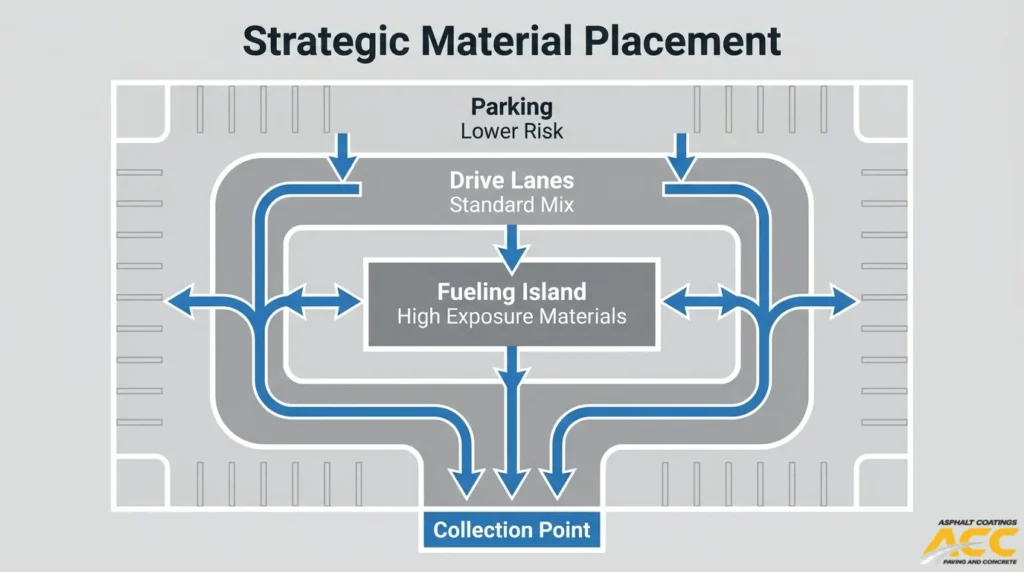
Drainage and slope should be designed to direct fuel spills and stormwater away from pavement surfaces quickly, preventing prolonged chemical contact with the binder. Fuel-exposed areas require positive drainage with slopes steep enough to shed liquids toward collection points, such as oil-water separators or containment basins, yet compliant with accessibility standards.
Key drainage design principles for fuel zones include:
- Grading surfaces with a minimum 2% cross-slope to prevent ponding in fueling lanes.
- Directing runoff toward trench drains or catch basins positioned at low points near dispensers.
- Connecting drainage infrastructure to oil-water separators before discharge enters the stormwater system.
- Avoiding flat spots or depressions where spilled fuel can pool and soften asphalt binder over extended contact time.
Designing drainage around fuel exposure is one of the most underappreciated steps in site planning; even the best fuel-resistant surface will degrade prematurely if spills sit unmanaged.
Where Should You Use the Most Chemically Resistant Materials on Site?
You should use the most chemically resistant materials in zones with the highest concentration and frequency of fuel contact. Dispenser islands, fueling lanes, tank fill areas, and vehicle maintenance bays experience direct, repeated exposure that standard asphalt or concrete cannot withstand.
According to the Federal Aviation Administration, P-404 Fuel Resistant Hot Mix Asphalt may replace the top 1.5 to 3 inches of standard P-401 or P-403 where a fuel-resistant surface is needed, and structurally, P-404 is considered the same as P-401. This same zoning principle applies to gas stations and fleet yards: reserve premium materials for high-exposure areas while using standard mixes in lower-risk zones like parking stalls and drive aisles.
Prioritizing material placement by exposure level controls costs without sacrificing protection where it matters most.
How Do Traffic Loads and Turning Movements Influence Paving Design?
Traffic loads and turning movements influence paving design by determining pavement thickness, material selection, and reinforcement requirements. Heavy vehicles generate concentrated stress, especially during slow-speed maneuvers at fuel islands and loading docks.
According to the Ohio Department of Transportation Pavement Design Manual, truck traffic is converted to a normalized equivalent 18,000 lb (80 kN) single axle load (ESAL) for design purposes. Fleet yards with frequent tanker deliveries and refuse trucks accumulate ESALs rapidly, requiring thicker structural sections than standard commercial lots.
Critical traffic factors for fuel-area pavement design include:
- Slow-speed turning at pump lanes, which increases shear stress on the surface course.
- Stationary loading from parked tankers during fuel delivery.
- Repetitive braking zones where deceleration compounds surface wear.
- Wider turning radii that distribute loads across joint and edge areas.
How Should Joints, Curbs, and Transitions Be Detailed in Fuel Areas?
Joints, curbs, and transitions in fuel areas should be detailed to prevent fuel infiltration and structural failure at connection points. Every seam, edge, and material change is a potential entry point for petroleum products that dissolve binders and erode subgrade support.
According to the California Department of Transportation Concrete Pavement Guide, cracks and joints should be sealed or resealed to prevent moisture infiltration. In fuel-exposed environments, this principle extends to chemical infiltration as well; unsealed joints allow gasoline and diesel to penetrate beneath the surface course, accelerating base deterioration.
Essential detailing practices include:
- Using fuel-compatible sealants rated for petroleum exposure at all construction and contraction joints.
- Installing curbs with sealed transitions where asphalt meets concrete around dispenser pads.
- Specifying spill-containment curbing at tank fill points to confine fuel within a drainable area.
Proper joint and transition detailing is where many fuel-area pavements fail first, making it the detail most worth getting right during construction.
How Is Fuel-Resistant Asphalt or Concrete Installed?
Fuel-resistant asphalt or concrete is installed through careful surface preparation, specialized mix design, controlled placement, and proper curing. The following sections cover substrate readiness, asphalt-specific mix and compaction requirements, concrete placement and curing, and the most common installation mistakes.
What Surface Preparation Is Required Before Installing Fuel-Resistant Pavement?
Surface preparation required before installing fuel-resistant pavement includes contamination removal, subgrade evaluation, existing surface cleaning, and drainage verification. Each step protects the bond between layers and ensures long-term chemical resistance.
Key preparation steps include:
- Contamination remediation. Any fuel quantity above the reportable threshold that has reached soil or ground surfaces must be cleaned up, according to the Federal Highway Administration, especially if the spill impacted soil or has potential to affect state waters.
- Subgrade compaction and grading. Unstable or saturated subgrade compromises load transfer and accelerates cracking under heavy fueling traffic.
- Existing surface cleaning. Dust, debris, and petroleum residue must be removed before placement. A tack coat should follow to ensure layer adhesion.
- Drainage testing. Field tests such as ASTM E2380 evaluate surface and internal drainage of pavement courses before overlay.
Skipping any of these steps creates weak points where fuel penetration and structural failure begin.
How Do Mix Design and Placement Differ for Fuel-Resistant Asphalt?
Mix design and placement for fuel-resistant asphalt differ from conventional asphalt in binder grade, target air voids, and compaction intensity. According to a study published in the Transportation Research Record, fuel resistance is generally achieved by combining a highly modified asphalt binder (performance grade PG 88-22 or PG 82-28) with lower design air voids of 2.5% compared to conventional airfield mixtures, promoting lower permeability and higher effective binder volume.
Critical placement differences include:
- Tack coat application. The underlying course must be cleaned and tacked per UFGS 32 12 17.19 specifications immediately before paving.
- Compaction priority. Field compaction is the single most important construction factor for long-term asphalt performance; a well-compacted dense-graded mixture becomes impermeable to water and air.
- Binder content. Sufficient asphalt binder content ensures adequate compaction while keeping air voids low enough to minimize permeability.
For commercial fueling areas, investing in proper compaction equipment and monitoring pays for itself in pavement longevity.
How Is Fuel-Resistant Concrete Mixed, Placed, and Cured?
Fuel-resistant concrete is mixed, placed, and cured using dense mix designs, chemical-resistant surface treatments, and controlled moisture conditions. The process focuses on minimizing porosity so fuel cannot penetrate the slab surface.
Essential installation practices include:
- Low water-to-cement ratio. Reducing the w/c ratio produces denser concrete with fewer capillary voids.
- Surface preparation for coatings. Concrete surfaces must be clean, dry, and roughened per International Concrete Repair Institute guidelines, as researchers at the Texas A&M Transportation Institute confirmed that surface preparation plays an important role in effective coating performance.
- Substrate temperature monitoring. Coatings should be applied only when substrate temperature is at least 5°F above the dew point to prevent adhesion failure.
- Proper curing duration. Rushed curing leaves excess moisture in the slab, weakening the surface layer that fuel contacts first.
Concrete’s inherent chemical resistance improves significantly when placement and curing protocols are followed precisely.
What Installation Mistakes Most Commonly Reduce Fuel Resistance?
The installation mistakes that most commonly reduce fuel resistance are inadequate compaction, contaminated substrates, incorrect binder selection, and premature traffic loading. Each error creates pathways for fuel infiltration or weakens the pavement’s chemical barrier.
Common failures include:
- Insufficient compaction. Leaving excessive air voids makes the surface permeable to fuel, which dissolves the binder from within.
- Skipping contamination cleanup. Paving over petroleum-soaked subgrade prevents proper adhesion and traps pollutants beneath the new surface.
- Wrong binder grade. Standard PG binders lack the polymer modification needed to resist fuel solvency in high-exposure zones.
- Equipment leaks during placement. Rollers or pavers leaking hydraulic fluid, coolant, or fuel onto fresh asphalt can ruin the entire surface layer.
- Opening to traffic too early. Premature loading before full compaction or curing compresses weak spots and creates surface defects.
Most of these mistakes are preventable with proper quality control, making pre-construction planning the strongest defense against premature pavement failure. Understanding installation requirements sets the stage for selecting the right protective sealers and coatings.
How Do Fuel-Resistant Paving Sealers and Coatings Work?
Fuel-resistant paving sealers and coatings work by forming a chemical or physical barrier between the pavement surface and petroleum-based fluids. The sections below cover sealer types for asphalt, protective coatings for concrete, resealing frequency, and application conditions.
What Types of Fuel-Resistant Sealers Are Used on Asphalt?
The types of fuel-resistant sealers used on asphalt include coal-tar emulsions, asphalt-emulsion sealcoats, and acrylic-based formulations. Each type creates a sacrificial film layer that absorbs chemical exposure before fuel reaches the underlying binder.
Coal-tar emulsions offer the highest fuel resistance but carry significant environmental concerns due to polycyclic aromatic hydrocarbon content. Asphalt-emulsion sealcoats provide moderate protection with a lower environmental profile. Acrylic sealers deliver UV resistance alongside fuel protection while containing no PAHs.
Without a sealer barrier, oxidized molecules leave the asphalt as water-soluble and volatile degradation products, according to the National Institute of Standards and Technology. Selecting the right sealer chemistry for the specific fuel exposure level is critical; high-drip zones near dispensers warrant more chemically resistant formulations than general traffic lanes.
What Coatings or Overlays Can Protect Concrete From Fuel Damage?
The coatings and overlays that protect concrete from fuel damage include epoxy-resin systems, polyurethane topcoats, and penetrating silane/siloxane sealers. Each serves a different protective role depending on exposure severity and traffic demands.
- Epoxy-resin coatings form a dense, fuel-impervious film ideal for high-exposure areas like fueling lanes.
- Polyurethane coatings offer strong chemical resistance with faster curing times, allowing quicker return to traffic.
- Penetrating sealers absorb into the concrete matrix, blocking fuel from entering pores without building a surface film.
A study by the North Dakota Department of Transportation and the University of North Dakota concluded that only the D335 sealer could seal cracks of 0.2 mm width for both normal and fly ash concrete mixes. During any coating application, equipment leaks must be prevented completely; contamination from hydraulic fluid or fuel on a fresh surface can compromise the entire installation. For most commercial fueling operations, an epoxy basecoat paired with a polyurethane topcoat provides the best balance of durability and chemical resistance.
How Often Should Fuel-Exposed Areas Be Resealed or Recoated?
Fuel-exposed areas should be resealed or recoated every one to three years, depending on the sealer type, traffic volume, and fuel exposure intensity. High-drip zones near pump islands and fleet fueling lanes degrade sealer films faster than adjacent parking areas.
Key factors that shorten resealing intervals include:
- Frequent diesel or gasoline spills at dispensers
- Heavy truck turning movements that abrade surface coatings
- Exposure to de-icing chemicals during winter months
- Visible signs of binder softening, discoloration, or aggregate exposure
Routine visual inspections every quarter help identify early wear before fuel penetrates the pavement structure. Waiting until visible damage appears typically means the protective barrier has already failed. A proactive resealing schedule based on documented exposure levels consistently costs less than reactive repairs after fuel infiltration compromises the substrate.
What Surface and Weather Conditions Are Needed for Proper Sealer Application?
The surface and weather conditions needed for proper sealer application include a clean, dry substrate; ambient temperatures above 50°F; and humidity levels that keep the surface at least 5°F above the dew point. Failing to meet these conditions causes adhesion failure and premature sealer breakdown.
Surface preparation requirements:
- Remove all oil, fuel residue, dirt, and loose aggregate before application.
- Ensure concrete surfaces meet International Concrete Repair Institute roughness guidelines.
- Confirm no rain is forecast for 24 to 48 hours after sealer placement.
According to a 2021 Iowa State University study on penetrating sealers for concrete pavements, the body of research strongly supports using penetrating sealers to improve deicer salt scaling resistance and reduce chloride penetration on horizontal surfaces. These performance benefits depend entirely on proper application conditions; even the best sealer chemistry fails on a poorly prepared or damp surface.
With proper sealer selection and application conditions established, ongoing maintenance keeps fuel-resistant surfaces performing at their designed protection level.
How Does Climate and Freeze-Thaw Impact Fuel-Resistant Paving Performance?
Climate and freeze-thaw cycles impact fuel-resistant paving performance by accelerating binder degradation, cracking, and joint failures. The sections below cover freeze-thaw damage mechanisms, high-altitude sun exposure, snow plow wear, and joint drainage strategies.
How Do Freeze-Thaw Cycles Affect Fuel-Exposed Asphalt?
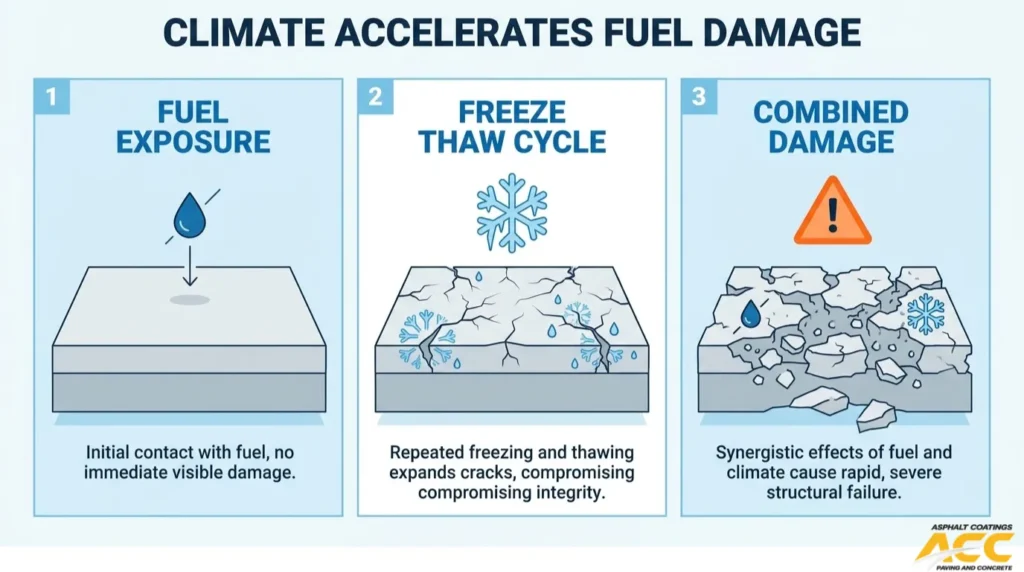
Freeze-thaw cycles affect fuel-exposed asphalt by breaking the bond between binder and aggregate, creating new voids that allow even deeper fuel penetration. Water trapped in pavement pores expands during freezing, then contracts during thawing. According to research published in Entropy using computerized tomography scanning, freeze-thaw action increases the disorder of the aggregate-asphalt adhesion system, stripping asphalt from aggregate surfaces and forming new voids. Fuel already weakens binder cohesion, so when freeze-thaw cycles open additional pathways, the combined effect accelerates raveling and pitting far beyond what either stressor causes alone. This makes cold-climate fuel zones especially vulnerable without proper mix design and sealing.
How Does High Altitude and Intense Sunlight Impact Pavement and Coatings?
High altitude and intense sunlight impact pavement and coatings by increasing thermal stress and UV-driven oxidation. Arizona State University’s Southwest Pavement Technology initiative found that the diurnal temperature range in Phoenix averages 15°C higher than the climate reference used in most pavement design standards, with evening cooling rates approximately 2.5 times faster than in other major U.S. cities. These rapid temperature swings cause repeated expansion and contraction, which opens micro-cracks in sealers and surface courses. At elevation, intensified UV radiation compounds this effect by hardening asphalt binder and degrading coating resins. For fuel-exposed surfaces, this brittleness makes the pavement far less capable of resisting chemical attack from spills.
How Should Fuel-Resistant Paving Be Designed for Snow Plows and De-Icing?
Fuel-resistant paving should be designed for snow plows and de-icing by specifying higher-strength surface courses and reinforced edges. Research by the Western Transportation Institute at Montana State University found that snow plows and snow removal equipment with tire chains subjected pavement slabs to greater load weights and cracking. Key design strategies include:
- Specifying thicker wear courses in plow lanes and fueling aprons.
- Using polymer-modified binders that resist both chemical softening and mechanical abrasion.
- Avoiding thin overlays at curb transitions where plow blades catch edges.
- Selecting de-icing chemicals compatible with the sealer or coating system in use.
Combining fuel resistance with plow durability requires deliberate material and thickness choices at the design stage.
How Can Joint Design and Drainage Reduce Cold-Climate Pavement Failures?
Joint design and drainage reduce cold-climate pavement failures by preventing water from pooling at the most structurally vulnerable points. According to research from the Purdue University Joint Transportation Research Program, over 80% of pavements tested had good drainage at mid-panel, but only 40% maintained good drainage at the joints. That gap matters significantly in fuel zones, where trapped moisture accelerates both freeze-thaw spalling and chemical infiltration.
Effective cold-climate joint strategies include:
- Sizing joint spacing per ACI PRC-330.2-17 guidelines for pavement support, thickness, and load transfer devices.
- Installing permeable base layers that drain freely beneath joint locations.
- Sealing joints with fuel-compatible sealants rated for low-temperature flexibility.
- Grading subbase to direct water away from joint lines toward collection systems.
Proper drainage at joints is the single most overlooked factor in cold-climate fuel-area longevity. With climate-specific detailing addressed, ongoing maintenance keeps these protections effective.
What Are the Maintenance Best Practices for Fuel-Exposed Pavement?
The maintenance best practices for fuel-exposed pavement include prompt spill cleanup, scheduled inspections, timely crack and pothole repair, and clear striping with signage. Each practice targets a specific failure point common in gas stations and fleet yards.
How Should Staff Clean Up Fuel Spills on Asphalt and Concrete?
Staff should clean up fuel spills on asphalt and concrete immediately using absorbent materials, then disposing of contaminated waste according to local environmental regulations. Speed matters most; prolonged fuel contact dissolves asphalt binder and penetrates concrete pores, accelerating surface failure.
A structured spill response protocol should include these steps:
- Contain the spill with absorbent booms, pads, or granular absorbent.
- Remove saturated absorbent material and bag it for proper disposal.
- Scrub the affected surface with a degreasing agent approved for pavement use.
- Inspect the cleaned area for softening, discoloration, or surface erosion.
According to the Connecticut Department of Energy and Environmental Protection, the person or business that caused a spill and the property owner where the pollution occurred are both responsible for cleaning it up. This shared liability makes written response procedures and staff training essential for every fueling facility.
Concrete surfaces require particular attention. Researchers at Texas A&M Transportation Institute found that surface preparation plays an important role in the effective performance of coating products, with concrete needing to be clean and free from moisture per International Concrete Repair Institute guidelines. Residual fuel contamination undermines any future sealcoat or coating application, so thorough cleaning after every spill protects both the existing surface and future maintenance investments.
How Often Should Fuel-Exposed Pavement Be Inspected?
Fuel-exposed pavement should be inspected at least monthly, with additional checks after heavy spill events, seasonal weather transitions, or periods of unusually high traffic volume. Federal regulations under 40 CFR Part 112 require facility operators to determine appropriate inspection frequency based on container size, configuration, and site design.
Key inspection targets include:
- Surface softening or discoloration near dispensers and loading areas
- Crack formation along joints, curbs, and high-traffic turning zones
- Drainage functionality at catch basins and channel slopes
- Sealcoat or coating wear, especially in direct fuel contact zones
Monthly visual inspections catch early-stage deterioration before it escalates into structural damage. For high-volume fleet yards, biweekly walkthroughs of the most heavily exposed zones are a worthwhile addition that most facility managers overlook.
When Should Cracks and Potholes in Fuel Areas Be Repaired?
Cracks and potholes in fuel areas should be repaired as soon as they are identified during routine inspections. Even hairline cracks create pathways for fuel to reach the binder layer or subgrade, where damage compounds rapidly.
The University of Delaware’s Center for Transportation notes that crack sealing early on recognizes that pavements need to relieve internal stresses but forms a barrier to water that infiltrates and damages the pavement cross section. In fuel-exposed zones, this principle is even more critical because petroleum penetrates faster than water and causes irreversible binder dissolution.
Prioritize repairs based on these factors:
- Immediate repair: Open cracks wider than 6 mm, potholes of any size, and any damage near fuel dispensers or tank fill points
- Scheduled repair: Hairline cracks in lower-traffic areas and minor surface wear
- Full-section replacement: Areas showing widespread raveling, binder loss, or base failure
Delaying repairs in fuel zones is one of the costliest maintenance mistakes a facility can make, since compromised pavement accelerates contamination of the subgrade and surrounding soil.
How Can Striping and Signage Support Longer-Lasting Fuel-Resistant Surfaces?
Striping and signage support longer-lasting fuel-resistant surfaces by directing traffic flow, reducing unnecessary turning stress, and clearly marking spill response zones. Proper lane markings guide vehicles along designed paths, which distributes wear evenly rather than concentrating it in unplanned areas.
Effective striping and signage strategies include:
- Marking designated fueling lanes to prevent vehicles from idling on vulnerable pavement sections
- Posting spill kit locations and cleanup procedure reminders at every dispenser island
- Using directional arrows to minimize sharp turns that gouge softened asphalt
- Marking no-parking zones over underground tank access points to protect critical infrastructure
Reflective, chemical-resistant striping materials last longer in fuel-exposed environments than standard traffic paint. Restriping on a regular schedule also creates a built-in opportunity to visually inspect the underlying pavement condition.
With consistent maintenance protocols established, the next consideration is meeting safety and environmental compliance requirements across the facility.
What Are the Safety and Environmental Compliance Requirements?
The safety and environmental compliance requirements for fuel-resistant paving span EPA stormwater regulations, spill containment infrastructure, ADA accessibility standards, and slip-resistance design. Each requirement shapes material selection and site layout.
How Does Fuel-Resistant Paving Support EPA and Stormwater Regulations?
Fuel-resistant paving supports EPA and stormwater regulations by preventing petroleum hydrocarbons from leaching into soil and entering municipal storm systems. The EPA requires facilities storing or handling fuel to implement Spill Prevention, Control, and Countermeasure (SPCC) plans that address surface containment. Impermeable fuel-resistant surfaces reduce the volume of contaminated runoff reaching waterways. Properly sloped fuel-resistant pavement directs spills toward designated collection points rather than storm drains, keeping operators compliant with Clean Water Act discharge limits. For gas stations and fleet yards, this pavement layer serves as a first line of regulatory defense.
What Role Do Spill Containment and Oil-Water Separators Play?
Spill containment and oil-water separators play the role of capturing petroleum before it reaches stormwater infrastructure. Oil-water separators use gravity and coalescing plates to remove hydrocarbons from runoff. According to the University of Connecticut’s Stormwater Manual, the combined volume of permanent pools in separator chambers should be 400 cubic feet per acre of contributing impervious area, with pools at least 4 feet deep. Fuel-resistant paving complements these systems by channeling contaminated runoff efficiently toward separator inlets. Without chemically resistant surfaces, dissolved binder material can add pollutant load, making separators less effective and increasing maintenance frequency.
How Do ADA Requirements Affect Paving Around Pumps and Parking Areas?
ADA requirements affect paving around pumps and parking areas by mandating specific slopes, surface conditions, and accessible paths of travel. According to the U.S. Access Board’s ADA Accessibility Standards, running slopes on walking surfaces shall not exceed 1:20, and cross slopes shall not exceed 1:48. Gas stations must also provide refueling assistance upon request from individuals with disabilities, per the U.S. Department of Justice. These slope tolerances directly influence grading plans for fuel-resistant pavement, since drainage design must balance spill containment with accessible routing. Smooth, stable, slip-resistant surfaces free of raveling or pitting are essential to maintain ADA compliance over time.
How Can Pavement Design Reduce Slip Hazards in Fuel Areas?
Pavement design reduces slip hazards in fuel areas through textured surface finishes, proper drainage grading, and material selection that resists fuel-induced surface degradation. Fuel spills create slick conditions on smooth pavement, so specifying aggregates with high micro-texture and designing adequate cross-slopes moves liquids off walking and driving surfaces quickly. Avoiding coal-tar-based sealcoats is also relevant to surface safety and environmental health; a USGS study found that coal-tar-based pavement sealcoat contains 35,000 to 200,000 mg/kg PAHs, roughly 1,000 times more than asphalt-based sealcoat products. Choosing lower-PAH alternatives protects both worker safety and stormwater quality while maintaining traction on fuel-exposed surfaces.
Understanding compliance requirements sets the framework; the next step is comparing costs across fuel-resistant paving options.
How Do Costs Compare for Different Fuel-Resistant Paving Options?
Costs for different fuel-resistant paving options vary based on material type, installation complexity, and long-term maintenance demands. The following sections break down upfront pricing, life-cycle value, site-specific budget factors, and phased construction strategies.
How Do Upfront Costs Differ Between Asphalt, Concrete, and Coated Systems?
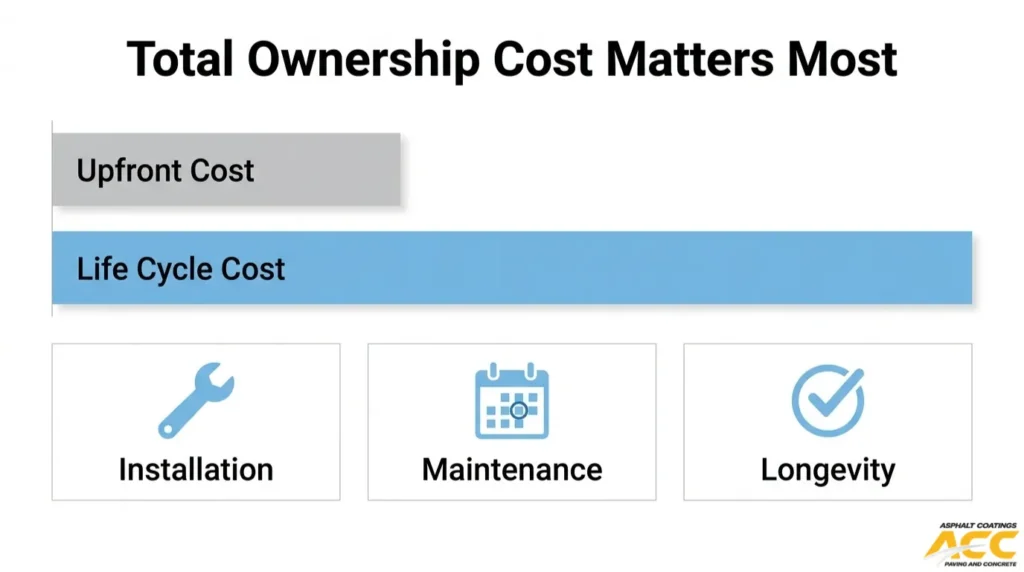
Upfront costs differ between asphalt, concrete, and coated systems based on material pricing, installation labor, and structural requirements. Fuel-resistant asphalt typically falls at the lower end of initial investment, while concrete carries higher material and placement costs. Coated systems, such as epoxy or polyurethane overlays applied to existing surfaces, sit between the two when the substrate is already in place.
However, upfront price alone is misleading. Freeze-thaw action strips asphalt binder from aggregate and creates new voids, as documented in a micro-scale investigation published in Entropy using CT scanning techniques. That accelerated deterioration means cheaper initial installations in harsh climates may require earlier intervention, narrowing the apparent cost gap.
How Do Life-Cycle Costs and Longevity Compare in Fuel-Exposed Areas?
Life-cycle costs and longevity in fuel-exposed areas favor materials that resist chemical breakdown over decades rather than years. Concrete surfaces generally last longer under persistent fuel contact because petroleum solvents do not dissolve Portland cement the way they dissolve asphalt binder. Polymer-modified asphalt overlays extend service life but still require periodic resealing.
Delaying maintenance until serious degradation occurs can cost three to four times more than early intervention, according to the Georgia Department of Transportation’s Airport Pavement Management System report. For gas stations and fleet yards, where fuel drips daily, that multiplier makes proactive life-cycle planning essential. Investing in higher-performing materials upfront almost always reduces total ownership cost over a 20-year horizon.
How Do Site Size, Traffic Volume, and Fuel Exposure Level Affect Budget?
Site size, traffic volume, and fuel exposure level affect budget by determining material quantities, structural thickness requirements, and maintenance frequency. Larger sites benefit from economies of scale on mobilization and material delivery. Higher traffic volumes demand thicker pavement sections engineered around equivalent single axle loads, increasing both material and subgrade preparation costs.
According to the Iowa Department of Transportation, pavement management software selects project treatments by prioritizing the greatest incremental benefit-to-cost ratio, optimizing benefits at any given budget level. Fuel exposure concentration matters too: a fueling island with constant drips needs the most chemically resistant surface, while perimeter parking areas may only require standard sealcoating.
How Can Phased Construction or Repairs Help Control Costs?
Phased construction or repairs help control costs by spreading capital expenditure across budget cycles while keeping operations running. Prioritizing the highest-risk zones first, such as fueling islands and tanker offloading areas, ensures the most vulnerable pavement receives protection immediately.
A practical phasing approach includes:
- Addressing active fuel-contact zones with fuel-resistant overlays or coatings in year one.
- Scheduling drive lanes and high-traffic areas for mill-and-pave or structural repair in year two.
- Applying preventive sealcoating to lower-risk perimeter areas in year three.
This staged method avoids full-site shutdowns that interrupt fueling revenue or fleet dispatch schedules. For most commercial operators, phased upgrades deliver better pavement condition per dollar spent than deferring everything until wholesale reconstruction becomes unavoidable.
With cost structures clarified, the next step is planning how to execute a fuel-resistant paving project efficiently.
How Can Asphalt Coatings Company Help With Fuel-Resistant Paving Needs?
Asphalt Coatings Company can help with fuel-resistant paving needs by combining asphalt paving, sealcoating, and crack sealing into a layered defense system for gas stations and fleet yards. The sections below explain how each service contributes to fuel resistance and summarize the key takeaways from this guide.
How Can Asphalt Paving, Sealcoating, and Crack Sealing Improve Fuel Resistance?
Asphalt paving, sealcoating, and crack sealing improve fuel resistance by addressing the three primary failure points: binder dissolution, surface permeability, and crack infiltration.
Properly designed asphalt paving uses highly modified binders and lower design air voids to block fuel penetration. According to research published in the Transportation Research Record, fuel resistance is generally achieved by combining a performance grade PG 88-22 or PG 82-28 binder with 2.5% design air voids, promoting lower permeability and higher effective binder volume than conventional mixtures.
Sealcoating adds a sacrificial barrier that absorbs chemical contact before fuel reaches the binder layer. Crack sealing closes entry points early, forming a barrier against water and fuel that would otherwise infiltrate and weaken the pavement cross section.
For commercial properties across Colorado’s Front Range, where freeze-thaw cycles accelerate crack formation, Asphalt Coatings Company delivers all three services with in-house crews. This single-source approach ensures each layer works together rather than being installed in isolation by separate contractors.
What Are the Key Takeaways About Fuel-Resistant Paving for Gas Stations and Fleet Yards We Covered?
The key takeaways about fuel-resistant paving for gas stations and fleet yards are:
- Fuel spills dissolve standard asphalt binder, causing raveling, pitting, and structural failure when left unaddressed.
- Modified binders, low-void mix designs, and fuel-resistant sealers form a layered defense that standard paving cannot provide.
- Drainage design, proper slope, and strategic material placement in high-exposure zones reduce chemical contact time and long-term damage.
- Crack sealing and sealcoating are not cosmetic; they serve as functional barriers that extend pavement service life significantly.
- Climate factors like freeze-thaw cycles, UV exposure, and thermal stress compound fuel-related degradation, making region-specific design essential.
- Proactive maintenance and timely repairs cost far less than full reconstruction after serious deterioration.
Asphalt Coatings Company brings 39 years of Colorado-specific expertise to fuel-resistant paving projects for commercial properties. Contact Asphalt Coatings Company to schedule a pavement condition assessment and develop a fuel-resistance plan tailored to your site.