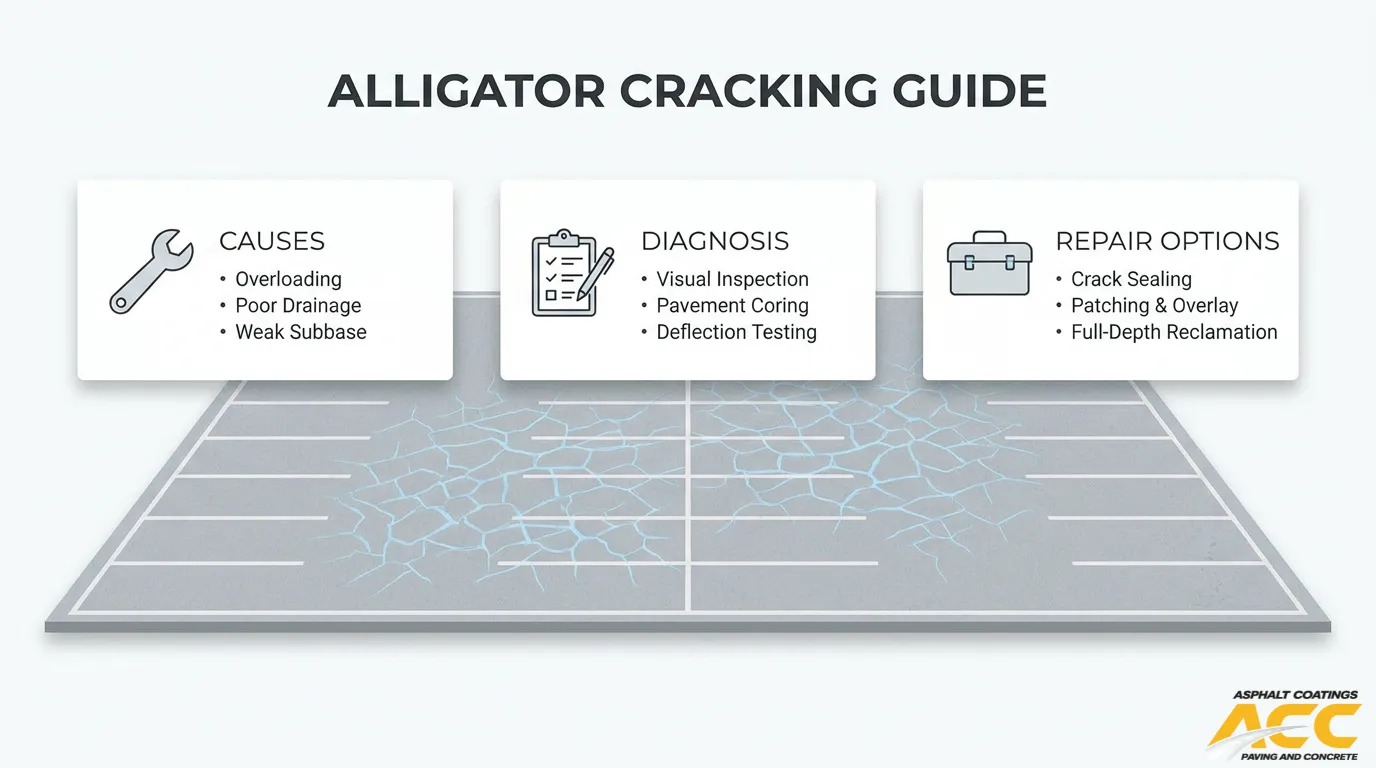
Alligator cracking is a structural asphalt distress defined by interconnecting cracks that form a chicken wire pattern in wheel paths, caused by fatigue failure under repeated traffic loading. The cracks initiate at the bottom of the hot mix asphalt layer and propagate upward, signaling that the pavement structure beneath the surface is compromised.
This guide covers the causes and diagnosis of alligator cracking, repair options ranging from surface treatments to full reconstruction, the risks of deferred maintenance, prevention strategies, and portfolio-level planning for commercial properties.
Alligator cracking results from repeated heavy vehicle loading, weak or moisture-saturated subgrade, thin pavement sections, poor drainage, and environmental factors like UV oxidation and freeze-thaw cycling. Each cause demands a different response, and misidentifying the source leads to failed repairs.
Distinguishing true fatigue cracking from block cracking or simple linear fractures requires visual pattern analysis, pavement coring, and sometimes deflection testing. Surface-only distress and structural failure look similar from above but require fundamentally different treatments.
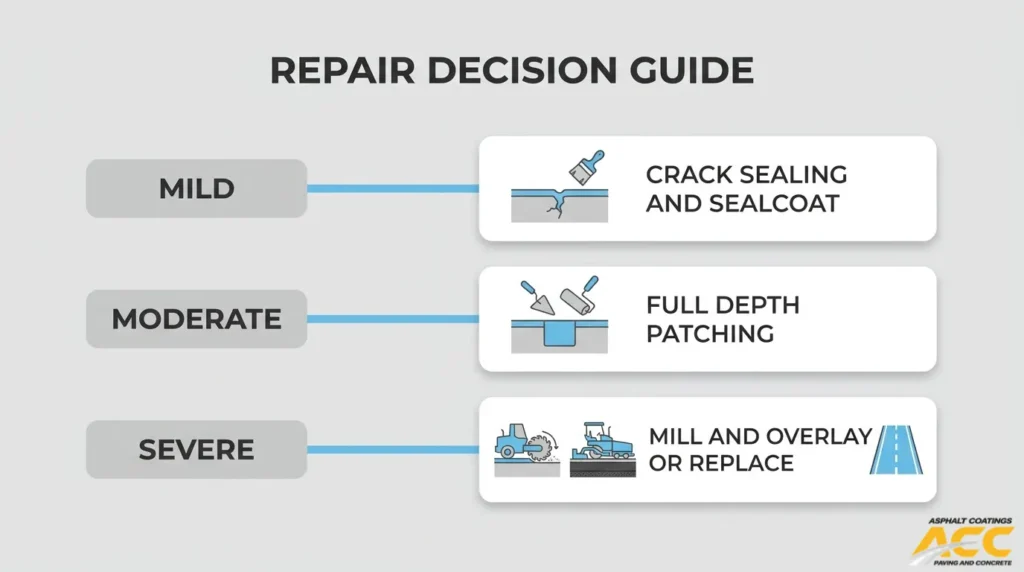
Repair options scale with severity. Crack sealing and sealcoating protect sound pavement and slow early-stage deterioration. Full-depth patching removes failed material and rebuilds isolated sections. Mill-and-overlay restores the surface only when the base still provides adequate support. Replacement becomes the only practical fix when high-severity cracking, repeated patch failures, and subgrade loss span most of the lot.
Ignoring alligator cracking allows water infiltration that softens the base, accelerates pothole formation, increases liability exposure, and converts manageable repairs into emergency reconstruction. Routine inspections, preventive sealcoating, proper drainage, and load-appropriate pavement design slow deterioration and protect capital budgets across a commercial portfolio.
What Is Alligator Cracking in Commercial Asphalt Parking Lots?
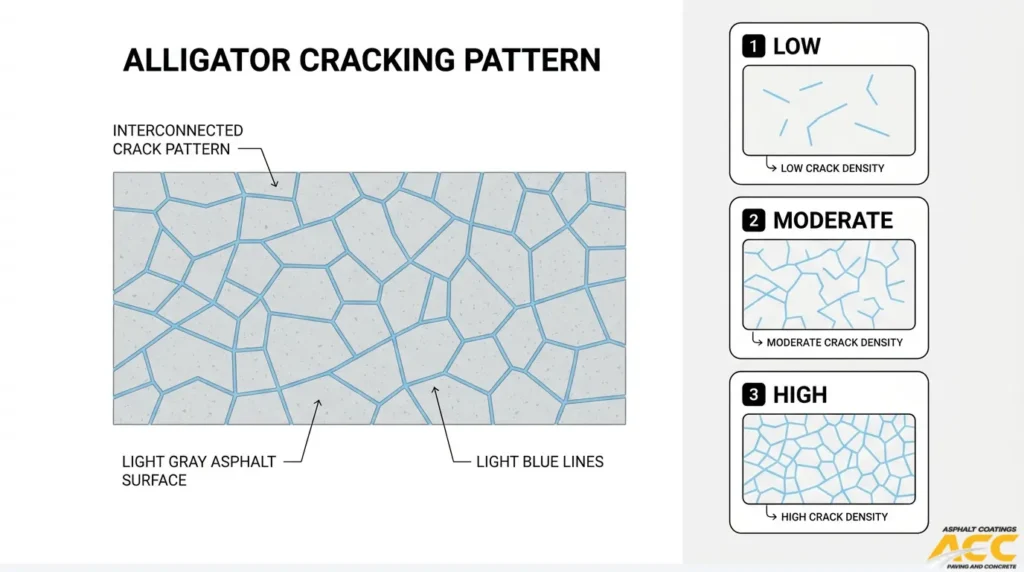
Alligator cracking in commercial asphalt parking lots is a structural pavement distress defined by interconnecting cracks that form a pattern resembling an alligator’s hide or chicken wire. These cracks result from fatigue failure of the asphalt surface under repeated traffic loading, starting at the bottom of the hot mix asphalt layer where tensile stress is highest and propagating upward to the surface.
In its early stages, alligator cracking may appear as a single longitudinal crack in the wheel path or a series of parallel cracks with few connections. As traffic loading continues, cracks interconnect into many-sided, sharp-angled pieces typically less than 0.3 meters on the longest side. According to the FHWA Distress Identification Manual for the Long-Term Pavement Performance Program, these cracks must have a quantifiable area and progress through three severity levels: low (few connecting cracks, no spalling, no pumping), moderate (complete interconnected pattern, slight spalling possible), and high (severely spalled pieces that may move under traffic, with pumping possibly evident).
This distress differs from block cracking, which is a separate, generally non-load-associated pattern linked to shrinkage and daily temperature cycling across entire areas not subjected to wheel loads. Alligator cracking occurs specifically in wheel paths and loaded areas, making it a direct indicator of structural inadequacy beneath the surface. Because the cracks typically extend through all asphalt layers, water penetrates into the base and subgrade, accelerating deterioration if left unaddressed. Understanding whether your parking lot has true fatigue cracking or surface-only distress determines the correct repair strategy, from localized patching to full reconstruction.
What Causes Alligator Cracking in Commercial Parking Lots?
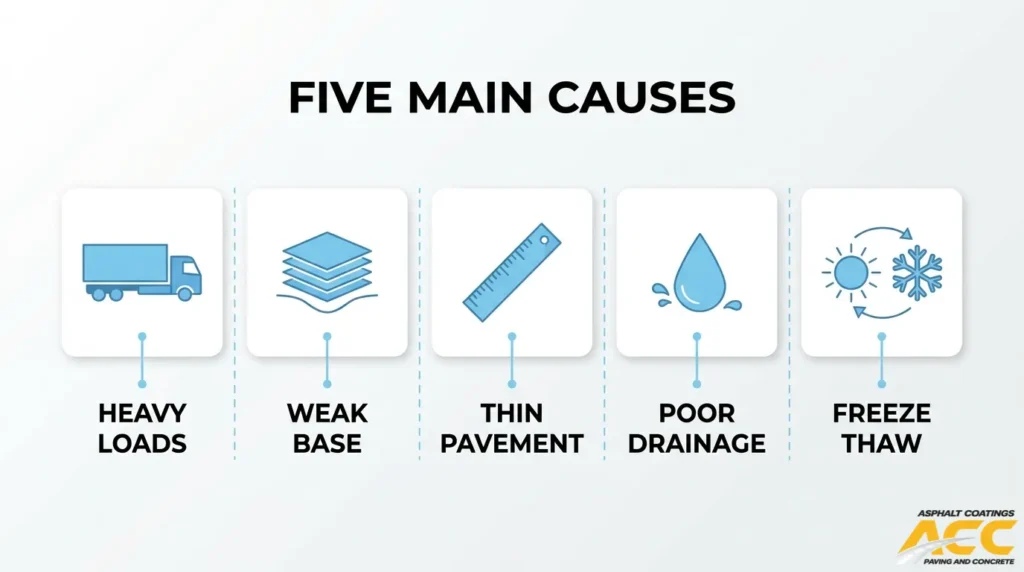
Alligator cracking in commercial parking lots results from repeated traffic loading, weak subgrade or base layers, thin pavement sections, poor drainage, and environmental stress. The following sections break down each cause.
How Do Traffic Loads and Heavy Vehicles Lead to Alligator Cracking?
Traffic loads and heavy vehicles lead to alligator cracking by subjecting the same wheel paths to repeated stress cycles that exceed the asphalt’s fatigue capacity. According to the FHWA Distress Identification Manual for the Long-Term Pavement Performance Program, this distress occurs in areas subjected to repeated traffic loadings, developing into many-sided, sharp-angled pieces less than 0.3 m on the longest side with a characteristic chicken wire pattern.
Commercial lots face concentrated damage from specific heavy vehicles:
- Semi-trailers and combination trucks delivering goods to retail tenants
- Trash trucks making weekly collection rounds along fixed routes
- Construction vehicles operating during tenant buildouts
The Missouri Asphalt Pavement Association notes that these heavy trucks generally dictate the eventual performance of the pavement. Dumpster pads and loading zones take the worst punishment because the same axle paths absorb load after load without rest.
How Do Subgrade and Base Failures Cause Alligator Cracking?
Subgrade and base failures cause alligator cracking by allowing excessive pavement deflection under wheel loads. Fatigue cracking initiates at the bottom of the hot mix asphalt layer, where tensile stress and strain are highest, then propagates upward as parallel cracks that eventually interconnect into the characteristic pattern.
According to TxDOT Report 0-7175, inadequate pavement thickness and subgrade weakening from excessive moisture can cause fatigue cracking. When saturated soil loses bearing strength, the asphalt flexes beyond its design limits with each passing vehicle.
Several conditions contribute to base and subgrade failure:
- Poor drainage that traps water beneath the pavement structure
- Inadequate maintenance allowing moisture infiltration through surface cracks
- Excessive or repeated loads beyond the original design capacity
- High tire pressures concentrating force on weakened sections
For alligator cracking and potholes, the Minnesota DOT Best Practices Handbook recommends removing weak granular base and subgrade materials prior to replacing the asphalt surface course. This confirms that surface repairs alone cannot resolve a failed foundation.
How Do Poor Asphalt Mixes and Thin Pavement Sections Contribute to Alligator Cracking?
Poor asphalt mixes and thin pavement sections contribute to alligator cracking by reducing the number of load repetitions the surface can absorb before fatigue failure. The Louisiana DOT defines alligator cracking as an indication that the pavement has been deflected an excessive number of times, forming a crack system from cumulative load applications.
Thin sections reach their fatigue limit faster because less material is available to distribute wheel loads across the base. Poorly designed mixes compound the problem; low binder content, improper aggregate gradation, or inadequate compaction during construction all reduce tensile strength at the bottom of the asphalt layer.
The National Asphalt Pavement Association’s 2025 Asphalt Paving Handbook states that badly cracked pavement sections with pattern cracking must be patched or replaced. Cutting corners on mix design or pavement thickness during initial construction is one of the most common reasons commercial lots fail well before their expected service life.
How Do Drainage and Standing Water Problems Trigger Alligator Cracking?
Drainage and standing water problems trigger alligator cracking by saturating the subgrade and weakening the structural support beneath the asphalt. When water pools on the surface or infiltrates through existing cracks, it softens granular base materials and reduces the soil’s load-bearing capacity. Each vehicle pass then deflects the pavement further than it would over a dry, stable foundation.
Ponding areas, clogged catch basins, and inadequate surface slopes all allow moisture to accumulate where it causes the most damage. Even minor depressions that hold water after rainstorms can initiate localized fatigue failure over time. Proper lot grading and functional drainage infrastructure are essential to preventing moisture-driven base deterioration.
How Do Colorado’s Freeze–Thaw Cycles and UV Exposure Accelerate Alligator Cracking?
Colorado’s freeze-thaw cycles and UV exposure accelerate alligator cracking by stiffening the asphalt binder and weakening the pavement’s tensile resistance. A 2023 study published in Materials (Basel) found that UV radiation increases stiffness by 35 to 40% in unaged polymer-modified binder asphalt and 12 to 17% in short-term aged mixtures, while accelerated water conditioning reduced indirect tensile strength by an average of 7 to 8%.
Colorado’s Front Range amplifies both mechanisms. High-altitude sun delivers intense UV year-round, oxidizing and embrittling the binder so it cracks more readily under load. Freeze-thaw cycles then force water into those cracks, expanding as ice and widening pathways to the base layer. Each seasonal cycle compounds the damage, turning minor surface distress into full-depth fatigue failure faster than in milder climates. Asphalt Coatings Company has observed these accelerated failure patterns across 39 years of Front Range projects, informing pavement design recommendations that account for Colorado’s unique environmental stresses rather than applying generic national standards.
Understanding these causes helps property managers target the right repair strategy for each situation.
How Can You Diagnose True Alligator Cracking Versus Surface-Level Asphalt Damage?
You can diagnose true alligator cracking versus surface-level asphalt damage by examining crack patterns, testing subsurface conditions, and knowing when professional evaluation is necessary. The following sections cover visual identification, base assessment methods, and contractor evaluation triggers.
What Visual Signs Distinguish Alligator Cracking From Simple Linear Cracks?
The visual signs that distinguish alligator cracking from simple linear cracks include interconnected, multi-sided crack patterns concentrated in wheel paths versus isolated straight-line fractures unrelated to traffic loading. Alligator cracking forms a chicken wire pattern where cracks branch and connect, creating sharp-angled pieces. Linear cracks, by contrast, run as single longitudinal or transverse lines without interconnection.
Block cracking is another common source of confusion. According to the U.S. Army PAVER distress identification system, block cracking produces rectangular patterns linked to shrinkage and daily temperature cycling, not repeated traffic loading. If cracking covers an entire area regardless of where vehicles travel, it is likely block cracking rather than fatigue-related alligator distress.
Spalling at crack edges and pieces that shift under traffic indicate higher severity. When interconnected patterns appear only in loaded areas, the damage almost certainly reflects structural fatigue rather than surface-only weathering.
How Can You Assess Crack Depth and the Condition of the Asphalt Base?
You can assess crack depth and the condition of the asphalt base through a combination of visual surveys, nondestructive deflection testing, and destructive core sampling. A visual-only inspection identifies surface distress type, severity, and extent, but it cannot confirm whether the base or subgrade has failed beneath the cracked surface.
According to the Georgia Department of Transportation’s 2024 Pavement Evaluation Manual, “pavement depths are determined by cutting and retrieving cores from the pavement” of sufficient length and diameter to reveal layer condition and crack depths. Core samples show whether cracks extend through the full asphalt thickness into weakened base material.
Key indicators of base failure beneath alligator cracking include:
- Pumping of fines or moisture through crack networks under traffic
- Rutting or depressions in wheel paths suggesting subgrade displacement
- Soft, wet, or unstable material visible in core samples below the asphalt layers
- Widespread cracking rather than isolated patches, suggesting systemic support loss
Matching surface observations with subsurface data determines whether localized patching or broader structural repair is appropriate.
When Should You Bring in a Commercial Asphalt Contractor for a Professional Evaluation?
You should bring in a commercial asphalt contractor for a professional evaluation when visible distress suggests conditions beyond what surface-level maintenance can address. No universal trigger point or deflection cutoff exists for commercial parking lots; the decision depends on project-specific evidence.
Situations that warrant professional assessment include:
- Interconnected alligator cracking covering multiple wheel paths or travel lanes
- Recurring failures in previously patched areas
- Visible base material pumping through cracks during wet conditions
- Standing water or drainage problems adjacent to cracked zones
- Cracking accompanied by rutting, potholes, or significant surface deformation
A qualified contractor can coordinate core sampling, deflection testing, and condition surveys to determine whether the failure is localized or structural. For most commercial property managers, attempting to interpret subsurface conditions without this testing leads to either over-spending on unnecessary reconstruction or under-treating damage that continues to spread.
Understanding the scope of damage through proper diagnosis directly shapes the repair strategy and budget decisions that follow.
What Are the Risks of Ignoring Alligator Cracking in a Commercial Parking Lot?
The risks of ignoring alligator cracking in a commercial parking lot include accelerated structural failure, increased liability exposure, and significantly higher long-term repair costs. Each of these consequences compounds over time.
How Can Alligator Cracking Lead to Potholes and Structural Failure?
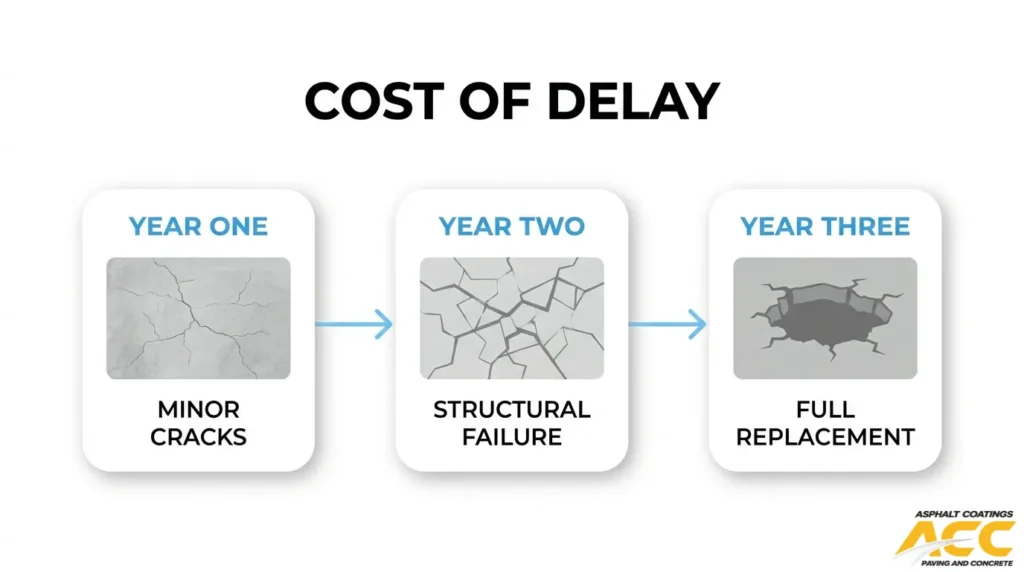
Alligator cracking can lead to potholes and structural failure because the interconnected crack network allows water to penetrate through all asphalt layers and into the subgrade. According to the Illinois Department of Transportation’s Local Agency Pavement Preservation guide, alligator cracking is a bottom-up structural distress; because cracks generally extend through all asphalt layers, water penetrates the subgrade, leading to increased deterioration.
Once moisture reaches the base and subgrade, it softens the supporting materials. Continued traffic loading on this weakened foundation causes the surface to deflect further, breaking loose pavement pieces into potholes. Each freeze-thaw cycle accelerates this process as trapped water expands and contracts. What begins as a cracked area quickly becomes a section of failed pavement requiring far more invasive repair than early intervention would have demanded.
How Does Alligator Cracking Increase Liability and Safety Risks on Commercial Sites?
Alligator cracking increases liability and safety risks on commercial sites by creating uneven surfaces, loose pavement fragments, and eventual potholes that endanger pedestrians and vehicles. Spalled, shifting pavement pieces are trip hazards for customers and employees, particularly near accessible routes where the ADA requires firm, stable, slip-resistant surfaces.
Vehicle damage from potholes that develop in neglected alligator-cracked areas represents another common exposure. Property managers carry a duty to maintain safe conditions, and documented neglect of visible structural distress strengthens negligence claims. For any commercial property owner, the legal and insurance costs of a single injury or vehicle-damage claim can far exceed what timely pavement repair would have cost.
How Does Deferred Repair of Alligator Cracking Impact Long-Term Capital Budgets?
Deferred repair of alligator cracking impacts long-term capital budgets by allowing localized distress to spread into widespread structural failure that demands full reconstruction instead of targeted fixes. When fatigue cracking is caught early, a contractor can remove and patch the affected area, preserving the surrounding sound pavement. Delay converts a manageable repair into a project that requires base removal, subgrade correction, and complete resurfacing.
This escalation compresses future budgets because the scope of work grows with each season of neglect. Phased, planned maintenance distributes costs across multiple budget cycles; emergency reconstruction concentrates them into a single, disruptive capital expenditure. For commercial portfolio managers overseeing multiple properties, one deferred lot can consume funding originally allocated for preventive maintenance across several sites.
Understanding the full cost of inaction makes it easier to evaluate which repair options match your pavement’s current condition.
What Repair Options Are Available When Alligator Cracking Is Still Mild to Moderate?
Repair options for mild to moderate alligator cracking include crack sealing, surface patching, and sealcoating. Each addresses a different need depending on crack extent and base condition.
When Is Crack Sealing an Effective Response to Early-Stage Alligator Cracking?
Crack sealing is an effective response to early-stage alligator cracking when cracks are few, disconnected, and the underlying base remains structurally sound. According to the FHWA Pavement Preservation Workbook, crack sealing stops water intrusion, keeps out incompressibles, and delivers an excellent cost-benefit ratio.
This treatment works best on isolated longitudinal cracks that have not yet formed an interconnected pattern. The Asphalt Institute notes that crack sealing prior to rehabilitation is a good idea, reinforcing its role as a preparedness measure rather than a structural fix. Once cracks interconnect into a full chicken wire pattern, sealing alone no longer addresses the root fatigue failure beneath the surface. For most commercial lots, treating cracks early with a proper sealant buys meaningful time before costlier interventions become necessary.
When Can Skin Patching or Surface Patching Address Localized Alligator Cracking?
Skin patching or surface patching can address localized alligator cracking only when damage is confined to a small area and the base beneath remains stable. A thin overlay of hot mix asphalt restores the riding surface without excavating the full pavement section.
However, skin patching is not a verified standalone treatment in major pavement engineering sources. The retained research supports full-depth patching, which removes failed pavement and weak base material before replacement, as the standard localized repair for fatigue cracking. Surface-only patches applied over compromised base layers tend to re-crack quickly because the structural deficiency persists underneath.
Property managers should treat skin patching as a short-term, stopgap measure. If cracking returns within one season, the base has likely failed and full-depth repair becomes the appropriate next step.
How Can Sealcoating Help Protect Areas Around Minor Alligator Cracking?
Sealcoating helps protect areas around minor alligator cracking by sealing the surrounding sound pavement against moisture infiltration and UV oxidation. It slows the environmental degradation that accelerates crack spread into adjacent sections.
Sealcoating adds no structural strength to the pavement. It protects surfaces that are still in good condition, not sections where fatigue cracking has already developed. Any alligator-cracked areas should be sealed or patched before the sealcoat is applied; coating over active cracks traps moisture and worsens deterioration underneath.
When used strategically alongside crack sealing or patching, sealcoating extends the service life of undamaged pavement surrounding a repair zone. This combination is one of the most cost-effective preservation strategies for commercial lots that still have predominantly sound pavement.
With mild-to-moderate options in place, understanding when damage demands structural repair prevents wasted investment on surface-only treatments.
What Structural Repairs Are Needed for Severe or Widespread Alligator Cracking?
Structural repairs needed for severe or widespread alligator cracking include full-depth patching, mill-and-overlay, and base/subgrade reconstruction. The following sections cover when each method applies.
When Is Full-Depth Patching the Right Fix for Alligatored Asphalt?
Full-depth patching is the right fix for alligatored asphalt when the failure is contained within a defined area and the surrounding pavement remains structurally sound. According to the Minnesota Department of Transportation’s Best Practices Handbook on Asphalt Pavement Maintenance, full-depth permanent patching removes the material in the failed area and replaces it with fresh asphalt mixture.
The process involves:
- Sawcutting clean, straight edges around the damaged zone.
- Removing all deteriorated asphalt and any weak granular base or subgrade material beneath it.
- Compacting and grading the exposed subgrade to restore proper support.
- Placing and compacting new hot-mix asphalt in full-thickness lifts.
This approach addresses the root structural deficiency rather than masking surface distress. For commercial lots with isolated wheel-path failures, full-depth patching delivers a permanent, load-bearing repair without the cost or disruption of larger-scale reconstruction. Commercial asphalt contractors like Asphalt Coatings Company perform full-depth patching with in-house crews trained in proper sawcutting, base removal, and compaction techniques – ensuring repairs integrate structurally with surrounding pavement rather than failing at the patch edges within a season or two.
When Should You Mill and Overlay Sections With Alligator Cracking?
You should mill and overlay sections with alligator cracking only after confirming that the base and subgrade beneath the milled area still provide adequate structural support. Milling removes the deteriorated surface course, and the overlay restores ride quality and thickness; however, neither step corrects a failed foundation.
Before specifying a mill-and-overlay, engineers typically evaluate subsurface conditions using Falling Weight Deflectometer testing and pavement cores. As noted in the Georgia Department of Transportation’s Pavement Evaluation Manual, FWD data can identify statistically different pavement sections, soil strength, and structural capacity, though measurements must be normalized for temperature and load.
If deflection testing reveals localized base weakness, those areas need full-depth correction before the overlay is placed. Skipping that step virtually guarantees alligator cracking will reappear through the new surface within a few seasons.
How Do Contractors Rebuild the Base and Subgrade Under Failed Alligator-Cracked Areas?
Contractors rebuild the base and subgrade under failed alligator-cracked areas by excavating all compromised layers, stabilizing the exposed soil, and reconstructing the pavement section from the ground up.
Key steps in the process include:
- Removing all cracked asphalt, failed aggregate base, and saturated or soft subgrade soil.
- Proof-rolling the exposed subgrade to identify remaining weak spots.
- Stabilizing soft soils with geotextile fabric, lime, or cement treatment as conditions require.
- Placing and compacting new aggregate base in controlled lifts to meet density specifications.
- Paving new hot-mix asphalt at a thickness designed for the lot’s anticipated traffic loads.
A visual distress survey alone is rarely sufficient to scope this work. A 2011 University of Texas at El Paso/TxDOT research report concluded that nondestructive and destructive testing should be considered whenever a structural problem is suspected. Understanding what failed below the surface is what separates a lasting rebuild from a repeated failure.
When Is Full Parking Lot Replacement the Only Practical Fix for Alligator Cracking?
Full parking lot replacement is the only practical fix for alligator cracking when structural failure extends across most of the pavement and localized repairs can no longer restore adequate support. The following subsections cover severity thresholds, repeated repair failures, pavement age, and budget considerations.
What Severity and Extent of Alligator Cracking Indicate That Replacement Is Necessary?
The severity and extent of alligator cracking that indicate replacement is necessary are high-severity distress spread across a large percentage of the lot’s total area, where spalled, interconnected crack patterns have destabilized the base layer beyond localized repair.
According to Auburn University’s 2010 assessment of FAA overlay procedures, the PCI procedure identifies distress types, rates severity levels, and quantifies extents within each sample unit. High-severity alligator cracking features well-defined, spalled pieces that rock under traffic. When this distress covers isolated sections, full-depth patching or reclamation can address it. However, once high-severity cracking spans the majority of wheel paths and parking stalls, patching each failed area individually becomes more costly and disruptive than removing and rebuilding the entire pavement structure. For most commercial lots, the tipping point is less about a single magic number and more about whether sound pavement still outweighs failed pavement.
How Do Repeated Patching and Ongoing Failures Signal the Need for Reconstruction?
Repeated patching and ongoing failures signal the need for reconstruction when new cracks consistently reappear around or within previously patched areas, indicating that the underlying base or subgrade cannot support traffic loads regardless of surface repairs.
A patch that fails within one to two seasons suggests the problem sits below the asphalt layer. Each successive patch adds cost while delivering diminishing returns, because the weak subgrade continues to deflect under load. When a maintenance log shows three or more patch cycles in the same zone without lasting improvement, the cumulative expense often approaches or exceeds the cost of full reconstruction. At that point, continuing to patch delays the inevitable while compounding total spending. Reconstruction addresses the root structural deficiency rather than repeatedly treating symptoms at the surface.
How Do Age of Asphalt and Prior Maintenance History Influence the Replace-or-Repair Decision?
Age of asphalt and prior maintenance history influence the replace-or-repair decision by determining how much residual structural life the pavement retains.
Well-maintained commercial asphalt with routine sealcoating and timely crack sealing can perform for 20 to 25 years before major rehabilitation. Pavements that received little or no preventive maintenance often deteriorate faster, with oxidation hardening the binder and moisture infiltrating unchecked. When a lot is already near or past its expected design life and exhibits widespread alligator cracking, overlay or localized patching rarely delivers long-term value. The aged binder, thinned cross-section, and compromised base collectively reduce the pavement’s ability to bond with new material or distribute loads. In these cases, full replacement provides a reset, including proper subgrade preparation, that extends the next service cycle by decades rather than years.
How Do Budget, Phasing, and Operational Disruption Affect the Choice to Replace?
Budget, phasing, and operational disruption affect the choice to replace by shaping when and how a property manager can execute a full reconstruction without crippling business operations.
Full replacement requires a larger upfront capital outlay than incremental patching, yet it often delivers a lower total cost of ownership over a 15- to 20-year horizon. Phased reconstruction, where sections of the lot are rebuilt sequentially while remaining areas stay open, helps commercial properties maintain tenant and customer access throughout the project. Scheduling work during lower-traffic seasons or overnight hours further reduces revenue impact. Property managers who delay replacement solely to avoid short-term expense frequently spend more on emergency patches, liability exposure, and accelerated deterioration of adjacent pavement. Balancing capital availability against long-term performance is the most reliable way to time a full replacement decision.
Understanding when replacement becomes unavoidable helps property managers plan proactively for the costs involved.
How Much Do Different Alligator Cracking Repair Options Typically Cost for Commercial Lots?
Different alligator cracking repair options typically cost anywhere from a few dollars per square yard for localized patching to significantly higher per-square-yard rates for full-depth reconstruction. The sections below compare spot patching versus reconstruction costs, pricing variables, and phased budgeting strategies.
How Do Costs Differ Between Spot Patching and Full-Depth Reconstruction?
Costs differ between spot patching and full-depth reconstruction primarily in scope, materials, and labor intensity. Spot patching targets isolated failed areas by sawcutting and replacing only the damaged asphalt, keeping mobilization and material volumes low. Full-depth reconstruction removes the entire pavement structure, addresses compromised base and subgrade layers, then rebuilds from the ground up.
According to the City of Danville, Virginia’s 2024-2025 municipal parking-lot bid tabulation, asphalt concrete patch ranged from $136.13 to $600.00 per ton across three bidders, while milling ran $3.00 to $4.63 per square yard. Reconstruction multiplies these line items across every layer. For most commercial lots, patching a few isolated spots costs a fraction of what full reconstruction demands, making accurate diagnosis of failure the single most important cost decision.
How Do Lot Size, Traffic Loads, and Access Constraints Affect Pricing?
Lot size, traffic loads, and access constraints affect pricing by changing mobilization costs, material quantities, structural design requirements, and scheduling complexity. Larger lots benefit from economies of scale on materials and equipment, reducing per-square-yard rates. Smaller lots absorb a proportionally higher share of mobilization and crew setup.
Heavy traffic loads require thicker asphalt sections and stronger base courses, increasing material costs. Dumpster pads, loading docks, and fire lanes that support heavy vehicles need upgraded structural designs compared to standard passenger-car stalls. Constrained access, such as active tenant operations, limited entry points, or required ADA route maintenance, forces phased work zones and night shifts. These logistical factors can increase labor costs substantially, even when the pavement area itself is modest.
How Can Phased Repairs Help Commercial Owners Manage Cash Flow and Budget Cycles?
Phased repairs help commercial owners manage cash flow and budget cycles by spreading capital expenditures across multiple fiscal periods instead of requiring one large outlay. Property managers can prioritize the highest-severity sections first, address moderate areas in subsequent budget years, and defer preventive treatments to later phases.
This approach also limits operational disruption. The Town of Branford, Connecticut, demonstrated phasing on a public reconstruction project designed to “limit disruptions and maintain access to businesses as much as possible.” That same principle applies directly to commercial lots where tenant access, customer parking, and revenue continuity matter. Aligning each phase with annual capital budgets or reserve fund cycles keeps repairs financially sustainable without allowing deferred sections to deteriorate beyond repair.
Understanding repair costs and budgeting strategies helps property managers work with a qualified contractor to build a realistic maintenance plan.
How Can Commercial Property Managers Prevent Alligator Cracking or Slow Its Return?
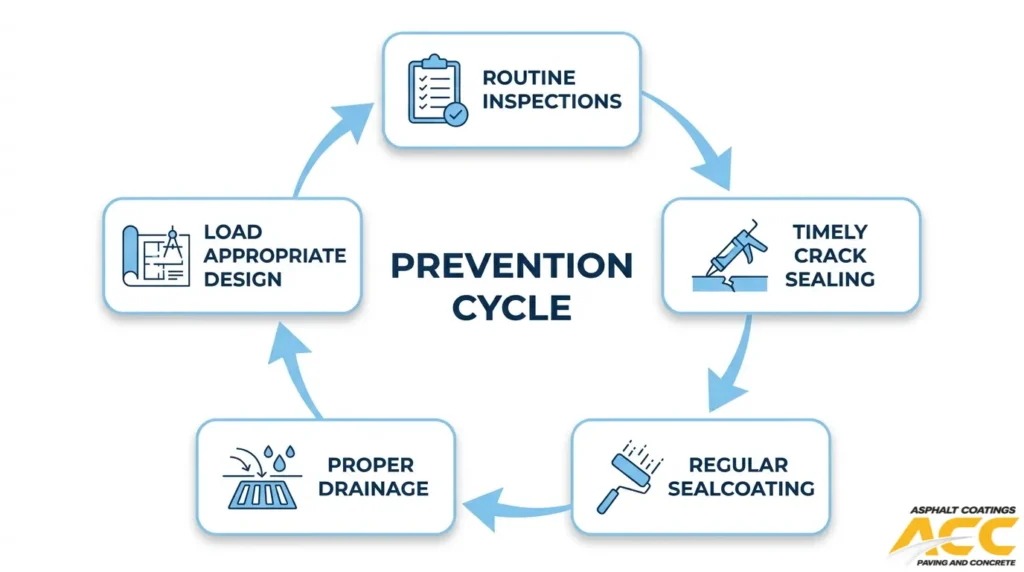
Commercial property managers can prevent alligator cracking or slow its return through proactive maintenance, sound drainage, and proper pavement design. The following subsections cover sealcoating, crack sealing, drainage, load-appropriate design, and routine inspections.
How Does Routine Sealcoating Extend Pavement Life and Delay Alligator Cracking?
Routine sealcoating extends pavement life and delays alligator cracking by shielding the asphalt surface from oxidation, moisture infiltration, and UV degradation. According to the University of Wisconsin–Madison Transportation Information Center (Wisconsin Transportation Bulletin No. 10), seal coating should provide five to eight years of additional life to the pavement, though it does not strengthen the underlying structure.
This distinction matters for property managers: sealcoating protects surfaces still in good condition, but areas already showing alligator cracking or soft subgrade require structural repair before any coating is applied. Scheduling sealcoat applications on a regular cycle, while addressing failed sections separately, keeps maintenance costs predictable and prevents surface-level neglect from escalating into structural problems.
How Does Timely Crack Sealing Help Prevent Alligator Cracking From Spreading?
Timely crack sealing helps prevent alligator cracking from spreading by blocking water and incompressible debris from entering pavement joints. Once moisture reaches the base or subgrade through open cracks, it weakens structural support and accelerates fatigue failure under traffic loads.
According to the Asphalt Institute, maintaining a slope of at least 1.5% on parking lots ensures proper surface drainage, minimizing infiltration and the detrimental effects of water. Crack sealing complements that drainage by closing the paths water would otherwise follow into the pavement structure. However, crack sealing is a preventive measure, not a structural repair. Cracks exhibiting interconnected alligator patterns require patching or reconstruction, not sealant alone.
How Do Proper Drainage Design and Maintenance Reduce the Risk of Alligator Cracking?
Proper drainage design and maintenance reduce the risk of alligator cracking by preventing water from saturating the base and subgrade layers beneath the pavement. Standing water softens these structural layers, which then deflect excessively under traffic loads and initiate bottom-up fatigue cracking.
Effective commercial lot drainage involves several components:
- Grading surfaces to maintain adequate slope so water flows to collection points.
- Designing storm drainage systems sized for local design-storm events, as outlined in FHWA’s Urban Drainage Design manual (HEC-22, 4th edition).
- Clearing catch basins, inlets, and swales regularly to prevent blockages.
- Repairing settled or ponding areas before moisture undermines the base.
Site-specific drainage design must follow applicable local requirements, since no single federal standard governs private commercial lots.
How Does Designing Pavement for Heavy Loads Help Prevent Premature Alligator Cracking?
Designing pavement for heavy loads helps prevent premature alligator cracking by ensuring the asphalt section and base thickness can absorb repeated stress without excessive deflection. Delivery trucks, waste haulers, and construction vehicles impose far greater loads than passenger cars, and underdesigned sections fatigue rapidly in those areas.
Key design considerations include:
- Calculating expected Equivalent Single Axle Loads (ESALs) for dumpster pads, loading docks, and drive aisles.
- Specifying thicker asphalt and aggregate base sections in heavy-traffic zones.
- Using appropriate mix designs that resist rutting under sustained heavy loads.
For most commercial lots, dumpster and loading areas are the first sections to develop alligator cracking when pavement thickness is sized only for passenger vehicles.
How Can Regular Parking Lot Inspections Catch Problems Before They Become Alligator Cracking?
Regular parking lot inspections can catch problems before they become alligator cracking by identifying early warning signs, such as single longitudinal cracks in wheel paths, minor settling, standing water, and base softening, while intervention costs remain low.
A practical inspection routine includes:
- Walking the lot at least twice per year, focusing on drive lanes, turning areas, and dumpster pads.
- Documenting new cracks, ponding locations, and pavement depressions with photos and measurements.
- Flagging any area where cracks have begun to interconnect, since this signals the transition toward fatigue failure.
- Scheduling repairs promptly based on findings rather than waiting for the next budget cycle.
Consistent documentation builds a maintenance history that supports better capital planning and helps contractors recommend the right repair scope. With a prevention strategy in place, the next step is prioritizing repairs across an entire commercial portfolio.
How Should You Prioritize and Plan Alligator Cracking Repairs Across a Commercial Portfolio?
You should prioritize and plan alligator cracking repairs across a commercial portfolio by combining standardized condition assessments, multi-year capital planning, and phased scheduling. The following subsections cover PCI-based prioritization, rolling capital plans, and strategies for minimizing disruption.
How Can Condition Assessments and Pavement Ratings Guide Repair Priorities?
Condition assessments and pavement ratings guide repair priorities by assigning each lot a standardized score that ranks structural need against available budget. The Pavement Condition Index, defined in ASTM D6433-20, quantifies pavement condition through visual surveys and serves as an indirect measurement of structural integrity and functional indicators such as roughness.
A pavement management system built on PCI surveys enables commercial portfolio managers to rank every property objectively. According to the Institute for Transportation at Iowa State University, agencies that implemented PCI-based pavement management systems were able to secure additional funding, better prioritize repairs, and perform maintenance at the right time. When visual surveys alone are insufficient, destructive testing through pavement cores can confirm layer condition and crack depth; these locations require engineering judgment.
For portfolios with dozens of sites, lots scoring lowest on the PCI scale receive structural repairs first, while lots still in good condition receive low-cost preservation treatments to halt further deterioration. This tiered approach prevents the common mistake of spreading budget evenly across all properties regardless of actual need.
How Can a Multi-Year Capital Plan Address Existing and Emerging Alligator Cracking?
A multi-year capital plan addresses existing and emerging alligator cracking by distributing structural repairs and preventive treatments across a rolling budget horizon. Rather than reacting to failures one lot at a time, portfolio managers can map every property’s current PCI score against projected deterioration rates and schedule interventions before conditions escalate.
The City of Oxnard’s 2024 Citywide Pavement Management Program illustrates this model: it functions as a planning and project programming roadmap broken into phased milestones over a multi-year horizon. Commercial property managers can adapt the same framework, grouping lots into annual repair tiers based on severity and coordinating contractor mobilization to reduce per-project costs.
How Can You Minimize Tenant and Customer Disruption During Major Repairs?
You can minimize tenant and customer disruption during major repairs by phasing construction around peak business hours and maintaining accessible circulation routes throughout the project. Sectioning a lot into isolated work zones allows portions of parking to remain open while crews complete full-depth patching or reconstruction in adjacent areas.
Clear signage, advanced tenant communication, and temporary restriping keep foot traffic and vehicle flow predictable. Scheduling the heaviest work, such as milling and base removal, during off-peak windows or overnight further reduces noise and access conflicts. For multi-tenant retail or office properties, coordinating repair phases with lease renewal timelines can align capital spending with tenant expectations.
With a prioritized repair plan in place, the next step is partnering with an experienced commercial asphalt contractor who can execute each phase efficiently.
How Should You Approach Alligator Cracking Repairs With a Commercial Asphalt Contractor Like Asphalt Coatings Company?
You should approach alligator cracking repairs with a commercial asphalt contractor by matching each service to the correct distress condition. Asphalt Coatings Company offers paving, sealcoating, and crack sealing to address every stage of pavement deterioration.
How Can Asphalt Paving, Sealcoating, and Crack Sealing Services Help Address Alligator Cracking?
Asphalt paving, sealcoating, and crack sealing services help address alligator cracking by targeting different failure stages with the appropriate treatment. Alligator cracking is a load-associated structural distress, distinct from block cracking that forms in unloaded areas. According to the U.S. Army PAVER Road Asphalt Distress Manual, fatigue cracking results from repeated traffic loading and requires treatment matched to its severity.
Asphalt Coatings Company applies each service based on the pavement’s actual condition:
- Crack sealing stops water intrusion and keeps incompressibles out of joints before fatigue patterns fully develop.
- Sealcoating protects structurally sound surfaces from oxidation and moisture but adds no structural capacity.
- Asphalt paving, including full-depth patching and mill-and-overlay, restores structural integrity where the base or subgrade has failed.
Choosing the wrong treatment wastes the budget. Sealcoating over active alligator cracking, for example, masks a structural problem without solving it. A qualified contractor evaluates distress type and severity first, then recommends the service that actually addresses the root cause.
What Are the Key Takeaways About Alligator Cracking in Commercial Parking Lots, Repair Options, and When Replacement Is the Only Fix?
The key takeaways about alligator cracking in commercial parking lots are that repair strategy depends on whether damage is isolated or widespread, and replacement becomes the only fix when structural failure extends beyond localized sections.
- Alligator cracking signals fatigue failure beneath the surface, not just cosmetic wear.
- Isolated, low-severity cracking responds to crack sealing, patching, or overlay when the base remains sound.
- Widespread, high-severity cracking with spalled pieces, pumping, or subgrade failure requires full-depth reconstruction.
- No single PCI score or area percentage triggers automatic whole-lot replacement; each site needs project-specific evaluation.
- Preventive maintenance, such as sealcoating and timely crack sealing, extends pavement life but cannot reverse structural damage already underway.
Experienced commercial asphalt contractors bring decades of Colorado-specific knowledge to these decisions.Contractors with in-house crews capable of handling everything from crack sealing to full reconstruction and subgrade preparation can evaluate your lot’s condition and match the right repair scope to your budget and operational needs.