A gravel parking lot is a commercial parking surface built with layered aggregate over a prepared subgrade, offering low upfront installation cost but requiring ongoing maintenance to remain functional.
This guide covers gravel lot economics and material selection, surface comparisons with asphalt and concrete, dust suppression strategies and health impacts, conversion triggers and paving costs, and long-term maintenance planning for commercial properties.
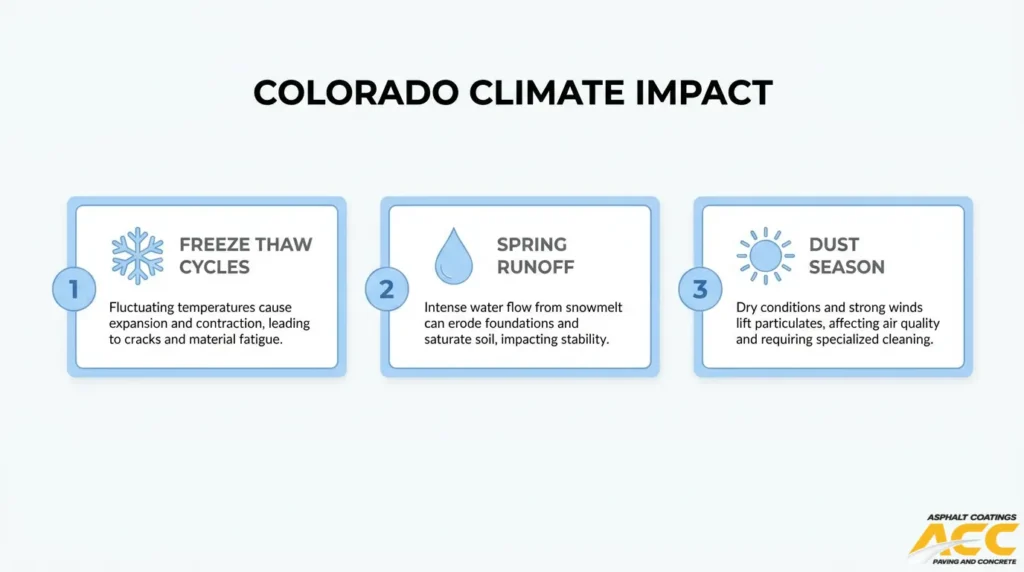
Gravel parking lot cost depends on lot size, aggregate type, site preparation, climate exposure, and regrading frequency. Crusher-run aggregate with proper gradation compacts into a tighter surface that retains fines, while poor material choices increase replenishment cycles. Colorado’s freeze-thaw patterns, spring breakup, and subsurface drainage limitations add region-specific costs that milder climates avoid.
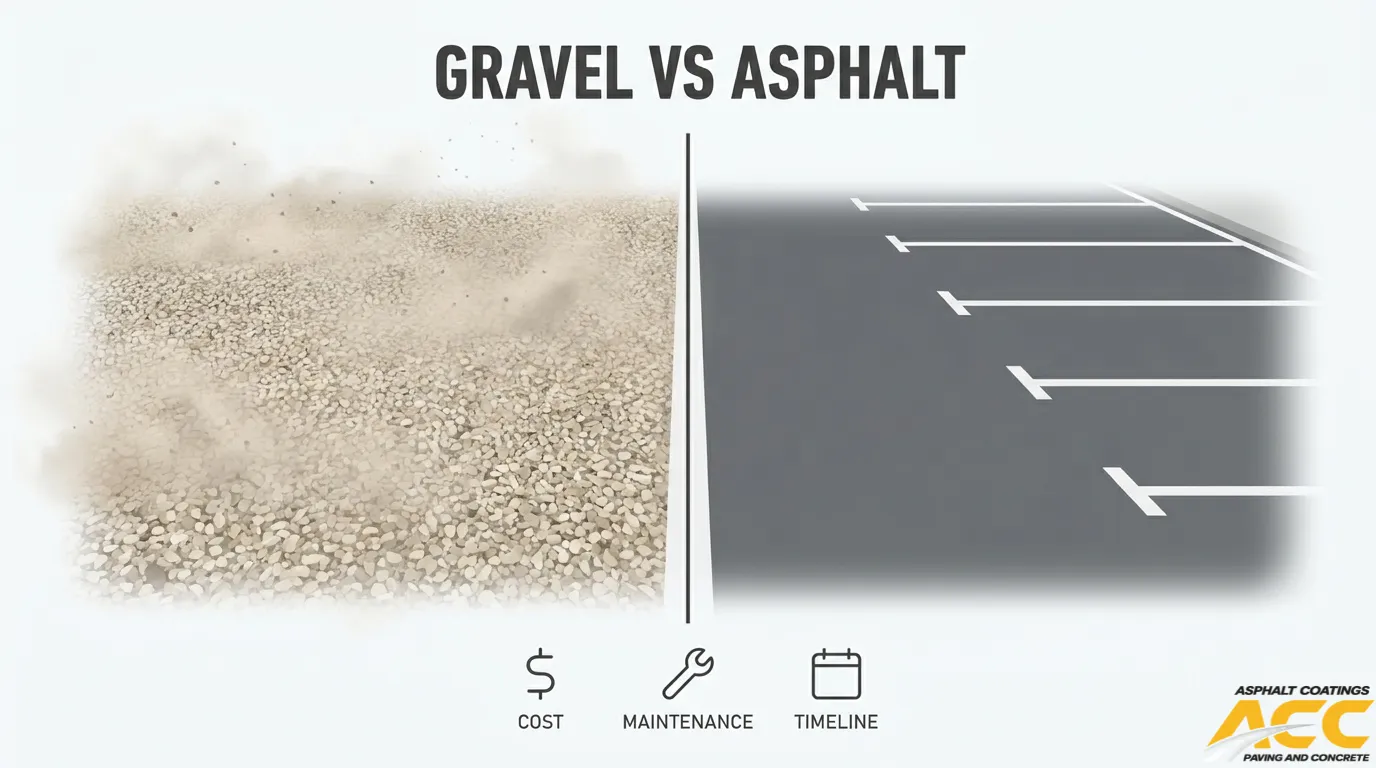
Gravel, asphalt, and concrete each perform differently across durability, accessibility, drainage, and curb appeal. Gravel surfaces fail to meet ADA firmness requirements without specialized treatment, and loose stone creates user-experience problems that paved surfaces eliminate. Lifecycle cost analysis shows that average daily traffic volume is the strongest predictor of which surface delivers the lowest 20-year ownership cost.
Dust control ranges from operational practices like speed management and RAP-blended aggregate to chemical treatments including magnesium chloride and polymer emulsions. Treated gravel sections retain significantly more aggregate than untreated surfaces; however, airborne PM2.5 from loose lots poses respiratory risks that suppression alone cannot fully resolve.
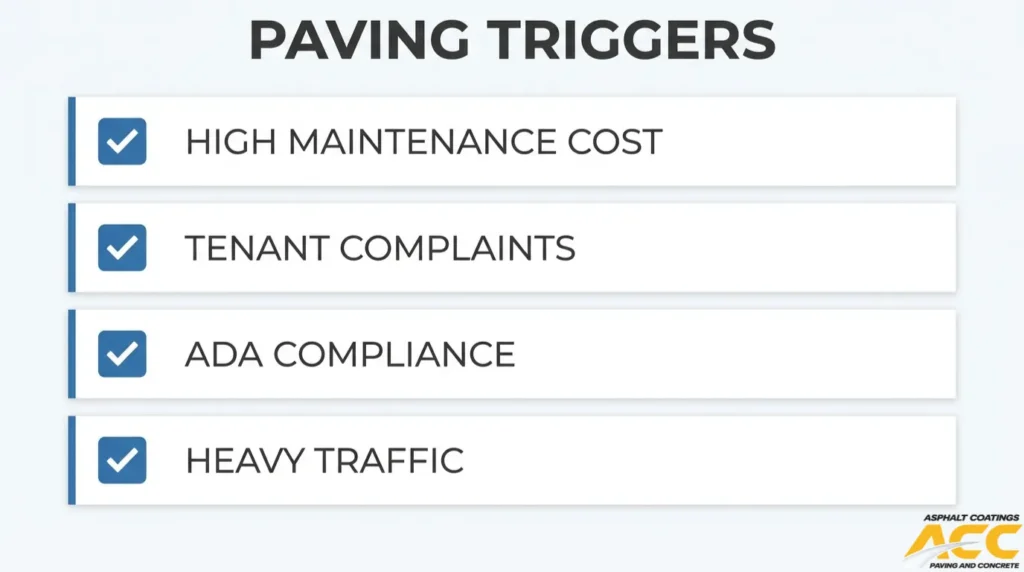
Paving triggers include escalating maintenance frequency, tenant complaints, ADA compliance gaps, and heavy vehicle loading that accelerates gravel deterioration. Conversion costs hinge on existing gravel condition and subgrade stability, since wet or rutted foundations directly reduce asphalt pavement life.
Phased upgrades allow property managers to convert high-priority zones first, spread capital costs across budget cycles, and maintain lot access during construction. Pairing a condition-based reserve schedule with predictable sealcoating intervals keeps long-term expenses controlled and supports stronger tenant retention.
What Are the Pros and Cons of a Gravel Parking Lot for Commercial Properties?
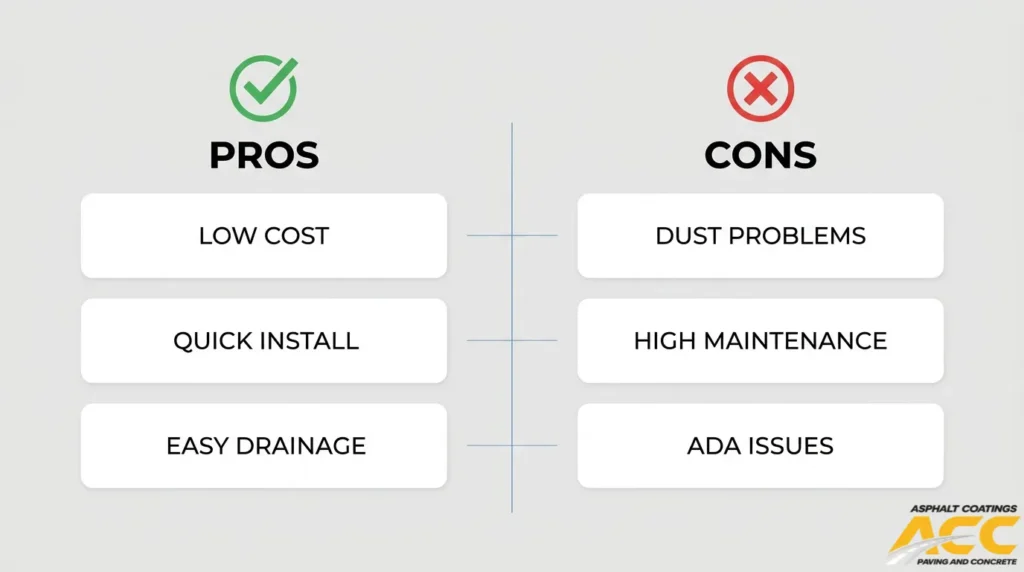
The pros and cons of a gravel parking lot for commercial properties center on cost, maintenance, drainage, dust, and accessibility. The advantages and disadvantages below help property managers weigh whether gravel suits their site or whether asphalt makes more sense.
Pros of a gravel parking lot:
- Gravel parking lots cost significantly less to install than asphalt or concrete, making them practical for low-traffic sites, temporary staging areas, and properties where budgets are tight.
- Gravel surfaces allow natural stormwater infiltration, reducing runoff and simplifying compliance with drainage requirements on commercial sites.
- Installation timelines are shorter because gravel lots require less equipment, no curing period, and minimal subgrade preparation compared to paved alternatives.
- Expanding or reconfiguring a gravel lot is straightforward; adding material or regrading sections costs a fraction of what milling and repaving would require.
Cons of a gravel parking lot:
- Dust generation is a persistent issue. According to a 2021 review published in Sustainability, lignosulfonate-based dust treatments reduced PM10 concentrations by 47.3% compared to water-treated roads, yet even treated gravel surfaces still produce more airborne particulate than sealed pavement.
- Gravel surfaces do not meet ADA firmness and stability requirements without specialized treatment, creating potential liability for commercial property owners who must provide accessible routes.
- Ongoing maintenance adds up. Regrading, gravel replenishment, and dust suppression cycles can erode the initial cost savings, especially on lots with moderate to heavy traffic.
- Loose stone damages vehicles, scatters into adjacent landscaping, and creates an uneven surface that deters customers and tenants accustomed to paved parking.
- Snow removal is more difficult because plows catch and displace gravel, leading to material loss each winter season.
For many commercial property managers, gravel works best as an interim surface rather than a permanent solution. The lower upfront investment provides breathing room, but rising maintenance demands and tenant expectations often make paving the smarter long-term choice. Understanding the full cost picture, including dust control and regrading cycles, clarifies when that tipping point arrives.
How Much Does a Gravel Parking Lot Cost to Build and Maintain?
Gravel parking lot cost depends on lot size, material selection, site preparation, ongoing maintenance, and regional climate. The following sections break down how each factor shapes both upfront and long-term expenses.
How Does Gravel Parking Lot Cost Change With Size and Layout?
Gravel parking lot cost changes with size and layout because larger lots require proportionally more aggregate, grading, and compaction labor. A simple rectangular layout minimizes waste, while irregular shapes or multiple access points increase earthwork and material handling. Lots requiring defined drive aisles, stall delineation, or stormwater grading add design complexity that raises costs per square foot. For most commercial properties, the per-unit cost of gravel decreases slightly at scale, but drainage infrastructure and traffic flow design can offset those savings on larger sites. Experienced commercial contractors can assess whether your existing grading and drainage systems will support a gravel surface long-term or whether upfront investment in proper subgrade preparation will prevent costly repairs. Asphalt Coatings Company evaluates these site-specific factors during initial assessments for properties across Colorado’s Front Range.
How Do Gravel Material Choices Affect the Total Parking Lot Cost?
Gravel material choices affect the total parking lot cost by influencing both the initial purchase price and the frequency of future replenishment. Crusher-run aggregate, which blends coarse and fine fractions, compacts into a tighter surface that resists displacement. According to a 2019 U.S. Geological Survey study on driving surface aggregate, properly graded material with optimum moisture placement produces a more tightly bound surface that preserves fines rather than losing them as dust or sediment.
Alternative materials also shift the cost equation:
- Recycled asphalt pavement (RAP) can serve as unbound base course material, often at lower cost than virgin aggregate.
- Washed river rock looks appealing but lacks the angular interlock needed for parking surfaces.
- Pit-run gravel costs less upfront yet requires more frequent regrading due to inconsistent particle sizes.
Construction phasing feasibility should also be evaluated early, since material decisions affect long-term property requirements and project duration.
How Does Site Preparation Impact Gravel Parking Lot Costs?
Site preparation impacts gravel parking lot costs by determining how much earthwork, drainage installation, and subgrade correction the project requires before a single load of aggregate arrives. Sites with poor native soil, steep grades, or existing vegetation demand more excavation, fill material, and compaction passes. Proper subgrade preparation is essential because a weak or uneven base leads to premature rutting and costly repairs. Drainage grading, culvert installation, and erosion control measures add to upfront costs but prevent far greater expenses from washouts and lot failure. For commercial properties, skipping thorough site preparation almost always increases total project cost within the first two years.
How Do Maintenance and Regrading Influence Long-Term Gravel Costs?
Maintenance and regrading influence long-term gravel costs significantly because a gravel lot is never “finished.” Periodic blading, pothole filling, and aggregate replenishment are recurring expenses that accumulate over the lot’s life.
Poorly timed maintenance can actually accelerate deterioration. According to the Federal Highway Administration’s Unpaved Road Dust Management handbook (2013), unscheduled maintenance can do more harm than good; breaking up a chemically treated surface crust leads to increased dust, rapid ride-quality loss, loose aggregate, washboarding, and the need for additional gravel sooner, greatly increasing maintenance costs.
A lifecycle cost perspective matters here. A 2004 study by Iowa State University’s Institute for Transportation conducted a 20-year life-cycle cost analysis using a 3.5% discount rate and found that average daily traffic volume is statistically significant in calculating both agency and vehicle operating costs across gravel, blotter, and hot-mix asphalt surfaces. For higher-traffic commercial lots, those recurring gravel costs compound quickly.
How Do Climate and Weather Conditions Affect Gravel Parking Lot Cost in Colorado?
Climate and weather conditions affect gravel parking lot cost in Colorado by accelerating material loss, drainage failures, and maintenance frequency beyond what milder regions experience.
Colorado’s freeze-thaw cycles pose a distinct challenge. Historical research published by the Transportation Research Board documents that during spring breakup, which typically begins at the end of April, frost boils 18 inches to 2 feet deep are common on sections lacking approximately 30 inches of granular soil beneath the surface. This seasonal heaving displaces gravel, creates soft spots, and demands emergency regrading.
Additional Colorado-specific cost factors include:
- Snowmelt timing concentrates heavy runoff in May and June, washing aggregate from poorly drained lots.
- Many Colorado soils allow surface infiltration but trap water at less permeable subsurface layers, saturating the base.
- Dust suppressant treatments can offset aggregate loss; Colorado road tests from 1993 to 1994 found treated sections retained 42 to 61% more aggregate than untreated controls, producing estimated cost savings of 28 to 42%.
For property managers along the Front Range, budgeting for Colorado’s climate impact is not optional; it is a core line item that determines whether gravel remains cost-effective or signals the right time to pave.
How Does Gravel Compare to Asphalt and Concrete Parking Lots?
Gravel compares to asphalt and concrete parking lots across four key dimensions: long-term cost, durability, user experience, and drainage performance. The following subsections break down each comparison factor.
When Is Gravel Cheaper Than Asphalt or Concrete Over the Long Term?
Gravel is cheaper than asphalt or concrete over the long term only when traffic volumes remain low and accessibility requirements are minimal. Initial installation costs for gravel fall well below paved surfaces; however, recurring regrading, aggregate replacement, and dust treatment erode that advantage as use intensifies.
According to a 2010 University of Wyoming study for the Mountain-Plains Consortium, RAP-incorporated gravel surfaces can reduce dust loss without harming serviceability, which lowers one of gravel’s largest recurring expenses. Still, the U.S. Access Board notes that hardened materials such as concrete, asphalt, tile, and wood are sufficiently firm and stable for accessibility, while most loose materials, including gravel, will not meet those requirements unless properly treated. For commercial properties expecting moderate to heavy traffic, asphalt typically delivers lower lifecycle costs because it eliminates annual regrading and dust-control cycles.
How Do Durability and Lifespan Compare Between Gravel and Asphalt?
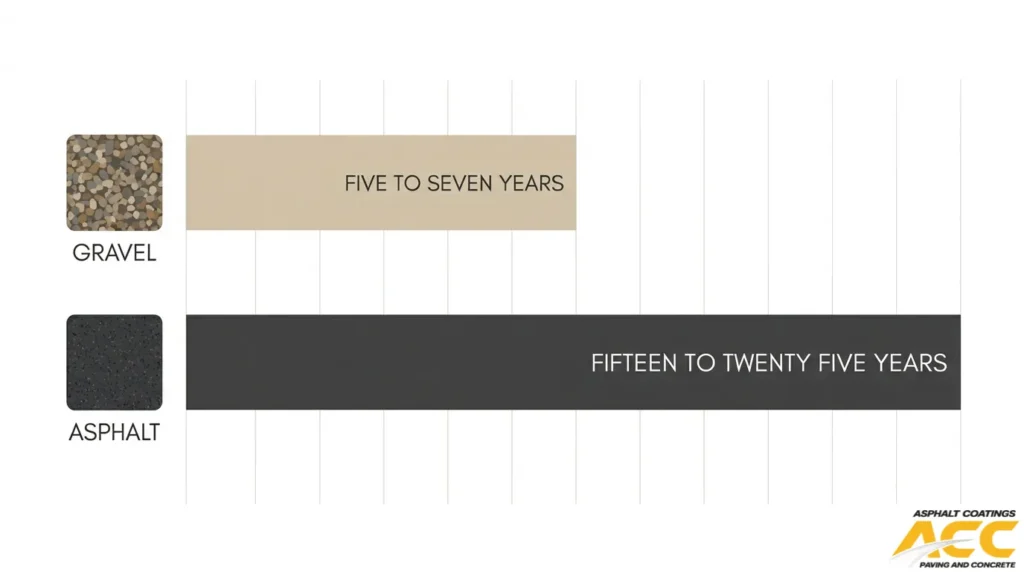
Durability and lifespan differ significantly between gravel and asphalt parking lots. Gravel surfaces lack structural binding, so vehicle traffic displaces aggregate, creates ruts, and accelerates surface breakdown. Asphalt parking lots, when properly constructed on a stable subgrade, routinely last 15 to 25 years before major rehabilitation.
Concrete offers the longest raw lifespan but introduces its own vulnerabilities. Deicing chemicals increase surface saturation and the number of freeze-thaw cycles, which can cause scaling. That risk makes concrete especially maintenance-intensive in climates with harsh winters. Gravel demands the most frequent intervention, asphalt occupies a durable middle ground, and concrete lasts longest but at the highest upfront and repair cost.
How Do User Experience and Curb Appeal Differ Between Gravel and Asphalt?
User experience and curb appeal differ substantially between gravel and asphalt. Gravel lots produce loose stones, uneven walking surfaces, and visible dust, all of which diminish a property’s professional appearance. Wheelchair users, customers with strollers, and anyone in heeled footwear face difficulty navigating loose aggregate.
Asphalt provides a smooth, uniform surface that supports striped parking stalls, ADA-compliant access aisles, and clear wayfinding markings. These features are difficult or impossible to maintain on gravel. For commercial properties competing for tenants or customers, a paved surface signals investment in the property and directly influences first impressions.
How Do Drainage and Snow Removal Compare for Gravel vs. Asphalt?
Drainage and snow removal compare differently for gravel and asphalt because each surface manages water through a distinct mechanism. Gravel is naturally permeable; rainfall filters through gaps between aggregate particles and percolates into the subgrade. According to the Portland Cement Association, pervious concrete pavement similarly allows rainfall to percolate into the ground, reducing stormwater runoff and recharging groundwater, with parking lots listed among its primary applications.
Standard asphalt is impervious and requires engineered slope, catch basins, or storm drains to direct runoff. Snow removal also diverges sharply:
- Plows on gravel displace surface aggregate, accelerating material loss and creating uneven patches.
- Plows on asphalt glide cleanly across a fixed surface without damaging the pavement structure.
- Gravel lots often need post-winter regrading to replace material scattered by plowing.
For properties that need reliable year-round plowing, asphalt eliminates the seasonal aggregate replacement cycle that gravel requires.
Understanding how gravel stacks up against paved alternatives clarifies when dust control is enough and when full conversion makes better financial sense.
How Can You Control Dust on a Gravel Parking Lot?
You can control dust on a gravel parking lot through operational practices, short-term suppression methods, and long-term chemical treatments. The sections below cover each approach and the health impacts dust creates for tenants and visitors.
What Operational Practices Help Reduce Dust on Gravel Parking Lots?
Operational practices that help reduce dust on gravel parking lots include speed management, proper aggregate selection, and surface grading techniques. Lowering vehicle speeds across the lot is the simplest first step, since tire action on loose stone is the primary mechanism that launches fine particles into the air.
Aggregate choice matters significantly. A 2010 study by the University of Wyoming and the Mountain-Plains Consortium found that RAP-incorporated gravel roads can reduce dust loss without adversely affecting serviceability. Blending recycled asphalt pavement into the surface mix binds fines more effectively than conventional crushed stone alone.
Maintaining proper crown and drainage also limits dust. When water drains efficiently rather than pooling and evaporating, the surface retains moisture longer between rain events. For property managers evaluating lot performance, combining speed controls with well-graded, RAP-blended aggregate delivers measurable dust reduction before any chemical treatment is applied.
How Effective Are Watering and Short-Term Dust Suppression Methods?
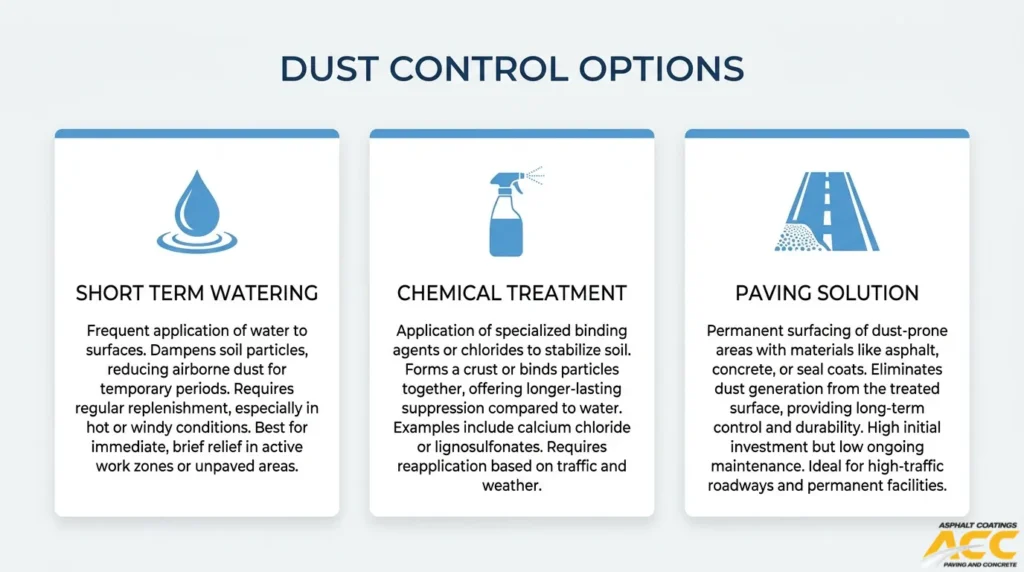
Watering and short-term dust suppression methods are effective for immediate relief but require frequent reapplication. Plain water is the most common short-term approach; however, its suppression effect lasts only a few hours in dry or windy conditions, making it labor-intensive for commercial lots with daily traffic.
Chemical-enhanced alternatives extend that window. According to a 1997 study published in the American Society of Civil Engineers’ Journal of Transportation Engineering, treated road sections retained 42 to 61 percent more aggregate than untreated controls, yielding an estimated cost savings of 28 to 42 percent. Short-term suppressants in this category include:
- Calcium chloride and magnesium chloride solutions that absorb atmospheric moisture
- Lignosulfonate-based palliatives derived from wood pulp processing
- Synthetic polymer emulsions that temporarily bind surface fines
Each option suits different budgets and reapplication schedules. For lots with moderate traffic, even a single chloride application per season can significantly cut dust between scheduled waterings.
What Long-Term Dust Control Treatments Work Best for Commercial Gravel Lots?
The long-term dust control treatments that work best for commercial gravel lots are chloride-based stabilizers, asphalt emulsions, and polymer treatments applied on a scheduled cycle. These products form a semi-rigid crust that binds surface aggregate and resists traffic abrasion for months rather than hours.
Magnesium chloride is among the most proven options. According to a synthesis by the Minnesota Local Road Research Board, practitioners reported that magnesium chloride controlled dust effectively while binding surface material tightly enough to reduce blading from a weekly schedule to just two to three times per summer.
Timing and maintenance discipline are critical. As the Federal Highway Administration’s Unpaved Road Dust Management handbook warns, unscheduled maintenance can break the chemical crust and actually increase dust, accelerate washboarding, and require premature gravel replacement. Commercial lot managers should coordinate regrading strictly around treatment schedules rather than reacting to surface appearance alone. This disciplined approach protects both the treatment investment and overall lot integrity.
How Does Dust From Gravel Parking Lots Affect Tenants and Visitors?
Dust from gravel parking lots affects tenants and visitors through respiratory health risks, property damage, and diminished curb appeal. Airborne particles generated by vehicle traffic on loose aggregate fall into regulated size categories that carry real health consequences.
According to the Centers for Disease Control and Prevention (updated August 2026), road dust is a type of PM10, and smaller PM2.5 particles are more dangerous because they can penetrate deep into the lungs or even enter the bloodstream. For commercial properties, this creates several compounding problems:
- Tenants with outdoor seating, retail displays, or ventilation intakes face ongoing air quality complaints
- Vehicles parked on dusty lots accumulate film that damages paint and frustrates customers
- Visible dust clouds signal neglect, directly undermining property branding and lease value
Uncontrolled dust is not merely a cosmetic issue; it is a liability and tenant retention concern. When suppression methods alone cannot keep particulate levels acceptable, converting to a sealed asphalt surface eliminates the dust source entirely.
When Does It Make Sense to Pave a Gravel Parking Lot With Asphalt?
It makes sense to pave a gravel parking lot with asphalt when recurring maintenance costs, increasing traffic, tenant demands, or liability risks outweigh the savings of keeping gravel. The following sections cover property triggers, traffic thresholds, branding expectations, and safety concerns.
What Property or Business Triggers Indicate It Is Time to Pave?
The property or business triggers that indicate it is time to pave include:
- Escalating maintenance frequency. Regrading, gravel replenishment, or dust treatments are needed multiple times per season, pushing annual upkeep costs toward the price of permanent surfacing.
- Tenant turnover or vacancy complaints. Prospective tenants reject or discount leases because the lot appears neglected or causes vehicle damage.
- Regulatory notices. Local code enforcement or stormwater permits flag erosion, sediment runoff, or dust violations.
- Property repositioning. A planned sale, refinance, or lease-up benefits from the higher appraised value that paved surfaces support.
When two or more of these triggers overlap, the financial case for asphalt almost always outperforms continued gravel maintenance.
How Do Traffic Volume and Vehicle Types Affect the Decision to Pave?
Traffic volume and vehicle types affect the decision to pave because heavier loads and higher daily counts accelerate gravel deterioration. Light passenger traffic at low volumes can be manageable on well-graded gravel; however, delivery trucks, waste haulers, and freight vehicles concentrate weight on narrow tire paths, creating ruts and displacing aggregate far faster.
According to the 2023 West Virginia Department of Transportation Highway Freight Modal Profile, lower functional class roadways often receive lower maintenance priority due to lower traffic volumes, yet these corridors can also comprise important first/last-mile connections to freight assets and freight-generating land uses. A commercial lot serving even occasional heavy vehicles faces the same dynamic: gravel degrades quickly under concentrated axle loads, making asphalt the more cost-effective long-term surface.
How Do Tenant Expectations and Branding Influence Paving Decisions?
Tenant expectations and branding influence paving decisions because a parking lot is the first surface customers and employees interact with. Loose gravel creates a perception of temporary or underdeveloped property, which conflicts with the professional image most retail, medical, and office tenants require.
Property managers competing for national-brand tenants often find that an asphalt surface is a lease prerequisite, not a preference. Dust coating vehicles, uneven surfaces damaging low-clearance cars, and a general lack of striped stalls all erode the curb appeal that drives foot traffic. For multi-tenant commercial properties, the visual consistency and clean appearance of asphalt directly supports higher lease rates and stronger tenant retention.
How Do Safety, Accessibility, and Liability Concerns Factor Into Paving?
Safety, accessibility, and liability concerns factor into paving because gravel surfaces create measurable risks that asphalt eliminates. Loose stone shifts underfoot, increasing slip-and-trip incidents for pedestrians. Wheelchair users, customers with strollers, and anyone with mobility limitations face serious difficulty navigating uneven, shifting gravel.
The U.S. Access Board’s Guide to ADA Accessibility Standards states that hardened materials such as concrete, asphalt, tile, and wood are sufficiently firm and stable for accessibility, while most loose materials, including gravel, will not meet these requirements unless properly treated. ADA-compliant accessible routes, van-accessible stalls, and detectable warning surfaces all require a stable, firm base that gravel cannot reliably provide. Each accessibility gap represents potential liability exposure under federal and state regulations, making asphalt conversion a risk-reduction investment as much as a surface upgrade.
Understanding when paving is justified sets the stage for estimating what the conversion will actually cost.
How Much Does It Cost to Pave an Existing Gravel Parking Lot With Asphalt?
The cost to pave an existing gravel parking lot with asphalt depends on gravel condition, asphalt thickness, project phasing, and lot size. The following sections break down how each factor shapes your final budget.
How Do Existing Gravel Conditions Affect Asphalt Paving Cost?
Existing gravel conditions affect asphalt paving cost by determining how much subgrade correction, grading, and material addition a project requires before paving can begin. A well-compacted, properly graded gravel base may serve as a suitable foundation, reducing preparation costs significantly. Poorly drained or rutted gravel, however, demands extensive rework.
According to the National Asphalt Pavement Association’s Asphalt Paving Handbook (April 2025), the performance of an asphalt mixture under traffic is directly related to the condition of the surface on which pavement layers are placed; a wet, rutted subgrade can significantly reduce ultimate pavement life.Commercial paving contractors experienced in Colorado conditions understand that proper subgrade correction is non-negotiable. Asphalt Coatings Company’s 39 years serving the Front Range means we’ve designed solutions for the region’s specific subsurface drainage challenges and freeze-thaw patterns that weaker foundations cannot withstand. This means skipping base repairs to save money upfront often leads to premature failure and costlier reconstruction. Properties with stable, free-draining gravel typically see the lowest conversion costs.
How Do Thickness, Mix Type, and Design Influence Asphalt Pricing?
Thickness, mix type, and design influence asphalt pricing by changing the volume of material required and the performance characteristics of the finished surface. A standard commercial parking lot typically uses 3 to 4 inches of hot-mix asphalt over a prepared aggregate base, though heavy-traffic areas may require thicker sections.
Key design variables that affect pricing include:
- Asphalt thickness: Each additional inch increases material and placement costs proportionally.
- Mix type: Finer surface mixes cost more per ton than coarser base mixes due to aggregate specifications and binder content.
- Structural design: Lots receiving heavy truck traffic need thicker cross-sections than those serving passenger vehicles only.
- Base course requirements: Some projects add a separate asphalt base lift beneath the wearing surface, increasing total tonnage.
Choosing the right mix and thickness for actual traffic loads avoids both over-engineering and premature pavement failure.
How Do Phasing and Project Timing Impact Paving Costs for Businesses?
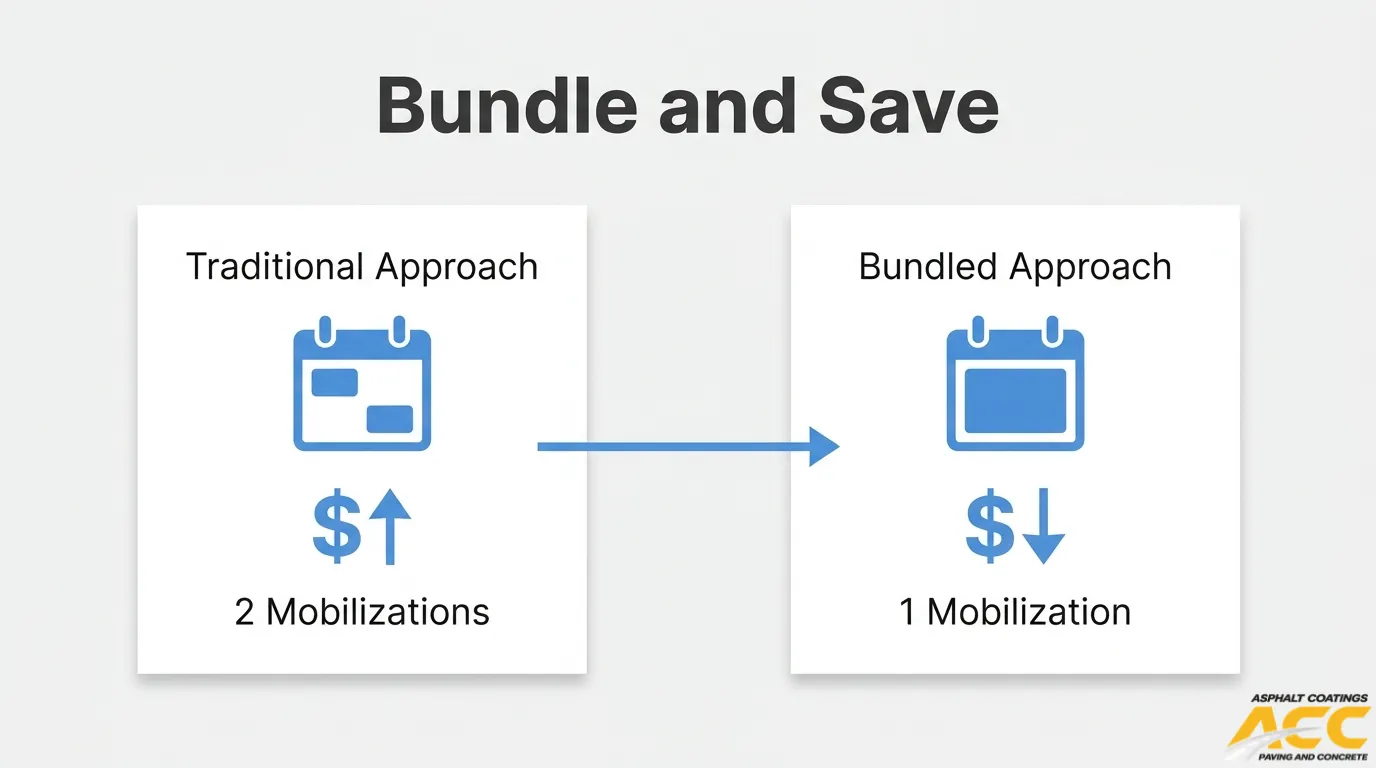
Phasing and project timing impact paving costs for businesses by influencing mobilization expenses, material pricing, and operational disruption. Paving an entire lot in one phase minimizes contractor mobilization costs, while splitting work across multiple phases adds setup charges for each visit.
Seasonal timing matters as well. Asphalt plants typically operate from late spring through fall, and scheduling during peak summer demand can extend lead times. Off-peak windows in early spring or late fall sometimes offer more competitive pricing. For businesses that cannot close their lot entirely, phased construction keeps portions accessible during paving, though this approach requires temporary traffic control and careful coordination that add to the total project cost.
What Are Typical Budget Ranges for Commercial Asphalt Parking Lots?
Typical budget ranges for commercial asphalt parking lots vary widely based on lot size, site conditions, and regional material costs. Small commercial lots under 10,000 square feet may fall in the low tens of thousands, while larger projects involving full site preparation can reach six figures.
Public bid data illustrates this range. A City of Creve Coeur, Missouri, bid tabulation for a 4-inch Type C bituminous concrete wearing surface at Lake School Park priced 89 tons of parking lot asphalt between $20,025 and $33,375, depending on the bidder. These figures cover material and placement for the wearing surface only, not base preparation, grading, or drainage work, which add substantially to total project cost.
For most commercial properties, requesting itemized bids that separate base work, paving, and site improvements provides the clearest picture of where budget dollars are going.
What Preparation Is Needed to Convert a Gravel Parking Lot to Asphalt?
The preparation needed to convert a gravel parking lot to asphalt includes subgrade evaluation, drainage correction, gravel assessment, edge infrastructure planning, and disruption management. The following sections cover each step.
How Do You Evaluate and Correct Subgrade and Drainage Before Paving?
You evaluate and correct subgrade and drainage before paving by testing soil stability, identifying moisture problems, and installing drainage systems before any asphalt is placed. A wet or rutted subgrade directly compromises pavement life. According to the National Asphalt Pavement Association’s April 2025 Asphalt Paving Handbook, if the condition of the subgrade soil is poor, particularly if it is wet and rutted under haul trucks, the ultimate life of the roadway may be significantly reduced.
Key subgrade and drainage evaluation steps include:
- Probe the existing surface for soft spots, standing water, and rutting patterns.
- Test soil compaction density and moisture content at multiple points across the lot.
- Identify subsurface layers that block water infiltration, which is common in many Colorado soils.
- Install French drains, underdrains, or regraded swales to redirect water away from the pavement section.
- Compact and proof-roll the corrected subgrade before placing any base material.
Skipping subgrade correction is one of the most costly mistakes in parking lot conversion; the pavement above is only as strong as the foundation beneath it.
When Should You Reuse, Regrade, or Remove Existing Gravel?
You should reuse, regrade, or remove existing gravel based on its gradation, contamination level, and compaction suitability as a base course. Well-graded, clean crusher-run gravel can often serve as an effective asphalt base, saving significant material and hauling costs. According to a 2011 report from the University of Wisconsin–Madison Recycled Materials Resource Center, reclaimed asphalt pavement may be used alone or in mixtures with other aggregate materials in the production of unbound base course materials, provided they meet specified gradation requirements.
Consider these decision factors:
- Reuse: Gravel with consistent gradation and minimal fines loss can be graded to profile and compacted in place.
- Regrade: Uneven or rutted gravel that is still structurally sound needs reshaping to achieve proper cross-slope for drainage.
- Remove: Contaminated gravel mixed with topsoil, organic debris, or excessive clay should be excavated and replaced with engineered aggregate.
A qualified contractor should core-sample or test-pit the gravel layer before committing to any approach.
How Do Curbs, Gutters, and Concrete Edges Factor Into Preparation?
Curbs, gutters, and concrete edges factor into preparation by defining lot boundaries, controlling stormwater flow, and establishing finished grade elevations for the asphalt surface. Without proper edge infrastructure, water migrates under the pavement and accelerates base failure.
Preparation tasks for edge elements include:
- Setting curb and gutter lines before paving to establish the final asphalt elevation.
- Installing concrete curbs along property boundaries, drive aisles, and landscape islands to contain the asphalt section.
- Connecting gutter flow lines to storm drains or detention areas so runoff exits the lot rather than pooling on the surface.
- Pouring ADA-compliant ramps and transitions at pedestrian crossings before the asphalt lift is placed.
Sequencing matters: concrete edge work must cure adequately before paving equipment operates adjacent to it. Planning curb placement early prevents costly rework after the asphalt is down.
How Do You Minimize Business Disruption During Parking Lot Conversion?
You minimize business disruption during parking lot conversion by phasing construction, maintaining partial access, and communicating clear timelines to tenants. According to the Texas Department of Transportation’s design guidance on TCP strategies, construction phasing feasibility can affect business access, construction cost, and duration, making early planning at the design stage essential.
Effective disruption-reduction strategies include:
- Dividing the lot into phases so tenants retain access to a portion of parking throughout the project.
- Scheduling demolition, grading, and paving during off-peak hours or business closures when possible.
- Providing temporary signage and traffic control directing customers to available parking areas.
- Coordinating material deliveries and equipment staging to avoid blocking primary building entrances.
For most commercial properties, a well-planned phased approach adds minimal time to the project while preserving daily operations. With preparation complete, the next step is understanding how maintenance needs differ once asphalt replaces the gravel surface.
How Do Maintenance Needs Differ Between Gravel and Asphalt Parking Lots?
Maintenance needs differ between gravel and asphalt parking lots in frequency, task type, and long-term cost trajectory. Gravel demands frequent regrading and material replenishment, while asphalt requires periodic sealcoating and crack repair. The subsections below break down each surface’s requirements and compare lifecycle costs.
What Ongoing Maintenance Does a Gravel Parking Lot Require?
Ongoing maintenance for a gravel parking lot includes regular grading, material replenishment, dust suppression, and drainage management. Loose aggregate shifts under traffic, creating ruts, potholes, and washboarding that require correction multiple times per season.
Key recurring tasks include:
- Grading and reshaping the surface to eliminate ruts and restore crown drainage.
- Adding fresh aggregate to replace material lost to displacement and erosion.
- Applying dust suppressants such as magnesium chloride or calcium chloride.
- Clearing and maintaining drainage channels to prevent standing water.
According to the Federal Highway Administration’s Unpaved Road Dust Management handbook (2013), unscheduled maintenance can do more harm than good because most chemical treatments form a crust that, if unnecessarily broken up, leads to increased dust, rapid ride-quality deterioration, and accelerated aggregate loss. Timing each intervention correctly matters as much as the intervention itself.
What Routine Maintenance Does an Asphalt Parking Lot Require?
Routine maintenance for an asphalt parking lot centers on sealcoating, crack sealing, patching, and re-striping. These tasks occur on predictable, multi-year cycles rather than the seasonal frequency gravel demands.
Essential asphalt maintenance activities include:
- Sealcoating every three to five years to slow oxidation and prevent water infiltration.
- Crack sealing as cracks appear to block moisture from reaching the base layer.
- Patching isolated potholes or failed areas before they spread.
- Re-striping parking stalls and traffic lanes after sealcoat applications.
A 2023 report from North Carolina State University Transportation confirmed that parking lots should be sealcoated every three to five years because sealant slows crack formation, minimizes raveling caused by oxidation, and prevents water penetration that leads to potholes. For property managers, this predictable schedule simplifies budgeting compared to the reactive nature of gravel upkeep.
How Do Maintenance Costs Over 10–20 Years Compare for Gravel and Asphalt?
Maintenance costs over 10 to 20 years depend heavily on traffic volume, with gravel becoming disproportionately expensive as vehicle counts rise. Gravel’s low installation cost is offset by compounding annual expenses for regrading, aggregate replacement, and dust control. Asphalt carries a higher upfront investment but spreads maintenance into less frequent, more predictable intervals.
A 2004 lifecycle study by the Institute for Transportation at Iowa State University conducted a 20-year cost analysis using a 3.5 percent discount rate and found that average daily traffic is statistically significant in calculating both agency costs and vehicle operating costs across hot-mix asphalt, blotter, and gravel surfaces. At higher traffic levels, gravel’s cumulative maintenance and vehicle wear costs erode the initial savings. For most commercial properties handling moderate to heavy daily traffic, asphalt delivers lower total cost of ownership over a 20-year horizon.
With maintenance differences clarified, a phased improvement plan helps property managers act on the right timeline.
How Should Property Managers Plan Parking Lot Improvements Over Time?
Property managers should plan parking lot improvements over time by phasing upgrades strategically, forecasting maintenance budgets annually, and tracking how lot condition affects tenant satisfaction. The following sections cover phased gravel-to-asphalt conversion, budgeting and forecasting, and the link between lot condition and lease value.
How Can You Phase Upgrades From Gravel to Asphalt on a Commercial Site?
You can phase upgrades from gravel to asphalt on a commercial site by converting high-traffic zones first, then expanding paving to secondary areas as budgets allow. This approach keeps the lot operational during construction and spreads capital costs across multiple fiscal years.
A practical phasing sequence includes:
- Phase 1: Pave primary drive lanes and fire access routes to address safety and ADA compliance.
- Phase 2: Convert main parking rows closest to building entrances.
- Phase 3: Pave overflow and perimeter sections, completing the full conversion.
Each phase should begin with subgrade evaluation and drainage correction before asphalt placement. A March 2024 design memorandum for the Town of Blue River, Colorado, estimated $320,000 for asphalt pavement on Spruce Creek Road, with an annualized cost of $23,000 per year. While that figure reflects roadway construction rather than commercial lot rates, it illustrates how annualized cost modeling helps property managers compare phased investment against ongoing gravel maintenance.
How Do You Budget and Forecast for Future Paving and Maintenance?
You budget and forecast for future paving and maintenance by establishing a capital reserve schedule tied to the lot’s current condition, expected traffic growth, and planned sealcoating intervals. Start with a baseline condition assessment, then project annual costs for gravel replenishment or asphalt preservation.
Key budgeting steps include:
- Conduct a condition survey every 12 to 18 months to identify emerging damage.
- Set aside reserves for sealcoating on a recurring cycle; lots should be sealcoated every three to five years to prevent the asphalt layer from breaking down, according to a 2023 report from North Carolina State University Transportation.
- Factor in crack sealing, striping, and drainage repairs as separate line items.
Forecasting becomes more accurate when property managers track actual maintenance spending year over year. Even a basic spreadsheet that logs repair dates, costs, and square footage treated builds a reliable dataset for future projections.
How Can Parking Lot Condition Impact Tenant Retention and Lease Value?
Parking lot condition can impact tenant retention and lease value by shaping first impressions, daily user experience, and perceived property quality. A deteriorating lot with potholes, standing water, or excessive dust signals deferred maintenance, which makes tenants question management’s commitment to the property overall.
Commercial tenants weigh several lot-related factors when renewing leases:
- Safety and liability: Cracked or uneven surfaces increase trip-and-fall risk, raising insurance concerns.
- Customer access: Retail and healthcare tenants depend on smooth, well-marked lots to attract visitors.
- Brand alignment: Professional tenants avoid properties where lot conditions undermine their own image.
Properties with well-maintained asphalt parking lots consistently command higher lease rates because the lot is often the first and last thing tenants and their customers see. For property managers weighing gravel maintenance costs against paving investment, tenant retention savings frequently justify the conversion. With a long-term improvement plan in place, the next step is partnering with an experienced contractor to execute it.
How Should You Approach Gravel Parking Lot Decisions With a Commercial Asphalt Contractor?
You should approach gravel parking lot decisions with a commercial asphalt contractor by requesting a site evaluation that covers subgrade conditions, drainage, dust exposure, and traffic patterns. The sections below explain how Asphalt Coatings Company supports this process and summarize the article’s key takeaways.
How Can Asphalt Coatings Company Help Evaluate and Upgrade a Gravel Parking Lot?
Asphalt Coatings Company can help evaluate and upgrade a gravel parking lot by conducting on-site assessments of base stability, drainage flow, and surface deterioration. With 39 years of commercial paving experience across Colorado’s Front Range, Asphalt Coatings Company designs solutions around freeze-thaw exposure, spring breakup risk, and the specific traffic loads each property faces.
Asphalt Coatings Company offers services relevant to gravel-to-asphalt conversions:
- Subgrade preparation and grading to correct soft or rutted base conditions before paving.
- Asphalt paving and installation using mix designs suited to Colorado’s altitude and climate.
- Curb and gutter installation to manage stormwater runoff after conversion.
- ADA-compliant concrete work to bring accessible routes up to federal surface requirements.
- Sealcoating and crack sealing to extend pavement life after the initial overlay.
Because Asphalt Coatings Company uses in-house crews rather than subcontractors, phasing and scheduling stay under direct control. For property managers weighing dust suppression costs against a permanent asphalt surface, that single-source coordination simplifies budgeting and reduces project risk.
What Are the Key Takeaways About Gravel Parking Lot Cost, Dust Control, and When to Pave It With Asphalt?
The key takeaways about gravel parking lot cost, dust control, and when to pave it with asphalt center on three decisions: how much you can spend upfront, how aggressively you need to manage dust, and whether traffic volume justifies a permanent surface.
- Cost is front-loaded or spread out. Gravel lots cost less to build, but ongoing regrading, aggregate replenishment, and dust treatments accumulate. A life-cycle cost analysis using a 20-year period and 3.5 percent discount rate, conducted by Iowa State University’s Institute for Transportation, found that average daily traffic is statistically significant in calculating both agency and vehicle operating costs across HMA, blotter, and gravel surfaces.
- Dust control works but has limits. Chemical suppressants, proper aggregate gradation, and moisture management all reduce airborne particulate. Still, paving with asphalt or applying a bituminous surface treatment eliminates the dust problem entirely, though low-traffic sites may not justify that expense.
- Subgrade and drainage decide long-term performance. Excess water in base and subgrade layers weakens unbound materials, increases frost heave potential, and causes pumping. Resolving drainage before any surface upgrade protects the investment regardless of whether you choose gravel maintenance or asphalt conversion.
The most practical approach is treating gravel lot management as a phased strategy. Start with proper gradation and dust suppression, monitor aggregate loss and maintenance frequency, and convert to asphalt when traffic, tenant expectations, or cumulative repair costs make the permanent surface more economical. Asphalt Coatings Company partners with commercial property owners at every stage of that progression.