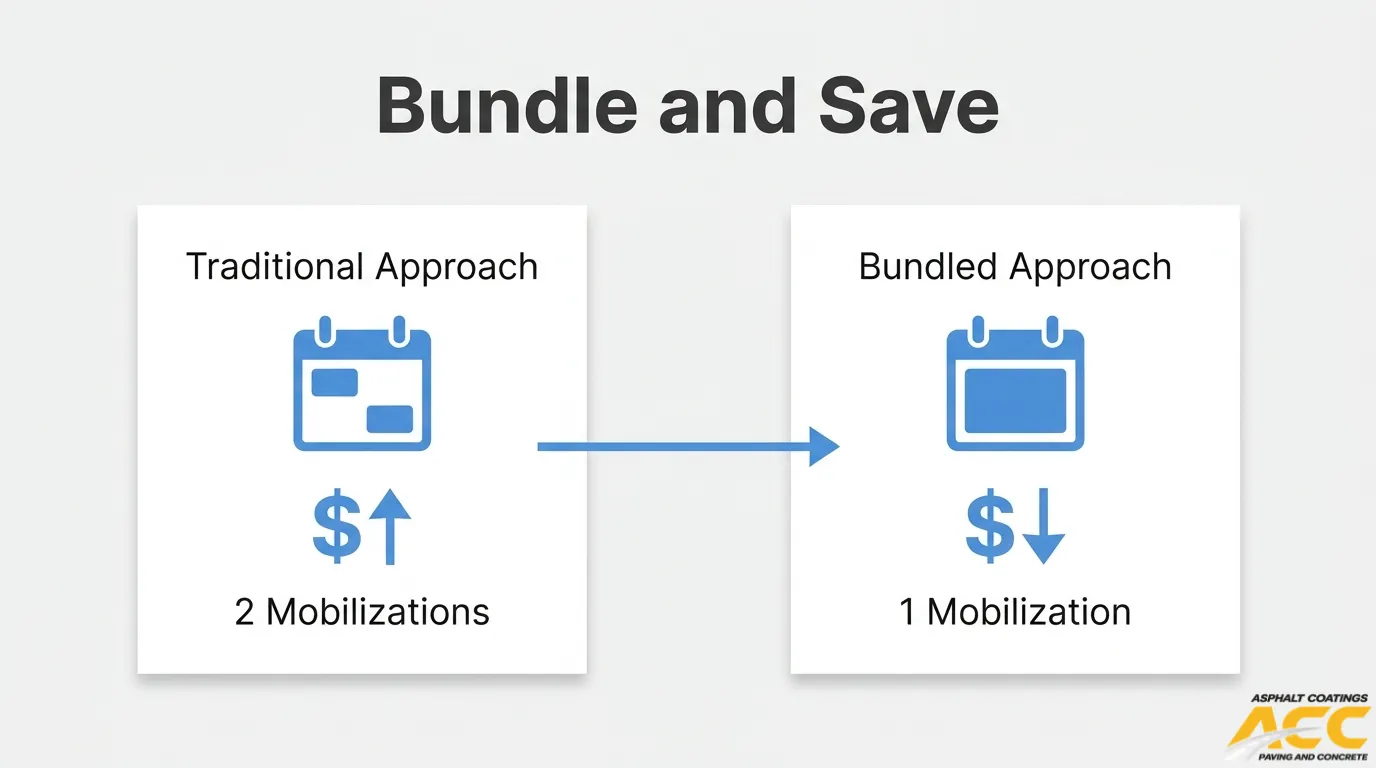
Bundling sealcoating and striping is the practice of combining both pavement maintenance scopes into a single project mobilization, eliminating duplicate closures, redundant setup costs, and the scheduling gaps that inflate budgets and downtime.
This guide covers why property owners default to separating these services, how the combined logistics and cost structure work, what operational and climate factors shape savings, how different property types adapt the approach, and when bundling is not the right choice.
Most owners split sealcoating and striping across separate contracts due to vendor specialization, misaligned budget cycles, or the assumption that cure times require weeks between scopes. In practice, sealcoat needs just 24 hours of cure before traffic paint application, a window that fits easily within one continuous project.
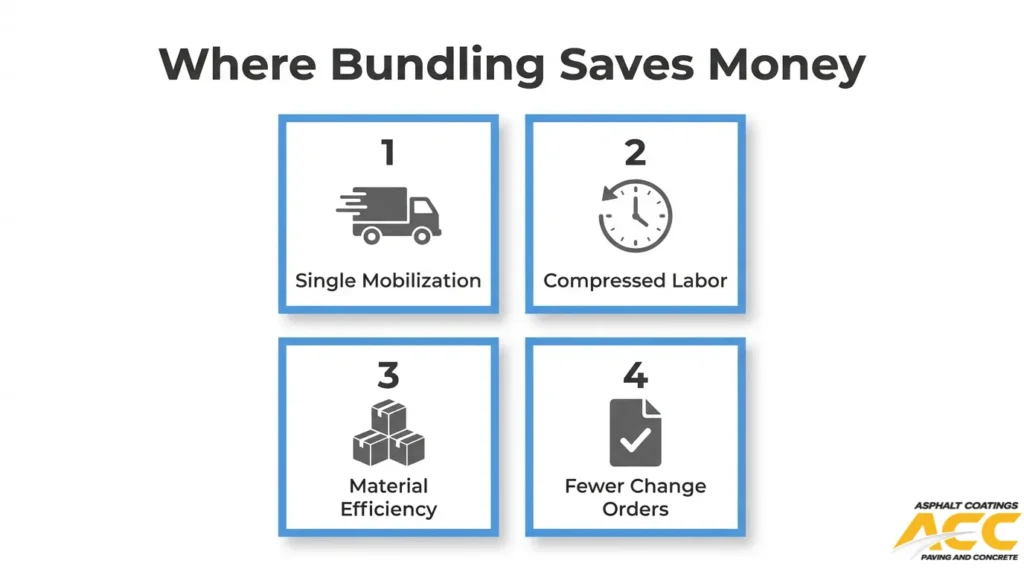
Bundling reduces direct costs by consolidating mobilization fees, compressing labor hours, and improving material procurement efficiency. A single crew deployment replaces two rounds of equipment transport, traffic control setup, and site staging.
Closure time drops because one phasing plan serves both scopes simultaneously. Institutions scheduling combined work have consolidated sealcoating, crack repair, and striping into daily closures that reopen lots the same evening, eliminating the extra days a separate striping mobilization would add.
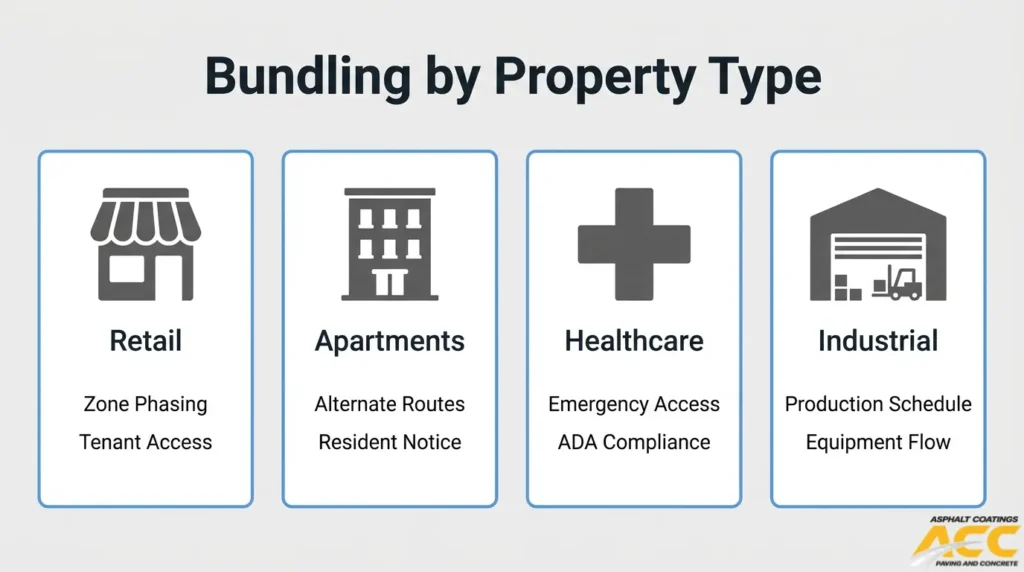
Savings vary by property type. Retail plazas phase by zone to protect storefront access, apartment communities designate alternate routes to limit resident displacement, healthcare campuses maintain emergency and ADA access through every phase, and industrial sites align closures with production downtime.
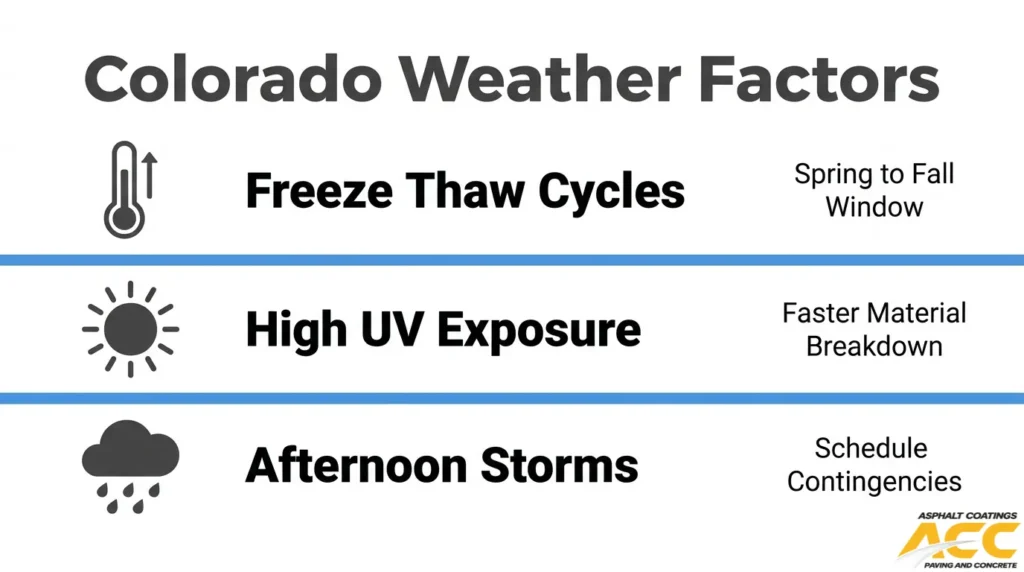
Colorado’s freeze-thaw cycles, high-altitude UV exposure, and afternoon monsoon storms compress the viable work window and demand precise scheduling. Early planning, typically three to four months ahead, secures contractor availability and stable weather conditions for a single-trip project.
Why Do Property Owners Commonly Separate Sealcoating and Striping Into Different Projects?
Property owners commonly separate sealcoating and striping into different projects because of scheduling conflicts, budget constraints, contractor specialization, and the assumption that each scope requires its own timeline. The sections below examine the specific reasons behind this default approach and what it costs in practice.
Sealcoating and striping share overlapping material requirements, cure-time dependencies, and closure logistics. Despite this natural pairing, several forces push property owners toward splitting the work across separate mobilizations. Understanding these forces is essential before evaluating whether bundling makes more sense.
The most common reasons property owners separate sealcoating and striping include:
- Different contractor specializations. Some sealcoating contractors do not offer striping services, and vice versa. Property managers who use separate vendors for each scope end up with two contracts, two schedules, and two mobilizations by default.
- Budget cycle timing. Capital budgets and maintenance budgets often fall under different approval processes. Sealcoating may be funded as a capital improvement while striping is categorized as routine maintenance, pushing each into a different fiscal quarter or year. According to Davenport University’s parking lot best-practices guide, institutions plan sealcoating and striping together at Year 5 and Year 15 of a pavement lifecycle, yet many owners still stagger these scopes when budget cycles do not align.
- Cure-time misunderstanding. Property owners sometimes assume sealcoat curing requires days of downtime before striping can begin, prompting them to schedule striping as a separate project weeks later. In reality, specifications from the City of Fair Oaks Ranch, Texas, require freshly applied pavement sealer to cure for a minimum of 24 hours before applying traffic paint, a window that fits easily within a single project mobilization.
- Perceived scheduling complexity. Coordinating two scopes feels more complicated than managing one at a time. Owners who lack experience with combined projects default to the simpler path of handling each service independently.
- Vendor bidding structures. Public procurement processes sometimes issue separate bid solicitations for sealcoating and striping. When the contracting framework separates the scopes, the execution follows suit.
Each of these factors adds cost and closure time that a bundled approach eliminates. The inefficiency compounds on larger commercial properties where every additional mobilization means another round of tenant notifications, traffic rerouting, and lost parking access.
For property owners managing retail plazas, apartment complexes, or healthcare campuses, the decision to separate scopes is rarely strategic. It is usually a byproduct of how contracts are structured and how budgets are approved. Recognizing this pattern is the first step toward capturing the savings that come from combining both services into one closure window.
What Happens Logistically When You Combine Sealcoating and Striping Into a Single Project?
Combining sealcoating and striping into a single project consolidates surface preparation, sealer application, curing, and line painting into one continuous closure window. The sequence below covers how each phase connects, what cure times govern the timeline, and why coordination determines whether the lot reopens on schedule.
How Does the Typical Sequence of a Bundled Project Unfold?
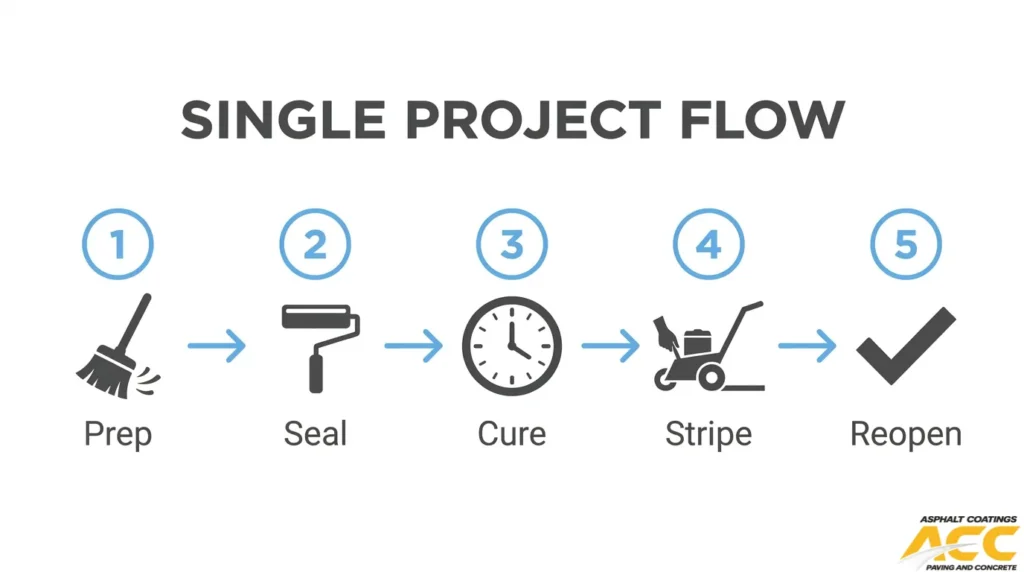
The typical sequence of a bundled project unfolds in five connected phases: surface preparation, sealcoat application, curing, striping, and reopening. Crews begin with cleaning, oil-spot priming, and crack filling. Once the surface is ready, sealcoat goes down in two coats, with the second applied after the first is dry to touch. According to St. Charles County, Missouri project specifications, sealcoat should cure 24 hours before opening to traffic. Striping follows that same cure window. Because each phase feeds directly into the next, idle time between trades shrinks significantly compared to scheduling each scope weeks apart. This continuous workflow is what makes bundling logistically efficient.
What Cure and Dry Times Control the Project Timeline?
Cure and dry times control the project timeline by dictating when crews can apply the next coat, when stripers can paint lines, and when vehicles can return. Sealcoat typically needs 24 hours of cure time before striping begins. The City of Fair Oaks Ranch, Texas specifies that freshly applied pavement sealer shall cure for a minimum of 24 hours prior to applying acrylic water-based traffic paint. Striping paint itself dries far faster; waterborne traffic paint reaches no-track condition within 60 to 90 seconds under favorable conditions. Temperature and humidity shift these windows, so the contractor must monitor conditions throughout the project to avoid premature application or delayed reopening.
How Does Crew and Equipment Coordination Work on a Combined Scope?
Crew and equipment coordination on a combined scope works by staging sealcoat and striping teams in a planned sequence so one crew hands off to the next without remobilization. The sealcoat crew brings squeegee machines, spray systems, and barricades. The striping crew follows with layout equipment, stencils, and paint stripers. On a bundled project, both teams schedule around the same closure dates, eliminating the need for separate traffic control setups. Ontario County, New York specifications require both surface and ambient temperatures to remain at a minimum of 50°F and not drop below that threshold for 24 hours after application. Coordinating both crews under one weather window avoids the risk of a second mobilization falling on an unsuitable day.
How Are Parking Areas Phased or Closed During the Work?
Parking areas are phased or closed during the work based on lot size, tenant needs, and how much simultaneous downtime the property can absorb. Smaller lots often close entirely for two to three days. Larger facilities split into sections so portions remain accessible while others cure. Tuolumne County, California required its parking lot project to be scheduled for weekends or after business hours, with lots broken into sections to allow curing times and continuous use during the project. Full closures simplify crew workflow and produce faster turnaround, while phased approaches demand more barricading and communication but keep partial access open.
What Communication and Signage Steps Keep Stakeholders Informed?
Communication and signage steps that keep stakeholders informed include advance written notices, posted closure schedules, directional signage, and designated alternate parking. Fairfax County’s Department of Public Works specifies that clear signage and traffic control measures must be in place to safely direct pedestrians and vehicles throughout the construction area, with accessible parking temporarily relocated to accommodate the work. For bundled projects, stakeholders need to know the full closure duration upfront, not just the sealcoating window. Providing a single, consolidated timeline prevents the confusion that arises when tenants or customers receive separate notices for two different scopes weeks apart.
Understanding the logistical sequence of a bundled project clarifies where the real cost and closure-time savings originate.
How Does Bundling Sealcoating and Striping Reduce Direct Project Costs?
Bundling sealcoating and striping reduces direct project costs by eliminating duplicate mobilization charges, compressing labor hours, improving material purchasing efficiency, and lowering the risk of change orders. The following subsections break down each cost lever.
How Do Single Mobilization and Setup Costs Change When You Bundle Both Services?
Single mobilization and setup costs drop significantly when you bundle both services. Every contractor visit carries fixed charges: crew travel, equipment transport, traffic control setup, and site preparation. Scheduling sealcoating and striping separately means paying those mobilization fees twice. A bundled project consolidates those expenses into one deployment cycle.
Equipment like barricades, cones, and signage gets positioned once and stays in place through both scopes. The crew arrives, completes sealcoating, allows cure time, then stripes without demobilizing. For property managers overseeing multiple lots, this single-trip approach compounds savings across every surface. Eliminating a redundant mobilization is often the most immediately visible line-item reduction on a bundled invoice.
How Can Combining Labor and Equipment Time Lower Your Overall Invoice?
Combining labor and equipment time lowers your overall invoice by removing idle gaps and redundant task overlap. When sealcoating and striping happen as separate projects, each scope carries its own crew staging, equipment warm-up, and teardown periods. Those non-productive hours still appear on your bill. Contractors with in-house crews for both sealcoating and striping can manage these transitions more efficiently than coordinating between separate subcontractors, which often introduces additional scheduling delays and communication gaps.
A bundled project keeps the crew on-site continuously. While sealcoat cures, striping equipment can be staged and layout measurements confirmed. This parallel workflow compresses the total billable labor window. Equipment rental or allocation costs also shrink because machines like line stripers and spray rigs occupy a single consolidated rental period rather than two separate ones. Tighter scheduling translates directly to a lower labor-and-equipment line item.
How Do Material Purchasing Efficiencies Improve When Both Scopes Are Done Together?
Material purchasing efficiencies improve when both scopes are done together because the contractor orders sealcoat emulsion and traffic paint for one coordinated project rather than placing two independent procurement cycles. Consolidated ordering often qualifies for volume pricing from suppliers and reduces delivery charges.
According to Ontario County, New York specifications, both surface and ambient temperature must be a minimum of 50°F and rising before applying sealcoating or traffic paints, and temperatures must hold above 50°F for 24 hours after application. Because sealcoat and striping paint share identical temperature requirements, a single weather-appropriate window ensures neither material is wasted to failed application conditions. Shared environmental constraints make joint procurement inherently more efficient than staggered purchasing.
How Can Bundling Sealcoating and Striping Reduce Change Orders and Rework Costs?
Bundling sealcoating and striping can reduce change orders and rework costs by keeping one contractor accountable for the full scope from surface preparation through final line placement. When separate contractors handle each phase independently, misaligned schedules frequently trigger costly scope adjustments.
A Stanford University project notice illustrated this risk: unforeseen scheduling delays forced additional areas into a later phase, extending closures and altering the planned work sequence. With a single bundled contract, the same crew controls sequencing, eliminating finger-pointing between trades when timelines shift. Striping over freshly sealed surfaces also means the paint bonds to a uniform substrate, reducing line adhesion failures that would otherwise require touch-up visits. One contract, one crew, and one accountability chain keeps change order exposure low.
With direct project costs addressed, the next question is how much closure time bundling can actually save.
How Much Closure Time Can You Save by Doing Sealcoating and Striping Together?
Bundling sealcoating and striping into one project can save significant closure time by eliminating redundant setup days, overlapping cure windows, and repeat phasing. The following sections cover total closure days, staging efficiency, disruption reduction, and cure-time coordination.
How Does Bundling Affect Total Days Your Parking Lot or Drive Lanes Are Closed?
Bundling affects total days your parking lot or drive lanes are closed by consolidating two separate closure events into one continuous window. When sealcoating and striping are scheduled independently, each project requires its own mobilization day, cure period, and re-opening sequence. Combined, the crew applies sealcoat, waits through a single cure window, then stripes before releasing the lot once.
According to a College of DuPage procurement award, sealcoating and line markings for Lot 6 and primary roads were contracted together under a single scope totaling $137,842.47, structuring both services as one closure event rather than two. For most commercial lots, this approach eliminates one to two full days of additional closure that a separate striping mobilization would require.
How Does a Combined Schedule Reduce Staging, Phasing, and Reconfiguration Time?
A combined schedule reduces staging, phasing, and reconfiguration time by allowing one crew to manage traffic control, barricading, and section transitions for both scopes simultaneously. Separate projects force duplicate setup of cones, signage, and access rerouting.
According to a Tuolumne County, California, parking lot maintenance RFP, the project required scheduling for weekends or after business hours, with lots broken into sections to allow curing times and continuous use during the work. When both sealcoating and striping fall under one phasing plan, section handoffs happen once per zone instead of twice. This single-pass phasing is especially valuable for properties with limited alternate parking, where every reconfiguration compounds tenant inconvenience.
How Does Doing Both Scopes at Once Minimize Disruption for Tenants, Customers, and Staff?
Doing both scopes at once minimizes disruption for tenants, customers, and staff by reducing the total number of days people must navigate closures, rerouted traffic, and relocated parking. Two separate projects mean two rounds of advance notices, two periods of restricted access, and two adjustment cycles for daily routines.
A single bundled closure lets property managers send one communication, set up alternate routing once, and restore normal operations in a single re-opening. From a practical standpoint, tenant patience erodes significantly by the second closure event. Combining scopes preserves goodwill and keeps revenue-generating access intact for the maximum number of operating days per season.
How Does Coordinating Cure Times and Striping Windows Optimize Re‑Opening Speed?
Coordinating cure times and striping windows optimizes re-opening speed by sequencing striping to begin immediately after the sealcoat reaches its required cure threshold. According to the Indiana Department of Transportation, regular waterborne traffic paint dries to no-track status within 60 seconds after application, though timing varies with temperature and humidity.
This fast-dry characteristic means once the sealcoat cures, striping adds minimal additional closure. A contractor already on-site can begin painting within hours of cure completion rather than scheduling a return visit days later. The result is a lot that reopens the same day striping finishes, rather than sitting sealed but unusable while waiting for a separate striping crew to mobilize.
With closure time strategies in place, understanding what operational factors affect savings helps refine the bundling approach further.
What Operational Factors Most Affect Savings When You Bundle Sealcoating and Striping?
The operational factors that most affect savings when you bundle sealcoating and striping include lot size, business hours, weather conditions, and safety requirements. Each factor shapes scheduling, phasing, and total closure duration.
How Do Lot Size and Layout Influence the Benefits of Bundling?
Lot size and layout influence the benefits of bundling by determining how much mobilization cost, crew time, and phasing complexity you can consolidate into one project. Larger lots with simple rectangular layouts allow crews to sealcoat and stripe in continuous passes, maximizing equipment utilization per mobilization. Smaller lots or those with complex configurations, such as multi-level garages, narrow drive aisles, or scattered islands, require more phasing stages. Each additional phase adds setup time that erodes bundled savings. Properties with multiple disconnected parking areas benefit most because a single mobilization eliminates repeated travel and staging costs across each sub-lot.
How Do Business Hours and Peak Traffic Patterns Change the Scheduling Strategy?
Business hours and peak traffic patterns change the scheduling strategy by dictating when crews can access the lot without disrupting operations. Sealcoat requires a 24-hour cure before striping paint application, according to specifications from the City of Fair Oaks Ranch, Texas. This means scheduling must account for consecutive low-traffic windows. Properties with daytime-only operations can schedule sealcoating Friday evening and striping Saturday afternoon. Facilities operating on weekends or running evening shifts need tighter coordination. High-traffic periods compress the available work window, so identifying predictable off-peak blocks is essential for keeping both scopes within a single closure event.
How Do Weather, Temperature, and Colorado’s Freeze‑Thaw Cycles Impact Timing Choices?
Weather, temperature, and Colorado’s freeze-thaw cycles impact timing choices by narrowing the viable application window for both sealcoat and striping materials. Both products require surface and ambient temperatures at or above 50°F, with temperatures remaining above that threshold for 24 hours after application, per Ontario County, New York specifications. Colorado’s Front Range complicates this requirement because chinook winds can swing temperatures 25° to 35°F in a short period, according to the Western Regional Climate Center. Bundled projects need multi-day stable forecasts. Contractors with decades of Front Range experience understand these localized weather patterns and build appropriate contingencies into bundled project timelines, reducing the risk of weather-driven delays that can compromise both sealcoat cure and striping quality. Scheduling between late April and early October typically provides the most reliable conditions, though afternoon monsoon storms in July through September can still force delays.
How Do Safety, ADA Access, and Emergency Routing Requirements Shape Phasing Plans?
Safety, ADA access, and emergency routing requirements shape phasing plans by dictating which areas must remain open during each phase of work. Fire apparatus access roads require an unobstructed driving surface width of at least 20 feet and vertical clearance of 13 feet 6 inches, according to Portland Fire & Rescue. ADA-compliant accessible parking must be relocated, not eliminated, during closures. Phasing plans should address the following:
- Maintain at least one accessible route and temporary accessible parking bays throughout every phase.
- Keep fire lanes and emergency vehicle access unobstructed at all times.
- Designate alternate pedestrian pathways with clear signage separating foot traffic from work zones.
- Coordinate controlled emergency drop-off points for healthcare or high-priority facilities.
These constraints often mean bundled projects require more phases than a simple full-lot closure, but careful pre-planning prevents the alternative: two entirely separate mobilizations with duplicated compliance efforts.
How Do Cost and Time Savings From Bundling Differ by Property Type?
Cost and time savings from bundling sealcoating and striping differ by property type based on traffic patterns, access requirements, and operational constraints. Shopping centers prioritize revenue continuity, apartments focus on resident access, healthcare campuses protect patient safety, and industrial sites coordinate around equipment flow.
How Should Shopping Centers and Retail Plazas Approach Bundled Sealcoating and Striping?
Shopping centers and retail plazas should approach bundled sealcoating and striping by phasing work across zones to keep storefronts accessible throughout the project. Retail properties depend on continuous customer access, so closing an entire lot at once typically causes unacceptable revenue loss for tenants.
Effective strategies for retail bundling include:
- Scheduling work overnight or during low-traffic windows, such as early weekday mornings.
- Phasing by zone so each section completes sealcoating and striping before crews move to the next.
- Maintaining fire lane access and ADA-compliant paths to every open storefront during each phase.
- Coordinating closure notices with tenant lease requirements, since many retail leases restrict parking disruptions.
For multi-tenant retail properties, bundling still delivers meaningful savings by eliminating a second mobilization, but the phasing plan must account for anchor tenant hours and seasonal traffic peaks.
How Can Apartment and HOA Communities Plan Bundled Work to Limit Resident Disruption?
Apartment and HOA communities can plan bundled work to limit resident disruption by designating alternate access routes and phasing closures across parking zones. Residents need guaranteed vehicle access to their units every day, which makes full-lot closures impractical for occupied communities.
Key planning steps include:
- Identifying alternate entry points before work begins. According to the City of Maple Grove, Minnesota, residents were directed to use the Weaver Lake Road entrance to access an apartment complex while Maple Knoll Way was closed during adjacent roadwork.
- Phasing work so only one parking section closes at a time, with overflow parking clearly marked.
- Distributing written notices at least two weeks before each phase, specifying exact dates and affected spaces.
- Scheduling sealcoating and striping in a single continuous phase per zone to avoid repeated displacement.
This phased, single-visit approach is where bundling saves apartment communities the most. Separating the scopes would double the number of nights residents scramble for alternative parking.
How Do Healthcare Centers and Medical Campuses Balance Access Needs With Bundled Closures?
Healthcare centers and medical campuses balance access needs with bundled closures by maintaining uninterrupted patient entry, ADA parking, and emergency vehicle routes throughout every phase. No other property type carries the same stakes during a parking closure; blocked access can delay care.
According to the U.S. Department of Veterans Affairs, when the Baltimore VAMC parking garage closed for maintenance, a valet parking service operated at the Metro West garage while a handicap-accessible shuttle ran between that garage and the hospital’s front entrance with regular pickups and drop-offs. All patients received mailed notifications with the exact closure date.
Critical requirements for healthcare bundling include:
- Relocating accessible parking spaces to meet ADA dimensional standards: car spaces at 96 inches minimum width and van spaces at 132 inches minimum, each with a compliant access aisle.
- Preserving ambulance and emergency vehicle access to all active entrances at all times.
- Operating shuttle services or temporary valet parking when primary lots close.
Bundling sealcoating and striping compresses the total disruption window, but healthcare campuses must invest more in phasing logistics than any other property type to maintain safe, compliant access.
How Should Industrial Facilities and Warehouses Coordinate Bundling Around Operations?
Industrial facilities and warehouses should coordinate bundling around operations by aligning closure phases with production schedules and maintaining safe clearances for equipment movement. Forklift traffic, loading dock access, and aisle widths create constraints that standard commercial lots do not face.
Planning considerations for industrial bundling include:
- Scheduling work during planned shutdowns, shift changes, or weekend downtime when equipment traffic stops.
- Maintaining OSHA-compliant aisle clearances at loading docks, doorways, and turning areas throughout active phases.
- Using temporary high-visibility physical barriers to separate work zones from pedestrian and vehicle areas, a control measure recommended by Safe Work Australia for warehouse traffic management.
- Coordinating with operations managers to sequence zones based on shipping schedules and inbound delivery windows.
Industrial properties often realize the largest per-square-foot savings from bundling because their lots are expansive and mobilization costs scale accordingly. The key is treating the bundled project like a production scheduling problem, not just a paving job.
Understanding how each property type handles bundled closures helps clarify the risks that come with compressing both scopes into one window.
What Risks or Drawbacks Come With Bundling Sealcoating and Striping, and How Can You Avoid Them?
The risks that come with bundling sealcoating and striping include weather disruptions, hidden surface damage, tenant miscommunication, and quality shortcuts from compressed timelines. The following sections cover each risk and how to prevent it.
How Can Weather Delays or Temperature Swings Disrupt a Bundled Project Schedule?
Weather delays or temperature swings can disrupt a bundled project schedule by stalling sealcoat cure times, pushing striping past its application window, and forcing unplanned closures that cascade across both scopes.
Sealcoating and striping share overlapping temperature requirements, so a single cold front can halt the entire combined timeline. According to a U.S. Forest Service technical guide by civil engineer Alan Yamada, the life expectancy and cost of seal treatments vary considerably based on temperature extremes, ultraviolet exposure, and project location. In Colorado, chinook winds can produce temperature swings of 25 to 35 degrees in a short period, turning a compliant morning into an unusable afternoon.
Building contingency days into every bundled schedule is the most practical safeguard against weather-driven delays.
How Do Poor Surface Conditions or Needed Repairs Undermine Bundled Cost Savings?
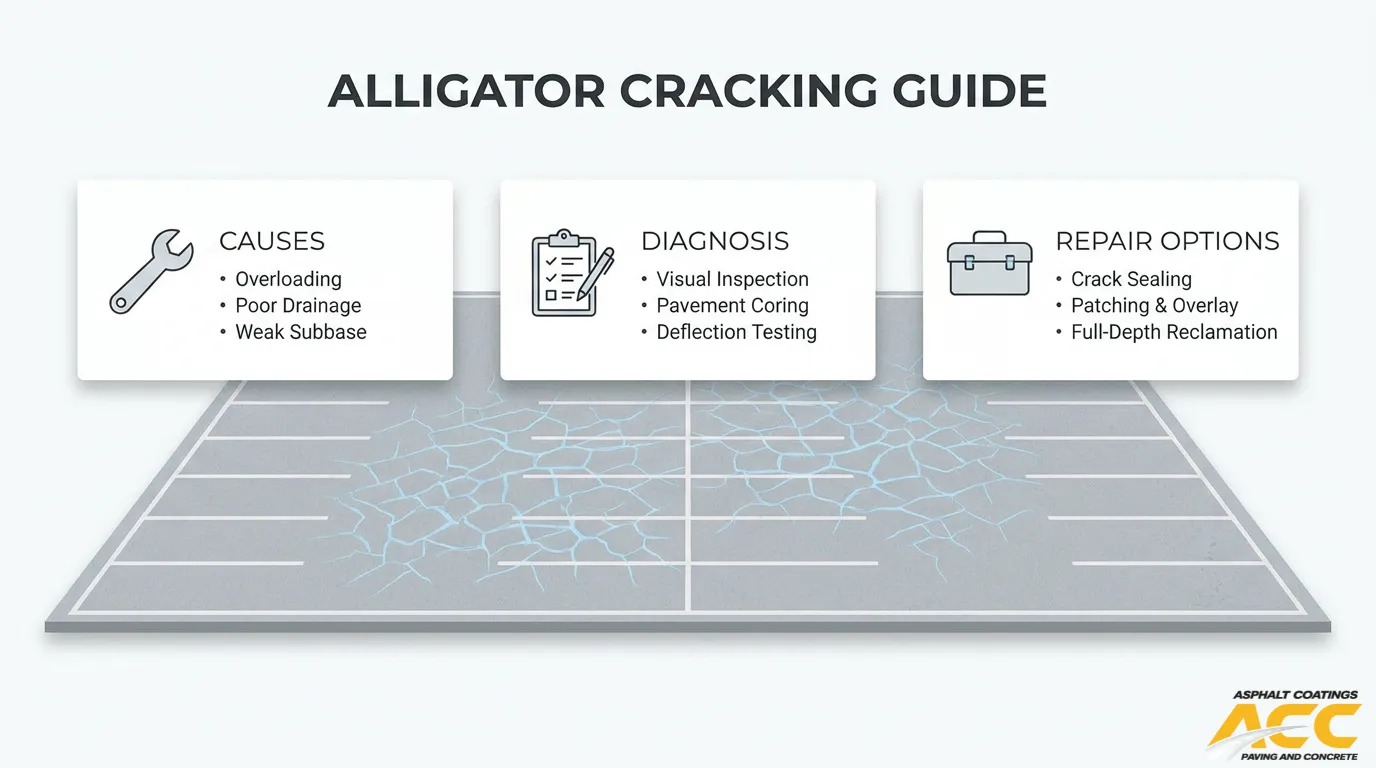
Poor surface conditions undermine bundled cost savings by introducing unplanned repair work that extends closure time and inflates the original budget. Cracks, potholes, and failed subgrade areas must be addressed before sealcoat application; skipping this step compromises adhesion and shortens the coating’s lifespan.
When these repairs are discovered mid-project rather than during a pre-work inspection, the contractor must remobilize equipment or adjust phasing on the fly. That reactive approach erodes the mobilization savings that made bundling attractive in the first place. A thorough pavement assessment before scheduling locks in the true scope and protects the cost advantage of combining both services.
How Can Miscommunication With Tenants or Customers Turn Bundled Work Into a Headache?
Miscommunication with tenants or customers can turn bundled work into a headache by leaving people unaware of extended closures, relocated accessible parking, and altered traffic routes.
Bundled projects close larger areas for longer periods than a single-scope job. According to the Royal Free London NHS Foundation Trust, one hospital resurfacing project affected approximately 20 disabled bays, requiring temporary replacements in drop-off zones along with a two-way traffic light system and emergency vehicle priority. Without advance notice covering every phase, tenants arrive at blocked entrances and missing accessible spaces.
- Send written notifications at least two weeks before work begins, specifying exact closure dates and times.
- Identify alternative parking, shuttle routes, or temporary accessible bays before day one.
- Post visible signage at every affected entrance with updated re-opening information.
Clear, early communication is the difference between a smooth bundled project and an avalanche of complaints.
How Do You Avoid Quality Compromises When Trying to Compress Both Scopes Into One Window?
You avoid quality compromises when compressing both scopes into one window by respecting minimum cure times between sealcoat application and striping, regardless of schedule pressure.
Rushing striping onto uncured sealcoat causes paint adhesion failure, blurred lines, and premature wear that requires costly rework. Sealcoat typically needs a full 24-hour cure before traffic paint can be applied, and compressing that window to save a few hours undermines the entire project’s longevity. A realistic timeline that accounts for two coats of sealer plus adequate drying before striping protects both finish quality and long-term pavement performance.
For most commercial properties, scheduling the striping crew for the day after final sealcoat application delivers the best balance of speed and durability. Understanding these risks makes it easier to plan and budget a bundled project with confidence.
How Should You Plan and Budget a Bundled Sealcoating and Striping Project?
You should plan and budget a bundled sealcoating and striping project by starting early enough to secure optimal weather windows, requesting itemized proposals, and comparing bundled versus separate bids. The sections below cover seasonal timing, proposal line items, bid comparison methods, and contractor vetting questions.
When Should You Start Planning to Hit the Optimal Season for Bundled Work?
You should start planning a bundled project three to four months before your target application window. Sealcoat and striping materials require stable warm temperatures and dry conditions, so scheduling around predictable weather disruptions is essential. According to the National Park Service, monsoon season spans July, August, and September, when afternoon thunderstorms are most frequent and severe. For most commercial properties, this means locking in contractor availability by late winter for spring or early summer execution. Waiting until April or May often means competing with other property managers for limited crew openings, which can push your project into riskier weather months. Early planning also allows time for lot assessments and any pre-project repairs.
What Line Items Should You Look For in a Bundled Sealcoating and Striping Proposal?
The line items you should look for in a bundled sealcoating and striping proposal include individually priced scopes that let you verify the bundled discount. A Brown County, Wisconsin bid document required contractors to include separate prices for sealcoating, line striping, standard parking lines, handicap stencil/logo work, and an overall combined price. Key line items to confirm in any bundled proposal:
- Sealcoating (material, number of coats, square footage rate)
- Line striping (per-line or per-stall pricing)
- Specialty markings (handicap stencils, fire lanes, directional arrows)
- Mobilization and traffic control as a single charge
- Combined project total showing the bundled savings
Without separate line items, you cannot verify whether the bundled price genuinely reduces costs or simply obscures individual scope pricing.
How Can You Compare Separate vs Bundled Bids to See True Cost and Downtime Differences?
You can compare separate versus bundled bids by building a side-by-side analysis that accounts for both direct costs and closure-related losses. Request standalone quotes for sealcoating and striping individually, then compare their combined total against a single bundled proposal. Beyond the invoice, factor in total closure days for each scenario; two separate mobilizations typically double the downtime window. Assign a dollar value to each lost business day based on your property’s revenue sensitivity. The bid with the lowest all-in cost, including lost revenue and tenant disruption, often reveals savings that the invoice alone does not show.
What Questions Should You Ask a Contractor Before Approving a Bundled Schedule?
The questions you should ask a contractor before approving a bundled schedule focus on crew logistics, cure-time management, and contingency planning. Essential questions include:
- Will the same crew handle both sealcoating and striping, or are subcontractors involved?
- What is your contingency plan if weather delays push striping past the sealcoat cure window?
- How do you phase work to maintain partial lot access during curing?
- What temperature and humidity thresholds will trigger a schedule hold?
- Are ADA-compliant stencils and access aisle markings included in the striping scope?
- What is the guaranteed timeline from first closure to full lot re-opening?
These questions expose whether a contractor has the operational depth to manage both scopes without compromising quality or extending your closure window. Understanding the answers up front helps protect your budget from surprise change orders and schedule overruns.
How Do Colorado’s Climate and Environmental Conditions Influence Bundled Sealcoating and Striping?
Colorado’s climate and environmental conditions influence bundled sealcoating and striping by compressing the viable work window and demanding precise scheduling around freeze-thaw cycles, UV degradation, afternoon storms, and elevation-driven microclimates. The sections below cover each factor.
How Do Freeze‑Thaw Cycles Affect the Best Timing for Combined Sealcoating and Striping?
Freeze-thaw cycles affect the best timing for combined sealcoating and striping by narrowing the safe application window to late spring through early fall, when overnight temperatures reliably stay above 50°F. During freezing temperatures, water within pavement cracks freezes and expands, widening damage that undermines fresh sealcoat adhesion. According to the City and County of Broomfield, Colorado, this expansion exerts pressure on surrounding pavement and accelerates deterioration.
Bundled projects that target early summer avoid this risk entirely. Boise State University, for example, scheduled combined crack repair, sealcoating, and striping for June 29 through July 3, closing lots daily from 6 a.m. to 5 p.m. This mid-summer window ensures both materials cure properly before fall temperatures drop.
How Does High‑Altitude UV Exposure Change Maintenance Frequency and Bundle Strategy?
High-altitude UV exposure changes maintenance frequency and bundle strategy by accelerating sealcoat oxidation, which shortens the interval between applications. As NASA Earth Observatory explains, organisms and surfaces at high elevations are exposed to more UV-B radiation because it travels through less atmosphere before reaching the ground, encountering fewer radiation-absorbing aerosols and chemical substances like ozone.
For Colorado properties above 5,000 feet, this intensified UV breaks down asphalt binder faster than at sea level. Bundling sealcoating and striping on the same cycle ensures both protective layers are refreshed simultaneously, rather than letting faded striping linger on deteriorating sealcoat. Properties at higher Front Range elevations may need to shorten their maintenance cycle compared to standard institutional benchmarks, which often place sealcoat and striping together at year five and again at year fifteen.
How Do Afternoon Storms and Temperature Swings Affect One‑Trip vs Two‑Trip Scheduling?
Afternoon storms and temperature swings affect one-trip vs two-trip scheduling by introducing cure-time risks that can force a return visit. According to the National Park Service, monsoon season spans July, August, and September, when afternoon thunderstorms are most frequent and severe. A sudden downpour on freshly applied sealcoat can wash material off the surface before it sets.
Colorado’s chinook winds add another variable. The Western Regional Climate Center notes that temperature rises of 25 to 35 degrees within a short time are not uncommon along the high plains. While rapid warming can speed drying, an unexpected cold snap overnight can stall cure times and delay striping. Experienced crews build contingency days into bundled schedules to absorb these swings without splitting the project into separate mobilizations.
How Should You Adapt Bundling Plans for Different Front Range Elevations and Microclimates?
You should adapt bundling plans for different Front Range elevations and microclimates by adjusting your target work dates and cure-time assumptions based on local temperature ranges. According to Colorado State University, lower elevation areas and plains around 5,000 feet see average winter temperatures in the teens and summer highs frequently topping 90°F, while higher mountain communities experience cooler summers and earlier fall freezes.
Key adaptations include:
- Scheduling Denver-area projects (approximately 5,280 feet) from May through September, when sustained warmth supports same-week sealcoating and striping.
- Moving mountain-adjacent properties to a tighter June-through-August window to avoid early cold snaps.
- Allowing longer cure times at higher elevations where cooler overnight temperatures slow sealcoat drying.
- Accounting for stronger UV at altitude, which may justify more frequent bundled maintenance cycles.
Matching the schedule to your property’s specific microclimate is what separates a smooth one-trip project from a weather-delayed callback.
When Does It Make Sense Not to Bundle Sealcoating and Striping on the Same Project?
It makes sense not to bundle sealcoating and striping when operational constraints, budget timelines, or design changes make a single closure impractical. The situations below cover phased maintenance, 24/7 facilities, split fiscal years, and major layout overhauls.
In What Situations Do Phased or Partial Sealcoating and Later Striping Work Better?
Phased or partial sealcoating with later striping works better when a property cannot close entirely at once. Tuolumne County, California, required its parking lot project to be “scheduled for weekends or after business hours” and “broken down into sections to allow curing times and continuous use of the parking lots during the project.” Properties with multiple buildings, shared access drives, or staggered lease schedules face similar constraints. Sealcoating one zone at a time and returning later for a single striping pass lets each section cure without forcing a full shutdown. This approach trades mobilization efficiency for uninterrupted daily access, which is often the higher priority for multi-tenant commercial sites.
How Do Heavy‑Use 24/7 Facilities Sometimes Benefit From Separating the Scopes?
Heavy-use 24/7 facilities sometimes benefit from separating the scopes because they cannot spare the consecutive closure hours that bundling demands. Hospitals, distribution warehouses, and emergency service centers need continuous vehicle and pedestrian access. Sealcoating can be applied in narrow overnight or weekend windows, zone by zone, while striping requires the fully cured surface plus its own no-track dry time. Compressing both into one restricted window risks incomplete curing or rushed application. Splitting the work into a sealcoat phase and a later striping phase gives each trade the time it needs without compromising facility operations. For properties where even a few hours of downtime carries real cost, that trade-off is worth the extra mobilization.
When Do Budget Cycles or Capital Planning Push Sealcoating and Striping Into Different Years?
Budget cycles or capital planning push sealcoating and striping into different years when each scope falls under a separate funding category or fiscal period. Davenport University’s published parking lot maintenance plan schedules sealcoating and striping together at Year 5 and Year 15, but many organizations lack that alignment. Municipal properties often fund sealcoating through capital improvement budgets approved annually, while striping falls under operational maintenance with its own line item. When approval timelines or grant disbursement windows do not overlap, splitting the scopes across fiscal years becomes the only practical path. The modest added mobilization cost is usually small compared to the risk of delaying both services while waiting for consolidated funding.
How Do Major Layout Changes or ADA Upgrades Affect the Decision to Bundle?
Major layout changes or ADA upgrades affect the decision to bundle by introducing design work that must be finalized before striping can begin. According to the U.S. Department of Justice, when a business restripes parking spaces, “it must provide accessible parking spaces as required by the 2010 ADA Standards for Accessible Design.” Reconfiguring stall counts, adding van-accessible spaces, or adjusting traffic flow patterns requires surveying, engineering review, and sometimes permit approval. Sealcoating does not depend on the final layout, so completing it first protects the pavement while design decisions are resolved. Striping then follows once the new configuration is locked in, preventing costly rework.
Understanding when not to bundle helps property owners avoid forcing two scopes into a timeline that cannot support both.
How Should You Approach Bundled Sealcoating and Striping With an Experienced Colorado Asphalt Contractor?
You should approach bundled sealcoating and striping by partnering with a contractor who manages both scopes under one plan, one mobilization, and one closure window. The following sections cover how Asphalt Coatings Company designs bundled projects and the key takeaways for maximizing savings.
How Can Asphalt Coatings Company Design a Bundled Sealcoating and Striping Plan for Your Property?
Asphalt Coatings Company designs a bundled sealcoating and striping plan by evaluating your lot’s current condition, traffic patterns, and access requirements before sequencing both scopes into a single closure.With 39 years of Colorado-specific experience, professional asphalt contractors coordinate sealer application, cure timing, and line striping so each step flows without unnecessary gaps.
Proper sequencing is critical. According to the City of Fair Oaks Ranch project specification, freshly applied pavement sealer must cure for a minimum of 24 hours before traffic paint can be applied. Experienced contractors build this cure window directly into the project timeline, eliminating the scheduling guesswork that leads to costly revisits. For most commercial properties, that coordination is what separates a tight, efficient closure from a drawn-out, disruptive one.
What Are the Key Takeaways About Bundling Sealcoating and Striping for Cost and Closure Time Savings?
The key takeaways about bundling sealcoating and striping for cost and closure time savings are:
- Single mobilization eliminates duplicate setup costs. One crew deployment, one traffic control plan, and one set of equipment staging fees replace two separate rounds of expense.
- Closure windows shrink significantly. Bundled projects at institutions like Boise State University consolidated sealcoating, crack repair, and striping into daily closures running from 6 a.m. to 5 p.m., reopening lots the same evening.
- Phasing decisions are made once. Whether a lot closes entirely or in sections, bundling means that phasing plan serves both scopes simultaneously rather than being repeated weeks later.
- Coordination prevents rework. Sequencing striping immediately after sealer cure avoids the faded or damaged markings that result from scheduling striping as a separate project months later.
Bundling is one of the most practical strategies commercial property managers can use to protect pavement, control budgets, and minimize tenant disruption in a single planned event. Asphalt Coatings Company delivers both sealcoating and striping with in-house crews across Colorado’s Front Range, ensuring every phase stays on schedule from first application to final stripe.