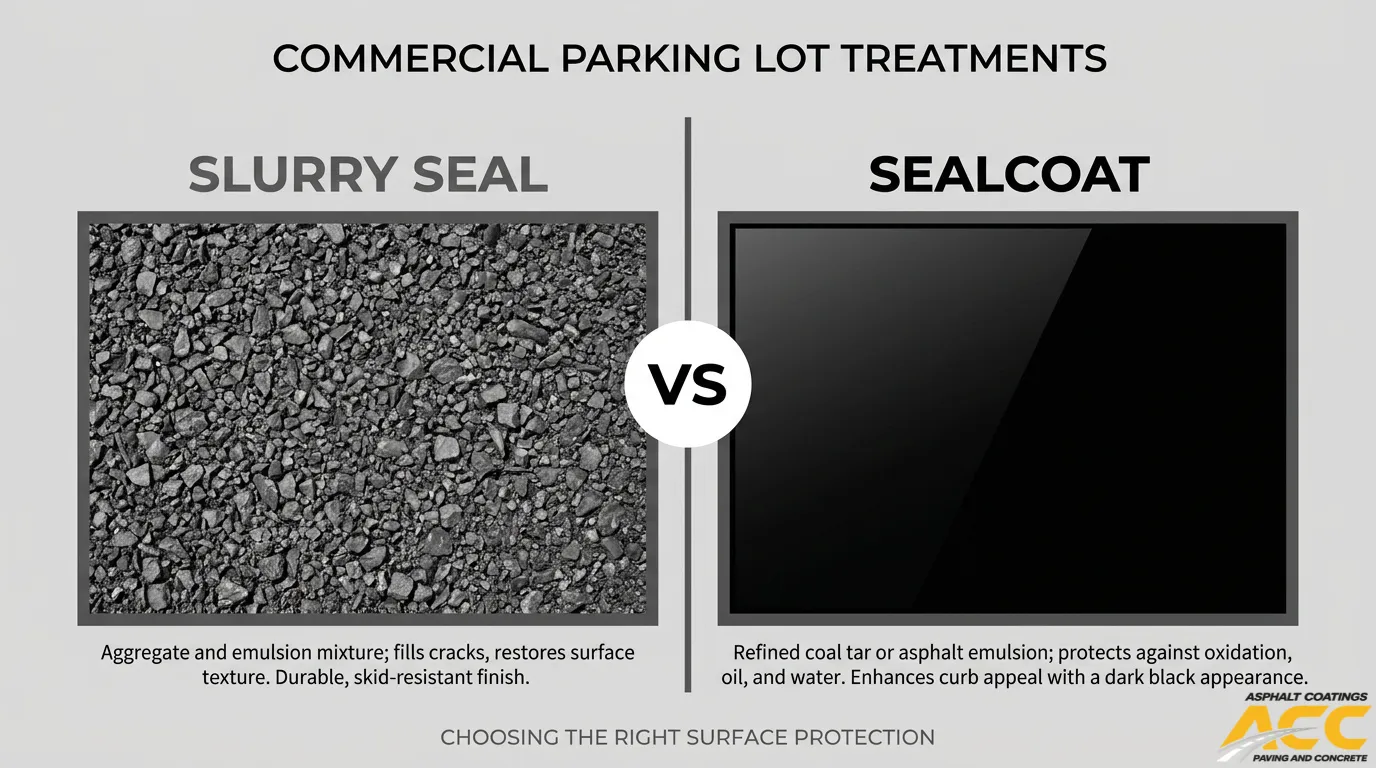
Slurry seal is a thin, aggregate-rich surface treatment that restores texture and fills minor cracks on aging asphalt. Sealcoat is a smooth emulsion coating that waterproofs sound pavement and refreshes its appearance. Both protect commercial parking lots, but they serve different conditions, budgets, and performance requirements.
This guide covers material composition and application methods, climate and traffic considerations, pavement condition assessment, cost and ROI analysis, and project planning with environmental compliance.
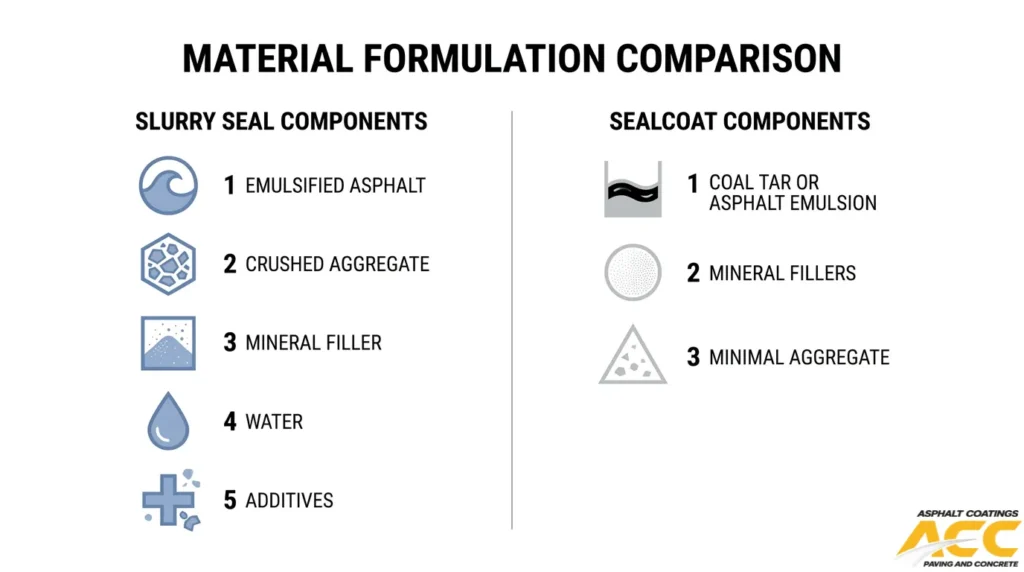
Slurry seal combines emulsified asphalt with crushed fine aggregate, mineral filler, and water to produce a textured, skid-resistant mat. Sealcoat uses either asphalt or coal-tar emulsion with minimal aggregate, creating a thinner protective film. These formulation differences determine how each treatment is applied, how long it cures, and how it performs under wear.
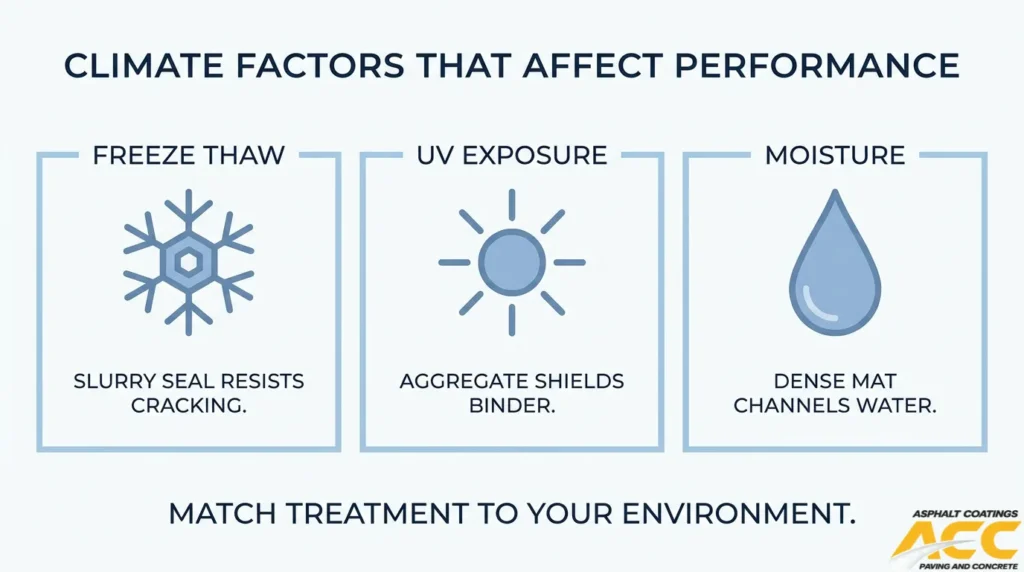
Climate stressors like freeze-thaw cycling, high-altitude UV exposure, and moisture levels affect each treatment differently. Slurry seal’s aggregate matrix resists thermal cracking and UV degradation more effectively, while sealcoat’s smooth film excels on well-drained, lower-stress surfaces.
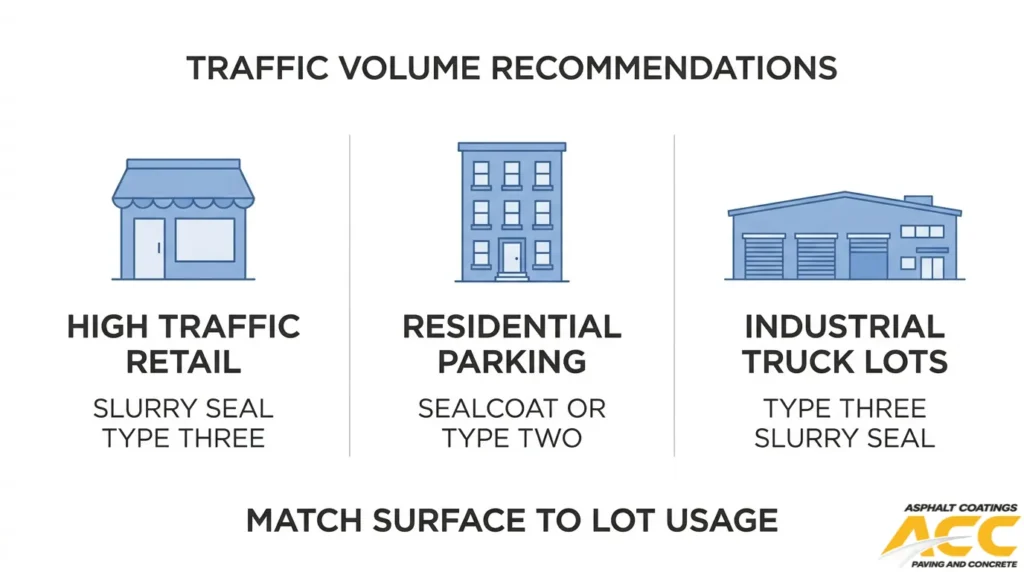
Traffic volume and lot usage shape the decision significantly. High-traffic retail centers and truck-heavy industrial lots benefit from slurry seal’s durability, while moderate-use apartment or HOA parking areas often perform well with sealcoat’s lower per-cycle cost. Existing pavement condition narrows the choice further; raveled or oxidized surfaces call for slurry seal, structurally sound but faded lots suit sealcoat, and lots with deep structural defects need repairs before either treatment applies.
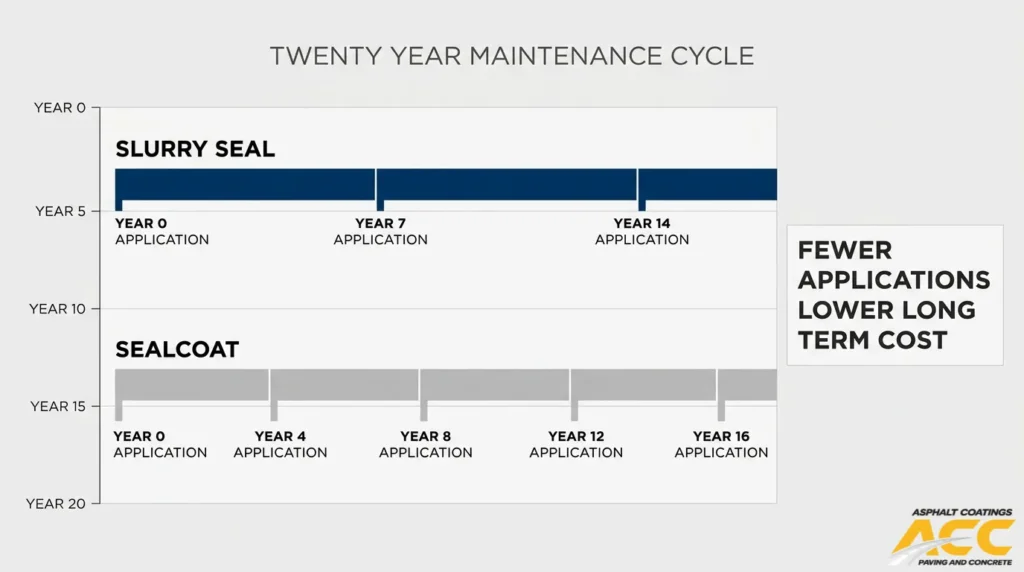
Slurry seal lasts five to seven years compared to sealcoat’s three-to-five-year cycle, which shifts long-term ROI in slurry seal’s favor on heavier-use properties. Environmental compliance also matters: coal-tar sealcoat formulations release dramatically higher PAH levels into stormwater and face growing municipal bans, while asphalt-emulsion products and slurry seal carry minimal regulatory risk. Proper seasonal scheduling, phased lot closures, and early tenant communication keep disruption manageable for either treatment.
What Is a Slurry Seal for Commercial Parking Lots?
Slurry seal for commercial parking lots is a thin, protective surface treatment made from emulsified asphalt, fine crushed aggregate, mineral filler, water, and chemical additives. Applied as a homogeneous mat over existing asphalt, it seals minor cracks, restores surface texture, and extends pavement life without adding structural capacity. According to the Asphalt Institute’s industry glossary, slurry seal fills minor cracks, restores a uniform surface texture, and restores friction values. This makes it particularly well suited for commercial lots showing early signs of wear, where the underlying pavement structure remains sound. For property managers weighing surface treatments, slurry seal occupies a specific niche: it is a preventive maintenance tool, not a repair solution that addresses structural defects. Lots selected for this treatment typically exhibit slight to moderate surface distress, narrow crack widths, and no rutting. Because the aggregate component provides a textured, skid-resistant finish throughout its service life, commercial properties benefit from improved traction in pedestrian and vehicle zones alike. Understanding what slurry seal can and cannot do is the first step in determining whether it, sealcoat, or a different approach best fits your parking lot’s condition.
What Is a Sealcoat for Commercial Parking Lots?
Sealcoat for commercial parking lots is a thin protective coating applied over existing asphalt to shield it from UV rays, water infiltration, and oxidation. The two primary formulation types, application benefits, and maintenance cycles are covered below.
Sealcoat is an emulsion-based pavement dressing applied to structurally sound asphalt surfaces. It creates a waterproof barrier that slows oxidation and raveling while restoring a uniform black appearance. According to a study published in Environmental Science & Technology by the American Chemical Society, the two primary sealcoat product types on the market are refined coal-tar-pitch emulsion and asphalt emulsion. Beyond those base formulations, sealcoat products may incorporate rejuvenators and fillers such as fibers, mineral fillers, and latex rubber to improve flexibility and adhesion. The coating is spread evenly across the pavement to produce a smooth surface free of streaks, excess buildup, or uncovered areas.
Sealcoat does not add structural strength to a parking lot. It functions strictly as a surface-level preservative, making it best suited for lots that are still in sound structural condition but showing early signs of fading or minor surface wear. For property managers, the practical value lies in extending the interval between more expensive repairs. Reapplication is typically needed every three to five years, depending on traffic volume and environmental exposure. This relatively short maintenance cycle, when followed consistently, helps prevent the binder breakdown that leads to cracking and costly rehabilitation.
Understanding how sealcoat compares to slurry seal in composition and application reveals which treatment fits your lot’s specific condition.
How Do Slurry Seal and Sealcoat Differ in Materials and Application?
Slurry seal and sealcoat differ in their base formulations, application methods, and curing requirements. The following subsections break down material components, application processes, and curing timelines for each treatment.
How Do the Material Components of Slurry Seal Differ from Sealcoat?
The material components of slurry seal differ from sealcoat primarily in aggregate content and binder type. Slurry seal contains emulsified asphalt, well-graded fine aggregate, mineral filler, water, and additives. This combination produces a textured, skid-resistant mat that adheres to existing pavement. According to the Los Angeles County Department of Public Works, roads selected for slurry seal treatment commonly have slight to moderate distress with narrow crack widths, and the aggregate component is what gives slurry seal its durable surface texture.
Sealcoat, by contrast, uses either refined coal-tar-pitch emulsion or asphalt emulsion as its primary binder, often with fillers such as fibers and mineral fillers but significantly less aggregate. The result is a thinner, smoother protective coating rather than a textured wearing surface. For commercial lot managers weighing environmental considerations, this binder distinction matters: coal-tar formulations have faced increasing scrutiny and municipal bans due to elevated PAH levels in stormwater runoff.
How Does the Application Process of Slurry Seal Differ from Sealcoat?
The application process of slurry seal differs from sealcoat in equipment, staging, and access restrictions. Slurry seal is mixed on-site in a continuous-flow machine and spread across the pavement using a spreader box or squeegees, producing a uniform aggregate mat. According to the City of Dublin’s 2024 Slurry Seal project, streets were closed for 4 to 8 hours per staged section to apply the slurry solution and allow initial curing before reopening to traffic.
Sealcoat application is comparatively simpler. Crews spray or squeegee the liquid emulsion in thin, even coats directly onto a cleaned surface, typically applying two coats with drying time between them. Because sealcoat contains little aggregate, the equipment footprint is smaller. However, both treatments require complete area closure during application; motorists, pedestrians, and even pets must stay off fresh slurry seal to avoid damaging the surface.
How Do Curing Times Compare Between Slurry Seal and Sealcoat?
Curing times between slurry seal and sealcoat vary based on mix design, temperature, and humidity, though both generally require several hours before traffic can return. Slurry seal takes several hours to dry, with the City of Cotati noting that all foot and vehicle traffic must remain off the surface during that window. Sealcoat follows a similar timeline, though curing variability depends heavily on environmental conditions. A historical specification reproduced by Purchase College, State University of New York, states that rubberized slurry seal must be protected from traffic until the mixture is sufficiently cured to resist damage, with the exact time varying by mix design and conditions.
In practice, property managers should plan for a minimum closure window of 4 to 8 hours per treated section for either product. Hot, dry weather accelerates curing; cooler or humid conditions extend it. Understanding how application and curing intersect with climate factors is essential for scheduling.
How Do Climate and Weather Conditions Affect Slurry Seal vs. Sealcoat Performance?
Climate and weather conditions affect slurry seal vs. sealcoat performance by influencing cure times, coating integrity, and long-term durability. Freeze-thaw cycles, UV intensity, and moisture levels each favor one treatment over the other.
How Do Freeze–Thaw Cycles Impact Slurry Seal Compared to Sealcoat?
Freeze-thaw cycles impact slurry seal more favorably than sealcoat because slurry seal contains crushed aggregate that resists surface cracking under thermal stress. Sealcoat’s thinner, liquid-applied film is more vulnerable to micro-fracturing as trapped moisture expands and contracts repeatedly. According to the Colorado Department of Transportation’s 2022 Transportation Asset Management Plan, environmental stressors such as precipitation and freeze-thaw cycles impact pavement design and treatment choice, which is why CDOT analyzes life-cycle planning strategies with consideration of environmental conditions. For commercial lots exposed to repeated winter cycling, slurry seal’s aggregate matrix provides a more resilient wearing surface.
How Does High-Altitude UV Exposure Affect Slurry Seal vs. Sealcoat?
High-altitude UV exposure affects slurry seal vs. sealcoat by accelerating oxidation in both treatments, though at different rates. According to NOAA’s 2006 Scientific Assessment of Ozone Depletion, UV radiation increases with altitude because of reduced scattering and absorption by the less-dense overhead atmosphere, with snow-covered surfaces amplifying irradiance further through enhanced surface albedo. Sealcoat’s petroleum-based binder oxidizes and becomes brittle faster under intense UV, requiring more frequent reapplication. Slurry seal’s aggregate content shields the underlying emulsion from direct exposure, slowing degradation. For Colorado lots above 5,000 feet, this difference in UV resilience can meaningfully extend service intervals between treatments.
How Do Moisture and Drainage Conditions Influence Which Treatment Performs Better?
Moisture and drainage conditions influence which treatment performs better by determining how effectively each coating resists water infiltration. Slurry seal forms a denser, aggregate-filled mat that channels surface water rather than absorbing it, making it a stronger performer on lots with adequate slope and drainage infrastructure. Sealcoat creates a smooth, waterproof membrane well suited for structurally sound lots where standing water is not a concern. On poorly drained surfaces, however, pooled water can lift sealcoat film and cause premature peeling. Neither treatment should be applied when rain is imminent or when surfaces are wet, so pre-project drainage assessment is essential for both options.
Understanding how climate stresses each treatment helps property managers select the right protection strategy for their lot’s traffic demands.
How Do Traffic Levels and Lot Usage Influence the Choice Between Slurry Seal and Sealcoat?
Traffic levels and lot usage influence the choice between slurry seal and sealcoat by determining which aggregate grade and surface durability each property requires. The sections below cover high-traffic retail lots, moderate-use residential parking, and heavy industrial applications.
Is Slurry Seal or Sealcoat Better for High-Traffic Shopping Centers and Retail Plazas?
Slurry seal is generally better for high-traffic shopping centers and retail plazas. According to a 2019 study by Iowa State University’s Institute for Transportation on pavement preservation effectiveness, Type III slurry seal is suitable for high-traffic volumes exceeding 5,000 AADT, while Type II handles medium-traffic volumes. Shopping centers with constant vehicle turnover generate wear patterns that demand the crushed aggregate matrix slurry seal provides. Sealcoat, which lacks aggregate structure, wears through more quickly under sustained traffic and turning movements. For retail plazas prioritizing both durability and skid resistance, a properly graded slurry seal outperforms standard sealcoat.
Which Surface Treatment Works Best for Apartment and HOA Parking Areas?
The surface treatment that works best for apartment and HOA parking areas depends on traffic intensity and budget priorities. These lots typically see moderate, predictable traffic with lower turning stress than retail environments. Sealcoat provides an effective, cost-efficient option for these settings because it restores appearance and seals against moisture without the heavier aggregate structure that higher-traffic lots demand. As described by the University of Wisconsin – Madison Transportation Information Center, seal coating helps prevent surface water from penetrating old, weathered, or cracked pavements. For apartment complexes with slightly higher volumes or steeper grades, a Type II slurry seal offers better long-term wear resistance. Most HOA properties benefit from sealcoat’s lower cost per cycle, reserving slurry seal for areas showing early signs of aggregate loss.
What Is the Better Option for Industrial and Truck-Heavy Commercial Lots?
The better option for industrial and truck-heavy commercial lots is typically a Type III slurry seal. Heavy truck traffic, forklift operations, and concentrated axle loads create shearing forces that standard sealcoat cannot withstand. Slurry seal’s crushed aggregate matrix resists scuffing and displacement far more effectively under these conditions. Industrial lots also benefit from the improved skid resistance that durable aggregates provide, particularly in areas where diesel spills or hydraulic fluid reduce surface traction. Sealcoat may still serve low-traffic peripheral zones, such as employee parking sections away from loading docks. For the primary operational areas of warehouses and distribution centers, slurry seal delivers the surface integrity these demanding environments require.
Understanding how traffic patterns shape treatment selection sets the stage for evaluating your lot’s existing pavement condition.
How Do Existing Pavement Conditions and Age Affect Whether You Should Choose a Slurry Seal or Sealcoat?
Existing pavement condition and age determine whether slurry seal, sealcoat, or a more intensive repair is the right treatment. The subsections below cover when slurry seal fits aging surfaces, when sealcoat suits structurally sound lots, and when defects require full repairs instead.
When Is Slurry Seal the Better Choice for an Aging or Raveled Parking Lot?
Slurry seal is the better choice for an aging or raveled parking lot when the surface shows slight to moderate distress, no rutting, and generally narrow crack widths. According to the Mineta Transportation Institute at San José State University, the distress modes that warrant slurry seal treatment include raveling, oxidized pavement with hairline cracks, and friction loss. Slurry seal provides no structural benefit, so the underlying base must still be intact. Lots with aggregate loss or surface roughening from years of UV exposure are ideal candidates, because the crushed aggregate in the slurry restores texture and extends service life until resurfacing becomes necessary. Scheduling requires ambient temperatures of at least 50°F and rising, with no rain imminent.
When Is Sealcoat the Better Choice for a Structurally Sound but Faded Lot?
Sealcoat is the better choice for a structurally sound but faded lot when the asphalt base remains intact and the primary concerns are cosmetic deterioration and oxidation protection. A parking lot that has lost its dark color yet shows no cracking, raveling, or aggregate loss benefits most from the thin, uniform coating sealcoat provides. Because sealcoat contains no crushed aggregate sized to correct surface texture deficiencies, it works best on smooth, sound pavement where the goal is UV shielding, waterproofing, and a refreshed black appearance. For property managers prioritizing curb appeal alongside basic preservation, sealcoat delivers those results at a lower material cost than slurry seal.
When Do Pavement Defects Mean You Need Repairs or Paving Instead of Slurry Seal or Sealcoat?
Pavement defects mean you need repairs or paving instead of slurry seal or sealcoat when damage extends below the surface layer. Neither treatment corrects structural failures. Defects that disqualify both surface treatments include:
- Deep or wide cracking that penetrates the full asphalt depth.
- Rutting from subgrade failure or base compaction loss.
- Alligator cracking that signals fatigue in the pavement structure.
- Potholes or areas where the base material is exposed.
According to the Pavement Preservation and Recycling Alliance’s 2022 best practices guide, slurry seals with emulsions are primarily used as a preventative treatment to seal the pavement, improve aesthetics and surface texture, and serve as the wearing surface. Applying either treatment over structural defects wastes material and accelerates further deterioration. Industry best practices indicate that the most costly mistake property managers make is sealing over a failing base; addressing subgrade and patching issues first always produces a better long-term outcome.
How Do Cost, Lifespan, and ROI Compare Between Slurry Seal and Sealcoat for Commercial Properties?
Cost, lifespan, and ROI between slurry seal and sealcoat differ based on material complexity, reapplication frequency, and lot size. The following subsections break down upfront pricing, maintenance cycles, and long-term value for property managers.
How Do Upfront Costs of Slurry Seal Compare to Sealcoat for Larger Lots?
Upfront costs of slurry seal are generally higher than sealcoat for larger lots because slurry seal requires specialized mixing equipment and crushed aggregate. According to the City of Littleton, Colorado, surface sealing protects asphalt from ultraviolet rays and water while slowing oxidation and raveling, with the goal of creating a waterproof coating that increases pavement life. For commercial properties across Colorado’s Front Range, contractors with experience in regional climate conditions can help property managers evaluate which treatment offers the best long-term value for their specific lot conditions and traffic patterns. Sealcoat, applied with spray systems or squeegees, uses simpler emulsion formulations that reduce per-square-foot material and labor costs on expansive commercial surfaces.
For property managers budgeting a large-lot project, the lower entry price of sealcoat can be appealing. However, cost-per-application alone rarely tells the full financial story; reapplication frequency shifts the equation considerably.
How Do Lifespan and Maintenance Cycles Differ Between Slurry Seal and Sealcoat?
Lifespan and maintenance cycles differ significantly between these two treatments. According to Henrico County Department of Public Works, the life expectancy of slurry seal is five to seven years. Sealcoat, by contrast, typically requires reapplication every three to five years to prevent the protective layer from breaking down. That shorter cycle means more frequent closures, mobilization costs, and tenant coordination over a parking lot’s service life.
Slurry seal’s crushed aggregate matrix creates a denser, more wear-resistant surface than sealcoat’s thin emulsion film. Property managers should also note that micro-surfacing, a polymer-modified cousin of slurry seal, offers even longer intervals between treatments for lots with heavier demands.
Which Option Typically Delivers Better Long-Term ROI for Property Managers?
The option that typically delivers better long-term ROI for property managers depends on lot conditions, traffic volume, and maintenance planning. Slurry seal’s longer service life means fewer reapplication cycles over a 20-year pavement management horizon. Although each slurry seal application costs more upfront, needing roughly three applications where sealcoat would require four to six reduces cumulative material, labor, and downtime expenses.
Sealcoat can still deliver strong ROI on structurally sound, lower-traffic lots where its simpler application keeps budgets lean. For high-traffic retail or industrial properties, slurry seal’s durability tends to offset its higher initial price. The most reliable ROI strategy pairs either treatment with proactive crack sealing and patching, preventing minor defects from escalating into costly structural repairs.
Understanding these financial trade-offs helps property managers select the right treatment when evaluating aesthetics and surface performance.
How Do Aesthetics, Safety, and User Experience Differ Between Slurry Seal and Sealcoat?
Aesthetics, safety, and user experience differ between slurry seal and sealcoat in surface finish, skid resistance, and striping compatibility. The sections below compare visual appearance, traction performance, and line marking visibility.
Which Treatment Provides a Smoother, More Attractive Black Finish?
Sealcoat provides a smoother, more attractive black finish on commercial parking lots. Specifications require applying the seal coating evenly to produce a smooth riding surface with no streaks, excess buildup, or uncovered areas. The result is a uniform, deep-black appearance that immediately refreshes a faded lot.
Slurry seal produces a slightly coarser texture because crushed mineral aggregate is integral to the mix. While it restores a consistent dark color, the surface has a lightly textured, matte look rather than a glossy sheen. For property managers prioritizing curb appeal above all else, sealcoat typically delivers a cleaner visual result. However, the textured finish of slurry seal ages more gracefully under heavy foot and vehicle traffic, masking minor scuffs that would show readily on a smooth sealcoat surface.
How Do Slurry Seal and Sealcoat Affect Skid Resistance and Safety?
Slurry seal and sealcoat affect skid resistance and safety differently because of their aggregate content and surface texture. Slurry seal delivers superior traction. According to the International Slurry Surfacing Association’s A105 Performance Guideline (revised 2010), slurry seal must be applied as a homogeneous mat that adheres firmly to the prepared surface and maintains a skid-resistant texture throughout its service life.
Crushed, durable aggregates embedded in the slurry create macro texture that channels water away from tire contact points. Sealcoat, by contrast, relies on a thinner emulsion film with finer fillers, producing a smoother surface that can become slick when wet. For high-liability commercial lots where pedestrian and vehicle safety is a priority, slurry seal’s built-in friction advantage makes it the stronger choice.
How Does Each Option Impact Line Striping Visibility and Parking Layouts?
Each option impacts line striping visibility and parking layouts based on surface texture and color contrast. Sealcoat’s smooth, jet-black finish creates strong contrast against white and yellow traffic paint, making fresh striping highly visible. Paint adheres evenly to the uniform surface, producing clean, sharp lines.
Slurry seal’s textured aggregate surface absorbs more paint, so striping may require slightly heavier application to achieve the same crispness. Despite this, the darker background still supports excellent line visibility. Both treatments accept standard parking lot striping and ADA markings once fully cured. Property managers should schedule striping immediately after the cure window closes, while the surface is cleanest, to maximize adhesion and contrast for parking layouts.
With surface aesthetics and safety characteristics clarified, choosing the right treatment depends on your lot’s specific conditions.
How Should Property Managers Decide Between Slurry Seal and Sealcoat for Their Specific Lot?
Property managers should decide between slurry seal and sealcoat by evaluating current pavement condition, budget constraints, operational downtime tolerance, and tenant impact. The following subsections cover the key lot-assessment questions, how budget and logistics shape the choice, and when bundling multiple treatments into one project makes sense.
What Key Questions Should You Ask About Your Lot Before Choosing a Treatment?
The key questions you should ask about your lot before choosing a treatment focus on surface condition, usage patterns, and scheduling feasibility:
- Is the pavement structurally sound, or does it have deep cracking, potholes, or base failure that requires repair first?
- Does the surface show raveling, oxidation, or friction loss that a slurry seal could correct, or is the lot simply faded and in need of a protective sealcoat layer?
- How much daily traffic does the lot handle, and what vehicle types use it most frequently?
- Can you close sections of the lot for several hours during curing, or do tenants require uninterrupted access?
- Are there drainage issues, standing water, or slope concerns that affect how material cures?
Municipal projects often post “No Parking” signage at least 72 hours before work begins, according to the City of El Cerrito’s 2026 Slurry Seal Project guidelines. Commercial property managers should plan similar advance coordination, because both treatments demand dry, traffic-free surfaces during application and curing.
How Should Budget, Downtime, and Tenant Expectations Influence Your Choice?
Budget, downtime, and tenant expectations should influence your choice by narrowing the field based on practical constraints rather than material performance alone. Sealcoat generally carries a lower per-application cost and works well for lots that simply need UV protection and a fresh black finish. Slurry seal costs more upfront but delivers a thicker, aggregate-reinforced wearing surface that lasts longer under heavier use.
Downtime is equally important. Both treatments require closures of four to eight hours or more, depending on environmental conditions and mix design. Properties with high daily turnover, such as retail centers or medical offices, may benefit from staged application so that only portions of the lot close at a time. For most property managers, the smartest approach is matching the treatment’s curing window to the lowest-traffic period of the week.
When Is It Smart to Combine Crack Sealing, Patching, and Sealcoating in One Project?
It is smart to combine crack sealing, patching, and sealcoating in one project when the lot has multiple distress types that a single treatment cannot address. Sealcoat and slurry seal are surface-level protectants; neither fills structural cracks nor replaces failed subgrade areas. Completing crack sealing and patching before applying a topcoat ensures the protective layer bonds to a stable surface, which extends the life of every treatment involved.
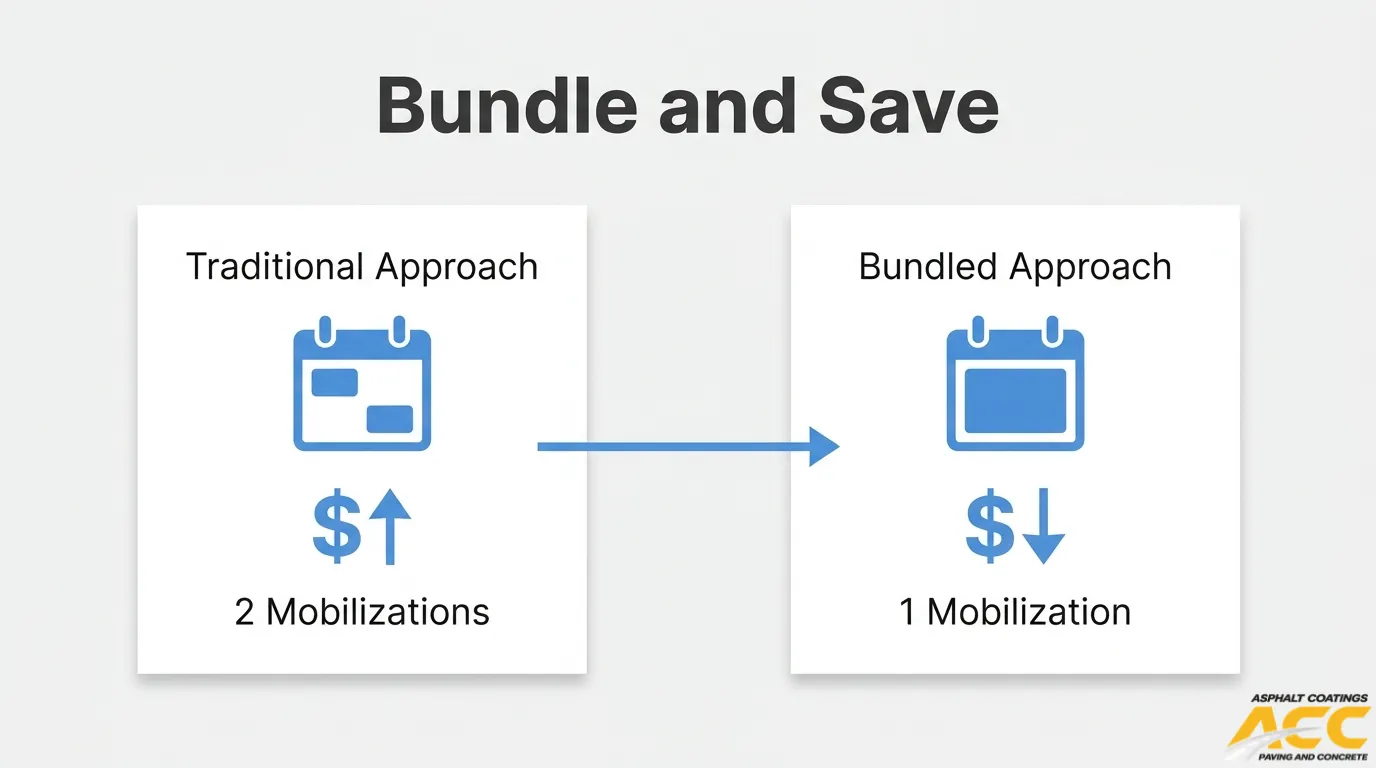
Bundling also reduces mobilization costs, shortens total downtime, and creates a single maintenance window rather than multiple disruptions across the season. According to the Ontario County, New York Specifications for Seal Coating Asphalt Surfaces (revised February 2026), sealcoat must be applied to a “sound, asphalt surface,” reinforcing that prep work is a prerequisite, not an optional add-on. Commercial property managers in Colorado can benefit from working with contractors who offer crack sealing, patching, and sealcoating services from a single source, eliminating coordination challenges and ensuring all prep work meets the standards required for effective surface protection.
Understanding what your lot needs upfront makes the contractor conversation far more productive.
How Do Slurry Seal and Sealcoat Compare in Terms of Environmental Impact and Compliance?
Slurry seal and sealcoat compare in terms of environmental impact and compliance primarily through their base formulations, PAH contamination potential, and exposure to local regulatory bans. The sections below cover material chemistry differences, stormwater runoff effects, and relevant industry or municipal standards.
How Do Material Formulations and VOC Content Differ Between Slurry Seal and Sealcoat?
Material formulations and VOC content differ between slurry seal and sealcoat because each product uses a fundamentally different binder chemistry. Slurry seal relies on emulsified asphalt combined with crushed mineral aggregate and water, producing a relatively low-emission mixture. Sealcoat, by contrast, is available in two primary formulations: refined coal-tar-pitch emulsion and asphalt emulsion. Coal-tar-based sealcoats contain significantly higher concentrations of polycyclic aromatic hydrocarbons (PAHs), which are classified as toxic air contaminants. According to the U.S. Department of Agriculture Forest Service, pavement dressings may include rejuvenators and fillers such as fibers and mineral fillers, further varying the VOC profiles between products. For commercial property managers evaluating environmental risk, the binder type is the single most consequential material decision.
How Do These Treatments Affect Stormwater Management and Runoff Quality?
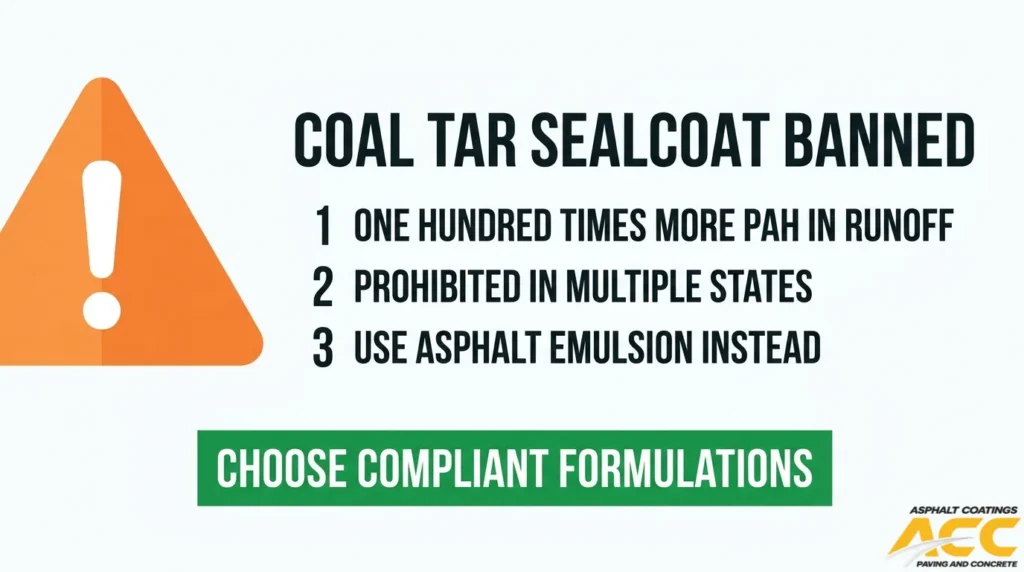
These treatments affect stormwater management and runoff quality at dramatically different levels depending on the sealcoat formulation applied. Slurry seal, which uses asphalt-based emulsion and mineral aggregate, contributes minimal PAH contamination to stormwater. Coal-tar-based sealcoat tells a very different story. According to a U.S. Environmental Protection Agency assessment on water quality of runoff from sealed asphalt surfaces, coal-tar-sealed surfaces released 100 to 1,000 times more PAHs to runoff than other surfaces. This contamination diminished over time but remained substantially elevated compared to unsealed or asphalt-emulsion-sealed lots. For any commercial parking lot with stormwater discharge requirements, choosing an asphalt-emulsion sealcoat or slurry seal virtually eliminates this risk category.
Are There Local or Industry Standards That Influence Which Treatment You Should Use?
There are local and industry standards that directly influence which treatment you should use, particularly regarding coal-tar sealcoat bans. Multiple jurisdictions have enacted outright prohibitions on coal-tar pavement products. Austin, Texas, banned coal-tar use effective January 1, 2006, with violators subject to fines up to $2,000 per day and mandatory lot remediation. New York State’s Environmental Conservation Law prohibits the sale or application of any pavement product containing coal tar on driveways or parking areas. While Colorado has not enacted a statewide coal-tar ban, commercial property managers should verify local municipal ordinances before specifying any sealcoat product. Slurry seal, formulated entirely with asphalt emulsion, faces none of these regulatory restrictions.
Understanding these compliance requirements helps property managers plan the right surface treatment and contractor partnership for their lots.
How Should You Plan the Timing and Logistics of a Slurry Seal or Sealcoat Project for a Commercial Parking Lot?
You should plan the timing and logistics of a slurry seal or sealcoat project around seasonal weather windows, phased lot closures, and clear stakeholder communication. The sections below cover optimal scheduling, disruption control, and pre-project notifications.
When Is the Best Time of Year to Schedule Slurry Seal or Sealcoat Work?
The best time of year to schedule slurry seal or sealcoat work is during warm, dry months when ambient temperatures consistently stay above 50°F. Both treatments require rising temperatures and no rain in the forecast for proper curing. Late spring through early fall typically offers the most reliable application windows.
Planning around these conditions is especially important because slurry seal has a life expectancy of five to seven years, according to the Los Angeles County Department of Public Works. Scheduling during ideal weather ensures maximum adhesion and longevity from each application cycle. For property managers overseeing large commercial lots, booking contractors early in the season helps secure preferred dates before peak demand fills schedules.
How Can You Minimize Business Disruption During Parking Lot Maintenance?
You can minimize business disruption during parking lot maintenance by staging the work in phases rather than closing the entire lot at once. A phased approach keeps a portion of parking available while crews apply and cure each section.
Key strategies for reducing downtime include:
- Dividing the lot into zones so tenants and customers always have accessible parking nearby.
- Scheduling application during off-peak hours or days when foot traffic is lowest.
- Allowing 4 to 8 hours per zone for application and curing before reopening to vehicles.
- Coordinating with your contractor to sequence zones in an order that preserves main access points.
For most commercial properties, weekend or overnight staging offers the least operational impact. Proactive scheduling with your contractor is more valuable than reactive adjustments once work begins.
What Should You Communicate to Tenants, Customers, and Vendors Before Work Starts?
You should communicate the project scope, exact dates, parking restrictions, and alternative access routes to tenants, customers, and vendors before work starts. According to the City of El Cerrito’s 2026 Slurry Seal Project, “No Parking” signs should be posted at least 72 hours before work begins.
Effective pre-project communication should include:
- Written notices distributed a minimum of three days in advance.
- A map showing which lot zones close on which dates.
- Designated alternative parking locations for each phase.
- Contact information for a project coordinator who can address questions or special access needs.
Clear, early communication prevents confusion and protects tenant and customer relationships throughout the maintenance window. With communication plans finalized, the next step is partnering with an experienced contractor who can manage every phase of your project.
How Should You Approach Slurry Seal vs. Sealcoat Decisions With an Experienced Colorado Asphalt Contractor?
You should approach slurry seal vs. sealcoat decisions with an experienced Colorado asphalt contractor by requesting a site assessment that evaluates pavement condition, traffic levels, and Colorado-specific stressors before recommending a treatment. The sections below cover how Asphalt Coatings Company protects commercial lots and the key takeaways to guide your decision.
How Can Sealcoating and Crack Sealing Services From Asphalt Coatings Company Help Protect Your Commercial Parking Lot?
Sealcoating and crack sealing services from Asphalt Coatings Company help protect your commercial parking lot by creating a waterproof barrier against UV rays, water infiltration, and oxidation. Sealcoat prevents surface water from penetrating old, weathered, or cracked pavements, while crack sealing with CDOT-approved materials stops moisture from reaching the subgrade. According to the City of Littleton, Colorado, the goal of seal coating is to create a waterproof, protective coating that can increase pavement life and improve appearance. Asphalt Asphalt Coatings Company pairs these treatments with patching and striping, delivering maintenance solutions across Denver, Colorado Springs, and the entire Front Range. For property managers weighing surface treatments, that combined approach addresses both cosmetic and structural needs in one project.
What Are the Key Takeaways About Slurry Seal vs. Sealcoat for Commercial Parking Lots That Can Help You Decide What Your Lot Needs?
The key takeaways about slurry seal vs. sealcoat for commercial parking lots are:
- Slurry seal fills minor cracks, restores uniform surface texture, and improves skid resistance; sealcoat creates a waterproof film that slows oxidation and refreshes appearance.
- The two primary sealcoat formulations are refined coal-tar-pitch emulsion and asphalt emulsion; coal-tar products carry significant environmental risk and face growing bans.
- A 2006 U.S. Geological Survey fact sheet found PAH concentrations from coal-tar-sealed lots averaged 3,500 mg/kg, roughly 65 times higher than unsealed lots.
- Several states now prohibit coal-tar pavement products; always confirm local compliance before specifying a sealcoat formulation.
- Pavement condition, traffic volume, Colorado’s freeze-thaw cycles, and high-altitude UV exposure all influence which treatment delivers the best return.
Choosing the right treatment starts with an honest assessment of your lot’s current condition, and Asphalt Coatings Company provides that evaluation as the first step of every project.