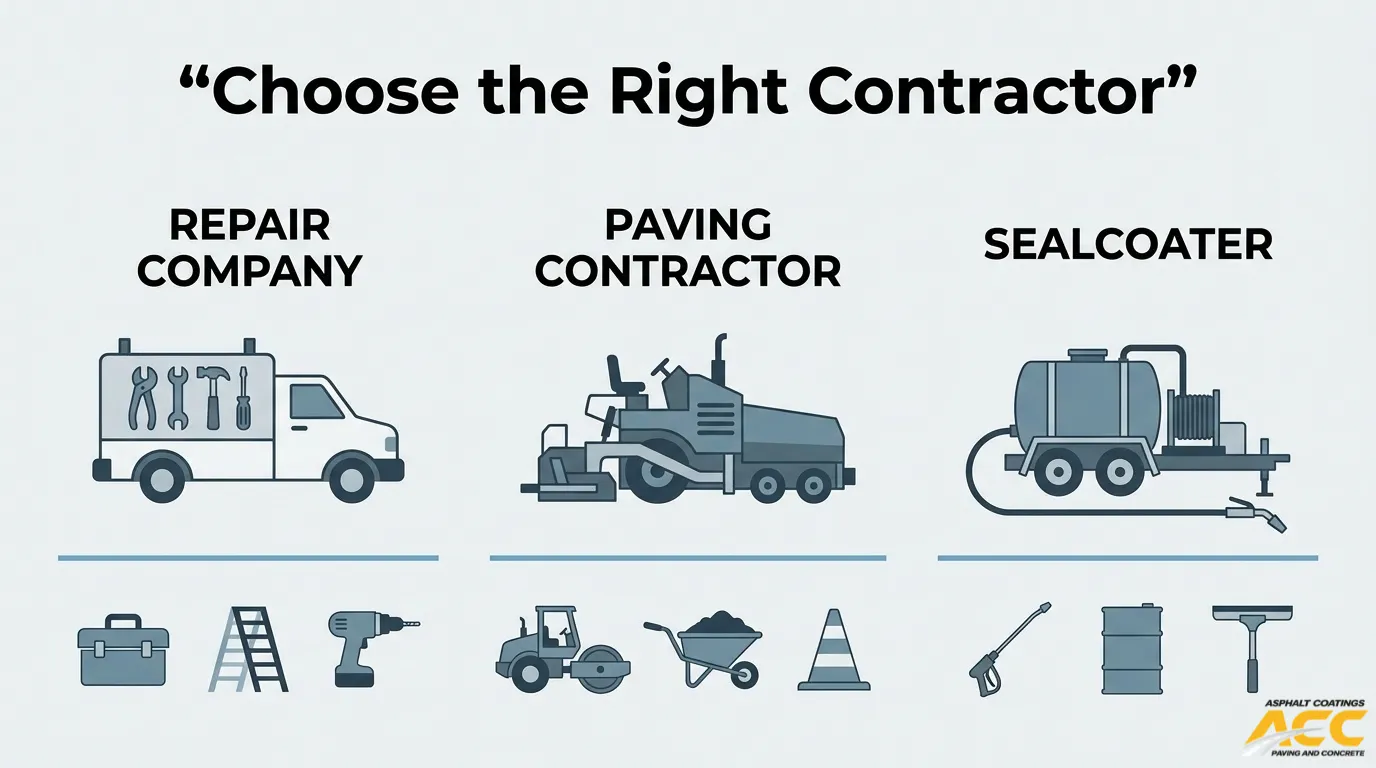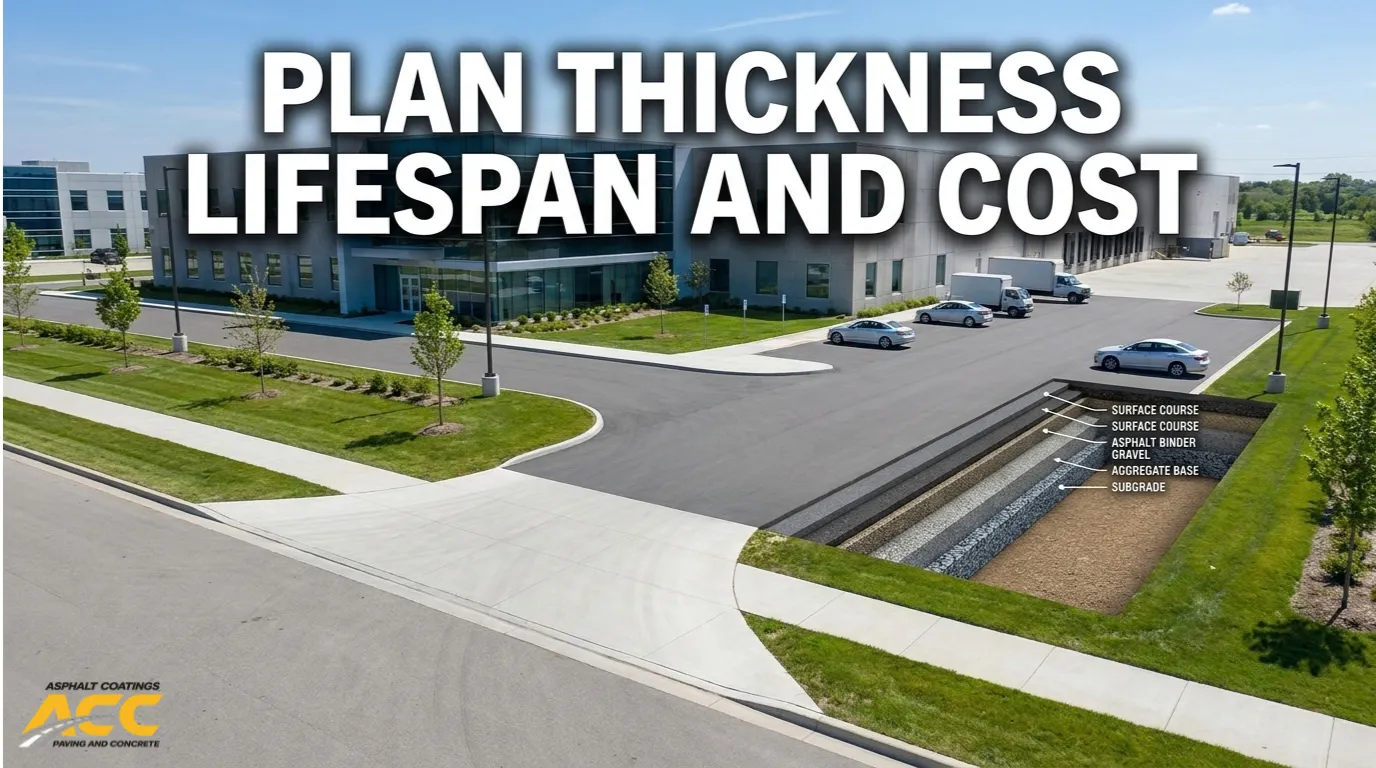
A reputable paving company is a contractor that demonstrates verifiable credentials, transparent business practices, technical competence, and consistent accountability throughout every phase of a project. Identifying these qualities protects commercial property owners from scams, poor workmanship, and costly failures.
This guide covers contractor legitimacy and licensing verification, professional estimates and communication standards, technical knowledge and material quality, scam patterns and pricing red flags, property-specific evaluation criteria, and structured bid comparison methods.
Established paving companies carry active state licenses, adequate insurance, and surety bonds; they also maintain permanent business addresses, branded equipment, and documented project histories spanning years of continuous operation. Verifying these credentials is one of the most effective filters for separating qualified contractors from fly-by-night operators.
Professional estimates should itemize materials, square footage, base preparation, and compaction methods in writing. Transparent contracts tie milestone-based payments to completed work phases, while strong communication practices (prompt responses, dedicated project contacts, and proactive schedule updates) reflect how the jobsite itself will be managed.
Technical competence shows up during initial site visits. Qualified contractors assess subgrade conditions, drainage patterns, and load requirements before quoting. They specify hot-mix asphalt heated above 300°F, follow compaction density standards, and refuse to pave in temperatures below 40°F or over frozen subgrade.
Common scam signals include door-to-door solicitation, “leftover asphalt” pitches, cash-only demands, and pressure for immediate decisions. Legitimate commercial deposits typically range from 10 to 30 percent of the bid price, with progress payments tied to verifiable milestones.
Commercial properties require additional scrutiny. Shopping centers need phased scheduling, industrial sites demand heavy-load pavement engineering, and hospitals must meet specific ADA parking ratios. Comparing bids through lifecycle cost analysis and thorough reference checks transforms contractor selection from guesswork into a documented, defensible process.
How Can You Tell If a Paving Company Is Truly Established and Experienced?
You can tell if a paving company is truly established and experienced by verifying its track record, credentials, physical presence, and industry involvement. The key indicators include years in operation, verifiable project history, permanent business addresses, proper registrations, and affiliations with recognized industry organizations.
A company’s longevity alone does not guarantee quality, but it does signal financial stability and an ability to maintain client relationships over time. When evaluating a paving contractor, look beyond surface-level marketing claims and focus on concrete, verifiable evidence of sustained operations and technical competence.
The most reliable indicators of an established paving company include:
- Documented years in business with a verifiable founding date and continuous operations, not a recently formed LLC with no project history.
- A permanent physical address such as an office or yard, rather than just a P.O. box or residential listing.
- Active state contractor registration that can be confirmed through your state’s licensing board or secretary of state database.
- Membership in industry associations such as the National Asphalt Pavement Association, which provides access to more than 1,000 technical reports, webinars, and industry tools available to the entire paving industry.
- A portfolio of completed commercial projects with named references you can contact directly.
- In-house crews and company-owned equipment, which indicate capital investment and operational control over project quality.
According to the Pennsylvania Office of Attorney General, checking a contractor’s credentials, references, reviews, and registration status can help you avoid scams, poor workmanship, and unexpected costs. This verification step is often the single most effective filter for separating experienced contractors from those who lack the qualifications to deliver lasting results.
Experienced paving companies also demonstrate technical fluency during initial conversations. They should discuss site-specific factors like subgrade conditions, drainage requirements, and material specifications without hesitation. A contractor that cannot articulate why base preparation or compaction methods matter for your specific property likely lacks the depth of knowledge that comes with genuine field experience. Prioritizing these verifiable markers over price alone consistently leads to better long-term outcomes for commercial properties.
With credentials confirmed, understanding what specific licensing, insurance, and bonding protections to require adds another critical layer of protection.
Why Is Proper Licensing, Insurance, and Bonding Critical When Choosing a Paving Contractor?
Proper licensing, insurance, and bonding are critical when choosing a paving contractor because these credentials confirm legal compliance, financial accountability, and protection against liability. Requirements vary significantly by state, covering surety bonds, general liability policies, and workers’ compensation.
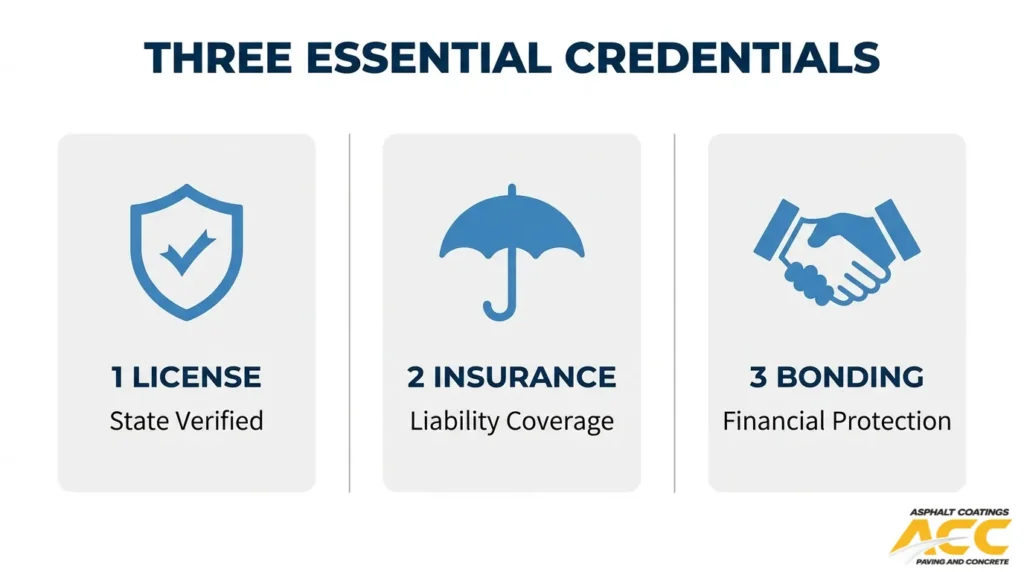
Licensing proves a contractor has met minimum competency and financial thresholds set by state regulatory boards. Insurance protects property owners from liability if workers are injured or property is damaged during a project. Bonding provides a financial guarantee that the contractor will fulfill contractual obligations; if they fail, the bond compensates the client.
These protections are not uniform across the country. According to the Washington State Department of Labor & Industries, registered contractors must carry surety bonds of $30,000 for general contractors and $15,000 for specialty contractors, along with a general liability insurance policy of at least $250,000 combined single limit. In contrast, the North Carolina Licensing Board for General Contractors notes that there is no insurance or bonding requirement for a general contractor’s license in that state, though workers’ compensation insurance is still required by North Carolina state law.
This inconsistency makes verification essential. A reputable paving contractor will voluntarily provide proof of all three credentials, even in states with lighter regulatory requirements. Property managers should request current copies of license certificates, insurance declarations, and bond documentation before signing any agreement. Contractors who hesitate or deflect when asked for this paperwork often lack one or more of these protections, which shifts all financial risk onto the property owner.
Understanding what these credentials cover helps you evaluate paving bids with far greater confidence and identify which contractors meet professional standards.
How Do Professional Estimates and Transparent Contracts Reveal a Paving Company’s Reliability?
Professional estimates and transparent contracts reveal a paving company’s reliability by showing how thoroughly a contractor documents scope, materials, and costs before work begins. The following sections cover what written estimates should include, which contract details matter most, and how vague proposals signal risk.
What Should a Written Paving Estimate Include?
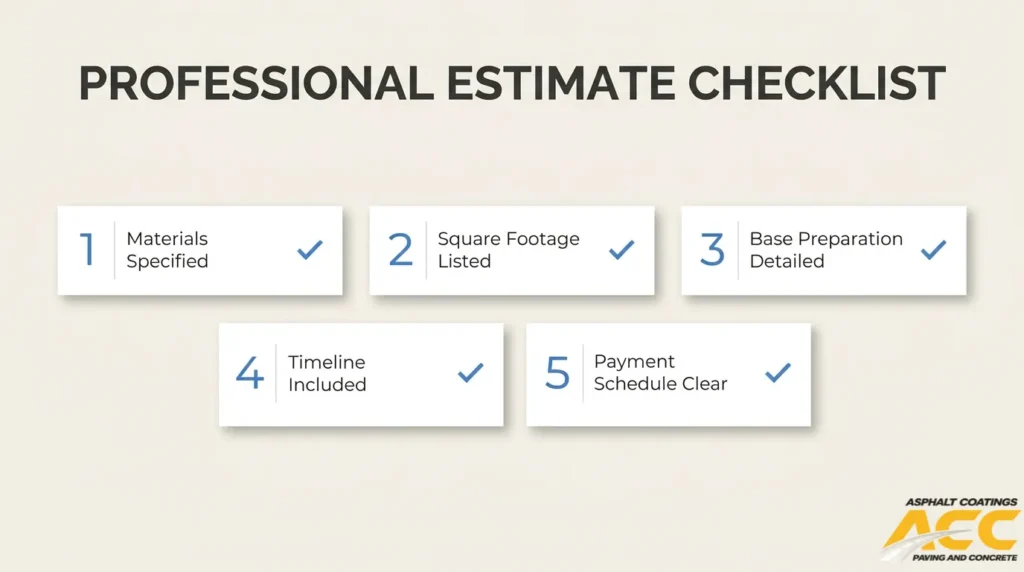
A written paving estimate should include a detailed breakdown of work performed, materials specified, project timelines, and total cost. According to the Cuyahoga County Department of Consumer Affairs, estimates should contain details about work performed and products used, and if estimates vary greatly between contractors, calling them back to confirm details can reveal whether a large price gap reflects differences in materials or scope of work.
Reliable estimates also list:
- Square footage and project dimensions.
- Asphalt mix type and thickness specifications.
- Base preparation and drainage work included.
- Equipment to be used on site.
- Estimated start and completion dates.
A contractor unwilling to itemize these details in writing likely lacks the technical rigor the project demands.
Why Does a Detailed Contract Protect You From Paving Disputes?
A detailed contract protects you from paving disputes by establishing enforceable expectations for both parties before work begins. Contracts that specify materials, payment schedules, change-order procedures, and warranty terms eliminate ambiguity that often leads to cost overruns or unfinished work.
Every paving contract should clearly state:
- The contractor’s legal business name, address, and license number.
- Full scope of work, including subgrade preparation and compaction standards.
- Payment milestones tied to completed project phases.
- Procedures for handling change orders or unforeseen conditions.
- Warranty duration and what it covers.
When a contractor resists putting these terms in writing, that reluctance itself is a red flag. Reputable paving companies welcome detailed documentation because it protects their reputation as much as your investment.
How Can Vague or Missing Proposal Details Signal an Unreliable Paving Contractor?
Vague or missing proposal details signal an unreliable paving contractor by leaving critical specifications undefined, which creates room for material substitutions, scope reductions, or surprise charges. Proposals that use generic language such as “paving services as discussed” without specifying asphalt mix type, compaction method, or base depth should raise immediate concern.
Warning signs in proposals include:
- No mention of specific materials or material grades.
- Lump-sum pricing without line-item breakdowns.
- Absent or unclear timelines for project milestones.
- Missing license, insurance, or bond documentation.
For commercial properties especially, where pavement must withstand heavy traffic loads, a proposal lacking technical specificity often means the contractor either lacks expertise or intends to cut corners. Always compare at least two to three detailed written estimates before committing.
Understanding what professional estimates and contracts should contain prepares you to evaluate how a contractor communicates throughout the project.
What Communication and Customer Service Behaviors Indicate a Reputable Paving Company?
The communication and customer service behaviors that indicate a reputable paving company include prompt responsiveness, clear project explanations, willingness to answer questions, and consistent follow-through on commitments. The sections below cover responsiveness, clarity, and proactive updates.
A reputable contractor treats every interaction as a reflection of how the project itself will be managed. If communication feels disorganized or evasive before work begins, the jobsite experience rarely improves. Companies that prioritize clear, timely communication tend to deliver more predictable outcomes, fewer disputes, and stronger long-term partnerships for commercial property managers.
Responsiveness during the initial inquiry matters. Professional paving companies return calls and emails within one business day, provide a clear point of contact, and confirm meeting times in writing. Contractors who are difficult to reach before signing a contract will be even harder to reach once they have your deposit.
Clarity in project discussions separates experienced contractors from unreliable ones. A reputable paving company explains scope, materials, timelines, and potential disruptions in plain language. According to the Pennsylvania Office of Attorney General, checking a contractor’s credentials, references, reviews, and registration status can help you avoid scams, poor workmanship, and unexpected costs. That same transparency should extend to every conversation about your project.
Proactive updates throughout the project lifecycle signal professionalism. Trustworthy contractors notify you of schedule changes, weather delays, or material adjustments before they become problems. Key communication behaviors to watch for include:
- Providing a dedicated project manager or single point of contact
- Sending written confirmations of scope changes or schedule shifts
- Explaining technical decisions, such as base preparation or compaction methods, without being asked
- Following up after project completion to address any concerns
Poor communication habits often foreshadow poor workmanship. Contractors who dodge specific questions, give vague timelines, or refuse to put details in writing are signaling how they handle accountability on the jobsite. Beyond technical competence, how a paving company communicates reveals whether it operates as a true partner or simply chases the next payment.
How Does On-Site Evaluation and Technical Knowledge Show a Paving Contractor Knows What They’re Doing?
On-site evaluation and technical knowledge show a paving contractor knows what they’re doing by revealing whether the contractor understands soil conditions, drainage requirements, and material specifications before any work begins. The following subsections cover what to expect during a site visit, which technical questions expose expertise, and how subgrade and drainage knowledge separates qualified contractors from unqualified ones.
What Should a Reputable Paving Contractor Do During an Initial Site Visit?
A reputable paving contractor should inspect the entire project area, assess existing pavement condition, check drainage patterns, and identify subgrade issues during an initial site visit. This evaluation should happen before any estimate is provided.
Key actions to look for during a site visit include:
- Walking the full property to note cracks, settling, and standing water.
- Measuring grades and slopes that affect water runoff.
- Identifying utility access points, curb lines, and ADA transition zones.
- Asking about traffic volume, vehicle types, and load requirements.
- Photographing existing damage for reference in the proposal.
A contractor who skips the site visit and quotes over the phone likely lacks the technical grounding to deliver lasting results.
Which Technical Questions Can Help You Gauge a Paving Contractor’s Expertise?
Technical questions that help you gauge a paving contractor’s expertise focus on materials, compaction standards, and temperature requirements. The answers reveal whether a contractor relies on industry knowledge or guesswork.
Effective questions to ask include:
- What asphalt mix design do you recommend for this project, and why?
- How do you determine the required base thickness for expected traffic loads?
- What compaction density do you target, and how do you verify it?
- At what temperatures will you refuse to pave?
According to the University of Nebraska–Lincoln and the Nebraska Department of Transportation, laboratory procedures such as the modified Proctor test (ASTM D 1557/AASHTO T 180) accurately estimate the greater densities achievable with modern construction equipment. A knowledgeable contractor should reference compaction testing standards confidently. Vague or dismissive answers to these questions signal a lack of technical competence.
Why Is Understanding Subgrade Conditions and Drainage Critical to Paving Quality?
Understanding subgrade conditions and drainage is critical to paving quality because pavement fails from the bottom up when the foundation beneath it cannot support loads or manage water. No surface material compensates for a weak or waterlogged base.
Subgrade evaluation determines soil type, bearing capacity, and moisture content. These factors dictate base material depth and compaction requirements. Drainage design ensures water moves away from the pavement structure rather than pooling underneath it, which accelerates deterioration through freeze-thaw cycles and erosion.
A contractor who discusses subgrade preparation, soil testing, and grading plans during the evaluation phase demonstrates the kind of technical depth that separates professionals from underqualified operators. With technical knowledge confirmed, the next step is verifying that same quality through a contractor’s past work and reputation.
What Does a Strong Portfolio, References, and Online Reputation Reveal About a Paving Company?
A strong portfolio, references, and online reputation reveal a paving company’s consistency, workmanship quality, and accountability over time. These three elements confirm whether past performance supports current claims.
A documented portfolio demonstrates that a paving contractor has completed projects similar in scope and complexity to yours. Completed parking lots, commercial overlays, and concrete flatwork photographed at various stages show technical capability that marketing language alone cannot prove. When a contractor readily shares before-and-after images of commercial properties, it signals confidence in the finished product.
References from past clients provide direct, verifiable evidence of reliability. According to the New York State Office of the Attorney General, homeowners and property managers should examine the completed project and ask previous clients if they are satisfied with the results. The same principle applies at a commercial scale: contacting two or three past clients about timeline adherence, communication quality, and post-project warranty support reveals patterns no website can fabricate.
Online reputation adds a third verification layer. Review platforms aggregate feedback from dozens or hundreds of clients, making it difficult for a contractor to hide recurring issues. Key indicators to evaluate include:
- Consistent ratings across multiple platforms, not just one curated source.
- Detailed reviews that mention specific services, such as sealcoating, crack sealing, or full-depth parking lot construction.
- Contractor responses to negative feedback, which demonstrate professionalism and willingness to resolve problems.
- Review volume over several years, confirming sustained activity rather than a short burst.
A paving company that lacks portfolio documentation, refuses to share references, or has sparse, unverifiable reviews is signaling risk. Reputable contractors treat their track record as a competitive advantage and present it openly. For commercial property managers evaluating multiple bids, this combination of visual proof, direct client feedback, and public review history is one of the most reliable filters for separating experienced contractors from those who overpromise and underdeliver.
Understanding what a contractor’s reputation reveals prepares you to evaluate pricing and payment practices next.
How Can Pricing and Payment Practices Help You Spot Paving Scams and Fly-by-Night Contractors?
Pricing and payment practices can help you spot paving scams by revealing patterns that legitimate contractors never follow. The subsections below cover suspiciously low bids, cash-only demands, pressure tactics, and the payment terms trustworthy companies use.
How Can You Recognize Bids That Are Suspiciously Low for Commercial Asphalt and Concrete Work?
You can recognize suspiciously low bids for commercial asphalt and concrete work by comparing quoted prices against known material costs and verifying the contractor’s licensing class. According to the University of Washington’s Green Technology Research, permeable asphalt materials and mixing alone cost approximately $0.60 to $0.70 per square foot, while permeable concrete material and installation runs $3.00 to $5.00 per square foot depending on thickness and site conditions. Any bid falling well below these baselines likely cuts corners on materials, base preparation, or compaction.
Warning signs that accompany underpriced bids include:
- The contractor refuses to provide a written estimate or contractor registration number.
- Credentials or references cannot be verified.
- The bid lacks line-item breakdowns for materials, labor, and equipment.
When a price seems too good to be true on a commercial project, it almost always is. Thin margins in paving typically mean thin asphalt.
Why Are Cash-Only Demands, Large Upfront Deposits, or Door-to-Door Offers Red Flags?
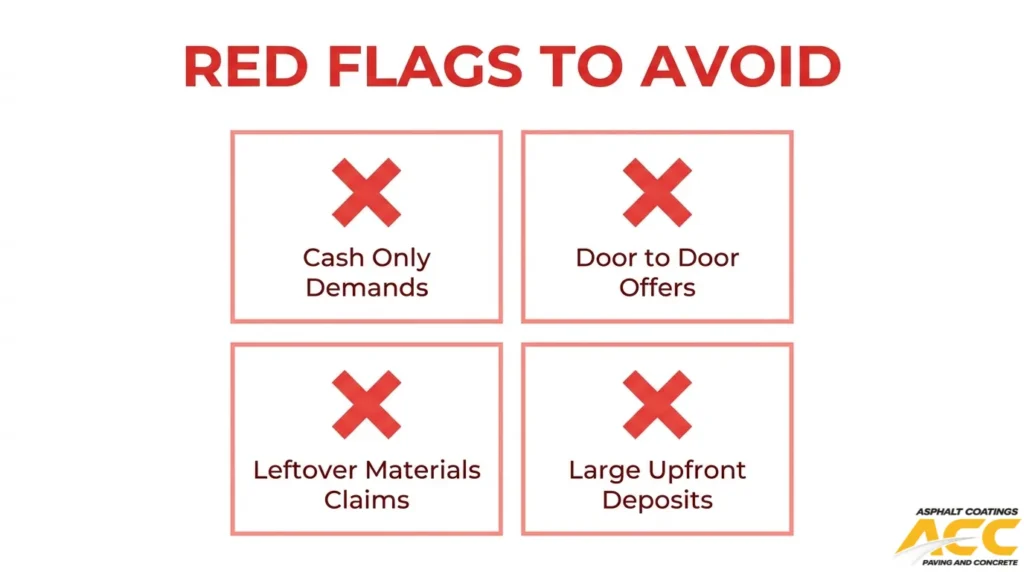
Cash-only demands, large upfront deposits, and door-to-door offers are red flags because they eliminate the financial accountability and documentation that protect property owners. Legitimate paving contractors accept multiple payment methods, provide receipts, and tie payment milestones to completed work phases. Scam operators, by contrast, prefer cash because it leaves no traceable record and makes recovery nearly impossible once they disappear.
A standard deposit for commercial paving should range between 10 and 15 percent of the bid price. Any contractor requesting full payment before breaking ground, or insisting on cash as the sole option, is operating outside industry norms. Door-to-door solicitation compounds the risk because reputable commercial contractors rely on referrals, established relationships, and formal bid processes rather than cold-knocking on properties.
How Do Short-Deadline Pressure Tactics and “Leftover Asphalt” Pitches Signal a Contractor to Avoid?
Short-deadline pressure tactics and “leftover asphalt” pitches signal a contractor to avoid because they bypass the evaluation steps every commercial property owner needs. According to the Federal Trade Commission, scammers knock on doors claiming to be “in the area,” say they have materials left over from a previous job, pressure for an immediate decision, and demand full payment upfront or cash only.
The “leftover material” story is engineered to create urgency. In reality, hot-mix asphalt has a limited working window and cannot simply be stockpiled in a truck for opportunistic sales. Legitimate commercial paving companies schedule projects based on site assessments, engineered specifications, and weather conditions. If someone pressures you to commit on the spot, that urgency exists to prevent you from checking licenses, comparing bids, or calling references.
What Payment Schedule and Terms Are Typical for a Trustworthy Commercial Paving Company?
The payment schedule and terms typical for a trustworthy commercial paving company involve milestone-based payments tied to project phases rather than a single lump sum. A standard structure includes:
- A deposit of 10 to 30 percent at contract signing.
- Progress payments after base preparation, paving, and striping milestones.
- A final payment upon inspection and project completion.
Reputable contractors provide these terms in a written contract that specifies scope, materials, timeline, and warranty provisions. They accept checks, credit cards, or electronic transfers and issue detailed invoices for each payment phase. Retaining a portion of the total until all work passes inspection gives property owners leverage to ensure quality.
Any contractor unwilling to put payment terms in writing, or who structures payments to front-load their cash collection before meaningful work begins, should be removed from consideration. Understanding these financial benchmarks makes it far easier to evaluate material quality and jobsite standards.
What Quality Standards, Materials, and Equipment Should a Trustworthy Paving Contractor Use?
A trustworthy paving contractor should use industry-standard hot-mix asphalt, proper compaction equipment, engineered base preparation, and climate-appropriate scheduling. The following sections cover mix selection, compaction and drainage, seasonal timing, and warranty expectations.
How Does the Choice Between Hot-Mix Asphalt and Other Mixes Affect Long-Term Performance?
The choice between hot-mix asphalt and other mixes affects long-term performance by determining pavement durability, maintenance frequency, and total lifecycle cost. Hot-mix asphalt (HMA) delivers a dense, well-bonded surface that resists cracking and moisture infiltration longer than cold-mix alternatives, which are generally suited only for temporary patches.
According to the National Center for Asphalt Technology at Auburn University, lifecycle cost analyses by most agencies use initial performance periods of 10 to 15 years for asphalt concrete pavements, compared to 20 to 25 years for portland cement concrete pavements. A reputable contractor should explain which mix type fits your traffic loads and budget, rather than defaulting to whatever is cheapest. When evaluating bids, ask specifically what mix design is proposed and why.
Why Do Compaction Methods, Base Preparation, and Drainage Design Matter for Quality Paving?
Compaction methods, base preparation, and drainage design matter because they create the structural foundation that determines whether pavement holds up or fails prematurely. Poor compaction leaves air voids that trap water, accelerating cracking and rutting. An unstable base shifts under traffic, causing surface distortion within months.
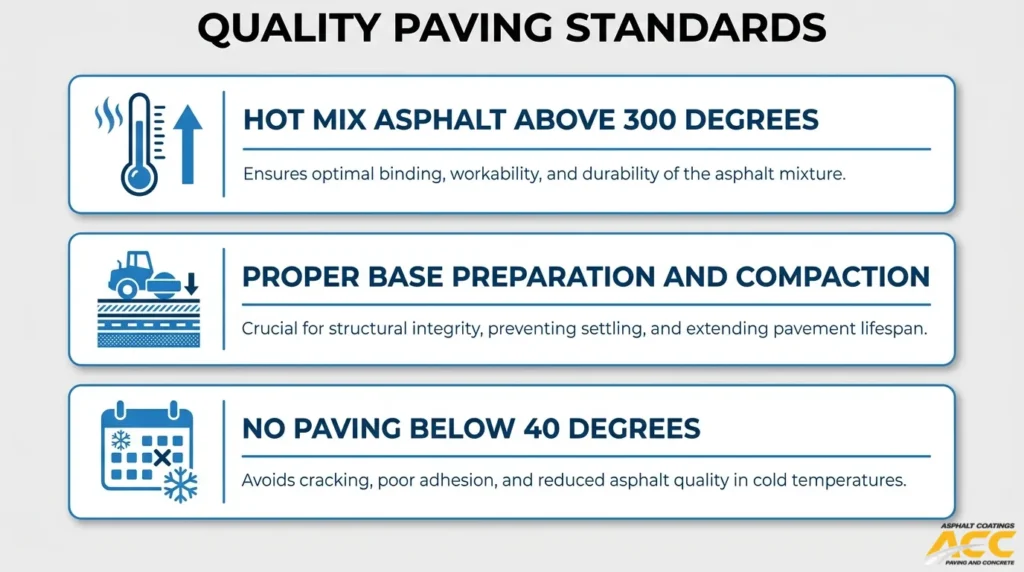
According to the Federal Highway Administration, HMA aggregates and asphalt cement are heated above 300°F during mixing and must remain hot through transport, placement by a paving machine, and compaction by roller machines. Iowa DOT standards reinforce this by prohibiting placement of flexible paving mixtures over frozen subgrade or unstable roadbeds. Proper drainage prevents water from saturating the base layer. A trustworthy contractor addresses all three elements before the first load of asphalt arrives.
How Do Weather, Climate, and Seasonal Timing Affect When a Good Contractor Will Schedule Work?
Weather, climate, and seasonal timing affect scheduling because asphalt requires specific temperature conditions for proper compaction and curing. Paving in cold or wet conditions prevents the mix from bonding correctly, leading to premature surface failures.
A reputable contractor will decline work when air temperatures drop below 40°F or when rain is expected during placement. In regions with freeze-thaw cycles, spring and fall windows narrow significantly. Honest scheduling that accounts for weather delays is a quality signal; contractors who push to pave regardless of conditions prioritize speed over durability. If a company insists on paving during marginal weather without explaining mitigation steps, treat that as a warning sign.
What Maintenance and Warranty Details Should a Reputable Paving Company Provide Up Front?
The maintenance and warranty details a reputable paving company should provide up front include written warranty terms, a recommended maintenance schedule, and clear definitions of what is covered versus excluded. Key elements to expect:
- A written warranty specifying duration, typically one to two years for workmanship.
- Defined coverage for issues such as premature cracking, delamination, or drainage failure.
- A maintenance timeline recommending sealcoating, crack sealing, and restriping intervals.
- Exclusions clearly stated, such as damage from utility cuts or chemical spills.
- Contact procedures for filing a warranty claim.
Any contractor unwilling to put warranty terms in writing before work begins is a contractor worth avoiding. Understanding material and equipment standards helps you evaluate jobsite behavior and red flags next.
What Red Flags in Behavior, Appearance, or Jobsite Practices Suggest a Paving Company Is Not Reputable?
Red flags in behavior, appearance, or jobsite practices suggest a paving company is not reputable when its operations lack consistency, accountability, and compliance. The following subsections cover branding inconsistencies, crew management problems, jobsite safety failures, and documentation avoidance.
How Can Inconsistent Branding, Unmarked Trucks, or Temporary Phone Numbers Signal Risk?
Inconsistent branding, unmarked trucks, or temporary phone numbers signal risk because they indicate a contractor has no permanent business identity to stand behind. Legitimate paving companies invest in branded vehicles, consistent logos, and permanent business phone lines tied to a verifiable address. When a contractor arrives in an unmarked truck or van, it often aligns with known scam patterns. According to the Washington State Office of the Attorney General, common tactics of fraudulent asphalt contractors include arriving in unmarked vehicles, soliciting door to door, and providing credentials that cannot be verified.
A disposable phone number makes it nearly impossible to reach the company after work is completed. If something goes wrong, that temporary number disconnects, and you have no recourse. Consistent, verifiable branding reflects a company that plans to be around long enough to honor its commitments.
Why Are Unsupervised Crews, Subcontractor Confusion, or Frequent Staff Turnover Concerning?
Unsupervised crews, subcontractor confusion, or frequent staff turnover are concerning because they undermine quality control and accountability on paving projects. When no identifiable foreman manages the crew on site, mistakes in compaction, grading, or material application go uncorrected. Subcontractor confusion compounds this problem; if the crew on your property cannot confirm who they work for or who holds the contract, liability becomes unclear.
Frequent staff turnover suggests the company cannot retain experienced workers, which directly affects workmanship consistency. Skilled paving requires operators who understand equipment calibration, temperature windows, and proper rolling patterns. A revolving crew rarely develops that proficiency. Companies that rely on in-house crews with stable employment typically deliver more reliable results than operations constantly cycling through unfamiliar labor.
How Do Messy Jobsites, Safety Violations, or Ignoring ADA Requirements Reveal Poor Professionalism?
Messy jobsites, safety violations, or ignoring ADA requirements reveal poor professionalism because they demonstrate a contractor’s disregard for regulatory standards and basic project management. OSHA’s highway work zone standards under 29 CFR 1926 Subpart G require proper signs, signals, and barricades on active paving sites. A contractor who skips these protections puts workers and the public at risk.
ADA compliance is equally non-negotiable for commercial properties. According to the U.S. Department of Justice, businesses providing parking lots must include accessible parking spaces that comply with the Americans with Disabilities Act, with specific ratios for van-accessible spaces at facilities like hospital outpatient centers. A paving contractor who ignores slope requirements, detectable warning surfaces, or accessible space counts exposes property owners to legal liability. Disorganized sites with scattered debris, unprotected trenches, or missing traffic control reflect the same negligence that leads to failed pavement.
Why Is Reluctance to Provide Documentation, References, or Proof of Insurance a Major Warning Sign?
Reluctance to provide documentation, references, or proof of insurance is a major warning sign because it suggests the contractor either lacks proper credentials or intends to avoid accountability. A reputable paving company readily shares its license number, certificate of insurance, and a list of completed projects. When a contractor deflects these requests, it typically means the paperwork does not exist.
Proof of insurance protects you from liability if a worker is injured on your property or if the work damages adjacent structures. References allow you to verify that past clients received the quality and timeline they were promised. Without these documents, you have no way to confirm the contractor’s claims. Any paving company that hesitates to produce this information should be removed from consideration immediately, regardless of how competitive the bid appears.
Recognizing these behavioral red flags early protects your investment before work begins.
How Do the Needs of Commercial Properties Change What You Should Look For in a Paving Company?
The needs of commercial properties change what you should look for in a paving company by requiring industry-specific expertise in traffic management, load engineering, ADA compliance, and phased scheduling. The sections below cover key questions for shopping centers, apartment complexes, industrial facilities, and high-traffic institutional sites.
What Should Property Managers at Shopping Centers and Retail Plazas Ask a Paving Contractor?
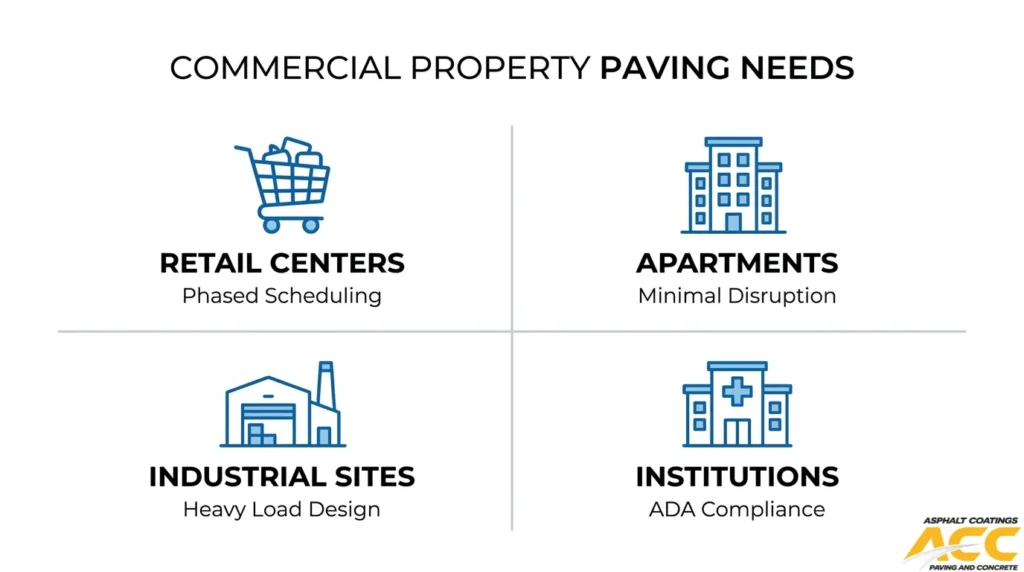
Property managers at shopping centers and retail plazas should ask a paving contractor about phased work scheduling, traffic control plans, and experience with large-format parking lot construction. Retail environments depend on continuous customer access, so any paving project must maintain open drive lanes and visible wayfinding throughout each phase.
Key questions to ask include:
- Can you provide a phased construction timeline that keeps a portion of the lot open at all times?
- How will you handle striping, ADA-accessible parking, and fire lane markings during and after the project?
- Do you have references from comparable retail properties with similar square footage?
- What is your plan for stormwater drainage across large, flat parking surfaces?
Contractors who cannot answer these questions with documented examples from previous retail projects are likely underqualified for the scope involved.
How Do Apartment Complexes and HOAs Choose a Paving Partner Who Minimizes Disruption?
Apartment complexes and HOAs choose a paving partner who minimizes disruption by prioritizing contractors with detailed resident communication plans, after-hours scheduling capability, and experience working in occupied multi-unit environments. Residents need consistent access to parking, driveways, and emergency vehicle routes throughout the project.
A qualified contractor should offer:
- Advance notification schedules coordinated with property management
- Temporary parking arrangements and phased lot closures
- Night or weekend paving options to reduce daytime noise and congestion
- Written timelines with contingency plans for weather delays
For communities where dozens or hundreds of residents share common paved areas, even a single day of poor coordination can generate complaints and liability exposure. Contractors accustomed only to single-site commercial jobs may underestimate this complexity.
What Should Industrial Facilities and Warehouses Verify About Pavement Strength and Load Capacity?
Industrial facilities and warehouses should verify that a paving contractor can engineer pavement sections rated for the specific axle loads, turning movements, and equipment traffic the site generates. Standard parking lot asphalt designs are not built for forklifts, loaded semi-trailers, or constant heavy-vehicle turning in dock areas.
Critical items to verify include:
- Subgrade preparation methods and soil testing protocols for load-bearing capacity
- Asphalt thickness and aggregate base specifications designed for heavy-duty use
- Experience paving truck courts, loading docks, and container staging yards
- Drainage solutions that prevent water pooling in high-traffic zones where surface wear accelerates
According to the University of Nebraska–Lincoln and Nebraska Department of Transportation, the modified Proctor test (ASTM D 1557/AASHTO T 180) accurately estimates the greater densities achievable with modern compaction equipment, making it essential for heavy-load pavement design. Any contractor unfamiliar with these standards is a poor fit for industrial work.
How Can Hospitals, Schools, and Other High-Traffic Sites Evaluate Safety and Accessibility Expertise?
Hospitals, schools, and other high-traffic sites can evaluate safety and accessibility expertise by confirming a contractor’s knowledge of ADA parking requirements, OSHA workzone safety standards, and phased construction in environments where pedestrian safety is paramount. These properties serve vulnerable populations, including patients, children, and individuals with mobility limitations, so paving errors carry heightened consequences.
According to the U.S. Department of Justice, hospital outpatient facilities must make ten percent of patient and visitor parking accessible, with at least one of every six accessible spaces designated as van accessible. A contractor who does not proactively address these ratios during the bidding phase likely lacks institutional project experience.
Essential evaluation criteria include:
- Demonstrated familiarity with ADA slope, signage, and accessible route standards
- Workzone safety plans that comply with OSHA Subpart G requirements for signaling and barricades
- Ability to maintain emergency vehicle access throughout every construction phase
With these property-specific factors clarified, the next step is comparing bids across contractors to make a confident final decision.
How Should You Compare Multiple Paving Bids to Make a Confident, Low-Risk Decision?
You should compare multiple paving bids by standardizing scope, evaluating lifecycle cost, verifying references, and documenting every step. The following subsections cover matching line items, weighing cost against lifespan, asking the right reference questions, and protecting your organization through documentation.
What Scope, Specs, and Line Items Should You Match Across Competing Paving Proposals?
The scope, specs, and line items you should match across competing paving proposals include material types, square footage, base preparation depth, compaction methods, drainage provisions, and warranty terms. When proposals use different specifications, a direct price comparison becomes meaningless.
To ensure an apples-to-apples evaluation, confirm these details in every bid:
- Asphalt mix type and thickness (e.g., hot-mix asphalt at 3 inches versus 2 inches)
- Subgrade preparation scope, including grading and aggregate base depth
- Compaction method and equipment specified
- Drainage design and slope grading
- Mobilization, traffic control, and striping costs
- Warranty duration and what it covers
If one proposal omits line items that others include, request a revised estimate before comparing totals. Missing scope is often where low bids hide future costs.
How Can You Weigh Upfront Cost Against Expected Lifespan and Maintenance Requirements?
You can weigh upfront cost against expected lifespan and maintenance requirements by applying lifecycle cost analysis to each bid. A lower initial price means little if the pavement fails years sooner or demands frequent repairs.
According to the National Center for Asphalt Technology at Auburn University, the initial performance periods used in lifecycle cost analysis by the majority of agencies ranged between 10 and 15 years for asphalt concrete pavements and between 20 and 25 years for portland cement concrete pavements. These benchmarks help you project when each bid’s proposed pavement will need overlays, sealcoating, or reconstruction.
Calculate total cost of ownership by adding the bid price to estimated maintenance expenses over the pavement’s expected service life. The bid with the lowest per-year cost often differs from the bid with the lowest sticker price.
Which Questions Should You Ask References to Validate Each Contractor’s Claims?
The questions you should ask references to validate each contractor’s claims focus on project accuracy, timeliness, communication, and post-completion support. References reveal whether a contractor’s promises hold up on actual jobsites.
When speaking with past clients, cover these specifics:
- Did the contractor complete the project on schedule and within the quoted budget?
- Were there unexpected change orders, and how were they handled?
- How did the crew manage site cleanliness, traffic flow, and safety during work?
- Did the finished pavement match the specifications in the original proposal?
- Has the pavement held up since installation, and did the contractor honor warranty claims?
- Would you hire this company again for a similar project?
Ask references about projects comparable to yours in scale and complexity. A contractor’s performance on a small driveway tells you little about their ability to handle a commercial parking lot.
How Can You Document Your Selection Process to Protect Your Budget and Organization?
You can document your selection process to protect your budget and organization by creating a written record of every bid, correspondence, and evaluation criterion used. This paper trail defends your decision if disputes, cost overruns, or stakeholder questions arise later.
According to the Cuyahoga County Department of Consumer Affairs, estimates should include details about work performed and products used; if estimates vary greatly, call the contractors back to confirm details or ask why, because a large price gap could indicate differences in materials or scope.
Key documentation steps include:
- Saving all written estimates, revised proposals, and email exchanges
- Recording a scoring matrix that ranks each bid on scope, price, references, and credentials
- Noting the reasons any bid was disqualified or advanced
- Structuring payment terms with milestone-based releases rather than full upfront payment
Thorough records transform your selection from a subjective preference into an auditable, defensible process. With a documented decision framework in place, your next step is choosing a contractor whose values align with your project goals.
How Should You Approach Choosing a Paving Contractor With Asphalt Coatings Company’s Services in Mind?
You should approach choosing a paving contractor by comparing credentials, verifying references, and evaluating whether services align with your property’s specific needs. The following sections explain how Asphalt Coatings Company’s offerings address common red flags and summarize the key takeaways covered throughout this guide.
How Can Asphalt Coatings Company’s Commercial Paving, Sealcoating, and Crack Sealing Services Help You Avoid Common Contractor Red Flags?
Asphalt Coatings Company’s commercial paving, sealcoating, and crack sealing services help you avoid common contractor red flags by providing the transparency and verifiable credentials that scam operators consistently lack. According to the Pennsylvania Office of Attorney General, checking a contractor’s credentials, references, reviews, and registration status can help you avoid scams, poor workmanship, and unexpected costs.
Asphalt Coatings Company addresses these concerns directly:
- Asphalt Coatings Company has served Colorado’s Front Range since 1986, providing decades of verifiable project history.
- Asphalt Coatings Company uses in-house crews for all paving, sealcoating, and crack sealing work, eliminating subcontractor confusion.
- Asphalt Coatings Company provides detailed written estimates covering scope, materials, and payment timelines.
- Asphalt Coatings Company specializes in ADA-compliant concrete work, subgrade preparation, and crack sealing with approved materials.
For property managers evaluating contractors, this combination of established credentials, specialized commercial focus, and full-service capabilities is exactly what separates a trustworthy partner from a risky hire.
What Are the Key Takeaways About Signs of a Reputable Paving Company and Red Flags to Avoid We Covered?
The key takeaways about signs of a reputable paving company and red flags to avoid center on verification, transparency, and technical competence. Throughout this guide, the consistent theme is clear: reputable contractors welcome scrutiny, while problematic ones avoid it.
Signs of a reputable paving company include:
- Verifiable licensing, insurance, bonding, and years of established business history.
- Detailed written estimates with clear scope, materials, and reasonable deposit terms of 10 to 30 percent.
- Strong portfolios, references from completed projects, and positive online reviews.
- Proper base preparation, compaction methods, drainage design, and weather-appropriate scheduling.
Red flags to avoid include:
- Door-to-door solicitation, “leftover materials” pitches, and pressure for immediate decisions.
- Cash-only demands, large upfront payments, or refusal to provide written contracts.
- Unmarked vehicles, unverifiable credentials, and reluctance to share proof of insurance.
- Messy jobsites, safety violations, and disregard for ADA accessibility requirements.
Choosing a paving contractor is ultimately a decision about risk management. Every red flag this guide identifies points to contractors who prioritize short-term profit over long-term quality, and every green flag reflects a company willing to stand behind its work.