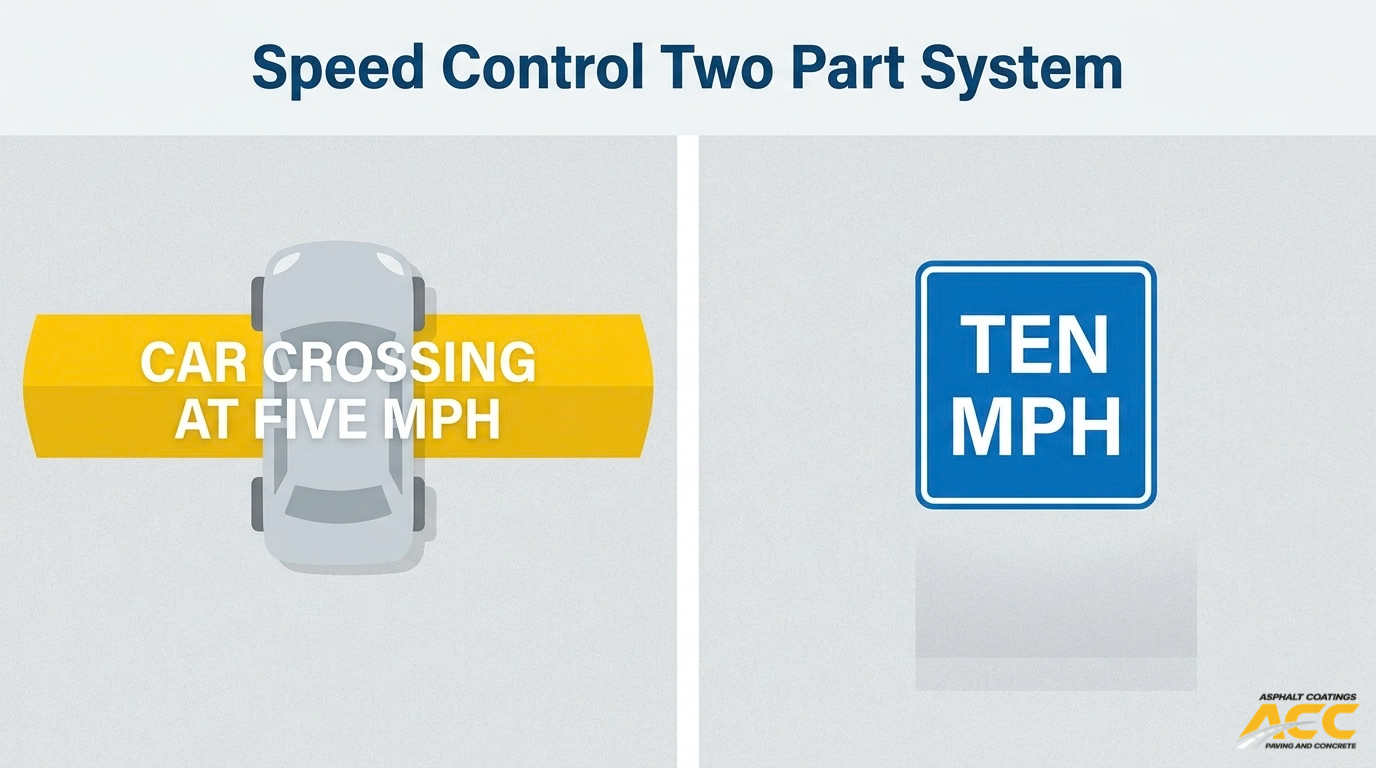
Parking lot speed bumps and speed limits are traffic calming measures property owners install to control vehicle speeds, protect pedestrians, and reduce liability in privately managed parking areas. Speed bumps enforce physical deceleration to roughly 5 mph, while posted limits between 10 and 15 mph establish the legal and behavioral framework for safe lot operations.
This guide covers the differences between speed control devices, safety and liability considerations, design and placement standards, regulatory and ADA compliance, and long-term maintenance planning.
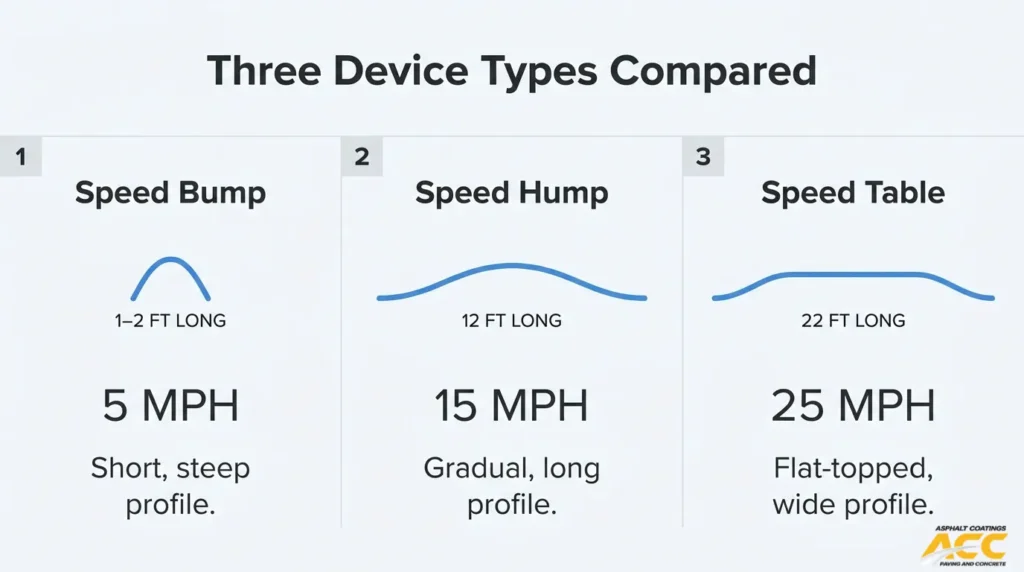
Speed bumps, speed humps, speed tables, and speed cushions each serve distinct environments based on their length, height, and target speed. Standard speed bumps measure 1 to 2 feet long and suit parking lots, while 12-foot speed humps and 22-foot speed tables work better on campus roads and connector lanes where slightly higher speeds are acceptable.
Pedestrian injury data from non-traffic locations reinforces why speed control is not optional. Thousands of injuries occur annually in parking lots and on private property, yet many of these incidents never appear in official crash statistics. Properly engineered speed bumps reduce pedestrian injury odds significantly, while missing or poorly installed devices increase premises liability exposure.
Placement and design depend on property type, traffic patterns, and vehicle mix. Retail centers, office parks, residential communities, and industrial facilities each demand different bump profiles, spacing intervals, and material choices. Asphalt construction offers up to 25 years of service life compared to roughly 10 years for rubber or plastic alternatives.
Local codes vary widely on allowable dimensions, signage requirements, and enforcement authority over private lots. ADA-accessible routes must maintain minimum clear widths, and speed bumps cannot obstruct the shortest path to building entrances. Checking municipal ordinances before installation prevents costly rework and legal exposure.
Routine inspection, timely crack repair, and seasonal adjustments protect the investment over time. Freeze-thaw cycles, snow plowing, and heavy traffic all accelerate surface wear, making a consistent maintenance schedule essential for sustained performance.
Why Do Parking Lots Need Speed Control Devices and Posted Speed Limits?
Parking lots need speed control devices and posted speed limits because these areas combine vehicle traffic with unpredictable pedestrian movement in confined spaces, creating high collision risk without physical enforcement. The sections below cover pedestrian vulnerability, the role of posted signage in establishing enforceable limits, and how accessible routing requirements add further urgency to speed management.
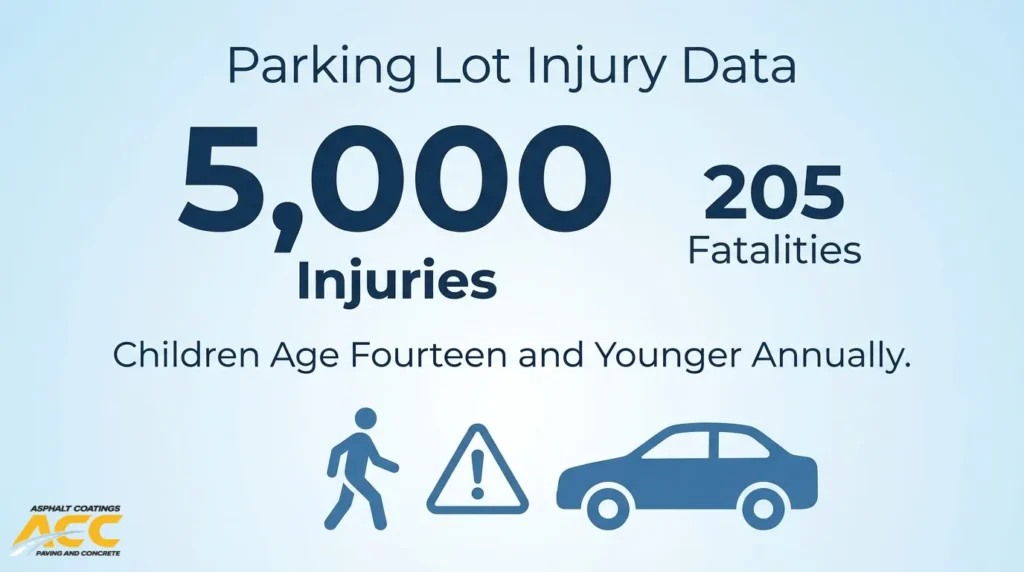
Parking lots lack the traffic signals, lane markings, and separation barriers found on public roads. Drivers navigate tight turning radii while pedestrians, including children and individuals using mobility aids, cross travel lanes at unpredictable points. According to a University of Alabama at Birmingham report, the National Highway Traffic Safety Administration estimated 5,000 injuries and 205 fatalities annually among children age 14 and younger from vehicle collisions in non-traffic locations such as parking lots, driveways, and private property. Without speed control devices like speed bumps or posted speed limit signs, there is no physical mechanism or legal framework compelling drivers to slow down in these shared spaces.
Posted speed limits serve a dual purpose. They set clear driver expectations, and in many jurisdictions, they activate municipal traffic enforcement authority on private property. For example, a City of Spring Hill, Kansas, ordinance requires property owners to post permanently lettered signs reading “SPEED LIMIT 15 M.P.H.” at each entrance before city traffic regulations can be enforced on private land. This means posted signage is not merely advisory; it is often a legal prerequisite for any enforcement action.
Common parking lot speed limits across institutional properties reinforce how low these thresholds need to be:
- 10 mph is the standard parking lot limit at campuses such as East Texas A&M University and Our Lady of the Lake University.
- 15 mph applies to campus roads and connector lanes at multiple institutions.
- 5 mph is enforced inside parking garages, as noted in University of Texas Health Science Center regulations.
Accessible route requirements compound the need for strict speed control. The U.S. Department of Justice requires accessible parking spaces to be located on the shortest accessible route to building entrances. Speed control devices protect these routes, where individuals with disabilities travel at slower speeds and with limited ability to react to approaching vehicles. For property owners managing commercial lots, the combination of pedestrian safety data, legal enforcement prerequisites, and accessibility obligations makes speed bumps and posted limits essential rather than optional infrastructure.
What Are the Differences Between Speed Bumps, Speed Humps, and Speed Tables?
The differences between speed bumps, speed humps, and speed tables come down to length, height, and intended speed environment. Each device serves a distinct traffic calming purpose based on its profile.
Speed bumps are the shortest and most abrupt. A speed bump measures 1 to 2 feet in the direction of travel, with a height of 3 to 4 inches. According to the Connecticut General Assembly’s OLR Research Report (2006-R-0567), the maximum comfortable crossing speed for a speed bump is about 5 mph, making these devices most appropriate for parking lots, private roads, and low-speed residential streets.
Speed humps are longer and more gradual. A standard speed hump measures 12 feet in length and 3 to 4 inches in height. Because of this gentler profile, speed humps suit public roadways with speed limits up to 25 mph. Previous studies show a 6 to 13 mph reduction in the 85th percentile speed where speed humps are installed, though this effect declines roughly 0.5 to 1 mph for every 100 feet beyond the 200-foot approach zone. Speed humps are typically placed mid-block, with spacing not exceeding 500 feet between devices.
Speed tables extend the concept further. A speed table measures 22 feet long and 3 to 3.5 inches high, featuring a flat top long enough for a passenger car’s entire wheelbase to rest on. This flat section reduces the disruption to vehicle operations compared to a rounded hump. Vehicle operating speeds on streets with speed tables range from 25 to 45 mph depending on spacing.
A fourth option, the speed cushion, consists of two or more raised mounds placed laterally across the roadway with gaps between them. These cutouts allow wide-track vehicles like fire trucks and buses to pass without vertical deflection, which makes speed cushions practical where emergency access is a priority.
The key dimensional and performance differences are:
| Device | Length | Height | Target Speed |
| Speed bump | 1–2 ft | 3–4 in | ~5 mph |
| Speed hump | 12 ft | 3–4 in | Up to 25 mph |
| Speed table | 22 ft | 3–3.5 in | 25–45 mph |
| Speed cushion | Varies | 3–4 in | Similar to humps |
Material choice also influences cost and flexibility. Rubber speed humps cost roughly one-tenth of a standard asphalt speed hump, according to the City of Burlington, Vermont Department of Public Works. Rubber units can be removed seasonally for snow plowing, a practical consideration for properties in climates with harsh winters.
For most commercial parking lots, speed bumps remain the most common choice because the 5 mph target speed matches typical lot conditions. Speed humps and tables are better suited to campus roads, connector lanes, or areas where slightly higher speeds are acceptable. Understanding these profile differences helps property owners select the device that matches their lot’s traffic flow, vehicle mix, and maintenance budget.
What Safety and Liability Issues Should Property Owners Consider With Speed Bumps?
Property owners should consider pedestrian injury risk, premises liability exposure, and the proven safety benefits of properly engineered speed bumps. The subsections below cover parking lot injury statistics, how speed bumps reduce those risks, and the liability implications of poor installation.
Parking lots, driveways, and private properties are high-risk zones for pedestrian injuries, particularly among children. According to a 2007 National Highway Traffic Safety Administration report, an estimated 5,000 injuries and 205 fatalities of children age 14 and younger occur annually from vehicle collisions in non-traffic locations such as parking lots, driveways, and private property. These incidents rarely appear in standard traffic crash databases because many states exclude private property collisions from official motor vehicle statistics entirely. That reporting gap means property owners may underestimate the true scope of risk on their premises. Without speed control measures in place, parking lots expose owners to preventable harm and the legal scrutiny that follows.
Speed bumps provide measurable protection when designed and installed correctly. A matched case-control study published in the American Journal of Public Health found that speed humps were associated with a 53% to 60% reduction in the odds of injury or death among children struck by vehicles in their neighborhood. Broader traffic calming research from the Federal Highway Administration supports similar conclusions: total accidents dropped by 50% and injury accidents fell by 25% or more in communities that implemented calming devices. These reductions demonstrate that speed bumps are not just a convenience measure; they are a documented safety intervention that directly lowers pedestrian harm in areas where vehicles and foot traffic share space.
Liability exposure increases significantly when property owners fail to follow accepted engineering practices. Municipal traffic calming policies, such as the City of Claremont’s Administrative Policy No. 10-35, explicitly require that calming measures use engineering design features that avoid unacceptable liability exposure. Property owners face similar scrutiny. Poorly designed speed bumps, missing warning signage, inadequate lighting, and noncompliant placement near ADA-accessible routes can all create grounds for negligence claims. Conversely, documented compliance with engineering standards strengthens a property owner’s legal position if an incident occurs. Maintaining inspection logs, following manufacturer specifications, and ensuring visible pavement markings are practical steps that reduce both accidents and liability. For commercial property owners managing high-traffic parking lots, treating speed bump installation as a liability management strategy is just as important as treating it as a safety measure.
What Parking Lot Speed Limits Are Commonly Recommended for Commercial Properties?
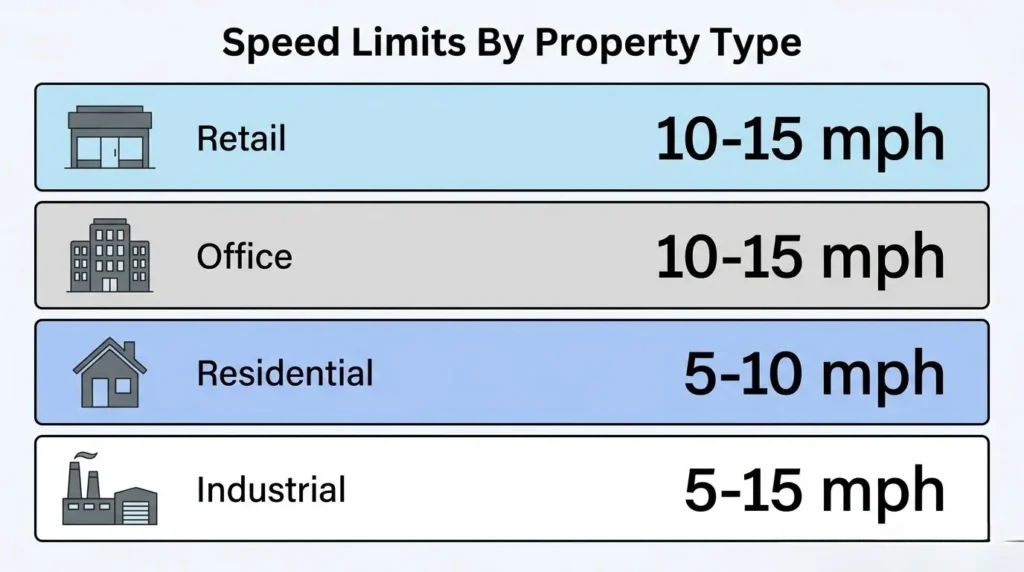
Parking lot speed limits commonly recommended for commercial properties range from 5 to 15 mph, depending on the property type and local jurisdiction. The sections below break down specific limits by property category, how jurisdictions enforce them, and where speed bumps fit into posted limit strategies.
What Speed Limits Apply to Standard Commercial Parking Lots?
Standard commercial parking lots typically post speed limits between 10 and 15 mph. According to the University of Texas Health Science Center at San Antonio’s parking and traffic regulations, the recommended maximum is 15 mph on campus roads, 10 mph in parking lots, and 5 mph in parking garages. Shopping centers, office parks, and medical facilities generally fall within this same range.
Properties with heavy pedestrian traffic, such as healthcare centers and retail plazas, benefit from the lower end of that spectrum. Parking garages almost universally warrant a 5 mph limit due to tight turns, limited sightlines, and shared pedestrian paths. For most open-air commercial lots, 10 mph strikes a practical balance between traffic flow and safety.
How Do Municipal Codes Influence Parking Lot Speed Limits?
Municipal codes influence parking lot speed limits by establishing enforceable maximums that property owners must follow when posting signage. Oregon Administrative Rules, for example, set a default maximum of 10 mph in parking areas unless otherwise posted at a lower speed. The City of Spring Hill, Kansas, requires property owners to post signs reading “SPEED LIMIT 15 M.P.H.” at each entrance for city traffic regulations to apply on private property.
These requirements vary significantly by jurisdiction. Some municipalities allow property owners to set their own limits within a permitted range, while others mandate specific speeds for private lots open to public traffic. Checking local ordinances before installing signage is essential because noncompliant postings may be unenforceable.
How Do Posted Speed Limits and Speed Bumps Work Together on Commercial Properties?
Posted speed limits and speed bumps work together by pairing regulatory authority with physical enforcement. A posted 10 mph sign communicates the expected behavior, while a speed bump physically prevents vehicles from exceeding roughly 5 mph at that point. According to 36 CFR 4.21 from the National Park Service, federal park areas set 15 mph limits in parking areas, campgrounds, and places of public assembly, often supplemented with physical traffic calming devices.
For commercial property owners, combining both measures creates layered protection. Speed limit signs alone rely on voluntary compliance; speed bumps ensure it. This dual approach strengthens a property owner’s liability position by demonstrating reasonable effort to control vehicle speeds in areas where pedestrians, shopping carts, and reversing vehicles share space.
How Do Property Type and Traffic Patterns Affect the Right Speed Bump Design?
Property type and traffic patterns affect the right speed bump design by determining vehicle mix, pedestrian density, and required travel speeds. Retail centers, office parks, residential communities, and industrial facilities each present distinct conditions that demand different speed bump profiles and placements.
How Should Parking Lot Speed Bumps Be Chosen for Retail Shopping Centers?
Parking lot speed bumps for retail shopping centers should be chosen based on high pedestrian volumes, frequent cart traffic, and constant vehicle turnover. According to the City of Lynwood Public Works Department’s Speed Hump Policy, installations of speed bumps are typically found in shopping center and other commercial and public parking lots.
Key selection factors for retail centers include:
- Standard speed bumps (2 to 3 feet wide, 4 to 6 inches high) enforce the 5 mph speeds appropriate near storefronts and crosswalks.
- Placement near pedestrian corridors, handicap-accessible routes, and cart return areas addresses the highest-risk zones.
- High-visibility paint and reflective markings account for nighttime shoppers and seasonal lighting changes.
Retail lots benefit from aggressive speed control because distracted pedestrians, children, and shopping carts create unpredictable movement patterns throughout the day.
How Should Parking Lot Speed Bumps Be Chosen for Office Parks and Business Campuses?
Parking lot speed bumps for office parks and business campuses should be chosen to manage predictable rush-hour surges while maintaining smooth flow during off-peak hours. Most office parking lots experience two concentrated traffic peaks: morning arrival and evening departure.
Effective design considerations include:
- Lower-profile bumps or speed humps work well in campus connector lanes where vehicles travel slightly faster between buildings.
- Standard speed bumps remain appropriate near building entrances, crosswalks, and garage entries where pedestrians concentrate.
- Spacing bumps closer together near main entrances prevents acceleration between the lot entry and parking areas.
Office campuses often involve delivery vehicles and service trucks, so bump profiles should accommodate heavier axle loads without creating excessive jarring.
How Should Parking Lot Speed Bumps Be Chosen for Apartment and Condo Communities?
Parking lot speed bumps for apartment and condo communities should be chosen to protect residents who walk, cycle, and play in shared parking areas at all hours. Residential properties present unique risks because children, pets, and elderly residents use these lots as daily pedestrian routes.
Important selection criteria include:
- Standard speed bumps placed near playground areas, building entrances, and mailbox clusters target the zones with the most vulnerable foot traffic.
- Durable asphalt construction handles the constant daily use that residential lots experience year-round.
- Clear signage at lot entrances reinforces the posted speed limit, which typically ranges from 5 to 10 mph in residential parking areas.
Private property crashes in apartment communities often go unreported in statewide statistics, making proactive speed control even more critical for resident safety.
How Should Parking Lot Speed Bumps Be Chosen for Industrial or Warehouse Facilities?
Parking lot speed bumps for industrial or warehouse facilities should be chosen to accommodate heavy trucks, forklifts, and trailers without damaging equipment or cargo. Industrial lots handle the widest range of vehicle types, from employee sedans to fully loaded semi-trucks.
Design priorities for industrial properties include:
- Speed cushions with cutouts allow wide-axle trucks and emergency vehicles to pass without full vertical deflection.
- Reinforced asphalt bumps withstand repeated heavy-load crossings better than rubber or plastic alternatives.
- Placement should focus on transition zones where truck traffic merges with employee pedestrian paths, loading dock approaches, and facility gate entries.
Industrial speed bump design requires balancing operational efficiency with pedestrian safety. Overly aggressive profiles can damage cargo and slow logistics, while insufficient control risks serious injury in areas where visibility is often limited by parked trailers.
Understanding each property type’s unique demands ensures speed bump installations perform effectively rather than creating new problems.
What Design and Placement Guidelines Should Property Owners Follow for Speed Bumps?
Property owners should follow design and placement guidelines that address proximity to entrances, pedestrian zones, spacing intervals, and visibility. The sections below cover where to install speed bumps relative to access points, how close they should sit to crosswalks, how to space them effectively, and how to plan signage and lighting.
Where Should Speed Bumps Be Installed in Relation to Entrances and Exits?
Speed bumps should be installed far enough from entrances and exits to give drivers time to recognize and react to the device before crossing it. Placing a speed bump too close to a lot entrance creates an abrupt encounter before vehicles have fully entered the traffic flow, while positioning one too near an exit forces braking in an area where drivers are already focused on merging with street traffic.
According to the New York City Department of Transportation’s Traffic Calming Design Guidelines, no speed reducer shall be installed at a critical point in a roadway system, such as at severe horizontal or vertical curvature, or on streets with more than an 8% grade. The same principle applies to parking lot entry and exit lanes, where turning movements and grade changes concentrate driver attention. A setback of at least 20 to 50 feet from the entrance throat gives adequate approach distance for safe deceleration.
How Close to Crosswalks, Pedestrian Areas, and Building Entrances Should Speed Bumps Be?
Speed bumps should be positioned close enough to crosswalks, pedestrian areas, and building entrances to force deceleration before vehicles reach those zones. The goal is ensuring drivers have already slowed to 5 mph or less by the time they approach a pedestrian crossing or storefront.
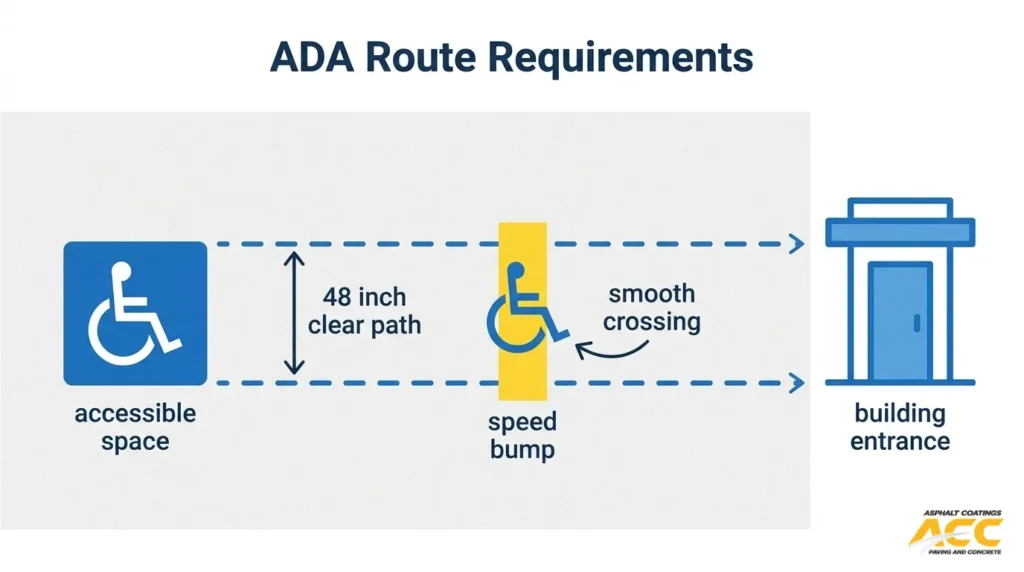
Accessible routes add a critical constraint. According to the U.S. Department of Justice, accessible parking spaces in lots or garages must be located on the shortest accessible route to the accessible entrance. Speed bumps cannot block or narrow these routes below required minimums. The U.S. Access Board specifies that pedestrian access routes require a continuous clear width of 48 inches minimum. Any speed bump placement near building entrances or crosswalks must preserve these clearances so wheelchairs, walkers, and other mobility devices can pass without obstruction.
How Should Speed Bumps Be Spaced Throughout a Parking Lot?
Speed bumps should be spaced throughout a parking lot at intervals that prevent vehicles from regaining unsafe speed between devices. According to the Virginia Department of Transportation’s Traffic Calming Guide, the spacing of vertical speed control devices should not exceed 500 feet between subsequent devices. For parking lots, where target speeds are 5 to 10 mph rather than 25 mph, tighter spacing is usually appropriate.
Speed reduction effects decline at roughly 0.5 to 1 mph for every 100 feet beyond the 200-foot approach and exit zone of a device, based on data from the Delaware Department of Transportation’s 2025 Traffic Calming Design Manual. This decay rate means that in a large commercial lot, placing bumps 150 to 300 feet apart maintains consistent low-speed behavior across the entire circulation path. Wider spacing risks creating acceleration zones where drivers speed up between bumps, defeating their purpose entirely.
How Should Visibility, Lighting, and Signage Be Planned Around Speed Bumps?
Visibility, lighting, and signage around speed bumps should be planned so drivers can detect each device with enough stopping distance at the posted lot speed, day or night. An unseen speed bump is a liability risk rather than a safety tool.
Key visibility planning elements include:
- Advance warning signs posted before the first speed bump in any series, as required by jurisdictions such as New Jersey, where state law mandates appropriate signs giving notice of speed humps and a pavement marker at the first device location.
- High-contrast striping or chevron markings painted directly on each bump to create visual contrast against the surrounding pavement.
- Dedicated lighting fixtures or reflective elements positioned so headlights or overhead lights illuminate each bump clearly in rain, snow, or low-light conditions.
According to the MUTCD 11th Edition (Section 2A.21), regulatory, warning, and guide signs must be retroreflective or illuminated to show the same shape and similar color by both day and night, with street or highway lighting alone not satisfying this requirement. Applying the same standard to private lot signage protects both pedestrians and the property owner’s legal position.
With visibility and placement addressed, choosing the right bump dimensions and materials determines how effectively these guidelines translate into actual speed reduction.
How Do Speed Bump Size, Shape, and Material Affect Driver Speed and Comfort?
Speed bump size, shape, and material affect driver speed and comfort by determining how aggressively the device forces deceleration and how much vehicle jolt occupants experience. The subsections below cover when higher profiles work best, when gradual designs improve comfort, and how asphalt compares to prefabricated alternatives.
When Is a Higher Speed Bump Profile Appropriate for a Parking Lot?
A higher speed bump profile is appropriate for a parking lot when maximum speed enforcement is the priority. Lots near schools, hospitals, daycare centers, and heavy pedestrian zones benefit from taller bumps (4 to 6 inches) because the steep rise makes speeds above 5 mph uncomfortable and physically difficult to maintain. Tight spaces where vehicles must stop shortly after the bump, such as near building entrances or loading docks, also justify aggressive profiles. However, a higher profile creates more vehicle jolting, increases noise, and can damage low-clearance vehicles. Property owners should pair tall bumps with clear signage and high-visibility markings so drivers anticipate the impact. For lots with frequent delivery trucks or emergency access needs, a lower or cushion-style alternative is typically more practical.
When Is a Lower or Gradual Speed Control Device Better for Driver Comfort?
A lower or gradual speed control device is better for driver comfort when the lot serves high traffic volumes, frequent commercial deliveries, or populations sensitive to sudden jolting. Speed humps with a 3-inch height spread across 12 feet of travel length produce far less cabin disruption than a compact 6-inch bump. Speed tables, with their flat-topped design, allow the full wheelbase to rest on the raised surface, virtually eliminating the rocking motion passengers feel over traditional bumps. These gradual profiles still reduce speeds effectively while minimizing complaints from tenants, customers, and fleet drivers. Office parks, medical campuses, and retail centers where repeat visitors expect a smoother driving experience are strong candidates. Choosing gradual devices is often the smartest investment for lots that need compliance without alienating the people who use them daily.
How Do Asphalt Speed Bumps Compare to Prefabricated Rubber or Plastic Options?
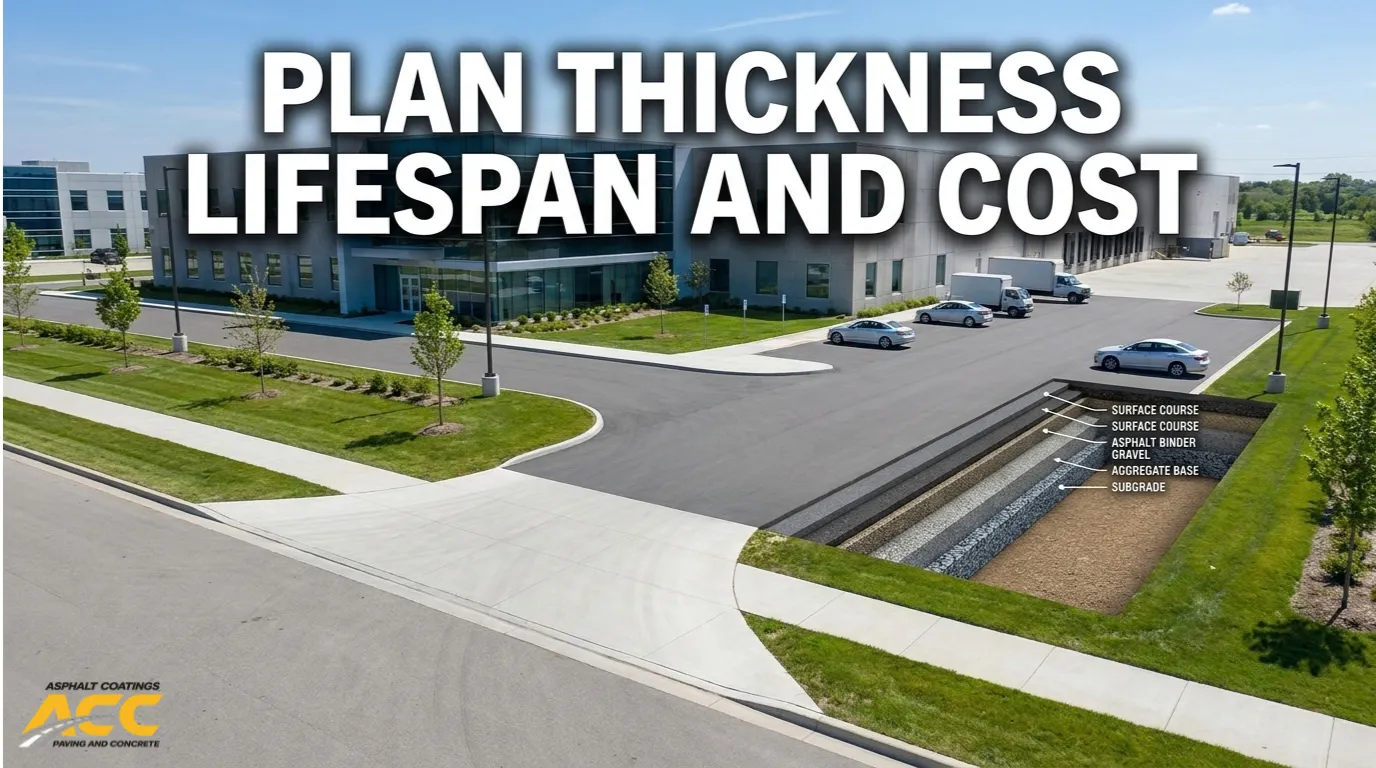
Asphalt speed bumps compare to prefabricated rubber or plastic options primarily in durability, cost, and maintenance requirements. According to a City of Los Angeles Department of Transportation report, asphalt and concrete humps can last up to 25 years, while rubber and plastic alternatives typically last no more than 10 years. Prefabricated units install faster and cost less upfront, but their shorter lifespan means more frequent replacement cycles. Rubber and plastic sections also shift or loosen under heavy commercial traffic, creating trip hazards. Asphalt bumps integrate directly into the pavement surface, resisting displacement and allowing seamless resealing alongside the surrounding lot. One additional consideration: motorized street sweeping equipment cannot operate over speed cushion installations, adding manual labor to routine maintenance. For property owners prioritizing long-term value and reduced upkeep, permanent asphalt construction consistently outperforms modular alternatives.
With size, shape, and material decisions made, proper marking and signage ensure drivers can see and react to speed bumps safely.
How Should Speed Bumps Be Marked, Painted, and Signed to Meet Best Practices?
Speed bumps should be marked, painted, and signed using high-contrast striping, advance warning signage, and visibility enhancements that ensure drivers detect them in all conditions. The subsections below cover pavement markings, required signage, and strategies for low-visibility situations.
What Striping and Pavement Markings Help Drivers See Speed Bumps in Time?
Striping and pavement markings that help drivers see speed bumps in time include alternating diagonal or chevron bars painted in high-contrast colors across the bump face. Yellow or white retroreflective paint applied in bold, evenly spaced stripes creates a visual pattern that stands out against dark asphalt. According to the FHWA’s MUTCD 11th Edition, Section 2A.21, regulatory and warning signs, along with object markers, must be retroreflective or illuminated to show the same shape and similar color by both day and night.
Pavement markings should extend to the full width of the speed bump, leaving no unmarked edges. Property owners who skip repainting after sealcoating or resurfacing create a serious hazard, since faded markings effectively make the bump invisible at approach speed.
What Signage Should Accompany Speed Bumps and Posted Speed Limits?
Signage that should accompany speed bumps and posted speed limits includes advance warning signs placed before the first bump and regulatory speed limit signs at each parking lot entrance. Warning signs typically display the W17-1 “SPEED BUMP” or “SPEED HUMP” symbol, positioned far enough upstream for drivers to react and decelerate. According to Oregon Administrative Rules, the maximum speed is ten miles per hour unless otherwise posted at a lower speed.
Regulatory speed limit signs should state the enforced limit clearly, such as 5 or 10 mph. Posting these signs at every entrance establishes legal enforceability and communicates expectations before a driver encounters the first bump. For lots with a series of bumps, repeating the warning sign before the initial bump in each sequence is a practical step many property owners overlook.
How Can Property Owners Improve Speed Bump Visibility in Snow, Rain, or Low Light?
Property owners can improve speed bump visibility in snow, rain, or low light by combining retroreflective materials, raised pavement markers, and dedicated lighting. Reflective tape or thermoplastic striping on the bump surface remains visible when standard paint washes out or gets buried under snow. Raised pavement markers (RPMs) installed on the approach side catch headlights and provide tactile feedback. According to the Georgia Department of Transportation Crash Safety Manual, private property crashes and their resulting injuries and deaths are not added to statewide traffic crash statistics, which means poor visibility on private lots can create serious incidents that go largely untracked.
Solar-powered LED delineator posts flanking each bump add another layer of protection during nighttime or heavy rain. For Colorado properties that face frequent freeze-thaw cycles, choosing durable marker materials rated for snowplow contact prevents costly seasonal replacements and keeps speed bumps consistently detectable year-round.
With markings and signage addressed, property owners should next understand how local regulations and ADA requirements shape their speed bump and speed limit decisions.
How Do Local Regulations and ADA Requirements Affect Speed Bump and Speed Limit Choices?
Local regulations and ADA requirements affect speed bump and speed limit choices by dictating allowable dimensions, placement restrictions, accessible route standards, and signage obligations. The subsections below cover how to check local codes, design for ADA compliance, and avoid legal risks from improper installation.
How Can Property Owners Check Local Codes Before Installing Speed Bumps?
Property owners can check local codes before installing speed bumps by contacting their municipal public works or traffic engineering department and reviewing applicable ordinances. Regulations vary significantly by jurisdiction. The City of Tucson, for example, prohibits speed bumps on local streets entirely, restricting them exclusively to shopping centers, apartment complexes, and other private properties. Some municipalities mandate specific dimensions, advance warning signage, and pavement markers before any installation can proceed.
Key steps for verifying local requirements include:
- Requesting the municipal traffic calming policy from the public works department.
- Reviewing zoning and site plan conditions that may restrict speed bump placement.
- Confirming whether the property falls under private road provisions that require state statute compliance.
- Checking fire department access requirements, since emergency vehicle clearance often influences allowable device types.
Starting with your local code review prevents costly rework and ensures the installation meets enforceable standards from the outset.
How Can Speed Bumps and Crosswalks Be Designed to Support ADA Compliance?
Speed bumps and crosswalks can be designed to support ADA compliance by preserving accessible routes, maintaining required clear widths, and ensuring detectable path continuity. According to the U.S. Department of Justice, accessible parking spaces must be located on the shortest accessible route to the accessible entrance, so speed bumps cannot obstruct or narrow that path.
Design considerations that support compliance include:
- Maintaining a minimum 36-inch clear width on exterior accessible routes, with allowable reduction to 32 inches only for segments no longer than 24 inches.
- Aligning crosswalk ramps and curb cuts so wheelchair users can traverse speed bump areas without abrupt grade changes.
- Using speed tables or flat-topped designs at pedestrian crossings, which provide smoother passage for mobility devices.
- Placing tactile warning strips and high-contrast markings at crosswalk transitions near speed control devices.
Overlooking accessible route geometry is one of the most common compliance failures in parking lot speed bump projects, and it creates exposure that is entirely preventable with proper planning.
How Can Improper Speed Bump Installation Increase Legal and Insurance Risks?
Improper speed bump installation can increase legal and insurance risks by creating conditions that cause vehicle damage, pedestrian injuries, or ADA violations, all of which expose property owners to negligence claims. According to the City of Claremont’s Administrative Policy Manual, traffic calming measures must use engineering design features and practices so as not to result in unacceptable liability exposure, requiring consultation with legal counsel when necessary.
Common installation errors that elevate risk include:
- Installing speed bumps without advance warning signage or pavement markers, leaving drivers unprepared.
- Exceeding recommended height or using non-standard profiles that damage vehicles or create trip hazards.
- Blocking accessible routes or fire lanes, which violates both ADA standards and local fire codes.
- Failing to maintain visibility markings, particularly in low-light or wet conditions.
Proactive documentation of design decisions, code compliance checks, and routine maintenance inspections strengthens the property owner’s defensible position if an incident occurs. Understanding these regulatory and accessibility requirements helps property owners maintain speed bumps that remain safe and compliant over time.
What Maintenance and Repair Considerations Apply to Parking Lot Speed Bumps?
Maintenance and repair considerations for parking lot speed bumps include routine inspections, timely crack sealing, and awareness of environmental damage. The following sections cover inspection schedules, repair triggers, and weather-related wear.
How Often Should Asphalt Speed Bumps Be Inspected and Resealed?
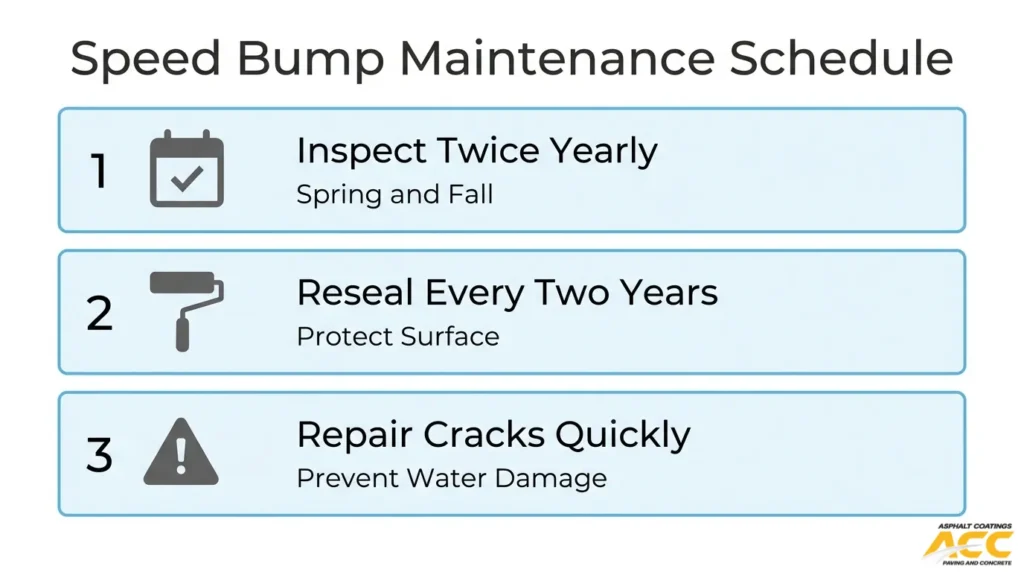
Asphalt speed bumps should be inspected at least twice per year, ideally in early spring and late fall. These seasonal checks catch surface cracking, edge deterioration, and sealant failure before minor issues escalate into structural problems.
Resealing frequency depends on traffic volume and sun exposure, but most asphalt speed bumps benefit from sealcoating every two to three years. Sealcoat protects the asphalt binder from UV degradation and moisture penetration, both of which shorten service life. Properties with heavier truck traffic or constant turning movements over speed bumps may need more frequent attention. In my experience, the property owners who schedule inspections alongside their broader parking lot maintenance program consistently avoid costly full rebuilds later.
When Should Damaged or Settled Speed Bumps Be Repaired or Rebuilt?
Damaged or settled speed bumps should be repaired or rebuilt when they no longer maintain their intended height profile or when visible cracking allows water infiltration. According to a 2018 Minnesota Department of Transportation report on pothole prevention, once cracks form and are not repaired, water infiltrates into the pavement surface layer and accelerates damage through mechanisms ranging from stripping to freeze-thaw cycles.
Key repair triggers include:
- Cracks wider than one-quarter inch across the bump surface.
- Settlement that reduces bump height below the designed profile.
- Loose or crumbling edges that create debris hazards.
- Ponding water on or around the bump after rain.
Prompt patching or overlay work can often restore a speed bump’s function without a complete rebuild, but significant base failure requires removal and reconstruction.
How Do Freeze–Thaw Cycles and Snow Plowing Affect Speed Bump Lifespan?
Freeze-thaw cycles and snow plowing affect speed bump lifespan by accelerating surface cracking, edge chipping, and base erosion. The City of Rockville’s Department of Public Works noted that repeated freeze-thaw cycles weaken pavement, prompting annual spring pothole inspections.
Snow plow blades catch speed bump edges, especially when bumps lack adequate taper or marking. Over several winters, this repeated impact gouges asphalt surfaces and exposes aggregate. Rubber speed bumps offer one alternative; the City of Burlington, Vermont, removes them during winter months to ensure normal plowing. For permanent asphalt speed bumps, proper height-to-taper ratios and reflective paint help plow operators adjust blade height. Properties in cold climates should budget for more frequent edge repair and plan post-winter inspections as a standard maintenance practice.
With a consistent maintenance schedule in place, professional asphalt services can extend speed bump performance across seasons.
How Should Property Owners Balance Driver Experience With Safety in Setting Speed Limits?
Property owners should balance driver experience with safety by combining posted speed limits with physical traffic calming devices, addressing complaints proactively, and measuring results over time. The following sections cover reducing complaints, pairing speed bumps with speed limits, and tracking effectiveness.
How Can Complaints From Tenants and Drivers About Speed Bumps Be Reduced?
Complaints from tenants and drivers about speed bumps can be reduced by choosing the right device profile, communicating the safety purpose, and involving stakeholders before installation. Several practical strategies help minimize friction:
- Select lower-profile speed tables or speed cushions for higher-traffic areas where a gentler transition improves comfort.
- Post clear signage well ahead of each device so drivers can slow gradually rather than brake abruptly.
- Notify tenants and regular users before installation, explaining the pedestrian safety rationale.
- Use temporary recycled rubber devices during a trial period to gather feedback and adjust placement before committing to permanent asphalt installations.
- Maintain bump surfaces so that settled or cracked profiles do not create jarring, uneven crossings.
Addressing concerns early turns speed control from a source of frustration into a visible commitment to safety that most building occupants will support.
How Can Speed Bumps and Speed Limits Work Together to Reduce Cut‑Through Traffic?
Speed bumps and speed limits work together to reduce cut-through traffic by creating layered deterrents: posted limits set the expectation, while physical devices enforce compliance. Drivers who use private lots as shortcuts to avoid congestion encounter enough friction to make the route unappealing.
According to a Federal Highway Administration report on rural traffic calming, speed reductions of 5 mph were typical, while total accidents were reduced by 50 percent and injury accidents by 25 percent or more. Temporary recycled rubber speed humps and speed tables allow property owners to test placements seasonally, which is especially useful for recreational areas or lots that experience cut-through traffic only during peak periods. Combining a clearly posted 10 or 15 mph limit with strategically spaced bumps creates a self-enforcing system that discourages non-tenant drivers without requiring constant patrol.
How Can Property Owners Measure Whether Speed Control Measures Are Working?
Property owners can measure whether speed control measures are working by tracking vehicle speeds, incident data, and user feedback before and after installation. Key evaluation methods include:
- Conducting spot speed studies with a radar gun or portable speed display sign to compare 85th-percentile speeds before and after device placement.
- Reviewing incident and near-miss reports from security staff or tenants over a defined period.
- Counting cut-through vehicle volumes at lot entrances during peak hours to detect traffic pattern changes.
- Documenting physical device condition during routine inspections to confirm ongoing compliance.
According to the City of Claremont’s traffic calming policy, traffic calming measures must use engineering design features that do not result in unacceptable liability exposure, with staff consulting attorneys and experts to verify acceptability. Regular data collection gives property owners documented evidence that their speed control investments are performing as intended and helps justify adjustments when they are not.
With measurable results in hand, property owners can confidently plan long-term lot improvements.
How Should Property Owners Plan a New Parking Lot Layout for Safe Speeds?
Property owners should plan a new parking lot layout for safe speeds by integrating geometric design elements that naturally slow vehicles, then adding speed bumps only where layout alone cannot achieve target speeds. The following subsections cover design-first strategies, lane and pedestrian route planning, and when retrofitting speed bumps becomes necessary.
How Can Parking Lot Design Reduce the Need for Excessive Speed Bumps?
Parking lot design can reduce the need for excessive speed bumps by using geometric features that make high speeds physically uncomfortable or impractical. Curved drive aisles, tight turning radii, and offset intersections force drivers to decelerate without relying on raised devices. Narrower lane widths create a visual compression effect that discourages speeding, while strategically placed landscaped islands break up long straightaways where vehicles tend to accelerate.
This design-first approach is often more cost-effective over the life of a parking lot because it reduces the number of physical devices that require maintenance, repainting, and eventual replacement. When the layout itself enforces slower movement, speed bumps serve as reinforcement at specific high-risk points rather than the primary speed control strategy.
How Should Lanes, Parking Angles, and Pedestrian Routes Be Planned for Slower Speeds?
Lanes, parking angles, and pedestrian routes should be planned for slower speeds by aligning each element to limit sight lines, create natural friction points, and separate vehicle and foot traffic. Angled parking stalls between 45 and 60 degrees require drivers to slow for tighter turns into spaces, while perpendicular 90-degree layouts work well in lower-traffic areas where aisle width can be kept narrower. According to NHTSA research citing Stutts and Hunter (1999) and Thomas and Levitt (2014), parking lot and driveway-related crashes represented up to 15% to 25% or more of all reported pedestrian crashes, which underscores why pedestrian route separation matters.
Key planning considerations include:
- Setting a 15 MPH target for main parking lot lanes and connector lanes.
- Maintaining pedestrian access routes at 48 inches minimum clear width, with passing spaces every 200 feet where routes are narrower than 60 inches.
- Placing designated crosswalks at high-volume pedestrian crossing points with clear sight triangles.
- Using raised medians or curbed islands to physically separate walkways from drive aisles.
Dedicating space to pedestrian infrastructure during the design phase is far easier than retrofitting it later, and it directly reduces the conflict points where speed bumps would otherwise be needed.
When Should Speed Bumps Be Added to an Existing Parking Lot Design?
Speed bumps should be added to an existing parking lot design when observed driver behavior consistently exceeds the posted speed limit despite signage and layout cues. Common triggers include near-miss incidents, pedestrian complaints, and measured vehicle speeds that surpass the lot’s intended limit. In one documented case from City of Solon, Ohio planning commission minutes, a property with a 5 MPH speed limit added speed bumps in 2007 as an additional deterrent after drivers continued to travel too fast.
Before installing, property owners should document the problem areas, measure actual vehicle speeds, and consult with a paving contractor to determine optimal bump placement that does not interfere with drainage, snow plowing, or ADA-accessible routes. For property owners weighing layout upgrades alongside speed control devices, professional asphalt services can evaluate both options together.
How Should You Approach Parking Lot Speed Bumps and Speed Limits With Professional Asphalt Services?
You should approach parking lot speed bumps and speed limits with professional asphalt services by combining traffic engineering expertise with proper construction and striping. The following sections cover how construction services optimize placement and the key takeaways property owners should remember.
How Can Parking Lot Construction and Striping Services Help Optimize Speed Bump Placement and Speed Limits?
Parking lot construction and striping services help optimize speed bump placement and speed limits by integrating traffic calming into the overall lot design from the start. Professional contractors evaluate lot geometry, traffic flow patterns, and grade conditions before positioning any speed control device. According to a 2006 Connecticut Office of Legislative Research report, the maximum comfortable speed for crossing a speed bump is about five miles per hour, making speed bumps appropriate primarily for parking lots, private roads, and low-speed residential streets.
This constraint means placement must account for approach angles, sight lines, and proximity to pedestrian crossings. Speed reducers should never be installed at points with severe horizontal or vertical curvature, or on grades exceeding 8%. Striping services reinforce these devices with high-visibility pavement markings that guide drivers before they reach each bump. When construction and striping work together, the result is a cohesive system where posted speed limits, physical devices, and visual cues all reinforce the same safe driving behavior.
What Are the Key Takeaways About Parking Lot Speed Bumps and Speed Limits Property Owners Should Remember?
The key takeaways about parking lot speed bumps and speed limits property owners should remember are:
- Speed bumps are most effective in parking lots where target speeds are 5 mph, while speed humps suit roads with limits up to 25 mph.
- Most parking areas follow a 10 to 15 mph posted speed limit, consistent with federal park area regulations that set 15 mph for parking areas, school zones, and places of public assembly.
- Proper placement requires professional site evaluation to avoid critical geometry points and ensure ADA-accessible routes remain unobstructed.
- Striping, signage, and lighting must accompany every speed control device to maximize visibility and reduce liability.
- Regular inspection and maintenance prevent deterioration that undermines both safety and compliance.
According to the 2014 Kentucky Traffic Collision Facts, injuries on parking lots and private property rose 24.1% year over year, underscoring why proactive speed control remains essential. Property owners who invest in professionally designed and installed speed management systems protect pedestrians, reduce legal exposure, and preserve long-term pavement integrity.
Asphalt Coatings Company specializes in parking lot construction, striping, and ADA-compliant concrete work, providing the integrated approach property owners need to get speed bumps and posted limits right from the ground up.