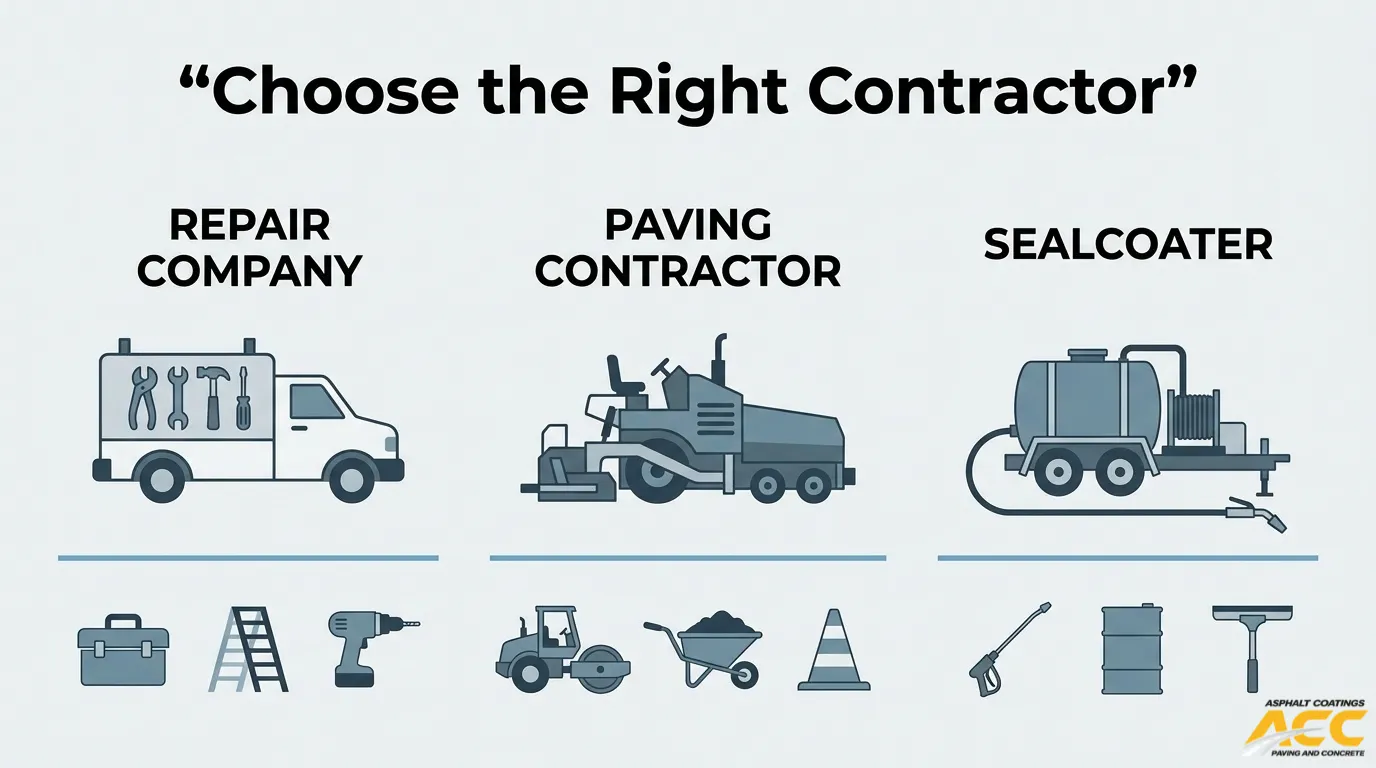
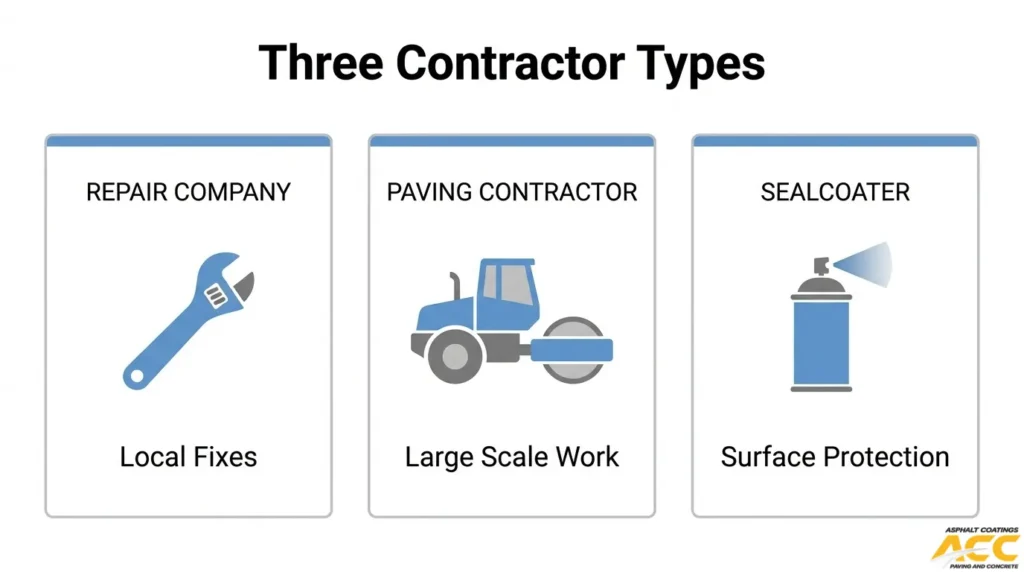
A parking lot repair company, a paving contractor, and a sealcoater are three distinct contractor types, each built to solve a different category of asphalt damage. Calling the wrong one wastes budget and leaves the actual problem unresolved.
This guide covers contractor distinctions and licensing, problem-to-contractor matching, when to call each specialist, crack and joint repair ownership, concrete and ADA compliance work, striping and markings, climate and traffic considerations, contractor vetting, lifecycle phasing, and working with a full-service provider.
Parking lot repair companies, paving contractors, and sealcoaters differ in scope, equipment, and licensing classifications. States like Arizona and Idaho issue separate license categories for surface sealing versus structural paving, and hiring a contractor without the correct classification can void warranties and create liability.
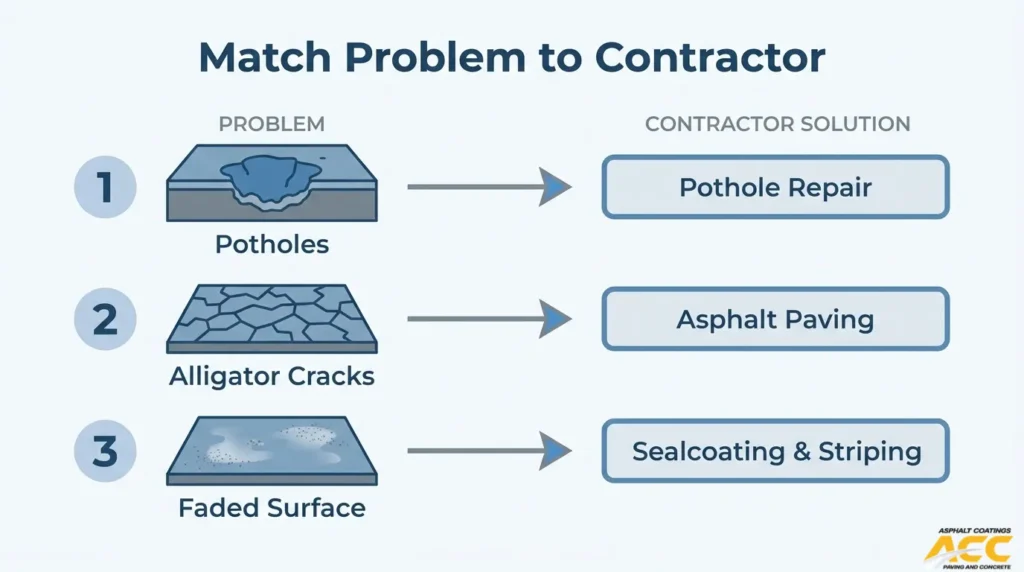
Matching visible distress to the right contractor prevents repeat failures. Potholes and alligator cracking that penetrate the base demand a paving contractor for milling, overlay, or reconstruction. Localized failures in otherwise sound pavement call for a repair-focused crew that can saw-cut and patch without full mobilization. Surface oxidation, fading, and hairline cracks on structurally intact asphalt are sealcoater territory, where a protective emulsion layer blocks moisture and UV degradation.
Crack sealing, concrete curb repairs, and ADA ramp work each require contractors with specific equipment and regulatory knowledge. Routed crack sealing involves up to five treatment steps; ADA-compliant ramps must meet precise slope ratios and surface standards under federal law.
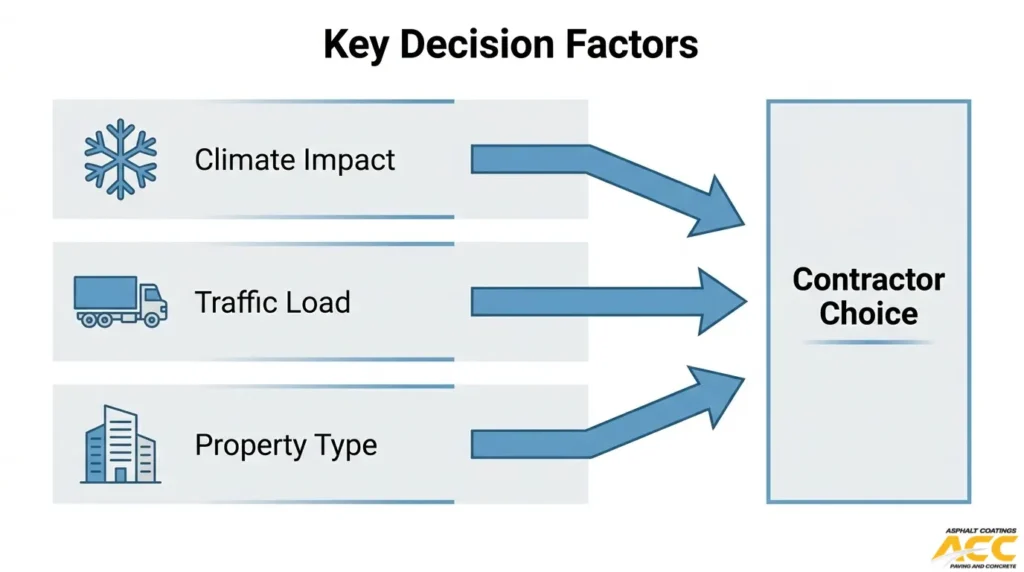
Climate, traffic loads, and property type shift the balance between preventive maintenance and structural work. Freeze-thaw cycling shortens treatment life, heavy truck zones need thicker pavement sections, and operating hours dictate whether repairs happen in overnight windows or full closures.
Phasing crack sealing, patching, sealcoating, and paving across budget cycles protects both pavement condition and capital reserves over the long term.
How Do Parking Lot Repair Companies, Paving Contractors, and Sealcoaters Differ?
Parking lot repair companies, paving contractors, and sealcoaters differ in scope, equipment, and the types of pavement problems they solve. The following sections break down what each contractor handles, where their specialties diverge, and how licensing requirements vary.
What does a parking lot repair company typically handle that the others do not?
A parking lot repair company typically handles localized distress corrections that do not require full-surface removal or new construction. This includes pothole patching, skin patches, small base repairs, speed bump installation, and minor concrete fixes like bollard replacements or catch basin adjustments.
What sets repair companies apart is their ability to mobilize quickly for targeted work without the heavy equipment a paving contractor brings. However, choosing a contractor solely on bid price without accounting for total project logistics can backfire. According to the City of New Orleans Office of Inspector General, the City awarded a contract that was $130,900 below the next bid, only to discover approximately $201,837 in hidden labor, transportation, and fuel costs. Repair scope demands careful alignment between the bid and the actual work required.
What does a paving contractor specialize in compared to a general repair company?
A paving contractor specializes in large-scale asphalt installation, milling and overlay, full-depth reconstruction, subgrade preparation, and grading. These projects require heavy equipment, such as pavers, rollers, and milling machines, that repair-focused companies typically do not own.
Paving contractors also handle new construction, lot expansions, and drainage corrections that involve regrading the entire surface. When evaluating any contractor for this scale of work, the Iowa Attorney General advises caution: be wary of unclear material descriptions that omit brand, grade, specifications, or quantities. For property managers, the distinction is straightforward. If the work involves removing and replacing asphalt across large areas or building new pavement, a paving contractor is the correct call.
What does a sealcoating contractor focus on versus paving and repair companies?
A sealcoating contractor focuses on preventive surface protection rather than structural repair or new installation. Sealcoating applies a thin, protective emulsion layer over sound asphalt to slow oxidation, resist water penetration, and restore a uniform black appearance.
This work requires spray rigs or squeegee applicators, edge tools, and blowers, not the heavy milling machines or compaction rollers that paving contractors use. Sealcoaters may also handle crack filling and parking lot striping as part of a maintenance package. The critical distinction is that sealcoating preserves pavement that is still structurally intact. It cannot fix potholes, correct drainage problems, or restore a failed base. Property managers who confuse surface preservation with structural repair risk wasting budget on a treatment the pavement has already outgrown.
How do licensing, equipment, and crew skills differ between each type of contractor?
Licensing, equipment, and crew skills differ significantly between each type of contractor, and these differences directly affect the quality and legality of the work performed.
- Licensing: States often issue separate license classifications. Arizona, for example, separates A-15 Seal Coating (surface coatings and crack repair) from R-13 Asphalt Paving (installation, repair, curbs, and striping). Idaho defines code 02785 as a specialty classification for asphalt maintenance, sealcoating, crack sealing, and chip sealing. Hiring a contractor without the correct classification can void warranties and create liability.
- Equipment: Paving contractors operate pavers, milling machines, and heavy rollers. Repair companies use infrared heaters, saw-cutting tools, and compact rollers. Sealcoaters rely on spray systems, squeegees, and crack-fill kettles.
- Crew skills: Paving crews manage grading, compaction density, and drainage engineering. Repair crews specialize in distress diagnosis and localized patching techniques. Sealcoating crews focus on surface preparation, application rates, and curing conditions.
According to the Washington State Department of Labor and Industries, property managers should get at least three written bids and compare them carefully while checking references. Verifying that each bidder holds the correct license for the specific work ensures the crew, equipment, and expertise match the job.
Understanding these contractor distinctions helps property managers match each parking lot problem to the right specialist, a topic the next section explores in detail.
What Common Parking Lot Problems Do Property Managers Need to Match With the Right Contractor?
Common parking lot problems range from surface distress and structural failure to cosmetic wear and safety violations. Each category demands a different contractor specialty, covered below.
What Surface Problems Like Potholes, Alligator Cracking, and Raveling Require Different Types of Contractors?
Surface problems like potholes, alligator cracking, and raveling require different contractor types based on failure depth and progression. According to the Transportation Research Board’s NCHRP pavement distress research, alligator cracking may progress to localized failures and potholes, which are bowl-shaped holes through one or more layers of the asphalt pavement structure, between about 6 inches and 3 feet in diameter.
Each surface distress points to a specific contractor:
- Potholes require a repair company for patching or a paving contractor if damage is widespread.
- Alligator cracking signals base-level failure, often demanding a paving contractor for full-depth repair.
- Raveling and surface unraveling in early stages can be slowed by a sealcoater, but advanced raveling alongside cracking needs structural intervention.
Matching the visible distress to the right scope of work prevents paying for repairs that do not address the root cause.
What Structural Problems Like Base Failure and Drainage Issues Call for a Paving Contractor Instead of a Sealcoater?
Structural problems like base failure and drainage issues call for a paving contractor because these conditions exist below the asphalt surface, beyond a sealcoater’s scope. Base failure involves compromised aggregate or subgrade layers that no surface treatment can restore. Poor drainage causes water to infiltrate and weaken the foundation, accelerating deterioration from within.
A paving contractor addresses structural problems through:
- Full-depth patching or reconstruction of failed base sections.
- Regrading and slope correction to redirect water flow.
- Subgrade stabilization before new asphalt placement.
- Storm drain integration and curb adjustments.
Sealcoating over a failed base wastes money. If water pools or the surface flexes under load, the problem is structural and requires excavation, not coating.
What Cosmetic or Early-Stage Problems Like Fading, Minor Oxidation, and Hairline Cracks Can a Sealcoater Address?
Cosmetic or early-stage problems like fading, minor oxidation, and hairline cracks can be addressed by a sealcoater. These issues affect only the top surface layer, where UV exposure and weathering strip binder oils and leave asphalt gray and brittle. A sealcoat restores a dark, uniform appearance while sealing fine surface voids against moisture penetration.
A sealcoater is the right call for:
- Color fading from sun and weather exposure.
- Surface oxidation that has not yet produced structural cracks.
- Hairline cracks too narrow for hot-pour sealant.
- General aesthetic improvement before restriping.
Once cracks widen beyond hairline stage or the surface shows interconnected patterns, the problem has moved past what sealcoating can fix. Timing sealcoat application while distress is still cosmetic is one of the most cost-effective decisions a property manager can make.
How Do Safety and Compliance Problems Like Trip Hazards and ADA Issues Affect Which Contractor You Choose?
Safety and compliance problems like trip hazards and ADA issues affect contractor choice by requiring specific technical capabilities and regulatory knowledge. Trip hazards from heaved slabs, sunken panels, or crumbled curb edges may need a concrete flatwork contractor, a paving contractor, or both, depending on whether the failure is in asphalt or concrete.
ADA compliance adds another layer. Accessible parking spaces, access aisles, curb ramps, and slopes must meet precise dimensional and grade requirements. Contractors working on these areas need experience with ADA standards, not just surface repair skills.
Key factors that determine the right contractor include:
- Whether the trip hazard originates in asphalt or concrete.
- Whether slope corrections or curb ramp reconstruction are involved.
- Whether the project requires lump sum or unit price bidding based on scope uncertainty.
As noted by Carnegie Mellon University’s construction pricing research, unit price bidding suits projects where labor or material quantities are particularly uncertain, which is common with compliance remediation work.
Identifying whether your lot’s issues are surface, structural, cosmetic, or compliance-driven sets the stage for understanding when each contractor type is the right call.
When Should You Call a Paving Contractor for Parking Lot Problems?
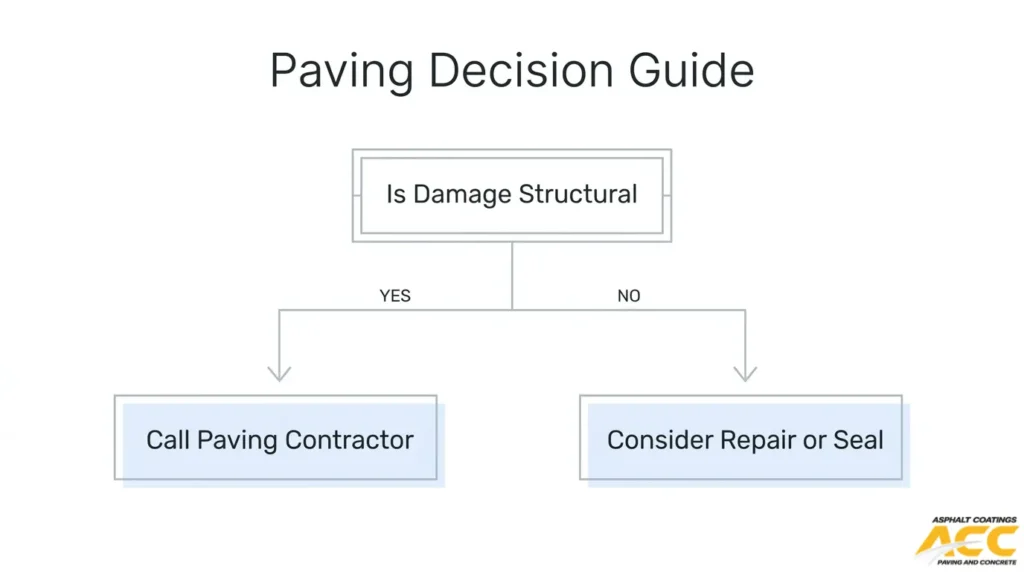
You should call a paving contractor when damage extends beyond the surface into the structural layers of your parking lot. The following scenarios cover when milling, reconstruction, drainage correction, or new construction requires a full-service paving crew.
When do widespread potholes and deep structural damage mean you need milling and repaving?
Widespread potholes and deep structural damage mean you need milling and repaving when isolated patches can no longer keep pace with recurring failures. A few scattered potholes can be addressed individually, but once damage covers large, connected areas, the underlying asphalt mat has likely deteriorated past the point of spot fixes. According to the University of Houston Campus Design Guidelines, maintenance of existing asphalt lots is predominantly crack repair, sealcoating, localized patches, and a mid-life asphalt overlay. When your lot has moved beyond that localized patch stage, milling the failed surface and repaving with fresh hot-mix asphalt is the cost-effective next step.
When do severe alligator cracks indicate the asphalt base has failed and needs reconstruction?
Severe alligator cracks indicate the asphalt base has failed and needs reconstruction when the interconnected crack pattern spans large sections rather than isolated spots. Alligator cracking signals that the sub-base can no longer support traffic loads; sealing or overlaying these areas without addressing the foundation will only delay the same failure. Base repair costs reflect this severity. The City of Wichita Falls 2025 Asphalt Rehabilitation Project bid tabulation listed 6-inch base repair at $125.00 per square yard and 10-inch base repair at $105.00 per square yard, alongside Type D hot-mix asphalt at $142.50 per ton. These unit prices underscore why accurate diagnosis matters before committing to a scope of work.
When is it better to reconstruct sections of a parking lot instead of repeatedly patching them?
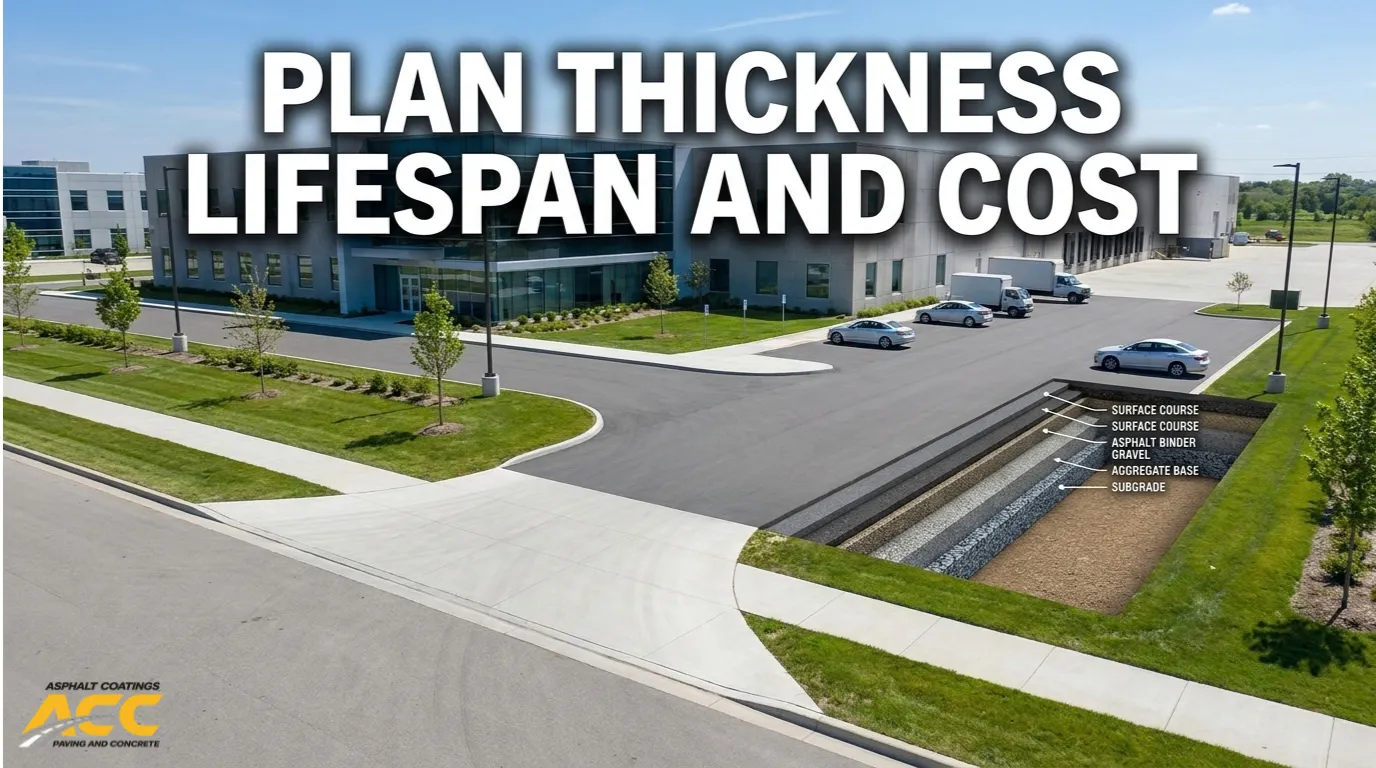
Reconstruction becomes the better choice when patching the same areas more than two or three times within a few years. Repeated patches in the same location indicate the base material, drainage, or subgrade has failed permanently. Each patch cycle costs money without solving the root cause, and the cumulative spending often exceeds what a one-time sectional reconstruction would have cost. For property managers tracking maintenance budgets, this tipping point is the clearest signal to shift from a repair contractor to a paving contractor who can excavate, rebuild the base, and install a full-depth asphalt section designed to last.
When should you call a paving contractor to fix grading, drainage, and ponding water issues?
You should call a paving contractor to fix grading, drainage, and ponding water issues when standing water persists more than 48 hours after rain. Ponding water accelerates asphalt deterioration by saturating the base and softening subgrade soils. Correcting poor drainage requires regrading the parking lot surface, installing or rerouting catch basins, and sometimes rebuilding low spots with new asphalt at proper slope. These tasks demand heavy equipment, surveying capability, and paving expertise that surface-level repair crews and sealcoaters do not carry. Addressing drainage problems early prevents the far more expensive base failures that follow prolonged water infiltration.
When do new construction, expansions, or layout changes require a full-service paving contractor?
New construction, expansions, or layout changes require a full-service paving contractor when the scope involves subgrade preparation, base installation, fresh asphalt placement, or reconfigured traffic flow. Adding parking stalls, extending drive aisles, or redesigning entrances all demand engineering-level grading and compaction that repair-focused contractors are not equipped to deliver. Non-compliant paving work can result in mandatory removal and replacement, as documented in a New Jersey Department of Transportation case where a contractor was directed to remove and replace pavement across five lane stations for failing to meet contract specifications. Proper paving from the start avoids costly rework.
With structural paving needs identified, smaller localized issues may call for a different type of contractor entirely.
When Should You Call a Parking Lot Repair Company Instead of a Paving Contractor?
You should call a parking lot repair company instead of a paving contractor when damage is localized, the surrounding pavement is structurally sound, and the scope does not justify full-area mobilization. The following sub-sections cover potholes, base repairs, minor installations, and budget-driven decisions.
When are localized potholes and small failed areas best handled by a repair-focused contractor?
Localized potholes and small failed areas are best handled by a repair-focused contractor when the damage is isolated and the rest of the lot remains structurally intact. According to the Minnesota Department of Transportation’s Maintenance Manual, potholes are localized, generally small pavement failure areas of partial or full depth caused by traffic loadings and freeze-thaw action. A repair company can saw-cut the damaged section, remove compromised material, and place a partial-depth or full-depth patch without disrupting the entire lot. Mobilizing a full paving crew for scattered failures of this size wastes money and creates unnecessary downtime. If failures cluster across more than roughly 25% of the surface, the problem shifts from repair territory into repaving territory.
When do localized base repairs and skin patches make more sense than full-area paving?
Localized base repairs and skin patches make more sense than full-area paving when only a few sections show subgrade failure while adjacent areas perform well. Skin patches address surface-level deterioration; base repairs excavate deeper to replace compromised aggregate before repaving the cut. Choosing the wrong scope has real financial consequences. A City of Fort Worth internal audit found that misaligned bid items resulted in the city paying approximately $403,000 more than it would have under the second-lowest bidder’s contract. Matching the repair method precisely to the distress type, rather than over-scoping or under-scoping, prevents this kind of waste. Patched areas must also maintain ADA-compliant surfaces that are firm, stable, and slip-resistant.
When should you rely on a repair company for speed bumps, bollards, and minor concrete fixes?
You should rely on a repair company for speed bumps, bollards, and minor concrete fixes when these items are standalone tasks unconnected to larger paving work. Installing a speed bump, replacing a damaged bollard, or repairing a small concrete pad at a dumpster enclosure does not require heavy milling equipment or a paving train. Repair-focused crews carry the right tools for these smaller installations and can typically complete them in a single day. Bundling minor concrete and asphalt fixes under one repair contractor also simplifies scheduling and reduces the number of vendor relationships a property manager must coordinate.
When are budget or operational constraints a reason to choose targeted repairs over paving?
Budget or operational constraints are a valid reason to choose targeted repairs over paving when the lot cannot be taken offline for multi-day construction or capital funds are limited. Targeted patching and localized base repairs allow property managers to address the highest-priority failures first, then schedule remaining work across future budget cycles. Retail centers, healthcare facilities, and apartment complexes often cannot close large sections simultaneously without losing revenue or restricting tenant access. Phasing repairs strategically preserves safety and extends usable pavement life until a full repaving project becomes financially feasible.
Understanding when repairs are enough, and when they are not, helps property managers avoid both overspending and underinvesting in their parking lots.
When Should You Call a Sealcoater for Your Parking Lot?
You should call a sealcoater when your parking lot asphalt is structurally sound but needs protection from weathering and oxidation. The following subsections cover when sealcoating fits, when damage has gone too far, ideal reapplication frequency, and which issues a seal coat can realistically address.
When is sealcoating the right choice for preventive maintenance on a sound parking lot?
Sealcoating is the right choice for preventive maintenance on a sound parking lot when the asphalt surface shows early signs of oxidation, minor color fading, or light surface wear but has no structural distress. According to the City of St. Charles, Missouri, Public Parking Lot Maintenance 2025 work packages, crack sealing, sealcoating, and re-striping were grouped as a single preventive scope for lots that did not require overlay or reconstruction.
A lot with a stable base, intact drainage, and only cosmetic aging is the ideal candidate. Applying sealcoat before damage progresses locks in the pavement’s flexibility and keeps water from penetrating the surface layer.
When is your asphalt “too far gone” for sealcoating to be effective?
Your asphalt is too far gone for sealcoating to be effective when structural failures, such as alligator cracking, deep potholes, base settlement, or widespread raveling, are present. Sealcoat creates a waterproof, protective coating that can increase the life of pavement and improve appearance, but it does not restore ride quality or structural integrity, according to the City of Littleton’s Street Maintenance Definitions and Costs.
Because a seal coat’s life expectancy is only three to five years, applying it over failing pavement wastes money. If more than about 25 percent of the surface shows interconnected cracking or if water is pooling due to subgrade issues, those areas need patching or repaving first. Sealcoating should follow structural repair, never replace it.
How often should commercial parking lots be sealcoated in harsher climates?
Commercial parking lots in harsher climates should be sealcoated every two to three years. Freeze-thaw cycling, road salt exposure, and intense UV at higher elevations accelerate oxidation and surface brittleness faster than milder environments allow.
Lots exposed to heavy winter deicing or extreme temperature swings may see a standard seal coat degrade well before the typical three-to-five-year window. High-traffic entrances and drive lanes often need attention sooner than lightly used perimeter spaces. Scheduling a professional assessment each spring helps property managers identify which zones justify early recoating versus which can wait another cycle. For most commercial properties in demanding climates, a consistent two-to-three-year schedule keeps costs predictable and prevents the compounding damage that leads to expensive structural repairs.
What appearance and performance issues can sealcoating realistically improve?
The appearance and performance issues sealcoating can realistically improve include faded color, minor surface oxidation, light raveling, and reduced water resistance. A fresh seal coat restores the uniform dark finish that property managers and tenants associate with a well-maintained lot.
Functionally, the coating seals hairline surface cracks and slows UV-driven binder breakdown, which helps prevent those small cracks from widening into water-entry points. It also makes oil and chemical spills easier to clean because the sealed surface is less porous. Sealcoating does not fix rutting, deep cracking, drainage problems, or base failures. For most commercial properties, scheduling sealcoat applications before visible damage escalates is one of the simplest ways to defer major capital expenses.
Understanding when sealcoating applies helps clarify when a different specialist, such as a crack sealing contractor, is the better call.
Who Should Handle Crack Sealing, Routing, and Joint Repairs?
Crack sealing, routing, and joint repairs require contractors with specialized equipment and knowledge of multi-step treatment processes. The right choice depends on whether cracks are active but superficial, need routing for lasting adhesion, or involve concrete-to-asphalt transitions.
When is crack sealing alone the right fix for active but non-structural cracks?
Crack sealing alone is the right fix when cracks are active (moving seasonally with temperature changes) but have not compromised the underlying pavement structure. These are typically longitudinal or transverse cracks narrower than about three-quarters of an inch, where the base material remains intact. A sealcoating contractor or asphalt maintenance specialist can handle this work using hot-poured rubberized sealant applied with a pressure-fed wand. Municipalities regularly bid standalone crack sealing projects to specialty firms; the Town of Barrington, New Hampshire, issued a dedicated 2025 Request for Proposal specifically for crack sealing as a standalone scope.
When should cracks be routed and sealed instead of just filled on the surface?
Cracks should be routed and sealed instead of just filled when they are wide enough, deep enough, or active enough that surface-applied sealant will not bond properly or last through freeze-thaw cycles. According to the Federal Highway Administration’s Manual of Practice for Asphalt Concrete Crack Sealing and Filling, crack treatment involves up to five steps: crack cutting (routing or sawing), cleaning and drying, material preparation and application, finishing, and blotting. Routing creates a uniform reservoir that holds more sealant and improves adhesion. This step requires specialized routing equipment that a general sealcoater may not carry, making an experienced asphalt maintenance contractor or dedicated crack sealing firm the better choice for routed applications.
Who should repair expansion joints, concrete joints, and transitions between asphalt and concrete?
Expansion joints, concrete joints, and asphalt-to-concrete transitions should be repaired by a contractor licensed for both asphalt paving and concrete work. These repairs span two materials with different thermal movement rates, so the contractor must understand joint design, flexible sealant selection, and milling techniques at transition points. Arizona’s contractor licensing system illustrates the distinction: an A-15 Seal Coating license covers surface crack repair, while an R-13 Asphalt Paving license covers paved areas including concrete bumper curbs and headers. Joint deterioration accelerates under deicing chemicals and heavy vehicle loads, as documented by the Iowa State University Institute for Transportation. For parking lots with multiple material transitions, a full-service paving contractor with concrete capabilities reduces coordination risk and ensures joint integrity across the entire surface.
How do you decide between a crack sealing specialist and a full paving contractor?
You decide between a crack sealing specialist and a full paving contractor based on whether the cracking is partial-depth or full-depth. Partial-depth cracking extends through only a portion of the pavement and responds well to sealing or routing treatments performed by a specialty maintenance contractor. Full-depth cracking penetrates the entire pavement structure and typically requires partial-depth or full-depth patching, which falls within a paving contractor’s scope. Idaho’s public works licensing code classifies “Asphalt Maintenance and Repair, Seal Coating, Crack Sealing and Chip Sealing” (category 02785) as a distinct specialty contractor designation. If your lot shows isolated surface cracks, a specialist keeps costs lower. If cracks signal structural failure beneath, a paving contractor is necessary.
Understanding which contractor handles crack and joint work correctly positions you to evaluate the broader concrete repairs covered next.
Who Should You Call for Concrete Curbs, Sidewalks, and ADA Ramp Repairs?
You should call a concrete flatwork contractor for curbs, sidewalks, and ADA ramp repairs. The following subsections cover when flatwork specialists are needed, who handles ADA-specific work, how to distinguish concrete issues from asphalt issues, and when to coordinate both trades under one contractor.
When should a concrete flatwork contractor handle sidewalks, curbs, and gutters around the lot?
A concrete flatwork contractor should handle sidewalks, curbs, and gutters around the lot when the work involves formed and finished concrete rather than asphalt surfaces. Curb-and-gutter systems, sidewalk panels, and concrete headers require specialty forming, reinforcement placement, and curing processes that fall outside a typical asphalt crew’s equipment and expertise.
Proactive concrete maintenance also delivers significant cost savings. According to Federal Highway Administration pavement preservation benchmarking, MDOT’s preventive maintenance program generated average savings of nearly $310,000 per lane-mile for flexible pavements while extending service life by approximately 16 years. The same preservation logic applies to concrete lot perimeters: addressing spalling curbs and cracked sidewalk panels early prevents water infiltration that undermines the adjacent asphalt base.
Who should repair or replace ADA ramps, landings, and accessible walkways?
ADA ramps, landings, and accessible walkways should be repaired or replaced by a contractor experienced in ADA-compliant concrete construction. These elements must meet precise slope, width, and surface requirements that general asphalt crews are not equipped to verify or execute.
Key compliance standards include:
- Curb ramp slopes must not exceed a ratio of 1:12.
- Level changes above 1/2 inch require ramp treatment.
- Surfaces must be firm, stable, and slip-resistant.
Federal regulations under 28 CFR 35.133 require public entities to maintain accessible features in operable working condition at all times. Failing to use a qualified concrete contractor for these repairs risks non-compliance and potential liability, making this one area where specialized expertise is non-negotiable.
When are trip hazards in sidewalks or curb edges a concrete issue versus an asphalt issue?
Trip hazards in sidewalks or curb edges are a concrete issue when the displacement occurs in formed concrete panels, such as heaved joints, spalled edges, or settled slabs. They become an asphalt issue when the raised or depressed surface involves asphalt overlay, patching, or the asphalt-to-concrete transition zone.
The distinction matters because each material requires different repair methods. Concrete trip hazards typically need panel replacement, grinding, or mud-jacking. Asphalt trip hazards at transitions may call for milling and re-feathering the asphalt edge. Misidentifying the material leads to callbacks and wasted spending. When in doubt, a contractor experienced with both materials can assess the failure origin and recommend the correct scope.
When should you coordinate concrete repairs with asphalt work under a single contractor?
You should coordinate concrete repairs with asphalt work under a single contractor when the project involves adjacent surfaces that share drainage paths, transitions, or ADA-accessible routes. Separating these scopes between two unrelated crews often creates scheduling conflicts, mismatched grades at transition joints, and gaps in warranty coverage.
According to Idaho Administrative Code IDAPA 24.39.50, specialty license classifications distinguish between asphalt paving and concrete work, yet contractors holding both classifications can manage the full scope. Look for a minimum two-year warranty covering both materials and labor. Be cautious of contractors who pressure you to sign before comparing options, request most payment upfront, or provide vague material descriptions without brand or grade specifications.
Working with a single full-service contractor streamlines accountability and ensures that concrete curb elevations, ADA ramp slopes, and asphalt surface grades align correctly across the entire lot.
Who Should Repaint Lines, ADA Markings, and Traffic Symbols in Your Parking Lot?
The right contractor for striping and ADA markings depends on the scope of the project. A standalone refresh calls for a striping specialist, while layout changes or post-paving work often require a full-service contractor.
When should you hire a striping contractor versus a full-service paving or repair company?
You should hire a striping contractor when the existing pavement is in good condition and only needs fresh paint or thermoplastic markings over the current layout. A dedicated striping crew offers fast turnaround and lower mobilization costs for routine re-striping. However, when line repainting follows structural repairs, patching, or sealcoating, a full-service paving or repair company that includes striping in the same scope of work ensures proper sequencing. Bundling prevents scheduling gaps that leave a lot unmarked and unusable. In most cases, separating striping from major surface work creates unnecessary coordination headaches and potential liability exposure during the gap between services.
Who should update or move ADA stalls, access aisles, and signage when layouts change?
A contractor experienced in ADA-compliant parking design should update or move ADA stalls, access aisles, and signage whenever layouts change. According to the U.S. Department of Justice, car accessible spaces must be at least 96 inches wide with an access aisle at least 60 inches wide and a maximum slope of 2.08% in all directions. Relocating these elements often involves regrading the surface to meet slope tolerances, installing new signage at correct heights, and verifying that the accessible route connects to building entrances without gaps. This work typically exceeds what a paint-only striping crew can deliver, making a full-service paving and concrete contractor the safer choice for compliance.
When is it best to schedule striping and ADA markings immediately after paving or sealcoating?
Striping and ADA markings are best scheduled immediately after paving or sealcoating, once the surface has fully cured. Fresh sealcoat needs 24 to 48 hours of dry weather before striping paint will adhere properly; new hot-mix asphalt typically requires a similar cure window. Scheduling striping as the final step in the same project mobilization eliminates return trips and keeps the lot closed for the shortest possible time. Delaying striping after a resurface or sealcoat leaves the lot without visible traffic flow, ADA markings, or fire lane designations, which creates both liability risk and code violations. For property managers juggling tenant access, coordinating all surface work and markings under one contractor simplifies communication considerably.
Understanding who handles your markings sets the stage for how climate, traffic, and property type further influence which contractor you need.
How Do Climate, Traffic Load, and Property Type Affect Which Contractor You Call?
Climate, traffic load, and property type affect which contractor you call by shifting the balance between preventive maintenance and structural work. The sections below cover freeze-thaw damage, heavy vehicle stress, property-specific demands, and scheduling constraints.
How does freeze–thaw weather change whether you need structural repairs or preventive sealcoating?
Freeze-thaw weather changes whether you need structural repairs or preventive sealcoating by accelerating moisture-driven damage that shortens treatment life and exposes base failures sooner. Water seeps into cracks, freezes, expands, and widens those cracks with each cycle. When sealcoating is applied on schedule to sound pavement, it blocks this moisture penetration and preserves the surface. However, once freeze-thaw action creates potholes or alligator cracking, a sealcoater cannot restore structural integrity; you need a repair or paving contractor.
According to the University of Kentucky Highway Knowledge Portal, if a plan anticipates a surface treatment will perform well for 7 to 8 years but it only lasts 5 to 6 years, changes may be needed. In freeze-prone regions, that shortened lifespan is common. Property managers in cold climates should budget for more frequent condition assessments and be ready to escalate from sealcoating to structural repair when cycles outpace the preventive schedule.
How do heavy truck traffic and loading docks affect the choice between patching and full-depth paving?
Heavy truck traffic and loading docks affect the choice between patching and full-depth paving by imposing axle loads that standard parking lot sections cannot sustain. According to the Georgia Department of Transportation Pavement Design Manual, traffic data is an important component of any pavement evaluation and design analysis, using Average Annual Daily Traffic (AADT) and 24-hour truck percentage to calculate the highest Equivalent Single Axle Load (ESAL).
Loading docks, dumpster pads, and delivery lanes experience concentrated heavy-vehicle stress that causes rutting and base failure far faster than passenger car areas. Simple patching in these zones typically fails within a season because the underlying section was never designed for those loads. A paving contractor should design thicker full-depth sections specifically for heavy-traffic zones. Lighter-use areas like employee parking rows may only need periodic patching and sealcoating from a maintenance contractor.
How do property types like shopping centers, apartments, and healthcare facilities change contractor needs?
Property types like shopping centers, apartments, and healthcare facilities change contractor needs by varying traffic patterns, compliance requirements, and aesthetic expectations. Key differences include:
- Shopping centers face high daily traffic volumes, cart damage, and customer-facing appearance standards that demand both structural paving capacity and routine sealcoating.
- Apartment complexes require phased work that keeps resident access open, plus ongoing crack sealing and patching for deferred-maintenance budgets.
- Healthcare facilities must maintain ADA-compliant surfaces, smooth ambulance access, and zero trip hazards at all times, often requiring a contractor capable of both concrete and asphalt work.
- Industrial and warehouse properties need heavy-duty pavement sections at loading docks and may tolerate a more utilitarian finish elsewhere.
Matching the contractor to the property type prevents overspending on cosmetic work where structural capacity matters most, and vice versa.
How do operating hours and tenant needs influence whether you call a repair-first or paving-first contractor?
Operating hours and tenant needs influence whether you call a repair-first or paving-first contractor by determining how much lot closure time is available. A full-depth paving project may require lane closures or complete section shutdowns for several days, which is impractical for a 24-hour healthcare facility or a high-traffic retail center during peak season. In those situations, a repair-first contractor can address potholes, failed patches, and trip hazards in targeted overnight or off-peak windows.
When tenants have seasonal slow periods or a property can phase closures by section, a paving contractor can deliver a longer-lasting, more cost-effective solution. The best approach often combines both: immediate repairs to manage safety and liability, followed by scheduled paving during a planned low-occupancy window.
Understanding your site’s unique combination of climate exposure, vehicle loads, and operational constraints is the foundation for choosing the right contractor scope.
What Questions Should You Ask Any Contractor Before Hiring Them?
The questions you should ask any contractor before hiring them cover experience verification, warranty terms, bid comparison, and warning signs. The sections below break down each area.
How can you verify a contractor’s experience with commercial parking lots similar to yours?
You can verify a contractor’s experience with commercial parking lots similar to yours by requesting project references that match your lot’s size, traffic volume, and layout complexity. Ask specifically whether they have handled high-traffic commercial environments, hybrid designs, or specialty surfaces.
Key verification questions include:
- How many commercial lots of similar square footage have you completed in the past three years?
- Can you provide contact information for property managers at those projects?
- Have you worked with lots that experience heavy truck traffic or unique drainage challenges?
- Do you carry insurance and licensing appropriate for commercial-scale paving work?
According to the EPA’s Green Parking Lot Resource Guide, high-traffic parking lots may incorporate hybrid designs combining permeable pavement parking spots with conventional paving in aisles. If your lot has similar complexity, confirming a contractor has handled comparable configurations is essential.
What should you ask about warranties, expected life, and maintenance plans for their work?
You should ask about warranties, expected life, and maintenance plans to ensure the contractor’s scope extends beyond installation day. Warranties that cover material failure, adhesion loss, and premature wear protect your investment over time.
Essential questions include:
- What is the written warranty period for labor and materials?
- What specific failures does the warranty cover, such as flaking, fading, or cracking?
- What is the realistic expected life of the proposed treatment under my lot’s traffic conditions?
- Do you offer a post-project maintenance plan that sequences future crack sealing, patching, and sealcoating?
According to Stanford Residential and Dining Enterprises’ Capital and Facility Planning program, proactive maintenance planning extends the lifespan of critical systems, reduces deferred maintenance, and minimizes unexpected failures, with planning horizons reaching up to 50 years. A contractor who cannot articulate a preservation strategy beyond the initial project is likely focused on short-term work, not long-term pavement performance.
How can you compare bids from repair companies, paving contractors, and sealcoaters fairly?
You can compare bids from repair companies, paving contractors, and sealcoaters fairly by standardizing what each bid includes before evaluating price. Scope differences between contractor types make raw dollar comparisons misleading.
Steps for a fair comparison:
- Collect at least three written bids, as recommended by the Washington State Department of Labor and Industries.
- Confirm every bid specifies the same scope: square footage, materials with brand and grade, layer thickness, surface preparation steps, and cleanup.
- Separate line items for mobilization, traffic control, and striping so you can see where costs actually differ.
- Ask each bidder to identify what is excluded, since a lower price often reflects omitted preparation work.
- Check references and verify licensing before weighting price as the deciding factor.
A bid that bundles everything into a single lump sum without itemization makes it nearly impossible to identify where corners are being cut. Unit-price breakdowns give you the clearest basis for comparison.
What red flags suggest a contractor is recommending the wrong level of work for your lot?
The red flags that suggest a contractor is recommending the wrong level of work for your lot include pressure tactics, vague material descriptions, and scope that does not match your pavement’s actual condition.
Watch for these warning signs:
- Pressure to sign immediately with “today-only” pricing or claims that damage will worsen overnight.
- Requests for most or all payment upfront before any work begins.
- Material descriptions that say “premium” without specifying brand, grade, or quantity.
- Recommending a full mill-and-pave when your lot only shows surface oxidation and hairline cracks.
- Recommending sealcoating over structural failures like alligator cracking or base settlement.
Mismatched scope costs real money. A City of Fort Worth internal audit found that bid items not aligned with completed work resulted in the city paying approximately $403,000 more than it would have under the second-lowest bidder. Always confirm the recommended scope matches an honest assessment of your lot’s distress types before signing.
With the right questions answered, you can confidently sequence repairs, paving, and sealcoating into a phased plan that protects your budget over time.
How Should You Phase Repairs, Paving, and Sealcoating Over the Life of a Parking Lot?
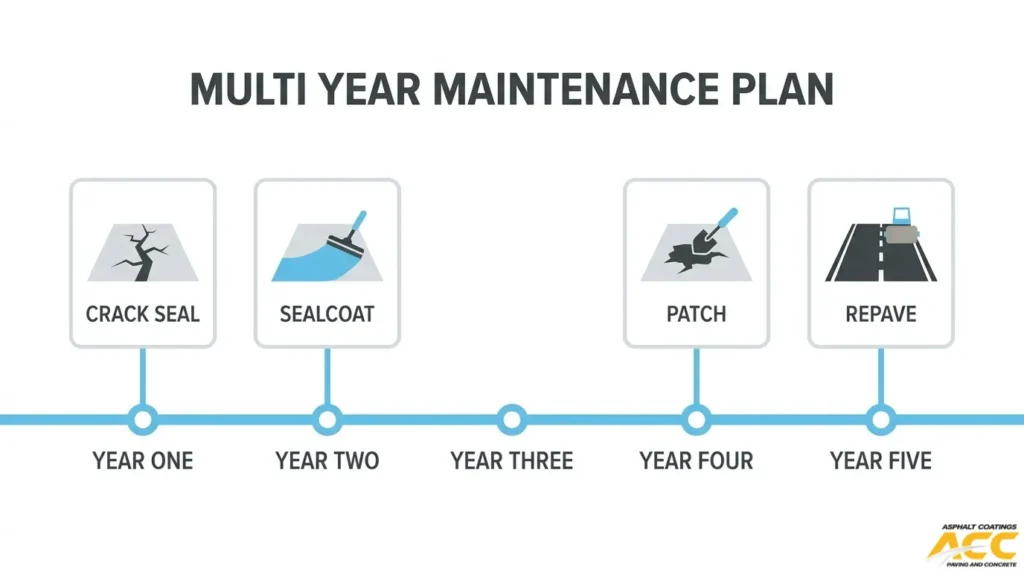
You should phase repairs, paving, and sealcoating by building a sequenced multi-year plan that prioritizes crack sealing and patching first, follows with sealcoating on a regular cycle, and reserves major paving work for later budget periods. The sections below cover planning, phasing, timing, and proactive strategies.
How can you build a multi-year plan that sequences crack sealing, patching, and sealcoating?
You can build a multi-year plan by layering maintenance tasks in order of urgency and protective value. Crack sealing should come first each cycle because it prevents water infiltration that accelerates base failure. Patching addresses localized structural damage before it spreads. Sealcoating then locks in those repairs by shielding the restored surface from UV exposure and moisture. A practical sequence looks like this:
- Year one: Conduct a full condition assessment and complete all crack sealing and patching.
- Years two through three: Apply sealcoating over the repaired surface.
- Years four through five: Reassess, repeat crack sealing, and patch any new failures.
- Year six onward: Sealcoat again and evaluate whether overlay or reconstruction is needed.
According to the U.S. Government Accountability Office, 13 of 16 state transportation agencies used Life-Cycle Cost Analysis to select pavement strategies, confirming that structured long-term planning yields the most cost-effective outcomes.
When is it smart to phase paving work over multiple budget cycles or sections of the lot?
It is smart to phase paving work when the full project cost exceeds a single year’s capital budget or when different lot sections have varying levels of deterioration. Spreading the work across two or three fiscal years lets property managers address the worst areas first, often high-traffic drive aisles or areas with base failure, while deferring sections still in fair condition. Phasing also reduces tenant disruption because only a portion of the lot closes at any given time. For properties with seasonal revenue peaks, such as shopping centers, scheduling major paving during slower months protects cash flow without deferring critical repairs indefinitely.
How should you time sealcoating and striping to minimize disruption to tenants and customers?
You should time sealcoating and striping for periods of lowest lot occupancy, typically weekends, evenings, or off-peak business seasons. Sealcoat needs 24 to 48 hours of dry cure time before traffic can return, so coordinating with weather forecasts is essential. Striping follows immediately after the sealcoat cures; combining both in a single mobilization saves cost and shortens the total closure window. For multi-tenant properties, phasing the work in sections, half the lot at a time, keeps parking available throughout the project. Notifying tenants at least two weeks in advance and posting clear directional signage prevents confusion and reduces complaints during the work.
How can proactive maintenance extend the time before you need major paving work?
Proactive maintenance extends the time before major paving work by addressing small damage before it compounds into structural failure. Regular crack sealing prevents water from reaching the aggregate base, where freeze-thaw cycles and traffic loads cause the most expensive deterioration. Routine sealcoating slows oxidation and surface raveling, preserving flexibility in the asphalt binder. As Ken Swedeen, DAPA Executive Director, stated in a research review published by NDLTAP, “Preventative maintenance is the key to wisely utilizing public dollars and building and maintaining an effective transportation system,” especially in climates where weather and frost-susceptible soils accelerate pavement decline. ADA compliance adds another layer; the ADA and state access boards require that all accessibility features remain fully operational at all times, which means proactive repairs to accessible routes and parking spaces are not optional.
Understanding how to phase maintenance correctly helps property managers get the longest possible service life from every dollar spent on their parking lot.
How Should You Approach Parking Lot Problems With a Full-Service Asphalt and Concrete Contractor?
You should approach parking lot problems with a full-service asphalt and concrete contractor by consolidating diagnosis and repair under one provider. The sections below explain how Asphalt Coatings Company simplifies this process and what property managers should remember.
How can Asphalt Coatings Company’s paving, sealcoating, and crack sealing services help you choose the right fix for each parking lot problem?
Asphalt Coatings Company’s paving, sealcoating, and crack sealing services help you choose the right fix by providing a single point of assessment for every distress type. Instead of coordinating separate specialists for surface protection, structural repair, and preventive maintenance, property managers get one evaluation that matches each problem to the correct treatment.
Asphalt Coatings Company performs asphalt paving and installation, mill and pave services, sealcoating, crack sealing with CDOT-approved materials, concrete flatwork, ADA-compliant work, and striping, all with in-house crews. According to the San José State University Transportation Consortium’s manual on asphalt pavement repair, having guidance that helps agencies and industry “select the right repair and preparation treatments, and also to design and construct the treatments” is essential for quality assurance and troubleshooting.
That single-source capability eliminates the risk of one contractor recommending unnecessary work because they lack the license or equipment for the actual solution needed.
What are the key takeaways about who to call for parking lot repair, paving, and sealcoating problems that property managers should remember?
The key takeaways about who to call for parking lot repair, paving, and sealcoating problems are:
- Sealcoating protects sound pavement from UV and water but cannot fix structural damage.
- Crack sealing addresses active, non-structural cracks before they allow water infiltration.
- Patching and repair contractors handle localized potholes, small base failures, and skin patches.
- Paving contractors manage large-scale milling, overlays, reconstruction, grading, and drainage.
- Concrete specialists repair curbs, sidewalks, ADA ramps, and transitions between materials.
- Conditions such as severe weather may require additional inspections beyond a routine schedule, according to FAA Advisory Circular AC 150/5380-6C.
A full-service contractor like Asphalt Coatings Company consolidates these disciplines, reducing miscommunication and ensuring each problem receives the treatment it actually needs rather than the only service a single-trade contractor can sell.