Mill-and-pave is a pavement rehabilitation method that removes deteriorated asphalt surface layers through milling, then replaces them with fresh hot-mix asphalt to restore structural integrity, proper drainage grades, and a smooth driving surface.
This guide covers visible surface distress patterns, subsurface and structural failures, climate-driven deterioration unique to Denver, maintenance threshold indicators, age and traffic load benchmarks, drainage and grading deficiencies, safety and compliance concerns, and cost-lifecycle planning.
Visible distress like widespread alligator cracking, deep rutting, recurring potholes, and severe aggregate loss each reveals a different stage of pavement failure where patching no longer provides lasting results. Milling removes the compromised material so crews can rebuild on a stable foundation.
Beneath the surface, base layer failures, persistent moisture infiltration, and repeated freeze-thaw heaving undermine pavement from below. These hidden conditions cause surface repairs to fail within months and signal the need for deeper rehabilitation.
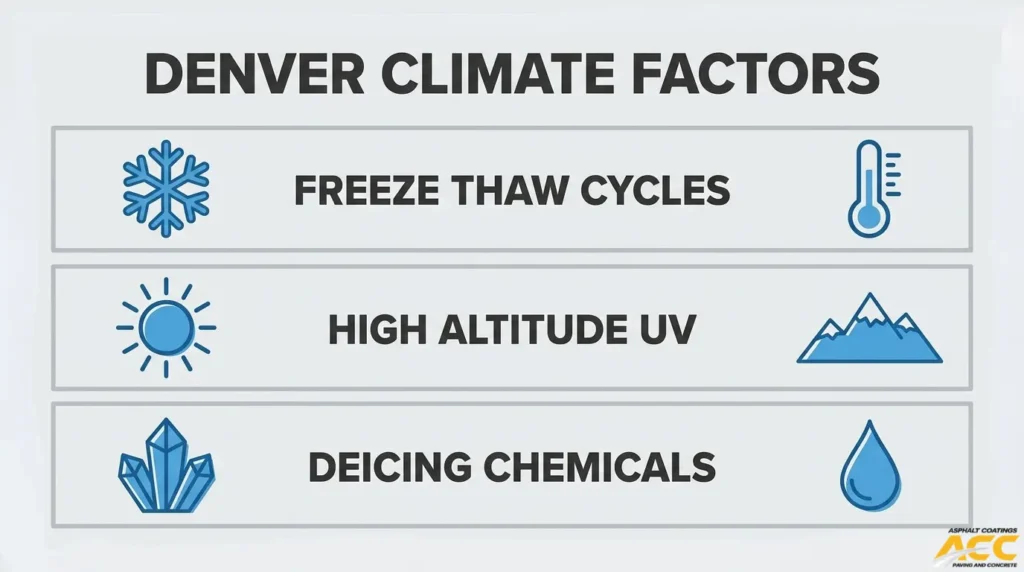
Denver’s frequent freeze-thaw transitions, elevated UV radiation above 5,200 feet, and magnesium chloride deicing exposure combine to degrade asphalt binder faster than in lower-elevation climates. This compression of pavement lifespan pushes many industrial lots toward mill-and-pave years earlier than standard timelines suggest.
When crack sealing cannot keep pace with new damage, overlays have stacked too high, and annual patching costs approach the price of full rehabilitation, maintenance has reached its practical limit. Industrial lots bearing forklift traffic, heavy truck loads, and static storage weight often cross this threshold well before the 13-to-17-year general lifespan window closes.
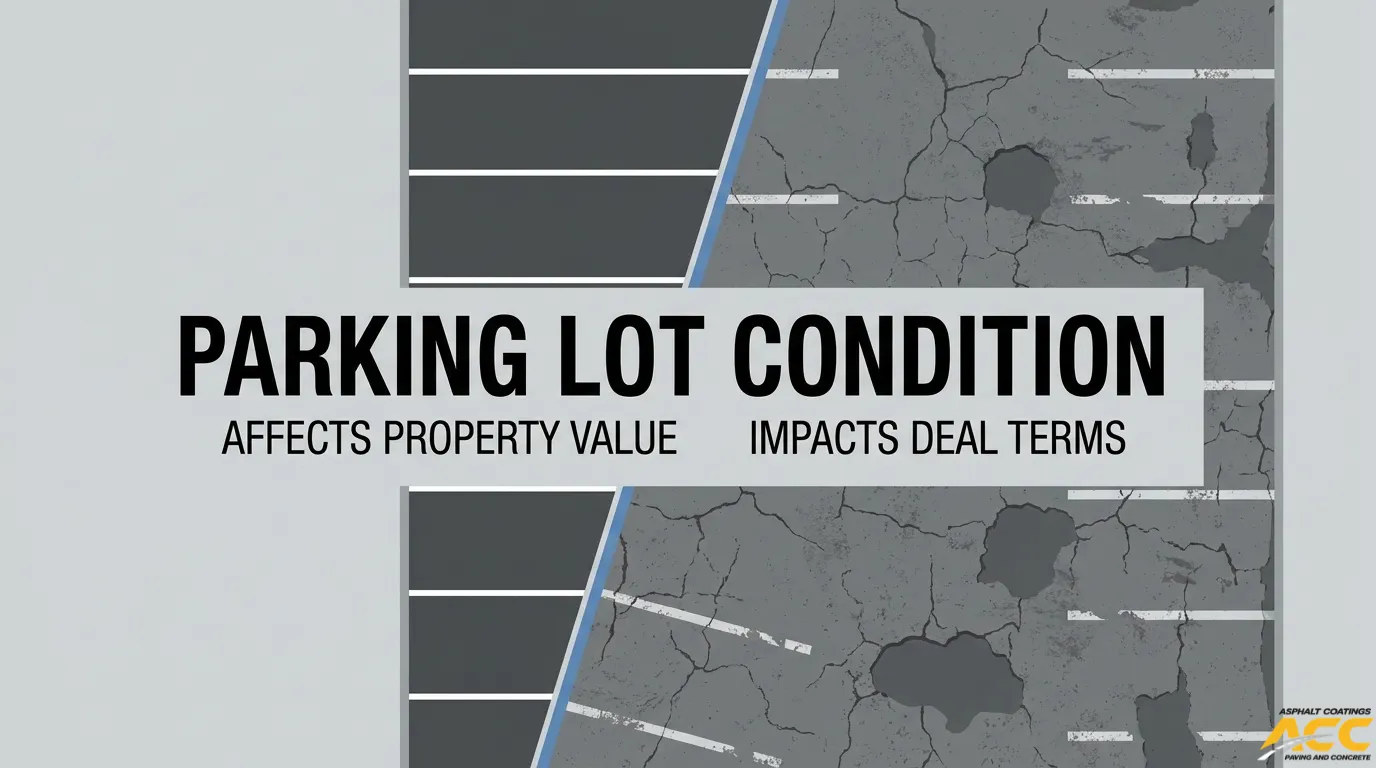
Ponding water, failed drainage slopes, ADA grade violations, and trip-and-fall hazards create legal and financial exposure that makes rehabilitation unavoidable. Deteriorated lots can measurably reduce property value, while a single mill-and-pave project resets surface condition, drainage function, and compliance in one scope of work.
What Makes Mill-and-Pave the Right Choice for Older Denver Industrial Asphalt?
Mill-and-pave is the right choice for older Denver industrial asphalt because it removes deteriorated surface layers, corrects grade and drainage deficiencies, and restores structural integrity without the cost of full-depth reconstruction. Denver’s combination of freeze-thaw cycling, high-altitude UV exposure, and heavy industrial traffic accelerates pavement failure beyond what overlays or patching can address. When aging asphalt shows interconnected distress patterns, mill-and-pave resets the surface while preserving a sound base.
For industrial lots subjected to forklift traffic, heavy truck loads, and chemical de-icers, surface-only repairs eventually fail to keep pace with new damage. According to Forta Corporation, asphalt pavement roads have a life expectancy of between 13 and 17 years before they require replacement or extensive rehabilitation. Properly maintained pavements can reach approximately 25 years, but industrial environments rarely allow that ideal maintenance timeline to hold. The combination of concentrated wheel loads at loading docks, turning movements from delivery vehicles, and Colorado’s aggressive climate compresses that window considerably.
Mill-and-pave addresses this reality by milling the damaged asphalt to a specified depth, then repaving with a fresh hot-mix layer calibrated to the lot’s traffic demands. This process corrects surface irregularities such as rutting, ponding areas, and uneven slopes that simple overlays would only mask. It also provides the opportunity to restore proper drainage grades, an essential consideration given that the Federal Highway Administration concluded poor drainage was a major contributing factor to premature failure of heavy-duty pavements. Asphalt Coatings Company has served Colorado’s Front Range since 1986, specializing in mill-and-pave services for commercial and industrial properties. Their in-house crews handle every phase of the project, from initial assessment through final striping, ensuring consistent quality and eliminating coordination delays that multi-contractor projects often face.
From a cost perspective, milling offers significant savings compared to full reconstruction. Milling costs approximately $10 to $20 per ton, while new asphalt for full-depth repaving ranges from $100 to $200 per ton. This positions mill-and-pave as the practical middle ground: more thorough than an overlay, yet far less disruptive and expensive than tearing out and rebuilding the entire pavement section. For property managers balancing budget constraints against long-term performance, this cost efficiency makes mill-and-pave the most defensible investment for aging industrial lots that still have a structurally sound base beneath worn-out surface layers.
What Visible Surface Distress Signals That a Denver Industrial Lot Needs Milling Instead of Patching?
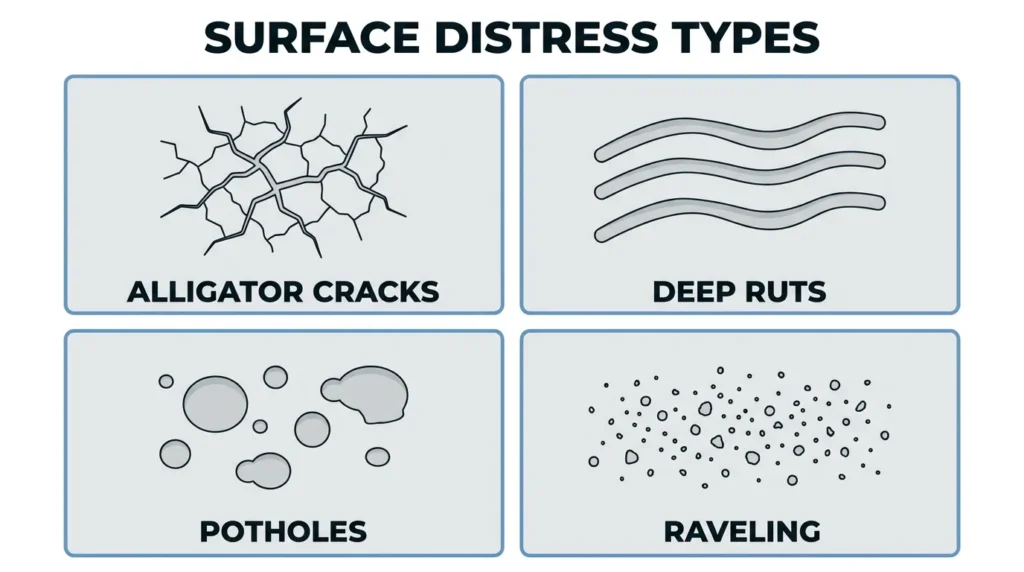
Visible surface distress signals that a Denver industrial lot needs milling instead of patching include interconnected alligator cracking, deep ruts, widespread potholes, and severe aggregate loss. Each distress type reveals a different stage of pavement failure.
When Do Alligator Cracks Indicate Structural Failure Requiring Mill-and-Pave?
Alligator cracks indicate structural failure requiring mill-and-pave when the interconnected pattern spreads across large, continuous sections of the lot rather than isolated spots. This cracking resembles reptile skin and signals that the base layers beneath the surface have lost load-bearing capacity. Patching only addresses the top layer, leaving the compromised structure intact.
Poor drainage is often the hidden cause. According to the Federal Highway Administration’s Guidelines for the Design of Subsurface Drainage Systems, poor drainage was identified as a major contributing factor to the premature failure of heavy-duty pavements. Once moisture weakens the subgrade and base layers, cracking accelerates alongside rutting and potholes. When alligator cracking covers a significant portion of your lot, milling removes the failed material so a proper structural rebuild can begin.
How Do Deep Ruts and Depressions Show That Milling Is Preferable to Simple Overlay?
Deep ruts and depressions show that milling is preferable to simple overlay because they indicate permanent deformation in the pavement structure, not just surface wear. Overlaying a rutted surface traps the uneven profile underneath, and the ruts telegraph through the new layer within months.
Milling removes the deformed asphalt down to a uniform grade, creating a stable platform for fresh material. This process also restores proper cross-slope for drainage. For industrial lots handling heavy truck traffic and forklift loads, ruts deeper than half an inch compromise vehicle handling and accelerate further structural damage. Correcting the profile through milling is the only way to reset the surface geometry and prevent recurring deformation.
When Are Widespread Potholes a Sign That Spot Repairs Are No Longer Cost-Effective?
Widespread potholes are a sign that spot repairs are no longer cost-effective when new holes form as fast as old ones are filled. Isolated potholes result from localized failure, but when they appear across multiple areas of the lot simultaneously, the underlying asphalt has deteriorated beyond what individual patches can stabilize.
Each patch introduces a cold joint between old and new material, which becomes the next weak point. On an industrial lot subjected to heavy axle loads, patched areas often fail again within one or two seasons. At that point, the cumulative cost of repeated mobilization, material, and labor exceeds what a single mill-and-pave project would require while delivering a far shorter service life.
How Do Severe Raveling and Loose Aggregate Reveal That the Surface Has Fully Worn Out?
Severe raveling and loose aggregate reveal that the surface has fully worn out because the asphalt binder holding the pavement together has oxidized and lost its adhesive properties. When aggregate separates freely under tire contact, the surface can no longer maintain the firm, stable, slip-resistant profile that the U.S. Department of Justice Civil Rights Division requires for accessible parking spaces, which must hold a maximum 1:48 slope.
Raveled surfaces also disrupt drainage function. Paved surfaces need a minimum 1-percent slope for efficient water flow, according to established parking lot condition guidelines. Loose material clogs inlets and creates uneven low spots where water collects. Sealcoating cannot rebind aggregate that has already separated from a structurally spent surface; milling strips the failed layer and allows proper slope restoration during repaving.
Understanding which surface distress patterns demand milling helps property managers move from reactive patching to a lasting structural solution.
What Subsurface or Structural Issues Suggest It Is Time for Mill-and-Pave?
Subsurface and structural issues that suggest it is time for mill-and-pave include base layer failure, persistent drainage problems, and repeated freeze-thaw heaving. These hidden conditions undermine pavement integrity from below.
When Does a Failing Base or Subgrade Make Milling and Repaving Necessary?
A failing base or subgrade makes milling and repaving necessary when surface distress keeps returning despite repeated repairs. Alligator cracking that reappears within months of patching, localized depressions that deepen under load, and soft spots that flex under truck traffic all indicate the aggregate base or native soil beneath the asphalt has lost structural capacity. Once the subgrade can no longer distribute weight evenly, surface-only fixes become temporary at best. Mill-and-pave allows contractors to remove the compromised surface, evaluate and correct the base, then place fresh asphalt on a stable foundation. For industrial lots carrying heavy equipment loads, ignoring base failure accelerates damage exponentially.
How Do Persistent Drainage Problems Reveal Structural Issues Under the Asphalt?
Persistent drainage problems reveal structural issues under the asphalt by exposing areas where water infiltrates and weakens the base from within. When ponding recurs in the same locations or pavement settles near inlets, trapped moisture is likely saturating the subgrade. According to the Federal Highway Administration’s Guidelines for the Design of Subsurface Drainage Systems, poor drainage was identified as a major contributing factor to the premature failure of heavy-duty pavements. Saturated base material loses load-bearing strength, causing rutting and cracking overhead. Mill-and-pave addresses this by removing damaged layers so crews can regrade the surface, repair or install subsurface drainage, and restore proper water flow before repaving.
When Do Repeated Freeze-Thaw Heaves Point to the Need for Deeper Rehabilitation?
Repeated freeze-thaw heaves point to the need for deeper rehabilitation when seasonal pavement lifting and settling creates persistent unevenness that patching cannot correct. Moisture trapped in the base freezes, expands, and pushes the asphalt upward; when it thaws, the pavement drops but never returns to its original profile. Over successive winters, this cycle compounds, producing uneven surfaces, cracked joints, and destabilized base layers. Denver’s climate produces numerous annual freeze-thaw transitions, and lots with poor drainage are especially vulnerable. When heave damage spans large sections of an industrial lot, mill-and-pave provides the opportunity to address moisture infiltration at the base level and rebuild a uniform, freeze-resistant pavement structure.
Understanding these subsurface warning signs helps property managers act before hidden damage escalates repair costs.
How Do Denver’s Freeze-Thaw Cycles and UV Exposure Accelerate Mill-and-Pave Timing?
Denver’s freeze-thaw cycles and UV exposure accelerate mill-and-pave timing by degrading asphalt binder integrity and oxidizing the surface faster than in lower-elevation, milder climates. The sections below cover freeze-thaw damage progression, high-altitude UV effects, and deicing chemical impact.
How Does Colorado’s Freeze-Thaw Cycle Turn Minor Cracking Into Mill-and-Pave Projects?
Colorado’s freeze-thaw cycle turns minor cracking into mill-and-pave projects by allowing water to infiltrate small cracks, expand as ice, and progressively widen damage with each cycle. According to a Federal Highway Administration Long-Term Pavement Performance Program report, pavement deterioration is more rapid in climatic zones with a large number of annual freeze-thaw cycles compared to areas with deep frost penetration alone. Denver’s frequent temperature swings across the freezing threshold create exactly this pattern.
Each cycle reduces asphalt binder stiffness and compressive strength, weakening the pavement structure from within. What begins as hairline thermal cracking can escalate to interconnected networks within a few seasons, particularly when subsurface drainage is inadequate. For industrial lots already bearing heavy loads, this progression often pushes damage beyond what crack sealing or patching can address. Proactive drainage improvements during milling can slow future deterioration considerably.
When Does High-Altitude UV Damage Mean Resurfacing Alone Will Not Last?
High-altitude UV damage means resurfacing alone will not last when oxidation has brittled the existing asphalt binder to a depth that a thin overlay cannot compensate for. Denver sits above 5,200 feet, and for every 1,000 feet of elevation, UV levels increase by approximately 2%, as reported by KOAA. That elevated radiation accelerates oxidative hardening of the asphalt surface, causing it to lose flexibility and crack under thermal stress or heavy loads.
When the existing surface has turned gray, feels chalky, and sheds fine aggregate, oxidation has likely penetrated well beyond the top layer. Placing a new overlay on this compromised substrate risks reflective cracking, where old cracks telegraph through the fresh surface within one to two seasons. Milling removes the oxidized material entirely, giving the new asphalt a structurally sound bonding surface. In my experience, lots above 5,000 feet with deferred sealcoating almost always need full milling rather than overlay alone.
How Does Deicing Chemical Use on Industrial Lots Influence Mill-and-Pave Decisions?
Deicing chemical use on industrial lots influences mill-and-pave decisions by accelerating surface breakdown and weakening the asphalt binder over repeated application seasons. Colorado primarily uses magnesium chloride as a deicing agent, according to High Country News. While less corrosive than sodium chloride, magnesium chloride still penetrates surface cracks and interacts with asphalt binder chemistry over time.
On industrial lots where deicing occurs frequently across loading areas, drive lanes, and entrance aprons, cumulative chemical exposure compounds the damage from freeze-thaw cycling and UV oxidation. The result is surface raveling and binder stripping that patching cannot resolve comprehensively. When chemical-related deterioration spans more than isolated sections, milling the affected depth and repaving with a fresh binder coat delivers a longer-lasting result than surface treatments alone.
Understanding these climate-driven factors helps property managers anticipate when maintenance strategies have reached their limit.
How Can You Recognize That Maintenance and Overlay Have Reached Their Limit?
You can recognize that maintenance and overlay have reached their limit when crack sealing falls behind new damage, past overlays have stacked too high, and repeated patching costs more than milling and repaving.
When Does Crack Sealing No Longer Keep Up With New Cracks Forming?
Crack sealing no longer keeps up with new cracks forming when sealed joints reopen within one season, fresh cracks appear faster than crews can address them, and interconnected cracking patterns spread across large sections of the lot. These signs indicate the pavement structure itself is failing, not just the surface. At that stage, sealing individual cracks treats symptoms while the underlying deterioration continues unchecked. Industrial lots under heavy forklift and truck traffic often reach this tipping point years earlier than lighter-use properties. When annual crack sealing budgets climb steadily yet the lot visibly worsens each spring, the pavement has crossed into territory where only milling and repaving restores structural integrity.
How Do Multiple Past Overlays Signal That Additional Layers Are No Longer Advisable?
Multiple past overlays signal that additional layers are no longer advisable when the total pavement thickness raises curb heights, disrupts drainage grades, and adds weight the base was never designed to carry. Each overlay bonds to the layer beneath it; if earlier layers contain trapped moisture or hidden cracks, new asphalt inherits those weaknesses. Stacking three or more overlays commonly creates lip edges at building entrances, catch basins, and ADA transitions that become tripping hazards. Milling removes compromised material down to a sound base, resets proper grades, and provides a clean bonding surface. For most aging industrial lots, this reset delivers far longer performance than yet another overlay ever could.
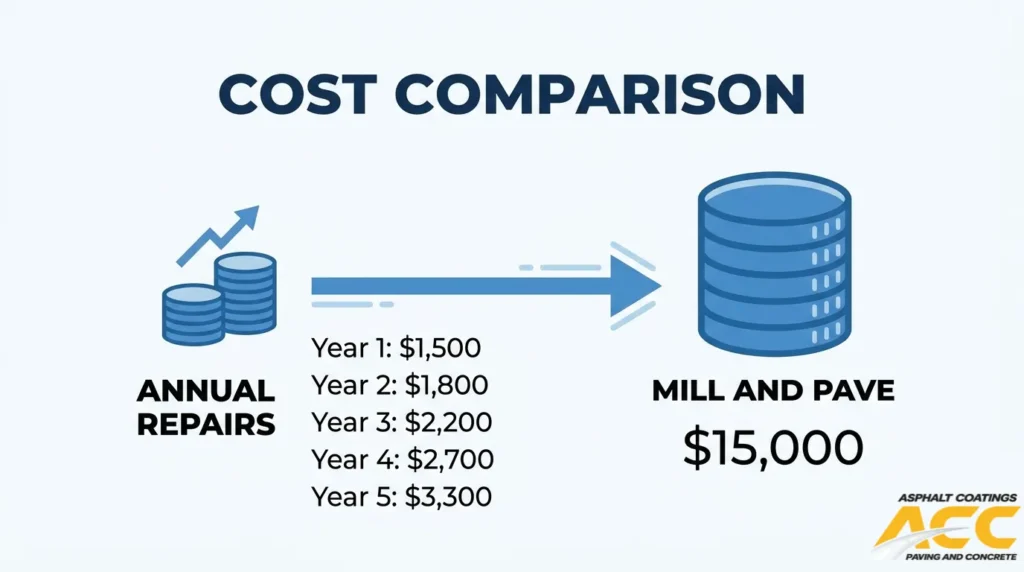
When Do Repeated Patching and Skin Paving Become More Expensive Than Mill-and-Pave?
Repeated patching and skin paving become more expensive than mill-and-pave when cumulative annual repair costs approach or exceed the one-time cost of full rehabilitation. According to Wright Construction Inc., asphalt overlay paving typically costs $3.50 to $6.00 per square foot, while full-depth replacement ranges from $8.00 to $15.00 per square foot. Mill-and-pave falls between those figures, often making it the most cost-effective middle path. Nonfunctioning drainage beneath repeatedly patched areas can actually shorten pavement service life more than having no drainage system at all, compounding wasted spending. When patch-on-patch repairs consume budget every year without extending lot life, consolidating that spend into a single mill-and-pave project delivers a longer-lasting surface and resets the maintenance clock.
Understanding when maintenance dollars stop producing results helps determine the right rehabilitation scope and timeline.
How Do Age, Traffic Loads, and Industrial Use Patterns Affect Mill-and-Pave Readiness?
Age, traffic loads, and industrial use patterns affect mill-and-pave readiness by determining how quickly asphalt deteriorates beyond the point where minor repairs remain viable. The sections below cover service life benchmarks, heavy truck damage thresholds, and industrial equipment impacts.
How Many Years of Service Typically Indicate a Denver Industrial Lot Is Near End of Life?
A Denver industrial lot is typically near end of life after 13 to 17 years of service, when asphalt requires replacement or extensive rehabilitation. According to Forta Corporation, asphalt pavement roads generally have a life expectancy within that range before major intervention becomes necessary.
Well-maintained asphalt can last approximately 25 years, though industrial lots rarely achieve that ceiling. Constant heavy loads, chemical exposure, and Denver’s freeze-thaw cycles compress the timeline significantly. Lots that received proper subsurface drainage during original construction may gain additional service years, but those without drainage often deteriorate faster. Once a lot passes the 13-year mark and shows compounding distress, scheduling a mill-and-pave assessment is more cost-effective than continuing reactive repairs.
When Do Heavy Truck Loads and Turning Movements Justify Milling Over Minor Repairs?
Heavy truck loads and turning movements justify milling over minor repairs when concentrated axle stress produces rutting, shoving, or fatigue cracking that localized patches cannot resolve. Repeated passes from loaded semi-trailers, especially at intersections and turning radii, apply forces far exceeding standard passenger vehicle loads. These forces compress and displace the asphalt binder, creating depressions that worsen with each load cycle.
Turning movements are particularly destructive because tires twist against the surface under heavy vertical load, generating shear stress that tears the top mat. When rutting or shoving recurs within months of patching, the surface layer has lost its structural integrity. Milling removes the damaged material and restores proper profile geometry in a way that spot repairs simply cannot.
How Do Forklifts, Loading Docks, and Storage Areas Change Mill-and-Pave Timing?
Forklifts, loading docks, and storage areas change mill-and-pave timing by concentrating repetitive point loads and static weight on small surface zones. Forklift wheels exert extreme pressure per square inch, and their tight turning patterns scuff and gouge asphalt far faster than standard vehicle traffic. Loading dock aprons endure constant braking, acceleration, and hydraulic fluid spills that soften the binder.
Storage areas where heavy pallets or containers sit for extended periods create permanent depressions through static load compaction. These high-stress zones often deteriorate years before the rest of the lot, making them early indicators that full mill-and-pave should be planned. Prioritizing these areas during rehabilitation prevents the damage from spreading into adjacent sections.
Understanding how use patterns accelerate deterioration helps property managers anticipate drainage and grading issues that compound the problem.
What Drainage, Grading, and Slope Problems Point Toward Mill-and-Pave?
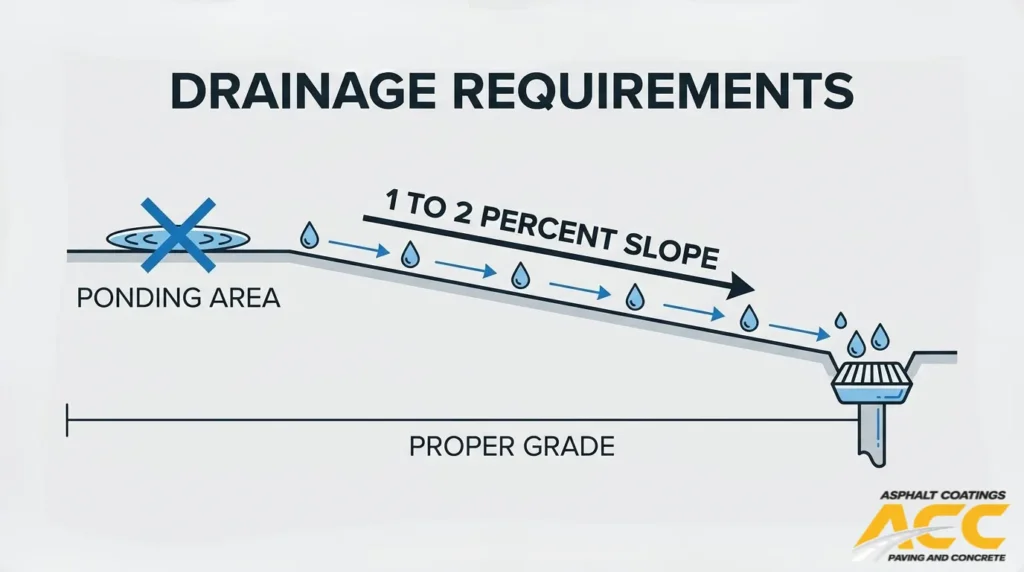
Drainage, grading, and slope problems point toward mill-and-pave when water no longer flows to inlets or the lot perimeter as designed. According to Cali Chi Engineering, parking lots should maintain a minimum 1–2% slope toward drainage inlets, with no flat areas where water ponds. The sections below cover standing water, infrastructure adjustments, and ice-related liability.
How Do Standing Water and Ponding Show That the Lot Needs Regrading During Milling?
Standing water and ponding show that the lot needs regrading during milling because persistent puddles indicate the surface slope has fallen below functional minimums. A parking lot can drain at slopes as low as 0.5%, according to the Engineering Tips Forum, yet settled or rutted industrial pavement often loses even that minimal grade over years of heavy use. Milling removes the compromised surface to a controlled depth, giving crews the opportunity to correct grade deficiencies before placing new asphalt. Without regrading at this stage, the fresh surface simply mirrors the old drainage failures underneath. For industrial lots handling forklift and truck traffic, this correction window is the most cost-effective moment to restore proper water flow.
When Do Gutters, Inlets, and Aprons Need Adjustment Alongside Mill-and-Pave?
Gutters, inlets, and aprons need adjustment alongside mill-and-pave when the new pavement elevation no longer matches existing drainage hardware. Milling lowers the surface, which can leave inlet grates, gutter lines, and apron transitions sitting above the finished grade. That height mismatch traps water at structure edges rather than channeling it into the drainage system. Adjusting these components during the paving window costs far less than retrofitting them after the lot reopens. Industrial lots with heavy vehicle turning movements at dock aprons are especially vulnerable, since even a half-inch lip creates pooling and accelerated wear at high-stress transition points.
How Can Ice Patches and Drainage-Related Liability Risks Justify Full Lot Rehabilitation?
Ice patches and drainage-related liability risks can justify full lot rehabilitation because ponding water that freezes creates slip-and-fall hazards and potential property owner liability. In Denver’s climate, any low spot that holds water during the day can become black ice overnight. Spot drainage fixes rarely solve the root cause when the entire lot profile has shifted from years of settlement and overlay buildup. Full mill-and-pave rehabilitation restores proper cross-slopes across the entire surface, eliminating the depressions where ice forms. For facility managers weighing repair costs against a single premises liability claim, correcting lot-wide drainage through rehabilitation is often the more defensible investment.
With drainage and grading resolved, the next consideration is how safety, ADA compliance, and curb appeal factor into mill-and-pave decisions.
How Do Safety, ADA Compliance, and Curb-Appeal Concerns Influence Mill-and-Pave Decisions?
Safety, ADA compliance, and curb-appeal concerns influence mill-and-pave decisions by creating legal, regulatory, and financial pressure that makes resurfacing unavoidable. The sections below cover trip-and-fall hazards, ADA slope restoration, and property value impact.
When Does Surface Roughness Create Trip-and-Fall or Vehicle Safety Hazards?
Surface roughness creates trip-and-fall or vehicle safety hazards when deteriorated pavement produces uneven joints, lifted edges, potholes, or loose aggregate that pedestrians and vehicles cannot safely navigate. According to Strategic Safety, slip, trip, and fall incidents account for 15% of all work-related injuries and represent 12% to 15% of total Workers’ Compensation expenses. Industrial lots with heavy foot traffic near loading docks and warehouse entries face elevated exposure to these incidents. Degraded surfaces also cause vehicle damage, steering instability at low speeds, and cargo shifting in loaded trucks. When roughness reaches the point where patching no longer maintains a consistent grade, mill-and-pave restores a uniform surface that eliminates the root hazard.
How Can Mill-and-Pave Help Restore Proper ADA Slopes, Cross-Slopes, and Transitions?
Mill-and-pave helps restore proper ADA slopes, cross-slopes, and transitions by removing the existing surface to a controlled depth and repaving to precise grade specifications. The U.S. Access Board requires accessible route cross-slopes no steeper than 1:48 (approximately 2.08%) and ramp slopes no greater than 1:12. Over time, settling, overlay buildup, and subgrade movement push these grades out of compliance. Milling strips the pavement back to a uniform plane so contractors can re-establish compliant slopes at accessible parking spaces, curb ramps, and pedestrian transitions. For industrial property managers, this is one of the most practical ways to address ADA violations without a full reconstruction.
When Does a Worn Industrial Lot Begin Hurting Tenant Perception and Property Value?
A worn industrial lot begins hurting tenant perception and property value when visible deterioration signals deferred maintenance to tenants, visitors, and appraisers. According to Denver Commercial Paving appraisal data, deteriorated parking lots can reduce property value by 5% to 10%, making pavement condition a measurable factor in commercial valuation and marketability. Cracked, patched, or ponding-prone surfaces also increase liability exposure; if ice forms in an untreated lot, the property owner may face legal claims for resulting injuries. Adequate, well-maintained parking and storage areas directly influence industrial property appraisals, and high-quality pavement boosts both curb appeal and long-term ROI. Mill-and-pave resets the surface condition in a single project, addressing the cosmetic, functional, and financial concerns simultaneously.
Beyond aesthetics and value, these safety and compliance factors often determine whether Asphalt Coatings Company recommends budgeting for mill-and-pave now or deferring to the next fiscal cycle.
How Should Property Managers Weigh Cost, Lifecycle, and Downtime When Considering Mill-and-Pave?
Property managers should weigh cost, lifecycle, and downtime by comparing total spending on repeated repairs against a single rehabilitation investment. The sections below cover long-term cost differences, when full-lot rehabilitation beats phased repairs, and how scheduling reduces operational disruption.
How Does the Long-Term Cost of Mill-and-Pave Compare to Ongoing Band-Aid Repairs?
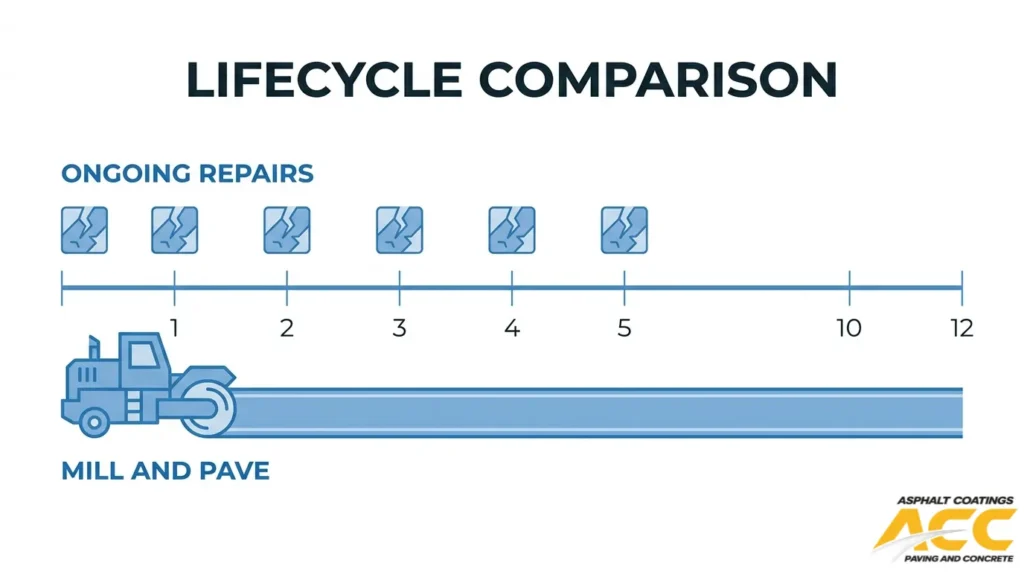
The long-term cost of mill-and-pave is typically lower than ongoing band-aid repairs because one comprehensive project eliminates the compounding expense of annual patching, crack filling, and emergency fixes. According to Asphalt Repair Solutions, commercial asphalt paving typically costs $4 to $10 per square foot, depending on site conditions, asphalt thickness, and drainage needs. Repeated spot repairs may seem affordable individually, but each intervention addresses only symptoms while the underlying pavement continues to deteriorate. Over a five-to-seven-year window, cumulative patch costs often approach or exceed a single mill-and-pave investment. For property managers budgeting across multiple fiscal years, consolidating those expenditures into one rehabilitation project delivers a newer surface, a reset maintenance clock, and more predictable long-term costs.
When Is It Cheaper to Rehabilitate an Entire Lot Than to Phase Repairs Over Years?
It is cheaper to rehabilitate an entire lot when phased repairs can no longer extend meaningful service life between interventions. According to Asphalt Magazine, CDOT enacted a policy change that increases the life expectancy of asphalt mill and mill overlays from 10 years to 12 years in life-cost analysis. That extended lifecycle means a single rehabilitation resets the pavement clock by over a decade. Phased repairs lose cost efficiency once they recur every one to two years, because each mobilization carries its own labor, material, and equipment charges. When annual repair spending exceeds roughly 30% of what full rehabilitation would cost, the math favors a one-time project. Consolidating work also lets contractors optimize material ordering and equipment staging, reducing per-square-foot pricing.
How Can Scheduling Mill-and-Pave Minimize Disruption for Tenants and Operations?
Scheduling mill-and-pave strategically minimizes disruption by aligning the project with periods of reduced site activity. Property managers can coordinate work during seasonal slowdowns, holiday weeks, or planned facility shutdowns when fewer trucks, forklifts, and employees use the lot. Phased construction zones allow portions of the lot to remain open while crews mill and repave adjacent sections. Clear tenant communication weeks before mobilization, combined with temporary signage and alternative parking maps, keeps operations running smoothly. For most industrial lots, experienced contractors complete mill-and-pave faster than the cumulative downtime caused by multiple smaller repair closures spread over years.
With cost and scheduling strategies established, partnering with an experienced contractor ensures the project scope matches your lot’s actual condition.
How Can a Commercial Asphalt Contractor Like Asphalt Coatings Company Help You Plan Mill-and-Pave?
A commercial asphalt contractor like Asphalt Coatings Company can help you plan mill-and-pave by conducting professional site assessments, recommending the right rehabilitation scope, and scheduling work to minimize operational disruption.
How Can Asphalt Coatings Company’s Paving and Parking Lot Rehabilitation Services Determine If Your Industrial Lot Needs Mill-and-Pave?
Asphalt Coatings Company’s paving and parking lot rehabilitation services determine if your industrial lot needs mill-and-pave through comprehensive site evaluations that assess surface distress, subsurface integrity, drainage performance, and traffic load history. Experienced commercial asphalt contractors use in-house crews to inspect alligator cracking patterns, rut depths, ponding areas, and base layer conditions before recommending a course of action.
According to industry standards, industrial facilities should plan for annual crack sealing, sealcoating every 3 to 5 years, and periodic professional grading. When those maintenance intervals no longer control deterioration, Asphalt Coatings Company can identify whether mill-and-pave, overlay, or full-depth replacement best fits your lot’s condition and budget. This proactive assessment approach prevents costly emergency repairs and extends pavement life.
What Are the Key Takeaways About Signs an Aging Denver Industrial Lot Is Ready for Mill-and-Pave We Covered?
The key takeaways about signs an aging Denver industrial lot is ready for mill-and-pave are:
- Widespread alligator cracking, deep ruts, and recurring potholes signal structural failure beyond the reach of patching or overlay.
- Subsurface drainage failures and base layer deterioration accelerate surface distress and demand deeper rehabilitation.
- Denver’s freeze-thaw cycles and high-altitude UV exposure shorten asphalt lifespan, making proactive assessment critical.
- Standing water, failed slopes, and ice-related liability risks indicate regrading is needed alongside milling.
- ADA slope violations, trip hazards, and declining curb appeal justify full-lot rehabilitation for safety and property value.
- Mill-and-pave delivers stronger long-term ROI than repeated band-aid repairs when maintenance has reached its limit.
Asphalt Coatings Company specializes in mill-and-pave services, parking lot rehabilitation, and subgrade preparation across Colorado’s Front Range. To schedule a professional site evaluation for your industrial lot, contact Asphalt Coatings Company for a consultation.