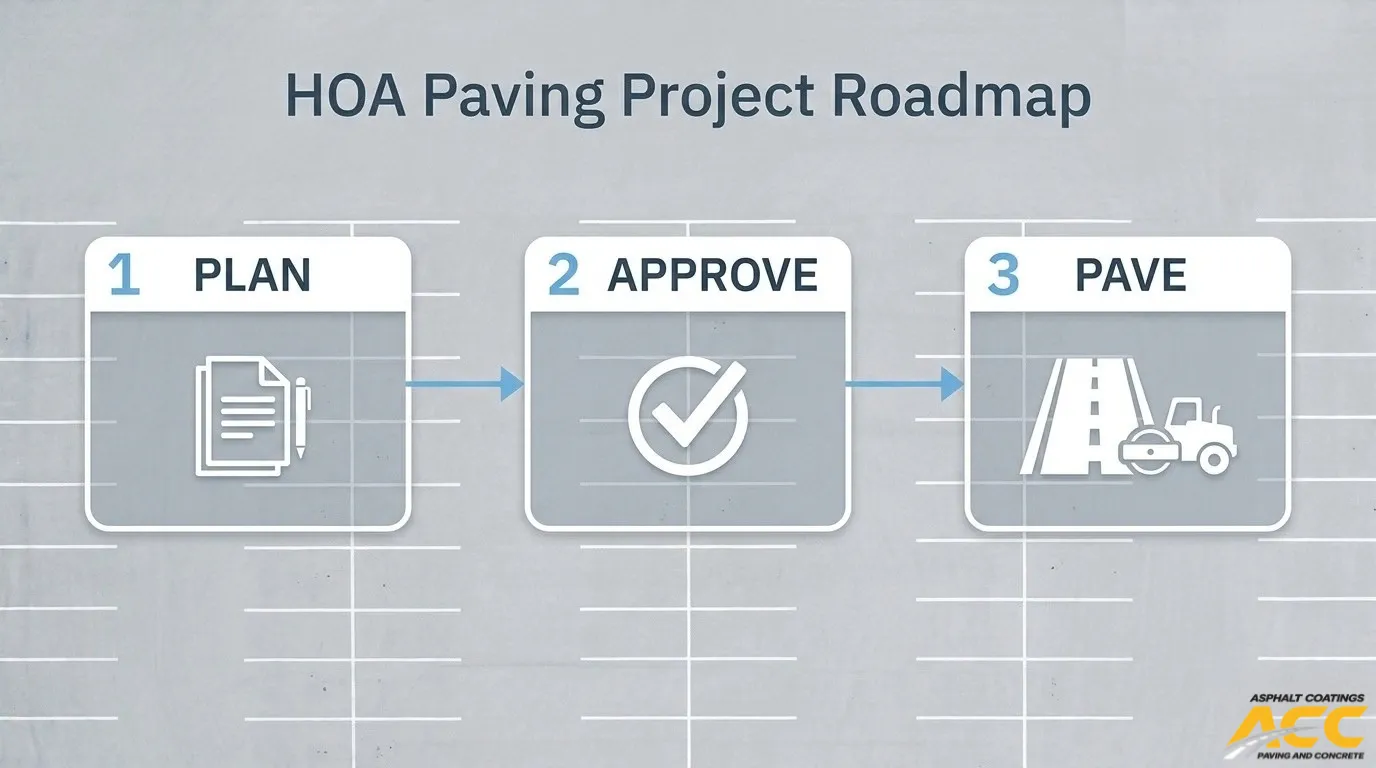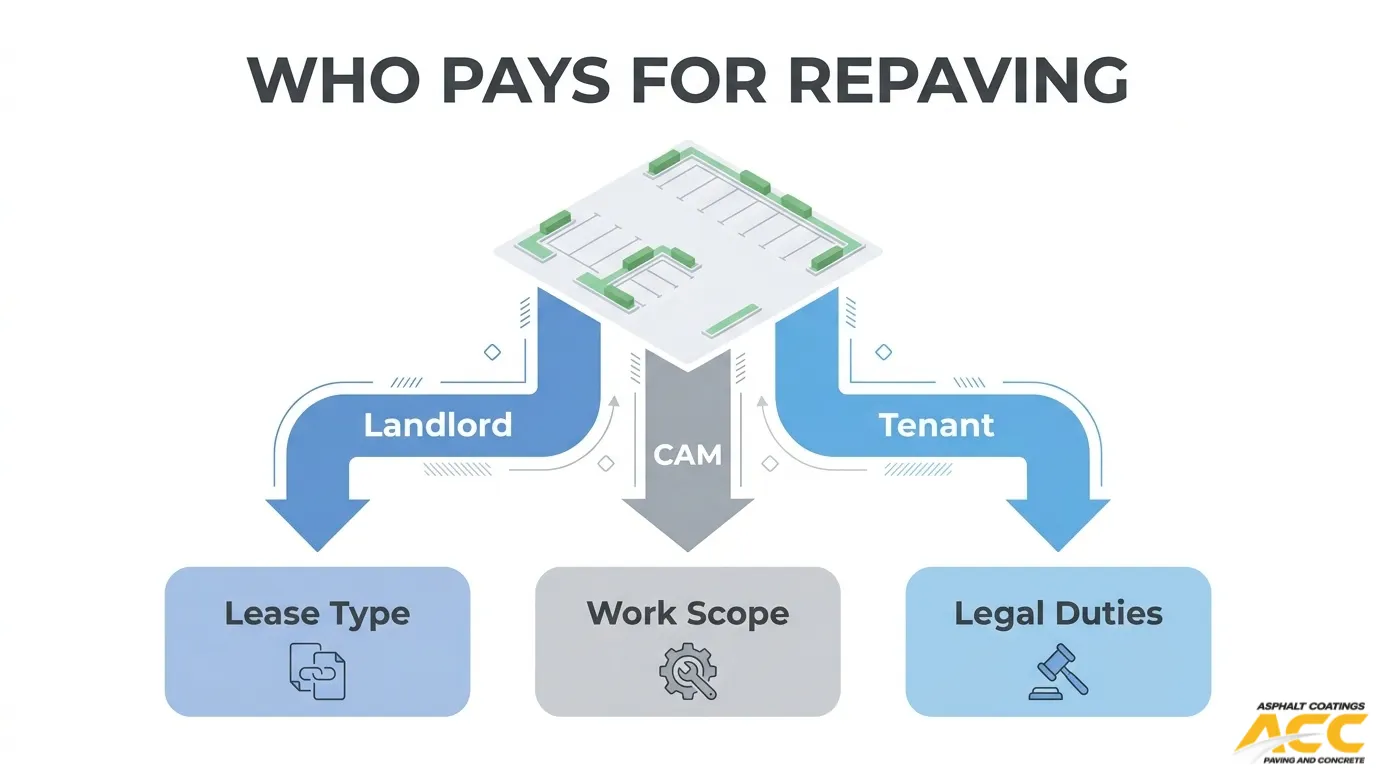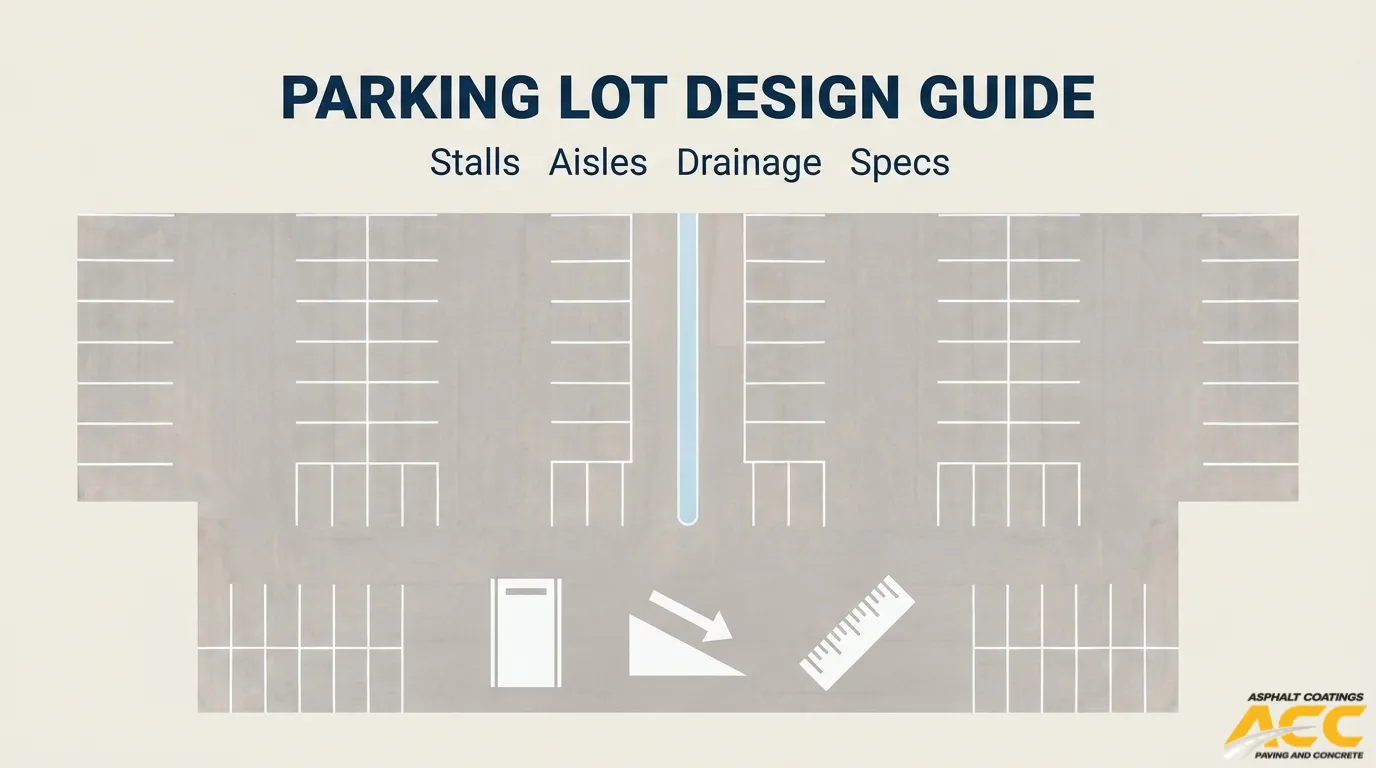
Paving an HOA or apartment community parking lot is a multi-phase capital project that requires reserve fund planning, structured board approval, detailed scoping, and ongoing maintenance coordination. Unlike standard commercial paving, community lots involve shared governance, resident impact, and regulatory triggers that shape every decision from budget to final striping.
This guide covers reserve studies and financial planning, pavement condition assessment, board approval and governance procedures, project scoping and contractor evaluation, construction logistics and resident communication, and long-term investment protection.
Reserve studies form the financial backbone of any community paving project. A properly maintained study catalogs every paved component by useful life, condition, and replacement cost, allowing boards to fund work through steady annual contributions rather than emergency special assessments that strain homeowner relationships.
Estimating a parking lot’s remaining useful life depends on visual distress indicators, climate exposure, and maintenance history. Freeze-thaw cycles, UV degradation, and deferred repairs can push a lot from routine sealcoating territory into full reconstruction well before the standard 25-year benchmark.
Board approval follows a governance path defined by CC&Rs, state statutes, and spending thresholds. Educating homeowners with condition data, following proper notice and voting procedures, and addressing cost objections with reserve study projections all determine whether a project moves forward smoothly or stalls.
Scoping and contractor evaluation protect the budget once approval is secured. A detailed RFP covering materials, drainage, ADA compliance, and phasing produces comparable bids, while verifying insurance, bonding, and in-house crew capability separates reliable contractors from those likely to generate change orders.
Construction logistics and resident communication keep occupied communities functional during active paving. Phased scheduling, layered notifications, emergency access coordination, and barricade enforcement prevent the disruptions that erode resident trust.
Protecting the finished surface through scheduled sealcoating, crack sealing, and restriping extends pavement life and maximizes every dollar the reserve fund invested.
What Makes Paving an HOA or Apartment Community Parking Lot Different From Other Projects?
Paving an HOA or apartment community parking lot differs from other projects because it involves shared governance, reserve fund obligations, resident coordination, and regulatory compliance that standard commercial paving does not require. Boards must navigate member approvals, phased scheduling around occupied buildings, ADA upgrades triggered by resurfacing, and multi-year budget planning tied to reserve studies. These layers of complexity demand a different approach from start to finish.
Unlike a standalone retail lot or warehouse pad, a community parking lot serves residents who live on-site every day. Construction phasing must preserve access to homes, emergency lanes, and accessible parking throughout the project. According to OSHA, guidance for work zone signs, barricades, and flagging follows the U.S. Department of Transportation’s Manual on Uniform Traffic Control Devices (MUTCD), and community projects must apply these same standards within a densely occupied environment where residents, children, and visitors are constantly present.
The governance layer adds another dimension. Boards typically need reserve study data to justify spending, may require membership votes for large expenditures, and must comply with CC&Rs and state statutes that dictate notice periods, bidding transparency, and fiduciary standards. Every decision passes through a structured approval process before a single piece of equipment arrives on site.
Financial planning also sets community paving apart. Reserve contributions accumulate over years, and poorly timed projects can force special assessments that frustrate homeowners. Accurate scoping, phased execution, and proactive maintenance planning all reduce the risk of budget shortfalls. For boards managing these responsibilities, understanding how paving intersects with governance, compliance, and resident impact is the essential first step toward a successful project.
Why Do HOAs and Apartment Communities Need a Reserve Study Before Paving?
HOAs and apartment communities need a reserve study before paving because it identifies the condition, remaining life, and replacement cost of every paved surface, ensuring funds are available when work is needed. The subsections below cover what a reserve study includes, how often to update it, and how it prevents special assessments.
What Does a Reserve Study Typically Include for Parking Lots and Paved Areas?
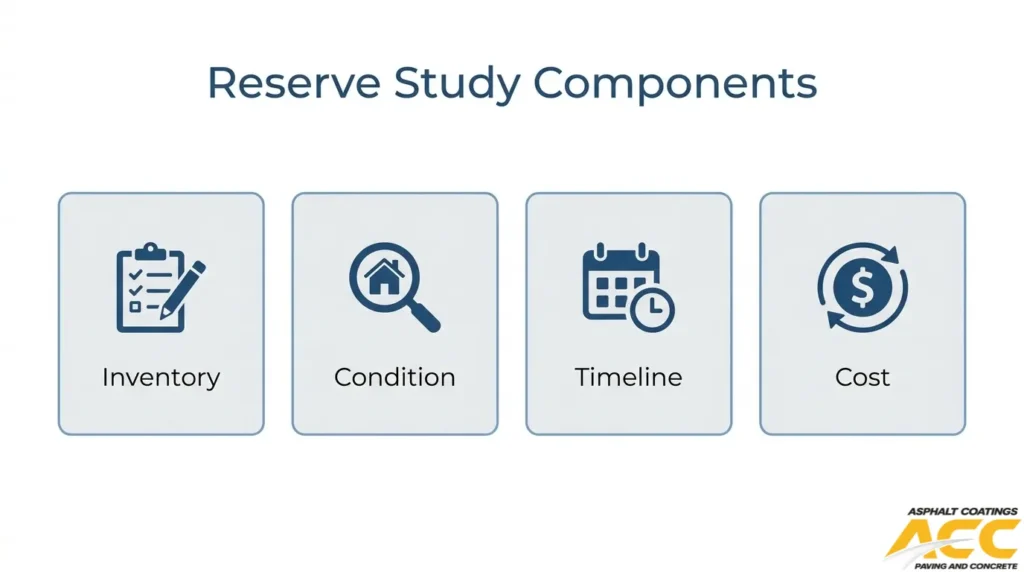
A reserve study typically includes an itemized inventory of every paved component, its current condition, estimated remaining useful life, and projected replacement cost. For parking lots specifically, the study also accounts for related elements:
- Asphalt pavement surface area and thickness
- Sealcoating and crack sealing cycles
- Striping, ADA-accessible spaces, and signage
- Drainage infrastructure and curbing
- Subgrade condition assessments
According to Oregon Revised Statutes § 94.595, a homeowners association must establish a reserve account to fund major maintenance, repair, or replacement of all common property items that will normally require work within one to 30 years.
The study also flags ADA compliance triggers. The U.S. Access Board notes that resurfacing a vehicular way qualifies as an “alteration,” which means accessible parking spaces must be evaluated whenever a lot is repaved. Boards that skip this step risk costly change orders mid-project. A well-scoped reserve study captures these obligations upfront so nothing is missed during bidding.
How Often Should an HOA or Apartment Community Update Its Reserve Study for Paving?
An HOA or apartment community should update its reserve study for paving at least annually, with a comprehensive professional review every three years. According to Washington State Legislature RCW 64.90.545, an updated reserve study must be prepared annually, and at least every third year a reserve study professional must conduct a visual site inspection as the basis for that update.
Annual reviews allow boards to adjust funding levels as material costs fluctuate and pavement conditions change. The three-year professional inspection catches deterioration that internal reviews may miss, particularly subsurface failures not visible during routine walkthroughs. For communities in climates with harsh freeze-thaw cycles, even a single severe winter can accelerate damage enough to shift a parking lot from a maintenance candidate to a full reconstruction project. Keeping the study current prevents that kind of surprise.
How Can a Reserve Study Help Prevent Special Assessments for Large Paving Projects?
A reserve study helps prevent special assessments for large paving projects by spreading the financial burden across years of planned contributions rather than requiring a lump-sum collection when the lot fails. When boards fund reserves according to the study’s annual contribution schedule, the money is already in the account when paving work becomes necessary.
Without adequate reserves, boards face difficult choices. Under Florida Statutes § 720.303(6)(d), establishing reserve accounts requires affirmative approval of a majority of total voting interests. If reserves are underfunded and a parking lot deteriorates beyond maintenance, the board may have no option except a special assessment, which often triggers owner pushback and payment disputes.
Consistent reserve funding also protects purchasing power. Inflation erodes cash value over time, so a study that projects costs five to ten years out gives the board a realistic savings target. Communities that treat the reserve study as a living financial plan, rather than a one-time report, are far less likely to face the emergency assessments that damage both budgets and community trust.
With reserve funding established, boards can turn their attention to evaluating the parking lot’s current condition and remaining useful life.
How Do You Estimate the Remaining Useful Life of an Existing Parking Lot?
You estimate the remaining useful life of an existing parking lot through a reserve study that documents each component’s age, condition, and projected replacement timeline. Key factors include visual distress signs, climate exposure, and maintenance history.
What Visual Signs Suggest It Is Time to Plan for Major Paving or Reconstruction?
The visual signs that suggest it is time to plan for major paving or reconstruction include progressive surface failures that routine maintenance can no longer correct. A reserve study identifies each component and states its estimated remaining useful life, so boards should watch for distresses that signal accelerated decline:
- Alligator cracking across interconnected areas, indicating base failure beneath the surface.
- Deep rutting in travel lanes caused by repeated loading on weakened subgrade.
- Widespread potholes that reappear shortly after patching.
- Standing water or ponding that signals drainage failure and subsurface erosion.
- Oxidized, gray-white surface texture where the asphalt binder has fully deteriorated.
When these conditions appear across a significant portion of the lot, surface treatments alone will not restore structural integrity. Boards that document distress progression during annual inspections can align capital planning with their reserve study’s replacement timeline rather than reacting to emergencies.
How Do Climate and Freeze–Thaw Cycles Affect Asphalt Lifespan in Community Lots?
Climate and freeze–thaw cycles affect asphalt lifespan in community lots by accelerating moisture infiltration and structural fatigue. Water enters small cracks, freezes, expands, and widens the damage with each cycle. According to a 2022 article from the American Society of Civil Engineers, resilient flexible roads should be designed to withstand conditions likely during their design life, accounting for the impact of climate change on pavement performance in response to daily and seasonal changes in heat, precipitation, freeze–thaw cycles, and extreme weather events.
Communities in regions with harsh winters or wide temperature swings often see useful life fall well below the standard 25-year benchmark. For Colorado specifically, high-altitude UV exposure compounds freeze–thaw damage by oxidizing the binder faster. Boards should factor local climate severity into reserve study projections rather than relying on national averages alone.
When Is Sealcoating and Crack Sealing Enough Versus Full Mill-and-Overlay or Reconstruction?
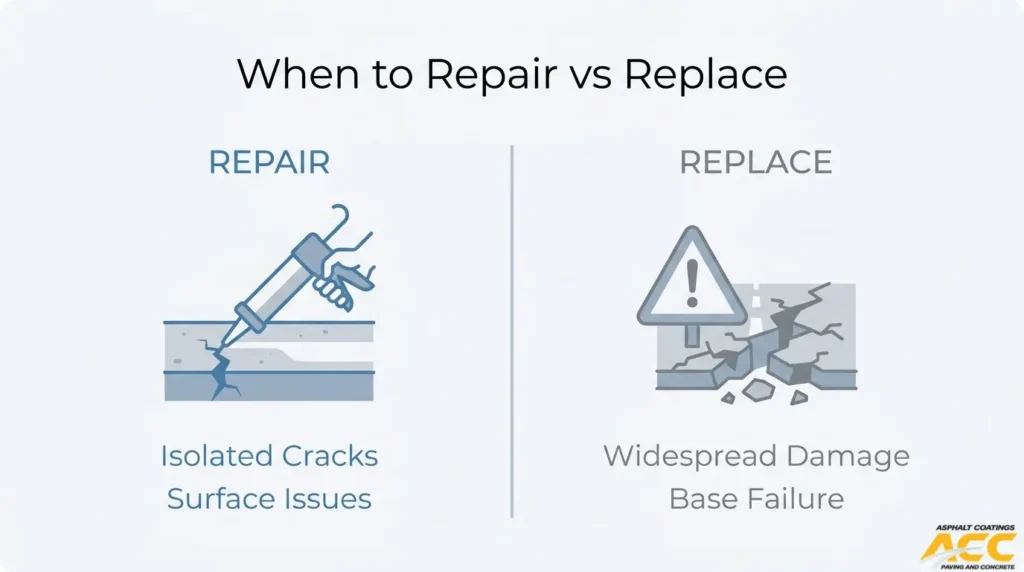
Sealcoating and crack sealing are enough when surface distress remains cosmetic and structurally isolated; full mill-and-overlay or reconstruction becomes necessary when damage is widespread or structural. The decision hinges on how much of the pavement area shows active failure.
According to the Iowa State University Institute for Transportation’s guide on full-depth reclamation, this rehabilitation method is a cost-effective strategy for pavements requiring patching in excess of 15 to 20 percent of the existing pavement area, and is also useful for pavements exhibiting advanced distress such as severe linear cracking, block cracking, alligator cracking, shoving, or rutting.
A practical framework for boards:
- Sealcoating and crack sealing: Appropriate when cracks are narrow, isolated, and the surrounding pavement is still firm. These treatments protect sound asphalt from moisture and UV degradation.
- Mill-and-overlay: Suited for lots where surface distress is moderate but the base layer remains structurally sound.
- Full reconstruction: Required when base failure, subgrade issues, or distress covering more than 15 to 20 percent of the surface makes overlaying ineffective.
In my experience, boards often delay too long in the middle zone, spending repeatedly on patches when an overlay would deliver better long-term value per dollar. Understanding where your lot sits on this spectrum directly shapes reserve study projections and funding timelines.
How Should Boards Budget and Build Reserves for Future Paving Work?
Boards should budget and build reserves for future paving work by aligning annual contributions with a phased replacement timeline, itemizing all paving-related costs, and communicating funding needs transparently to owners.
How Can Boards Use Phased Paving Plans to Match Reserve Contributions?
Boards can use phased paving plans to match reserve contributions by dividing the community’s paved areas into sections and scheduling each section for repair or replacement across multiple budget years. This approach spreads costs evenly, preventing a single large assessment from hitting owners all at once.
A multi-building property illustrates the logic well. The King County Housing Authority’s Juanita Court paving improvements bid package, covering eleven residential buildings and one management office, included a $14,400 owner allowance for added work contingency. That contingency structure shows how phased planning accounts for unexpected costs within each stage.
Boards should map every lot section to a target year, then back-calculate the annual reserve deposit needed per phase. Steady, predictable contributions are far easier for owners to absorb than emergency lump sums.
What Line Items Should Be Included in a Paving Reserve Budget for HOAs and Apartments?
The line items that should be included in a paving reserve budget for HOAs and apartments are:
- Full replacement or reconstruction costs for each parking lot section
- Mill-and-overlay allowances for lots not yet requiring full reconstruction
- Sealcoating and crack sealing cycles on a three-to-five-year rotation
- Striping and ADA-compliant marking renewal
- Drainage and subgrade repairs tied to paving work
- Engineering and reserve study update fees
- Contingency allowance (typically 5 to 15 percent of estimated project cost)
- Inflation adjustment applied annually to projected replacement costs
According to the California Department of Real Estate’s Reserve Study Guidelines for Homeowner Association Budgets, reserves are an important part of the association’s annual pro forma operating budget. Treating paving as an integrated budget category, not a surprise expense, is the most reliable way to protect an association’s financial health.
How Can Boards Communicate Reserve Funding Needs for Paving to Owners and Residents?
Boards can communicate reserve funding needs for paving to owners and residents by presenting clear, visual financial summaries that connect current lot conditions to future costs. Owners respond better to concrete numbers paired with photographs of pavement distress than to abstract budget tables alone.
Effective communication strategies include:
- Annual reserve disclosure letters showing the current funding level and target balance
- Town hall meetings or open board sessions where the reserve study findings are reviewed
- Side-by-side comparisons of steady reserve contributions versus a potential special assessment
- Condition photo updates distributed with meeting minutes or newsletters
Transparency builds trust. When owners understand that small, consistent monthly contributions prevent large one-time charges, resistance to reserve increases typically decreases. Boards that invest time in education upfront spend far less time managing disputes later.
With reserves properly funded and communicated, the next step is securing the formal approvals needed to move a paving project forward.
What Steps Should HOAs and Apartment Boards Follow to Get Paving Projects Approved?
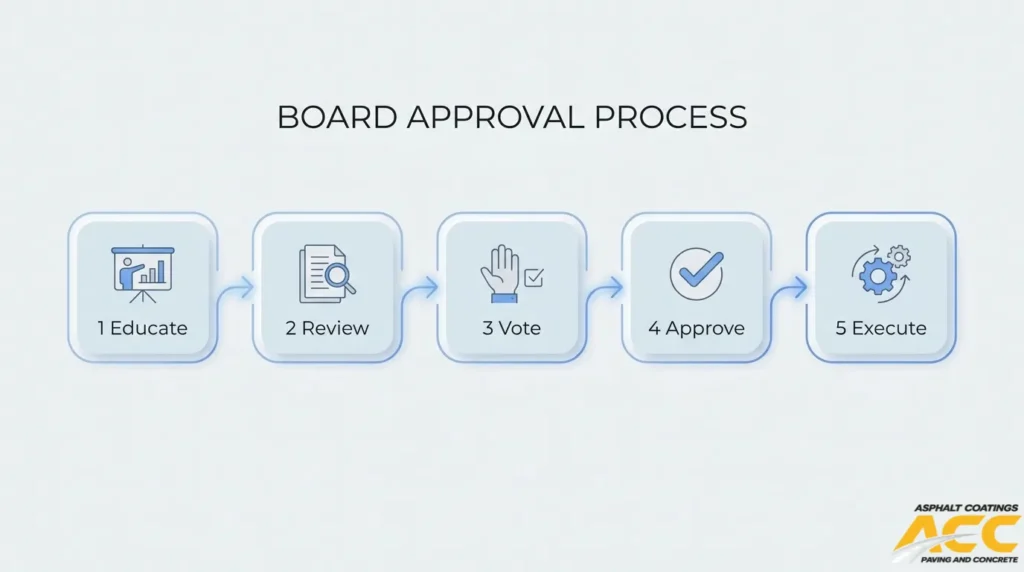
HOAs and apartment boards should follow a sequence of education, governance review, and stakeholder engagement to get paving projects approved. The key steps include educating homeowners on lot conditions, determining whether a membership vote or board approval applies, and addressing objections about cost and disruption.
How Should Boards Educate Homeowners and Stakeholders About Parking Lot Conditions?
Boards should educate homeowners and stakeholders about parking lot conditions by presenting documented evidence of pavement deterioration alongside reserve study findings. Effective education methods include:
- Sharing photos and condition reports that show cracking, potholes, or drainage failures in the lot.
- Distributing reserve study excerpts that highlight the parking lot’s remaining useful life and projected replacement cost.
- Hosting open meetings where a paving professional or reserve analyst can explain the scope and urgency of needed work.
- Providing written summaries that connect deferred maintenance to rising repair costs over time.
Boards that invest in early, transparent communication tend to face far fewer surprises at the approval stage. When residents understand what they are looking at in the parking lot and why the reserve study flags it, the conversation shifts from “why are we spending this?” to “how do we get it done right?”
When Is a Membership Vote Required Versus Simple Board Approval for Paving?
A membership vote is required versus simple board approval for paving when governing documents or state statutes mandate owner consent for reserve funding, special assessments, or capital expenditures above a defined threshold. According to Florida Statutes § 720.303(6)(d), an association is deemed to have provided for reserve accounts upon the affirmative approval of a majority of the total voting interests, obtained either by vote at a duly called meeting or by written consent of a majority of voting interests.
Boards should review their CC&Rs and bylaws carefully, because many communities set dollar thresholds that separate routine maintenance approvals from projects requiring a full membership vote. If the paving project falls within an already funded reserve category and stays under the board’s spending authority, simple board approval may suffice.
How Can Boards Handle Objections or Concerns About Cost, Disruption, and Timing?
Boards can handle objections or concerns about cost, disruption, and timing by preparing clear, data-backed responses before the approval meeting. Common objections and effective responses include:
- Cost concerns: Present the reserve study’s funding projections alongside competitive bids to show the project fits within planned contributions or explain why a special assessment is necessary.
- Disruption worries: Outline a phased construction plan that maintains partial parking access throughout the project, with specific dates and alternative parking locations.
- Timing disputes: Show how deferring the project increases deterioration and raises future costs, using condition data from the lot inspection.
Acknowledging concerns directly, rather than dismissing them, builds the trust boards need to move forward. The strongest boards treat the approval meeting as a conversation, not a presentation, and come prepared with a written FAQ that addresses the most predictable pushback.
With project approval secured, the next step is defining a clear scope and specification for the paving work itself.
How Do You Scope and Specify a Paving Project for a Community Parking Lot?
You scope and specify a paving project for a community parking lot by defining every technical, logistical, and compliance requirement before soliciting bids. The subsections below cover RFP details, drainage and subgrade, ADA compliance, and phasing with traffic control.
What Project Details Should Be Included in an RFP or Bid Request for Paving?
The project details that should be included in an RFP or bid request for paving cover the full technical and administrative scope. A well-structured RFP prevents scope creep and cost overruns during construction. Key elements to include are:
- Total square footage and boundaries of the paving area
- Existing pavement condition, including core samples or PCI ratings
- Specified work type (mill-and-overlay, full-depth reconstruction, or new construction)
- Material specifications such as asphalt mix design, lift thicknesses, and compaction requirements
- Subgrade preparation and grading expectations
- Drainage improvements, curb and gutter work, and utility coordination
- ADA-compliant accessible parking spaces, access aisles, and signage
- Striping layout with dimensions and paint or thermoplastic specifications
- Insurance, bonding, and licensing requirements for bidders
- Project timeline, phasing plan, and liquidated damages for delays
- Warranty terms for materials and workmanship
Boards that invest time in a detailed RFP receive tighter, more comparable bids and significantly reduce the risk of change orders mid-project.
How Should Boards Address Drainage, Slope, and Subgrade Issues in the Scope?
Boards should address drainage, slope, and subgrade issues in the scope by requiring a site evaluation before any paving specifications are finalized. Poor drainage and weak subgrade cause premature pavement failure, regardless of surface quality.
The scope should specify minimum slope grades (typically 1% to 2%) to direct stormwater away from buildings and toward catch basins or retention areas. Subgrade testing, including soil compaction and moisture content analysis, determines whether stabilization or additional base material is needed. If existing pavement shows structural distress such as alligator cracking or rutting, the scope must call for subgrade correction before overlay work begins. Failing to address these hidden conditions is one of the most common reasons community paving projects exceed their original budgets.
How Can HOAs Ensure ADA and Accessibility Requirements Are Included in the Plan?
HOAs can ensure ADA and accessibility requirements are included in the plan by referencing federal standards directly in the project scope. According to the U.S. Access Board, accessible spaces are required where parking facilities are altered or added, and the term “alterations” includes resurfacing of vehicular ways. This means any repaving project triggers ADA compliance obligations.
The plan should specify:
- The correct number of accessible spaces calculated per lot, not per site
- Van-accessible spaces with adjacent access aisles wide enough for wheelchair maneuvering
- Compliant signage height and placement
- Accessible routes connecting parking to building entrances, including curb ramps with detectable warning surfaces
Overlooking these requirements exposes the association to costly retrofits and potential legal liability after the project is complete.
What Phasing and Traffic-Control Questions Should Boards Ask to Minimize Disruption?
The phasing and traffic-control questions boards should ask to minimize disruption focus on resident access, safety, and project sequencing. Before approving a contractor’s plan, boards should confirm answers to these questions:
- How many phases will the project require, and what is the duration of each phase?
- Which sections of the lot will be closed during each phase, and where will displaced vehicles park?
- Will emergency vehicle access be maintained at all times throughout the project?
- What signage, barricades, and traffic control devices will be used, and who is responsible for them?
- How will the contractor communicate daily schedule changes to management and residents?
- What is the required asphalt cure time before vehicles can return to freshly paved sections?
Clear phasing and traffic-control expectations, documented in writing, protect both residents and the board from preventable conflicts during construction.
How Should HOAs and Apartment Communities Evaluate Paving Contractor Proposals?
HOAs and apartment communities should evaluate paving contractor proposals by verifying qualifications, comparing scope details side by side, assessing crew structure, and watching for red flags. The following subsections cover each evaluation step.
What Qualifications and Insurance Documentation Should Boards Require From Paving Contractors?
Boards should require a current contractor’s license, a Certificate of Insurance proving valid public liability and property damage coverage, and surety bond documentation. According to the Oregon Construction Contractors Board, a Certificate of Insurance showing proof of a valid public liability and property damage insurance policy is required, and Oregon law requires contractors to carry surety bonds.
Beyond these baseline documents, boards should request:
- A performance and payment bond equal to the contract price.
- Proof of workers’ compensation coverage.
- A written workmanship warranty of at least one year.
- References from completed HOA or apartment community projects.
Reviewing these documents before shortlisting protects the association from liability exposure and unfinished work.
How Can Boards Compare Bids That Use Different Materials, Thicknesses, or Scopes?
Boards can compare bids that use different materials, thicknesses, or scopes by normalizing each proposal into a standardized line-item format. When one contractor proposes a 2-inch hot-mix asphalt overlay while another specifies 3 inches over milled surface, the cost-per-square-foot figure alone is misleading.
To make an accurate comparison, boards should require each bidder to itemize:
- Asphalt mix type and thickness.
- Base preparation or milling depth.
- Drainage corrections and subgrade work.
- ADA-compliant striping and signage.
- Mobilization, traffic control, and contingency allowances.
Placing these line items in a comparison spreadsheet reveals where scope gaps exist. The lowest total price often excludes critical work that other bidders include, so matching scope before comparing cost prevents costly change orders later.
Why Should Boards Prioritize Contractors With In-House Crews Over Subcontractors?
Boards should prioritize contractors with in-house crews because direct employment gives the general contractor full control over scheduling, quality standards, and accountability. When a paving company subcontracts key phases, the board loses a direct chain of command if problems arise during milling, grading, or overlay placement.
According to the City of Salisbury, North Carolina’s Bid No. 026-2024 Asphalt Paving RFP, the contractor shall furnish a Performance and Payment Bond covering obligations to pay subcontractors and others for material and labor, and shall guarantee all materials and workmanship for one year from acceptance.
In-house crews also reduce the risk of miscommunication between trades. For HOA and apartment projects where residents need reliable timelines, a single crew working under one supervisor typically delivers tighter schedule adherence and consistent workmanship across every phase.
What Red Flags in a Paving Proposal Should Cause a Board to Pause or Rebid?
Red flags in a paving proposal that should cause a board to pause or rebid include vague scope language, missing insurance documents, and unusually low pricing without explanation.
Specific warning signs to watch for:
- No itemized breakdown of materials, labor, and equipment.
- Absence of a written warranty or guarantee period.
- Refusal to provide a performance bond or proof of surety.
- No mention of ADA compliance, drainage, or subgrade evaluation.
- A timeline that seems unrealistically short for the project size.
- Pressure to sign quickly before a “price increase.”
Any proposal that omits these details likely signals a contractor who will rely on change orders to recover margin. Boards that encounter multiple red flags should reject the bid and rebid with a more detailed RFP rather than negotiate missing terms after award.
With contractor evaluation complete, the next step is addressing the legal and governance requirements that affect board approval.
What Legal, Governance, and Compliance Issues Affect Board Approval of Paving?
Legal, governance, and compliance issues that affect board approval of paving include CC&R restrictions, notice and meeting requirements, ADA obligations, local building codes, and contract review thresholds. The following subsections cover governing document authority, procedural requirements, accessibility mandates, and when legal counsel is essential.
How Do CC&Rs, Bylaws, and Governing Documents Guide Paving Decisions?
CC&Rs, bylaws, and governing documents guide paving decisions by defining the board’s authority over common elements, setting spending thresholds, and establishing approval procedures. Most CC&Rs designate parking lots and roadways as common areas the association must maintain. Bylaws typically specify whether a paving project requires only board approval or a full membership vote, often based on dollar amount or percentage of reserves being spent. Governing documents may also restrict assessment increases, require competitive bidding above certain values, or mandate reserve fund usage for capital improvements. Boards should review these documents before soliciting bids, because exceeding authorized spending limits or skipping a required vote can expose the association to legal challenges from homeowners.
What Notice and Meeting Requirements Apply When Approving Major Reserve Projects?
Notice and meeting requirements that apply when approving major reserve projects include written advance notice to all members, open board meetings, quorum verification, and documented voting procedures. Most state statutes and association bylaws require boards to provide written notice, often 10 to 30 days before a meeting where major capital expenditures will be discussed or voted on. The notice should describe the project scope, estimated cost, and funding source. Open meeting laws in many states require that reserve spending decisions occur during properly noticed meetings, not through informal email polls. Failing to follow these procedures can invalidate a board’s approval and create grounds for owner lawsuits. Accurate meeting minutes documenting the vote protect the board if decisions are later questioned.
How Do ADA and Local Code Requirements Affect Parking Lot Design and Striping?
ADA and local code requirements affect parking lot design and striping by mandating accessible space counts, access aisle dimensions, signage placement, and slope maximums. Under federal ADA standards, an access aisle is a designated space for maneuvering a wheelchair or mobility device when entering or exiting a vehicle, immediately adjacent to a properly designated accessible parking space, and it must be marked to discourage parking in it. Resurfacing triggers compliance obligations; the U.S. Access Board classifies resurfacing of vehicular ways as an alteration requiring updated accessible features. Local fire codes and municipal ordinances may impose additional requirements for lane widths and emergency access. During construction, parking restrictions are often needed to allow heavy construction activity, which usually requires maintaining a local and emergency lane at all times. Boards should verify both federal and local requirements before finalizing striping plans.
When Should Boards Consult Legal Counsel Before Approving a Paving Contract?
Boards should consult legal counsel before approving a paving contract whenever the project involves large reserve expenditures, special assessments, complex contractor agreements, or regulatory compliance obligations. Contract review is especially important for verifying bonding requirements; according to the California Contractors State License Board, a Contractor’s Bond of $25,000 must be in place before the CSLB can issue or renew an active license. Legal counsel can also review indemnification clauses, insurance certificates, warranty terms, and lien waiver provisions. For projects that affect public access or traffic flow, attorneys familiar with local construction regulations can confirm the board meets notification and permitting obligations. Skipping legal review on large contracts is one of the most common governance mistakes boards make, often leading to disputes that cost far more than the attorney’s fee would have.
With compliance frameworks addressed, planning construction logistics and resident communication keeps the project running smoothly.
How Should Boards Plan Construction Logistics and Resident Communication for Paving?
Boards should plan construction logistics and resident communication for paving by phasing work to preserve access, issuing advance notices, coordinating with emergency services, and enforcing barricade compliance. The following sections cover phasing, notification, vendor coordination, and enforcement.
How Can HOAs Phase Work to Maintain Access and Parking During Paving?
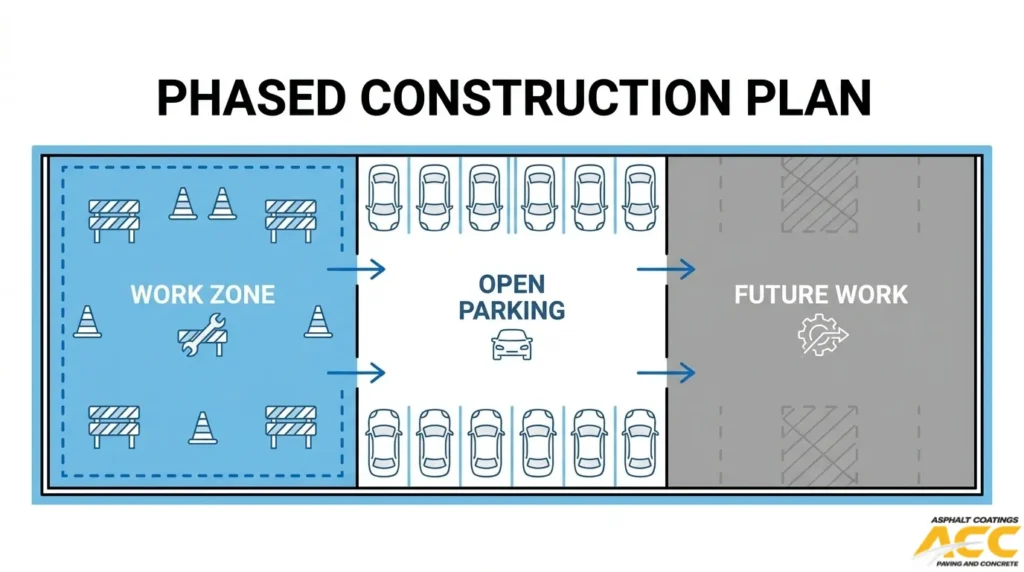
HOAs can phase work to maintain access and parking during paving by dividing the lot into sections and completing one zone at a time. This approach keeps a portion of the lot open for residents while crews work on the closed section. Temporary parking maps should identify overflow areas, nearby street parking, or shared spaces with adjacent properties.
Accessible parking requires special attention during phasing. According to the U.S. Department of Justice, the number of accessible parking spaces must be considered separately for each parking structure, not based on the total number of spaces provided on a site. Each active phase must maintain ADA-compliant spaces with proper access aisles within the open zone. Boards that overlook this requirement risk both compliance violations and resident hardship.
What Is the Best Way to Notify Residents and Tenants About Paving Schedules and Closures?
The best way to notify residents and tenants about paving schedules and closures is through layered communication delivered at multiple intervals before work begins. Effective notification combines written and digital channels to reach every household.
A practical notification timeline includes:
- Mailing or emailing a project overview 30 days before the start date, outlining the full scope, phasing plan, and expected duration.
- Posting physical signs at lot entrances and building common areas 14 days before each phase begins.
- Sending reminders 48 to 72 hours before vehicle-move deadlines for each zone.
- Providing a day-of contact number so residents can reach property management with urgent questions.
Clear, repeated communication is the single most effective tool boards have for preventing conflicts and vehicle-towing situations during active paving.
How Should Boards Coordinate With Towing, Emergency Services, and Vendors During the Project?
Boards should coordinate with towing, emergency services, and vendors during the project by establishing written agreements and communication protocols before construction begins. A well-defined scope prevents reactive decision-making once heavy equipment arrives.
Key coordination steps include:
- Confirming a towing company is on standby with pre-authorized instructions for vehicles left in active work zones.
- Notifying local fire and EMS dispatch of the project timeline, affected access routes, and any temporary lane closures.
- Requiring the paving contractor to maintain an emergency access lane at all times.
- Scheduling delivery windows for other property vendors so trucks do not block active paving zones.
According to a 2017 study cited by the Kentucky Transportation Center, scope creep is the most common reason for costs increasing or projects falling behind schedule. Locking in vendor coordination details before mobilization protects both the budget and the timeline.
What Rules and Enforcement Steps Help Ensure Residents Respect Paving Barricades and Cure Time?
The rules and enforcement steps that help ensure residents respect paving barricades and cure time include clear written policies, visible physical barriers, and consistent penalty enforcement.
Boards should implement the following measures:
- Distributing a signed acknowledgment form requiring each unit to confirm they understand vehicle-move deadlines and cure-time restrictions.
- Installing MUTCD-compliant barricades, cones, and signage around active work zones and freshly paved areas.
- Posting cure-time windows prominently at every lot entrance, specifying the exact hours the surface must remain untouched.
- Assigning a management representative to monitor compliance during the first 24 to 48 hours after each phase is paved.
- Enforcing fines or towing for vehicles that breach barricades, as outlined in the community’s governing documents.
Fresh asphalt typically needs 24 to 72 hours before it can handle vehicle traffic without surface damage. Boards that treat cure-time enforcement casually often end up paying for avoidable repairs.
With logistics and communication planned, boards can shift focus to protecting the new surface through routine maintenance.
How Can HOAs and Apartment Communities Protect Their Paving Investment After Approval?
HOAs and apartment communities can protect their paving investment after approval by budgeting for routine maintenance, scheduling preventive treatments on a fixed cycle, and retaining all warranty documentation. The subsections below cover specific maintenance tasks, treatment intervals, and record-keeping practices.
What Routine Maintenance Tasks Should Be Budgeted After a Major Paving Project?
The routine maintenance tasks that should be budgeted after a major paving project include:
- Crack sealing to prevent water infiltration and subgrade erosion.
- Sealcoating to shield the asphalt binder from UV degradation and oxidation.
- Re-striping and pavement markings to maintain ADA compliance and traffic flow.
- Pothole patching to address isolated failures before they spread.
- Drainage inspection and cleaning to keep catch basins and inlets clear.
According to the National Center for Asphalt Technology at Auburn University, crack sealing decreases further crack deterioration, protects the pavement structure from moisture damage, and ultimately extends pavement life, with a typical life extension of two to five years depending on traffic, climate, and pavement condition at the time of treatment. Boards that line-item each task in their annual operating budget avoid deferred maintenance that accelerates costly reconstruction.
How Often Should Communities Schedule Sealcoating, Crack Sealing, and Re-striping?
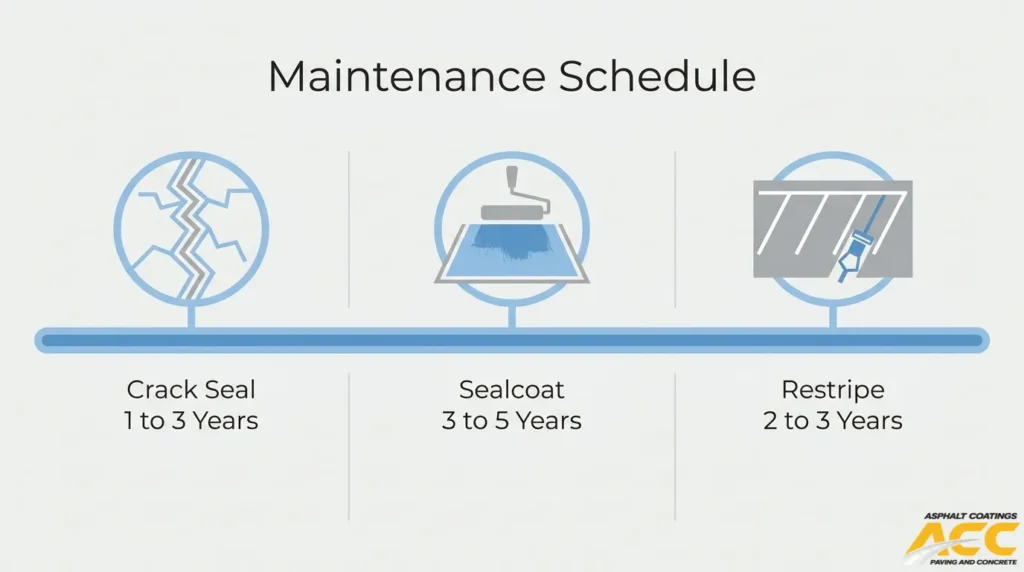
Communities should schedule sealcoating every three to five years, crack sealing as cracks appear (typically every one to three years), and re-striping every two to three years. According to North Carolina State University’s Transportation Department, lots should be sealcoated every three to five years to prevent the surface layer from breaking down.
Re-striping frequency depends on the marking material used. Epoxy and thermoplastic markings generally last three to five years, while standard traffic paint may fade within one to two seasons in high-traffic lots. Crack sealing should happen as soon as cracks are visible; waiting allows moisture penetration that compounds damage through freeze-thaw cycles. Staggering these treatments across budget years keeps annual costs predictable and avoids large lump-sum expenditures.
What Warranty and Documentation Should Boards Keep After Project Completion?
The warranty and documentation boards should keep after project completion include the signed contractor warranty, material certifications, as-built drawings, compaction test results, and final inspection reports. Boards should also retain the original contract, any change orders, and proof of insurance and bonding that was active during construction.
Most paving contractors guarantee materials and workmanship for at least one year from the date of project acceptance. Keeping organized records allows the board to enforce warranty claims if premature cracking, raveling, or drainage failures appear. Store digital copies in the association’s shared drive alongside the reserve study, so future board members can reference original specifications when planning maintenance or rebids.
With a structured maintenance plan in place, communities are positioned to maximize the full useful life of their new pavement.
How Can Asphalt Coatings Company Help HOAs and Apartment Communities Plan and Approve Paving Projects?
Asphalt Coatings Company can help HOAs and apartment communities plan and approve paving projects by providing site evaluations, phased construction plans, and long-term maintenance programs tailored to community budgets and board timelines.
How Can Asphalt Coatings Company Assist With Evaluations, Phased Plans, and Maintenance for Community Lots?
Asphalt Coatings Company assists with evaluations, phased plans, and maintenance for community lots by combining nearly four decades of Colorado-specific paving experience with a full suite of in-house services. Asphalt Coatings Company performs detailed site assessments that identify pavement distress, subgrade problems, and drainage concerns before boards commit to a scope of work.
Because Asphalt Coatings Company operates with in-house crews rather than subcontractors, phased projects stay on schedule without coordination gaps between multiple vendors. Services span the full lifecycle of a community lot:
- Asphalt paving and mill-and-overlay for full or partial reconstruction
- Sealcoating and crack sealing using CDOT-approved materials
- ADA-compliant concrete work, curb and gutter installation, and sidewalk construction
- Parking lot striping and marking to meet current accessibility codes
- Subgrade preparation and grading for proper drainage
This single-source approach simplifies board decision-making and keeps budgets transparent from the first estimate through final completion.
What Are the Key Takeaways About Paving an HOA or Apartment Community Lot, Reserve Studies, and Board Approval We Covered?
The key takeaways about paving an HOA or apartment community lot, reserve studies, and board approval are that successful projects depend on early financial planning, informed governance, and selecting the right contractor.
- Reserve studies should catalog every paved component by useful life, remaining life, and replacement cost so boards can fund projects incrementally rather than through emergency special assessments.
- Board approval requires clear communication with homeowners, proper notice under CC&Rs, and, in many states, a membership vote for major reserve expenditures.
- Project scoping must address drainage, ADA compliance, phasing for resident access, and contractor qualifications including bonding, insurance, and workmanship warranties.
- Post-paving maintenance, including sealcoating, crack sealing, and restriping, protects the investment and extends pavement life well beyond initial construction.
For communities across Colorado’s Front Range, Asphalt Coatings Company offers the expertise to guide boards from the reserve study stage through construction and ongoing maintenance, ensuring every dollar invested in pavement delivers lasting value.