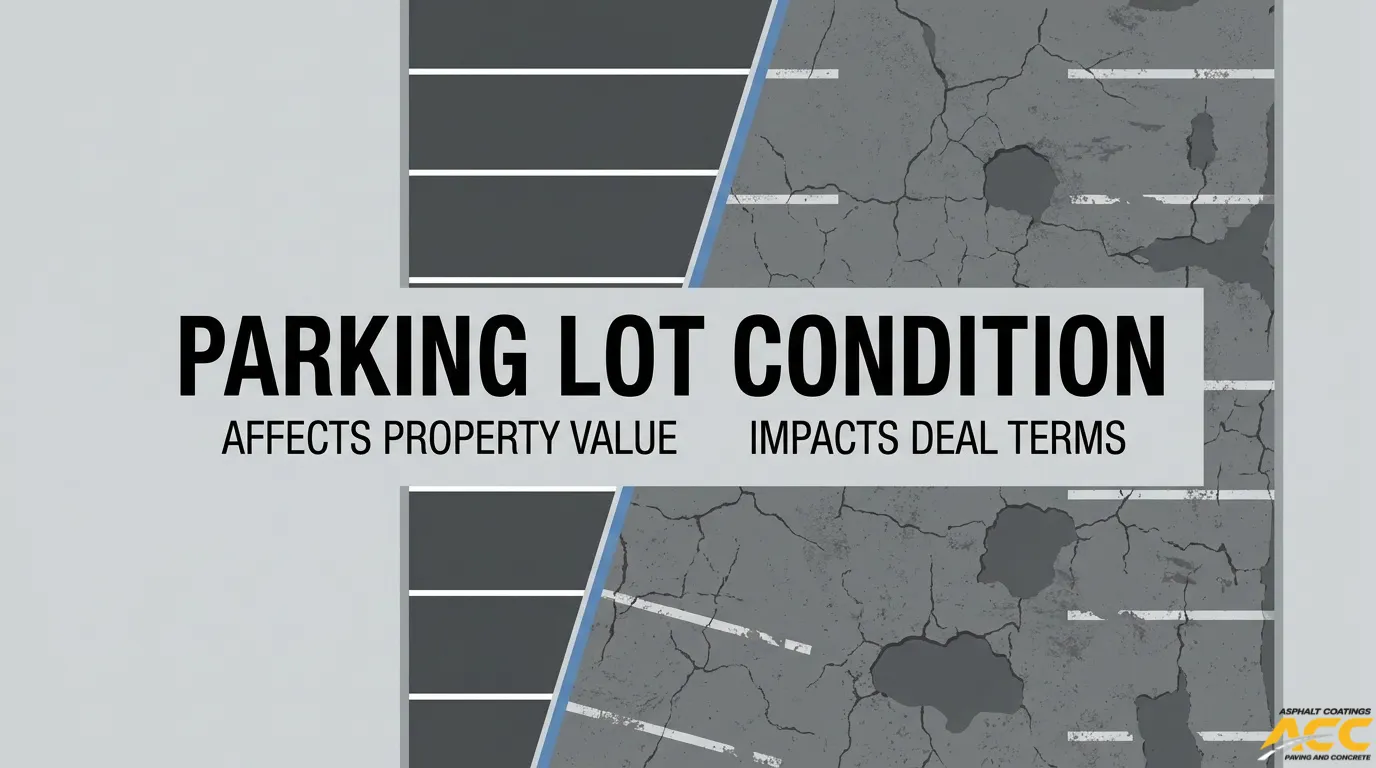
Parking lot condition in a commercial sale or refinance is a measurable property attribute that directly influences appraised value, lender underwriting decisions, tenant retention, and legal liability exposure. Appraisers evaluate pavement in its “as-is” physical state, and every visible defect on the inspection date factors into the market value conclusion.
This guide covers due diligence and valuation mechanics, pavement defects and climate-driven deterioration, financing and lender risk, repair strategy and capital planning, tenant and lease implications, safety and ADA compliance, and transaction negotiation tactics.
During due diligence, Property Condition Assessments document cracking, potholes, and drainage failures, feeding directly into replacement reserve calculations that lenders use to set loan terms. Appraisers rely on these findings to determine whether a parking lot represents routine maintenance or deferred capital expenditure.
Visible defects range from surface-level oxidation to structural base failure, and freeze-thaw cycles accelerate deterioration by expanding trapped moisture into cracks and potholes each winter season. The severity level determines whether spot repairs, milling and resurfacing, or full removal and replacement is warranted, with cost differences reaching 40 to 60 percent per square yard between overlay and full replacement.
Lenders respond to pavement deficiencies by requiring larger reserves, reducing loan-to-value ratios, or imposing escrow holdbacks that increase the borrower’s cost of capital. Tenant satisfaction drops when parking surfaces visibly deteriorate, compressing lease renewal rates and weakening net operating income projections.
Unresolved potholes and cracked surfaces create premises liability exposure, while ADA noncompliance triggers federal enforcement risk and buyer price adjustments. Proactive crack sealing, sealcoating, and striping completed before the appraisal date eliminate deferred maintenance flags and position the property for stronger deal outcomes.
Why Does Parking Lot Condition Matter to Buyers, Lenders, and Appraisers?
Parking lot condition matters to buyers, lenders, and appraisers because it directly affects property valuation, financing eligibility, and liability exposure. A deteriorating lot signals deferred maintenance, increases capital expenditure risk, and can trigger legal consequences that reduce a property’s marketability.
Buyers evaluate parking lot condition to estimate repair costs and negotiate purchase price adjustments. Lenders assess pavement condition as part of overall property risk, since deferred maintenance reduces collateral value and increases the likelihood of unexpected capital calls. Appraisers document the lot’s physical state to arrive at an accurate “as-is” market value, and visible defects can lower that figure or trigger reserve requirements.
The liability dimension is equally significant. In a premises-liability suit reviewed by the Supreme Court of Texas, a customer sustained serious injuries from tripping over an approximately 3/4-inch divot in a grocery store parking lot. Even minor surface defects create legal exposure that buyers and lenders factor into their risk calculations.
For commercial property owners approaching a sale or refinance, parking lot condition is not cosmetic. It is a measurable variable that influences the appraisal report, the lender’s underwriting decision, and the buyer’s willingness to close at the asking price. The sections ahead examine how each stakeholder evaluates lot condition, what defects matter most, and how strategic repairs can protect or improve deal outcomes.
How Is Parking Lot Condition Evaluated During Due Diligence?
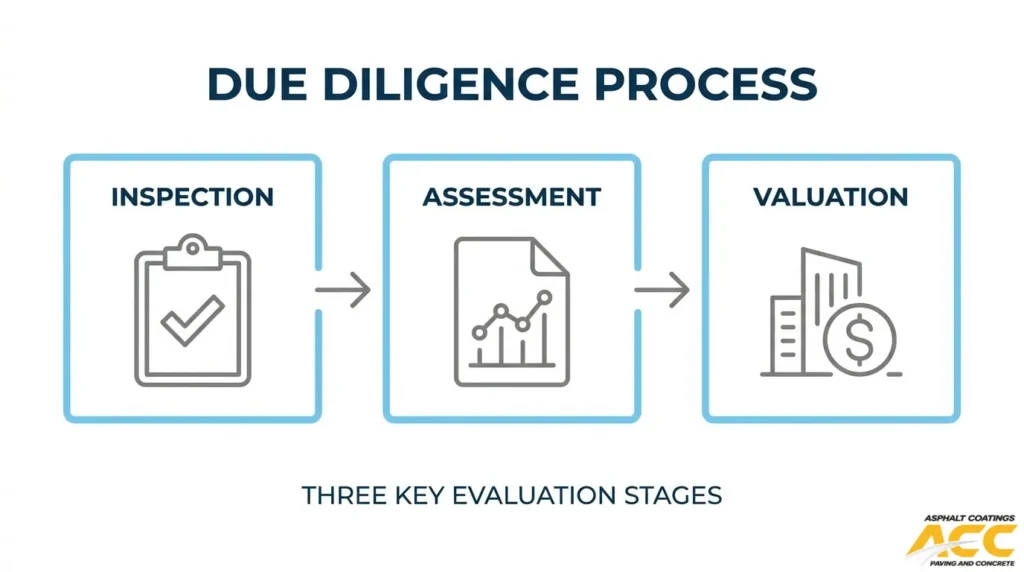
Parking lot condition is evaluated during due diligence through property condition assessments, appraisal inspections, and buyer walkthroughs that document pavement defects, deferred maintenance, and capital repair needs. The following sections cover the formal assessment process, what appraisers examine, and how buyers verify condition independently.
What Is a Property Condition Assessment for a Parking Lot?
A Property Condition Assessment for a parking lot is a third-party evaluation that documents the pavement’s physical state and projects capital expenditures over a defined period. According to Fannie Mae, a PCA is “a comprehensive evaluation of the overall physical condition” of a property “at a specific point in time and anticipated capital expenditures required at the Property over a specified evaluation period,” used by owners, lenders, and loan servicers as a capital planning and risk assessment tool. The assessor walks the lot, photographs distresses such as cracking, potholes, and drainage failures, and estimates remaining useful life. PCA findings feed directly into replacement reserve calculations and CapEx projections that lenders require before approving financing.
How Do Appraisers Assess Parking Lot Condition?
Appraisers assess parking lot condition by inspecting the pavement’s actual physical state and factoring deficiencies into the property’s “as-is” market value. They note visible distresses, including alligator cracking, rutting, faded striping, and ADA noncompliance. When a third-party property condition report is available, the appraiser uses it as the starting point for replacement reserve estimates. Without one, the appraiser must rely on market evidence or another substantive basis. Significant deferred maintenance on the parking lot can reduce the concluded value, because appraisers treat unresolved repair costs as a direct offset to what a buyer would pay. This is one area where proactive maintenance pays for itself before the appraiser ever arrives.
What Should Buyers Look for During a Parking Lot Walkthrough?
Buyers should look for pavement distresses, drainage problems, and code deficiencies during a parking lot walkthrough. Key items to inspect include:
- Standing water or ponding that signals grading or drainage failure.
- Longitudinal and alligator cracking, which indicate structural fatigue.
- Potholes, spalling, and base failure in high-traffic areas.
- Faded or missing striping, especially around ADA-accessible spaces.
- Crumbling curbs, damaged concrete sidewalks, and deteriorated catch basins.
- Evidence of prior patchwork repairs that may mask deeper problems.
According to Georgetown University’s Steers Center for Global Real Assets, thorough due diligence requires a property inspection that identifies “any structural issues or needed repairs as well as problematic environmental conditions.” Documenting each defect with photos and measurements gives buyers leverage to negotiate repair credits or price adjustments before closing.
With the evaluation complete, the next step is identifying the specific visible defects that signal deeper pavement problems.
What Visible Signs Indicate a Parking Lot Is in Poor Condition?
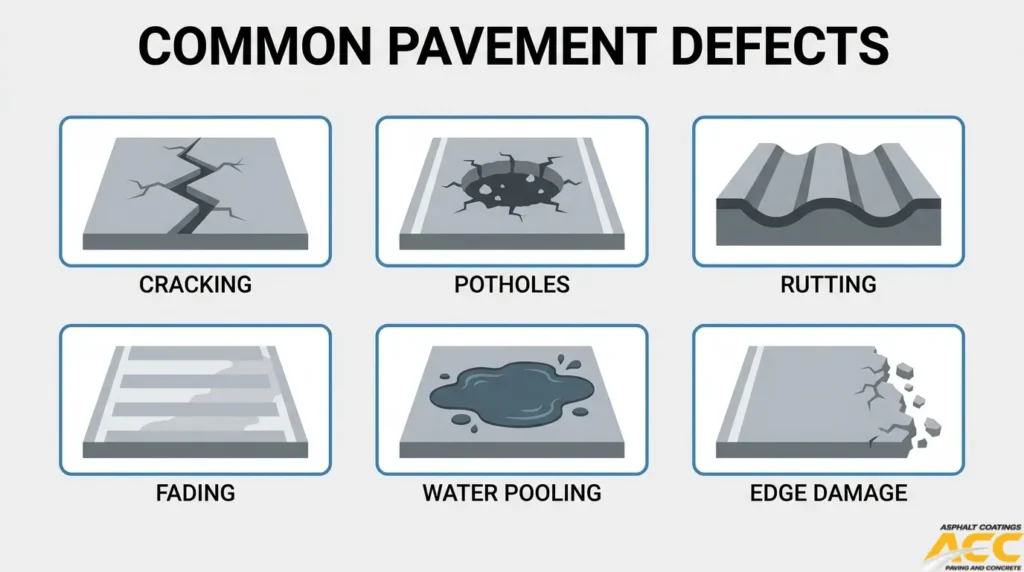
The visible signs that indicate a parking lot is in poor condition include cracking, potholes, rutting, spalling, faded striping, standing water, and crumbling edges. Each defect signals a different stage of deterioration that buyers, lenders, and appraisers evaluate during due diligence.
Cracking is typically the earliest and most common surface defect. Longitudinal cracks run parallel to traffic flow, while alligator cracking forms an interconnected pattern that signals structural failure in the base layers. Left unsealed, cracks allow water infiltration that accelerates subsurface damage.
Potholes form when water penetrates cracked pavement, erodes the base material, and causes the surface to collapse under traffic loads. According to the Federal Highway Administration, the Distress Identification Manual (DIM) provides a common language for describing cracks, potholes, rutting, spalling, and other pavement distresses, enabling standardized condition data collection and consistent pavement condition ratings.
Rutting appears as depressions in wheel paths caused by repeated traffic loading or inadequate base compaction. Spalling produces surface fragments that break away from joints or edges, exposing aggregate and weakening the pavement structure. Both defects worsen rapidly once water enters the damaged areas.
Additional visible indicators include:
- Faded or missing parking lot striping, which signals prolonged UV exposure and lack of sealcoat protection.
- Standing water or ponding after rain, which reveals grading failures or clogged drainage.
- Crumbling or undermined pavement edges where curbing has shifted or deteriorated.
- Uneven surfaces or settling near utility access points and catch basins.
For commercial transactions, these signs matter because each one represents a quantifiable repair cost that affects property valuation and lender risk assessment. A parking lot showing only hairline cracks needs far less capital than one with widespread alligator cracking and active potholes. Identifying the specific defect type and its severity helps property owners, buyers, and appraisers distinguish between routine maintenance needs and deferred capital expenditures that could reshape deal terms.
How Do Different Levels of Parking Lot Deterioration Impact Property Value?
Different levels of parking lot deterioration impact property value by directly shaping appraisal conclusions, tenant loyalty, and buyer risk perception. Minor surface wear, moderate structural distress, and severe failure each carry distinct financial consequences.
Appraisers are required to arrive at a supportable opinion of market value in the property’s “as-is” condition, according to the Appraisal Institute. This means every crack, pothole, and patch visible on the effective date of an appraisal feeds directly into the valuation conclusion. A lot showing only minor oxidation or hairline cracking signals routine maintenance needs, which rarely triggers significant value adjustments. Moderate deterioration, such as widespread alligator cracking or shallow rutting, suggests deferred maintenance that buyers and lenders price into their offers through repair escrows or purchase price reductions.
Severe deterioration presents a different equation entirely. When base failure, deep potholes, or standing water indicate the pavement has reached the end of its useful life, the cost conversation shifts from repair to full removal and replacement. That distinction can represent a difference of tens of thousands of dollars on a mid-size commercial lot, and it changes how underwriters assess the property’s net operating income and capital expenditure profile.
Beyond the appraisal itself, deterioration levels influence tenant behavior, which in turn affects income stability. According to research from the University of Reading, the perception of receiving value for money is the key determinant of occupiers’ loyalty and their stated likelihood of renewing a lease. A parking lot in visibly poor condition undermines that perception, particularly when tenants share maintenance costs through common area charges. Properties with moderate or severe lot damage tend to face higher vacancy risk, which compounds the direct repair cost with lost revenue.
For property owners approaching a sale or refinance, understanding where a parking lot falls on the deterioration spectrum is one of the most practical steps in protecting value. Minor issues addressed proactively cost a fraction of what severe failures demand, and they preserve the income stream that ultimately drives commercial property valuation.
How Does Parking Lot Condition Influence Financing Terms and Lender Risk?
Parking lot condition influences financing terms and lender risk by directly affecting how underwriters assess a property’s physical and financial profile. Lenders rely on Property Condition Assessments, capital expenditure projections, and reserve requirements to determine loan eligibility, interest rates, and escrow holdbacks.
A deteriorated parking lot signals deferred maintenance, which increases the lender’s perceived risk of future capital calls and income disruption. When a Property Condition Assessment identifies significant pavement deficiencies, lenders may respond in several ways:
- They may require larger replacement reserve deposits to cover anticipated repairs.
- They may reduce the loan-to-value ratio, limiting how much the borrower can finance.
- They may impose escrow holdbacks, withholding a portion of loan proceeds until repairs are completed.
- They may increase the interest rate to compensate for elevated collateral risk.
According to Fannie Mae, the Property Condition Assessment is a comprehensive evaluation of a property’s overall physical condition at a specific point in time and its anticipated capital expenditures over a defined evaluation period, serving as a capital planning and risk assessment tool for owners, managers, and mortgage lenders. When this assessment flags parking lot deterioration, it becomes a line item that directly shapes the lender’s underwriting model.
For borrowers, the practical takeaway is clear: addressing pavement deficiencies before the PCA inspection removes a variable that lenders use to tighten terms. Properties with well-maintained parking lots present lower collateral risk, which typically translates to more favorable loan structures. Neglecting the parking lot, by contrast, gives the lender leverage to impose conditions that increase the borrower’s cost of capital.
Understanding how lender risk assessments connect to pavement condition helps owners prepare for the defects most commonly flagged during inspections.
How Do Climate and Freeze-Thaw Cycles Affect Parking Lot Condition in Commercial Deals?
Climate and freeze-thaw cycles affect parking lot condition in commercial deals by accelerating pavement deterioration, which increases repair costs, lowers appraised values, and raises lender scrutiny during due diligence. Properties in cold-weather regions face unique risks that buyers, sellers, and appraisers must account for.
During freeze-thaw cycles, water inside the pavement expands when it freezes and contracts when it thaws. According to a 2024 University of Washington study on climate impacts to pavement, this phenomenon accelerates deterioration, leading to large cracks in rigid pavements such as concrete and potholes in flexible pavements such as asphalt. The cumulative effect compounds each winter season, meaning a parking lot that appears serviceable in autumn may show significant new distress by spring.
Beyond temperature cycling alone, cold climates introduce additional stressors:
- Deicing salts penetrate surface cracks and break down the asphalt binder.
- Snow plows scrape and gouge the pavement surface, removing protective sealcoat layers.
- Sand accumulation clogs drainage paths, trapping moisture against the pavement.
- Seasonal ground movement shifts the subgrade beneath the asphalt structure.
For commercial transactions, these climate-driven conditions carry direct financial consequences. Appraisers evaluate a property’s physical condition as of the inspection date, so a parking lot inspected after a harsh winter will reflect every pothole and crack in the “as-is” valuation. Lenders reviewing Property Condition Assessments in freeze-thaw regions often require larger replacement reserves to account for the shortened pavement life cycle. Buyers in these markets should time their inspections carefully; a mid-summer walkthrough may conceal damage that reappears with the first hard freeze.
From a practical standpoint, properties in freeze-thaw climates benefit most from proactive maintenance performed before listing or refinancing. Crack sealing before winter prevents water infiltration at the source, and sealcoating restores the protective barrier that temperature cycling erodes. Sellers who address these climate-specific vulnerabilities before the transaction reduce the likelihood of price reductions driven by deferred maintenance findings.
Understanding regional climate impact on pavement condition is essential, but equally important is recognizing the specific defects that buyers and inspectors flag most frequently.
What Are the Most Common Parking Lot Defects Found in Commercial Properties?
The most common parking lot defects found in commercial properties include cracking, potholes, rutting, surface deterioration, drainage failures, faded striping, and damaged curbing. Each defect creates distinct risks during a sale or refinance, from liability exposure to appraisal deductions.
Cracking is the most widespread defect. Longitudinal, transverse, and alligator cracking patterns indicate different stages of structural decline, ranging from surface-level oxidation damage to full subbase failure. Left untreated, cracks allow water infiltration that accelerates every other form of deterioration.
Potholes represent advanced-stage failure where the pavement surface has broken apart entirely. According to a report from Sandia National Laboratories and the U.S. Department of Energy, in 2007, SNL experienced over 100 cases of slips, trips, and falls, with almost half of those cases citing curb, parking lot, or parking bumper/barrier as the cause. Potholes create direct vehicle damage liability and trip-and-fall exposure that buyers and lenders flag immediately.
Additional defects commonly documented during property inspections include:
- Rutting and depressions that trap standing water and signal subgrade compaction failure.
- Spalling and raveling where the aggregate separates from the binder, leaving a rough, loose surface.
- Drainage failures caused by settled areas, blocked catch basins, or improper grading that directs water toward building foundations.
- Faded or missing striping that creates ADA compliance gaps and traffic flow confusion.
- Damaged curbing and wheel stops that compromise pedestrian safety and property boundaries.
From a transaction perspective, any defect that presents a safety hazard carries outsized weight. Buyers and lenders view unaddressed defects as deferred maintenance, which directly reduces appraised value and can trigger repair escrows or deal renegotiation. The defects that matter most are the ones that compound quickly when ignored, making early identification essential before listing or applying for refinancing.
How Do You Prioritize Parking Lot Repairs Before a Sale or Refinance?
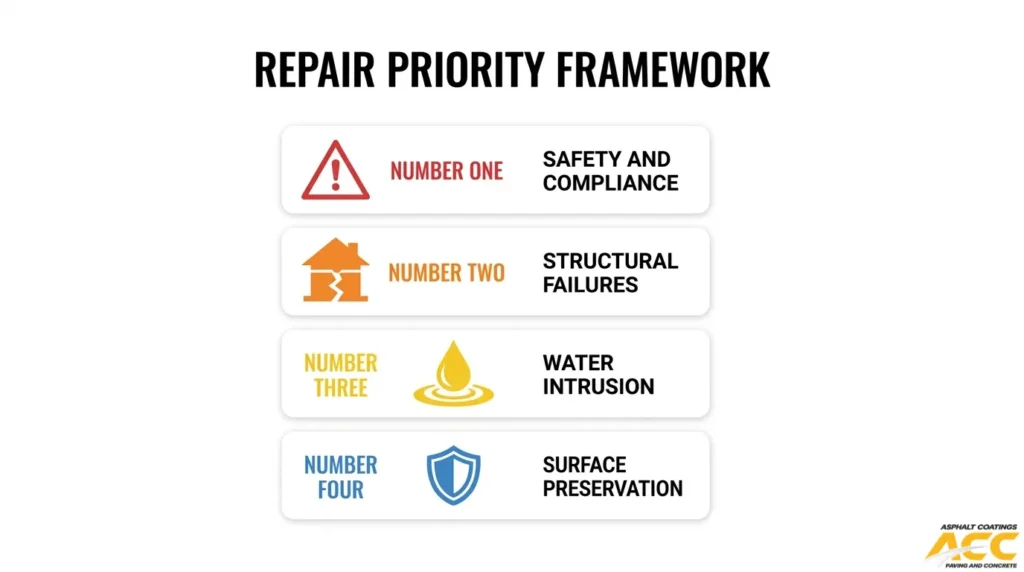
You prioritize parking lot repairs before a sale or refinance by addressing safety hazards and code violations first, then structural failures, and finally cosmetic improvements. The sequence below covers each priority tier.
Priority 1: Safety and compliance issues. ADA violations, tripping hazards from potholes or raised pavement, and missing signage create immediate legal exposure. These repairs eliminate deal-breaking red flags that appraisers, lenders, and inspectors flag during due diligence.
Priority 2: Structural failures. Base failures, deep rutting, and alligator cracking signal that the pavement’s load-bearing capacity is compromised. Leaving these unaddressed inflates the deferred maintenance estimate in a Property Condition Assessment, which directly reduces the appraised value or triggers lender holdbacks.
Priority 3: Water intrusion prevention. Crack sealing and drainage corrections stop moisture from reaching the subbase, where it causes the structural damage described above. A Tuolumne County, California parking lot repair project illustrates this sequencing: the scope required replacing approximately 4,050 square feet of damaged hot mix asphalt, filling all cracks with hot-applied crack filler, then sealcoating and restriping, including ADA space updates.
Priority 4: Surface preservation and curb appeal. Sealcoating and fresh striping come last because they deliver visual impact but offer no structural benefit. Applying them over unrepaired base failures wastes money and misleads no experienced buyer or appraiser.
For most commercial owners approaching a transaction, the instinct is to start with what looks best. That approach is backwards. Lenders and buyers scrutinize structural integrity and compliance first; cosmetic improvements matter only after those foundations are sound.
Understanding repair priorities prepares you for the next step: identifying which quick improvements deliver the highest curb appeal return.
What Parking Lot Repairs Can Boost Curb Appeal Quickly?
Parking lot repairs that boost curb appeal quickly include sealcoating, crack sealing, fresh striping, pothole patching, and ADA signage updates. Each targets a high-visibility defect that buyers and appraisers notice immediately.
Sealcoating restores the uniform dark finish of oxidized asphalt, covering minor surface wear in a single application. Crack sealing prevents water intrusion and eliminates the neglected appearance that interconnected cracks create. Fresh line striping sharpens the visual organization of stalls, fire lanes, and directional arrows, signaling active management to anyone walking the property.
Pothole patching removes the most conspicuous safety hazard a visitor can encounter. Even small divots suggest deferred maintenance, so addressing them before showings or inspections removes a common objection.
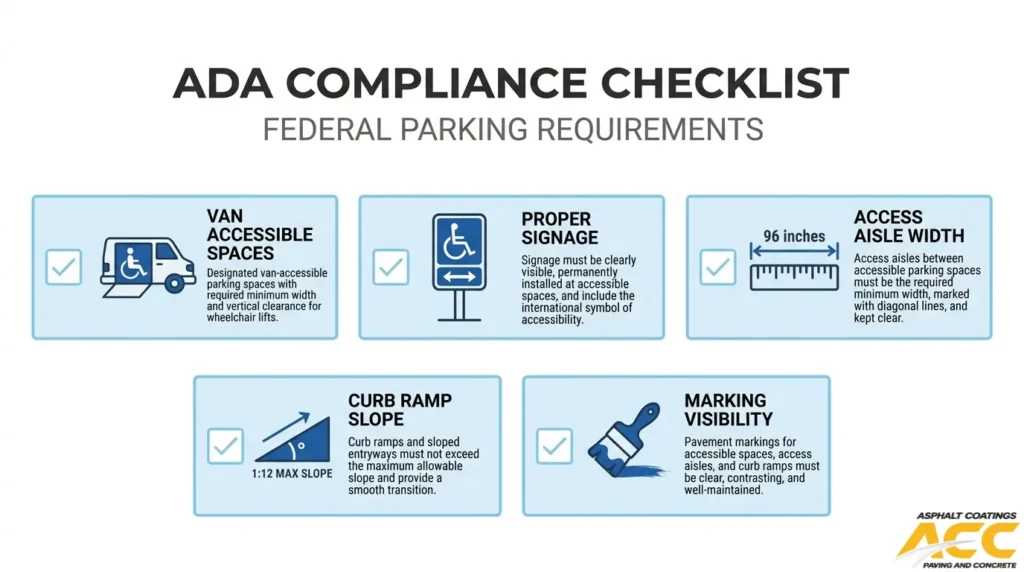
ADA-compliant updates also carry visual weight. According to the U.S. Access Board, at least one of every six accessible spaces must be van-accessible, and curb ramps cannot protrude into access aisles, which cannot slope more than 1:48 (§502.4). Properly mounted signage, clearly painted blue markings, and compliant ramp transitions communicate regulatory diligence at first glance.
For properties approaching a sale or refinance, these repairs deliver outsized returns relative to their cost because they address what appraisers and prospective buyers see first. A well-maintained surface creates the impression that the entire property has been cared for, while a neglected lot raises questions about hidden problems elsewhere.
How Do You Decide Between Parking Lot Repair, Resurfacing, or Full Replacement?
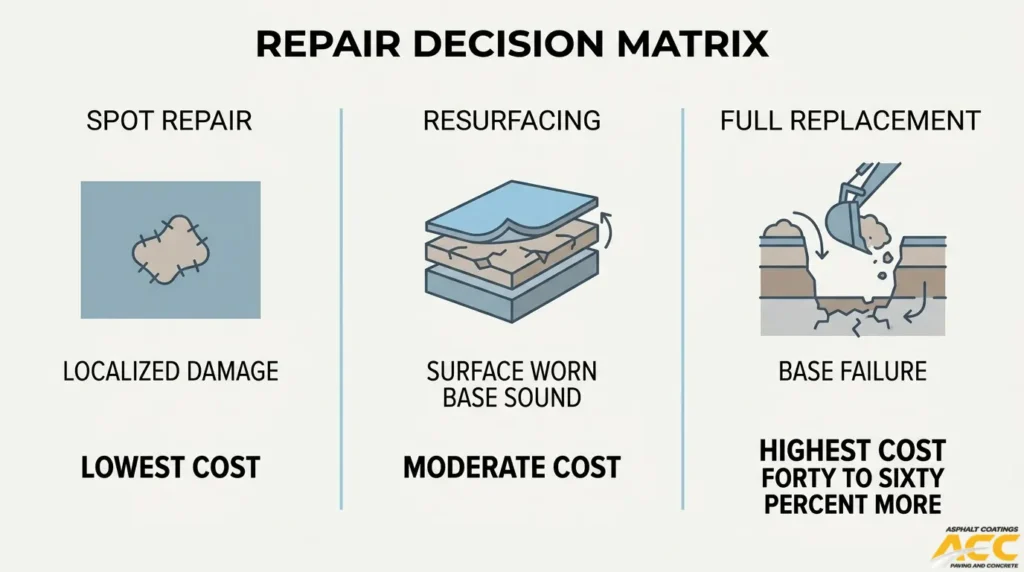
You decide between parking lot repair, resurfacing, or full replacement based on the extent of pavement deterioration, base condition, and project budget. Each option serves a different stage of pavement decline, and cost differences per square yard are significant.
Localized damage, such as isolated potholes or cracking in limited areas, typically calls for spot repair or full-depth patching. When surface distress spreads across the majority of the lot but the base remains structurally sound, milling and resurfacing or an asphalt overlay restores the driving surface without excavation. Full removal and replacement becomes necessary when base failure, widespread alligator cracking, or severe rutting compromise the subgrade itself.
According to a 2025 bid tabulation from the Village of Key Biscayne, Florida, cost benchmarks illustrate the gap between these approaches:
| Method | 0–500 SY (Low Bid) | 501–2,500 SY (Low Bid) | 5,000+ SY (Low Bid) |
| Milling and Resurfacing | $29.03/SY | $27.82/SY | $23.84/SY |
| Asphalt Overlay | $22.38/SY | $21.77/SY | $17.74/SY |
| Removal and Replacement | $35.68/SY | $35.08/SY | $29.94/SY |
Full replacement costs roughly 40–60% more per square yard than overlay at every project size. That premium is justified only when the existing base can no longer support a new surface layer. As the Building Owners and Managers Association International notes, parking lot repair and replacement are frequently overlooked items in commercial property budgets, which makes accurate scoping before a transaction even more critical.
A typical resurfacing project scope includes milling the existing surface, base repair where needed, full-depth pavement patching, new striping, and ancillary work such as drain relocation. Skipping the base assessment and defaulting to a cheaper overlay over a compromised subgrade is one of the most common mistakes property owners make; the savings disappear when the new surface fails prematurely.
For properties approaching a sale or refinance, choosing the right intervention level directly shapes the capital expenditure line in the pro forma and influences how appraisers assess remaining useful life.
How Should Parking Lot Condition Be Reflected in Your CapEx and Pro Forma?
Parking lot condition should be reflected in your CapEx and pro forma through dedicated line items for current repairs, scheduled preservation, and long-term replacement reserves. The subsections below cover capital expenditure modeling, pavement useful life, reserve planning, and how preservation treatments protect projected returns.
How Do You Build a CapEx Line Item for Parking Lot Work?
You build a CapEx line item for parking lot work by quantifying existing distresses, estimating repair costs, and scheduling expenditures across the hold period. A thorough approach separates immediate deferred maintenance from recurring preservation costs.
Key elements to include in the line item:
- Deferred maintenance costs for patching potholes, filling cracks, and correcting drainage failures identified during the property condition assessment.
- Periodic sealcoating and crack sealing budgeted on a two-to-four-year cycle.
- A mill-and-overlay or full replacement reserve timed to the pavement’s remaining useful life.
- ADA compliance upgrades if the current lot does not meet striping or access aisle standards.
According to the IRS, when a taxpayer owns an asphalt parking lot that has deteriorated after years of neglect and is no longer usable, the costs to restore it are capitalized as restoration costs. Distinguishing routine maintenance from capitalized improvements directly affects how expenses flow through your pro forma and tax treatment.
What Is the Typical Useful Life of a Commercial Asphalt Parking Lot?
The typical useful life of a commercial asphalt parking lot ranges from 15 to 25 years, depending on traffic volume, subgrade quality, drainage design, and climate exposure. Preventive maintenance significantly extends that window. A study by the Connecticut Transportation Institute at the University of Connecticut found that treating pavement cracks is a viable, cost-effective preventive maintenance strategy that can extend asphalt service life by at least two years.
Pavement management systems rate surfaces on a 0-to-100 Pavement Condition Index scale, helping owners track deterioration and time interventions before costly reconstruction becomes necessary. Owners who defer crack sealing and sealcoating often compress their lot’s useful life by several years, which concentrates replacement costs into a shorter pro forma window and erodes projected cash flow.
Why Do Replacement Reserves Matter for Parking Lot Maintenance?
Replacement reserves matter for parking lot maintenance because they ensure capital is available when major repairs or full replacement become necessary, preventing sudden cash shortfalls that disrupt net operating income projections.
Freddie Mac Multifamily requires appraisers to use a third-party property condition report as the starting point for estimating replacement reserve deposits when one is available. Without that report, the appraiser must justify reserves using specific market evidence. Underfunded reserves signal deferred maintenance risk to lenders, which can tighten loan terms or reduce proceeds.
A well-structured reserve should account for:
- Crack sealing and sealcoating cycles every two to four years.
- Overlay or mill-and-pave work at the midpoint of the pavement’s life.
- Full removal and replacement at end of useful life.
- Annual inflation adjustments to unit costs.
How Does Pavement Preservation Affect Long-Term Financial Projections?
Pavement preservation affects long-term financial projections by reducing total lifecycle costs and smoothing CapEx outlays across the hold period. The National Center for Asphalt Technology at Auburn University confirms that crack sealing and filling are cost-effective treatments when applied while pavement is still in good repair, preventing water intrusion that accelerates structural failure.
A research analysis by the Institute for Transportation at Iowa State University determined that microsurfacing and HMA crack sealing are cost-effective treatments based on observed life extension. These lower-cost interventions push major capital events further into the future, improving internal rate of return and stabilizing debt service coverage ratios in the pro forma. Owners who invest early in preservation rather than waiting for failure consistently achieve better financial outcomes over a 10-year hold.
With CapEx and reserves properly modeled, the next consideration is how parking lot condition shapes tenant retention and lease negotiations.
How Does Parking Lot Condition Affect Tenant Retention and Lease Negotiations?
Parking lot condition affects tenant retention and lease negotiations by directly influencing tenant satisfaction, renewal decisions, and how maintenance costs are allocated in lease agreements. The subsections below cover the quantified link between satisfaction and renewals, lease structure implications, and why this factor is frequently overlooked.
Parking lot condition is one of those factors that rarely makes headlines during lease discussions, yet it quietly shapes whether tenants stay or leave. Property managers who treat pavement maintenance as an afterthought often discover its true cost in vacancy rates rather than repair invoices.
A study published in the Journal of Real Estate Finance and Economics by Maastricht University documented that a 1-point increase in tenant satisfaction on a 5-point Likert scale is associated with:
- An 8.6% greater willingness to renew the lease.
- An 11.5% higher likelihood to recommend the property to prospective tenants.
- A 23.1% lower probability of moving out.
Cracked, pothole-ridden parking surfaces erode the perceived value tenants receive for their rent. Research from the University of Reading confirms that the perception of receiving value for money is the key determinant of occupier loyalty, depending on property management reliability and service charge transparency. When tenants see deferred pavement maintenance, they question whether other building systems are equally neglected.
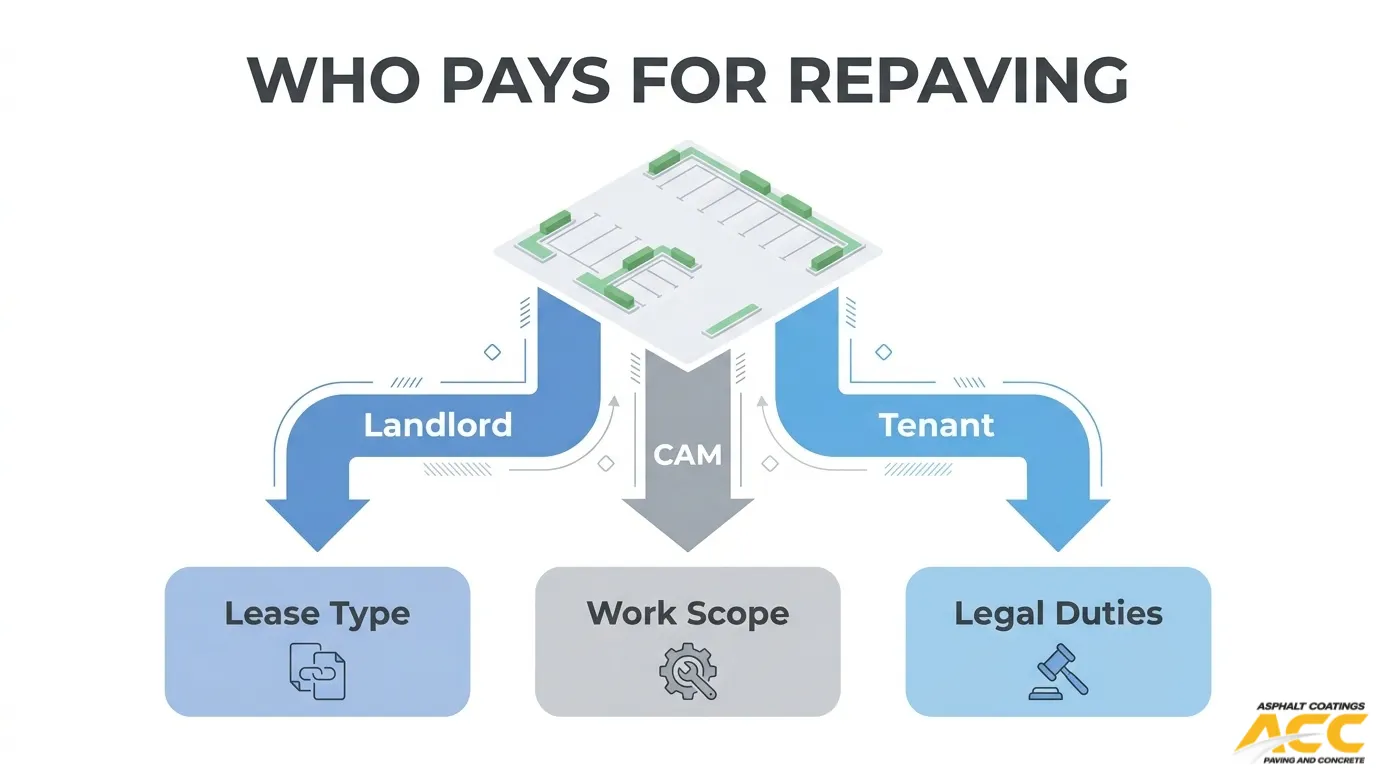
Lease structures determine who bears parking lot maintenance costs, and this allocation directly affects negotiation leverage. Under a triple net lease (NNN), as defined by the Legal Information Institute at Cornell Law School, the tenant pays rent plus insurance, maintenance, and taxes. Some leases go further; a filing with the U.S. Securities and Exchange Commission includes language requiring the tenant to “pay 100% of the cost of maintenance of the parking lot constituting the leased premises.”
The Building Owners and Managers Association International notes that parking lot repair and replacement are frequently overlooked items in lease negotiations. This gap creates risk for both parties:
- Tenants may inherit unexpected six-figure repaving obligations mid-lease.
- Landlords who defer repairs face higher vacancy costs when dissatisfied tenants decline to renew.
For owners approaching a sale or refinance, documenting a clear parking lot maintenance history strengthens the property’s income stability narrative. Prospective buyers and lenders evaluate tenant retention risk as part of underwriting, and a well-maintained lot signals lower turnover probability and more predictable cash flows.
Understanding how lease terms interact with safety and compliance obligations adds another layer of complexity to these negotiations.
What Are the Safety and Liability Risks of a Neglected Parking Lot?
The safety and liability risks of a neglected parking lot include slip-and-fall injuries, vehicle damage claims, and premises liability lawsuits. These risks escalate when potholes, cracked surfaces, and faded markings go unaddressed, exposing property owners to financial and legal consequences that can complicate a commercial sale or refinance.
Neglected pavement creates conditions where visitors, tenants, and employees face preventable hazards daily. According to a Lincoln-Lancaster County Health Department publication, the majority of liability claims result from slip, trip, and fall accidents, with the average claim for a fall reaching at least $7,000 and many claims exceeding that amount. Potholes pose particular danger; the Mineta Transportation Institute at San José State University identifies potholes as a primary concern for comfort, safety, and vehicle damage across transportation pavements. When a buyer or lender sees unresolved hazards during due diligence, they factor potential litigation costs directly into their risk assessment.
Court records illustrate how even small defects trigger costly disputes. In a Washington State Court of Appeals case from 2014, a cyclist struck a pothole in a shopping plaza parking lot and sustained injuries to his wrist, hand, ankle, back, and teeth. The Texas Supreme Court reviewed a premises liability suit in which a customer suffered serious injuries from tripping over an approximately 3/4-inch divot in a grocery store parking lot. Defects that seem minor can meet the legal threshold for an unreasonably dangerous condition, depending on jurisdiction.
Property owners also face liability tied to negligent maintenance of the underlying pavement itself. As noted in Illinois Courts case law, recovery for falls on icy sidewalks or parking lots can be based on negligent design or maintenance of the underlying pavement. This means deteriorated asphalt that collects water or ice amplifies exposure beyond the original defect.
For commercial property owners preparing for a transaction, unresolved safety hazards do more than invite lawsuits. They signal deferred maintenance to appraisers and lenders, lower perceived property value, and give buyers leverage to negotiate price reductions or require escrow holdbacks. Addressing pavement defects before listing eliminates a tangible source of risk that touches every party in the deal.
Understanding these liability exposures makes ADA compliance of the parking lot an equally important consideration during any sale or refinance.
How Does ADA Compliance of the Parking Lot Affect a Sale or Refinance?
ADA compliance of the parking lot affects a sale or refinance by exposing the property to federal enforcement risk, buyer objections, and potential lender holdbacks when accessible parking standards are not met. The subsections below cover specific requirements, enforcement consequences, and how compliance status shapes transaction outcomes.
ADA-compliant parking is not optional for commercial properties. The Americans with Disabilities Act requires accessible spaces, van-accessible sizing, proper signage, compliant access aisles, and curb ramps in every commercial parking facility. According to the U.S. Access Board, at least one of every six accessible spaces, or fraction of six, must be sized to accommodate vans, and curb ramps cannot protrude into access aisles, which cannot slope more than 1:48 maximum (§502.4). Each accessible space must also have a sign with the international symbol of accessibility mounted at least 60 inches above the ground.
During a sale or refinance, buyers and lenders evaluate ADA compliance as part of due diligence. Non-compliant parking lots create measurable transaction risk in several ways:
- Settlement agreements and federal enforcement actions can require costly remediation. The U.S. Department of Justice has resolved ADA complaints requiring restaurants and businesses to add accessible parking, construct accessible entrances, and build compliant restrooms.
- Buyer price adjustments often reflect the cost of bringing non-compliant areas up to current ADA standards, reducing the seller’s net proceeds.
- Lender holdbacks or escrow requirements may be imposed when a property condition assessment identifies ADA deficiencies, since unresolved compliance issues represent both legal liability and future capital expenditure.
- Appraisers flag non-compliance as a condition deficiency that can affect the “as-is” market value conclusion.
For property owners approaching a transaction, ADA parking compliance is one of the most cost-effective issues to resolve proactively. Restriping, adding van-accessible spaces, correcting signage height, and repairing curb ramps are relatively low-cost compared to the price reductions or deal delays non-compliance triggers. Ignoring these requirements is a common oversight that experienced buyers will identify immediately, weakening the seller’s negotiating position.
Scheduling a professional parking lot assessment well before listing or applying for refinancing gives owners time to address ADA deficiencies without transaction pressure.
When Should You Schedule a Professional Parking Lot Assessment?
You should schedule a professional parking lot assessment before listing a property for sale, initiating a refinance application, or entering a lease renewal cycle. The timing depends on transaction type, pavement age, and visible distress levels.
Key situations that warrant scheduling an assessment include:
- Before listing for sale. A pre-listing assessment identifies deferred maintenance that buyers and appraisers will flag during due diligence. Addressing defects beforehand removes negotiation leverage from the buyer’s side.
- Six to twelve months before a refinance. Lenders require property condition data to underwrite loans. Completing repairs before the appraisal allows the “as-is” valuation to reflect improved conditions rather than deferred costs.
- After observing new pavement distress. Visible cracking, potholes, or drainage pooling signals structural decline that worsens rapidly without intervention. Early assessment prevents minor issues from escalating into capital-intensive replacements.
- Following severe weather seasons. Freeze-thaw cycles, heavy rainfall, or prolonged UV exposure accelerate deterioration. A post-season assessment captures damage before it compounds.
- When tenant complaints increase. Rising complaints about surface conditions, standing water, or tripping hazards suggest the pavement has crossed a threshold where routine maintenance is no longer sufficient.
- At regular intervals for portfolio properties. Properties held long-term benefit from assessments every two to three years, aligning findings with capital expenditure planning cycles.
According to the U.S. Environmental Protection Agency, due diligence is conducted to obtain and verify available information regarding property attributes, physical and environmental condition, and other information relevant to its potential reuse and redevelopment. This principle applies directly to parking lot assessments: verified condition data strengthens your position whether you are buying, selling, or refinancing.
Waiting until a transaction is already underway often compresses repair timelines and limits contractor availability. Scheduling an assessment early gives you the flexibility to phase repairs strategically and present documented improvements to appraisers, lenders, or prospective buyers.
How Should Buyers and Owners Negotiate Parking Lot Condition in the Purchase Agreement?
Buyers and owners should negotiate parking lot condition in the purchase agreement by addressing repair responsibilities, cost allocations, compliance obligations, and closing contingencies. The key negotiation points include escrow holdbacks, seller repair credits, ADA compliance commitments, and deadline-driven inspection contingencies.
Parking lot condition often becomes a sticking point late in commercial transactions, yet the purchase agreement is the only place where both parties can lock in enforceable terms. Buyers who skip this step inherit deferred maintenance costs with no recourse. Sellers who resist reasonable concessions risk losing deals or facing post-closing claims. The most effective negotiations treat parking lot condition as a line item with the same rigor applied to roof condition or environmental remediation.
Buyers should request a parking lot inspection contingency with a defined deadline, typically aligned with the broader due diligence period. If the property condition assessment reveals cracking, potholes, drainage failures, or subgrade issues, the buyer gains leverage to negotiate one of several remedies:
- Seller-funded repairs before closing, completed to agreed specifications with third-party verification.
- Purchase price reduction reflecting the estimated cost of deferred maintenance identified during inspection.
- Escrow holdback where a portion of the sale proceeds is held in escrow until repairs are completed post-closing.
- Repair credit at closing, giving the buyer funds to manage repairs on their own timeline and with their preferred contractor.
ADA compliance deserves its own contract clause. According to the U.S. Department of Justice, a settlement agreement resolving an ADA complaint required a commercial property to ensure accessible parking availability, construct accessible routes, and update facility access, demonstrating that non-compliance carries enforceable legal consequences that transfer with ownership. Buyers should require sellers to disclose known ADA deficiencies and specify which party bears remediation responsibility.
For owners preparing to sell, completing visible repairs and documenting maintenance history before listing strengthens negotiating position and reduces the likelihood of aggressive price reductions during due diligence. A well-documented parking lot with current sealcoating, crack sealing, and compliant striping signals lower risk to buyers and lenders alike.
The strongest purchase agreements define parking lot condition standards by reference to specific metrics, such as pavement condition index scores or identified distress types, rather than vague language like “good condition.” This precision protects both parties and reduces post-closing disputes.
With negotiation terms settled, sellers can further strengthen their position by using parking lot improvements to actively support a higher valuation.
How Can Sellers Use Parking Lot Improvements to Support a Higher Valuation?
Sellers can use parking lot improvements to support a higher valuation by completing targeted repairs before the appraisal date, reducing deferred maintenance flags, and presenting documented evidence of recent work. The subsections below are covered in other parts of this guide.
Appraisers evaluate commercial property in its “as-is” condition on the effective date of the appraisal. This means every visible improvement completed before that date directly shapes the market value conclusion. According to the Federal Deposit Insurance Corporation, for federally related transactions, an appraisal must include the current market value of the property in its actual physical condition as of the appraisal date. Sellers who address cracking, potholes, faded striping, and ADA deficiencies before listing eliminate the most common objections buyers and lenders raise during due diligence. A freshly sealcoated and restriped parking lot signals active ownership, which reduces the perceived risk that drives price negotiations downward.
The strategic advantage lies in timing. Completing improvements weeks before a property condition assessment means the appraiser documents a well-maintained asset rather than one burdened by deferred capital needs. Restoration costs for a severely neglected asphalt parking lot must be capitalized, as noted by the Internal Revenue Service, which means buyers factor those expenses into their offer price. Sellers who invest in preventive work shift the cost burden away from the negotiation table and into the appraised value itself. For properties in freeze-thaw climates, where water expansion accelerates deterioration into large cracks and potholes, proactive crack sealing and patching before winter damage compounds is especially effective at preserving valuation.
With a clear understanding of how improvements influence valuation, a long-term maintenance strategy keeps that value intact between transactions.
How Should You Plan a Long-Term Maintenance Strategy for Your Commercial Parking Lot?
You should plan a long-term maintenance strategy for your commercial parking lot by establishing a cyclical schedule of inspections, preventive treatments, and budgeted reserves that address deterioration before it escalates into costly repairs or liability exposure.
A sound strategy accounts for lease structures, seasonal hazards, and liability risk. The key components include clarifying maintenance responsibilities within your lease, scheduling preventive treatments on a recurring cycle, and budgeting reserves that keep pavement serviceable throughout the property’s hold period.
Lease structure directly shapes who bears maintenance costs. According to the Legal Information Institute at Cornell Law School, a triple net lease (NNN) is a commercial lease where the lessee pays rent, utilities, insurance, maintenance, and taxes. NNN structures incentivize tenants to keep up the property because they absorb cost fluctuations. However, even under NNN terms, owners should verify that tenants are actually performing parking lot maintenance rather than deferring it.
A proactive maintenance cycle should follow a predictable sequence:
- Annual inspections identify new cracks, drainage failures, and ADA compliance gaps before they compound.
- Crack sealing every one to two years prevents water intrusion that accelerates base failure.
- Sealcoating every two to three years protects the asphalt binder from oxidation and moisture penetration.
- Patching and localized repairs address potholes and base failures as they appear.
- Mill and overlay or full replacement at the end of the pavement’s useful life, typically planned within a five-year capital forecast.
Liability exposure reinforces the urgency of consistent upkeep. Illinois Courts have recognized that recovery for falls on icy sidewalks or parking lots can be based on negligent design or maintenance of the underlying pavement. Deferred maintenance creates uneven surfaces, standing water, and ice accumulation that expose property owners to premises liability claims.
For owners approaching a sale or refinance, a documented maintenance history demonstrates responsible stewardship to buyers, appraisers, and lenders. Properties with verifiable maintenance records face fewer deferred maintenance deductions during due diligence, which directly protects the valuation. The most effective long-term strategies treat parking lot maintenance not as an optional expense but as a recurring capital obligation that preserves asset value and reduces transaction risk.
How Should You Approach Parking Lot Condition in a Commercial Sale or Refinance With Asphalt Coatings Company?
You should approach parking lot condition in a commercial sale or refinance with Asphalt Coatings Company by scheduling a professional assessment, addressing visible defects through targeted paving, sealcoating, and crack sealing, and documenting all improvements before the appraisal date.
How Can Asphalt Paving, Sealcoating, and Crack Sealing Help Improve Parking Lot Condition Before a Transaction?
Asphalt paving, sealcoating, and crack sealing help improve parking lot condition before a transaction by eliminating the visible distresses that directly lower appraised value. According to the Federal Deposit Insurance Corporation, federally related transactions require an appraisal that reflects the property’s current market value in its actual physical condition as of the appraisal date. Every crack, pothole, and patch of deteriorated asphalt that exists on that date becomes part of the “as is” assessment.
Crack sealing prevents water intrusion that accelerates freeze-thaw damage, while sealcoating protects the asphalt surface from oxidation and further breakdown. Addressing defects before due diligence begins helps property owners avoid deferred maintenance flags in property condition reports, which appraisers use as the starting point for replacement reserve estimates.
Asphalt Coatings Company provides the full scope of pre-transaction parking lot services:
- Crack sealing with CDOT-approved materials to stop moisture penetration and extend pavement life.
- Sealcoating to restore surface appearance and shield against UV and chemical degradation.
- Asphalt patching and paving to replace failed sections of Hot Mix Asphalt.
- Parking lot striping and ADA-compliant space updates to meet accessibility requirements.
Completing these improvements before a sale or refinance positions the property for a stronger valuation and reduces the likelihood of lender-required holdbacks or buyer repair credits.
What Are the Key Takeaways About Parking Lot Condition in a Commercial Sale or Refinance We Covered?
The key takeaways about parking lot condition in a commercial sale or refinance are that pavement condition directly shapes appraised value, lender risk assessments, tenant retention, and liability exposure. Buyers, lenders, and appraisers all evaluate the parking lot’s physical state during due diligence, and visible defects like cracking, potholes, and faded striping can trigger higher replacement reserves, unfavorable financing terms, or negotiated price reductions. Proactive maintenance through crack sealing, sealcoating, and asphalt repair is a cost-effective strategy that preserves pavement integrity and strengthens a property’s transaction position. Asphalt Coatings Company specializes in commercial parking lot construction and maintenance across Colorado’s Front Range, helping property owners address these concerns before they become deal obstacles.