Salt-damaged concrete repair in Denver is the process of restoring commercial concrete surfaces deteriorated by deicing chemicals and freeze-thaw cycling. Repair methods range from thin bonded overlays for minor scaling to full slab removal and replacement for structurally compromised sections.
This guide covers how salt damage starts and progresses, repair methods and materials for every severity level, cost factors and project planning for commercial properties, compliance with ADA and local building codes, and long-term prevention strategies.
Denver’s combination of 56.6 inches of average seasonal snowfall and rapid temperature swings across the freezing threshold creates especially aggressive conditions. Deicing salts amplify freeze-thaw forces within the concrete pore structure, and chloride ions penetrate deeper with each cycle, eventually reaching reinforcing steel and triggering corrosion-driven spalling from within.
Repair options follow a tiered approach matched to damage depth. Minor surface scaling responds well to polymer-modified resurfacing mortars, while deep pitting and pop-outs require saw-cut partial-depth patches. Once deterioration compromises more than half the slab thickness or corrodes embedded rebar, full replacement with air-entrained, low water-cement ratio concrete becomes the only viable path.
Commercial repair costs typically range from $45 per square foot for minor work to $150+ per square foot for full structural replacement. Phasing repairs by safety priority, scheduling during the May-through-September weather window, and maintaining penetrating sealers on a two- to three-year cycle all reduce long-term expense.
Every repair must also meet ADA slope and texture requirements along accessible routes, plus whichever building codes the local municipality enforces. Proper documentation of pre-repair conditions, materials used, and post-repair measurements protects property managers from liability exposure.
What Causes Salt Damage to Concrete in Denver’s Climate?
Salt damage to concrete in Denver’s climate results from the interaction between deicing chemicals and the city’s intense freeze-thaw cycling. Denver’s seasonal snowfall, rapid temperature swings, and heavy deicer use create conditions that accelerate concrete deterioration through both chemical and physical mechanisms.
How Do Deicing Salts Interact with Concrete During Freeze-Thaw Cycles?
Deicing salts interact with concrete during freeze-thaw cycles by amplifying the physical forces that break down the material’s internal structure. When salt dissolves into surface moisture, it lowers the freezing point unevenly across the slab. This creates differential freezing pressures within the concrete pore network, generating hydraulic stress that exceeds what plain water freezing alone would produce.
According to the Federal Highway Administration, chemical deicer applications amplify the physical mechanisms responsible for freeze-thaw deterioration of concrete. Each cycle forces salt-laden water deeper into the matrix, widening microcracks and increasing the concrete’s permeability to further moisture intrusion. For commercial property managers in Denver, where dozens of these cycles occur each winter, even properly mixed concrete faces cumulative stress that compounds season after season.
Why Does Denver’s Climate Create Especially Harsh Conditions for Concrete?
Denver’s climate creates especially harsh conditions for concrete because of its combination of heavy snowfall, frequent temperature oscillations across the freezing threshold, and intense solar radiation at altitude. According to the National Weather Service, Denver’s long-term average seasonal snowfall is 56.6 inches (1882 to 2025), with the average first freeze arriving as early as October 7th. That long winter window means months of repeated deicer applications on commercial parking lots, sidewalks, and loading areas.
What makes Denver particularly punishing is how quickly temperatures swing. A sunny afternoon can warm exposed concrete well above freezing, only for overnight lows to plunge below 32°F. These rapid transitions cycle moisture in and out of the concrete’s pore structure at a pace that outstrips many other cold-climate cities, where temperatures remain consistently frozen for longer stretches.
How Do Chloride Ions Penetrate and Weaken Concrete Over Time?
Chloride ions penetrate and weaken concrete over time through a diffusion process that accelerates under freeze-thaw conditions. While chloride ions do not directly attack the cement paste, freeze-thaw action destroys the pore structure and instigates macro cracks, which provide fast transport paths for chloride ions to reach greater depths, according to research published in ScienceDirect.
Once chloride concentrations reach embedded steel reinforcement, corrosion begins. The rust that forms occupies more volume than the original steel, creating internal expansive pressure that causes spalling and delamination from within. This process is especially concerning for structural slabs, curb-and-gutter sections, and elevated concrete in commercial properties where reinforcement integrity is critical to long-term safety. Recognizing the specific signs of this damage is the next step toward timely intervention.
How Can You Tell If Your Concrete Is Damaged by Salt?
You can tell if your concrete is damaged by salt by looking for visible surface deterioration, structural warning signs, and changes in texture or color. The signs below range from early cosmetic issues to serious structural concerns.
Salt damage rarely appears overnight. Instead, it progresses through recognizable stages that correspond to increasing severity. Catching early indicators prevents small surface problems from escalating into costly structural failures. The most reliable signs fall into three categories: surface-level visual changes, structural degradation patterns, and less obvious secondary indicators.
Early surface warning signs include:
- White, powdery deposits (efflorescence) forming on the concrete surface, caused by salt crystallizing as moisture evaporates.
- Light pitting or roughening of the top layer, where the smooth finish begins to feel gritty or sandpaper-like underfoot.
- Thin flakes or scales lifting from the surface, especially along edges and joints where salt solution pools.
Moderate to severe structural damage indicators include:
- Spalling, where larger chips or chunks break away and expose the aggregate beneath. According to Spec Chemical, concrete spalling is caused by freeze-thaw cycles, the use of deicing salts, improper pouring and finishing, and corrosion of embedded metals.
- Pop-outs, which are small conical fragments that eject from the surface when moisture trapped beneath expands during freezing.
- Visible cracking patterns, particularly map cracking or D-cracking, that follow a network pattern across the slab.
- Exposed or corroding rebar, which signals that chloride ions have penetrated deep enough to compromise the reinforcing steel.
Secondary indicators that are easy to overlook:
- Concrete that sounds hollow when tapped, suggesting delamination beneath an intact-looking surface.
- Joints or control cuts that have widened, softened, or lost their sealant integrity.
- Standing water that no longer drains properly because surface erosion has altered the slab’s original slope.
For commercial property managers, a simple hands-and-knees inspection each spring can reveal damage that is invisible from a walking survey. If scraping the surface with a flathead screwdriver produces loose material or crumbling, the deterioration has already moved beyond cosmetic concern. Understanding what type of damage is present helps determine which concrete surfaces need attention first.
What Types of Concrete Surfaces in Commercial Properties Are Most Vulnerable to Salt Damage?
The types of concrete surfaces in commercial properties most vulnerable to salt damage are parking lots, sidewalks, loading docks, entry aprons, and exterior ramps. Each faces distinct exposure levels based on traffic, drainage, and deicing frequency.
Parking lots and drive lanes absorb the heaviest salt exposure because maintenance crews apply deicers across these large, flat surfaces after every snow event. Vehicles track additional road salt onto the concrete, compounding chloride contact. The combination of constant traffic wear and repeated chemical exposure makes parking areas the first surfaces to show scaling and spalling.
Sidewalks and pedestrian walkways rank as the next most vulnerable. These narrower surfaces receive concentrated salt applications near building entrances where slip-and-fall liability is highest. Water pools along edges and in low spots, keeping dissolved chlorides in prolonged contact with the concrete. According to Eagles Concrete, most concrete surfaces need resealing every two to three years, with more frequent checks in high-traffic or high-exposure areas.
Loading docks and service aprons face a unique risk profile. Heavy truck traffic creates micro-abrasions that strip surface sealers faster than pedestrian use, and diesel fuel spills can further degrade protective coatings. When salt-laden meltwater collects against dock walls or in recessed bays, the concrete stays saturated longer, accelerating chloride penetration.
Exterior ramps and ADA-accessible routes are often overlooked but highly susceptible. These sloped surfaces require aggressive deicing to maintain safe access, yet their grade encourages meltwater to pool at transitions and landings. Ramps also tend to be thinner slabs with less concrete cover over reinforcement, which makes them more prone to corrosion-driven cracking once chlorides reach the steel.
For property managers prioritizing inspections, the surfaces that combine three factors deserve the most attention: high deicing frequency, poor drainage, and heavy traffic loading. Those conditions create the fastest path from surface scaling to structural deterioration, making early intervention far more cost-effective than delayed repair.
How Does Salt Damage Progress Over Time If Concrete Is Not Repaired?
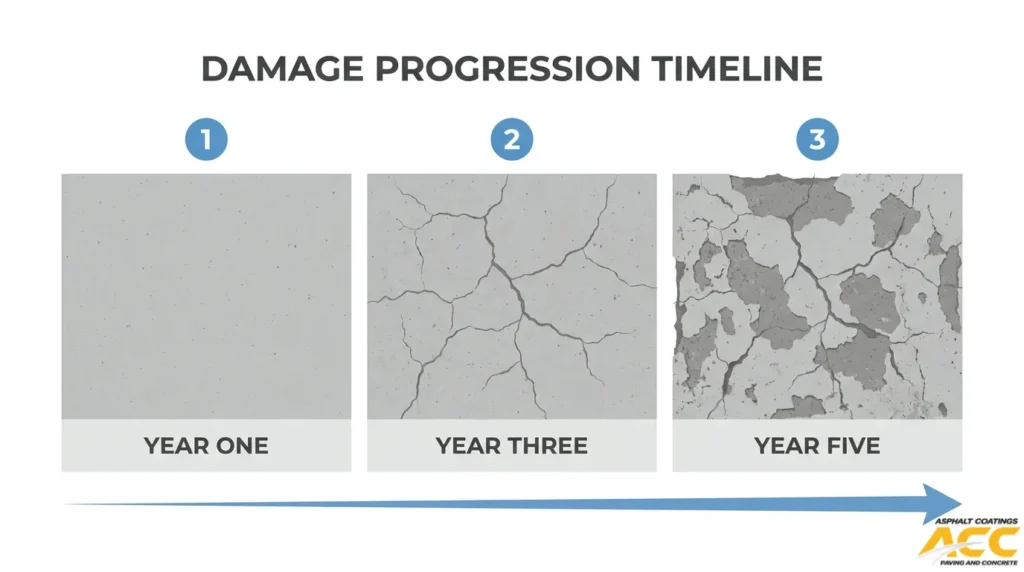
Salt damage to concrete progresses through a predictable escalation: surface scaling leads to deeper pitting, which opens pathways for chloride penetration, eventually compromising reinforcing steel and structural integrity. Each freeze-thaw season accelerates the cycle when repairs are delayed.
The progression begins with cosmetic surface deterioration. Deicing salt solutions saturate the top layer of concrete, and as temperatures drop below 32°F, the frozen moisture expands within the pore structure. This initial damage appears as light flaking or scaling, often dismissed as normal wear. Without intervention, however, these shallow defects deepen with every subsequent winter.
As surface scaling worsens, exposed aggregate and shallow pitting create larger voids that trap more moisture and salt solution. According to research published in ScienceDirect, freeze-thaw action not only destroys the pore structure but also instigates macro cracks in concrete, which provides a fast transport path for chloride ions. Once macro cracks form, the deterioration rate increases dramatically because salt-laden water reaches deeper into the slab with each cycle.
The most consequential stage involves chloride ions reaching embedded reinforcing steel. Chloride ingress follows a time-dependent diffusion process; the longer cracks and pores remain open, the faster ions accumulate around rebar. Once chloride concentrations reach the corrosion threshold, steel begins to rust and expand. That expansion creates internal pressure that fractures the surrounding concrete from within, producing the severe spalling, delamination, and structural compromise that demands full-depth replacement rather than surface repair.
For commercial property managers, the practical takeaway is clear: what starts as a minor cosmetic issue in year one can become a structural liability within just a few winter seasons. Early-stage repairs cost a fraction of full replacement, and every season of neglect narrows the window for cost-effective intervention. Understanding this timeline helps justify proactive budgeting before damage reaches the point of no return.
What Are the Best Repair Options for Salt-Damaged Concrete in Denver, CO?
The best repair options for salt-damaged concrete in Denver range from surface patching for minor scaling to full removal and replacement for structurally compromised slabs. According to HomeWyse, the basic cost to repair concrete ranges from $13.82 to $16.43 per square foot as of January 2026, though site conditions significantly affect final pricing.
How Do You Repair Minor Surface Scaling and Spalling from Salt?
You repair minor surface scaling and spalling from salt by removing loose material, cleaning the substrate, and applying a thin bonded overlay or polymer-modified resurfacing mortar. As noted by Spec Chemical, concrete spalling is caused by freeze-thaw cycles, the use of deicing salts, improper pouring and finishing, and corrosion of embedded metals.
The typical repair process for minor damage involves:
- Mechanically removing all deteriorated concrete back to sound material.
- Cleaning the surface with pressure washing to eliminate salt residue and debris.
- Applying a bonding agent to ensure adhesion between old and new material.
- Placing a thin-set repair mortar or cementitious overlay at the correct thickness.
- Curing the patch properly before allowing traffic or applying sealers.
For commercial properties where scaling covers broad areas, a full-depth resurfacing overlay is often more cost-effective than patching dozens of individual spots.
How Do You Repair Deep Pitting, Pop-Outs, and Potholes Caused by Salt?
You repair deep pitting, pop-outs, and potholes caused by salt by saw-cutting around the damaged area, removing compromised concrete to a minimum depth of one inch, and filling with a high-strength polymer-modified repair mortar. Partial-depth repairs work best when the damage does not extend below the top third of the slab thickness.
Key steps for deep repairs include:
- Saw-cutting clean, vertical edges around each damaged zone to prevent feathered edges.
- Removing all unsound concrete and checking for corroded reinforcement underneath.
- Treating any exposed rebar with a corrosion-inhibiting primer before patching.
- Placing repair material in lifts if the cavity exceeds two inches in depth.
- Matching the surrounding surface profile for proper drainage and ADA compliance.
When pop-outs cluster in one area, that pattern often signals poor aggregate quality or inadequate air entrainment in the original mix, which should factor into long-term planning. Commercial property managers throughout Denver and the Front Range trust Asphalt Coatings Company’s 39 years of experience in executing these technical concrete repairs using in-house crews trained in Colorado’s unique climate challenges.
When Does Severely Salt-Damaged Concrete Need Full Removal and Replacement?
Severely salt-damaged concrete needs full removal and replacement when deterioration extends through more than half the slab thickness, when reinforcing steel shows significant section loss, or when the subgrade has been compromised by water infiltration. Surface repairs cannot restore structural capacity once damage reaches this level.
Signs that warrant full replacement include:
- Large interconnected cracks with visible rebar corrosion and delamination.
- Slab sections that sound hollow when struck, indicating subsurface voids.
- Heaving, settlement, or rocking under traffic loads.
- Widespread scaling that has eroded the slab below minimum design thickness.
According to a 2021 study published in the World Journal of Advanced Research and Reviews, low water-to-cement ratio concrete exhibits better freeze-thaw durability due to reduced capillary porosity. Specifying a low w/c ratio and proper air entrainment in replacement concrete is critical for Denver’s climate. Applying a penetrating sealer afterward, which A1 Concrete notes may need reapplication every one to ten years depending on product type, adds another layer of long-term protection.
How Should Joint and Crack Repairs Be Handled When Salt Has Intruded?
Joint and crack repairs should be handled by first flushing out chloride-contaminated debris, then routing or sawing the joint to create a uniform reservoir before installing fresh sealant or filler. Salt intrusion accelerates deterioration inside joints because chloride solutions pool in these low points and penetrate deeper with each freeze-thaw cycle.
The recommended repair sequence includes:
- Routing cracks to a minimum width of one-quarter inch and a depth-to-width ratio of one-to-one.
- Removing all old sealant, incompressible material, and salt-contaminated residue.
- Cleaning with compressed air or flushing to eliminate chloride buildup.
- Installing a backer rod at the correct depth before applying flexible sealant.
- Using a polyurethane or silicone joint sealant rated for freeze-thaw exposure.
Neglecting joint maintenance is one of the most common oversights on commercial properties, and it often accelerates the need for far more expensive slab repairs within just a few seasons.
Understanding repair options helps property managers budget accurately, but Denver’s freeze-thaw cycles add another layer of complexity to material and timing decisions.
How Do Denver’s Freeze-Thaw Cycles Affect Salt-Damaged Concrete Repair Choices?
Denver’s freeze-thaw cycles affect salt-damaged concrete repair choices by demanding materials and methods that resist repeated freezing, thawing, and chloride penetration. Repair strategies differ based on traffic levels, structural elevation, and sun exposure.
How Does Repair Strategy Change for High-Traffic Parking Lots Versus Low-Traffic Areas?
Repair strategy changes for high-traffic parking lots versus low-traffic areas primarily in material selection, cure time requirements, and repair depth. High-traffic commercial parking lots need rapid-setting, high-compressive-strength repair materials that can withstand continuous vehicle loads while resisting salt exposure. These areas often require full-depth patching with air-entrained concrete to survive Denver’s winters.
Low-traffic zones, such as pedestrian walkways or landscape-adjacent slabs, can tolerate surface-applied repair methods like polymer-modified overlays or skim coats. Because these areas experience less mechanical stress, thinner repair profiles often perform adequately. For commercial property managers balancing budgets, concentrating full-depth repairs on high-traffic zones while using surface treatments on low-traffic areas is one of the most cost-effective approaches to extend overall pavement life.
How Should You Approach Repairs for Elevated or Structured Concrete in Freeze-Thaw Conditions?
You should approach repairs for elevated or structured concrete in freeze-thaw conditions by prioritizing chloride mitigation and drainage, since these elements are exposed on multiple sides. Elevated slabs on parking structures, loading docks, and raised walkways face accelerated deterioration because water and deicing chemicals can penetrate from both the top surface and the underside.
According to the Federal Highway Administration, chemical deicer applications amplify the physical mechanisms responsible for freeze-thaw deterioration of concrete. This matters especially for elevated elements where trapped moisture has no escape path. Freeze-thaw action destroys pore structure and creates macro cracks that become fast transport paths for chloride ions, compounding damage with each winter cycle.
Repairs to elevated concrete should include:
- Low-permeability repair materials that slow chloride ingress.
- Penetrating sealers applied to all exposed surfaces, including undersides where accessible.
- Improved drainage detailing to prevent water from ponding on or around repaired areas.
- Corrosion inhibitors on any exposed reinforcing steel before patching.
How Do Repair Choices Differ for Shaded Versus Sun-Exposed Concrete Areas?
Repair choices differ for shaded versus sun-exposed concrete areas because moisture retention and freeze-thaw cycle frequency vary dramatically between the two. Shaded concrete in Denver stays wet longer after snow events and experiences more freeze-thaw transitions per season, since direct sunlight never accelerates drying or warming. This prolonged moisture exposure increases the risk of chloride penetration and scaling.
Sun-exposed concrete dries faster but faces its own challenge: rapid temperature swings. Denver’s intense solar radiation can warm a slab above freezing during the day, then temperatures plummet overnight. Repair materials for sun-exposed areas should tolerate thermal cycling without debonding.
For shaded zones, selecting repair products with very low permeability and applying penetrating sealers more frequently protects against the extended moisture contact these areas endure. Property managers who overlook the shaded-versus-exposed distinction often see repairs fail prematurely in the exact areas that seemed least trafficked.
Understanding how site-specific conditions shape repair performance helps property managers select the right materials and protection strategies for each area of a commercial property.
What Materials and Products Work Best for Repairing Salt-Damaged Concrete in Colorado?
The best materials for repairing salt-damaged concrete in Colorado include polymer-modified repair mortars, penetrating sealers, and concrete densifiers. Each serves a distinct role in restoration and long-term protection.
When Should You Use Polymer-Modified Repair Mortars for Salt Damage?
You should use polymer-modified repair mortars for salt damage when concrete surfaces show spalling, scaling, or structural deterioration that requires a durable patching material. Polymer-modified structural repair is a pre-blended cement and polymer product designed to fix damage on both concrete and masonry surfaces, according to product specifications listed by The Home Depot. The polymer component improves adhesion, flexural strength, and resistance to moisture penetration, all critical in Colorado’s harsh winter environment. For properties dealing with recurring freeze-thaw stress, these mortars bond more reliably to existing substrates than standard portland cement patches, making them the practical first choice for most salt-damage repairs.
How Do Concrete Sealers and Densifiers Help Protect Repaired Areas from Future Salt Damage?
Concrete sealers and densifiers help protect repaired areas from future salt damage by reducing moisture absorption and chloride penetration into the concrete matrix. Penetrating sealers, such as silane and siloxane formulations, work below the surface to repel water without changing the concrete’s appearance. Densifiers, by contrast, chemically react with free lime in the concrete to create a harder, less porous surface. Together, these products address the root mechanism of salt damage: water carrying chloride ions into the pore structure, where freeze-thaw cycling then causes internal pressure and cracking. For commercial properties across Colorado’s Front Range, Asphalt Coatings Company applies professional-grade sealers as part of comprehensive concrete maintenance programs designed specifically for the region’s freeze-thaw conditions. Applying a sealer after every repair is one of the most cost-effective steps a property manager can take to extend the life of concrete in Colorado’s climate.
What Role Do Deicing Salt Alternatives Play in Protecting Repaired Concrete?
Deicing salt alternatives play a protective role by reducing chloride exposure on freshly repaired concrete surfaces. According to the American Concrete Institute Foundation, the most severe freeze-thaw exposure class (F3) is distinguished specifically by additional exposure to deicing chemicals, meaning that switching away from chloride-based products can effectively lower a surface’s exposure classification. Non-chloride options include:
- Calcium magnesium acetate (CMA), which has low environmental impact and is less toxic than chloride-based deicers, though it costs considerably more than rock salt.
- Acetate-based and formate-based products used successfully by transportation agencies nationwide.
- Agricultural-based deicing products designed for reduced concrete damage.
Pairing quality repairs with a chloride-free deicing strategy is one of the smartest long-term investments for commercial properties in Colorado.
How Much Does It Typically Cost to Repair Salt-Damaged Concrete in Commercial Settings?
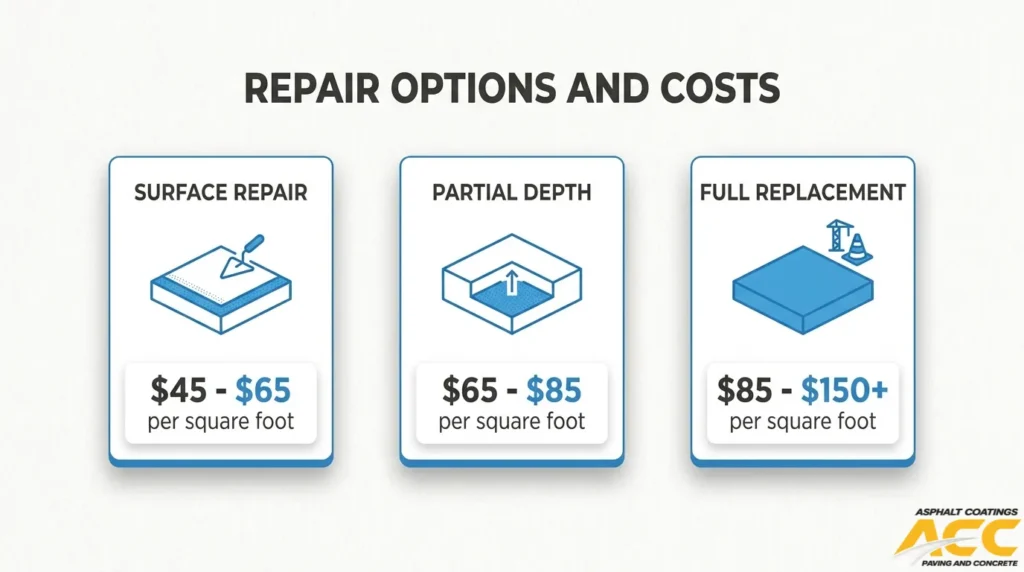
Repairing salt-damaged concrete in commercial settings typically costs between $45 and $150+ per square foot, depending on damage severity and structural complexity. Key cost factors include repair area size, concrete thickness, and operational constraints during construction.
How Do Repair Costs Differ for Small Localized Damage Versus Large Surface Areas?
Repair costs for small localized damage versus large surface areas differ primarily in unit pricing and mobilization overhead. Small patch repairs covering a few square feet carry higher per-unit costs because mobilization, equipment setup, and crew minimums remain fixed regardless of area. Contractors often apply minimum project charges that make isolated patches disproportionately expensive.
Larger surface areas spread mobilization costs across more square footage, reducing the effective rate per square foot. However, total project costs rise significantly as area increases. For commercial properties with widespread salt scaling across parking structures or loading docks, phased repairs can balance budget constraints against deterioration timelines. The most cost-effective approach is addressing clusters of damage in a single mobilization rather than scheduling multiple small callouts.
How Does Concrete Thickness and Structural Role Affect Repair Pricing?
Concrete thickness and structural role affect repair pricing because load-bearing elements require engineered solutions, code-compliant materials, and often reinforcement restoration. According to Restoration Systems, commercial concrete repair follows a three-tier pricing system: minor repairs cost $45–65 per square foot, partial depth repairs cost $65–85 per square foot, and full depth structural replacement costs $85–150+ per square foot.
Thin decorative flatwork, such as sidewalks, involves straightforward removal and replacement. Structural slabs in parking garages or loading areas demand assessment under standards like ACI 562-16, which governs repair and rehabilitation of existing structural concrete. When salt damage reaches embedded reinforcement, costs escalate because corroded rebar must be exposed, cleaned, and supplemented before new concrete is placed. For most commercial properties, early intervention at the partial depth level prevents escalation into full structural replacement.
How Do Business Downtime and Staging Constraints Impact Project Cost?
Business downtime and staging constraints impact project cost by adding expenses for phased scheduling, temporary traffic management, and accelerated cure materials. Commercial properties that cannot shut down parking areas or pedestrian routes during repairs require contractors to work in smaller sections, often during off-peak hours or overnight. These restrictions reduce daily production rates and extend project timelines.
Accelerated-cure repair materials cost more than standard mixes but allow faster return to service. Temporary barriers, signage, and traffic control add further overhead. Properties with tight staging areas, such as urban retail centers, face higher costs for material delivery logistics and equipment access. Proactive scheduling during slower business periods remains the most reliable way to control these indirect costs.
Understanding total repair costs helps property managers build realistic budgets and prioritize which areas to address first.
How Should Property Managers Prioritize and Plan Salt-Damaged Concrete Repairs?
Property managers should prioritize salt-damaged concrete repairs by ranking areas based on safety risk, phasing work to limit operational disruption, and scheduling projects during Denver’s optimal weather windows.
Which Areas of a Property Should Be Repaired First for Safety and Liability Reasons?
The areas of a property that should be repaired first are those presenting the highest trip-and-fall or vehicle hazard risk. Main building entrances, ADA-accessible ramps, and high-traffic pedestrian walkways top the priority list because damage in these zones creates direct liability exposure.
Parking lot drive lanes and fire access routes rank next, since spalled or heaved concrete in these areas can damage vehicles or impede emergency response. Lower-traffic zones, such as landscaping borders or rear service areas, can be deferred to later phases. For any commercial property, documenting the condition of each zone before and after repair strengthens your defense against premises liability claims. Addressing the most visible, most-used surfaces first also signals proactive maintenance to tenants and inspectors.
How Can You Phase Concrete Repairs to Minimize Disruption to Tenants and Customers?
You can phase concrete repairs to minimize disruption by dividing the project scope into sequential work zones that keep primary access points open at all times. Start with the highest-priority safety areas identified during assessment, then rotate through secondary zones while maintaining alternative pedestrian and vehicle routes.
Coordinate each phase with tenant operating hours. Retail properties benefit from scheduling pours during overnight or early-morning windows. Office complexes often absorb weekend closures more easily. Clear signage, temporary barriers, and advance tenant communication reduce confusion during active phases. For large commercial properties, splitting work across two or three mobilizations also helps control per-phase cost while spreading budget impact across quarters.
What Seasonal Timing Is Best for Scheduling Salt-Damaged Concrete Repairs in Denver?
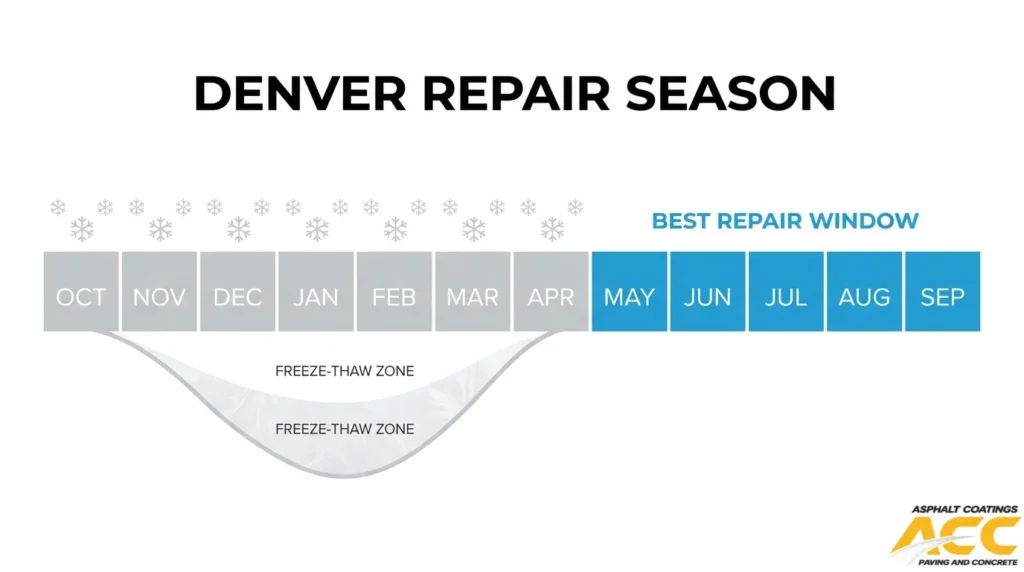
The best seasonal timing for scheduling salt-damaged concrete repairs in Denver is late spring through early fall, roughly May through September. This window avoids active freeze-thaw cycling and allows fresh concrete adequate cure time before winter exposure.
According to the National Weather Service, Denver’s long-term average seasonal snowfall is 56.6 inches (1882 to 2025), with most accumulation falling between October and April. Scheduling repairs after the last significant spring snow event and completing them well before the first fall freeze gives repair materials the warm, stable conditions they need to bond and cure properly. Early summer is particularly effective because it provides the longest buffer before winter salt application resumes, maximizing the protective benefit of post-repair sealer coats.
With seasonal timing established, the next step is adopting preventive measures that reduce future salt damage altogether.
What Preventive Steps Can You Take to Reduce Future Salt Damage to Concrete?
You can reduce future salt damage to concrete by adjusting deicing practices, maintaining a consistent cleaning and sealing schedule, and specifying salt-resistant mix designs for new construction. The following sections cover each strategy.
How Can You Adjust Snow and Ice Management Practices to Protect Concrete?
You can adjust snow and ice management practices to protect concrete by minimizing salt application rates and switching to less corrosive alternatives. Key adjustments include:
- Pre-treating surfaces with liquid brine to reduce the total volume of granular salt needed after a storm.
- Calibrating spreaders so deicing material is applied at manufacturer-recommended rates, not over-applied.
- Using calcium magnesium acetate or sand/grit blends on newer concrete that has not fully cured through its first winter.
- Removing snow mechanically with plows or blowers before applying any chemical deicer.
Prompt mechanical removal is the single most effective way to cut salt use on commercial properties. Every pound of salt that never touches the surface is a pound that cannot trigger scaling or chloride intrusion during the next freeze-thaw cycle.
How Often Should Commercial Concrete Be Cleaned and Resealed After Winter?
Commercial concrete should be cleaned and resealed after winter on a recurring schedule based on traffic volume and exposure level. According to Eagles Concrete, sealing every two to three years is appropriate for most surfaces, with more frequent checks recommended in high-traffic or high-exposure areas.
A simple water test helps determine when resealing is due: pour water on the surface, and if it absorbs rather than beads, the sealer has worn through. Spring is the ideal time to pressure-wash salt residue and reapply a penetrating silane or siloxane sealer before summer heat helps it cure fully. High-traffic parking lots and loading docks often need attention closer to every two years, while protected sidewalks may last longer.
What Design and Construction Choices Help New Concrete Resist Salt Damage?
Design and construction choices that help new concrete resist salt damage include specifying air-entrained mixes, controlling the water-cement ratio, and ensuring proper slope for drainage. According to the American Concrete Institute, entrained air bubbles larger than 3 micrometers provide resistance to freeze-thaw damage by giving expanding water space to move without fracturing the paste matrix.
Additional specifications that improve durability:
- A low water-cement ratio reduces capillary porosity, limiting how deeply chloride ions can penetrate.
- A maximum running slope of 4% (1:25), as recommended by ACI 117.1R-14, promotes drainage and prevents standing water that accelerates salt saturation.
- Colorado Department of Transportation specifications prohibit using salt to thaw ice or frost on forms before concrete placement, a practice that contaminates fresh concrete from day one.
For any commercial property owner planning new flatwork in Denver, investing in these specifications upfront costs far less than repairing salt damage after a few winters of exposure.
How Do Building Codes and ADA Requirements Affect Salt-Damaged Concrete Repairs?
Building codes and ADA requirements affect salt-damaged concrete repairs by dictating specific standards for structural integrity, accessibility, and surface safety that every repair must meet. The subsections below cover ADA-compliant repairs for accessible routes, slope and texture requirements for restored surfaces, and documentation practices for ongoing compliance.
How Can Salt-Damaged Ramps, Crosswalks, and Accessible Routes Be Repaired to Meet ADA?
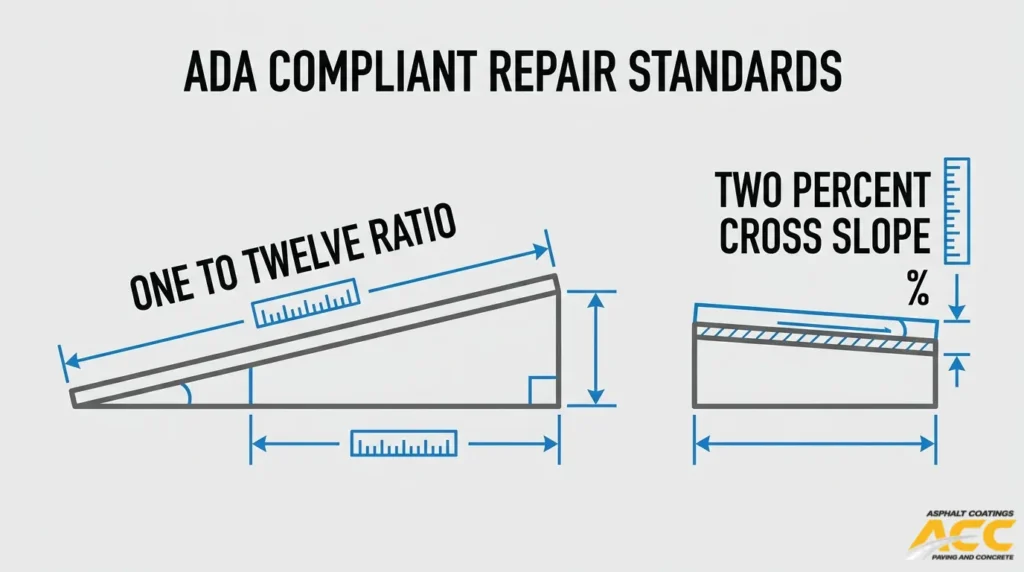
Salt-damaged ramps, crosswalks, and accessible routes can be repaired to meet ADA by restoring original slope grades, surface textures, and detectable warning surfaces to current federal accessibility standards. According to the Colorado Office of the State Architect, Colorado has no statewide building code; building codes are primarily adopted and enforced at the local level. This means property managers must verify their municipality’s adopted codes before beginning any repair.
Key ADA repair requirements for accessible routes include:
- Restoring running slopes to no steeper than 1:12 for ramps.
- Maintaining cross slopes at or below 1:48 (approximately 2%).
- Replacing damaged detectable warning panels at curb ramps with compliant truncated dome surfaces.
- Ensuring a minimum 36-inch clear width along the entire accessible path.
- Matching repaired surface levels flush with adjacent areas to eliminate trip hazards.
For commercial properties, overlooking even one of these specifications during a salt damage repair can trigger ADA complaints and costly rework.
What Slope, Texture, and Finish Requirements Matter When Restoring Damaged Accessible Surfaces?
The slope, texture, and finish requirements that matter when restoring damaged accessible surfaces are cross slope limits, surface slip resistance, and broom-finish consistency. ADA/ABAAG sets a maximum cross slope of 1:48, which translates to roughly 2%. Any salt-damaged section repaired beyond this tolerance fails compliance regardless of structural soundness.
Texture and finish requirements for restored accessible surfaces include:
- Broom-finished or equivalent slip-resistant texture applied perpendicular to the direction of travel.
- No abrupt level changes exceeding 1/4 inch without beveling.
- Stable, firm, and operable surface conditions that do not accumulate ponding water.
Concrete damaged by salt often develops uneven surfaces that pond water and reduce traction. When patching or overlaying these areas, matching the original finish texture is critical, since smooth-troweled patches on otherwise broom-finished walkways create inconsistent slip resistance that compromises pedestrian safety.
How Should You Document Repairs to Demonstrate Ongoing Safety and Compliance?
You should document repairs to demonstrate ongoing safety and compliance by maintaining detailed records of pre-repair conditions, repair specifications, and post-repair verification measurements. Thorough documentation protects property managers from liability claims and proves due diligence during inspections.
Essential documentation items include:
- Dated photographs of salt damage before, during, and after repair.
- Slope measurements taken with a digital level at multiple points along accessible routes.
- Material specifications and batch records for repair products used.
- Contractor certifications, insurance records, and signed compliance statements.
- Written confirmation that repairs meet the locally adopted building code and current ADA standards.
Maintaining a centralized repair log, updated after each project, creates an auditable compliance trail. Many municipalities in Colorado enforce codes at the local level, so keeping records organized by jurisdiction simplifies future inspections and renewal processes.
With compliance documentation in place, selecting the right contractor ensures these standards hold up over the long term.
How Do You Choose a Contractor for Salt-Damaged Concrete Repair in Denver, CO?
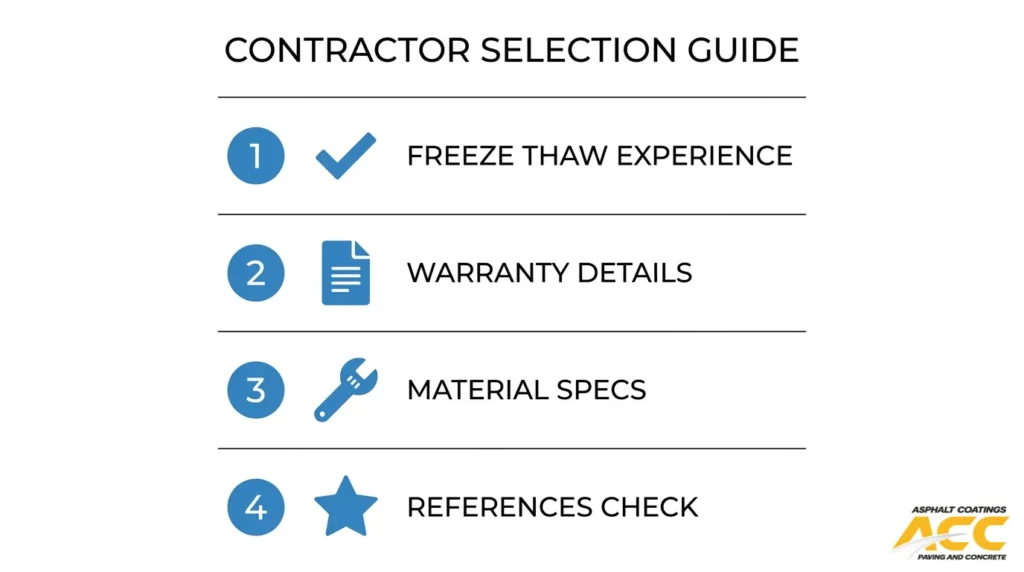
You choose a contractor for salt-damaged concrete repair in Denver, CO by verifying their direct experience with freeze-thaw damage, asking targeted questions about materials and warranties, and checking references from completed commercial projects.
What Experience Should a Contractor Have with Salt Damage and Freeze-Thaw in Colorado?
A contractor should have documented experience diagnosing and repairing salt damage in Colorado’s freeze-thaw climate. This means understanding how repeated temperature crossings at 32°F drive concrete deterioration, not just performing surface-level patches.
According to a Federal Highway Administration study, concrete mixes with air content at 3.5% and 4.5% withstand at least 300 freeze-thaw cycles with durability factors above 80%, while mixes near 2.5% air content show dramatically lower resistance. A qualified contractor should be able to discuss air entrainment specifications, chloride penetration risks, and exposure class ratings without hesitation. Any contractor unfamiliar with these Colorado-specific durability factors is likely to deliver repairs that fail within a few winters.
What Questions Should You Ask About Repair Methods, Materials, and Warranties?
The questions you should ask about repair methods, materials, and warranties include:
- What repair approach do you recommend for this specific damage type, such as polymer-modified mortars, partial depth removal, or full replacement?
- Which materials will you use, and do they meet freeze-thaw durability standards for Colorado’s exposure conditions?
- What warranty do you provide on both labor and materials, and what voids the warranty?
- How do you prepare the substrate before applying repair materials?
- Will you apply a penetrating sealer after the repair, and what resealing schedule do you recommend?
Vague answers to any of these questions typically indicate a contractor who relies on generic repair methods rather than climate-specific solutions.
How Can You Evaluate Past Commercial Projects and References Before Hiring?
You can evaluate past commercial projects and references before hiring by requesting a portfolio of completed salt-damage repairs on properties similar to yours, such as parking structures, loading docks, or pedestrian walkways.
Ask for at least three references from commercial property managers in the Denver metro area, then follow up with specific questions:
- Did the repairs hold through subsequent winters without recurring spalling or delamination?
- Was the project completed on schedule with minimal disruption to tenants or customers?
- Did the contractor communicate clearly about material choices and timeline changes?
Prioritize contractors whose past work has survived multiple freeze-thaw seasons, since that track record matters more than any sales presentation. Understanding what a contractor has proven in Colorado’s climate directly informs how they will manage your repair project.
How Should You Approach Salt-Damaged Concrete Repair With Asphalt Coatings Company?
You should approach salt-damaged concrete repair with Asphalt Coatings Company by leveraging specialized concrete flatwork, parking lot construction, and ADA-compliant repair services built on 39 years of Colorado experience. The following sections cover specific service capabilities and key article takeaways.
How Can Asphalt Coatings Company’s Concrete Flatwork and Parking Lot Construction Services Help With Salt-Damaged Surfaces?
Asphalt Coatings Company’s concrete flatwork and parking lot construction services help with salt-damaged surfaces by providing full-scope repair, replacement, and preventive protection for commercial properties. Asphalt Coatings Company performs concrete flatwork installation and repair, parking lot construction, sidewalk construction, and curb and gutter installation using in-house crews across Denver and the Front Range.
For salt-damaged surfaces specifically, new concrete placements can incorporate proper air entrainment, low water-cement ratios, and compliant slopes to resist future deterioration. Repaired surfaces can then be protected with penetrating sealers; according to Euclid Chemical, silane and siloxane product chemistry penetrates concrete to repel water and liquids, with silane being solvent-based and siloxane being water-based. Asphalt Coatings Company delivers ADA-compliant concrete work for commercial properties throughout the Front Range.
What Are the Key Takeaways About Salt-Damaged Concrete Repair in Denver, CO We Covered?
The key takeaways about salt-damaged concrete repair in Denver, CO are:
- Denver’s freeze-thaw cycles and deicing salt use accelerate concrete deterioration through scaling, spalling, pitting, and chloride-driven rebar corrosion.
- Early identification of damage severity determines whether surfaces need minor patching, partial depth repair, or full removal and replacement.
- Parking lots, sidewalks, ramps, and loading areas on commercial properties face the highest salt exposure and should be prioritized for repair.
- Proper repair materials, including polymer-modified mortars and air-entrained replacement concrete, improve long-term durability against repeated freeze-thaw cycling.
- Penetrating sealers applied on a regular schedule protect both new and repaired concrete from future chloride intrusion.
- ADA compliance and local building code requirements must be met during any concrete restoration project.
- Scheduling repairs during Denver’s warmer months allows proper curing and avoids complications from early-season freezing.
Asphalt Coatings Company brings 39 years of Colorado-specific expertise to commercial concrete projects, delivering the craftsmanship and dependability that property managers across the Front Range rely on.