A skid steer is a compact, zero-radius-turning construction machine that serves as the backbone of asphalt paving operations; the decision to rent or buy one depends on your project frequency, budget, and long-term equipment needs. This guide covers paving attachments and their applications, rental and purchase cost breakdowns, hidden expenses on both sides of the equation, equipment sizing and usage frequency thresholds, Colorado-specific climate and altitude factors, and when hiring a professional contractor makes more sense than managing equipment yourself.
Skid steer attachments like cold planers, paver boxes, wheel saws, grading buckets, and asphalt processors each serve a distinct role in the paving workflow, from milling deteriorated surfaces to spreading hot mix at controlled thickness. Matching the right attachment to your project scope directly influences whether renting or buying the machine makes financial sense.
Rental rates range from roughly $104 per day for small-frame loaders to $2,000 per week for large-frame units, while purchase prices span $38,000 for used models to $87,000 for new 2025 machines. Neither sticker price tells the full story: owners face 18% annual depreciation and roughly 8% in yearly maintenance costs, while renters absorb delivery fees, damage waivers, and fuel surcharges that can add hundreds per rental period.
Usage frequency is the clearest decision point. Utilization rates above 65% of available working days push the economics toward ownership, while fewer than three to four projects per year favor renting. Colorado’s 120-plus annual freeze-thaw cycles and altitude-driven engine power loss add further complexity by compressing paving seasons and reducing diesel performance above 5,000 feet.
For large commercial projects where precision and long-term pavement durability matter most, partnering with an experienced paving contractor like Asphalt Coatings Company can eliminate the equipment question entirely.
What Is a Skid Steer and Why Is It Essential for Paving?
A skid steer is a compact wheeled construction machine designed to operate in tight spaces, and it is essential for paving because its maneuverability and attachment versatility make it indispensable for asphalt spreading, milling, grading, and material handling on job sites of all sizes.
A skid steer loader features a small, low-profile body with either no cab or a minimal cab enclosure. According to Sany Global, this compact design allows the machine to work in confined areas where larger equipment cannot reach. What makes it uniquely suited to paving is its zero-radius turning capability, achieved by driving one set of wheels forward while simultaneously driving the opposite set in reverse. This differential steering system lets operators pivot in place, which proves critical when navigating tight parking lots, narrow driveways, and crowded commercial sites.
For asphalt work specifically, skid steers can precisely spread asphalt on surfaces by feathering material off the bucket as the machine backs up, ensuring an even distribution across the paving area. Beyond spreading, the machine’s universal mounting plate accepts dozens of specialized attachments, such as cold planers, paver boxes, wheel saws, and grading buckets, that transform a single piece of equipment into a complete paving toolkit. This versatility is why Sarah Peckskamp of Bobcat notes that “the fewer number of machines a pavement maintenance contractor owns or rents to get a job done, the greater the opportunity for profit.”
Also known as a skid loader, this machine differs from a compact track loader, which runs on rubber tracks instead of wheels and provides lower ground pressure on soft subgrades. For most asphalt paving applications on prepared surfaces, wheeled skid steers deliver faster travel speeds and better performance on hard ground.
Understanding what a skid steer does and why paving crews rely on it sets the foundation for the next key decision: which attachments you need for your specific project.
What Types of Skid Steer Attachments Are Used in Paving?
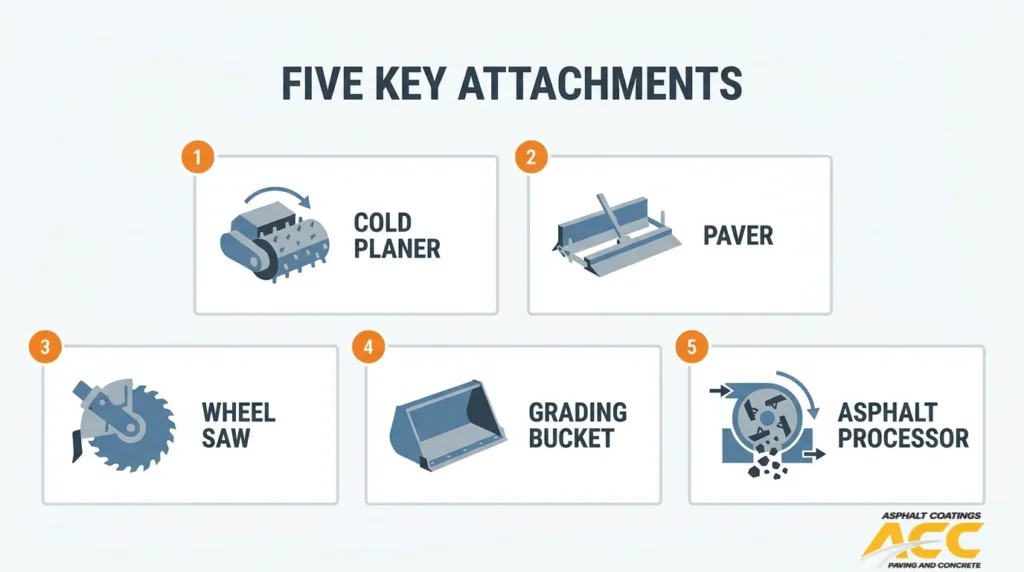
The types of skid steer attachments used in paving include cold planers, paver attachments, wheel saws, grading buckets, and asphalt processors. Each serves a distinct role in the paving workflow.
Cold Planer Attachment
A cold planer attachment is an attachment equipped with a rotating drum featuring carbide-tipped teeth that mills and removes layers of asphalt and concrete. According to Skid Steer Solutions, cold planer attachments are available in widths ranging from 12″ to 36″, with both standard and high-flow hydraulic models offered. These tools handle tasks such as:
- Removing deteriorated asphalt surfaces before repaving
- Grinding down road stripes and surface markings
- Milling precise depths for overlay preparation
For anyone weighing rent vs. buy decisions, the cold planer is often the first attachment that justifies skid steer access on a paving project.
Paver Attachment
A paver attachment converts a skid steer into a compact asphalt laydown machine. The attachment spreads hot mix asphalt at a controlled thickness and width, which makes it well suited for driveways, pathways, and small parking areas where full-size pavers cannot maneuver. Skid steers can precisely spread asphalt by feathering material off the bucket as the machine backs up, ensuring an even surface. This versatility is one reason paving contractors often keep a paver attachment in their regular rotation.
Wheel Saw Attachment
A wheel saw attachment is a diamond-blade cutting tool mounted to the skid steer’s universal quick-attach plate. It cuts clean, straight lines through existing asphalt and concrete for tasks like utility trenching, expansion joint creation, and pavement edge trimming. Because wheel saws serve a narrower purpose than cold planers, they are strong candidates for rental rather than purchase when paving needs are occasional.
Grading and Leveling Bucket
A grading and leveling bucket is a flat-bottomed bucket designed to create smooth, uniform subgrade surfaces before asphalt placement. Proper subgrade preparation directly affects pavement longevity, so this attachment plays a critical role in the paving process. Key functions include:
- Spreading and leveling aggregate base material
- Fine-grading soil to meet slope and drainage specifications
- Backfilling around curbs and gutters
Subgrade quality is often underestimated, yet it determines whether the finished asphalt layer performs as designed or fails prematurely.
Asphalt Processor Attachment
An asphalt processor attachment pulverizes reclaimed asphalt pavement (RAP) into reusable aggregate. It grinds milled or broken asphalt into consistent granular material that can be reapplied as base course or recycled into new hot mix. This attachment reduces material waste and hauling costs on projects that involve removing old pavement before repaving. For contractors managing multiple commercial sites, the asphalt processor can pay for itself through material savings alone.
Choosing the right attachment matters as much as choosing the right machine, and attachment needs directly influence whether renting or buying a skid steer makes more financial sense.
How Much Does It Cost to Rent a Skid Steer for Paving?
Renting a skid steer for paving costs between $104 and $450 per day, depending on frame size and rental duration. Daily, weekly, and monthly rates each offer different value depending on your project timeline.
How Much Does a Daily Skid Steer Rental Cost?
A daily skid steer rental costs between $200 and $450 for most wheeled models suited to paving work. According to BigRentz, small-frame skid steer loaders rent for approximately $104 per day, while medium-frame loaders cost around $227 per day. The price gap reflects differences in rated operating capacity and hydraulic power, both of which matter when running attachments like cold planers or paver buckets. For a single-day driveway repair or small parking lot patch, the daily rate often represents the most cost-effective option. Exceeding the standard 8-hour shift, however, triggers overtime charges that can quickly erode that advantage.
How Much Does a Weekly Skid Steer Rental Cost?
A weekly skid steer rental costs between $750 and $2,000 for wheeled models, as reported by DOZR. This range covers small-frame through large-frame loaders, with medium-frame units falling near the midpoint. Weekly rates typically offer a 30% to 50% discount compared to renting at the daily rate for seven consecutive days. For paving projects that span multiple days, such as a mid-size commercial parking lot overlay, the weekly rate delivers significantly better per-day value. Reserving by the week also locks in availability during peak paving season, when daily rentals can be harder to secure on short notice.
How Much Does a Monthly Skid Steer Rental Cost?
A monthly skid steer rental costs between $773 for a small-frame loader and $1,575 for a medium-frame loader. According to BigRentz, these figures reflect typical rates in the Colorado Springs market. Monthly rentals make sense when a project involves phased work, such as milling, grading, and repaving across a large commercial site over several weeks. On a per-day basis, the monthly rate drops well below $100 for small-frame machines, which is less than half the equivalent daily rental price. For contractors handling back-to-back paving jobs within a single month, this tier often represents the lowest total equipment cost before factoring in delivery fees and damage waivers.
Understanding base rental rates is only part of the equation; hidden fees like delivery charges and damage waivers add to the total.
How Much Does It Cost to Buy a Skid Steer for Paving?
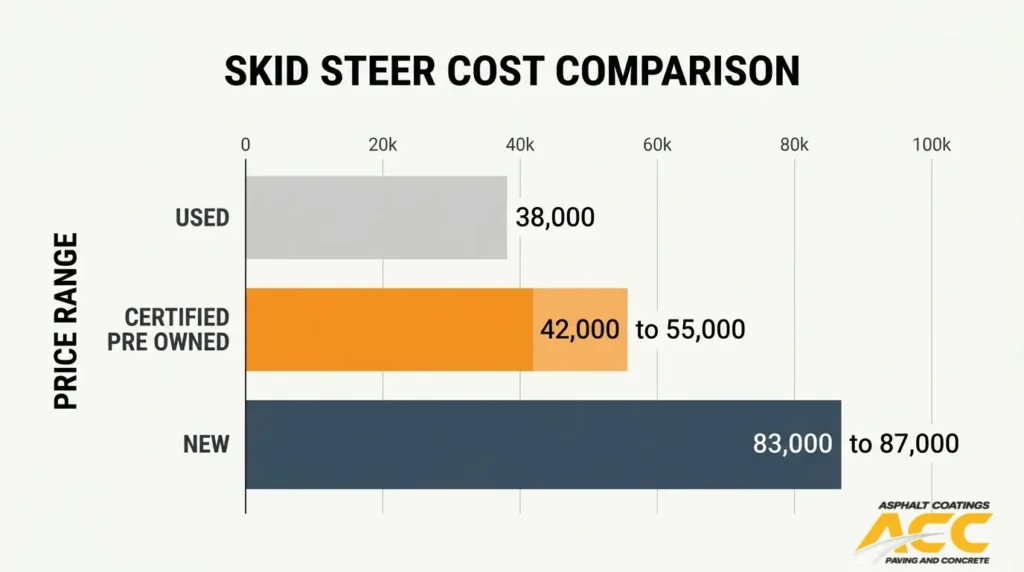
The cost to buy a skid steer for paving ranges from approximately $38,000 for a used model to $87,000 or more for a new unit. Pricing depends on whether you choose new, used, or certified pre-owned.
How Much Does a New Skid Steer Cost?
A new skid steer costs between approximately $83,000 and $87,000 for 2025 paving-capable models. According to pricing data shared in the Skid Steer Group on Facebook, the Kubota SVL97-3 lists at roughly $83,000 while the John Deere 331P sits around $87,000. These figures reflect base machine pricing; adding paving-specific attachments like cold planers or grading buckets increases the total investment further. For contractors who pave frequently throughout the season, the higher upfront cost of a new unit often comes with a full manufacturer warranty and the latest hydraulic performance specs, which can reduce downtime on commercial jobsites.
How Much Does a Used Skid Steer Cost?
A used skid steer costs significantly less than a new model, though pricing varies by age, brand, and condition. According to Equipment Trader, a used 2019 Bobcat T595 in good condition is currently listed at approximately $38,000. That represents roughly half the price of a comparable new machine. Buyers should inspect hydraulic lines, undercarriage wear, and engine hours carefully before purchasing. Machines with high engine hours may carry hidden repair costs that offset the initial savings. For paving work, verifying that the loader’s hydraulic flow matches your intended attachments is essential, since underpowered systems struggle with cold planers and asphalt processors.
How Much Does a Certified Pre-Owned Skid Steer Cost?
A certified pre-owned skid steer typically costs 10% to 20% more than a standard used unit, placing most models between $42,000 and $55,000 depending on the manufacturer and frame size. Certified programs from brands like Bobcat, Caterpillar, and John Deere include multi-point inspections, limited warranties, and verified maintenance histories. This option bridges the gap between new and used pricing by reducing the mechanical risk that comes with buying off the open market. For paving contractors who want a lower entry price without gambling on unknown repair costs, certified pre-owned equipment offers a practical middle ground.
Understanding purchase costs is only part of the equation; the hidden expenses of ownership add substantially to your total investment.
What Are the Hidden Costs of Owning a Skid Steer?
The hidden costs of owning a skid steer include ongoing maintenance, insurance, storage, and depreciation. These expenses accumulate well beyond the purchase price, as the sections below detail.
How Much Does Skid Steer Maintenance Cost Annually?
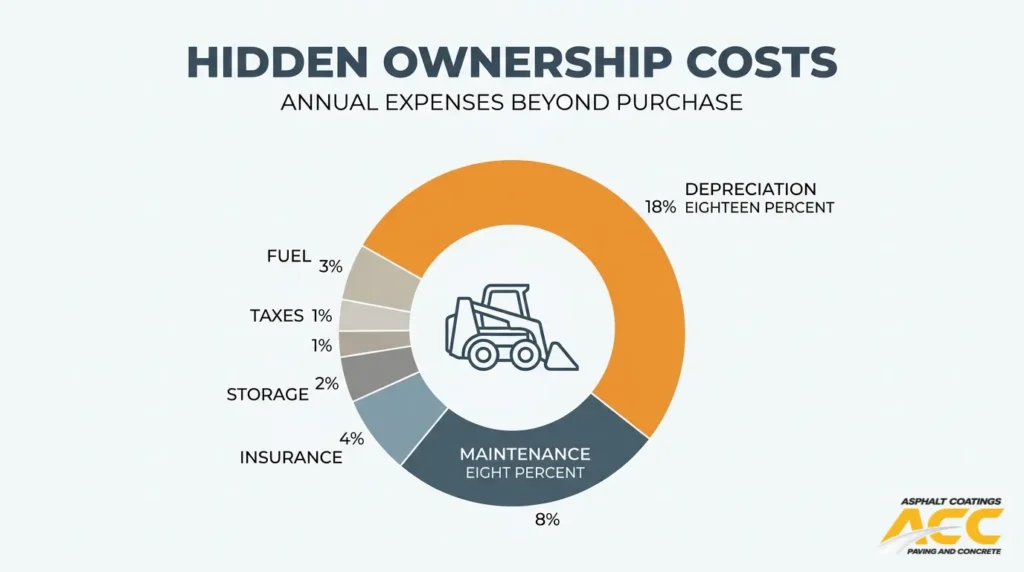
Skid steer maintenance costs annually around 8% of the machine’s purchase price. On a new unit priced at $85,000, that translates to roughly $6,800 per year for routine service alone. Scheduled items include hydraulic fluid changes, filter replacements, tire or track wear, and greasing pivot points. Unscheduled repairs, such as a failed hydraulic pump or broken drive motor, can add thousands more without warning. According to Beehive Rental and Sales, skid steer ownership carries maintenance costs of around 8% annually alongside an 18% depreciation rate. For paving applications, where cold planners and buckets stress hydraulic systems heavily, maintenance expenses often trend higher than average. Most buyers underestimate these recurring costs when comparing against rental rates.
How Much Does Skid Steer Insurance and Storage Cost?
Skid steer insurance and storage cost between $2,000 and $5,000 annually, depending on coverage level and facility type. Inland marine or equipment floater policies cover theft, vandalism, and accidental damage, while general liability adds protection during active jobsite use. Premiums vary with the machine’s value, deductible selection, and claim history. Storage adds another layer: outdoor yard space may run $100 to $300 per month, while an enclosed bay with security costs more. These fixed expenses apply year-round, even during months the skid steer sits idle. For operators who only pave seasonally, paying insurance and storage through winter months significantly raises the true cost per hour of actual use.
How Fast Does a Skid Steer Depreciate in Value?
A skid steer depreciates in value at a typical rate of 18% per year, according to Beehive Rental and Sales. Residual value also drops at just under $25 per engine hour, based on depreciation studies within the industry. On a new $85,000 machine, first-year depreciation alone could exceed $15,000. Depreciation accelerates with higher engine hours, harsh operating conditions, and deferred maintenance. Paving work, which involves abrasive materials and sustained hydraulic loads, tends to push wear faster than lighter applications. After five years of steady use, many skid steers retain less than half their original value. This loss is a real cost that never appears on a monthly expense report, yet it directly impacts total cost of ownership.
Understanding these ownership expenses helps clarify when renting might offer a more predictable cost structure.
What Are the Hidden Costs of Renting a Skid Steer?
The hidden costs of renting a skid steer include delivery fees, damage waivers, and fuel surcharges that can add hundreds of dollars to the quoted rate. Below, each of these costs is broken down individually.
What Delivery and Pickup Fees Apply to Rentals?
Delivery and pickup fees apply as flat-rate transport charges added to your rental agreement. According to Rubbl, typical delivery and pickup fees for a skid steer rental total approximately $250 combined. Most rental companies do not include transport in their advertised daily or weekly rates, so this cost is easy to overlook when budgeting.
The fee varies based on distance from the rental yard to your job site. For paving contractors running multiple short-duration projects, these transport charges compound quickly. Requesting exact delivery pricing upfront, before signing any rental contract, prevents unwelcome surprises on your final invoice.
What Damage Waivers and Liability Costs Should You Expect?
Damage waivers and liability costs add a percentage-based fee on top of your base rental rate. According to LendControl, damage waivers for equipment rentals are typically priced at 10% to 15% of the total rental rate. On a weekly skid steer rental of $1,500, that translates to $150 to $225 in waiver fees alone.
Declining the waiver shifts full liability for any equipment damage to you, which can be far more expensive if something goes wrong on a paving site. Reviewing the rental company’s specific damage policy, including deductibles and exclusion clauses, is essential before committing. For most renters, the waiver is worth the predictable cost over the unpredictable risk.
How Do Fuel and Operating Surcharges Affect Rental Price?
Fuel and operating surcharges affect rental price by adding charges for fuel consumption, overtime hours, and environmental fees. Fuel charges on a skid steer rental typically run around $150 per rental period. Additionally, overtime rates for daily rentals are calculated by dividing the daily rate by 8 for every hour exceeding the standard shift, according to Wheeler Cat’s 2025 rate sheet.
These surcharges are especially relevant for paving projects, where long pour days can push equipment use well past an 8-hour window. Factoring in fuel costs, overtime penalties, and any environmental compliance fees gives a far more accurate picture of your true rental expense.
Understanding these hidden rental costs helps clarify when renting remains cost-effective and when purchasing starts to make more financial sense.
How Often Would You Use a Skid Steer for Paving Work?
You would use a skid steer for paving work anywhere from a few days per year to several times monthly, depending on your project volume. Usage frequency is the single most important factor in the rent vs buy decision.
When Does Rental Frequency Make Buying More Economical?
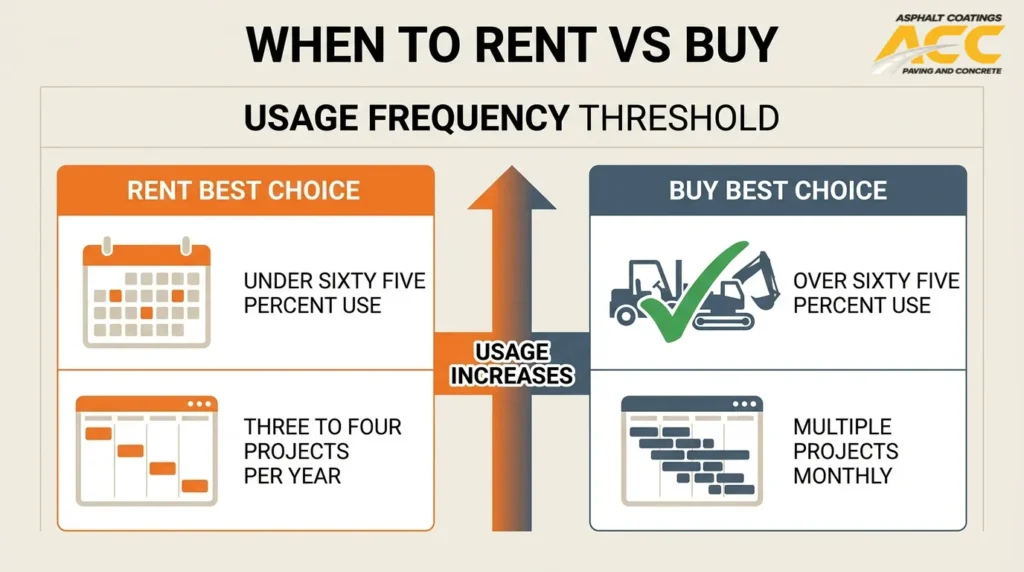
Rental frequency makes buying more economical when your skid steer utilization consistently exceeds 65% of available working days. According to a 2025 Hapn fleet utilization analysis, a time utilization rate of 65% to 75% represents the profitability “sweet spot” for construction equipment.
To put this in practical terms, consider the math. A medium-frame skid steer rents for roughly $1,575 per month. If you are renting for eight or more months annually, that totals over $12,600 in rental costs alone, not including delivery fees, damage waivers, and fuel surcharges. A used skid steer purchased at approximately $38,000 could pay for itself within three years at that usage level, even after factoring in annual depreciation of 18% and maintenance costs around 8% of the purchase price.
Frequent renters also lose scheduling flexibility; equipment availability is never guaranteed during peak paving season.
When Does Infrequent Use Make Renting the Better Choice?
Infrequent use makes renting the better choice when you need a skid steer for fewer than three to four projects per year. Owners who run equipment below that 65% utilization threshold absorb depreciation, insurance, and storage costs on a machine that sits idle most of the time.
Renting eliminates several ongoing financial burdens:
- Depreciation of roughly $25 per engine hour does not apply.
- Annual maintenance costs (around 8% of purchase price) fall on the rental company.
- Storage and insurance expenses disappear between projects.
For property managers or facility owners handling occasional parking lot repairs rather than continuous paving operations, renting keeps capital available for the work itself. When project scope grows beyond occasional use, the economics shift toward ownership or hiring a professional paving contractor.
What Size Skid Steer Do You Need for Your Paving Projects?
The size skid steer you need depends on the scale of your paving project. Small parking lots and driveways require small-to-medium frame machines, while large commercial sites demand large-frame loaders with higher operating capacity.
What Size Skid Steer Works Best for Small Parking Lots?
A small-to-medium frame skid steer works best for small parking lots. According to SkidSteers.com, skid steer loaders are classified into small frame (under 1,750 lbs rated operating capacity), medium frame (1,750 to 2,200 lbs ROC), and large frame (over 2,200 lbs ROC). For small lots, patching jobs, and driveways, a medium-frame unit with 1,750 to 2,200 lb ROC and 50 to 70 HP provides the ideal balance of power and maneuverability.
These compact machines excel in confined spaces because they achieve zero-radius turning. Smaller cold planer attachments in the 12″ to 18″ width range pair well with medium-frame skid steers for targeted milling work. For contractors weighing the rent-versus-buy decision, medium-frame machines often represent the sweet spot: capable enough for most small-lot paving tasks without the higher rental or purchase costs of large-frame models.
What Size Skid Steer Works Best for Large Commercial Sites?
A large-frame skid steer with over 2,200 lbs rated operating capacity works best for large commercial sites. These machines deliver the hydraulic power and lifting strength needed to run wider cold planer attachments, move heavier material loads, and maintain productivity across expansive parking lots or roadways.
Tharen Peterson of Caterpillar recommends “about two hydraulic horsepower for every inch of planer on the ground” to ensure adequate milling performance. Cold planers up to 36″ wide require high-flow hydraulic models that only large-frame loaders can support. Compact track loaders, which run on rubber tracks instead of wheels, are also worth considering for large sites where lower ground pressure reduces damage to prepared subgrade surfaces.
For commercial-scale projects, matching machine size to job scope directly affects productivity and cost per square foot of paving completed.
How Do Colorado Conditions Affect Your Rent vs Buy Decision?
Colorado conditions affect your rent vs buy decision by creating unique equipment demands tied to freeze-thaw damage, altitude-related power loss, and a compressed paving season. These factors shape how often you need a skid steer and whether ownership pencils out.
How Do Freeze-Thaw Cycles Influence Paving Equipment Demand?
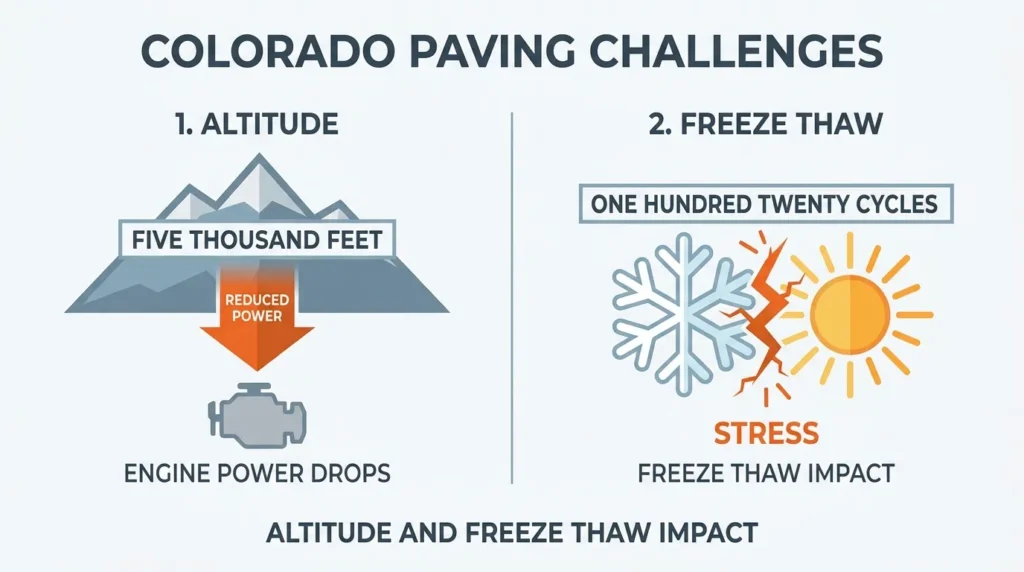
Freeze-thaw cycles influence paving equipment demand by accelerating asphalt deterioration, which creates concentrated repair windows each spring. According to a 2022 study published in MDPI’s Coatings journal, high-altitude areas encounter more than 120 frequent freeze-thaw cycles, which significantly influences asphalt pavement performance. This constant expansion and contraction cracks surfaces faster than in milder climates, generating urgent milling and patching work once temperatures stabilize. The resulting demand spike means rental availability tightens precisely when you need a skid steer most. For contractors facing this annual surge, owning a machine guarantees access during peak repair season without competing for limited rental inventory.
How Does High Altitude Impact Skid Steer Engine Performance?
High altitude impacts skid steer engine performance by reducing the oxygen available for diesel combustion. As Goldfarb Inc. explains, at higher elevations air pressure drops and engines receive less oxygen, which reduces combustion efficiency and overall diesel engine power output. A skid steer rated at sea-level horsepower will deliver noticeably less force when operating at Colorado elevations above 5,000 feet. This performance gap matters when running hydraulically demanding attachments like cold planers. If you buy, you can select a model with a turbocharged engine sized for altitude. Renters, however, are limited to whatever the rental yard stocks, which may not be altitude-optimized.
How Does Seasonal Paving Scheduling Affect Equipment Needs?
Seasonal paving scheduling affects equipment needs by compressing most asphalt work into a roughly six-to-seven-month window, typically April through October in Colorado. During this active season, skid steers run frequently for grading, milling, and material handling. Outside this window, an owned machine sits idle, accumulating storage costs and depreciation without generating revenue. Renting aligns costs directly with billable project days, which is particularly advantageous for contractors who only handle a handful of paving jobs each year. For operations running equipment steadily throughout the paving season, however, ownership avoids repeated mobilization fees and rental premiums during peak months. Understanding your seasonal workload is essential before committing either way.
What Are the Pros and Cons of Renting a Skid Steer?
The pros and cons of renting a skid steer center on financial flexibility versus long-term cost accumulation. Renting eliminates large capital outlays and maintenance burdens, but repeated rentals and hidden fees can erode savings over time.
Pros of renting a skid steer:
- Renting requires no hefty upfront payment, preserving cash flow for materials, labor, and other project costs.
- The rental company handles all maintenance, repairs, and storage between jobs.
- You can select the exact machine size and attachment for each project without committing to one configuration.
- Renting avoids the 18% annual depreciation that ownership carries.
Cons of renting a skid steer:
- Hidden costs add up quickly; according to Rubbl, typical extras include delivery and pickup fees of approximately $250, damage waivers at $350 per week, and fuel charges around $150.
- Availability is never guaranteed during peak paving season, which can delay project timelines.
- Repeated weekly rentals at $750 to $2,000 per week mean costs compound fast on multi-phase commercial jobs.
- You build no equity in the equipment and have no asset to resell when work slows.
For contractors who use a skid steer only a few times per year, renting remains the more practical choice. However, once rental frequency crosses roughly 60% to 65% of available working weeks, the cumulative spend begins approaching ownership territory. Weighing project volume against these trade-offs is the clearest path to the right decision.
What Are the Pros and Cons of Buying a Skid Steer?
The pros and cons of buying a skid steer center on long-term value versus upfront financial commitment. Ownership rewards high-frequency users but penalizes those who underestimate ongoing costs.
Pros of buying a skid steer:
- Full ownership builds equity in a depreciable asset you can use on any project without scheduling around rental availability.
- Unlimited access eliminates per-day rental charges, making each additional hour of use progressively cheaper over time.
- You control maintenance schedules, attachment compatibility, and operator familiarity, which improves efficiency on paving jobs.
- The machine can generate revenue on multiple project types beyond asphalt work, including grading, demolition, and material handling.
Cons of buying a skid steer:
- New skid steer prices are substantial; 2025 models like the Kubota SVL97-3 list at approximately $83,000 and the John Deere 331P at around $87,000.
- According to Beehive Rental and Sales, skid steer ownership carries an annual depreciation rate of typically 18% per year, with maintenance costs adding roughly 8% on top.
- Insurance, storage, and repair expenses accumulate whether the machine runs or sits idle.
- Technology and emissions standards evolve, potentially making older units less competitive or compliant over time.
For most paving contractors who use a skid steer fewer than three or four days per week year-round, ownership costs often outpace the convenience it provides. Buying makes the strongest financial case only when utilization stays consistently high across multiple seasons. Understanding when to skip both options and hire a professional paving contractor can simplify the decision entirely.
When Should You Hire a Paving Contractor Instead?
You should hire a paving contractor when the project scope, equipment complexity, or compliance requirements exceed what a rented or owned skid steer can deliver on its own. The sections below cover how Asphalt Coatings Company serves commercial paving needs and the key takeaways from the rent vs. buy decision.
Can Asphalt Coatings Company Handle Your Commercial Paving?
Yes, Asphalt Coatings Company can handle your commercial paving. Asphalt Coatings Company is a commercial asphalt paving and parking lot maintenance company that has been servicing the entire Colorado Front Range since 1986. With in-house crews specializing in asphalt paving, mill and pave services, sealcoating, crack sealing, parking lot construction, and concrete flatwork, Asphalt Coatings Company eliminates the need to rent equipment, source operators, or coordinate multiple subcontractors. For property managers, industrial complex owners, and shopping center managers facing large-scale projects, partnering with a dedicated contractor often costs less than self-managing equipment while delivering professional-grade results built for Colorado’s demanding climate.
What Are the Key Takeaways About Renting vs Buying a Skid Steer?
The key takeaways about renting vs buying a skid steer center on usage frequency, total cost, and project scale:
- Renting suits short-term or infrequent paving jobs by eliminating upfront purchase costs, depreciation, and long-term maintenance obligations.
- Buying becomes more economical when utilization consistently reaches the 65% to 75% range, where ownership costs per hour drop below cumulative rental fees.
- Hidden costs exist on both sides; owners face roughly 18% annual depreciation plus ongoing maintenance, while renters absorb delivery fees, damage waivers, and fuel surcharges.
- Colorado’s freeze-thaw cycles and high-altitude engine performance losses add complexity that may favor professional contractor partnerships over self-managed equipment.
For large commercial projects where precision, compliance, and long-term pavement durability matter most, hiring an experienced paving contractor like Asphalt Coatings Company remains the most practical path forward.