Certified skid steer operators for asphalt paving are trained professionals who bring verified skills in grading, material handling, and hazard recognition to every phase of commercial pavement construction. Their competence directly determines surface quality, jobsite safety, and long-term project value.
This guide covers why certification matters under OSHA requirements, how trained operators improve paving quality and pavement longevity, the safety advantages on active commercial sites, efficiency and timeline benefits, cost comparisons between certified and uncertified labor, property-type considerations, climate and local code factors, credential verification, full-process integration, and the advantages of in-house crews over subcontractors.
Operator certification exists because OSHA requires employers to provide comprehensive, site-specific training rather than issuing a single federal credential. Skid steer-related injuries remain well documented in federal data, and bystanders often face greater risk than operators themselves when machine handling is poor.
Certified operators achieve more consistent compaction density, uniform grading, and subbase protection, all of which extend pavement service life and reduce premature cracking or settling. Their precision eliminates the rework cycle that drives up costs and pushes schedules backward.
On active paving sites, trained operators reduce accident risks near pedestrians, vehicles, and structures through disciplined spatial awareness and communication protocols. They also handle hot-mix asphalt coordination safely at temperatures exceeding 300°F.
Skilled operators shorten project durations, prevent change orders, and keep equipment running by performing proper daily inspections. These efficiency gains translate into measurable cost savings; preservation-first construction strategies can reduce expenses by roughly 25 percent per lane-mile compared to rehabilitation approaches.
Certification proves especially valuable across different property types (retail, residential, healthcare, industrial) and in regions with freeze-thaw cycles, steep grades, or strict accessibility codes. Verifying credentials and prioritizing in-house crews over subcontracted labor locks in accountability from first grading pass to final cleanup.
Why Does Operator Certification Matter So Much in Asphalt Paving?
Operator certification matters so much in asphalt paving because it directly affects jobsite safety, surface quality, and project efficiency. Certified skid steer operators bring verified skills in grading, material handling, and hazard recognition that untrained operators lack. The sections below cover OSHA training requirements, injury data that underscores the stakes, and how workforce shortages amplify the need for qualified crews.
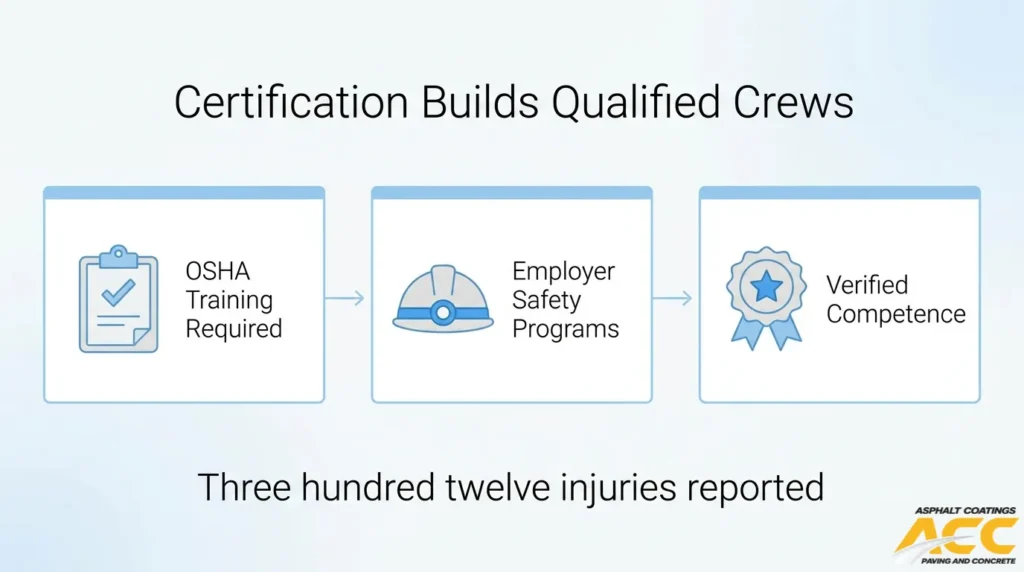
OSHA does not apply forklift-style licensing rules to skid steer loaders. According to a 2004 OSHA standard interpretation, because skid steer loaders are “intended primarily for earth moving,” the powered industrial truck training requirements in §1910.178(l) do not apply. Instead, under §1926.21(b)(2), employers must provide training comprehensive enough to ensure operators can recognize and avoid unsafe conditions specific to each site. This distinction means certification is not a single federal credential; it is a combination of employer-provided safety training, manufacturer courses, and third-party programs that together validate competence.
The consequences of inadequate training are well documented. A CDC/NIOSH study identified 312 skid steer-related injuries between 2015 and 2020 in OSHA records, with an additional 68 agricultural injuries captured through the Agricultural Injury Network. Notably, bystanders experienced a higher number of injuries than operators themselves, highlighting how poor machine handling endangers everyone on a paving site, not just the person behind the controls. Construction and extraction workers experienced 1,032 fatalities in 2024, according to the U.S. Bureau of Labor Statistics.
These risks are compounded by an ongoing labor shortage. As Ken Simonson, chief economist for the Associated General Contractors of America, stated: “Construction projects of all types are being delayed because there aren’t enough qualified workers available for firms to hire.” When qualified operators are scarce, the pressure to use undertrained personnel increases, which raises both safety and quality risks on commercial asphalt projects. Prioritizing certification is one of the most effective ways to counter this trend, ensuring that every operator on site has the verified skills to protect people, property, and pavement integrity.
How Do Certified Skid Steer Operators Improve Asphalt Paving Quality?
Certified skid steer operators improve asphalt paving quality by delivering consistent surface smoothness, reducing compaction and grading errors, protecting the subbase, and extending pavement lifespan. The following sections explain each benefit.
How Does Certification Help Operators Achieve Smoother, More Even Asphalt Surfaces?
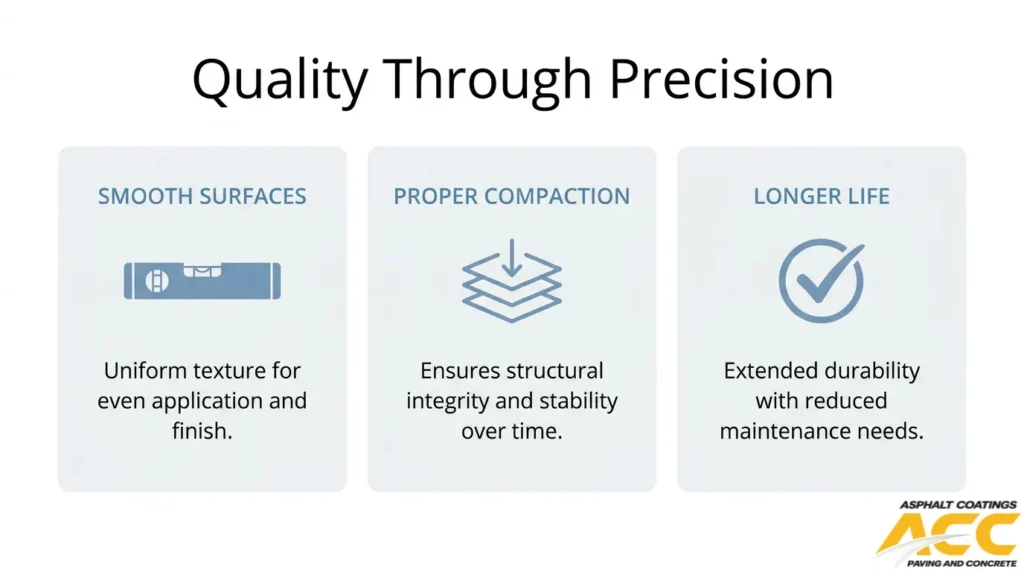
Certification helps operators achieve smoother, more even asphalt surfaces by training them to control blade angle, travel speed, and material placement with precision. Proper grading technique directly affects pavement density, which determines surface uniformity and long-term performance.
According to the Federal Highway Administration, 26 State DOTs participated in 29 demonstration projects constructing 121 experimental pavement sections, and 24 of those 29 projects achieved either a 1.0% or greater increase in in-place density or reached at least 94.0% Gmm. Achieving these density thresholds depends on skilled material handling before and during compaction. Certified operators understand how uneven material distribution creates low-density spots that lead to premature cracking and raveling. For most commercial lots, this precision at the grading stage is what separates a surface that stays smooth for years from one that develops problems within the first winter.
How Do Certified Operators Reduce Compaction and Grading Errors During Paving?
Certified operators reduce compaction and grading errors during paving by maintaining consistent lift thickness and proper cross-slopes across the work area. Skid steers handle material spreading, fine grading, and base preparation; errors at this stage compound once the paver and rollers follow.
Common compaction and grading errors that certified operators are trained to avoid include:
- Depositing material in uneven windrows that create thickness variations after paving.
- Overworking the subgrade with aggressive bucket passes, which loosens compacted soil.
- Failing to maintain proper drainage slopes, causing water to pond on the finished surface.
- Leaving debris or soft spots in the graded base that reduce load-bearing capacity.
Each of these mistakes forces costly rework. Operators who have completed formal training programs recognize these conditions before they escalate, which keeps the paving crew on schedule and protects final surface quality.
In What Ways Do Certified Operators Better Protect Your Subbase and Existing Pavement?
Certified operators better protect your subbase and existing pavement by controlling bucket force, machine weight distribution, and travel patterns to avoid disturbing compacted layers. An untrained operator can rut a prepared subbase in a single careless pass, compromising the structural foundation beneath the asphalt.
Subbase integrity is the single most important factor in long-term pavement performance. Key protective practices certified operators follow include:
- Using rubber-track or turf-tire configurations when working on finished or adjacent surfaces.
- Avoiding sharp pivot turns on compacted aggregate base, which displaces material.
- Positioning the machine to distribute loads evenly rather than concentrating weight on narrow paths.
When the subbase remains intact and properly graded, the asphalt layer above performs as designed. Subbase damage that goes undetected before paving often leads to settling, cracking, and premature failure that costs far more to repair than the original installation.
How Do Certified Operators Help Asphalt Surfaces Last Longer Before Needing Repairs?
Certified operators help asphalt surfaces last longer before needing repairs by ensuring correct base preparation, uniform material placement, and proper drainage grading from the start. Every phase of skid steer work, from excavation to final grading, influences how the finished pavement handles traffic loads, water infiltration, and thermal cycling.
Pavement durability depends on several factors that skilled operators control:
- Achieving target subgrade compaction so the base does not settle under load.
- Maintaining design cross-slopes that direct water off the surface before it penetrates joints or cracks.
- Avoiding contamination of aggregate base with topsoil or organic material during earthwork.
Surfaces built on a properly prepared foundation routinely outlast those where corners were cut during site preparation. For commercial property managers budgeting long-term maintenance, the operator’s skill level during initial construction is one of the most cost-effective investments in pavement longevity.
With quality foundations in place, the next priority is keeping every worker and bystander safe on site.
How Do Certified Skid Steer Operators Increase Safety on Paving Sites?
Certified skid steer operators increase safety on paving sites by recognizing hazards, protecting bystanders, and controlling equipment precisely in high-risk environments. The sections below cover pedestrian protection, property damage prevention, congested-lot operation, and hot-mix asphalt safety.
How does operator certification reduce accident risks around pedestrians and vehicles?
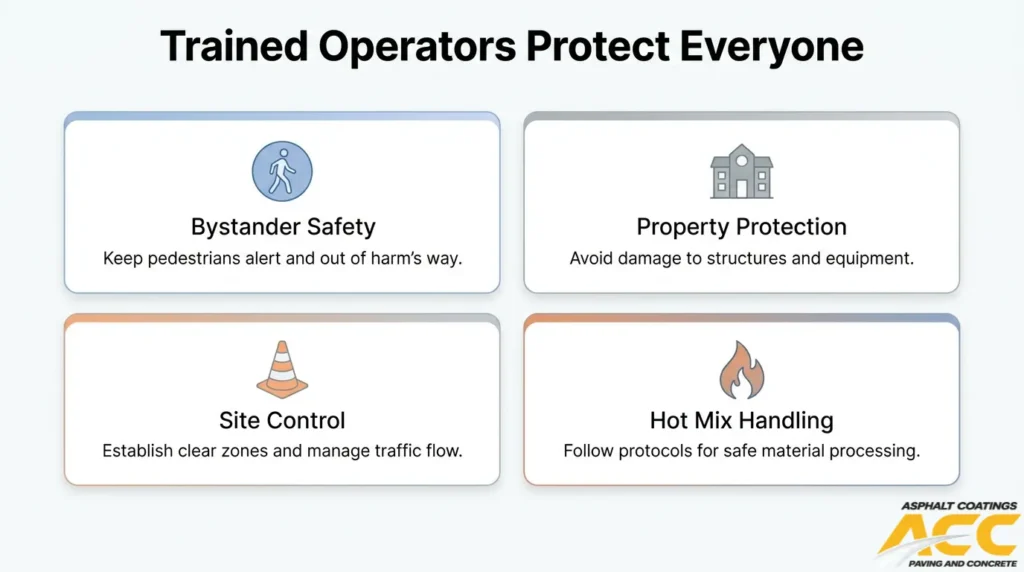
Operator certification reduces accident risks around pedestrians and vehicles by training operators to maintain situational awareness, establish safe travel paths, and follow standardized communication protocols with ground crews. Certified operators learn to identify blind spots inherent to skid steer cab designs and use spotter signals before reversing or swinging loads near foot traffic.
According to OSHA’s 2004 standard interpretation, employers must train skid steer operators under §1926.21(b)(2) so they “can recognize and avoid unsafe conditions,” with training “comprehensive enough to ensure that the operator is fully capable of safely handling the equipment in the type of conditions he/she will encounter at the site.” This requirement makes structured training essential, not optional. Without it, pedestrians crossing active commercial lots face unpredictable machine movements from operators who lack hazard-recognition skills.
How do certified operators minimize damage to buildings, curbs, and site features?
Certified operators minimize damage to buildings, curbs, and site features by understanding machine dimensions, turn radius limitations, and attachment clearances before operating near structures. Formal training emphasizes controlled bucket movements and precise steering inputs that prevent accidental contact with storefronts, light poles, signage, and freshly poured curb lines.
Skid steers pivot on a zero-turn axis, which makes them agile but also capable of gouging surfaces when handled carelessly. Operators who complete structured coursework practice spatial judgment drills that build muscle memory for tight maneuvering. For commercial property managers, this skill gap between trained and untrained operators often determines whether a paving project protects existing infrastructure or creates new repair bills.
How does certification improve safe operation in tight or congested commercial lots?
Certification improves safe operation in tight or congested commercial lots by drilling operators on low-speed precision, obstacle scanning, and load management in confined spaces. Commercial paving sites frequently involve active drive aisles, parked vehicles, dumpster enclosures, and pedestrian walkways that leave minimal clearance for heavy equipment.
Trained operators apply techniques such as incremental repositioning, consistent mirror checks, and predetermined travel lanes to navigate these constraints safely. Without this discipline, congested lots become high-risk environments where a single miscalculation can strike a parked vehicle or clip a building corner. Certification creates a repeatable safety routine that untrained operators simply do not possess.
Why is safety training for working around hot-mix asphalt and trucks so critical?
Safety training for working around hot-mix asphalt and trucks is critical because hot-mix asphalt (HMA) arrives at temperatures exceeding 300°F, and delivery trucks create additional crush and pinch-point hazards on active paving sites. Operators who lack formal training may position equipment too close to dump trucks during material transfer, risking contact burns or struck-by incidents.
According to the National Academies of Sciences, Engineering, and Medicine, AASHTO T 283 measures the resistance of compacted HMA to moisture-induced damage, underscoring how precisely this material must be handled to maintain structural integrity. Certified operators understand both the thermal hazards of HMA and the coordination timing required when working alongside paving crews and haul trucks, reducing the chance of burns, collisions, and material waste.
With safety practices firmly established, the next consideration is how certified operators affect overall project efficiency and timelines.
How Do Certified Skid Steer Operators Boost Efficiency and Control Project Timelines?
Certified skid steer operators boost efficiency and control project timelines by reducing rework, minimizing equipment downtime, and coordinating seamlessly with paving crews. The following sections cover how certification shortens project durations, prevents delays, improves crew coordination, and limits machine-related downtime.
How do certified operators shorten project durations for busy commercial properties?
Certified operators shorten project durations for busy commercial properties by completing grading, material handling, and site preparation tasks correctly on the first pass. Trained operators understand optimal bucket angles, travel speeds, and load capacities, which eliminates wasted motion across the jobsite. For commercial properties like shopping centers, apartment complexes, and office parks, this precision keeps tenant disruptions brief and parking areas accessible sooner. According to the Associated General Contractors of America, construction workforce shortages are the leading cause of project delays because “there aren’t enough qualified workers available for firms to hire.” Certified operators represent exactly the kind of qualified workforce that prevents these bottlenecks.
How do experienced operators reduce rework, change orders, and schedule delays?
Experienced operators reduce rework, change orders, and schedule delays by executing grading and excavation to specification the first time. When subbase preparation is done incorrectly, the paving crew cannot lay asphalt until corrections are made, triggering change orders and pushing the schedule backward. A certified operator reads grade stakes accurately, maintains consistent depth, and avoids over-excavation that wastes material. These skills eliminate the costly cycle of tearing out defective work and redoing it under time pressure. For property managers working within tight budgets, every avoided change order translates directly to saved time and protected contract terms.
In what ways does certification improve coordination with paving and milling crews?
Certification improves coordination with paving and milling crews by giving the skid steer operator a shared understanding of asphalt placement workflows. Certified operators know when to stage materials, how to position the machine for efficient loading, and where to clear debris without disrupting the paver’s path. This situational awareness keeps hot-mix asphalt moving from truck to paver without temperature loss or production gaps. Poorly coordinated equipment operators often force paving crews to stop and wait, which compromises mat quality and extends project timelines. In my experience, the best-run commercial paving projects always have operators who anticipate the next crew need before being asked.
How does operator skill affect downtime from breakdowns, stuck machines, or mishaps?
Operator skill directly affects downtime from breakdowns, stuck machines, or mishaps. Certified operators perform daily pre-operation inspections, identify hydraulic leaks or track wear early, and operate within the machine’s designed load limits. These habits prevent mid-project breakdowns that strand equipment on active commercial sites. Untrained operators, by contrast, frequently overload buckets, ignore warning indicators, and push machines into soft or unstable ground where they become stuck. Each incident can halt an entire crew for hours. For large parking lot projects with firm completion deadlines, even a single day of unplanned downtime can cascade into penalties or lost business access for tenants.
Understanding how certification drives efficiency sets the stage for evaluating the cost benefits of hiring certified operators.
What Are the Cost Benefits of Hiring Certified Versus Uncertified Skid Steer Operators?
The cost benefits of hiring certified versus uncertified skid steer operators include lower maintenance expenses, fewer surface failures, tighter budget control on large projects, and avoidance of hidden costs from rework.
How does using certified operators lower lifecycle maintenance and repair costs?
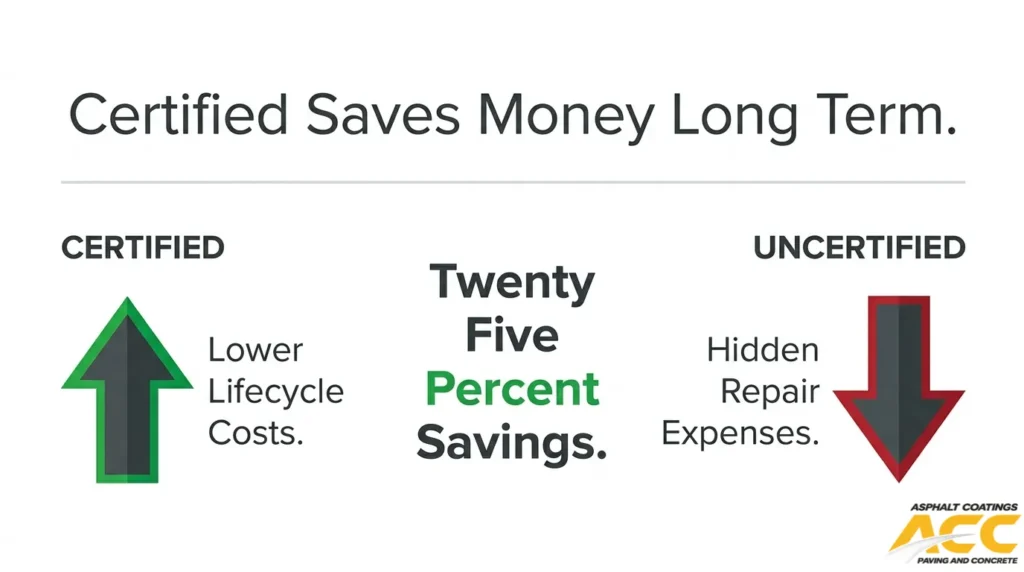
Using certified operators lowers lifecycle maintenance and repair costs by reducing equipment abuse, preventing subbase damage, and extending pavement service life. Trained operators handle skid steers with precise control during grading and material placement, which minimizes unnecessary wear on both the machine and the surface being built.
A study published through the National Transportation Library found that pavement preservation strategies result in agency cost savings of approximately 25 percent per lane-mile compared to rehabilitation strategies. Proper initial construction, guided by skilled operators, is the foundation of that preservation approach.
When operators lack training, small errors compound. Uneven grading forces premature patching. Overworked hydraulics accelerate equipment breakdowns. Each repair cycle adds cost that proper technique would have prevented from the start.
How can certified operators reduce the risk of costly surface failures and replacements?
Certified operators reduce the risk of costly surface failures and replacements by achieving correct compaction density and uniform grade during initial construction. These two factors directly determine whether an asphalt surface resists cracking, rutting, and moisture infiltration over its service life.
Poor compaction is one of the leading causes of premature pavement failure. When a skid steer operator improperly prepares the subgrade or distributes material unevenly, weak spots develop beneath the surface. Water penetrates these areas, accelerates deterioration through freeze-thaw cycles, and eventually forces a full-depth replacement rather than a simple overlay.
For commercial property managers, a single premature replacement can cost several times more than the original installation. Investing in certified operators at the construction stage is one of the most effective ways to avoid that scenario entirely.
How do certified operators help protect your budget on large parking lot projects?
Certified operators help protect your budget on large parking lot projects by maintaining consistent material placement across expansive surfaces, reducing waste, and preventing the rework that inflates project costs. According to the Washington Asphalt Pavement Association, parking areas with significant truck traffic require thicker pavement structures, particularly at entrance lanes, store fronts, and loading zones. Skilled operators understand these variable thickness requirements and adjust their work accordingly.
On large commercial lots, even minor grading inconsistencies multiply across thousands of square feet. Certified operators keep tolerances tight, which means less material overuse and fewer change orders. Budget predictability on large-scale projects depends heavily on getting the foundation work right the first time.
Why can “cheaper” uncertified operators end up costing more over time?
“Cheaper” uncertified operators end up costing more over time because their lower hourly rates mask downstream expenses: rework, accelerated pavement deterioration, equipment damage, safety incidents, and project delays. Each of these hidden costs can individually exceed the savings gained from a reduced labor rate.
Common cost escalators from uncertified operators include:
- Uneven subgrade preparation that leads to premature cracking and patching within two to three years.
- Equipment mishandling that increases hydraulic repairs and shortens machine service life.
- Safety incidents that trigger work stoppages, liability claims, and increased insurance premiums.
- Poor coordination with paving crews that causes material waste and schedule overruns.
The initial price difference between certified and uncertified labor is typically small relative to total project cost. When factored against the full lifecycle of a commercial pavement, certified operators represent one of the strongest returns on investment a property manager can make.
Understanding cost implications helps frame why operator certification also plays a different role across various property types and use cases.
How Does Operator Certification Impact Asphalt Paving in Different Property Types?
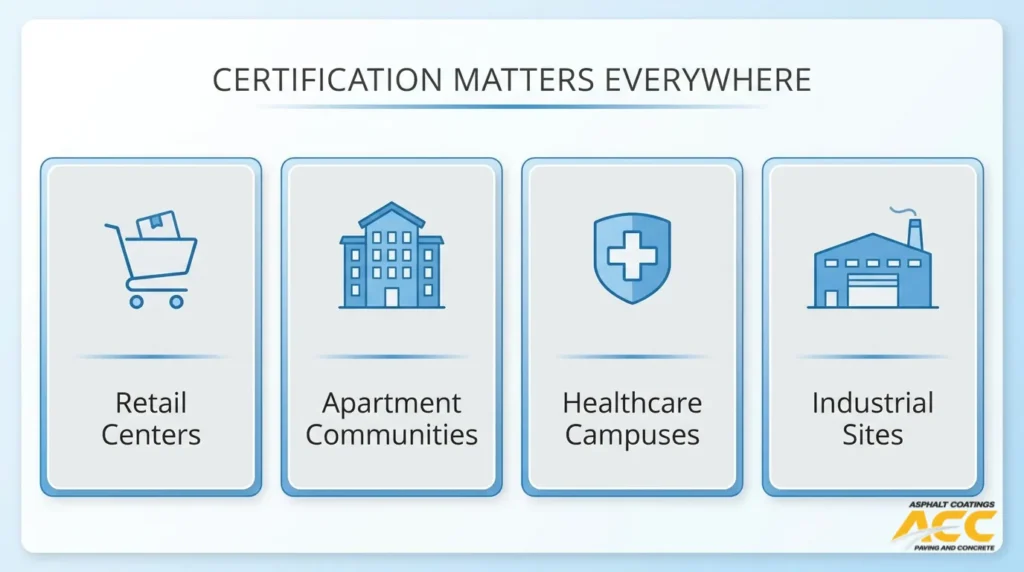
Operator certification impacts asphalt paving in different property types by addressing each site’s unique traffic patterns, access requirements, and disruption tolerances. The following sections cover shopping centers, apartment communities, healthcare campuses, and industrial facilities.
Why do shopping centers and retail plazas benefit from certified operators?
Shopping centers and retail plazas benefit from certified operators because these properties demand precise staging and phased paving that keeps storefronts accessible during construction. Certified skid steer operators understand how to sequence work around peak shopping hours, maintaining customer traffic flow to individual tenants while heavy equipment operates nearby.
Retail plazas also require careful maneuvering around storefront curbing, pedestrian islands, and cart corrals. Operators with formal training are less likely to damage these features, reducing costly post-project repairs. For properties with significant truck traffic at loading zones and store entrances, properly graded and compacted pavement sections are essential to prevent premature failure. In my experience, the difference between a retail repave that gains or loses tenant goodwill comes down to how well the crew manages access during the work.
How do certified operators help apartment and HOA communities minimize disruptions?
Certified operators help apartment and HOA communities minimize disruptions by executing tighter work schedules with fewer errors that would extend project timelines. Residents need continuous access to parking, driveways, and emergency routes, so operators must coordinate closely with property management on phased closures.
Trained operators handle skid steers with greater precision in narrow drive aisles and around parked vehicles, reducing the risk of property damage claims. They also manage noise-generating tasks more efficiently, completing grading and material handling in shorter windows. For multi-building complexes where paving happens across several phases, this consistency prevents the compounding delays that frustrate residents and boards alike.
How do certified operators support hospitals and healthcare campuses with strict access needs?
Certified operators support hospitals and healthcare campuses with strict access needs by maintaining uninterrupted emergency vehicle routes and patient drop-off zones throughout the paving process. Healthcare facilities require ADA-compliant surfaces with precise slopes and accessible parking ratios that leave no room for grading errors.
According to Kubota Engine America Corporation, its Engine Academy emphasizes 80% hands-on training with only 20% classroom instruction, reflecting the industry standard that real equipment proficiency comes from supervised field experience, not theory alone. Hospital campuses particularly benefit from this hands-on competence because operators must work around ambulance bays, helipads, and pedestrian-heavy zones where a single misstep creates serious safety and liability concerns.
What are the advantages of certified operators for industrial and warehouse paving?
The advantages of certified operators for industrial and warehouse paving include proper handling of heavy-duty pavement sections that withstand constant forklift, trailer, and truck traffic. Industrial sites require thicker asphalt structures at loading docks, turning aprons, and access lanes where concentrated wheel loads accelerate surface deterioration.
Certified operators grade subbases to tighter tolerances, which prevents the uneven settling that leads to ponding water and premature cracking in high-load areas. They also navigate around active operations more safely, keeping clear of dock doors, staging areas, and overhead obstructions common in warehouse environments. For facilities that cannot afford downtime, this operational awareness is arguably the most valuable skill a certified operator brings to the project.
Understanding how certification benefits each property type helps clarify what to look for when local conditions add further complexity.
How Do Local Conditions and Climate Make Certified Operators Even More Valuable?
Local conditions and climate make certified operators even more valuable because regional challenges like freeze-thaw cycles, steep terrain, and harsh winters demand specialized paving knowledge. The following sections cover freeze-thaw and altitude concerns, steep grades and drainage, snowplow damage awareness, and local code compliance.
Why are certified operators crucial in freeze–thaw climates and high-altitude areas?
Certified operators are crucial in freeze-thaw climates and high-altitude areas because these environments accelerate pavement deterioration through repeated moisture infiltration and temperature cycling. Water seeps into small surface voids, freezes, expands, and cracks asphalt from within. At higher elevations, UV exposure intensifies, further degrading binder integrity.
Trained operators understand how to achieve tighter compaction densities that resist moisture penetration. They adjust rolling patterns and material temperatures to account for faster heat loss at altitude, where ambient temperatures drop more rapidly during placement. Without this calibration, the finished surface develops premature cracking and potholing within its first winter. For commercial properties in regions like Colorado’s Front Range, this expertise directly extends pavement life and reduces emergency repair cycles.
How do certified operators adapt paving techniques to steep grades and drainage issues?
Certified operators adapt paving techniques to steep grades and drainage issues by modifying equipment approach angles, material placement sequences, and compaction methods to prevent runoff damage. On sloped surfaces, asphalt can shift before it sets if placement is poorly timed or the skid steer pushes material downhill.
Trained operators work uphill in controlled passes, maintaining consistent lift thickness so water channels toward designed drainage paths rather than pooling against curbs or building foundations. They coordinate with grading crews to verify cross-slope tolerances before asphalt arrives. Poor drainage design causes standing water, which is one of the fastest routes to base failure. Operators who recognize grade deficiencies before paving begins save property managers from costly tear-outs.
How does experience with snowplows and de-icing impacts guide better skid steer work?
Experience with snowplows and de-icing impacts guides better skid steer work by teaching operators where pavement endures the most mechanical stress and chemical exposure. Snowplow blades gouge raised seams, uneven transitions, and poorly compacted edges. Chemical de-icers penetrate weakened surfaces and accelerate freeze-thaw spalling.
Certified operators account for these forces during placement. They feather transitions smoothly, reinforce edges at entry lanes, and ensure surface tolerances leave no catch points for plow blades. According to a CDC/NIOSH study, 312 skid steer-related injuries were identified in OSHA data between 2015 and 2020, with bystanders experiencing more injuries than operators. This reinforces why skilled operation matters; experienced operators position equipment predictably, reducing hazards in active commercial lots where snow removal crews later work alongside pedestrians.
How do local-code-aware operators help avoid paving and accessibility problems?
Local-code-aware operators help avoid paving and accessibility problems by applying municipal specifications and ADA requirements during, not after, construction. Running slopes, cross slopes, accessible parking ratios, and curb ramp placements all have precise tolerances that vary by jurisdiction.
Operators familiar with local codes grade surfaces to meet requirements on the first pass, eliminating rework that disrupts tenants and extends project timelines. They verify that accessible routes maintain compliant slopes before final compaction locks the surface in place. Correcting slope violations after paving requires milling and overlay, sometimes doubling project costs. For property managers overseeing healthcare campuses, retail centers, or apartment communities, code-aware operators prevent compliance citations and potential liability claims.
Understanding how climate and local regulations shape paving outcomes helps clarify why verifying an operator’s credentials matters before any project begins.
How Can You Verify That a Skid Steer Operator Is Properly Certified and Qualified?
You can verify that a skid steer operator is properly certified and qualified by reviewing training records, asking targeted questions about experience, confirming employment status, and watching for warning signs of inadequate preparation.
What Training and Certification Programs Should Commercial Asphalt Operators Have?
Commercial asphalt operators should have a combination of OSHA-compliant hazard recognition training, manufacturer-specific equipment courses, and quality control knowledge relevant to hot-mix asphalt placement. OSHA requires employers to train skid steer operators comprehensively enough to handle site-specific conditions safely. Operators working on asphalt projects should also understand job mix formulas and quality control plans for HMA production; according to the California Department of Transportation, contractors must submit these documents covering compaction, smoothness, and acceptance testing. Look for completion certificates from programs offered by equipment manufacturers such as Caterpillar, Bobcat, or CASE, which cover safe operation fundamentals. Crews working on commercial parking lots should understand pavement structure requirements, particularly for areas with heavy truck traffic.
What Questions Should Property Managers Ask About Operator Experience and Safety?
The questions property managers should ask about operator experience and safety focus on verifiable credentials and site-specific competence. Key questions include:
- How many years has this specific operator run skid steers on asphalt paving projects?
- Can you provide documentation of completed OSHA hazard recognition training?
- What manufacturer training courses has the operator completed?
- Has the operator worked on projects similar to mine, such as parking lots, loading docks, or phased construction in occupied properties?
- What is the crew’s safety record over the past three years?
Asking for project references where the operator handled grading, material placement, or tight-space maneuvering near pedestrians reveals real-world capability beyond a certificate alone.
How Can You Confirm That Operators Are In-House Employees Rather Than Subcontractors?
You can confirm that operators are in-house employees rather than subcontractors by requesting direct documentation from the paving contractor. Ask for proof of workers’ compensation coverage listing the operator under the contractor’s policy. In-house employees appear on the company’s payroll records and carry the contractor’s safety training certifications. Request the contractor’s organizational chart or crew roster for your project. Subcontracted operators often arrive in unmarked vehicles, wear different safety gear, or lack familiarity with the lead contractor’s procedures. In-house crews train together, follow unified quality standards, and answer directly to the project superintendent, which produces more consistent asphalt work and clearer accountability if problems arise.
What Red Flags Suggest an Operator or Crew May Not Be Properly Qualified?
The red flags that suggest an operator or crew may not be properly qualified include:
- Inability to produce any training certificates or completion records when asked.
- Hesitation or vague answers about previous commercial asphalt projects.
- No pre-operation walkaround or equipment inspection before starting work.
- Operators unfamiliar with the specific skid steer model on site.
- Missing or inconsistent personal protective equipment across crew members.
- No visible communication protocol between the skid steer operator and ground crew.
A qualified operator confidently discusses compaction grades, material handling temperatures, and site safety procedures. When a contractor cannot clearly explain their crew’s training background, that gap often signals deeper issues with project quality and jobsite safety. Understanding crew qualifications prepares you to evaluate how certified operators integrate into the full paving workflow.
How Do Certified Skid Steer Operators Integrate With the Full Asphalt Paving Process?
Certified skid steer operators integrate with the full asphalt paving process by handling critical tasks before, during, and after placement. The following sections cover site preparation, crew coordination, post-paving detail work, and traffic management.
How do certified operators prepare the site before asphalt paving begins?
Certified operators prepare the site before asphalt paving begins by clearing debris, stripping vegetation, and establishing rough grades that meet design specifications. Skid steers equipped with bucket, grading, and sweeper attachments remove existing materials and expose stable subgrade soils.
Key site preparation tasks include:
- Demolishing and loading deteriorated asphalt or concrete for removal.
- Grading subbase material to specified elevations and cross-slopes.
- Compacting loose fill in utility trenches and soft spots.
- Establishing drainage contours that direct water away from the future pavement surface.
According to the National Asphalt Pavement Association, specialized CrewSafety training modules for equipment operators help crews recognize hazards and implement proactive safety measures during these early phases. Proper site preparation is the single most underappreciated factor in pavement longevity; every inch of grade error at this stage compounds into surface failures later.
How do skid steer operators coordinate with grading, compaction, and paving crews?
Skid steer operators coordinate with grading, compaction, and paving crews by sequencing material placement, maintaining supply flow, and staying ahead of the paver. The operator feeds aggregate or millings to the grading crew, backfills edges behind the roller, and repositions stockpiles so the paving machine never stops waiting for material.
Effective coordination requires:
- Matching skid steer loading speed to the paver’s forward pace.
- Communicating with roller operators to avoid compacting cold seams.
- Adjusting bucket loads based on lift thickness requirements.
- Staying clear of the hot-mix asphalt transfer zone during placement.
This real-time synchronization prevents temperature loss in the mat, which directly affects final density. A crew that moves in rhythm reduces rework and keeps the asphalt within its compaction window.
How do operators handle cleanup, backfilling, and final detail work after paving?
Operators handle cleanup, backfilling, and final detail work after paving by addressing shoulders, transitions, and perimeter areas that the paver and roller cannot reach. Skid steers backfill gravel or topsoil against new asphalt edges, grade landscape borders, and sweep loose aggregate from finished surfaces.
Post-paving detail tasks include:
- Backfilling and compacting shoulders to support pavement edges.
- Grading transitions between new asphalt and existing concrete or curbing.
- Removing construction debris, excess material, and temporary barriers.
- Fine-grading landscape areas disturbed during equipment staging.
These finishing steps protect the pavement edge from premature cracking and erosion. Neglecting shoulder backfill, for example, allows water to undermine the new mat within months.
How do certified operators help maintain traffic flow and access during construction?
Certified operators help maintain traffic flow and access during construction by managing phased lane closures, repositioning barriers, and keeping entry points open for tenants, customers, and emergency vehicles. Skid steers can quickly shift barricades, cones, and temporary signage between paving phases.
Traffic management responsibilities include:
- Clearing completed sections so vehicles can use freshly opened lanes.
- Relocating material stockpiles to minimize pedestrian detour distances.
- Maintaining ADA-accessible pathways throughout each construction phase.
- Coordinating with flaggers to sequence equipment movements safely.
CASE Construction Equipment notes that operator training, fleet management tools, and responsive equipment support help maintain maximum uptime on municipal and commercial jobsites. For busy commercial properties, keeping even one access lane open at all times often determines whether a project disrupts revenue or goes unnoticed by customers.
With integration across every paving phase understood, in-house certified crews offer even greater advantages over subcontracted operators.
How Does Using In-House, Certified Crews Compare to Subcontracted Operators?
Using in-house, certified crews delivers stronger consistency, accountability, and coordination than subcontracted operators. The sections below cover why permanent teams outperform temporary labor across quality, communication, and long-term portfolio management.
Why do in-house certified operators provide better consistency and accountability?
In-house certified operators provide better consistency and accountability because they work under a single company’s quality standards, safety protocols, and supervision structure every day. Subcontracted operators, by contrast, rotate between employers with varying expectations and training levels. When operators are permanent employees, management can track individual performance, enforce corrective training, and maintain documentation of certifications and renewal dates. This direct oversight eliminates the ambiguity that arises when a third-party crew arrives with credentials that are difficult to verify on short notice. For property managers overseeing commercial asphalt projects, that chain of accountability translates into fewer quality disputes and clearer responsibility when issues surface.
How does crew familiarity with each other improve project outcomes?
Crew familiarity with each other improves project outcomes by reducing hesitation, miscommunication, and timing errors during coordinated tasks. Skid steer operators who regularly work alongside the same grading, compaction, and paving teams develop an intuitive understanding of each person’s pace and tendencies. Material handoffs happen faster when the loader operator already knows how the paver crew prefers delivery staging. This operational rhythm is especially valuable during hot-mix asphalt placement, where temperature windows are tight and delays cause compaction problems. Teams that have built trust through repeated collaboration also self-correct more quickly, catching small mistakes before they escalate into rework.
How does avoiding subcontractors reduce communication and coordination issues?
Avoiding subcontractors reduces communication and coordination issues by consolidating all project instructions within one organizational chain. Subcontracted crews often report to their own dispatcher or foreman, creating a secondary communication layer that can distort specifications, schedules, and safety directives. When every operator on site answers to the same project manager, change orders travel faster and scope clarifications reach the equipment cab without passing through intermediaries. Scheduling conflicts also decrease because the contractor controls crew availability directly rather than competing with a subcontractor’s other client commitments. For commercial properties that need paving completed within narrow access windows, this streamlined coordination is often the difference between on-time delivery and costly overruns.
How does using the same certified crews year after year benefit multi-site portfolios?
Using the same certified crews year after year benefits multi-site portfolios by building institutional knowledge of each property’s layout, drainage patterns, subbase conditions, and access restrictions. Operators who previously paved a shopping center’s loading zone or an apartment complex’s fire lane already understand the site-specific challenges, so mobilization is faster and fewer surveying surprises occur. According to the Associated General Contractors of America, construction workforce shortages are a leading cause of project delays because qualified workers are scarce. Retaining experienced, certified crews insulates portfolio managers from that labor volatility while preserving the quality benchmarks established during earlier project phases.
With in-house crew advantages clear, the next step is aligning these standards with your commercial paving contractor.
How Should You Approach Certified Skid Steer Operation Needs With a Commercial Asphalt Contractor?
You should approach certified skid steer operation needs by verifying that your commercial asphalt contractor uses trained, in-house operators rather than subcontracted labor. The following sections explain how Asphalt Coatings Company supports these requirements and summarize the key benefits.
How Can Asphalt Coatings Company’s In-House Crews and Paving Services Support Projects Requiring Certified Skid Steer Operators?
Asphalt Coatings Company’s in-house crews and paving services support projects requiring certified skid steer operators by maintaining direct oversight of training, equipment readiness, and jobsite safety across every phase. Since 1986, Asphalt Coatings Company has built its operations around employing trained crews rather than relying on subcontractors, which ensures consistent operator skill levels from grading through final compaction.
Asphalt Coatings Company provides:
- Subgrade preparation and grading performed by operators familiar with Colorado’s freeze-thaw conditions.
- Mill and pave services coordinated between equipment operators and paving crews under unified project management.
- ADA-compliant concrete and asphalt work requiring precise slope control that trained skid steer operators deliver.
- Parking lot construction for commercial properties, including shopping centers, healthcare campuses, and industrial complexes.
For property managers evaluating operator qualifications, the emphasis on in-house teams matters. Certification frameworks in heavy equipment typically require both written and practical assessments, with renewal cycles that maintain competency over time. Asphalt Coatings Company’s single-source model eliminates the accountability gaps that arise when operators come from third-party labor pools unfamiliar with project specifications.
What Are the Key Takeaways About the Benefits of Certified Skid Steer Operators for Asphalt Paving?
The key takeaways about the benefits of certified skid steer operators for asphalt paving center on quality, safety, cost control, and project reliability:
- Certified operators produce smoother surfaces and better compaction density, directly extending pavement lifespan.
- Proper training reduces accident risks for workers, bystanders, and adjacent property features.
- Skilled operators shorten project timelines by minimizing rework, equipment mishaps, and coordination breakdowns.
- Using trained, in-house crews provides stronger accountability than subcontracted labor arrangements.
- Operator familiarity with local climate challenges, such as freeze-thaw cycles and steep drainage grades, prevents premature pavement failure.
Prioritizing certified operators is one of the most practical decisions a property manager can make. The upfront investment in qualified crews consistently yields lower lifecycle costs and fewer disruptive emergency repairs. When selecting a commercial asphalt contractor, confirming that skid steer operators are trained, experienced, and employed in-house should be a baseline requirement, not an afterthought.