Quality sealcoating in Fort Collins is a preventive asphalt treatment that shields pavement from UV radiation, water infiltration, and chemical damage, adding five to eight years of service life to protected surfaces.
This guide covers Fort Collins climate challenges and their effect on asphalt, sealcoating protection mechanisms and scheduling, surface preparation and material selection, long-term cost savings with safety and ADA compliance, and choosing the right contractor for Colorado conditions.
Fort Collins sits at roughly 5,000 feet, where intensified UV exposure and frequent freeze-thaw cycles accelerate asphalt oxidation and cracking far faster than in lower-elevation cities. Sealcoating creates a barrier that absorbs UV radiation before it reaches the binder, blocks moisture from penetrating surface voids, and resists petroleum-based solvents that dissolve unprotected asphalt.
Proper surface preparation and material choice determine whether that barrier holds. Cleaning, crack routing, stain treatment, and moisture verification must precede application. Asphalt-based emulsion sealers applied in two thin coats during optimal weather windows outperform single heavy applications and avoid the environmental concerns associated with coal tar products.
Most commercial and residential surfaces need reapplication every two to three years, though Fort Collins properties often show wear faster due to elevation-driven stressors. Pairing sealcoating with routed crack sealing before each cycle prevents subsurface water damage and compounds the protective benefit over time.
Beyond preservation, consistent sealcoating reduces long-term reconstruction costs, restores curb appeal, improves pedestrian safety, and supports ADA-compliant parking lot striping. Selecting a contractor with Colorado-specific expertise ensures application techniques account for local cure times, seasonal windows, and Front Range weather patterns.
What Is Sealcoating and Why Does It Matter for Fort Collins Pavement Longevity?
Sealcoating is a protective surface treatment applied to asphalt pavement that shields it from environmental damage, oxidation, and water infiltration. For Fort Collins, where harsh winters and high-altitude UV exposure accelerate deterioration, sealcoating serves as a critical layer of defense. According to the U.S. Geological Survey, sealcoat is the black, viscous liquid applied to asphalt parking lots, driveways, and playgrounds in North America to protect and enhance the appearance of the underlying asphalt.
This preventive treatment does not strengthen pavement structurally. Instead, it preserves the existing surface by slowing the breakdown caused by sunlight, moisture, and chemical exposure. As the Federal Highway Administration defines it, preventive maintenance is “a planned strategy of cost-effective treatments to an existing roadway system that preserves the system, retards future deterioration, and maintains or improves the functional condition of the system without significantly increasing the structural capacity.” Sealcoating fits squarely within that framework.
Fort Collins property managers should understand that pavement degradation begins the moment asphalt is exposed to the elements. The asphalt binder that holds aggregate together starts oxidizing on contact with air, turning brittle over time. Water seeps into small surface voids, and when temperatures drop below freezing, that trapped moisture expands, widening cracks from within. Without a protective barrier, this cycle compounds with each passing season.
What makes sealcoating particularly valuable in this region is the combination of climate factors working against unprotected pavement. Fort Collins experiences a cold semi-arid climate where summers are warm while winters are cold and bring significant snowfall, according to U.S. Climate Data. That seasonal swing, paired with Colorado’s intense solar radiation at elevation, creates a punishing environment for exposed asphalt surfaces.
According to the University of Wisconsin Local Technical Assistance Program, a properly applied seal coat should provide five to eight years of additional life to the pavement. For commercial property owners managing parking lots, access roads, and loading areas, those additional years translate directly into deferred reconstruction costs and reduced disruption. Investing in sealcoating early in a pavement’s life cycle is one of the most cost-effective preservation strategies available, especially in a climate as demanding as Northern Colorado’s.
How Does Fort Collins’ Climate Impact Asphalt Pavement and Make Sealcoating Essential?
Fort Collins’ climate impacts asphalt pavement through intensified UV radiation at elevation, extreme temperature swings, and harsh winter conditions that accelerate surface deterioration. These factors combine to make sealcoating essential for preserving pavement integrity.
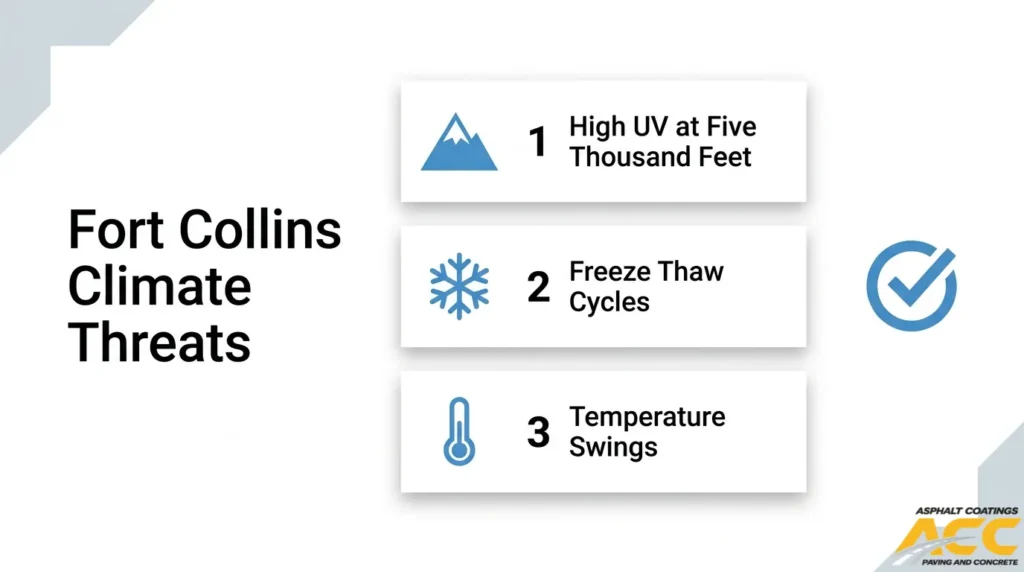
Fort Collins sits at roughly 5,000 feet above sea level, which exposes asphalt surfaces to significantly stronger ultraviolet radiation than lower-elevation cities experience. According to KOAA News, UV radiation increases 2 percent for every 1,000 feet of elevation gain, making UV levels in Colorado communities approximately 10% or more higher than at sea level. This elevated UV exposure accelerates oxidation, causing asphalt binder to dry out, become brittle, and lose the flexibility it needs to resist cracking.
Beyond UV damage, Fort Collins experiences a cold semi-arid climate where warm summers give way to cold winters with significant snowfall. These seasonal extremes produce repeated freeze-thaw cycles; water seeps into small surface cracks, freezes, expands, then thaws, progressively widening each fissure. Left unaddressed, this cycle transforms minor surface cracks into potholes and structural failures that require costly reconstruction.
Sealcoating directly counteracts these climate-driven threats by creating a protective barrier that shields the asphalt binder from UV oxidation and prevents water from penetrating the pavement surface. For commercial properties along the Front Range, where pavement endures both intense summer sun and winter freeze-thaw stress simultaneously, this protective layer is not optional; it is a baseline maintenance requirement. Ignoring these conditions shortens pavement life dramatically and drives up long-term repair costs. Asphalt Coatings Company has served Colorado’s Front Range for decade years, developing expertise in addressing these exact climate challenges through comprehensive sealcoating and crack sealing programs designed specifically for high-altitude conditions.
Understanding these climate pressures clarifies why the specific protection methods and materials used in sealcoating matter so much for Fort Collins properties.
How Exactly Does Sealcoating Protect Asphalt and Extend Its Service Life?
Sealcoating protects asphalt and extends its service life by creating a barrier that shields the pavement surface from UV radiation, water infiltration, and chemical exposure. The following sections cover its core protection mechanisms and the measurable lifespan gains it delivers.
How Does Sealcoating Block UV Rays, Water, and Chemical Damage?
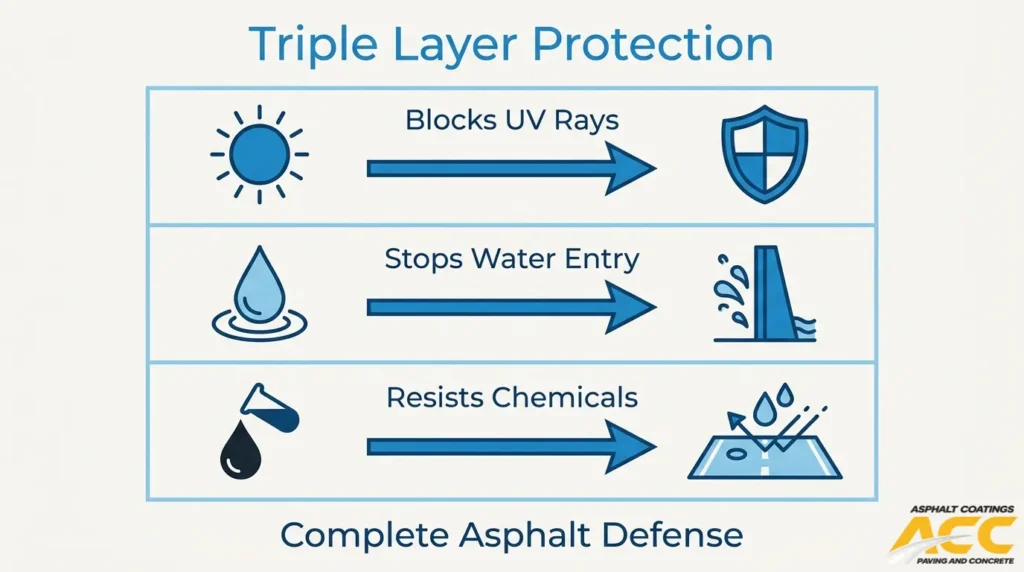
Sealcoating blocks UV rays, water, and chemical damage by forming a protective film over the asphalt binder. UV radiation oxidizes the liquid asphalt cement that binds aggregate together, making the surface brittle and prone to cracking. The sealcoat layer absorbs this radiation before it reaches the binder. Water infiltration is equally destructive; when moisture penetrates small surface cracks, it erodes the subbase and accelerates pothole formation. Sealcoating fills minor surface voids, preventing water entry. Automotive fluids, such as oil and gasoline, dissolve unprotected asphalt binder on contact. A properly applied sealcoat resists these petroleum-based solvents, preserving structural cohesion. For Colorado properties at higher elevations where UV intensity and freeze-thaw stress are compounded, this barrier is not optional; it is the first line of defense.
How Does Sealcoating Slow Oxidation and Prevent Asphalt from Becoming Brittle?
Sealcoating slows oxidation and prevents asphalt from becoming brittle by sealing the binder away from oxygen and sunlight. Fresh asphalt contains flexible maltene compounds that keep the surface pliable. Over time, oxygen reacts with these compounds and converts them into rigid asphaltenes, causing the pavement to harden and crack. Sealcoating reduces this oxygen exposure significantly. By maintaining binder flexibility, the surface can better absorb thermal expansion and contraction cycles without fracturing. Periodic reapplication renews this oxidation barrier before degradation reaches the aggregate layer. The result is pavement that remains resilient and resistant to surface raveling years longer than untreated asphalt.
How Much Additional Pavement Life Can Quality Sealcoating Provide?
Quality sealcoating can provide five to eight years of additional pavement life, according to the University of Wisconsin Local Technical Assistance Program. Although a sealcoat protects the existing surface, it does not increase structural capacity. This distinction matters: sealcoating is a preservation treatment, not a structural repair. Its value lies in delaying the point at which costly rehabilitation or full-depth reconstruction becomes necessary. When applied on a consistent cycle to pavement still in fair to good condition, sealcoating compounds its protective benefits over time. Each successive application resets the oxidation clock, keeping the surface functional far longer than neglected pavement. For commercial properties managing large paved areas, this added lifespan translates directly into deferred capital expenditure.
Understanding how sealcoating protects asphalt helps determine the right application schedule for Fort Collins conditions.
How Often Should Pavement Be Sealcoated in Fort Collins for Maximum Longevity?
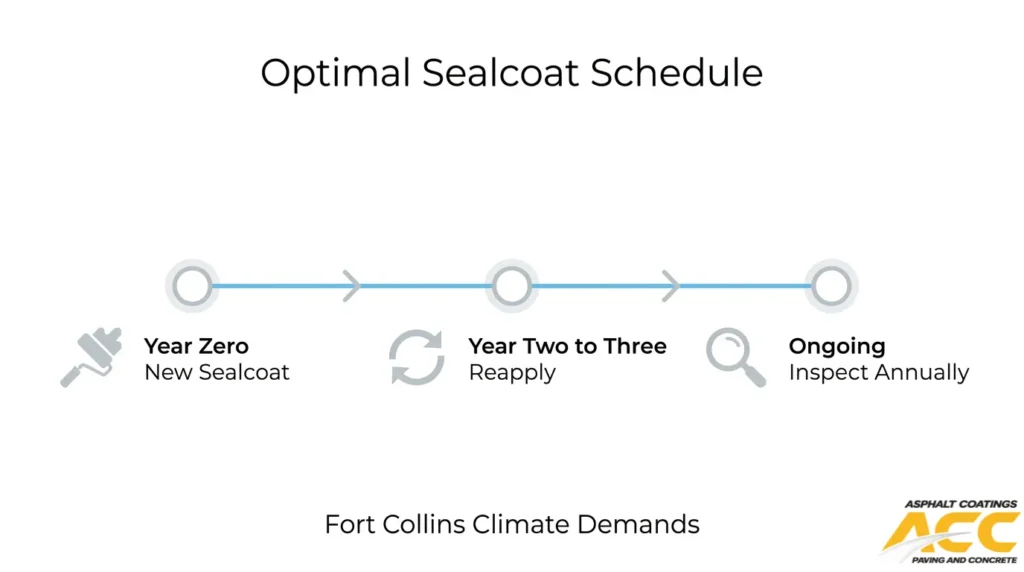
Pavement in Fort Collins should be sealcoated every 2 to 3 years for maximum longevity. However, the ideal interval depends on several site-specific factors that can shorten or extend that cycle.
According to Utah Asphalt, asphalt should typically be sealcoated every 2 to 3 years for most residential and commercial surfaces, depending on traffic volume, weather exposure, and other contributing factors. Fort Collins properties face elevated UV radiation and frequent freeze-thaw cycles, both of which accelerate binder oxidation and surface cracking faster than in lower-elevation regions. Commercial lots with heavy truck traffic or constant vehicle turning may need reapplication closer to the two-year mark. Surfaces with lighter use and minimal chemical exposure often hold closer to three years between applications.
For property managers monitoring multiple assets, the most reliable approach is scheduling annual pavement inspections rather than relying on a fixed calendar alone. Visible fading, hairline surface cracks, and areas where aggregate begins showing through the sealcoat layer all signal that the protective barrier is breaking down. Waiting too long between applications allows moisture and UV damage to penetrate the asphalt binder, turning a low-cost maintenance treatment into a far more expensive repair project. Staying within that 2-to-3-year window keeps the protective layer intact before deterioration compounds.
Understanding reapplication timing sets the stage for identifying which pavement types gain the most from a consistent sealcoating program.
What Types of Pavement Surfaces in Fort Collins Benefit Most from Sealcoating?
The types of pavement surfaces in Fort Collins that benefit most from sealcoating are asphalt parking lots, driveways, access roads, and commercial lot surfaces exposed to heavy traffic and weather. Each surface type faces distinct stressors that sealcoating addresses differently.
- Commercial parking lots endure constant vehicle traffic, fluid leaks, and UV exposure. Sealcoating shields these high-use surfaces from oxidation and chemical penetration, preserving structural integrity across thousands of daily load cycles. For properties near waterways, sealer selection matters significantly. According to U.S. Geological Survey research, PAH releases from parking lots sealed with coal-tar-based products 3 to 8 years prior were on average 60 times higher than releases from unsealed pavement, making asphalt-based sealers the responsible choice in Colorado.
- Asphalt driveways and access roads at apartment complexes, office parks, and distribution centers face concentrated turning movements that accelerate surface wear. Sealcoating restores flexibility to aging binder, reducing the brittleness that leads to cracking under repetitive stress.
- Industrial and warehouse aprons support heavy truck loads and frequent equipment movement. These surfaces develop surface raveling faster than standard lots, so a well-timed sealcoat application prevents aggregate loss before it progresses into structural failure.
- Church, healthcare, and retail lots prioritize both appearance and safety for visitors. Sealcoating delivers a uniform, dark surface that enhances pavement markings and improves stormwater visibility during rain.
One factor many property managers overlook is that sealcoating protects the surface layer only; it does not add structural capacity. Surfaces with deep base failures need repair before sealing will provide meaningful benefit. Prioritizing sealcoating on structurally sound pavement delivers the greatest return on investment.
Knowing which surfaces respond best to sealcoating sets the stage for understanding how crack sealing works alongside it to prevent premature failure.
How Does Proper Crack Sealing Work with Sealcoating to Prevent Premature Pavement Failure?
Proper crack sealing works with sealcoating by addressing subsurface water infiltration before a protective surface coating is applied. This two-step preventive strategy stops moisture from reaching the asphalt base layer, where freeze-thaw expansion causes the most structural damage.
According to the Federal Highway Administration, preventive maintenance is “a planned strategy of cost-effective treatments to an existing roadway system that preserves the system, retards future deterioration, and maintains or improves the functional condition of the system.” Crack sealing and sealcoating are both classified as preventive treatments within this framework. When performed in sequence, crack sealing eliminates the pathways water uses to penetrate pavement, and sealcoating then seals the entire surface against oxidation, UV rays, and chemical spills. Skipping crack repair before sealcoating leaves vulnerable entry points intact, which means moisture continues undermining the pavement structure despite the surface barrier. For commercial properties with heavy traffic loads, this combined approach is one of the most cost-effective ways to delay major rehabilitation and avoid premature pavement failure.
Understanding surface preparation requirements ensures sealcoating bonds properly and delivers its full protective benefit.
What Surface Preparation Steps Are Critical Before Sealcoating to Ensure Long-Lasting Results?
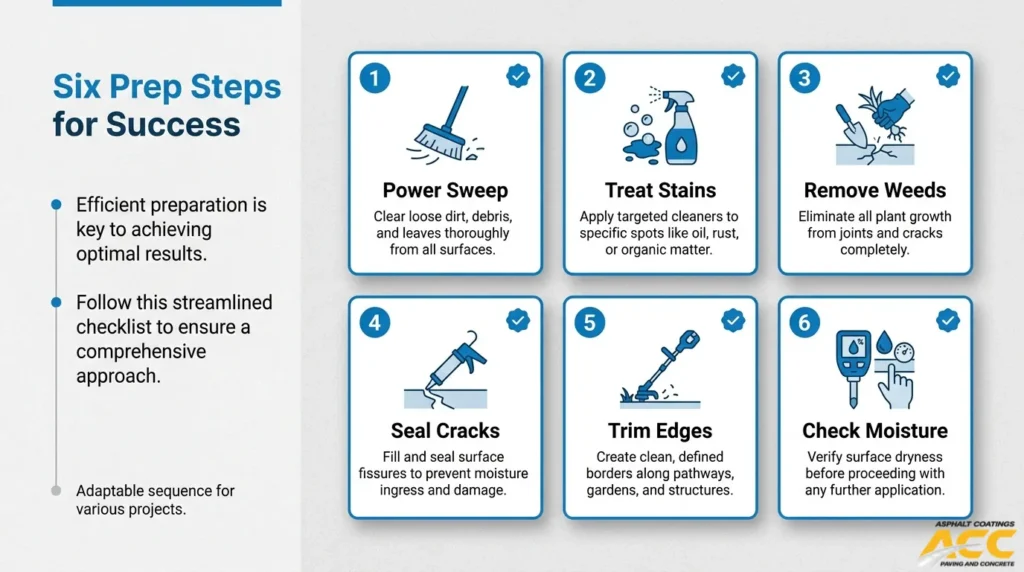
The surface preparation steps critical before sealcoating include thorough cleaning, oil and stain treatment, crack repair, and ensuring proper pavement conditions for adhesion.
Surface preparation determines whether sealcoat bonds properly to the asphalt or fails prematurely. Without removing debris, treating stains, and addressing structural defects beforehand, even high-quality sealcoat materials cannot adhere effectively. Each step in the preparation sequence serves a specific purpose: cleaning removes contaminants that block adhesion, crack filling prevents water from bypassing the protective layer, and surface profiling creates the texture sealcoat needs to grip.
The essential surface preparation steps before sealcoating are:
- Power sweeping and blowing removes loose dirt, gravel, leaves, and debris that would prevent sealcoat from contacting the asphalt binder directly.
- Oil and chemical stain treatment addresses petroleum-based spots with a primer or degreaser, since sealcoat will not bond to oil-saturated pavement.
- Vegetation and weed removal clears grass or weeds growing through cracks, which would otherwise lift the sealcoat layer from below.
- Crack sealing and patching fills structural defects so water cannot penetrate beneath the new seal layer and cause further deterioration.
- Edge trimming cuts back grass and soil that have encroached onto pavement edges, creating clean boundaries for uniform sealcoat application.
- Moisture verification confirms the surface is completely dry, since trapped moisture prevents proper curing and causes peeling.
Skipping any single step compromises the entire application. For commercial properties with heavy traffic, thorough preparation is arguably more important than the sealcoat material itself, because adhesion failure wastes the full investment. Property managers who prioritize preparation consistently see longer intervals between reapplications and fewer warranty issues.
With the surface properly prepared, the next consideration is selecting sealcoat materials and application methods suited to Colorado’s weather extremes.
What Sealcoat Materials and Application Methods Best Withstand Colorado’s Weather Extremes?
The sealcoat materials and application methods that best withstand Colorado’s weather extremes combine asphalt-based emulsion formulations with proper application timing, uniform coverage techniques, and adequate curing protocols suited to high-altitude conditions.
Asphalt emulsion sealers are the dominant choice west of the Continental Divide, and for good reason. According to the U.S. Geological Survey, coal-tar-based sealcoat is more common east of the Continental Divide, while asphalt-based sealcoat is more common to the west. Colorado sits right along this geographic divide, but the environmental profile of asphalt-based products makes them the stronger choice for the region. Asphalt emulsion bonds chemically with the existing pavement surface because both share a petroleum-based composition, creating a more cohesive protective layer that flexes with temperature swings rather than cracking under thermal stress.
Colorado’s combination of intense UV exposure at elevation, rapid freeze-thaw cycling, and semi-arid moisture patterns demands specific application considerations. Spray application using a distributor truck delivers the most uniform mil thickness across large commercial surfaces, while squeegee methods work well for smaller areas where precision matters. Regardless of method, two thin coats outperform a single heavy coat because each layer cures more completely and produces a denser, less porous film.
Timing matters as much as material selection. Sealcoat requires ambient temperatures above 50°F and rising, with no rain forecast for 24 hours. In Colorado’s Front Range, this typically limits the application window to late spring through early fall. Applying during the wrong conditions, even with the right product, leads to premature failure because the emulsion cannot coalesce into a continuous film.
Additives also influence performance. Sand aggregate mixed into the sealcoat improves skid resistance on sloped commercial lots and adds a textured profile that resists wear from snowplow blades. Polymer-modified formulations offer enhanced flexibility, which is particularly valuable where freeze-thaw cycles repeatedly stress the coating.
For property managers evaluating materials and methods, the practical takeaway is straightforward: prioritize asphalt-based emulsions applied in two coats during optimal weather windows, and insist on proper aggregate and polymer additives for high-traffic or high-exposure surfaces. Knowing when to schedule application is the next critical decision in a complete pavement preservation strategy.
How Can Property Managers in Fort Collins Tell When It’s Time to Schedule Sealcoating?
Property managers in Fort Collins can tell when it’s time to schedule sealcoating by watching for visible surface deterioration, tracking pavement age, and monitoring how the asphalt responds to seasonal weather cycles.
The most reliable indicators fall into three categories: visual warning signs on the pavement surface, time-based scheduling benchmarks, and condition changes tied to Fort Collins’ climate extremes. Recognizing these signals early prevents minor surface wear from escalating into structural failures that require costly reconstruction.
Key indicators that sealcoating is overdue include:
- Fading from deep black to a dull, brittle gray, which signals UV oxidation has broken down the asphalt binder.
- Hairline surface cracking, sometimes called “map cracking” or “alligator cracking,” where interconnected fractures spread across the pavement.
- Small areas of loose aggregate or raveling, where individual stones dislodge from the surface as the binder weakens.
- Standing water or slow drainage in areas that previously shed moisture effectively, suggesting early water infiltration.
- Visible wear patterns in high-traffic lanes or turning areas where vehicles stress the surface most.
According to Utah Asphalt, most residential and commercial surfaces should typically be sealcoated every 2 to 3 years depending on traffic, weather exposure, and other factors. However, Fort Collins’ elevation intensifies both UV degradation and freeze-thaw stress, so surfaces here often show wear faster than that general benchmark suggests.
For property managers overseeing parking lots, apartment complexes, or commercial facilities, the smartest approach combines calendar-based scheduling with regular visual inspections every spring after the freeze-thaw season ends. If the surface looks gray and brittle or new cracks have appeared over winter, that is a clear signal to act before water infiltration compounds the damage. Property managers throughout the Front Range rely on Asphalt Coatings Company’s in-house crews to provide comprehensive pavement assessments and coordinate sealcoating schedules that align with Colorado’s unique seasonal application windows.
Waiting until cracks widen or potholes form means the pavement has already moved past the preventive maintenance window, where sealcoating is most cost-effective, and into corrective repair territory.
How Does Quality Sealcoating Reduce Long-Term Maintenance and Reconstruction Costs?
Quality sealcoating reduces long-term maintenance and reconstruction costs by functioning as a proactive preservation treatment that slows pavement deterioration before expensive repairs become necessary. According to the Federal Highway Administration, pavement preservation represents a proactive approach that enables agencies to reduce costly, time-consuming rehabilitation and reconstruction projects and the associated traffic disruptions. This principle applies directly to commercial properties: routine sealcoating addresses surface degradation early, preventing the compounding damage that leads to full-depth failures. For property managers budgeting across multi-year capital plans, the math is straightforward. Investing in scheduled sealcoating cycles costs substantially less over a pavement’s lifespan than deferring maintenance until reconstruction is the only option.
How Does Professional Sealcoating Improve Safety, Curb Appeal, and ADA Accessibility Over Time?
Professional sealcoating improves safety, curb appeal, and ADA accessibility by restoring surface uniformity, enhancing pavement visibility for striping, and creating smooth surfaces that meet accessibility standards. The sections below cover how sealcoating reduces slip and trip hazards, restores visual appeal, and supports ADA-compliant parking lot design.
How Does Sealcoating Reduce Slip, Trip, and Fall Hazards on Commercial Pavement?
Sealcoating reduces slip, trip, and fall hazards by filling minor surface irregularities and restoring a uniform texture across parking lots and walkways. Cracked, pitted asphalt creates uneven surfaces where pedestrians catch their feet, especially in low-light conditions. A sealed surface eliminates these small elevation changes that accumulate as untreated pavement deteriorates. According to the Federal Highway Administration, an effective pavement preservation program provides improved safety and mobility, reinforcing how proactive surface treatments directly lower risk. For commercial properties with heavy foot traffic, consistent sealcoating every few years keeps walking surfaces predictable and hazard-free.
How Does a Fresh Sealcoat Restore and Maintain Curb Appeal for Commercial Properties?
A fresh sealcoat restores and maintains curb appeal by returning faded, gray asphalt to a rich, deep black finish. Oxidized pavement signals neglect to tenants, customers, and visitors before they even enter a building. Because sealcoating fills hairline cracks and smooths minor surface wear, the entire parking area looks newly paved at a fraction of replacement cost. This visual transformation is especially valuable for retail centers, office parks, and healthcare facilities where first impressions influence occupancy rates and customer confidence. Prioritizing appearance through scheduled sealcoating is one of the most cost-effective property investments a commercial manager can make.
What ADA Parking Lot Requirements Does Sealcoating Help Property Managers Meet?
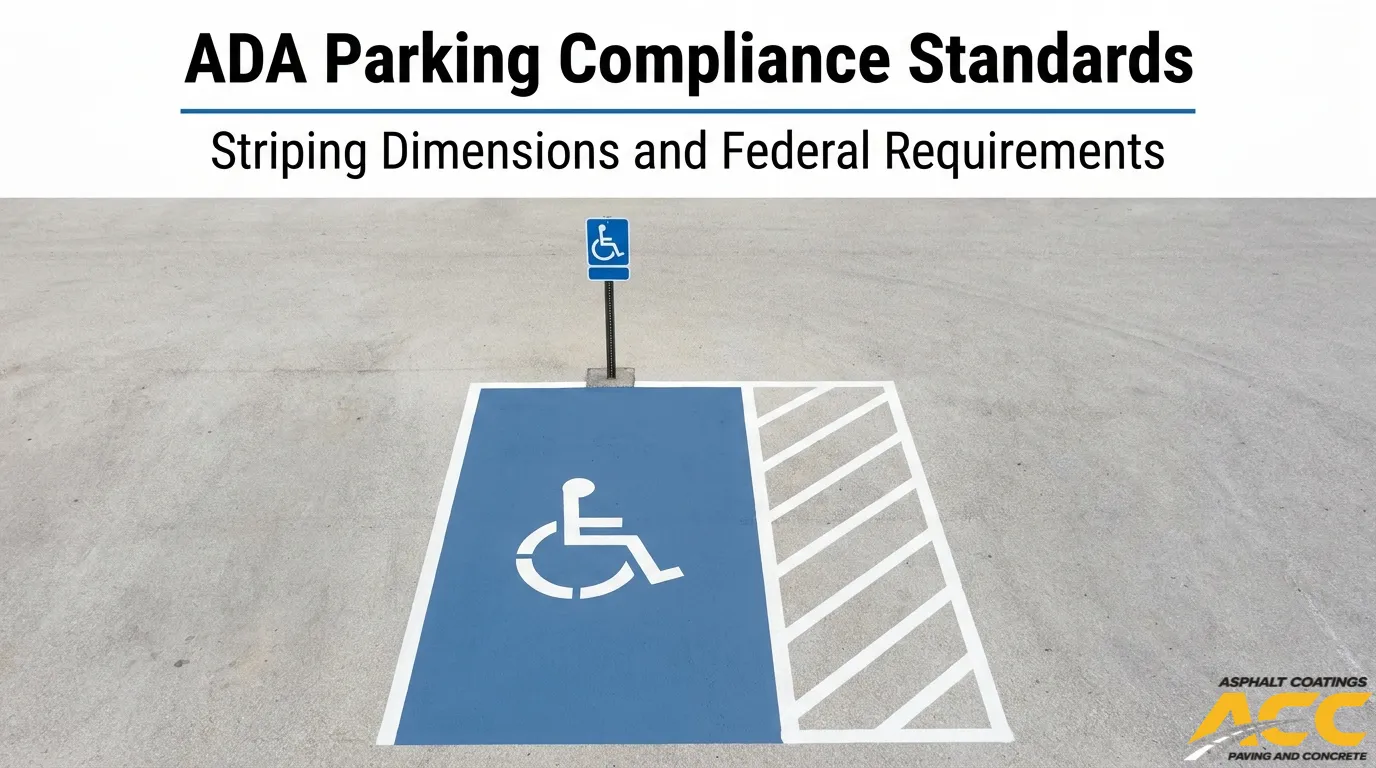
The ADA parking lot requirements that sealcoating helps property managers meet include maintaining smooth, level surfaces and supporting clear, durable striping for accessible spaces. According to the U.S. Department of Justice Civil Rights Division, when a business restripes parking spaces in a parking lot, it must provide accessible parking spaces as required by the 2010 ADA Standards for Accessible Design. Key ADA requirements supported by proper sealcoating and restriping include:
- Accessible parking spaces must be 96 inches wide minimum, with clearly marked boundaries.
- Access aisle boundaries must be clearly marked to discourage parking in them.
- Accessible spaces must be located on the shortest accessible route to an accessible facility entrance.
Deteriorated asphalt undermines these standards because faded markings become invisible and surface cracks create obstacles for wheelchair users. Sealcoating before restriping ensures paint adheres properly and lasts longer, keeping compliant markings visible throughout the maintenance cycle.
Why Does Consistent Pavement Maintenance Signal Professionalism to Tenants and Customers?
Consistent pavement maintenance signals professionalism to tenants and customers because it demonstrates active property stewardship. A well-maintained parking lot communicates that management invests in the entire facility, not just the building interior. Crumbling asphalt and faded striping, on the other hand, suggest deferred maintenance across all building systems. For property managers overseeing apartment complexes, shopping centers, or office parks, the parking lot is the first and last thing every visitor sees. Maintaining it through regular sealcoating builds the kind of trust that retains tenants and attracts new ones.
Choosing the right contractor ensures these safety, aesthetic, and compliance benefits are delivered consistently.
How Should You Choose a Fort Collins Sealcoating Contractor to Maximize Pavement Life?
You should choose a Fort Collins sealcoating contractor by evaluating regional experience, asking targeted questions about materials and methods, and scrutinizing bids for quality indicators. The following sections cover expertise requirements, essential contractor questions, and proposal evaluation.
Why Do Experience and Colorado-Specific Expertise Matter When Selecting a Sealcoating Contractor?
Experience and Colorado-specific expertise matter because Fort Collins pavement faces unique stressors that general contractors may underestimate. High-altitude UV exposure, freeze-thaw cycling, and cold semi-arid weather patterns demand application techniques calibrated to local conditions. A contractor familiar with Colorado’s Front Range understands how elevation affects cure times, when seasonal application windows open, and which sealcoat formulations perform best under intense UV and rapid temperature swings. Years of regional work also mean familiarity with local drainage patterns and subgrade conditions that influence how sealcoat adheres and wears. Prioritizing Colorado experience over general paving credentials is one of the most practical steps property managers can take to protect their investment.
What Questions Should You Ask a Sealcoating Contractor About Materials, Methods, and Scheduling?
The questions you should ask a sealcoating contractor about materials, methods, and scheduling include:
- What sealcoat product do you use, and is it asphalt-based or coal-tar-based?
- How many coats do you apply, and what is the dry time between coats?
- Do you perform crack sealing and surface cleaning before sealcoat application?
- What is your scheduling window, and how do you handle weather delays?
- Do you use in-house crews or subcontractors?
Contractors who answer these questions with specifics, rather than vague assurances, typically deliver more consistent results. According to the Asphalt Institute, spending a dollar on preventive maintenance in the tenth year of a pavement’s life can save up to five dollars in corrective maintenance five years later, so material and method choices carry real financial weight.
How Can You Evaluate Bids and Proposals to Avoid Low-Quality Sealcoating Work?
You can evaluate bids and proposals to avoid low-quality sealcoating work by comparing scope details rather than price alone. A thorough proposal should specify the sealcoat product by name, number of coats, surface preparation steps, square footage covered, cure time, and any traffic control provisions. Bids that omit crack sealing, power washing, or edge work often signal corners being cut. When one bid is significantly lower than others, it usually reflects thinner application, inferior materials, or skipped prep work. Requesting references from commercial properties of similar scale provides additional verification of quality and reliability.
With contractor selection criteria in place, the right partner can deliver sealcoating that consistently extends pavement life.
How Does Asphalt Coatings Company Help Extend Pavement Life with Comprehensive Asphalt Services?
Asphalt Coatings Company helps extend pavement life by combining commercial sealcoating, crack sealing, and full-service asphalt maintenance into a proactive preservation program tailored to Colorado’s climate. The following sections cover specific service details and key article takeaways.
How Does Asphalt Coatings Company’s Commercial Sealcoating and Crack Sealing Program Protect Fort Collins Pavement?
Asphalt Coatings Company’s commercial sealcoating and crack sealing program protects Fort Collins pavement by addressing climate-driven deterioration before it escalates into structural failure. Fort Collins experiences a cold semi-arid climate with warm summers and cold, snowy winters, according to U.S. Climate Data. That combination accelerates oxidation and water infiltration in unprotected asphalt surfaces.
Asphalt Coatings Company pairs sealcoating with routed crack sealing to maximize protection. Routing before crack sealing can double sealant service life by creating a clean reservoir for proper adhesion. Together, these treatments can add five to eight years of additional pavement life.
Key program elements include:
- Commercial sealcoating using asphalt-based emulsion products with lower PAH concentrations than coal tar alternatives
- CDOT-approved crack sealing materials applied after routing to remove loose debris
- Scheduling aligned with Colorado’s short application windows for optimal curing
- In-house crews ensuring consistent quality across parking lots, office parks, and industrial complexes
For property managers facing frequent freeze-thaw cycles at Colorado’s elevation, an integrated approach to crack sealing and sealcoating represents a cost-effective path to preserving pavement integrity.
What Are the Key Takeaways About How Fort Collins Quality Sealcoating Extends Pavement Life We Covered?
The key takeaways about how Fort Collins quality sealcoating extends pavement life are rooted in proactive, climate-informed maintenance. According to the Federal Highway Administration, the cumulative discount value of systematic preservation treatments is substantially less than the cost of reconstruction or major rehabilitation.
The most actionable conclusions from this article include:
- Sealcoating shields asphalt from UV radiation, water infiltration, and chemical exposure, but it protects the surface without adding structural strength.
- Crack sealing before sealcoating prevents moisture from reaching the subbase, where freeze-thaw cycles cause the most damage.
- Asphalt-based sealcoat products are the safer, regionally appropriate choice west of the Continental Divide, avoiding the high PAH concentrations found in coal tar alternatives.
- Preventive maintenance timing matters; investing early in a pavement’s life avoids exponentially higher corrective costs later.
- Colorado’s elevation, freeze-thaw frequency, and intense UV exposure make regular preservation cycles essential rather than optional.
Asphalt Coatings Company brings 39 years of Colorado-specific expertise to every commercial project, delivering sealcoating, crack sealing, and full asphalt services with in-house crews across the Front Range.