Contractor insurance for paving is a collection of specialized commercial policies that protect paving businesses, property owners, and the public from financial losses caused by jobsite accidents, property damage, environmental contamination, and professional errors. These policies function as a financial safeguard for every party involved in asphalt and concrete projects.
This guide covers policy types and their specific roles, the real-world risks each policy addresses, coverage limits by project scale, verification and compliance practices, and how insurance separates professional contractors from risky ones.
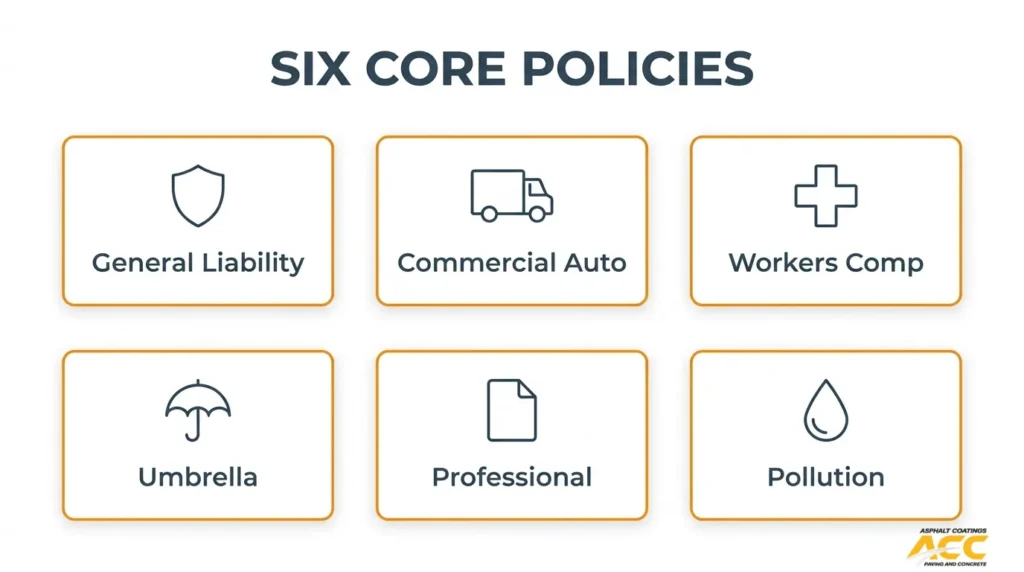
Paving contractors need six core policies: general liability, commercial auto, workers’ compensation, umbrella liability, professional liability, and pollution liability. Each fills a distinct gap; standard CGL policies, for example, include a total pollution exclusion that leaves environmental incidents completely uncovered without a separate pollution liability policy.
On-site risks range from crew injuries and adjacent property damage to premature surface failures and chemical runoff into storm drains. A single diesel spill on a road project can generate cleanup costs reaching six figures, and those costs fall directly on the property owner when the contractor carries no coverage.
Coverage limits vary by project scope. Commercial parking lots typically require $1,000,000 per occurrence and $2,000,000 aggregate as a baseline, while municipal and industrial projects demand umbrella policies of $5,000,000 or more. Even small residential jobs require verified general liability and workers’ compensation at state-mandated levels.
Verification goes beyond collecting a certificate of insurance. A certificate holder only receives proof of insurance; for actual protection, property managers must confirm additional insured status on the underlying policy. Requiring verified coverage before bid review, not after contractor selection, prevents the most common and costly compliance gaps.
Insurance also serves as a reliable indicator of contractor professionalism and long-term viability, and it operates separately from paving warranties, which cover only workmanship defects within a fixed term. Neither replaces the other.
What Is Contractor Insurance in the Paving Industry?
Contractor insurance in the paving industry is a collection of specialized commercial policies designed to protect paving businesses, their clients, and the public from financial losses caused by jobsite accidents, property damage, environmental incidents, and professional errors. These policies function as a safeguard for every party involved in asphalt and concrete projects, from the crew operating heavy equipment to the property manager who commissioned the work.
Paving operations carry inherent risks that general business coverage alone cannot address. Heavy machinery, hot-mix asphalt, chemical sealants, and high-traffic work zones create exposures that demand purpose-built coverage. A single incident, whether a diesel spill reaching a storm drain or a dump truck collision on a public road, can generate six-figure liability costs that would devastate an uninsured contractor and leave the hiring client exposed.
The core policies that make up a paving contractor’s insurance portfolio typically include:
- General liability insurance, which covers bodily injury and property damage claims arising from operations.
- Commercial auto insurance for dump trucks, pavers, and other fleet vehicles.
- Workers’ compensation insurance, covering medical expenses and lost wages for injured crew members.
- Pollution liability insurance, addressing cleanup costs and damages from environmental contamination.
- Umbrella or excess liability insurance, providing additional limits above primary policies.
- Professional liability insurance, protecting against claims tied to design advice or project specifications.
Each policy fills a distinct gap. Standard commercial general liability, for instance, includes a total pollution exclusion, which means a separate pollution liability policy is essential for contractors who handle asphalt emulsions, solvents, and petroleum-based materials daily. Understanding how these coverages work together is critical for both contractors and the commercial property managers who hire them.
Why Should Property Managers Require Insurance From Paving Contractors?
Property managers should require insurance from paving contractors because it transfers financial liability for on-site injuries, property damage, and environmental incidents away from the property owner before work begins.
Verifying insurance at the vendor screening stage is critical. According to NetVendor, vendors must satisfy insurance and credential requirements before they appear in an RFP or bid review, not after a selection has already been made. Waiting until a contract is signed leaves the property exposed to uninsured losses during the most risk-heavy phase of a project.
For property managers overseeing commercial parking lots, industrial facilities, or apartment complexes, this requirement serves as a baseline filter for contractor professionalism. A paving contractor who carries proper coverage demonstrates financial stability and accountability. One who cannot produce proof of insurance signals a risk that no cost savings can justify. Setting insurance minimums early in the selection process protects both the property and the manager’s fiduciary responsibility to stakeholders.
The following sections break down the specific policy types, coverage limits, and verification steps that make this protection effective.
What Types of Insurance Should a Paving Contractor Carry?
A paving contractor should carry six core policy types: general liability, commercial auto, workers’ compensation, umbrella liability, professional liability, and pollution liability. Each covers a distinct risk category common to asphalt and concrete operations.
General Liability Insurance
General liability insurance is the foundational policy every paving contractor needs. The commercial general liability (CGL) policy protects businesses against claims for bodily injury, property damage, completed operations defects, and personal injury liability. According to the International Risk Management Institute (IRMI), CGL coverage extends across premises, operations, products, and completed operations.
Industry-standard limits sit at $1,000,000 per occurrence and $2,000,000 general aggregate. Paving contractors pay an average of $926 per year for this coverage. One critical gap to understand: standard CGL policies include a total pollution exclusion, meaning environmental incidents require separate coverage.
Commercial Auto Insurance
Commercial auto insurance covers vehicles used for business purposes, including dump trucks, pavers, and equipment haulers. Paving operations rely on heavy fleets that travel between job sites daily. This policy protects against third-party liability from accidents and physical damage to owned vehicles. Without it, a single collision involving a loaded dump truck could generate claims that far exceed what personal auto policies allow.
Workers’ Compensation Insurance
Workers’ compensation insurance provides coverage for medical expenses, lost wages, and rehabilitation costs when employees are injured on the job. Paving crews face elevated hazards from heavy machinery, hot asphalt, and roadside traffic exposure. Most states mandate this coverage for contractors with employees, and according to the New York State Workers’ Compensation Board, penalties for non-compliance can reach $2,000 for every 10 days a business operates without it.
Umbrella or Excess Liability Insurance
Umbrella or excess liability insurance provides additional coverage limits above primary policies, such as general liability and commercial auto. According to The Hartford, this layer protects against catastrophic losses that exceed underlying policy caps. For paving contractors working on high-value commercial properties, a single serious incident can surpass standard limits quickly. This policy closes that gap without requiring higher base policy limits.
Professional Liability Insurance
Professional liability insurance covers financial losses arising from professional advice or services. Unlike CGL, which addresses physical risks such as bodily injury and property damage, professional liability responds to claims involving design errors, specification mistakes, or flawed project recommendations. Paving contractors who provide grading plans, drainage assessments, or pavement design consulting face exposure that general liability alone cannot address.
Pollution Liability Insurance
Pollution liability insurance covers bodily injury claims, cleanup costs, and property damage caused by pollutants on paved properties. Standard CGL policies exclude pollution events entirely, leaving a significant coverage gap. Contractors Pollution Liability (CPL) insurance specifically protects contractors who cause or exacerbate environmental conditions during operations, such as diesel spills, asphalt runoff, or chemical releases into storm drains.
For any paving operation handling hot-mix asphalt, sealcoat materials, or fuel storage on site, this coverage is not optional in practice. Understanding how much coverage each policy requires depends on the project’s scale and contractual demands.
What Risks Does Paving Contractor Insurance Protect Against?
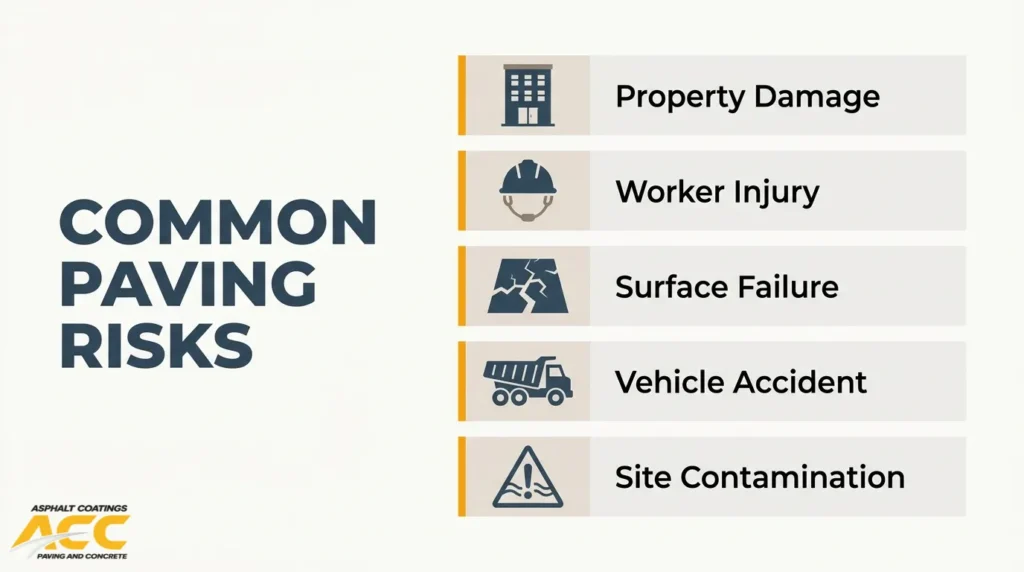
Paving contractor insurance protects against property damage, worker injuries, premature surface failures, vehicle accidents, and environmental contamination. Each scenario below illustrates how specific coverage types serve as a financial safeguard for contractors and property owners alike.
What Happens if a Paving Crew Damages Adjacent Property?
If a paving crew damages adjacent property, general liability insurance covers the resulting repair costs and legal expenses. Heavy equipment, hot asphalt materials, and grading operations can harm neighboring structures, landscaping, fences, or underground utilities during routine paving work. Without coverage, the contractor bears full financial responsibility for third-party property damage claims. For property managers hiring paving contractors, simply holding a certificate of insurance is not enough; according to the F.O. Agency, a certificate holder only receives proof of insurance, and for true protection, a party must be added as an “additional insured” on the policy. This distinction matters when adjacent property owners pursue claims after construction-related damage.
What Happens if a Worker Is Injured on a Paving Job Site?
If a worker is injured on a paving job site, workers’ compensation insurance covers medical expenses, lost wages, and rehabilitation costs. Paving environments expose crews to burns from hot-mix asphalt, struck-by hazards from rollers and pavers, and repetitive strain injuries from manual labor. According to the U.S. Bureau of Labor Statistics, the total recordable cases incidence rate for asphalt paving mixture and block manufacturing reached 2.2 per 100 full-time workers in 2024. That rate underscores why workers’ compensation is not optional for paving operations. Without this coverage, an injured employee’s medical bills and potential litigation fall directly on the contractor and, in some cases, the property owner who hired them.
What Happens if a Completed Paving Surface Fails Prematurely?
If a completed paving surface fails prematurely, completed operations coverage under a general liability policy responds to claims arising after the project is finished. Cracking, rutting, or delamination on an asphalt surface can emerge months after installation due to improper compaction, inadequate base preparation, or material deficiencies. This coverage addresses third-party bodily injury or property damage caused by the failed work. From a practical standpoint, completed operations protection is one of the most overlooked components of paving contractor insurance, yet it carries some of the highest financial exposure for commercial parking lots and roadways that serve heavy daily traffic.
What Happens if Paving Equipment Causes a Vehicle Accident?
If paving equipment causes a vehicle accident, commercial auto insurance covers liability for injuries and physical damage to vehicles involved. According to Progressive Commercial, commercial auto insurance covers vehicles used for business purposes, including dump trucks and paving equipment, protecting against both liability and physical damage. Paving operations frequently involve dump trucks hauling materials on public roads, pavers blocking traffic lanes, and rollers operating near active roadways. A collision involving any of these vehicles can generate substantial medical and property damage claims that personal auto policies will not cover.
What Happens if Runoff or Materials Contaminate a Site?
If runoff or materials contaminate a site, pollution liability insurance covers cleanup costs, bodily injury claims, and property damage caused by pollutants. Standard general liability policies typically exclude pollution events entirely, leaving contractors exposed during asphalt operations that involve petroleum-based sealants, diesel fuel, and hot-mix materials near storm drains or waterways. Spills, chemical leaks from equipment, and contaminated stormwater runoff can trigger regulatory action and remediation obligations that quickly escalate into significant expenses. For commercial paving projects near sensitive areas, pollution liability fills a critical gap that no other policy type addresses.
Understanding these risk scenarios clarifies why adequate coverage limits matter for every project scope.
How Much Insurance Coverage Should a Paving Contractor Have?
A paving contractor should have coverage limits that match the scale, risk profile, and contractual demands of each project type. Commercial, industrial, and residential jobs each require different minimums for general liability, workers’ compensation, and specialty policies.
How Much Coverage Do Commercial Parking Lot Projects Need?
Commercial parking lot projects need higher coverage limits than most other paving work due to greater traffic exposure, larger surface areas, and stricter client requirements. Property managers and building owners typically mandate:
- General liability limits of $1,000,000 per occurrence and $2,000,000 aggregate as a baseline.
- Workers’ compensation with employers’ liability of at least $1,000,000, which institutions like the University of Illinois System require for all construction contractors.
- Commercial auto liability covering dump trucks and heavy equipment.
- Pollution liability to address runoff, fuel spills, or sealcoat chemical exposure.
Certificates of insurance alone do not confer insured status unless the underlying policy is amended, according to the International Risk Management Institute (IRMI). Always confirm that additional insured endorsements are in place before work begins.
How Much Coverage Do Industrial or Municipal Projects Need?
Industrial or municipal projects need the highest insurance thresholds of any paving work because government agencies and large-scale facilities impose strict contractual insurance requirements. Many municipalities require minimum limits across five or more coverage types, including general liability, automobile liability, and workers’ compensation.
Key considerations for industrial and municipal paving include:
- Umbrella or excess liability policies of $5,000,000 or more to cover catastrophic losses on high-traffic corridors.
- Contractors pollution liability, since standard CGL policies contain a total pollution exclusion that leaves environmental incidents uncovered.
- State-specific mandates that may require workers’ compensation even for contractors with no employees; California, for example, enforces this for certain contractor classifications.
For projects of this magnitude, verifying that coverage descriptions on certificates are accurate is essential. As Insurance Journal warns, a certificate with errors can create liability exposure years into the future.
How Much Coverage Do Small-Scale Residential Projects Need?
Small-scale residential projects need lower coverage limits than commercial or municipal work, though baseline protections remain essential. Homeowners should still verify that any paving contractor carries general liability and workers’ compensation before allowing work on their property.
Typical minimums for residential paving include:
- General liability of at least $500,000 to $1,000,000 per occurrence.
- Workers’ compensation at state-mandated levels for all crew members.
- Commercial auto coverage for any vehicles brought onto the property.
Coverage gaps remain a common concern at the residential level. “People Also Ask” queries for local contractors frequently focus on whether a standard policy covers pollution runoff or completed operations, both of which require separate endorsements or specialty policies. Even on smaller driveways and walkways, confirming actual policy terms protects homeowners from absorbing costs that should fall on the contractor.
Understanding required coverage levels makes it easier to evaluate whether a contractor’s insurance documentation is legitimate and complete.
How Can You Verify a Paving Contractor’s Insurance Coverage?
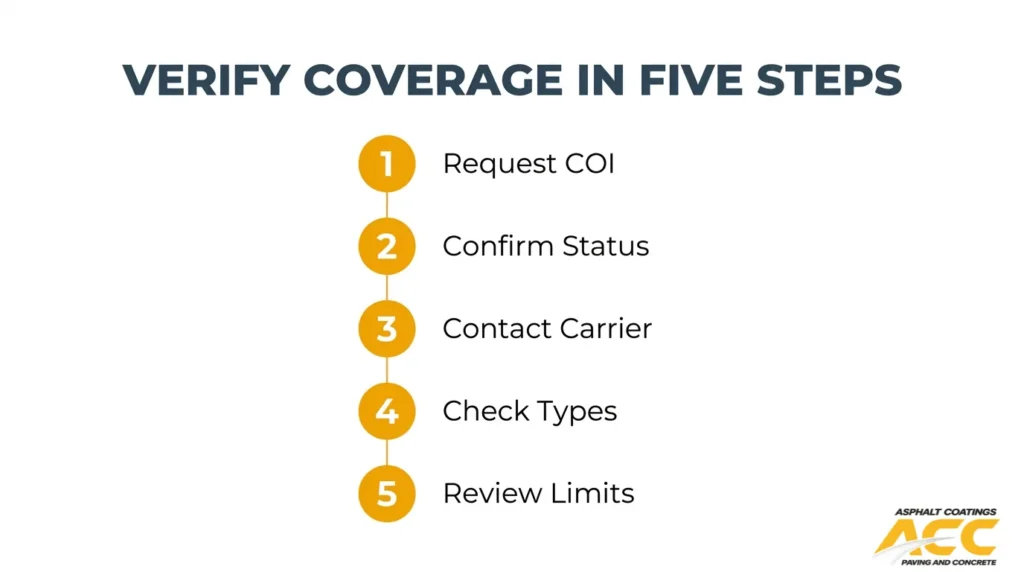
You can verify a paving contractor’s insurance coverage by requesting a certificate of insurance, confirming additional insured status, and contacting the insurer directly. A certificate alone does not guarantee protection, so each document requires careful review.
The National Asphalt Pavement Association (NAPA) recommends that property owners verify insurance by asking for written proof of general liability and workers’ compensation coverage before any work begins. This step protects you if an accident occurs on your property.
Start with these verification steps:
- Request a certificate of insurance (COI). Ask the contractor to provide a current COI listing your organization as the certificate holder. Review it for policy types, coverage limits, and expiration dates.
- Confirm additional insured status. A certificate holder only receives proof of insurance. For true protection, your organization must be added as an additional insured on the contractor’s policy, which extends coverage to you for claims arising from the contractor’s work.
- Contact the insurance carrier directly. Call the insurer listed on the COI to confirm the policy is active, limits are accurate, and no cancellations are pending.
- Check for required coverage types. Verify the contractor carries general liability, workers’ compensation, commercial auto, and any pollution liability relevant to your project scope.
- Review limits against your project requirements. Confirm per-occurrence and aggregate limits meet your minimum thresholds before signing any contract.
According to the International Risk Management Institute (IRMI), certificates of insurance do not confer coverage or insured status unless the policy itself is amended. Relying on a COI without verifying the underlying policy language is one of the most common mistakes property managers make. Always treat the certificate as a starting point for due diligence, not the final word on your protection.
With coverage verified, understanding the consequences of skipping this step reveals why uninsured contractors pose serious financial risk.
What Happens When You Hire an Uninsured Paving Contractor?
When you hire an uninsured paving contractor, you assume direct financial and legal liability for any accident, injury, or property damage that occurs during the project. The consequences range from personal lawsuits to regulatory penalties and unrecoverable repair costs.
Hiring without verifying coverage is one of the most expensive mistakes a property manager can make. When no insurance backstop exists, every risk transfers to the property owner. Worker injuries on your site can trigger medical expense claims filed directly against you, since no workers’ compensation policy exists to absorb them. Property damage to adjacent buildings, utilities, or vehicles becomes your financial burden. Environmental contamination from asphalt runoff or fuel spills can generate remediation costs reaching hundreds of thousands of dollars; according to Morris & Garritano, a diesel spill on one road project released 300 gallons into a storm drain, with cleanup and remediation costs reaching $750,000.
Beyond immediate costs, uninsured contractor incidents expose property owners to prolonged litigation. Without a general liability policy backing the contractor, injured third parties have no insurer to file claims against, so they pursue the property owner instead. Municipal code enforcement may also impose penalties if the contractor was operating without state-mandated coverage. In New York, for example, the Workers’ Compensation Board can assess penalties of up to $2,000 for every 10 days a business operates without required coverage.
The financial exposure compounds when completed work fails. An uninsured contractor has no completed operations coverage to fund repairs for premature surface failures, cracking, or drainage problems. The property owner absorbs full replacement costs with no recourse beyond civil court, where collecting from an undercapitalized contractor is often impractical.
For commercial property managers, this risk is entirely avoidable. Requiring verified insurance before any contract is signed protects against catastrophic out-of-pocket losses and signals due diligence to tenants, investors, and regulatory bodies. Understanding how insurance reflects broader contractor professionalism helps distinguish reliable partners from risky ones.
How Does Insurance Reflect a Paving Contractor’s Professionalism?
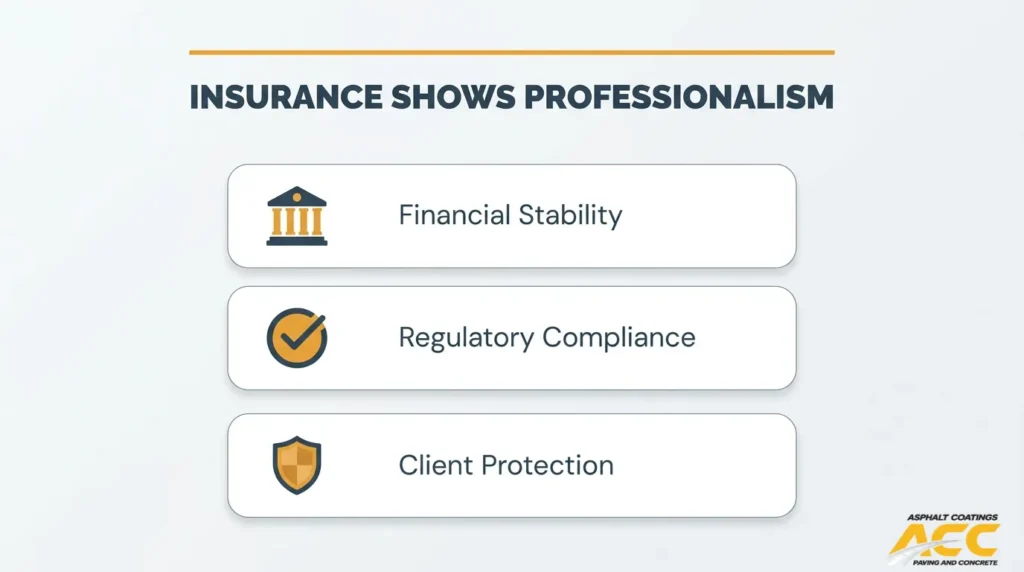
Insurance reflects a paving contractor’s professionalism by demonstrating financial responsibility, regulatory compliance, and a commitment to protecting clients from project-related risks. A contractor who maintains comprehensive coverage signals operational maturity and accountability.
Securing and maintaining proper insurance requires investment, organizational discipline, and a willingness to stand behind every project. Contractors who carry adequate policies show they plan for contingencies rather than shifting liability onto property owners. This proactive approach to risk management separates established commercial paving firms from operators cutting corners to win bids on price alone.
For property managers evaluating paving partners, insurance status serves as one of the most reliable indicators of a contractor’s long-term viability and professional standards. Understanding how insurance differs from a paving warranty further clarifies the protections each provides.
How Does Contractor Insurance Differ From a Paving Warranty?
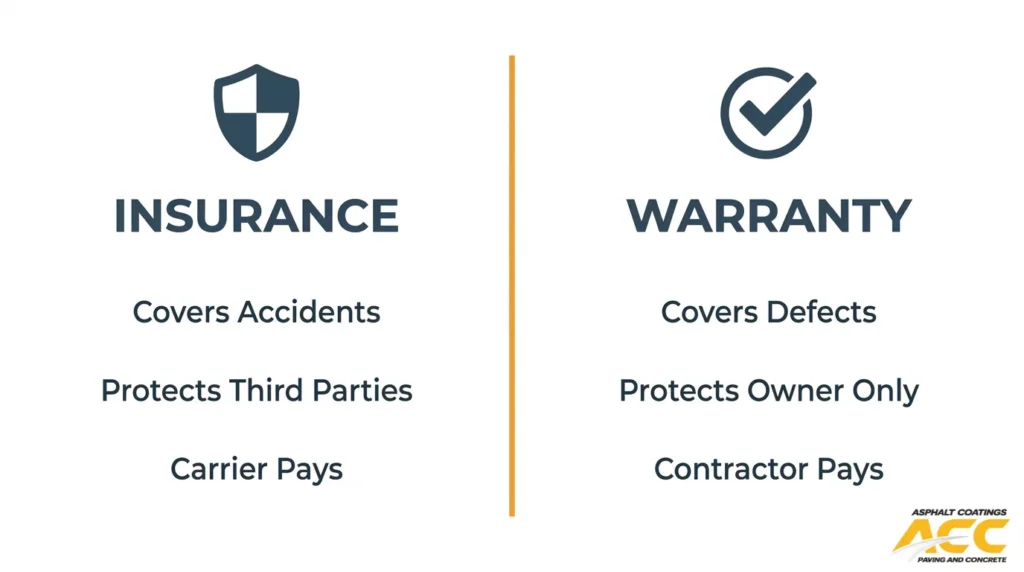
Contractor insurance differs from a paving warranty in scope, trigger, and who bears financial responsibility. Insurance covers third-party losses from accidents and negligence, while a warranty addresses defects in the finished work itself.
Contractor insurance activates when an unexpected event causes bodily injury, property damage, or environmental contamination during or after a project. It protects the property owner, the contractor, and injured third parties through policies like general liability, workers’ compensation, and pollution liability. The financial burden shifts to the insurance carrier rather than either contracting party.
A paving warranty, by contrast, is a contractual promise that the completed surface will perform to an agreed standard for a defined period. It covers material failures, premature cracking, or drainage issues tied to workmanship. However, warranty protections have significant limits. According to Venable LLP, a contractor is generally not liable for repairs under a warranty of good workmanship if the failure is due to a defect in the owner’s design or specifications.
Key differences include:
- Trigger: Insurance responds to accidents and unforeseen losses; a warranty responds to defects in the finished product.
- Coverage scope: Insurance covers bodily injury, property damage, and pollution cleanup; a warranty covers only repair or replacement of the paving surface.
- Duration: Insurance remains active as long as premiums are paid; warranties expire after a fixed term.
- Financial source: Insurance claims are paid by the carrier; warranty claims are fulfilled by the contractor at their own cost.
- Third-party protection: Insurance protects injured workers, bystanders, and adjacent property owners; a warranty protects only the project owner.
Neither protection replaces the other. A warranty alone leaves a property owner exposed to injury claims and environmental liability, while insurance alone offers no recourse if the asphalt deteriorates prematurely. For commercial property managers, requiring both from a paving contractor is the most reliable way to close coverage gaps. Understanding this distinction helps when evaluating a contractor’s full qualifications.
How Should You Evaluate Insurance When Choosing a Commercial Paving Partner?
You should evaluate insurance when choosing a commercial paving partner by verifying active coverage, confirming adequate limits, and assessing the contractor’s overall risk profile. The following subsections cover how experience reduces risk and the key takeaways about contractor insurance for paving.
Can an Experienced Asphalt Paving Contractor Reduce Your Risk?
Yes, an experienced asphalt paving contractor can reduce your risk significantly. Contractors with proven track records carry comprehensive insurance portfolios because insurers reward consistent safety performance and operational competence with broader coverage options.
An experienced paving contractor understands site-specific hazards, from pollution liability exposure during asphalt operations to equipment risks near active traffic. According to NAPA, property owners should verify insurance by asking for written proof of general liability and workers’ compensation coverage before work begins.
Contractors who have navigated complex commercial projects develop risk management protocols that fewer claims and incidents reflect directly. For property managers evaluating bids, years of safe operations signal a contractor who protects both their crew and your property. Asphalt Coatings Company brings 39 years of commercial paving expertise across Colorado’s Front Range, maintaining the coverage and safety standards that complex projects demand.
What Are the Key Takeaways About Contractor Insurance for Paving?
The key takeaways about contractor insurance for paving center on proactive verification, appropriate coverage types, and contractual compliance. According to the Washington State Department of Transportation and APWA guidelines, contractors shall procure and maintain all required insurance in addition to any other insurance required by the contract.
Essential points to remember include:
- General liability, workers’ compensation, commercial auto, and pollution liability form the core coverage portfolio for paving contractors.
- Coverage limits should match project scope; municipal and industrial projects typically require higher thresholds than standard commercial work.
- Certificates of insurance prove coverage exists but do not grant you insured status unless the policy itself names you as additional insured.
- Verifying insurance before bid review, not after contractor selection, prevents costly gaps.
- Experienced contractors treat insurance as a reflection of professionalism, not just a regulatory checkbox.
Insurance is ultimately a safeguard that protects every stakeholder in a paving project. Asphalt Coatings Company maintains comprehensive insurance coverage and partners with commercial clients across Colorado to deliver paving solutions built on trust, transparency, and accountability.