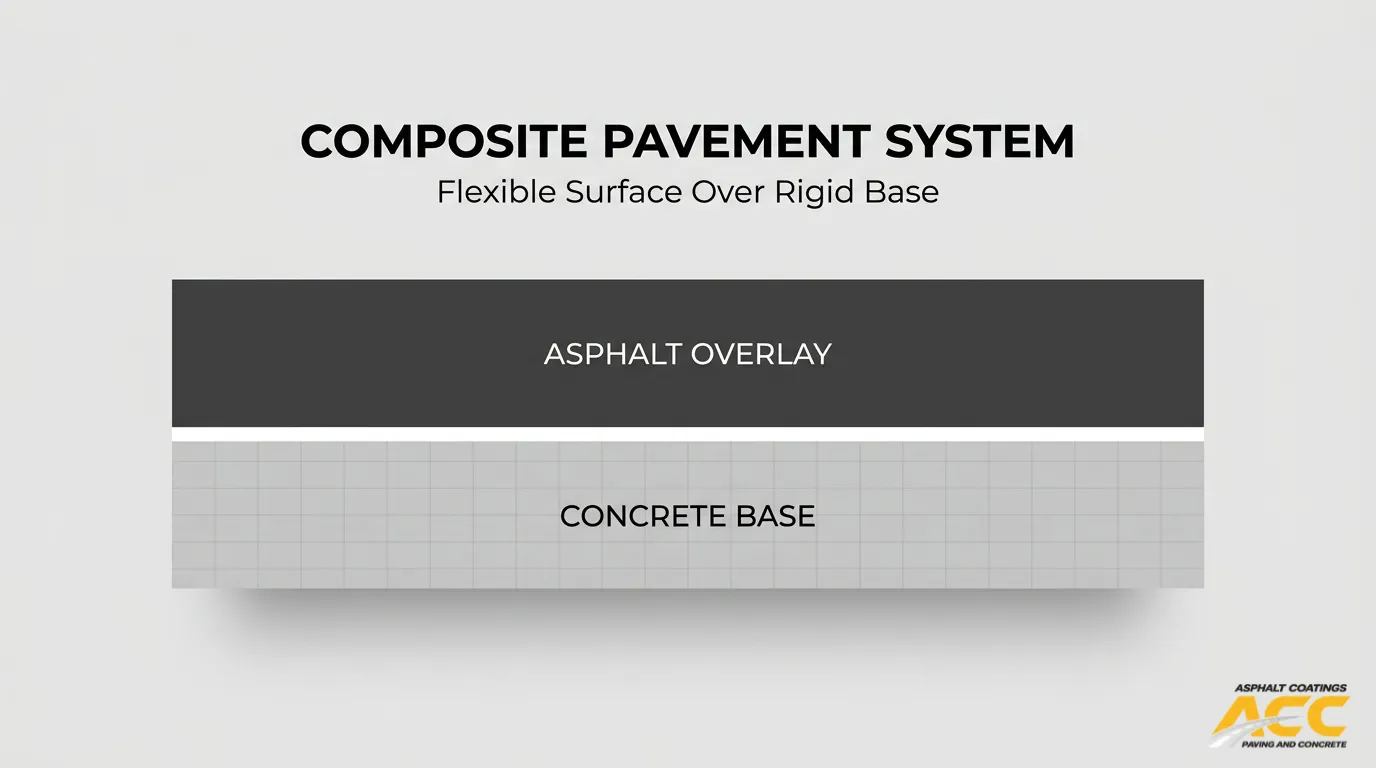
Paving asphalt over concrete creates a composite pavement system where a flexible surface layer rides on a rigid base, leveraging the strengths of both materials. The overlay succeeds when the concrete is structurally sound, joints are stable, and preparation is thorough; it fails when existing cracks, unstable subgrade, or poor drainage allow reflective cracking to propagate upward through the new surface.
This guide covers how composite overlays perform, when overlaying makes sense versus when it leads to premature failure, the preparation and thickness requirements that determine longevity, how Colorado’s climate and soil conditions compound overlay risks, and how to evaluate whether your property is a good candidate.
Asphalt over concrete performs as a layered system where the concrete distributes structural loads while the asphalt absorbs surface wear. Service life ranges from 5 to 20 years depending on preparation quality, traffic intensity, and maintenance; most commercial properties should plan for 8 to 12 years when conditions are favorable.
Overlaying works best when slabs are intact, joints are tight, and project constraints favor speed over full reconstruction. Retail centers, office parks, and facilities that cannot close for extended demolition timelines benefit most from this approach. However, the method fails when deteriorated joints telegraph cracks through the asphalt within just a few years, when expansive clay soils create seasonal subgrade movement, or when heavy truck traffic exceeds the overlay’s fatigue capacity.
Colorado’s freeze-thaw cycles, high-altitude UV exposure, and expansive soils (affecting roughly half the state) make proper joint treatment, interlayer systems, and adequate thickness non-negotiable. Correct preparation includes crack routing, drainage correction, ADA grade adjustments, and uniform tack coat application. Proactive sealcoating and crack sealing after installation can effectively double the interval between major rehabilitation cycles.
How Does Asphalt Perform When It Is Installed Over Existing Concrete?
Asphalt installed over existing concrete performs as a composite pavement system, where a flexible surface layer rides on a rigid base. Performance depends on concrete condition, overlay thickness, traffic loads, and how well reflective cracking is managed. The subsections below break down each factor.
How Does the Composite Pavement Structure Actually Work?
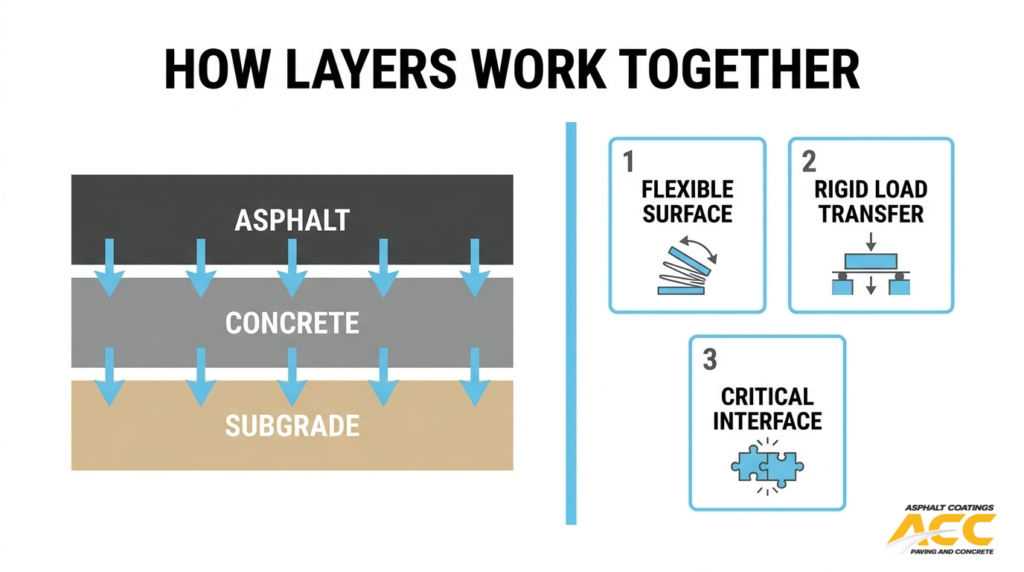
The composite pavement structure works by combining a flexible asphalt surface layer over a rigid concrete base to leverage the strengths of both materials. The asphalt layer provides a smooth, quiet driving surface, while the concrete underneath supplies stiffness and load distribution.
According to a Virginia Transportation Research Council and Virginia Tech synthesis, a composite structure is defined as a multi-layer system where a flexible layer such as dense-graded HMA or stone matrix asphalt sits over a rigid layer like continuously reinforced concrete pavement or cement-treated base. This pairing means the concrete handles structural loads while the asphalt absorbs surface wear and minor deflections. However, because two dissimilar materials respond differently to temperature and moisture, the interface between them becomes the most performance-critical zone in the entire system.
What Kind of Service Life Can You Expect from an Asphalt-Over-Concrete Overlay?
You can expect an asphalt-over-concrete overlay to last anywhere from five years to well over a decade, depending on preparation quality, traffic intensity, and maintenance. The range is wide because so many variables influence longevity.
According to the FHWA’s performance evaluation of rehabilitation treatments, asphalt concrete overlays on existing concrete pavements extended pavement service life from 1 to 20 years across 12 studied projects. Thin overlays on lightly trafficked commercial lots tend toward the shorter end, while thicker overlays with proper interlayer treatment on structurally sound slabs push toward the upper range. For most commercial property managers, realistic planning should target the 8 to 12 year window when concrete condition is good and a proactive sealcoating schedule is maintained.
What Is the Biggest Performance Risk in Asphalt Over Concrete?
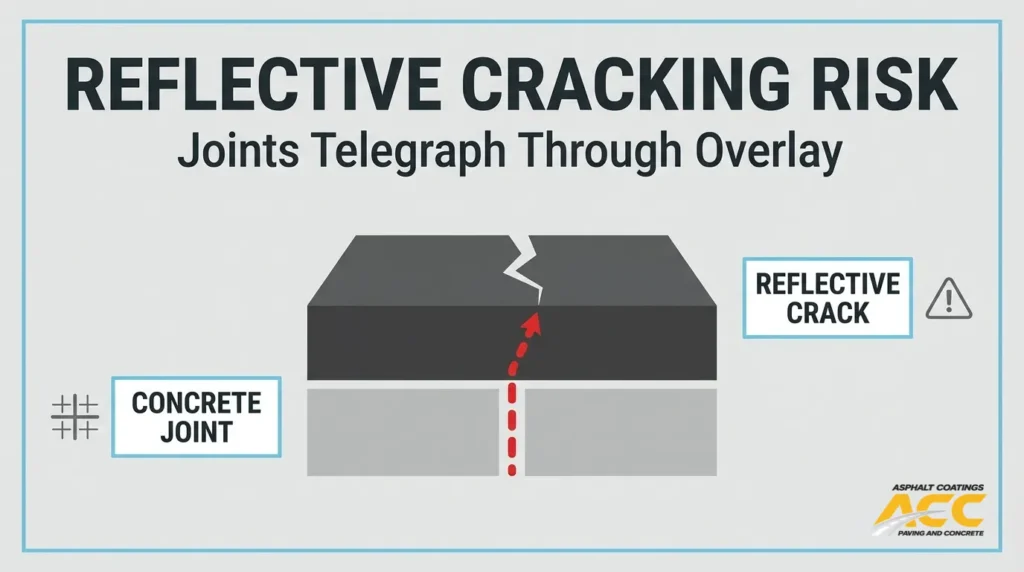
The biggest performance risk in asphalt over concrete is reflective cracking. Joints and cracks in the underlying concrete slab telegraph upward through the asphalt overlay, often within the first few years.
The FAA’s technical guidance on reflective cracking explains that the basic mechanisms are horizontal movements from thermal expansion and contraction of PCC slabs concentrated at joints, combined with differential vertical deflections at those same locations. Once a reflective crack opens at the surface, water infiltrates the pavement structure and accelerates deterioration of both layers. This single failure mode drives more overlay maintenance costs than any other issue, which is why interlayer systems, proper joint treatment, and adequate overlay thickness are non-negotiable steps during installation.
How Does Overlay Thickness Influence Long-Term Performance?
Overlay thickness directly influences long-term performance by controlling fatigue resistance and the speed at which reflective cracks reach the surface. Thicker overlays absorb more stress before cracking propagates through.
The Texas Asphalt Pavement Association’s user guide specifies a minimum asphalt thickness of 4 inches for areas receiving any heavy traffic, including buses and garbage trucks, due to the potential for fatigue cracking. Light-duty parking areas may perform adequately at 3 inches. Skimping on thickness to save upfront cost is one of the most common mistakes in overlay projects; every fraction of an inch removed accelerates the timeline for reflective cracks to appear and shortens the effective service life of the investment.
Understanding how asphalt performs over concrete sets the stage for identifying when this approach makes practical sense for a property.
When Does It Make Sense to Pave Asphalt Over Concrete Instead of Removing the Slab?
Paving asphalt over concrete makes sense when the existing slab is structurally sound, joints are stable, and project constraints favor speed over full reconstruction. The subsections below cover structural readiness, joint behavior, budget timing, traffic demands, and long-term maintenance goals.
When is the existing concrete structurally sound enough to support an asphalt overlay?
The existing concrete is structurally sound enough to support an asphalt overlay when slabs are intact, stable on their subgrade, and free of widespread cracking or settlement. Key indicators include:
- Slabs show no rocking, pumping, or corner breaks under load.
- Joints are tight with minimal faulting between panels.
- Surface distress is limited to minor spalling rather than full-depth fractures.
- The subgrade beneath the concrete remains firm with no voids or erosion.
According to a Purdue University Joint Transportation Research Program study on composite pavements, distress frequently occurs near joints or cracks where water enters the pavement structure, leading to concrete deterioration and loss of subgrade support. Any slab section showing these symptoms needs repair or removal before overlay placement.
How do joint spacing and movement in the concrete affect overlay success?
Joint spacing and movement in the concrete affect overlay success by controlling how much stress transfers into the asphalt layer above. Wider joint spacing means longer slab panels, which produce greater thermal expansion and contraction forces concentrated at each joint.
According to the Federal Aviation Administration’s research on reflective cracking mitigation, the basic mechanisms driving reflective cracks are horizontal movements from PCC slab expansion and contraction concentrated at joints and cracks, combined with increased vertical deflections at those same locations. When differential vertical movement between adjacent panels is significant, the asphalt above flexes repeatedly until it fractures. Shorter joint spacing distributes movement across more locations, reducing stress per joint. Before overlaying, each joint should be evaluated for active movement; joints exceeding tolerable thresholds may require saw-and-seal treatment or interlayer reinforcement.
When do budget and downtime constraints favor asphalt over concrete removal?
Budget and downtime constraints favor asphalt over concrete removal when the property cannot absorb the cost or disruption of full demolition. Full concrete removal involves sawcutting, breaking, hauling debris, preparing subgrade, and repaving, a process that can take weeks on a commercial lot. An asphalt overlay, by contrast, can often be placed directly over the cleaned and tacked slab in a fraction of that time.
This matters most for properties that cannot close for extended periods:
- Retail centers and shopping plazas needing continuous customer access.
- Distribution warehouses operating on tight shipping schedules.
- Healthcare facilities where ambulance and patient access is non-negotiable.
When the concrete is structurally adequate, overlaying preserves the existing investment while keeping capital expenditure significantly lower than reconstruction.
When does traffic type and loading make an asphalt-over-concrete solution viable?
Traffic type and loading make an asphalt-over-concrete solution viable when vehicle weights remain within the structural capacity of the composite section. Light-duty environments such as office park parking lots and passenger vehicle areas are strong candidates because the concrete slab provides a rigid base that distributes loads effectively.
According to the Texas Asphalt Pavement Association’s pavement user guide, a minimum asphalt thickness of 4 inches should be used where heavy traffic is expected, including buses and garbage trucks, due to the potential for fatigue cracking. Properties with predominantly car traffic can often use thinner overlays successfully. Sites receiving frequent heavy truck traffic, dumpster service, or loaded delivery vehicles need thicker asphalt sections and careful evaluation of whether the existing concrete can handle concentrated wheel loads without punching through at deteriorated joints.
How do long-term maintenance goals influence the decision to overlay instead of replace?
Long-term maintenance goals influence the decision to overlay instead of replace by determining whether shorter maintenance cycles are acceptable or whether a single longer-lasting investment is preferred. An asphalt overlay is not a permanent fix; it requires ongoing crack sealing, sealcoating, and eventual resurfacing.
Overlaying makes sense when the property owner plans to:
- Maintain the surface actively with scheduled sealcoating and crack repair.
- Budget for a future mill-and-overlay or full reconstruction within 10 to 15 years.
- Preserve capital now while extending usable pavement life incrementally.
If the goal is a 20-plus-year low-maintenance surface, full removal and new construction often delivers better lifecycle value. For owners who prioritize immediate function and plan proactive upkeep, an overlay can be the more practical path forward.
Understanding when overlay conditions are right sets the stage for recognizing when they are not.
In What Situations Will Asphalt Over Concrete Likely Crack, Reflect, or Fail Prematurely?
Asphalt over concrete will likely crack, reflect, or fail prematurely when the underlying slab is already deteriorated, the subgrade is unstable, drainage is poor, freeze-thaw exposure is severe, or heavy vehicles exceed the overlay’s design capacity. The following sections detail each failure scenario.
How Do Existing Concrete Cracks and Broken Slabs Telegraph Through New Asphalt?
Existing concrete cracks and broken slabs telegraph through new asphalt when horizontal expansion, contraction, and differential vertical movement at joints concentrate stress on the overlay. These forces propagate upward, reproducing the original crack pattern on the asphalt surface within a few years.
According to an NCAT Report from Auburn University, deteriorated joints and severe cracks in jointed reinforced PCC pavements reflected through asphalt overlays within a few years, causing ride quality, cracking, and raveling problems that required resurfacing every five to six years. Rocking or shattered panels are especially aggressive crack initiators because they create abrupt deflection differences that thin overlays cannot absorb. Any slab with active movement should be stabilized or removed before paving.
How Do Unstable Subgrade or Frost Heave Issues Cause Asphalt Overlays to Fail?
Unstable subgrade or frost heave issues cause asphalt overlays to fail by creating uneven vertical movement beneath the concrete base. When moisture-saturated soils freeze, ice lenses form and push the slab upward; upon thawing, voids develop underneath. This cyclic heaving and settling flexes the rigid concrete, and the asphalt overlay above cracks along the same stress lines. Expansive clay soils compound the problem by swelling when wet and shrinking when dry. Even a structurally sound concrete slab cannot compensate for a subgrade that shifts seasonally. Proper subgrade evaluation, including soil testing and drainage assessment, is essential before any overlay project proceeds.
When Do Drainage and Standing Water Problems Undermine Asphalt Over Concrete?
Drainage and standing water problems undermine asphalt over concrete when water infiltrates joints, seams, or pavement edges and becomes trapped between layers. Pooling water softens the subgrade, accelerates stripping of the asphalt binder from aggregate, and erodes base support beneath the concrete slab. In freezing conditions, trapped moisture expands and delaminates the overlay from the concrete surface. Inadequate slope, blocked drains, or missing edge containment all allow water to accumulate. Correcting drainage deficiencies before overlay placement is non-negotiable; otherwise, the moisture damage will shorten overlay life dramatically regardless of material quality or thickness.
How Do Snow, Freeze–Thaw Cycles, and Deicing in Colorado Impact Overlay Cracking?
Snow, freeze-thaw cycles, and deicing in Colorado impact overlay cracking by subjecting the asphalt to repeated thermal expansion and contraction, moisture infiltration, and chemical degradation. Each freeze-thaw cycle forces water into micro-cracks, where it expands and widens the opening. Deicing salts accelerate binder oxidation and can weaken the bond between asphalt and concrete layers. Colorado’s Front Range experiences dozens of freeze-thaw transitions per winter, making overlays here far more vulnerable than in milder climates. This is one reason I consider Colorado among the toughest environments for composite pavements; without proper interlayer treatment and adequate thickness, reflective cracking often appears within the first two winters.
When Does Heavy Truck or Dumpster Traffic Make Asphalt Over Concrete a Bad Choice?
Heavy truck or dumpster traffic makes asphalt over concrete a bad choice when the overlay thickness cannot support repeated high-axle loads. According to the Texas Asphalt Pavement Association’s Pavement User Guide, a minimum asphalt thickness of 4 inches is recommended, and anything less should only be used where no heavy traffic is expected, including buses and garbage trucks, due to the potential for fatigue cracking.
Concentrated loads from dumpster pads, delivery trucks, and turning movements at loading docks create repetitive stress that thin overlays cannot withstand. Commercial properties expecting regular heavy vehicle activity should either increase overlay thickness significantly or consider full-depth reconstruction.
Understanding where overlays fail helps determine what condition the existing concrete must meet before paving begins.
What Conditions Must the Existing Concrete Meet Before You Overlay It with Asphalt?
The existing concrete must be structurally stable, reasonably flat, free of active movement at joints, and clean before asphalt overlay placement. The sections below cover surface flatness, allowable damage, joint activity, coating interference, and cleanliness requirements.
How flat and level should the concrete surface be before adding asphalt?
The concrete surface should be flat and level enough to allow uniform asphalt compaction without creating thin spots prone to premature cracking. High points, settled panels, and abrupt grade changes all prevent the paver from laying a consistent mat thickness. According to the Federal Highway Administration’s Materials and Procedures for Repair of Potholes in Asphalt-Surfaced Pavements, localized depressions and surface irregularities must be corrected before overlay placement to avoid trapping moisture and concentrating stress. Deviations greater than a quarter inch over a ten-foot straightedge typically require milling or leveling course correction. Getting this right early prevents the overlay from mirroring every flaw beneath it.
How much spalling, raveling, or surface damage is acceptable under an overlay?
Minor surface spalling and shallow raveling are acceptable under an overlay as long as the concrete slab beneath remains structurally intact. Small pop-outs, scaling, and light surface erosion do not compromise the rigid base that supports the asphalt layer. However, deep spalls that expose reinforcing steel, widespread raveling that has loosened aggregate across large areas, or D-cracking patterns signal deterioration extending below the surface. These conditions reduce load transfer and create voids where the asphalt will flex, fatigue, and crack. Any damaged area deeper than roughly one inch should be patched with a compatible cementitious repair material and allowed to cure before paving. Overlooking deep damage is one of the fastest ways to shorten overlay life.
How wide and active can concrete joints be before they must be treated?
Concrete joints can remain untreated only when they are tight, stable, and showing minimal seasonal movement. Joints wider than approximately a quarter inch or exhibiting measurable horizontal movement concentrate stress directly into the overlay and accelerate reflective cracking. Active joints, where slabs rock or pump water under load, require stabilization before any asphalt is placed. Treatment options include routing and sealing, dowel-bar retrofit for load transfer, or full-depth panel replacement when movement is severe. For most commercial lots, sealing dormant joints and addressing any panel instability provides a reliable foundation for the overlay.
How do previous coatings, sealers, or repairs affect asphalt bonding?
Previous coatings, sealers, or repairs affect asphalt bonding by creating a barrier between the tack coat and the concrete surface. Acrylic sealers, curing compounds, paint markings, and silicone-based treatments all reduce the tack coat’s ability to grip the substrate. Incompatible patch materials that are soft, oil-based, or poorly bonded to the surrounding slab can shift under compaction and create delamination zones. Before overlay placement, the concrete should be tested for adhesion: a simple tack coat pull test on a small area reveals whether the surface accepts bonding. Milling, shot-blasting, or mechanical scarification removes most problem coatings and exposes a profile the tack coat can penetrate.
How clean and dry does the concrete need to be on paving day?
The concrete needs to be thoroughly clean and dry on paving day to ensure full tack coat adhesion. Dirt, oil, leaves, standing water, and even morning dew prevent the emulsion from wetting the concrete surface evenly. A contaminated bond line leads to delamination, where the asphalt layer separates from the slab and shifts under traffic. Power sweeping removes loose debris, while oil stains may require degreasing or localized milling. Paving crews should confirm no puddles remain and that the surface has dried completely after any rain event. Tack coat applied to a clean, dry surface forms the critical bond that holds the entire composite system together.
With surface conditions confirmed, the next step is proper preparation of the concrete before paving begins.
How Do Climate and Local Conditions Affect Asphalt Over Concrete Performance?
Climate and local conditions affect asphalt over concrete performance by accelerating cracking, binder degradation, and subgrade movement. Colorado’s freeze–thaw cycles, high-altitude UV exposure, expansive soils, and winter maintenance practices each introduce distinct risks.
How Do Colorado’s Freeze–Thaw Cycles Change the Risk of Reflective Cracking?
Colorado’s freeze–thaw cycles change the risk of reflective cracking by amplifying the horizontal and vertical slab movements that drive cracks upward through the overlay. According to the Federal Aviation Administration, reflective cracks are caused by expansion and contraction of PCC slabs concentrated at joints and cracks, combined with increased vertical deflections at those locations. Each freeze event forces moisture into existing joints, expands the concrete, then contracts it upon thawing. This repeated movement widens joint openings and accelerates crack propagation into the asphalt layer above. For properties along the Front Range, where dozens of freeze–thaw cycles occur each winter, interlayer systems and adequate overlay thickness become essential rather than optional.
How Does Altitude and UV Exposure on the Front Range Impact Overlay Life?
Altitude and UV exposure on the Front Range impact overlay life by accelerating binder degradation in the asphalt mix. Colorado’s higher elevation means more intense ultraviolet radiation reaches pavement surfaces year-round. A study published in Polymers found that UV radiation seriously destroys the network structure formed by cross-linking in SBS-modified asphalt binders, aggravating polymer degradation and significantly changing rheological properties after UV aging. This makes overlays along the Front Range more prone to brittleness, surface raveling, and premature cracking than identical mixes installed at lower elevations. Selecting UV-resistant binder formulations and maintaining a consistent sealcoating schedule can offset some of this accelerated aging.
How Do Local Soils and Expansive Clays Influence Whether an Overlay Will Move?
Local soils and expansive clays influence whether an overlay will move by creating unstable subgrade conditions beneath the concrete base. According to the Colorado Department of Local Affairs, about 50 percent of Colorado’s soil has a high or very high potential for shrinking and swelling, making expansive soils one of the most significant and costly geologic hazards in the state. When these clays absorb seasonal moisture, they swell and push the concrete slab upward; when they dry, they shrink and allow settlement. That cyclical movement transfers directly through the rigid slab into the asphalt overlay, producing cracks and surface irregularities that no overlay thickness alone can prevent. A geotechnical evaluation before paving is critical in these areas.
How Should Snow Plowing and Sanding Practices Factor into Overlay Decisions?
Snow plowing and sanding practices should factor into overlay decisions because aggressive winter maintenance accelerates surface wear on asphalt overlays. Plow blades set too low can gouge thin overlays, especially at joints where slight elevation differences exist between the asphalt and underlying concrete edges. Sand and gravel spread for traction act as abrasives under tire traffic, grinding away the asphalt surface layer faster than on monolithic pavements. Selecting a durable surface mix, specifying adequate overlay thickness at transition points, and coordinating with snow removal operators on blade height settings all reduce the risk of premature surface loss. These winter factors are often underestimated, yet they directly determine whether an overlay survives its expected service life in Colorado.
Understanding how local climate stresses compound over time helps determine the right preparation and material choices for any overlay project.
What Preparation Is Required Before Paving Asphalt Over Concrete?
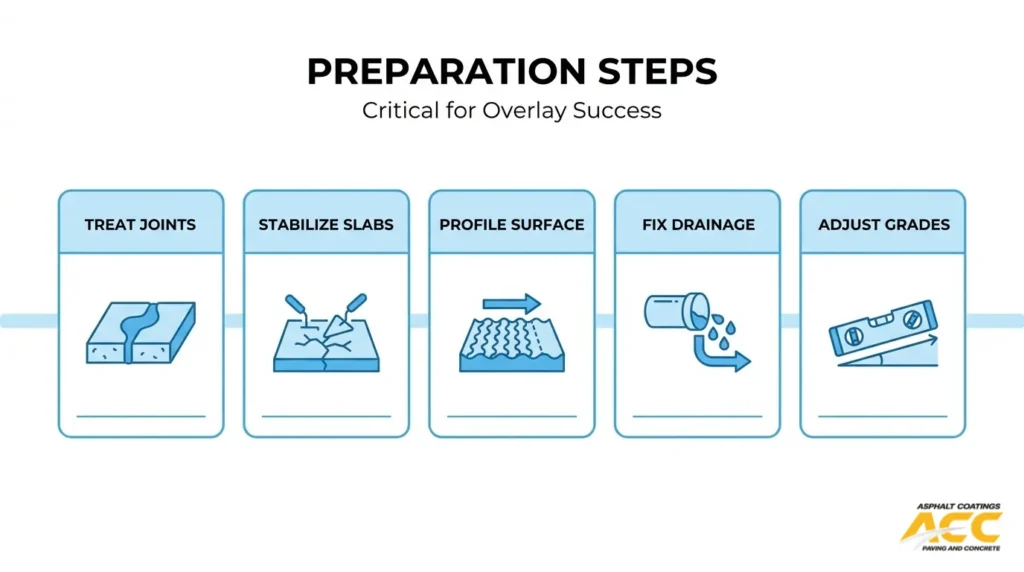
Preparation before paving asphalt over concrete requires treating joints and cracks, stabilizing damaged panels, profiling and tacking the surface, correcting drainage, and adjusting grades at transitions. Each step directly affects how long the overlay performs.
How are concrete joints and cracks treated before placing an asphalt overlay?
Concrete joints and cracks are treated before placing an asphalt overlay through routing, cleaning, and filling with flexible sealant or installing crack-arresting interlayers. Active joints need special attention because untreated movement transfers directly into the new asphalt surface.
According to a Minnesota Department of Transportation study on sawing and sealing joints in bituminous pavements, saw cuts in the overlay must fall within 25 mm (1 in.) of the joints in the underlying concrete for cracks to develop at the intended saw cut locations rather than randomly. Routing and sealing dormant cracks with hot-pour sealant prevents moisture infiltration. For joints with significant horizontal movement, paving fabrics or stress-absorbing interlayers help delay reflective cracking. Skipping this step is one of the most common reasons overlays fail prematurely.
When should damaged or rocking concrete panels be removed or stabilized first?
Damaged or rocking concrete panels should be removed or stabilized first whenever slabs move under traffic loading, have lost subgrade support, or show corner breaks and shattered sections. Panels that deflect under load create stress concentrations that crack through any overlay thickness.
Stabilization options include:
- Undersealing with polyurethane foam or cement grout to fill voids beneath intact but rocking slabs.
- Full-depth removal and replacement of severely broken panels with new concrete or compacted aggregate.
- Dowel-bar retrofitting at transverse joints to restore load transfer between adjacent slabs.
Attempting to pave over unstable panels wastes material and budget. If more than about 10% to 15% of panels need replacement, full reconstruction often becomes the more practical path.
How is the concrete surface milled, profiled, or tacked to help asphalt bond?
The concrete surface is milled, profiled, or tacked to help asphalt bond by creating a clean, roughened profile and applying a uniform tack coat. Milling removes surface irregularities, old patches, and high spots that would otherwise cause uneven asphalt thickness.
Before milling begins, the Pavement Condition Index (PCI) should guide decisions. As described by the FAA’s PaveAir documentation, PCI is a numerical rating based on the type and severity of distresses observed on the pavement surface, and its history helps establish deterioration rates and future rehabilitation needs. After profiling, a tack coat of asphalt emulsion is applied uniformly across the entire surface. Proper tack application is critical; too little results in delamination, while too much creates a slip plane between layers.
How is drainage corrected or improved before overlay installation?
Drainage is corrected or improved before overlay installation by regrading low spots, clearing or replacing catch basins, and ensuring positive slope directs water off the pavement surface. Adding 2 to 4 inches of asphalt raises the overall surface elevation, which can block existing drainage inlets or reverse flow patterns if not accounted for.
Key drainage corrections include:
- Raising catch basin frames and grates to match the new finished grade.
- Extending or rerouting drain lines where overlay thickness changes flow paths.
- Correcting ponding areas with localized milling or variable-depth asphalt placement.
- Verifying that perimeter drainage channels remain functional after the elevation change.
Standing water beneath or on an overlay accelerates stripping, freeze-thaw damage, and subgrade erosion. Addressing drainage before paving is far less expensive than repairing water-related failures afterward.
How do you adjust grades and transitions at curb lines, ADA ramps, and doors?
Grades and transitions at curb lines, ADA ramps, and doors are adjusted by feathering asphalt thickness, milling approach areas, and verifying that final slopes meet accessibility requirements. The overlay’s added height can reduce curb reveal, block door swings, and steepen ramp slopes beyond legal limits.
The 2010 ADA Standards for Accessible Design require walking surface running slopes no steeper than 1:20 and cross slopes no steeper than 1:48. Door thresholds must not exceed 1/2 inch (13 mm) in height. Meeting these standards after an overlay often requires milling transitions at building entries, reconstructing ramp panels, or installing tapered asphalt wedges at curb returns. Failing to verify ADA compliance exposes property owners to both legal liability and safety risks.
With surface preparation complete, the next decision is determining the right asphalt thickness for the overlay.
How Thick Should Asphalt Be When It Is Placed Over Concrete?
Asphalt thickness over concrete depends on traffic loading, the condition and strength of the existing slab, and long-term performance goals. The sections below break down how each factor shapes the right overlay depth.
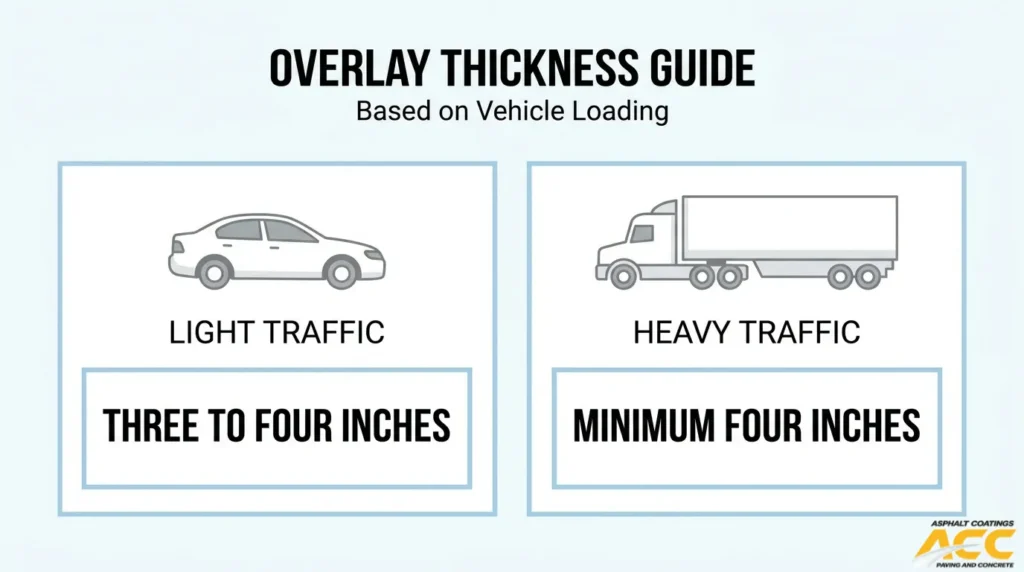
How does required asphalt thickness change between car parking and heavy trucks?
Required asphalt thickness changes significantly between car parking and heavy trucks. Light-duty parking lots with 30,000 to 50,000 design ESALs require a minimum recommended pavement thickness of 3 to 4 inches, according to Eastern Michigan University’s Division 15 Pavement Construction Standards. Heavy truck routes demand considerably more. Areas receiving regular bus, garbage truck, or delivery traffic need at least 4 inches of asphalt; anything thinner risks fatigue cracking under repeated heavy axle loads. For commercial properties that mix passenger vehicles with occasional freight or waste hauling, designing to the heavier loading is always the safer call.
How do you decide on thickness when concrete is in good but aging condition?
You decide on thickness when concrete is in good but aging condition by evaluating how much structural life the slab still provides. Concrete that shows minor surface wear, shallow spalling, or early-stage joint deterioration can still carry load effectively. In these cases, a thinner overlay of 2 to 3 inches may suffice for light-duty applications because the slab contributes meaningful structural support. However, aging concrete loses stiffness over time as micro-cracking accumulates beneath the surface. A pavement condition index (PCI) assessment helps quantify remaining life. Properties expecting another 10 to 15 years before full reconstruction should lean toward a thicker lift to absorb the slab’s gradual decline.
How does existing concrete thickness and strength influence asphalt depth?
Existing concrete thickness and strength directly influence asphalt depth because a thicker, higher-strength slab reduces the structural demand on the overlay. A 6-inch concrete base in sound condition distributes wheel loads across a wide area, so the asphalt layer functions primarily as a wearing surface rather than a load-bearing element. Thinner or lower-strength slabs transfer more stress upward, requiring additional asphalt thickness to prevent fatigue cracking. Engineers often use deflection testing to measure how much the slab flexes under load. Greater deflection signals reduced effective stiffness, which translates to a thicker overlay requirement. Ignoring this relationship is one of the most common reasons commercial overlays underperform.
How do budget and life-cycle expectations affect overlay thickness choices?
Budget and life-cycle expectations affect overlay thickness choices by forcing a tradeoff between upfront cost and long-term performance. A thinner 2-inch overlay costs less to install but may need resurfacing within five to eight years, especially under moderate traffic. Adding an extra inch or two increases initial expense yet extends service life substantially, reducing cumulative maintenance spending. Property managers planning to hold assets long-term benefit from investing in thicker overlays that delay the next major rehabilitation cycle. Those anticipating full reconstruction within a few years may find a thinner, lower-cost overlay sufficient as an interim solution.
Understanding the right overlay thickness sets the stage for weighing the broader advantages and drawbacks of paving asphalt over concrete.
What Are the Pros and Cons of Paving Asphalt Over Concrete?
The pros and cons of paving asphalt over concrete center on cost savings and speed versus reduced longevity and recurring maintenance. The following sections break down schedule advantages, structural tradeoffs, ride quality differences, and long-term repair costs.
What are the main cost and schedule advantages of asphalt over concrete removal?
The main cost and schedule advantages of asphalt over concrete removal are lower upfront expense, faster installation, and minimal disruption. Overlay projects skip the demolition, hauling, and disposal costs that drive up full reconstruction budgets. Paving crews can place the full asphalt depth in a single pass, keeping parking lots or roadways open sooner.
According to the National Center for Asphalt Technology at Auburn University’s NCAT Report 20-05 on life cycle cost analysis, overlay strategies that build on an existing pavement structure deliver significant savings compared to complete removal and replacement. When urgent repairs arise, asphalt patching can be performed as an emergency fix under harsh conditions, so property managers are never forced to wait for ideal weather to address hazards.
For most commercial properties, these schedule and budget benefits make overlays the practical first choice when the underlying concrete is structurally sound.
What are the structural and longevity tradeoffs of an asphalt overlay?
The structural and longevity tradeoffs of an asphalt overlay involve trading a shorter service life for lower initial investment. Concrete joints and cracks beneath the overlay create stress concentrations that eventually telegraph upward as reflective cracking. Even with proper preparation, the rigid slab underneath expands and contracts independently of the flexible asphalt layer above it.
Thin overlays in good conditions typically last five to eight years before requiring resurfacing. Thicker overlays on well-maintained concrete can extend that window, but they rarely match the 20-to-30-year lifespan of a full-depth pavement built from scratch. Property managers should weigh this compressed service cycle against the savings at installation, because the breakeven point depends heavily on traffic volume and local climate severity.
How do ride quality and appearance compare between overlay and full reconstruction?
Ride quality and appearance improve immediately after an asphalt overlay. A fresh hot-mix asphalt surface provides a smooth, quiet driving experience that eliminates the bumps, spalls, and joint faults common in aging concrete. Visually, the uniform black surface looks clean and professional on day one.
Full reconstruction, however, allows contractors to correct subgrade irregularities, adjust drainage slopes, and establish precise grade transitions that an overlay cannot fix. Over time, reflective cracks in an overlay can mar the surface and create roughness that degrades the initial smoothness. When long-term aesthetics and a consistently flat profile matter most, full reconstruction delivers a more durable result, though it takes considerably longer to complete.
How do future maintenance and repair costs differ between the two options?
Future maintenance and repair costs for asphalt overlays are lower per event but more frequent than those for full reconstruction. Crack sealing, sealcoating, and localized patching keep an overlay functional, yet these treatments must be repeated on shorter cycles because reflective cracking accelerates surface deterioration.
Full reconstruction carries higher upfront costs but typically requires less frequent intervention over its longer lifespan. The tradeoff becomes clearer when property managers calculate total cost of ownership across 15 to 20 years rather than focusing on a single budget cycle.
Understanding these cost dynamics helps property managers choose a paving strategy that aligns with both their capital budget and their long-term maintenance plan.
How Does Paving Asphalt Over Concrete Compare with Full Demolition and Replacement?
Paving asphalt over concrete compares favorably on speed and cost but falls short when infrastructure changes are needed. The sections below cover when reconstruction wins on long-term value, how utility and layout work tips the scale, how each option affects operations, and how permitting differs.
When is full concrete or asphalt reconstruction more cost-effective long term?
Full concrete or asphalt reconstruction is more cost-effective long term when the existing pavement has widespread structural failure, when maintenance cycles would consume the savings from an overlay, or when the surface needs a full-depth reset for decades of service. Overlays depend on strong interlayer bonding; according to the New York State Department of Transportation, a uniform application of high-quality tack coat at the appropriate residual asphalt rate to a clean, dry surface is key to bonding pavement layers for peak long-term performance. Without that bond quality, overlays delaminate early and trigger repeated repairs. If an overlay requires crack sealing every two years plus chip sealing every five years, the cumulative cost can exceed a single reconstruction within 15 years. For properties planning a 20-year-plus hold, reconstruction often delivers lower total cost of ownership.
How do utility, drainage, and layout changes favor full replacement over overlay?
Utility, drainage, and layout changes favor full replacement over overlay because overlays add material on top of existing grades without exposing what lies beneath. Buried utilities, storm drains, and catch basins sit at fixed elevations. Adding 2 to 4 inches of asphalt raises the surface above inlet rims, disrupting drainage flow paths and potentially ponding water against buildings. Reconfiguring parking stall geometry, drive aisles, or ADA-accessible routes also requires grade control that an overlay cannot provide. Full demolition exposes the subgrade, allowing crews to relocate utility lines, re-pitch drainage slopes, and rebuild curb profiles to match a new layout. When a project involves any combination of these infrastructure modifications, reconstruction is the only practical path.
How does demolition impact business operations compared to a quicker overlay?
Demolition impacts business operations far more heavily than a quicker overlay. According to research from the National Concrete Pavement Technology Center at Iowa State University, overlay projects can usually be completed in approximately one-quarter of the time needed for a full reconstruction project, and traffic disruption is significantly reduced because the full overlay depth is placed in one pass. Full demolition requires saw-cutting, jackhammering, hauling debris, grading subbase, and repaving in multiple lifts. Each phase closes sections of a lot for days or weeks. For commercial properties where lost parking directly reduces revenue, that extended timeline carries real financial weight. Overlays let tenants and customers maintain access throughout most of the project, making them the preferred choice when downtime tolerance is low.
How do permitting and inspection requirements differ between overlay and rebuild?
Permitting and inspection requirements differ between overlay and rebuild primarily in scope and review depth. Overlay projects typically require a standard paving or resurfacing permit, with inspections focused on material thickness, compaction, and grade compliance at curb transitions. Full reconstruction triggers more extensive review because it involves demolition, subgrade modification, drainage regrading, and potentially utility relocation. Municipalities often require engineered site plans, stormwater management documentation, and ADA compliance verification for rebuilds. Inspection checkpoints multiply as well, covering subgrade compaction, base course, drainage tie-ins, and final surface. The additional permitting steps add weeks to project timelines and increase administrative costs.
Understanding these trade-offs helps property managers choose the right scope before requesting contractor proposals.
How Long Can You Expect Asphalt Over Concrete to Last?
Asphalt over concrete typically lasts between 5 and 20 years, depending on traffic loads, climate exposure, construction quality, and maintenance frequency. The following subsections break down each factor.
How do traffic type and load levels affect overlay life expectancy?
Traffic type and load levels affect overlay life expectancy by accelerating fatigue cracking and structural deterioration under heavier, more frequent loads. Light-duty parking areas with only passenger vehicles place minimal stress on the overlay, while commercial lots serving buses, garbage trucks, and delivery vehicles concentrate repeated heavy loads at the same points. According to research from the Center for Transportation Research at the University of Texas at Austin, engineers evaluate overlay suitability using a dynamic load factor, a pavement distress index tracking failures per mile per year, and deflection measurements assessing structural contribution. Properties with consistent heavy-truck traffic should expect shorter overlay cycles and may need thicker asphalt sections to compensate.
How do Colorado weather and freeze–thaw cycles shorten or extend overlay life?
Colorado weather and freeze-thaw cycles shorten overlay life by forcing repeated expansion and contraction at concrete joints beneath the asphalt. Moisture infiltrates hairline cracks during warm periods, then freezes and expands overnight when temperatures drop below freezing. This cycle widens cracks from below, accelerating reflective cracking through the overlay surface. Colorado’s Front Range experiences wide daily temperature swings, sometimes exceeding 40°F in a single day, which intensifies this stress. Overlays in milder climates with fewer freeze-thaw events generally last longer under equivalent traffic. Proper joint treatment and crack-resistant interlayers before paving can offset some of this seasonal damage and extend service life.
How does initial construction quality influence how long an overlay holds up?
Initial construction quality influences how long an overlay holds up by determining bond strength, compaction density, and surface profile accuracy from day one. Poor tack coat application creates delamination planes where the asphalt separates from the concrete. Inadequate compaction leaves air voids that trap moisture and accelerate deterioration. Skipping joint treatment or milling allows existing distresses to telegraph through the new surface within the first few years. Every shortcut during installation compounds over time, turning what could be a 15-year overlay into one that needs resurfacing in five. Investing in qualified crews and proper materials upfront consistently delivers the best return on overlay projects.
How much does a proactive maintenance plan extend the overlay’s service life?
A proactive maintenance plan extends an overlay’s service life by catching minor damage before it reaches the concrete interface below. Crack sealing, which remains effective for approximately two years per application according to a 2018 Michigan Technological University pavement treatment life study, prevents water from penetrating joints where it causes the most structural harm. Sealcoating restores UV protection and slows oxidation of the asphalt binder. Timely pothole patching prevents localized failures from spreading. Together, these treatments can double the interval between major rehabilitation cycles, making them one of the highest-value investments for any commercial property.
With realistic life expectancy benchmarks in place, ongoing maintenance practices keep overlays performing at their best throughout each cycle.
How Do You Decide Whether Your Property Is a Good Candidate for Asphalt Over Concrete?
You decide whether your property is a good candidate for asphalt over concrete by evaluating surface condition, structural integrity, risk factors, and contractor input. The following subsections cover visual assessment, engineering evaluation, capital planning, and contractor questions.
What Should Property Managers Look for in a Quick Visual Assessment?
Property managers should look for visible distress patterns that signal whether the existing concrete can support an overlay. Walk the entire surface and note these indicators:
- Joint and crack width: Joints wider than 1/4 inch or cracks with vertical movement suggest active structural problems beneath.
- Slab rocking: Step on slab edges near joints. Any movement under foot traffic means the subgrade has lost support.
- Spalling and surface breakup: Localized surface deterioration is repairable, but widespread spalling across more than 20% of the area raises concern.
- Standing water: Ponding after rain reveals drainage deficiencies that will accelerate overlay failure.
- Prior patch history: Multiple previous repairs in the same zones indicate recurring subgrade or joint issues.
A surface that looks stable, drains well, and shows only minor cosmetic wear is typically a strong overlay candidate. Concrete with rocking slabs, wide active cracks, or chronic ponding usually needs deeper investigation before committing to an overlay.
When Should You Order Core Samples or Engineering Evaluation Before Deciding?
You should order core samples or engineering evaluation when the visual assessment reveals uncertainty about what lies beneath the surface. Specific triggers include:
- Active joint movement or slab deflection that cannot be explained by surface conditions alone.
- Unknown pavement history, especially on acquired properties where original construction records are missing.
- Heavy-vehicle use planned, such as garbage trucks or delivery routes, where fatigue cracking risk demands confirmed structural capacity.
- Widespread distress patterns covering large contiguous areas rather than isolated spots.
According to the Center for Transportation Research at the University of Texas at Austin, technical suitability criteria for asphalt overlays on concrete include a profile criterion based on remaining life, a condition survey utilizing a pavement distress index, and a deflection criterion evaluating structural contribution through deflection measurements. Core samples reveal concrete thickness, reinforcement condition, and subgrade composition. For commercial properties with significant traffic loads, this data prevents costly overlay failures that a visual check alone would miss.
How Do Risk Tolerance and Capital Planning Influence the Overlay Decision?
Risk tolerance and capital planning influence the overlay decision by determining whether a property owner prioritizes lower upfront cost or longer-term pavement life. An asphalt overlay over sound concrete costs substantially less than full demolition and reconstruction, making it attractive for properties with constrained annual budgets or those nearing a planned redevelopment.
However, if the concrete substrate has questionable integrity, choosing an overlay to save money now introduces the risk of premature reflective cracking, which generates repeated maintenance costs. Property managers with a five-to-ten-year hold horizon and limited capital often find overlays align well with their financial planning. Those investing in a 20-year pavement life on a flagship property may find full reconstruction more cost-effective when analyzed over the entire cycle. The decision ultimately balances current budget reality against the acceptable probability of early re-intervention.
What Questions Should You Ask a Paving Contractor About Asphalt Over Concrete?
The questions you should ask a paving contractor about asphalt over concrete focus on their evaluation process, material approach, and warranty terms:
- “Will you inspect the existing concrete before quoting, and what does your assessment include?” A credible contractor examines joints, drainage, and slab stability rather than quoting sight-unseen.
- “What overlay thickness do you recommend for my traffic type, and why?” The answer should reference specific loading conditions, not a one-size-fits-all number.
- “How will you address existing joints and cracks to reduce reflective cracking?” Look for mention of crack treatment, interlayer systems, or saw-and-seal strategies.
- “What is the expected service life, and what maintenance will be needed?” Honest contractors provide a realistic range rather than an inflated guarantee.
- “Do you handle drainage corrections and ADA grade adjustments as part of the overlay scope?” These details are frequently overlooked and cause compliance problems later.
Any contractor who skips the substrate evaluation or avoids discussing reflective cracking mitigation is a red flag. With the right evaluation in place, the next step is partnering with a team that can execute the full scope from assessment through long-term maintenance.
How Should You Approach Asphalt Over Concrete Projects with Asphalt Coatings Company?
You should approach asphalt over concrete projects with Asphalt Coatings Company by starting with a professional site evaluation, then leveraging ongoing maintenance services to protect the investment. The following sections cover evaluation, supporting services, and key takeaways.
How can Asphalt Coatings Company evaluate whether your concrete can be overlaid?
Asphalt Coatings Company can evaluate whether your concrete can be overlaid by conducting a thorough on-site assessment of slab condition, joint activity, drainage, and subgrade stability. With 39 years of commercial paving experience across Colorado’s Front Range, Asphalt Coatings Company uses in-house crews to inspect for spalling, rocking panels, and active cracking before recommending an overlay or full removal. According to the Center for Transportation Research at The University of Texas at Austin, technical suitability criteria for asphalt overlays on concrete include profile evaluation, a condition survey using pavement distress indices, and deflection measurements of the existing structure. Asphalt Coatings Company applies this same data-driven approach to every commercial property, from parking lots to distribution warehouses.
How can services like paving, sealcoating, and crack sealing support a long-lasting overlay?
Services like paving, sealcoating, and crack sealing support a long-lasting overlay by addressing deterioration at each stage of the pavement’s life cycle. Key maintenance services Asphalt Coatings Company provides include:
- Asphalt paving and installation to establish proper thickness and compaction over the concrete base.
- Sealcoating to shield the asphalt surface from UV degradation, moisture intrusion, and oxidation.
- Crack sealing with CDOT-approved materials to prevent water from reaching the concrete joints below.
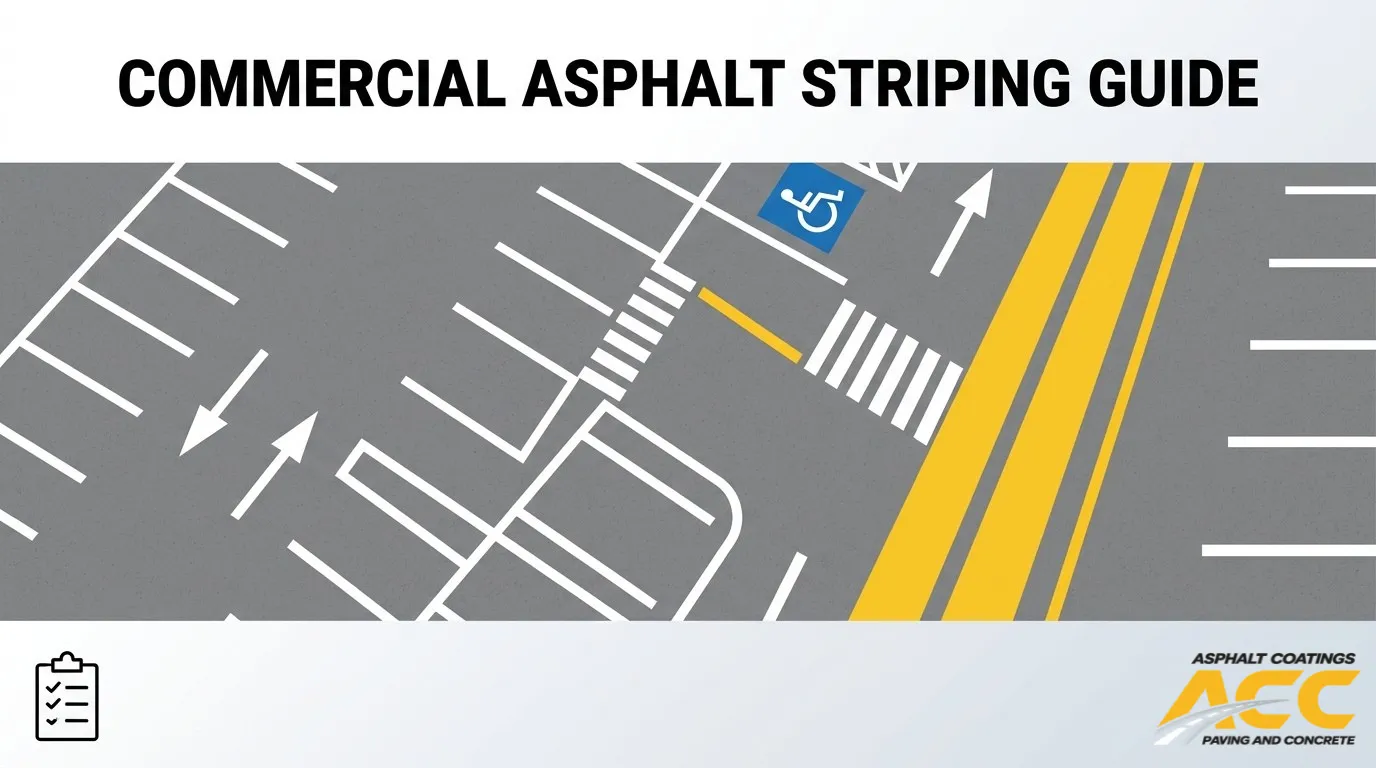
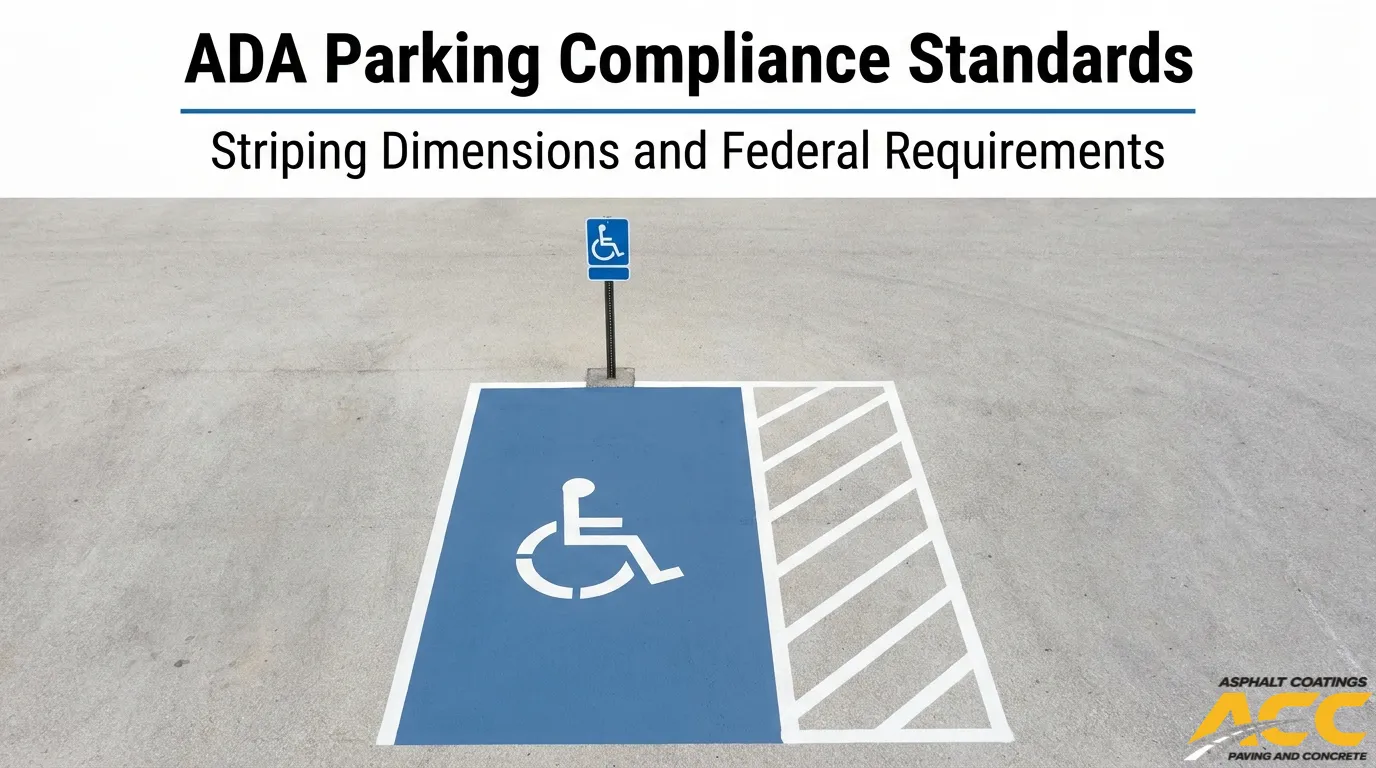
- Striping and ADA-compliant markings to maintain safe, accessible commercial lots.
When these services are applied on a proactive schedule, thin asphalt overlays can achieve an estimated life of five to eight or more years, according to the Mineta Transportation Institute’s Manual for Thin Asphalt Overlays.
What are the key takeaways about paving asphalt over concrete and when it will crack through?
The key takeaways about paving asphalt over concrete and when it will crack through center on three factors: concrete condition, proper preparation, and ongoing maintenance.
- Asphalt overlays succeed when the underlying concrete is structurally sound, joints are treated, and drainage is corrected before paving.
- Overlays fail when active cracks, unstable subgrade, or untreated joint movement allows reflective cracking to propagate upward.
- Thermal cracking poses a particular risk; as the Texas Transportation Institute documented, rates of temperature drop, minimum temperature, and asphalt binder properties determine when induced stresses exceed the mix’s tensile strength.
- Proactive sealcoating and crack sealing extend overlay life significantly compared to reactive repairs.
For commercial property managers weighing an overlay against full reconstruction, the right decision depends on honest site evaluation and a long-term maintenance commitment. Asphalt Coatings Company partners with clients across Denver, Colorado Springs, and the broader Front Range to deliver overlay solutions built for Colorado’s demanding climate.