Asphalt raveling is the progressive wearing away of a parking lot surface caused by the dislodging of aggregate particles and loss of asphalt binder. It begins with fine granules shedding from the pavement matrix and advances to coarse stone loss, leaving a rough, pitted surface that threatens safety and structural integrity.
This guide covers the causes and identification of raveling, repair options ranging from sealcoating to overlays to full replacement, climate and regional factors that influence deterioration, preventive maintenance strategies, and project planning for commercial properties.
Raveling results from a combination of freeze-thaw cycling, UV oxidation, poor original mix design or compaction, concentrated traffic shear at turning points, and drainage failures that trap moisture against the binder. Each factor weakens the bond holding aggregate in place, and Colorado Front Range conditions intensify several of them simultaneously.
Distinguishing raveling from other distresses like alligator cracking or cosmetic fading determines which repair path applies. Loose scattered stones and a granular surface texture point to raveling; interconnected crack patterns signal structural fatigue requiring a different approach entirely.
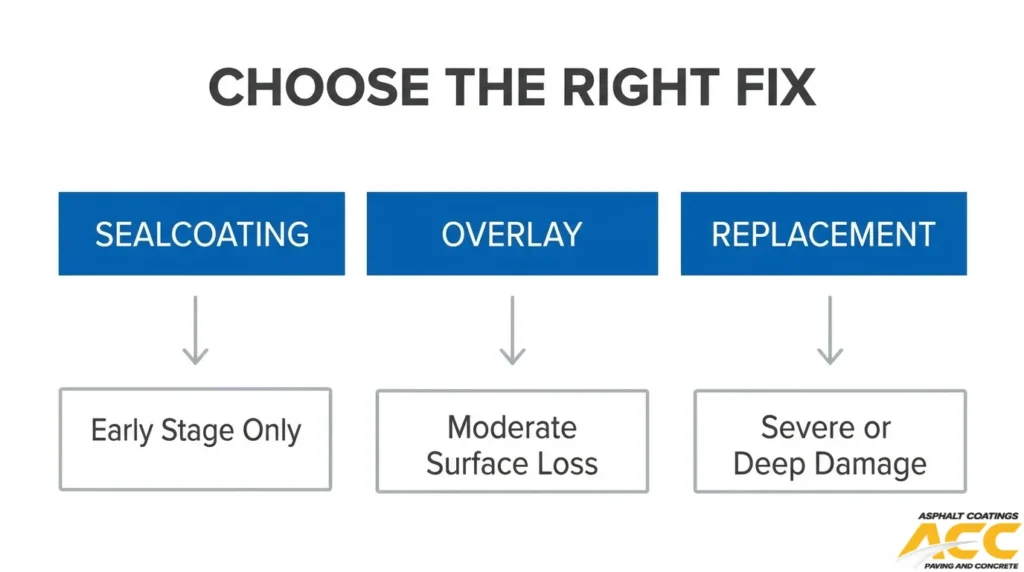
Sealcoating protects pavement in the earliest stages when only fine particles are shedding, but it cannot restore aggregate that has already broken free. Overlays and mill-and-pave work when the base remains structurally sound. Full-depth replacement becomes the only viable option once deterioration reaches the subgrade or base layers.
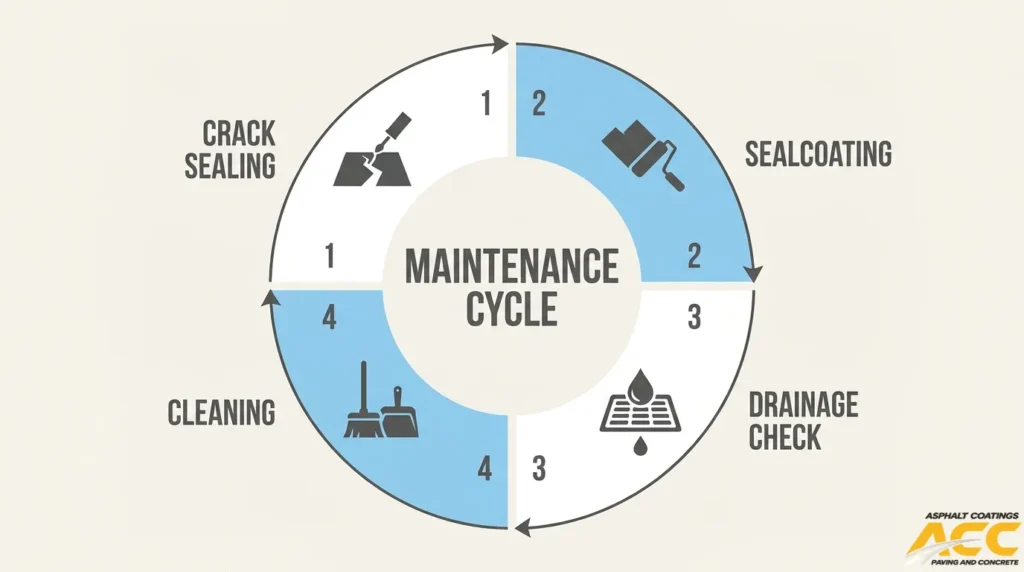
Routine crack sealing, scheduled sealcoating cycles, proper drainage upkeep, and restrained salt use form the preventive foundation that keeps raveling from starting. When repairs are needed, phased scheduling and coordinated upgrades minimize tenant disruption while addressing the most severe zones first.
What Exactly Is Asphalt Raveling in a Parking Lot and How Does It Look?
Asphalt raveling in a parking lot is the progressive wearing away of the pavement surface caused by the dislodging of aggregate particles and loss of asphalt binder. It looks different at each stage, from subtle texture changes to rough, pitted surfaces with exposed stone.
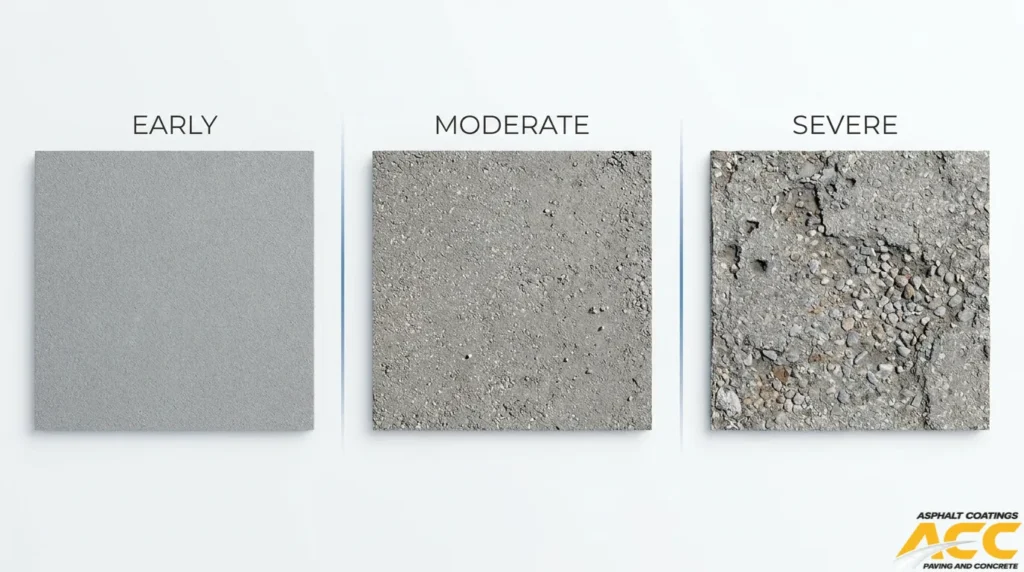
Raveling begins quietly. The first visible sign is a slight roughening of the surface where fine aggregate particles break free from the binder matrix. At this early stage, the pavement may simply appear sandier or more textured than the surrounding area, often accompanied by a fading of the original dark asphalt color. Small loose granules collect along curb lines, in parking stall corners, and near drain grates.
As the condition progresses to moderate severity, the loss extends beyond fine particles. The surface develops a noticeably open texture, and you can feel the roughness underfoot or hear it under tire contact. Pavement markings in affected zones begin losing adhesion because the substrate they were applied to is actively disintegrating.
Severe raveling presents unmistakable visual evidence. According to the Federal Aviation Administration’s AC 150/5320-17A pavement guidance, severe raveling is characterized by loss of coarse aggregate, meaning the larger stones that provide structural interlock at the surface are breaking free. At this point, the parking lot surface appears deeply pitted and rough, with obvious voids where aggregate once sat. Loose gravel scatters across the lot, and the exposed binder layer, now brittle and cracked, is clearly visible between remaining stones.
Property managers should understand what raveling is not. Unlike alligator cracking, which produces a pattern of interconnecting cracks caused by fatigue failure under repeated traffic loading, raveling is a surface disintegration problem. Alligator cracking signals structural distress from below; raveling signals material breakdown at the surface. Both demand attention, but they require different repair strategies.
Recognizing raveling early, when only fine particles are shedding, opens the widest range of cost-effective treatment options before the damage reaches the structural layers beneath.
What Causes Asphalt Raveling in Commercial and Retail Parking Lots?
Asphalt raveling in commercial and retail parking lots results from weather damage, mix design flaws, traffic stress, drainage failures, binder aging, and harmful maintenance chemicals. The following subsections break down each cause.
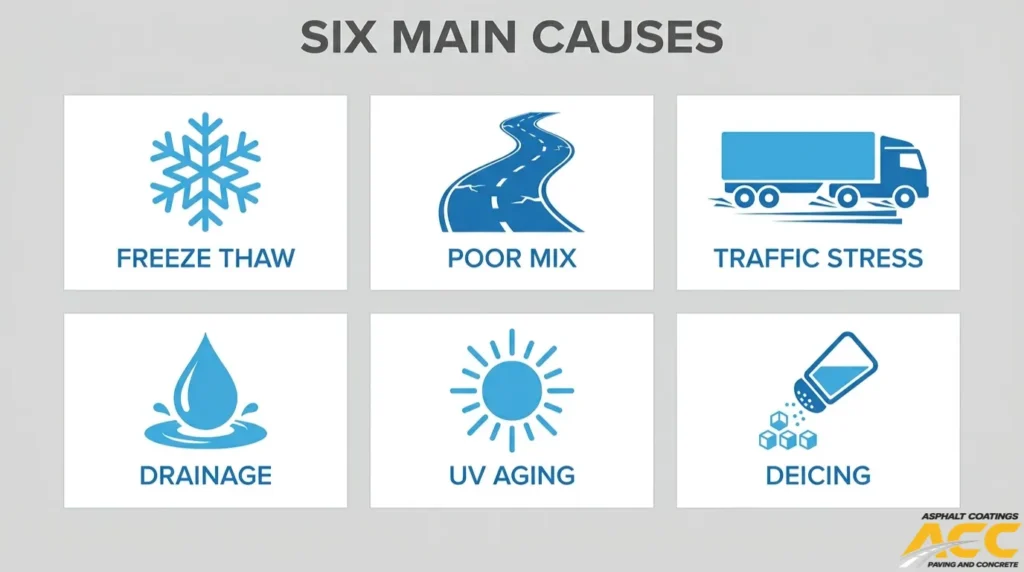
How Do Weather and Freeze–Thaw Cycles Contribute to Raveling in Parking Lots?
Weather and freeze–thaw cycles contribute to raveling in parking lots by forcing moisture into small surface voids, where it expands as ice and breaks the bond between aggregate particles and the asphalt binder. Each cycle weakens binder stiffness progressively, loosening fine particles first and eventually dislodging coarse aggregate. According to a 2022 study published in Coatings (MDPI), freezing and thawing cycles cause measurable damage to the binder, visible as a reduction in stiffness that increases with freeze–thaw intensity. Parking lots are especially vulnerable because standing water in low spots and at drain inlets saturates the surface before temperatures drop. Adequate compaction during installation remains one of the most effective defenses against this damage.
How Does Poor Initial Asphalt Mix Design or Installation Lead to Raveling?
Poor initial asphalt mix design or installation leads to raveling by producing a surface that lacks the internal cohesion needed to hold aggregate in place under traffic and weather. Insufficient asphalt binder content starves the mix of the adhesive “glue” that coats and bonds aggregate particles. Improper aggregate gradation, particularly mixes that are too coarse or have low filler content, leaves excessive air voids. Inadequate compaction during paving compounds these problems by failing to close those voids. As Asphalt Magazine notes, evaluating each potential cause and following best practices for compaction go a long way toward preventing raveling. For parking lots, where construction windows are often rushed to minimize tenant disruption, compaction shortcuts are a frequent root cause.
How Do Traffic Loads and Turning Movements in Parking Lots Accelerate Raveling?
Traffic loads and turning movements in parking lots accelerate raveling by applying repeated shear and scuffing forces to the asphalt surface. Drive aisles, turning radii near entrances, and areas around shopping cart corrals absorb concentrated horizontal stress every time a vehicle brakes, accelerates, or turns. According to Auburn University’s National Center for Asphalt Technology, mixes with coarse gradation and low filler content have relatively low shear strength; in these mixes, resistance to turning and braking forces depends almost entirely on the asphalt binder rather than internal aggregate interlock. Heavy delivery trucks and garbage vehicles intensify this effect because their high axle loads and tight turning paths generate far greater surface shear than passenger cars.
How Do Water Drainage and Standing Water Problems Cause Raveling?
Water drainage and standing water problems cause raveling by allowing moisture to penetrate the pavement surface, weaken the asphalt binder, and strip aggregate from the mix. Ponding water softens the binder film around aggregate particles through a process called moisture-induced damage, or stripping. According to AASHTO’s SHRP2 preservation guidance, treatment effectiveness depends on matching pavement conditions to the right treatment; crack and joint sealing prevents the infiltration of water and incompressible materials that accelerate deterioration. In parking lots, clogged catch basins, settled pavement near curb lines, and poorly graded surfaces create chronic ponding zones. These saturated areas deteriorate far faster than well-drained sections, making proper drainage design and maintenance essential for controlling raveling progression.
How Do Age and Oxidation of the Asphalt Binder Result in the Surface Coming Loose?
Age and oxidation of the asphalt binder result in the surface coming loose because the binder gradually hardens, becomes brittle, and loses its ability to hold aggregate particles together. UV radiation and atmospheric oxygen break down the lighter chemical components (maltenes) in asphalt, leaving behind a stiff, inflexible residue. A study published in PubMed Central found that UV radiation seriously destroys the cross-linked network structure in SBS-modified asphalt binders, increases shrinkage stress at the surface, and leads to surface cracking. This progressive embrittlement means the binder can no longer flex under thermal expansion or traffic loads. Fine aggregate particles loosen first, followed by coarse stones, producing the rough, pitted texture characteristic of advanced raveling.
How Do Deicing Chemicals and Parking Lot Maintenance Practices Influence Raveling?
Deicing chemicals and parking lot maintenance practices influence raveling by introducing chemical agents and mechanical forces that can weaken the asphalt surface over time. Chloride-based brines reduce adhesion force and Young’s modulus at the nano scale in asphalt binders, according to a Georgia Southern University thesis on blended salt anti-icers. However, the relationship is nuanced; a 1963 Transportation Research Board study found that repetitive daily salt applications had no significant effects on specimen stability, penetration, softening point, or ductility under its test conditions. Aggressive snow plowing with improperly set blades can scrape aggregate directly off the surface. Neglected maintenance, such as years without crack sealing or sealcoating, leaves the binder exposed to every other cause on this list.
Understanding these causes helps property managers choose whether sealcoating, overlay, or full replacement is the right response.
How Can You Tell If Your Parking Lot Surface Damage Is Raveling or Something Else?
You can tell if parking lot surface damage is raveling by looking for loose aggregate particles scattered on the surface rather than interconnected crack patterns. The sections below explain visual differences between raveling, alligator cracking, and general wear, plus when severity crosses the safety threshold.
How Can You Visually Distinguish Raveling from Alligator Cracking or Fatigue Cracking?
You can visually distinguish raveling from alligator cracking by examining the damage pattern. Raveling shows as the wearing away of the pavement surface caused by the dislodging of aggregate particles, leaving a rough, pitted texture. Alligator cracking, by contrast, appears as a series of interconnecting cracks caused by fatigue failure of the HMA surface under repeated traffic loading, according to the Texas A&M Transportation Institute’s ACRP pavement distress identification tool.
Key visual differences to look for:
- Raveling produces scattered loose stones, exposed aggregate, and a granular surface texture without defined crack lines.
- Alligator cracking creates a web-like pattern resembling reptile skin, with clearly defined crack edges forming connected polygons.
- Location clues also help; alligator cracking concentrates in wheel paths where loads repeat, while raveling can appear anywhere the binder has failed.
Correctly identifying the distress type matters because the repair approach differs. Thin overlays designed for surface raveling cannot address structural fatigue cracking, which must be resolved separately before resurfacing.
How Can You Tell the Difference Between Raveling and General Surface Wear or Fading?
You can tell the difference between raveling and general surface wear by checking whether aggregate is actually dislodging from the surface. General weathering and fading involve the asphalt turning gray and losing its dark color as the binder oxidizes, but the aggregate stays embedded. Raveling, however, produces loose stones you can sweep up or feel underfoot.
- Fading changes only the surface color from black to gray, with the pavement matrix remaining intact.
- Weathering may include slight loss of fine particles, but coarse aggregate remains locked in place.
- Raveling advances beyond color change; you will see pitting, exposed stone edges, and debris collecting in low spots.
Fading alone is cosmetic. Once aggregate begins breaking free, the damage has crossed from weathering into active raveling, and protective action becomes necessary.
When Does Raveling Get Severe Enough to Threaten Safety and Striping Visibility?
Raveling gets severe enough to threaten safety when coarse aggregate dislodges, creating an uneven, pitted surface that obscures painted lines and generates trip hazards. At this stage, loose stones accumulate near curbs and drain inlets, and striping paint has no stable substrate to bond to.
Specific safety thresholds to watch for:
- Striping adhesion failure occurs once the fine aggregate matrix is gone, since paint cannot adhere to exposed, irregular stone.
- Pedestrian trip risk increases as surface pitting creates abrupt level changes, particularly near accessible routes where ADA standards require stable, firm, and slip-resistant ground surfaces.
- Vehicle traction loss becomes a concern when loose gravel accumulates in travel lanes and turning areas.
Property managers who notice striping fading faster than the recoating cycle should inspect for underlying raveling. Waiting until the surface looks obviously deteriorated often means repair costs have already escalated beyond a surface-level fix.
Why Is Raveling a Serious Problem for Parking Lots if It Is Not Repaired Early?
Raveling is a serious problem for parking lots if it is not repaired early because surface aggregate loss accelerates into potholes, ADA violations, and costly structural failures. The following sections cover how costs escalate, how liability exposure grows, and how property value declines.
How Does Raveling Lead to Potholes, Structural Failure, and Higher Repair Costs?
Raveling leads to potholes, structural failure, and higher repair costs because each dislodged aggregate particle exposes fresh binder and base material to water, oxidation, and traffic. Once water infiltrates beyond the surface layer, freeze-thaw cycles and vehicle loads rapidly erode the sublayers, turning shallow surface loss into deep structural voids.
Preventive surface treatments like slurry seals are inexpensive at this early stage. According to St. Mary’s County, Maryland Department of Public Works, a slurry seal adds no structural strength but extends service life by five to eight years at a unit price of $0.81 to $0.88 per square yard. Compare that to full-depth replacement, which can cost several times more per square foot. Delaying a low-cost preventive treatment almost always guarantees a high-cost structural repair later.
How Does Raveling Affect ADA Compliance, Trip Hazards, and Liability Exposure?
Raveling affects ADA compliance, trip hazards, and liability exposure by creating uneven, unstable walking surfaces that violate federal accessibility standards. The U.S. Access Board specifies that accessible ground surfaces must be stable, firm, and slip resistant, with changes in level permitted only up to one-quarter inch without treatment or one-half inch if beveled at a slope no steeper than 1:2. Severe raveling easily exceeds these thresholds.
Loose aggregate and surface voids create direct trip hazards for pedestrians, wheelchair users, and customers with mobility aids. Property owners who neglect these conditions face potential ADA complaints and premises liability claims. For commercial property managers, proactive surface repair is far less expensive than legal defense and settlement costs.
How Does Raveling Impact Curb Appeal, Tenant Satisfaction, and Property Value?
Raveling impacts curb appeal, tenant satisfaction, and property value by making a parking lot look neglected from the moment visitors arrive. A rough, pitted surface with visible aggregate scatter signals deferred maintenance, which tenants and prospective lessees interpret as a reflection of overall property management quality.
Retail and office tenants depend on clean, well-maintained parking areas to attract foot traffic. When surface deterioration discourages customers or triggers complaints, lease renewal negotiations become more difficult. Appraisers and potential buyers also factor pavement condition into commercial property valuations, since a lot requiring imminent major repair represents a quantifiable capital liability. Addressing raveling before it reaches this stage protects both rental income and long-term asset value.
Understanding the full scope of consequences clarifies why choosing the right repair method matters.
When Can Parking Lot Sealcoating Slow or Stop Asphalt Raveling?
Parking lot sealcoating can slow or stop asphalt raveling when damage is limited to the earliest stage of surface deterioration. The following subsections cover when sealcoating is sufficient, why it fails on worse damage, and how often to reapply.
When Is Sealcoating Enough for Very Early, Light Raveling in a Parking Lot?
Sealcoating is enough for very early, light raveling when only fine aggregate particles have begun to dislodge and the underlying binder remains intact. At this stage, the surface looks slightly rough or sandy, but no coarse stones are missing and no open voids have formed. Contractors specializing in commercial parking lot maintenance can assess whether your pavement is still within the early-stage window where sealcoating remains effective, or whether the damage has progressed to require more comprehensive treatment.
According to the Asphalt Institute’s engineering FAQs, sealing is effective to renew old asphalt surfaces that have become dry and brittle with age, to seal small surface cracks and surface voids, and to inhibit raveling.
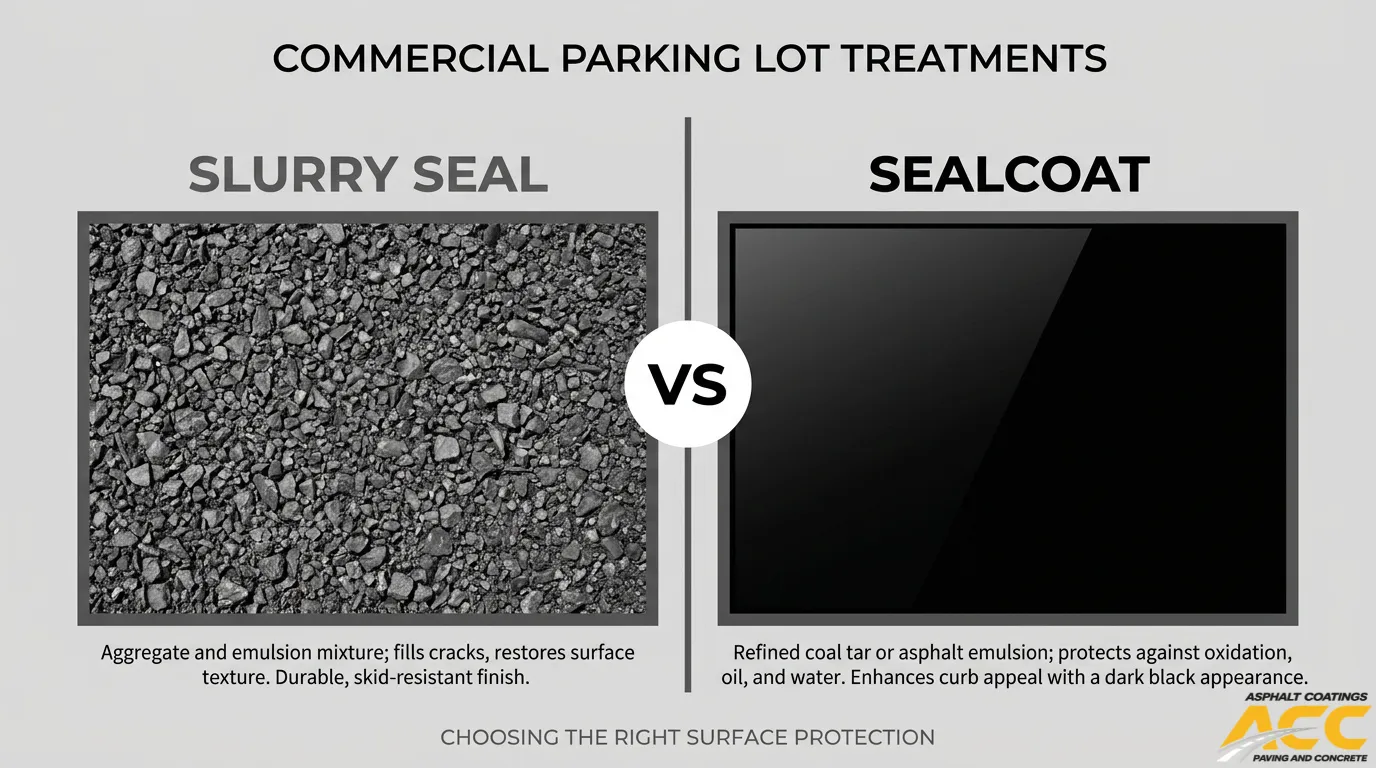
Sealcoat works here because it replenishes a protective film over exposed binder, blocking UV and moisture before deeper degradation begins. Once the window passes, though, a topical coating cannot restore aggregate that is already gone.
Why Will Sealcoating Alone Not Fix Moderate or Severe Raveling?
Sealcoating alone will not fix moderate or severe raveling because the surface has lost too much material for a thin coating to replace. According to FAA Advisory Circular 150/5320-17A, slight to moderate raveling involves loss of fine aggregate, while severe raveling involves loss of coarse aggregate. When stones larger than sand-sized particles are dislodging, the pavement matrix has deteriorated beyond what any surface seal can bridge.
Sealcoat is a protective barrier, not a structural repair. Applying it over moderate or severe raveling traps moisture beneath the coating and can actually accelerate deterioration. These conditions require patching, overlay, or full-depth rehabilitation to restore a sound driving surface.
How Often Should a Commercial Parking Lot Be Sealcoated to Help Prevent Raveling?
A commercial parking lot should be sealcoated every two to three years to help prevent raveling, though high-traffic areas or harsh climates may warrant shorter intervals. The first application typically occurs two to five years after initial paving, once the asphalt has fully cured.
Consistent sealcoating cycles are only one part of a preventive strategy. According to the New Hampshire Department of Environmental Services, encouraging mechanical snow removal as early as possible at the onset of a storm helps prevent snow and ice from adhering to parking lot pavement and normally requires less salt application during the full course of the storm. Reducing salt exposure between sealcoat cycles protects the binder that sealcoating is designed to preserve.
Pairing timely sealcoating with smart winter maintenance gives commercial lots the best defense against the surface deterioration that leads to raveling. Understanding when sealcoating reaches its limits helps property managers evaluate whether an overlay is the better next step.
When Is an Asphalt Overlay the Right Fix for a Raveling Parking Lot Surface?
An asphalt overlay is the right fix for a raveling parking lot surface when the base and subgrade remain structurally sound but the surface layer has deteriorated beyond what sealcoating can address. The following subsections cover when a thin overlay works, when milling is necessary first, and how traffic and subgrade conditions determine overlay longevity.
When Does a Leveling or Skin Overlay Work for Raveled Parking Lot Surfaces?
A leveling or skin overlay works for raveled parking lot surfaces when damage is limited to the top layer, with no structural cracking, rutting, or base failure beneath. Thin overlays, typically 0.75 to 1.25 inches thick, cap the raveled surface with fresh hot mix asphalt and restore a smooth, sealed profile. This approach suits lots showing early-to-moderate fine aggregate loss and color fading, where the existing pavement still drains properly and supports traffic loads without flexing. However, any existing rutting or severe cracking must be repaired before placement. For property managers weighing cost, thin overlays represent one of the most practical options when the underlying structure is still intact and only the wearing course needs renewal.
When Do You Need Mill-and-Overlay Instead of a Simple Overlay for Raveling?
You need mill-and-overlay instead of a simple overlay for raveling when the surface deterioration is too deep or uneven for a thin cap to bond properly. Milling removes the damaged top layer, creating a clean, textured substrate for the new hot mix asphalt. According to a U.S. Department of Transportation publication on full-depth reclamation best practices, the current mill-and-fill technique of removing the top layer of deteriorated asphalt and replacing it with a new HMA overlay has become standard practice; however, when the pavement structure has deteriorated to the point that deeper repairs are required, more comprehensive techniques are needed. This means mill-and-overlay is appropriate when raveling has penetrated well into the surface course but the base layers remain sound. If distress extends below milling depth, the lot likely needs full-depth rehabilitation rather than an overlay of any kind.
How Do Traffic Levels and Subgrade Condition Affect Whether Overlay Will Last?
Traffic levels and subgrade condition affect whether an overlay will last by determining how quickly the new surface experiences stress and whether it has stable support underneath. Heavy truck traffic and frequent turning movements generate shear forces that thin overlays cannot absorb if the base is already compromised. According to the National Asphalt Pavement Association’s 2024 report on pavement carbon footprints, rehabilitation activities for pavements in fair condition include overlays with minimal surface preparation or milling followed by overlays, while reconstruction of the pavement structure is often necessary for pavements in poor condition. A systematic pavement condition assessment before committing to overlay prevents costly premature failure. For high-traffic commercial lots, investing in a thorough subgrade evaluation is often the difference between an overlay that performs for years and one that cracks within a single season.
With overlay suitability established, the next step is recognizing when damage runs too deep for any overlay to succeed.
When Is Full Depth Asphalt Replacement the Only Real Solution for Raveling?
Full depth asphalt replacement is the only real solution for raveling when damage extends through the entire pavement structure or the underlying base has failed. The following subsections cover the warning signs that rule out surface treatments, the role of subgrade failure, and how to budget a full replacement project.
What Signs Show That Raveling Damage Is Too Deep for Sealcoating or Overlays?
The signs that raveling damage is too deep for sealcoating or overlays include widespread coarse aggregate loss, interconnected cracking reaching below the surface layer, and visible base material through eroded pavement. When milling reveals continued distress in the substrate, surface-level treatments cannot restore structural integrity.
Additional indicators that demand full depth work:
- Aggregate dislodges under light hand pressure across large, continuous areas.
- Potholes recur within months after patching in the same zones.
- Core samples show binder deterioration extending through the full asphalt depth.
- Standing water pools in depressions that shift or grow between seasons.
According to the U.S. Department of Transportation ROSA-P Repository’s best practices guidance, standard mill-and-fill removes only the top deteriorated layer and replaces it with new hot mix asphalt overlay; however, when the pavement structure has deteriorated to the point that deeper repairs are required, more comprehensive techniques are needed. If your parking lot consistently fails after overlays, full depth replacement is likely the only cost-effective path forward.
When Does Subgrade or Base Failure Make Full Depth Replacement Necessary?
Subgrade or base failure makes full depth replacement necessary when the foundation beneath the asphalt can no longer support traffic loads. Soft spots, pumping of fines through cracks, and rutting that mirrors the base layer all point to structural compromise that no overlay can correct.
According to the New Jersey Department of Transportation’s Pavement Design Manual, the underlying layer must be structurally sound, and when significant pavement distresses in the substrate cannot be removed by milling, alternative rehabilitation methods such as Cold-in-place Recycling or Full Depth Reclamation should be considered. FDR pulverizes existing asphalt and a portion of the underlying material while mixing with stabilizing additives in one pass, creating a new base to receive a fresh structural surface. For parking lots where base failure is localized, partial FDR sections can be combined with conventional paving to control scope and cost.
How Should Property Managers Budget and Phase Full Parking Lot Replacement?
Property managers should budget and phase full parking lot replacement by combining a current condition assessment with a multi-year capital plan that sequences work in manageable sections. This approach spreads cost across budget cycles while keeping portions of the lot operational for tenants and customers.
Key budgeting and phasing steps include:
- Obtain core samples and a professional condition survey to define which zones need full replacement versus localized repair.
- Prioritize high-traffic entrances, fire lanes, and ADA routes in the first phase.
- Schedule construction during warmer months when asphalt placement conditions are met and tenant activity may be lower.
- Reserve a contingency of 10 to 15 percent for unexpected subgrade issues uncovered during demolition.
- Coordinate striping, signage, and drainage upgrades into each phase to avoid redundant mobilization costs.
Phased replacement also reduces the liability window. Rather than operating an entirely deteriorated lot for years while saving for one large project, completing sections annually keeps the worst hazards addressed first.
With replacement triggers identified, property managers benefit from understanding how Colorado’s climate and Front Range conditions further influence raveling progression and repair timing.
How Do Climate and Colorado Front Range Conditions Change Raveling and Repair Choices?
Climate and Colorado Front Range conditions change raveling and repair choices by intensifying UV degradation, expanding freeze-thaw damage, and compressing the viable construction season. The subsections below cover high-altitude UV exposure, freeze-thaw impacts on sealcoating and overlays, and seasonal repair planning.
How Do High-Altitude UV Exposure and Temperature Swings Accelerate Raveling?
High-altitude UV exposure and temperature swings accelerate raveling by degrading the asphalt binder faster than at lower elevations. According to the U.S. Environmental Protection Agency, UV intensity increases approximately 6% per kilometer of elevation above sea level. Front Range cities like Denver (1,609 m) and Colorado Springs (1,839 m) receive meaningfully higher UV doses than sea-level locations, which speeds oxidation of the binder matrix.
Laboratory research on SBS-modified asphalt binders confirms that continuous UV radiation destroys the polymer network, increases shrinkage stress at the binder surface, and leads to surface cracking. When daily temperature swings of 30°F or more follow that UV damage, repeated thermal expansion and contraction loosen aggregate particles that a weakened binder can no longer hold. This combination makes proactive sealcoating and timely overlays more important along the Front Range than in milder, lower-elevation markets.
How Do Freeze–Thaw Cycles in the Front Range Affect Sealcoating and Overlay Performance?
Freeze-thaw cycles in the Front Range affect sealcoating and overlay performance by forcing moisture into micro-cracks, where it expands upon freezing and progressively breaks the bond between binder and aggregate. A 2022 study published in MDPI’s Coatings journal found that freezing and thawing cycles cause measurable damage to asphalt binder, visible as a reduction in stiffness that worsens as freeze-thaw intensity increases.
For sealcoating, this means the protective film must be intact before winter; any gaps allow water entry that accelerates subsurface deterioration. For overlays, the underlying pavement must be sound. If freeze-thaw action has already compromised the existing surface, a thin overlay placed over weakened material will debond or crack within a few seasons. Property managers should treat crack sealing as a priority before each freeze season to limit moisture infiltration and extend the service life of both sealcoats and overlays.
How Should Repair Timing and Construction Season Be Planned in a Cold-Weather Market?
Repair timing and construction season in a cold-weather market should be planned around strict temperature requirements for hot mix asphalt placement. According to CDOT’s 2023 Standard Specifications (Section 401.07), HMA shall be placed only on properly prepared unfrozen surfaces free of water, snow, and ice, and only when both air and surface temperatures meet the values specified in Table 401-3.
Along the Front Range, this typically limits full-scale paving and overlay work to late spring through early fall. Sealcoating requires similar warm, dry conditions for proper cure. Property managers who delay assessment until summer often lose weeks of the construction window waiting for contractor availability. Scheduling a professional condition assessment in late winter or early spring allows time to scope the project, secure materials, and begin work as soon as temperatures comply. For parking lots experiencing active raveling, this proactive scheduling prevents another full freeze-thaw season of unprotected deterioration.
Understanding how Front Range climate shapes both damage and repair windows helps property managers choose the right fix at the right time.
How Should Property Managers Decide Between Sealcoating, Overlay, and Replacement for Raveling?
Property managers should decide between sealcoating, overlay, and replacement by evaluating current pavement condition, structural integrity, budget constraints, and long-term performance goals. The following subsections cover condition assessment questions, strategy alignment with goals and risk tolerance, and phased repair approaches.
What Questions Should You Ask During a Professional Parking Lot Condition Assessment?
The questions you should ask during a professional parking lot condition assessment focus on distress type, severity, structural soundness, and maintenance history. Key questions include:
- What distress types are present, and how severe is the raveling (loss of fines only versus loss of coarse aggregate)?
- Is the base and subgrade structurally sound, or do core samples reveal deeper deterioration?
- How old is the pavement, and what maintenance has been performed since installation?
- Are drainage systems functioning, or is standing water accelerating surface breakdown?
- What is the current and projected traffic volume across the lot?
According to a 2003 Iowa State University Institute for Transportation study on roadway management systems, a systematic condition evaluation helps agencies identify pavement problems, select repair strategies at minimum cost, and generate priority programs for scheduling maintenance at both project and network levels. This same framework applies directly to commercial parking lots. Without structured assessment data, property managers risk choosing a treatment that either under-addresses the damage or overspends relative to actual need. Commercial property managers along Colorado’s Front Range benefit from working with contractors who understand regional freeze-thaw patterns, high-altitude UV exposure, and the compressed construction season when planning multi-year pavement management programs.
How Do Budget, Lifespan Goals, and Risk Tolerance Shape the Best Repair Strategy?
Budget, lifespan goals, and risk tolerance shape the best repair strategy by determining how much upfront investment a property manager can justify against long-term performance expectations. Sealcoating costs the least initially but only addresses surface-level protection on pavement that is still structurally intact. Overlays carry moderate cost and extend useful life when the base remains sound. Full replacement demands the highest capital outlay but resets the pavement’s structural lifespan entirely.
A property manager planning to hold and maintain a property for 15 or more years will typically find full replacement or mill-and-overlay more cost-effective over that horizon than repeated surface treatments. Conversely, shorter hold periods may justify sealcoating and targeted patching to preserve appearance at lower immediate cost. Risk tolerance matters too: a healthcare center or retail property with heavy pedestrian traffic faces greater liability exposure from deferred repairs than a low-traffic warehouse lot. Matching the repair scope to both financial constraints and acceptable risk levels prevents costly misalignment.
How Can Staged or Phased Repairs Minimize Disruption for Tenants and Customers?
Staged or phased repairs minimize disruption for tenants and customers by dividing the parking lot into sections and completing work in planned sequences. This approach keeps a portion of the lot open for parking, deliveries, and pedestrian access at all times.
Effective phasing strategies include:
- Prioritizing the most severely raveled zones first, then scheduling remaining sections across subsequent phases.
- Coordinating phases around tenant lease cycles, seasonal business peaks, and construction-season weather windows.
- Combining related work (crack sealing, striping, ADA upgrades) within each phase to avoid repeated mobilization costs.
- Communicating clear timelines and parking alternatives to tenants before each phase begins.
For large commercial properties, phased repairs also spread capital expenditures across multiple budget cycles, reducing the financial impact of any single phase. The key is aligning the repair sequence with both pavement condition severity and operational priorities so that the highest-risk areas receive attention first without shutting down revenue-generating access points.
With a clear decision framework in place, proactive preventive maintenance keeps raveling from returning prematurely.
What Preventive Maintenance Strategies Help Avoid Raveling in Parking Lots?
Preventive maintenance strategies that help avoid raveling in parking lots include routine crack sealing, scheduled sealcoating cycles, and consistent cleaning with proper drainage upkeep. Each approach targets a different stage of surface deterioration.
How Do Routine Crack Sealing and Patching Prevent Raveling From Spreading?
Routine crack sealing and patching prevent raveling from spreading by blocking water and debris from penetrating the asphalt surface layer. Once moisture reaches the binder through open cracks, freeze-thaw cycles and oxidation accelerate aggregate loss in the surrounding pavement.
According to the AASHTO SHRP2 preservation guidance, the effectiveness of a treatment is maximized when pavement conditions are most suitable for that treatment; crack and joint sealing prevents the infiltration of water and incompressible materials that weaken the bond between binder and aggregate.
Timing matters more than most property managers realize. Sealing cracks while they are still narrow and isolated costs a fraction of what patching large raveled areas requires later. Waiting until damage is visible across an entire lane or drive aisle usually means the window for simple crack treatment has passed.
How Do Regular Sealcoating Cycles Extend the Life of a Parking Lot Surface?
Regular sealcoating cycles extend the life of a parking lot surface by restoring a protective film over the oxidized binder, slowing UV degradation and moisture penetration. This barrier reduces the rate at which fine aggregate dislodges from the surface matrix.
Most commercial parking lots benefit from sealcoating every two to four years, though high-traffic areas may need shorter intervals. Each properly timed application resets the surface’s resistance to weathering, effectively pushing back the point at which raveling becomes visible.
Sealcoating is one of the lowest-cost preventive treatments available, yet skipping even one scheduled cycle can allow enough binder deterioration to shift a lot from “maintainable” to “needs overlay.” Consistent scheduling is what separates lots that last decades from those requiring early rehabilitation.
How Do Cleaning, Drainage Maintenance, and Snow Removal Practices Reduce Raveling Risk?
Cleaning, drainage maintenance, and snow removal practices reduce raveling risk by limiting the time that water, chemicals, and abrasive debris remain in contact with the asphalt surface. Standing water softens the binder, clogged drains concentrate moisture at low points, and excessive salt use degrades aggregate-binder adhesion.
The New Hampshire Department of Environmental Services recommends encouraging mechanical snow removal as early as possible at the onset of a storm, noting this helps prevent snow and ice from adhering to parking lot pavement and normally requires less salt application during the full course of the storm.
Key practices that protect the surface include:
- Sweeping sand, gravel, and organic debris quarterly to prevent drain blockages.
- Inspecting catch basins and inlets before each rainy season to ensure proper flow.
- Plowing early and aggressively rather than relying on heavy salt applications.
- Spacing salt granules widely, which the Maryland Smart Salting Training Manual confirms is safe, effective, and cost-conscious.
Combining these habits creates a maintenance rhythm that addresses the three most controllable accelerants of raveling: standing water, chemical exposure, and surface abrasion. With these strategies in place, scheduling professional assessments becomes the next step toward long-term pavement protection.
How Should You Plan and Schedule Parking Lot Raveling Repairs Around Operations?
You should plan and schedule parking lot raveling repairs around operations by phasing work into manageable sections, coordinating related upgrades simultaneously, and communicating timelines clearly to all stakeholders. The following subsections cover phased repair logistics, multi-trade coordination, and tenant communication strategies.
How Can Large Parking Lots Be Repaired in Phases to Maintain Access and Parking?
Large parking lots can be repaired in phases by dividing the lot into discrete zones and completing one zone at a time while keeping remaining areas open for parking and circulation. This approach preserves access for tenants, customers, and deliveries throughout the project. A capital improvement plan for the City of Newark, Delaware, Parking Lot #1 Expansion assigned a 10-year useful life estimate to its asphalt work, which underscores why phasing should align with long-term pavement management timelines rather than reactive, all-at-once shutdowns.
Effective phasing requires several planning steps:
- Map traffic flow patterns to identify which zones can close with the least disruption during peak hours.
- Prioritize the most severely raveled sections first to address safety hazards and prevent further deterioration.
- Designate temporary overflow parking and clear wayfinding routes before each phase begins.
- Schedule each phase so cure times and restriping occur during lower-traffic periods, such as weekends or overnight windows.
For property managers overseeing large commercial lots, phased repairs also spread capital expenditures across budget cycles instead of requiring a single large outlay.
How Can You Coordinate Raveling Repairs With Striping, Signage, and ADA Upgrades?
You can coordinate raveling repairs with striping, signage, and ADA upgrades by bundling these scopes into a single mobilization. When a paving or sealcoating crew is already on-site, adding striping, signage installation, and ADA-compliant concrete work eliminates redundant closures and reduces overall project cost.
Key coordination priorities include:
- Completing all surface repairs and sealcoating before new striping is applied, since paint adheres poorly to loose or freshly disturbed aggregate.
- Updating ADA-accessible routes, ramps, and detectable warning surfaces at the same time pavement grades change, ensuring slopes remain compliant.
- Replacing or repositioning signage after final pavement elevations are established so mounting heights and visibility lines remain correct.
Sequencing matters more than most property managers realize. Restriping a lot before the raveling repair is finished wastes material and doubles labor costs. Treating the entire scope as one coordinated project keeps the lot closed once, not three separate times.
How Should You Communicate Raveling Repair Plans and Closures to Tenants and Visitors?
You should communicate raveling repair plans and closures to tenants and visitors through written notices, on-site signage, and direct outreach well before work begins. Proactive communication reduces complaints, prevents parking conflicts, and protects tenant relationships.
A practical communication plan includes:
- Distributing written notices to all tenants at least two to three weeks before the first phase begins, detailing specific dates, affected zones, and alternate parking locations.
- Posting temporary wayfinding signage at lot entrances that clearly marks open areas, detours, and pedestrian routes.
- Sending reminder updates as each phase transition approaches, especially when accessible parking spaces or fire lanes shift temporarily.
- Designating a single point of contact for questions so tenants and visitors know whom to call if issues arise during construction.
Transparency throughout the process builds trust and reduces the friction that poorly communicated closures inevitably create. With repair logistics, coordination, and communication aligned, the final step is choosing the right contractor to execute the work.
How Should You Approach Parking Lot Raveling With Asphalt Coatings Company’s Services?
You should approach the parking lot raveling with Asphalt Coatings Company’s services by matching the right repair method to the severity of surface deterioration. The sections below cover how paving, sealcoating, and crack sealing address raveling, along with key takeaways for choosing the correct fix.
How Can Asphalt Coatings Company Use Paving, Sealcoating, and Crack Sealing to Address Raveling?
Asphalt Coatings Company can use paving, sealcoating, and crack sealing to address raveling by tailoring each service to the stage of surface deterioration. Sealcoating renews dry, brittle asphalt and inhibits the loss of surface aggregate when applied early. According to the Asphalt Institute, sealing is effective to renew old asphalt surfaces, seal small cracks and voids, and inhibit raveling, with well-constructed low-traffic pavements typically not requiring sealing for two to five years after installation. Crack sealing stops water infiltration before it loosens aggregate deeper in the pavement structure.. When raveling has progressed beyond surface-level treatment, professional contractors provide mill-and-pave services or full-depth asphalt replacement to restore structural integrity. Professional contractors with extensive Colorado Front Range experience design each repair scope around site-specific conditions rather than applying a one-size-fits-all approach.
What Are the Key Takeaways About Asphalt Raveling, Loose Surfaces, and Whether Sealcoating, Overlay, or Replacement Is the Right Fix?
The key takeaways about asphalt raveling, loose surfaces, and whether sealcoating, overlay, or replacement is the right fix are:
- Sealcoating works best as a preventive measure on early-stage raveling where aggregate loss is limited to fine particles.
- Overlays and mill-and-pave restore a sound driving surface when raveling is moderate but the base remains structurally intact.
- Full-depth replacement is necessary when raveling has reached coarse aggregate loss, base failure, or widespread structural distress.
- Sealcoat product selection matters for environmental safety; according to a U.S. Geological Survey report, coal-tar-based sealcoat contains roughly 1,000 times more PAHs than asphalt-emulsion-based products.
- Acting early keeps repair costs lower and extends overall pavement life.
For property managers across the Colorado Front Range, experienced contractors provide condition assessments, repair recommendations, and qualified crews to execute every phase of parking lot restoration.