A PCI score is a numerical index between 0 and 100 that quantifies the general condition of a pavement section based on standardized visual distress surveys. Property managers use this rating to determine how much functional life a parking lot has left and what maintenance or repairs will protect that investment most effectively.
This guide covers PCI fundamentals and calculation methodology, what each score range means for remaining service life, how Denver’s climate shifts those projections, the distress types that drive scores down fastest, maintenance decision thresholds, budget planning strategies, safety and ADA implications, how PCI compares with other assessment methods, and optimal inspection scheduling.
This guide breaks down the PCI scale from 85 to 100 (where lots can expect 15 to 25 years of life with routine sealcoating) through scores below 40 (where full reconstruction becomes the only viable path). Each range connects to specific treatments and cost expectations.
Denver’s high elevation intensifies UV exposure and compounds freeze-thaw damage, meaning a PCI reading here represents a shorter remaining lifespan than the same score in a milder climate. This article examines how altitude-driven oxidation, winter plowing, and deicing chemicals compress deterioration timelines.
Structural distresses like alligator cracking and potholes carry the steepest PCI deductions and signal base failure that surface treatments cannot reverse. This guide identifies which defects demand immediate action versus those that respond to preventive care.
PCI 70 serves as the critical threshold where deterioration shifts from gradual to exponential. This article maps each score range to the right intervention, from sealcoating and crack sealing through mill-and-overlay to full-depth reconstruction, helping property managers build realistic capital plans and protect both safety and curb appeal.
What Is a PCI Score and How Is It Used for Parking Lots?
A PCI score is a numerical index between 0 and 100 that indicates the general condition of a pavement section. Property managers use this standardized rating to evaluate parking lot health, plan maintenance budgets, and determine when repairs or reconstruction become necessary. Originally developed for airfield pavements, the PCI system now serves as the industry standard for roads and parking lots alike.
According to the U.S. Army Corps of Engineers, the PCI index was first developed as an airfield rating system funded by the U.S. Air Force, then expanded for roadway pavements funded by the U.S. Army, and later documented and standardized by the American Society of Testing and Materials (ASTM) for surveying processes and calculation methods covering both roads and airport pavements. ASTM D6433 now governs the determination of roads and parking lots pavement condition through visual surveys using the PCI method.
A score of 100 represents newly paved or rehabilitated pavement with virtually no distress, while a score approaching 0 indicates a failed surface requiring complete reconstruction. The rating captures more than surface appearance; it accounts for the type, severity, and quantity of distresses present across sampled areas of the lot. This makes PCI far more objective than a casual walkthrough or visual estimate.
For parking lot owners, the PCI score serves several practical functions:
- It establishes a baseline condition that can be tracked over time to measure deterioration rates.
- It identifies the appropriate maintenance treatment, whether sealcoating, crack sealing, overlay, or full replacement.
- It supports capital improvement planning by linking condition data to cost projections.
- It provides documentation for ADA compliance reviews and liability protection.
Because the PCI framework is repeatable and standardized, different inspectors evaluating the same lot will arrive at comparable scores. This consistency is what separates PCI from subjective assessments and makes it valuable for multi-property portfolios where managers need to compare conditions across sites and prioritize spending. Understanding how this score is calculated, and what each range signals about remaining service life, forms the foundation for every maintenance decision covered in the sections that follow.
How Is a PCI Score Calculated for a Denver Parking Lot?
A PCI score is calculated for a Denver parking lot through a standardized visual survey that identifies distress types, classifies their severity, and statistically samples representative areas. The subsections below cover each step in this process.
What Distress Types Does a PCI Inspection Look for in Asphalt Pavement?
A PCI inspection looks for specific, cataloged distress types in asphalt pavement that indicate surface or structural deterioration. According to the Federal Highway Administration, the Distress Identification Manual provides a common language for describing cracks, potholes, rutting, spalling, and other pavement distresses. Beyond these, inspectors document additional conditions during the survey:
- Alligator cracking (fatigue cracking caused by repeated loading)
- Longitudinal and block cracking
- Weathering and raveling of the surface layer
- Existing patches and their condition
Unlike subjective drive-by assessments, PCI employs a standardized distress survey methodology that considers the type, severity, and quantity of each distress observed. This objectivity is what makes PCI the preferred condition metric for parking lot maintenance planning across Denver.
How Do Severity Levels of Distress Affect Your Parking Lot’s PCI Score?
Severity levels of distress affect your parking lot’s PCI score by determining how many deduct points each observed defect contributes to the final calculation. According to TarmacView, each distress type in ASTM D6433 is classified into three severity levels: Low (L), Medium (M), and High (H), with the sole exception of Polished Aggregate.
A low-severity longitudinal crack, for instance, generates a small deduction, while the same crack at high severity produces a significantly larger penalty. This tiered system means two parking lots can share identical distress types yet receive very different PCI scores based entirely on how advanced the damage has become. Addressing distresses while they remain at the low-severity stage is one of the most cost-effective strategies for preserving a higher PCI.
How Do Sample Units and Random Testing Areas Influence the Final PCI?
Sample units and random testing areas influence the final PCI by allowing inspectors to evaluate a statistically representative portion of the parking lot rather than surveying every square foot. The lot is divided into equal-sized sample units, and a randomized subset is selected for detailed distress mapping.
Each sampled unit receives its own PCI calculation based on observed distresses. The final score for the entire parking lot is then derived by averaging or weighting results across all inspected units. If the randomly selected areas happen to include heavily trafficked drive aisles, the score will reflect that wear. Conversely, sampling only lightly used sections could produce an artificially high result, which is why proper randomization and adequate sample size are critical for an accurate assessment.
With the calculation process established, the next step is understanding what each PCI score range means for your lot’s condition.
What Do Different PCI Score Ranges Mean for Your Parking Lot’s Condition?
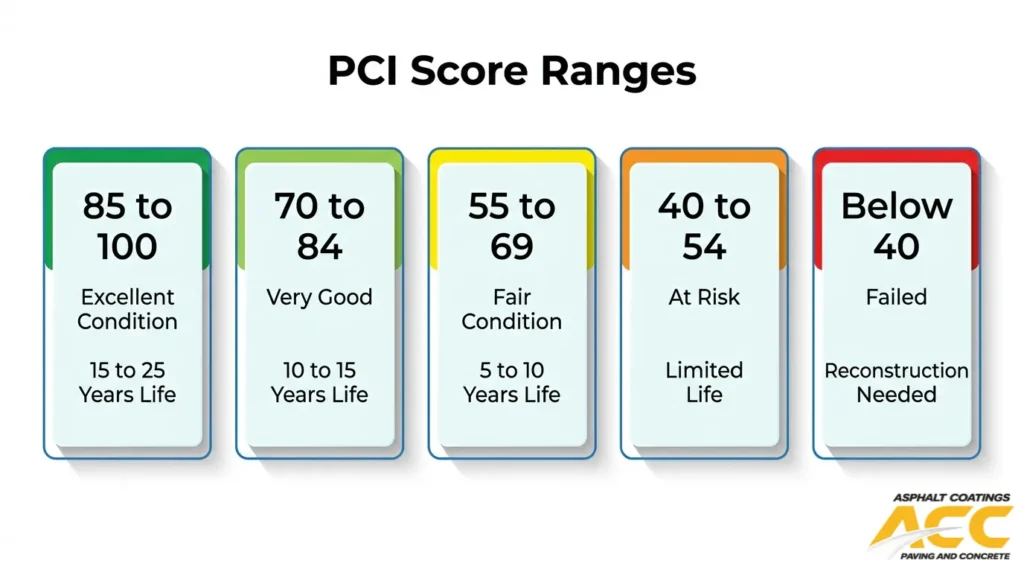
Different PCI score ranges indicate specific condition levels, from newly paved surfaces to pavements requiring full reconstruction. The following breakdowns cover what each range reveals about remaining life and recommended action.
What Does a PCI Score of 85–100 Mean for Your Parking Lot’s Remaining Life?
A PCI score of 85–100 means your parking lot is in excellent condition with significant remaining service life. According to the City of San Mateo’s inspection and scoring system, pavements in the 90–100 PCI range show little or no distress, typically because they have been recently repaved or rehabilitated.
At this level, the surface is structurally sound with no cracking, rutting, or weathering concerns. Routine preventive maintenance, such as sealcoating on a regular cycle, is the only action needed. Parking lots in this range can reasonably expect 15 to 25 years of functional life before major intervention becomes necessary, depending on traffic volume and environmental exposure. Keeping a lot above 85 is the most cost-effective long-term strategy.
What Does a PCI Score of 70–84 Mean for Your Parking Lot’s Remaining Life?
A PCI score of 70–84 means your parking lot has minor distress but remains in very good, serviceable condition. You may notice some hairline cracks, light weathering, or small utility patches. These are cosmetic issues that have not yet compromised structural integrity.
This range represents the ideal window for preventive maintenance. Crack sealing and sealcoating applied now can extend remaining life by 3 to 5 years per application cycle. Once a pavement drops below PCI 70, the rate of deterioration accelerates significantly; according to TarmacView, a pavement at PCI 85 may lose only 1–2 points annually, whereas one at PCI 65 can lose 5–10 points per year. Acting in this range prevents that exponential decline and protects your investment.
What Does a PCI Score of 55–69 Mean for Your Parking Lot’s Remaining Life?
A PCI score of 55–69 means your parking lot is in fair condition with visible, progressing distress that demands prompt attention. Light to moderate weathering, early-stage base failure, and moderate linear cracking are typical at this level.
Asphalt overlays become the primary recommended treatment in this range. A well-executed overlay can extend pavement life by 8 to 12 years. However, delaying action here is risky. Pavements below PCI 55 enter the poor-to-failed zone where costs escalate sharply, shifting from overlay solutions to full-depth repairs or reconstruction. For Denver parking lots exposed to freeze-thaw cycles and high UV, this range narrows faster than in milder climates. Property managers should treat a score in the low 60s as an urgent signal, not a comfortable buffer.
What Does a PCI Score of 40–54 Mean for Your Parking Lot’s Remaining Life?
A PCI score of 40–54 means your parking lot is at risk, with moderate to severe distress that signals limited remaining functional life without major intervention. Expect moderate to heavy linear cracking, visible base failure, and significant surface weathering.
According to the City of San Mateo’s pavement management data, pavements in the 30–49 range require a medium to thick overlay of 2 to 4 inches, which can extend street life by 10 to 20 years. Without that investment, the pavement will continue deteriorating rapidly toward failure. At this stage, spot repairs alone are insufficient because the underlying structure is compromised. A thorough engineering evaluation should determine whether an overlay will hold or whether partial reconstruction is more practical given the extent of base damage.
What Does a PCI Score Below 40 Mean for Your Parking Lot’s Remaining Life?
A PCI score below 40 means your parking lot has reached a failed or near-failed state with very little usable service life remaining. Extensive weathering, heavy base failure, failed patches, and widespread cracking networks characterize this condition level.
Reconstruction is typically the only viable solution at this point. The process involves removing all existing asphalt and failed subbase, then replacing and compacting new materials. These costs are substantial; City of Littleton, Colorado data shows reconstruction runs approximately $1.3 million per lane mile, with a resulting life expectancy of 20 to 25 years. Letting a parking lot reach this stage represents the most expensive possible outcome per year of pavement life. For property managers, a score below 40 should trigger immediate capital planning.
Understanding where your parking lot falls on the PCI scale clarifies what maintenance or repairs will deliver the best return.
How Does Denver’s Climate Affect the Way You Interpret a PCI Score?
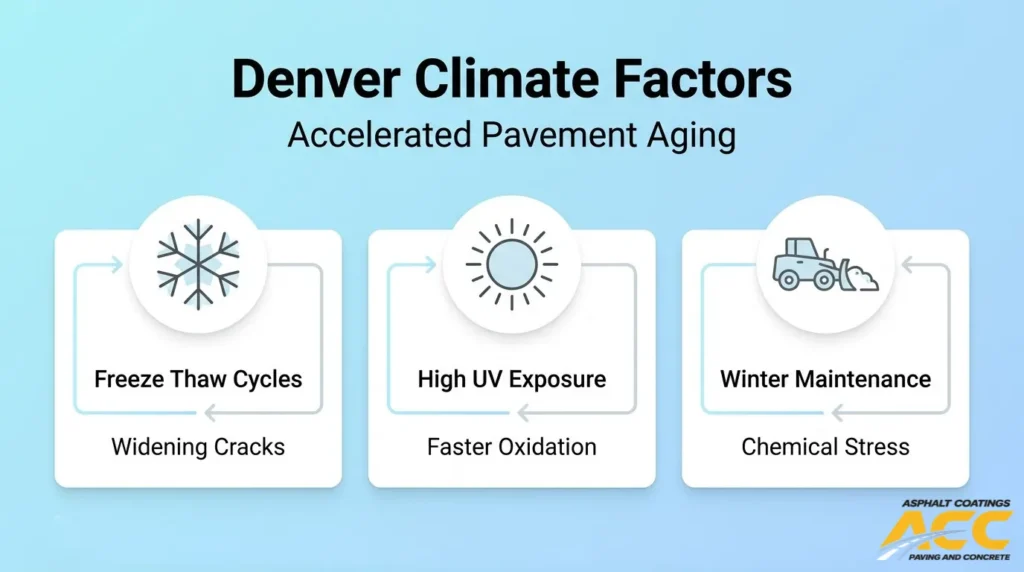
Denver’s climate accelerates pavement deterioration faster than regions with milder conditions. Freeze-thaw cycles, intense UV exposure at elevation, and deicing practices all compress the timeline a PCI score represents.
How Do Freeze–Thaw Cycles in Colorado Impact PCI and Remaining Life?
Freeze-thaw cycles in Colorado impact PCI and remaining life by widening existing cracks and accelerating subgrade failure each winter. Water seeps into pavement fissures, freezes, expands, then thaws repeatedly throughout Denver’s fluctuating winter temperatures. This mechanical stress turns low-severity cracks into medium or high-severity distresses within a single season, often dropping a parking lot’s PCI several points faster than the same score would decline in a temperate climate.
Sealing cracks before winter is the most cost-effective defense. According to the City of Littleton, Colorado, crack sealing costs approximately $5,500 per lane mile and extends pavement life by 3 to 5 years. Once freeze-thaw damage progresses beyond surface cracks into base failure, repairs escalate sharply; mill and overlay runs approximately $320,000 per lane mile. For Denver parking lots, a PCI reading taken in autumn should be treated as a conservative estimate, since the upcoming freeze-thaw season will likely push that number lower by spring.
How Does Denver’s UV Exposure and High Elevation Accelerate PCI Decline?
Denver’s UV exposure and high elevation accelerate PCI decline by breaking down the asphalt binder faster than in lower-altitude cities. Ultraviolet radiation oxidizes the oils in asphalt, making the surface brittle, faded, and prone to raveling and block cracking. At 5,280 feet, Denver receives significantly more UV than coastal areas at the same latitude. According to KOAA News, UV radiation increases 2 percent for every 1,000 feet of elevation gain, putting Colorado communities roughly 10 to 12 percent above sea-level exposure.
This means a parking lot with a PCI of 75 in Denver may develop oxidation-related distresses sooner than an identical lot at sea level. Regular sealcoating counteracts this by replenishing the surface layer that UV degrades. Property managers who interpret PCI scores without factoring in altitude-driven oxidation risk underestimating how quickly their pavement will move from “good” to “fair.”
How Do Snow Removal and Deicing Practices Influence PCI Over Time?
Snow removal and deicing practices influence PCI over time by introducing both chemical and mechanical stressors to the pavement surface. Plow blades scrape the asphalt, stripping away sealcoat and aggregate, while deicing salts and magnesium chloride penetrate cracks and weaken the binder. Repeated plowing across the same traffic lanes creates localized raveling and surface wear that a standard PCI inspection will capture as increased distress density.
Chemical deicers also draw moisture into the pavement structure, compounding freeze-thaw damage discussed above. Parking lots that receive heavy winter maintenance often show PCI declines 2 to 4 points faster per year than lots with lighter snow management demands. Scheduling sealcoating and crack sealing in late spring, after the plowing season ends, helps restore the protective surface layer before summer UV exposure compounds the damage further.
How Accurately Can a PCI Score Predict Your Parking Lot’s Remaining Service Life?
A PCI score predicts remaining service life with reasonable accuracy for surface condition, though real-world variables shift that estimate significantly. Traffic loads, drainage quality, and subgrade integrity all modify how many functional years a given score represents.
How Many Years of Life Typically Remain at Different PCI Levels?
The years of life typically remaining at different PCI levels range from decades for high-scoring pavements to near-zero for those in the failed category. According to the City of San Mateo’s inspection and scoring system, pavements in the 30 to 49 PCI range show moderate to severe weathering and base failure, yet a medium-to-thick overlay of 2 to 4 inches can still extend service life by 10 to 20 years.
General remaining-life benchmarks by PCI range include:
- PCI 85 to 100: 15 to 25+ years with routine sealcoating and crack sealing only.
- PCI 70 to 84: 10 to 15 years before major rehabilitation is needed.
- PCI 50 to 69: 5 to 10 years; an overlay can add 8 to 12 additional years.
- PCI 30 to 49: Immediate overlay required to recover 10 to 20 years of life.
- PCI below 30: Reconstruction is necessary; the pavement has effectively exhausted its service life.
These figures assume timely intervention. Delaying treatment at any threshold compresses remaining life dramatically, especially once deterioration accelerates below PCI 70.
How Do Traffic Loads and Use Types Change Remaining Life at the Same PCI?
Traffic loads and use types change remaining life at the same PCI by accelerating structural fatigue at different rates. A parking lot scoring PCI 65 at a shopping center with constant delivery truck traffic will deteriorate faster than an office park lot at the same score carrying only passenger vehicles.
Key traffic-related factors that modify the PCI-to-lifespan relationship include:
- Heavy vehicle frequency: Delivery trucks and garbage vehicles concentrate weight on turning areas, reducing remaining life by several years compared to car-only lots.
- Daily traffic volume: High-turnover retail lots experience more load repetitions, compounding surface and base wear.
- Static versus dynamic loading: Lots where vehicles idle or park for extended periods, such as distribution warehouses, develop localized depressions faster.
For commercial property managers, this means two lots with identical PCI scores can have vastly different remaining lifespans depending on their use profile.
How Do Drainage and Subgrade Conditions Affect Life Expectancy for a Given PCI?
Drainage and subgrade conditions affect life expectancy for a given PCI by controlling how quickly water undermines the pavement structure beneath what the surface inspection reveals. Poor drainage is the single most common accelerant of pavement failure, regardless of what the visible surface condition suggests.
Two lots at PCI 60 can diverge sharply in actual remaining life:
- Well-drained lot with stable subgrade: The PCI score reliably reflects 5 to 10 years of remaining service, and standard overlay treatments perform as expected.
- Lot with ponding water or clay-rich subgrade: Trapped moisture weakens the base layer, meaning the true structural life may be 2 to 4 years less than the PCI score implies.
This is precisely why PCI should be treated as one input in a broader assessment, not a standalone lifespan guarantee. Pairing PCI surveys with drainage evaluation and, when warranted, core sampling gives property managers a far more accurate picture of what their investment timeline actually looks like.
With remaining life estimated, the next consideration is identifying which specific distresses drive PCI scores down the fastest.
What Types of Distress Most Strongly Reduce a Parking Lot’s PCI Score?
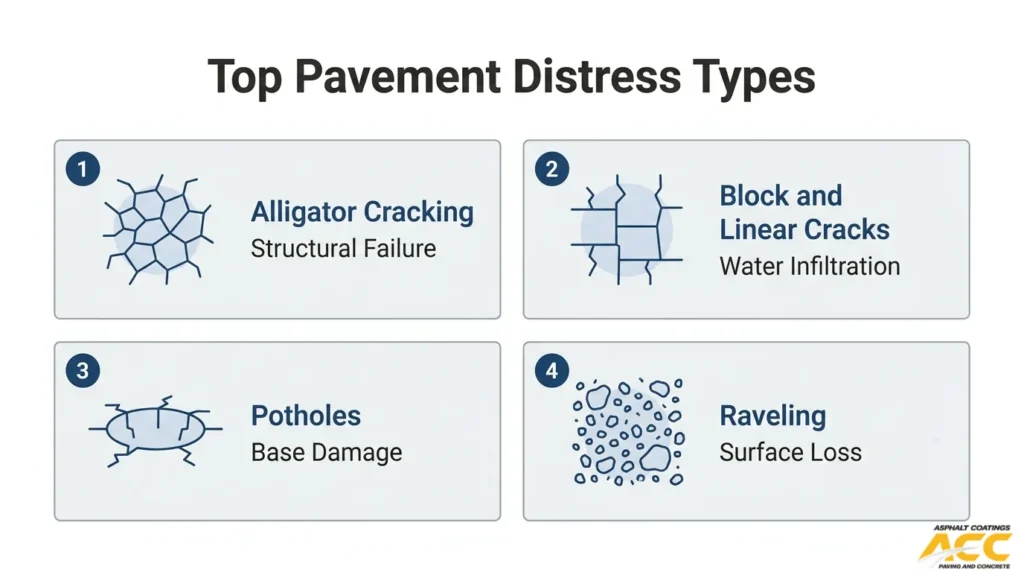
The types of distress that most strongly reduce a parking lot’s PCI score are load-related structural failures, such as alligator cracking and potholes, followed by environmental surface distresses like raveling and block cracking. Each distress type below explains how it impacts remaining life.
How Do Alligator Cracking and Structural Failures Affect Remaining Life?
Alligator cracking and structural failures affect remaining life by signaling that the pavement’s base or subgrade can no longer support traffic loads. According to TarmacView, fatigue cracking (also called alligator cracking) is defined as a series of interconnected cracks forming a pattern resembling alligator skin or chicken wire. This distress develops from repeated loading that exceeds the pavement’s structural capacity.
Once alligator cracking appears, especially at medium or high severity, the deduct values applied during PCI calculation are among the largest of any distress type. Because the damage originates below the surface, treatments like sealcoating cannot reverse it. Full-depth patching or reconstruction becomes the only viable repair, making early detection critical for preserving remaining service life.
Why Do Block Cracks and Longitudinal Cracks Matter for Future Performance?
Block cracks and longitudinal cracks matter for future performance because they allow water infiltration that accelerates base deterioration. While these crack types start as low-severity surface distresses with moderate PCI deductions, their real danger lies in progression. Water entering through unsealed cracks softens the subgrade, eventually converting manageable linear cracking into structural failure.
Beyond pavement life, these cracks create direct safety and compliance concerns. According to the National Safety Council, potholes or cracks, inadequate striping, and puddles can lead to pedestrian injuries, with slips, trips, and falls being common in parking lots. When vertical displacement at crack edges reaches 1/4 inch, the surface also triggers ADA trip hazard thresholds. Addressing block and longitudinal cracks early prevents both accelerated PCI decline and costly liability exposure.
How Do Potholes and Patch Failures Signal Deeper Structural Problems?
Potholes and patch failures signal deeper structural problems because both indicate that the pavement system has already failed at one or more locations. A pothole forms when the surface layer disintegrates under traffic after moisture has weakened the underlying base. Patch failures confirm that a previous repair did not address the root cause, whether that was poor drainage, inadequate compaction, or subgrade instability.
In PCI scoring, high-severity potholes carry some of the steepest deduct values. Multiple failed patches across a lot suggest widespread base compromise rather than isolated weak spots. For property managers, a pattern of recurring patch failures is often the clearest sign that preventive maintenance has been outpaced and major rehabilitation should be evaluated.
How Do Raveling and Surface Oxidation Impact Your Lot’s Longevity?
Raveling and surface oxidation impact your lot’s longevity by stripping away the protective asphalt binder that holds aggregate in place. Oxidation hardens the binder over time, making the surface brittle and prone to losing aggregate particles. In Colorado, this process accelerates because Denver’s high elevation intensifies UV exposure, and fluctuating freeze-thaw conditions compound the stress. According to a U.S. Environmental Protection Agency report, unfrozen surface conditions are an important factor in determining impacts to surface hydrology, which directly affects how moisture interacts with deteriorating pavement.
Left untreated, raveling progresses from cosmetic roughness to exposed aggregate and eventual structural vulnerability. Timely sealcoating is the most effective way to slow oxidation and preserve remaining PCI points before surface distress compounds into load-related failure.
With distress types identified, the next step is knowing when to shift from preventive care to major repairs.
When Should You Move from Preventive Maintenance to Major Repairs Based on PCI?
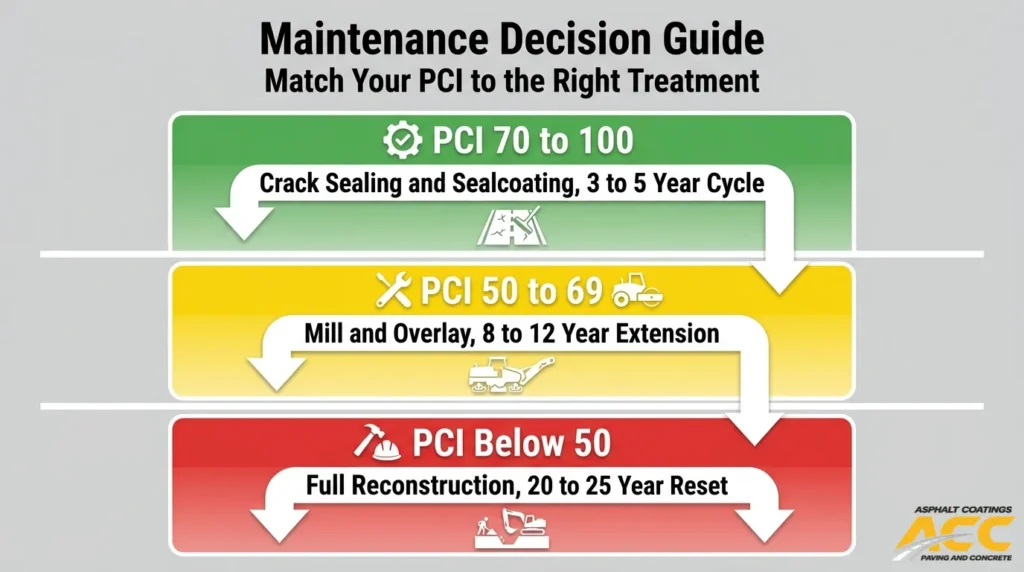
You should move from preventive maintenance to major repairs when your PCI drops below 70. According to TarmacView, FAA guidance sets PCI 70 as the preventive maintenance threshold; below that point, deterioration accelerates exponentially, with a pavement at PCI 65 potentially losing 5 to 10 points per year compared to just 1 to 2 points annually at PCI 85. The sections below break down specific PCI ranges for crack sealing, mill-and-overlay, and full reconstruction.
At What PCI Range Does Crack Sealing and Sealcoating Still Make Sense?
Crack sealing and sealcoating still make sense in the PCI 70 to 89 range. Pavements at this level typically show only minor to moderate hairline cracks and light weathering, making them ideal candidates for surface treatments applied in 3 to 5 year intervals. According to the City of San Mateo’s inspection and scoring system, this range qualifies for crack sealing and slurry seal as the first defense against water penetration.
At the cost level, parking lot sealcoating runs $0.18 to $0.36 per square foot, with crack filling adding $1.50 to $2.20 per linear foot. Once a pavement drops below PCI 70 into the 50 to 69 range, surface treatments alone cannot keep pace with accelerating deterioration, and overlays become the appropriate intervention.
At What PCI Range Should You Consider Mill-and-Overlay Solutions?
You should consider mill-and-overlay solutions in the PCI 50 to 69 range. Pavements at this level exhibit light to moderate weathering, early base failure, and moderate linear cracking. An overlay applied at this stage can extend pavement life by 8 to 12 years, making it a cost-effective bridge between surface treatments and full reconstruction.
Waiting until a pavement drops well below PCI 55, however, often means the base has deteriorated too far for an overlay to bond properly. For commercial parking lots with consistent traffic loads, acting within this window preserves structural integrity at a fraction of reconstruction costs.
At What PCI Range Is Full-Depth Reclamation or Reconstruction Recommended?
Full-depth reclamation or reconstruction is recommended when PCI falls below 55. According to TarmacView, pavements below PCI 55 enter the poor-to-failed range where major structural overlays, full-depth repairs, or complete reconstruction become necessary.
At this stage, distresses typically include:
- Extensive weathering across the surface
- Moderate to heavy base failure beneath the asphalt layer
- Failed patches that no longer hold
- Dense networks of moderate to heavy linear cracking
Once PCI drops below 30, reconstruction is the only viable option. Delaying action in this range compounds costs rapidly, since each year of neglect can erase 5 to 10 additional PCI points.
Understanding these PCI thresholds helps property managers build realistic maintenance budgets before costs escalate.
How Should Property Managers in Denver Use PCI Scores for Budget Planning?
Property managers in Denver should use PCI scores to align pavement spending with measurable condition data. The following sections cover building capital improvement plans, phasing work to minimize disruption, and tracking results over time.
How Can PCI Data Help You Build a 3–5 Year Capital Improvement Plan?
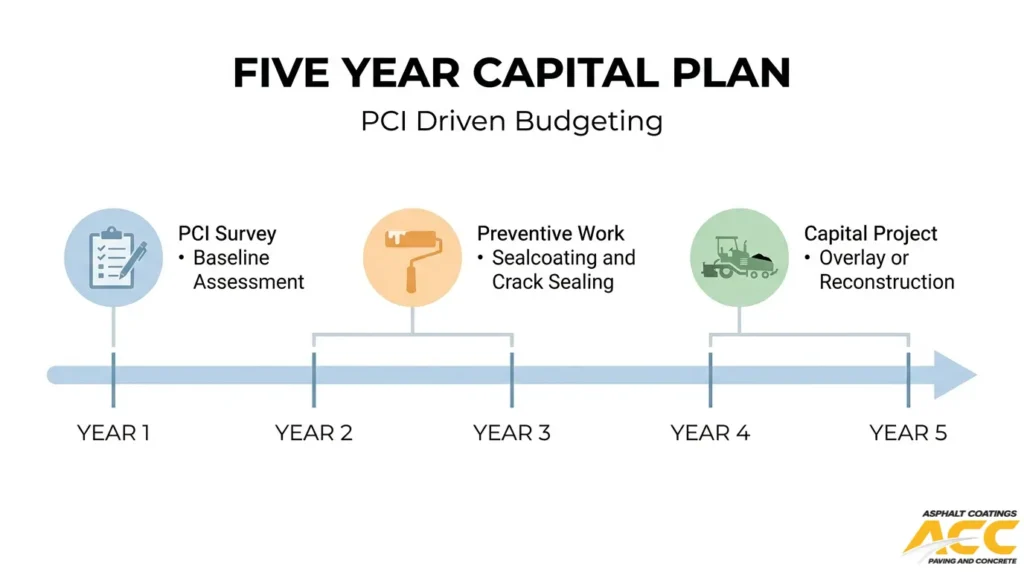
PCI data helps you build a 3-5 year capital improvement plan by matching each parking lot section’s current score to the treatment it will need and when. A lot scoring 75 today may only require sealcoating this year, while a section at 55 signals an overlay within two to three years. According to HFM Magazine, the most cost-effective approach is to set a pavement condition rating target in the satisfactory range, between 71 and 85 on the PCI scale. By mapping every scored section onto a timeline, property managers can forecast annual costs, stagger large expenditures, and avoid the budget shock of emergency reconstruction. This data-driven approach transforms reactive spending into a predictable capital schedule.
How Can PCI-Based Phasing Reduce Disruption for Tenants and Customers?
PCI-based phasing reduces disruption for tenants and customers by prioritizing the worst sections first while keeping higher-scoring areas open for normal use. Instead of shutting down an entire lot for a single large project, property managers can schedule repairs in stages aligned with each zone’s score. Zones below 55 receive structural work immediately; zones between 70 and 85 get preventive treatments during lower-traffic periods. This staged approach keeps parking capacity available throughout the project, limits noise and dust exposure for adjacent tenants, and spreads costs across multiple budget cycles. For retail and office properties, maintaining accessible parking during repairs directly protects revenue.
How Can Tracking PCI Over Time Show Whether Your Maintenance Plan Is Working?
Tracking PCI over time shows whether your maintenance plan is working by revealing whether scores stabilize, improve, or continue declining after each treatment. A lot that received sealcoating at PCI 78 and holds steady at 75 two years later confirms the treatment slowed deterioration effectively. Conversely, a section that drops from 65 to 52 despite crack sealing indicates deeper structural issues requiring a different approach. Regular resurveys, ideally every one to three years, create a trend line that quantifies return on maintenance investment. For property managers overseeing multiple Denver lots, comparing PCI trends across sites identifies which properties need more aggressive intervention and which maintenance strategies deliver the best long-term value.
With a data-backed budget plan in place, the next step is understanding how PCI scores connect to safety, ADA compliance, and curb appeal.
How Do PCI Scores Influence Safety, ADA Compliance, and Curb Appeal?
PCI scores influence safety, ADA compliance, and curb appeal by revealing surface defects that create hazards, violate accessibility standards, and diminish property appearance. The following sections cover trip hazard liability, ADA-specific parking lot concerns, and how higher PCI values protect tenant retention.
How Can Low PCI Scores Create Trip Hazards and Liability Risks?
Low PCI scores can create trip hazards and liability risks by indicating surface distresses, such as potholes, heaved slabs, and cracked pavement, that cause pedestrians to stumble or fall. According to the Centers for Disease Control and Prevention, over one million Americans suffer a slip, trip, or fall injury and over 17,000 people die in such incidents annually. Parking lots with deteriorating surfaces are frequent settings for these events. ADA sidewalk violations, particularly trip hazards and missing curb ramps, rank among the most common triggers for premises liability claims. Property owners who allow PCI scores to drop into the “at-risk” or “poor” range without remediation face compounding legal exposure. Proactive pavement management is one of the most straightforward ways to reduce this risk.
How Can PCI-Related Surface Issues Affect ADA Accessibility in Parking Lots?
PCI-related surface issues can affect ADA accessibility in parking lots by producing uneven surfaces, deteriorated accessible routes, and damaged curb ramps that prevent wheelchair users and mobility-impaired individuals from navigating safely. The PCI methodology, standardized by ASTM International, covers the determination of parking lot pavement condition through visual surveys that identify exactly the types of distresses most likely to violate ADA standards. Cracked and settled pavement around accessible parking stalls, loading zones, and pedestrian pathways creates vertical displacement that exceeds ADA thresholds. According to the National Safety Council, tens of thousands of crashes occur in parking lots and garage structures annually, resulting in hundreds of deaths and thousands of injuries. Monitoring PCI scores gives property managers an early warning system before surface conditions escalate into compliance violations.
How Does Maintaining a Higher PCI Improve Curb Appeal and Tenant Retention?
Maintaining a higher PCI improves curb appeal and tenant retention by keeping parking lot surfaces smooth, uniformly dark, and free of visible distresses like potholes, alligator cracking, and faded striping. First impressions shape tenant and customer decisions; a well-maintained lot signals professional management and operational investment. Tenants in commercial properties, especially retail and office environments, often evaluate lease renewals partly on the condition of shared exterior spaces. A parking lot scoring above 70 on the PCI scale projects a maintained, safe property, while a lot below 50 communicates deferred maintenance that may drive tenants to competing locations. For property managers balancing limited budgets, investing in preventive treatments that sustain higher PCI values typically costs far less than recovering lost tenants.
Beyond aesthetics, PCI-driven maintenance connects directly to the safety and compliance standards covered above.
How Do PCI Scores Compare with Other Ways to Assess a Parking Lot’s Health?
PCI scores compare with other assessment methods by offering a standardized, repeatable surface evaluation, while alternatives like visual inspections and structural testing measure different dimensions of pavement health. The sections below cover drive-by assessments, core sampling, and hidden structural risks.
Why Is PCI More Reliable Than a Simple Visual “Drive-By” Assessment?
PCI is more reliable than a simple visual drive-by assessment because it uses a standardized distress survey methodology that classifies, measures, and quantifies every surface defect. A drive-by inspection depends entirely on the observer’s experience and vantage point; two inspectors can walk the same lot and reach different conclusions about its condition.
The PCI method, by contrast, assigns each distress a type, severity level, and density measurement before calculating a single numerical score between 0 and 100. According to the U.S. Army Corps of Engineers, the pavement condition index is a numerical index between 0 and 100 used to indicate the general condition of a pavement section. That objectivity makes PCI results comparable across inspections, inspectors, and time periods. For property managers tracking year-over-year decline, this consistency is far more actionable than subjective notes from a windshield tour.
How Can Core Sampling and Structural Testing Complement a PCI Survey?
Core sampling and structural testing complement a PCI survey by revealing subsurface conditions that visual distress surveys cannot detect. PCI evaluates surface distresses only. Core samples physically extract a cross-section of the pavement and base layers, exposing actual asphalt thickness, layer bonding, and subgrade compaction quality.
Ground penetrating radar offers another nondestructive option for identifying voids and moisture pockets beneath the surface. When paired together, PCI establishes the surface condition score while core sampling and GPR confirm whether the structural foundation supports that rating. According to the U.S. Army Corps of Engineers, the PCI index was first developed as an airfield rating system funded by the U.S. Air Force and later standardized by ASTM for roads and airport pavements. That surface-focused heritage is precisely why structural testing fills the gap PCI was never designed to cover.
When Might a High PCI Score Still Hide Underlying Structural Issues?
A high PCI score might still hide underlying structural issues when the surface appears sound but the base or subgrade has already begun to fail. Moisture infiltration through hairline cracks, poor original compaction, or deteriorating drainage can weaken structural layers long before visible distresses appear on the surface.
A parking lot scoring 80 on a PCI survey could still have saturated subgrade soils or delamination between asphalt lifts. These problems typically manifest as rapid PCI decline once they reach the surface. For this reason, pairing periodic PCI surveys with selective core sampling or GPR testing at high-stress areas, such as dumpster pads, drive lanes, and loading zones, provides a more complete picture of pavement health than surface scoring alone.
Understanding PCI’s strengths and limitations helps property owners schedule the right combination of assessments at the right intervals.
How Often Should Denver Property Owners Recheck PCI Scores?
Denver property owners should recheck PCI scores every one to three years, depending on pavement age, traffic volume, and seasonal exposure. The following subsections break down how each factor shapes the ideal inspection schedule.
How Does Parking Lot Age Affect the Ideal PCI Inspection Frequency?
Parking lot age affects the ideal PCI inspection frequency because older pavements deteriorate faster and require shorter intervals between surveys. A lot less than five years old with a PCI above 85 may only need inspection every three years, since it typically loses just one to two PCI points annually. Once a lot reaches 10 to 15 years, minor distresses accumulate more quickly, and biennial checks become necessary to catch problems before they cross critical thresholds. Lots older than 20 years, especially those that have never been overlaid, often warrant annual PCI surveys. At that stage, even a single harsh winter can accelerate alligator cracking or base failure enough to shift the pavement from a maintenance candidate into reconstruction territory.
How Do Heavy Use Sites Like Shopping Centers Change PCI Check Schedules?
Heavy use sites like shopping centers change PCI check schedules by compressing the interval between surveys to as little as one year. According to FAA AC 150/5380-7B, PCI surveys are recommended every one to three years depending on traffic volume and pavement age, with the highest-traffic surfaces requiring the most frequent assessments. Shopping centers, distribution warehouses, and large box stores experience constant turning movements, heavy delivery trucks, and concentrated load paths that accelerate rutting and fatigue cracking far beyond what a standard office park endures. For these properties, waiting three years between inspections risks missing the narrow window where sealcoating or crack sealing remains viable. Annual surveys give property managers the data needed to intervene before repair costs multiply.
How Can Seasonal Factors in Colorado Influence the Timing of PCI Surveys?
Seasonal factors in Colorado influence the timing of PCI surveys by dictating when distress is most visible and when results are most accurate. Denver’s elevation at 5,280 feet produces UV radiation roughly 25 percent stronger than a coastal city at the same latitude, according to UV Blocker, accelerating binder oxidation throughout summer. Freeze-thaw cycles during late fall through early spring force water into existing cracks, widening them before inspectors can assess stable conditions. The best window for PCI surveys in Colorado falls between late spring and early fall, after snowmelt has dried and before the next freeze cycle begins. Scheduling inspections during this period captures the full extent of winter damage while providing enough lead time to complete maintenance before temperatures drop again. For commercial property managers throughout the Front Range, from Denver and Aurora to Colorado Springs, partnering with a contractor who understands these Colorado-specific timing considerations is essential for maintaining parking lot longevity and protecting capital improvement budgets.
With a clear inspection schedule established, the next step is turning PCI data into an actionable maintenance plan.
How Should You Approach PCI-Driven Maintenance and Repairs with Asphalt Coatings Company?
You should approach PCI-driven maintenance and repairs with Asphalt Coatings Company by sharing your current PCI data so the team can match the right service to your pavement’s condition. The sections below cover how Asphalt Coatings Company plans work from your scores and the key takeaways from this article.
How Can Asphalt Coatings Company Use PCI Scores to Plan Sealcoating, Crack Sealing, and Paving for Your Lot?
Asphalt Coatings Company uses PCI scores to plan sealcoating, crack sealing, and paving by matching each service to the condition range where it delivers the most value. A lot scoring above 70 is a strong candidate for sealcoating and crack sealing, both of which extend surface life at a fraction of reconstruction costs. When scores drop into the 50s and 60s, mill-and-overlay solutions become the better investment. With 39 years of experience working exclusively on commercial projects across Colorado’s Front Range, Asphalt Coatings Company has developed expertise in evaluating how Denver’s high-altitude UV exposure and freeze-thaw cycles affect the relationship between PCI scores and actual remaining pavement life. All work is performed by in-house crews rather than subcontractors, ensuring consistent quality and direct accountability throughout the project. According to data from the City of Littleton, Colorado, reconstruction costs approximately $1.3 million per lane mile once pavement falls below 30, so acting early at higher PCI levels prevents that escalation. Asphalt Coatings Company performs all services with in-house crews, keeping timelines predictable and accountability clear throughout every phase.
What Are the Key Takeaways About What a PCI Score Reveals About Your Parking Lot’s Remaining Life We Covered?
The key takeaways about what a PCI score reveals about your parking lot’s remaining life are straightforward:
- PCI is a 0-to-100 index that objectively quantifies pavement condition using standardized distress surveys.
- Each PCI range corresponds to specific maintenance actions, from sealcoating above 70 to full reconstruction below 30.
- Denver’s elevation of 5,280 feet increases UV intensity by roughly 8 to 10% per 1,000 feet of elevation gain, accelerating asphalt oxidation faster than in lower-altitude cities.
- Deterioration accelerates exponentially below PCI 70, making early preventive maintenance the most cost-effective strategy.
- Regular PCI tracking builds a data-driven capital improvement plan that protects budgets and extends pavement life.
For property managers ready to put these insights into action, Asphalt Coatings Company brings 39 years of Colorado-specific expertise to every assessment and repair.