A parking lot catch basin is a drainage structure that intercepts stormwater through a grated or curb-opening inlet and channels it into underground storm drains, protecting the pavement structure from water damage. When components like grates, frames, adjustment rings, or mortar collars deteriorate, the basin becomes the source of the very damage it was designed to prevent.
This guide covers catch basin function and failure modes, root causes of structural settlement, safety and liability exposure, inspection and diagnosis methods, repair and replacement options, and long-term preventive maintenance.
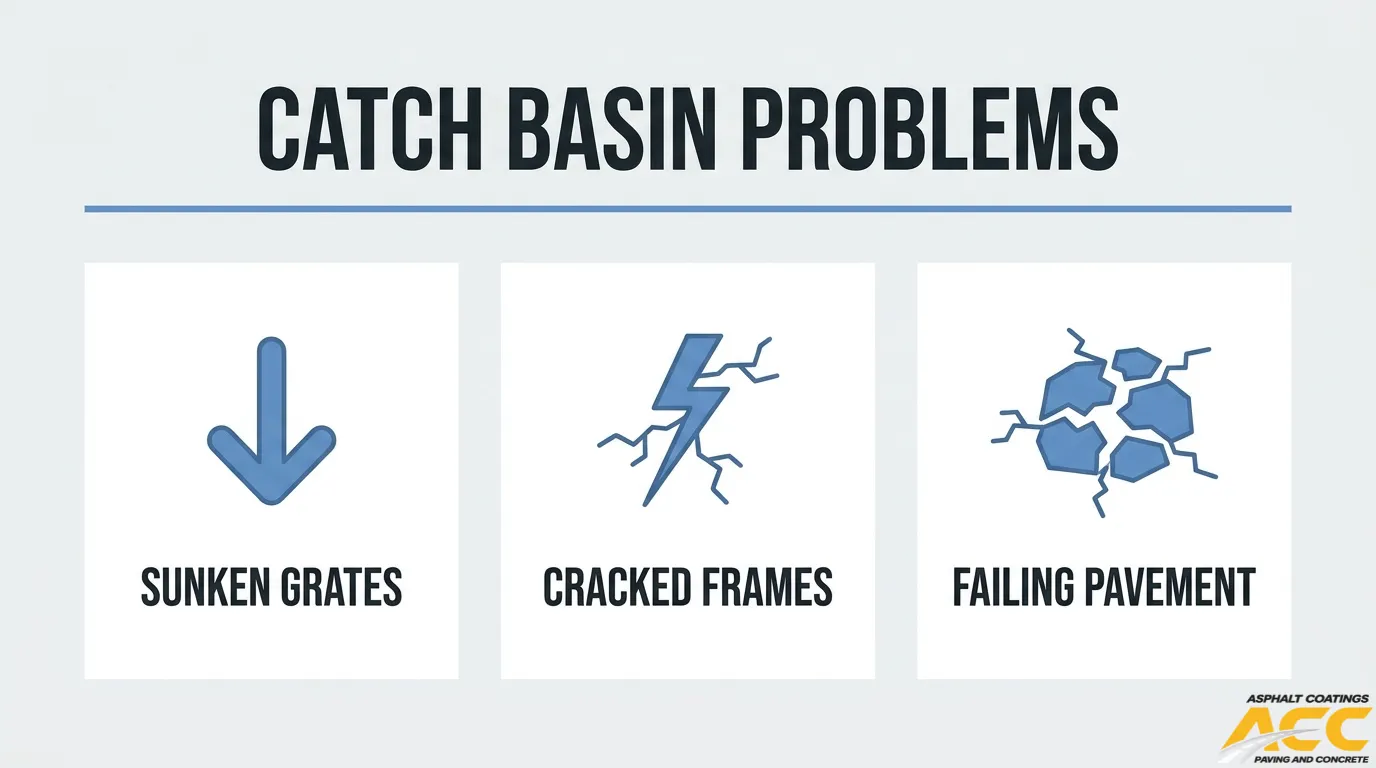
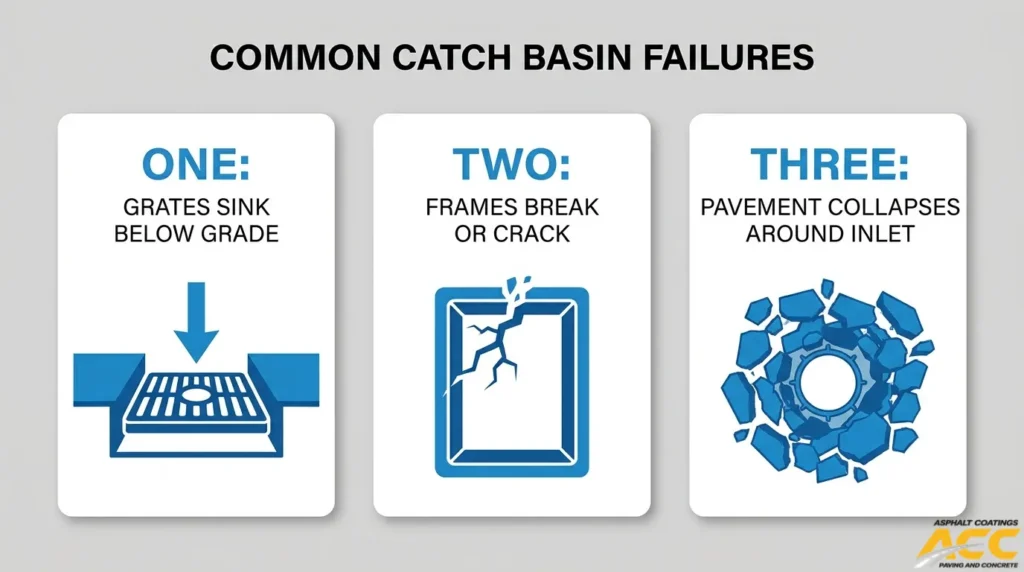
Catch basins fail in three primary ways: grates sink below grade as backfill consolidates or adjustment rings crack, frames break under repeated thermal stress and heavy vehicle impact, and surrounding pavement collapses when water infiltrates the joint between asphalt and the rigid basin structure.
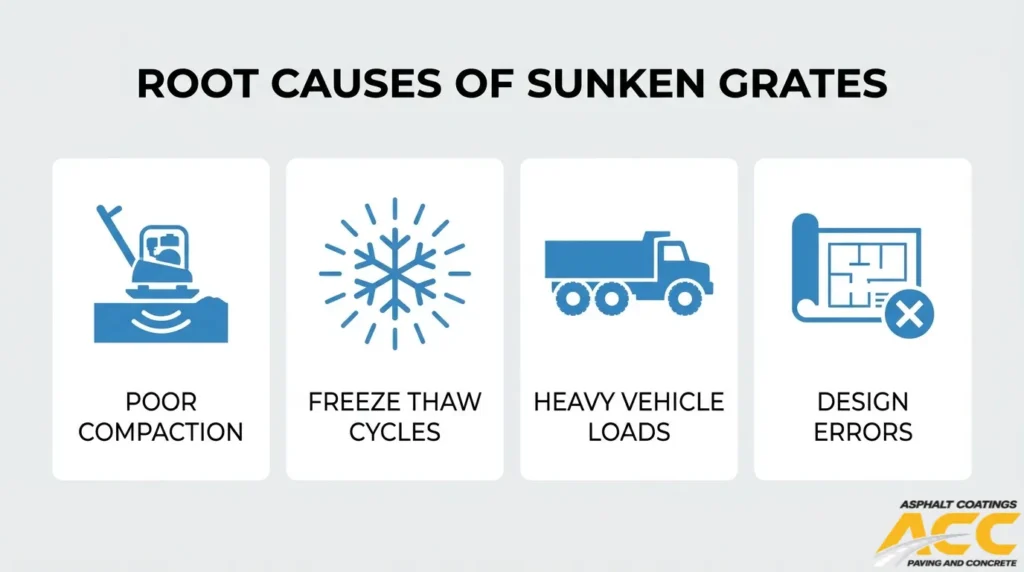
The root causes behind these failures include improper compaction during original construction, freeze-thaw cycling that displaces subgrade material, concentrated truck and dumpster loads, and design errors that trap water around the structure instead of directing it away.
Sunken grates, rocking frames, and poor drainage create measurable liability risks for property owners. Trip hazards at out-of-grade grates can violate ADA elevation thresholds, standing water from compromised inlets becomes black ice in freezing temperatures, and a single failing basin can trigger base erosion and pothole formation across an entire drainage zone.
Professional diagnosis separates surface problems from structural failures through visual evaluation, elevation measurement, and CCTV pipe inspection. Repair options range from adjusting frames and rings to full-depth asphalt replacement and concrete collar installation, with the right choice depending on structural condition, traffic loads, and remaining pavement life.
Routine cleaning, crack sealing, sealcoating, and annual inspections stop minor deterioration before it compounds into costly structural rebuilds.
What Does a Catch Basin Do in a Parking Lot Drainage System?
A catch basin collects surface water from paved areas and channels it into underground storm drains, preventing flooding and protecting the pavement structure. Its core components, drainage function, and maintenance needs are outlined below.
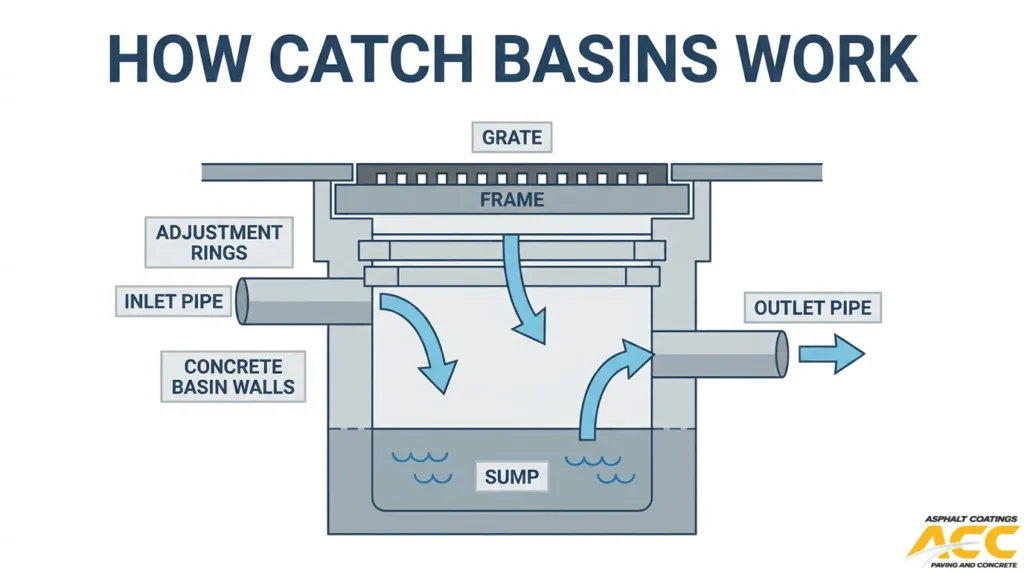
A catch basin in a parking lot drainage system intercepts stormwater runoff through a grated or curb-opening inlet and directs it into a below-grade conduit. According to the South Dakota Department of Transportation’s Drainage Manual, inlets are drainage structures that collect surface water through a grate, a curb opening, or a combination of both and convey it to storm drains or culverts. Without this interception point, water would pool across the lot surface, saturate the asphalt base, and accelerate structural deterioration.
The structure itself consists of several key components:
- A cast-iron or steel grate that screens debris while allowing water to pass.
- A frame that anchors the grate flush with the surrounding pavement surface.
- Adjustment rings that sit between the frame and the concrete structure, allowing grade corrections.
- A sump at the base of the basin that traps sediment before water enters the outflow pipe.
- Inlet and outlet pipes that connect the basin to the broader storm drain network.
Each component must remain structurally sound for the system to function. When grates sink, frames crack, or adjustment rings deteriorate, water bypasses the inlet or infiltrates the surrounding pavement, triggering the exact damage the basin was designed to prevent. Municipal jurisdictions recognize this risk; as noted in Norfolk, Nebraska’s stormwater FAQ, each jurisdiction maintains and cleans out detention basins, channels, and storm drains on a regular basis to keep systems operational.
For property managers, understanding this function matters because a catch basin is not just a drain opening. It is the critical junction where surface drainage, structural pavement support, and underground conveyance all converge. Neglecting any single component compromises the entire system, often in ways that remain invisible until pavement failure is already underway.
What Are the Most Common Catch Basin Problems in Asphalt Parking Lots?
The most common catch basin problems in asphalt parking lots are sunken grates, cracked or broken frames, and pavement failure around inlets. Each issue develops differently and creates distinct drainage and safety concerns.
Why Do Catch Basin Grates Become Sunken or Lower Than the Surrounding Pavement?
Catch basin grates become sunken or lower than the surrounding pavement when the underlying support structure settles, compacts, or erodes over time. Several factors drive this downward shift:
- Poorly compacted backfill around the basin consolidates under traffic loads.
- Deteriorated adjustment rings beneath the frame lose height as mortar cracks or spalls away.
- Water infiltrating the joint between the frame and pavement washes out fine aggregate from the base layer.
According to the City of Charlottesville’s Catch Basin Type C Standard Detail, a maximum of three adjustment rings totaling 8 inches in height may be used, meaning even modest ring deterioration can drop a grate well below grade. Once a grate sits low, it collects debris faster, traps standing water, and accelerates erosion of the surrounding asphalt.
How Do Cracked or Broken Catch Basin Frames Develop?
Cracked or broken catch basin frames develop through repeated stress cycles, corrosion, and impact loading. Cast iron and steel frames endure constant thermal expansion and contraction, which fatigues the metal over years of service. Heavy vehicles, such as delivery trucks and garbage haulers, concentrate point loads directly on the frame during turns and stops. Snowplow blades striking a slightly raised or misaligned frame can fracture the casting in a single pass. Corrosion from deicing chemicals weakens the frame’s cross-section, reducing its load capacity. When mortar joints between adjustment rings deteriorate, the frame loses stable bearing and begins rocking, which concentrates stress at the corners and accelerates cracking. Even a hairline frame crack allows water to bypass the grate and erode the base below.
Why Does Pavement Fail and Sink Around Catch Basin Inlets?
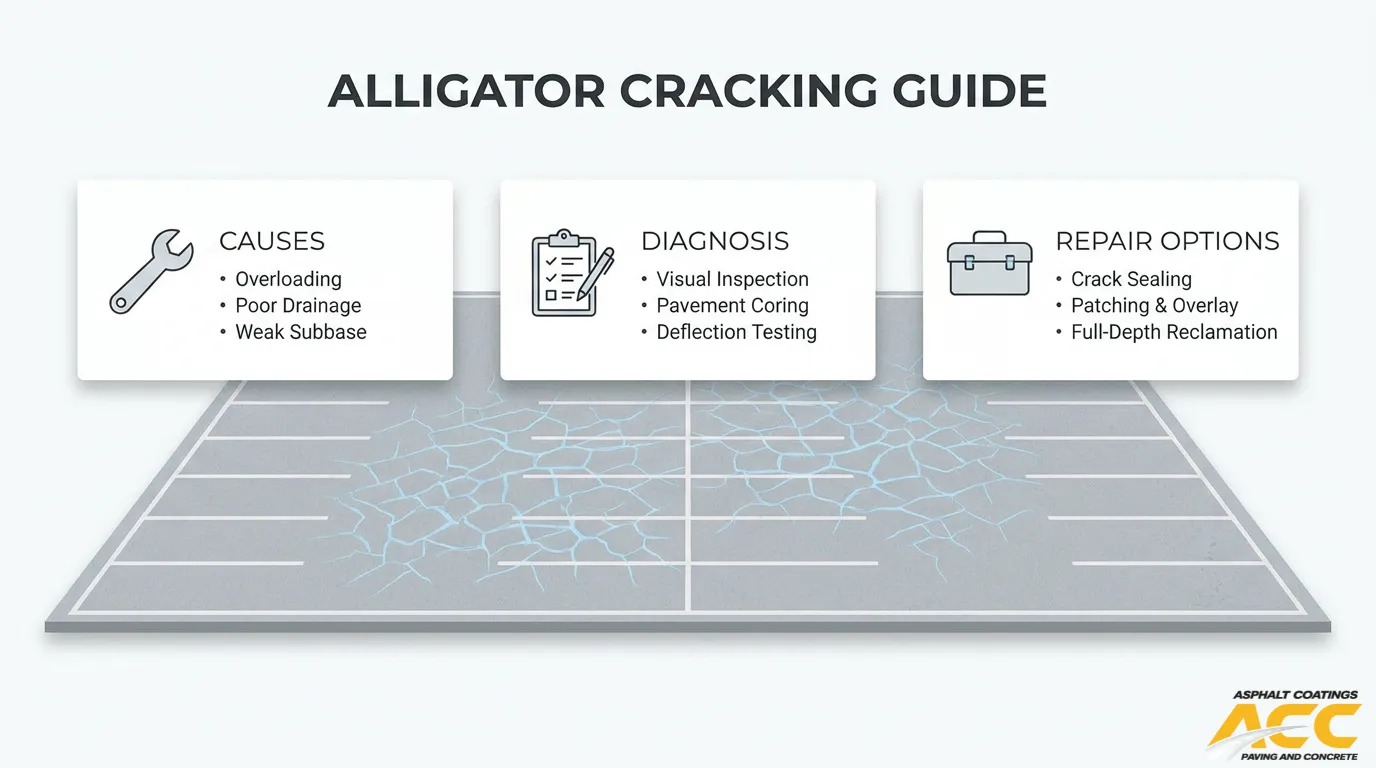
Pavement fails and sinks around catch basin inlets primarily because water infiltrates the joint between the asphalt surface and the basin structure. That joint is inherently a weak point; the rigid concrete or precast basin and the flexible asphalt move at different rates under thermal stress and traffic loading. Once water reaches the aggregate base, it loosens fines, reduces compaction density, and creates voids. Traffic then compresses the weakened base into those voids, producing visible depressions and alligator cracking.
According to FHWA pavement drainage guidance, the primary source of free water in pavement structures is infiltration through cracks and joints. For property managers, the practical takeaway is clear: sealing the perimeter joint around every inlet is one of the most cost-effective steps to prevent progressive base failure.
Understanding these three failure modes helps property managers identify which repair approach each basin needs.
What Warning Signs Indicate Your Catch Basin Is Starting to Fail?
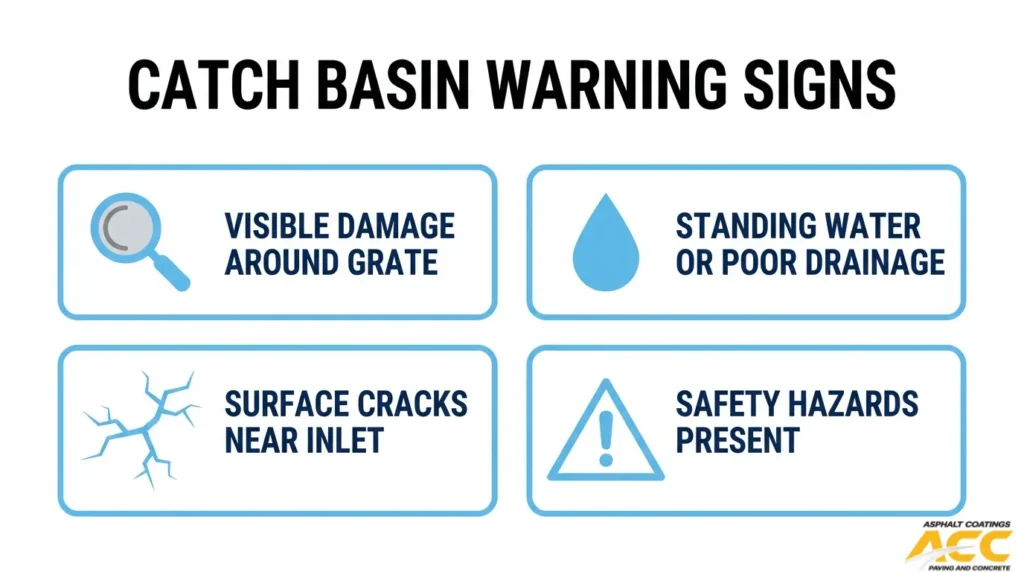
Warning signs that indicate your catch basin is starting to fail include visible damage around grates, persistent standing water, and surface cracking near inlets. The sections below cover visual clues at the grate, drainage-related red flags, and when pavement cracks point to deeper structural problems.
What Visual Clues Around the Grate and Inlet Should You Look For?
The visual clues around the grate and inlet you should look for include physical damage to the frame, grate misalignment, and deterioration of the surrounding pavement edge. According to the Town of Spencer, Massachusetts Standard Operation Procedure for Catch Basin Inspection and Cleaning, inspection procedures should address both the grate opening and the catch basin structure, including the sump, inlet and outlet pipes, frame condition, and stormwater quality.
Key visual indicators to check during a walkthrough:
- Grate bars that are cracked, bent, or missing entirely.
- Frame edges sitting unevenly or rocking when stepped on.
- Gaps between the frame casting and the surrounding asphalt surface.
- Debris buildup blocking more than half the grate openings.
- Staining, erosion channels, or loose aggregate radiating outward from the inlet.
Even minor frame displacement often signals that adjustment rings or mortar joints beneath the casting have started to fail. Catching these clues early prevents the kind of accelerated pavement breakdown that turns a simple frame reset into a full-depth reconstruction.
How Can Standing Water and Poor Drainage Reveal Catch Basin Issues?
Standing water and poor drainage reveal catch basin issues by exposing blockages, undersized piping, or structural settling that prevents stormwater from entering and moving through the system. A catch basin intercepts stormwater from gutters or medians and discharges it through a conduit; when any part of that pathway is compromised, water pools on the surface instead.
Persistent puddles near an inlet after moderate rain suggest the grate is partially blocked, the sump is full of sediment, or the outflow pipe has collapsed. As documented in a Louisiana Transportation Research Center survey response for US 371, “the catch basin spacing and outflow pipe from the catch basin do not appear to be large enough and the road gets inundated with water a few times per year.” That same pattern plays out in parking lots where undersized or failing basins can no longer handle design storm volumes.
Standing water is never just a nuisance. It infiltrates pavement joints, softens the aggregate base, and accelerates pothole formation. If water consistently lingers around the same inlet, the problem is almost certainly structural rather than cosmetic.
When Do Surface Cracks Signal a Deeper Catch Basin or Subgrade Problem?
Surface cracks signal a deeper catch basin or subgrade problem when they form in radial or concentric patterns around the inlet rather than following normal pavement aging patterns. Isolated longitudinal cracks across an open lot suggest thermal cycling, but cracks that radiate outward from a catch basin frame point to localized settlement, base erosion, or structural movement beneath the pavement.
The North Carolina Department of Transportation Stormwater Control Inspection and Maintenance Manual directs inspectors to examine the ground surface above buried pipes and structures for sinkholes, depressions, or other signs of pipe breakage or separation. Those same subsurface failures cause the cracking patterns property managers see at grade level.
Alligator cracking within a few feet of the grate is especially telling. It indicates the base course has lost load-bearing capacity, typically because infiltrating water has washed out fines from around the structure. At that stage, surface patching alone will not hold; the subgrade and catch basin connection both require attention before repaving delivers lasting results.
What Causes Sunken Catch Basin Grates in Commercial Parking Lots?
Sunken catch basin grates in commercial parking lots result from subgrade failures, environmental stress, heavy loads, and original construction defects. The following sections break down each root cause: improper compaction, freeze-thaw cycles, heavy vehicle traffic, and design or construction mistakes.
How Does Improper Compaction or Base Preparation Lead to Sunken Grates?
Improper compaction or base preparation leads to sunken grates by leaving voids and loose material beneath the catch basin structure that consolidate under load over time. When backfill around a basin is not placed in controlled lifts with proper moisture conditioning, the soil settles unevenly. According to the Colorado Department of Transportation’s WAQTC Manual, compaction is achieved through control of lift thickness and use of appropriate equipment, with moisture conditioning required if material is too dry. Skipping these steps creates soft pockets that compress under pavement weight and traffic, pulling the grate and frame below the surrounding asphalt surface. This is one of the most preventable causes of inlet settlement, yet it remains common when construction schedules pressure crews to backfill quickly.
In What Ways Do Freeze–Thaw Cycles and Colorado Climate Contribute?
Freeze-thaw cycles and Colorado’s climate contribute to sunken grates by repeatedly expanding and contracting moisture trapped in the base and subgrade around catch basin structures. Water enters through pavement cracks and the joint between asphalt and the basin frame. When temperatures drop below freezing, that water expands, pushing soil and aggregate apart. During thaw, the displaced material does not return to its original position, leaving voids that progressively deepen with each cycle. Colorado’s Front Range commonly experiences rapid temperature swings, sometimes crossing the freeze-thaw threshold multiple times in a single week during winter and spring. Over several seasons, this cumulative displacement loosens the support beneath the grate, causing it to sink relative to the surrounding pavement.
How Does Heavy Truck or Dumpster Traffic Damage Catch Basin Structures?
Heavy truck or dumpster traffic damages catch basin structures by concentrating extreme point loads directly over or adjacent to the grate and frame assembly. Garbage trucks, delivery vehicles, and dumpsters on casters impose repeated high-impact forces that exceed the load tolerance of standard grate frames and the surrounding pavement section. Each heavy pass compresses the base course and subgrade incrementally. Over months, the pavement and structure settle into a visible depression. Particularly in loading dock areas and dumpster pads, where trucks brake and turn, shear forces compound the vertical load. Adjustment rings beneath the frame can crack under this stress, accelerating settlement further. For high-traffic inlets, specifying heavy-duty frames rated for H-20 loading is critical during original construction or replacement.
Can Design or Construction Mistakes Cause Chronic Settling Around Inlets?
Yes, design or construction mistakes can cause chronic settling around inlets. Common errors include setting the basin on an inadequately prepared subgrade, using too many or too few adjustment rings, and failing to compact backfill in proper lifts around the structure walls. When the original construction omits a stable aggregate base beneath the basin or misaligns the outlet pipe grade, water collects around the structure instead of draining away. That trapped water erodes supporting soil from beneath the frame. According to the Federal Highway Administration’s pavement drainage guidance, the primary source of free water is infiltration through cracks and joints in the pavement, which directly undermines structures where drainage connections were poorly sealed during initial installation.
Understanding these root causes helps property managers identify which factor is driving settlement at a specific inlet, so the right repair approach targets the actual problem rather than just the surface symptom.
What Problems Do Cracked Catch Basin Frames and Rings Create?
Cracked catch basin frames and rings create water infiltration pathways, safety hazards, and accelerated pavement failure. The following subsections cover how cracks undermine pavement, when loose frames become dangerous, and how deteriorated mortar collars fail.
How Do Frame and Ring Cracks Allow Water to Undermine the Pavement?
Frame and ring cracks allow water to undermine the pavement by channeling surface runoff directly into the subgrade, bypassing the drainage structure entirely. Once water enters these gaps, it erodes the compacted base material beneath the asphalt, creating voids that cause settlement and eventual collapse.
According to Federal Highway Administration pavement drainage guidance, the primary source of free water is infiltration through cracks and joints in the pavement surface. Moisture infiltration is, in fact, the primary cause of pavement deterioration. Crack sealing prevents water and debris from entering, but when the crack originates at a cast-iron frame or concrete ring, standard pavement sealant alone cannot address the structural gap. Neglecting frame cracks often accelerates damage far beyond what surface sealing can reverse.
When Do Loose, Tilted, or Rocking Frames Become a Safety Hazard?
Loose, tilted, or rocking frames become a safety hazard as soon as they shift under pedestrian foot traffic, wheelchair wheels, or vehicle tires. A frame that rocks even slightly under load creates unpredictable elevation changes in the pavement surface.
The risks include:
- Tripping hazards for pedestrians and employees crossing the parking lot.
- Wheelchair or mobility-device wheels catching on raised or tilted edges.
- Sudden jolts to vehicle suspensions that can damage tires or undercarriages.
- Progressive loosening with each load cycle, worsening the instability over time.
For property managers, a rocking frame that goes unaddressed is both a maintenance problem and a liability exposure. Documenting the condition during routine inspections is the simplest way to demonstrate proactive risk management.
How Can Deteriorated Mortar or Concrete Collars Around Frames Fail?
Deteriorated mortar or concrete collars around frames can fail by cracking, separating from the structure, or disintegrating entirely, leaving the frame unsupported and the joint between structure and pavement open to water entry. The collar serves as the structural bond between the cast-iron frame and the top of the catch basin walls.
Common failure modes include:
- Mortar crumbling from freeze-thaw cycling, exposing the adjustment rings beneath.
- Collar concrete cracking under repeated traffic loading and thermal expansion.
- Complete separation between the frame and top slab, allowing the frame to shift independently.
Once the collar fails, every rain event pushes water directly into the structure walls and surrounding base. Catching collar deterioration early keeps a minor repointing job from becoming a full frame-and-ring rebuild.
Why Does Pavement Fail, Sink, or Alligator Around Catch Basin Inlets?
Pavement fails, sinks, or alligators around catch basin inlets because water infiltration, aging asphalt, and mechanical impact work together to destroy the base and surface layers. The following sections cover how each factor contributes.
How Does Water Infiltration Around the Inlet Weaken the Asphalt Base?
Water infiltration around the inlet weakens the asphalt base by entering through cracks, joints, and gaps between the pavement and the catch basin frame, then eroding the aggregate subgrade beneath. According to the Federal Highway Administration’s pavement drainage guidance, the primary source of free water is infiltration through cracks and joints in the pavement. Once trapped below the surface, this moisture softens the compacted base material, causing voids to form. Repeated traffic loads then compress the unsupported pavement into those voids, producing settlement, depressions, and eventually alligator cracking radiating outward from the inlet. The joint where asphalt meets a rigid concrete or cast-iron structure is especially vulnerable because differential movement opens gaps that funnel even more water downward.
What Role Do Aging Asphalt and Lack of Maintenance Play in Failure?
Aging asphalt and lack of maintenance play a direct role in failure because oxidized binder loses flexibility, cracks propagate faster, and unsealed openings accelerate water entry. Research published through the University of Nebraska-Lincoln’s Civil Engineering Faculty confirmed that structural integrity of the pavement is often degraded due to segregation and strength loss of materials, which sequentially results in frequent occurrences of potholes. When property managers skip routine crack sealing and sealcoating around inlets, surface cracks widen through freeze-thaw cycles and UV exposure. Each unaddressed crack becomes another pathway for moisture to reach the base. Neglected catch basins compound the problem; sediment buildup restricts outflow, raises standing water levels, and prolongs pavement saturation.
How Do Plows, Snow Equipment, and Utility Vehicles Accelerate Damage?
Plows, snow equipment, and utility vehicles accelerate damage by concentrating repeated mechanical stress on pavement that is already weakened around catch basin inlets. Plow blades catch raised or uneven grate edges, chipping the surrounding asphalt and widening frame-to-pavement joints. Heavy utility vehicles and dumpster trucks impose point loads that exceed the design capacity of a compromised base, deepening depressions and cracking the surface further. In Colorado, this impact compounds during winter when the asphalt is cold, brittle, and most susceptible to fracture. Even routine snow removal equipment, when operated without knowledge of sunken grate locations, can peel back pavement edges and expose the base layer to direct moisture contact.
Understanding these combined failure mechanisms helps property managers prioritize timely repairs before localized inlet damage spreads across the lot.
What Safety and Liability Risks Come With Catch Basin Failures?
Catch basin failures create direct safety hazards and measurable liability exposure for property owners. Trip injuries, vehicle damage, and ice-related slip-and-fall claims are the most common consequences, covered below.
How Can Trip Hazards Around Sunken Grates Lead to Injury Claims?
Trip hazards around sunken grates can lead to injury claims when pedestrians encounter unexpected level changes between the grate surface and surrounding pavement. According to the U.S. Department of Justice’s 2010 ADA Standards for Accessible Design, changes in level greater than half an inch must be ramped, and changes between one-quarter inch and half an inch must be beveled at a slope no steeper than 1:2. A sunken catch basin grate that violates these thresholds creates a documented code violation, which strengthens any resulting personal injury claim. Wheelchair users face additional risk; the U.S. Access Board notes that grate openings wider than half an inch can wedge wheelchair casters. For commercial property managers, an unrepaired sunken grate is essentially a recorded admission of negligence once an incident occurs.
Why Are Vehicle Damage and Tire Blowouts a Real Concern Near Inlets?
Vehicle damage and tire blowouts are a real concern near inlets because sunken, tilted, or broken frames create sudden elevation drops in the driving surface. When a tire strikes the exposed edge of a depressed grate or cracked frame at even moderate parking lot speeds, sidewall punctures and rim damage frequently result. Heavier vehicles, including delivery trucks and dumpster haulers, can dislodge loose frames entirely, leaving an open basin that poses catastrophic risk to any vehicle that follows. These incidents generate property damage claims that are difficult to defend when inspection records show deferred maintenance. Proactively repairing catch basin frames before they shift or crack is far less costly than absorbing a single vehicle damage claim and the reputational fallout that accompanies it.
How Could Poor Drainage and Icy Areas Increase Premises Liability?
Poor drainage and icy areas could increase premises liability by creating foreseeable slip-and-fall conditions that property owners have a legal duty to prevent. When a failing catch basin no longer intercepts surface water effectively, standing water accumulates in low spots across the parking lot. In freezing temperatures, those pooled areas become ice patches that are nearly invisible to pedestrians and drivers. Research from the Louisiana Transportation Research Center documented that undersized or obstructed catch basins can cause a road surface to become “inundated with water a few times per year,” a pattern that translates directly to recurring ice hazard in cold climates. Courts evaluate whether the property owner knew or should have known about the drainage deficiency, making routine inlet inspections a critical liability shield.
Understanding these risks underscores why timely catch basin repair protects both pavement performance and long-term property value.
How Do Catch Basin Problems Affect Parking Lot Drainage and Structural Life?
Catch basin problems affect parking lot drainage and structural life by allowing water to bypass inlets, saturate the aggregate base, and accelerate pavement deterioration far beyond the immediate area. The following subsections cover pothole formation, shortened pavement lifespan, and damage to adjacent buildings.
How Can a Failing Inlet Lead to Widespread Potholes and Base Failure?
A failing inlet leads to widespread potholes and base failure by allowing stormwater to pond on the surface and infiltrate the pavement structure instead of draining into the storm system. When a sunken grate, cracked frame, or clogged sump blocks normal flow, water spreads across the parking lot and enters through joints and surface cracks. Once trapped beneath the asphalt, moisture weakens the aggregate base through saturation and material segregation. According to research published through the University of Nebraska–Lincoln, structural integrity of pavement is often degraded due to segregation and strength loss of materials, which sequentially results in frequent occurrences of potholes. A single compromised inlet can trigger base failure across an entire drainage zone, not just the area immediately surrounding the grate.
In What Ways Do Localized Catch Basin Issues Shorten Pavement Lifespan?
Localized catch basin issues shorten pavement lifespan by creating chronic moisture exposure that erodes subgrade support beneath otherwise sound asphalt. Even a minor problem, such as a partially clogged sump or a frame separated from the top slab, reduces the inlet’s capture capacity. Some catch basins that appear to always be clogged or flooding over may actually be overflow or bubbler basins operating at the limit of their design capacity, as noted in the City of New Rochelle’s public FAQ. Either way, recurring surface flooding subjects the surrounding pavement to repeated wet-dry and freeze-thaw stress. Over multiple seasons, this localized moisture damage radiates outward, turning what began as a small drainage deficiency into alligator cracking and structural failure that demands full-depth repair years ahead of schedule.
How Can Drainage Problems Around Inlets Impact Adjacent Buildings and Sites?
Drainage problems around inlets impact adjacent buildings and sites by redirecting stormwater toward foundations, landscaping, and neighboring properties. A catch basin is a structure for intercepting stormwater from a gutter or median and discharging it through a conduit, according to the Michigan Department of Transportation Drainage Manual. When that interception fails, uncontrolled runoff follows the path of least resistance. Water can pool against building foundations, seep into below-grade utilities, erode landscaped areas, and migrate onto adjacent parcels. For property managers, this exposure extends liability well beyond pavement condition; foundation moisture damage, tenant complaints, and stormwater compliance violations all become realistic consequences of neglected inlet maintenance.
With drainage consequences understood, the next step is knowing how professionals diagnose and inspect these issues before recommending repairs.
How Are Parking Lot Catch Basin Issues Diagnosed and Inspected?
Parking lot catch basin issues are diagnosed through a combination of visual surface evaluation, elevation measurement, and internal structure inspection. The sections below cover what professional inspections include, when camera inspections are necessary, and how contractors distinguish surface problems from structural failures.
What Should a Professional Visual and Elevation Inspection Include?
A professional visual and elevation inspection should include evaluation of the grate, frame, structure walls, sump, and all inlet and outlet pipes. According to the Town of Spencer, Massachusetts Standard Operation Procedure, catch basin inspection procedures should address both the grate opening and the catch basin structure, including the sump, while collecting data on the condition of the physical basin, its frame, and the grate.
Beyond the structure itself, inspectors should check for:
- Elevation differences between the grate and surrounding pavement surface
- Cracked or missing mortar in adjustment rings
- Frame separation from the top slab
- Sinkholes, depressions, or settlement in adjacent asphalt
- Standing water patterns that indicate grading failure
Measuring lip height with a straightedge reveals whether the grate has sunk or the pavement has heaved. This single measurement often determines whether the fix involves the structure, the pavement, or both.
When Is a Camera or Internal Structure Inspection Necessary?
A camera or internal structure inspection is necessary when surface symptoms suggest hidden pipe damage, joint separation, or internal wall deterioration that visual evaluation alone cannot confirm. According to the City of Puyallup, Washington stormwater management standards, all new stormwater pipes shall be inspected by television camera with the City Engineer or designee present.
For existing catch basins, camera inspection becomes essential when:
- Repeated settling occurs after surface repairs
- Water backs up despite clean grates and sumps
- Sinkholes develop near pipe connections
- Sediment discharge patterns suggest pipe breakage underground
CCTV inspection uses a wheeled robotic camera positioned inside the pipe to evaluate wall condition, joint integrity, and blockage locations. This data allows contractors to categorize repairs and prioritize work based on severity rather than guesswork.
How Do Contractors Determine Whether the Problem Is Surface or Structural?
Contractors determine whether the problem is surface or structural by correlating visible pavement distress with the condition of the catch basin’s internal components. A sunken grate surrounded by stable pavement typically points to structure settlement or deteriorated adjustment rings. Alligator cracking radiating outward from the inlet, on the other hand, signals base failure caused by water infiltration through the pavement-to-structure joint.
The diagnostic process generally follows this sequence:
- Inspect the grate, frame, and ring assembly for cracks, separation, or rocking.
- Measure pavement elevation at multiple points around the inlet.
- Probe the asphalt edges for soft base material indicating moisture damage.
- Examine the internal structure walls, sump depth, and pipe connections.
- Deploy camera inspection if pipe or subsurface conditions remain unclear.
When frame separation exceeds three-quarters of an inch from the top slab, the problem is almost always structural. Surface-only issues, such as minor settling from thin overlay wear, rarely produce that degree of displacement. Distinguishing between these two categories early prevents costly rework and ensures the repair scope matches the actual failure.
With a clear diagnosis in hand, contractors can recommend the most effective repair strategy for each catch basin.
What Repair Options Are Available for Sunken Grates and Failing Pavement?
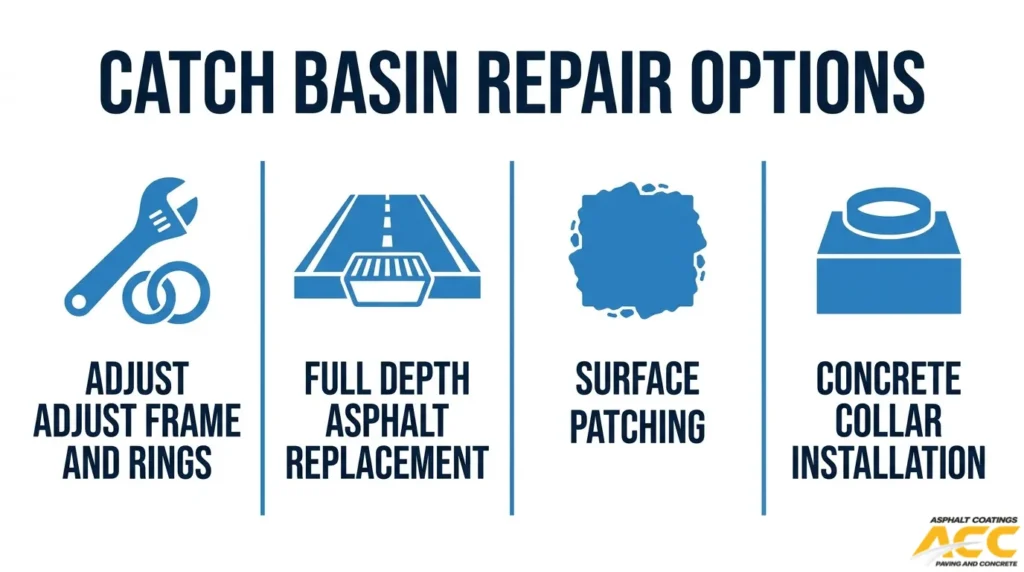
The repair options available for sunken grates and failing pavement range from adjusting the catch basin frame and rings to full-depth asphalt replacement, surface patching, and installing concrete collars around inlets. Each approach suits a different severity level.
When Is It Best to Rebuild or Adjust the Catch Basin Frame and Rings?
It is best to rebuild or adjust the catch basin frame and rings when the grate has settled below the surrounding pavement grade, when adjustment rings are cracked or missing mortar, or when the frame no longer sits flush on the top slab. According to the City of Charlottesville’s Catch Basin Type C Standard Detail, a minimum of one adjustment ring is required on all structures in curb lines, with a maximum of three rings totaling 8 inches in height.
Adjustment rings raise the casting assembly back to proper grade without replacing the entire structure. When rings show deterioration, such as cracking or missing mortar between layers, the frame becomes unstable and allows water infiltration into the base. A thorough inspection of the basin structure, frame, grate, sump, and connected pipes should precede any ring work to confirm the problem is limited to the upper assembly.
How Does Full‑Depth Asphalt Replacement Around the Inlet Work?
Full-depth asphalt replacement around the inlet works by sawcutting and removing the entire asphalt section surrounding the catch basin, excavating the compromised base material, recompacting or replacing the subgrade, and paving new asphalt tied into the existing pavement surface. This method addresses situations where water infiltration has eroded the aggregate base beneath the pavement, making surface-level fixes ineffective.
Contractors typically sawcut a clean geometric perimeter around the inlet, remove all deteriorated material down to stable subgrade, and rebuild each lift with proper compaction. The new asphalt must match the elevation of the surrounding surface while maintaining the slight depression at the grate that allows drainage. For parking lots with heavy truck or dumpster traffic, full-depth replacement is often the only repair that delivers lasting results. Asphalt Coatings Company has been performing full-depth catch basin repairs throughout Colorado’s Front Range since 1986, with in-house asphalt and concrete crews who understand how the region’s freeze-thaw cycles affect drainage structures and pavement longevity.
When Are Asphalt Patching or Skin Patches Around Catch Basins Appropriate?
Asphalt patching or skin patches around catch basins are appropriate when surface distress is limited to the top one to two inches of asphalt and the underlying base remains structurally sound. Skin patches, sometimes called overlay patches, add a thin asphalt layer over the existing surface to restore grade and seal minor cracking.
These approaches work best for cosmetic deterioration, shallow alligator cracking, or minor settlement that has not yet undermined the base course. However, if water has already penetrated below the surface and softened the aggregate base, a skin patch will fail quickly. Patching should be considered a short-term or interim solution when budget constraints prevent full-depth work; it buys time but rarely eliminates the root cause of settlement around inlets.
Can Concrete Collars or Concrete Paving Around Inlets Improve Durability?
Yes, concrete collars or concrete paving around inlets can improve durability by providing a rigid, load-resistant border that protects the transition zone between the catch basin structure and the surrounding asphalt. Concrete resists the rutting and deformation that asphalt experiences under repeated point loads from traffic turning over inlets.
A concrete collar is a band of reinforced concrete poured around the perimeter of the frame, typically extending 12 to 24 inches outward. Some specifications call for full concrete aprons that replace asphalt entirely in the immediate inlet area. This approach is especially effective in high-traffic zones, near dumpster pads, and at drive aisle intersections where heavy vehicles concentrate stress on the pavement around the grate. The trade-off is higher initial material and labor cost compared to asphalt-only repairs.
With repair methods identified, understanding how cracked frames and basin structures are specifically rebuilt completes the full picture.
How Are Cracked Catch Basin Frames and Structures Repaired or Rebuilt?
Cracked catch basin frames and structures are repaired or rebuilt through targeted replacement of damaged components, reconstruction of deteriorated walls, and proper use of mortar, grout, and adjusting rings. The approach depends on whether damage is limited to surface hardware or extends into the basin structure itself.
When Should Frames, Rings, or Grates Be Fully Replaced?
Frames, rings, or grates should be fully replaced when cracking, warping, or corrosion prevents them from sitting flush and supporting traffic loads. A frame that rocks, tilts, or shows separation greater than 3/4 inch from the top slab, as identified in the City of Sequim’s maintenance checklist, has lost structural contact and cannot be salvaged through shimming or resetting alone. Grates with broken bars or distorted openings also require full replacement to maintain drainage function and pedestrian safety. For most commercial parking lots, replacing compromised hardware early costs far less than repairing the surrounding pavement damage that follows.
How Are Concrete or Masonry Catch Basin Walls Repaired or Reconstructed?
Concrete or masonry catch basin walls are repaired by patching, mortar finishing, or partially rebuilding deteriorated sections. Minor wall damage involves sealing cracks and voids with specified mortar mix, while major repairs can include rebuilding up to 50 percent of the walls, pouring a new concrete floor, and applying concrete collars to pipe connections. The severity of spalling, joint separation, and structural displacement determines whether targeted patching or full reconstruction is needed. Waiting too long allows water infiltration to accelerate wall deterioration from the inside out, making partial repairs insufficient.
What Role Do New Mortar, Grout, and Adjusting Rings Play in a Lasting Fix?
New mortar, grout, and adjusting rings play a critical role in restoring the sealed, load-bearing connection between a catch basin’s concrete structure and its iron casting assembly. According to the Minnesota Department of Transportation’s HydInfra Culvert and Storm Drain System Inspection Manual, adjusting rings (the layers below the iron casting assembly) commonly become broken or cracked, and may also have missing mortar. Fresh mortar beds and grout fill these voids, preventing water from migrating between components. Properly seated adjusting rings re-establish correct frame elevation, ensuring the grate sits at grade and traffic loads transfer evenly into the structure below.
With frames and structures restored, preventive maintenance keeps these repairs performing long term.
How Can Preventive Maintenance Reduce Catch Basin Problems Over Time?
Preventive maintenance reduces catch basin problems over time by stopping minor issues before they escalate into structural failures. Routine cleaning, surface protection, and scheduled inspections each play a distinct role.
How Does Routine Cleaning of Debris and Sediment Protect Catch Basins?
Routine cleaning of debris and sediment protects catch basins by keeping inlet flow paths clear and preventing sediment buildup from reaching levels that block pipes or cause backups. When sediment depth reaches one-third of the distance to the lowest pipe invert, drainage efficiency drops significantly.
According to the American Public Works Association, San Diego’s adaptive management plan produced an 82 percent increase in the volume of sediment removed after one year while reducing the number of cleanings needed by 9,090. Data-driven scheduling like this removes more material with fewer service calls. For commercial parking lots, seasonal cleanups in spring and fall address the heaviest debris loads and keep sumps functional year-round.
How Do Sealcoating and Crack Sealing Help Around Catch Basin Areas?
Sealcoating and crack sealing help around catch basin areas by blocking the moisture infiltration that weakens asphalt and undermines the structure below. The Ontario Hot Mix Producers Association’s 2004 pavement preservation guide identifies moisture infiltration as the primary cause of pavement deterioration and confirms that crack sealing prevents water and debris from entering pavement cracks.
Around inlets, where pavement joints meet concrete collars or frames, cracks develop faster due to differential movement between materials. Sealing these cracks early stops water from reaching the subgrade, which is where the erosion and settling that produce sunken grates begins. Sealcoating the surrounding asphalt adds a protective layer that slows oxidation and keeps the surface flexible enough to resist cracking in the first place.Property managers working with Asphalt Coatings Company receive a comprehensive approach to inlet protection: crack sealing with CDOT-approved materials, professional sealcoating, and concrete flatwork – all performed by in-house crews to ensure consistent quality around these critical drainage structures.
How Often Should Property Managers Schedule Drainage and Inlet Reviews?
Property managers should schedule drainage and inlet reviews at least once per year, with additional inspections after heavy storms or snowmelt events. Annual inspections catch developing cracks, settling frames, and sediment accumulation before they require major repairs.
A practical inspection schedule includes:
- Spring: Check for winter damage, frost heave around frames, and sediment from snowmelt and deicing materials.
- Fall: Clear leaves and debris before winter, verify grate elevation, and confirm drainage flow.
- Post-storm: Walk the lot after significant rain events to identify ponding, slow-draining inlets, or new pavement cracking near basins.
Consistent reviews turn small, inexpensive maintenance tasks into a reliable defense against the costly structural repairs covered earlier in this article.
When Is It Time to Replace Versus Repair a Damaged Catch Basin Area?
The time to replace versus repair a damaged catch basin area depends on structural condition, safety risk, budget constraints, and remaining pavement life. A systematic decision framework helps property managers justify the right approach, covering condition assessment, traffic considerations, and lifecycle cost analysis.
What Condition and Safety Factors Help Decide Between Repair and Replacement?
Condition and safety factors that help decide between repair and replacement include the severity of structural deterioration, the extent of surrounding pavement damage, and whether the basin creates an active hazard. Cracked walls, collapsed pipes, or frames separated more than three-quarters of an inch from the top slab typically push the decision toward full replacement.
CCTV inspection plays a critical role in this evaluation. According to City of East Providence storm drain specifications, each pipe between catch basins and storm drain manholes shall be CCTV inspected with a wheeled robotic camera so the pipe condition can be evaluated and repairs categorized to prioritize work. When inspection reveals localized mortar loss or minor frame shifting, repair is often sufficient. Widespread structural failure, however, makes replacement the more reliable path.
How Do Budget, Traffic Loads, and Remaining Pavement Life Influence the Choice?
Budget, traffic loads, and remaining pavement life influence the choice by determining whether a repair will last long enough to justify its cost. High-traffic areas serving dumpster trucks or delivery vehicles accelerate wear on patched sections, sometimes making full replacement more cost-effective within a shorter timeframe.
Remaining pavement life is equally important. If surrounding asphalt is within a few years of needing mill-and-pave or overlay work, investing in a full catch basin rebuild during that project consolidates mobilization costs. Conversely, when pavement is relatively new, a targeted repair preserves the intact surface. The Ontario Hot Mix Producers Association’s pavement preservation guidance emphasizes that moisture infiltration is the primary cause of pavement deterioration, reinforcing why even budget-constrained managers should prioritize sealing water entry points around inlets rather than deferring all work.
Why Should Property Managers Consider Long‑Term Lifecycle Costs?
Property managers should consider long-term lifecycle costs because repeated repairs on a failing catch basin often exceed the one-time expense of replacement. A systematic framework developed by Iowa State University’s Institute for Transportation outlines three steps for this analysis: pavement condition assessment, selection of technically feasible treatments using decision trees, and selection of the most appropriate treatment considering return-on-investment and non-economic factors.
Factoring in tenant disruption, liability exposure from trip hazards, and the compounding damage that deferred drainage problems cause to surrounding pavement makes the true cost of “wait and patch” strategies clear. For most commercial properties, investing in a complete rebuild when structural indicators warrant it delivers a lower total cost per year of service life.
With the repair-or-replace decision clarified, effective planning and budgeting keep the project on track.
How Should Property Managers Plan and Budget for Catch Basin Repairs?
Property managers should plan and budget for catch basin repairs by gathering detailed site data, ranking issues by severity and safety risk, and structuring work in phases. The subsections below cover pre-proposal preparation, prioritization strategies, and phased project scheduling.
What Information Should You Gather Before Requesting Repair Proposals?
The information you should gather before requesting repair proposals includes the number, location, and condition of every catch basin on your property, along with the surrounding pavement condition and drainage behavior during storms. Document each structure’s frame, grate, sump depth, and visible defects such as cracks, settlement, or standing water. According to the Town of Spencer, Massachusetts Standard Operating Procedure, catch basin inspection procedures should address the grate opening, the basin structure, the sump, and all inlet and outlet pipes. Collect photos, note ADA-compliance concerns at each grate, and record traffic patterns. Contractors produce more accurate proposals when they receive organized, site-specific condition data upfront rather than vague descriptions.
How Can You Prioritize Multiple Catch Basin and Pavement Issues on Site?
You can prioritize multiple catch basin and pavement issues on site by ranking each deficiency against safety risk, drainage impact, and structural severity. Trip hazards and ADA violations at sunken grates should top the list, followed by basins where frame cracks allow active water infiltration into the subgrade. Issues causing standing water near building entries or fire lanes rank above cosmetic pavement distress in low-traffic corners. A condition-based approach works well here; the Iowa State University Pavement Asset Management Decision-Making Framework recommends a three-step process of condition assessment, decision-tree treatment selection, and return-on-investment analysis to justify maintenance decisions. Tackling the highest-consequence failures first protects both tenants and long-term pavement life.
How Can Phased Projects Minimize Disruption to Tenants and Customers?
Phased projects minimize disruption to tenants and customers by splitting catch basin and pavement repairs into planned stages aligned with budget cycles and seasonal windows. Address safety-critical repairs in phase one, then schedule structural rebuilds and surrounding pavement restoration in subsequent phases as funding allows. The City of Manistee, Michigan Stormwater Asset Management Plan notes that stormwater construction projects are anticipated to be performed on a long-term incremental basis as funding allows. Phasing also lets property managers keep parking areas partially open during construction, reducing tenant complaints. Coordinating catch basin work with scheduled sealcoating or crack sealing maximizes mobilization efficiency and lowers per-unit costs.
With a phased plan in place, the next step is partnering with an experienced contractor.
How Should You Approach Parking Lot Catch Basin Problems With a Commercial Asphalt and Concrete Contractor?
You should approach parking lot catch basin problems with a commercial asphalt and concrete contractor by combining pavement expertise with drainage structure knowledge. The following sections cover how Asphalt Coatings Company can help and the key takeaways from this guide.
How Can Asphalt Repair, Sealcoating, and Concrete Flatwork Services from Asphalt Coatings Company Help Resolve Catch Basin Issues?
Asphalt repair, sealcoating, and concrete flatwork services from Asphalt Coatings Company can help resolve catch basin issues by addressing both the surrounding pavement and the structural components in a single scope of work. Catch basin repairs range widely in complexity: minor repairs include sealing cracks with mortar, resetting castings to grade, and replacing concrete borders, while major repairs involve setting new precast tops, rebuilding walls, and applying concrete collars to pipe connections, as detailed in the City of Centerville, Ohio municipal specification (revised March 2023). Professional asphalt contractors perform asphalt patching, full-depth replacement, sealcoating, crack sealing, and concrete flatwork to address catch basin issues.Working with a contractor who handles both asphalt and concrete services in-house eliminates coordination gaps that often cause recurring failures around inlets.
What Are the Key Takeaways About Parking Lot Catch Basin Problems: Sunken Grates, Cracked Frames and Pavement Failing Around Inlets We Covered?
The key takeaways about parking lot catch basin problems, including sunken grates, cracked frames, and pavement failing around inlets, are:
- Sunken grates typically result from poor compaction, freeze-thaw cycles, or heavy vehicle loads eroding the base beneath the structure.
- Cracked frames and deteriorated rings allow water infiltration that accelerates subgrade failure and widens pavement damage.
- Pavement failures around inlets often signal deeper structural or drainage problems requiring professional inspection before repair.
- Proper grade matters: according to City of Kirkland, Washington pre-approved plans, catch basin grates shall be set 0.10 feet below pavement level and adjusted immediately prior to final paving.
- Preventive maintenance, including annual inspections, sediment removal, crack sealing, and sealcoating, extends catch basin and pavement life significantly.
Early intervention from a qualified contractor saves property managers from escalating repair costs. Experienced commercial asphalt and concrete contractors can help evaluate your parking lot catch basins and recommend the right combination of asphalt, concrete, and drainage solutions for a lasting fix.