A laydown yard is a designated area used for temporary storage, staging, and assembly of construction materials, equipment, and tools. The surface material chosen for a laydown yard determines its load capacity, drainage behavior, maintenance burden, and regulatory compliance.
This guide covers laydown yard fundamentals, surface material performance, site design and preparation, regulatory and climate considerations, and decision-making strategies for choosing between gravel, asphalt, and concrete.
Laydown yards serve a different function than standard parking lots or storage yards. They support concentrated point loads from cranes, stacked steel, and heavy haulers, and they trigger stormwater and environmental requirements that typical commercial lots rarely face.
Gravel, asphalt, and concrete each fill a distinct role. Gravel suits temporary staging and budget-constrained projects but demands frequent regrading and fails ADA accessibility standards without stabilization treatment. Asphalt delivers a durable, dust-free surface for high-traffic yards and offers the strongest cost-per-year return across a 15- to 25-year horizon when properly maintained. Concrete handles the heaviest static and point loads for crane pads and container staging, yet carries the highest upfront cost and remains vulnerable to chloride-based deicing damage in cold climates.
Site preparation and regulatory compliance apply regardless of surface choice. Subgrade compaction, drainage grading, stormwater permitting, and ADA-compliant pathways must be addressed before any material is placed. Colorado’s 124 annual freeze-thaw cycles and high-altitude UV exposure add climate-specific design requirements that shape material selection, mix specifications, and long-term maintenance schedules.
What Is a Laydown Yard in Commercial and Industrial Operations?
A laydown yard is a designated area used for temporary storage, staging, and assembly of construction materials and equipment. The sections below cover typical uses, the kinds of materials stored, and how laydown yards differ from standard parking lots or storage yards.
How Is a Laydown Yard Typically Used on Construction and Industrial Sites?
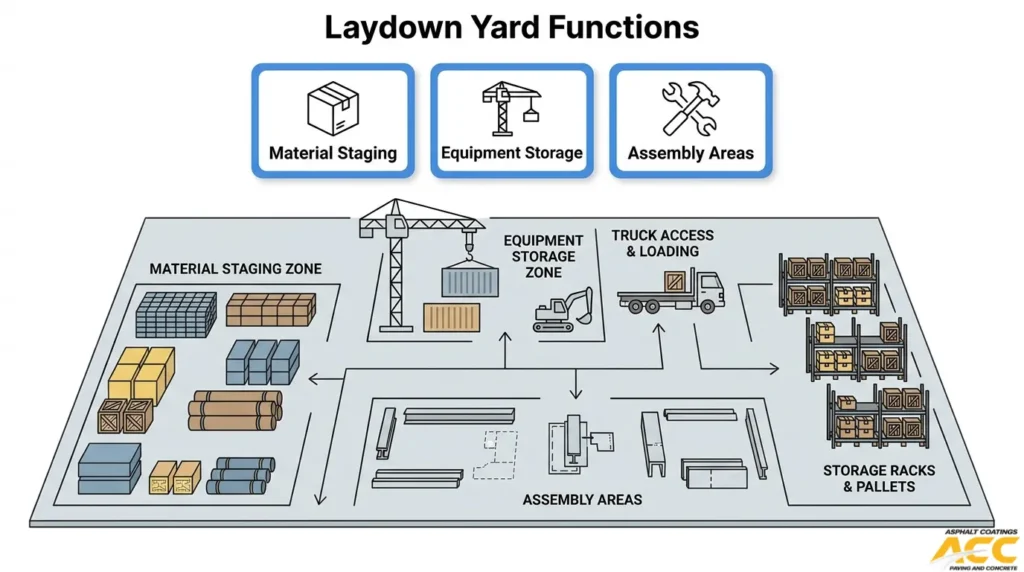
A laydown yard is typically used on construction and industrial sites as a designated area for temporary storage and assembly of construction materials, equipment, and tools. According to the U.S. Department of Energy’s Office of Environmental Management, a laydown area serves this exact staging function within a facility.
Large-scale projects rely on these yards throughout active construction phases. The Bureau of Ocean Energy Management’s 2022 Coastal Virginia Offshore Wind Construction and Operations Plan, for example, called for temporary construction laydown areas and construction ports to support offshore installation. Once a project phase concludes, the yard can be reconfigured or decommissioned entirely. This flexibility makes laydown yards essential for managing logistics on sites where space, scheduling, and material flow change constantly.
What Kinds of Materials and Equipment Are Usually Stored in a Laydown Yard?
The kinds of materials and equipment usually stored in a laydown yard include:
- Structural steel, piping, and prefabricated building components
- Heavy mobile equipment such as cranes, forklifts, and excavators
- Storage racks loaded with smaller parts and fittings
- Construction vehicles including flatbed trailers and dump trucks
- Temporary formwork, scaffolding, and tooling
These loads place serious demands on the yard surface. ACI 360R-10 from the American Concrete Institute addresses slab design for material stored directly on the ground, storage rack loads, and both static and dynamic loads from equipment and vehicles. Ground conditions must also be firm, drained, and graded so that equipment meets manufacturer specifications for adequate support and level positioning, as required by OSHA under 29 CFR § 1926.1402(b).
How Does a Laydown Yard Differ from a Regular Parking Lot or Storage Yard?
A laydown yard differs from a regular parking lot or storage yard in load intensity, surface engineering, environmental exposure, and regulatory scope. Parking lots handle predictable passenger-vehicle traffic on standardized pavement sections. Laydown yards, by contrast, must support concentrated point loads from cranes, stacked materials, and heavy haulers that can shift position daily.
Surface design also reflects this difference. Project specifications from the U.S. Nuclear Regulatory Commission’s Reno Creek civil drawings note that gravel limits encompass both site access roadways and laydown yard areas, with depths determined during final design. NASA Kennedy Space Center’s 2023 Annual Environmental Report describes a laydown yard combining paved roadways, gravel parking areas, and a covered concrete work area, all within one facility footprint.
Environmental compliance adds another layer of complexity. The U.S. EPA notes that material handling, equipment maintenance, and storage at industrial facilities are often weather-exposed, and runoff from these activities can transport pollutants to nearby waterways or storm sewers. Standard parking lots rarely trigger the same level of stormwater scrutiny. For operations managers evaluating yard construction, recognizing these distinctions early prevents costly design mismatches down the line.
Why Does the Surface Material of a Laydown Yard Matter?
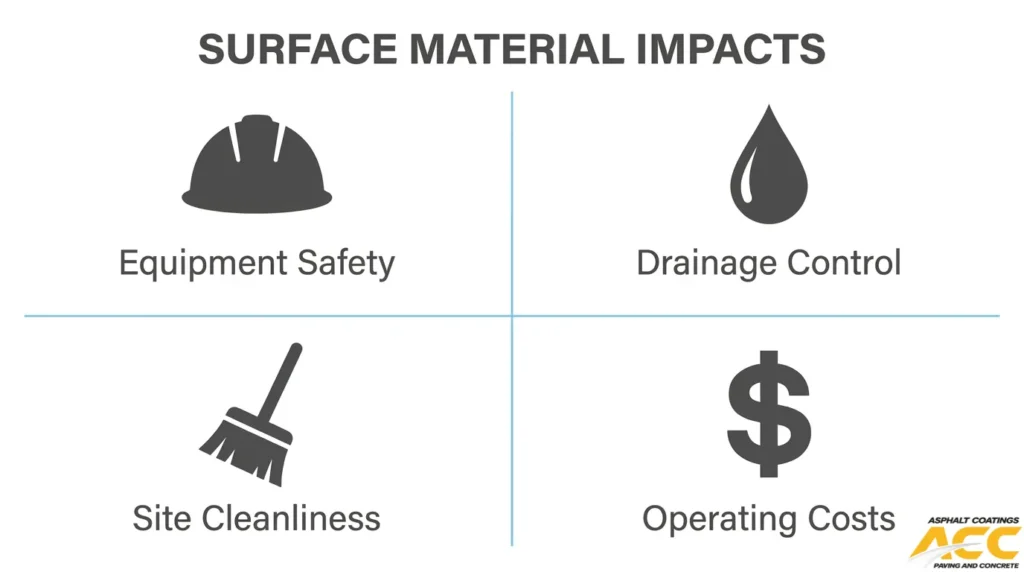
The surface material of a laydown yard matters because it directly determines equipment safety, drainage performance, site cleanliness, and long-term operating costs. The following sections break down each of these impacts.
How does the surface choice affect equipment safety and damage risk?
The surface choice affects equipment safety and damage risk by determining ground stability, traction, and load-bearing capacity. Unstable or uneven surfaces increase the likelihood of equipment tipping, material shifting, and worker injuries. According to the U.S. Bureau of Labor Statistics (2024), nonfatal falls, slips, and trips in private construction occurred at an annualized rate of 31.5 per 10,000 full-time workers during 2021–2022.
Gravel can shift under concentrated loads, while asphalt and concrete provide consistent, level bearing surfaces. For crane operations in particular, OSHA requires ground conditions that are firm, drained, and graded to meet manufacturer specifications. Choosing the wrong surface material creates avoidable liability exposure and equipment downtime.
How do drainage and stormwater management depend on the laydown yard surface?
Drainage and stormwater management depend on the laydown yard surface because each material handles water infiltration differently. Pervious surfaces like gravel allow water to infiltrate into the ground, while impervious surfaces such as asphalt and concrete generate runoff that must be captured and directed, as outlined in the Mile High Flood District’s 2024 Urban Storm Drainage Criteria Manual.
This distinction carries regulatory weight. The U.S. EPA notes that runoff from industrial material handling and storage areas can pick up pollutants and transport them to nearby waterways. In Colorado, operators of certain industrial facilities must obtain stormwater permit coverage for actual or potential discharges. Selecting the wrong surface without accounting for imperviousness can trigger permit requirements that a gravel yard might avoid, or leave a gravel yard without adequate pollution control.
How do surface materials impact dust, mud, and cleanliness on-site?
Surface materials impact dust, mud, and cleanliness on-site by controlling how exposed soil and aggregate interact with traffic and weather. Gravel yards generate airborne dust during dry conditions and develop mud in wet periods, both of which impair visibility, soil equipment, and create slip hazards. Asphalt and concrete surfaces eliminate loose particulates, keeping stored materials cleaner and reducing housekeeping demands.
For operations storing sensitive components or requiring clean staging areas, a paved surface is often the only practical option. Even in less demanding applications, dust suppression on gravel requires ongoing water or chemical treatment, adding hidden operational costs that paved alternatives avoid.
How do different surfaces affect long-term maintenance and operating costs?
Different surfaces affect long-term maintenance and operating costs by shifting the balance between upfront investment and recurring repair expenses. A 2004 study by Iowa State University’s Institute for Transportation found that per-mile maintenance costs are higher on gravel roads than on bituminous (asphalt) surfaces at traffic volumes around 100 vehicles per day, with costs increasing considerably above 200 vehicles per day.
Gravel requires periodic regrading, aggregate replenishment, and dust control. Asphalt needs crack sealing and eventual overlay but maintains its structure longer under traffic. Concrete carries the highest initial cost yet demands the least routine maintenance. For most laydown yards with regular equipment traffic, the lower recurring cost of a paved surface often offsets its higher installation price within a few years.
Understanding how surface material shapes safety, drainage, cleanliness, and cost sets the foundation for evaluating which option fits your specific site conditions.
What Key Factors Should You Consider Before Choosing a Laydown Yard Surface?
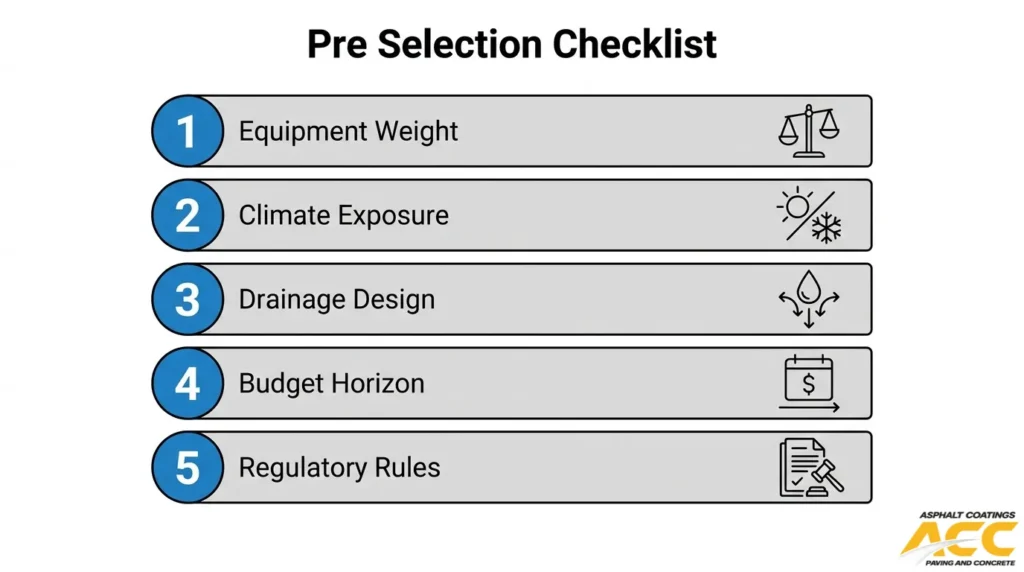
The key factors you should consider before choosing a laydown yard surface include equipment weight, climate exposure, drainage design, budget constraints, and regulatory requirements. Each factor narrows the field between gravel, asphalt, and concrete.
How does the weight and type of stored equipment influence surface selection?
The weight and type of stored equipment influence surface selection by determining the structural capacity a surface must provide. Static loads from stacked pipe or steel plate differ from dynamic loads generated by forklifts, cranes, and loaded trailers. Concentrated point loads, such as crane outrigger floats, demand rigid surfaces like reinforced concrete. Distributed loads from palletized materials may perform well on properly compacted aggregate or asphalt. Lighter, temporary storage often justifies gravel, while permanent yards handling heavy machinery benefit from engineered pavement. Matching surface design to actual load profiles prevents premature rutting, cracking, and costly repairs.
How do climate and freeze–thaw cycles affect the best surface choice?
Climate and freeze-thaw cycles affect the best surface choice by accelerating material degradation at different rates for gravel, asphalt, and concrete. Water infiltrates surface cracks, expands when frozen, and breaks apart pavement from within. According to NOAA National Centers for Environmental Information data for Colorado Springs (station ICAO_KCOS), the area averages 124 annual freeze-thaw cycles. That level of thermal cycling punishes surfaces with poor drainage or inadequate air-entrainment in concrete mixes. Gravel tolerates frost heave if properly graded, asphalt flexes but stiffens over time, and concrete resists deformation yet cracks if joints and mix design are not specified for cold climates.
How much does drainage and site grading influence surface performance?
Drainage and site grading influence surface performance significantly, because standing water is the single fastest way to destroy any laydown yard surface. Proper slope directs runoff away from stored materials and load-bearing areas. Gravel surfaces allow partial infiltration but still need crown or cross-slope grading to prevent ponding. Asphalt and concrete are impervious, requiring engineered swales, catch basins, or retention areas. Neglecting grade design leads to subgrade saturation, frost heave damage, and accelerated surface failure. For most industrial sites, investing in drainage upfront costs far less than repeated surface repairs caused by poor water management.
How do budget and life-cycle cost expectations guide surface decisions?
Budget and life-cycle cost expectations guide surface decisions by forcing a trade-off between lower upfront installation and higher long-term maintenance. Gravel has the lowest initial cost but requires frequent regrading, topping, and dust control. Asphalt sits in the middle range and needs periodic sealcoating and crack repair. Concrete carries the highest installation price yet delivers the longest service life with minimal annual upkeep. As the U.S. Access Board notes, hardened materials such as concrete and asphalt are sufficiently firm and stable for accessibility, while most loose materials, including gravel, require treatment to meet surface integrity requirements. Factoring in accessibility upgrades shifts total project costs further.
How do environmental and regulatory requirements shape surface options?
Environmental and regulatory requirements shape surface options by restricting impervious coverage, mandating stormwater controls, and requiring accessible pathways. Industrial sites with impervious asphalt or concrete surfaces often trigger stormwater discharge permits, since runoff from these areas can carry pollutants to nearby waterways. Gravel reduces impervious acreage but may not satisfy ADA accessibility or dust-control standards. Local zoning codes frequently dictate allowable surface types, screening, and containment for outdoor storage areas. Selecting a surface without reviewing permit thresholds, environmental regulations, and accessibility mandates risks costly retrofits or code violations after construction.
Understanding these five factors clarifies which surface type aligns with your operational, financial, and compliance priorities.
How Does Gravel Perform as a Laydown Yard Surface?
Gravel performs as a laydown yard surface best in temporary, low-to-moderate-traffic applications where budget flexibility and fast installation matter most. The sections below cover ideal use cases, load-bearing behavior, weather resilience, maintenance costs, and overall pros and cons.
In What Situations Is Gravel the Most Practical Surface for a Laydown Yard?
Gravel is the most practical surface for a laydown yard in temporary construction staging, short-term material storage, and projects where the site layout may change. Real-world project documents confirm this pattern. A U.S. Nuclear Regulatory Commission civil site plan for the Reno Creek Project in Wyoming specified gravel for both site access roadways and laydown yard areas, with final depths determined during design.
Gravel suits these scenarios well:
- Temporary construction laydown areas with defined project timelines.
- Rural or remote sites where paving infrastructure is not justified.
- Phased projects where the yard may be relocated or reconfigured.
- Budget-constrained sites needing a functional surface quickly.
One important limitation applies to accessibility. According to the U.S. Access Board, loose materials including gravel will not meet ADA firmness and stability requirements unless properly treated to provide sufficient surface integrity. Sites requiring accessible routes should plan paved pathways or stabilized gravel sections accordingly.
How Does Gravel Handle Heavy Loads, Ruts, and Potholes Over Time?
Gravel handles heavy loads adequately when properly constructed, but it develops ruts and potholes under repeated high-tonnage traffic. Crushed rock combined with fines and well compacted generally provides a stable surface for vehicles and pedestrians, according to a 2017 USDA Natural Resources Conservation Service design guide. The key is aggregate selection and compaction quality.
Best practices for load-bearing gravel surfaces include:
- Installing geotextile fabric beneath the aggregate layer to prevent subgrade contamination.
- Using crushed limestone or angular stone that interlocks under compaction.
- Matching aggregate depth to anticipated load cycles.
Cumulative load estimation matters significantly. The Federal Highway Administration emphasizes that accurate load estimates, normally expressed as equivalent single axle loads, are extremely important to pavement structural design. For gravel, this principle still applies; underestimating traffic volume accelerates surface deterioration. Operators storing heavy steel, precast elements, or running loaded trucks daily should expect faster degradation than a paved alternative would experience.
How Does Gravel Perform in Wet Weather and Freeze–Thaw Conditions?
Gravel performs reasonably well in wet weather because it functions as a pervious surface, allowing water to infiltrate rather than pool. This natural drainage reduces standing water and limits hydroplaning risks for equipment.
However, freeze–thaw cycles create challenges:
- Water trapped between aggregate particles expands during freezing, loosening compacted stone.
- Repeated cycles produce soft spots, frost heave, and accelerated pothole formation.
- Spring thaw periods often require immediate regrading before the yard is operational again.
Gravel’s permeability is a double-edged quality in cold climates. While it reduces runoff volume, it also allows moisture to reach the subgrade, weakening the foundation over successive winters. For sites experiencing dozens of annual freeze–thaw cycles, a geotextile separation layer and thicker aggregate base help preserve structural integrity, though they do not eliminate the problem entirely.
What Kind of Maintenance Schedule and Costs Should You Expect with Gravel?
The maintenance schedule for a gravel laydown yard typically includes regrading, pothole filling, and periodic aggregate replenishment on a seasonal or quarterly basis. A 2004 study published by Iowa State University’s Institute for Transportation found that maintenance costs per mile are higher on gravel roads than bituminous surfaced roads at traffic volumes around 100 vehicles per day, with costs increasing considerably above 200 vehicles per day.
Routine gravel maintenance tasks include:
- Grading and reshaping the surface after heavy rain or snow.
- Filling ruts and potholes with fresh aggregate.
- Controlling dust with water or chemical suppressants during dry periods.
- Replacing displaced stone along edges and high-traffic lanes.
One cost advantage worth noting: snow removal on unsurfaced gravel is approximately 20% less expensive than on paved surfaces. For seasonal operations or yards with limited winter activity, this difference can offset some of the higher warm-season maintenance burden. Overall, gravel’s low installation cost comes with a trade-off in ongoing labor and material expenses.
What Are the Typical Pros and Cons of Choosing Gravel for a Laydown Yard?
The typical pros and cons of choosing gravel for a laydown yard reflect its trade-off between low upfront cost and higher long-term maintenance.
Pros:
- Lowest initial installation cost among the three surface options.
- Fast to install with minimal curing or set-up time.
- Natural drainage reduces stormwater management complexity.
- Easy to reconfigure, expand, or remove when site needs change.
- Lower snow removal costs compared to paved surfaces.
Cons:
- Requires frequent regrading, pothole repair, and aggregate replenishment.
- Develops ruts under repeated heavy loads, limiting equipment stability.
- Does not meet ADA accessibility standards without additional stabilization treatment.
- Generates dust in dry conditions and mud during wet periods.
- Higher per-unit maintenance costs than asphalt at moderate-to-high traffic volumes.
For many operators, gravel works best as a starting surface that can be upgraded to asphalt or concrete once site use patterns are established and budgets allow. Understanding how asphalt handles those same demands provides a useful comparison.
How Does Asphalt Perform as a Laydown Yard Surface?
Asphalt performs as a laydown yard surface by providing a smooth, load-bearing platform that resists rutting under repeated heavy traffic. The subsections below cover ideal use cases, load capacity, climate resilience, maintenance needs, and life-cycle cost comparisons.
When is asphalt the best fit for a high-traffic laydown yard?
Asphalt is the best fit for a high-traffic laydown yard when the site handles frequent truck and trailer movements, moderate point loads, and demands a clean, dust-free surface. Yards with daily equipment staging, material deliveries exceeding 100 vehicle passes per day, or mixed-use operations benefit most from asphalt’s combination of load distribution and smooth rolling resistance.
Sites that require ADA-compliant pedestrian routes also favor asphalt, since it meets firmness and stability standards that loose gravel cannot. For operations where turnaround speed matters, asphalt’s relatively fast installation and cure time minimizes downtime compared to concrete.
How does asphalt stand up to heavy trucks, trailers, and equipment?
Asphalt stands up to heavy trucks, trailers, and equipment by distributing loads across a flexible pavement structure that absorbs stress without cracking. According to the Asphalt Institute’s Engineering FAQs on container-terminal heavy loads, two issues must be evaluated: whether the full pavement structure (subgrade, subbase, base, and all asphalt layers) can support the loads, and whether the mix design resists deformation under sustained or repeated pressure.
Proper structural design matched to cumulative axle loads is essential. Thicker base courses and polymer-modified binders help high-load yards resist rutting. For static equipment that sits in one position for extended periods, asphalt can soften and deform, making concrete a better choice in those specific zones.
How do temperature swings and Colorado’s climate impact asphalt yards?
Temperature swings and Colorado’s climate impact asphalt yards through accelerated aging, thermal cracking, and surface oxidation. Colorado’s Front Range experiences wide daily temperature fluctuations, and Colorado Springs alone averages 124 annual freeze-thaw cycles according to NOAA’s engineering weather data for station KCOS (1988 to 2017).
Each cycle forces moisture into micro-cracks, expands during freezing, and widens damage over time. High-altitude UV exposure compounds the problem; laboratory research has shown that ultraviolet radiation increases asphalt stiffness by 35 to 40 percent in unaged polymer-modified binders. Stiffer binder loses flexibility, which makes the pavement more vulnerable to thermal cracking during cold snaps. Sealcoating and crack sealing on a regular schedule counteract both UV degradation and moisture intrusion.
What maintenance does an asphalt laydown yard need over its lifespan?
An asphalt laydown yard needs a consistent maintenance program that includes:
- Crack sealing every one to two years to prevent water infiltration before freeze-thaw cycles widen damage.
- Sealcoating every two to three years to restore surface flexibility and block UV oxidation.
- Pothole patching as needed, especially after winter when freeze-thaw damage is most visible.
- Drainage clearing at inlets and swales to prevent standing water that accelerates base failure.
- Periodic overlay or mill-and-pave after 12 to 20 years, depending on traffic intensity and load history.
Neglecting early-stage crack sealing is the most common and costly mistake in laydown yard management, since small cracks compound into base failures that require full-depth reconstruction.
How do asphalt installation and life-cycle costs compare to gravel and concrete?
Asphalt installation and life-cycle costs fall between gravel and concrete. Upfront, asphalt typically costs more than gravel but significantly less than reinforced concrete. Over the full life cycle, however, the comparison shifts.
A 2004 study through Iowa State University for the South Dakota DOT found that gravel road maintenance costs per mile exceed those of bituminous-surfaced roads once average daily traffic reaches approximately 100 vehicles per day, with costs increasing considerably above 200 vehicles per day. High-traffic laydown yards easily surpass those thresholds, making asphalt more economical long-term than gravel despite higher initial investment. Concrete offers the longest service life but carries two to three times the upfront cost and requires joint maintenance. For most commercial laydown yards balancing budget with durability, asphalt delivers the strongest return on investment across a 15- to 25-year horizon. Asphalt Coatings Company has designed and installed laydown yard surfaces for commercial and industrial clients across Colorado’s Front Range since 1986, engineering pavement structures specifically for the region’s demanding freeze-thaw cycles and high-altitude conditions.
Understanding asphalt’s cost position helps frame how concrete compares under even heavier loading demands.
How Does Concrete Perform as a Laydown Yard Surface?
Concrete performs as a laydown yard surface by delivering exceptional rigidity, point-load capacity, and longevity in high-demand applications. The sections below cover where concrete excels, how it handles concentrated loads, its freeze-thaw vulnerabilities, maintenance expectations, and cost comparisons.
In which applications is concrete the preferred surface for a laydown yard?
Concrete is the preferred surface for a laydown yard in applications involving static heavy loads, precision equipment staging, and long-term fixed infrastructure. Warehouse distribution pads, container marshaling areas, and crane staging zones all benefit from concrete’s rigidity and resistance to deformation under sustained weight.
For lighter-duty or temporary sites, however, other materials may perform adequately. According to the USDA Natural Resources Conservation Service’s 2017 Earth and Aggregate Surfacing Design Guide, crushed rock combined with fines and well compacted is generally preferred for surface courses on heavy-use and livestock areas because the material fits together tightly, offering a stable surface for pedestrians, livestock, and vehicles. Concrete becomes the clear choice only when load concentration, surface flatness, or permanence requirements exceed what aggregate or asphalt can reliably deliver.
How does concrete handle point loads from racking, containers, and cranes?
Concrete handles point loads from racking, containers, and cranes through engineered slab-on-ground design that distributes concentrated forces across the subgrade. ACI 360R-10, the American Concrete Institute’s Guide to Design of Slabs-on-Ground, covers the design of slabs for loads from material stored directly on the slab, storage rack loads, and static and dynamic loads associated with equipment and vehicles.
Crane outrigger float loads demand particular attention. The U.S. Department of Defense’s UFC 4-152-01 specifies applying outrigger float loads to a 1.5-foot by 1.5-foot area unless the actual float size is known. This concentrated force requires properly reinforced concrete with adequate thickness; standard 4-inch residential slabs are insufficient. For most laydown yard crane operations, a structural engineer should specify slab thickness, reinforcement, and joint spacing based on the actual equipment loads anticipated.
How does concrete behave through freeze–thaw cycles and deicing in cold climates?
Concrete behaves through freeze-thaw cycles and deicing in cold climates with notable vulnerability to surface scaling and internal cracking when not properly specified. Water absorbed into concrete pores expands during freezing, and repeated cycling progressively degrades the matrix.
Deicing chemicals compound this problem significantly. Research from Purdue University’s Joint Transportation Research Program found that chloride-based deicing salts attack the concrete itself through chemical reactions and phase changes, producing dimensional changes and cracking. Air-entrained concrete resists freeze-thaw damage far more effectively than non-air-entrained mixes, yet even well-designed concrete suffers accelerated deterioration when exposed to repeated salt application. Sealer coatings can reduce chloride penetration, but they require reapplication every few years. In regions with aggressive winters, this ongoing vulnerability is one of concrete’s most significant drawbacks compared to asphalt, which can flex under thermal stress rather than crack.
What are the maintenance needs and typical lifespan of a concrete laydown yard?
The maintenance needs of a concrete laydown yard include joint sealing, crack repair, surface resealing, and periodic slab replacement at failed sections. Properly designed and installed concrete slabs can last 20 to 30 years or longer in favorable conditions, making concrete among the most durable laydown yard surfaces available.
Key maintenance tasks include:
- Resealing control joints every 3 to 5 years to prevent water infiltration.
- Patching spalls and surface scaling caused by freeze-thaw damage.
- Grinding uneven joints or lifted slabs to maintain level surfaces for equipment.
- Replacing individual panels when cracking compromises structural integrity.
Unlike asphalt, which allows overlay repairs, concrete panel replacement requires sawcutting and full removal. This makes individual repairs more expensive and disruptive, even though they occur less frequently.
How do upfront and long-term costs of concrete compare to asphalt and gravel?
The upfront cost of concrete typically runs two to three times higher than asphalt and significantly more than gravel for equivalent laydown yard coverage. Installation requires formwork, curing time, and reinforcement detailing that add labor and schedule costs.
Long-term cost dynamics shift the comparison, however. Concrete’s extended lifespan reduces the frequency of full replacement cycles, and its resistance to rutting eliminates the recurring regrading that gravel demands. Asphalt occupies the middle ground: lower installation cost than concrete, with periodic maintenance such as sealcoating and overlay that keeps life-cycle costs competitive. For operations requiring a 5-year temporary pad, gravel delivers the lowest total cost. For permanent facilities expecting 20-plus years of heavy static loads, concrete’s higher upfront investment often produces a lower cost per year of service.
Understanding how concrete performs alongside other options helps clarify when its strengths justify the investment.
How Do Gravel, Asphalt, and Concrete Laydown Yards Compare Side by Side?
Gravel, asphalt, and concrete laydown yards compare across five critical dimensions: heavy-load performance, cost, drainage, safety, and property value. The following subsections break down each comparison point.
How do gravel, asphalt, and concrete compare for heavy-load performance?
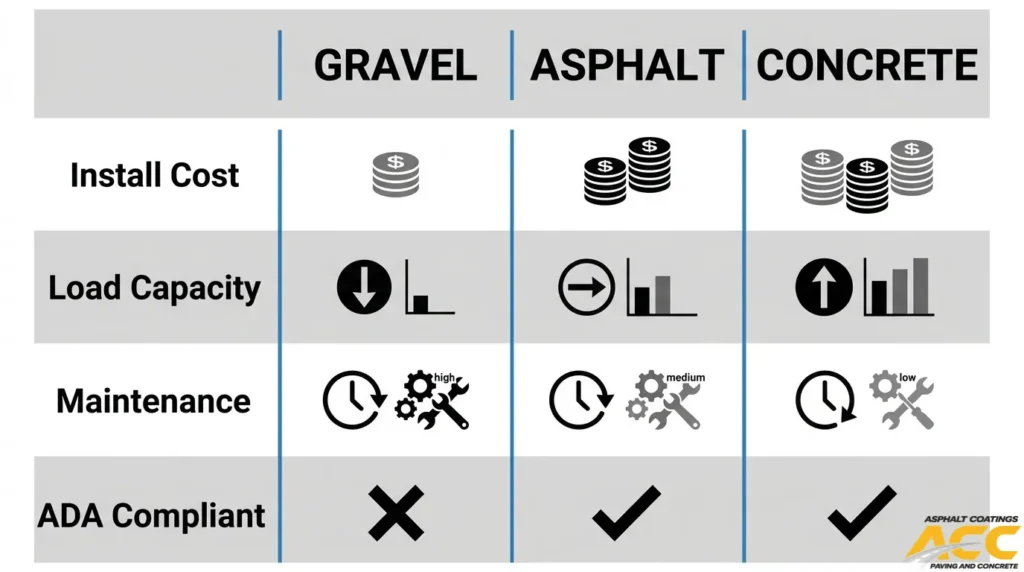
Gravel, asphalt, and concrete compare for heavy-load performance based on load distribution, surface stability, and resistance to deformation. According to the Federal Highway Administration’s Pavement Design Considerations, accurate cumulative load estimates (expressed as 18-kip equivalent single axle loads) are extremely important to pavement structural design. Concrete handles concentrated point loads from cranes and racking best due to its rigidity. Asphalt distributes rolling loads from trucks and trailers effectively when properly compacted. Gravel performs adequately under moderate static loads but ruts and displaces under repeated heavy traffic. For yards supporting crane outriggers or container stacking, concrete is the strongest option; for truck-heavy operations, asphalt offers a practical balance of flexibility and strength.
How do the three surfaces differ in installation and life-cycle cost?
The three surfaces differ in installation and life-cycle cost significantly. Gravel has the lowest upfront cost but requires frequent regrading and material replenishment, especially under heavy traffic. Asphalt falls in the mid-range for installation and offers predictable maintenance through sealcoating and patching. Concrete carries the highest initial investment but delivers the longest service life with minimal annual upkeep.
- Gravel: lowest install cost, highest annual maintenance frequency.
- Asphalt: moderate install cost, periodic sealcoating and crack repair needed.
- Concrete: highest install cost, lowest long-term maintenance burden.
Operators who plan to use a site for ten or more years often find that asphalt or concrete delivers better cost-per-year value than gravel, despite higher initial outlays.
How does each surface type impact drainage, mud, and dust control?
Each surface type impacts drainage, mud, and dust control differently based on permeability. Gravel is pervious, allowing water to infiltrate, which reduces stormwater runoff but creates mud in saturated conditions and generates dust during dry periods. Asphalt and concrete are impervious surfaces that shed water predictably, making engineered drainage essential. According to ASTM International’s guidance on compaction control, proper compaction of earthfills follows standardized test procedures, though this guidance does not replace engineering judgment. Impervious surfaces eliminate mud and reduce dust but require stormwater management infrastructure. Gravel yards benefit from geotextile underlayment to limit mud migration, while asphalt and concrete yards need swales, catch basins, or detention features to manage runoff volumes.
How does each surface option affect safety, liability, and ADA accessibility?
Each surface option affects safety, liability, and ADA accessibility through surface stability and slip resistance. Concrete and asphalt provide firm, stable surfaces that meet ADA accessibility requirements for ground surfaces. The U.S. Access Board states that hardened materials such as concrete, asphalt, tile, and wood are sufficiently firm and stable for accessibility, while most loose materials, including gravel, will not meet these requirements unless properly treated.
- Concrete: smooth, ADA-compliant, low trip hazard.
- Asphalt: firm, ADA-compliant, moderate slip resistance.
- Gravel: non-compliant unless stabilized; higher slip and trip risk.
Liability exposure increases on loose gravel because uneven surfaces contribute to falls. In commercial zones, outdoor storage is often prohibited unless specified on an approved site plan, adding a regulatory dimension to surface and safety planning.
How does surface choice influence resale value and property perception?
Surface choice influences resale value and property perception by signaling investment quality and operational readiness. Concrete and asphalt surfaces convey permanence, professionalism, and code compliance to prospective buyers or tenants. Gravel, while functional, can suggest temporary or underdeveloped use.
- Paved surfaces increase appraised property value and attract higher-quality tenants.
- Well-maintained asphalt demonstrates active stewardship at moderate cost.
- Gravel may limit buyer interest for commercial or industrial reuse.
For operators considering eventual property sale or lease, investing in asphalt or concrete surfacing typically returns more value than leaving a gravel yard in place. With surface comparisons established, the next step is matching these options to your specific site conditions.
How Should You Decide Which Laydown Yard Surface Is Best for Your Site?
You should decide which laydown yard surface is best by evaluating your operations, traffic demands, budget horizon, and phasing flexibility. The following subsections break down the key decision factors.
What Questions Should You Ask About Your Operations Before Choosing a Surface?
The questions you should ask about your operations before choosing a surface center on how the yard will actually be used day to day. Consider these starting points:
- What is the heaviest single load that will sit on or move across the surface?
- How frequently will trucks, forklifts, or cranes enter and exit the yard?
- Will materials be stored short-term or staged for months at a time?
- Does the site need to accommodate pedestrian access or ADA-compliant pathways?
- Are there chemicals, fuels, or runoff-sensitive materials that could contact the surface?
Answering these questions before soliciting bids prevents costly mid-project redesigns. Operations that involve static heavy storage point toward rigid surfaces, while yards with lighter, rotating inventory may perform well on compacted aggregate.
How Should Expected Traffic Patterns and Load Cycles Factor into Your Decision?
Expected traffic patterns and load cycles should factor into your decision as the primary structural sizing inputs. According to the Asphalt Institute’s engineering FAQ, there is no rule-of-thumb answer; instead, two issues must be considered: whether the pavement structure (subgrade, subbase, base, and all asphalt layers) is adequate to support the loads, and whether the surface can withstand repeated loading without premature failure.
Sites with high daily truck counts accumulate load cycles quickly, demanding thicker pavement sections or reinforced concrete. Yards that see only occasional heavy deliveries can often succeed with a well-compacted aggregate base. Mapping your actual vehicle classifications and projected growth before design keeps the structural section matched to real demand rather than guesswork.
How Can You Balance Upfront Budget with Long-Term Maintenance Costs?
You can balance upfront budget with long-term maintenance costs by calculating total cost of ownership rather than comparing installation prices alone. Gravel carries the lowest initial investment, yet ongoing grading, topping, and dust control add up. Asphalt costs more to install but delivers a smoother, more durable surface that reduces annual upkeep when properly maintained. Concrete commands the highest upfront price; however, its extended service life and minimal routine maintenance can make it the least expensive option per year of use.
For most commercial operators, the smartest approach is to model a 10- to 20-year cost horizon that includes material replacement, sealing, patching, and operational downtime. That longer view often shifts the value equation away from the cheapest install.
When Does It Make Sense to Phase Improvements or Mix Surface Types on One Site?
It makes sense to phase improvements or mix surface types on one site when budget constraints, variable load zones, or evolving operational needs prevent a single-material build-out. Practical scenarios include:
- Starting with compacted gravel across the full yard, then paving high-traffic lanes with asphalt once traffic patterns are confirmed.
- Pouring concrete pads only where cranes, outriggers, or heavy racking concentrate point loads, while leaving surrounding staging areas as aggregate.
- Scheduling asphalt overlays in phases aligned with capital budget cycles rather than deferring all work indefinitely.
Mixing surfaces also lets you match drainage strategies to each zone. Phased construction is one of the most underutilized planning tools in commercial site work; it reduces financial risk while still improving the areas that matter most first.
With a clear decision framework in place, the next step is designing and preparing the site before any surface material is installed.
How Should a Laydown Yard Be Designed and Prepared Before Surfacing?
A laydown yard should be designed and prepared through site evaluation, subgrade work, drainage planning, and edge containment. The subsections below cover soil testing, compaction, stormwater routing, and restraint details.
What Site Evaluation and Soil Testing Should Be Done Before Design?
Site evaluation and soil testing before design should include a geotechnical investigation of native soil conditions, load-bearing capacity, and moisture characteristics. Engineers classify the subgrade soil type, measure its California Bearing Ratio (CBR), and identify any expansive clays or organic layers that could shift under load.
Key pre-design assessments include:
- Soil classification and gradation analysis to determine particle size distribution and plasticity index.
- Moisture-density testing (Proctor test) to establish optimum moisture content for compaction.
- CBR or resilient modulus testing to quantify subgrade strength for pavement thickness calculations.
- Depth-to-water-table measurement to identify drainage constraints.
- Topographic survey to map existing grades, drainage paths, and utility locations.
According to the USDA Natural Resources Conservation Service’s 2017 Earth and Aggregate Surfacing Design Guide, proper soil evaluation directly informs both aggregate depth and surfacing material selection. Skipping this step is the single most common reason laydown yards fail prematurely.
How Should Subgrade Preparation and Compaction Be Handled for Durability?
Subgrade preparation and compaction should be handled by excavating to a uniform depth, removing unstable material, and compacting in controlled lifts. According to the U.S. Army Corps of Engineers’ EM 1110-3-138, the subgrade must be excavated and scarified to a predetermined depth, windrowed and bladed to achieve adequate blending, then relaid and compacted.
A geotextile separation fabric is often placed over the prepared subgrade before aggregate placement. As documented in a 2010 University of Texas at Austin application guide, a geotextile prevents intermixing of aggregate base with soft subgrade soil, which is a major cause of roadway and pad failure.
Compaction control follows ASTM test procedures to verify density targets, though these standards provide guidance rather than replacing engineering judgment. For laydown yards carrying heavy equipment, achieving 95% or greater of maximum dry density across every lift is essential for long-term surface stability.
How Do You Design Slopes, Drainage, and Stormwater Paths for a Laydown Yard?
Slopes, drainage, and stormwater paths for a laydown yard are designed by grading the surface to direct runoff toward controlled collection points while preventing ponding under stored equipment. A minimum cross-slope of 1.5% to 2% moves water efficiently without creating erosion channels.
Effective drainage design addresses:
- Sheet flow direction graded toward perimeter swales or catch basins.
- Crown or cross-slope profiles that prevent standing water beneath heavy loads.
- Perimeter swales or French drains sized for local rainfall intensity.
- Sediment and pollutant controls required under industrial stormwater permits.
Impervious surfaces like asphalt and concrete generate higher runoff volumes than gravel, which makes stormwater infrastructure sizing critical during the design phase. Underestimating runoff from a fully paved laydown yard is a costly oversight that leads to flooding, surface erosion, and potential permit violations.
What Edge Restraints, Curb, or Containment Details Help Protect the Surface?
Edge restraints, curbs, and containment details help protect the surface by preventing lateral migration of aggregate, confining asphalt edges from raveling, and channeling runoff into drainage structures. Without proper edge treatment, heavy vehicle traffic along yard perimeters breaks down surfacing material within the first season.
Common edge protection strategies include:
- Concrete curb and gutter to contain asphalt or gravel and direct stormwater.
- Precast or extruded concrete barriers for heavy-traffic perimeters exposed to truck turning movements.
- Steel or aluminum edge restraints pinned into the subgrade for aggregate-surfaced zones.
- Compacted aggregate shoulders as a lower-cost option for temporary or phased yards.
Containment details also serve an environmental function by preventing material from migrating off-site. For sites storing fuels, lubricants, or chemicals, secondary containment curbs may be required to comply with spill-prevention regulations.
With site preparation complete, understanding local permits, codes, and ADA requirements shapes the final design decisions.
How Do Permits, Codes, and ADA Requirements Affect Laydown Yard Surfacing?
Permits, codes, and ADA requirements affect laydown yard surfacing by dictating which materials are allowed, how drainage must be managed, and where accessible surfaces are mandatory. The sections below cover permit triggers, zoning influence, ADA compliance thresholds, and stormwater regulations.
When do you need permits or approvals for building or upgrading a laydown yard?
You need permits or approvals for building or upgrading a laydown yard whenever the project involves new construction, changes to impervious surface area, grading alterations, or a shift in site use. According to the City and County of Denver, all businesses are required to have a zoning use permit indicating that the zoning code allows specific business activities at that location. Grading permits, building permits for retaining walls or drainage infrastructure, and stormwater permits may also apply depending on scope. Even resurfacing an existing yard from gravel to asphalt can trigger review because the change increases impervious coverage. Checking with the local planning department before breaking ground prevents costly rework and project delays.
How do local codes and zoning influence surface and drainage choices?
Local codes and zoning influence surface and drainage choices by restricting outdoor storage, mandating stormwater controls, and specifying allowable surface types for commercial parcels. In Aurora, for example, placing materials outdoors on any property for storage purposes in commercial zones is prohibited unless specified on an approved site plan. Zoning districts may also cap impervious surface ratios, which directly affects whether asphalt or concrete is feasible across the entire yard or whether previous gravel zones must be retained. Drainage design often must comply with local stormwater criteria that set allowable runoff rates. These requirements make early coordination with zoning and engineering reviewers essential before selecting a surface material.
When must portions of a laydown yard comply with ADA accessibility standards?
Portions of a laydown yard must comply with ADA accessibility standards when the site includes public-facing areas, visitor access routes, or new construction completed after January 26, 1993. Under the 2010 ADA Standards for Accessible Design (§ 203.9), employee work areas carry a limited requirement: they must be designed so individuals with disabilities can approach, enter, and exit the space. Accessible routes connecting parking, offices, and yard entrances typically require firm, stable surfaces. The U.S. Access Board notes that hardened materials such as concrete and asphalt are sufficiently firm and stable for accessibility, while most loose materials, including gravel, will not meet these requirements unless properly treated. This distinction often determines where paved surfaces are non-negotiable.
Are there stormwater or environmental rules that affect laydown yard design?
Yes, there are stormwater and environmental rules that affect laydown yard design. The U.S. Environmental Protection Agency requires operators of industrial facilities with actual or potential stormwater discharges to obtain NPDES permit coverage, because runoff from material handling and storage areas can pick up pollutants and transport them to nearby waterways. In Colorado, the Department of Public Health and Environment administers the COR900000 Industrial Stormwater General Permit for non-extractive industries, requiring pollution prevention plans and best management practices. Switching from gravel to an impervious surface like asphalt increases runoff volume, potentially triggering additional detention or treatment requirements. Factoring these rules into surface selection early avoids permit violations and retrofit expenses.
Understanding these regulatory layers helps ensure that surface material choices satisfy legal requirements from the start.
How Does Ongoing Maintenance Differ for Gravel, Asphalt, and Concrete Yards?
Ongoing maintenance differs for gravel, asphalt, and concrete yards in frequency, cost, and the types of interventions each surface demands. Gravel requires the most frequent attention, asphalt needs periodic sealing and repair, and concrete requires the least routine work but presents costlier fixes when issues arise.
What routine maintenance does a gravel laydown yard require?
Routine maintenance for a gravel laydown yard requires frequent regrading, material replenishment, and drainage upkeep. Heavy equipment displaces aggregate, creating ruts and low spots that collect water and accelerate surface breakdown. A 2004 study by Iowa State University’s Institute for Transportation found that per-mile maintenance costs are higher on gravel roads than bituminous surfaced roads at traffic levels around 100 vehicles per day, with costs increasing considerably above 200 vehicles per day.
Key routine tasks include:
- Regrading the surface with a motor grader or box blade after heavy traffic periods.
- Adding fresh aggregate to restore proper depth in worn or rutted areas.
- Clearing and reshaping drainage swales to prevent standing water.
- Compacting loose material to maintain load-bearing stability.
For high-traffic laydown yards, monthly regrading is often the minimum; neglecting it compounds repair costs quickly.
What ongoing care do asphalt laydown yards need to stay in good condition?
Ongoing care for asphalt laydown yards includes crack sealing, sealcoating, patching, and drainage maintenance. Asphalt surfaces oxidize over time, becoming brittle and susceptible to cracking. Left untreated, small cracks allow water infiltration that undermines the base and accelerates structural failure.
Essential asphalt maintenance tasks include:
- Sealing cracks annually before they widen, using CDOT-approved materials where applicable.
- Applying a sealcoat every two to three years to protect against UV degradation and oxidation.
- Patching potholes and areas of localized failure before they spread.
- Keeping drainage structures clear so water does not pond on the surface.
Properly maintained asphalt yards deliver significantly longer service life than neglected ones, making scheduled upkeep one of the highest-return investments an operator can make.
What common issues arise with concrete laydown yards and how are they handled?
Common issues that arise with concrete laydown yards include joint deterioration, surface spalling, cracking, and chemical attack. Concrete is inherently rigid, so when movement or settlement occurs, the surface cracks rather than flexes. Research from the Purdue University Joint Transportation Research Program has indicated that chloride-based deicing salts attack concrete through chemical reactions and phase changes, producing dimensional changes and cracking.
These issues are typically handled through:
- Resealing control joints and expansion joints to block water and debris infiltration.
- Grinding or patching spalled areas before they compromise structural integrity.
- Applying penetrating sealers to reduce moisture absorption and salt damage.
- Monitoring slab settlement and addressing subgrade issues before cracks propagate.
Concrete repairs tend to be less frequent than gravel or asphalt interventions, but individual repairs carry higher material and labor costs.
How can proactive maintenance extend the life of any laydown yard surface?
Proactive maintenance extends the life of any laydown yard surface by addressing minor deterioration before it becomes structural failure. Scheduled inspections catch drainage blockages, surface wear, and joint failures early, when repairs are simple and inexpensive.
Effective strategies across all surface types include:
- Conducting quarterly visual inspections to identify developing problems.
- Maintaining drainage paths so water never ponds on or beneath the surface.
- Addressing cracks, ruts, or joint failures within weeks rather than months.
- Keeping records of repairs and traffic patterns to predict future maintenance needs.
Operators who follow a documented maintenance schedule consistently spend less over a surface’s full lifecycle than those who react only after visible damage appears. With the right maintenance plan in place, choosing the best surface for Colorado’s climate becomes the next critical decision.
How Can You Plan for Colorado’s Climate When Surfacing a Laydown Yard?
You can plan for Colorado’s climate by accounting for freeze-thaw cycling, snow removal demands, UV degradation, and proper material compaction during design. The sections below cover how each weather factor affects gravel, asphalt, and concrete surfaces, and which design strategies reduce long-term damage.
How do freeze–thaw cycles in Colorado affect each surface option?
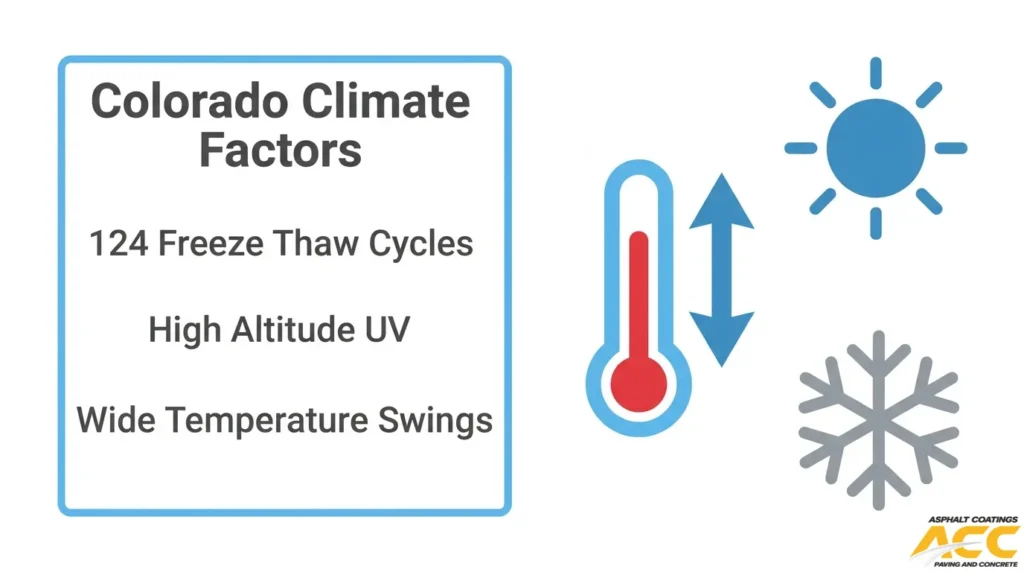
Freeze-thaw cycles in Colorado affect each surface option by repeatedly expanding trapped moisture, then contracting it as temperatures swing above and below 32 °F. According to NOAA engineering weather data for the Colorado Springs station (1988–2017), the area averages 124 annual freeze-thaw cycles. That intensity accelerates damage differently across materials:
- Gravel shifts and loosens as ice lenses form in the aggregate base, creating ruts and soft spots that worsen with each cycle.
- Asphalt develops surface cracking when water infiltrates small voids, freezes, and pries the binder apart from within.
- Concrete is vulnerable to scaling and spalling, especially when deicing salts introduce additional moisture into pores before a freeze event.
Proper subgrade drainage is the single most effective defense for any surface, because reducing the water available to freeze limits the force acting on the material.
How should snow removal and deicing be handled on different surfaces?
Snow removal and deicing should be handled differently depending on whether the laydown yard is gravel, asphalt, or concrete. Each surface responds to plowing and chemical treatment in distinct ways:
- Gravel tolerates plowing poorly; blades catch loose aggregate, displacing material and creating bare patches that need periodic re-grading.
- Asphalt handles mechanical plowing well, though operators should keep blade edges slightly raised to avoid gouging the binder surface.
- Concrete withstands plowing but is chemically vulnerable. Research from Purdue University’s Joint Transportation Research Program found that chloride-based deicing salts attack concrete through reactions and phase changes, producing dimensional changes and cracking.
For concrete yards, sand or non-chloride alternatives reduce chemical damage. For asphalt, standard rock salt is generally safe when applied at recommended rates. Regardless of surface type, prompt snow removal prevents meltwater from pooling and refreezing.
How does high-altitude UV exposure impact asphalt and concrete yards?
High-altitude UV exposure impacts asphalt and concrete yards by accelerating surface oxidation and material stiffening at rates higher than lower-elevation sites experience. Colorado’s thinner atmosphere filters less ultraviolet radiation, which means exposed pavement absorbs more energy year-round.
A 2023 study published in Materials (Basel) and indexed by PubMed Central found that ultraviolet radiation exposure increased stiffness by 35 to 40% in unaged polymer-modified binder asphalt and by 12 to 17% in short-term aged mixtures. Stiffer asphalt becomes brittle and more prone to cracking under thermal cycling and heavy loads.
Concrete surfaces are less affected by UV directly, though joint sealants and surface coatings degrade faster at altitude. Timely sealcoating on asphalt yards and resealing concrete joints are the most practical countermeasures for UV-driven deterioration.
How can design and materials reduce weather-related damage over time?
Design and materials can reduce weather-related damage over time by combining proper compaction, adequate drainage, and climate-appropriate material specifications from the start. According to the National Asphalt Pavement Association’s AAPTP Asphalt Paving Handbook, compaction is the most important factor in flexible pavement performance; adequate compaction increases fatigue life, decreases rutting, reduces oxidation and aging, decreases moisture damage, increases strength and stability, and decreases low-temperature cracking.
Additional strategies that limit weather-related deterioration include:
- Specifying air-entrained concrete to resist freeze-thaw scaling.
- Installing geotextile separation layers beneath gravel to prevent subgrade contamination.
- Designing minimum 2% cross-slopes so meltwater drains before it can refreeze in surface voids.
- Scheduling sealcoat applications every two to three years on asphalt to block UV penetration and reduce moisture infiltration.
Investing in these measures during initial construction costs less than repeated repairs after Colorado’s climate has already taken its toll. With climate-driven design decisions in place, choosing the right paving partner ensures those specifications translate into lasting results.
How Should You Approach Laydown Yard Surfacing With a Commercial Paving Partner?
You should approach laydown yard surfacing with a commercial paving partner by selecting a contractor who handles site evaluation, subgrade preparation, drainage design, and surface installation as an integrated scope. The sections below cover how Asphalt Coatings Company delivers this process and the key takeaways from this guide.
How Can Asphalt Coatings Company Help Design and Build Durable Laydown Yards?
Asphalt Coatings Company helps design and build durable laydown yards by combining subgrade preparation, grading, paving, and concrete flatwork under one in-house team. Since 1986, Asphalt Coatings Company has served Colorado’s Front Range with commercial asphalt and concrete projects engineered for the region’s 124 annual freeze-thaw cycles and high-altitude UV exposure.
Asphalt Coatings Company provides services directly relevant to laydown yard construction:
- Subgrade preparation and grading establish the compacted, load-ready foundation every laydown surface requires.
- Asphalt paving and installation deliver smooth, dust-free surfaces for high-traffic equipment zones.
- Concrete flatwork handles point-load areas where cranes, outriggers, or heavy racking demand rigid slabs.
- Curb and gutter installation creates edge restraints that protect surfaces and direct stormwater.
- ADA-compliant concrete work ensures accessible pedestrian paths meet federal standards.
Because Asphalt Coatings Company uses in-house crews rather than subcontractors, scheduling, quality control, and accountability stay consolidated. For operations that need phased improvements or mixed surface types across a single site, this single-source approach simplifies coordination considerably. Whether your project requires asphalt paving for high-traffic zones, concrete flatwork for crane pads, or integrated grading and drainage work, Asphalt Coatings Company’s in-house team delivers laydown yard construction built to last in Colorado’s challenging climate.
What Are the Key Takeaways About What Is a Laydown Yard and How Should It Be Surfaced: Gravel, Asphalt or Concrete We Covered?
The key takeaways about what a laydown yard is and how it should be surfaced are that no single material fits every operation; the right choice depends on load requirements, traffic volume, drainage needs, climate exposure, budget horizon, and regulatory obligations.
The most actionable conclusions from this guide include:
- Gravel works best for temporary sites, low-traffic yards, and projects where rapid deployment and low upfront cost matter most, though it demands frequent regrading and fails ADA accessibility requirements without treatment.
- Asphalt balances durability, cost, and maintenance for high-traffic laydown yards, provided the pavement structure is engineered for actual cumulative loads and protected with timely sealcoating.
- Concrete is the strongest option for point loads, crane outrigger pads, and permanent installations, but it carries the highest upfront cost and remains vulnerable to chloride-based deicing damage.
- Mixed-surface strategies, like NASA Kennedy Space Center’s ML-2 Mod Yard combining paved roadways, gravel lots, and a covered concrete work area, often represent the most practical real-world approach.
- Subgrade compaction, drainage planning, stormwater permitting, and ADA compliance are non-negotiable regardless of which surface you select.
Prioritizing a site evaluation before committing to any material prevents costly rework. Partnering with a contractor experienced in Colorado’s specific climate and regulatory landscape turns that evaluation into a laydown yard built to last.