Choosing a commercial paving contractor is a decision that determines whether your pavement lasts decades or deteriorates within a few years. The wrong selection leads to cost overruns, premature failure, and reactive repairs that far exceed the original project budget.
This guide covers credentials and licensing verification, experience and project-specific expertise, bid process evaluation, reputation assessment, climate-driven material requirements, and long-term maintenance planning.
Proper credentials form the foundation of any qualified contractor. Active state licensing, adequate general liability insurance, surety bonding, and industry certifications such as NAPA recognition or state DOT technician credentials confirm a company meets both legal and technical standards. A documented safety record with verifiable metrics like Experience Modification Rates adds another layer of protection.
Experience goes beyond years in business. The right contractor has completed projects matching your specific scope, whether that involves parking lot reconstruction, industrial yard paving, or retail center installation, and understands how your local climate shapes mix design and compaction decisions.
The bid process reveals how a contractor actually operates. In-house crews, specific material and mix design specifications, written warranties covering both materials and workmanship, and transparent change order policies separate thorough proposals from vague lowball bids. Unusually low pricing, missing written contracts, and pressure to sign immediately are disqualifying red flags.
Reputation verification through online review patterns, direct reference calls, and completed project portfolios confirms whether a contractor delivers consistent commercial-scale results.
Climate expertise and ongoing maintenance capabilities round out the selection criteria. Regional factors like freeze-thaw cycles and high-altitude UV exposure require specialized material knowledge, and contractors who offer preventive sealcoating and crack sealing protect your investment at roughly three times less cost than reactive repairs.
Why Does Choosing the Right Commercial Paving Contractor Matter?
Choosing the right commercial paving contractor matters because the wrong selection leads directly to cost overruns, premature pavement failure, and operational disruptions that far exceed the original project budget. A decision based solely on the lowest bid often results in skipped steps, substandard materials, and repairs that cost multiples of the initial savings.
According to a study published in The Open Civil Engineering Journal, improper contractor selection in construction leads to inadequate quality, project suspension, and failure to meet required specifications, which directly results in cost overruns and delays. These consequences are not abstract risks; nine out of ten construction projects experience cost overruns, and low-cost paving contractors frequently skip essential steps like drainage design and base preparation. When those shortcuts catch up, property owners face premature failures such as potholes, cracking, and standing water that require costly reactive repairs.
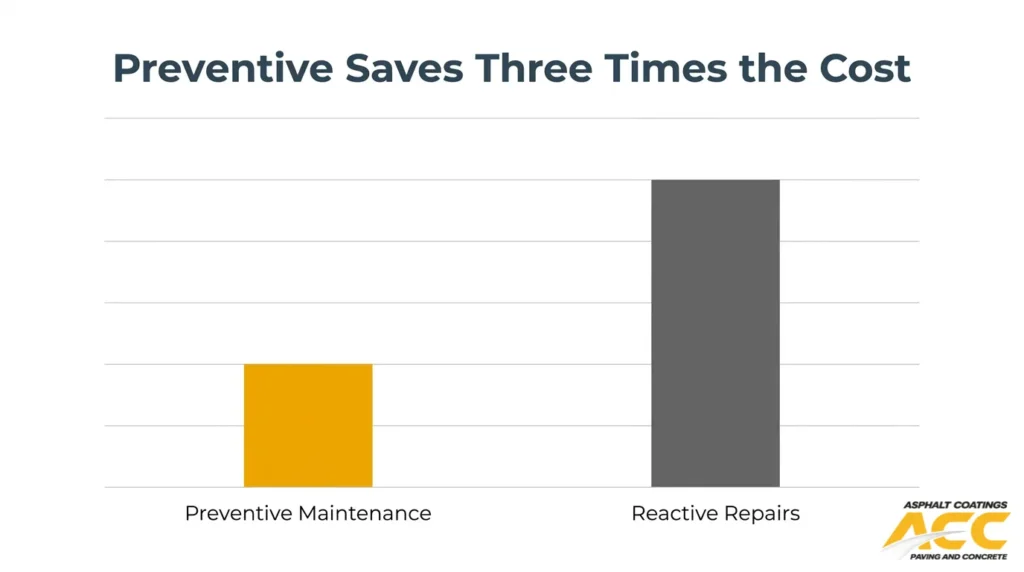
Preventive maintenance for commercial asphalt typically costs approximately three times less than reactive repairs. That gap widens dramatically when the original installation was done poorly, because patching a failed base is never as effective or affordable as building it correctly the first time. For commercial property managers overseeing parking lots, access roads, or industrial yards, the contractor you choose determines whether your pavement lasts decades or deteriorates within a few years.
The sections ahead cover the specific credentials, experience benchmarks, and evaluation criteria that separate qualified commercial paving contractors from those likely to create long-term liabilities.
What Credentials Should a Commercial Paving Contractor Have?
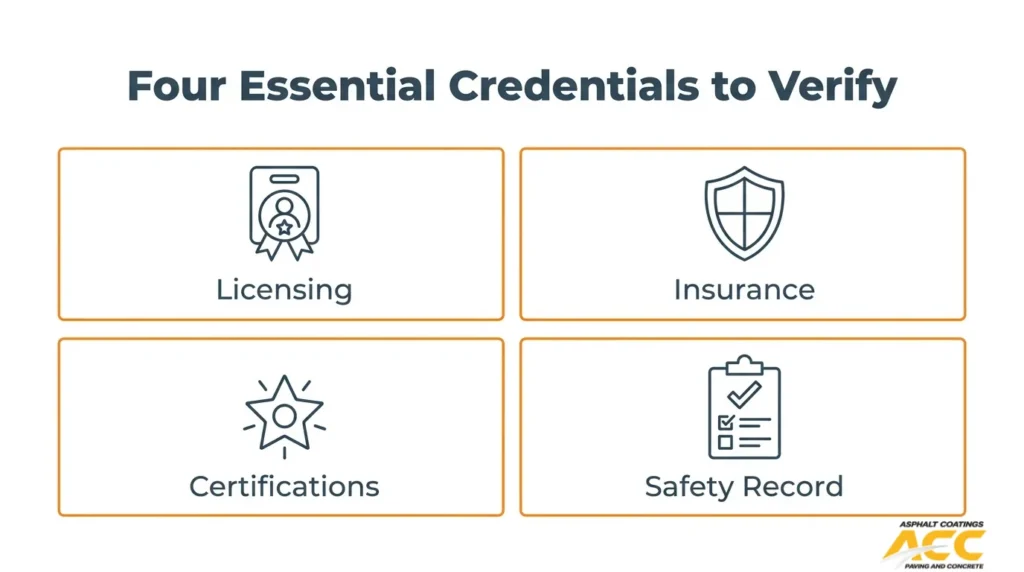
A commercial paving contractor should have proper licensing, adequate insurance, relevant industry certifications, and a documented safety record. The sections below cover each credential category in detail.
Does the Contractor Carry Proper Licensing and Insurance?
The contractor should carry both a valid state or local license and sufficient insurance coverage to protect your property. Licensing requirements vary by jurisdiction, but most states mandate a surety bond and general liability policy. According to the Washington State Department of Labor & Industries, general contractors must purchase a $30,000 continuous contractor surety bond and maintain a general liability policy with a minimum $250,000 combined single limit.
Ask every prospective paving contractor to provide:
- A current, verifiable contractor license for your state or municipality.
- General liability insurance with coverage limits appropriate for commercial projects.
- A surety bond that meets or exceeds your state’s minimum threshold.
- Workers’ compensation coverage for all on-site crew members.
Always verify these documents independently rather than relying on copies the contractor provides, since lapsed policies are more common than most property managers expect.
Does the Contractor Hold Industry Certifications?
The contractor should hold industry certifications that demonstrate technical competence beyond basic licensing. The National Asphalt Pavement Association (NAPA) offers Quality in Construction (QIC) Awards, which evaluate projects on asphalt mix production and placement quality across categories based on tonnage and project type.
State-level credentials matter as well. Many state Departments of Transportation, such as those in North Carolina and South Dakota, require paving technicians to complete specific training schools and pass both written and performance exams to earn certifications that typically last five years. These credentials confirm a crew understands proper mix design, compaction standards, and grade control. For commercial projects with long expected service lives, certified technicians represent a meaningful quality advantage over uncertified competitors.
Does the Contractor Have an Established Safety Record?
The contractor should have an established safety record documented through verifiable metrics. According to the U.S. Bureau of Labor Statistics, the 2024 incidence rate of nonfatal occupational injuries and illnesses for highway, street, and bridge construction was 2.5 total recordable cases per 100 full-time workers.
Request these safety indicators before signing a contract:
- The contractor’s Experience Modification Rate (EMR), where a score below 1.0 signals better-than-average safety performance.
- OSHA 300 logs showing injury and illness records for the past three years.
- Documentation of regular crew safety training, including toolbox talks and equipment certifications.
- Any OSHA citations or violations, resolved or outstanding.
A contractor unwilling to share safety data is a contractor worth passing over. Strong safety programs reduce jobsite disruptions and protect you from liability exposure. With credentials verified, evaluating a contractor’s project experience becomes the next critical step.
What Experience Should You Look for in a Commercial Paving Contractor?
You should look for a commercial paving contractor with verified longevity, project-specific expertise, and climate-adapted knowledge. The following subsections cover years in business, relevant project history, and local climate experience.
How Many Years Has the Contractor Been in Business?
The contractor should have been in business long enough to demonstrate stability, operational consistency, and a proven ability to deliver commercial-scale results. A minimum of 10 years is a reasonable benchmark, though firms with several decades of experience often bring deeper institutional knowledge of materials, equipment, and local conditions.
Longevity alone does not guarantee quality, but it does signal financial health and repeat client confidence. Contractors who have survived multiple economic cycles have likely refined their processes for estimating, project management, and problem resolution. When evaluating tenure, ask for documentation such as incorporation records or state licensing history to verify claims. For high-stakes commercial projects, prioritizing established contractors significantly reduces the risk of mid-project abandonment or substandard work.
Has the Contractor Completed Projects Similar to Yours?
The contractor should have completed projects similar to yours in scope, surface area, and commercial use case. A firm experienced in residential driveways may lack the equipment, crew depth, or traffic management skills that a large parking lot reconstruction demands.
Ask for a portfolio that includes projects matching your specific needs, such as:
- Parking lot construction or reconstruction
- Industrial yard and loading dock paving
- Retail center lot installation
- Multi-family community paving
- Road and access lane construction
Request references from those past commercial clients and verify timelines, budget adherence, and post-completion satisfaction. Contractors who can demonstrate repeated success on similar project types bring proven workflows that reduce costly surprises during execution.
Does the Contractor Have Experience with Your Local Climate?
The contractor should have direct experience with your local climate, because regional weather patterns fundamentally shape asphalt mix selection, compaction timing, and long-term pavement performance. A contractor unfamiliar with local conditions is more likely to specify materials that fail prematurely.
Climate challenges vary significantly by region. High-altitude areas experience approximately 15 to 20% higher UV radiation compared to sea level, which accelerates asphalt binder oxidation and embrittlement. According to research published in Case Studies in Construction Materials, UV-aged asphalt shows rutting factor increments reaching 25.9% to 42.5% depending on exposure levels, confirming measurable degradation of deformation resistance. Freeze-thaw cycles, extreme heat, and heavy precipitation each require distinct base preparation, drainage design, and mix specifications like Superpave formulations with approved additives.
Choosing a contractor with climate-specific knowledge ensures your pavement is engineered for where it will actually perform.
What Types of Commercial Paving Projects Require a Specialist?
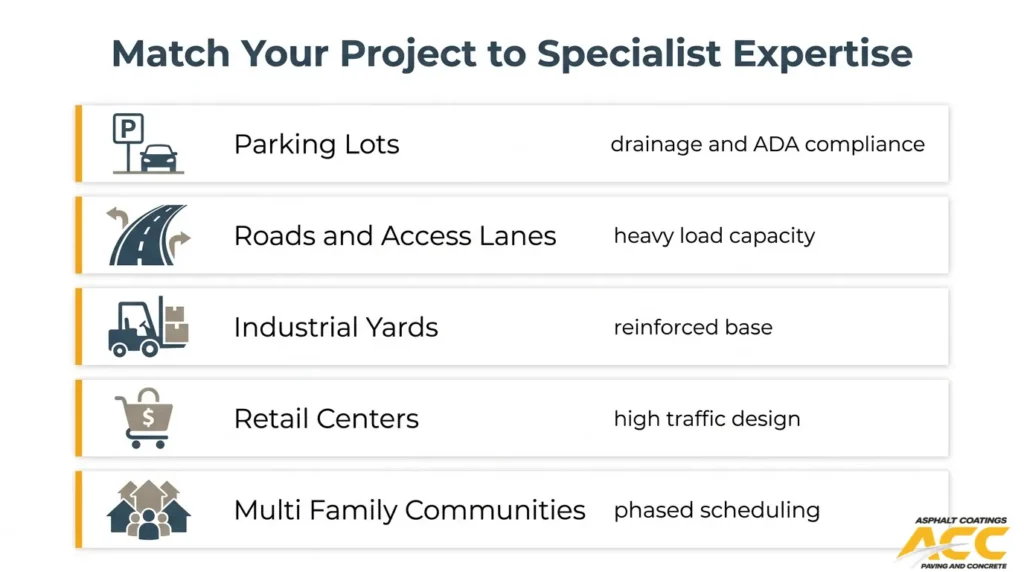
The types of commercial paving projects that require a specialist include parking lots, roads and access lanes, industrial yards, retail center lots, and multi-family community surfaces. Each project type presents distinct engineering, compliance, and durability demands.
Parking Lot Paving and Reconstruction
Parking lot paving and reconstruction require a specialist because these projects involve far more than laying asphalt. Proper drainage design, subgrade preparation, and ADA-compliant layouts must all work together. Under the ADA Standards for Accessible Design, car-accessible parking spaces must be at least 96 inches wide, with an access aisle at least 60 inches wide and a slope no steeper than 1:48 in all directions. Contractors who skip base preparation or drainage planning create conditions for premature potholes and cracking. Given the high daily traffic volume most commercial lots endure, hiring a specialist with proven lot construction experience is one of the most cost-effective decisions a property manager can make.
Road and Access Lane Construction
Road and access lane construction requires a specialist because these surfaces must support sustained heavy vehicle traffic, precise grading for water runoff, and integration with existing site infrastructure. Mix design selection is critical; hot-mix asphalt performance depends heavily on nominal maximum aggregate size and compaction effort, with Superpave designs requiring precise aggregate combinations and approved additives for long-term durability. Private commercial roads and fire lanes also carry local code requirements for width, turning radii, and load-bearing capacity. Without a contractor experienced in commercial roadway standards, the pavement often fails prematurely under repetitive heavy loads.
Industrial Yard and Loading Dock Paving
Industrial yard and loading dock paving requires a specialist because these surfaces endure the most punishing conditions in commercial paving. Forklifts, tractor-trailers, and stationary heavy equipment concentrate immense point loads on relatively small areas. Thicker asphalt sections, reinforced subgrades, and specialized drainage solutions are necessary to prevent rutting and structural failure. Low-cost contractors who skip essential steps like drainage design and base preparation create premature failures that necessitate costly reactive repairs. For warehouses and distribution centers, even brief pavement downtime disrupts logistics operations, making specialist-level planning and execution essential.
Retail and Shopping Center Lot Installation
Retail and shopping center lot installation requires a specialist because these projects combine high traffic volume with strict aesthetic and compliance standards. Shoppers expect smooth, well-marked surfaces with clear pedestrian pathways, accessible parking, and proper stormwater management. ADA slope and spacing requirements apply across every accessible space and route. Commercial paving costs for standard projects range from approximately $3.75 to $5.00 per square foot, though retail lots often involve additional expenses for curbing, concrete sidewalks, and striping. A specialist understands how to phase construction to minimize disruption to active retail tenants, which is something general contractors frequently underestimate.
Multi-Family and HOA Community Paving
Multi-family and HOA community paving requires a specialist because these projects serve as shared infrastructure for residents who use the surfaces daily. Apartment complexes, townhome communities, and HOA-managed properties need pavement that handles constant passenger vehicle traffic while maintaining a clean, well-kept appearance. Preventive maintenance for commercial asphalt typically costs approximately three times less than reactive repairs, making long-term planning especially valuable for community associations operating on fixed budgets. A specialist contractor can design phased paving schedules that limit resident inconvenience and incorporate ongoing sealcoating and crack sealing into the project plan from the start.
Understanding which project type you are managing helps narrow the field of qualified contractors to evaluate during the bid process.
What Questions Should You Ask During the Bid Process?
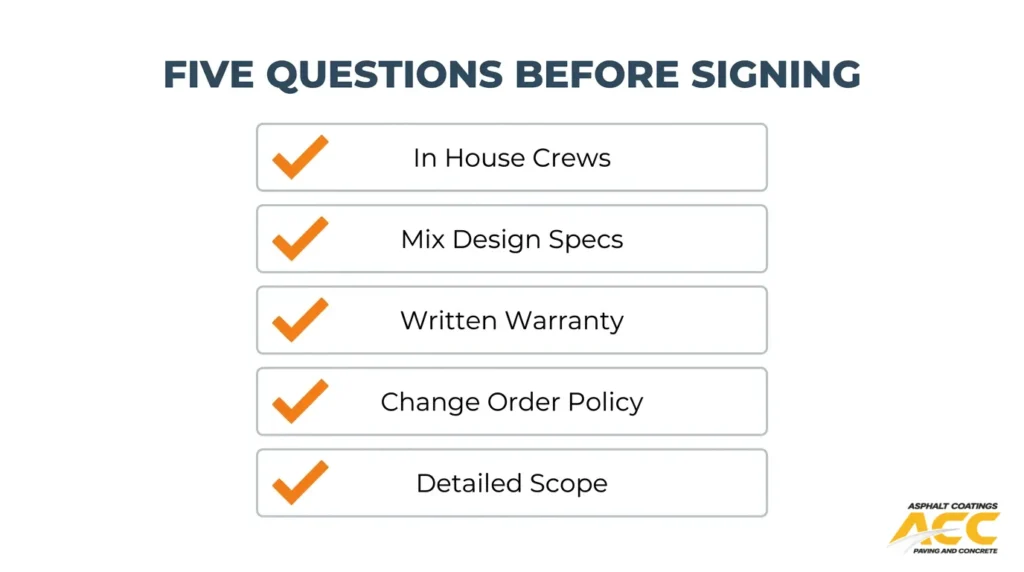
The questions you should ask during the bid process cover crew structure, materials, warranty terms, change order policies, and scope documentation. Each area reveals how a contractor operates and whether the bid reflects true project value.
Does the Contractor Use In-House Crews or Subcontractors?
The contractor either uses in-house crews or subcontractors, and the distinction directly affects accountability and quality control. In-house crews operate under the contractor’s direct supervision, which means consistent training standards, familiar equipment, and unified communication on the jobsite. Subcontracted work introduces a layer of separation between the company you hired and the workers performing the job.
When crews are subcontracted, scheduling conflicts, inconsistent workmanship, and unclear liability can complicate a project. Ask whether the contractor’s own employees handle grading, paving, and compaction, or whether those tasks are farmed out. For most commercial property managers, a contractor with dedicated in-house teams offers more predictable results and simpler dispute resolution.
What Materials and Mix Designs Does the Contractor Specify?
The materials and mix designs a contractor specifies determine the pavement’s long-term performance. According to the Idaho Transportation Department’s 2024 special provision for Superpave hot-mix asphalt, HMA performance depends heavily on nominal maximum aggregate size and compaction effort, with Superpave mixes requiring a precise combination of aggregate and approved additives for long-term durability.
Ask the contractor to identify the specific asphalt mix type, binder grade, and aggregate source proposed for your project. Key specification details to request include:
- Hot-mix asphalt (HMA) mix design designation
- Performance-graded binder suited to your climate
- Aggregate source and nominal maximum size
- Compaction method and minimum density targets
A contractor who cannot explain these choices likely lacks the technical depth your project requires.
What Does the Written Warranty Cover and for How Long?
The written warranty should cover both materials and workmanship for a clearly defined period. Industry data from Pacific Surfacing indicates that regular maintenance and sealcoating every two to three years can extend commercial asphalt lifespan by up to 30 years or more, but only when the original installation meets quality standards that a warranty enforces.
Ask specifically whether the warranty addresses:
- Surface defects such as premature cracking or raveling
- Base failure caused by improper subgrade preparation
- Drainage issues resulting from incorrect grading
Confirm whether the warranty requires the property owner to follow a maintenance schedule. Many contractors void coverage if sealcoating or crack sealing is neglected. Get every warranty term in writing before signing.
How Does the Contractor Handle Change Orders and Overruns?
The contractor should handle change orders and overruns through a documented, pre-agreed process outlined in the contract. A study published in Engineering, Technology & Applied Science Research found that design changes account for approximately 56.5% of cost overruns and 40% of project delays in construction projects.
Before signing, confirm the contractor’s policy on:
- Written approval requirements before any scope change begins
- Unit pricing or cost-plus formulas for additional work
- Timeline adjustments tied to approved change orders
- Dispute resolution procedures for contested charges
Without a clear change order protocol, even well-planned commercial paving projects can spiral beyond budget. The best contractors welcome these questions because transparent billing protects both parties.
Does the Contractor Provide a Detailed Scope of Work?
The contractor should provide a detailed scope of work that documents every phase, material specification, and timeline commitment before the project begins. A vague or overly brief proposal often signals that the contractor intends to cut corners or add charges later.
A complete scope of work for commercial paving should include:
- Site preparation steps such as grading, subgrade compaction, and drainage installation
- Asphalt mix type, lift thickness, and compaction standards
- ADA-compliance requirements for parking areas and access routes
- Cleanup responsibilities and final inspection criteria
- Payment milestones tied to completed project phases
Comparing scopes side by side across multiple bids makes it far easier to identify which contractor offers genuine value rather than simply the lowest number. With a thorough scope in hand, evaluating the contractor’s track record becomes the next step.
How Do You Evaluate a Commercial Paving Contractor’s Reputation?
You evaluate a commercial paving contractor’s reputation by examining online reviews, verifying references from past commercial clients, and reviewing a portfolio of completed projects. These three steps reveal consistency, quality, and reliability.
What Should You Look for in Online Reviews and Ratings?
You should look for patterns in online reviews and ratings that reveal a contractor’s consistency across multiple commercial projects. Individual star ratings matter less than recurring themes. Focus on these indicators:
- Reviews that mention on-time completion and adherence to budget
- Comments about communication quality during the project
- Feedback on how the contractor handled unexpected issues or change orders
- Repeat commercial clients who left multiple reviews over time
A contractor with dozens of reviews averaging 4.5 stars or higher across Google and industry directories demonstrates sustained performance. Single negative reviews carry less weight than patterns of complaint about the same issue, such as poor cleanup or missed deadlines. Prioritize platforms where verified commercial property managers leave detailed feedback over anonymous consumer review sites.
How Do You Verify References from Past Commercial Clients?
You verify references from past commercial clients by contacting them directly and asking specific, project-focused questions. A reputable contractor should provide at least three references from projects similar in scope to yours.
When speaking with references, ask about:
- Whether the project finished on schedule and within the original budget
- How the contractor communicated during unexpected delays or scope changes
- The current condition of the pavement one or more years after completion
- Whether the client would hire the same contractor again
According to a study published in The Open Civil Engineering Journal, improper contractor selection leads to inadequate quality, project suspension, and failure to meet specifications, directly resulting in cost overruns and delays. Checking references thoroughly helps you avoid these outcomes before signing a contract.
Does the Contractor Have a Portfolio of Completed Projects?
Yes, a qualified contractor should have a portfolio of completed projects that demonstrates relevant commercial paving experience. The portfolio should include projects comparable to yours in size, scope, and surface type.
Look for these elements in a strong portfolio:
- Before-and-after photographs showing finished parking lots, access roads, or industrial surfaces
- Project descriptions that list square footage, materials used, and timeline
- Evidence of work across multiple commercial property types, such as retail centers, office parks, and industrial yards
A portfolio with only residential driveways or small-scale patches signals a mismatch for large commercial work. The best contractors document their projects consistently and share them openly, which reflects confidence in their craftsmanship. With reputation thoroughly evaluated, understanding common warning signs helps you eliminate unqualified contractors early.
What Red Flags Should Disqualify a Commercial Paving Contractor?
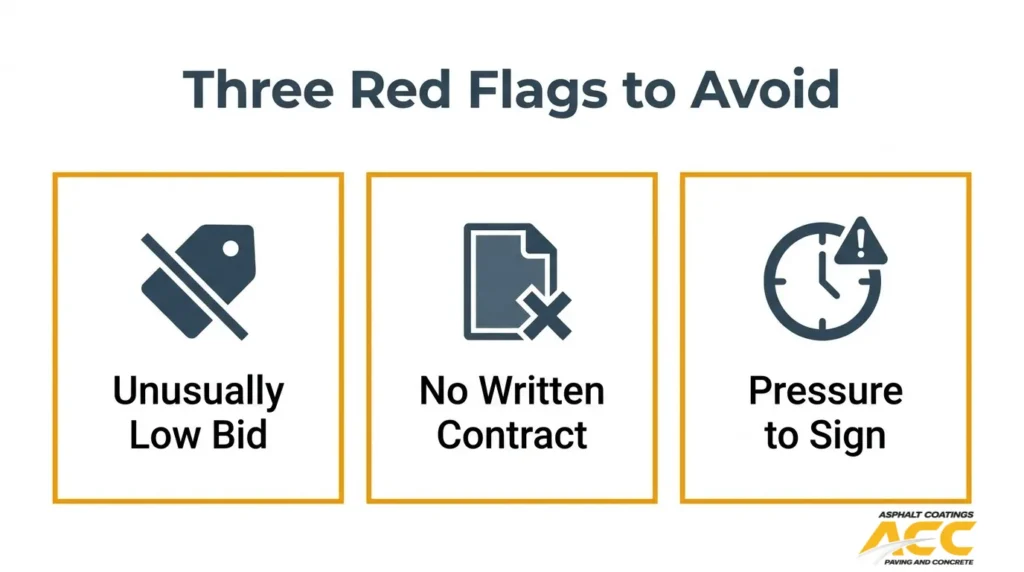
Red flags that should disqualify a commercial paving contractor include unusually low bids, refusal to provide written contracts, and high-pressure sales tactics. These warning signs often indicate shortcuts, hidden costs, or unreliable business practices.
Why Is an Unusually Low Bid a Warning Sign?
An unusually low bid is a warning sign because it typically signals that the contractor plans to cut corners on critical steps. In the paving industry, low-cost contractors often skip essential work like drainage design and base preparation, leading to premature failures such as potholes and cracks that require costly reactive repairs. According to a Propeller Aero analysis of large-scale construction projects, nine out of ten projects experience cost overruns, with only 31% finishing within 10% of the original budget. A bid that seems too good to be true usually means the real costs will surface later through change orders, material substitutions, or early pavement failure. Comparing multiple detailed bids against the same scope of work is the most reliable way to identify pricing outliers.
Why Should You Avoid Contractors Without Written Contracts?
You should avoid contractors without written contracts because a verbal agreement offers no enforceable protection for scope, timeline, or cost. A written contract defines the specific materials, mix designs, project milestones, payment schedule, and warranty terms that both parties must honor. Without one, disputes over change orders, incomplete work, or substandard materials become nearly impossible to resolve. The contract should also confirm the contractor’s licensing, insurance coverage, and bonding status. Any reputable commercial paving contractor will provide a detailed written agreement before work begins; reluctance to do so suggests the contractor cannot or will not stand behind the finished project.
Why Is Pressure to Sign Immediately a Concern?
Pressure to sign immediately is a concern because it prevents you from verifying credentials, comparing bids, and reviewing contract details. Legitimate commercial paving contractors expect property managers to conduct due diligence, including checking references, confirming insurance, and evaluating the proposed scope of work. High-pressure tactics often accompany limited-time pricing that masks incomplete scopes or inferior materials. A contractor who discourages you from seeking competing bids likely cannot compete on quality or transparency. Taking time to evaluate each proposal thoroughly protects your investment from preventable cost overruns and substandard results.
Recognizing these red flags early helps narrow the field to contractors suited for your region’s specific conditions.
How Does Climate Affect Your Choice of Paving Contractor?
Climate affects your choice of paving contractor because regional weather extremes demand specialized knowledge of materials, mix designs, and installation techniques. The subsections below cover freeze-thaw cycle expertise and high-altitude UV exposure requirements.
Why Do Freeze-Thaw Cycles Demand Specialized Expertise?
Freeze-thaw cycles demand specialized expertise because repeated expansion and contraction of trapped moisture cracks asphalt from within, and only contractors experienced with this phenomenon can prevent premature failure. Water infiltrates small surface voids, freezes, expands, then thaws, widening cracks with each cycle. This process accelerates in regions that experience dozens of freeze-thaw transitions per winter season.
A contractor familiar with these conditions will prioritize proper subgrade preparation, adequate drainage design, and compaction techniques that minimize air voids. Mix design selection also matters; hot-mix asphalt formulations with appropriate aggregate gradation and binder flexibility resist thermal stress more effectively than generic mixes. Without this climate-specific knowledge, even a well-installed pavement can deteriorate within a few seasons. For any commercial property in a freeze-prone region, verifying a contractor’s direct experience with cold-climate paving is essential.
Why Does High-Altitude Sun Exposure Require Specific Materials?
High-altitude sun exposure requires specific materials because elevated UV radiation accelerates oxidation and embrittlement of asphalt binders far faster than at sea level. High-altitude regions like Denver experience approximately 15 to 20% higher UV radiation levels compared to sea level, which significantly speeds pavement degradation.
According to a 2024 study published in Case Studies in Construction Materials, UV-aged asphalt showed rutting factor increments reaching 25.9%, 36.39%, and 42.5% depending on exposure level, demonstrating measurable losses in high-temperature performance and deformation resistance. These findings mean a contractor working at altitude must specify UV-resistant binder grades and consider protective sealcoating schedules as part of the installation plan. Performance-grade mix designs, such as Superpave formulations requiring precise aggregate sizing and approved additives, help counteract sun-driven deterioration. Choosing a contractor who understands this relationship between altitude, UV intensity, and material selection protects long-term pavement investment.
With climate-specific expertise addressed, ongoing maintenance capabilities further distinguish the right paving partner.
What Role Does Ongoing Maintenance Play in Contractor Selection?
Ongoing maintenance plays a critical role in contractor selection because it determines how long your pavement investment lasts. Choosing a contractor who handles both installation and upkeep simplifies budgeting, ensures consistent quality, and protects your surface over decades.
Should Your Paving Contractor Also Offer Sealcoating Services?
Yes, your paving contractor should also offer sealcoating services. A single contractor managing both installation and sealcoating ensures material compatibility and consistent application standards across the life of your pavement. According to Pacific Surfacing, regular maintenance and sealcoating performed every 2 to 3 years can extend commercial asphalt lifespan by up to 30 years or more.
Contractors offering sealcoating alongside paving provide key advantages:
- Familiarity with the original mix design and base preparation used on your lot.
- Scheduling efficiency, since one provider coordinates all service timelines.
- Accountability for surface performance from initial installation through each protective cycle.
When a single provider owns the full scope, there is no finger-pointing if issues arise between the paving and the coating.
Why Is a Long-Term Maintenance Plan Part of the Decision?
A long-term maintenance plan is part of the decision because preventive care costs far less than emergency repairs. Preventive maintenance for commercial asphalt typically costs approximately three times less than reactive repairs, with crack sealing ranging from $0.50 to $3.00 per linear foot. Contractors who build a maintenance schedule into their proposal demonstrate a commitment to protecting your investment, not just collecting payment at project closeup.
A strong long-term plan should include:
- Scheduled sealcoating intervals based on traffic volume and climate exposure.
- Annual crack sealing to prevent water infiltration and subgrade damage.
- Periodic lot assessments to catch early-stage deterioration before it spreads.
Prioritizing contractors who plan beyond installation day is one of the most cost-effective decisions a property manager can make. Selecting a maintenance-focused paving partner sets the stage for evaluating how to approach large-scale commercial projects.
How Should You Approach Choosing a Contractor for Large-Scale Commercial Paving?
You should approach choosing a contractor for large-scale commercial paving by prioritizing a single-source partner with comprehensive capabilities. The following subsections cover how consolidation simplifies execution and summarize the most critical selection criteria.
Can a Single-Source Commercial Paving Partner Simplify Your Project?
Yes, a single-source commercial paving partner can simplify your project by consolidating every phase under one accountable team. When a single contractor handles paving, sealcoating, concrete work, striping, and ADA compliance, communication gaps between subcontractors disappear. Scheduling becomes more predictable, and accountability stays with one point of contact from estimate through final walkthrough.
Asphalt Coatings Company operates as this kind of full-service partner across Colorado’s Front Range. Asphalt Coatings Company performs all work with in-house crews, covering asphalt installation, repair, mill and pave, crack sealing, sealcoating, parking lot striping, concrete flatwork, curb and gutter, and ADA-compliant construction. For property managers and facility owners coordinating complex commercial projects, this single-source model eliminates the need to vet and manage multiple vendors.
What Are the Key Takeaways for Choosing a Commercial Paving Contractor?
The key takeaways for choosing a commercial paving contractor center on five essential criteria:
- Verify credentials first. Confirm active licensing, adequate general liability insurance, surety bonding, and industry certifications such as NAPA recognition or state DOT technician credentials.
- Prioritize relevant experience. Select a contractor with a documented history of completing projects similar to yours in both scale and local climate conditions.
- Scrutinize the bid process. Demand a detailed written scope of work, clear change order policies, and a warranty that specifies coverage terms and duration.
- Check reputation thoroughly. Review online ratings, contact past commercial clients directly, and request a portfolio of completed projects.
- Plan for long-term maintenance. Choose a contractor who offers preventive services like sealcoating and crack sealing, since preventive maintenance costs roughly three times less than reactive repairs.
Selecting a commercial paving contractor is ultimately a decision about long-term partnership, not just the lowest bid price.