Concrete care for Denver winters is the process of inspecting, sealing, repairing, and maintaining concrete surfaces to withstand the city’s prolonged freeze-thaw season and heavy snowfall. Proactive winter care prevents moisture damage, reduces slip-and-fall liability, and extends the functional lifespan of commercial flatwork.
This guide covers Denver’s unique climate pressures on concrete, pre-winter surface preparation, snow and ice removal practices, freeze-thaw prevention, sealing and coating strategies, property management routines, damage identification, post-winter recovery, and long-term budgeting.
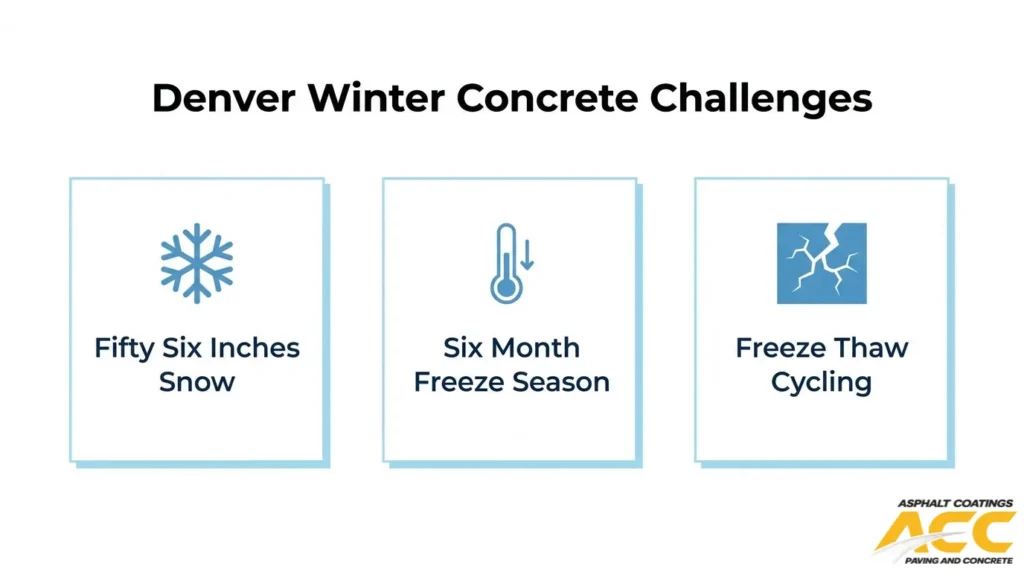
Denver averages 56 inches of seasonal snowfall with freezing conditions that can begin as early as October, giving concrete surfaces roughly six months of winter exposure. That extended season drives repeated freeze-thaw cycling, where water expands inside pores and micro-cracks, progressively breaking apart even well-installed slabs.
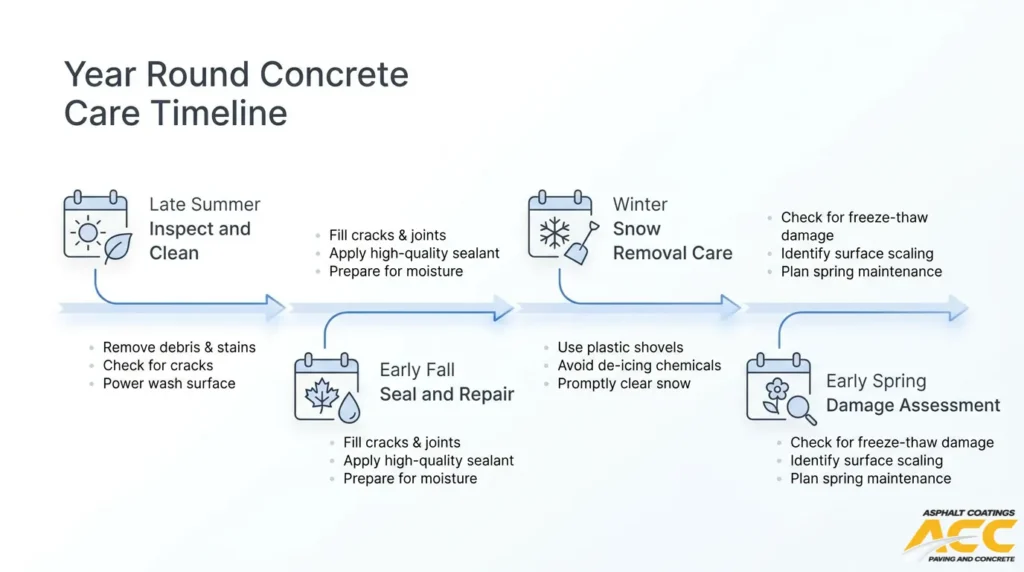
Effective preparation starts before temperatures drop. Thorough inspections, crack repairs, surface cleaning, and sealer application during late summer or early fall create a moisture barrier that blocks the infiltration driving seasonal deterioration. Penetrating sealers, particularly silane and siloxane formulations, offer the strongest protection in cold climates.
During winter, choosing concrete-safe de-icers like calcium magnesium acetate, using rubber-edged plow blades, and removing snow before refreeze cycles all limit chemical and mechanical surface damage. Structured inspection checklists and consistent documentation help property managers catch scaling, spalling, and delamination before small failures escalate.
Post-winter recovery depends on timely spring inspections and matching repair methods to actual damage severity. Budgeting for annual maintenance through multi-year contracts keeps costs predictable and prevents deferred repairs from compounding into full-depth replacements.
Why Does Denver’s Winter Climate Create Unique Challenges for Concrete?
Denver’s winter climate creates unique challenges for concrete because the city combines heavy snowfall, early freezes, and rapid temperature swings that accelerate surface deterioration. These conditions increase freeze-thaw cycling, moisture infiltration, and slip-and-fall liability for commercial properties.
Denver averages 56 inches of seasonal snowfall based on the 1991–2020 estimate, with the first freeze typically occurring around October 7th, according to the National Weather Service. That early onset means concrete surfaces endure roughly six months of winter exposure. Repeated freezing and thawing forces moisture deep into pores and micro-cracks, gradually breaking apart even well-installed slabs.
Beyond structural damage, deteriorating concrete raises serious safety concerns. According to the U.S. Bureau of Labor Statistics, private industry reported 674,100 workplace injuries resulting in days away from work, job restrictions, or job transfers due to slips, trips, or falls in 2021–22. Scaled or spalled concrete in parking lots and walkways significantly increases this risk for commercial properties during icy conditions.
For property managers along Colorado’s Front Range, understanding these climate-driven pressures is the first step toward an effective winter concrete care plan.
How Can You Prepare Existing Concrete Surfaces Before Denver’s Winter Starts?
You can prepare existing concrete surfaces before Denver’s winter starts by completing a thorough inspection, cleaning all surfaces, repairing visible damage, and applying a protective sealer. The following steps cover each phase of pre-winter preparation.
Inspect All Concrete for Existing Damage
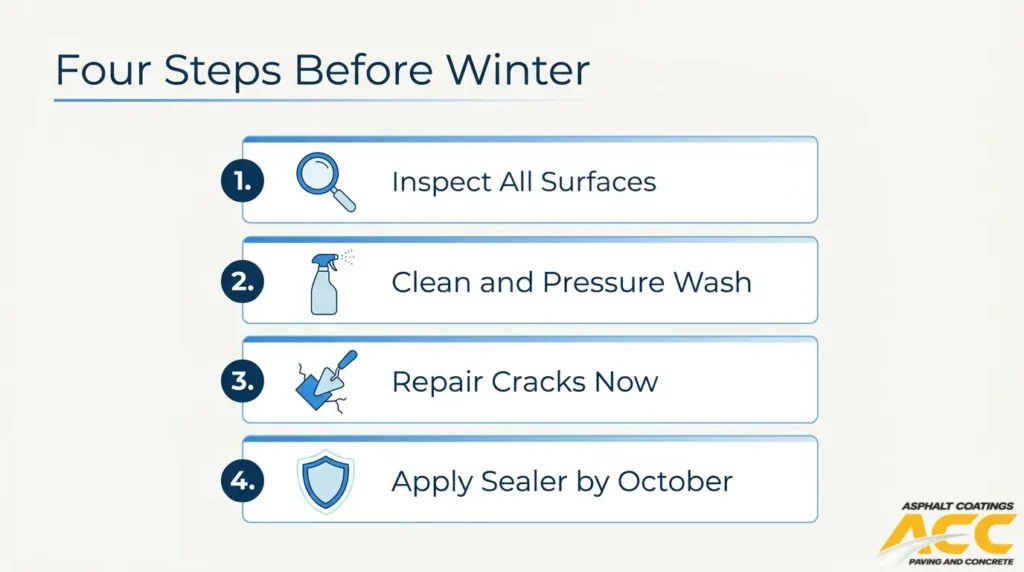
A complete visual survey is the foundation of any pre-winter concrete assessment. According to CAPCRETE’s concrete inspection checklist, inspectors should look for cracks, spalling, surface scaling, pitting, discoloration, efflorescence, and areas that sound hollow when tapped. Walk every slab, curb, and sidewalk section systematically. Mark each defect with spray chalk so repair crews can locate problem areas quickly. Catching damage before freezing temperatures arrive prevents minor flaws from becoming costly structural failures over winter.
Clean and Prepare the Surface
Cleaning concrete surfaces before winter removes contaminants that compromise sealer adhesion and trap moisture. Pressure wash all slabs to strip away dirt, oil stains, and organic debris. For commercial properties with heavy vehicle traffic, use a degreaser on loading docks and parking areas where petroleum buildup is common. Thorough surface preparation is the single most overlooked step in winterization; skipping it almost guarantees premature sealer failure and leaves concrete vulnerable to freeze-thaw cycles.
Repair Cracks and Surface Defects
Crack repair before ground freezing is essential because water infiltrates even hairline openings and expands when frozen. For cracks less than 1/4 inch, use flexible polyurethane or epoxy crack filler designed for temperature fluctuation, as recommended by Independent Floor Testing & Inspection. Larger cracks and spalled areas may require routing and filling with a compatible patching compound. Address every defect before sealing; sealers bridge minor surface imperfections but cannot compensate for unrepaired structural damage beneath them.
Apply a Protective Sealer Before Temperatures Drop
Applying a concrete sealer is the final and most critical step in pre-winter preparation. Sealers create a barrier that reduces moisture absorption, the primary driver of freeze-thaw deterioration. Schedule application when daytime temperatures remain consistently above 50°F, which in Denver typically means completing the work by late September or early October. Most penetrating sealers need 24 to 48 hours of dry conditions to cure properly. For commercial properties managing multiple buildings, prioritizing high-traffic walkways and entryways first ensures the most liability-prone areas receive protection before the season’s first freeze arrives.
What Daily and Weekly Concrete Care Habits Help During Denver Winters?
Daily and weekly concrete care habits that help during Denver winters include prompt snow clearing, surface inspections, and moisture management. These routines prevent small issues from becoming costly repairs across driveways, walkways, and commercial parking areas.
Consistent daily attention should focus on keeping concrete surfaces clear of standing water and snow accumulation. Even thin layers of moisture that refreeze overnight can accelerate surface deterioration through repeated freeze-thaw stress. Sweeping debris away from expansion joints also prevents trapped moisture from widening existing cracks.
Weekly habits require a more deliberate approach:
- Walk the property to check for new cracks, flaking, or surface irregularities.
- Clear drainage channels and scuppers so meltwater flows away from concrete slabs.
- Inspect areas where de-icing products have been applied for signs of scaling or discoloration.
- Remove any sand or gravel buildup that could trap moisture against the surface.
For commercial properties, assigning specific staff members to daily clearing and weekly walkthroughs ensures accountability. Property managers who treat these habits as non-negotiable, rather than weather-dependent, consistently see fewer emergency repairs by spring. The discipline of routine maintenance is what separates properties that hold up well through Denver’s winters from those that need major rehabilitation after every season.
Establishing these care habits creates the foundation for smarter snow and ice removal practices.
How Should You Handle Snow and Ice Removal on Concrete in Denver?
You should handle snow and ice removal on concrete in Denver by choosing concrete-safe de-icers, using proper shoveling techniques, and timing removal before melt-refreeze cycles cause damage.
What De-icing Products Are Safest for Concrete in Denver Winters?
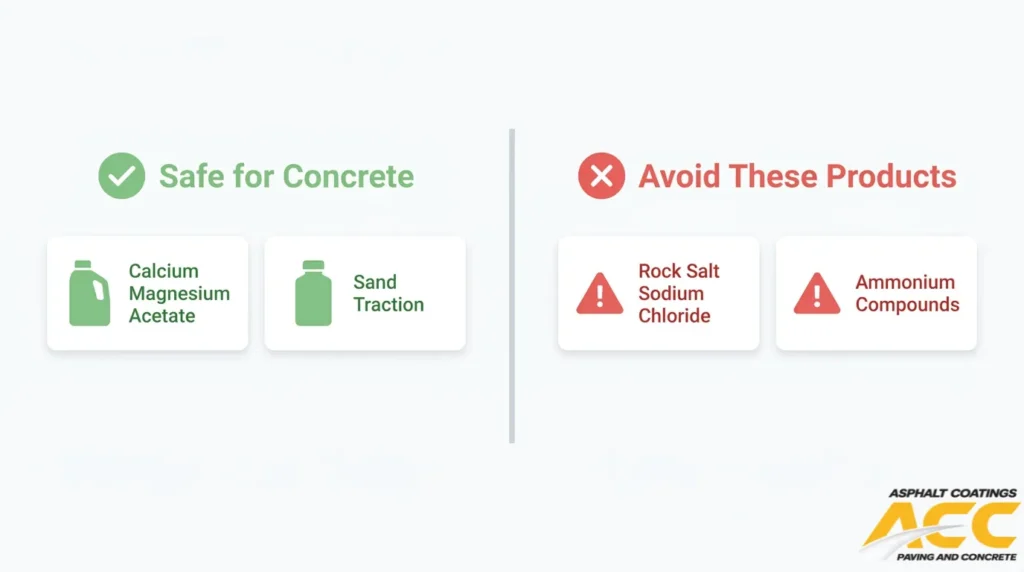
The de-icing products safest for concrete in Denver winters are calcium magnesium acetate (CMA) and sand-based traction alternatives. Sodium chloride (rock salt) is widely available but accelerates surface scaling on concrete, especially during the first winter after placement. Magnesium chloride, commonly used on Colorado highways, is gentler than rock salt yet still corrosive at high concentrations.
Products to avoid on concrete include:
- Ammonium nitrate and ammonium sulfate, which chemically attack concrete surfaces.
- Calcium chloride in excess, which can increase freeze-thaw saturation damage.
For commercial properties, applying de-icer sparingly and sweeping residue after storms limits cumulative chemical exposure. CMA costs more upfront but causes significantly less long-term surface deterioration, making it a worthwhile investment for high-value concrete flatwork.
How Should You Shovel and Plow Concrete Surfaces to Avoid Damage?
You should shovel and plow concrete surfaces using plastic-edged or rubber-edged blades to avoid gouging, chipping, or scraping sealed surfaces. Metal blades dragged directly across concrete dislodge aggregate and strip protective sealers, creating entry points for moisture.
Key techniques that protect concrete during removal:
- Lift rather than scrape when hand-shoveling; angle the blade to glide above the surface.
- Set plow blades slightly above grade so rubber shoes contact the concrete instead of bare steel.
- Push snow in consistent directions to prevent repeated abrasion over the same area.
Colorado’s emphasis on snow removal safety, reinforced when Gov. Jared Polis signed House Bill 19-1265 in 2019 increasing penalties around snowplow operations, underscores how seriously the state treats winter clearing practices. That same care should extend to your concrete surfaces.
When Should You Remove Snow and Slush to Best Protect Concrete?
You should remove snow and slush from concrete as soon as accumulation reaches two inches or before temperatures drop and trigger a refreeze. Slush left on concrete saturates the pore structure; when overnight temperatures fall below freezing, that trapped moisture expands and accelerates scaling and spalling.
Timing priorities for Denver properties:
- During the storm: Clear walkways and high-traffic zones every few hours to prevent compaction.
- Immediately after snowfall stops: Remove remaining accumulation before the next temperature swing.
- Before sunset on sunny days: Denver’s intense daytime sun melts surface snow, but rapid evening cooling refreezes meltwater inside micro-cracks.
Prompt removal is the simplest freeze-thaw prevention strategy available. Paired with proper de-icing products and careful shoveling techniques, consistent timing protects concrete throughout Denver’s winter season.
How Can You Prevent Freeze–Thaw Damage to Concrete in Denver?
You can prevent freeze–thaw damage to concrete in Denver by addressing vulnerabilities before winter arrives. The key strategies involve repairing micro-cracks, eliminating standing water, and improving drainage across your property.
How Do Micro-Cracks and Surface Defects Increase Freeze–Thaw Risk?
Micro-cracks and surface defects increase freeze–thaw risk by creating entry points where moisture penetrates concrete. Once water seeps into these small openings, temperature drops cause it to freeze and expand inside the slab. That expansion widens the original crack, allowing even more water to enter during the next thaw cycle.
Each repetition compounds the damage. What begins as a hairline fracture can progress to spalling or full-depth deterioration over a single Denver winter. Sealing micro-cracks and patching surface defects before the first freeze is one of the most cost-effective ways to protect commercial concrete. Even minor imperfections deserve attention; ignoring them invites exponentially worse repairs by spring.
When Should You Address Ponding Water on Concrete Before It Freezes?
You should address ponding water on concrete before it freezes as soon as you notice persistent puddles, ideally during late summer or early fall before Denver’s first freeze. Standing water that remains on slabs gives moisture extended time to saturate the surface and fill pores.
According to the National Ready Mixed Concrete Association, water expands approximately 9% on freezing, and since concrete contains roughly 10% freezable water, this results in about 1% expansion during freezing. That expansion generates enormous internal pressure. Eliminating low spots, regrading surrounding surfaces, and ensuring functional drainage before October removes the moisture source that drives freeze–thaw cycles. For commercial properties with large flatwork areas, even slight depressions can pool enough water to cause significant seasonal damage. Professional subgrade preparation and proper grading during initial installation or full-depth repairs prevent these drainage issues from developing. Contractors with Colorado-specific expertise can identify and correct grade problems before they lead to costly freeze-thaw damage.
How Can Drainage Improvements Protect Concrete in Denver’s Winters?
Drainage improvements protect concrete in Denver’s winters by directing snowmelt and runoff away from slabs before moisture can saturate the surface. Effective strategies include:
- Installing or clearing channel drains along parking lot edges and loading areas.
- Regrading adjacent landscapes so water flows away from concrete, not toward it.
- Adding catch basins at low points where ponding commonly occurs.
- Maintaining existing storm drains to prevent blockages from debris or ice.
Proper drainage reduces the volume of water that contacts concrete during repeated freeze–thaw cycles. For large commercial sites, a drainage audit before winter often reveals simple corrections that prevent costly repairs. With drainage strategies in place, sealing and coating add another layer of winter protection.
How Does Sealing and Coating Help Protect Concrete Through Denver Winters?
Sealing and coating help protect concrete through Denver winters by creating a moisture barrier that prevents water infiltration before freeze–thaw cycles cause internal damage. The subsections below cover optimal application timing, sealer types for cold climates, and resealing frequency for commercial properties.
When Is the Best Time of Year to Seal Concrete in Denver?
The best time of year to seal concrete in Denver is late summer through early fall, ideally between August and early October. Sealers require dry conditions and surface temperatures above 50°F to cure properly. Because Denver’s first freeze typically arrives around early October, this window gives the coating enough time to bond and harden before moisture and cold set in.
Applying sealer too late risks incomplete curing, which leaves the concrete just as vulnerable as an unsealed surface. For commercial properties managing large footprints, scheduling seal work in September strikes the best balance between warm temperatures and pre-winter readiness.
What Types of Concrete Sealers Work Best in Freeze–Thaw Climates?
The types of concrete sealers that work best in freeze–thaw climates are penetrating sealers, particularly silane and siloxane formulations. These products absorb into the concrete pore structure rather than forming a surface film, which allows moisture vapor to escape while blocking liquid water entry.
- Silane sealers penetrate deeply and protect against chloride intrusion from de-icing chemicals.
- Siloxane sealers offer slightly less penetration depth but provide strong water repellency on denser surfaces.
- Acrylic sealers form a topical film suited to decorative concrete but wear faster under heavy commercial traffic and plow abrasion.
According to the American Concrete Institute, exposing damp concrete to freezing-and-thawing cycles is a severe test for concrete to survive without impairment. Penetrating sealers directly address this vulnerability by reducing the moisture content available to freeze within the slab.
How Often Should Commercial Properties Reseal Concrete Surfaces in Denver?
Commercial properties should reseal concrete surfaces in Denver every two to three years, though high-traffic areas like parking lot entrances and loading docks may need attention annually. Penetrating sealers generally last longer than film-forming products because they are not worn away by tire traffic or snow removal equipment.
A simple water bead test helps determine when resealing is due: sprinkle water on the surface, and if it absorbs rather than beading up, the sealer has diminished. For properties managing multiple buildings, staggering reseal schedules across fiscal years keeps budgets predictable while maintaining consistent protection.
With sealing strategies established, recognizing early signs of winter damage ensures problems are caught before they escalate.
How Should Property Managers Maintain Concrete Around Parking Lots and Walkways in Winter?
Property managers should maintain concrete around parking lots and walkways in winter by prioritizing high-liability zones, following structured inspection checklists, and coordinating maintenance across properties. The following subsections cover each strategy.
How Can You Prioritize High-Traffic and High-Liability Concrete Areas?
You can prioritize high-traffic and high-liability concrete areas by ranking zones based on pedestrian volume, slip-and-fall exposure, and structural load. Building entrances, ADA ramps, loading docks, and crosswalk connectors between parking lots and storefronts should receive attention first. These areas bear the most foot traffic and carry the greatest legal exposure if damage goes unaddressed.
Stairwells, drive aisles near cart corrals, and fire lane curbing rank next. Each zone should have a designated severity tier so maintenance crews address the most critical concrete surfaces before secondary areas. For commercial properties managing multiple buildings, this tiered approach prevents reactive, costly emergency repairs and keeps liability risk contained throughout winter.
What Winter Inspection Checklist Should Facility Teams Use for Concrete?
The winter inspection checklist facility teams should use for concrete begins with a complete visual survey. According to CAPCRETE, this survey forms the foundation of any concrete inspection checklist, examining cracks, spalling, surface scaling, pitting, discoloration, efflorescence, and areas that sound hollow when tapped.
A thorough checklist includes:
- Walking all pedestrian paths and parking areas to identify new or widened cracks.
- Checking expansion joints for sealant failure or debris accumulation.
- Noting any standing water or drainage obstructions near concrete edges.
- Flagging uneven surfaces that create trip hazards.
- Filling cracks under 1/4 inch with flexible polyurethane or epoxy crack filler designed for temperature fluctuation before ground freezing occurs.
Teams should document findings with photos, dates, and locations to build a maintenance record that supports both repair scheduling and liability protection.
How Can You Plan Winter Maintenance for Multi-Property Portfolios in Denver?
You can plan winter maintenance for multi-property portfolios in Denver by creating a centralized schedule that assigns inspection dates, repair windows, and de-icing protocols to each site. Properties with older concrete or heavier traffic volumes should receive earlier and more frequent service rotations.
Grouping nearby properties into geographic clusters allows maintenance crews to service multiple sites efficiently during the same mobilization. Standardized reporting templates across all locations ensure consistent documentation and make it easier to compare conditions year over year. Establishing a single contractor relationship for the entire portfolio also streamlines communication and helps lock in seasonal pricing before winter demand peaks.
With a structured portfolio plan in place, the next step is learning to identify early signs of winter concrete damage before small issues escalate.
How Do You Spot Early Signs of Winter-Related Concrete Damage in Denver?
You spot early signs of winter-related concrete damage in Denver by inspecting surfaces for texture changes, new or widening cracks, and material loss after freeze-thaw events. The following subsections cover surface failure types, crack severity assessment, and seasonal documentation methods.
Which Surface Changes Signal Scaling, Spalling, or Pop-Outs?
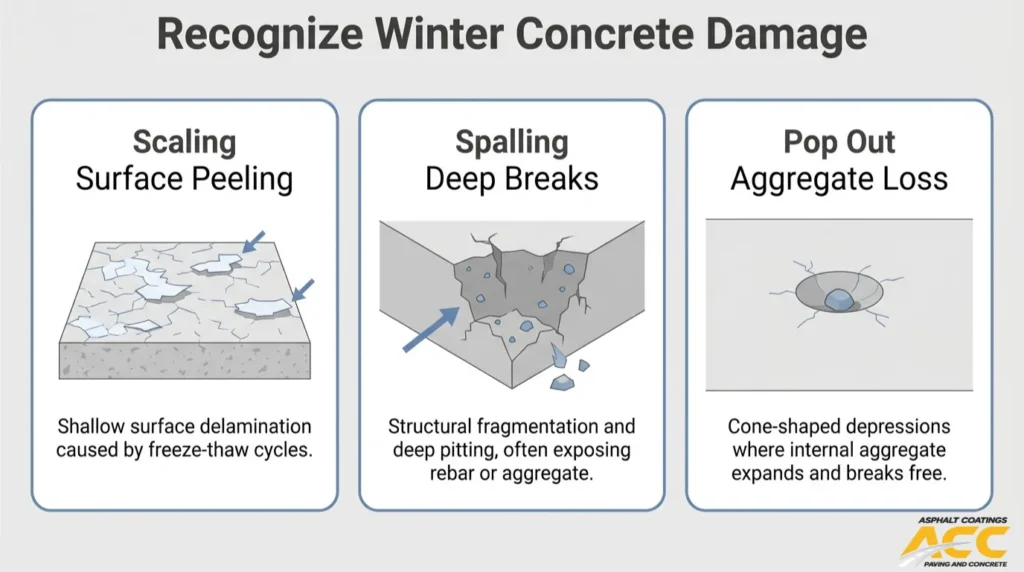
The surface changes that signal scaling, spalling, or pop-outs are distinct and stem from different failure mechanisms. Scaling appears as flaky, peeling layers on the top surface, typically caused by repeated freeze-thaw exposure combined with de-icing chemicals. Spalling produces deeper, irregular chunks breaking away from the slab, often at edges or joints. Pop-outs leave small, cone-shaped craters where aggregate near the surface has fractured outward.
According to Materials Lab, delamination is a separation within the concrete below the surface where a layer has detached but may not have broken off yet. Tapping the surface with a chain drag or hammer can reveal hollow-sounding areas where delamination hides beneath an intact-looking finish. Catching these changes early prevents small surface failures from escalating into costly structural repairs.
When Are Cracks a Cosmetic Issue Versus a Structural Concern?
Cracks are a cosmetic issue when they remain hairline-thin, stable in width, and confined to the surface without affecting load-bearing capacity. These fine surface cracks, often called crazing, result from normal shrinkage during curing and rarely worsen under freeze-thaw cycling alone.
Cracks become a structural concern when they exhibit specific warning signs:
- Widths exceeding 1/4 inch, which allow significant moisture infiltration before freezing.
- Active growth, meaning the crack measurably widens between inspections.
- Vertical displacement, where one side of the crack sits higher than the other.
- Patterns radiating from corners or joints, suggesting subgrade failure beneath the slab.
For commercial property managers, any crack showing active movement or differential settlement warrants professional evaluation before winter conditions accelerate the deterioration.
How Should You Document and Track Concrete Damage Over the Winter Season?
You should document and track concrete damage over the winter season by establishing a consistent, repeatable inspection routine tied to weather events. Photograph each area of concern from the same angle and distance at regular intervals, including a ruler or reference object for scale. Record the date, temperature, and recent weather conditions alongside every photo.
A simple tracking log should include:
- Location of the defect, referenced to a site map or grid.
- Defect type, such as scaling, spalling, cracking, or pop-out.
- Measured dimensions, including length, width, and depth.
- Change since last inspection, noting growth rate or stability.
This seasonal record gives contractors the context needed to recommend targeted repairs rather than guesswork. Consistent documentation throughout winter also strengthens budget planning for post-season recovery work.
What Are the Best Practices for Post-Winter Concrete Recovery and Repairs?
The best practices for post-winter concrete recovery and repairs include timely inspections, matching repair methods to damage type, and prioritizing work by safety risk. The following subsections cover inspection timing, common repair types, and site-wide prioritization strategies.
When Should You Schedule Concrete Inspections After Denver’s Winter?
You should schedule concrete inspections after Denver’s winter as soon as temperatures consistently remain above freezing, typically in late March or April. This timing ensures freeze-thaw cycles have largely concluded and new damage is no longer actively forming.
A thorough post-winter assessment should cover:
- Cracks wider than 1/4 inch that may have expanded during winter.
- Surface scaling or flaking from de-icer exposure.
- Spalling, pop-outs, or delaminated areas.
- Joint sealant failures along expansion and control joints.
- Drainage issues where ponding water accelerated deterioration.
Waiting too long delays repairs into summer heat, when demand peaks and scheduling becomes harder. Conversely, inspecting too early risks missing damage still developing during late-season freezes. For commercial properties, a structured spring walkthrough that documents conditions with photos and measurements creates a clear baseline for repair scoping.
What Types of Concrete Repairs Are Most Common After Harsh Winters?
The types of concrete repairs most common after harsh winters are crack filling, surface patching, partial-depth repairs, and full-depth section replacement. Each method addresses a different severity of winter damage.
- Crack sealing addresses narrow cracks using flexible polyurethane or epoxy fillers that accommodate ongoing thermal movement.
- Surface patching restores areas affected by scaling or minor spalling with polymer-modified overlays.
- Partial-depth repairs remove and replace deteriorated concrete in the upper portion of a slab while preserving the sound base.
- Full-depth repairs replace entire slab sections. According to the Federal Highway Administration, full-depth repair replaces more severely distressed portland cement concrete sections with new material, requiring careful evaluation of distress criteria for successful implementation.
Matching the repair method to actual damage severity prevents both under-treatment, which allows problems to worsen, and over-treatment, which wastes budget on unnecessary demolition.
How Can You Prioritize Repairs Across Large Commercial Sites?
You can prioritize repairs across large commercial sites by ranking each damaged area according to safety risk, structural severity, and traffic volume. Not every defect demands immediate attention, so a systematic approach prevents reactive spending.
A practical prioritization framework includes:
- Safety-critical repairs first: Trip hazards on walkways, ADA-accessible routes, and building entries take top priority due to slip-and-fall liability.
- Structural failures second: Full-depth cracking, significant delamination, or slab settlement that threatens load-bearing capacity requires prompt scheduling.
- Functional damage third: Spalling or scaling on parking surfaces and secondary pathways that worsens with continued use but poses lower immediate risk.
- Cosmetic issues last: Minor surface blemishes that do not affect safety or structural performance can be grouped into planned maintenance cycles.
Documenting each area with severity ratings during the spring inspection allows facility teams to present clear, data-backed repair proposals to ownership. With a prioritized repair plan established, budgeting for ongoing winter concrete care becomes far more predictable.
How Should Commercial Properties Budget and Plan for Ongoing Winter Concrete Care?
Commercial properties should budget for winter concrete care by estimating annual maintenance costs, adopting long-term preservation strategies, and securing multi-year service contracts. The following subsections cover cost estimation, lifespan extension, and contract planning.
How Can You Estimate Annual Concrete Maintenance Costs for Denver Winters?
You can estimate annual concrete maintenance costs for Denver winters by accounting for the city’s climate severity, total concrete square footage, and the recurring services each surface requires. According to the National Weather Service, Denver averages 56 inches of seasonal snowfall based on the 1991–2020 estimate, with the first freeze typically occurring around October 7th. That extended winter window means budgets must cover several months of active care.
Key line items to include in an annual estimate:
- Sealer reapplication based on manufacturer-recommended cycles
- Snow and ice removal for all concrete walkways, entries, and lots
- Crack filling and minor patching before and after winter
- Post-winter inspections and damage assessments
- Emergency repair reserves for unexpected freeze–thaw failures
Properties that underestimate Denver’s freeze season length consistently face unbudgeted spring repair costs, making conservative estimates the more reliable approach.
What Long-Term Strategies Help Extend Concrete Lifespan in Harsh Climates?
Long-term strategies that help extend concrete lifespan in harsh climates focus on proactive maintenance rather than reactive repair. Preventive care consistently costs less than full-depth replacements over a 10- to 20-year horizon.
Effective long-term strategies include:
- Applying penetrating sealers on a scheduled cycle to block moisture intrusion before freeze–thaw cycles cause internal damage
- Maintaining proper drainage slopes and functioning catch basins so water never ponds on concrete surfaces
- Filling cracks at the sub-quarter-inch stage, before they widen and allow deeper water penetration
- Specifying air-entrained concrete mixes for any new pours or full-section replacements
For most commercial properties, investing in scheduled sealing and drainage upkeep yields a far better return than deferring maintenance until visible failure demands costly reconstruction.
How Can Maintenance Contracts and Multi-Year Plans Benefit Property Managers?
Maintenance contracts and multi-year plans benefit property managers by locking in predictable costs, ensuring timely seasonal service, and reducing the risk of deferred maintenance escalating into major expenses. A structured contract typically bundles pre-winter sealing, winter snow removal, and post-winter inspections into a single agreement.
Core advantages of multi-year maintenance plans:
- Predictable annual budgeting with fixed or pre-negotiated pricing
- Priority scheduling that ensures services happen before the first freeze, not after damage occurs
- Consistent documentation of surface conditions across seasons, supporting warranty claims and liability protection
- Reduced administrative burden from rebidding services every year
Property managers overseeing multiple sites gain the most from consolidated contracts, since a single provider familiar with each property’s concrete conditions can coordinate care more efficiently. With budgeting strategies defined, partnering with an experienced contractor turns these plans into action.
How Should You Approach Denver Winter Concrete Care With a Commercial Asphalt and Concrete Contractor?
You should approach Denver winter concrete care with a commercial asphalt and concrete contractor by combining pre-winter surface preparation, professional-grade repairs, and flatwork construction built for freeze-thaw resilience. The following sections cover how construction services protect your property and the key takeaways from this guide.
How Can Concrete Flatwork and Parking Lot Construction Services Help Protect Your Property in Denver Winters?
Concrete flatwork and parking lot construction services help protect your property in Denver winters by ensuring surfaces are built or repaired to withstand freeze-thaw cycling from the start. Proper subgrade preparation, correct drainage grading, and quality concrete placement prevent the ponding and moisture infiltration that cause seasonal damage.
According to The Concrete Network, thorough surface cleaning before sealing prevents adhesion failures that leave concrete vulnerable to moisture penetration. When existing slabs show severe distress, full-depth repair replaces compromised sections entirely with new material rather than patching over structural weakness. For commercial properties, professional flatwork installation and parking lot construction from Asphalt Coatings Company address these concerns proactively, combining Colorado-specific mix designs with proper joint spacing and sealant application to maximize winter durability.
What Are the Key Takeaways About Top Concrete Care Tips for Denver Winters We Covered?
The key takeaways about top concrete care tips for Denver winters are:
- Inspect all concrete surfaces before the season begins, looking for cracks, spalling, scaling, and drainage issues.
- Seal and coat concrete during favorable fall temperatures to block moisture before freeze-thaw cycles start.
- Use concrete-safe de-icers and prompt snow removal to reduce chemical and mechanical surface damage.
- Address cracks, ponding water, and drainage deficiencies before the ground freezes.
- Schedule post-winter inspections to catch scaling, pop-outs, and structural concerns early.
- Budget for annual maintenance rather than deferring repairs that compound into costly replacements.
Prioritizing prevention over reaction is the most cost-effective approach to winter concrete management. Asphalt Coatings Company specializes in concrete flatwork, parking lot construction, and repair services designed specifically for Colorado’s freeze-thaw climate, bringing 39 years of Front Range expertise to every commercial project.