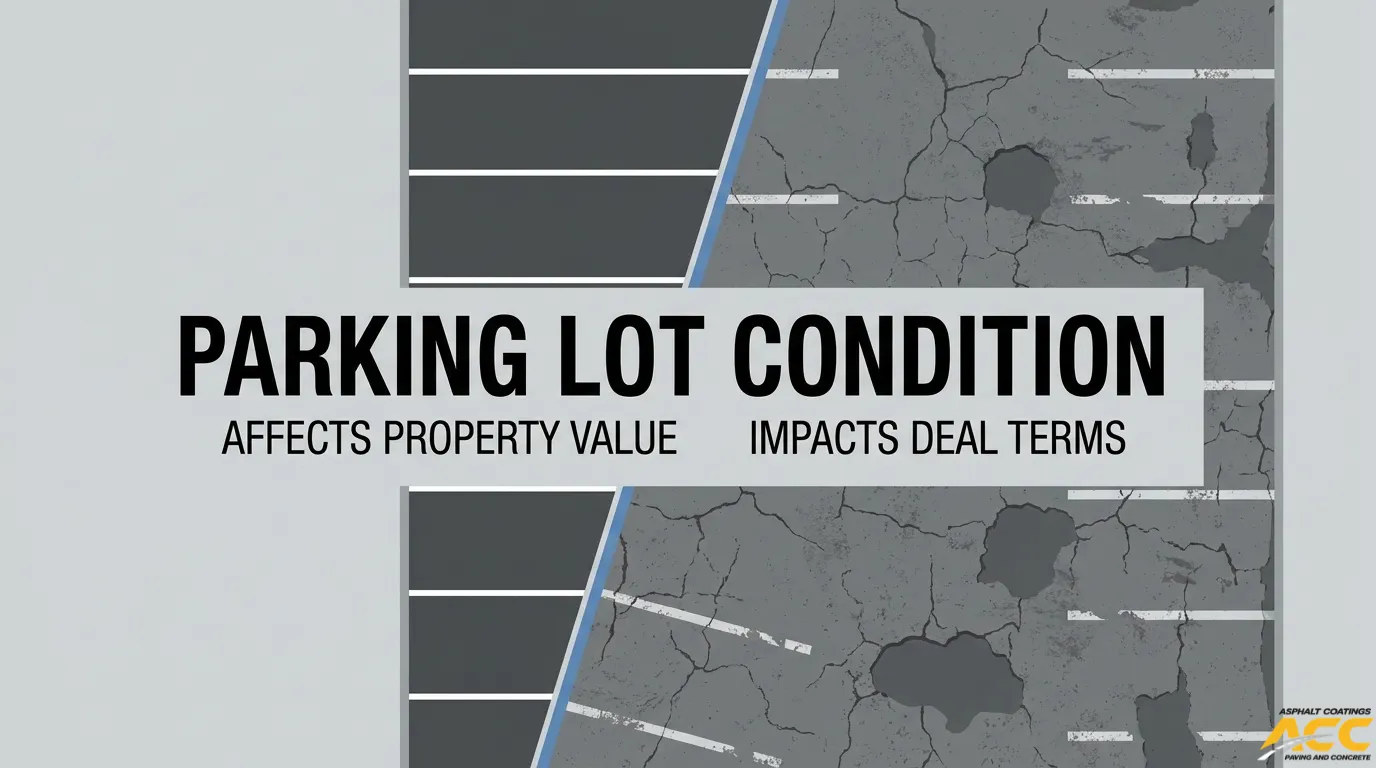
Denver’s spring pothole season is the period when freeze-thaw cycling, snowmelt infiltration, and heavy traffic converge to destroy commercial asphalt weakened by winter. Three elements drive every pothole: surface cracks, water, and repeated vehicle loads.
This guide covers freeze-thaw mechanics and winter damage accumulation, spring failure patterns across different commercial property types, warning signs that predict pavement collapse, repair and preventive treatment options, and long-term planning strategies for liability protection and cost control.
Freeze-thaw cycles force moisture into pavement cracks, where it expands as ice and contracts upon thawing. Each cycle widens fractures, loosens the aggregate-binder bond, and erodes the subgrade beneath. Snow plows, deicing salts, and UV oxidation at Denver’s high altitude compound this deterioration before spring even arrives.
Spring concentrates the consequences. Daytime thaws and overnight refreezes multiply potholes across parking lots in weeks. Saturated subgrade soil loses load-bearing capacity, and continued traffic punches through weakened surfaces into full-depth failures. Shopping centers, apartment communities, healthcare facilities, and industrial yards each face distinct vulnerability patterns based on traffic type and drainage conditions.
Early crack patterns, standing water, raveling, and faded striping all signal pavement approaching failure. Recognizing these indicators creates a window for crack sealing and sealcoating before structural collapse demands costlier interventions like infrared repair, milling, or full-depth replacement.
Proactive maintenance planning spreads costs across predictable cycles and can extend commercial pavement life from as few as 7 years to 20 years. Proper documentation of inspections and repairs also builds the strongest defense against Colorado premises liability claims tied to trip-and-fall hazards.
What Happens To Commercial Asphalt During Denver’s Winter And Spring Freeze–Thaw Cycles?
Commercial asphalt during Denver’s winter and spring freeze–thaw cycles undergoes repeated expansion and contraction that cracks the surface, weakens the base, and creates the conditions for potholes. The subsections below explain the freeze–thaw mechanism, how trapped moisture becomes potholes, and how winter maintenance equipment compounds the damage.
How Do Freeze–Thaw Cycles In Denver’s Climate Break Down Asphalt Pavement?
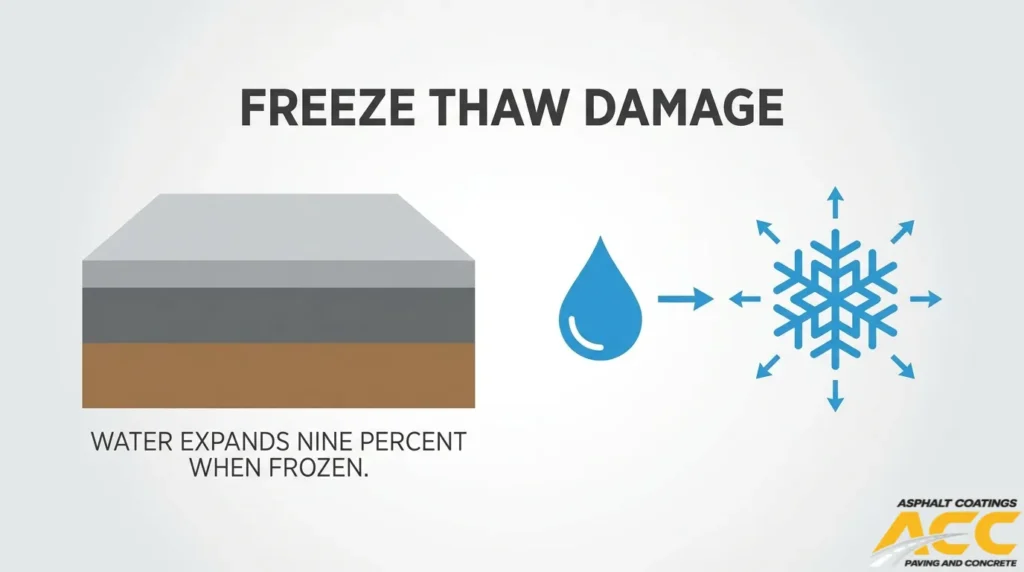
Freeze–thaw cycles in Denver’s climate break down asphalt pavement by forcing water into surface cracks, where it expands as ice and then contracts upon thawing. Each cycle widens cracks incrementally and loosens the bond between aggregate and binder.
According to Federal Highway Administration (FHWA) Long-Term Pavement Performance data, the thawing period did not begin until a temperature of −0.17 °C (31.7 °F) was achieved at the base of the asphalt, a condition not met until average soil temperature rose to approximately 1.11 °C (34 °F). This delayed thaw means moisture stays trapped longer, prolonging damage. Over time, asphalt binder oxidation further embrittles the pavement, reducing its ability to flex under thermal stress and making each subsequent freeze–thaw cycle more destructive.
Why Does Trapped Moisture Under Commercial Pavement Turn Into Potholes In Spring?
Trapped moisture under commercial pavement turns into potholes in spring because repeated freezing expands water beneath the surface, dislodging aggregate and creating voids that collapse under traffic loads. As temperatures rise, saturated subgrade soil loses structural support, and vehicle weight punches through the weakened asphalt layer above.
Three factors drive this progression:
- Surface cracks allow water infiltration during winter melt events.
- Frozen subsurface water heaves the pavement upward, breaking internal bonds.
- Spring traffic compresses the softened, void-filled pavement until chunks break free.
According to the American Public Works Association (APWA), preventing potholes requires proper surface treatment selection, correction of underlying deficiencies, and improved drainage. For most commercial lots, addressing drainage before winter is the single most cost-effective way to reduce spring pothole formation.
How Do Snow Plows, Deicing Salts, And Sand Accelerate Asphalt Damage By Spring?
Snow plows, deicing salts, and sand accelerate asphalt damage by spring through a combination of mechanical abrasion and chemical degradation. Plow blades scrape the pavement surface, stripping sealcoat and exposing raw binder to moisture infiltration. Sand particles ground into cracks by traffic act as abrasives that widen existing fissures.
According to peer-reviewed research published through the National Center for Biotechnology Information (NCBI), chloride salt erosion reduces penetration and ductility in asphalt binders, raises the softening point, and weakens the asphalt-aggregate bond. This chemical weakening compounds the physical damage from plowing, leaving commercial pavement significantly more vulnerable by the time spring freeze–thaw cycles begin their most aggressive phase.
Understanding these combined winter stressors helps property managers anticipate which pavement areas will need attention first when temperatures stabilize.
Why Is Spring The Worst Time Of Year For Potholes On Denver Commercial Properties?
Spring is the worst time of year for potholes on Denver commercial properties because snowmelt, persistent freeze-thaw cycling, and increased traffic converge on already weakened pavement. The following sections explain how each factor accelerates failure.
How Does Melting Snow And Runoff Exploit Existing Cracks After Winter?
Melting snow and runoff exploit existing cracks after winter by flooding hairline fractures and joint separations that developed during cold months. Water follows the path of least resistance, seeping through surface cracks into the aggregate base and subgrade beneath. Once trapped below the pavement, this moisture saturates and destabilizes the foundation layers that support the asphalt surface.
Denver’s spring snowmelt is particularly damaging because it arrives in repeated surges rather than a single gradual thaw. Each melt event forces more water deeper into the pavement structure, washing away fine particles that hold the base together. This erosion creates voids beneath the surface, and without that structural support, the asphalt above becomes a thin shell waiting to collapse under the next passing vehicle.
Why Do Daytime Thaws And Overnight Freezes Make Spring Potholes Multiply?
Daytime thaws and overnight freezes make spring potholes multiply because water trapped in cracks expands roughly 9% when it refreezes each night. This expansion widens existing fractures, and every warm afternoon melts the ice again, allowing water to penetrate even deeper. Denver’s spring weather routinely swings between above-freezing afternoons and below-freezing nights, creating daily freeze-thaw cycles that act like a wedge driven repeatedly into damaged pavement.
Each cycle compounds the previous one. Small cracks become interconnected networks, subsurface voids grow larger, and weakened sections that survived winter intact begin to break apart in just a few weeks. For commercial properties with large parking areas, this rapid multiplication can turn a manageable maintenance issue into widespread surface failure before property managers even schedule an inspection.
How Does Heavy Spring Traffic On Wet, Softened Asphalt Lead To Rapid Failures?
Heavy spring traffic on wet, softened asphalt leads to rapid failures because vehicle loads compress pavement that has lost its structural integrity during the thaw period. According to a peer-reviewed study published in Transportation Research Procedia, asphalt pavements weaken over time due to the combined effect of environment and heavy traffic loading, with rutting, fatigue cracking, and low-temperature cracking being the major distresses responsible for pavement degradation and failure.
Spring compounds this problem on commercial properties. Saturated subgrade soils cannot distribute wheel loads effectively, so each vehicle concentrates stress on already compromised areas. Delivery trucks, customer traffic, and service vehicles all contribute repeated impacts to the same weakened zones. For high-traffic commercial lots, even a few days of heavy use on thaw-softened pavement can punch through the surface and create full-depth potholes.
Understanding these combined spring forces helps property managers anticipate where damage will appear and how quickly it can escalate across a commercial lot.
What Types Of Damage Does Denver Pothole Season Cause On Commercial Pavement?
Denver pothole season causes several distinct types of damage on commercial pavement, ranging from cosmetic surface distress to structural failures that threaten safety. The most common damage patterns include alligator cracking, full-depth potholes, and broken edges that create liability concerns.
How Do Small Surface Cracks Turn Into Alligator Cracking By Spring?
Small surface cracks turn into alligator cracking by spring through repeated freeze-thaw cycling that forces moisture deeper into the asphalt structure with each cycle. Hairline cracks that seem minor in fall allow water to infiltrate during winter. As that moisture freezes, it expands and widens each crack. When spring thaw softens the base layer, continued traffic loading connects isolated cracks into the interconnected, cell-like pattern known as fatigue cracking or alligator cracking. According to FHWA Long-Term Pavement Performance data, approximately 49 percent of fatigue damage accumulates during winter, while 42 percent occurs in spring. This means over 90 percent of the cracking that destroys commercial parking lots concentrates in just two seasons. Catching cracks before they interconnect is the single most cost-effective intervention a property manager can make.
When Do Depressions And Birdbaths Become Full‑Depth Potholes?
Depressions and birdbaths become full-depth potholes when standing water in these low spots penetrates weakened asphalt and erodes the subgrade beneath. Three elements drive this progression: surface cracks, water, and traffic. According to a Rock Asphalt industry resource, when the freeze-thaw cycle happens in early spring, it wreaks havoc on pavement as these three factors converge. Shallow depressions trap snowmelt and rain, which seeps through cracked surfaces into the base. Repeated freezing expands the void, and daily traffic loads punch through the unsupported pavement above. Once the surface layer collapses into the eroded base, a full-depth pothole forms. Properties with poor drainage are especially vulnerable because birdbaths never fully dry, giving water constant access to the subgrade.
How Can Potholes And Broken Edges Create ADA And Trip‑Hazard Liability?
Potholes and broken edges create ADA and trip-hazard liability by producing sudden changes in surface level that exceed federal accessibility thresholds. According to ADA compliance standards referenced by PCC NorCal, a vertical change in level of just 1/4 inch (6.4 mm) is the maximum permitted without beveling, changes between 1/4 inch and 1/2 inch require beveling at a slope no steeper than 1:2, and anything over 1/2 inch requires a ramp. Spring potholes frequently exceed these limits within days of forming. Broken pavement edges along curb lines and sidewalk transitions compound the risk, particularly for visitors using wheelchairs, walkers, or other mobility aids. Colorado law establishes that commercial property owners must keep premises reasonably safe for invitees, making unaddressed pavement defects a direct liability exposure.
Understanding the specific damage patterns pothole season helps property managers identify which areas of their pavement need the most urgent attention before conditions worsen.
How Does Denver’s High‑Altitude Climate Make Commercial Asphalt More Vulnerable In Spring?
Denver’s high-altitude climate makes commercial asphalt more vulnerable in spring through intensified UV radiation, extreme temperature swings, and challenging soil drainage conditions. The following subsections cover UV degradation, Front Range thermal stress, and local drainage factors.
How Do UV Exposure And High Altitude Weaken Asphalt Before Freeze–Thaw Season?
UV exposure and high altitude weaken asphalt before freeze–thaw season by accelerating binder oxidation at the molecular level. Denver sits above 5,000 feet, where thinner atmosphere filters less ultraviolet radiation. This concentrated UV energy breaks down the flexible compounds in asphalt binder, making the surface brittle and crack-prone well before winter arrives.
When winter deicing compounds enter those UV-generated cracks, the damage compounds. According to peer-reviewed research published through the National Center for Biotechnology Information, chloride salt erosion reduces penetration and ductility in asphalt binders, raises the softening point, and weakens the asphalt-aggregate bond. Pavement that enters spring already oxidized and salt-compromised has far less structural resilience to absorb freeze–thaw stress. For commercial lots along the Front Range, this combination of altitude-driven UV aging and chemical erosion creates conditions uniquely favorable to rapid pothole formation.
Why Do Sudden Temperature Swings Along The Front Range Stress Pavement?
Sudden temperature swings along the Front Range stress pavement by forcing asphalt through repeated expansion and contraction cycles within a single day. Denver routinely sees 40- to 50-degree Fahrenheit temperature shifts between afternoon highs and overnight lows during spring. Each swing pushes asphalt to expand under warm sun, then contract sharply after sunset.
This thermal cycling generates tensile stress that accumulates in the pavement structure over weeks. Existing microcracks widen slightly with every contraction, allowing more moisture infiltration. Unlike regions with gradual seasonal transitions, the Front Range delivers these swings unpredictably, sometimes oscillating above and below freezing multiple times per week in March and April. Commercial parking lots absorb additional radiant heat during the day due to their dark surface, amplifying the temperature differential and accelerating fatigue damage at joints, edges, and previously patched areas.
How Do Local Soil Conditions And Drainage Around Denver Properties Affect Pothole Risk?
Local soil conditions and drainage around Denver properties affect pothole risk by controlling how quickly water moves away from the pavement structure. Much of the Denver metro area sits on expansive clay soils that swell when saturated and shrink when dry. This movement destabilizes the subgrade beneath commercial lots, creating voids that lead to surface depressions and eventual potholes.
Poor drainage magnifies the problem. Lots with clogged catch basins, settled curb lines, or grading that directs snowmelt toward the pavement center trap water exactly where it causes the most damage. Property owners who neglect these conditions also face legal exposure. According to the McGraw Legal Group, commercial property owners have a legal duty to keep their premises reasonably safe for customers, tenants, and visitors, including maintaining abutting public sidewalks in reasonably good condition. Proactive drainage management is both a pavement preservation strategy and a liability safeguard.
Understanding these altitude-specific vulnerabilities helps property managers target the right preventive measures before damage escalates.
Which Commercial Properties Around Denver Are Hit Hardest By Spring Potholes?
Shopping centers, apartment communities, healthcare facilities, and industrial sites are hit hardest by spring potholes around Denver. Each property type faces distinct pavement stressors that amplify seasonal damage.
Why Are Shopping Centers And Retail Parking Lots Especially Prone To Spring Failures?
Shopping centers and retail parking lots are especially prone to spring failures because of their expansive, flat pavement surfaces and constant stop-and-go traffic. Vehicles braking, turning, and idling in drive lanes concentrate stress on the same asphalt sections repeatedly. Winter deicing treatments weaken the binder-aggregate bond across these large surfaces, and when spring meltwater infiltrates through neglected cracks, the combination of softened subgrade and heavy daily traffic accelerates pothole formation. Poorly graded lots with shallow drainage slopes trap standing water in low spots, compounding the problem. For most retail property managers, the sheer square footage makes it easy to overlook early-stage distress until failures become customer-facing hazards.
How Does High Turnover At Apartment Communities Compound Pothole Damage?
High turnover at apartment communities compounds pothole damage by increasing concentrated vehicle loads on the same access routes, drive aisles, and parking stalls year-round. Move-in and move-out periods bring heavy trucks and trailers that exceed the load ratings typical parking lot pavement was designed for. Residents cycling through units also means maintenance requests for pavement issues often go unreported or deprioritized between tenancy changes. This creates a gap where cracks widen through winter unaddressed, allowing spring moisture to penetrate the base layer. Communities with tight operating budgets frequently defer preventive crack sealing, which turns manageable surface cracks into full-depth failures by April.
Why Are Hospitals And Healthcare Facilities Under Extra Pressure To Control Pavement Hazards?
Hospitals and healthcare facilities are under extra pressure to control pavement hazards because their visitors include patients with mobility impairments, wheelchair users, and individuals using walkers or crutches. Even minor surface defects pose serious trip-and-fall risks for these populations. Emergency department entrances, patient drop-off zones, and ambulance bays must remain smooth and accessible around the clock. ADA compliance requirements leave no room for deferred maintenance on walkways and parking areas. Spring pothole damage at healthcare properties creates both immediate patient safety concerns and significant premises liability exposure, making rapid response essential.
How Do Industrial Sites And Truck Yards Experience Different Spring Pavement Failures?
Industrial sites and truck yards experience different spring pavement failures because heavy axle loads from semi-trucks, forklifts, and loaded trailers impose far greater stress on asphalt than standard passenger vehicles. According to FHWA Long-Term Pavement Performance data, noninsulated pavement sections experience 65 percent of transverse cracking damage in winter followed by 25.5 percent in spring, driven by accumulated tensile stress from thermal shrinkage. On industrial lots where heavy equipment operates daily over this weakened pavement, cracks propagate into structural failures rapidly. Inadequate drainage compounds the issue; as HUD pavement maintenance guidance notes, water intrusion below the surface remains the most common cause of pavement failure.
Understanding which property type you manage helps determine the right spring repair strategy and timeline.
What Warning Signs Show Your Commercial Pavement Will Fail When Pothole Season Starts?
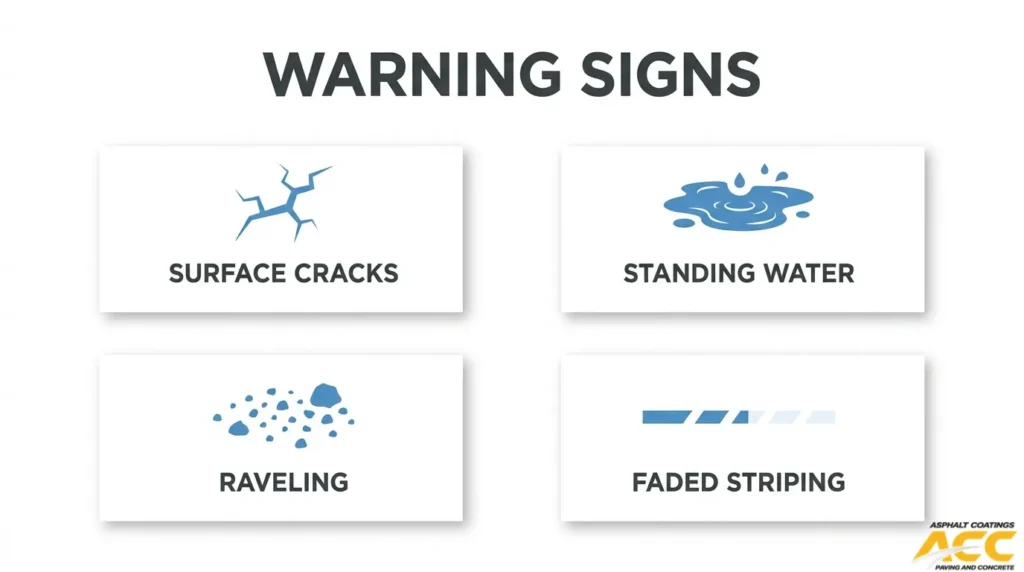
Warning signs that show your commercial pavement will fail when pothole season starts include early crack patterns, standing water from poor drainage, and surface deterioration like raveling and faded striping. Each signals a different stage of distress beneath the surface.
Which Early Crack Patterns Signal Serious Under‑Surface Problems?
Early crack patterns that signal serious under-surface problems include longitudinal cracks running parallel to traffic flow, transverse cracks spanning the pavement width, and interconnected alligator cracking. Longitudinal cracks often indicate joint failure or subgrade settlement. Transverse cracks suggest thermal contraction stress. Alligator cracking, with its grid-like pattern, reveals fatigue failure in the base layer, meaning the pavement structure itself is compromised.
When any of these patterns appear before winter ends, freeze-thaw cycles will force water deeper into each crack, accelerating deterioration exponentially. Alligator cracking in particular should be treated as urgent; once it develops, surface-level repairs rarely hold through a full pothole season.
How Do Standing Water And Poor Drainage Predict Spring Potholes?
Standing water and poor drainage predict spring potholes by allowing moisture to saturate the subgrade beneath the asphalt surface. Pooling water in low spots, along curb lines, or near clogged catch basins signals that the pavement’s grade or drainage system is failing. Once trapped below the surface, that moisture expands during freeze cycles, loosens the aggregate base, and creates voids that collapse under traffic loads.
Property managers should watch for these indicators before spring:
- Puddles that persist more than 48 hours after precipitation.
- Water flowing toward the building instead of toward drains.
- Staining or sediment deposits outlining recurring ponding areas.
- Visible erosion along pavement edges or expansion joints.
Addressing drainage deficiencies before freeze-thaw season remains the single most effective way to prevent widespread pothole formation.
When Do Raveling, Loose Aggregate, And Faded Striping Indicate Deeper Distress?
Raveling, loose aggregate, and faded striping indicate deeper distress when they appear together across broad sections rather than in isolated spots. According to the FHWA Distress Identification Manual, raveling is the wearing away of the pavement surface caused by the dislodging of aggregate particles and loss of asphalt binder, ranging from loss of fines to loss of coarse aggregate. Loose gravel scattered across the surface confirms that the binder has oxidized and can no longer hold the pavement matrix together.
Faded striping compounds the concern. When paint wears rapidly, it suggests the surface texture has degraded enough to lose adhesion. Combined, these signs mean the protective top layer is gone, leaving the structural layers fully exposed to water infiltration and freeze-thaw damage.
Recognizing these warning signs early creates the window for targeted preventive work before full failures develop.
How Can Property Managers Prepare Commercial Pavement Before Denver’s Pothole Season?
Property managers can prepare commercial pavement before Denver’s pothole season by completing fall inspections, scheduling preventive treatments during optimal weather windows, and budgeting for recurring maintenance cycles.
What Should A Pre‑Winter Pavement Inspection Checklist Include?
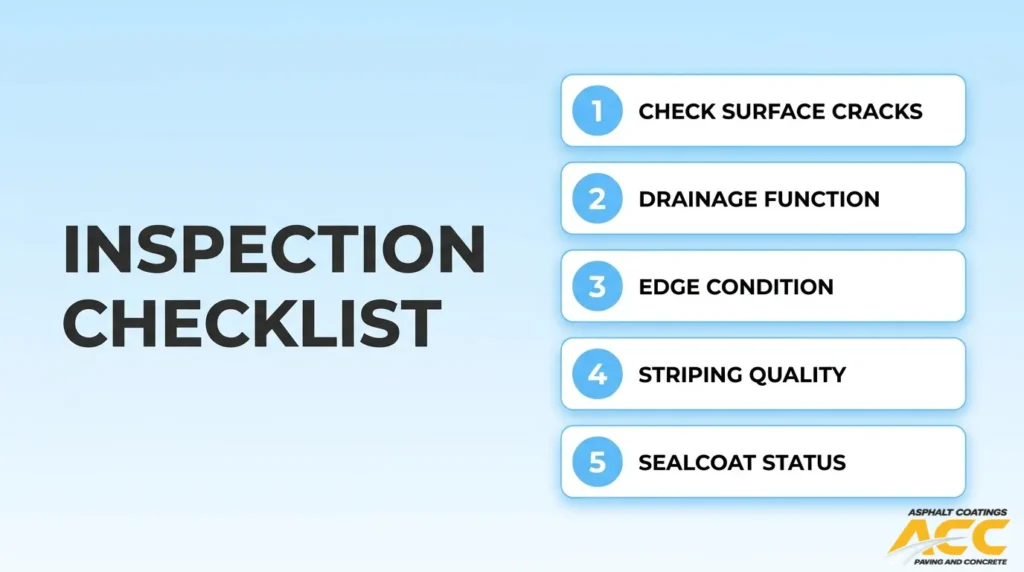
A pre-winter pavement inspection checklist should include a systematic evaluation of surface distresses, drainage function, and structural integrity. The Pavement Condition Index (PCI), a numerical index between 0 and 100, provides a standardized way to rate overall pavement health, according to the Federal Aviation Administration.
A thorough checklist covers these key items:
- Surface cracking patterns, including longitudinal, transverse, and alligator cracking
- Raveling areas where aggregate particles have dislodged from the binder
- Standing water, birdbaths, or blocked drainage inlets
- Pavement edge deterioration and curb condition
- Faded or worn striping and ADA-compliant markings
- Sealcoat condition and remaining protective coverage
Documenting conditions with photos and PCI scores before winter creates a baseline. That record makes it far easier to identify spring damage, prioritize repairs, and justify maintenance spending to ownership.
When Is The Best Time Of Year In Colorado To Schedule Preventive Asphalt Work?
The best time of year in Colorado to schedule preventive asphalt work is late spring through early fall, when sustained warm temperatures and low humidity support proper material curing. According to DBK Kriegh Inc., the best time to sealcoat blacktop is when temperatures reach 70 degrees and rising, conditions are sunny, and humidity is low.
Crack sealing performs best at moderate temperatures between 50°F and 75°F, making spring and fall the ideal windows for that treatment. For Colorado’s Front Range, this typically means scheduling sealcoating from June through September and crack sealing in May, early June, or September through mid-October. Waiting until potholes appear in spring means competing for contractor availability when demand peaks. Booking preventive work in late summer or early fall, before freeze-thaw cycles begin, gives pavement its strongest defense heading into winter.
How Should Commercial Budgets Plan For Seasonal Pavement Maintenance?
Commercial budgets should plan for seasonal pavement maintenance by establishing recurring line items tied to treatment cycles rather than reacting to emergencies. According to Cincy Asphalt, heavy-load surfaces require sealcoating reapplication every 1.5 to 2 years, with line striping and pavement markings refreshed every 2 to 3 years, always after sealcoating.
Consistent preventive investment dramatically extends pavement life. Without routine maintenance, commercial asphalt may last only 7 to 12 years; with regular inspections and preventive services, that same pavement can perform for 20 years. Budgeting should account for these recurring costs:
- Annual inspections and minor crack sealing
- Sealcoating every 2 to 3 years
- Striping and ADA marking refresh after each sealcoat
- A contingency reserve for emergency pothole repairs after severe winters
Spreading costs across predictable maintenance cycles is always more cost-effective than funding emergency full-depth replacements. Proactive planning protects both the pavement and the property’s bottom line.
With a preparation strategy in place, choosing the right repair method ensures spring damage is addressed effectively.
What Are The Best Repair Options For Potholes And Spring Damage On Commercial Asphalt?
The best repair options for potholes and spring damage on commercial asphalt range from simple patching for isolated surface failures to infrared repair, milling, and full-depth replacement for structural problems. The right method depends on damage severity, base condition, and budget.
When Is A Simple Pothole Patch Enough For A Commercial Lot In Denver?
A simple pothole patch is enough for a commercial lot in Denver when damage is isolated, shallow, and limited to the surface layer without compromising the base underneath. Patches work well for individual potholes smaller than two square feet with firm, stable subgrade beneath them. If the surrounding pavement shows no cracking, settling, or moisture intrusion, a properly compacted hot-mix patch can restore the surface effectively. However, when multiple potholes cluster in the same area or the edges of the hole crumble easily, that signals deeper structural failure where patching alone becomes a short-lived fix. For most commercial lots, patching is the right first response only when base integrity remains intact.
When Do You Need Infrared Repair, Milling, Or Full‑Depth Replacement Instead Of Patching?
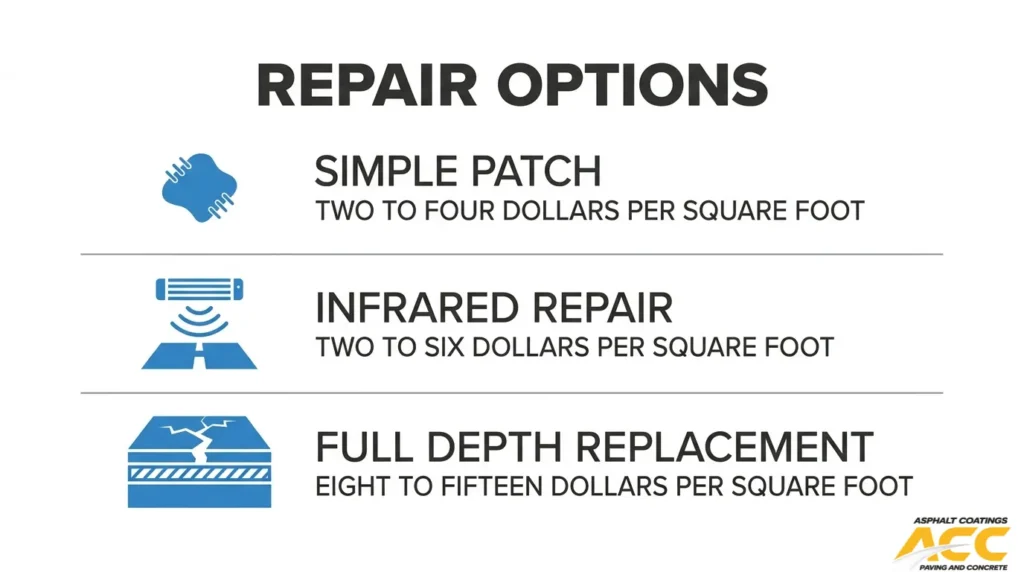
You need infrared repair, milling, or full-depth replacement instead of patching when damage extends beyond the surface into the asphalt base or subgrade. Each method addresses a different severity level:
- Infrared repair heats existing asphalt to blend new material seamlessly, ideal for moderate surface failures with intact base layers.
- Milling removes deteriorated asphalt to a specified depth before repaving, suited for widespread surface distress across larger sections.
- Full-depth replacement removes the entire pavement structure down to subgrade, necessary when base failure, standing water, or alligator cracking indicates structural collapse.
According to an industry cost analysis from Bart’s Asphalt, infrared repair costs between $2 and $6 per square foot and completes in 20 to 30 minutes, while cut-and-replace runs $8 to $15 per square foot. Matching the repair method to the actual failure depth prevents wasted spending on repeated surface patches.
How Do Temporary Cold Patches Compare To Permanent Hot‑Mix Asphalt Repairs In Spring?
Temporary cold patches compare to permanent hot-mix asphalt repairs as a short-term stopgap versus a lasting structural fix. Cold patch material can be applied in cold or wet conditions without heating, making it useful for emergency pothole filling during late winter and early spring. Hot-mix asphalt requires warm installation temperatures but bonds far more durably with surrounding pavement. For commercial properties expecting sustained traffic, cold patches rarely survive more than one season before loosening and failing again. Permanent hot-mix repairs, installed once spring temperatures stabilize, deliver the compaction and adhesion needed for multi-year performance. Investing in hot-mix as soon as weather permits eliminates the cycle of repeatedly filling the same potholes.
With repair strategies selected, sealcoating and crack sealing protect those investments from the next freeze-thaw cycle.
How Do Sealcoating And Crack Sealing Help Commercial Pavement Survive Denver’s Pothole Season?
Sealcoating and crack sealing help commercial pavement survive Denver’s pothole season by blocking moisture infiltration and restoring surface resilience before freeze-thaw cycles cause structural failure. The sections below explain how each treatment prevents potholes, when to schedule them, and how often busy lots need reapplication.
How Does Crack Sealing Keep Meltwater From Turning Into Spring Potholes?
Crack sealing keeps meltwater from turning into spring potholes by filling open cracks with flexible, hot-applied sealant that blocks water from reaching the sub-base. Once moisture penetrates below the surface, freeze-thaw cycles expand it repeatedly, weakening the pavement structure until traffic loads punch through. Sealed cracks eliminate that entry point entirely.
According to the Federal Aviation Administration, the Pavement Condition Index (PCI) rates pavement on a 0-to-100 scale, where 0 is the worst condition and 100 is the best. Crack sealing directly protects PCI scores by stopping the progression from hairline cracks to base erosion. For commercial properties, maintaining those scores through timely crack sealing costs a fraction of what full-depth pothole repair demands later. Property managers working with experienced commercial contractors can establish regular crack sealing programs using CDOT-approved materials designed for Colorado winters. This proactive approach protects both immediate pavement condition and long-term replacement budgets.
When Should Commercial Properties Schedule Sealcoating In Colorado’s Climate?
Commercial properties should schedule sealcoating in Colorado’s climate during late spring through early fall, when conditions consistently meet application requirements. Sealcoat needs warm, dry weather to cure properly.
Optimal conditions include:
- Pavement temperatures of 50°F or above, ideally 70°F and rising.
- Humidity below 50%.
- No rain forecasted within 48 hours of application.
According to The Surface Masters, sealant manufacturers confirm that temperatures between 50 and 90°F with low humidity produce the best results. In Colorado, this window typically runs from May through September. Scheduling sealcoating before Denver’s first hard freeze gives the coating a full season to protect against winter moisture and spring meltwater.
How Often Should Busy Commercial Parking Lots Be Sealed To Withstand Freeze-Thaw Stress?
Busy commercial parking lots should be sealed every two to three years under standard traffic conditions. High-traffic or heavy-load surfaces, such as distribution centers and industrial lots, benefit from reapplication every 1.5 to 2 years.
Factors that shorten sealcoating intervals include:
- Constant truck or delivery vehicle traffic.
- Exposure to deicing salts throughout winter.
- South-facing lots with intense UV degradation.
- Poor drainage that pools water on the surface.
Most commercial contractors recommend the two-to-three-year cycle as a baseline. Properties experiencing heavier wear should inspect annually and adjust the schedule accordingly. Consistent resealing is one of the most cost-effective ways to extend pavement life and avoid the compounding repair costs that Denver’s pothole season creates each spring.
With preventive treatments in place, prioritizing repairs by safety risk keeps commercial properties compliant and protected.
How Should Denver Property Managers Prioritize Pothole Repairs For Safety And Liability?
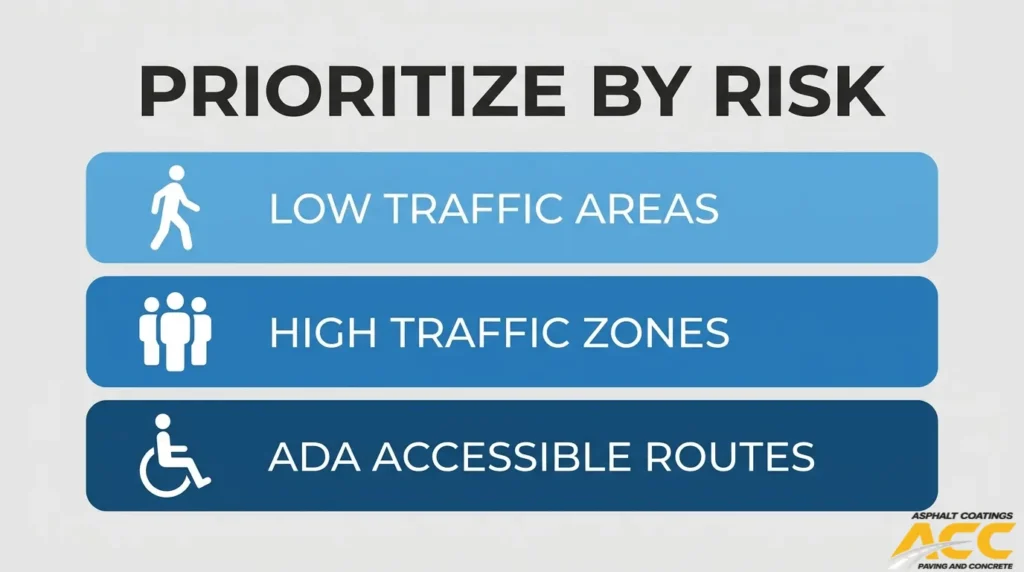
Denver property managers should prioritize pothole repairs by addressing the highest-risk hazards first, then ensuring ADA compliance, and maintaining thorough documentation throughout the process. The following subsections cover trip-and-fall risk assessment, accessibility requirements, and recordkeeping practices.
Which Potholes And Surface Defects Create The Highest Trip‑And‑Fall Risk?
The potholes and surface defects that create the highest trip-and-fall risk are those located in high-traffic pedestrian zones with significant depth or irregular edges. According to the Colorado Judicial Branch’s premises liability standards, Colorado law establishes liability for property owners based on the status of the injured person, whether trespasser, licensee, or invitee, with elements determined by the court.
Defects that demand immediate attention include:
- Potholes deeper than two inches near building entrances, crosswalks, or accessible parking spaces.
- Broken or heaved pavement edges along sidewalks and curb ramps.
- Depressions that collect standing water, concealing their true depth from pedestrians.
- Crumbling asphalt at drive aisle transitions where foot traffic intersects vehicle paths.
Commercial property owners carry a legal duty to keep premises reasonably safe for customers, tenants, and visitors. Prioritizing repairs in areas with the heaviest pedestrian volume reduces both injury risk and exposure to premises liability claims.
How Do Pavement Conditions Affect ADA Accessibility And Compliance?
Pavement conditions affect ADA accessibility and compliance by creating level changes and uneven surfaces that obstruct wheelchair users, people with mobility aids, and those with visual impairments. According to the U.S. Access Board’s ADA Accessibility Standards, accessible surfaces must be slip resistant to minimize hazards, especially for individuals who are ambulatory, semi-ambulatory, or use canes, crutches, and other walking aids.
ADA-critical thresholds for pavement level changes are:
- Vertical changes up to 1/4 inch (6.4 mm) are permitted without modification.
- Changes between 1/4 inch and 1/2 inch require beveling at a slope no steeper than 1:2.
- Changes exceeding 1/2 inch require a compliant ramp.
Spring freeze-thaw damage frequently pushes pavement defects past these thresholds. Chloride salt erosion further accelerates deterioration by weakening asphalt binder-aggregate adhesion, which produces the loose, uneven surfaces that violate accessibility requirements. Property managers should measure level changes at accessible routes after each winter season and schedule repairs before defects cross the 1/2-inch threshold.
What Documentation Should Property Managers Keep When Addressing Pavement Hazards?
The documentation property managers should keep when addressing pavement hazards includes inspection records, repair logs, photographic evidence, and communication records that demonstrate a consistent duty of care. This paper trail serves as the primary defense against premises liability claims in Colorado courts.
Essential records to maintain include:
- Dated inspection reports noting defect locations, measurements, and severity ratings.
- Timestamped photographs of hazards before, during, and after repair.
- Work orders and contractor invoices showing repair scope and completion dates.
- Incident reports for any slip, trip, or fall events on the property.
- Correspondence with tenants or visitors who reported pavement concerns.
Consistent documentation proves that management acted promptly and reasonably. Even when budget constraints delay permanent repairs, records showing temporary measures, such as barricades, warning cones, or cold patches, demonstrate proactive hazard management. For Denver property managers, maintaining a seasonal inspection schedule tied to spring pothole season builds the strongest possible liability defense.
With repair priorities and documentation protocols established, long-term pavement planning can further reduce seasonal costs.
How Can Long‑Term Pavement Planning Reduce The Impact Of Denver’s Annual Pothole Season?
Long-term pavement planning reduces the impact of Denver’s annual pothole season by replacing reactive emergency repairs with scheduled, cost-effective maintenance cycles. The subsections below cover multi-season budgeting, overlay timing, and tenant-facing benefits.
How Do Pavement Management Plans Spread Costs Over Multiple Seasons?
Pavement management plans spread costs over multiple seasons by scheduling preventive treatments, such as crack sealing, sealcoating, and minor patching, at planned intervals instead of funding large emergency repairs after failures occur. This approach converts unpredictable capital expenses into manageable annual line items.
A typical plan phases work by priority:
- Year one: crack sealing and sealcoating on the highest-traffic zones.
- Year two: overlay or patching on secondary lots and access drives.
- Year three: re-striping, drainage corrections, and condition reassessment.
According to a Carolina Asphalt commercial maintenance guide, commercial asphalt without routine maintenance may last only 7 to 12 years, while consistent inspections and preventive services can extend pavement performance to 20 years. Spreading that maintenance across budget cycles eliminates the financial shock of full-depth replacement and keeps pavement above the condition threshold where potholes form.
When Does It Make Financial Sense To Overlay Instead Of Constantly Patching?
It makes financial sense to overlay instead of constantly patching when cumulative patch costs approach the per-square-foot price of an asphalt overlay and the pavement shows interconnected distress rather than isolated failures. Repeated cold patches at $2 to $4 per square foot add up quickly on a large commercial lot, while an asphalt overlay runs $4 to $12 per square foot and resets the surface life entirely.
A practical decision threshold: if a parking lot requires patching in more than 25 to 30 percent of its total area within a two-year window, overlay typically delivers better long-term value. Overlays seal underlying cracks, restore drainage grade, and eliminate the patchwork surface that traps water and accelerates future freeze-thaw damage. For most Denver commercial properties, investing in an overlay before cumulative patching exceeds that cost threshold is the smarter financial move.
How Can Proactive Maintenance Protect Tenant Experience And Property Reputation?
Proactive maintenance protects tenant experience and property reputation by keeping parking surfaces smooth, well-marked, and free of hazards that drive complaints, liability claims, and lease non-renewals. Potholes and crumbling edges signal neglect to tenants, customers, and visitors before they ever step inside a building.
Key reputation benefits of a proactive approach include:
- Reduced liability exposure: well-maintained surfaces minimize trip-and-fall incidents and ADA compliance gaps.
- Higher tenant retention: commercial tenants expect functional, safe parking as a baseline amenity.
- Stronger curb appeal: fresh sealcoating and clean striping visually communicate professional property management.
- Lower emergency spending: scheduled work prevents the costly, disruptive scramble of spring pothole season.
Properties that defer maintenance often spend more on reactive repairs while simultaneously losing tenants frustrated by unsafe conditions. Prioritizing pavement upkeep is one of the most visible ways a property manager can demonstrate operational competence.
With a long-term plan in place, partnering with an experienced contractor turns strategy into results.
How Should You Approach Denver Pothole Season With Asphalt Coatings Company’s Commercial Services?
You should approach Denver pothole season with Asphalt Coatings Company’s commercial services by combining preventive treatments with timely repairs. According to Carolina Asphalt’s Commercial Parking Lot Maintenance Guide, commercial asphalt without routine maintenance may last only 7 to 12 years, but consistent inspections and preventative services can extend pavement performance to 20 years.
How Can Commercial Paving, Sealcoating, And Crack Sealing From Asphalt Coatings Company Help You Prevent And Repair Spring Pothole Damage?
Commercial paving, sealcoating, and crack sealing from Asphalt Coatings Company help prevent and repair spring pothole damage by addressing each stage of pavement deterioration before it escalates. Crack sealing stops meltwater from penetrating the base layer where freeze-thaw cycles cause the most harm. Sealcoating shields the surface from oxidation, moisture intrusion, and UV degradation. When damage has already progressed, Asphalt Coatings Company provides patching, mill and pave services, and full-depth replacement using in-house crews.
Optimal sealcoating conditions require temperatures between 50 and 90°F, humidity below 50%, and no rain within 48 hours. Most commercial contractors recommend sealcoating every 2 to 3 years to maintain protection. Scheduling these services in late spring or early summer, once Denver’s temperatures stabilize, gives property managers the best results. Working with a contractor experienced in Colorado’s specific freeze-thaw cycles ensures repairs are engineered for Front Range conditions. Asphalt Coatings Company has served commercial properties across the Denver metro since 1986, using in-house crews trained specifically for high-altitude climate challenges.
What Are The Key Takeaways About Why Denver’s Spring Pothole Season Wrecks Commercial Pavement And How Property Managers Should Respond?
The key takeaways about why Denver’s spring pothole season wrecks commercial pavement center on three converging forces: surface cracks, water infiltration, and traffic. According to FHWA Long-Term Pavement Performance Data Analysis, approximately 49 percent of fatigue damage accumulates during winter and 42 percent occurs in spring, with partial thawing of the pavement base driving much of that deterioration.
Property managers should respond with these priorities:
- Schedule post-winter inspections to identify cracks, depressions, and drainage failures before spring thaw peaks.
- Seal all visible cracks before moisture can reach the subgrade.
- Budget for sealcoating on 2 to 3 year cycles to maintain a protective barrier.
- Address potholes with permanent hot-mix repairs rather than relying solely on temporary cold patches.
- Partner with a contractor experienced in Colorado’s freeze-thaw conditions to build a multi-season maintenance plan.
Reactive patching alone will never outpace the damage Denver’s climate inflicts each spring. Asphalt Coatings Company brings 39 years of Front Range experience to commercial pavement projects, offering paving, sealcoating, crack sealing, and ADA-compliant concrete work through in-house crews dedicated to long-term pavement performance.