Choosing between concrete and asphalt for a commercial parking lot in Fort Collins is a material performance decision shaped by local climate, traffic demands, and long-term budget goals. Each surface handles the region’s freeze-thaw cycles, UV exposure, and heavy vehicle loads differently.
This guide covers climate and durability factors, installation and maintenance planning, lifecycle cost analysis, winter and environmental performance, property-type recommendations, and compliance with ADA and local design standards.
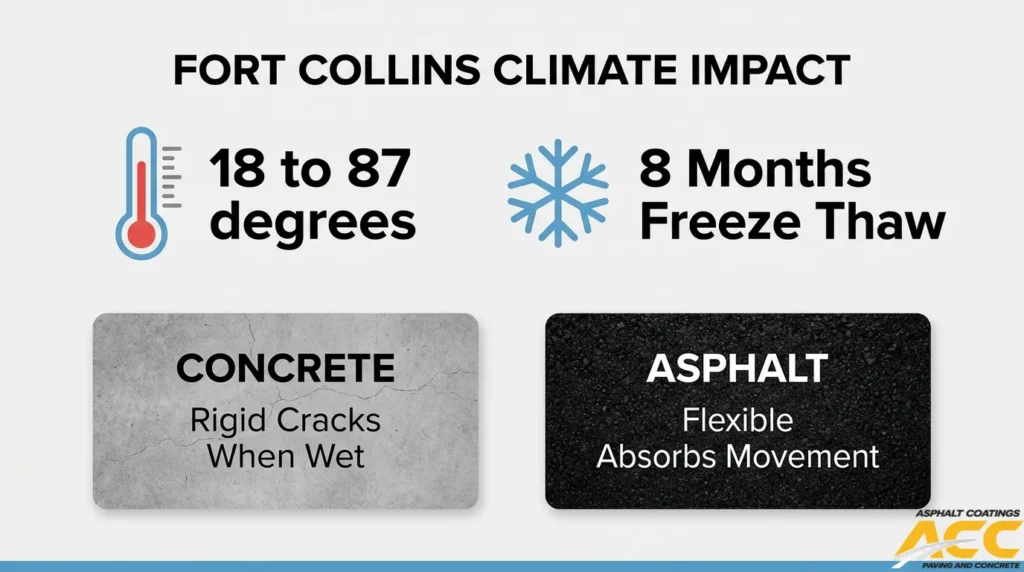
Fort Collins temperatures swing nearly 70 degrees across the year, with freezing conditions stretching from mid-September through mid-May. That eight-month freeze-thaw window affects asphalt and concrete in opposite ways; asphalt flexes under frost heave while concrete holds its shape under heat but cracks when trapped moisture expands.
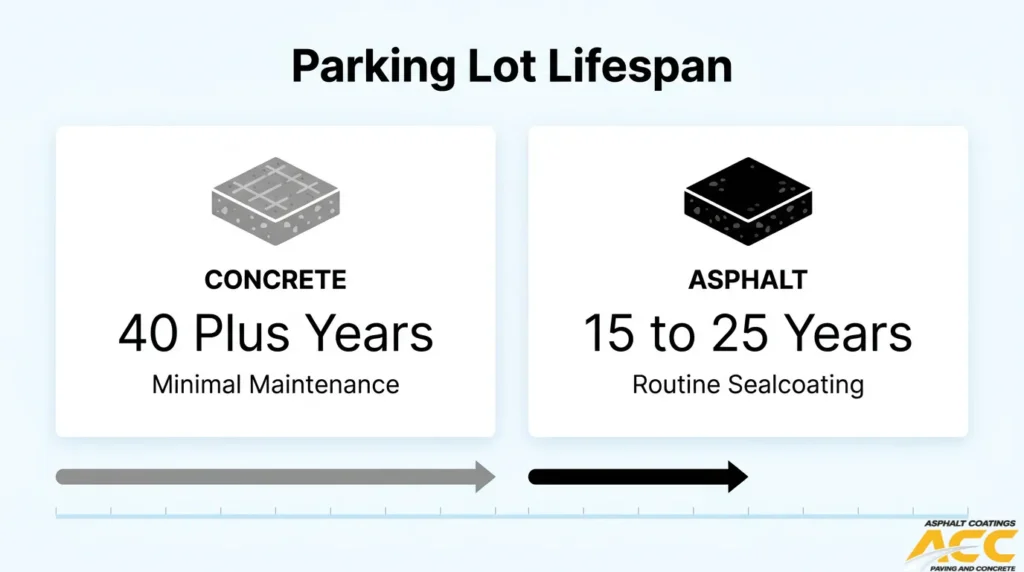
Concrete parking lots can perform for 40 or more years with minimal intervention, while asphalt lots typically last 15 to 25 years with routine sealcoating and crack sealing. Asphalt installs faster (often ready for traffic within 24 to 48 hours), whereas concrete requires a minimum seven-day cure before vehicles can use the surface.
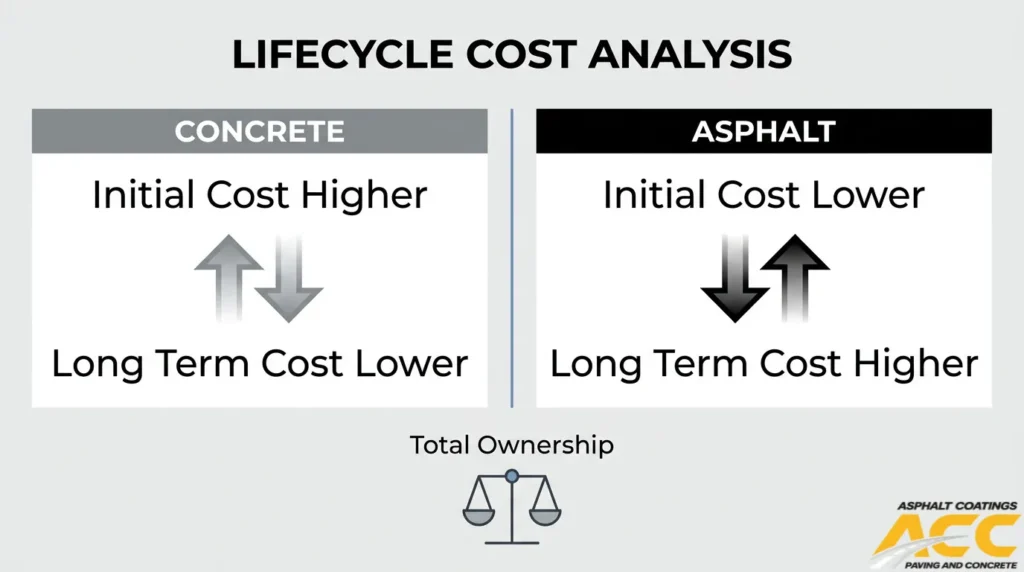
Cost comparisons shift depending on the time horizon. Asphalt runs 30% to 40% lower per square foot upfront, but concrete’s longer service life means fewer full replacements over a property’s lifetime. Chloride-based deicers also create hidden expenses, corroding concrete reinforcement while gradually degrading asphalt binder.
Different commercial properties benefit from different strategies. Shopping centers, industrial facilities, multifamily communities, and healthcare campuses each face unique load, accessibility, and aesthetic priorities. For most Fort Collins properties, a hybrid approach (asphalt for general parking with concrete at high-stress zones like dumpster pads and loading docks) delivers the strongest balance of cost and performance. Asphalt Coatings Company has been implementing hybrid paving solutions across Colorado’s Front Range since 1986, combining their concrete flatwork and asphalt paving capabilities to optimize performance for commercial properties facing the region’s demanding climate conditions.
How Do Fort Collins’ Climate and Conditions Affect Concrete vs Asphalt Parking Lots?
Fort Collins’ climate and conditions affect concrete vs asphalt parking lots through extreme temperature swings, prolonged freeze-thaw exposure, and intense high-altitude sun. Each material responds differently to these stresses.
Fort Collins experiences average monthly temperatures ranging from 18.3°F to 87.4°F, according to the Colorado Climate Center. That nearly 70-degree seasonal swing creates distinct performance challenges for both paving materials. Freezing temperatures are probable from mid-September through mid-May, meaning commercial parking lots endure roughly eight months of potential freeze-thaw cycling each year.
Asphalt’s flexibility allows it to absorb minor ground movement caused by frost heave without cracking immediately. However, repeated thermal cycling softens and hardens the binder over time, accelerating surface deterioration. Concrete, being rigid, resists deformation under heat but is more vulnerable to cracking when moisture trapped in joints freezes and expands.
Colorado’s high-altitude UV exposure adds another layer of stress. Ultraviolet radiation oxidizes asphalt binder faster than in lower-elevation regions, turning surfaces brittle if left unprotected by sealcoating. Concrete holds up better against UV degradation but remains susceptible to surface scaling when freeze-thaw cycles combine with moisture infiltration.
For Fort Collins property managers, these overlapping climate factors make material selection more consequential than in milder regions. Neither surface is immune to local conditions; the better choice depends on how each material’s vulnerabilities align with a property’s specific maintenance capacity and traffic demands.
How Do Concrete and Asphalt Compare for Durability and Lifespan in Commercial Parking Lots?
Concrete and asphalt compare differently for durability and lifespan in commercial parking lots based on material composition, load tolerance, and expected service years. Each surface handles wear, weather, and heavy traffic in distinct ways.
Concrete parking lots deliver exceptional longevity. According to the Federal Highway Administration, long service life is a hallmark of concrete pavements, and it is not uncommon for them to provide outstanding performance for 40 or more years. This rigid surface resists rutting under heavy vehicle loads, making it well suited for areas with constant truck traffic or stationary equipment. However, when concrete does crack, repairs tend to be more complex and costly than asphalt fixes.
Asphalt parking lots typically last 15 to 25 years with proper maintenance, including routine sealcoating and crack sealing. The flexible nature of asphalt allows it to absorb minor ground movement without fracturing immediately. That said, asphalt is more susceptible to surface deterioration from UV exposure and oxidation over time, which gradually breaks down the binder holding the aggregate together.
Key durability differences include:
- Concrete resists deformation under sustained heavy loads, while asphalt can develop ruts in high-traffic lanes.
- Asphalt absorbs thermal expansion more readily, reducing the risk of sudden cracking during temperature shifts.
- Concrete requires fewer interventions over its lifespan but demands higher repair costs per incident.
- Asphalt needs more frequent maintenance yet offers simpler, less expensive individual repairs.
For most commercial property managers weighing long-term value, the decision often comes down to traffic intensity and maintenance commitment. A concrete lot rewards owners who prioritize longevity with minimal intervention, while asphalt suits properties where flexible budgeting and phased upkeep align better with operational needs.
Understanding how each material installs and cures helps property managers plan for minimal business disruption during construction.
How Do Installation and Curing Time Differ Between Concrete and Asphalt for Busy Commercial Properties?
Installation and curing time differ significantly between concrete and asphalt for busy commercial properties, with asphalt offering much faster turnaround. The subsections below compare each material’s installation process, curing requirements, and strategies for minimizing business disruption.
How Quickly Can an Asphalt Parking Lot Be Installed and Ready for Traffic?
An asphalt parking lot can typically be installed and ready for traffic within one to three days for most commercial projects. Asphalt is placed hot, compacted with rollers, and cools rapidly to a usable state. Most lots can handle vehicle traffic within 24 to 48 hours after final compaction, depending on ambient temperature and lot size. This quick turnaround makes asphalt particularly practical for retail centers, medical campuses, and apartment communities where prolonged closures directly affect revenue and tenant satisfaction. For property managers juggling daily operations, few paving options match asphalt’s ability to minimize downtime. Asphalt Coatings Company’s in-house crews complete commercial asphalt installations with minimal business disruption, a critical capability for retail centers and medical campuses where extended closures directly impact revenue and patient access.
How Long Does Concrete Parking Lot Installation and Curing Take?
Concrete parking lot installation and curing take substantially longer than asphalt. The process involves formwork construction, steel reinforcement placement, pouring, finishing, and a controlled curing period. Concrete requires a minimum of seven days to reach adequate strength for vehicle traffic, with full design strength developing over 28 days. During curing, the surface must remain moist and protected from temperature extremes, which can further extend timelines in variable weather. For a busy commercial property, this means weeks of partial or full closure across phased pours. The extended schedule demands careful coordination to keep adjacent businesses accessible throughout the project.
What Strategies Help Minimize Business Disruption During Parking Lot Paving?
Strategies that help minimize business disruption during parking lot paving include phased construction, off-hours scheduling, and clear tenant communication. Key approaches property managers should consider:
- Phased paving divides the lot into sections so portions remain open while others are under construction.
- Night or weekend paving shifts work around peak business hours, especially for retail and healthcare properties.
- Temporary directional signage and traffic control maintain safe access for customers during active work zones.
- Coordinating material deliveries during low-traffic windows reduces congestion at lot entrances.
Asphalt’s fast cure time makes phased construction especially efficient, since completed sections reopen within a day or two. Concrete phasing, while effective, requires longer intervals between phases due to extended curing. Understanding each material’s installation timeline shapes smarter project planning for Fort Collins commercial properties.
How Do Maintenance and Repair Needs Compare Between Concrete and Asphalt Parking Lots?
Maintenance and repair needs differ significantly between concrete and asphalt parking lots in terms of frequency, cost, and complexity. Asphalt requires more routine upkeep but offers simpler, less expensive repairs, while concrete demands less frequent attention but presents costlier fixes when damage occurs.
Asphalt parking lots need regular preventive maintenance to maximize their service life. The most common tasks include:
- Sealcoating every two to three years to protect against UV degradation, moisture intrusion, and oxidation.
- Crack sealing as soon as cracks appear, preventing water from penetrating the subbase and causing further deterioration.
- Pothole patching using hot-mix or cold-mix asphalt, which can typically be completed within hours.
- Overlay or mill-and-pave for surfaces with widespread wear, restoring the driving surface without full replacement.
These repairs are straightforward because asphalt is a flexible pavement. Damaged sections can be cut out and replaced with matching material that bonds to the existing surface, keeping the lot operational with minimal downtime.
Concrete parking lots require less frequent maintenance, but repairs are more involved when they become necessary. Common concrete maintenance needs include:
- Joint sealing to prevent water and debris from entering expansion joints, which can cause subgrade erosion.
- Slab replacement for cracked or settled panels, requiring the removal and repouring of entire sections.
- Spalling repair where the surface layer flakes due to freeze-thaw cycling or deicing chemical exposure.
- Grinding or leveling to correct uneven slabs that create trip hazards.
Color matching is one of the most persistent challenges with concrete repairs. New concrete rarely matches the weathered tone of surrounding panels, leaving visible patchwork that can affect a property’s appearance. Asphalt repairs, by contrast, blend more uniformly after sealcoating.
From a practical standpoint, asphalt’s lower per-repair cost and faster turnaround make it easier to maintain on a rolling budget. Concrete’s higher durability means fewer interventions overall, but each intervention carries a larger price tag and longer disruption window. For commercial property managers balancing uptime with long-term investment, this trade-off is often the deciding factor.
Understanding these maintenance profiles becomes especially important when evaluating total cost of ownership over a parking lot’s full lifespan.
How Do Concrete and Asphalt Parking Lots Compare in Cost Over the Life of a Commercial Property?
Concrete and asphalt parking lots compare in cost over the life of a commercial property through differences in upfront investment, ongoing maintenance expenses, and total replacement cycles. The sections below break down initial pricing, long-term maintenance costs, and hidden expenses that shape true lifecycle value.
Asphalt parking lots cost significantly less to install than concrete. Typical asphalt installation runs roughly 30% to 40% lower per square foot, making it the more accessible option for property managers working within tight capital budgets. However, that initial savings tells only part of the story. Asphalt requires periodic sealcoating every two to three years, plus crack sealing and occasional patching, which accumulate steadily over the pavement’s 20- to 30-year lifespan. Concrete, by contrast, demands a larger upfront commitment but needs far fewer interventions during its service life. According to the Federal Highway Administration, concrete pavements commonly provide outstanding performance for 40 or more years. That extended lifespan means fewer full-replacement cycles over a property’s lifetime, which can offset the higher initial price.
The true cost comparison also depends on factors that are easy to overlook during budgeting. Chloride-based deicers, commonly used across Colorado’s long winters, create indirect costs; the National Concrete Pavement Technology Center notes these salts can corrode steel reinforcement in concrete, leading to premature joint deterioration and costly repairs. Asphalt surfaces tolerate salt application more readily but still require resealing afterward. When concrete overlays are used to reinforce aging asphalt, the National Concrete Pavement Technology Center recommends joint patterns of small 4- to 6-foot squares, adding design and labor costs that property managers should anticipate. For most commercial properties, the lowest lifecycle cost comes from matching the pavement type to the property’s expected traffic load, maintenance capacity, and budget horizon rather than choosing based on installation price alone.
Understanding cost over time positions property managers to weigh winter maintenance factors, which directly influence long-term pavement expenses.
How Do Snow, Ice, and Deicing Practices Impact Concrete vs Asphalt in Fort Collins?
Snow, ice, and deicing practices impact concrete and asphalt in Fort Collins differently due to each material’s vulnerability to freeze-thaw cycles and chemical exposure. The key factors include surface spalling, pothole formation, and long-term chemical damage.
Fort Collins experiences freezing temperatures from mid-September through mid-May, which means parking lots endure roughly eight months of potential freeze-thaw stress each year. Water seeps into surface cracks, freezes, expands, and breaks the pavement apart from within. Asphalt’s flexibility allows it to absorb minor expansion without cracking immediately, while concrete’s rigid structure makes it more prone to surface spalling when trapped moisture freezes repeatedly.
Deicing chemicals present a distinct challenge for each material. According to the National Concrete Pavement Technology Center, the most common deicers used on pavements are chloride-based salts, which involve indirect costs because of the potential for corrosion of steel reinforcement in concrete and corrosive damage to automobile bodies. Concrete surfaces are particularly susceptible to scaling and pitting when chloride salts penetrate the pore structure, especially during the first few winters after installation. Asphalt resists chemical degradation from salt more effectively, though petroleum-based deicers can soften its binder over time.
Snow removal practices also affect each surface differently. Snowplow blades can catch on raised concrete joints and crack slab edges, creating entry points for moisture. Asphalt’s smoother, continuous surface allows plows to glide without catching, reducing mechanical damage during clearing operations.
For commercial property managers in Fort Collins, this distinction matters when calculating long-term maintenance costs. Concrete parking lots in heavily salted areas may require joint sealing and surface treatments more frequently. Asphalt lots benefit from periodic sealcoating, which restores the protective layer that salt and plowing gradually wear away. Choosing the right material often depends on how aggressively a property uses chemical deicers and how frequently snow removal occurs throughout the season.
Understanding how winter conditions affect your parking surface leads naturally to another critical factor: how each material influences safety, visual appeal, and the impression your property makes on visitors.
How Do Safety, Appearance, and Brand Image Differ Between Concrete and Asphalt Parking Lots?
Safety, appearance, and brand image differ between concrete and asphalt parking lots in visibility, surface texture, stain resistance, and the overall impression each material creates for customers and tenants.
Concrete parking lots offer a lighter surface color that improves nighttime visibility under artificial lighting. This brighter reflectance reduces the need for additional light fixtures while helping drivers and pedestrians see lane markings, curbs, and obstacles more clearly. Asphalt’s darker surface absorbs more light, which can make poorly lit areas harder to navigate after dark. However, fresh sealcoating on asphalt creates a uniform, well-maintained appearance that signals attentiveness to property upkeep.
From a traction standpoint, both materials provide adequate grip when properly finished. Asphalt’s slightly textured surface offers reliable skid resistance, while concrete can be broom-finished or stamped to enhance traction in pedestrian zones. Where safety risk increases is at transitions between the two materials; uneven joints or height differences at concrete-to-asphalt seams require careful installation to prevent trip hazards.
Appearance shapes first impressions for every visitor. Key visual differences include:
- Concrete resists oil and fluid stains better than asphalt, maintaining a cleaner look in high-traffic areas.
- Asphalt tends to show oil spots and tire marks more visibly, though routine sealcoating refreshes its appearance.
- Concrete accepts decorative finishes, colored aggregates, and stamped patterns that reinforce brand identity at entryways.
- Asphalt delivers a clean, uniform black surface that looks sharp immediately after installation or recoating.
For commercial properties where brand image matters, the parking lot is often the first physical touchpoint a customer experiences. A well-maintained asphalt lot with crisp striping and fresh sealcoat communicates professionalism just as effectively as a concrete surface. The deciding factor is usually maintenance consistency rather than the material itself. Properties that invest in regular upkeep project a strong brand image regardless of which paving material they choose.
Understanding how each surface affects your property’s visual identity leads naturally into another critical factor: how concrete and asphalt handle drainage, environmental impact, and heat.
How Do Concrete and Asphalt Parking Lots Affect Drainage, Environmental Impact, and Heat?
Concrete and asphalt parking lots affect drainage, environmental impact, and heat in distinct ways based on their surface properties and material composition. The key differences involve stormwater runoff behavior, urban heat island contribution, and available eco-friendly alternatives.
Both concrete and asphalt are impervious surfaces, meaning they prevent rainwater from soaking into the ground naturally. This forces stormwater across the parking lot surface, picking up oil, sediment, and pollutants before entering storm drains. Proper grading, catch basins, and retention areas are essential for both materials. However, asphalt’s flexibility allows easier integration of drainage slopes during installation, while concrete’s rigid surface can be more precisely graded to direct water flow toward collection points.
Where the two materials diverge most is heat absorption. Asphalt’s dark color absorbs significantly more solar radiation than concrete’s lighter surface. According to a U.S. Environmental Protection Agency pilot study in Arizona, conventional asphalt can reach surface temperatures up to 152°F at mid-day, while cool pavements remained 10 to 16°F cooler. Concrete’s higher solar reflectance reduces its contribution to urban heat island effects, which matters for large commercial lots where radiated heat affects building cooling costs and pedestrian comfort.
For property managers prioritizing environmental performance, permeable pavement options exist for both materials. The EPA identifies permeable pavements as a stormwater control that allows infiltration through the surface to the ground below, serving as a green infrastructure alternative to traditional impervious surfaces. Pervious concrete and porous asphalt both reduce runoff volume, though each requires specific subbase design and ongoing maintenance to prevent clogging.
From a recyclability standpoint, asphalt holds an advantage. Reclaimed asphalt pavement can be milled, reprocessed, and reused in new paving projects, making it one of the most recycled materials in the country. Concrete is also recyclable as crushed aggregate, though the process is more energy-intensive. For commercial properties balancing budget with environmental responsibility, this recyclability factor often tips the scale toward asphalt for standard lot areas while reserving concrete for high-visibility or high-load zones.
Understanding how each material handles drainage and heat helps property managers select the right surface for ADA-compliant, well-designed parking lots.
Which Is Better for Different Types of Commercial Properties in Fort Collins: Concrete or Asphalt?
The better choice between concrete and asphalt depends on the specific demands of each commercial property type. Shopping centers, industrial facilities, multifamily communities, and healthcare campuses each prioritize different performance factors.
How Should Property Managers for Shopping Centers Weigh Concrete vs Asphalt?
Property managers for shopping centers should weigh concrete vs asphalt by prioritizing high-traffic durability, curb appeal, and maintenance scheduling around peak retail periods. Shopping centers generate constant vehicle and cart traffic across large surface areas, making pavement longevity a core concern.
Key factors for shopping center parking lots include:
- Traffic volume and turning stress: Concrete resists rutting in high-turn areas near entrances, while asphalt handles general driving lanes cost-effectively.
- Aesthetic expectations: Concrete offers a cleaner, brighter appearance that reinforces brand image for retail tenants.
- Seasonal repair timing: Asphalt repairs cure faster, allowing sections to reopen without disrupting holiday or weekend shopping traffic.
- Cart and pedestrian wear: Heavy cart use near storefronts accelerates surface wear on softer asphalt.
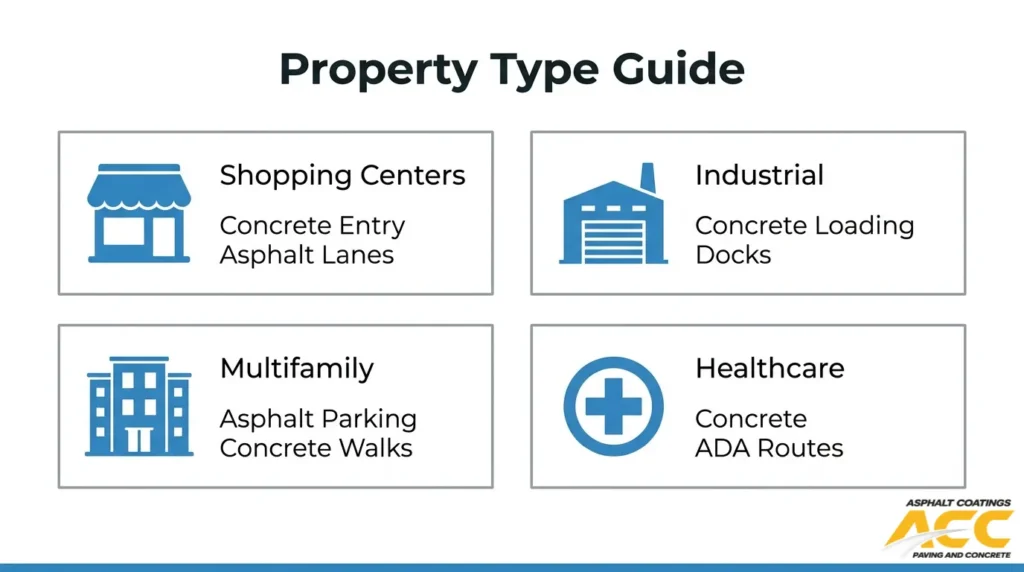
A hybrid approach, with concrete at entries and storefronts and asphalt across general parking fields, often delivers the best balance of cost and performance for retail properties.
How Should Industrial and Warehouse Facilities Choose Between Concrete and Asphalt?
Industrial and warehouse facilities should choose between concrete and asphalt based on load-bearing requirements, chemical exposure, and operational downtime tolerance. Heavy equipment, forklifts, and loaded trucks impose concentrated weight that standard asphalt cannot always withstand without deformation.
Concrete performs better in loading dock areas and forklift lanes because its rigid structure resists the indentation and rutting that heavy static loads cause. Asphalt, however, works well for perimeter roads and employee parking where loads are lighter and repair speed matters more. Facilities handling petroleum products or hydraulic fluids should also consider that oil-based chemicals degrade asphalt binders over time, while concrete resists these substances more effectively. For most industrial properties, reinforced concrete at high-stress zones paired with asphalt in standard-traffic areas minimizes both upfront cost and long-term pavement failure.
How Should Apartment and Multifamily Communities Decide Between Concrete and Asphalt?
Apartment and multifamily communities should decide between concrete and asphalt by balancing resident experience, long-term maintenance budgets, and noise considerations. These properties face steady daily traffic from residents, delivery vehicles, and visitor parking.
Factors that matter most for multifamily parking lots include:
- Budget predictability: Asphalt’s lower installation cost suits communities managing tight capital budgets, while concrete’s longer lifespan reduces long-term repaving frequency.
- Noise impact: Asphalt produces less tire noise, which benefits residents in units adjacent to parking areas.
- Sealcoating schedules: Asphalt requires periodic sealcoating every two to three years, which temporarily restricts parking access for residents.
- Walkway integration: Concrete sidewalks and curbing connect naturally to concrete lot sections, creating a cohesive and ADA-accessible pedestrian environment.
For most apartment communities, asphalt driving surfaces with concrete walkways, curbs, and dumpster pads offer the most practical combination.
How Should Healthcare and Medical Campuses Evaluate Concrete vs Asphalt?
Healthcare and medical campuses should evaluate concrete vs asphalt by prioritizing ADA accessibility, emergency vehicle access, and patient safety above all other factors. According to the U.S. Department of Justice, accessible routes require slopes no greater than 1:12, and car-accessible parking spaces must be a minimum of 96 inches wide. Both materials can meet these standards, but concrete maintains more consistent surface grades over time because it resists settling and rutting.
Emergency lanes and ambulance bays benefit from concrete’s load-bearing capacity and resistance to fluid damage from idling vehicles. Patient drop-off zones also demand smooth, stable surfaces to accommodate wheelchairs and mobility devices safely. Standard parking areas, by contrast, can use asphalt effectively when properly maintained. Healthcare properties face the highest liability exposure from pavement failures, making long-term surface stability a decisive factor over initial cost savings.
Understanding which material suits each property type helps clarify broader compliance and accessibility requirements across all commercial lots.
How Do ADA Compliance and Striping Considerations Differ Between Concrete and Asphalt Parking Lots?
ADA compliance and striping considerations differ between concrete and asphalt parking lots primarily in surface preparation, paint visibility, and long-term slope stability. Both materials must meet identical federal accessibility standards, but each presents unique challenges for maintaining compliant markings and accessible routes.
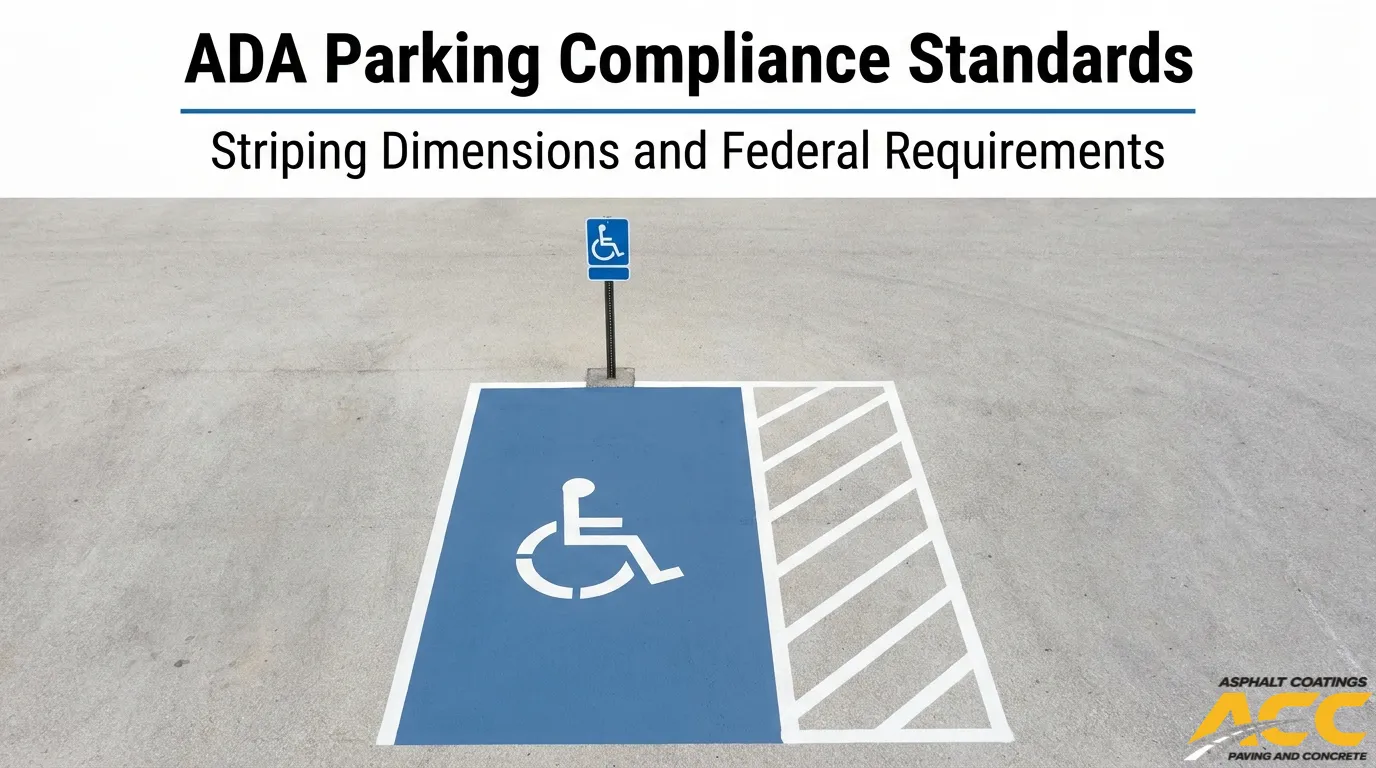
Concrete surfaces hold their grade more consistently over time, which helps maintain the required slope ratios for accessible routes. Asphalt, while easier to grade initially, can develop settling or rutting that compromises accessibility if not properly maintained. According to the U.S. Department of Justice Civil Rights Division, the slope along an accessible route must not exceed 1:12 in the direction of travel, and a car-accessible parking space must be at least 96 inches wide minimum.
Striping visibility also varies by material. On dark asphalt surfaces, standard white and yellow paints provide high contrast, making lines immediately readable. Concrete’s lighter tone can reduce that contrast, sometimes requiring different paint formulations or more frequent restriping to maintain clear markings. The U.S. Access Board notes that ADA Standards do not specify the method or color of parking space markings, leaving those details to state or local codes.
For property managers, the practical difference comes down to maintenance frequency. Asphalt lots typically need restriping every two to three years as sealcoating cycles refresh the surface. Concrete lots may retain paint longer due to less surface wear, but faded lines on a light background become harder to see before they become harder to feel underfoot. Regardless of material, both surfaces require the same ADA-compliant dimensions, signage, and access aisle widths.
Choosing the right striping schedule and surface material matters for staying compliant and avoiding costly violations, which is where professional assessment of your specific lot conditions becomes essential.
How Should Fort Collins Property Managers Decide Between Concrete, Asphalt, or a Hybrid Parking Lot Approach?
Fort Collins property managers should decide between concrete, asphalt, or a hybrid parking lot approach by matching each material to the specific traffic patterns, budget constraints, and stress conditions of their site. The following sub-sections break down when each strategy works best.
When Does It Make Sense to Use Mostly Asphalt With Concrete at High-Stress Areas?
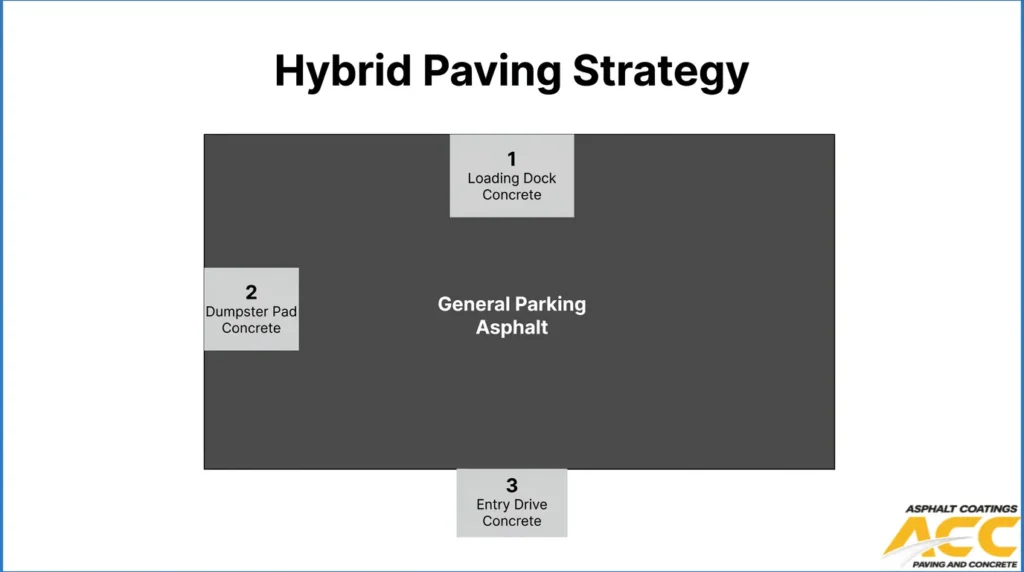
It makes sense to use mostly asphalt with concrete at high-stress areas when a property needs to balance upfront cost savings with long-term durability at its most vulnerable points. Dumpster pads, drive-through lanes, loading docks, and turning aprons experience concentrated weight and repetitive stress that accelerate asphalt deterioration. Placing concrete pads at these locations prevents rutting and soft-spot failures, while the surrounding general parking area benefits from asphalt’s lower installation cost and faster curing.
This hybrid approach is the most practical strategy for the majority of Fort Collins commercial properties. It targets spending where damage is most likely, keeping overall project costs manageable without sacrificing performance where it matters most.
When Is a Primarily Concrete Parking Lot the Better Choice?
A primarily concrete parking lot is the better choice when longevity, minimal maintenance, and heavy sustained loads outweigh upfront budget concerns. According to the Federal Highway Administration, it is not uncommon for concrete pavements to provide outstanding performance for 40 or more years. Properties with heavy delivery vehicles, fire lanes requiring rigid surfaces, or owners planning to hold the asset for decades benefit most from a full concrete installation.
Concrete also suits sites where aesthetic consistency matters, since it resists oil staining more effectively and maintains a uniform appearance longer. For properties with a long ownership horizon, the higher initial investment often results in lower total cost per year of service.
When Is a Full Asphalt Parking Lot the Most Practical Option?
A full asphalt parking lot is the most practical option when budget constraints are tight, the project timeline is compressed, or the property primarily handles standard passenger-vehicle traffic. Asphalt cures faster than concrete, allowing businesses to reopen parking areas sooner and minimize revenue disruption.
- Properties with limited capital budgets benefit from asphalt’s lower per-square-foot installation cost.
- Facilities needing phased construction can pave sections independently without complex joint planning.
- Sites expecting future layout changes gain flexibility, since asphalt is easier and cheaper to mill, reconfigure, and repave.
For properties without extreme loading demands, a well-maintained asphalt lot paired with routine sealcoating delivers reliable performance at the lowest entry cost. Understanding these material trade-offs helps property managers plan the right maintenance strategy from day one.
How Can Asphalt Coatings Company Help Design, Build, and Maintain the Right Parking Lot Surface for Your Fort Collins Property?
Asphalt Coatings Company can help design, build, and maintain the right parking lot surface by combining nearly four decades of Colorado-specific paving expertise with full-service asphalt, sealcoating, and concrete flatwork capabilities. The sections below cover available services and key takeaways from this guide.
How Can Asphalt Coatings Company’s Paving, Sealcoating, and Concrete Flatwork Services Support Your Commercial Parking Lot?
Asphalt Coatings Company’s paving, sealcoating, and concrete flatwork services support commercial parking lots by providing a single-source contractor for every phase of the project. Since 1986, professional commercial paving contractors in the region have handled large-scale projects across Colorado’s Front Range with experienced crews. Core services that apply directly to parking lot projects include:
- Asphalt paving, repair, patching, and mill-and-pave for driving lanes and parking stalls.
- Sealcoating and crack sealing with CDOT-approved materials to extend surface life.
- Concrete flatwork for curbs, gutters, sidewalks, and high-stress areas such as dumpster pads and loading docks.
- ADA-compliant concrete work, parking lot striping, and marking.
- Subgrade preparation and grading to ensure proper drainage from the start.
According to Larimer County’s Urban Area Street Standards, the minimum setback distance from the street curb face to the nearest parking space must follow Figure 19-6 specifications. Professional paving contractors design Fort Collins lots to meet local requirements alongside ADA standards, helping property managers avoid costly code violations.
What Are the Key Takeaways About Concrete vs Asphalt for Commercial Parking Lots in Fort Collins We Covered?
The key takeaways about concrete vs asphalt for commercial parking lots in Fort Collins center on matching the right material to your property’s traffic, budget, and climate demands. Fort Collins temperatures range from 18.3°F to 87.4°F across the year, with freezing conditions possible from mid-September through mid-May, according to the Colorado Climate Center. That extended freeze-thaw window makes material selection, drainage design, and maintenance planning critical for any commercial lot.
The most actionable conclusions from this guide are:
- Asphalt offers lower upfront costs, faster installation, and easier patching for routine maintenance.
- Concrete delivers a longer lifespan and higher load capacity for heavy-traffic or heavy-vehicle areas.
- A hybrid approach, using asphalt for driving lanes and concrete at high-stress points, often balances cost and durability.
- Proactive sealcoating, crack sealing, and proper drainage design extend the life of either surface.
For property managers weighing these options, Asphalt Coatings Company provides site-specific assessments that account for Fort Collins conditions, local code requirements, and long-term budget goals. With offices in both Aurora and Colorado Springs and nearly four decades of Front Range experience, the company brings Colorado-specific expertise to every parking lot evaluation, understanding how the region’s unique freeze-thaw cycles and high-altitude conditions affect long-term pavement performance.