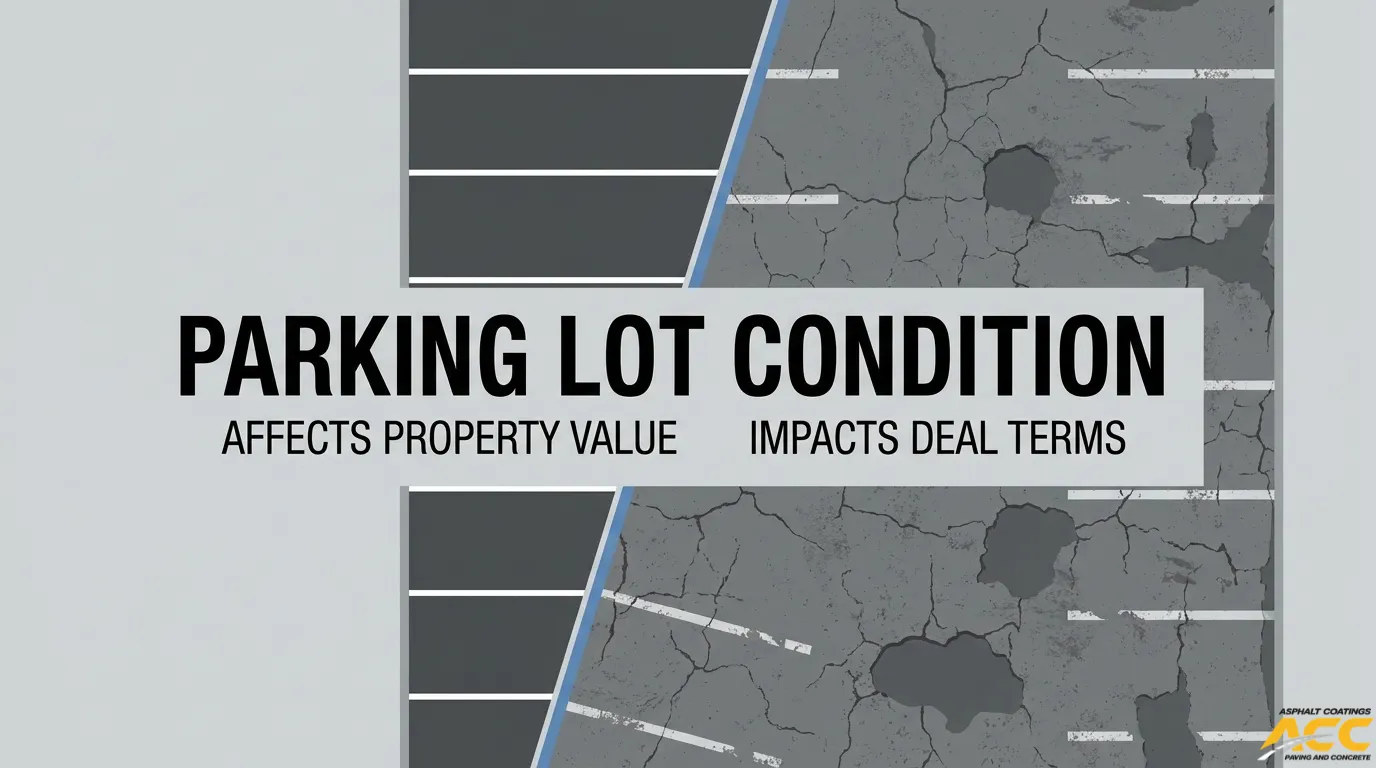
A concrete trip hazard is any raised, sunken, cracked, or uneven concrete surface that creates a stumbling risk for pedestrians on commercial properties. Denver’s extreme climate accelerates this damage faster than most U.S. cities, making proactive removal essential for safety, compliance, and long-term property value.
This guide covers hazard identification and climate-driven causes, pedestrian safety risks, ADA compliance and legal liability, tenant satisfaction and brand reputation, and effective repair and prevention strategies.
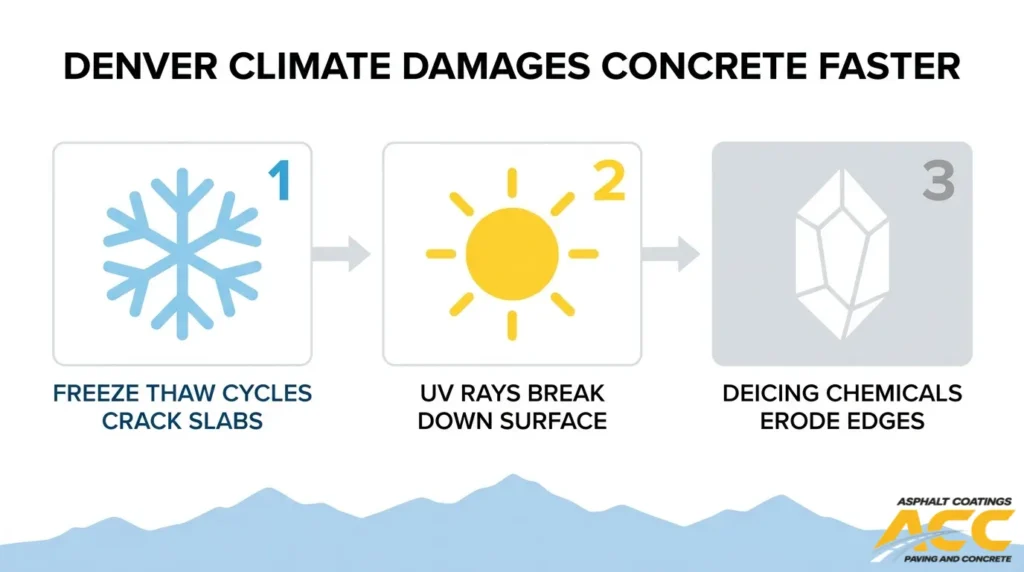
Denver experiences over 100 freeze-thaw cycles per year, and each cycle forces water trapped in concrete pores to expand and contract. This relentless process cracks slabs, lifts edges, and destabilizes subgrade soil, turning minor surface flaws into significant elevation changes within a single season. Intense high-altitude UV exposure and de-icing chemicals compound the deterioration.
Falls caused by uneven concrete range from sprains and fractures to traumatic brain injuries, with seniors and wheelchair users facing the greatest vulnerability. Even small vertical offsets can catch a shoe, cane tip, or wheelchair caster without warning.
Federal ADA standards restrict vertical level changes to strict thresholds; anything over half an inch must be ramped. Noncompliant surfaces expose property owners to civil penalties, while Colorado premises liability law holds owners accountable for hazards they knew about or should have discovered.
Cracked, uneven walkways also erode tenant confidence and discourage customer foot traffic. Well-maintained concrete signals professionalism; neglected surfaces drive vacancies and damage brand perception.
Repair options include diamond grinding for minor offsets, full slab replacement for structural failures, polyurethane slabjacking for sunken panels, and joint sealing to prevent future damage. Routine inspections, proper drainage, and scheduled sealer applications keep surfaces level and extend concrete service life across Denver’s demanding climate.
What Counts as a Concrete Trip Hazard and Where Do They Commonly Occur in Denver?
A concrete trip hazard is any uneven, raised, sunken, or damaged concrete surface that creates a stumbling risk for pedestrians. The following subsections cover the surface types that pose the highest risk, the commercial property areas where hazards concentrate, and how Denver’s conditions degrade concrete over time.
What types of uneven concrete surfaces create the highest trip risk?
The types of uneven concrete surfaces that create the highest trip risk include raised slab edges, sunken panels, heaved joints, wide cracks, and spalled or crumbling surfaces. Even small vertical offsets between adjacent slabs can catch a shoe or wheel. Tree root intrusion lifts entire sections of walkway, while settled subgrade soil causes slabs to sink unevenly. Crumbling edges along expansion joints and surface spalling from weathering also create irregular footing. For commercial property managers, any vertical change in level that a pedestrian does not expect represents a liability. Proactive identification of these surface irregularities is the first step toward preventing costly incidents.
Where are concrete trip hazards most common on commercial properties?
Concrete trip hazards on commercial properties are most common in high-traffic areas: building entryways, sidewalks connecting parking lots to storefronts, loading dock aprons, ramp transitions, and curb lines along drive aisles. Commercial property managers seeking to address these high-traffic zones can benefit from partnering with contractors experienced in both concrete flatwork and parking lot systems. Asphalt Coatings Company has served Colorado’s Front Range since 1986, providing integrated solutions for sidewalks, curbs, ramps, and parking areas using in-house crews familiar with the region’s demanding conditions. These zones endure repetitive foot traffic, vehicle loading, and constant exposure to the elements. According to the Centers for Disease Control and Prevention, falls are the most common cause of traumatic brain injuries, and roughly 37% of people who fall report injuries requiring medical treatment or activity restriction for at least one day.
Given that slip and fall settlements in Colorado typically range from $30,000 to $75,000, commercial property owners face significant financial exposure when these high-traffic zones go unrepaired. Regularly inspecting entryways, ADA ramps, and parking lot walkways should be a baseline property management practice.
How do Denver’s sidewalks, curbs, and parking lots become trip hazards over time?
Denver’s sidewalks, curbs, and parking lots become trip hazards over time through a combination of freeze-thaw cycling, soil settlement, heavy use, and deferred maintenance. Water seeps into concrete pores and expansion joints during rain or snowmelt, then freezes and expands as temperatures drop. Denver experiences over 100 freeze-thaw cycles annually, and this repeated stress cracks slabs, lifts edges, and erodes joint sealant season after season. Soil beneath concrete also shifts as moisture levels fluctuate, causing panels to sink or heave unevenly.
Because Colorado’s statute of limitations for premises liability claims is two years from the date of injury, property owners who delay repairs risk both physical harm to visitors and extended legal exposure during the entire period damage remains unaddressed.
Understanding where and how these hazards develop sets the foundation for evaluating why Denver’s climate accelerates the problem.
Why Are Concrete Trip Hazards Especially Problematic in Denver’s Climate?
Concrete trip hazards are especially problematic in Denver’s climate because freeze-thaw cycles, intense UV radiation, and heavy de-icing chemical use accelerate concrete deterioration far faster than in milder regions. The sections below explain how each climate factor contributes to raised and sunken slabs, surface degradation, and increased danger during winter conditions.
How does Denver’s freeze–thaw cycle contribute to raised and sunken concrete?
Denver’s freeze-thaw cycle contributes to raised and sunken concrete by forcing water trapped in concrete pores to expand during freezing, then contract during thawing, progressively breaking apart the internal structure. Each cycle widens existing cracks and destabilizes the subgrade beneath slabs. According to the Federal Highway Administration, Denver experiences over 100 annual freeze-thaw cycles, making concrete repair an ongoing requirement for commercial properties. This relentless repetition means that even minor surface flaws can escalate into significant elevation changes within a single winter season. Soil beneath slabs also shifts as moisture freezes and thaws, causing sections to heave upward or settle unevenly. For commercial property managers, this makes seasonal concrete inspections essential rather than optional.
In what ways do Denver’s UV exposure and de-icing chemicals damage concrete surfaces?
Denver’s UV exposure and de-icing chemicals damage concrete surfaces by breaking down the cement paste and accelerating surface deterioration. At Denver’s high altitude, ultraviolet radiation is more intense than at sea level, which degrades sealants and surface coatings faster. This leaves concrete pores exposed to moisture infiltration. De-icing salts compound the problem by creating additional freeze-thaw pressure within the concrete matrix. Salt solutions lower the freezing point unevenly across the slab surface, generating thermal stress that causes scaling and spalling. These shallow surface failures create uneven textures and raised edges that qualify as trip hazards. The combination of UV degradation and chemical attack is particularly damaging because each weakens the concrete’s defenses against the other, creating an accelerating cycle of deterioration.
How do snow and ice accumulation make existing concrete trip hazards more dangerous?
Snow and ice accumulation make existing concrete trip hazards more dangerous by concealing uneven surfaces and reducing traction at the same time. A raised slab edge hidden beneath even a thin layer of packed snow becomes virtually invisible to pedestrians. Ice formation in the gaps between offset slabs creates slick, unstable footing exactly where elevation changes pose the greatest risk. Compacted snow can also freeze into ice shelves that extend the effective trip zone beyond the original hazard. Snowmelt refreezing overnight adds another layer of unpredictability, as surfaces that appeared clear during the day become glazed by morning. For commercial properties, this seasonal concealment makes proactive repair before winter far more effective than relying on snow removal alone to keep walkways safe.
Understanding how Denver’s climate intensifies concrete damage helps property managers prioritize repairs before hazards lead to injuries or liability.
What Safety Risks and Injury Types Are Associated With Concrete Trip Hazards?
Concrete trip hazards create safety risks ranging from minor scrapes to life-threatening traumatic brain injuries. Pedestrians, seniors, people with disabilities, and even cyclists face distinct dangers from uneven surfaces.
What kinds of falls and injuries do pedestrians typically suffer from trip hazards?
Pedestrians typically suffer injuries from trip hazards that range from sprains and lacerations to fractures and head trauma. Raised concrete edges, sunken slabs, and cracked panels catch footwear unexpectedly, sending walkers to the ground with little time to brace for impact.
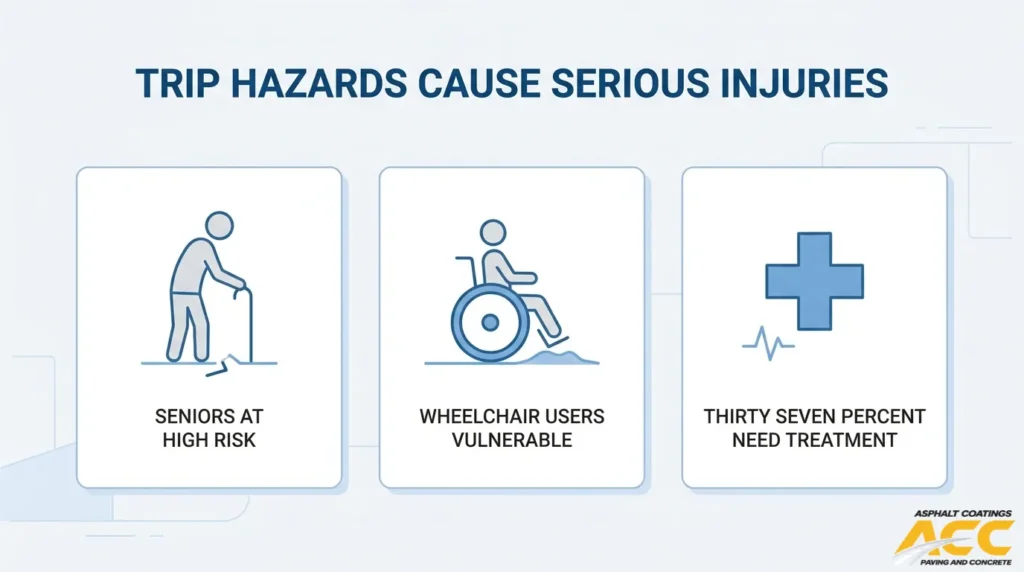
Falls are the most common cause of traumatic brain injuries, and according to the CDC, about 37% of those who fall report an injury requiring medical treatment or restricted activity for at least one day. The severity often depends on the fall angle and the surface struck. Wrist fractures occur frequently when people attempt to catch themselves, while hip and knee injuries result from sideways falls.
For commercial property managers, even a single pedestrian fall on neglected concrete can trigger costly liability claims and operational disruptions.
Why are seniors and people with disabilities at higher risk around uneven concrete?
Seniors and people with disabilities are at higher risk around uneven concrete because reduced mobility, balance impairments, and reliance on assistive devices make even minor surface irregularities dangerous obstacles. A half-inch lip that a younger pedestrian might step over can catch a wheelchair caster, walker leg, or shuffling gait.
According to the CDC, more than one out of four adults aged 65 and older falls each year, and falling once doubles the chances of falling again. Wheelchair users and individuals with visual impairments face compounded risk when surfaces lack the level, predictable transitions required under the 2010 ADA Standards.
These vulnerabilities make proactive concrete maintenance on commercial properties not just a legal responsibility, but a practical safety priority for the populations most affected.
How can concrete trip hazards impact drivers, cyclists, and delivery personnel?
Concrete trip hazards can impact drivers, cyclists, and delivery personnel by creating unexpected surface changes in parking lots, loading zones, and curb transitions. A raised slab edge at a driveway apron can jolt a cyclist off balance, while a sunken panel in a loading dock area may cause a delivery worker carrying heavy items to stumble.
Drivers encounter risk when uneven concrete at parking lot entrances causes sudden vehicle jolts that lead to cargo shifts or loss of steering control at low speeds. Cyclists navigating commercial property pathways are particularly vulnerable because narrow tires amplify the effect of even small elevation changes.
These hazards extend well beyond foot traffic, making level concrete surfaces essential across every access point on a commercial property. Understanding these risks underscores why property owners must also consider their ADA compliance obligations.
How Do Concrete Trip Hazards Affect ADA Compliance and Accessibility?
Concrete trip hazards affect ADA compliance and accessibility by creating changes in level that exceed federal thresholds for walkable surfaces. The subsections below cover specific ADA rules for level changes, how common concrete defects trigger violations, and why property owners must prioritize compliant repairs.
What ADA Rules Apply to Changes in Level and Surface Slopes in Walkways and Ramps?
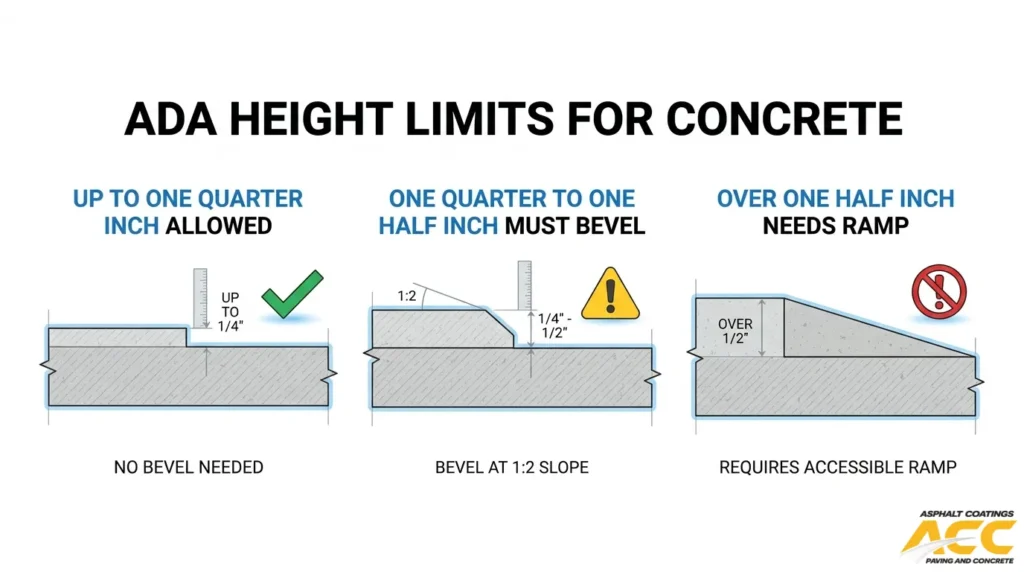
The ADA rules that apply to changes in level and surface slopes in walkways and ramps are defined by strict height thresholds established by the U.S. Access Board. According to the U.S. Access Board’s ADA Accessibility Guidelines, changes in level follow a three-tier standard:
- Changes up to 1/4 inch (6.4 mm) high are permitted to be vertical with no additional treatment.
- Changes between 1/4 inch and 1/2 inch (13 mm) high must be beveled with a slope not steeper than 1:2.
- Changes greater than 1/2 inch high must be ramped with compliant slope ratios.
These thresholds mean that even minor concrete displacement, sometimes barely visible, can push a surface out of compliance. For commercial properties with high foot traffic, routine measurement against these standards is essential.
How Can Raised Slabs, Cracked Panels, and Spalled Edges Create ADA Violations?
Raised slabs, cracked panels, and spalled edges create ADA violations by producing abrupt level changes and unstable surfaces that exceed federal accessibility thresholds. A slab lifted just over half an inch by soil settlement or root intrusion already requires ramped transition under ADA standards. Cracked panels introduce jagged edges that catch wheelchair casters and walker tips, while spalled concrete creates unpredictable, crumbling surfaces that narrow the effective path of travel. Each of these defects can independently disqualify a walkway, ramp, or entrance from meeting the 2010 ADA Standards for accessible design. Because deterioration is progressive, a surface that measures compliant today may fall out of compliance within a single freeze-thaw season if left unmonitored.
Why Do Property Owners and Managers Need to Prioritize ADA-Compliant Concrete Repairs?
Property owners and managers need to prioritize ADA-compliant concrete repairs because noncompliance creates simultaneous legal, financial, and accessibility risks. Businesses violating Title III of the ADA face DOJ civil penalties reaching $75,000 for a first offense and $150,000 for subsequent violations. Beyond federal exposure, Denver’s regulatory landscape adds a local layer of responsibility. According to Zaner Law, a decades-old city ordinance makes adjacent property owners responsible for building and maintaining sidewalks, yet City Council members have acknowledged that homeowners frequently cannot afford the high costs of these repairs, with minimal city enforcement historically taking place.
For commercial property managers, waiting for enforcement is a gamble that rarely pays off. Proactive ADA-compliant repairs protect against lawsuits, preserve accessibility for all visitors, and demonstrate a standard of care that strengthens a property’s legal defensibility.
Understanding how trip hazards intersect with legal liability helps clarify the full financial risk property owners face.
What Legal and Financial Liabilities Can Trip Hazards Create for Property Owners?
Trip hazards can create premises liability lawsuits, costly settlements, increased insurance premiums, and brand damage for property owners. The following sections cover how lawsuits arise, what costs accumulate, and how prompt repairs reduce exposure.
How can a concrete trip hazard lead to a premises liability or slip-and-fall lawsuit?
A concrete trip hazard can lead to a premises liability or slip-and-fall lawsuit when an injured person proves the property owner knew, or should have known, about the dangerous condition and failed to fix it. Under Colorado Revised Statutes, an invitee may recover damages caused by a landowner’s unreasonable failure to exercise reasonable care to protect against dangers the landowner actually knew about or should have known about.
Colorado’s statute of limitations gives injured parties two years from the date of injury to file a claim, with exceptions for delayed discovery. Raised slabs, cracked panels, and uneven joints all qualify as known hazards once documented during inspections. For property managers, this means that even a single unaddressed trip hazard creates a window of legal vulnerability that remains open until the condition is corrected.
What direct and indirect costs can arise from ignoring concrete trip hazards?
The direct and indirect costs of ignoring concrete trip hazards extend well beyond repair bills. Direct costs include legal defense fees, settlement payouts, medical reimbursements, and rising insurance premiums after claims are filed.
Indirect costs are harder to quantify but equally damaging:
- A visibly neglected facility signals poor customer service, which can drive potential consumers away from brands that appear indifferent to their physical appearance, according to a facility condition study published by A&K Painting.
- Tenant turnover increases when walkways feel unsafe, raising vacancy rates and leasing costs.
- Code enforcement fines and ADA civil penalties compound financial losses over time.
Proactive concrete maintenance costs a fraction of what a single settlement demands. Property owners who treat repair budgets as optional often pay far more in liability than they ever would have spent on prevention.
How does prompt removal of trip hazards reduce insurance claims and legal exposure?
Prompt removal of trip hazards reduces insurance claims and legal exposure by eliminating the hazardous condition before an injury occurs. When a property owner documents and repairs a known defect quickly, it becomes significantly harder for a plaintiff to prove negligence.
Consistent maintenance also builds a defensible record. Inspection logs, repair receipts, and before-and-after photos demonstrate reasonable care, which is the standard Colorado premises liability law uses to evaluate owner responsibility. Insurance carriers often reward this diligence with more favorable renewal terms, since properties with active hazard management programs generate fewer claims.
Well-maintained commercial properties also strengthen credibility and build trust with clients, reinforcing the long-term investment value of the asset. Understanding repair methods helps property owners act on these liabilities before they escalate.
How Do Concrete Trip Hazards Impact Tenant Satisfaction and Business Reputation?
Concrete trip hazards impact tenant satisfaction and business reputation by signaling neglect, discouraging foot traffic, and eroding trust in property management. The following subsections cover first impressions, tenant retention, and proactive maintenance strategies.
How do visible trip hazards influence first impressions for customers and visitors?
Visible trip hazards influence first impressions by immediately signaling poor property management to customers and visitors. Cracked, raised, or sunken concrete in entryways, walkways, and parking areas creates an impression of neglect before anyone steps inside. According to Tomarchio Enterprises, a clean, well-maintained commercial property strengthens credibility and builds trust with clients, while poorly kept properties undermine customer confidence.
Visitors form judgments about a business within seconds of arriving. When the first thing they encounter is uneven concrete or spalled edges, that negative perception often extends to the business itself. For commercial properties competing for foot traffic, maintaining level, hazard-free surfaces is one of the simplest ways to project professionalism from the curb.
In what ways can unsafe walkways affect tenant retention and leasing decisions?
Unsafe walkways affect tenant retention and leasing decisions by eroding confidence in property management and creating liability concerns that drive tenants to seek better-maintained spaces. Commercial tenants evaluate more than rent prices; they assess whether a property reflects the professional image their own business needs.
According to VTS, putting off regular maintenance erodes tenant trust and is a surefire recipe for future vacancies and higher repair costs. When walkways, entryways, or shared areas present visible trip hazards, tenants question whether management will address other building issues. Prospective tenants conducting property tours notice these conditions immediately. For property managers, every unrepaired trip hazard becomes a silent argument against lease renewal, making preventive concrete maintenance one of the most cost-effective retention strategies available.
How can proactive concrete maintenance support a professional brand image?
Proactive concrete maintenance supports a professional brand image by demonstrating that a property owner prioritizes safety, accessibility, and long-term property value. Regularly scheduled inspections, timely grinding of raised edges, and prompt slab repairs prevent small issues from becoming visible hazards that undermine tenant and visitor confidence.
Concrete pavement has shown strong long-term performance due to its low maintenance requirements, according to the Texas Transportation Institute, but increasing traffic accelerates deterioration and demands more frequent upkeep. Properties that stay ahead of this curve project reliability and care. In commercial real estate, the condition of exterior surfaces communicates a brand’s standards before any conversation takes place.
With tenant satisfaction tied to property condition, understanding effective repair methods helps property managers act on these priorities.
What Are the Most Effective Methods to Remove or Repair Concrete Trip Hazards?
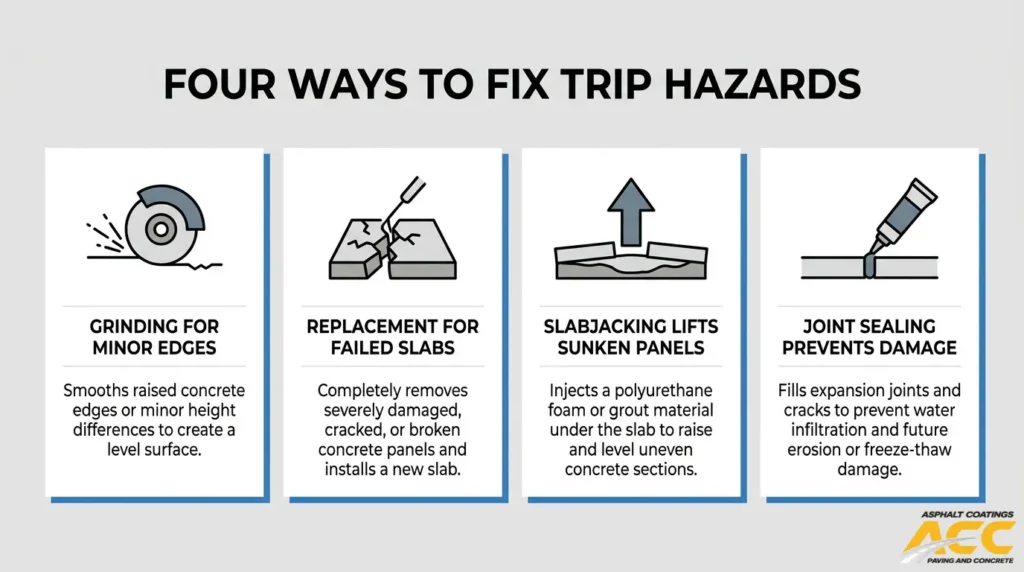
The most effective methods to remove or repair concrete trip hazards include grinding, slab replacement, slabjacking, and joint sealing. Each method addresses a different type of damage.
When is concrete grinding the best option for eliminating raised edges?
Concrete grinding is the best option for eliminating raised edges when the elevation difference between adjacent slabs is minor and the concrete is otherwise structurally sound. Diamond grinding shaves down the higher slab to create a smooth, level transition. This method works well for sidewalk joints, expansion joint offsets, and areas where tree roots have lifted one panel slightly above its neighbor. Grinding is fast, minimally disruptive, and cost-effective for surface-level corrections. However, it only removes material; it cannot raise a sunken slab or restore thickness. For properties with dozens of minor offsets across walkways and parking areas, grinding often delivers the best return on investment.
When should slabs be replaced instead of leveled or patched?
Slabs should be replaced instead of leveled or patched when the concrete is severely cracked, structurally compromised, or too deteriorated for surface corrections to hold. Deep spalling, multiple fracture lines through the panel, or significant subgrade failure beneath the slab all indicate that removal and replacement is the most reliable path forward. Patching over structurally failed concrete is a temporary fix that typically re-cracks within one or two seasons, especially under Denver’s freeze-thaw stress. Full replacement also allows contractors to correct subgrade drainage problems and compact the base properly before pouring new concrete. Although replacement costs more upfront, it eliminates recurring repair cycles on panels that have reached the end of their service life. For Colorado commercial properties evaluating full slab replacement, working with a contractor that handles both subgrade preparation and concrete installation ensures proper base compaction and drainage correction. Asphalt Coatings Company provides comprehensive concrete flatwork services including subgrade preparation and grading, addressing the underlying soil issues that cause panels to fail prematurely in Denver’s freeze-thaw environment.
How does concrete slabjacking or mudjacking help correct sunken panels?
Concrete slabjacking or mudjacking helps correct sunken panels by pumping material beneath the settled slab to raise it back to grade. Small holes are drilled through the concrete, and either a traditional mud slurry or polyurethane foam is injected underneath until the panel lifts to the correct elevation. According to HMI Company, polyurethane foam solutions are known for life spans of 20 years or more, compared to mudjacking material that can last multiple years when done correctly, though soil conditions and drainage efficiency are critical to the longevity of both materials. Polyurethane weighs only 2 to 4 pounds per cubic foot versus 100 to 150 pounds for traditional mud, making it less likely to overburden unstable soil. For commercial properties with widespread settlement, slabjacking preserves existing concrete while restoring safe, level surfaces.
What role do joint sealing and crack filling play in preventing new trip hazards?
Joint sealing and crack filling play a preventive role by blocking water infiltration that leads to subgrade erosion, frost heaving, and eventual slab displacement. Unsealed joints and open cracks allow moisture to reach the soil beneath the concrete, where freeze-thaw cycles expand and contract the ground repeatedly. Over time, this process destabilizes the slab support and creates the uneven surfaces that become trip hazards. Applying flexible sealants to control joints and filling cracks with appropriate materials stops this cycle before damage escalates. For commercial property managers, routine sealing is one of the most cost-effective maintenance strategies available because it addresses the root cause of many trip hazards rather than just the symptoms.
Choosing the right repair method depends on the specific damage; a professional site assessment ensures each hazard gets the correct fix.
How Can Property Managers Proactively Identify and Prioritize Concrete Trip Hazards?
Property managers can proactively identify and prioritize concrete trip hazards by establishing scheduled inspections, ranking repairs by risk severity, and maintaining thorough documentation. The following subsections cover inspection frequency, prioritization criteria, and hazard documentation practices.
How Often Should Commercial Properties Inspect Sidewalks, Ramps, and Parking Lots?
Commercial properties should inspect sidewalks, ramps, and parking lots at least quarterly, with additional inspections after severe weather events. According to the Commercial Property Inspectors Association, the purpose of a commercial property inspection is to define best practices through visual observation during a walk-through survey, conducting research about the property, and generating a meaningful report about its condition.
Seasonal timing matters in Denver. Spring inspections catch damage from winter freeze-thaw cycles, while fall inspections identify hazards before snow obscures them. High-traffic zones like building entrances, ADA ramps, and parking lot crosswalks warrant monthly visual checks. Properties with older concrete or known soil movement issues benefit from more frequent monitoring.
What Criteria Help Decide Which Trip Hazards to Fix First on a Limited Budget?
The criteria that help decide which trip hazards to fix first on a limited budget include severity of the displacement, foot traffic volume, proximity to ADA-required paths, and liability exposure. A practical prioritization framework ranks hazards by these factors:
- Displacement height: Offsets exceeding half an inch pose the greatest trip risk and often violate ADA standards, making them top priority.
- Location and traffic volume: Hazards near main entrances, ADA routes, and high-pedestrian zones should rank above those in low-traffic areas.
- Vulnerable populations: Areas frequented by seniors, wheelchair users, or children demand faster repair timelines.
- Deterioration trajectory: Cracks and heaves that are actively worsening need attention before stable, cosmetic-only issues.
Addressing the highest-risk hazards first is the most cost-effective way to reduce liability while stretching a maintenance budget.
How Can Property Teams Document Hazards to Support Planning and Risk Management?
Property teams can document hazards to support planning and risk management by creating a standardized inspection log that records location, measurements, photos, and timestamps for every identified defect. Each entry should include the displacement height, surface condition, and a risk rating tied to the prioritization criteria above.
Effective documentation practices include:
- Photographing each hazard with a ruler or measurement reference visible.
- Recording GPS coordinates or property map references for precise location tracking.
- Logging the date of discovery, assigned priority level, and planned repair date.
- Maintaining a repair history that shows completed work and associated costs.
This documentation trail demonstrates reasonable care under Colorado premises liability law, strengthens insurance defense if an incident occurs, and provides data-driven justification for annual maintenance budgets. With clear inspection records in place, the next step is ensuring long-term concrete performance through preventive maintenance strategies.
What Are Best Practices for Maintaining Safe, Level Concrete in Denver Over Time?
Best practices for maintaining safe, level concrete in Denver over time include routine sealing, freeze-thaw-resistant design, and proper drainage management. The following subsections cover each strategy.
How can routine sealing and surface protection extend concrete life in Denver?
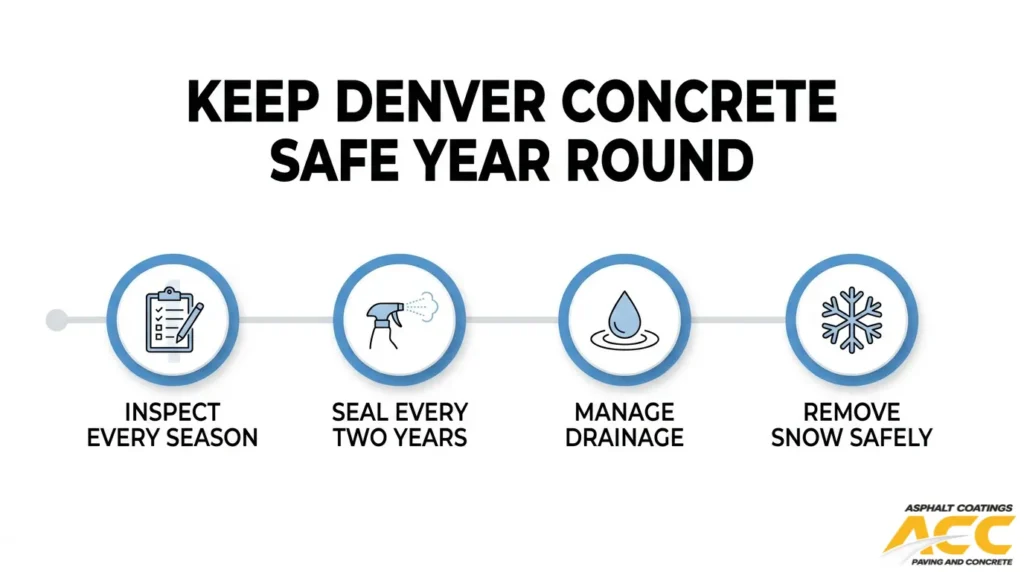
Routine sealing and surface protection extend concrete life in Denver by blocking moisture from penetrating the pore structure. When water enters unsealed concrete and freezes, it expands and cracks the surface from within. Applying a penetrating concrete sealer every two to three years creates a barrier that resists water absorption, salt intrusion, and UV degradation.
Surface protection also includes filling minor cracks before they widen into trip hazards. For commercial properties, scheduling sealer applications in late spring or early fall allows proper curing before Denver’s temperature extremes arrive. This proactive approach is one of the most cost-effective ways to prevent the kind of deterioration that leads to uneven slabs and ADA violations.
What design choices help new concrete withstand freeze–thaw and heavy traffic?
Design choices that help new concrete withstand freeze-thaw and heavy traffic start with specifying air-entrained concrete and adequate slab thickness. Proper joint spacing, reinforced subgrade preparation, and higher-strength mix designs all reduce long-term cracking and settlement.
According to research from the Texas Transportation Institute, concrete pavement has demonstrated long service life and low maintenance requirements in urban and interstate settings, but rapidly increasing heavy traffic accelerates deterioration and increases maintenance needs. This means commercial properties with loading docks, delivery routes, or high-volume parking areas should specify thicker slabs and tighter joint layouts from the start. Investing in the right mix design and structural details upfront prevents the uneven surfaces that become trip hazards later.
How should drainage and snow removal be managed to prevent future trip hazards?
Drainage and snow removal should be managed to prevent future trip hazards by directing water away from concrete surfaces and avoiding practices that accelerate deterioration. Key strategies include:
- Grading adjacent landscaping so runoff flows toward storm drains rather than pooling against slab edges.
- Maintaining clean expansion joints and drainage channels to prevent water from saturating the subgrade beneath concrete panels.
- Using sand or non-chloride deicers instead of rock salt, which breaks down concrete surfaces over repeated applications.
- Plowing snow with rubber-edged blades to avoid gouging concrete and creating new surface irregularities.
Standing water is one of the leading causes of subgrade erosion, which produces the sunken or tilted slabs that become trip hazards. Consistent seasonal maintenance prevents small drainage issues from compounding into costly repairs.
With maintenance strategies in place, partnering with an experienced contractor keeps concrete safe long-term.
How Should You Approach Concrete Trip Hazard Removal With a Commercial Asphalt and Concrete Partner?
You should approach concrete trip hazard removal by partnering with a commercial contractor that offers site assessment, ADA-compliant repairs, and materials engineered for Denver’s climate. The following sections cover how Asphalt Coatings Company can help and the key takeaways from this article.
How can Asphalt Coatings Company’s concrete flatwork and ADA compliance services help remove trip hazards?
Asphalt Coatings Company’s concrete flatwork and ADA compliance services help remove trip hazards by combining site-specific assessment with precision repair methods tailored for Colorado’s Front Range. Since 1986, Asphalt Coatings Company has served Colorado’s Front Range with commercial concrete and asphalt projects, using in-house crews to deliver consistent quality across sidewalks, curbs, ramps, and parking lots.
Asphalt Coatings Company provides several services that directly address trip hazard removal:
- Concrete flatwork installation and repair corrects uneven, cracked, or sunken panels.
- ADA-compliant concrete work ensures surface transitions meet federal accessibility standards.
- Curb and gutter installation restores proper drainage that prevents future slab settlement.
- Subgrade preparation and grading addresses the soil instability that causes concrete to shift.
Asphalt Coatings Company designs solutions specifically for Colorado’s freeze-thaw cycles and high-altitude UV exposure, drawing on decades of Front Range experience. For property managers balancing compliance deadlines with budget constraints, working with a single-source commercial partner eliminates coordination delays and keeps projects on schedule.
What are the key takeaways about the importance of removing concrete trip hazards in Denver we covered?
The key takeaways about the importance of removing concrete trip hazards in Denver are that proactive removal protects pedestrian safety, maintains ADA compliance, and reduces costly legal exposure for commercial property owners.
Throughout this article, we covered several critical points:
- Denver’s 100+ annual freeze-thaw cycles accelerate concrete deterioration, making trip hazards an ongoing maintenance requirement.
- ADA standards restrict level changes to specific thresholds; anything over 1/2 inch must be ramped.
- Falls remain the leading cause of traumatic brain injuries, with seniors and people with disabilities facing the highest risk.
- Colorado premises liability law holds property owners accountable for hazards they knew about or should have discovered.
- Repair methods such as concrete grinding, slab replacement, and polyurethane slabjacking each suit different conditions.
- Routine inspections, joint sealing, and proper drainage extend concrete service life and prevent new hazards from forming.
Addressing trip hazards before they cause injuries is always more cost-effective than managing the legal, financial, and reputational consequences afterward. For Denver commercial properties, partnering with an experienced contractor like Asphalt Coatings Company turns reactive repairs into a long-term pavement management strategy.