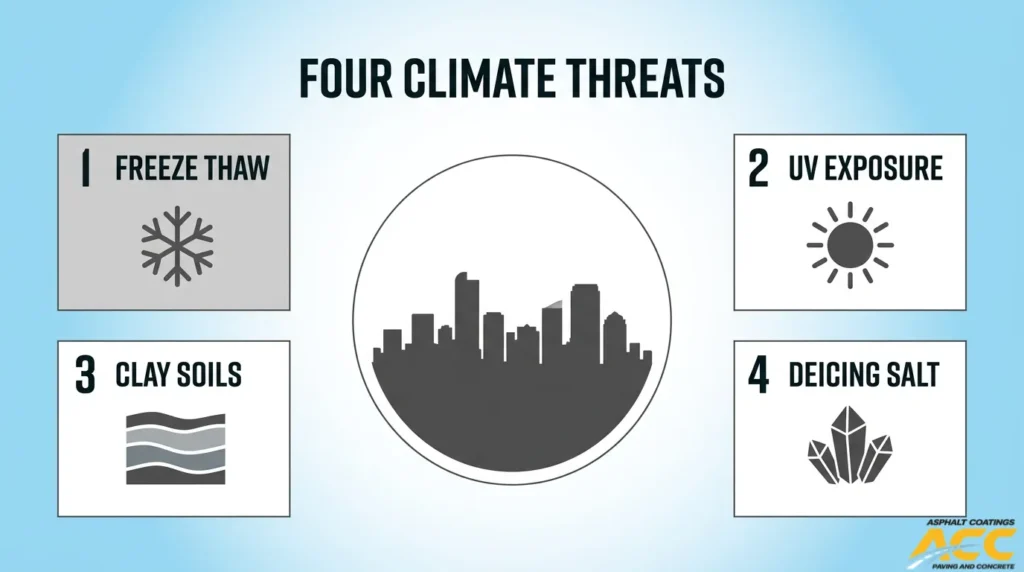
Denver concrete faces a unique combination of threats: freeze-thaw cycling, expansive clay soils, intense UV exposure at altitude, and heavy deicer application that together accelerate deterioration far faster than in most U.S. cities.
This guide covers climate-driven cracking and surface deterioration, drainage and grading failures, settlement and trip hazard risks, joint and sealant breakdown, appearance and compliance concerns, expert repair strategies, and long-term prevention practices.
Freeze-thaw cycles force trapped moisture to expand repeatedly inside concrete pores, producing surface cracks, map cracking, and full-depth splits. Improper control joint spacing and heavy truck loads compound the problem, especially in commercial parking lots and loading zones.
Deicing salt saturates the surface layer and triggers scaling, while moisture concentration around joints and drains accelerates spalling. Corroding rebar beneath the surface can fracture concrete from within, signaling structural damage that simple resurfacing cannot resolve.
Poor parking lot grading traps water on slabs, softens subgrade soils, and creates ponding zones that endure dozens of freeze-thaw cycles per season. Clogged or misplaced drains redirect water beneath panels, compounding settlement risk.
Colorado’s expansive clay soils shift unpredictably between wet and dry periods, lifting or dropping slabs and creating trip hazards. Frost heave, tree roots, and poorly compacted utility trenches add further displacement that threatens ADA compliance.
Open joints and degraded sealants allow water infiltration that erodes slab edges in a self-reinforcing cycle. Surface staining, faded markings, and slope changes from settled concrete increase both liability exposure and regulatory risk.
Effective solutions range from targeted crack sealing and joint resealing for early-stage damage to full-depth removal and replacement when structural failure or subgrade erosion has occurred. Proactive inspection schedules, climate-informed design specifications, and disciplined operational practices prevent minor wear from escalating into costly emergencies.
Why Does Denver’s Climate Create Unique Concrete Problems?
Denver’s climate creates unique concrete problems because its combination of extreme temperature swings, deep frost penetration, intense UV exposure, and reactive soils subjects concrete to simultaneous stresses rarely found together in other U.S. cities. Denver sits at over 5,000 feet of elevation along Colorado’s Front Range, where winter temperatures plunge well below freezing and summer surface temperatures can exceed 130°F. This dramatic range drives repeated freeze-thaw cycles that force moisture trapped in concrete pores to expand and contract dozens of times each season. According to a Colorado State University climate change report, statewide annual average temperatures warmed by 2.3°F from 1980 to 2022, intensifying these thermal extremes. Higher temperatures accelerate moisture evaporation during curing, while colder lows deepen frost penetration into subgrade soils. The 2025 Denver Building Code sets the frost line at 36 inches below finished grade, meaning frost reaches deep enough to shift the ground beneath concrete slabs, sidewalks, and footings. Semi-arid conditions add another layer of stress. Denver’s clay-rich soils shrink during dry spells and swell after sudden rainstorms or snowmelt, creating unpredictable subgrade movement that conventional concrete installations in milder climates never face. At high altitude, UV radiation is roughly 25% more intense than at sea level, which degrades sealants, joint materials, and surface coatings faster than property managers typically expect. Combined with the heavy application of road deicers each winter, these overlapping forces accelerate cracking, spalling, joint failure, and surface deterioration across commercial properties. For property managers, understanding this climate context is essential because it shapes every repair and maintenance decision that follows in the sections ahead, from cracking patterns and surface damage to drainage failures and settlement issues.
What Are the Most Common Concrete Cracking Issues in Denver?
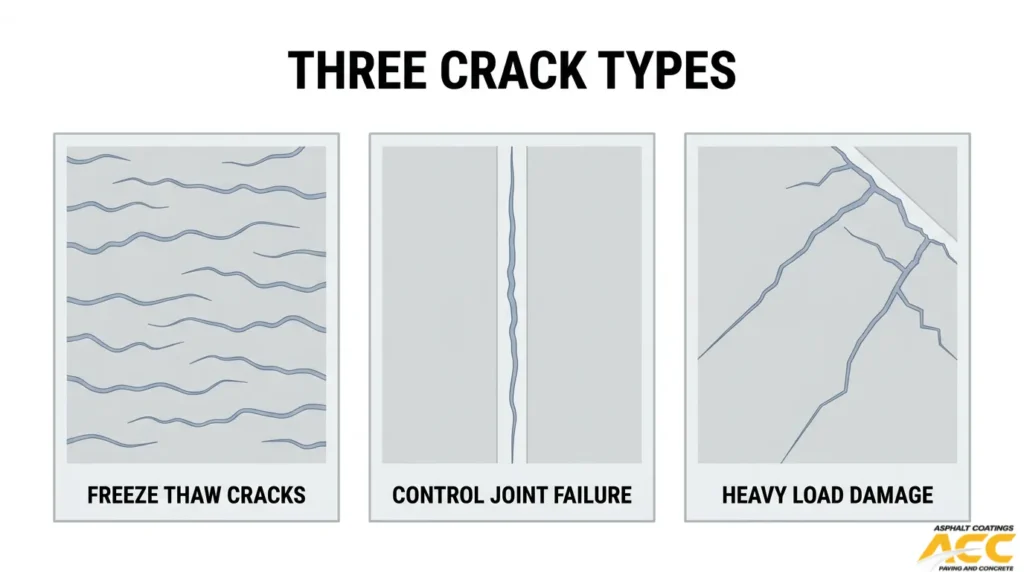
The most common concrete cracking issues in Denver stem from freeze-thaw cycles, poorly spaced control joints, and heavy vehicle loads. Each of these factors produces distinct crack patterns that require targeted repair strategies.
How Do Freeze–Thaw Cycles Cause Concrete Cracks in Denver?
Freeze-thaw cycles cause concrete cracks in Denver by forcing trapped moisture to expand repeatedly within the slab. Water seeps into concrete’s porous surface, freezes and expands by roughly 9% in volume, then thaws and contracts. Each cycle widens existing micro-fractures until visible surface cracking, map cracking, or full-depth splits appear.
Denver’s semi-arid climate produces rapid temperature swings, sometimes cycling above and below freezing within a single day. This frequency accelerates deterioration far faster than in regions with steadier winter temperatures. For commercial properties, the resulting damage often concentrates at curb lines, sidewalk edges, and parking slab corners where moisture exposure is highest.
Why Does Concrete Crack at Control Joints and Slabs in Commercial Lots?
Concrete cracks at control joints and slabs in commercial lots because of improper joint spacing, insufficient depth, or delayed sawcutting after placement. Control joints are designed to direct inevitable shrinkage cracking along predetermined lines, but when spacing exceeds recommended limits, random cracking develops between joints instead.
According to Federal Highway Administration Technical Advisory T 5040.30, transverse joint spacing for concrete pavements should average 12 to 20 feet depending on slab thickness, with no more than 20 feet advisable. Commercial lots that ignore these guidelines often see mid-panel cracks that compromise structural performance. Joints cut too shallow, typically less than one-quarter of slab depth, fail to create an effective weakened plane. In my experience, this remains one of the most preventable yet frequently overlooked causes of commercial concrete failure.
How Do Heavy Trucks and Traffic Lanes Lead to Structural Cracking?
Heavy trucks and concentrated traffic lanes lead to structural cracking by imposing repetitive loads that exceed the slab’s designed flexural capacity. Delivery trucks, garbage vehicles, and semi-trailers generate point loads far beyond what standard 4-inch commercial slabs can absorb over time. The damage typically appears as longitudinal cracks along wheel paths and corner breaks at slab edges.
A Federal Highway Administration report (FHWA-HIF-18-019) found that additional saturation from traffic-driven water infiltration, combined with freeze-thaw cycling, produces varied forms of damage and deterioration distinct from standard D-cracking. Truck turning movements at loading docks and dumpster pads concentrate this stress further, making these high-traffic zones especially vulnerable to progressive structural failure.
Understanding these cracking patterns helps property managers choose the right repair approach for each situation.
What Spalling and Surface Deterioration Problems Affect Denver Concrete?
Spalling and surface deterioration on Denver concrete typically result from deicing salt exposure, moisture concentration around joints and drains, and corroding reinforcement steel. Each cause produces distinct damage patterns.
How Does Deicing Salt Contribute to Concrete Scaling and Flaking?
Deicing salt contributes to concrete scaling and flaking by drawing moisture into the surface layer, where repeated freeze-thaw cycles break apart the top of the slab. Salt solutions lower the freezing point unevenly, creating internal stress as some pore water freezes while adjacent saturated areas remain liquid. This differential expansion pops off thin layers of the surface, a process called scaling.
According to a Federal Highway Administration report (FHWA-HIF-17-008), the effects of deicing salts are likely the tipping point; while this form of distress has occurred for a long time, changes in salting practices have made it more common and more notable than before. Colorado agencies apply over 250,000 tons of salt annually, so commercial parking lots and loading areas face concentrated exposure. Scaling often begins as cosmetic roughness but progresses to aggregate exposure and structural loss if untreated.
Why Does Surface Spalling Happen Around Joints and Drains?
Surface spalling happens around joints and drains because these locations collect and hold more water than the surrounding slab. Saw-cut joints, construction joints, and drain perimeters create edges where moisture infiltrates more readily, and ponding water extends saturation time. When temperatures drop, ice formation along these saturated edges generates expansive pressure that fractures the concrete surface.
Failed or missing joint sealant accelerates the problem by allowing runoff to penetrate beneath the slab edge. Drains that sit slightly above grade trap standing water against the surrounding concrete, compounding freeze-thaw damage in a concentrated zone. For commercial properties, these high-traffic transition points deteriorate fastest because wheel loads flex already-weakened edges.
How Does Rebar Corrosion Show Up as Surface Spalling?
Rebar corrosion shows up as surface spalling when oxidizing steel expands to several times its original volume, cracking the concrete cover from within. Rust-colored staining on the surface is often the first visible sign. As corrosion progresses, horizontal cracks form parallel to the reinforcement, and sections of concrete delaminate and pop off, exposing the corroded bar underneath.
In Denver, chloride ions from deicing salts penetrate the concrete and reach the embedded steel, initiating corrosion even when cover depth meets code. Insufficient concrete cover, poor consolidation during placement, or existing surface cracks all shorten the time before corrosion-driven spalling appears. Unlike surface scaling, rebar-related spalling indicates a structural concern that typically requires partial-depth or full-depth repair rather than simple resurfacing.
Understanding these surface deterioration patterns helps property managers identify which repair strategy each area of damage actually requires.
What Drainage-Related Concrete Failures Are Common in Denver Properties?
Drainage-related concrete failures common in Denver properties include damage from poor parking lot grading, ponding water that freezes into ice sheets, and clogged or misplaced drain systems. Each failure type compounds over time when left unaddressed.
How Does Poor Parking Lot Grading Damage Concrete Over Time?
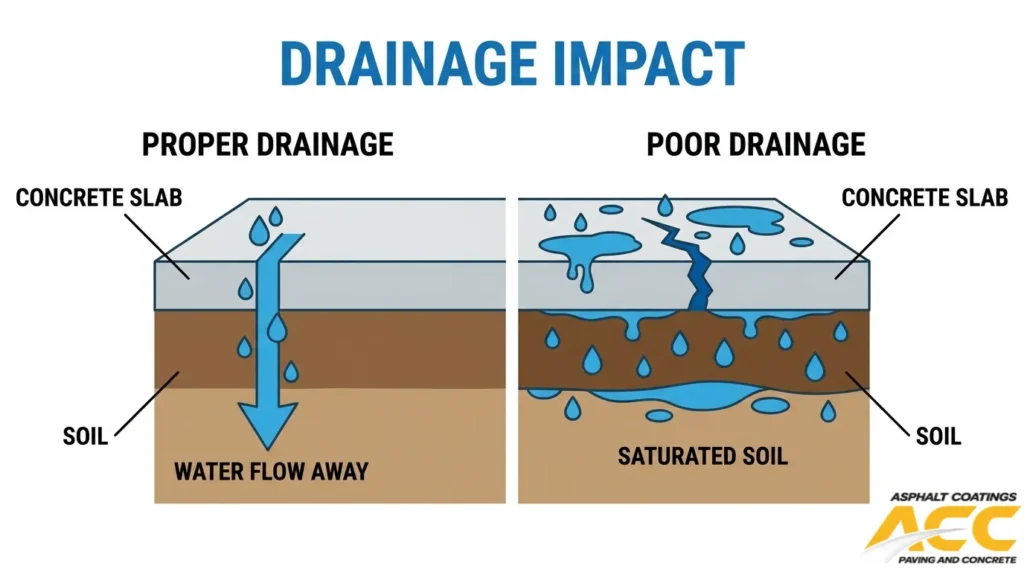
Poor parking lot grading damages concrete over time by allowing water to collect in low spots instead of flowing toward drains. Without adequate slope, standing water saturates the subgrade beneath concrete slabs, softening the soil and creating voids that lead to cracking and settlement.
According to Calichi Design Group, the 2% ADA cross-slope rule controls the entire parking lot layout, meaning accessible stalls and paths of travel must not exceed 2.0% cross slope in any direction. Balancing drainage needs against ADA compliance requirements demands precise grading from the start. When initial construction cuts corners on slope design, the resulting water retention silently erodes structural support beneath the slab for years before visible damage appears.
Why Do Ponding Water and Ice Sheets Accelerate Concrete Failure?
Ponding water and ice sheets accelerate concrete failure by subjecting the slab to prolonged moisture exposure and repeated freeze-thaw pressure. Water that pools on concrete infiltrates surface pores, microcracks, and joint gaps. When temperatures drop below freezing, that trapped water expands by roughly 9% in volume, generating internal hydraulic pressure that widens existing cracks and creates new ones.
In Denver, where overnight freezes can follow sunny afternoons even in spring and fall, a single ponding zone may endure dozens of freeze-thaw cycles per season. Ice sheets also create slip hazards and liability concerns for commercial property managers. Correcting the underlying drainage slope is far more effective than repeatedly patching surface damage caused by standing water.
How Can Clogged or Misplaced Drains Undermine Concrete Slabs?
Clogged or misplaced drains undermine concrete slabs by redirecting water beneath or against the slab rather than away from it. Debris, sediment, and deferred maintenance cause catch basins and trench drains to lose capacity over time. When drains overflow, water follows the path of least resistance, often saturating the subgrade soil directly under adjacent concrete panels.
Misplaced drains create a similar problem from the outset; if a drain sits too far from a low point, water never reaches it. The saturated subgrade loses bearing capacity, and the slab above settles unevenly or cracks under load. Routine drain cleaning and proper placement during construction are the most cost-effective ways to prevent this type of failure. With drainage strategies in place, regular maintenance keeps these protections effective.
What Settlement, Heaving, and Trip Hazard Issues Impact Denver Concrete?
Settlement, heaving, and trip hazard issues impact Denver concrete through expansive soil movement, frost heave cycles, and subsurface obstructions like tree roots and utilities. Each factor displaces slabs differently.
How Does Soil Movement Cause Uneven Concrete and Trip Hazards?
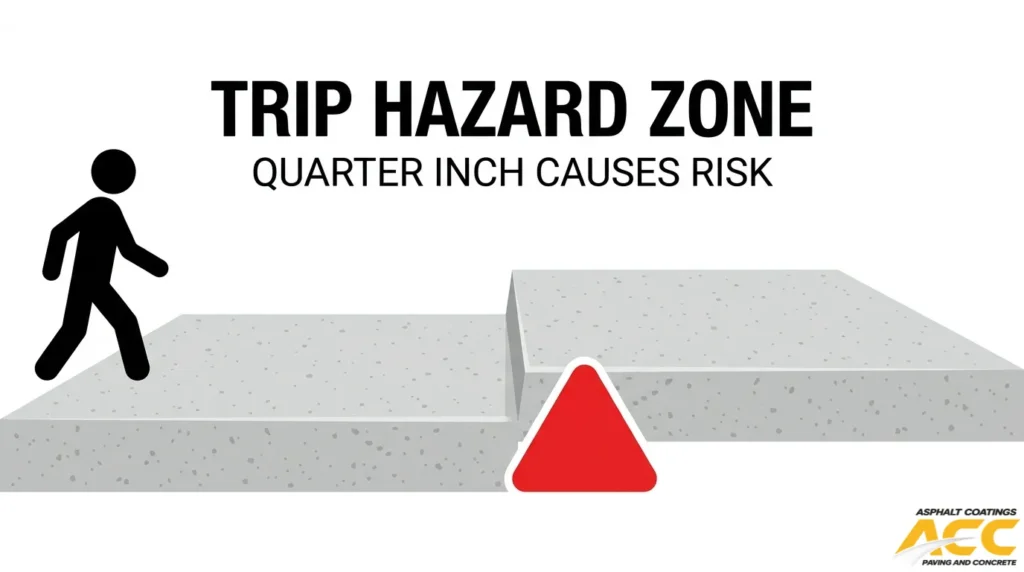
Soil movement causes uneven concrete and trip hazards when clay-rich soils expand during wet periods and shrink during dry spells, lifting or dropping slabs unevenly. According to the Colorado Geological Survey, Colorado’s most significant geologic hazard is expansive or swelling soil, specifically soil laced with layers of various clays. These volume changes create differential settlement beneath concrete flatwork, producing raised edges, tilted panels, and offset joints that become pedestrian trip hazards.
Commercial properties with large concrete footprints are especially vulnerable because soil moisture varies across the site. Walkways, loading docks, and parking areas often settle at different rates, and even half an inch of displacement at a joint can trigger ADA non-compliance and liability exposure.
Why Does Frost Heave Lift Concrete at Walkways and Ramps?
Frost heave lifts concrete at walkways and ramps when moisture in the subgrade freezes and expands, pushing slabs upward from below. Denver’s frost line extends 36 inches below finished grade, meaning shallow footings and thin slabs without adequate base preparation are particularly susceptible. As ice lenses form in the soil, they generate upward pressure that raises concrete sections unevenly.
The damage is often most visible at transitions between heated and unheated areas, where temperature differentials concentrate freeze activity. Ramps and curb transitions bear the worst effects because their geometry channels foot traffic directly over displaced edges, creating immediate safety concerns.
How Do Tree Roots and Utilities Contribute to Concrete Settlement?
Tree roots and utilities contribute to concrete settlement by exerting upward pressure on slabs from below and by creating voids when roots decay or utility trenches consolidate. According to Colorado State University Extension, most tree roots occupy the top 6 to 24 inches of soil and spread across an area two to four times the diameter of the tree crown.
This shallow, wide root zone means a single mature tree can affect concrete panels 20 feet or more from the trunk. Utility trenches pose a similar risk; backfill material often compacts unevenly over time, leaving voids beneath slabs that cause localized sinking. For property managers, proactive site surveys that map root zones and utility corridors help predict where settlement will occur before trip hazards develop.
Understanding what drives slab displacement helps property managers choose the right repair strategy.
What Joint and Sealant Failures Do Denver Concrete Surfaces Face?
Denver concrete surfaces face joint and sealant failures that include sealant loss from thermal cycling, joint widening, and water infiltration that accelerates edge deterioration. The following sections cover why joints open, how failed joints invite damage, and when to schedule replacement.
Why Do Concrete Joints Open Up and Lose Their Sealants?
Concrete joints open up and lose their sealants because repeated thermal expansion and contraction cycles stretch sealant material beyond its elastic limit. Denver’s wide daily temperature swings force joints to move constantly, and over time this movement fatigues even flexible sealants until they crack, debond, or pull away from joint walls.
Improper joint spacing accelerates the problem. When original construction places joints too far apart, each joint must absorb more movement than it was designed to handle. UV exposure at Denver’s elevation further degrades sealant compounds, making them brittle years before their expected service life ends. Incompatible sealant types or poor surface preparation during installation also shorten joint integrity, leaving gaps that widen with each seasonal cycle.
How Do Failed Joints Let Water and Ice Destroy Concrete Edges?
Failed joints let water and ice destroy concrete edges by allowing moisture to penetrate beneath the slab surface and into the subgrade. Once sealant integrity is lost, every rain event and snowmelt channels water directly into the open joint.
According to the Federal Highway Administration (FHWA-HIF-18-019), this additional saturation, in combination with freeze-thaw cycling, can lead to varied forms of damage and deterioration distinct from D-cracking. Water trapped in joint cavities freezes, expands, and spalls the concrete edges from within. Each cycle chips away more material, widening the joint further and creating a self-reinforcing cycle of progressive failure. For commercial properties, this edge deterioration compounds quickly under heavy traffic loads.
When Should Joint Sealants Be Replaced on Commercial Properties?
Joint sealants should be replaced on commercial properties every five to eight years under normal conditions, or sooner when visible signs of failure appear. Key indicators include sealant pulling away from joint walls, visible gaps or cracks in the sealant bead, standing water inside joints after rain, and edge spalling along joint lines.
According to West Bend Mutual Insurance Company’s parking lot condition guidelines, paved surfaces require a minimum 1-percent slope for efficient drainage. When failing sealants allow water to pool at joints rather than drain, the replacement timeline should accelerate regardless of sealant age. Scheduling joint resealing during spring or early fall gives the material optimal curing conditions before Denver’s freeze season begins.
Understanding how joint failures develop helps property managers connect them to broader repair strategies.
How Do Appearance and Compliance Issues Affect Commercial Concrete in Denver?
Appearance and compliance issues affect commercial concrete in Denver by reducing property value, increasing liability exposure, and triggering regulatory violations. The following sections cover surface staining, pavement markings, and ADA requirements.
How Do Stains, Rust, and Tire Marks Impact Property Curb Appeal?
Stains, rust, and tire marks impact property curb appeal by creating a neglected, unprofessional appearance that discourages tenants, customers, and visitors. Oil drips from parked vehicles penetrate porous concrete surfaces and leave darkened patches that worsen over time. Rust stains from aging rebar, metal fixtures, or irrigation components bleed orange discoloration across walkways and entrances. Tire marks accumulate in high-traffic drive lanes and turning areas, leaving dark rubber residue.
These blemishes signal deferred maintenance to prospective tenants evaluating a commercial property. For property managers overseeing shopping centers, office parks, or healthcare facilities, surface staining directly undermines first impressions. Regular pressure washing, concrete sealing, and prompt stain treatment preserve a professional appearance that reflects well on the business.
Why Are Faded or Missing Markings a Safety and Liability Problem?
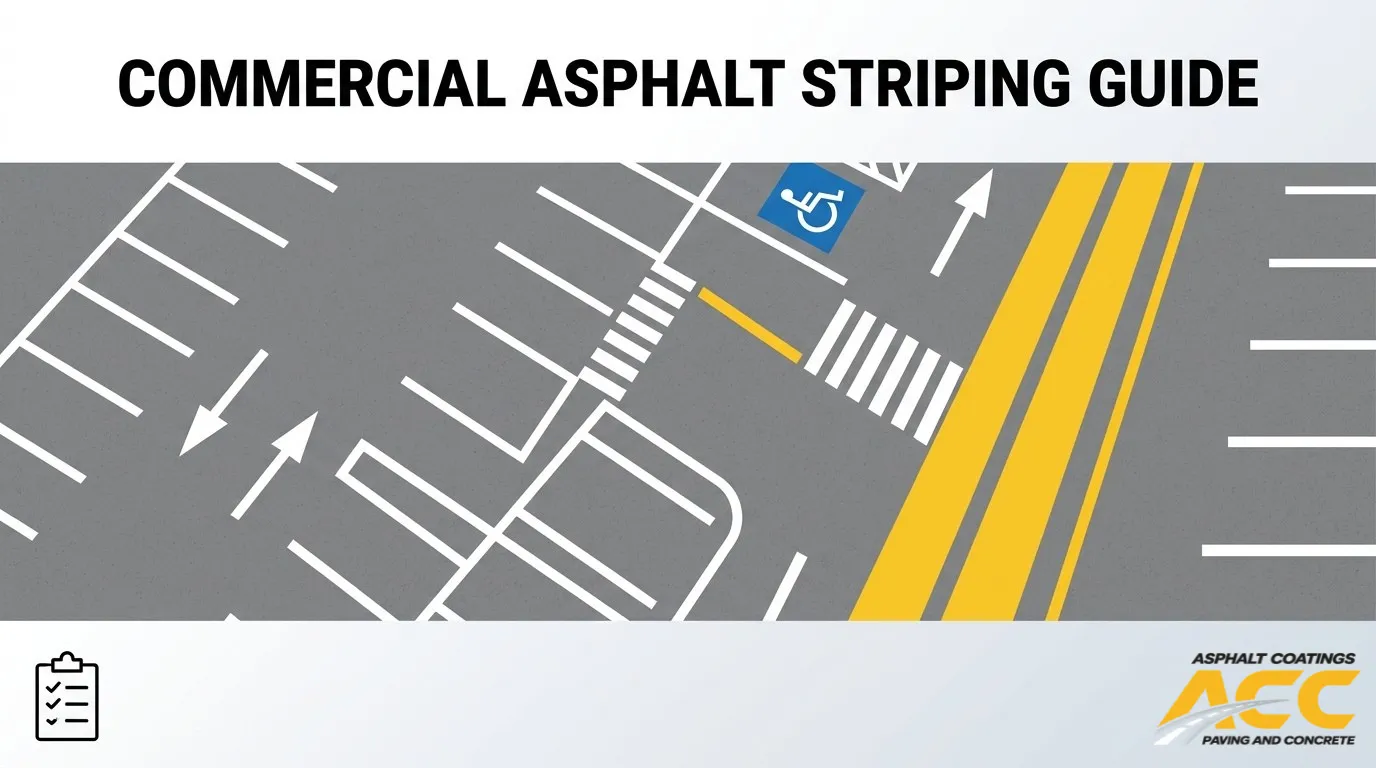
Faded or missing markings are a safety and liability problem because they eliminate the visual cues drivers and pedestrians rely on to navigate parking lots safely. Directional arrows, crosswalks, stop bars, fire lane designations, and stall lines all degrade under Denver’s intense UV exposure and seasonal abrasion from snow plows and deicers.
When these markings disappear, the risks compound quickly:
- Drivers lose clear lane guidance, increasing collision potential at intersections and drive aisles.
- Pedestrians cannot identify designated crosswalks, raising the chance of vehicle-pedestrian incidents.
- Fire lanes without visible red curb markings may go unenforced, blocking emergency access.
- Handicap symbols that fade below recognizable standards invite ADA complaints.
Restriping on a regular cycle is one of the most cost-effective risk-reduction measures a property manager can implement. Neglecting it opens the door to premises liability claims that far exceed the cost of fresh paint.
How Can Concrete Issues Lead to ADA Non-Compliance in Denver?
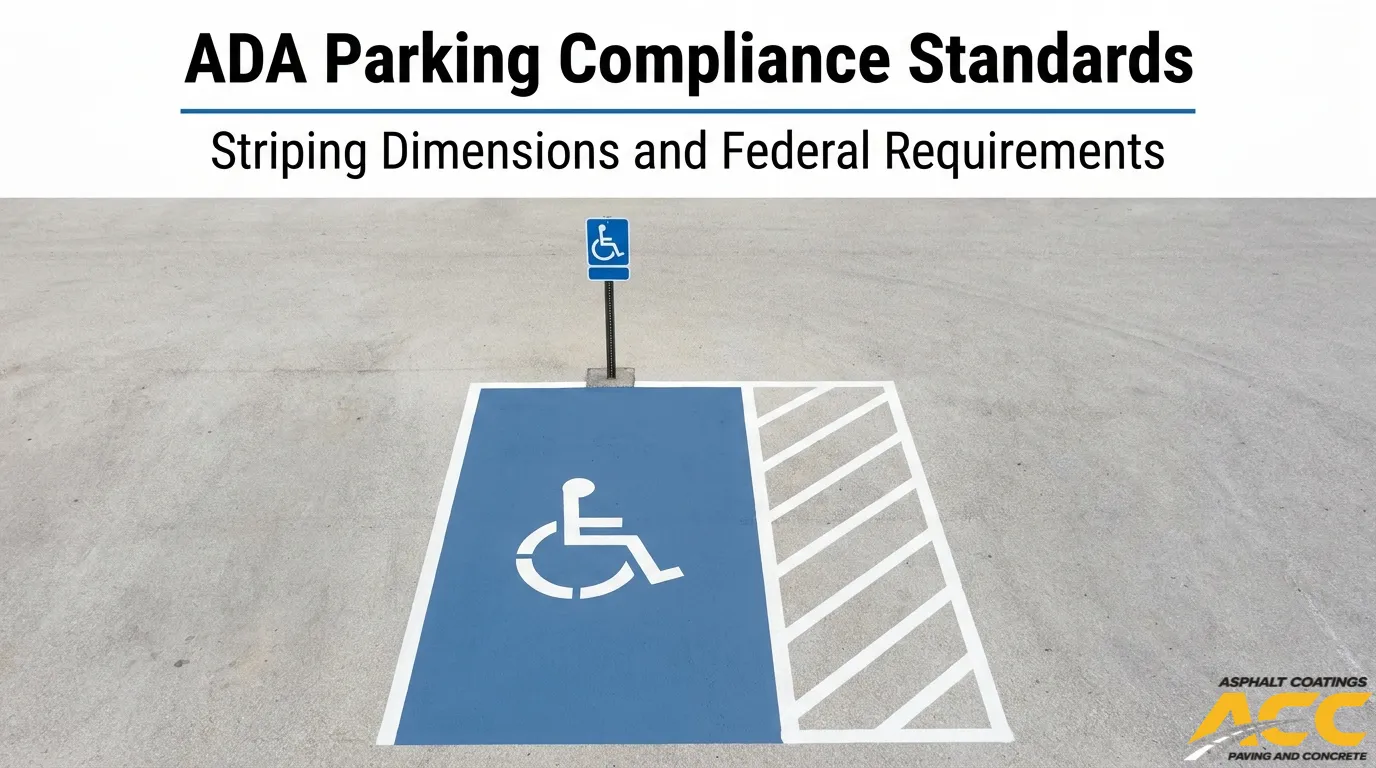
Concrete issues can lead to ADA non-compliance in Denver when surface deterioration alters slopes, creates level changes, or damages accessible routes. According to the U.S. Department of Justice, car accessible parking spaces must be at least 96 inches wide with a 60-inch access aisle, and slopes cannot exceed 2.08% in any direction.
Common violations caused by concrete damage include:
- Settled or heaved slabs that exceed the maximum 1:48 cross slope on accessible routes.
- Spalled surfaces creating abrupt level changes greater than one-quarter inch along pathways.
- Cracked or buckled curb ramps that no longer meet the 1:12 maximum running slope set by the U.S. Access Board.
- Deteriorated detectable warning surfaces at curb ramp transitions.
ADA violations carry significant financial penalties and litigation costs that dwarf the expense of corrective repairs. Proactive concrete inspections focused on accessible parking, ramps, and pathways help Denver property managers maintain compliance before small surface defects become federal violations.
With appearance and compliance addressed, choosing the right repair strategy ensures these issues are resolved effectively.
What Expert Repair and Maintenance Solutions Work Best for Denver Concrete?
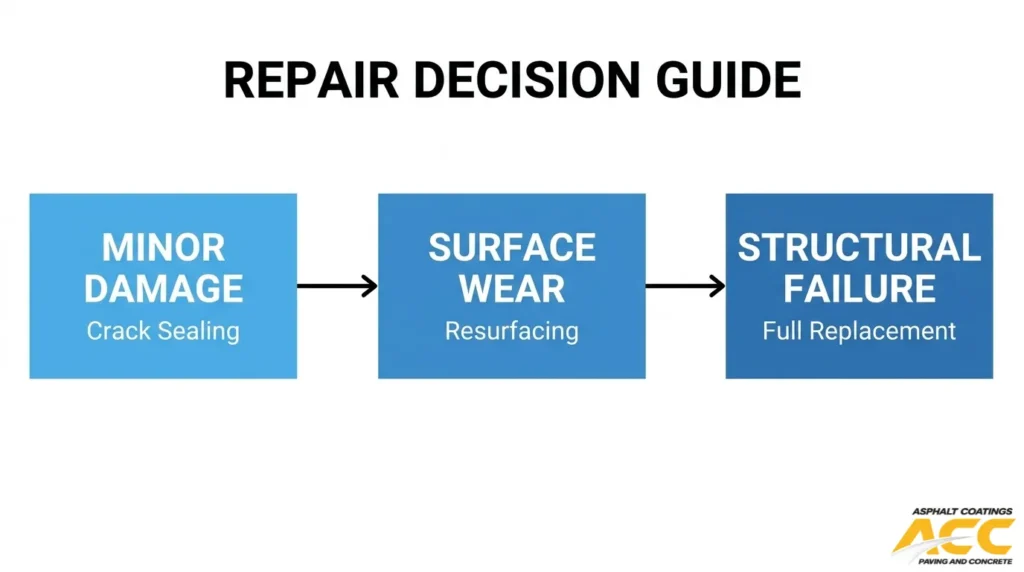
The best expert repair and maintenance solutions for Denver concrete range from targeted crack sealing to full slab replacement, depending on damage severity. The following subsections cover crack repair, resurfacing, removal and replacement, and proactive maintenance strategies.
When Is Concrete Crack Repair and Joint Resealing the Right Fix?
Concrete crack repair and joint resealing are the right fix when damage is cosmetic or surface-level, not structural. Hairline cracks, minor spalling at joint edges, and dried-out sealant gaps all qualify for this targeted approach.
Routing and sealing individual cracks stops water infiltration before freeze-thaw cycles widen the damage. Joint resealing restores the watertight barrier that prevents moisture from reaching the subgrade. This solution works best when the surrounding slab remains stable and level.
For most commercial properties, crack repair and resealing represent the most cost-effective first line of defense. Addressing small cracks early prevents them from becoming structural failures that demand far more expensive interventions.
How Does Concrete Resurfacing Restore Damaged Slabs in Denver?
Concrete resurfacing restores damaged slabs in Denver by applying a bonded overlay or polymer-modified topping to structurally sound concrete that has surface deterioration. Scaling, shallow spalling, and worn finishes are ideal candidates for this method.
The process involves grinding or shot-blasting the existing surface to create a clean bonding profile, then applying the new layer. This restores a uniform, durable finish without the cost and disruption of full removal. Resurfacing also allows property managers to re-establish proper drainage slopes on surfaces that have lost their original grade.
However, resurfacing only works when the underlying slab is structurally intact. If the base has settled, heaved, or cracked through its full depth, an overlay will mirror those failures within months.
When Is Full-Depth Concrete Removal and Replacement Necessary?
Full-depth concrete removal and replacement is necessary when structural damage extends through the entire slab or the subgrade beneath has failed. Deep cracking patterns, severe settlement, significant heaving, and widespread reinforcement corrosion all indicate that surface-level repairs will not hold.
Situations that typically require full replacement include:
- Slabs with multiple intersecting structural cracks that compromise load-bearing capacity.
- Sections where subgrade erosion or expansive soil movement has created voids beneath the concrete.
- Areas with exposed, corroded rebar where the steel can no longer reinforce the slab.
- Panels that have settled or heaved beyond ADA-compliant slope tolerances.
Full replacement addresses the root cause by allowing contractors to correct subgrade conditions, improve drainage, and install properly reinforced new concrete designed for Denver’s climate demands.
How Can Proactive Maintenance Extend the Life of Denver Concrete?
Proactive maintenance extends the life of Denver concrete by addressing minor wear before it escalates into structural failure. Consistent upkeep is far less expensive than reactive emergency repairs.
Key maintenance practices include:
- Scheduling annual inspections to catch hairline cracks, joint sealant gaps, and early spalling.
- Resealing joints and cracks every two to three years to maintain a watertight surface.
- Keeping drainage systems clear so water does not pond on or beneath slabs.
- Applying penetrating sealers to reduce moisture absorption and limit freeze-thaw damage.
- Using sand or non-chloride deicers to minimize chemical surface deterioration during winter.
In practice, the properties that avoid major concrete failures are the ones with consistent inspection and maintenance cycles. Waiting until damage is visible to the untrained eye usually means the problem has already progressed well beyond a simple fix.
With the right repair strategy identified, the next step is prioritizing which concrete issues to address first.
How Should You Prioritize Concrete Repairs on a Commercial Property?
You should prioritize concrete repairs on a commercial property by ranking issues according to safety risk, structural threat, and budget impact. The sections below cover which problems demand immediate action, which threaten long-term integrity, and how to phase repairs strategically.
Which Concrete Issues Pose the Highest Safety and Liability Risks?
The concrete issues that pose the highest safety and liability risks are trip hazards, ADA non-compliance, and unstable surfaces in high-traffic pedestrian zones. Uneven slabs with vertical displacement greater than a quarter inch create fall hazards that expose property owners to premises liability claims. Heaved walkways, spalled entry areas, and deteriorated ramps should be addressed first because they affect the most people and carry the greatest legal exposure.
Prioritize repairs in this order:
- ADA-accessible routes, including ramps, curb cuts, and accessible parking stalls.
- Building entries and primary walkways with visible displacement or spalling.
- Parking areas where ponding water creates ice sheets during winter.
- Loading zones with structural cracking under heavy vehicle traffic.
For most commercial properties, fixing pedestrian-facing hazards before pavement-level issues is the most defensible approach from both a safety and legal standpoint.
What Concrete Problems Threaten Structural Integrity If Ignored?
The concrete problems that threaten structural integrity if ignored are deep structural cracking, active settlement, failed joints, and subgrade erosion. These issues worsen progressively because water infiltration accelerates deterioration through freeze-thaw cycling. According to the Federal Highway Administration (FHWA-HIF-18-019), additional saturation in combination with freeze-thaw cycling leads to varied forms of damage and deterioration distinct from standard D-cracking.
Failed joints allow moisture to penetrate beneath slabs, softening the subgrade and creating voids that lead to further settlement. Structural cracks that extend through the full slab depth compromise load-bearing capacity, particularly in truck lanes and loading docks. Ignoring these problems for even one winter season can turn a repairable crack into a full-depth replacement.
How Can Property Managers Phase Concrete Repairs Within a Budget?
Property managers can phase concrete repairs within a budget by categorizing all identified issues into three tiers: immediate safety fixes, near-term structural repairs, and scheduled maintenance items. This approach spreads capital expenditure across multiple budget cycles without allowing critical problems to escalate.
- Tier 1 (immediate): Trip hazards, ADA violations, and any condition creating fall risk.
- Tier 2 (within 6 months): Structural cracks, active settlement, and failed joints that allow water infiltration.
- Tier 3 (next budget cycle): Surface spalling, cosmetic deterioration, and sealant replacement on stable joints.
Conducting a documented condition assessment each spring gives property managers the data needed to justify repair budgets to ownership. Pairing lower-cost maintenance like joint resealing with higher-cost replacements in the same mobilization also reduces overall project expenses.
With a clear repair priority framework in place, the next step is preventing future concrete problems through better design and maintenance practices.
How Can Denver Property Managers Prevent Future Concrete Problems?
Denver property managers can prevent future concrete problems by combining climate-informed design, scheduled inspections, and disciplined operational practices. The following subsections cover design choices, inspection frequency, and daily habits that reduce long-term damage.
What Design Choices Help Concrete Perform Better in Denver’s Climate?
Design choices that help concrete perform better in Denver’s climate start with proper subgrade preparation, adequate slab thickness, and air-entrained mix designs rated for freeze-thaw exposure. Footings and foundations should extend below the frost line, which the 2025 Denver Building Code sets at 36 inches below finished grade. Asphalt Coatings Company has designed concrete installations for Colorado’s Front Range since 1986, incorporating frost-depth footings, air-entrained mixes, and proper joint spacing as standard practice across commercial projects from Denver to Colorado Springs.
Effective design also includes:
- Specifying control joint spacing no greater than 20 feet, adjusted for slab thickness, to control where cracks form.
- Maintaining a minimum 1-percent slope on paved surfaces for efficient drainage.
- Installing root barriers near trees, since roots commonly occupy the top 6 to 24 inches of soil and extend two to four times the canopy diameter.
- Using fiber reinforcement or welded wire mesh in high-traffic zones to resist structural cracking.
Investing in these specifications during initial construction is far more cost-effective than retrofitting damaged slabs later.
How Often Should Commercial Concrete Be Inspected and Maintained?
Commercial concrete should be inspected and maintained at least twice per year, with additional walkthroughs after severe weather events. The most effective schedule targets early spring and late fall, aligning inspections with the beginning and end of Denver’s freeze-thaw season.
Each inspection should evaluate:
- Joint sealant condition and any signs of separation or hardening.
- Surface scaling, spalling, or delamination near drains and high-traffic lanes.
- Drainage performance, checking for ponding water that signals grading failures.
- ADA-compliant slopes and trip hazard thresholds at walkways and ramps.
Asphalt Coatings Company provides concrete inspection services as part of comprehensive parking lot and flatwork maintenance programs for commercial properties throughout the Front Range, identifying early-stage damage before it escalates into costly structural repairs. Documenting findings with photos and timestamps creates a maintenance record that supports warranty claims, liability defense, and budget planning. Properties with heavy truck traffic or chemical exposure may need quarterly reviews to catch deterioration before it compounds.
What Operational Practices Reduce Long-Term Concrete Damage?
Operational practices that reduce long-term concrete damage focus on limiting chemical exposure, managing water, and controlling mechanical stress. According to the Federal Highway Administration (FHWA-HIF-17-008), changes in salting practices have made deicer-related distress more common and more notable than before.
Key daily and seasonal practices include:
- Switching to sand or acetate-based deicers on concrete surfaces instead of rock salt or magnesium chloride.
- Clearing snow promptly to prevent meltwater from saturating joints and refreezing.
- Keeping catch basins and drainage channels clear of debris so water moves off slabs quickly.
- Enforcing weight limits in areas designed for passenger vehicles only.
- Resealing joints as soon as sealant shows cracking or adhesion loss.
These habits cost little compared to the repair bills they prevent, making operational discipline the most accessible form of concrete preservation for any commercial property.
How Should You Approach Denver Concrete Issues with a Commercial Contractor?
You should approach Denver concrete issues with a commercial contractor by selecting a firm that offers comprehensive concrete flatwork, parking lot construction, and repair services under one roof. The sections below cover how integrated services solve common problems and summarize key takeaways.
How Can Concrete Flatwork and Parking Lot Construction Services Solve Denver’s Top Concrete Problems?
Concrete flatwork and parking lot construction services solve Denver’s top concrete problems by addressing root causes during initial design and providing targeted repairs when damage occurs. A contractor experienced with Colorado’s expansive soils, freeze-thaw cycling, and drainage challenges can engineer slabs, joints, and grading systems that prevent recurring failures.
Commercial concrete contractors deliver concrete flatwork installation and repair, parking lot construction, curb and gutter work, subgrade preparation, and ADA-compliant concrete services. This single-source approach ensures that grading, joint placement, drainage design, and surface finishing all follow a unified plan. For commercial property managers dealing with spalling, settlement, or cracked slabs, having one contractor coordinate every layer of the solution reduces miscommunication and accelerates project timelines.
What Are the Key Takeaways About the Top Concrete Issues in Denver and the Expert Solutions to Fix Them?
The key takeaways about the top concrete issues in Denver and the expert solutions to fix them center on five practical priorities:
- Climate drives most damage. Freeze-thaw cycles, deicer salt exposure, and expansive clay soils are the primary forces behind cracking, spalling, and settlement across commercial properties.
- Drainage and grading prevent costly failures. Proper slope design, functional drains, and ADA-compliant cross slopes protect concrete from ponding water and ice formation.
- Joint maintenance is non-negotiable. Timely sealant replacement stops water infiltration that accelerates edge deterioration and sub-slab erosion.
- Proactive inspection saves money. Routine assessments catch minor cracks and surface wear before they escalate into full-depth replacements.
- Choosing the right contractor matters most. A commercial specialist with Colorado-specific expertise, like Asphalt Coatings Company, brings the subgrade knowledge, material selection, and construction methods needed to build concrete surfaces that last.