Commercial and residential paving are two distinct categories of asphalt construction separated by project scale, material specifications, regulatory requirements, and long-term maintenance demands.
This guide covers scope and traffic load differences, material and mix design specifications, the paving process from site prep through drainage, cost comparisons, regulatory compliance, maintenance schedules, contractor selection, durability, and Colorado climate considerations.
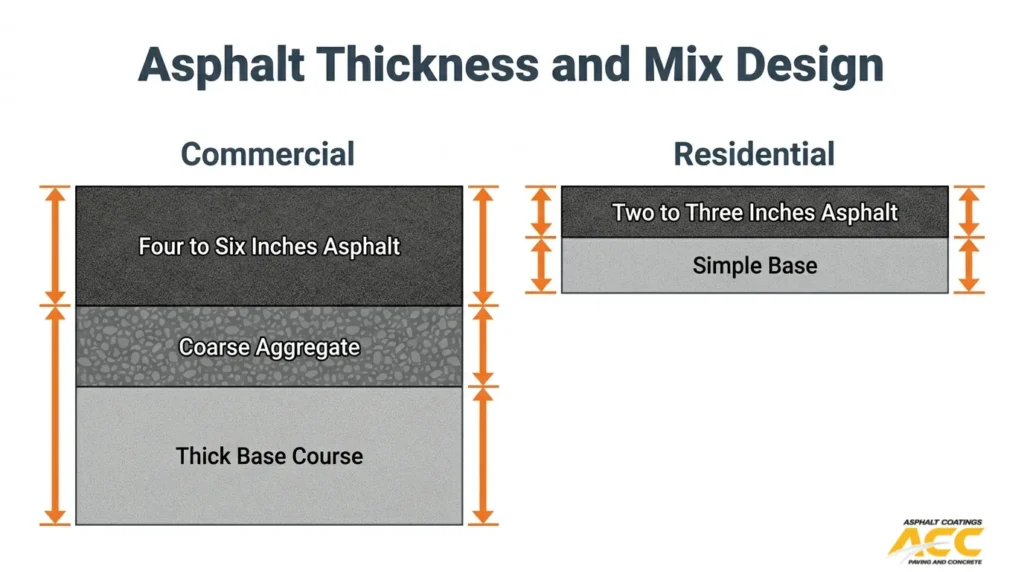
Commercial projects span parking lots, loading docks, and access roads covering tens of thousands of square feet, while residential work focuses on driveways and walkways with far smaller footprints. Heavy vehicle traffic on commercial sites demands thicker structural sections engineered to AASHTO standards, whereas residential driveways typically need only 2 to 3 inches of asphalt designed for passenger car loads.
Material choices diverge at the aggregate level. Commercial mixes use coarser aggregate and thicker lifts for load distribution; residential mixes favor finer gradations for a smoother finish. These specifications carry directly into how each project is built, from deeper excavation and soil stabilization on commercial sites to simpler grading on residential properties.
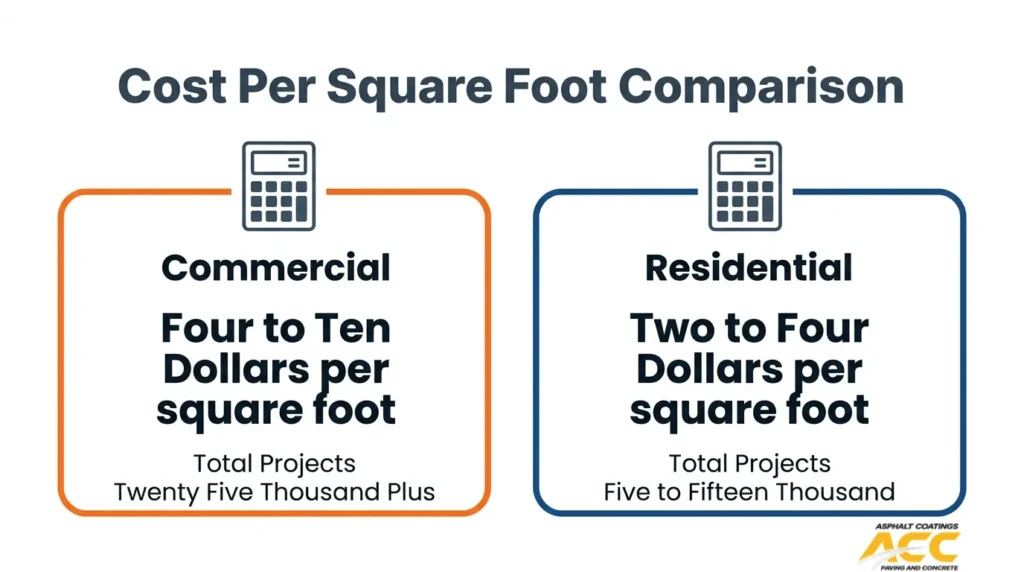
Commercial paving costs range from $4 to $10 per square foot, with total budgets often exceeding $25,000, driven by ADA compliance, engineered drainage systems, and permitting layers that residential projects rarely require. Homeowners instead navigate zoning codes and HOA rules that govern driveway dimensions and approved materials.
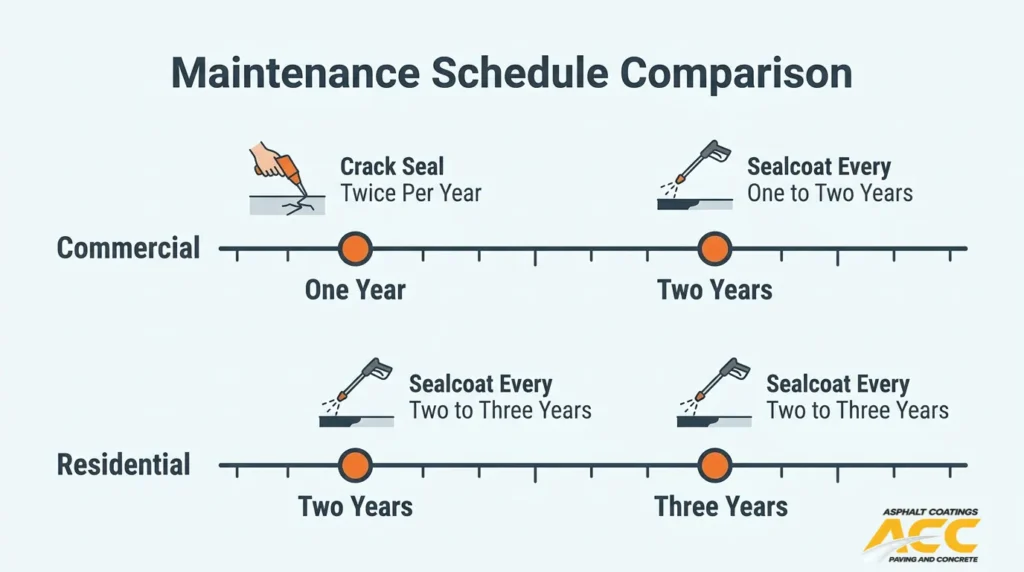
Maintenance intensity also splits sharply. Commercial lots need crack sealing twice per year and sealcoating every 1 to 2 years in high-traffic zones, while residential driveways follow a 2 to 3 year sealcoating cycle. Colorado’s freeze-thaw cycles compound these demands for both pavement types, making contractor expertise and proper subgrade engineering essential for lasting performance.
What Is Commercial Paving?
Commercial paving is the construction, installation, and maintenance of asphalt or concrete surfaces for business and industrial properties. These projects include parking lots, loading docks, access roads, and other high-traffic surfaces designed to support heavy vehicle loads. Unlike residential work, commercial paving demands thicker materials, stricter regulatory compliance, and engineered drainage systems built to withstand sustained use.
According to Pate Asphalt, commercial paving typically involves large-scale projects like parking lots, loading docks, and access roads, while residential paving primarily focuses on driveways and walkways. This distinction in scope directly shapes every decision, from material selection to project timeline. Commercial surfaces must also meet ADA accessibility standards and local code requirements that rarely apply to home driveways.
For property managers and business owners evaluating paving needs, understanding what qualifies as commercial work is the essential first step before comparing costs, materials, or contractor qualifications.
What Is Residential Paving?
Residential paving is the installation of asphalt or concrete surfaces on private home properties, primarily driveways and walkways. Designed for lighter passenger vehicle loads, these projects are smaller in scale and often emphasize curb appeal alongside functionality. According to a Residential Asphalt Installation Guide, residential paving projects are generally smaller in scale, such as a standard driveway, compared to commercial ventures that can cover tens of thousands of square feet. Asphalt thickness for residential applications typically ranges from 2 to 3 inches, often laid in a single lift. Because the traffic demands are modest, the structural design prioritizes a clean finish and long-term weather resistance over heavy-load capacity. Understanding these characteristics helps clarify how residential projects compare to their commercial counterparts.
How Do Commercial and Residential Paving Differ in Scope and Scale?
Commercial and residential paving differ in scope and scale across three primary dimensions: project size, traffic load requirements, and timeline expectations. The sections below break down each factor.
How Does Project Size Compare Between Commercial and Residential Paving?
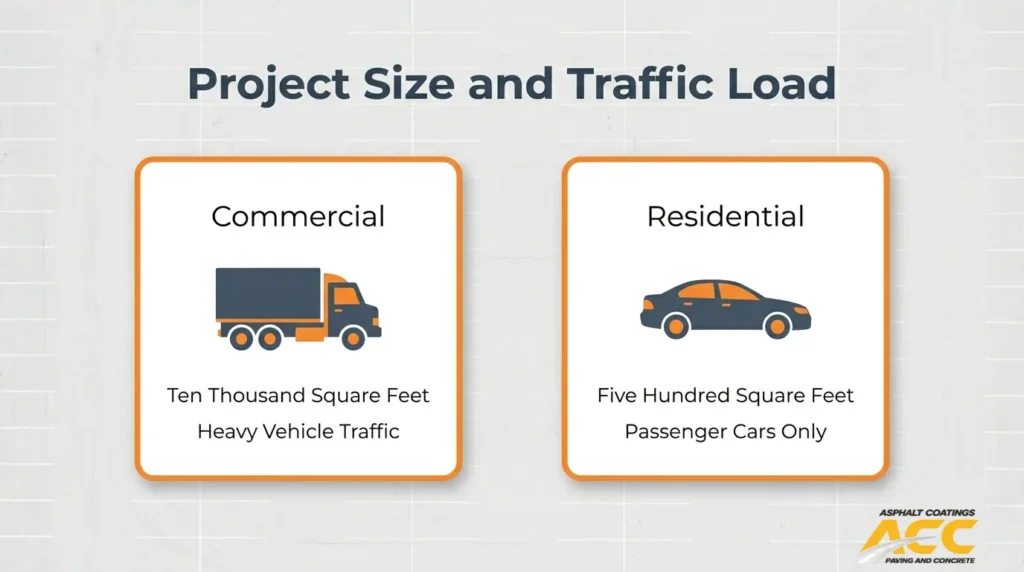
Project size between commercial and residential paving differs dramatically in square footage and structural demands. Commercial paving covers parking lots, loading docks, and access roads that can span tens of thousands of square feet. Residential paving focuses on driveways and walkways, which are far smaller in total area.
According to a Residential Asphalt Installation Guide, residential projects are generally limited to a standard driveway, while commercial ventures routinely cover ten times that surface area or more. This gap in scale directly affects material volume, equipment needs, and crew size. For property managers planning a commercial lot, understanding this size disparity is essential because it shapes every downstream decision, from budget to construction sequencing.
How Do Traffic Load Requirements Differ?
Traffic load requirements differ because commercial pavement must support heavy vehicles, while residential pavement handles passenger cars. The ESAL (Equivalent Single Axle Load), representing the damage from a single 18,000-pound axle load, serves as the standard unit for calculating pavement stress. Commercial sites accumulate far higher ESAL counts due to delivery trucks, service vehicles, and constant traffic flow.
This heavier loading demands thicker asphalt layers, more robust base courses, and stricter engineering inputs based on AASHTO design standards. Residential driveways, by contrast, rarely encounter loads beyond a standard SUV or pickup truck. The practical takeaway is straightforward: underbuilding a commercial surface to residential specifications virtually guarantees premature failure and costly repairs.
How Do Timeline and Scheduling Expectations Differ?
Timeline and scheduling expectations differ because commercial paving projects require longer planning, phased construction, and coordination with business operations. A commercial parking lot may need traffic management plans, after-hours work to avoid disrupting tenants, and staged completion so portions of the lot remain accessible throughout the project.
Residential paving timelines are considerably shorter. Most driveway installations wrap up within one to three days, with minimal logistical coordination beyond the homeowner’s schedule. Commercial projects, on the other hand, often run several weeks depending on lot size, subgrade conditions, and regulatory inspections. Factoring in adequate scheduling lead time on commercial work prevents costly delays and keeps tenants satisfied.
Understanding these scope and scale differences clarifies why material choices and mix designs also vary between project types.
What Materials Are Used in Commercial vs Residential Paving?
The materials used in commercial vs residential paving differ primarily in asphalt thickness, aggregate size, and mix design. Commercial projects require thicker layers and coarser aggregates, while residential projects use thinner lifts with finer mixes.
How Does Asphalt Thickness Differ for Commercial Projects?
Asphalt thickness for commercial projects typically exceeds residential standards because parking lots, loading docks, and access roads must support heavy vehicle traffic. According to Wright Construction Inc., commercial and industrial requirements often demand thicker asphalt layers to handle heavier loads, while residential paving typically ranges from only 2 to 3 inches. AASHTO pavement design standards calculate the required thickness using design ESALs and subgrade resilient modulus, meaning commercial pavements are engineered to distribute greater force across a stronger structural section. Skipping this engineering step is one of the most common mistakes property managers make; it leads to premature cracking and costly repairs within just a few years.
How Does Asphalt Thickness Differ for Residential Projects?
Asphalt thickness for residential projects typically ranges from 2 to 3 inches, often applied in a single lift. This thinner profile is sufficient because driveways and walkways primarily support passenger vehicles rather than heavy trucks. Residential pavement design also uses a lower terminal serviceability index (Pt) of 2.00, compared to the 2.25 recommended for commercial and industrial streets. Simplified engineering inputs based on the AASHTO 1993 design process are commonly used for these lower-volume applications. For most homeowners, that 2 to 3 inch range handles daily use well, though properties with heavier vehicles like RVs may benefit from moving closer to the upper end.
What Aggregate and Mix Design Differences Exist?
The aggregate and mix design differences between commercial and residential asphalt center on particle size and binder performance. Commercial grade asphalt contains larger aggregate, making it more durable and capable of withstanding heavy traffic compared to residential mixes. Hot Mix Asphalt (HMA) is standard for both applications, with layer coefficients in structural design typically ranging from 0.40 to 0.44. However, commercial mixes use coarser gradations to improve load distribution, while residential mixes favor finer aggregate for a smoother finished surface. This distinction matters more than most people realize; selecting the wrong mix design for the traffic load is a reliability issue, not just an aesthetic one.
Understanding material differences sets the stage for how each paving process unfolds on-site.
How Does the Paving Process Differ for Commercial and Residential Projects?
The paving process differs for commercial and residential projects in site preparation complexity, subgrade engineering, and drainage design. The following sections cover site prep expectations, base installation differences, and drainage requirements.
What Site Preparation Differences Should You Expect?
Site preparation differences between commercial and residential paving center on scale, equipment, and environmental assessment. Residential driveways typically require clearing a defined area, removing topsoil, and grading a relatively compact footprint. Commercial projects demand extensive site surveys, utility locating, environmental testing, and demolition of existing surfaces across thousands of square feet.
Commercial sites often involve coordinating phased work to keep businesses operational during construction. Soil testing becomes more rigorous because the subgrade must support heavier loads from trucks and constant traffic. According to Wright Construction Inc., commercial requirements demand thicker pavement layers to handle heavier loads, which means site prep must accommodate deeper excavation from the start. Residential prep, while simpler in scope, still requires proper grading to prevent future settling.
How Does Subgrade and Base Installation Differ?
Subgrade and base installation differs primarily in depth, compaction standards, and material specifications. Residential driveways typically use a compacted aggregate base of 6 to 8 inches beneath 2 to 3 inches of asphalt. Commercial pavements require substantially thicker base layers, often engineered using AASHTO design standards that calculate required thickness from design ESALs and subgrade resilient modulus.
For commercial projects, soil stabilization techniques such as lime or cement treatment may be necessary when native soil lacks adequate bearing capacity. Compaction testing at multiple points across the site ensures uniformity under heavy-load conditions. Residential subgrade work rarely demands this level of verification. In practice, cutting corners on commercial base installation is the single fastest way to guarantee premature pavement failure, making this phase non-negotiable for long-term performance.
How Do Drainage Engineering Requirements Compare?
Drainage engineering requirements for commercial paving are significantly more complex than residential applications. Commercial parking lots and access roads must manage stormwater runoff across large impervious surfaces, often requiring engineered drainage systems with catch basins, storm drains, and retention or detention ponds that comply with municipal stormwater regulations.
Residential driveways typically rely on simpler solutions: crown grading to shed water toward yard areas or existing street drainage. Commercial sites, by contrast, must account for ADA slope requirements; according to DMI Paving and Sealcoating, parking surfaces must maintain slopes no steeper than 1:48 (approximately 2.08%) while still directing water effectively. Balancing accessibility compliance with adequate drainage is one of the most technically demanding aspects of commercial paving design. Proper drainage protections established here set the stage for understanding long-term cost differences.
How Do Costs Compare Between Commercial and Residential Paving?
Costs between commercial and residential paving differ significantly in per-square-foot rates, total project budgets, and the factors that drive each. The sections below break down typical parking lot costs, driveway costs, and the reasons commercial projects carry higher price tags.
What Does Commercial Parking Lot Paving Typically Cost?
Commercial parking lot paving typically costs between $4 and $10 per square foot, with total project budgets often ranging from $25,000 to over $150,000. According to Angi, paved parking lots generally fall between $2.50 and $7 per square foot when comparing asphalt and concrete options. The wide range reflects variables such as lot size, base preparation complexity, drainage engineering, and ADA compliance requirements. Sealcoating adds $0.20 to $0.50 per square foot on top of initial installation. For property managers budgeting a commercial project, the per-square-foot rate alone rarely tells the full story; site conditions and regulatory obligations shape the final number far more than material prices.
What Does a Residential Driveway Paving Typically Cost?
A residential driveway paving typically costs less per project than commercial work, though per-square-foot rates can overlap. Because residential driveways use thinner asphalt layers of 2 to 3 inches and cover a much smaller area, total project budgets stay well below commercial thresholds. Simpler subgrade preparation, fewer drainage requirements, and no ADA compliance obligations reduce both labor and engineering costs. Asphalt prices in FY 2026 Q1 fell to approximately $159 per ton, down from $169 per ton in FY 2025, which benefits both project types. Still, homeowners should expect that material savings on a driveway are partially offset by the higher per-unit mobilization cost of bringing equipment to a smaller job site.
Why Does Commercial Paving Cost More Per Project?
Commercial paving costs more per project because of greater material volume, stricter engineering standards, and additional regulatory requirements. Several factors compound the price difference:
- Thicker asphalt sections and heavier-duty aggregate mixes increase raw material costs.
- Larger project footprints require more equipment, longer timelines, and bigger crews.
- ADA compliance, stormwater drainage design, and striping add engineering and labor layers that residential driveways rarely need.
- Heavy vehicle traffic demands robust base preparation and structural design standards, such as those from AASHTO, which raise upfront construction investment.
These added layers of complexity mean commercial budgets reflect not just more square footage, but a fundamentally different scope of work. Understanding these cost drivers helps property managers evaluate bids more accurately and plan for long-term pavement performance.
What Regulatory and Compliance Requirements Apply to Each?
Regulatory and compliance requirements differ significantly between commercial and residential paving. Commercial projects must meet ADA accessibility standards, obtain building permits, and follow local code requirements. Residential projects typically navigate zoning restrictions and HOA rules.
What ADA Compliance Standards Apply to Commercial Paving?
ADA compliance standards that apply to commercial paving govern parking lot accessibility, surface slopes, and van-accessible space requirements. According to the U.S. Access Board, the 2010 ADA Standards for Accessible Design require that accessible parking spaces be located on the shortest accessible route to an accessible entrance, and at least one of every six accessible spaces must be sized to accommodate vans.
Parking spaces and access aisles must maintain a surface slope of no more than 1:48 (approximately 2.08%) in all directions. Proper striping, signage, and curb ramp placement are also mandatory. Failing to meet these standards exposes property owners to legal liability and costly retrofits, making ADA compliance one of the most consequential aspects of any commercial paving project.
What Permits and Code Requirements Differ for Commercial Projects?
Permits and code requirements for commercial projects are substantially more involved than those for residential work. Commercial paving typically requires:
- Building or construction permits from the local municipality before work begins.
- Stormwater management plans demonstrating proper drainage and runoff control.
- Engineering drawings stamped by a licensed professional for projects above certain square footage thresholds.
- Fire lane and emergency access compliance verified during plan review.
- Traffic control permits when paving affects public roadways or intersections.
Residential driveways, by contrast, may only need a simple right-of-way or driveway approach permit. The permitting gap reflects the higher public safety stakes of commercial sites, where heavier traffic volumes and larger impervious surfaces demand closer regulatory oversight.
What Zoning or HOA Rules Affect Residential Paving?
Zoning and HOA rules that affect residential paving regulate driveway dimensions, setback distances, surface materials, and impervious coverage limits. Municipal zoning codes often restrict driveway width, specify maximum lot coverage percentages for paved surfaces, and require minimum setbacks from property lines.
HOA covenants can add further constraints, such as:
- Approved surface materials (asphalt, concrete, or pavers only).
- Color and finish requirements for visible surfaces.
- Pre-approval submissions before any paving work begins.
- Restrictions on parking pad additions or driveway expansions.
Homeowners who skip HOA approval or violate zoning setbacks risk fines, forced removal, or project delays. While these rules carry less complexity than commercial permitting, overlooking them remains a common and expensive mistake.
Understanding each project type’s compliance landscape helps property owners plan realistic timelines and budgets before construction begins.
How Do Maintenance Needs Differ for Commercial and Residential Pavement?
Maintenance needs differ for commercial and residential pavement primarily in frequency and intensity. Commercial surfaces endure heavier traffic loads, requiring more frequent sealcoating, crack sealing, and inspections. The following sections break down sealcoating schedules for each type and how freeze-thaw cycles compound the differences.
How Often Does Commercial Pavement Need Sealcoating?
Commercial pavement needs sealcoating every 1 to 2 years for high-traffic areas and every 2 to 4 years for moderate-use surfaces. According to Fix Asphalt’s 2026 commercial property manager’s guide, commercial properties should inspect and seal cracks twice per year, once in spring and once in fall, to prevent small issues from escalating.
New asphalt should cure for 6 to 12 months before the first sealcoat application. After that initial coat, the reseal cycle tightens considerably compared to residential driveways because constant vehicle turning, heavy delivery trucks, and daily traffic volumes break down the asphalt binder faster. For property managers overseeing large parking lots, staying ahead of this schedule is far more cost-effective than reactive repairs.
How Often Does Residential Pavement Need Sealcoating?
Residential pavement needs sealcoating every 2 to 3 years after the initial application. This longer interval reflects the lighter traffic loads that driveways and walkways typically experience compared to commercial lots.
Residential asphalt still requires the same 6 to 12 month curing period before the first sealcoat. Beyond that, homeowners benefit from visual inspections each spring to catch surface cracking early. Because driveways support mostly passenger vehicles rather than heavy trucks, the asphalt binder degrades more slowly. That said, neglecting the 2 to 3 year cycle allows UV exposure and moisture penetration to accelerate deterioration, ultimately shortening pavement lifespan well below its potential.
How Do Freeze-Thaw Cycles Affect Each Pavement Type Differently?
Freeze-thaw cycles affect each pavement type differently based on structural thickness, traffic stress, and maintenance history. According to Tensar, freeze-thaw cycles damage the asphalt binder itself, reducing both stiffness and compressive strength over time.
Commercial pavement faces compounded risk because heavy vehicle loads create micro-cracks that allow water infiltration. When that water freezes and expands, potholes form rapidly across high-traffic zones. Residential driveways experience the same freeze-thaw mechanism, but lighter traffic produces fewer entry points for moisture. This is precisely why commercial maintenance schedules demand biannual crack sealing; every unsealed crack becomes a pothole candidate after just one winter cycle.
Understanding these maintenance differences helps property owners budget accurately for long-term pavement care.
How Do You Choose the Right Paving Contractor for Each Project Type?
You choose the right paving contractor by matching their specialization, licensing, and project experience to your specific paving needs. Commercial projects demand different qualifications than residential work.
Why Does Commercial Paving Require Specialized Contractor Experience?
Commercial paving requires specialized contractor experience because large-scale projects involve complex engineering, strict regulatory compliance, and heavy-traffic design standards that general contractors rarely handle. Parking lots, loading docks, and access roads demand knowledge of ADA requirements, proper drainage grading, and AASHTO structural design principles.
According to Procore, licensing and bonding requirements ensure that contractors have the necessary insurance and financial security to perform large-scale commercial paving projects. Beyond credentials, a commercial specialist should demonstrate familiarity with ESAL calculations, subgrade preparation for heavy loads, and phased scheduling that minimizes business disruption.
Choosing a contractor without verified commercial experience is one of the most common mistakes property managers make; it often leads to premature pavement failure and costly repairs.
What Should You Look for in a Residential Paving Contractor?
You should look for a residential paving contractor who holds proper local licensing, carries adequate insurance, and has a portfolio of completed driveway and walkway projects. As Tandem Paving notes, contractors may specialize in residential or commercial paving, so it is important to inquire about their specific expertise for a given project.
Key qualities to evaluate include:
- Verified experience with residential-scale work, such as driveways and walkways.
- Willingness to discuss asphalt thickness, mix design, and curing timelines.
- Transparent written estimates that detail materials, labor, and project scope.
- References from previous homeowners in your area.
- Knowledge of any local HOA or municipal requirements that affect paving.
A residential contractor who communicates clearly about material choices and project timelines typically delivers a more reliable finished product. Understanding the difference between commercial and residential contractor qualifications helps property owners make confident hiring decisions.
How Does Durability and Lifespan Compare Between Commercial and Residential Pavement?
Durability and lifespan differ significantly between commercial and residential pavement due to design priorities, traffic exposure, and environmental stress. The subsections below are covered within this overview.
Commercial asphalt paving is designed for durability to handle heavy use, while residential paving often emphasizes appearance and is subjected to lighter traffic. According to Black Tar Paving, this fundamental difference in design philosophy shapes every material and structural decision, from aggregate size to layer thickness.
These contrasting priorities produce measurable differences in how each pavement type ages:
- Commercial pavement endures constant heavy vehicle loads, accelerating surface wear and requiring thicker structural sections to maintain integrity over time.
- Residential pavement supports lighter passenger vehicles, which generates far less cumulative stress on the asphalt binder and base layers.
- Analysis periods for both concrete and asphalt pavements span 50 years when evaluating lifecycle costs, as recommended by the Institute for Transportation at Iowa State University.
Environmental conditions compound these differences. Freeze-thaw cycles cause damage to the asphalt binder, reducing stiffness and compressive strength over time. The repeated freezing, thawing, and re-freezing of trapped water leads to pothole formation and structural cracking in both pavement types, though commercial surfaces face compounded deterioration when heavy loads coincide with weakened pavement.
For property managers evaluating long-term investment, the takeaway is straightforward: commercial pavement demands heavier upfront construction to achieve comparable service life, while residential pavement achieves longevity more easily through lighter use conditions. Proactive maintenance remains the single most effective way to extend lifespan regardless of application type.
With durability factors established, Colorado’s climate introduces additional considerations for commercial projects.
How Should You Approach Commercial Paving in Colorado’s Climate?
You should approach commercial paving in Colorado’s climate by selecting a contractor with proven expertise in freeze-thaw resilience, CDOT specifications, and regional design standards. The following sections cover contractor selection and key article takeaways.
Can a Commercial-Only Paving Contractor With Colorado Expertise Help With Your Project?
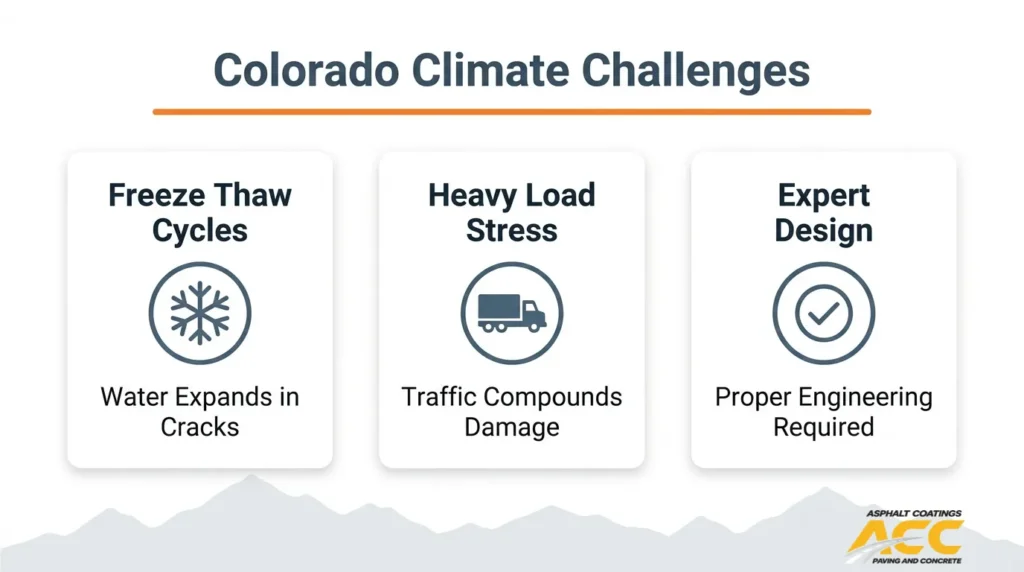
Yes, a commercial-only paving contractor with Colorado expertise can help with your project by designing pavement systems built specifically for the state’s harsh conditions. Colorado’s freeze-thaw cycles, where water repeatedly freezes, expands, and thaws, accelerate cracking and pothole formation in pavement that lacks proper engineering. A contractor focused exclusively on commercial work understands the thicker asphalt layers, robust subgrade preparation, and drainage solutions these projects demand.
Asphalt Coatings Company has served Colorado’s Front Range since 1986, specializing in commercial asphalt paving, sealcoating, crack sealing, and ADA-compliant concrete work. With in-house crews operating across Denver, Colorado Springs, Aurora, and surrounding cities, Asphalt Coatings Company delivers projects engineered for regional challenges, including high-altitude UV exposure and CDOT-approved materials. That nearly four decades of local focus translates into pavement built to last through Colorado’s punishing seasonal swings.
What Are the Key Takeaways About Commercial vs Residential Paving?
The key takeaways about commercial vs residential paving center on differences in scale, materials, cost, compliance, and maintenance:
- Commercial projects cover tens of thousands of square feet and require thicker asphalt with larger aggregate, while residential driveways typically need only 2 to 3 inches of material.
- Commercial paving costs more per project due to heavier structural requirements, ADA compliance obligations, and stricter drainage engineering.
- Maintenance cycles differ significantly; commercial lots need crack sealing twice yearly and sealcoating every 1 to 2 years in high-traffic areas, compared to every 2 to 3 years for residential surfaces.
- Colorado’s freeze-thaw cycles make proper mix design and subgrade preparation critical for both pavement types, though commercial surfaces face greater damage risk from heavy vehicle loads.
Choosing the right contractor for each project type remains the single most impactful decision property owners can make.