Commercial paving contractors are specialized firms that manage the full lifecycle of paved surfaces for businesses, covering everything from new asphalt and concrete installations to sealcoating, striping, and ADA compliance work. Choosing the right one requires a structured comparison across multiple dimensions.
This guide covers the scope of commercial paving services, contractor evaluation criteria, bid comparison strategies, property-specific selection factors, and climate-driven performance considerations.
We break down each major service category, including asphalt paving, concrete flatwork, sealcoating, pavement repair, and striping, so you can verify whether a contractor’s bid covers your full project scope. Material specifications like compacted asphalt depth and mix design vary significantly between proposals, making line-item detail essential for accurate comparison.
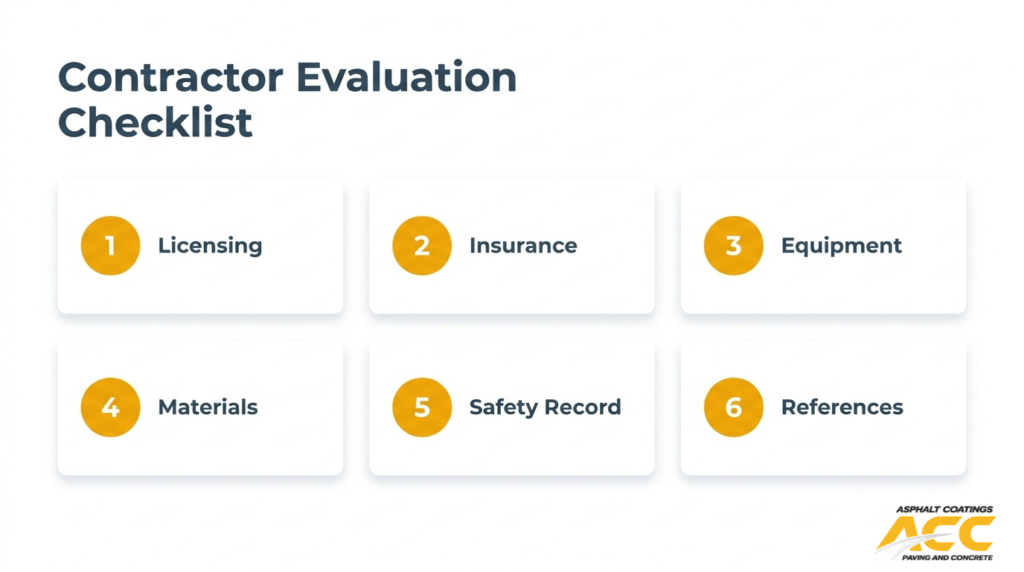
Evaluating contractors means examining licensing, insurance coverage, equipment ownership, supplier relationships, safety records, and verified client references. Contractors with in-house crews and established material partnerships maintain tighter quality control than those relying on subcontracted labor and inconsistent sourcing.
Bid comparison goes beyond price. Vague estimates that omit sub-base preparation, ADA compliance, or warranty terms often signal corners cut. Standard commercial asphalt warranties cover one year, though stronger contractors back their work for up to three.
Property type shapes contractor selection directly. Shopping centers, office campuses, industrial facilities, and HOA communities each demand different pavement designs, traffic load calculations, and construction phasing. Regional climate factors, particularly freeze-thaw cycles and high-altitude UV exposure, further narrow the field to contractors with proven local expertise.
What Do Commercial Paving Contractors Actually Do?
Commercial paving contractors manage the full lifecycle of paved surfaces for businesses, from new construction and grading to ongoing maintenance and repair. Their work spans asphalt installation, concrete flatwork, sealcoating, striping, and ADA compliance across properties such as parking lots, industrial yards, and office campuses.
According to the National Asphalt Pavement Association, asphalt is 100% recyclable, with old pavements often reprocessed into new material. This recyclability shapes how contractors approach both new installations and rehabilitation projects, since milled material can be reclaimed on-site and incorporated into fresh hot-mix. A qualified commercial paving contractor coordinates every phase: site assessment, subgrade preparation, material selection, paving, compaction, surface treatments, and long-term maintenance planning. Understanding this full scope of work is essential before comparing contractors, which the following sections cover in detail.
What Types of Commercial Paving Services Should You Compare?
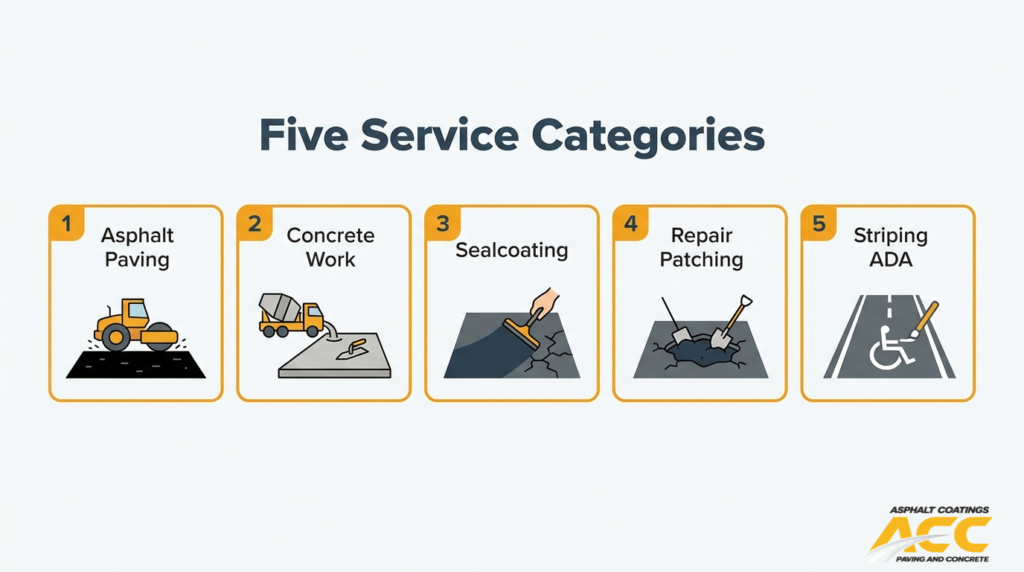
The types of commercial paving services you should compare include asphalt paving, concrete paving, sealcoating and surface treatments, pavement repair and patching, and striping and ADA compliance work. Each service category affects project cost, longevity, and bid structure differently.
Asphalt Paving
Asphalt paving is the most common commercial paving service, covering new installations, overlays, and full-depth replacements for parking lots, roadways, and access drives. When comparing contractors on asphalt work, pay close attention to the specified mix design and compacted depth, since quotes should always list compacted asphalt depth separately from loose depth.
Professional asphalt operations require three essential machines: the asphalt paver, the compaction roller, and the milling machine. According to TruTec’s contractor equipment guide, milling machines use a rotating drum with carbide teeth to grind old pavement, producing Reclaimed Asphalt Pavement that can be 100% recycled into new hot-mix. Regional specifications also matter; the Pikes Peak Region mandates that Superpave Asphalt Pavement Material meets construction requirements tailored to Colorado’s terrain and climate.
Concrete Paving
Concrete paving covers flatwork, curb and gutter installations, sidewalks, and heavy-duty slabs for loading docks or drive lanes. Concrete surfaces generally require less frequent maintenance than asphalt, though initial installation costs run higher. For properties needing long service life under heavy point loads, concrete is often the more cost-effective choice over a multi-decade horizon. Comparing contractors on concrete work means verifying their experience with proper joint spacing, reinforcement placement, and curing protocols specific to your property’s traffic demands.
Sealcoating and Surface Treatments
Sealcoating and surface treatments are preventive maintenance services that extend asphalt pavement life by shielding it from UV damage, water infiltration, and chemical spills. These treatments involve applying a protective emulsion layer over existing asphalt. When comparing bids, confirm whether the contractor includes crack sealing before sealcoat application; omitting this step significantly reduces treatment effectiveness. Sealcoating is one of the most cost-efficient ways to delay full resurfacing, making it a critical line item to evaluate across proposals.
Pavement Repair and Patching
Pavement repair and patching services address localized failures, such as potholes, alligator cracking, and utility cuts, without requiring full resurfacing. Contractors should specify whether they use infrared repair, saw-cut removal with full-depth replacement, or skin patching, since each method suits different failure types. Property owners should seek explanations for unusually low repair bids, as these might indicate a “lowball” strategy that omits critical services like crack repair or tack coating. Proper patching restores structural integrity and prevents small problems from escalating into costly full-depth failures.
Striping and ADA Compliance Work
Striping and ADA compliance work includes parking lot line painting, directional markings, handicap signage, and accessible route construction. These services ensure your property meets federal accessibility standards while maximizing parking efficiency. When comparing contractors, verify they understand current ADA slope, width, and surface requirements, not just paint application. Overlooking ADA compliance during a paving project creates legal liability that far exceeds the cost of doing it correctly from the start.
Understanding each service category makes it easier to evaluate whether contractor bids cover the full scope your property requires.
What Criteria Should You Use to Evaluate Commercial Paving Contractors?
The criteria you should use to evaluate commercial paving contractors include industry experience, licensing, insurance, equipment capabilities, material quality, safety compliance, and verified references. The following sections break down each factor.
How Important Is Industry Experience and Track Record?
Industry experience and track record are critical indicators of a commercial paving contractor’s reliability. Contractors with decades of completed projects demonstrate proven ability to handle complex site conditions, tight schedules, and large-scale installations. A strong track record reveals consistency across different property types, such as retail centers, industrial parks, and office campuses.
Look for documented project histories that match your scope. Contractors who have navigated region-specific challenges over many years tend to anticipate problems before they escalate. In my experience, a contractor’s longevity in one market often matters more than national reach, because local knowledge directly affects pavement performance and project efficiency.
What Licensing and Insurance Should a Contractor Carry?
The licensing and insurance a contractor should carry depend on local jurisdiction requirements and project scale. According to a Contractors Liability guide on Colorado regulations, the state does not enforce state-level general contractor licensing, but most cities and counties maintain their own specific licensing requirements. Always verify that a paving contractor holds valid municipal or county permits for your project location.
For insurance, require at minimum:
- General liability coverage (industry average runs approximately $926 per year for paving contractors).
- Employers’ liability coverage with a minimum limit of $1,000,000 per occurrence.
- For projects valued between $5 million and $10 million, a general liability limit of $5 million per incident and aggregate.
Request certificates of insurance directly from the contractor’s insurer before signing any agreement.
How Should You Assess Equipment and In-House Crew Capabilities?
You should assess equipment and in-house crew capabilities by confirming a contractor owns the essential machinery and employs trained operators on payroll. Contractors who rely on in-house crews maintain tighter quality control than those who subcontract labor.
Ask specifically whether the company owns its core fleet or rents equipment per project. Contractors with dedicated, well-maintained machinery can mobilize faster and maintain consistent compaction standards. An in-house workforce also means direct accountability; if an issue arises on-site, the same team that caused it fixes it. This single-source approach reduces scheduling delays and finger-pointing between subcontractors.
Why Do Material Quality and Supplier Relationships Matter?
Material quality and supplier relationships matter because the asphalt mix and aggregate grade directly determine pavement longevity and structural performance. A 2025 study published in the Journal of Supply Chain Management found that long-term relationships with reliable material suppliers significantly enhance the reliability and durability of paving projects for construction firms.
Contractors with established supplier partnerships secure consistent mix designs, priority scheduling during peak season, and competitive material pricing. When evaluating a contractor, ask which hot-mix plants they source from and whether they specify mix designs by project requirements rather than defaulting to a single generic formula. Inconsistent material sourcing is one of the fastest paths to premature pavement failure.
How Can You Verify Safety Records and OSHA Compliance?
You can verify safety records and OSHA compliance by requesting a contractor’s Experience Modification Rate (EMR), reviewing their OSHA 300 logs, and searching the OSHA public database for past violations. An EMR below 1.0 indicates better-than-average safety performance relative to the industry.
Key verification steps include:
- Request the contractor’s written safety program and proof of regular crew training.
- Check OSHA’s online inspection history for any citations or repeat violations.
- Confirm the company designates a site safety officer for active projects.
Contractors who invest in safety culture tend to deliver more consistent quality, because disciplined crews follow specifications as carefully as they follow safety protocols.
What Role Do Client References and Portfolio Projects Play?
Client references and portfolio projects play a decisive role in confirming that a contractor delivers on promises made during the bidding process. Completed project portfolios provide visual and structural evidence of workmanship quality across different property types and scales.
When contacting references, ask targeted questions:
- Did the contractor meet the original timeline and budget?
- How did the crew handle unexpected site conditions or change orders?
- What is the current pavement condition months or years after completion?
Portfolio projects should include properties similar to yours in scope, traffic volume, and surface type. A contractor who can demonstrate successful outcomes on comparable commercial sites is far more likely to meet your specific performance expectations. With evaluation criteria established, comparing contractor bids becomes the next step.
How Should You Compare Commercial Paving Contractor Bids?
You should compare commercial paving contractor bids by evaluating line-item detail, identifying suspiciously low pricing, and reviewing warranty coverage. The following sections break down each of these comparison points.
What Line Items Should a Paving Estimate Include?
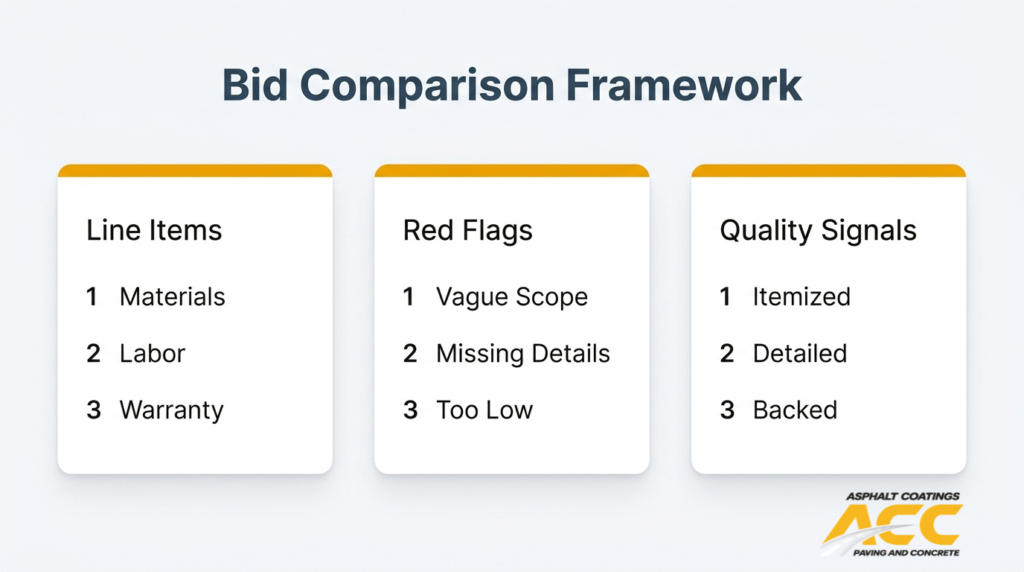
A paving estimate should include line items for site preparation, sub-base work, asphalt materials with compacted depths, labor hours, equipment costs, drainage provisions, striping, ADA compliance, and cleanup. Estimates that omit specific material quantities, skip sub-base preparation details, or lack a detailed project timeline are considered red flags, according to The Diamond Solutions’ guide on selecting commercial paving contractors.
Thorough estimates also address regulatory requirements. According to ADA.gov, accessible routes must be at least 3 feet wide with firm, slip-resistant surfaces, and parking spaces require a maximum slope of 1:48 in all directions. Any bid missing these compliance line items leaves you exposed to costly rework. Insisting on itemized detail upfront is the single best way to make bids genuinely comparable.
How Can You Spot Lowball Bids That Signal Corners Cut?
You can spot lowball bids that signal corners cut by looking for vague scope descriptions and missing essential services. Bids that omit crack repair, tack coating, or sub-base compaction often indicate a contractor plans to reduce costs by skipping steps that directly affect pavement longevity.
Watch for these warning signs:
- No specified compacted asphalt depth (only loose depth listed)
- Missing asphalt mix design details, which affect both quality and long-term performance
- Absence of mobilization, traffic control, or site protection costs
- No mention of grading, drainage, or subgrade preparation
A bid priced well below competitors rarely means better value. It usually means the scope has been quietly reduced, and change orders will follow once the project starts.
Why Should You Compare Warranty Terms Across Contractors?
You should compare warranty terms across contractors because coverage varies significantly and directly affects your long-term cost exposure. A typical standard warranty for commercial asphalt paving covers materials and workmanship for one year, though some top-tier contractors offer extended warranties of up to three years.
Key warranty factors to compare include:
- Duration of coverage for materials and workmanship
- Whether the warranty covers drainage-related failures
- Exclusions for normal wear, weather events, or subgrade issues
- Transferability if property ownership changes
A one-year warranty may seem standard, but it often expires before installation defects become visible. Contractors willing to stand behind their work for two to three years signal greater confidence in their materials and processes. Warranty terms reveal more about a contractor’s quality standards than the bid price alone.
With bid comparison complete, knowing the right questions to ask before signing solidifies your contractor selection.
What Questions Should You Ask Before Hiring a Paving Contractor?
The questions you should ask before hiring a paving contractor cover project timelines, crew structure, change order policies, and communication expectations. These four areas reveal how a contractor operates day to day.
What Should You Ask About Project Timelines and Scheduling?
You should ask about project timelines and scheduling to establish clear start dates, milestone benchmarks, and completion targets before work begins. Request a written schedule that specifies each phase: mobilization, sub-base preparation, paving, striping, and final inspection.
Key timeline questions to ask include:
- What is the guaranteed start date, and what conditions could delay it?
- How many working days will each phase require?
- Will weather delays trigger automatic schedule extensions or require renegotiation?
- Is there a penalty clause for contractor-caused delays?
A detailed project timeline is one of the clearest indicators of a well-organized operation. Contractors who resist putting dates in writing often lack the project management discipline that complex commercial work demands.
What Should You Ask About Subcontractors Versus In-House Crews?
You should ask about subcontractors versus in-house crews because crew structure directly affects quality control, accountability, and scheduling reliability. Contractors who rely on subcontractors introduce additional layers of coordination that can complicate communication and dilute oversight.
Essential questions include:
- Does your company perform all work with in-house employees?
- If subcontractors are used, which phases do they handle?
- Who carries liability insurance for subcontracted work?
- Can you provide the subcontractor’s safety record and credentials?
According to a 2024 report by Associated Builders and Contractors, the U.S. construction sector needed approximately 500,000 new workers to meet demand, which means some contractors increasingly outsource to fill labor gaps. Knowing whether your contractor controls its own workforce helps you gauge consistency across every project phase.
What Should You Ask About Change Order Policies?
You should ask about change order policies to understand how unexpected scope adjustments affect cost and timeline. Change orders are a leading source of disputes on commercial paving projects, so clarifying the process upfront prevents costly surprises.
Questions to raise include:
- What triggers a formal change order?
- How are additional costs calculated, and is there a markup cap?
- Must all change orders be approved in writing before work proceeds?
- How do change orders affect the original completion date?
Insist on a written change order protocol as part of your contract. Vague language around scope changes gives contractors room to inflate costs after work is underway.
What Should You Ask About Communication and Project Updates?
You should ask about communication and project updates to confirm how and when the contractor will keep you informed throughout the project. Clear communication protocols reduce misunderstandings and keep commercial operations running smoothly during active construction.
Important questions include:
- Who is the designated project manager and primary point of contact?
- How frequently will progress updates be provided, and in what format?
- What is the process for reporting issues or requesting urgent changes?
- Will you receive documentation, such as daily logs or photo updates?
For property managers overseeing tenant-occupied spaces, consistent updates are especially critical because paving work affects parking access, foot traffic, and business operations. Establishing these expectations early sets the tone for a transparent working relationship throughout the project.
How Does Property Type Affect Your Contractor Selection?
Property type affects your contractor selection by determining the traffic loads, maintenance cycles, surface priorities, and construction phasing your project requires. The sections below cover specialization needs for shopping centers, office parks, industrial facilities, and HOA or multi-family properties.
Which Contractors Specialize in Shopping Center Parking Lots?
Contractors who specialize in shopping center parking lots focus on smooth driving surfaces, clear markings, and consistent maintenance scheduling. According to industry data from Brixco, most commercial parking lots require re-striping every 18 to 36 months depending on wear, climate, and traffic volume. Retail center paving quality directly influences tenant retention and customer experience, making surface condition a top priority for property managers. Look for contractors offering bundled maintenance programs that include sealcoating, striping, and crack repair on a recurring schedule. A contractor without retail-specific experience may underestimate the coordination needed to keep storefronts accessible during phased work.
Which Contractors Specialize in Office Park and Campus Paving?
Contractors who specialize in office park and campus paving manage multi-building layouts with shared circulation routes, pedestrian pathways, and staggered tenant schedules. These projects require equipment suited to tight spaces and overlay work on existing surfaces. Prioritize contractors with in-house crews who can sequence paving across multiple buildings without disrupting daily operations. Campus environments also demand attention to curb and gutter transitions, ADA-compliant walkways, and coordinated drainage across interconnected lots. Firms experienced in this property type plan work in off-peak phases to minimize tenant impact.
Which Contractors Specialize in Industrial and Warehouse Paving?
Contractors who specialize in industrial and warehouse paving engineer surfaces for heavy-duty traffic loads. According to The Surface Masters, industrial park projects often require thicker asphalt mats and reinforced sub-bases compared to retail centers due to the weight of trucks, forklifts, and heavy equipment. Turning radii at loading docks, apron thickness near bay doors, and proper sub-grade compaction are critical design factors. A contractor lacking industrial experience may specify standard parking lot depths that fail under sustained heavy loads, leading to premature cracking and costly repairs within just a few years.
Which Contractors Specialize in HOA and Multi-Family Properties?
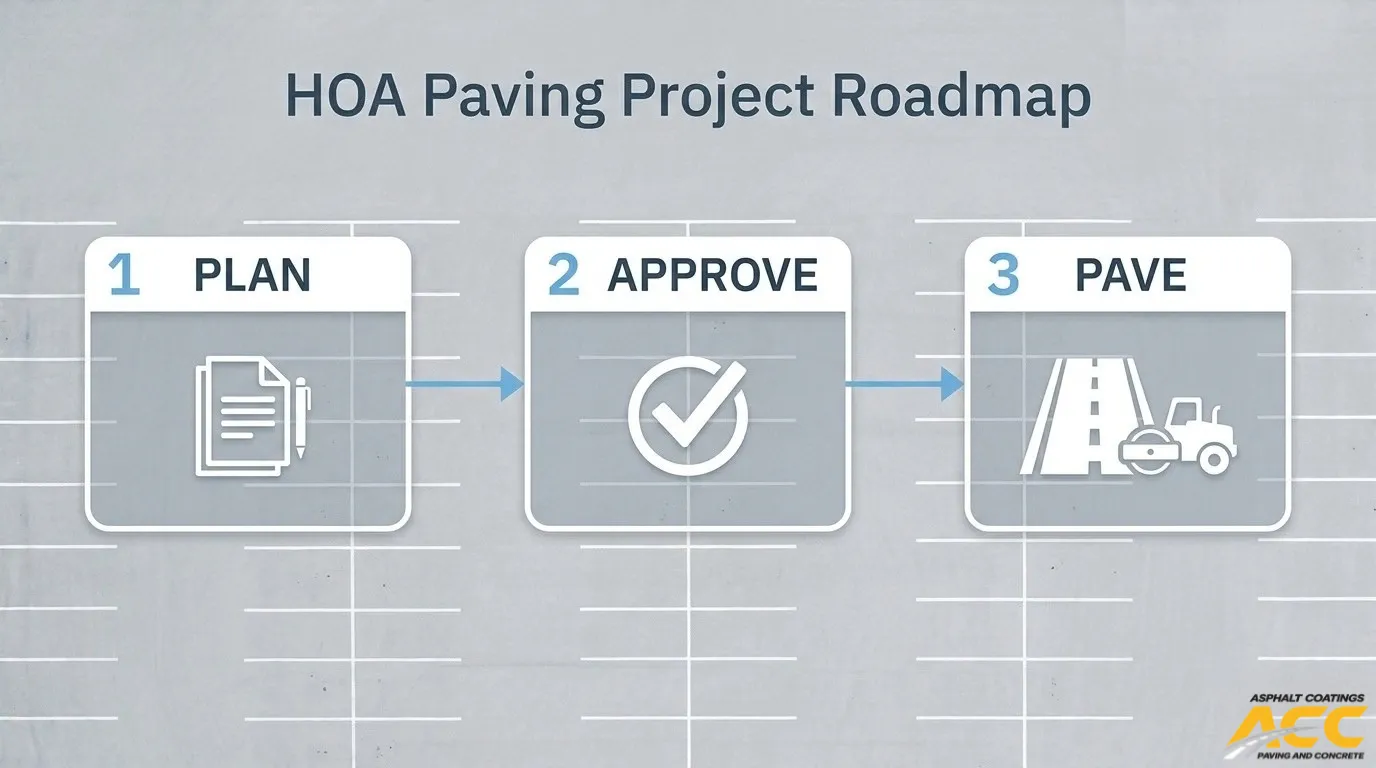
Contractors who specialize in HOA and multi-family properties navigate unique challenges involving resident access, board approvals, and phased construction timelines. Multi-tenant paving projects frequently require staged work to keep parking available for residents throughout the project. Communication with HOA boards adds a coordination layer that differs significantly from single-owner commercial properties. Experienced HOA contractors present phased plans that address noise restrictions, temporary parking arrangements, and clear resident notifications. For property managers balancing multiple stakeholder expectations, this operational awareness often matters as much as technical paving skill.
Understanding property-specific demands helps narrow your search to contractors built for your exact project type.
How Do Climate and Regional Conditions Influence Contractor Choice?
Climate and regional conditions influence contractor choice by determining which technical skills, materials, and construction methods a project requires. The subsections below cover freeze-thaw expertise, elevation and UV factors, and drainage challenges.
Why Do Freeze-Thaw Cycles Demand Specialized Paving Expertise?
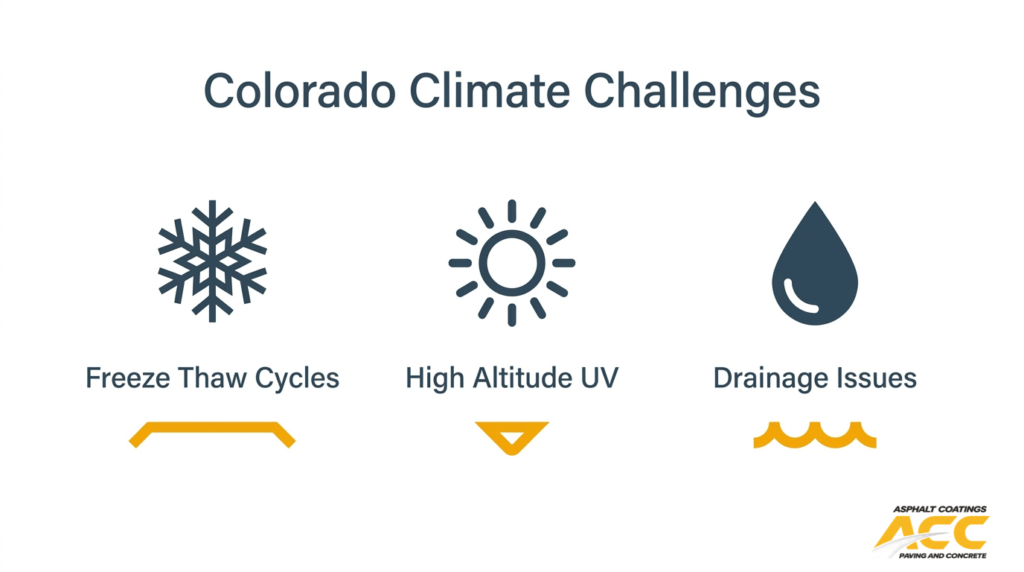
Freeze-thaw cycles demand specialized paving expertise because water infiltrates pavement cracks, expands when frozen, and widens damage with each cycle. Contractors working in climates with severe temperature swings must understand proper mix design, joint spacing, and crack sealing timing to prevent accelerated deterioration. Without this knowledge, new pavement can fail within a few seasons. Choosing a contractor who has documented experience managing freeze-thaw conditions is one of the most practical ways to protect a long-term paving investment.
How Does Elevation and UV Exposure Affect Pavement Performance?
Elevation and UV exposure affect pavement performance by accelerating binder oxidation and intensifying thermal stress on the asphalt mat. According to a 2024 study published in the Journal of Construction and Building Materials, coupled damage from UV radiation and freeze-thaw cycles substantially weakens the fracture resistance of asphalt concrete compared to either factor alone. High-altitude sites above 4,000 meters can experience more than 120 freeze-thaw cycles per year, compounding this degradation. When crack repairs and sealcoating are neglected under these conditions, typical asphalt pavement often lasts fewer than 10 years. Contractors familiar with high-elevation environments select UV-resistant binders and tighter maintenance schedules that extend pavement life well beyond that threshold.
What Drainage and Subgrade Challenges Should Contractors Address?
The drainage and subgrade challenges contractors should address include:
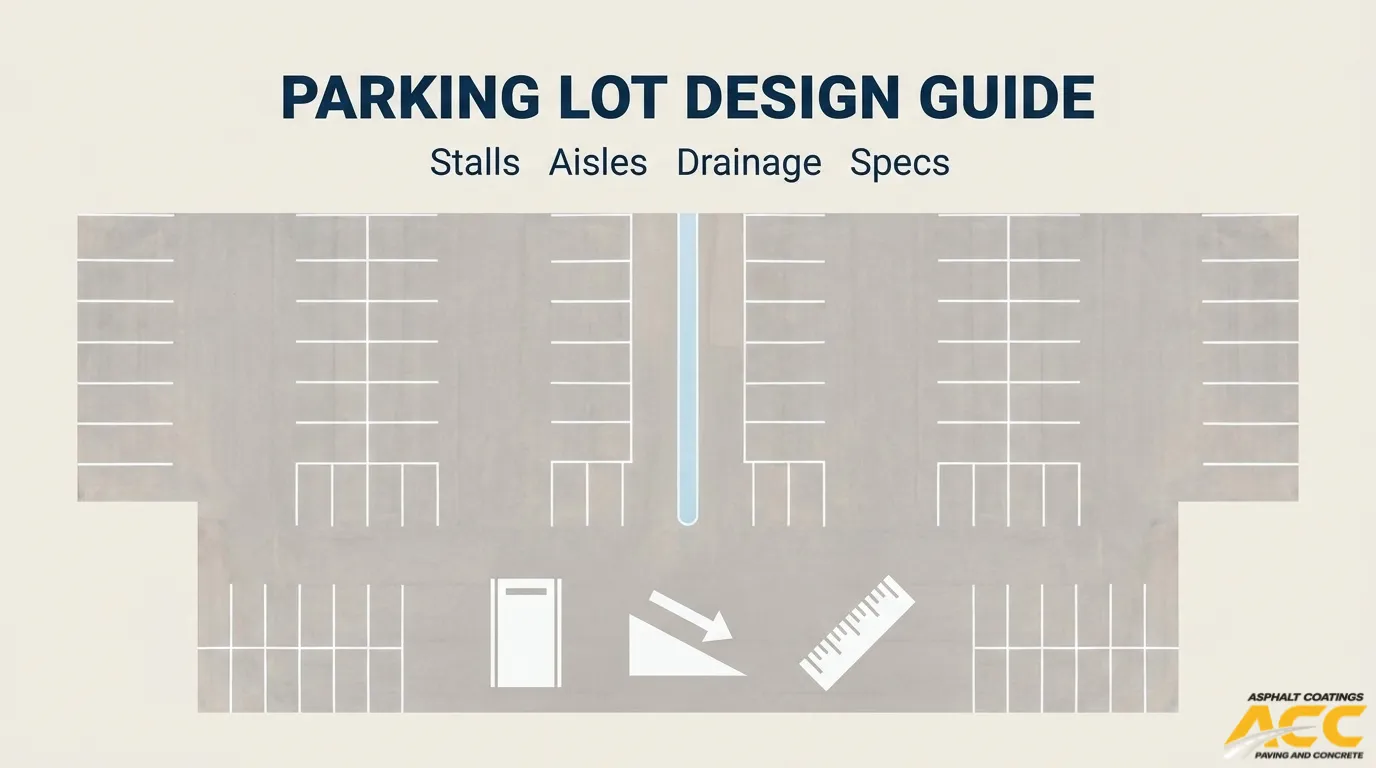
- Poor surface drainage: Inadequate slope design allows water to pond, softening the asphalt surface and accelerating failure.
- Unstable subgrade soils: Expansive clay or loose fill beneath the pavement shifts with moisture changes, causing cracking and settling.
- Insufficient base compaction: A base layer that is not compacted to specification cannot distribute traffic loads evenly.
- Blocked or missing storm infrastructure: Catch basins, culverts, and channel drains must be integrated into the paving plan to move water off the surface quickly.
A contractor who evaluates subgrade conditions and drainage pathways before paving begins delivers a more durable result than one who skips this step.
Understanding regional climate factors helps narrow the field to contractors equipped for your specific conditions.
What Red Flags Should Disqualify a Commercial Paving Contractor?
The red flags that should disqualify a commercial paving contractor include missing insurance documentation, vague bid details, no verifiable references, and pressure to sign immediately. According to The Diamond Solutions’ guide to selecting a commercial paving contractor, specific red flags in paving bids include a lack of specific material quantities, failure to mention sub-base preparation, and the absence of a detailed project timeline.
Any contractor who cannot produce proof of general liability insurance and workers’ compensation coverage on request should be eliminated immediately. For context, paving contractors typically carry general liability insurance averaging $926 per year; a company unwilling to show this basic documentation likely operates without adequate coverage.
Additional warning signs that should prompt disqualification include:
- The contractor demands full payment upfront before mobilizing equipment or ordering materials.
- Bids list only a lump sum total with no breakdown of labor, materials, or equipment costs.
- The company has no physical business address, permanent signage, or verifiable local presence.
- Estimates omit compacted asphalt depth and reference only loose depth measurements.
- The contractor refuses to provide a written warranty covering materials and workmanship.
- No client references, portfolio photos, or project history can be verified independently.
- The bid fails to address ADA compliance requirements for accessible routes and parking areas.
Unusually low bids deserve particular scrutiny. A price significantly below competing estimates often signals a “lowball” strategy that omits critical services, such as crack repair, tack coating, or proper sub-base preparation. These omissions lead to premature pavement failure and costly repairs that far exceed any initial savings.
In my experience, the single most reliable disqualifier is a contractor’s unwillingness to answer detailed questions about their process, materials, and crew qualifications. Reputable commercial paving contractors welcome scrutiny because transparency is how they differentiate themselves from unreliable operators. Recognizing these red flags early protects your investment and sets the stage for evaluating long-term contractor partnerships.
How Do Long-Term Partnerships Compare to One-Time Paving Contracts?
Long-term partnerships with a commercial paving contractor deliver consistent quality, predictable budgeting, and proactive maintenance that one-time contracts cannot match. The differences span cost efficiency, material reliability, and property preservation.
A contractor who knows your property’s drainage patterns, subgrade conditions, and traffic loads can plan maintenance proactively rather than reactively. One-time contracts, by contrast, require re-educating a new crew on site-specific conditions with every project, which increases the risk of oversights.
According to a 2025 study published in the Journal of Supply Chain Management, long-term relationships with reliable material suppliers are crucial for construction firms to significantly enhance the reliability and durability of their paving projects. This supply chain advantage extends directly to property owners: a contractor with established supplier partnerships secures consistent mix designs and material availability, reducing delays and quality inconsistencies.
Key advantages of long-term paving partnerships over one-time contracts include:
- Proactive maintenance scheduling that addresses cracks and sealcoating before small issues become costly failures.
- Site-specific knowledge accumulated over multiple service cycles, improving accuracy in scoping and execution.
- Priority scheduling during peak paving season, when one-time clients often face longer wait times.
- Consistent pricing structures that reduce bid evaluation overhead and eliminate the risk of lowball bids from unknown contractors.
- Warranty continuity, since a partner contractor stands behind cumulative work rather than isolated projects.
One-time contracts still serve a purpose for single capital improvement projects or when testing a new contractor’s capabilities. However, commercial properties with ongoing maintenance needs, such as parking lots requiring re-striping every 18 to 36 months, benefit far more from a partnership model.
For most commercial property managers, the compounding value of a dedicated paving partner outweighs the perceived flexibility of bidding every project separately. The real savings come not from chasing the lowest bid each cycle, but from preventing the premature failures that fragmented contractor relationships often produce. Choosing the right long-term partner starts with evaluating how a contractor aligns with your specific property needs.
How Should You Choose a Commercial Paving Partner for Your Property?
You should choose a commercial paving partner by prioritizing Colorado-specific expertise, verified credentials, and a long-term partnership approach. The following sections cover why regional experience matters and the key takeaways from this guide.
Can a Contractor With Decades of Colorado-Specific Expertise Deliver Better Results?
Yes, a contractor with decades of Colorado-specific expertise can deliver better results because the state’s freeze-thaw cycles, high-altitude UV exposure, and regional paving specifications demand knowledge that only comes from sustained local experience. Contractors unfamiliar with Pikes Peak Region specifications or Front Range drainage patterns risk installing surfaces that fail prematurely.
Asphalt Coatings Company has served Colorado’s Front Range since 1986, bringing 39 years of hands-on experience across Denver, Colorado Springs, and surrounding communities. Asphalt Coatings Company operates with in-house crews rather than subcontractors, maintaining direct quality control from subgrade preparation through final striping. This single-source approach eliminates coordination gaps that often cause delays and inconsistencies on commercial projects. For property managers seeking a partner rather than a one-time vendor, that depth of regional knowledge translates directly into longer-lasting pavement and fewer costly surprises.
What Are the Key Takeaways From This Commercial Paving Contractor Comparison Guide?
The key takeaways from this commercial paving contractor comparison guide center on five decision-driving principles:
- Verify credentials thoroughly. Confirm local licensing, adequate general liability coverage, and OSHA compliance before reviewing any bid.
- Compare bids on substance, not price alone. Evaluate compacted asphalt depth, mix design specifications, sub-base preparation details, and warranty terms side by side.
- Match the contractor to your property type. Industrial parks, retail centers, and HOA communities each require different pavement designs and construction phasing strategies.
- Prioritize regional climate expertise. According to the Colorado Asphalt Pavement Association, the best months to pave in Colorado fall between May and October, when ground temperatures consistently exceed 50°F.
- Invest in a long-term partnership. A well-maintained commercial asphalt parking lot lasts 15 to 30 years, and that lifespan depends on choosing a contractor committed to ongoing maintenance, not just initial installation.
Selecting the right commercial paving partner is ultimately about protecting a significant property investment over decades, not just completing a single project.