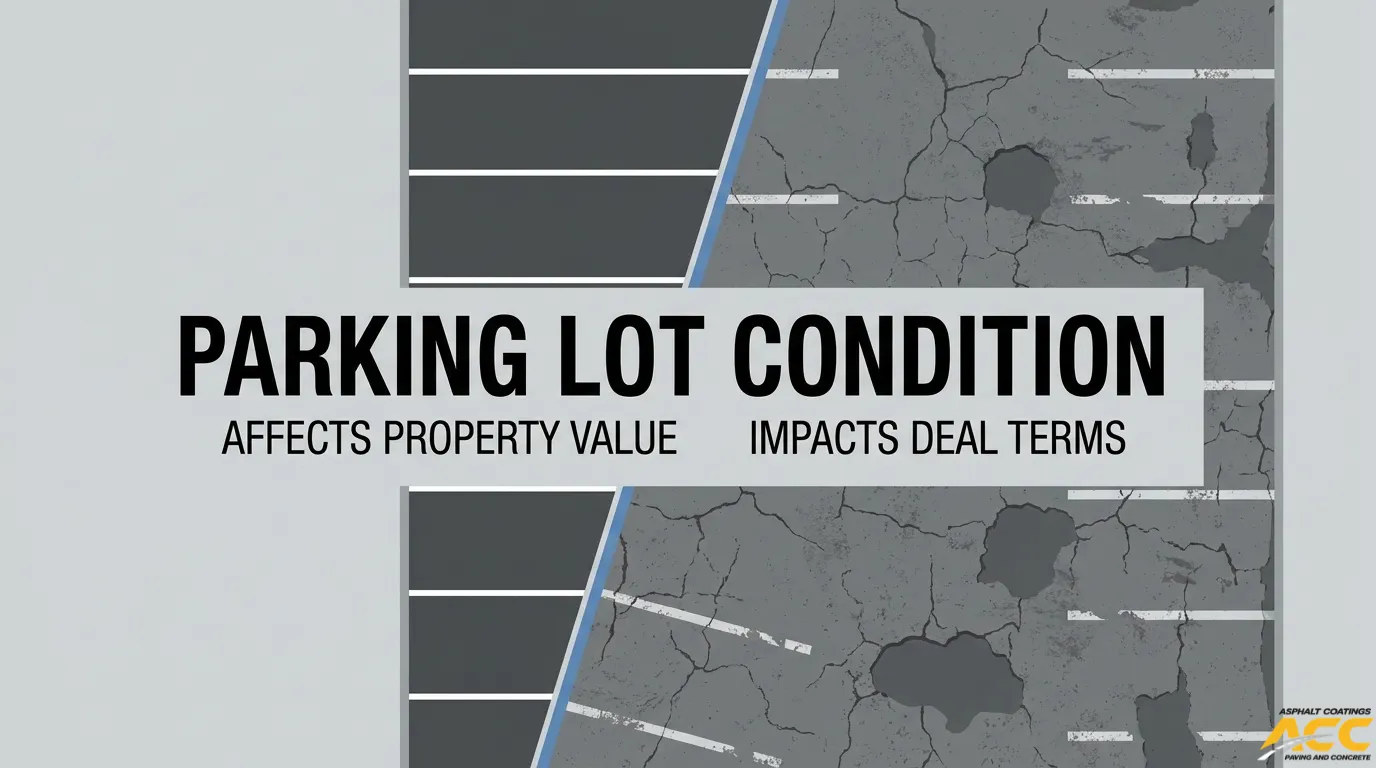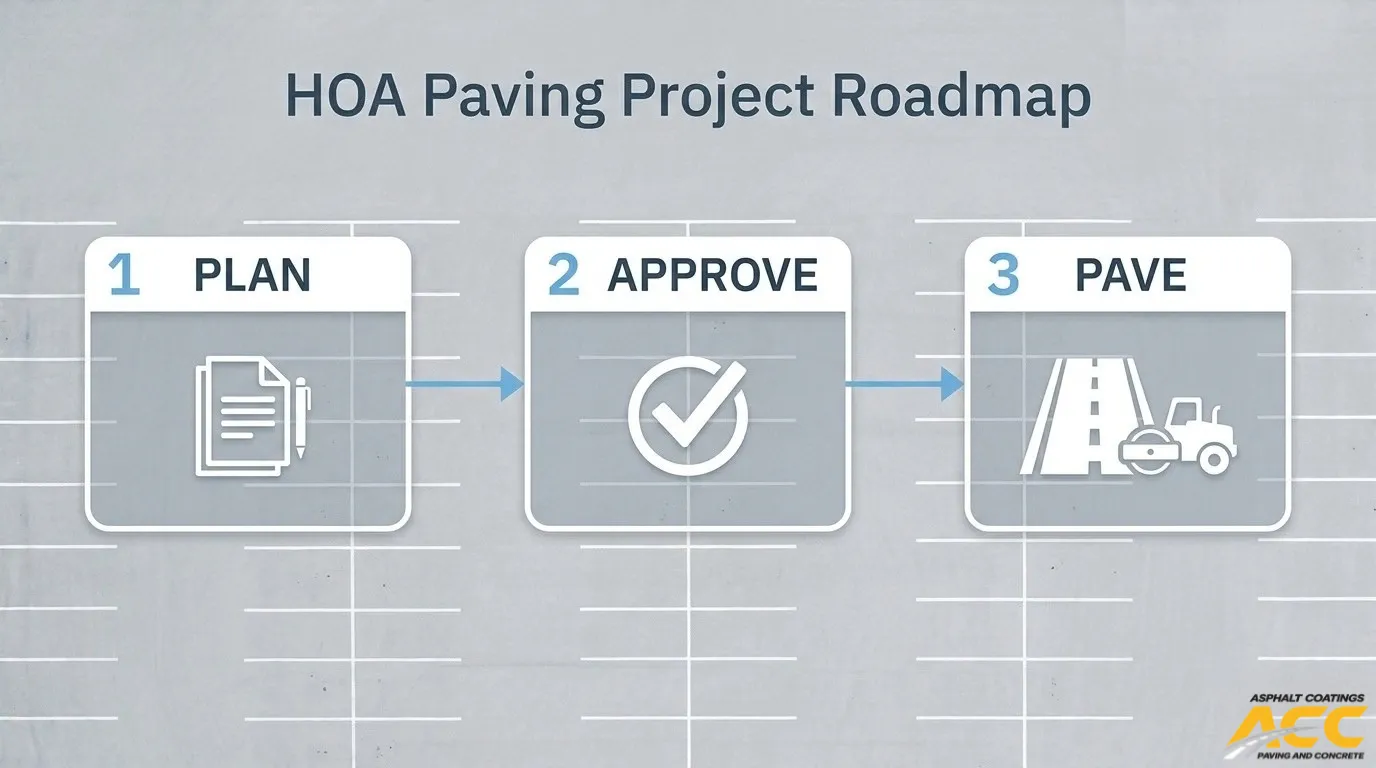
Commercial parking lot paving cost in Fort Collins is the total investment required for asphalt installation, base preparation, drainage, striping, and ongoing maintenance on a commercial property. Most Fort Collins projects range from $2.54 to $8.00 per square foot depending on scope, with final pricing shaped by local soil conditions, freeze-thaw exposure, and lot size.
This guide covers cost breakdowns by project type and lot size, Fort Collins environmental factors that drive pricing, scope of work comparisons, asphalt design and material specifications, site preparation and drainage, striping and ADA compliance, ongoing maintenance planning, project estimation strategies, and asphalt-versus-concrete comparisons.
Per-square-foot rates for new asphalt installation in Fort Collins average $3.25, while full-depth projects including grading, subbase, and drainage push costs to $3.50 to $8.00 per square foot. Small lots around 10,000 square feet typically run $25,000 to $45,000 for resurfacing, with larger properties benefiting from lower unit costs through economies of scale.
Fort Collins’ freeze-thaw cycles demand deeper base sections and cold-rated binder grades, and the region’s expansive clay soils can require over-excavation, stabilization, or moisture barriers before paving begins. Asphalt Coatings Company has been designing parking lot solutions for Colorado’s Front Range conditions since 1986, with deep expertise in specifying the correct base depths and asphalt mixes for Fort Collins’ elevation and climate challenges.
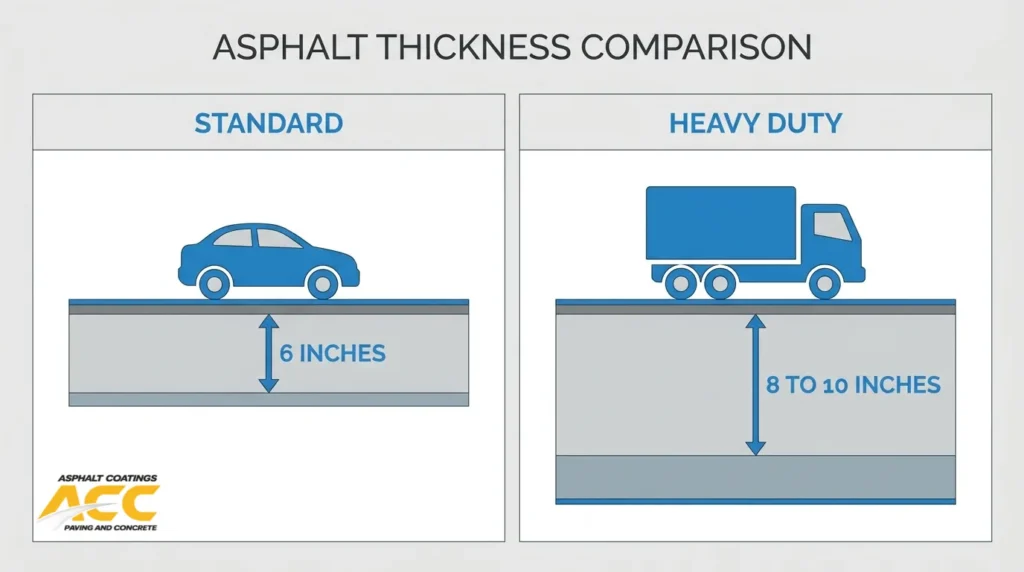
Choosing between full reconstruction, mill-and-overlay, and standard overlay significantly affects total cost; mill-and-overlay projects typically run 30% to 50% less than full tear-out-and-replace. Heavier-duty sections for truck traffic require 8 to 10 inches of asphalt rather than the standard 6-inch minimum.
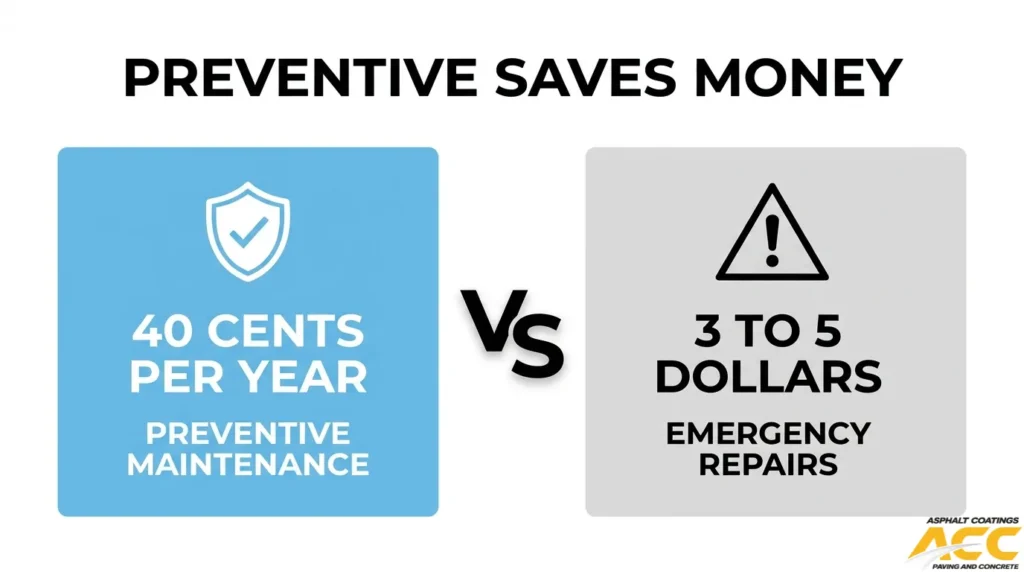
ADA-compliant stalls, fire lane markings, and specialty striping add required line items beyond base paving. Preventive maintenance, including sealcoating every two to three years and annual crack sealing, prevents $3 to $5 per square foot in emergency repairs for roughly $0.40 per square foot annually.
Concrete delivers 20% to 25% lower lifecycle costs over 30-plus years despite higher upfront pricing, making hybrid asphalt-concrete designs one of the most effective budget optimization strategies for commercial properties.
How Do Typical Commercial Parking Lot Paving Costs Break Down in Fort Collins, CO?
Typical commercial parking lot paving costs in Fort Collins break down into per-square-foot material and labor rates, lot-size-based project totals, and scheduling premiums. The following subsections cover each cost layer.
How Much Does New Asphalt Parking Lot Paving Usually Cost Per Square Foot in Fort Collins?
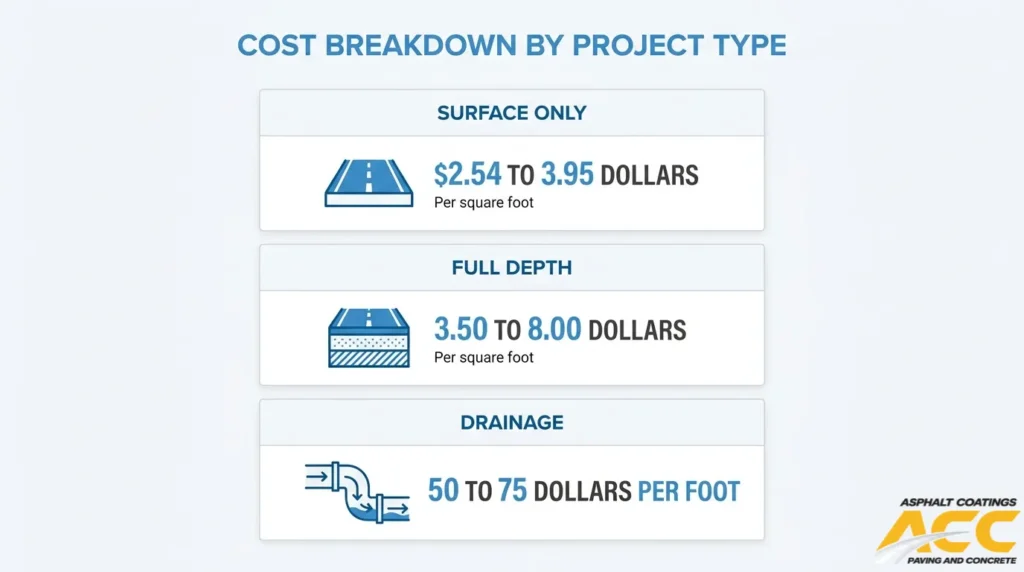
New asphalt parking lot paving in Fort Collins usually costs $2.54 to $3.95 per square foot for standard installation, with an average of $3.25 per square foot. According to ProMatcher’s Fort Collins cost data, that average reflects typical commercial paving jobs in the area. Resurfacing runs slightly wider, from $2.50 to $4.50 per square foot, depending on existing pavement condition.
Full-depth projects cost more. The base layer alone, including grading, subbase, and paving, ranges from $3.50 to $8.00 per square foot. Drainage adds $50 to $75 per linear foot for inlets, excavation, and underdrain systems. For property managers budgeting a complete build, combining surface paving with base work and drainage typically pushes total costs well above the surface-only range.
How Do Costs Change for Small, Medium, and Large Commercial Parking Lots?
Costs change for small, medium, and large commercial parking lots primarily through economies of scale. Smaller lots carry higher per-square-foot rates because mobilization, equipment setup, and crew costs are spread across less area.
- A small 10,000-square-foot lot typically costs $25,000 to $45,000 for resurfacing.
- A midsize 50,000-square-foot lot benefits from volume pricing on materials and labor, reducing the per-square-foot rate.
- Large lots above 100,000 square feet see the lowest unit costs, though total project budgets increase substantially.
Lifecycle costs follow a similar pattern. A proactive maintenance plan for a 50,000-square-foot lot runs roughly $55,000 to $80,000 over 15 years. Larger properties spread that maintenance investment more efficiently per square foot.
How Much More Can You Expect to Pay for Phased or After-Hours Paving Projects?
You can expect to pay 10% to 30% more for phased or after-hours paving projects compared to standard single-phase daytime work. Phased construction requires multiple mobilizations, repeated traffic control setup, and additional joint seaming between phases, all of which increase labor hours.
After-hours paving adds overtime labor premiums, temporary lighting costs, and potential noise-mitigation requirements. For commercial properties that must remain open during construction, these scheduling adjustments are often unavoidable. The tradeoff is real, but keeping revenue flowing during a paving project usually offsets the added construction cost. Asphalt Coatings Company routinely handles phased commercial paving projects throughout the Front Range, coordinating staging plans that minimize business disruption while maintaining safe customer access.
Understanding these cost layers sets the stage for evaluating which Fort Collins-specific site conditions affect your final price.
What Local Factors in Fort Collins, CO Have the Biggest Impact on Your Paving Price?
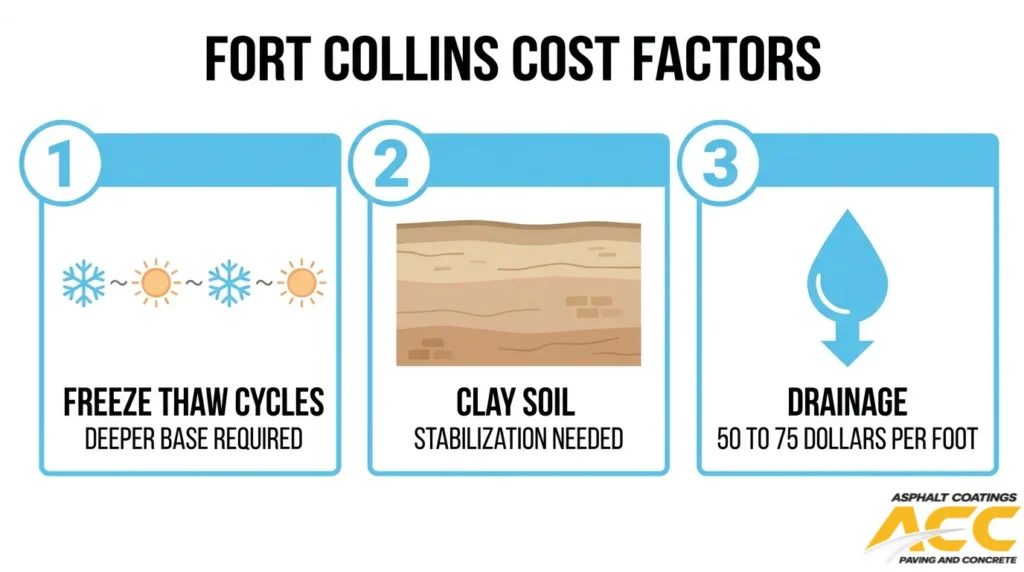
The local factors in Fort Collins, CO that have the biggest impact on your paving price are freeze-thaw cycling, expansive clay soils, and site-specific drainage demands. Each adds cost through material upgrades, deeper base sections, or additional infrastructure.
How Do Fort Collins’ Freeze-Thaw Cycles Affect Parking Lot Paving Costs?
Fort Collins’ freeze-thaw cycles affect parking lot paving costs by requiring thicker asphalt sections, cold-rated binder grades, and deeper base preparation. Water infiltrates pavement cracks, freezes, expands, and breaks the surface from within. Each cycle compounds the damage, accelerating pothole formation and structural failure.
Contractors must design for frost penetration that reaches significant depths along Colorado’s Front Range. According to MeltPlan, the minimum required frost depth for footings in the Denver metro area is typically 30 to 36 inches below undisturbed ground, and Fort Collins experiences comparable or greater frost penetration due to its elevation.
This means base layers must extend well below the frost line, adding excavation and aggregate costs that warmer climates simply avoid. Skipping this step to save money upfront is one of the most expensive mistakes a property owner can make; the pavement will crack within a few seasons, demanding premature reconstruction.
How Does Existing Soil and Subgrade Condition Change What You’ll Pay?
Existing soil and subgrade condition changes what you’ll pay by determining how much excavation, stabilization, or replacement the site requires before a single inch of asphalt goes down. Weak or reactive soils cannot support pavement loads without costly intervention.
Fort Collins sits in a region with significant expansive clay deposits. According to the Colorado Geological Survey, expansive soils laced with bentonite and montmorillonite clays can expand up to 20% by volume when exposed to water and exert forces up to 30,000 pounds per square foot. That pressure buckles pavement, cracks curbs, and destroys drainage structures.
Sites with expansive soils often need:
- Over-excavation and replacement with engineered fill.
- Lime or cement stabilization of the existing subgrade.
- Thicker aggregate base sections to distribute loads above the reactive layer.
- Moisture barriers to limit water migration into clay zones.
Each of these adds material and labor costs that sites with stable, granular soils avoid entirely.
How Do Drainage and Slope Requirements Add to Your Total Project Cost?
Drainage and slope requirements add to your total project cost through additional grading, underground infrastructure, and stormwater management features that prevent water from destroying your pavement investment. Proper drainage is not optional in Fort Collins; it is structural protection.
Standing water accelerates every failure mode, from freeze-thaw cracking to subgrade saturation that weakens the base. Parking lots must be graded to direct runoff toward inlets, swales, or retention areas. According to Wins Parking, installation of parking lot drainage solutions costs $50 to $75 per linear foot, including excavation, soil media, plants, and gravel underdrain.
Sloped sites present additional challenges. Steeper grades require more precise grading, retaining structures, or stepped lot designs that increase both engineering and construction costs. Flat sites, conversely, may need more inlets and underground piping because water has no natural path to exit.
Investing in proper drainage during initial construction protects every dollar spent on asphalt and base material. With drainage and soil factors accounted for, the scope of work becomes the next major cost driver.
How Does the Scope of Work for Your Commercial Property Change the Total Cost?
The scope of work for your commercial property changes the total cost primarily based on whether you need full reconstruction, an overlay, or a mill-and-overlay. Staging requirements to keep your business open also add to the final price.
How Does Cost Differ Between Full-Depth Reconstruction and Asphalt Overlay?
Cost differs between full-depth reconstruction and asphalt overlay significantly. Full-depth reconstruction involves removing all existing pavement, rebuilding the base, and installing new asphalt, which typically runs $3.50 to $8.00 per square foot. An asphalt overlay, which adds a new surface layer over the existing pavement, costs considerably less at $2.50 to $4.50 per square foot.
The right choice depends on the condition of the existing base. If subgrade failure, deep cracking, or drainage problems are present, an overlay will only mask the issue temporarily. According to ProMatcher, asphalt paving installation in Fort Collins averages $3.25 per square foot, ranging from $2.54 to $3.95. For properties with a structurally sound base, an overlay delivers excellent value without the expense of full excavation.
How Much Do Mill-and-Overlay Projects Typically Cost Compared to Tear-Out-and-Replace?
Mill-and-overlay projects typically cost 30% to 50% less than full tear-out-and-replace. Milling removes the top 1.5 to 3 inches of deteriorated asphalt, then a fresh surface course is applied directly over the existing base.
Tear-out-and-replace requires complete removal, hauling, disposal, base regrading, and compaction before new asphalt is laid. Each additional step adds labor, equipment hours, and material costs. Mill-and-overlay works best when the underlying base and subgrade remain structurally intact but the surface has reached the end of its service life. For most commercial lots with moderate surface distress, milling is the more cost-effective path that still resets the pavement’s useful life.
How Do Staging and Keeping Your Business Open During Construction Affect Price?
Staging and keeping your business open during construction affect price by increasing labor, mobilization, and project duration. Phased paving requires the crew to set up and break down multiple times, section off work zones, and install temporary traffic control.
Key cost factors include:
- Temporary striping and barricades for redirecting traffic safely through active work zones.
- Multiple mobilizations, since crews return on separate days rather than completing the job continuously.
- Extended project timelines that increase equipment rental and supervision costs.
- Night or weekend scheduling, which often carries premium labor rates.
For high-traffic retail or medical properties, phased staging is often unavoidable. Planning the sequence carefully with your contractor minimizes disruptions while controlling the added expense.
With the scope of work defined, asphalt thickness and mix design further influence what you will pay.
How Do Asphalt Thickness, Mix Design, and Expected Traffic Loads Affect Cost?
Asphalt thickness, mix design, and expected traffic loads affect cost by determining how much material is required and which binder grades are specified. Heavier loads demand thicker sections, and Colorado’s climate requires specialized mixes.
How Much More Does a Heavier-Duty Section for Delivery Trucks or Dumpsters Cost?
A heavier-duty section for delivery trucks or dumpsters costs significantly more because it requires additional asphalt depth and a reinforced aggregate base. According to the Plantmix Asphalt Industry of Kentucky (PAIKY), the minimum recommended thickness is 6.0 inches of asphalt over 4.0 inches of dense graded aggregate base for standard parking lots. Areas that handle regular truck traffic or dumpster pads typically need 8 to 10 inches of asphalt with a thicker base layer. Each additional inch of asphalt adds material and labor cost across every square foot. For commercial properties expecting frequent deliveries, specifying adequate thickness upfront prevents premature failure and costly reconstruction.
How Do Material Choices for High-Altitude Colorado Conditions Affect Your Budget?
Material choices for high-altitude Colorado conditions affect your budget by requiring specialized binder grades that cost more than standard formulations. According to BitumenCalc, high-altitude areas above 8,000 feet require softer PG binder grades, such as PG 58-28 or PG 58-34, for low-temperature flexibility. These performance-graded binders resist thermal cracking during severe freeze-thaw cycles common along Colorado’s Front Range. Softer binder grades carry a premium over standard mixes, though the exact price difference depends on current oil prices and supplier availability. Selecting the correct PG grade for your elevation is not optional; it directly determines whether your pavement survives its first few winters without cracking.
How Can Designing for Longevity Lower Your Long-Term Cost Per Year?
Designing for longevity lowers your long-term cost per year by spreading a higher upfront investment across a significantly longer service life. A properly engineered section with adequate thickness, the correct binder grade, and a well-compacted aggregate base can extend pavement life well beyond minimum expectations. When the initial build accounts for actual traffic loads and Colorado’s climate demands, the frequency of major repairs drops considerably. This approach is one of the most overlooked cost-saving strategies in commercial paving; property managers who invest in proper design spend far less over a 15- to 20-year cycle than those who cut corners on initial specifications.
Understanding how thickness and materials drive cost helps frame the next major budget factor: site preparation, base work, and drainage.
What Will You Pay for Site Preparation, Base Work, and Drainage Improvements?
Site preparation, base work, and drainage improvements typically cost $3.50 to $8.00 per square foot for commercial parking lots. The sections below cover base excavation and rebuilding, underground drainage pricing, and curb and gutter tie-in costs.
How Much Does it Cost to Excavate and Rebuild a Failed Parking Lot Base?
Excavating and rebuilding a failed parking lot base costs $3.50 to $8.00 per square foot, covering grading, subbase installation, and paving, according to Wins Parking. The wide range reflects how severely the existing base has deteriorated. Lots with localized soft spots may only need partial excavation, while those with widespread subgrade failure require full-depth removal and replacement with compacted aggregate. For a 20,000-square-foot lot, that translates to $70,000 to $160,000 before the asphalt surface is even placed. Skipping proper base reconstruction to save money upfront is one of the most expensive mistakes a property owner can make; premature cracking and settling will follow within just a few years.
What Do Underground Drainage, Inlets, and Additional Concrete Gutters Add to the Price?
Underground drainage, inlets, and additional concrete gutters add $50 to $75 per linear foot to a parking lot project, including excavation, soil media, plants, and gravel underdrain, as reported by Wins Parking. For a mid-size commercial lot requiring 200 to 400 linear feet of drainage infrastructure, this adds $10,000 to $30,000 to the total budget. Storm inlets, catch basins, and concrete gutter sections each carry their own material and labor costs on top of the linear-foot pricing. Proper drainage is non-negotiable in Fort Collins, where clay-heavy soils and seasonal snowmelt create persistent moisture problems that destroy pavement from below.
How Do Curb, Gutter, and Sidewalk Tie-Ins Impact the Overall Paving Budget?
Curb, gutter, and sidewalk tie-ins impact the overall paving budget by adding concrete work, forming, and grading costs that typically fall outside the base asphalt price per square foot. Tying new pavement into existing curb lines requires saw-cutting, removal, and precise grade matching to maintain proper water flow. New curb and gutter installation, sidewalk connections, and ADA-compliant ramp transitions each introduce separate line items. These elements are often required by local municipal codes, making them unavoidable rather than optional upgrades. Budgeting 10% to 15% of total project cost for concrete tie-ins is a reasonable starting estimate, though complex sites with multiple access points will trend higher.
Understanding site preparation costs helps clarify the full investment before striping and compliance work begins.
How Much Do Striping, Marking, and ADA Compliance Add to Your Parking Lot Cost?
Striping, marking, and ADA compliance typically add $0.10 to $0.50 per square foot to your parking lot cost, depending on layout complexity and regulatory requirements. The sections below cover standard striping, ADA-compliant features, and specialty markings.
What Does Standard Parking Lot Striping Typically Cost in Fort Collins?
Standard parking lot striping in Fort Collins typically costs $0.10 to $0.25 per linear foot for basic traffic paint, with thermoplastic or reflective options running higher. Most commercial lots spend between $500 and $2,500 for a full re-stripe, depending on the number of stalls and directional markings. According to a lifecycle cost analysis by Strike Force Striping, regular re-striping is a core component of proactive pavement maintenance programs that protect long-term investment. Faded lines create confusion, increase liability exposure, and signal deferred maintenance to customers. For high-traffic retail or healthcare lots, budgeting for re-striping every 18 to 24 months keeps markings visible through Colorado’s UV-intensive summers and abrasive winter plowing.
How Much Should You Budget for ADA-Compliant Stalls, Signage, and Access Routes?
You should budget $500 to $1,500 per ADA-compliant stall for striping, signage, and access aisle markings combined. According to ADA.gov, each accessible parking space must be 96 inches wide minimum, clearly marked to define the width, with a maximum slope of 1:48 in all directions. Required elements include:
- Van-accessible stalls with 96-inch-wide access aisles
- Mounted signage at proper height with the International Symbol of Accessibility
- Detectable warning surfaces at curb ramp transitions
- Accessible routes connecting stalls to building entrances
Concrete curb ramp construction and detectable warning panel installation drive most of the cost beyond paint alone. Skipping any of these components risks costly ADA violation fines that far exceed the upfront investment.
How Do Specialty Markings for Fire Lanes, Loading Zones, and EV Spaces Affect Price?
Specialty markings for fire lanes, loading zones, and EV spaces affect price by adding $1 to $5 per linear foot beyond standard striping, plus the cost of required stenciling and signage. According to Asphalt Care Services, most jurisdictions require fire lanes to be at least 20 feet wide and 150 feet long, with red curb paint and “No Parking” markings. Additional specialty marking costs include:
- Loading zone stencils and crosshatching for delivery areas
- EV charging station stalls with dedicated signage and green paint markings
- Directional arrows, speed limit stencils, and pedestrian crossing markings
Each specialty zone requires specific colors, dimensions, and sign types dictated by local fire code and municipal ordinance. Bundling all striping and marking work into a single mobilization saves on setup fees compared to scheduling each element separately.
With markings and compliance addressed, ongoing maintenance keeps your new surface performing for years.
What Are the Ongoing Maintenance Costs to Protect Your New Parking Lot Investment?
The ongoing maintenance costs to protect your new parking lot investment include periodic sealcoating, annual crack sealing, pothole repairs, and planned preventive programs. These recurring expenses are far smaller than emergency repairs or premature repaving.
How Much Should You Expect to Spend on Periodic Sealcoating in Colorado’s Climate?
You should expect to spend on periodic sealcoating every two to three years to maintain asphalt integrity in Colorado’s climate. According to American Asphalt, pavement maintenance experts recommend this frequency based on traffic volume, climate severity, and current pavement condition. Colorado’s intense UV exposure at altitude and repeated freeze-thaw cycles accelerate binder oxidation, making consistent sealcoating essential rather than optional. Most commercial property managers budget sealcoating as a scheduled line item, which prevents the surface from becoming brittle and cracking prematurely. Skipping even one cycle in this climate can cut years off your pavement’s serviceable life.
What Do Routine Crack Sealing and Pothole Repairs Typically Cost Each Year?
Routine crack sealing and pothole repairs typically cost $0.50 to $3.00 per square foot annually, depending on pavement condition and the prep work involved. Cracks left unsealed allow moisture infiltration, which accelerates base deterioration through freeze-thaw expansion. For a 50,000-square-foot commercial lot, even addressing 5% to 10% of the surface each year keeps costs manageable while preventing small failures from becoming structural problems. Prioritizing crack sealing before winter is one of the most cost-effective maintenance decisions a property manager can make, since water penetration during Colorado’s cold months causes the most rapid damage progression.
How Can a Planned Maintenance Program Reduce Your Lifetime Parking Lot Cost?
A planned maintenance program reduces your lifetime parking lot cost by replacing reactive, expensive emergency repairs with scheduled, lower-cost preventive treatments. According to ProLine Pavement Maintenance, investing $0.40 per square foot annually in preventive services prevents $3 to $5 per square foot in emergency repairs. That return makes preventive maintenance one of the highest-ROI budget items for any commercial property. A structured program typically includes scheduled sealcoating, annual crack sealing, drainage inspections, and periodic re-striping. Properties that follow this approach consistently extend pavement life well beyond the standard 15- to 20-year range.
With maintenance costs mapped out, the next step is estimating your specific project accurately.
How Can You Accurately Estimate the Cost of Your Specific Commercial Parking Lot?
You can accurately estimate the cost of your specific commercial parking lot by gathering precise site measurements, evaluating total cost of ownership, and planning project phases strategically. The sections below cover what contractors need for quoting, why lifecycle cost analysis matters, and how phasing controls spending.
What Measurements and Site Details Do Contractors Need to Provide a Precise Quote?
Contractors need the following measurements and site details to provide a precise quote:
- Total square footage, measured from property boundary to boundary, including drive aisles and landscaped islands.
- Existing pavement condition, noting crack density, pothole locations, and areas of base failure.
- Subgrade soil type, since expansive clays common along Colorado’s Front Range dramatically affect base design requirements.
- Drainage patterns and slope grades, including inlet locations and any standing water zones.
- Traffic load expectations, specifying whether the lot serves passenger vehicles only or accommodates delivery trucks and dumpsters.
- ADA stall count and access route locations, which influence concrete work and signage placement.
- Utility locations, marking underground lines that may require protection or relocation during excavation.
Providing these details upfront eliminates the vague allowances that inflate bids. The more specific your site documentation, the tighter the contractor’s pricing.
Why Should You Compare Multi-Year Cost of Ownership Instead of Just the Lowest Bid?
You should compare multi-year cost of ownership because the lowest bid often excludes maintenance realities that drive long-term expenses. According to ProLine Pavement Maintenance, investing $0.40 per square foot annually in preventive services prevents $3 to $5 per square foot in emergency repairs.
A low initial price means nothing if the pavement fails prematurely due to inadequate base preparation or thin asphalt sections. Lifecycle cost analysis accounts for sealcoating cycles, crack sealing intervals, and eventual overlay timing. When these recurring costs are factored across 15 to 20 years, a slightly higher upfront bid with proper thickness and drainage often delivers the lowest total expenditure. Prioritizing cost of ownership over sticker price protects your capital investment.
How Can Phasing Your Project Help Match Paving Costs to Your Capital Budget?
Phasing your project helps match paving costs to your capital budget by splitting the total scope into planned stages across multiple budget cycles. Instead of funding full-depth reconstruction of an entire lot in one year, you can prioritize the highest-traffic or most deteriorated sections first.
Common phasing strategies include:
- Year one: Base repair and paving of primary drive aisles and customer-facing areas.
- Year two: Secondary lot sections, striping updates, and ADA improvements.
- Year three: Sealcoating the first phase while completing remaining zones.
This approach spreads capital expenditure while keeping the property functional throughout construction. Phasing also allows you to lock in contractor relationships and negotiate volume pricing across stages, which often reduces the per-square-foot cost compared to isolated one-off projects.
With a clear cost estimation strategy in place, comparing material options helps finalize your budget.
How Do Asphalt Paving Costs Compare to Concrete and Other Surface Options?
Asphalt paving costs are typically lower upfront than concrete, but total project value depends on lifespan, maintenance frequency, and intended use. Concrete surfaces often last 30 to 40 years, while asphalt typically endures 15 to 20 years.
When Does Concrete Become More Cost-Effective Than Asphalt for Commercial Lots?
Concrete becomes more cost-effective than asphalt for commercial lots when the pavement must support heavy static loads, endure chemical exposure, or serve a 30-plus-year service life without major rehabilitation. Areas like dumpster pads, loading docks, and drive-through lanes benefit most from concrete’s rigidity and resistance to deformation under sustained weight.
For high-traffic travel lanes and general parking areas where periodic resurfacing is practical, asphalt often delivers better short-term value. The decision should be driven by how each zone within the lot will actually be used, not by material preference alone.
How Do Lifecycle and Maintenance Costs Differ Between Asphalt and Concrete?
Lifecycle and maintenance costs differ significantly between asphalt and concrete due to repair frequency and long-term durability. Asphalt requires sealcoating, crack sealing, and eventual overlay within its 15-to-20-year lifespan, accumulating recurring maintenance expenses.
According to SCB Construction Group, concrete commonly delivers 20 to 25% lower lifecycle costs than asphalt once routine maintenance is factored in. Concrete’s minimal upkeep requirements, including joint sealing and occasional panel replacement, keep long-term spending lower despite the higher initial investment. For commercial property managers evaluating total cost of ownership over two or three decades, this lifecycle gap is often the most important financial consideration.
How Can Combining Asphalt and Concrete in One Project Optimize Your Budget?
Combining asphalt and concrete in one project optimizes your budget by placing each material where it performs best. Concrete handles high-stress zones such as:
- Dumpster pads and loading docks subject to heavy static loads
- Drive-through lanes with frequent braking and turning
- Curb and gutter sections requiring long-term structural integrity
Asphalt covers general parking and travel lanes at a lower per-square-foot cost. This hybrid approach reduces upfront spending on areas that do not demand concrete’s durability while extending pavement life where stress is concentrated. Properly zoning materials across a single project is one of the most effective ways to balance initial investment with long-term performance.
How Should You Approach Commercial Parking Lot Paving Costs in Fort Collins, CO with Asphalt Coatings Company?
You should approach commercial parking lot paving costs in Fort Collins by partnering with Asphalt Coatings Company for full-scope paving, repair, and maintenance services tailored to Colorado conditions.
How Can Asphalt Coatings Company’s Paving, Repair, and Maintenance Services Help Manage Your Parking Lot Costs?
Asphalt Coatings Company’s paving, repair, and maintenance services help manage parking lot costs by combining new construction, patching, sealcoating, crack sealing, and striping under one contractor. This single-source approach, backed by 39 years of Colorado Front Range experience, eliminates coordination gaps between vendors and keeps projects on schedule and within budget.
Asphalt Coatings Company uses in-house crews for every phase, from subgrade preparation and asphalt installation to ADA-compliant concrete work and parking lot striping. According to HomeGuide, asphalt crack filling or sealing costs $0.50 to $3.00 per square foot depending on pavement condition and prep work. Bundling routine repairs with scheduled sealcoating through a single provider reduces mobilization fees and catches small problems before they escalate into costly full-depth failures.
For commercial property managers in Fort Collins, this partnership model means transparent estimates, Colorado-specific mix designs, and maintenance plans calibrated to local freeze-thaw cycles and UV exposure.
What Are the Key Takeaways About What You’ll Pay for Commercial Parking Lot Paving in Fort Collins, CO?
The key takeaways about what you’ll pay for commercial parking lot paving in Fort Collins center on three decisions: scope of work, material specifications, and long-term maintenance commitment.
- New asphalt installation typically ranges from $2.54 to $3.95 per square foot, while full base rebuilds push costs significantly higher.
- Fort Collins freeze-thaw cycles, expansive soils, and drainage requirements add site-specific costs that generic national estimates miss.
- Heavier-duty sections for truck traffic and proper asphalt thickness over aggregate base prevent premature failure.
- ADA-compliant striping, fire lane markings, and drainage improvements are required line items, not optional add-ons.
- Preventive maintenance, including sealcoating every two to three years and annual crack sealing, delivers the strongest return on your paving investment.
The lowest bid rarely reflects the lowest lifetime cost. Prioritizing proper base preparation, Colorado-appropriate mix designs, and a structured maintenance plan protects your capital investment for decades. Asphalt Coatings Company can guide you through each of these cost factors with site-specific recommendations built on nearly four decades of Front Range commercial paving experience.