Commercial asphalt paving installation is a sequential, seven-phase process where each layer and procedure builds directly on the one before it. Skipping or rushing any single step compromises every layer above it.
This guide covers pre-construction planning, site preparation and demolition, subgrade and base layer engineering, binder and surface course placement, post-installation quality assurance, freeze-thaw resilience, and long-term maintenance.
Pre-construction planning addresses site assessments, NPDES permit compliance, realistic budgeting against current cost benchmarks, and seasonal scheduling to keep ambient temperatures above the 50°F threshold that prevents weak compaction.
Site preparation and demolition cover full-depth pavement removal, grading corrections that establish positive drainage, and underground utility coordination to avoid weather-related delays that push paving into unfavorable conditions.
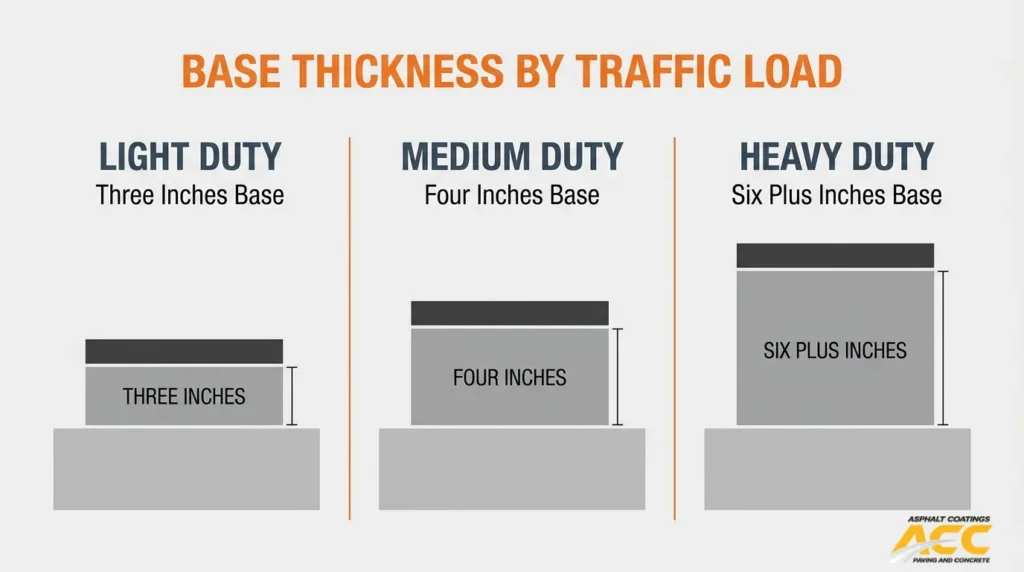
Subgrade and base layer engineering focus on soil evaluation, compaction verification through nuclear density testing, stabilization of weak soils, and selecting aggregate gradations and thicknesses matched to anticipated traffic loads, which range from 3 inches for light-duty areas to 6 or more inches for heavy commercial zones.
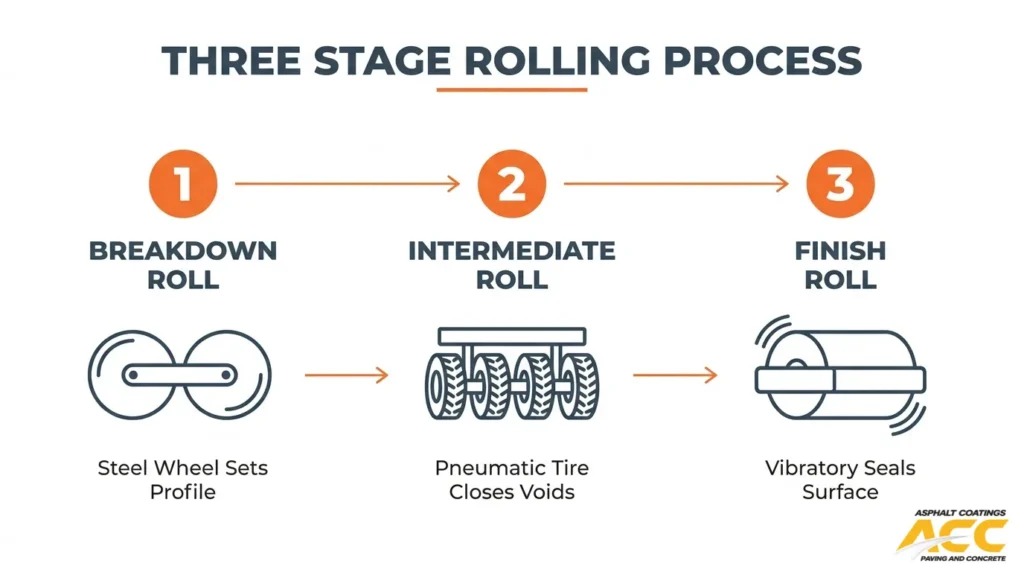
Binder and surface course placement detail how structural asphalt concrete distributes wheel loads, why polymer-modified binders resist temperature-related distresses, and how sequential rolling with steel-wheel, pneumatic-tire, and vibratory rollers achieves target density between 3.0 and 4.0 percent air voids.
Post-installation quality assurance explains core sampling for thickness verification, slope and drainage testing against municipal standards, and visual surface inspection criteria that confirm the finished mat meets engineering specifications.
Freeze-thaw resilience examines how thermal tensile stress causes low-temperature cracking and why climate-appropriate mix design and precise compaction technique prevent moisture infiltration at high altitude.
Long-term maintenance outlines sealcoating cycles, crack sealing protocols, drainage upkeep, and inspection schedules that protect the pavement investment across its full service life.
Why Does Proper Planning Matter Before Commercial Paving?
Proper planning matters before commercial paving because it prevents costly rework, budget overruns, and regulatory violations. The subsections below cover site assessments, realistic budgeting, and seasonal scheduling.
What Should a Site Assessment Cover for Commercial Paving?
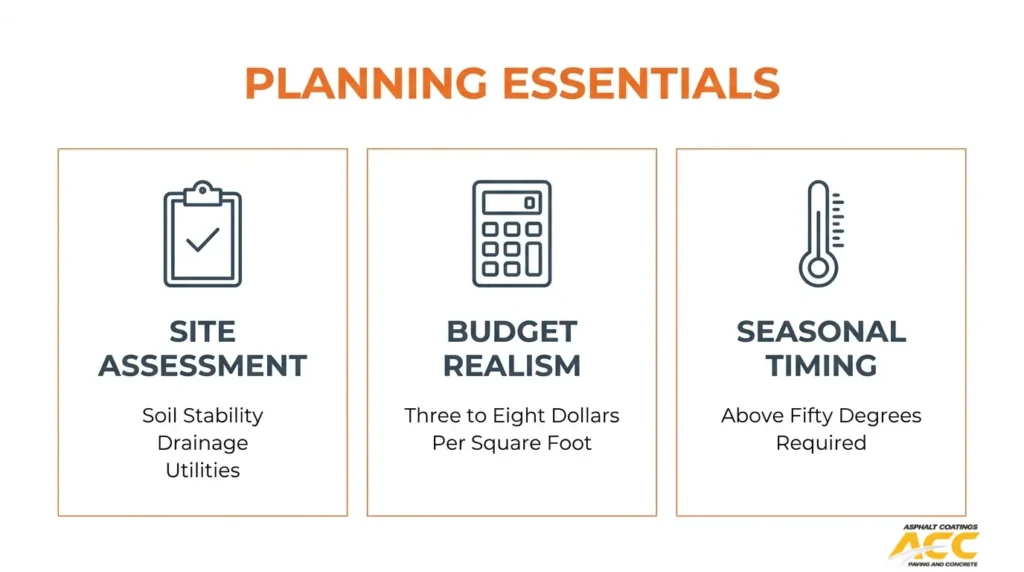
A site assessment for commercial paving should cover existing surface conditions, subsurface soil stability, drainage patterns, utility locations, and environmental compliance requirements. Evaluators measure pavement distress, grade elevations, and traffic load expectations to determine whether full-depth removal or an overlay is appropriate.
Environmental review is equally critical. According to the U.S. Environmental Protection Agency, stormwater discharges associated with industrial activity, including some commercial paving facilities, must be covered under a National Pollutant Discharge Elimination System (NPDES) permit to prevent pollutants from reaching local surface waters. Ignoring this step risks permit violations and project shutdowns.
Cost context also shapes assessment priorities. Commercial parking lots typically run $3 to $8 per square foot, so accurate square footage measurements and site preparation scope directly influence project feasibility. Skipping thorough site evaluation is the single most common reason commercial paving projects exceed their original estimates.
How Do Property Managers Set a Realistic Paving Budget?
Property managers set a realistic paving budget by combining accurate site assessment data with current material and labor cost benchmarks. The process starts with defining project scope: new construction, mill and overlay, or full-depth replacement.
Key budget factors include:
- Total square footage and required asphalt thickness for anticipated traffic loads.
- Subgrade condition, which determines excavation and soil stabilization costs.
- Drainage improvements, ADA compliance upgrades, and striping requirements.
- Permitting fees and environmental compliance expenses.
Building a 10 to 15 percent contingency into the total estimate accounts for unforeseen subgrade issues or material price fluctuations. Requesting detailed, line-item proposals from contractors, rather than lump-sum bids, makes it far easier to compare scope and identify where costs can be managed without sacrificing pavement quality.
When Is the Best Season to Schedule Commercial Paving?
The best season to schedule commercial paving is late spring through early fall, when ambient temperatures consistently remain above 50°F. According to Ruston Paving, finishing asphalt paving before temperatures drop below 50°F is critical to prevent weak compaction, raveling, and premature cracking.
Warm, dry conditions allow hot mix asphalt to stay workable long enough for proper placement and roller compaction. Rain delays and cold snaps compress schedules and inflate costs, so booking contractors well before peak season secures better availability and pricing.
For property managers balancing tenant operations with construction disruption, scheduling during shoulder months like April or October can reduce conflicts while still providing adequate paving temperatures. With seasonal timing established, the next step focuses on preparing the existing site for demolition and grading.
What Happens During Site Preparation and Demolition?
Site preparation and demolition involve removing old pavement, correcting grading and drainage, and addressing underground utilities. These steps create a stable, properly sloped foundation before any new asphalt is placed.
How Is Existing Pavement Removed and Disposed Of?
Existing pavement is removed through full-depth demolition or milling, depending on the condition of the underlying structure. Hydraulic breakers and milling machines break deteriorated asphalt into manageable pieces, which are then loaded into haul trucks for recycling or disposal at approved facilities.
Before removal begins, the project team evaluates existing pavement condition to determine whether full replacement or partial milling is appropriate. As Jose Garcia and Kent Hansen note in the HMA Pavement Mix Type Selection Guide, designers must consider “traffic, environment, subsurface pavement structure, existing pavement condition and preparation, and economics” when planning the work ahead. Reclaimed asphalt pavement, or RAP, is frequently reprocessed for use in new aggregate base or mix designs, reducing material waste.
Skipping thorough removal where deterioration runs deep often leads to recurring failures in the new surface. Full-depth demolition, while costlier upfront, eliminates compromised material that would otherwise undermine long-term pavement performance.
What Grading and Drainage Corrections Are Needed First?
Grading and drainage corrections needed first include establishing proper surface slopes, installing or repositioning catch basins, and routing stormwater away from the paved area. Without these corrections, water pools on the surface and infiltrates the subgrade, accelerating structural failure.
Crews use motor graders and laser-guided equipment to shape the subgrade to precise slope specifications. Positive drainage requires consistent gradients directing runoff toward collection points. Low spots and reverse grades must be identified and corrected during this phase, because once aggregate base and asphalt layers are placed, regrading becomes far more expensive.
For commercial properties, this step is arguably the most underestimated part of the entire paving process. Drainage failures cause more premature pavement damage than nearly any other single factor, making upfront grading corrections one of the highest-value investments in a project.
How Are Underground Utilities Addressed Before Paving?
Underground utilities are addressed before paving by locating, marking, and either protecting or relocating water lines, gas mains, electrical conduits, and storm drains that sit within the construction zone. Utility locating services use ground-penetrating radar and electromagnetic detection to map subsurface infrastructure before excavation begins.
Any utility repairs, replacements, or adjustments must be completed and backfilled with properly compacted material before base installation proceeds. Poorly compacted utility trenches create differential settlement, which leads to surface depressions and cracking directly above the trench line.
Scheduling is equally critical. According to Ruston Paving, finishing asphalt paving before ambient temperatures drop below 50°F is critical to prevent weak compaction, raveling, and premature cracking. Coordinating utility work early in the project timeline helps avoid weather-related delays that push paving into unfavorable conditions.
With site preparation and demolition complete, the focus shifts to evaluating and compacting the exposed subgrade soil.
Why Is Subgrade Preparation Critical for Pavement Longevity?
Subgrade preparation is critical for pavement longevity because every pavement layer above depends on the stability and load-bearing capacity of the soil beneath. Proper evaluation, compaction, and stabilization of the subgrade prevent structural failures that shorten pavement life.
How Is the Soil Subgrade Evaluated and Compacted?
The soil subgrade is evaluated and compacted through a systematic process of testing soil properties and achieving a specified density before any aggregate or asphalt layers are placed. Engineers assess moisture content, bearing capacity, and soil classification to determine whether the native material can support the planned pavement structure.
According to the National Asphalt Pavement Association and FHWA, flexible pavements consist of layers of HMA and aggregate base placed above the prepared roadbed soil, or subgrade, which consists of existing soil or borrow material compacted to a specified density. Field crews use proof rolling, nuclear density gauges, or dynamic cone penetrometers to verify that compaction meets design specifications. Achieving uniform density across the entire subgrade eliminates soft spots that would otherwise telegraph upward as depressions in the finished surface.
What Happens When Unstable Subgrade Conditions Are Found?
Unstable subgrade conditions require corrective stabilization measures before paving can proceed. When testing reveals weak, saturated, or organic soils, simply placing aggregate on top will not resolve the underlying problem.
Common stabilization methods include:
- Removing and replacing unsuitable soil with engineered fill material.
- Adding lime or cement to chemically stabilize clay-heavy subgrades.
- Installing geotextile fabric to separate soft soils from the aggregate base.
- Improving drainage to lower the water table beneath the pavement section.
Skipping these corrections almost guarantees premature pavement failure. Soft subgrades shift under repeated traffic loads, causing cracking, rutting, and costly full-depth repairs far sooner than the pavement’s intended service life. Addressing instability at this stage is one of the most cost-effective investments in the entire paving process.
With the subgrade stabilized and compacted, the aggregate base layer can be installed on a reliable foundation.
What Goes Into Installing the Aggregate Base Layer?
Installing the aggregate base layer requires selecting the right material, matching thickness to expected traffic loads, and verifying compaction across the entire site. The following sections cover base type selection, thickness requirements, and compaction testing.
What Type of Aggregate Base Does Commercial Paving Require?
The type of aggregate base commercial paving requires depends on anticipated traffic volume and vehicle weight. Light-duty areas typically need 3 to 4 inches of asphalt thickness, medium-duty areas require 4 inches, and heavy-duty zones demand 6 inches or more. These varying load demands influence the crushed stone gradation specified for the base.
For commercial parking surfaces, asphalt binder grade F is often cited as a sufficient option, with air void requirements typically set at 3.0 to 4.0 percent. Properly graded aggregate, usually crushed limestone or recycled concrete, creates a stable platform that distributes vehicle loads evenly before any asphalt is placed.
Commercial projects benefit from economies of scale in material sourcing. According to Asphalt Repair Solutions, new commercial parking lots often cost $2.50 to $4.50 per square foot compared to $7 to $13 for residential driveways, partly because base requirements differ for heavier commercial use.
How Thick Should the Base Layer Be for Heavy Traffic Loads?
The base layer for heavy traffic loads should be a minimum of 6 inches of compacted aggregate, though many engineers specify 8 to 12 inches for areas serving trucks, delivery vehicles, or heavy equipment. Thickness depends on subgrade soil strength and projected axle loads.
Above the aggregate base, the intermediate mix (sometimes called the binder course) consists of one or more lifts of structural asphalt concrete placed below the surface layer to distribute traffic loads. According to Asphalt Magazine, lift thickness should be a minimum of four times the Nominal Maximum Aggregate Size of the aggregate, since proper compaction is “probably the most important factor in determining the ultimate performance of an asphalt pavement.”
For commercial sites expecting sustained heavy loads, erring toward a thicker base is almost always the more cost-effective choice over the pavement’s lifespan.
How Is Proper Base Compaction Verified on Commercial Sites?
Proper base compaction is verified on commercial sites through nuclear density gauge testing, proof rolling, and visual inspection of the finished surface. Crews measure compaction at multiple points across the base to confirm uniform density meets the project’s engineering specifications.
Subgrade failure caused by improper compaction or excessive moisture can lead to depressions and rutting of the pavement layers above. To prevent this, testing typically confirms that 95% or greater of maximum dry density has been achieved throughout the aggregate base.
Proof rolling with a loaded tandem-axle truck is another practical verification method. Areas that deflect under the truck’s weight indicate insufficient compaction or unstable soil below, requiring correction before paving proceeds.
With a properly verified base in place, crews can move forward to the binder course application.
How Is the Asphalt Binder Course Applied?
The asphalt binder course is applied by placing one or more lifts of structural asphalt concrete over the compacted aggregate base using a paving machine, then rolling each lift to achieve target density. The subsections below cover the binder course’s structural role and how mix design adapts for commercial use.
What Role Does the Binder Course Play in Pavement Structure?
The binder course plays a critical structural role in pavement by distributing traffic loads from the surface layer down to the aggregate base and subgrade. Positioned between the finished surface course and the base, this intermediate layer absorbs and spreads concentrated wheel loads across a wider area, reducing stress on lower layers.
According to the FHWA’s HMA Pavement Mix Type Selection Guide, designers must consider factors such as traffic volume, environment, and subsurface pavement structure when selecting appropriate mix types for each layer. Without a properly designed binder course, heavy commercial vehicles can transmit loads directly through the surface, accelerating rutting and fatigue cracking. For high-traffic commercial lots, the binder course is arguably the most underappreciated layer; its performance determines whether the surface course above it remains stable for years or fails prematurely.
How Does Binder Mix Design Differ for Commercial Applications?
Binder mix design differs for commercial applications by using coarser aggregate gradations, higher asphalt content, and stiffer binder grades to withstand heavier, more frequent loading. Commercial lots experience sustained pressure from delivery trucks, buses, and turning movements that standard residential mixes cannot handle.
Key differences in commercial binder mix design include:
- Larger aggregate size: Coarser nominal maximum aggregate sizes create stronger stone-on-stone contact within the mix matrix.
- Stiffer binder grades: Higher-performance grades resist deformation under sustained heavy loads and elevated pavement temperatures.
- Polymer-modified binders: PMBs improve mechanical properties compared to unmodified binders, particularly in resisting temperature-related distresses such as rutting and thermal cracking, according to a Minnesota Department of Transportation study.
- Tighter air void targets: Specifications often call for 3.0 to 4.0 percent air voids to balance durability with moisture resistance.
Selecting the right binder mix for the expected traffic class prevents costly rehabilitation down the road, making it one of the most consequential engineering decisions in any commercial paving project. With the binder course in place, crews can proceed to the surface course installation.
What Does the Surface Course Installation Process Involve?
The surface course installation process involves placing hot mix asphalt at the correct temperature, compacting it to target density, and finishing joints for a seamless driving surface. The following subsections cover placement, compaction, and joint construction.
How Is Hot Mix Asphalt Placed and Spread Evenly?
Hot mix asphalt is placed and spread evenly using a paver machine that deposits material at a consistent depth and width across the prepared surface. The paver’s heated screed strikes off each pass to a pre-set thickness, producing a uniform mat before compaction begins.
Crews monitor mix temperature continuously during placement because HMA that cools below the optimal working range compresses poorly and develops weak spots. Material transfer vehicles feed the paver at a steady rate, preventing segregation where coarse and fine aggregates separate. According to Asphalt Magazine, lift thickness should be a minimum of four times the Nominal Maximum Aggregate Size of the aggregate to achieve proper compaction. On large commercial lots, paver speed stays constant so the mat thickness remains even from one end of the project to the other.
What Compaction Methods Ensure a Smooth Finished Surface?
The compaction methods that ensure a smooth finished surface include sequential rolling with steel-wheel, pneumatic-tire, and vibratory rollers. Each roller type serves a distinct purpose in achieving the required pavement density.
- Steel-wheel breakdown rollers make initial passes immediately behind the paver while the mat is hottest, setting the surface profile.
- Pneumatic-tire intermediate rollers knead the mix to close surface voids and improve aggregate interlock.
- Vibratory finish rollers remove roller marks and seal the surface to its final smooth texture.
Rolling must begin while the mat temperature is high enough for the mix to consolidate. For most commercial applications, crews target air void content between 3.0 and 4.0 percent in the finished surface. Timing each roller pass correctly is one of the most underappreciated skills in commercial paving; even a short delay can leave density below specification.
How Do Crews Handle Joints and Transitions on Large Lots?
Crews handle joints and transitions on large lots by overlapping adjacent paving passes and carefully managing temperature at the joint edge. Longitudinal joints, which run parallel to the direction of paving, form where two passes meet. Transverse joints occur where a day’s work ends or a new section begins.
Proper technique requires the exposed edge of the cooled lane to be cut back to a clean, vertical face before the hot mat is placed against it. Luting by hand corrects minor irregularities at transitions near curbs, catch basins, and building aprons. Poorly constructed joints allow water infiltration, which accelerates cracking from the surface down. Well-executed joint construction is what separates a parking lot that performs for decades from one that fails prematurely at the seams.
Why Is Final Compaction and Curing So Important?
Final compaction and curing are important because they determine the long-term density, impermeability, and structural performance of commercial asphalt pavement. Proper rolling patterns and adequate cure time prevent premature failures.
What Rolling Patterns Achieve Optimal Pavement Density?
Rolling patterns achieve optimal pavement density through a systematic sequence of breakdown, intermediate, and finish rolling applied at controlled speeds and overlap widths. Each pass compresses the hot mix asphalt while the material remains at workable temperatures, closing air voids and locking aggregate into a stable matrix.
Uniform lift thickness is essential to this process. According to the Ohio Department of Transportation, the maximum lift thickness for asphalt pavement is 3.75 inches (95 mm), and uniform thickness is required to ensure proper density acceptance. When lifts vary in depth, rollers cannot apply consistent pressure, leaving pockets of low density that become entry points for moisture.
The relationship between density and durability is direct: as density increases, permeability decreases. For commercial lots handling heavy truck traffic, even small density shortfalls accelerate oxidation and structural deterioration from within.
How Long Should New Commercial Asphalt Cure Before Use?
New commercial asphalt should cure for a minimum of 24 to 48 hours before allowing light vehicle traffic, with heavier loads typically restricted for several additional days depending on ambient temperature and pavement thickness. During this period, the binder continues to harden as lighter oil fractions oxidize and the mat stiffens to its design strength.
Premature loading on uncured pavement causes surface scuffing, indentations from tire pressure, and displacement of the still-pliable mix. A case study of a commercial parking lot installation for three leased buildings in Madison, Wisconsin, by Wolf Paving confirmed that full-depth replacement in areas with severe subgrade failure was essential to achieve the long-term stability that proper curing alone could not overcome.
For high-traffic commercial properties, phased opening schedules allow sections to cure fully while maintaining partial site access. This balances operational needs with the patience that quality pavement demands.
What Quality Checks Confirm a Proper Paving Installation?
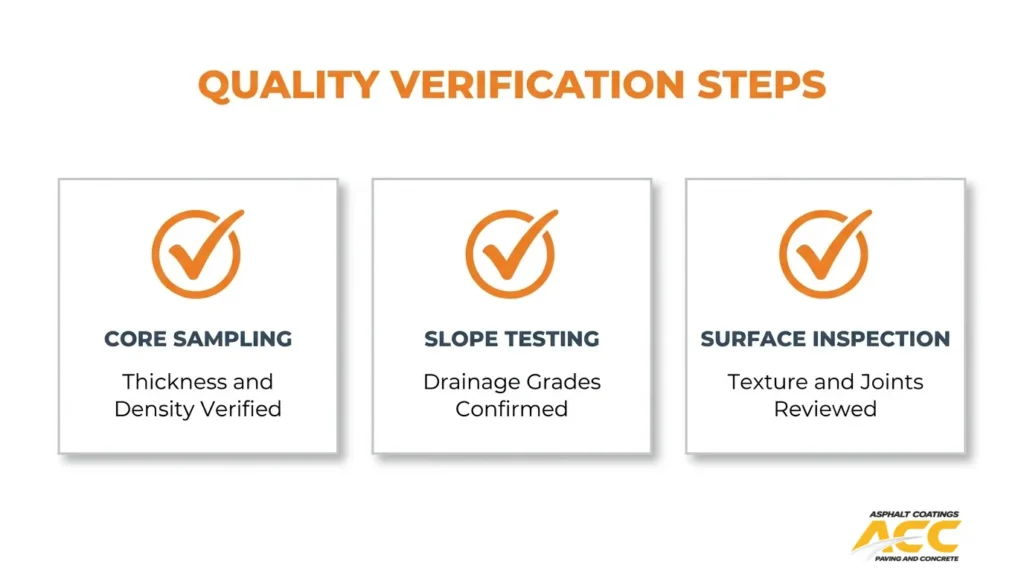
Quality checks that confirm a proper paving installation include thickness verification, slope and drainage testing, and surface inspection. These three assessments catch deficiencies before they become costly failures.
How Is Pavement Thickness Verified After Installation?
Pavement thickness is verified after installation through core sampling. Contractors drill small cylindrical cores from the finished surface and measure each core against the design specification. Commercial lots typically require 3 to 4 inches of asphalt for light-duty areas and 6 inches or more for heavy-duty zones, so even a half-inch shortfall compromises structural capacity.
Cores also reveal whether individual lifts bonded correctly and whether compaction density meets the target range. Most specifications call for cores at randomized locations across the lot, not just areas the crew selects. If any core falls below the minimum thickness, the contractor must address the deficiency before the project is accepted. This single test is arguably the most objective proof that a paving crew delivered what the design called for.
What Slope and Drainage Tests Are Performed on New Lots?
Slope and drainage tests performed on new lots include grade verification with survey instruments and standing-water observation after simulated or natural rainfall. Proper drainage engineering for parking lots requires slope gradients and catch basin placement that adhere to local municipal standards, according to engineering guidelines such as those published by the Town of Grand Valley, which define minimum slopes for sanitary and surface water routing.
Surveyors confirm that cross-slopes, longitudinal grades, and transitions around catch basins match the approved grading plan. Even minor deviations, sometimes less than a quarter percent, can redirect water toward building foundations or create ponding zones that accelerate pavement deterioration. For commercial properties, drainage failure is not just a maintenance issue; it introduces liability risk and potential stormwater compliance violations.
How Should the Finished Surface Look and Feel?
The finished surface should look uniformly dark, smooth, and free of visible defects. A properly installed commercial asphalt surface has consistent texture across the entire lot, with no segregation patterns, roller marks, or loose aggregate.
Key indicators of surface quality include:
- Tight, well-sealed longitudinal and transverse joints with no exposed gaps.
- Absence of raveling, tearing, or dragging marks from the paver screed.
- Smooth transitions at curb lines, utility covers, and building interfaces.
- No standing water after light rain, confirming the surface grade matches design intent.
Running a straightedge across the mat is a common field check; deviations greater than a quarter inch over ten feet typically signal placement problems. A quality surface reflects proper mix temperature at laydown, correct screed settings, and disciplined rolling patterns. With surface quality confirmed, attention can shift to protecting the new pavement through ongoing maintenance.
How Do Freeze-Thaw Cycles Affect Commercial Asphalt Paving?
Freeze-thaw cycles affect commercial asphalt paving by generating internal thermal stress that cracks and degrades the pavement surface over time. The sections below explain why high-altitude climates intensify this damage and how proper installation minimizes it.
Why Does High-Altitude Climate Demand Specialized Paving?
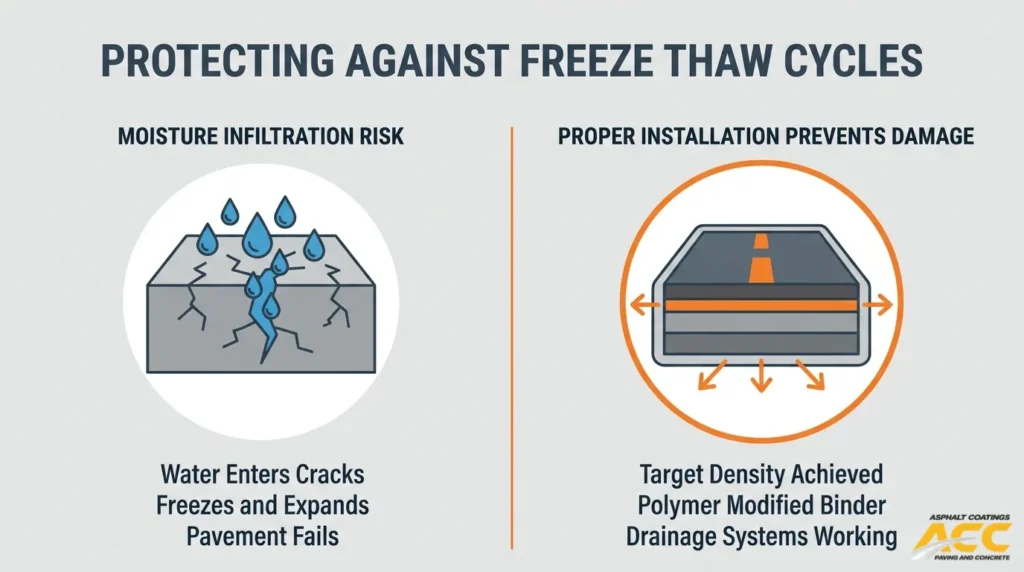
High-altitude climate demands specialized paving because extreme temperature swings between day and night accelerate pavement deterioration. According to a study published in Case Studies in Construction Materials via ScienceDirect, low temperature cracking occurs when the thermal tensile stress in asphalt pavements exceeds its tensile strength, a condition often exacerbated by multiple freeze-thaw cycles.
At elevation, thinner atmosphere and intense UV exposure compound this effect, breaking down asphalt binders faster than in lower regions. Moisture from snowmelt penetrates surface cracks, refreezes overnight, and expands within the pavement structure. Each cycle widens existing damage. Selecting polymer-modified binders and climate-appropriate mix designs addresses these stresses at the material level, giving commercial surfaces the resilience high-altitude environments require.
How Does Proper Installation Prevent Freeze-Thaw Damage?
Proper installation prevents freeze-thaw damage by eliminating the structural weaknesses where moisture infiltration begins. Adequate subgrade compaction removes air voids that trap water beneath the pavement. Correct aggregate base thickness distributes thermal loads evenly, reducing concentrated stress points.
Key installation practices that resist freeze-thaw deterioration include:
- Achieving target density during compaction to lower permeability and block water entry.
- Placing asphalt at the correct temperature to ensure full binder adhesion between lifts.
- Engineering proper surface slope so snowmelt drains away rather than pooling and seeping into cracks.
- Specifying appropriate asphalt thickness for the expected traffic load and climate severity.
For property managers in regions with harsh winters, investing in precise installation technique is far more cost-effective than repairing premature cracking every few years. Understanding these climate-specific challenges helps in selecting the right long-term maintenance strategy.
What Maintenance Extends the Life of New Commercial Asphalt?
Maintenance that extends the life of new commercial asphalt includes sealcoating, crack sealing, routine inspections, and proper drainage upkeep. A proactive maintenance program protects the pavement investment made during installation and prevents minor surface wear from becoming costly structural failures.
Key maintenance practices for new commercial asphalt include:
- Sealcoating protects the surface course from UV degradation, oxidation, and moisture infiltration. Applying a sealcoat within 12 to 18 months of installation, then every two to three years, preserves binder flexibility.
- Crack sealing prevents water from penetrating through the surface into the binder course and subgrade layers below. Even hairline cracks should be filled promptly, since trapped moisture accelerates freeze-thaw damage.
- Drainage maintenance keeps catch basins, slope gradients, and stormwater systems functioning as designed. Clogged drains allow standing water to soften the aggregate base and compromise compaction integrity.
- Routine inspections identify early signs of distress, such as raveling, minor depressions, or edge deterioration, before they require full-depth repair.
- Striping and marking upkeep maintains ADA compliance and traffic flow while preserving the finished surface from concentrated wear patterns.
For commercial properties that experience heavy traffic loads, scheduling inspections at least twice per year catches seasonal damage early. Neglecting even basic maintenance can cut a commercial pavement’s functional lifespan in half, turning what should be decades of reliable service into premature replacement costs. Consistent upkeep is the most cost-effective strategy property managers have for maximizing return on a quality paving installation. With a solid maintenance plan established, partnering with the right contractor ensures these protections are applied correctly from day one.
How Should You Approach Commercial Paving With an Experienced Contractor?
You should approach commercial paving with an experienced contractor by selecting a full-service partner who manages every phase, from planning through final striping. The sections below cover how Asphalt Coatings Company supports commercial properties and the key takeaways from the seven-step installation process.
Can Full-Service Commercial Paving From Asphalt Coatings Company Help Your Property?
Yes, full-service commercial paving from Asphalt Coatings Company can help your property by consolidating every installation phase under one experienced team. Since 1986, Asphalt Coatings Company has served Colorado’s Front Range with in-house crews handling subgrade preparation, aggregate base installation, asphalt paving, sealcoating, striping, and ADA-compliant concrete work.
This single-source approach eliminates coordination gaps between subcontractors, keeping projects on schedule and within budget. Asphalt Coatings Company designs pavement systems specifically for Colorado’s freeze-thaw cycles and high-altitude UV exposure, factors that demand specialized mix selection and compaction techniques.
Property managers, industrial complex owners, and shopping center operators benefit from a partnership approach built on transparency and precision at every phase.
What Are the Key Takeaways About the 7 Steps to Commercial Paving?
The key takeaways about the 7 steps to commercial paving are that each phase builds directly on the one before it, and skipping or rushing any step compromises the entire pavement structure. The most critical lessons include:
- Thorough site assessment and realistic budgeting prevent costly mid-project changes.
- Proper demolition and grading establish the drainage foundation that protects pavement longevity.
- Subgrade compaction is the single most important factor in long-term pavement performance.
- Aggregate base thickness must match anticipated traffic loads, ranging from 3 inches for light duty to 6 or more inches for heavy commercial use.
- Binder and surface course installation require precise temperature and compaction control.
- Final rolling patterns and adequate curing time determine density, permeability resistance, and surface durability.
- Post-installation quality checks, including thickness verification and slope testing, confirm the pavement meets engineering standards.
Investing in each step with a qualified contractor protects your property’s value for decades. To discuss your next commercial paving project, contact Asphalt Coatings Company for a consultation.