Asphalt paving for commercial properties is a layered system of binder, graded aggregates, and prepared base courses that typically delivers 15 to 30 years of service life. Actual longevity depends on how climate, traffic, structural design, maintenance, and installation quality interact across the pavement’s deterioration curve.
This guide covers durability factors and property-type benchmarks, climate and structural design influences, distress identification and maintenance strategies, overlay and replacement decisions, and long-term budgeting with supporting concrete infrastructure.
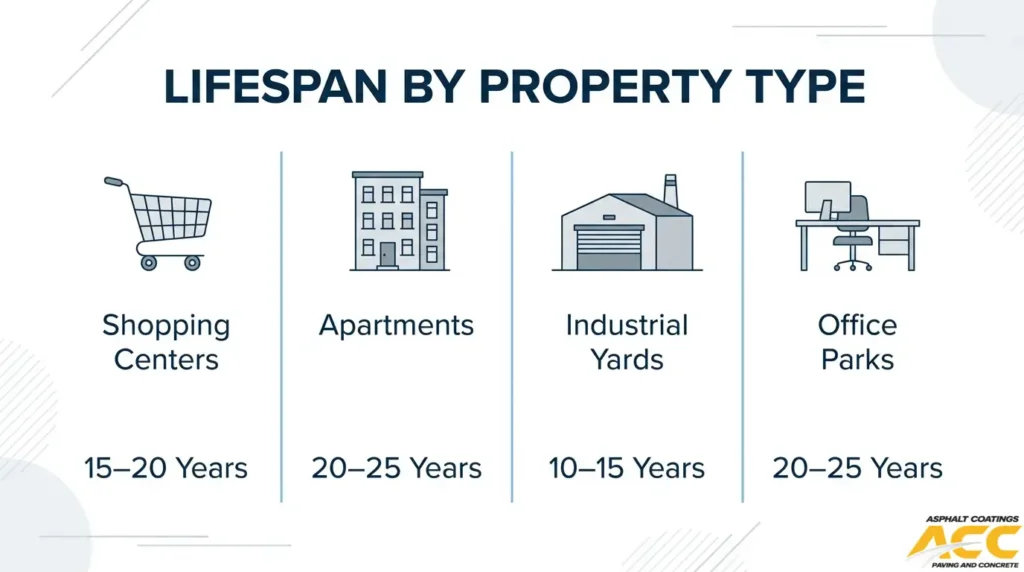
Commercial asphalt performance varies significantly by use. Shopping center lots endure constant stop-and-go traffic and typically last 15 to 20 years, while lightly trafficked office lots can exceed 25 years with consistent care. Industrial yards face concentrated axle loads that compress service life to 10 to 15 years without heavier structural sections.
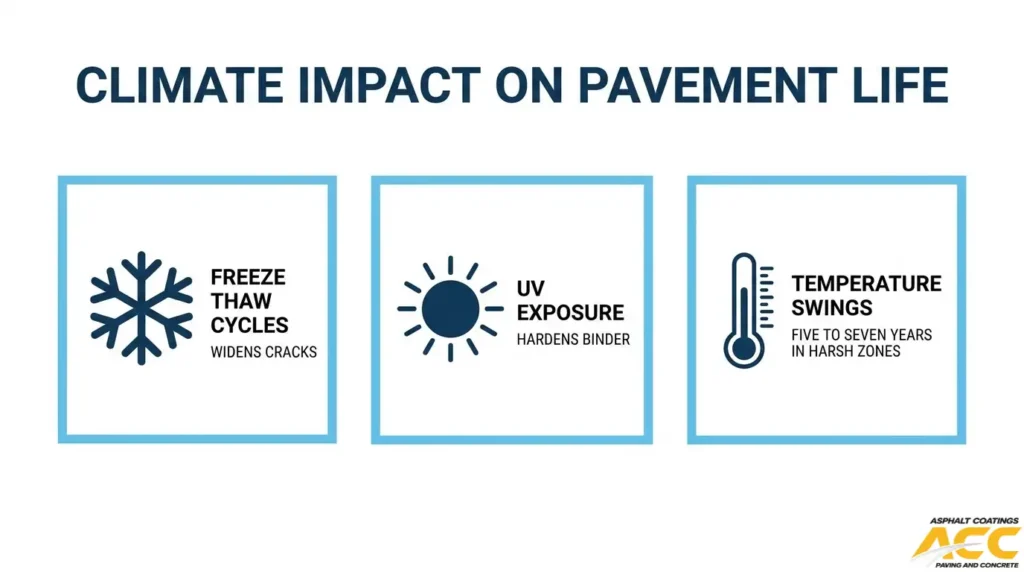
Climate and thickness design are equally decisive. Freeze-thaw cycling widens cracks each season, UV exposure at altitude stiffens the binder, and combined temperature extremes can cut surface life to under a decade in severe regions. Matching performance-graded binders and pavement depth to local conditions prevents premature failure before maintenance even enters the equation.
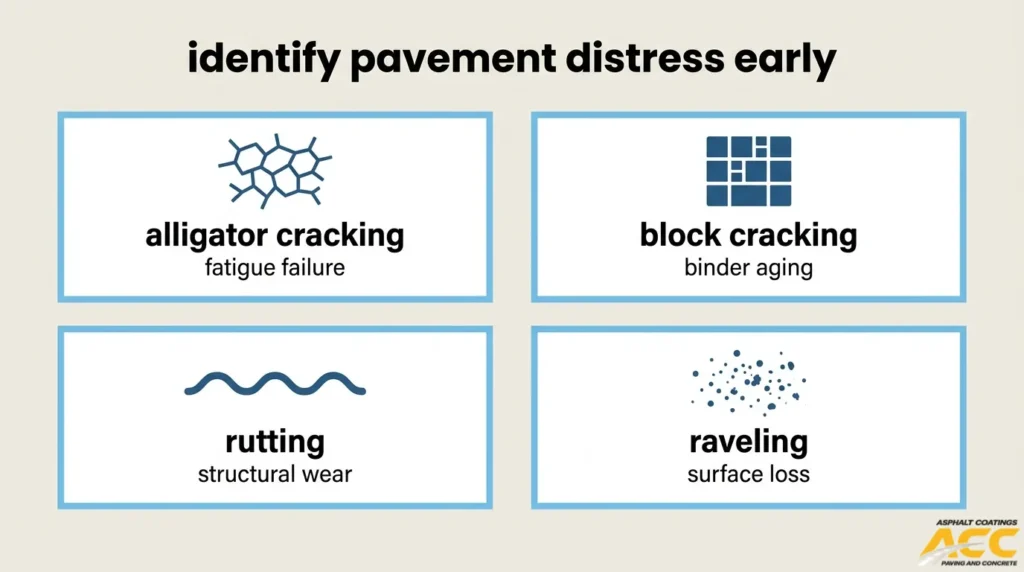
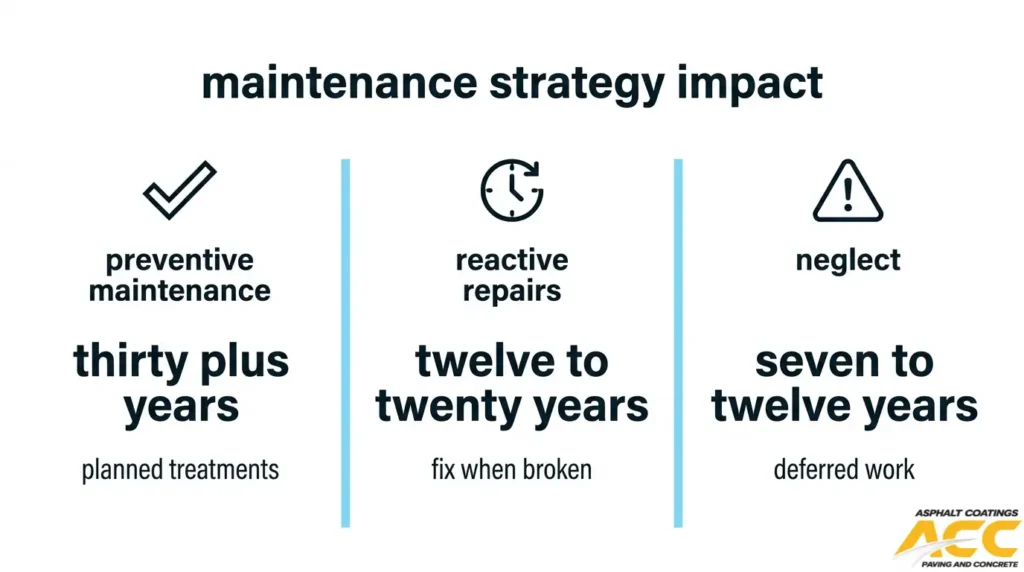
Recognizing distress types (alligator cracking, block cracking, rutting, raveling) at the right stage determines whether a property needs sealcoating, crack sealing, overlay, or full reconstruction. Preventive programs that start early can push pavement life past 30 years, while neglect compresses it to as few as 7 to 12 years.
Property managers who pair regular Pavement Condition Index assessments with structured reserve funds convert reactive spending into planned investments, reducing per-square-foot costs across the full pavement life cycle.
What Is Asphalt Paving and How Does It Perform Over Time?
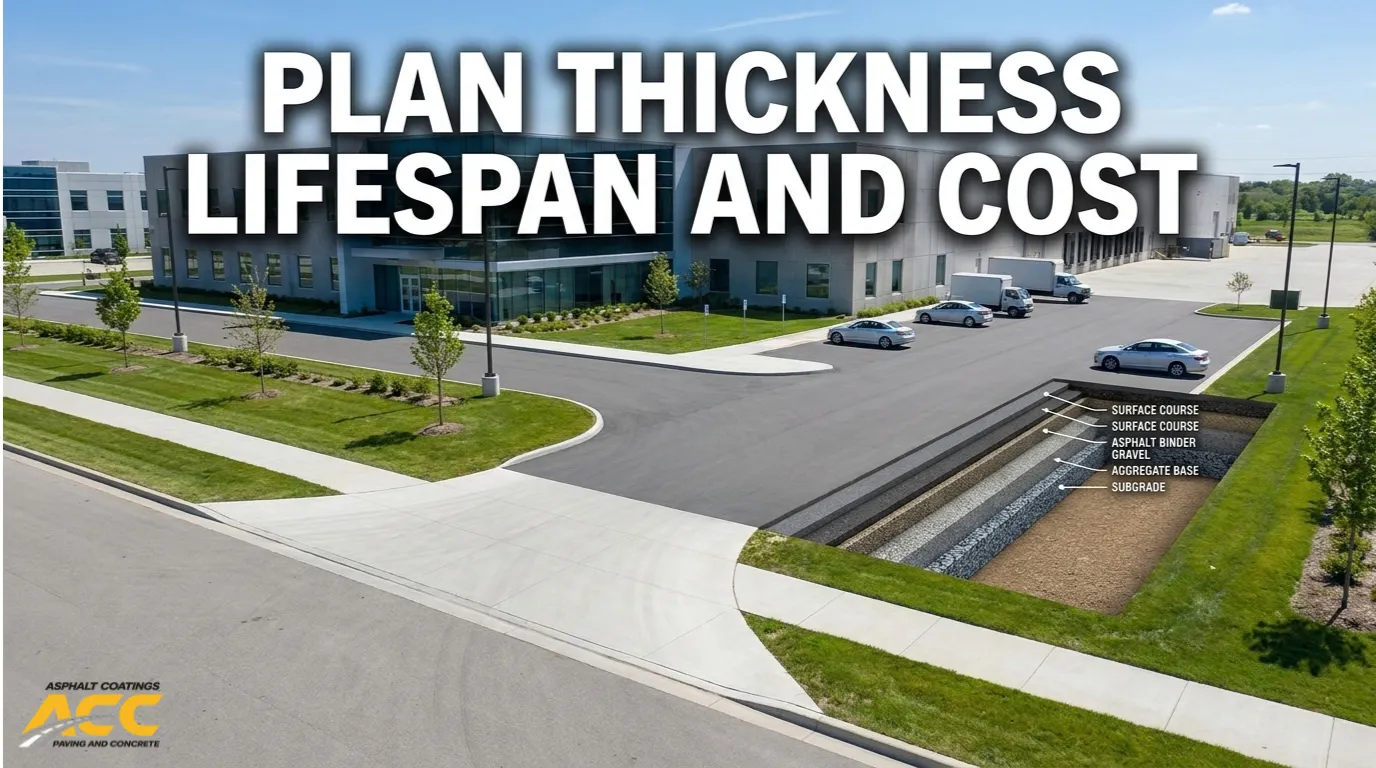
Asphalt paving is a layered pavement system that combines asphalt binder with graded aggregates over a prepared base and subgrade. Its performance over time depends on traffic loads, environmental exposure, and maintenance timing.
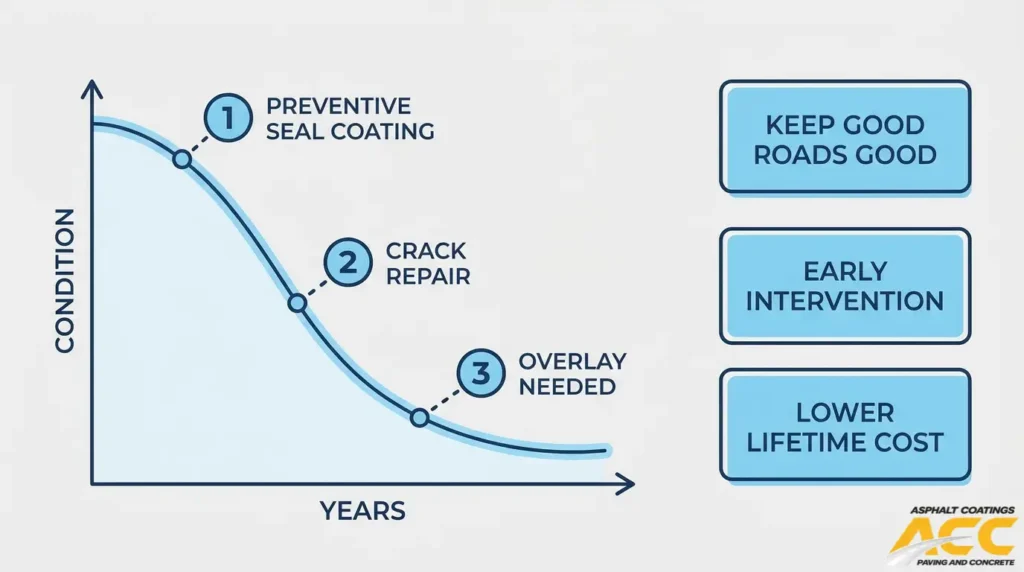
Asphalt paving performs over time through a gradual deterioration curve driven by two primary forces: traffic loading and environmental weathering. New pavement starts at peak condition, then loses flexibility and structural integrity as the asphalt binder oxidizes and aggregate bonds weaken under repeated stress cycles.
What makes this deterioration curve critical for commercial property managers is the concept of intervention timing. According to the American Public Works Association, if appropriate treatments are applied during the early stages of deterioration, it is possible to keep good roads good with minimal investments, instead of performing costly rehabilitation treatments later in the pavement’s life. This principle underpins every maintenance decision covered in the sections that follow.
The practical takeaway is straightforward: asphalt does not fail suddenly. It signals distress progressively through cracking, raveling, and surface loss. Recognizing where a pavement sits on its deterioration curve determines whether a property needs preventive maintenance, rehabilitation, or full replacement.
How Many Years Does Commercial Asphalt Paving Typically Last?
Commercial asphalt paving typically lasts 15 to 30 years, depending on traffic volume, climate exposure, structural design, and maintenance practices. Well-built pavements with proactive care reach the upper end of that range, while neglected surfaces can deteriorate significantly within 10 to 15 years.
According to the City of Durango, Colorado, asphalt streets have an average life of about 20 years; however, with proper care and maintenance, that average can be extended to 30 years or more. Parking lots in northern climates often see shorter baselines. A Clemson University Cooperative Extension factsheet notes that traditional northern parking lots typically last 15 years, while porous asphalt designs can exceed 30 years due to reduced freeze-thaw stress.
These figures represent general benchmarks. The actual service life of any commercial lot, access road, or loading area depends on how several variables interact: pavement thickness, base preparation, drainage design, traffic loading, and the timing of maintenance treatments. For most commercial property managers, the practical question is less about a single number and more about which controllable factors push pavement life toward 25 to 30 years instead of falling short at 12 to 15.
What Factors Have the Biggest Impact on How Long Asphalt Paving Lasts?
The factors with the biggest impact on how long asphalt paving lasts include climate exposure, traffic volume, structural design, drainage, chemical contact, installation quality, and ongoing maintenance. Each factor can add years to pavement life or accelerate failure.
How Does Climate and Freeze-Thaw Cycling Affect Asphalt Lifespan?
Climate and freeze-thaw cycling affect asphalt lifespan by repeatedly expanding and contracting moisture trapped within the pavement structure. Water seeps into micro-cracks, freezes, expands, then thaws, widening those cracks with each cycle. Over multiple seasons, this process breaks the bond between asphalt binder and aggregate, leading to alligator cracking, potholes, and surface raveling. Regions with harsh winters and frequent temperature swings experience significantly faster deterioration than mild climates. UV radiation compounds the damage by stiffening the binder and making it more brittle. For property managers in climates with seasonal extremes, selecting the right performance-graded binder and maintaining crack seals before winter are critical steps to preserving pavement integrity.
How Do Traffic Loads and Vehicle Types Change Asphalt Durability?
Traffic loads and vehicle types change asphalt durability by applying cumulative stress measured in Equivalent Single Axle Loads (ESALs). One ESAL represents the damage caused by a single 18,000-pound, dual-tire axle inflated to 110 psi. According to the U.S. Government Accountability Office, a five-axle tractor-trailer loaded to the 80,000-pound federal limit has the same impact on a highway as 9,600 automobiles. Heavy commercial vehicles concentrate enormous force into small contact areas, accelerating rutting and fatigue cracking. Parking lots serving delivery trucks or heavy equipment need thicker asphalt sections and stiffer base layers than those handling only passenger vehicles. Underestimating expected truck traffic is one of the most common design errors in commercial paving projects.
How Do Design Thickness and Base Preparation Influence Service Life?
Design thickness and base preparation influence service life by determining how well the pavement structure distributes loads to the subgrade. A properly graded and compacted aggregate base provides the load-carrying foundation, while sufficient asphalt thickness absorbs surface stresses before they reach the base. When either layer is too thin, fatigue cracking and rutting develop prematurely. Light-duty commercial lots typically require less total pavement depth than heavy-duty areas serving arterial traffic or loading docks. Skipping subgrade stabilization or compacting aggregate unevenly creates weak points that concentrate stress, often causing localized failures within the first few years.
How Do Drainage and Standing Water Impact Asphalt Longevity?
Drainage and standing water impact asphalt longevity by accelerating moisture damage within the pavement layers. A peer-reviewed study published in Materials (Basel) found that accelerated water conditioning reduced the indirect tensile strength of asphalt by an average of 7 to 8%, with long-term aged samples experiencing reductions of 9 to 17%. Pooling water infiltrates through surface cracks, strips the asphalt binder from aggregate particles, and softens the subgrade. This process, known as stripping, weakens the structural bond that holds the pavement together. Properly graded surfaces, functional catch basins, and unobstructed drainage channels prevent water from lingering on or beneath the pavement.
How Do Deicing Chemicals and Other Contaminants Affect Asphalt Wear?
Deicing chemicals and other contaminants affect asphalt wear by altering the binder’s rheological properties and weakening the mix. A 2023 study published in Frontiers in Materials found that deicing agents decreased splitting strength of the asphalt mixture by 10 to 40% while increasing bending stiffness modulus by 6 to 20%. These chemical changes make the pavement more brittle and prone to cracking under load. Oil, fuel, and hydraulic fluid spills also soften asphalt binder, creating localized weak spots. Minimizing chemical exposure through prompt spill cleanup, controlled salt application, and regular sealcoating protects the surface from premature degradation.
How Do Installation Quality and Contractor Experience Shape Pavement Life?
Installation quality and contractor experience shape pavement life by controlling the variables that determine long-term structural performance, such as compaction density, paving temperature, joint construction, and grade accuracy. Even identical materials perform differently depending on how they are placed. Data from the Washington State Department of Transportation illustrates this regional variability: pavements west of the Cascade Mountains averaged 16.7 years of surface life, compared to just 10.9 years east of the Cascades and 5 to 7 years in mountain pass areas. While climate drives part of that gap, construction practices adapted to local conditions play a significant role. Choosing an experienced contractor who understands site-specific challenges is one of the highest-return decisions a property owner can make.
How Do Ongoing Maintenance Practices Extend or Shorten Asphalt Lifespan?
Ongoing maintenance practices extend or shorten asphalt lifespan by determining whether minor damage is addressed early or allowed to compound into structural failure. Preventive treatments, such as sealcoating, crack sealing, and fog seals applied on a consistent schedule, keep moisture and UV radiation from penetrating the surface. When maintenance is deferred, small cracks widen, water infiltrates the base, and repair costs escalate. Reactive-only approaches consistently produce shorter pavement life and higher total expenditure compared to planned preventive programs. For commercial property managers, a documented maintenance schedule is the single most controllable factor in maximizing the return on an asphalt investment.
With the key durability factors identified, understanding how these variables play out across different commercial property types adds practical context.
How Does Asphalt Lifespan Differ by Commercial Property Type?
Asphalt lifespan differs by commercial property type based on traffic volume, vehicle weight, and turning frequency. The sections below cover shopping centers, apartment complexes, industrial yards, and office or medical lots.
How Long Does Asphalt Typically Last in Shopping Center Parking Lots?
Asphalt in shopping center parking lots typically lasts 15 to 20 years with standard construction and maintenance. These lots endure constant stop-and-go traffic, tight turning movements, and delivery truck loads concentrated near storefronts and loading docks.
According to the Clemson University Cooperative Extension Service, traditional northern parking lots have a typical lifespan of 15 years, while porous asphalt parking lots can exceed 30 years due to reduced freeze-thaw stress. Shopping centers that combine proper layered pavement structure with routine sealcoating tend to reach the upper end of this range. High-traffic drive aisles near anchor stores often deteriorate faster than peripheral parking rows, making phased maintenance essential.
How Long Does Asphalt Typically Last in Apartment and HOA Parking Areas?
Asphalt in apartment and HOA parking areas typically lasts 20 to 25 years when properly installed and maintained. These properties benefit from lighter vehicle loads compared to retail or industrial sites, since most traffic consists of passenger cars and occasional moving trucks.
The primary wear factors are concentrated turning at entry points, speed bumps that trap moisture, and dumpster areas subjected to heavy collection vehicles. Without consistent crack sealing and sealcoating, however, even lightly trafficked apartment lots can fail prematurely. HOA boards that defer maintenance often see pavement decline sharply after year 12, turning a manageable preservation cost into a full reconstruction expense.
How Long Does Asphalt Typically Last in Industrial and Warehouse Yards?
Asphalt in industrial and warehouse yards typically lasts 10 to 15 years under heavy-duty conditions. Forklifts, loaded tractor-trailers, and frequent dock maneuvering generate far higher equivalent single-axle loads than standard parking lot traffic.
Concentrated stress at loading dock aprons, turning bays, and container staging areas accelerates rutting and fatigue cracking. Thicker pavement sections with reinforced aggregate bases are essential for these applications. Even with proper structural design, petroleum and hydraulic fluid spills common in industrial settings dissolve asphalt binder and shorten surface life. For most warehouse operators, budgeting for localized mill-and-overlay repairs every 8 to 10 years keeps the broader pavement network functional.
How Long Does Asphalt Typically Last in Office and Medical Complex Lots?
Asphalt in office and medical complex lots typically lasts 20 to 25 years. These properties generally see moderate, predictable traffic composed almost entirely of passenger vehicles, which places far less structural demand on the pavement than retail or industrial use.
The main durability risks are ADA-compliant ramp transitions, fire lane markings that require periodic restriping, and drainage points near building foundations where standing water collects. Medical complexes with ambulance bays may experience localized heavy-load wear in those zones. Because office lots carry lighter loads overall, a consistent preventive maintenance schedule of sealcoating and crack sealing can push usable pavement life well beyond 25 years. Understanding how regional climate interacts with these property-specific demands further refines lifespan expectations.
How Do Climate and Regional Conditions Affect Asphalt Paving Longevity?
Climate and regional conditions affect asphalt paving longevity by accelerating or slowing oxidation, cracking, and structural deterioration. Freeze-thaw cycles, UV intensity, temperature swings, and soil stability each influence pavement life differently.
How Does a Freeze-Thaw Climate Change Asphalt Pavement Life Expectancy?
A freeze-thaw climate changes asphalt pavement life expectancy by forcing water trapped in cracks and voids to expand and contract repeatedly, widening damage with each cycle. This process accelerates alligator cracking, pothole formation, and base erosion.
Regions with severe freeze-thaw exposure require thicker structural sections and performance-graded binders to resist thermal stress. According to the Maryland Department of Transportation State Highway Administration, heavy-duty pavement sections specify 2 inches of Superpave surface mix over 8 inches of Superpave base mix on 6 inches of graded aggregate base, all using PG 64S-22 binder rated for cold-climate performance.
Proactive crack sealing is especially critical in these climates, since moisture infiltration before a freeze event compounds structural damage exponentially.
How Does High-Altitude UV Exposure Influence Asphalt Aging?
High-altitude UV exposure influences asphalt aging by oxidizing the asphalt binder at an accelerated rate, making the surface brittle and prone to cracking. Thinner atmospheric cover at elevation allows more ultraviolet radiation to reach the pavement surface year-round.
This oxidation hardens the binder, reduces flexibility, and leads to earlier raveling and block cracking. Properties in mountain and high-altitude regions often see surface distress years sooner than identical pavements at lower elevations. Regular sealcoating helps block UV penetration and preserve binder flexibility, which is one of the most cost-effective countermeasures for altitude-driven aging.
How Do Hot, Dry Summers and Cold Winters Together Affect Asphalt?
Hot, dry summers and cold winters together affect asphalt by subjecting the pavement to extreme thermal cycling. Summer heat softens the binder and increases rutting susceptibility under traffic loads, while winter cold stiffens it and promotes thermal cracking.
According to Washington State Department of Transportation data, the average surface life of pavements in mountain pass areas drops to just 5 to 7 years, compared to 16.7 years for pavements west of the Cascades. This stark difference illustrates how combined temperature extremes compress pavement service life. For properties in regions with wide seasonal temperature swings, selecting a binder with a broad performance grade range is one of the most impactful design decisions.
How Does Local Soil and Subgrade Condition Impact Asphalt Durability?
Local soil and subgrade condition impacts asphalt durability by determining how well the pavement foundation supports traffic loads and resists moisture-driven movement. Expansive clay soils swell when wet and shrink when dry, creating uneven support that leads to cracking and settlement.
Key subgrade factors that influence pavement life include:
- Soil type and plasticity index, which indicate expansion and contraction potential.
- Moisture content and drainage capacity, which affect load-bearing strength.
- Compaction density, which determines resistance to rutting and differential settlement.
A well-prepared subgrade distributes loads evenly and prevents localized failures that shorten surface life. Even a perfectly designed asphalt section will underperform if placed on an unstable or poorly compacted foundation.
With regional climate and soil conditions understood, structural design and thickness become the next critical variables in maximizing pavement life.
How Does Asphalt Thickness and Structural Design Influence Lifespan?
Asphalt thickness and structural design influence lifespan by determining how well the pavement distributes traffic loads across its layered system. The sections below cover light-duty and heavy-duty thickness recommendations, aggregate base quality, and ADA transition wear.
What Asphalt Thickness Is Recommended for Light-Duty Commercial Traffic?
The asphalt thickness recommended for light-duty commercial traffic is typically 7.5 inches of total asphalt over a 6-inch aggregate base. According to the Maryland Department of Transportation State Highway Administration, light-duty pavement sections (ADT of 10,000 or less) specify 1.5 inches of Superpave 9.5mm surface mix over 6 inches of Superpave 19.0mm base mix, placed in two 3-inch lifts on 6 inches of graded aggregate base.
This combination provides adequate load distribution for passenger vehicles, delivery vans, and light commercial trucks without overbuilding. Undersizing even slightly, however, accelerates fatigue cracking in wheel paths and shortens service life considerably.
What Asphalt Thickness Is Needed for Heavy Trucks and Loading Areas?
The asphalt thickness needed for heavy trucks and loading areas is a minimum of 10 inches of total asphalt over a reinforced aggregate base. Heavy-duty pavement sections serving principal arterials or sites with ADT of 30,000 or greater call for 2 inches of Superpave 12.5mm surface mix over 8 inches of Superpave 19.0mm base mix, placed in two 4-inch lifts on 6 inches of graded aggregate base.
Loading docks, truck courts, and warehouse aprons experience concentrated axle loads that thin pavement sections simply cannot absorb. Investing in proper heavy-duty thickness from the start is far more cost-effective than premature reconstruction caused by structural underdesign.
How Does the Quality of the Aggregate Base Affect Long-Term Performance?
The quality of the aggregate base affects long-term performance by controlling load distribution, drainage, and subgrade protection beneath the asphalt layers. A well-graded, properly compacted aggregate base functions as the structural backbone of the entire pavement system.
Key factors that determine aggregate base quality include:
- Gradation uniformity, which prevents internal voids and settlement.
- Compaction density, which maximizes load-bearing capacity.
- Drainage capability, which channels moisture away from the subgrade.
- Material angularity, which resists lateral movement under repeated loading.
When the base fails, the asphalt above it fails regardless of surface thickness. No amount of overlay corrects a compromised foundation.
How Do ADA Ramps and Transitions Impact Localized Pavement Wear?
ADA ramps and transitions impact localized pavement wear by creating grade changes and material joints where water collects and traffic loads concentrate. These transition points between concrete curb ramps and asphalt surfaces are among the most vulnerable areas on any commercial property.
Turning vehicles apply shear forces at ramp throats, while the material joint between concrete and asphalt expands and contracts at different rates. Without proper joint sealing and adequate asphalt thickness at these interfaces, cracking develops rapidly and allows moisture infiltration into the base layer.
Prioritizing structural detailing at ADA transitions protects both accessibility compliance and the surrounding pavement’s long-term integrity. With structural design addressed, installation quality becomes the next critical factor in pavement longevity.
How Does Installation Quality Affect How Long Asphalt Paving Lasts?
Installation quality affects how long asphalt paving lasts by determining the pavement’s density, material integrity, thermal bond, and joint durability from day one. The following sections cover compaction, mix design, paving temperatures, and seam construction.
What Role Does Proper Compaction Play in Asphalt Longevity?
Proper compaction plays a critical role in asphalt longevity by reducing air voids that allow water infiltration and accelerate structural failure. According to a Texas A&M Transportation Institute study, test specimens with lower percent air voids performed better than those with higher percent air voids, and moisture-conditioned specimens outperformed dry ones at the same compaction levels. Each 1% increase in air voids above the design target can significantly shorten pavement life because interconnected voids create pathways for water, which strips the asphalt binder from aggregates. Achieving target density during the initial rolling window is one of the single most controllable factors in commercial pavement longevity.
How Do Mix Design and Material Quality Influence Lifespan?
Mix design and material quality influence lifespan by controlling how well the asphalt binder bonds with aggregates and resists environmental degradation. Key mix design factors include:
- Aggregate gradation determines load distribution and interlocking strength within the asphalt matrix.
- Binder grade selection must match the local climate; an incorrect performance grade leads to premature cracking or rutting.
- Anti-stripping agents protect against moisture damage, since adhesion loss between aggregate and binder is a primary failure mechanism.
- Optimal asphalt content ensures sufficient coating of aggregates without excess that causes bleeding.
Cutting corners on material quality during production saves money upfront but typically accelerates every major distress type, from fatigue cracking to raveling.
How Do Paving Temperatures and Weather at Installation Affect Durability?
Paving temperatures and weather at installation affect durability by determining whether the asphalt mat achieves proper compaction before cooling. Hot-mix asphalt must arrive at the job site within a specific temperature range, typically between 275°F and 325°F, so rollers can compact the material before it stiffens. Ambient temperatures below 40°F, high winds, or rain during placement all accelerate heat loss, leaving the mat undercompacted with excess air voids. Cold or wet conditions also weaken the bond between successive lifts, creating delamination planes where water collects. Scheduling paving during favorable weather is a low-cost decision that directly extends service life.
How Does Joint Construction and Seam Quality Impact Future Cracking?
Joint construction and seam quality impact future cracking by creating the pavement’s most structurally vulnerable points. Longitudinal and transverse joints form where adjacent paving passes meet, and poorly constructed joints leave low-density seams that crack first. Best practices for durable joints include:
- Overlapping the hot mat slightly over the cold edge before trimming for a tight, high-density bond.
- Compacting the joint with a steel-wheel roller before the material cools below compaction temperature.
- Applying a tack coat on the cold vertical face to promote adhesion between passes.
Seams that open within the first few years almost always trace back to installation errors rather than traffic or weather.
With installation fundamentals established, recognizing early distress signs helps property managers act before minor issues become structural failures.
What Types of Asphalt Distress Signal That Pavement Life Is Declining?
The types of asphalt distress that signal declining pavement life include alligator cracking, block cracking, potholes, rutting, raveling, and drainage-related failures. Each distress type reveals a specific stage of deterioration, from surface aging to deep structural compromise.
What Do Alligator Cracks Indicate About Asphalt Condition?
Alligator cracks indicate that the asphalt pavement structure is experiencing fatigue failure from repeated traffic loading. According to the Federal Highway Administration’s Distress Identification Manual for the Long-Term Pavement Performance Program, alligator cracking occurs in wheel paths as interconnected cracks that develop into many-sided, sharp-angled pieces typically less than 0.3 m on the longest side, forming a characteristic chicken wire pattern in later stages.
This distress type points to a weakened base or subgrade rather than just surface wear. Once alligator cracking progresses beyond early-stage hairline fractures, moisture infiltration accelerates, making timely intervention critical.
What Does Block Cracking Reveal About Asphalt Aging?
Block cracking reveals that the asphalt binder has lost flexibility due to oxidation and thermal cycling. Unlike alligator cracking, block cracking forms a pattern of approximately rectangular pieces ranging from 0.1 to 10 square meters, and it appears across the full pavement surface rather than only in wheel paths.
Severity depends on crack width:
- Low severity: mean width of 6 mm or less
- Moderate severity: greater than 6 mm up to 19 mm
- High severity: greater than 19 mm, or narrower cracks with adjacent moderate to high severity random cracking
Block cracking typically signals that the binder has aged beyond its effective service window, even if the structural layers remain intact.
How Do Potholes and Rutting Reflect Structural Failure?
Potholes and rutting reflect structural failure in different ways. Potholes are bowl-shaped holes with a minimum plan dimension of 150 mm, formed when weakened pavement disintegrates under traffic. Severity classifications range from less than 25 mm deep (low) to greater than 50 mm deep (high). Rutting is a longitudinal surface depression confined to the wheel path, caused by permanent deformation in one or more pavement layers.
Both distresses indicate that the load-bearing capacity of the pavement system has been compromised. Potholes often follow untreated alligator cracking, while rutting may stem from inadequate compaction, poor mix design, or excessive loading. For commercial property managers, either condition warrants prompt structural evaluation.
How Do Raveling and Surface Loss Show Oxidation and Wear?
Raveling and surface loss show oxidation and wear by progressively stripping aggregate particles from the pavement surface. Raveling is defined as the wearing away of the pavement surface caused by dislodging of aggregate particles and loss of asphalt binder. As the binder oxidizes and hardens, it loses the adhesive properties that hold aggregate in place.
Early raveling appears as a rough, pitted texture; advanced stages expose underlying aggregate layers and accelerate water intrusion. A study published in the Journal of Transportation Engineering, Part B: Pavements found that preventive maintenance treatments had average equivalent uniform annual costs between $740 and $2,105 per lane kilometer, compared to $1,774 to $3,542 for structural overlays. Addressing raveling early is one of the most cost-effective ways to preserve pavement life.
When Do Drainage-Related Failures Point to Subgrade Problems?
Drainage-related failures point to subgrade problems when water bleeding and pumping become visible at the pavement surface. Water bleeding and pumping is the seeping or ejection of water from beneath the pavement through cracks, indicating that trapped moisture has saturated or destabilized the subgrade below.
Signs that drainage issues have reached the subgrade level include:
- Water staining or wet spots that persist after rainfall ends
- Ejection of fine soil particles through surface cracks under traffic loading
- Localized depressions or settlement not confined to wheel paths
When these symptoms appear, surface treatments alone cannot resolve the damage. The subgrade requires investigation and likely reconstruction before any overlay or resurfacing will perform as designed.
With distress types identified, the next step is matching the right maintenance strategy to each condition.
How Long Does Asphalt Paving Last With Different Maintenance Strategies?
Asphalt paving lasts anywhere from 7 to 30+ years depending on the maintenance strategy applied. The sections below compare preventive programs, reactive repairs, and complete neglect.
How Long Can Asphalt Last With a Preventive Maintenance Program?
Asphalt can last 30 years or more with a preventive maintenance program. According to the City of Durango, Colorado, asphalt streets have an average life of about 20 years, but proper care and maintenance can extend that average to 30 years or more.
A preventive program relies on early, scheduled treatments applied while the surface is still in good condition. Key components include:
- Fog seals applied every 2 to 3 years, starting while the asphalt shows only minor surface aggregate loss.
- Crack sealing with hot-pour rubberized material to block water infiltration into the base structure.
- Overlays timed before structural deterioration reaches the subgrade.
Each treatment costs a fraction of reconstruction, yet collectively they prevent the alligator cracking and potholes that force early replacement. For most commercial properties, this approach delivers the highest return per dollar spent on pavement.
How Long Does Asphalt Last With Only Reactive, “Fix-It-When-It-Breaks” Repairs?
Asphalt lasts roughly 12 to 20 years with only reactive repairs, depending on traffic loads and climate severity. Waiting until cracks widen, potholes form, or drainage fails before acting allows water to penetrate the base layer. Once base erosion begins, each subsequent repair holds for a shorter period, accelerating the cycle toward full reconstruction.
Reactive patching and spot repairs address visible symptoms without treating root causes such as oxidation or subgrade moisture. The contrast is stark when compared to engineered perpetual pavements. As the Washington Asphalt Pavement Association defines, a Perpetual Pavement is designed to last longer than 50 years, needing only periodic surface renewal for distresses confined to the top layer. Reactive-only strategies never achieve that structural resilience because they ignore the pavement until damage is already underway.
How Long Can Neglected or Unmaintained Asphalt Realistically Perform?
Neglected or unmaintained asphalt can realistically perform for only 7 to 12 years before it requires major rehabilitation or full replacement. Without sealcoating, crack sealing, or drainage upkeep, UV radiation oxidizes the binder within the first few years, making the surface brittle and prone to raveling. Water then enters through open cracks, softens the aggregate base, and triggers alligator cracking and potholes that spread rapidly.
Neglect compresses the pavement deterioration curve so steeply that by year 10, a surface that could have remained functional for decades may already need reconstruction. The cost difference is significant: property managers who skip preventive treatments often pay three to five times more over the pavement’s total lifecycle. Proactive maintenance strategies, explored next, show how sealcoating specifically extends these timelines.
How Does Sealcoating Affect the Lifespan of Asphalt Paving?
Sealcoating affects the lifespan of asphalt paving by shielding the binder from UV oxidation, water infiltration, and chemical exposure that accelerate deterioration. The sections below cover optimal application frequency, the additional years sealcoating can deliver, and the visual cues that signal when reapplication is needed.
How Often Should Commercial Asphalt Be Sealcoated to Maximize Life?
Commercial asphalt should be sealcoated every two to three years to maximize life. The first application typically occurs 12 to 18 months after initial paving, once the surface has fully cured and the lighter volatile oils have dissipated.
High-traffic areas, such as shopping center entrances and drive lanes, may need reapplication closer to the two-year mark. Lower-traffic zones like peripheral parking rows can often extend to three years between coats. Colorado’s intense high-altitude UV exposure and freeze-thaw cycling tend to push schedules toward the shorter end of that range. Consistent reapplication on this cycle keeps the asphalt binder flexible and resistant to cracking, which is far more cost-effective than waiting for visible damage to appear.
How Much Extra Life Can Sealcoating Add to Commercial Asphalt?
Sealcoating can add roughly 8 to 15 additional years to commercial asphalt when applied on a consistent preventive schedule. Unsealed pavement in moderate climates often begins showing significant distress within 10 to 12 years, while properly sealcoated surfaces regularly perform well into the 20- to 30-year range.
The value becomes clearer when compared against repair costs. Surface treatment runs approximately $0.39 per square foot, while reconstruction costs around $5.36 per square foot, according to the Indiana Department of Transportation’s Kentland Municipal Airport Pavement Condition Report. Spending a fraction of the reconstruction cost on routine sealcoating is one of the highest-return maintenance investments a commercial property manager can make.
How Do You Know When an Asphalt Surface Is Due for Sealcoating?
An asphalt surface is due for sealcoating when the pavement color fades from dark black to a dull gray, fine aggregate begins loosening from the surface, and hairline cracks start forming. These early signs indicate that oxidation is breaking down the asphalt binder.
More quantitative assessment uses the Pavement Condition Index (PCI). Pavements with PCI values between 70 and 85 are ideal candidates for sealcoating, since the surface is still structurally sound. Once PCI drops between 55 and 70, rehabilitation such as a mill and inlay becomes necessary instead. Waiting too long converts a low-cost preventive treatment into an expensive structural repair. Scheduling a professional pavement evaluation before visible distress spreads ensures sealcoating is applied during the window where it delivers the greatest return.
With sealcoating timing established, understanding how crack sealing and patching complement this protection further extends pavement service life.
How Do Crack Sealing and Patching Extend Asphalt Service Life?
Crack sealing and patching extend asphalt service life by stopping water infiltration and preventing minor distresses from escalating into structural failures. The following sections cover how crack sealing prevents premature failure, when patching is the better choice, and how quickly new cracks should be addressed.
How Does Crack Sealing Prevent Premature Pavement Failure?
Crack sealing prevents premature pavement failure by blocking surface water from reaching the base and subgrade layers. Hot-pour rubberized crack sealant minimizes water infiltration into the underlying base structure, which reduces the structural deterioration that causes alligator cracking and potholes. When moisture penetrates unsealed cracks, freeze-thaw cycles widen those openings, accelerating base erosion and pothole formation. According to the National Center for Asphalt Technology at Auburn University, crack sealing and filling can be cost-effective treatments when applied while the pavement is still in good repair, with expected life extensions typically reported between two to five years depending on traffic, climate, and pavement condition at the time of treatment. Addressing cracks early keeps repair costs low and avoids the compounding damage that leads to full reconstruction.
When Is Patching Preferable to Full-Depth Asphalt Replacement?
Patching is preferable to full-depth asphalt replacement when distresses are localized and the surrounding pavement structure remains sound. Isolated potholes, utility cuts, or small areas of alligator cracking respond well to patching because the base layer beneath them has not failed. If damage extends across large, interconnected areas or the subgrade shows signs of pumping and settlement, patching becomes a temporary fix rather than a lasting solution. For property managers evaluating options, the key distinction is whether the failure is confined to the surface layer or has compromised the structural layers below. Surface-only damage warrants patching; widespread base failure typically demands mill-and-overlay or full reconstruction.
How Quickly Should New Cracks Be Sealed to Protect Pavement Life?
New cracks should be sealed within the first season they appear to protect pavement life effectively. Preventive maintenance treatments, including crack sealing, deliver the maximum investment benefit when applied during early stages of deterioration rather than after damage compounds. Every rain event or freeze-thaw cycle that passes with an open crack allows water deeper into the pavement structure, accelerating base erosion. Delaying even one winter can transform a simple crack seal into a costly patch or overlay project. Scheduling annual inspections and sealing cracks before seasonal weather shifts is one of the most cost-effective strategies for extending total pavement service life.
With cracks and localized damage addressed, the next consideration is whether an overlay or full replacement better serves aging pavement.
When Is It Better to Overlay vs Completely Replace Asphalt?
It is better to overlay asphalt when the base and subgrade remain structurally sound, and better to completely replace asphalt when foundation layers have failed. The decision depends on existing pavement condition, base integrity, and remaining service life.
How Do You Know When an Asphalt Overlay Is Still a Viable Option?
An asphalt overlay is still a viable option when surface distress is moderate but the underlying base and subgrade remain intact. Pavements with a Pavement Condition Index (PCI) between 55 and 70 are typically candidates for rehabilitation methods like mill and inlay, according to an Indiana Department of Transportation pavement condition report.
Key indicators that support an overlay include:
- Surface cracking is limited to low or moderate severity without interconnected alligator patterns.
- No evidence of water pumping, base settlement, or subgrade movement.
- Rutting is confined to the surface layer rather than caused by base deformation.
- Core samples confirm adequate remaining structural thickness.
When distress remains confined to the top layers, an overlay delivers significant cost savings over full reconstruction. However, overlaying pavement with hidden base problems only masks the failure temporarily, making accurate condition assessment essential before committing to this approach.
When Does Base or Subgrade Failure Mean Full Replacement Is Needed?
Base or subgrade failure means full replacement is needed when structural layers beneath the asphalt surface can no longer support traffic loads. A joint study by the University of Pittsburgh and the Pennsylvania Department of Transportation found that fatigue damage, rutting, and shear failure potential were particularly high when asphalt and base layers were thin and relatively less stiff.
Signs that indicate base or subgrade failure include:
- Widespread alligator cracking across wheel paths, not just isolated areas.
- Pavement sections that pump water or fine material through surface cracks.
- Deep rutting that returns after patching, suggesting subgrade consolidation.
- PCI values below 55, where mill and inlay may no longer deliver adequate performance.
Once the foundation has lost its load-bearing capacity, placing new asphalt over compromised layers accelerates the return of the same distresses. Full-depth removal, subgrade correction, and proper base reconstruction become the only cost-effective path forward.
How Does Remaining Pavement Life Influence Overlay Decisions?
Remaining pavement life influences overlay decisions by determining whether the existing structure can support the added service years an overlay is designed to provide. PCI is a numerical index from 0 to 100 that rates pavement condition, and tracking PCI history over time establishes the rate of deterioration, helping forecast when major rehabilitation will be needed.
If a pavement’s deterioration curve shows rapid decline, an overlay may only buy a few years before reconstruction becomes unavoidable. Conversely, pavements deteriorating slowly with stable base conditions can gain 10 to 15 years from a well-timed overlay. Investing in an overlay too late in the pavement’s life cycle often wastes capital that would be better allocated toward full replacement.
Understanding where a pavement sits on its deterioration curve is one of the most practical tools property managers have for making this decision wisely.
How Should Commercial Property Managers Plan for Asphalt Lifespan and Budgeting?
Commercial property managers should plan for asphalt lifespan and budgeting by combining condition assessments, reserve fund strategies, and phased project scheduling. These three approaches align capital spending with actual pavement deterioration rather than arbitrary timelines.
How Can Pavement Condition Assessments Help Forecast Remaining Life?
Pavement condition assessments help forecast remaining life by tracking measurable surface distresses and assigning a numerical score that reveals deterioration trends. The Pavement Condition Index (PCI) is the most widely used tool for this purpose. PCI rates pavement on a scale of 0 to 100, where 0 represents the worst possible condition and 100 represents the best. According to the Federal Aviation Administration’s PAVEAIR documentation, PCI history of a pavement section can establish its rate of deterioration and identify future major rehabilitation needs; PCI values are also used in prioritizing, funding, and executing maintenance and rehabilitation on each section.
For commercial property managers, scheduling PCI surveys every two to three years creates a reliable deterioration curve that transforms guesswork into data-driven forecasting.
How Should Reserve Funds Be Planned Around Asphalt Life Cycles?
Reserve funds should be planned around asphalt life cycles by matching annual contributions to the projected timing of major maintenance events and eventual replacement. A well-structured reserve study accounts for sealcoating cycles, crack sealing intervals, overlay windows, and full reconstruction.
Key reserve fund planning steps include:
- Establishing the pavement’s current PCI score and annual rate of decline.
- Estimating costs for each treatment tier: surface treatments, overlays, and reconstruction.
- Spreading projected costs across the pavement’s remaining useful life as annual contributions.
- Revisiting the reserve study after each condition assessment to adjust funding levels.
Applying early preservation treatments keeps costs lower than deferring work until expensive rehabilitation becomes the only option. Underfunded reserves force reactive spending, which consistently costs more per square foot over the pavement’s full life cycle.
How Can Phased Asphalt Projects Reduce Disruption and Cost?
Phased asphalt projects reduce disruption and cost by dividing large-scope work into manageable stages that spread capital expenditure across multiple budget years while keeping portions of the property operational. Rather than closing an entire parking lot for reconstruction, phased execution addresses the most deteriorated sections first and defers areas still in serviceable condition.
Benefits of phased asphalt project planning include:
- Maintaining tenant and customer access throughout construction.
- Aligning each phase with available reserve funds instead of requiring emergency capital calls.
- Allowing condition reassessment between phases to adjust scope based on updated PCI data.
For most commercial properties, prioritizing high-traffic and high-visibility zones in early phases delivers the greatest return on investment while preserving cash flow for later stages. With budgeting strategies in place, supporting infrastructure like curbs and concrete elements further protects overall pavement longevity.
How Do Concrete Elements Around Asphalt Influence Overall Pavement Longevity?
Concrete elements around asphalt influence overall pavement longevity by providing structural edge support, absorbing concentrated loads, and managing water flow at critical transition points. The sections below cover curbs and gutters, dumpster pads and aprons, and sidewalks with ADA curb ramps.
How Do Concrete Curbs and Gutters Help Protect Asphalt Edges?
Concrete curbs and gutters help protect asphalt edges by providing a rigid boundary that prevents lateral movement and edge raveling. Asphalt pavement is most vulnerable where it terminates; without confinement, traffic loads push the mat outward, causing the edge to crumble and crack. Concrete curbing absorbs this lateral force and holds the asphalt section intact.
Gutters channel surface water away from the pavement edge and into drainage inlets, reducing moisture infiltration into the aggregate base and subgrade. When curbs deteriorate or separate from the asphalt, water pools at the joint, accelerating subgrade erosion and shortening pavement life. Maintaining tight curb-to-asphalt joints is one of the simplest ways to preserve a parking lot’s structural integrity.
How Do Concrete Dumpster Pads and Aprons Extend Asphalt Life Nearby?
Concrete dumpster pads and aprons extend asphalt life nearby by absorbing the concentrated, repeated loads that waste haulers impose during pickup. Garbage trucks generate extremely high point loads through hydraulic stabilizer arms and front forks. Asphalt under these forces softens, ruts, and develops depressions far faster than surrounding pavement.
A properly sized concrete pad transfers these loads across a rigid slab instead. The same principle applies to loading dock aprons and drive-through lanes where heavy vehicles idle, turn, or brake repeatedly. Installing concrete in these high-stress zones protects the adjacent asphalt from premature rutting and fatigue cracking, which would otherwise spread outward over time.
How Do Sidewalks and ADA Curb Ramps Affect Adjacent Asphalt Performance?
Sidewalks and ADA curb ramps affect adjacent asphalt performance by creating defined transition zones where pedestrian infrastructure meets vehicular pavement. Poorly constructed transitions allow water to infiltrate the joint between concrete and asphalt, weakening the base layer directly beneath the connection point.
ADA curb ramps are particularly important because they channel both foot traffic and stormwater runoff across the asphalt edge. When ramp grades do not match the surrounding pavement elevation, standing water collects at the base, accelerating localized deterioration. Proper detectable warning panel installation and flush grade transitions keep these interfaces watertight and structurally sound, preventing the kind of edge failure that shortens overall pavement service life.
With concrete elements performing as intended, professional paving services can focus on maximizing the asphalt surface itself.
How Should You Approach Asphalt Paving Lifespan for Commercial Properties With Professional Services?
You should approach asphalt paving lifespan for commercial properties with professional services that address mix design, moisture resistance, preventive maintenance, and long-term condition monitoring. The following sections cover how specialized paving and maintenance services maximize pavement life, and the key takeaways from this guide.
How Can Commercial Paving, Sealcoating, and Crack Sealing Services Help Maximize Asphalt Lifespan?
Commercial paving, sealcoating, and crack sealing services help maximize asphalt lifespan by combining proper installation with proactive surface protection. Professional contractors ensure correct mix design, including anti-stripping agents that prevent moisture from breaking the bond between aggregate and asphalt binder. According to the Texas Department of Transportation, mixtures at every level within the pavement structure should be designed to resist stripping, because moisture will eventually infiltrate.
Sealcoating shields against UV oxidation, while crack sealing stops water infiltration before it causes structural deterioration. Asphalt Coatings Company delivers all three services with in-house crews, ensuring consistent quality from initial paving through ongoing preservation.
What Are the Key Takeaways About How Long Asphalt Paving Last for Commercial Properties?
The key takeaways about how long asphalt paving lasts for commercial properties center on three principles:
- Lifespan depends on multiple interacting factors. Climate, traffic loads, thickness design, drainage, and installation quality all shape whether pavement reaches 15 years or exceeds 30.
- Preventive maintenance is the highest-return investment. Sealcoating, crack sealing, and timely patching cost far less than reconstruction and can extend service life by a decade or more.
- Professional condition assessments drive smarter budgeting. Regular PCI evaluations help property managers schedule treatments before costly failures develop.
- Mix design and moisture resistance matter from day one. Proper aggregate selection and anti-stripping agents protect structural integrity throughout the pavement’s life.
For commercial property managers seeking durable, cost-effective asphalt solutions, Asphalt Coatings Company provides expert paving, sealcoating, and crack sealing services built on nearly four decades of Colorado experience.