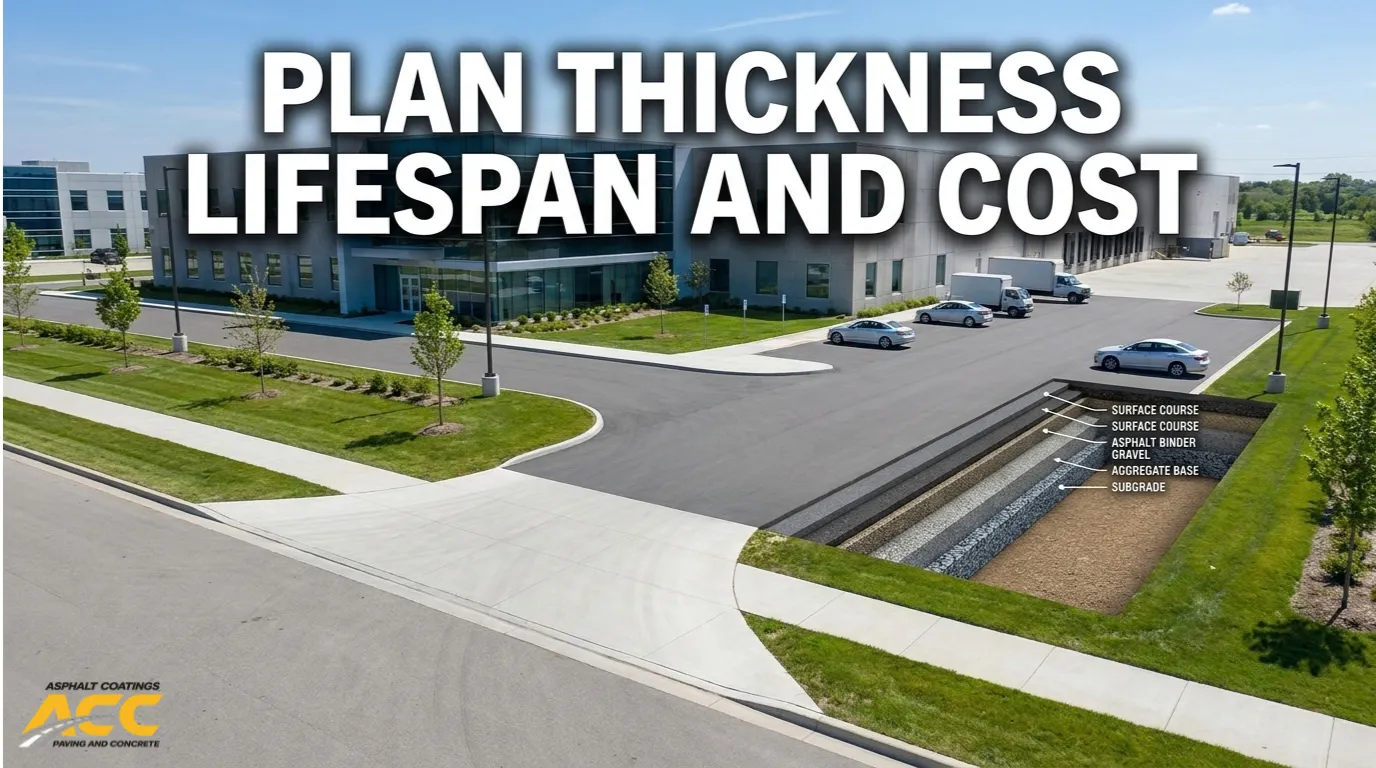
Asphalt overlay is a pavement rehabilitation method that places a new layer of hot mix asphalt, typically 1 to 3 inches thick, over an existing surface to restore ride quality and structural capacity without removing the underlying base.
This guide covers overlay fundamentals and candidacy criteria, the step-by-step installation process, commercial benefits and long-term ROI, site conditions and thickness specifications, cost factors and treatment comparisons, and post-overlay maintenance with ADA compliance.
Overlay is defined against full reconstruction by scope and cost; it addresses surface-level deterioration on structurally sound pavement at roughly five to ten times less expense than complete removal and replacement. Candidacy depends on base stability, distress severity, and drainage function.
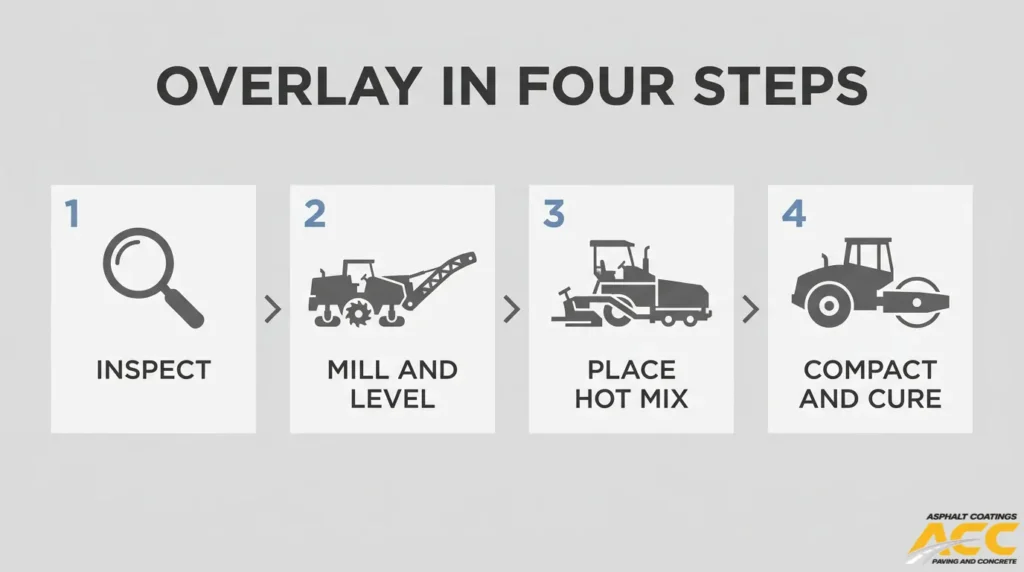
The installation process follows a defined sequence: surface evaluation and repair, milling to restore proper grade, hot mix asphalt placement with compaction to target density, and controlled curing before traffic returns. Each phase builds directly on the last.
Commercial properties gain reduced capital expenditure, shorter project timelines that keep tenants and customers accessible, improved curb appeal that influences patronage decisions and property values, and extended pavement life that pushes costly reconstruction further into the future.
Site conditions including subgrade soil quality, cracking patterns, and freeze-thaw exposure determine whether overlay is viable or whether deeper intervention is required. Thickness ranges from 1.5 inches for light-duty parking areas to 3 inches or more for heavy-traffic commercial use.
Cost depends on project size, existing pavement condition, and material selection. Overlay occupies the middle ground between sealcoating (surface protection only) and full-depth reconstruction (complete structural replacement). Routine sealcoating, crack sealing, and careful deicing practices protect the finished surface. Overlay projects also trigger ADA alteration requirements, making restriping and slope verification essential parts of every commercial resurfacing plan.
How Is Asphalt Overlay Defined In Commercial Paving?
Asphalt overlay is defined in commercial paving as a rehabilitation method that places a new layer of hot mix asphalt over an existing pavement surface. Rather than removing the entire pavement structure, overlay preserves the underlying base while restoring ride quality, surface integrity, and structural capacity. According to the City of Lexington, North Carolina, overlay provides a new layer of asphalt surface on the street without the milling process to protect the underlying road structure and improve the quality of the ride. Thickness typically ranges from 1 to 3 inches depending on traffic demands and existing pavement condition. For commercial properties like parking lots, retail centers, and distribution facilities, this approach addresses surface deterioration without the cost and disruption of full reconstruction. When the existing base remains structurally sound, overlay delivers a renewed driving surface at a fraction of the time and expense that complete replacement requires.
How Does Asphalt Overlay Differ From Full Asphalt Replacement?
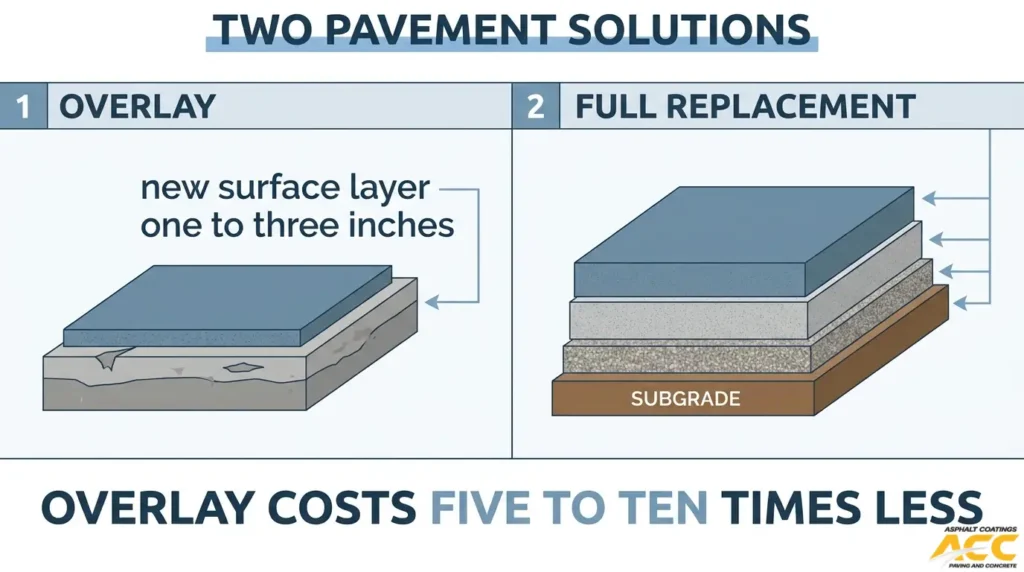
Asphalt overlay differs from full asphalt replacement in scope, cost, and structural intent. An overlay adds a new surface layer over existing pavement, while full replacement removes and rebuilds the entire pavement structure.
Overlay applies a thin Hot Mix Asphalt (HMA) layer, typically 1.5 inches or less in thickness, directly onto a structurally sound existing surface. According to the Mineta Transportation Institute at San José State University, a thin asphalt overlay is an HMA treatment consisting of a thin layer usually 1.5 inches or less. Full asphalt replacement, by contrast, requires complete removal of the old pavement, subbase regrading, and installation of an entirely new pavement section from the ground up.
The key differences between asphalt overlay and full replacement include:
- Depth of work: Overlay addresses the surface layer only; replacement reconstructs every layer down to the subgrade.
- Existing pavement requirement: Overlay requires a structurally intact base; replacement is necessary when the base or subgrade has failed.
- Project duration: Overlay projects complete in days; full replacement can take weeks due to excavation and base preparation.
- Cost: Overlay costs a fraction of reconstruction, making it the preferred option when underlying structure remains sound.
- Temperature constraints: Both methods require minimum ambient air temperatures for proper compaction, with the Wisconsin Department of Transportation specifying 32°F for lower layers and 36°F for upper layers.
For commercial property managers weighing these options, the deciding factor is almost always the condition below the surface. If the base is solid and distress is limited to surface-level wear, overlay delivers a like-new riding surface without the expense of tearing everything out. When base failures, deep rutting, or subgrade instability exist, no overlay thickness will compensate for what is happening underneath.
Understanding when each approach applies helps property managers avoid overspending on unnecessary reconstruction or underinvesting with an overlay that cannot hold.
When Is Asphalt Overlay The Right Choice For A Commercial Property?
Asphalt overlay is the right choice for a commercial property when the existing pavement is structurally sound but showing surface-level wear. The decision depends on current pavement condition, the type of distress present, budget constraints, and long-term performance goals. Key factors include base stability, distress severity, cost comparisons, and expected pavement life extension.
An overlay works best when the underlying base and subgrade remain intact. Surface problems such as minor cracking, roughness, and shallow rutting respond well to a new asphalt layer, but deep structural failures require a different approach entirely. Property managers should evaluate several conditions before committing to this treatment:
- The base course must have adequate bearing capacity and proper drainage characteristics, as recommended by the Massachusetts Department of Transportation’s pavement design guidelines.
- Surface distresses should be limited to functional wear rather than structural failure; alligator cracking and deep rutting may disqualify a pavement from overlay candidacy.
- The existing pavement should score in the fair-to-good range on a condition index, indicating that preservation is still viable.
- Drainage must function correctly, since trapped moisture beneath an overlay accelerates deterioration from within.
Cost is often the deciding factor for commercial property owners. According to Jefferson County Public Works in Oregon, milling and overlaying a road costs roughly five to ten times less than full roadway reconstruction. That difference makes overlay especially attractive for parking lots and access roads where the structure remains solid but the riding surface has degraded.
Timing also matters. Overlay is most effective as a proactive treatment applied before a pavement deteriorates beyond the preservation window. Once base failures develop, the investment in overlay materials is largely wasted because the new surface will reflect the damage below. For commercial properties with moderate surface wear and a structurally adequate base, overlay delivers a cost-effective path to extending pavement life without the disruption and expense of full removal and replacement.
Understanding overlay thickness requirements, which vary by traffic load and pavement condition, helps property managers make informed decisions about their specific situation.
What Is The Step-By-Step Process For A Commercial Asphalt Overlay?
The step-by-step process for a commercial asphalt overlay includes surface evaluation, milling and leveling, new asphalt installation with compaction, and post-installation curing. Each phase builds on the last to produce a durable, long-lasting surface.
How Is The Existing Asphalt Surface Evaluated And Prepared For Overlay?
The existing asphalt surface is evaluated and prepared for overlay by inspecting structural integrity, repairing defects, and cleaning the pavement to ensure proper bonding. According to the Texas Department of Transportation, the existing pavement should be structurally sound, level, clean, and capable of bonding to the overlay; to meet these prerequisites, it is usually repaired, leveled by milling or applying a level-up course, cleaned, and then coated with a binding agent.
Key preparation steps include:
- Assessing pavement distress, such as cracking, rutting, and drainage issues.
- Patching potholes and failed areas so the base can support the new layer.
- Removing debris, oil stains, and loose material from the surface.
- Applying a tack coat as a binding agent between the old and new layers.
Thorough evaluation is the most undervalued phase of any overlay project; skipping it almost always leads to premature failure of the new surface.
How Are Milling And Leveling Used Before Laying An Asphalt Overlay?
Milling and leveling are used before laying an asphalt overlay to remove deteriorated material, restore proper grade, and prevent buildup at curbs and transitions. Milling machines grind down the existing surface, typically removing 1 to 2 inches, which creates a rough texture that improves bonding with the new asphalt layer.
This step also controls elevation. Without milling, repeated overlays raise the pavement above gutter lines, drainage inlets, and adjacent surfaces. According to the Federal Highway Administration, the total cost of milling and overlay for a 1.5-inch thick overlay is approximately $8.00 per square yard, rising to between $11 and $12 per square yard for 2-inch or 2.5-inch thick overlays.
Milling and overlay projects also trigger ADA compliance requirements; if the resurfacing affects a crosswalk, curb ramps must be provided at both ends.
How Is New Asphalt Installed, Compacted, And Finished During An Overlay?
New asphalt is installed, compacted, and finished during an overlay by spreading hot mix asphalt with a paver, then immediately rolling it with compaction equipment. The paver lays the material at a consistent thickness, typically 1 to 3 inches for commercial applications, while maintaining proper cross-slope for drainage.
Compaction follows a specific sequence:
- A steel-wheel roller makes initial breakdown passes while the mix is hottest.
- A pneumatic-tire roller kneads the surface to close voids.
- A finish roller smooths the final surface texture.
Achieving proper density is critical. The Iowa Department of Transportation specifies compacting to a minimum of 94% of laboratory density, with no more than 8% average air voids in roadway specimens. Inadequate compaction is one of the fastest paths to early overlay failure, so experienced crews monitor mat temperature continuously during rolling.
What Post-Installation Steps Help An Asphalt Overlay Cure And Perform Properly?
The post-installation steps that help an asphalt overlay cure and perform properly include controlled cooling, traffic restriction, and early inspection. Fresh asphalt needs time to cool and harden before it can withstand vehicle loads. The California Department of Transportation recommends allowing the surface to cool to approximately 140°F before opening it to traffic.
Additional post-installation actions include:
- Barricading newly paved areas to prevent premature traffic damage.
- Inspecting for surface irregularities, such as segregation or roller marks, before final acceptance.
- Scheduling striping and pavement markings only after the surface has fully cured.
- Planning a sealcoat application within the first few years to protect the new surface.
Rushing traffic onto a fresh overlay is a common mistake that compresses the mat before it sets, leading to ruts and shoving. A short delay at this stage protects the investment for years to come, making patience one of the most cost-effective decisions in the entire process.
With the installation process complete, understanding the commercial benefits helps property managers evaluate whether overlay is the right investment.
What Are The Main Commercial Benefits Of Asphalt Overlay?
The main commercial benefits of asphalt overlay include reduced capital costs, minimized business downtime, improved safety and curb appeal, and stronger long-term pavement performance. The following sections break down each advantage.
How Does Asphalt Overlay Reduce Capital Costs Compared To Reconstruction?
Asphalt overlay reduces capital costs compared to reconstruction by preserving the existing base structure rather than removing and replacing it. This eliminates expensive excavation, hauling, and new subgrade preparation. Milling and overlaying a road costs roughly five to ten times less than full reconstruction, according to Jefferson County Public Works in Oregon. For property managers overseeing large commercial lots, that cost difference can free up significant capital for other site improvements. Overlay is one of the most budget-efficient ways to restore a parking surface when the underlying structure remains sound.
How Does Asphalt Overlay Minimize Downtime For Tenants And Customers?
Asphalt overlay minimizes downtime for tenants and customers by completing work in days rather than weeks. Because crews mill and pave over the existing surface, there is no need for full-depth removal, base reconstruction, or extended curing periods. Sections of a parking lot can be phased so that businesses remain accessible throughout the project. This matters most for retail centers, medical offices, and apartment complexes where lost access directly translates to lost revenue. Keeping disruption short protects tenant relationships and customer traffic during the improvement.
How Does Asphalt Overlay Improve Safety, Curb Appeal, And Property Value?
Asphalt overlay improves safety, curb appeal, and property value by replacing cracked, uneven surfaces with a smooth, uniform pavement layer. A fresh overlay eliminates trip hazards, improves drainage, and restores visible striping contrast. According to research published through Portland State University, curb appeal in retail real estate directly affects consumer patronage decisions and property sales prices. For commercial property owners, a well-maintained parking lot signals professionalism and encourages higher foot traffic. Few capital improvements deliver as visible a return as a clean asphalt surface.
How Does Asphalt Overlay Support Long-Term Pavement Performance And ROI?
Asphalt overlay supports long-term pavement performance and ROI by adding a protective wearing course that slows structural deterioration. A study by the National Center for Asphalt Technology at Auburn University confirmed that, nearly nine years after placement, all thin overlay treatments continued to slow deterioration rates and extend overall pavement life. Overlays also shield the base from climate stressors; high temperatures cause rutting, and deicing salts contribute to billions of dollars in annual infrastructure damage. Properly timed overlays interrupt this cycle, pushing costly reconstruction further into the future and maximizing each maintenance dollar spent.
With these commercial benefits established, site conditions determine whether overlay is the right fit for a specific property.
What Site And Pavement Conditions Affect Whether An Overlay Will Work?
Site and pavement conditions that affect whether an overlay will work include base stability, subgrade soil quality, surface distress severity, drainage capacity, and climate exposure. The sections below cover base failures, cracking and drainage problems, and freeze-thaw considerations.
How Do Base Failures And Subgrade Problems Limit Overlay Options?
Base failures and subgrade problems limit overlay options by undermining the structural foundation an overlay depends on. An overlay adds surface strength, but it cannot compensate for a base that shifts, settles, or lacks adequate bearing capacity. When the layers beneath the asphalt cannot support loads, new material simply cracks and deforms along the same failure patterns.
According to the City of Spokane Valley’s pavement design standards, the minimum pavement section cannot be used for sites with poor subgrade soils, specifically those with CBR values less than three, R-values less than 20, or resilient modulus values below 3,000 psi. Soils classified as MH, CL, CH, OL, or peat under the Unified Soil Classification System also disqualify standard overlay sections.
For commercial properties, skipping a subgrade evaluation before overlaying is one of the most costly mistakes a property manager can make.
How Do Extensive Cracking, Potholes, And Drainage Issues Impact Overlay Feasibility?
Extensive cracking, potholes, and drainage issues impact overlay feasibility by signaling structural distress that a new surface layer alone cannot resolve. Alligator cracking, deep potholes, and standing water each indicate failures that extend below the wearing course.
The Texas Transportation Institute at Texas A&M University notes that rutting and alligator cracking are two of the most difficult distress types to rehabilitate, requiring careful planning of alternative treatments rather than a standard overlay. Standing water accelerates base deterioration because moisture weakens aggregate bonds and promotes subgrade erosion beneath the pavement.
Before approving an overlay, contractors should evaluate sub-base and subgrade for both drainage characteristics and bearing capacity, as the Massachusetts Department of Transportation recommends. Properties with widespread interconnected cracking or chronic ponding typically need full-depth reclamation or reconstruction instead.
How Do Climate And Freeze-Thaw Cycles Influence Overlay Design Choices?
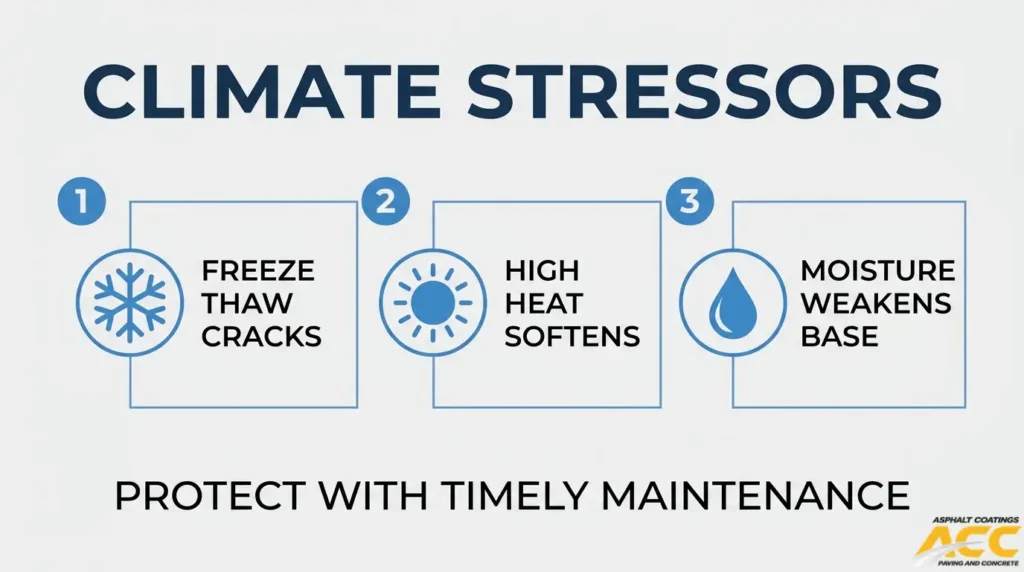
Climate and freeze-thaw cycles influence overlay design choices by dictating material specifications, placement timing, and subgrade protection requirements. Temperature swings force moisture into pavement cracks, where repeated freezing and thawing fractures the asphalt from within.
A study published in Nature Reviews Earth and Environment found that high temperatures soften asphalt pavements, causing rutting projected to increase by 2% per 1% increase in mean temperature. Cold-climate regions face the opposite problem: the Minnesota Department of Transportation has required frost-free materials in subgrade depths of 30 to 36 inches for asphalt pavements since 1995, based on traffic load requirements.
Placement timing also matters. The Wisconsin Department of Transportation specifies minimum ambient air temperatures of 32°F for lower layers and 36°F for upper layers during overlay installation. For commercial properties in regions with extreme seasonal variation, factoring climate into both material selection and scheduling is essential.
Understanding these site conditions helps property managers determine whether an overlay is viable or whether deeper intervention is needed.
How Thick Should A Commercial Asphalt Overlay Be?
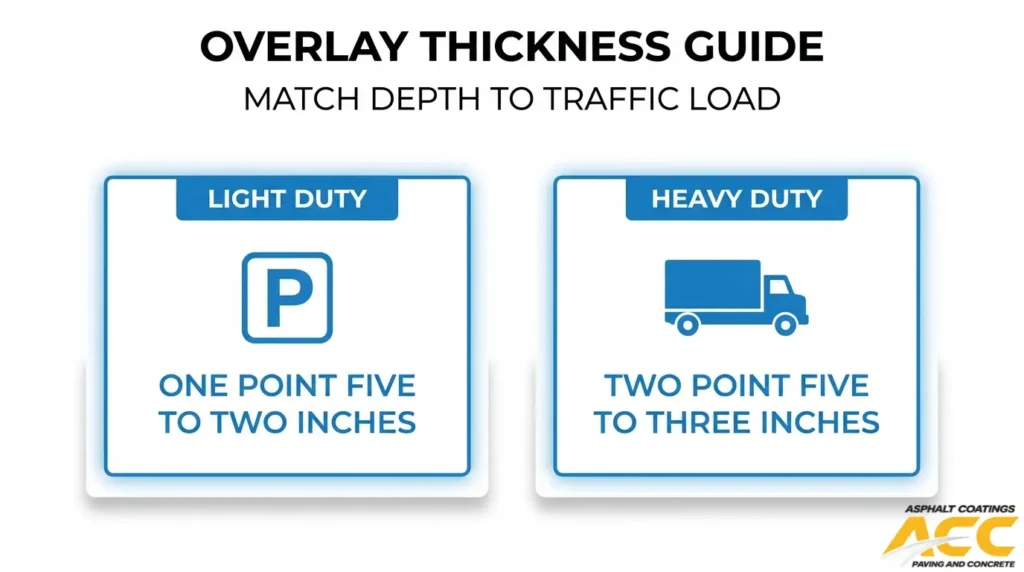
A commercial asphalt overlay should be 1.5 to 3 inches thick, depending on traffic volume and existing pavement condition. Light-duty lots need less material, while heavy-traffic areas require greater depth.
What Overlay Thickness Is Typical For Light-Duty Commercial Parking Areas?
The overlay thickness typical for light-duty commercial parking areas is 1.5 to 2 inches of hot mix asphalt. Office parks, small retail lots, and church parking areas with primarily passenger vehicle traffic fall into this category. These thinner overlays improve ride quality, seal surface cracks, and restore curb appeal without over-engineering the pavement section. For properties with sound existing base layers, 1.5 inches often provides adequate structural reinforcement and water resistance. A 2-inch overlay adds a margin of durability for lots that see moderate daily turnover. Choosing the right thickness at this level keeps project costs proportional to actual loading demands.
What Overlay Thickness Is Best For Heavy-Duty Or High-Traffic Commercial Use?
The overlay thickness best for heavy-duty or high-traffic commercial use is 2.5 to 3 inches or more. Shopping centers with constant vehicle circulation, distribution warehouses receiving loaded trucks, and industrial complexes with heavy equipment all generate concentrated wheel loads that thinner overlays cannot withstand. At this depth, the asphalt layer distributes stress more effectively across the base and subgrade. Properties expecting future increases in truck frequency should consider the upper end of this range. Undersizing the overlay on a high-traffic lot is a costly mistake; premature rutting and fatigue cracking will demand repairs far sooner than the overlay’s intended service life.
How Do Existing Pavement Strength And Future Loads Affect Overlay Thickness Decisions?
Existing pavement strength and future loads affect overlay thickness decisions by determining whether a thin preservation treatment or a thicker structural overlay is appropriate. A structurally sound base with minor surface distress may only need 1 to 1.5 inches. According to Pima County, Arizona’s treatment selection framework, a thin overlay of approximately 1 to 1.5 inches provides limited structural improvement, water resistance, and crack resistance for pavements in fair to poor surface condition. When the base has failed or anticipated loads exceed the existing section’s capacity, an overlay alone may not suffice; the Federal Highway Administration defines pavement reconstruction as the complete removal and replacement of the entire pavement structure. A thorough engineering evaluation of subgrade bearing capacity, current distress patterns, and projected traffic ensures the selected thickness delivers lasting performance.
Understanding the right overlay depth sets the stage for evaluating expected service life.
How Long Does A Commercial Asphalt Overlay Last?
A commercial asphalt overlay typically lasts 10 to 15 years, though actual performance depends on traffic loads, climate conditions, and ongoing maintenance. The following sections break down how each factor shapes overlay durability.
How Do Traffic Loads And Vehicle Types Affect Overlay Lifespan?
Traffic loads and vehicle types affect overlay lifespan by accelerating wear in proportion to axle weight and volume. Passenger cars create minimal stress, while delivery trucks, garbage vehicles, and semi-trailers concentrate far greater force per square inch on the asphalt surface. A parking lot serving a commercial distribution warehouse will degrade faster than one at an office park, even with identical overlay thickness. According to the California Department of Transportation, Type A HMA thin overlays extend pavement life only 1 to 3 years on high-volume roads compared to 3 to 5 years on low-volume roads. Heavy turning movements at drive aisles and loading docks compound the effect, making overlay thickness selection critical for high-traffic commercial properties.
How Does Weather Exposure In Different Climates Change Overlay Durability?
Weather exposure in different climates changes overlay durability by subjecting the asphalt binder to thermal stress, moisture infiltration, and UV degradation. Freeze-thaw cycles force water into micro-cracks, expanding and widening them with each cycle. High summer temperatures soften the binder and promote rutting; according to Nature Reviews Earth & Environment, rutting is projected to increase by 2% for every 1% rise in mean temperature. Prolonged UV exposure at higher elevations, common along Colorado’s Front Range, oxidizes the binder faster and makes the surface brittle. Properties in regions with wide seasonal temperature swings should anticipate shorter intervals between preservation treatments unless climate-adapted mix designs are specified during installation.
How Do Maintenance Practices Influence How Long An Overlay Performs?
Maintenance practices influence how long an overlay performs by either preventing or accelerating surface deterioration. Timely sealcoating, crack sealing, and drainage management protect the asphalt binder from water and oxidation. Key practices that extend overlay life include:
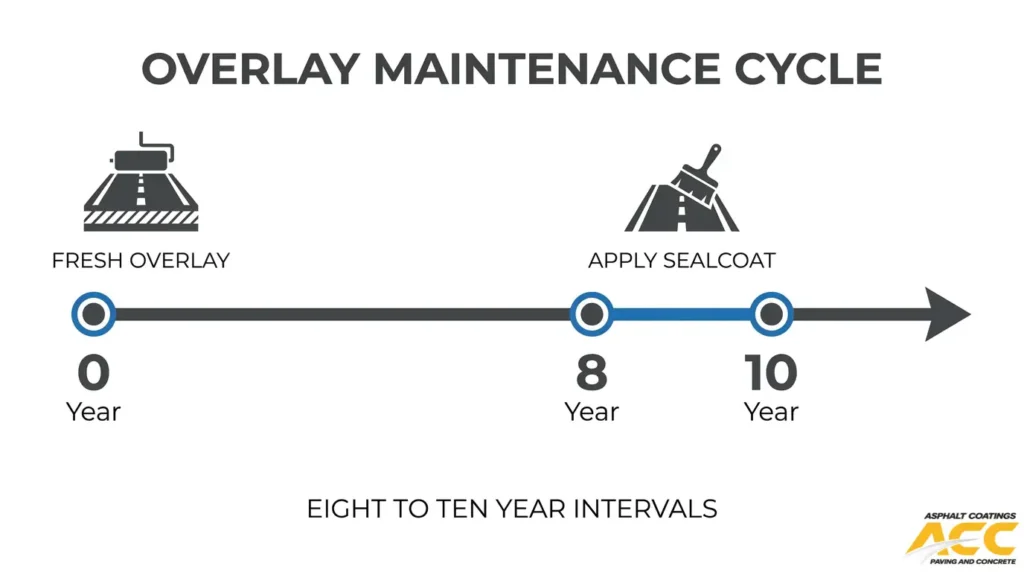
- Applying sealcoat on an 8- to 10-year cycle, as recommended by Williamson County, Texas, to restore surface flexibility.
- Sealing cracks before they allow water to reach the base layer.
- Inspecting the pavement annually or up to once every three years, depending on use, per Sacramento County Department of Transportation guidelines.
- Using deicing products carefully, since salt-based deicers cost an estimated $5 billion in U.S. road infrastructure damage annually according to Yale Environment 360.
Neglecting routine maintenance is costly. For properties that skip these steps, the next overlay or restoration effort becomes a significantly larger capital expense. Understanding maintenance needs sets the stage for evaluating total overlay costs.
How Much Does Asphalt Overlay Typically Cost For Commercial Lots?
Asphalt overlay cost for commercial lots depends on project size, existing pavement condition, and material specifications. The following sections break down how each factor shapes pricing.
How Do Project Size And Layout Affect Asphalt Overlay Pricing?
Project size and layout affect asphalt overlay pricing through economies of scale and mobilization costs. Larger lots spread fixed expenses like equipment transport, traffic control setup, and crew mobilization across more square yards, lowering the per-unit rate. Smaller lots absorb those same fixed costs over less area, increasing the cost per square yard.
Irregular layouts with islands, curves, tight corners, or multiple access points also raise costs. These features require more hand work, additional passes with the paver, and careful grade transitions that slow production. Properties with simple rectangular footprints are the most cost-efficient to overlay because crews maintain steady paving speed with minimal downtime.
How Do Pavement Condition And Prep Work Requirements Change Overlay Costs?
Pavement condition and prep work requirements change overlay costs by dictating how much repair, milling, and leveling the surface needs before new asphalt can be placed. A lot in good structural condition may need only cleaning and a tack coat, while a deteriorated surface requires patching, crack routing, and extensive milling.
According to the Federal Aviation Administration’s PAVEAIR system, the Pavement Condition Index (PCI) rates surface condition on a scale of 0 to 100, where 0 represents the worst possible condition and 100 the best. Lots with low PCI scores typically demand more prep labor and materials, which can significantly increase total project cost. For most commercial properties, investing in thorough prep work before the overlay is the single most effective way to avoid premature failure and costly re-dos.
How Do Material Choices And Thickness Influence Total Overlay Budget?
Material choices and thickness influence total overlay budget by determining both material volume and mix design cost per ton. A standard 1.5-inch hot mix asphalt overlay uses less material than a 2.5-inch structural overlay, and the price difference compounds across large commercial lots.
Specialty mixes add to the budget as well. Polymer-modified asphalt offers better crack resistance and flexibility but costs more per ton than conventional HMA. Fiber-reinforced mixes and warm-mix asphalt carry similar premiums. Choosing the right combination of thickness and mix design requires balancing upfront cost against expected traffic loads and climate exposure.
Understanding cost drivers at the project level helps property managers set realistic budgets before requesting contractor proposals.
How Does Asphalt Overlay Compare To Alternatives Like Sealcoating Or Reconstruction?
Asphalt overlay compares to alternatives like sealcoating or reconstruction by occupying the middle ground in both cost and structural impact. The sections below clarify when sealcoating, patching, or full-depth removal is the better choice.
When Is Sealcoating Enough Instead Of An Asphalt Overlay?
Sealcoating is enough instead of an asphalt overlay when the existing pavement is structurally sound and shows only surface-level oxidation, minor weathering, or light wear. Sealcoating applies a thin protective emulsion that shields asphalt from UV rays, water penetration, and chemical spills, but it adds no structural strength. Pavement with isolated hairline cracks, slight color fading, or early brittleness typically benefits more from sealcoating than from an overlay. According to Williamson County, Texas, seal coat maintenance is often performed on an 8 to 10 year basis, making it a low-cost preventive cycle. Once cracking becomes interconnected or surface deformation appears, sealcoating alone can no longer address the damage, and an overlay or more intensive treatment becomes necessary.
When Is Patching Appropriate Instead Of A Full Parking Lot Overlay?
Patching is appropriate instead of a full parking lot overlay when damage is confined to isolated areas rather than spread across the entire surface. Localized potholes, small utility cuts, or individual failed sections can be repaired with saw-cut patching or infrared patching without disturbing surrounding pavement. This targeted approach works best when the majority of the lot maintains good structural integrity and adequate drainage. As the Texas Transportation Institute at Texas A&M University notes, rutting and alligator cracking are two of the most difficult distress types to rehabilitate and require careful planning of alternative treatments. If distressed areas exceed roughly 25 to 30 percent of total lot area, the cumulative cost and patchwork appearance of spot repairs often makes a full overlay more practical and cost-effective.
When Is Full-Depth Removal And Replacement Better Than Overlay?
Full-depth removal and replacement is better than overlay when the existing pavement structure, base, or subgrade has failed beyond surface-level repair. According to the Federal Highway Administration, pavement reconstruction involves complete removal and replacement of the entire existing pavement structure. Conditions that demand reconstruction include:
- Widespread alligator cracking extending through the full pavement depth
- Subgrade failure with soft, unstable soils or poor bearing capacity
- Chronic drainage problems that cannot be corrected by regrading alone
- Severe rutting or settlement indicating base material breakdown
An overlay placed over a compromised base will reflect the same failures within a short period. Although reconstruction costs 5 to 10 times more than milling and overlay, it resets the pavement’s structural life entirely. For properties facing systemic foundation issues, reconstruction is the only path to lasting performance.
With each treatment option defined, maintaining whichever solution you choose protects that investment long-term.
How Should Commercial Properties Maintain An Asphalt Overlay Over Time?
Commercial properties should maintain an asphalt overlay over time through scheduled sealcoating, timely crack sealing, and careful winter maintenance practices. The sections below cover sealcoating frequency, crack repair timing, and snow removal strategies.
How Often Should Sealcoating Be Applied To A New Overlay?
Sealcoating should be applied to a new overlay on an eight to ten year cycle for ongoing protection. According to Williamson County, Texas, seal coat maintenance is often performed on an 8 to 10 year basis. Most contractors recommend waiting at least 12 months after installation before the first application, allowing the asphalt to fully cure and oxidize. Subsequent applications then follow the standard cycle, though high-traffic commercial lots may benefit from slightly shorter intervals. Consistent sealcoating prevents UV degradation, blocks water penetration, and preserves the flexible binder that keeps the overlay intact. Skipping this step accelerates surface oxidation and shortens overall pavement life considerably.
When Should Crack Sealing Be Performed On Overlaid Parking Lots?
Crack sealing should be performed on overlaid parking lots as soon as cracks appear, ideally during annual inspections. According to St. Mary’s County Government Department of Public Works, restoration costs rise four to five times higher when routine maintenance is not performed. Even hairline cracks allow moisture to reach the base layer, where freeze-thaw cycles widen the damage. For best adhesion, crack sealant should be applied when pavement temperatures are moderate, typically in spring or fall. Property managers who address cracks within one season of formation prevent small defects from becoming potholes or alligator cracking patterns that compromise the overlay’s structural integrity.
How Should Snow Removal And Deicing Be Handled To Protect Overlays?
Snow removal and deicing should be handled with methods that minimize chemical and mechanical damage to the overlay surface. Rubber-edged plow blades reduce scraping and gouging compared to steel edges. When selecting deicers, property managers should limit sodium chloride use; according to Yale Environment 360, common deicing salt is corrosive to asphalt and costs $5 billion in road infrastructure damage every year. Alternatives such as calcium magnesium acetate or sand-salt blends provide traction with less surface degradation. Prompt snow removal also prevents meltwater from pooling and infiltrating cracks during refreeze cycles.
With a consistent maintenance schedule in place, the next consideration is how overlay projects affect striping and ADA compliance.
How Does Asphalt Overlay Affect Commercial Parking Lot Striping And ADA Compliance?
Asphalt overlay affects commercial parking lot striping and ADA compliance by burying existing markings and triggering federal alteration requirements. The sections below cover restriping timing, accessible parking improvements, and slope and drainage management.
When Should Line Striping And Pavement Markings Be Redone After An Overlay?
Line striping and pavement markings should be redone as soon as the new overlay has fully cured and cooled, typically within a few days of placement. An overlay completely covers all existing parking stall lines, directional arrows, fire lanes, and ADA symbols, so the lot is effectively unmarked until restriped.
According to a joint technical guidance from the U.S. Department of Justice and Federal Highway Administration, a project involving milling and overlaying falls within the definition of “alteration” because it changes the road surface in ways that affect pedestrian route usability. This classification means updated ADA-compliant markings, including van-accessible stalls and access aisle hatching, must be included in the new striping layout. Delaying restriping creates liability exposure and confuses traffic flow during business hours.
How Can An Overlay Project Improve ADA-Accessible Parking And Routes?
An overlay project can improve ADA-accessible parking and routes by resetting surface grades, correcting uneven pavement, and allowing a fresh layout that meets current standards. Because overlay qualifies as an alteration under federal guidelines, the 2010 ADA Standards for Accessible Design apply. These standards, published by the U.S. Department of Justice, set minimum scoping and technical requirements for altered commercial facilities to be readily accessible to individuals with disabilities.
Practical improvements an overlay enables include:
- Repositioning accessible stalls closer to building entrances.
- Adding van-accessible spaces with proper 8-foot access aisles.
- Installing or upgrading curb ramps at pedestrian crossings.
- Creating smoother, continuous accessible routes free of trip hazards.
Property managers who treat the overlay as an opportunity, rather than just a resurfacing task, gain a compliant lot without a separate ADA retrofit project.
How Should Slope And Drainage Be Managed To Stay ADA Compliant After Overlay?
Slope and drainage should be managed by verifying cross-slope and running-slope measurements during overlay placement, not after. The U.S. Access Board specifies that accessible routes must maintain a running slope no steeper than 1:20 and a cross slope no steeper than 1:48. Even a modest overlay thickness can push existing grades beyond these thresholds if the underlying surface already slopes near the maximum.
Key steps to maintain compliance include:
- Surveying existing grades before milling to identify problem areas.
- Using variable-depth milling to correct slopes rather than adding uniform thickness.
- Directing stormwater away from accessible routes through adjusted drainage inlets.
- Verifying final grades with a digital level before the lot reopens.
Overlooking slope tolerances is one of the most common ADA violations on resurfaced commercial lots. Addressing drainage and grade together during overlay prevents costly post-construction corrections and keeps pedestrian paths safe for all users.
How Should Property Managers Plan An Asphalt Overlay Project With Minimal Disruption?
Property managers should plan an asphalt overlay project with minimal disruption by phasing work in sections, maintaining clear communication with tenants, and coordinating the overlay with other site improvements.
How Can Phasing And Scheduling Reduce Impacts On Tenants And Customers?
Phasing and scheduling reduce impacts on tenants and customers by dividing the parking lot into sections and completing each zone before opening it to traffic. This approach keeps a portion of the lot accessible at all times, preventing full closures that drive customers away.
Effective phasing strategies include:
- Scheduling overlay work during off-peak hours or weekends when tenant traffic is lowest.
- Completing high-traffic zones first so critical access points reopen quickly.
- Staggering work across multiple days rather than attempting full-lot paving in one session.
- Maintaining fire lane access and emergency vehicle routes throughout every phase.
For multi-tenant commercial properties, even a single day of full closure can cause measurable revenue loss. Splitting the project into two or three phases typically adds minimal cost while preserving business continuity.
How Should Communication And Signage Be Handled During An Overlay Project?
Communication and signage during an overlay project should be handled proactively, starting well before construction begins. According to the Work Zone Safety Information Clearinghouse, good, clear, and consistent language aids understanding and yields a better product in the field, which in turn enhances safety.
Key communication steps include:
- Notifying tenants and customers at least two weeks before work starts, with specific dates and affected areas.
- Posting directional signage to guide traffic around active work zones and toward available parking.
- Updating digital channels, such as email, property websites, and social media, with daily progress.
- Placing barricades and cones with clear “no entry” markings at fresh asphalt sections.
Consistent messaging prevents confusion and reduces complaints significantly more than reactive updates issued after disruptions occur.
How Can Overlay Work Be Coordinated With Other Site Improvements?
Overlay work can be coordinated with other site improvements by bundling related projects, such as curb repair, striping, sealcoating, crack sealing, and drainage corrections, into a single mobilization. This reduces total disruption days and lowers combined costs since equipment and crews are already on-site.
Before bundling, a geotechnical assessment should confirm subgrade suitability. According to the City of Spokane Valley’s pavement design guidelines, the minimum pavement section cannot be used for sites with poor subgrade soils that have CBR values less than three, R-values less than 20, or resilient modulus values less than 3,000 psi.
Coordinating concrete flatwork, ADA ramp upgrades, and drainage improvements alongside the overlay prevents reopening freshly paved surfaces months later for separate projects. Proper planning with the paving contractor during the proposal stage ensures all scope items share one construction timeline.
How Should You Approach Asphalt Overlay Planning With Asphalt Coatings Company?
You should approach asphalt overlay planning with Asphalt Coatings Company by combining overlay installation with complementary services. The sections below cover how paving, sealcoating, crack sealing, and striping support a successful overlay, along with the key takeaways from this guide.
How Can Services Like Paving, Sealcoating, Crack Sealing, And Striping Support A Successful Overlay?
Services like paving, sealcoating, crack sealing, and striping support a successful overlay by addressing every stage of pavement life, from preparation through long-term protection. Asphalt Coatings Company delivers all four services with in-house crews across Colorado’s Front Range, eliminating the need to coordinate multiple subcontractors.
Each service plays a distinct role in overlay success:
- Asphalt paving and subgrade preparation establish the structural foundation an overlay requires.
- Crack sealing with CDOT-approved materials prevents moisture infiltration that undermines overlay bond integrity.
- Sealcoating protects the finished overlay surface from UV degradation and freeze-thaw damage common at Colorado’s elevation.
- Parking lot striping and ADA-compliant markings restore traffic flow, accessible routes, and code compliance after resurfacing.
Coordinating these services under a single contractor reduces project timelines and keeps commercial properties operational faster.
What Are The Key Takeaways About What Is Asphalt Overlay, Its Process, And Commercial Benefits?
The key takeaways about what asphalt overlay is, its process, and commercial benefits center on three principles: overlay preserves existing pavement structure, follows a defined installation sequence, and delivers measurable commercial value. As the City of Lexington, North Carolina describes, overlay provides a new layer of asphalt surface on the street without milling to protect the underlying road structure and improve ride quality.
The most actionable conclusions from this guide are:
- Asphalt overlay adds 1 to 3 inches of new material over structurally sound pavement, costing a fraction of full reconstruction.
- Proper evaluation, milling, tack coating, and compaction determine whether an overlay performs for years or fails prematurely.
- Commercial properties gain reduced capital expenditure, minimized tenant disruption, improved curb appeal, and ADA compliance updates.
- Routine maintenance, including sealcoating, crack sealing, and careful snow removal, extends overlay lifespan significantly.
For commercial property managers across Colorado’s Front Range, experienced asphalt contractors provide the full scope of overlay planning, installation, and ongoing maintenance with deep regional expertise in high-altitude conditions and freeze-thaw cycles.