Commercial asphalt in Fort Collins is a climate-sensitive investment that demands careful planning, proper materials, and consistent maintenance to perform under northern Colorado’s harsh conditions.
This guide covers climate impacts on pavement performance, parking lot design and material selection, inspection and maintenance strategy, budgeting and safety compliance, ADA requirements, and contractor evaluation.
Fort Collins’ combination of freeze-thaw cycling, 51+ inches of annual snowfall, and UV radiation roughly 15 to 20 percent more intense than sea level accelerates asphalt deterioration faster than most business owners expect. Binder oxidation, surface cracking, and plow damage compound each winter season.
Proper lot design starts with matching pavement thickness to actual traffic loads, grading surfaces at a minimum 1 to 2 percent slope for drainage, and coordinating stall layout with pedestrian safety and fire code requirements before any paving begins.
Material choices, particularly binder grade selection and mix design, directly determine how well pavement resists cracking and rutting through Colorado’s temperature extremes. Full-depth reconstruction versus overlay decisions hinge on whether the existing base remains structurally sound.
Preventive maintenance through crack sealing, sealcoating every two to three years, and seasonal inspections consistently delivers lower lifecycle costs than reactive repairs. Knowing when repair expenses approach 40 to 50 percent of replacement value signals the shift from maintenance to reconstruction.
ADA compliance requires specific space dimensions, van-accessible ratios, slope tolerances, and integrated ramp and signage placement from the initial design phase. Striping and markings need reapplication every 12 to 24 months to maintain visibility and legal compliance.
Evaluating contractors on DOT prequalification, in-house crew structure, and itemized bid specifications protects businesses from costly quality failures in Fort Collins’ demanding climate.
How Does Fort Collins’ Climate Impact Commercial Asphalt Performance?
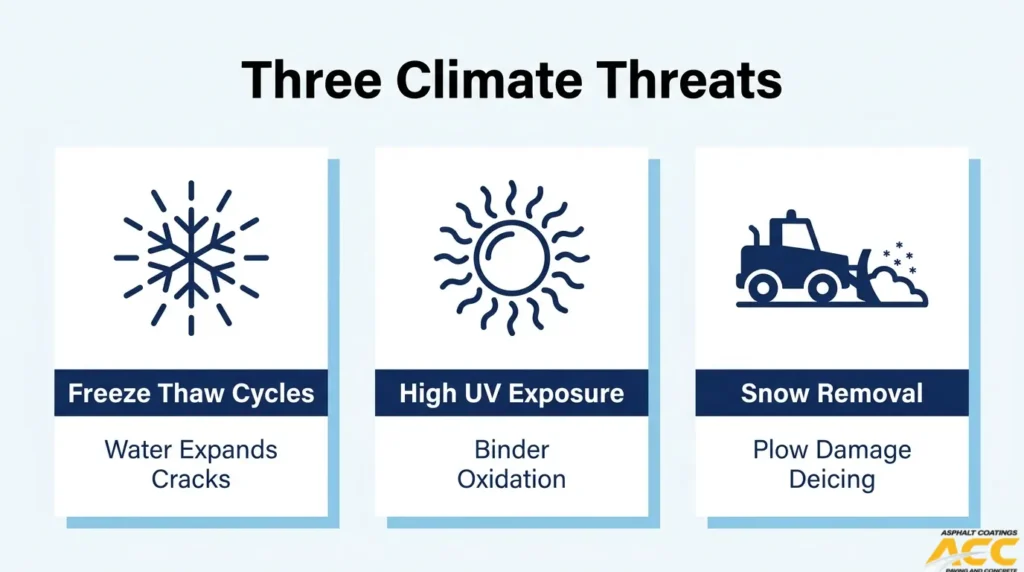
Fort Collins’ climate impacts commercial asphalt performance through freeze-thaw cycling, intense UV radiation, and heavy snow management demands. Each of these stressors accelerates deterioration in distinct ways.
How Do Freeze–Thaw Cycles Affect Commercial Asphalt Surfaces?
Freeze-thaw cycles affect commercial asphalt surfaces by allowing water to infiltrate small cracks, expand as it freezes, and widen those openings with each repetition. Over a single Fort Collins winter, this process can turn hairline cracks into structural failures that compromise entire pavement sections.
The damage compounds because oxidation, which freeze-thaw stress accelerates, is irreversible. According to a 2024 study published in MDPI Buildings, oxidation is the main deterioration mechanism affecting asphalt binders since its effects cannot be reversed, unlike other forms of hardening. Once the binder becomes brittle, each freeze-thaw cycle causes progressively more damage. Proactive crack sealing before winter is one of the most effective ways to interrupt this cycle.
How Does Colorado’s High UV Exposure Change Asphalt Durability?
Colorado’s high UV exposure changes asphalt durability by accelerating oxidation of the liquid asphalt binder, causing it to become brittle and lose flexibility. At Colorado’s elevation, UV radiation is approximately 15 to 20 percent more intense than at sea level, which means commercial pavements in Fort Collins age faster than identical surfaces in lower-altitude regions.
This oxidation dries out the binder, leading to surface raveling, color fading, and microcracking that invites moisture intrusion. Sealcoating provides a protective barrier against UV penetration, and modern mix technologies can also help. For businesses planning new installations, warm mix asphalt produces comparable performance while allowing lower production temperatures, which can reduce initial binder oxidation during placement.
How Do Snow Removal And Deicing Practices Impact Asphalt In Fort Collins?
Snow removal and deicing practices impact asphalt in Fort Collins by subjecting pavement to mechanical abrasion from plows and chemical degradation from deicing agents. According to the Coloradoan, Fort Collins experiences an average annual snowfall of 51.4 inches, with 34.2 inches falling through February alone. That volume demands frequent plowing, which scrapes aggregate loose and accelerates surface wear.
Chemical deicers, particularly those containing magnesium chloride, can penetrate the asphalt surface and weaken the bond between aggregate and binder. Proper drainage design minimizes standing meltwater that carries these chemicals deeper into the pavement structure. For most commercial properties, scheduling a post-winter inspection is the single most cost-effective step to catch plow scarring and chemical damage before spring moisture makes it worse.
Understanding these climate-driven stressors helps businesses plan smarter when designing a new parking lot.
What Should Businesses Consider When Planning A New Asphalt Parking Lot?
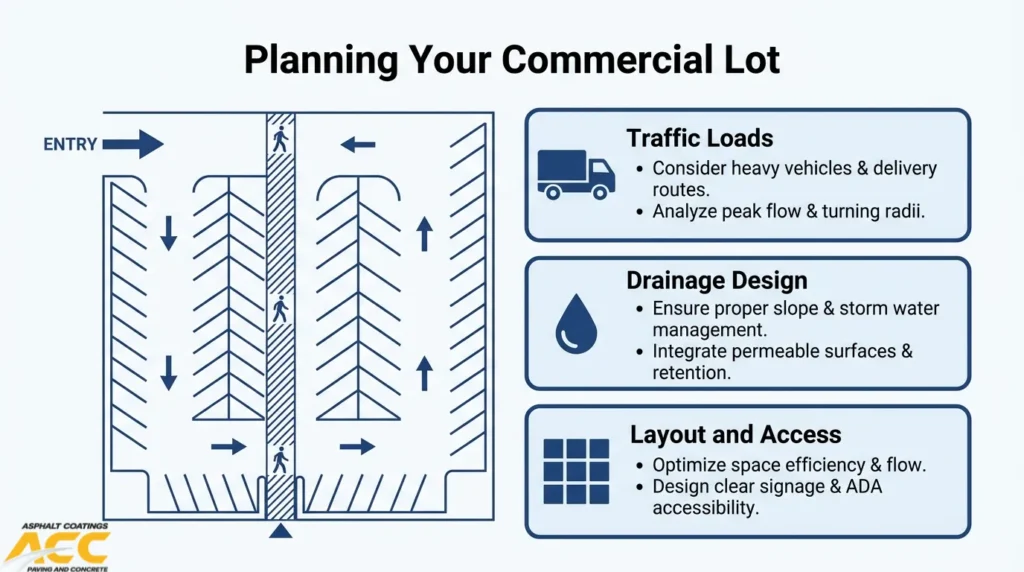
Businesses should consider traffic loads, drainage design, and lot layout when planning a new asphalt parking lot. The following sections cover how vehicle types shape structural decisions, how grading protects long-term performance, and how access planning improves safety and compliance.
How Do Traffic Loads And Vehicle Types Influence Parking Lot Design?
Traffic loads and vehicle types influence parking lot design by determining asphalt thickness, subbase depth, and circulation patterns. A retail lot serving passenger cars requires a thinner pavement section than a warehouse lot handling delivery trucks and semi-trailers. Heavier axle loads demand thicker aggregate base courses and stronger asphalt mixes to prevent rutting and premature fatigue cracking.
Circulation layout must also match expected traffic. According to the City of Lake Forest Park’s parking design guidelines, one-way traffic flow should never be combined with 90-degree parking to ensure proper separation of inbound and outbound vehicles. Lots expecting frequent truck turning movements benefit from wider drive aisles and reinforced aprons at entry points. Failing to account for actual vehicle weights during the design phase often leads to costly structural repairs within the first few years.
How Do Drainage And Site Grading Affect Long-Term Asphalt Performance?
Drainage and site grading affect long-term asphalt performance by controlling where water flows and how quickly it leaves the surface. Standing water accelerates oxidation, softens the subgrade, and creates conditions for pothole formation, especially during Colorado’s freeze-thaw cycles.
Proper site grading directs stormwater toward catch basins, swales, or retention areas. Parking lots should slope a minimum of 1 to 2 percent toward drains to prevent ponding, according to D.B. Krieg, Inc. Inadequate grading is one of the most common and expensive mistakes in commercial lot construction. Even a well-mixed asphalt surface will deteriorate prematurely if water sits on or beneath it, making drainage planning just as critical as material selection.
How Should You Plan Layout, Access, And Safety For A Commercial Lot?
You should plan layout, access, and safety for a commercial lot by coordinating stall dimensions, drive aisle widths, pedestrian pathways, and ADA-compliant accessible spaces from the earliest design stage. Key planning elements include:
- Stall angles (60-degree, 75-degree, or 90-degree) matched to traffic flow direction and available space.
- Drive aisle widths sized for the largest vehicles expected to use the lot regularly.
- Clearly separated pedestrian walkways connecting parking areas to building entrances.
- Designated fire lanes that meet local fire code clearance requirements.
- ADA-accessible parking spaces positioned on the shortest accessible route to the main entrance.
Early coordination between the paving contractor, civil engineer, and property owner prevents costly redesigns. With layout and access decisions finalized, selecting the right asphalt materials becomes the next priority.
How Do Commercial Asphalt Material And Mix Choices Affect Performance?
Commercial asphalt material and mix choices affect performance by determining how well pavement resists cracking, rutting, and moisture damage under local conditions. The subsections below cover freeze-thaw mix performance, binder grades and additives, and when full-depth paving outperforms overlay solutions.
How Do Different Asphalt Mix Designs Perform In Freeze–Thaw Conditions?
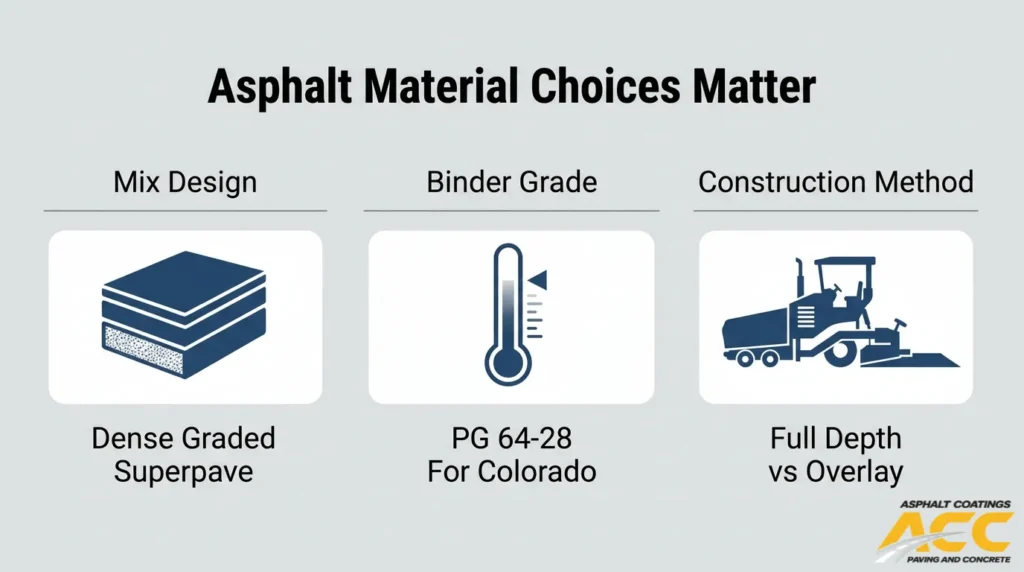
Different asphalt mix designs perform in freeze-thaw conditions based on their void structure, aggregate gradation, and flexibility at low temperatures. Dense-graded Superpave mixes minimize interconnected air voids, which reduces moisture infiltration before freezing occurs. Stone matrix asphalt (SMA) uses a gap-graded aggregate skeleton that resists cracking under thermal contraction. Warm mix asphalt (WMA) also performs well because improved compaction at lower temperatures produces fewer in-place voids from the start. For Fort Collins commercial lots, selecting a mix with low permeability and high fracture resistance is the most effective defense against seasonal freeze-thaw damage.
How Do Binder Grades And Additives Affect Durability In Fort Collins?
Binder grades and additives affect durability in Fort Collins by matching the asphalt’s temperature performance range to local climate extremes. PG 64-28, commonly used in low-elevation Colorado areas, handles summer highs up to 64°C and remains flexible down to -28°C. Polymer-modified binders, such as SBS-modified PG 76-28, improve both rutting resistance and low-temperature crack resistance for high-traffic commercial lots. Additives like recycled tire rubber and anti-stripping agents further enhance moisture resistance. Given Fort Collins’ combination of intense UV exposure and harsh winters, upgrading to a polymer-modified binder is often worth the added cost for lots that need to last beyond 15 years.
When Might Full-Depth Asphalt Be Better Than Overlay Solutions?
Full-depth asphalt might be better than overlay solutions when the existing pavement structure has failed beneath the surface. Overlays work best on structurally sound substrates. According to the Federal Highway Administration, thin asphalt overlays placed for pavement preservation are functional overlays typically less than 1.5 inches in thickness that extend service life by improving ride, correcting rutting, providing impermeability, and reducing noise. However, when core samples reveal base failure, alligator cracking throughout the section, or subgrade instability, overlaying only masks the problem temporarily. Full-depth reconstruction replaces the entire pavement section, establishing a properly engineered base that supports decades of commercial traffic.
Understanding how materials perform sets the stage for knowing when to inspect and maintain them.
How Often Should Commercial Asphalt Be Inspected And Maintained?
Commercial asphalt should be inspected at least twice per year, with additional checks after severe weather events. The subsections below cover seasonal inspection timing, how to prioritize the issues you find, and when replacement becomes more cost-effective than continued repairs.
What Seasonal Asphalt Inspections Should Fort Collins Businesses Schedule?
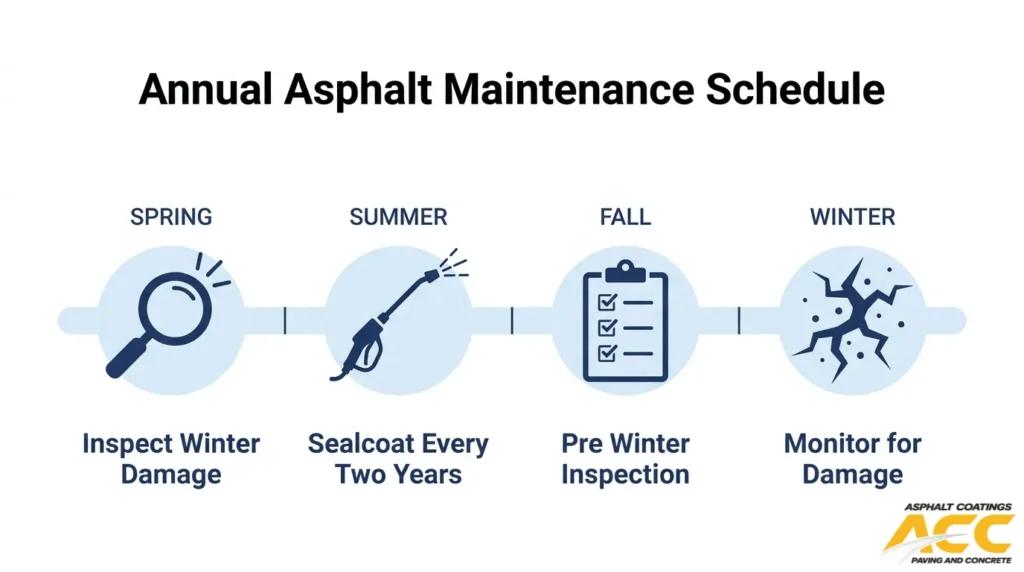
Fort Collins businesses should schedule asphalt inspections in early spring and late fall. A spring walkthrough reveals winter damage from freeze-thaw cycles, including new cracks, heaving, and pothole formation. The fall inspection identifies issues that need repair before snow and ice make conditions worse.
Additional inspections are warranted after major weather events, such as heavy snowstorms, prolonged rain, or late-season hailstorms. During each inspection, property managers should document:
- Surface cracking (linear, alligator, and block patterns)
- Standing water or drainage failures
- Pothole formation and base settlement
- Faded or worn striping and markings
- Sealcoat condition and exposed aggregate
Scheduling sealcoating every 2 to 3 years, with crack sealing performed as needed, keeps minor issues from becoming structural problems. Consistent seasonal documentation also creates a maintenance history that supports better long-term budgeting decisions.
How Should Property Managers Prioritize Maintenance Issues They Find?
Property managers should prioritize maintenance issues by addressing safety hazards first, then structural damage, and finally cosmetic concerns. A study published in the ASCE Library found that preventative maintenance techniques, specifically crack sealing and chip seals, had lower life-cycle costs compared to structural overlays.
A practical prioritization framework includes:
- Safety hazards such as potholes, tripping edges, and ADA non-compliance need immediate repair.
- Structural failures including alligator cracking and base settlement require prompt professional assessment.
- Water infiltration issues like poor drainage or unsealed cracks should be addressed within weeks.
- Surface wear such as oxidation, minor cracking, and faded sealcoat can be scheduled seasonally.
Delaying structural repairs almost always increases total cost, because water penetration accelerates subsurface deterioration through each freeze-thaw cycle. Addressing small cracks at $0.50 to $1.00 per linear foot is far more economical than allowing them to develop into base failures requiring full-depth work.
When Does Ongoing Maintenance No Longer Make Sense Versus Replacement?
Ongoing maintenance no longer makes sense versus replacement when repair costs approach 40 to 50 percent of full replacement value, or when structural failures cover large areas of the lot. Widespread alligator cracking, persistent drainage failures despite regrading attempts, and recurring potholes in the same zones all signal that the pavement base has deteriorated beyond what surface treatments can correct.
Mill-and-overlay remains viable when the subgrade is still structurally sound, typically costing $3.50 to $5.50 per square foot. However, if core samples reveal compromised base layers or the pavement has exceeded its expected service life, full-depth reconstruction delivers better long-term value. In my experience, property managers who invest in timely replacement rather than repeated patching often see lower total costs over a 10-year horizon. Commercial asphalt contractors with Colorado-specific experience can help property managers make this critical decision by performing detailed pavement evaluations that account for Front Range climate conditions. Asphalt Coatings Company has been guiding Fort Collins businesses through these replacement-versus-repair decisions since 1986, using in-house assessment teams familiar with how freeze-thaw cycles affect base layer integrity.
What Are The Most Important Commercial Asphalt Maintenance Services?
The most important commercial asphalt maintenance services are crack sealing, sealcoating, and patching or milling and overlay. Each service addresses a different stage of pavement deterioration, from hairline cracks to structural failure.
How Does Routine Crack Sealing Protect Commercial Asphalt Pavement?
Routine crack sealing protects commercial asphalt pavement by preventing water from reaching the base layers where it causes the most structural damage. Once moisture infiltrates through surface cracks, freeze-thaw cycles accelerate deterioration rapidly. According to Dunn Company, freeze-thaw cycles allow moisture to penetrate asphalt, leading to cracks and surface failure.
Sealing cracks early interrupts this cycle before minor surface defects become costly base failures. The process involves cleaning cracks and filling them with hot-pour rubberized sealant that flexes with seasonal temperature shifts. For most commercial properties, crack sealing remains the single highest-return preventive measure because it directly targets the root cause of pavement breakdown: water infiltration.
When And Why Should Businesses Invest In Asphalt Sealcoating?
Businesses should invest in asphalt sealcoating every two to three years to restore the protective surface layer that UV exposure and traffic wear away over time. Sealcoating shields the asphalt binder from oxidation, which hardens and brittles the pavement.
Key reasons to maintain a sealcoating schedule include:
- Blocking UV rays that degrade asphalt binder at Colorado’s elevated UV levels.
- Repelling water, oil, and chemical spills that soften or dissolve pavement.
- Restoring a uniform dark surface that improves lot appearance and curb appeal.
- Extending pavement life at a fraction of full replacement cost.
Sealcoating is most effective when applied to pavement that is still structurally sound, with cracks sealed beforehand.
When Is Patching Or Milling And Overlay The Right Repair Choice?
Patching or milling and overlay is the right repair choice when surface damage has progressed beyond what crack sealing and sealcoating can address, but the base remains structurally intact. Patching targets isolated failures such as potholes or localized alligator cracking. Milling and overlay resurfaces larger areas by removing the top layer and replacing it with fresh hot mix asphalt.
The decision between these options depends on damage extent:
- Patching suits small, contained areas where surrounding pavement is still in good condition.
- Milling and overlay suits widespread surface distress across a section or entire lot.
If base failure is present, neither option provides a lasting fix; full-depth reconstruction becomes necessary instead. Choosing the right service at the right time is where a proactive budgeting strategy makes the biggest difference.
How Should Fort Collins Businesses Budget For Commercial Asphalt Work?
Fort Collins businesses should budget for commercial asphalt work by evaluating lot size, traffic volume, project phasing, and long-term maintenance costs together. The sections below cover how each factor shapes project pricing, scheduling, and total lifecycle investment.
How Do Lot Size And Traffic Volume Affect Asphalt Project Costs?
Lot size and traffic volume affect asphalt project costs by directly determining material quantities, pavement thickness requirements, and subgrade preparation scope. Larger lots require more square footage of asphalt, while high-traffic areas demand thicker cross-sections and heavier-duty base courses to resist rutting and fatigue cracking.
According to Asphalt Repair Solutions, commercial asphalt paving typically costs $4 to $10 per square foot, depending on site conditions, asphalt thickness, and drainage needs. A small office park lot at the lower end of that range will carry a fundamentally different budget than a distribution warehouse entrance handling daily truck traffic. Businesses receiving heavy vehicle loads should expect costs toward the higher end, since thicker lifts and reinforced subgrades add material and labor. Accurately assessing both lot square footage and anticipated daily traffic counts early in the planning process prevents costly mid-project scope changes.
How Do Phasing And Off-Hours Work Minimize Business Disruption?
Phasing and off-hours work minimize business disruption by allowing portions of a parking lot to remain open while construction proceeds on other sections. Rather than closing an entire lot at once, a phased approach divides the project into stages so customers and employees retain access throughout the process.
Scheduling paving, milling, or sealcoating during evenings, weekends, or seasonal slow periods further reduces revenue impact. Retail centers and healthcare facilities benefit most from this strategy, since uninterrupted customer access is critical to daily operations. While phased work may extend overall project timelines slightly, the trade-off preserves business continuity. For most commercial properties, the modest scheduling premium is far less costly than lost foot traffic during a full closure. Asphalt Coatings Company routinely works with Fort Collins retail centers and healthcare facilities to develop phased paving schedules that keep customer access open throughout construction. Using in-house crews rather than subcontractors provides the scheduling flexibility needed to coordinate evening and weekend work effectively.
How Can Long-Term Maintenance Planning Reduce Lifecycle Costs?
Long-term maintenance planning reduces lifecycle costs by addressing minor pavement issues before they escalate into expensive structural failures. A study published in the ASCE Library found that preventative maintenance techniques, specifically crack sealing and chip seals, had lower life-cycle costs compared to structural overlays.
Scheduling sealcoating every two to three years and performing crack sealing as needed keeps moisture out of the asphalt structure, slowing oxidation and preventing subgrade damage. Key components of a cost-effective maintenance plan include:
- Routine crack sealing to block water infiltration before freeze-thaw cycles widen damage.
- Periodic sealcoating to restore surface flexibility and UV resistance.
- Targeted patching of localized failures rather than premature full-depth reconstruction.
- Annual inspections to catch drainage problems and surface distress early.
Businesses that invest consistently in preventative care extend pavement life significantly and avoid the much larger capital expense of full replacement. With budgeting strategies defined, proper design and striping further protect that investment by improving daily safety and compliance.
How Do Design And Striping Improve Safety And Compliance In Parking Lots?
Design and striping improve safety and compliance in parking lots by organizing vehicle movement, protecting pedestrians, and maintaining clear visual guidance. The sections below cover traffic flow markings, wayfinding striping, and reapplication schedules.
How Should Traffic Flow And Pedestrian Routes Be Marked For Safety?
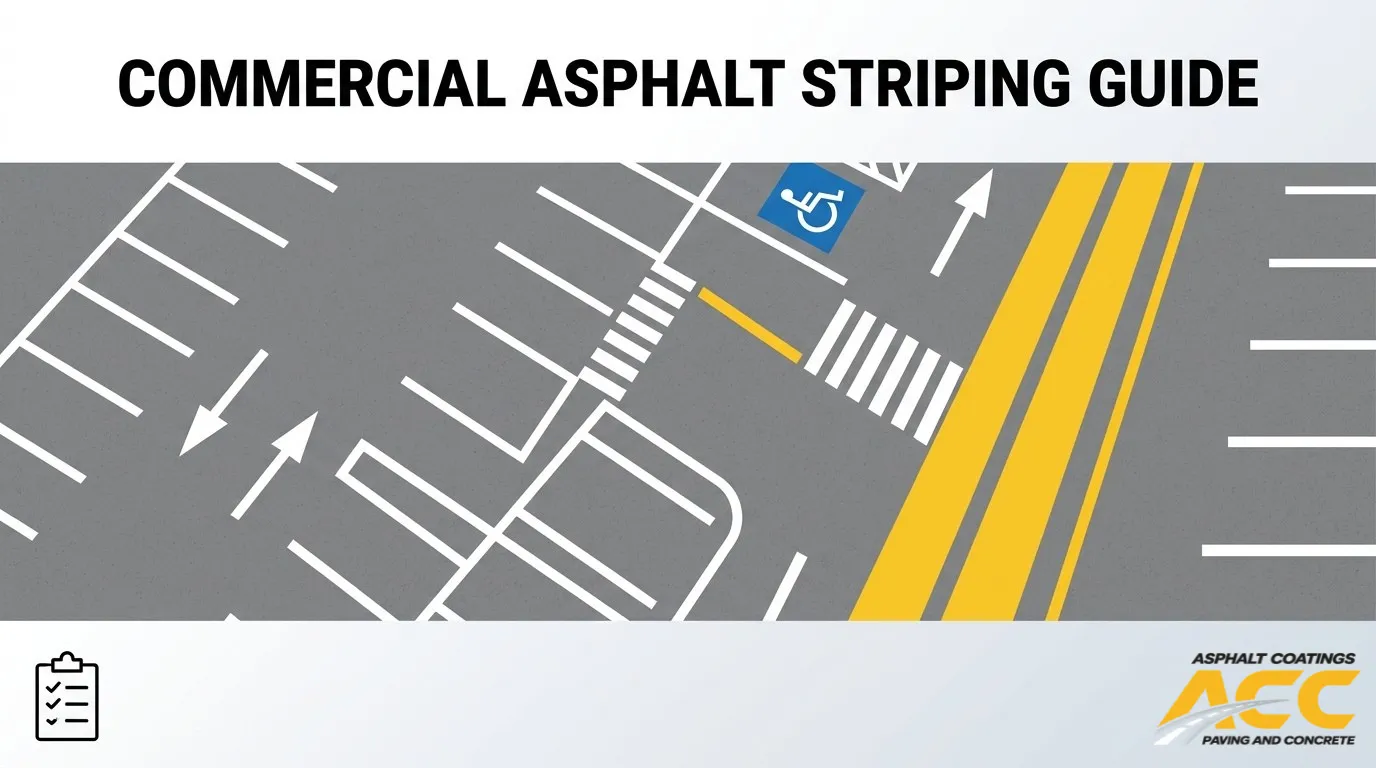
Traffic flow and pedestrian routes should be marked using directional arrows, lane lines, crosswalk striping, and stop bars painted directly on the asphalt surface. Directional arrows guide drivers through one-way aisles and turn lanes, while painted crosswalks create designated pedestrian zones at building entrances and between parking rows.
According to D.B. Krieg, Inc., parking lots should be graded to slope a minimum of 1 to 2 percent toward drains to avoid standing water, which also prevents markings from deteriorating prematurely under pooled moisture. Stop bars at intersections and yield markings near pedestrian crossings reduce conflict points between vehicles and foot traffic. For high-traffic commercial lots, contrasting paint colors and reflective materials make these markings visible during evening hours and low-light conditions.
How Can Striping Improve Wayfinding For Customers And Tenants?
Striping improves wayfinding for customers and tenants by creating a visual hierarchy that communicates parking availability, traffic direction, and zone boundaries at a glance. Color-coded curb markings distinguish fire lanes, loading zones, and no-parking areas. Numbered or lettered aisle identifiers help visitors locate their vehicles quickly in larger lots.
Consistent striping also separates visitor parking from tenant-reserved spaces, reducing confusion in multi-tenant commercial properties. When combined with directional arrows and clearly marked entry and exit points, well-planned striping shortens the time drivers spend circling for spaces. This matters most for retail centers and healthcare facilities where customer experience begins in the parking lot.
How Often Should Striping And Markings Be Reapplied For Visibility?
Striping and markings should be reapplied every 12 to 24 months in most commercial parking lots, depending on traffic volume and weather exposure. High-traffic areas near entrances, drive lanes, and crosswalks fade faster and may need annual restriping.
Colorado’s intense UV exposure and winter plowing accelerate paint degradation beyond what milder climates produce. Property managers should inspect markings each spring after snow season ends, looking for faded lines, chipped paint at stop bars, and worn crosswalk boundaries. Proactive reapplication before markings become illegible keeps the lot compliant with fire lane and ADA signage requirements while reducing liability exposure.
With safety markings in place, ADA-specific design standards ensure accessible parking meets federal requirements.
How Can Businesses Ensure ADA Compliance In Their Asphalt Parking Lots?
Businesses can ensure ADA compliance in their asphalt parking lots by meeting federal standards for accessible space dimensions, van-accessible ratios, slope tolerances, ramp placement, and signage. The following sections cover layout requirements, space counts, and design integration.
What ADA Requirements Apply To Commercial Parking Lot Layouts?
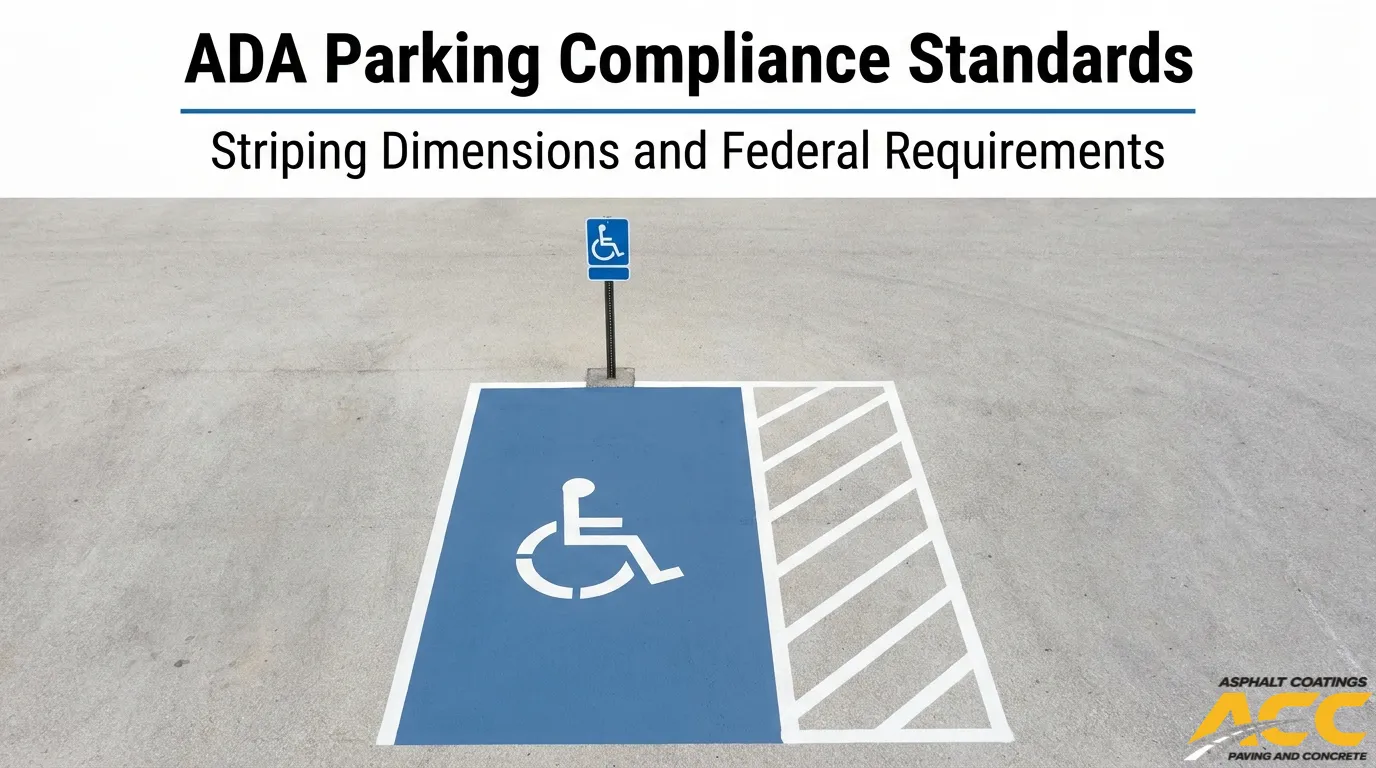
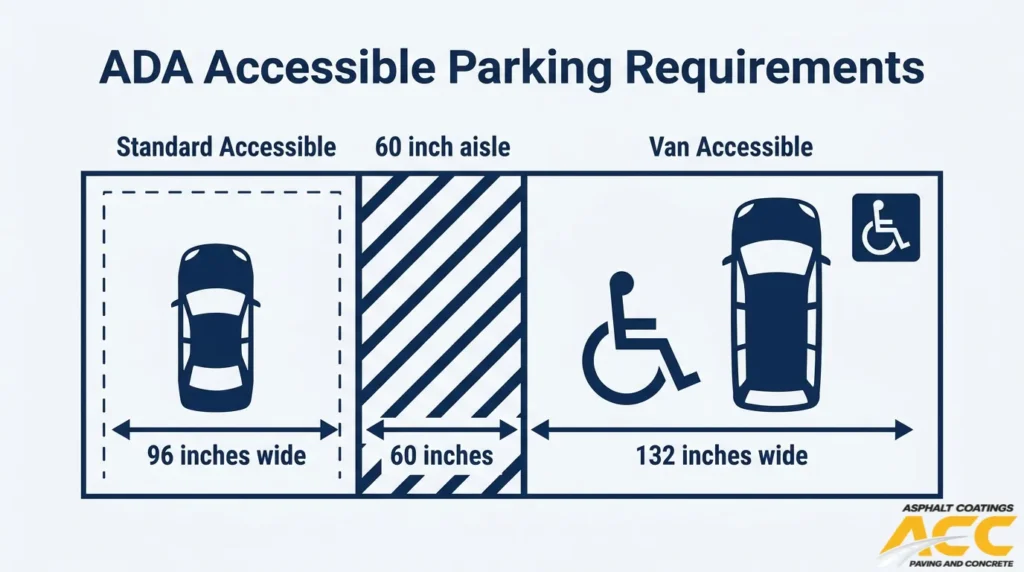
ADA requirements that apply to commercial parking lot layouts include minimum space widths, access aisle dimensions, slope limits, vertical clearance for van spaces, and proper signage placement. Every accessible space must connect to an accessible route leading to the building entrance, with surfaces kept smooth, firm, and level. Asphalt parking lots require careful grading to maintain the maximum 2.08% slope in all directions within accessible spaces. Detectable warning surfaces at curb ramps, proper striping of access aisles, and upright signage with the International Symbol of Accessibility are all mandatory elements. Non-compliance can result in federal complaints, lawsuits, and costly retrofits.
How Many Accessible And Van-Accessible Spaces Are Typically Required?
The number of accessible and van-accessible spaces typically required depends on the total parking count in the lot. According to ADA.gov, car accessible spaces must be at least 96 inches wide, have an access aisle at least 60 inches wide, and have no more than a 1:48 (2.08%) slope in all directions. Van accessible spaces must be at least 132 inches wide with a 60-inch access aisle and at least 98 inches of vertical clearance.
Key ratio and sizing requirements include:
- At least one of every six accessible spaces, or fraction of six, must be van-accessible.
- Lots with 1 to 25 total spaces need one accessible space.
- Lots with 26 to 50 total spaces need two accessible spaces.
- Accessible spaces must be located on the shortest accessible route to the building entrance.
Failing to meet these ratios is one of the most common compliance gaps in commercial lots, and it is often the first item ADA auditors flag.
How Should Ramps, Crosswalks, And Signage Be Integrated Into Design?
Ramps, crosswalks, and signage should be integrated into design during the initial site planning phase, not added as afterthoughts. Curb ramps must transition from the parking surface to sidewalks with a maximum slope of 1:12 and include detectable warning surfaces at the bottom. Crosswalks should connect accessible parking areas to building entrances using high-contrast striping visible in all lighting conditions. Signage for each accessible space requires mounting at a minimum height of 60 inches, measured to the bottom of the sign, so it remains visible when a vehicle occupies the space. Coordinating ramp locations, crosswalk paths, and signage placement with the overall lot striping plan prevents conflicts with traffic flow and drainage patterns.
With ADA design elements addressed, choosing the right contractor ensures these standards hold up over time.
How Should Property Managers Evaluate A Commercial Asphalt Contractor?
Property managers should evaluate a commercial asphalt contractor by examining climate-specific experience, credential verification, bid comparison methods, and crew structure. The following subsections cover credentials, bid analysis, and in-house versus subcontracted labor.
What Experience And Credentials Matter In Fort Collins’ Climate?
The experience and credentials that matter in Fort Collins’ climate include proven freeze-thaw expertise, proper licensing, and industry-recognized certifications. Contractors working in northern Colorado must demonstrate a track record of designing pavements that withstand severe thermal cycling, high-altitude UV exposure, and heavy snow removal operations.
Key credentials to verify include:
- DOT Prequalification, which ensures the contractor meets state-level financial and quality standards, according to Wright Construction Company.
- NAPA membership, confirming alignment with the only national trade association dedicated exclusively to asphalt pavement industry standards.
- Insurance and bonding sufficient for commercial-scale projects.
- Documented portfolio of Fort Collins or Front Range commercial projects completed across multiple winter seasons.
A contractor who has navigated Colorado’s climate for decades will specify appropriate binder grades and drainage solutions instinctively, rather than applying generic approaches that fail under local conditions.
How Can You Compare Scope, Specifications, And Warranties Between Bids?
You can compare scope, specifications, and warranties between bids by requiring each contractor to itemize materials, methods, and coverage terms in a standardized format. Vague line items make meaningful comparison impossible.
When reviewing bids, focus on these elements:
- Material specifications, including asphalt mix design, binder grade (such as PG 64-28), and aggregate source.
- Scope details covering subgrade preparation, compaction standards, drainage grading, and striping.
- Warranty terms specifying what is covered, for how long, and under which conditions coverage is voided.
- Exclusions and assumptions that could trigger costly change orders mid-project.
The lowest bid rarely reflects the best value. Bids that omit compaction testing, specify thinner lifts, or exclude crack sealing warranties often cost more over the pavement’s lifecycle. Always compare bids on a cost-per-square-foot basis with identical scope assumptions before making a decision.
Why Does Using In-House Crews Versus Subcontractors Matter?
Using in-house crews versus subcontractors matters because crew structure directly affects quality control, scheduling reliability, and accountability. When a contractor relies on subcontractors, the company managing your project may have limited oversight over the workers actually performing the installation.
In-house crews provide several advantages:
- Direct supervision ensures consistent workmanship from subgrade preparation through final compaction.
- Scheduling control reduces delays caused by subcontractor availability conflicts.
- Single-source accountability means one company owns every outcome, eliminating finger-pointing between parties.
- Crew familiarity with company standards produces more uniform results across project phases.
For property managers overseeing high-traffic commercial lots, this distinction is not minor. Subcontracted crews rotating between companies may lack familiarity with Colorado-specific installation practices, which increases the risk of premature pavement failure.
With contractor evaluation criteria established, the next step is partnering with the right team for your project.
How Should You Approach Commercial Asphalt Needs With Asphalt Coatings Company?
You should approach commercial asphalt needs with Asphalt Coatings Company by treating the relationship as a long-term partnership built on Colorado-specific expertise. The sections below cover how paving and sealcoating services support Fort Collins businesses and the key takeaways to remember.
How Can Asphalt Coatings Company’s Paving And Sealcoating Services Help Fort Collins Businesses?
Asphalt Coatings Company’s paving and sealcoating services help Fort Collins businesses by delivering full-scope commercial asphalt solutions with in-house crews. Since 1986, Asphalt Coatings Company has specialized exclusively in commercial projects across Colorado’s Front Range, including asphalt paving, sealcoating, crack sealing, mill and overlay services, parking lot striping, and ADA-compliant concrete work.
This single-source approach eliminates the coordination headaches that come with managing multiple subcontractors. Asphalt Coatings Company handles everything from subgrade preparation and grading through final striping, keeping timelines tight and accountability clear. For property managers and facility owners navigating Fort Collins’ freeze-thaw cycles and high-altitude UV exposure, that regional experience translates directly into longer-lasting pavements and fewer surprise repairs.
What Are The Key Takeaways About Commercial Asphalt In Fort Collins That Businesses Should Remember?
The key takeaways about commercial asphalt in Fort Collins that businesses should remember center on compliance, climate preparedness, and proactive maintenance:
- The City of Fort Collins requires all parking, loading, maneuvering, and driving areas to be paved with asphalt, concrete, or a similar permanent material approved by the City, according to a summary of Fort Collins regulations published by the City of Loveland.
- Freeze-thaw cycles and elevated UV radiation make preventive maintenance, including sealcoating and crack sealing, essential rather than optional.
- ADA-compliant design must be integrated from the start, not retrofitted after construction.
- Choosing a contractor with DOT prequalification and in-house crews reduces risk and improves quality control.
- Long-term maintenance planning consistently lowers lifecycle costs compared to reactive, emergency-driven repairs.
Asphalt Coatings Company partners with Fort Collins businesses to address each of these priorities, combining 39 years of Colorado-specific expertise with a commitment to craftsmanship and transparent project guidance.