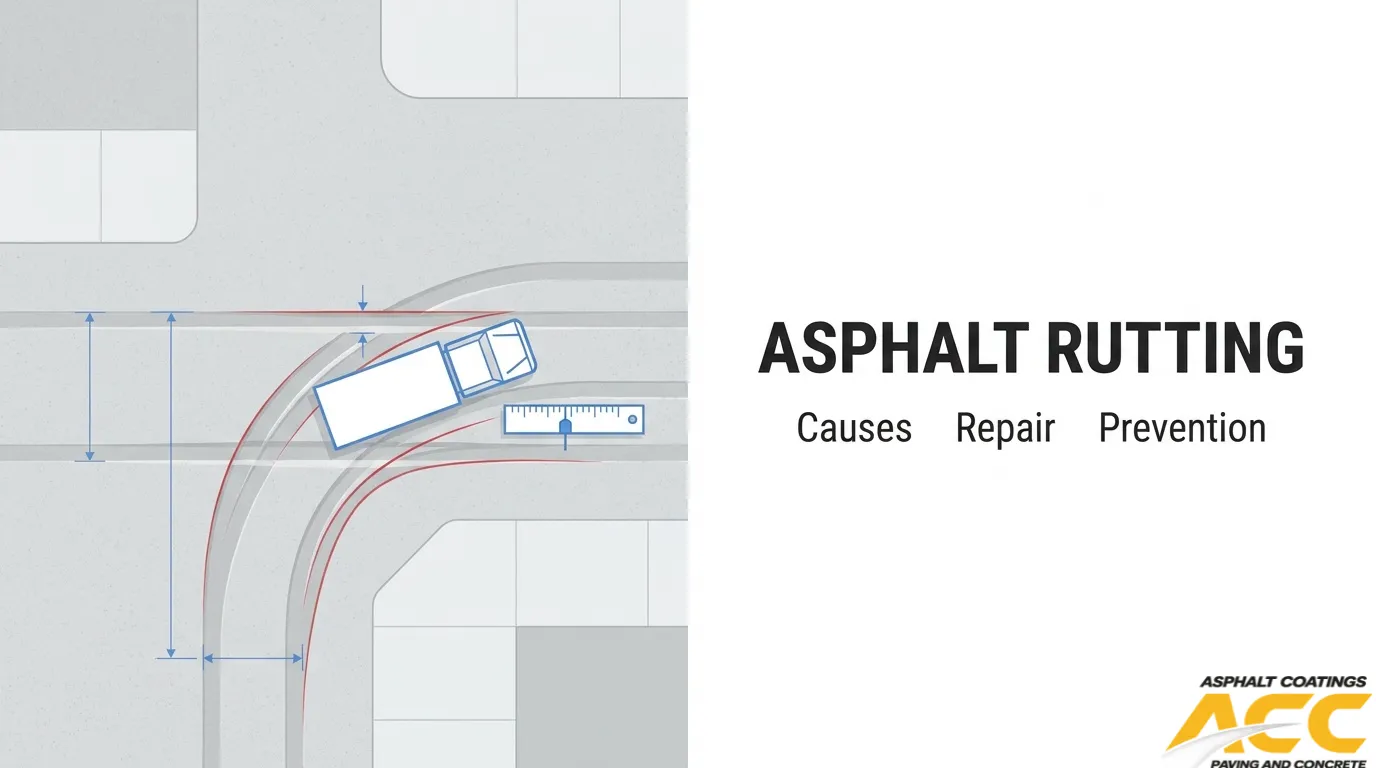
Asphalt rutting is permanent channel-like deformation that forms along wheel paths where heavy vehicles repeatedly load the pavement in truck and delivery lots. It ranges from shallow surface wear to deep structural failure, and the distinction between the two determines whether a simple overlay or full reconstruction is required.
This guide covers the causes of rutting in heavy-load environments, diagnostic methods for identifying severity and root cause, repair options from patching through mill-and-pave, climate and design considerations for long-term prevention, and operational planning for active commercial facilities.
Heavy axle loads, turning movements, poor mix design, weak subgrades, and drainage failures each contribute to rutting through different mechanisms. Slow-speed truck traffic at docks and turning areas generates lateral shear forces that knead asphalt, while moisture infiltration softens base layers and accelerates deformation beneath the surface.
Diagnosing rutting requires measuring rut depth with a straightedge, classifying severity from low (¼ to ½ inch) through high (greater than 1 inch), and using core samples or trench cuts to confirm which pavement layer has failed. Whether upheaval appears alongside wheel-path depressions separates surface-layer flow from deeper structural failure.
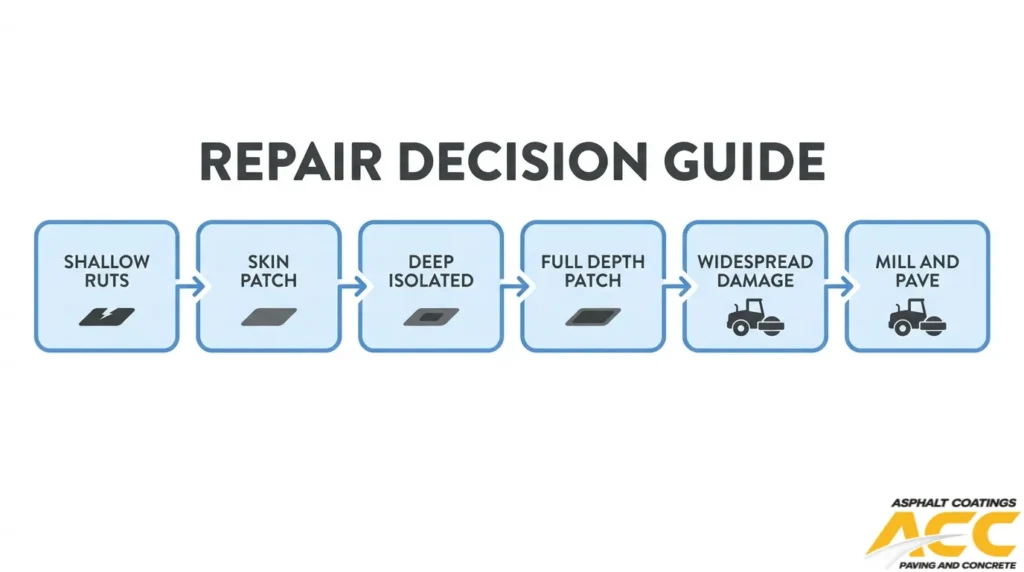
Repair selection ranges from skin patches and leveling courses for shallow, isolated damage to full-depth patching, structural overlays, and complete mill-and-pave for widespread or deep deformation. Lots that have accumulated patches over 25 to 30 percent of their surface typically get better per-year value from milling and repaving.
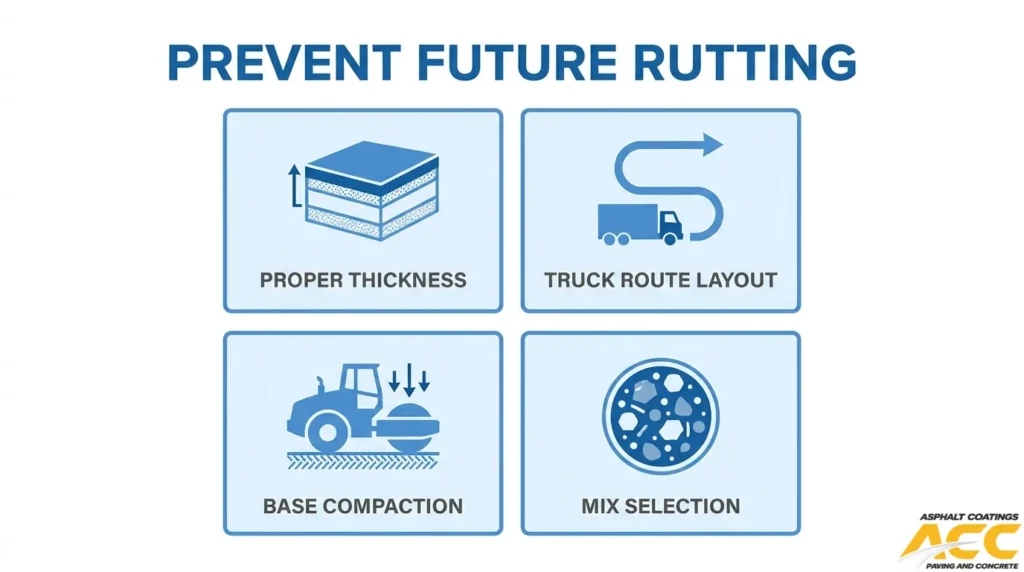
Colorado’s freeze-thaw cycles, elevation-driven temperature swings, and intense solar radiation demand polymer-modified binders, tighter compaction targets, and seasonal scheduling that aligns with CDOT placement temperature requirements. Proper pavement thickness design, truck route geometry, base compaction, and ongoing drainage maintenance prevent recurrence after repairs are complete.
Phasing work around active delivery operations, maintaining ADA-compliant access during construction, and coordinating schedules with tenants at least three weeks in advance keep facilities functional throughout the repair process.
What Is Asphalt Rutting in Heavy Truck and Delivery Lots?
Asphalt rutting in heavy truck and delivery lots is permanent surface deformation that forms channel-like depressions along wheel paths where heavy vehicles repeatedly load the pavement. These depressions develop when asphalt layers, base materials, or subgrade soils consolidate or shift laterally under sustained heavy axle loads. Rutting severity in commercial lots ranges from shallow surface wear to deep structural failure, and the distinction determines whether a simple overlay or full mill-and-pave is required. According to the U.S. Army Engineer Research and Development Center’s PAVER distress manual, rutting stems from permanent deformation in any pavement layer or subgrade, usually caused by consolidated or lateral movement of materials due to traffic load, with severity classified as low (¼ to ½ inch mean rut depth), medium (½ to 1 inch), or high (greater than 1 inch).
For property managers overseeing distribution centers, loading docks, and high-volume delivery areas, even low-severity rutting signals that the pavement structure is yielding under repeated stress. Left unaddressed, shallow ruts trap water, accelerate further deterioration, and create safety hazards for both truck operators and pedestrians. Understanding where the deformation originates, whether in the hot mix asphalt surface, the aggregate base, or the subgrade, is the first step toward selecting the right repair strategy and preventing costly recurrence.
What Are the Main Causes of Asphalt Rutting in Truck and Delivery Areas?
The main causes of asphalt rutting in truck and delivery areas include heavy axle loads, poor mix design, weak subgrade and base layers, drainage failures, temperature extremes, and inadequate construction or maintenance practices. Each cause is detailed below.
How Do Heavy Truck Loads and Turning Movements Cause Rutting?
Heavy truck loads and turning movements cause rutting by concentrating extreme axle forces on narrow pavement contact areas. According to Pavement Interactive, one Equivalent Single Axle Load (ESAL) is defined as a single axle with a downward force of 18,000 lbs, and heavier loads cause exponentially greater damage relative to this baseline.
Delivery zones and dock aprons absorb repeated loading in fixed positions, which compounds deformation over time. Turning movements intensify the problem further. Slow-speed turns generate lateral shear forces that knead the asphalt surface, pushing material outward. The City of Boulder’s Design and Construction Standards address this by requiring mountable truck aprons where large vehicles turn infrequently, providing a larger effective radius to distribute turning stresses. For any truck lot, ignoring turning geometry during design is one of the fastest paths to premature rutting.
How Does Asphalt Mix Design and Compaction Influence Rutting?
Asphalt mix design and compaction influence rutting by determining how well the pavement resists deformation under repeated heavy loads. Mixes with inadequate aggregate interlock, improper binder grade, or poor volumetric proportions deform more readily at high temperatures and slow loading rates common in delivery zones.
Compaction quality is equally critical. Research from the National Center for Asphalt Technology at Auburn University found that fatigue and rutting performance improved between 8.2% and 43.8% with just a 1% decrease in air voids, based on constant-stress bending beam fatigue testing and field results from WesTrack. Undercompacted asphalt retains excess air voids that allow the mix to consolidate further under traffic, creating channel-shaped ruts. Specifying the correct mix and achieving target density during installation are among the most controllable factors in preventing rutting.
How Do Subgrade and Base Failures Lead to Rutting in Truck Lanes?
Subgrade and base failures lead to rutting in truck lanes when underlying layers cannot support the loads transferred through the asphalt surface. Weak or poorly compacted subgrade soil deforms under heavy axle loads, and that deformation reflects upward as broad, shallow ruts without significant upheaval along the edges.
Aggregate base layers serve as load-distribution platforms between the surface course and subgrade. According to the Oregon Department of Transportation’s Pavement Design Guide, adequate drainage is essential for any pavement to succeed long-term, and drainage issues can impact both the subgrade and aggregate base materials. When moisture saturates these layers, their bearing capacity drops significantly. Structural rutting caused by foundation failure cannot be corrected with surface-level repairs alone; it requires addressing the compromised layers beneath.
How Do Drainage and Moisture Problems Contribute to Rutting?
Drainage and moisture problems contribute to rutting by weakening pavement layers and accelerating deformation under traffic. Rutted pavement surfaces impede surface drainage, reduce friction properties, and may contribute to hydroplaning, according to ASTM International’s standard E1703/E1703M. This creates a destructive cycle: ruts trap water, and trapped water deepens ruts.
Subsurface moisture is equally damaging. A Purdue University Joint Transportation Research Program study on flexible pavements found that pavement rutting increased whenever high moisture levels were present in the pavement system, and that edge drains had a positive effect on performance, especially in sections without a drainage layer. For truck lots where heavy loads repeatedly compress saturated materials, poor drainage transforms a manageable pavement into one that fails years ahead of its design life.
How Do Temperature Extremes and Freeze–Thaw Cycles Affect Rutting in Colorado Lots?
Temperature extremes and freeze-thaw cycles affect rutting in Colorado lots by softening asphalt in summer heat and fracturing pavement structure during winter. High surface temperatures reduce asphalt binder viscosity, making the mix more susceptible to permanent deformation under slow-moving or stationary truck loads at docks and loading areas.
Colorado’s elevation creates wide daily and seasonal temperature swings. Freeze-thaw cycles force moisture trapped in cracks and voids to expand as ice, then contract upon thawing. This repeated action loosens aggregate bonds and degrades base layer integrity over successive seasons. The cumulative effect weakens the pavement’s load-bearing capacity, making it increasingly vulnerable to rutting from truck traffic that would not damage the same surface in a more temperate climate.
How Do Construction Quality and Maintenance Practices Impact Rutting Risk?
Construction quality and maintenance practices impact rutting risk by establishing the pavement’s initial resilience and preserving it over time. Inadequate subgrade preparation, insufficient compaction passes, or paving during improper weather conditions can introduce weaknesses that surface as ruts within the first few years of service.
Deferred maintenance accelerates the problem. Key practices that reduce rutting risk include:
- Achieving target compaction density during initial installation.
- Sealcoating on a regular cycle to protect the binder from oxidation and moisture infiltration.
- Sealing cracks before water penetrates the base and subgrade layers.
- Maintaining drainage inlets and subsurface systems to prevent saturation.
Neglecting any one of these creates conditions where heavy truck traffic causes disproportionate damage. Proactive maintenance is far less costly than structural rehabilitation after rutting has progressed.
Understanding these root causes helps property managers and facility operators choose the right diagnostic and repair approach for their specific rutting conditions.
How Can You Diagnose the Severity and Root Cause of Rutting in a Commercial Lot?
You can diagnose the severity and root cause of rutting in a commercial lot through visual inspection, core sampling, pavement testing, and traffic pattern analysis. The following sections cover visual identification, laboratory evaluation, surface versus structural diagnosis, and how loading patterns reveal underlying causes.
How Can You Visually Identify Different Severities and Patterns of Rutting?
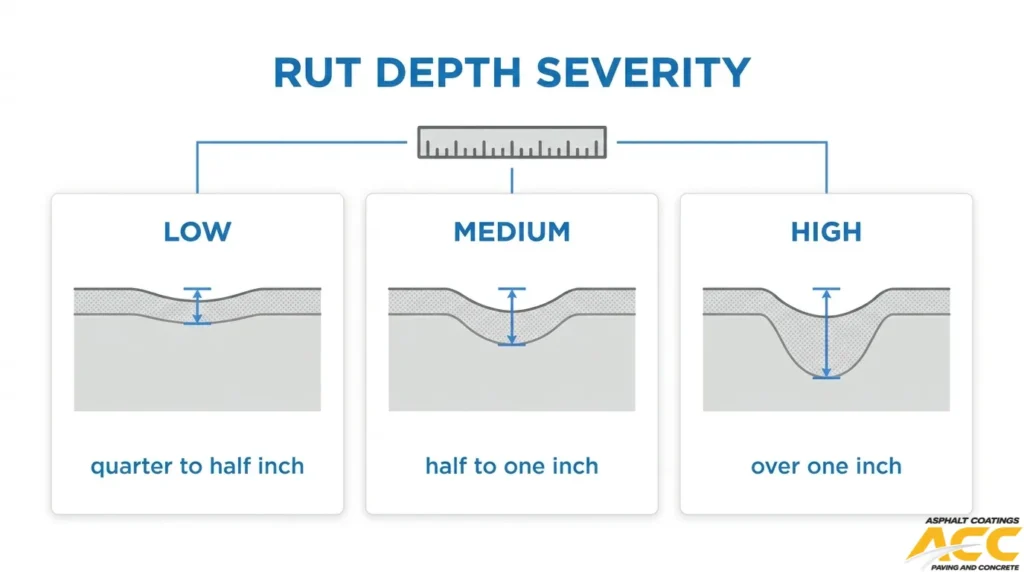
You can visually identify different severities and patterns of rutting by measuring rut depth with a straightedge and classifying the deformation. According to the Federal Highway Administration, the common method is to place a 3- to 4-ft straightedge across the wheelpath to measure maximum rut depth. The U.S. Army PAVER system classifies severity into three bands:
- Low: 1/4 to 1/2 inch mean rut depth
- Medium: greater than 1/2 to 1 inch mean rut depth
- High: greater than 1 inch mean rut depth
Beyond depth, the pattern itself matters. Rutting confined to wheelpaths with raised edges suggests surface-layer flow, while broad, shallow depressions without upheaval often point to subgrade weakness. Catching low-severity rutting early keeps repair costs manageable.
When Should You Use Core Samples or Pavement Testing to Evaluate Rutting?
You should use core samples or pavement testing to evaluate rutting when visual inspection alone cannot confirm which pavement layer has failed. According to the Georgia Department of Transportation’s Pavement Evaluation Manual, pavement depths are determined by cutting and retrieving cores of sufficient length and diameter to assess the condition of each layer and crack depths, or based on anticipated laboratory testing requirements.
Core sampling is especially valuable in truck lots where slow-moving or turning vehicles create concentrated stress. These dynamic loads impart a kneading action on the asphalt surface, accelerating permanent deformation faster than in straight-travel sections. When rut depth approaches moderate severity, cores confirm whether the mix, base, or subgrade is responsible, so the repair targets the actual problem.
How Do You Distinguish Surface Rutting From Deeper Structural Rutting?
You can distinguish surface rutting from deeper structural rutting by examining the deformation pattern and, when necessary, cutting trenches to inspect individual layers. Rutting stems from permanent deformation in any pavement layer or subgrade, usually caused by consolidation or lateral movement of materials under traffic load.
The key visual indicator comes from the Transportation Research Board’s NCHRP Report 468: when failure occurs in the HMA surface layer, wheel-path depressions are accompanied by upheaval along the sides. When failure occurs in the supporting layers, depressions appear without significant upheaval. For pavements with excessive rutting greater than 0.75 inches, the New Jersey Department of Transportation recommends trenches to determine whether the HMA or subsurface layers are responsible; however, trenches are time-consuming and expensive. Proper compaction during original construction reduces both failure modes, since research from the National Center for Asphalt Technology at Auburn University shows that fatigue performance improved between 8.2% and 43.8% with each 1% decrease in air voids.
How Do Truck Traffic Patterns and Loading Help Pinpoint the Root Cause?
Truck traffic patterns and loading help pinpoint the root cause of rutting by revealing where concentrated stress exceeds the pavement’s design capacity. Rutting that appears exclusively at dock aprons, dumpster pads, or turning areas signals that slow-speed, high-contact-time loading is overwhelming the asphalt mix. Rutting along straight travel lanes, by contrast, often points to insufficient pavement thickness or a weak subgrade that cannot support cumulative axle loads.
Mapping rut locations against daily truck routes, delivery schedules, and dwell times clarifies whether the issue is mix-related, structural, or both. Lots with frequent stop-and-go trailer traffic typically experience the most severe surface-layer flow, while lots with consistent through-traffic develop structural fatigue over broader areas. This diagnostic step directly shapes whether the repair should target the surface course, the full pavement section, or the base and subgrade beneath it.
With the root cause identified, the next step is selecting the right repair method for the type and severity of damage.
What Repair Options Are Available for Rutting in Truck and Delivery Lots?
The repair options available for rutting in truck and delivery lots include skin patching, full-depth patching, overlays, and base or subgrade reconstruction. The right choice depends on rut depth, structural condition, and traffic demands.
When Is Skin Patching or Leveling Course an Appropriate Rutting Repair?
Skin patching or a leveling course is an appropriate rutting repair when deformation is confined to the surface layer and the underlying base remains structurally sound. This method involves placing new hot mix asphalt over the distressed area to restore grade and smoothness without removing existing material.
According to the California Department of Transportation’s Maintenance Technical Advisory Guide, patching places new material to cover the distressed area, while highly distressed sections require full removal and replacement. A thin leveling course works best for low-severity ruts, typically under half an inch, where the pavement structure below is intact. For moderately deteriorated surfaces, the Michigan PASER guidance recommends patching and repair prior to a major overlay to extend overall pavement life.
Skin patches are a cost-effective interim solution, but they should not be mistaken for a long-term structural fix in heavy truck areas.
When Should You Use Full-Depth Patching to Fix Localized Rutting?
You should use full-depth patching to fix localized rutting when the deformation extends through the entire asphalt layer or when the existing material has deteriorated beyond surface-level repair. Full-depth patching removes the compromised asphalt down to the base, then replaces it with new compacted hot mix.
According to a 2014 Pavement Management Study for the City of Cañon City, full-depth asphalt patching carries a unit cost of approximately $7.50 per square foot and delivers a service life of three to five years. That relatively short lifespan makes full-depth patching best suited as preparation for a future overlay or mill-and-pave project rather than a standalone permanent fix.
For truck and delivery lots with isolated rutted areas surrounded by otherwise sound pavement, full-depth patching targets the problem zones without disrupting the entire surface.
When Is Overlaying an Option for Rutting in Truck and Loading Zones?
Overlaying is an option for rutting in truck and loading zones when the existing pavement structure is still sound but the surface has reached the end of its functional life. An overlay places a new layer of hot mix asphalt, typically greater than two inches for structural benefit, directly over the existing surface.
Before overlaying, any localized failures should be patched, and milling the existing surface improves bond and extends overlay life. Property managers should also be aware that overlay projects in loading zones can trigger ADA path-of-travel requirements. According to the U.S. Access Board, the accessible path of travel must extend from the altered primary function area to site arrival points, including parking and passenger loading zones.
In leased facilities, tenant-only alterations do not obligate the landlord for unaltered common areas. Planning for these accessibility requirements early prevents costly change orders during construction.
How Do You Address Rutting Caused by Base or Subgrade Failure?
You address rutting caused by base or subgrade failure by removing the failed pavement section entirely and reconstructing the foundation layers before repaving. Surface-only repairs will not hold when the problem originates beneath the asphalt.
The process typically involves:
- Sawcutting and removing the full pavement section in the affected area.
- Excavating and replacing compromised base or subgrade material.
- Compacting the new subgrade to specified density standards.
- Rebuilding the aggregate base layer to proper thickness.
- Paving new hot mix asphalt in lifts to achieve the design section.
Core samples or test trenches are essential for confirming whether the base or subgrade has failed before committing to this level of reconstruction. Skipping this diagnostic step risks selecting a cheaper surface repair that fails within months under heavy truck traffic.
Understanding available repair options sets the stage for deciding when full mill-and-pave becomes the better investment.
When Should You Mill and Pave Instead of Spot-Repairing Rutting?
You should mill and pave instead of spot-repairing rutting when rut depths exceed moderate severity, structural damage is widespread, or repeated patches have failed to hold. The following subsections cover severity thresholds, structural indicators, lot history, and budget considerations.
When Does Rutting Severity Indicate It Is Time to Mill and Pave?
Rutting severity indicates it is time to mill and pave when mean rut depth reaches moderate-to-high levels across a significant portion of the lot. According to the U.S. Army Engineer Research and Development Center’s PAVER distress manual, severity is classified as follows:
- Low: 1/4 to 1/2 inch (6 to 13 mm) mean rut depth.
- Moderate: greater than 1/2 to 1 inch (13 to 25 mm).
- High: greater than 1 inch (25 mm).
Spot repairs remain cost-effective at low severity, where deformation is shallow and isolated. Once ruts reach moderate severity across multiple wheel paths, localized patches cannot restore proper drainage or ride quality. High-severity rutting almost always demands milling and overlay because the permanent deformation has progressed too far for surface-level corrections to last. Moisture trapped in ruts accelerates this progression; research from Purdue University’s Joint Transportation Research Program confirmed that pavement rutting increases whenever high moisture levels are present in the pavement system. For property managers weighing costs, a preservative seal on good pavement costs roughly $1 per square yard and extends life about 5 years, while milling and overlaying deteriorated pavement costs $10 to $15 per square yard for an 8 to 12 year life extension.
How Do Rut Depth and Structural Damage Influence a Mill-and-Overlay Decision?
Rut depth and structural damage influence a mill-and-overlay decision by determining whether the problem is confined to the surface layer or extends into the base and subgrade. Surface-only rutting, identifiable by upheaval along the sides of wheel paths, can sometimes be addressed with a leveling course or partial-depth removal. When rut depressions appear without side upheaval, the failure likely originates in deeper structural layers, and spot repairs will not resolve the root cause.
Milling depth is dictated by existing pavement conditions. The National Asphalt Pavement Association classifies milling as full or partial depth depending on how much material must be removed. If core samples or trench cuts reveal that deformation has penetrated the HMA layer into the base, a full-depth mill-and-pave, sometimes combined with base repair, becomes the only viable long-term solution. Ignoring structural rutting and patching over it typically results in recurring failure within one to two seasons under heavy truck loading.
How Do Lot Age and Previous Repairs Affect the Choice to Mill and Pave?
Lot age and previous repairs affect the choice to mill and pave by signaling when cumulative deterioration has outpaced the effectiveness of localized fixes. An aging pavement that has already received multiple patches creates an uneven surface profile, inconsistent material bonds, and disrupted drainage patterns. Each added patch introduces a new seam vulnerable to water infiltration and differential settlement under heavy axle loads.
According to the Washington State Department of Transportation’s Maintenance Manual, the two principal methods of repairing HMA pavements are remove-and-replace (grind and inlay), categorized as partial-depth and full-depth repairs. When a truck lot has accumulated several partial-depth patches over its service life, milling the entire affected area and placing a uniform overlay produces a structurally consistent surface. As a practical rule, if more than 25 to 30 percent of a lot section has been patched, milling and paving typically delivers better per-year value than continuing to add isolated repairs.
How Do Budget, Downtime, and Phasing Considerations Shape the Repair Strategy?
Budget, downtime, and phasing considerations shape the repair strategy by forcing property managers to balance upfront cost against long-term performance and operational disruption. Spot repairs cost less per event but accumulate quickly when rutting is widespread, often surpassing the total cost of a single mill-and-overlay within a few maintenance cycles. Milling and paving carries a higher one-time expense but resets the pavement’s service life for 8 to 12 years.
Key factors to evaluate include:
- Annual repair frequency: lots needing patches every 1 to 2 years are better candidates for a one-time mill-and-pave.
- Operational downtime tolerance: active delivery and logistics facilities may require phased milling across multiple weekends or overnight shifts.
- Capital budget cycles: aligning mill-and-pave projects with annual capital planning avoids emergency spending on repeated spot fixes.
Phased milling allows sections of a truck lot to remain operational while adjacent areas are repaired, minimizing revenue loss. Understanding the balance between repair timing and pavement condition determines whether each dollar spent extends service life or simply delays the inevitable.
How Does Climate and High-Altitude Weather Change Rutting and Repair Decisions?
Climate and high-altitude weather change rutting and repair decisions by intensifying pavement damage through freeze–thaw cycling, UV exposure, and shortened paving seasons. The sections below cover freeze–thaw acceleration of rutting, mix adjustments for altitude, and seasonal repair planning.
How Do Colorado Freeze–Thaw Cycles Accelerate Rutting in Truck Lanes?
Colorado freeze–thaw cycles accelerate rutting in truck lanes by repeatedly expanding and weakening the asphalt binder and base materials beneath heavy wheel paths. Water infiltrates small surface cracks during warmer periods, then freezes and expands, progressively loosening aggregate bonds and reducing load-bearing capacity. When heavy trucks roll over these weakened zones, the softened pavement deforms faster than it would in a more stable climate.
According to the 2015 Colorado Climate Change Vulnerability Study by the University of Colorado Boulder and Colorado State University, differences in elevation produce a wide range of precipitation and temperature patterns across the state. This variability means a truck lot in Denver may experience dozens more freeze–thaw transitions per winter than one at lower elevation elsewhere, compounding cumulative pavement damage in concentrated wheel paths.

How Should Asphalt Mixes for Truck Lots Be Adjusted for High-Altitude Conditions?
Asphalt mixes for truck lots should be adjusted for high-altitude conditions by selecting performance-graded binders rated for wider temperature swings and specifying polymer-modified formulations that resist both thermal cracking and high-temperature flow. Colorado’s intense solar radiation is a key factor; according to the Federal Highway Administration’s Towards Sustainable Pavement Systems report, new asphalt concrete absorbs roughly 95 percent of incident solar radiation, driving surface temperatures well above ambient air temperature.
Key mix adjustments for high-altitude truck lots include:
- Choosing a PG binder with a low-temperature grade that matches the site’s coldest expected pavement temperature.
- Specifying polymer modification to improve elastic recovery under repeated truck loads.
- Targeting lower in-place air voids through tighter compaction to reduce moisture infiltration.
- Using angular, durable aggregates that maintain interlock under thermal cycling and heavy axle loads.
How Should Repair Timing and Season Be Planned in a Freeze–Thaw Climate?
Repair timing and season in a freeze–thaw climate should be planned around the narrow window when surface and air temperatures consistently support proper compaction. Colorado’s 2025 CDOT Standard Specifications (Section 401.07) require that hot mix asphalt be placed only on unfrozen surfaces free of water, snow, and ice, with both air and surface temperatures meeting minimum thresholds.
Practical scheduling considerations include:
- Targeting late spring through early fall for mill-and-pave or overlay work, when overnight temperatures remain above freezing.
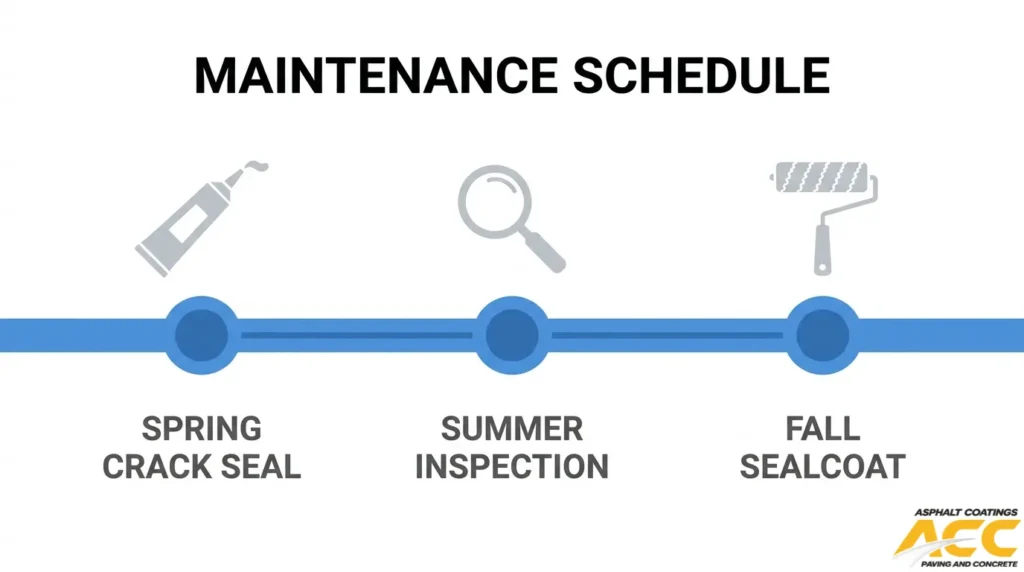
- Completing crack sealing in spring or fall, when moderate temperatures allow sealant to bond without overheating or premature cooling.
- Addressing emergency patches promptly before winter to prevent water infiltration that freeze–thaw cycles would rapidly worsen.
For most Colorado truck lots, delaying non-emergency repairs into the optimal seasonal window produces a longer-lasting result than rushing placement during marginal conditions.Colorado contractors with extensive Front Range experience understand these seasonal timing requirements and can help property managers schedule repairs during optimal weather windows. Asphalt Coatings Company’s 39 years of Colorado experience includes working within these climate constraints across hundreds of commercial projects. With climate-driven timing established, the next step is designing pavement structures and construction practices that resist rutting from the start.
How Can Design and Construction Reduce Future Rutting in Truck and Delivery Areas?
Design and construction reduce future rutting in truck and delivery areas by engineering the pavement structure, site layout, base preparation, and mix selection to handle concentrated heavy loads. The following sections cover pavement thickness, truck route geometry, compaction standards, and binder selection.
How Should Pavement Thickness Be Designed for Heavy Truck and Delivery Traffic?
Pavement thickness for heavy truck and delivery traffic should be designed using predicted axle load counts and subgrade strength data collected over the pavement’s expected service life. According to the University of Wisconsin–Madison Transportation Information Center, pavement thickness is a major factor in load capacity, and pavements are designed using the predicted number and weight of axle loads over the expected life.
Subgrade characterization matters even more in flexible (asphalt) designs than in rigid (concrete) designs because thickness requirements are highly dependent on subgrade strength. Underestimating that strength leads to premature failure; overestimating it wastes material. For truck-heavy delivery lots, this means soil testing before design is non-negotiable, not optional.
How Should Truck Routes, Loading Zones, and Turning Radii Be Laid Out to Limit Rutting?
Truck routes, loading zones, and turning radii should be laid out to distribute load stress and minimize repetitive low-speed tire contact on the same pavement areas. Concentrated turning movements generate a dynamic kneading action on asphalt, accelerating permanent deformation far faster than straight-line traffic.
Key layout strategies include:
- Separate truck circulation routes from passenger vehicle lanes to isolate heavy loads.
- Position loading docks so trucks approach and depart in forward motion, reducing tight turns.
- Design turning radii using mountable truck aprons where space is limited, providing smaller effective radii for standard vehicles and larger radii for heavy trucks.
- Widen truck lanes at intersections to spread tire contact across more pavement surfaces.
How Do Base Preparation and Compaction Standards Help Prevent Rutting?
Base preparation and compaction standards help prevent rutting by creating a stable foundation that resists deformation under repeated heavy loads. Poorly compacted subgrade or base layers allow consolidation and lateral movement of material, which produces structural ruts that surface treatments cannot fix.
Proper preparation requires scarifying the subgrade, adjusting moisture content, and compacting to at least 95% of Proctor density. Research from the National Center for Asphalt Technology at Auburn University found that fatigue and rutting performance improved between 8.2% and 43.8% with just a 1% decrease in air voids, depending on mix type. Compaction during construction is one of the most cost-effective ways to extend pavement life in truck areas.
How Can Mix Selection and Performance Graded Binders Reduce Rutting Risk?
Mix selection and performance graded (PG) binders reduce rutting risk by matching the asphalt’s stiffness and deformation resistance to site-specific temperature and loading conditions. PG binders are graded by the high and low temperatures they can withstand, so specifying the correct grade prevents softening under summer heat and slow-moving truck traffic.
Stone matrix asphalt (SMA) is particularly effective for heavy-load areas. SMA fills voids in the coarse aggregate skeleton with fibers, mineral filler, and a minimum 6% polymer-modified asphalt binder, producing a mix that resists both cracking and rutting simultaneously. For delivery lots with frequent stop-and-go traffic, polymer-modified mixes consistently outperform conventional dense-graded designs. Asphalt Coatings Company specifies polymer-modified asphalt and stone matrix asphalt formulations for Colorado commercial truck lots, combining material science with proper installation techniques to extend pavement life in heavy-load environments.
With the right structural design in place, ongoing maintenance keeps these protections performing over time.
How Should Ongoing Maintenance Be Managed to Minimize Rutting Over Time?
Ongoing maintenance should be managed through scheduled sealcoating, crack sealing, routine inspections, and drainage upkeep. The sections below cover how each practice protects truck and delivery lot pavements from progressive rutting.
How Do Sealcoating and Crack Sealing Help Support Rut-Resistant Pavements?
Sealcoating and crack sealing help support rut-resistant pavements by waterproofing the asphalt surface and preventing moisture infiltration that weakens underlying layers. A seal coat is a thin asphalt surface treatment used to waterproof and improve the texture of a wearing surface, as defined by the Iowa Department of Transportation’s HMA Paving Field Inspection Manual. Crack sealing fills open joints before water can reach the base and subgrade, where it softens materials and accelerates deformation under heavy loads. According to a 2013 North Dakota State University survey for NDDOT, the preferred time for crack maintenance is spring and fall, when moderate temperatures allow sealant to bond properly. Scheduling both treatments on a regular cycle keeps the surface intact so truck traffic compacts against a sealed, structurally sound layer rather than a compromised one.
How Does Routine Inspection of Truck and Delivery Lanes Catch Rutting Early?
Routine inspection of truck and delivery lanes catches rutting early by identifying shallow depressions before they deepen into costly structural failures. Walking the lot quarterly, particularly along turning radii and loading dock approaches where repeated axle loads concentrate, reveals surface changes that are invisible from a vehicle. Measuring with a straightedge confirms whether depressions remain in the low-severity range or have progressed. Early detection allows property managers to address ruts with lower-cost treatments, such as leveling courses or targeted patching, instead of full mill-and-pave projects. Lots that skip regular walkthroughs often discover rutting only after it exceeds half an inch, at which point repair options become significantly more expensive and disruptive. Commercial property managers working with full-service asphalt contractors can often coordinate routine inspections with scheduled sealcoating or crack sealing visits, catching early-stage distress before it requires major repair. Asphalt Coatings Company offers integrated maintenance programs that include inspection, preventive treatment, and repair planning for Colorado commercial properties.
How Should Drainage Maintenance Be Handled to Prevent Moisture-Related Rutting?
Drainage maintenance should be handled through regular clearing of catch basins, inlet grates, and edge drains to prevent water from saturating the pavement structure. According to NCHRP Synthesis 239, as cited by the New York State Department of Transportation, drained and maintained pavements last up to twice as long as undrained pavements. Clogged drains trap water beneath the surface, which softens the aggregate base and subgrade, creating the conditions that allow truck loads to push pavement into permanent ruts. Seasonal inspections before spring snowmelt and fall storms are the most critical windows for clearing debris. Proactive drainage upkeep is one of the most cost-effective ways to protect a truck lot, because it addresses the root moisture condition that accelerates nearly every form of pavement distress.
With drainage strategies in place, planning repairs around active operations keeps truck lots functional during maintenance.
How Should You Plan Rutting Repairs for Active Truck, Delivery, and Logistics Operations?
You should plan rutting repairs for active truck, delivery, and logistics operations by phasing work in sections, maintaining ADA-compliant access throughout construction, and coordinating schedules with all affected tenants and vendors well in advance.
How Can You Phase Rutting Repairs to Keep Truck and Delivery Traffic Moving?
You can phase rutting repairs to keep truck and delivery traffic moving by dividing the lot into work zones and completing one section at a time while rerouting vehicles through unaffected areas. According to a 2020 Virginia Tech Facilities transportation and parking project review checklist, all vehicle and transit disruptions require at least three weeks’ advance notice, including submission of a detailed plan and a traffic disruption request.
Effective phasing for commercial lots typically involves:
- Identifying primary truck routes and dock areas that must remain open during peak delivery windows.
- Scheduling heavy milling and paving work during off-peak hours or overnight shifts.
- Establishing clearly marked temporary traffic patterns with signage and barriers for each phase.
- Coordinating with the paving contractor to stage materials and equipment outside active travel lanes.
For most distribution and logistics facilities, splitting repairs into two or three phases prevents full shutdowns while still allowing proper compaction and cure times between lifts.
How Do Safety and ADA Access Requirements Affect Repair Planning?
Safety and ADA access requirements affect repair planning by mandating that accessible features remain operational even during construction. The U.S. Department of Justice’s ADA Guide for Small Towns states that entities must maintain in operable working condition features necessary to provide access, including curb ramps at intersections, accessible parking spaces, ramps to building entrances, and accessible toilet facilities. Isolated or temporary interruptions in access are permitted only for active maintenance or repairs.
This means repair phasing must account for:
- Providing temporary accessible parking spaces if permanent ones fall within the work zone.
- Maintaining or creating alternate accessible paths of travel to building entrances throughout each phase.
- Installing compliant temporary ramps and detectable warning surfaces where permanent curb ramps are removed.
Overlooking these requirements during a seemingly straightforward paving project is one of the most common planning failures in commercial lot repairs, and it can expose property managers to both liability and costly rework.
How Should You Communicate and Coordinate Repair Schedules With Tenants and Vendors?
You should communicate and coordinate repair schedules with tenants and vendors by issuing written notices at least three weeks before work begins, then maintaining regular updates as phases progress. Early notification gives delivery carriers, freight brokers, and on-site tenants time to adjust routes, reschedule shipments, or arrange temporary staging areas.
Key coordination steps include:
- Distributing a phasing map that shows which zones close on which dates and where alternate access points are located.
- Holding a pre-construction meeting with all major tenants and high-volume delivery vendors to address scheduling conflicts.
- Assigning a single point of contact on the property management side who can relay real-time changes from the paving crew.
- Sending daily or phase-by-phase email updates with revised traffic flow diagrams as work advances.
Clear, proactive communication is the difference between a repair project that tenants tolerate and one that generates complaints and lease disputes. With coordination protocols established, the next step is selecting a contractor experienced in managing active commercial lot repairs.
How Should You Approach Rutting Problems in Truck and Delivery Lots With a Colorado Asphalt Contractor?
You should approach rutting problems by partnering with a Colorado asphalt contractor who offers integrated paving, sealcoating, and crack sealing services tailored to heavy-load commercial environments. The following sections explain how Asphalt Coatings Company addresses rutting and summarize the key takeaways from this guide.
How Can Commercial Paving, Sealcoating, and Crack Sealing Services From Asphalt Coatings Company Help Address Rutting?
Commercial paving, sealcoating, and crack sealing services help address rutting by combining structural repair with preventive surface protection across every stage of pavement life. Asphalt Coatings Company provides these integrated services specifically for Colorado commercial properties. Asphalt Coatings Company provides mill and pave services that remove deformed surface layers and replace them with properly engineered hot mix asphalt, restoring grade and load-bearing capacity in truck lanes, loading docks, and delivery aprons.
Sealcoating waterproofs the wearing surface and slows oxidation, while crack sealing prevents moisture from reaching the base and subgrade where it accelerates deformation. For lots subjected to repetitive heavy axle loads, specifying polymer modified asphalt mixes is critical. According to the Texas Department of Transportation’s Bituminous Material Selection Guide, stone matrix asphalt fills the coarse aggregate skeleton with fibers, mineral filler, and a minimum 6% polymer modified binder, producing a mixture that resists both cracking and rutting simultaneously.
Experienced Colorado asphalt contractors use in-house crews to manage subgrade preparation, paving, and ongoing maintenance as a single source, eliminating coordination gaps that often lead to premature pavement failure.
What Are the Key Takeaways About Asphalt Rutting in Truck and Delivery Lots: Causes, Repair and When to Mill and Pave We Covered?
The key takeaways about asphalt rutting in truck and delivery lots are practical decisions that connect root-cause diagnosis to the right repair strategy:
- Rutting stems from heavy axle loads, weak subgrades, poor drainage, inadequate mix design, or a combination of these factors acting together.
- Standing water weakens pavement surfaces and, when combined with traffic, causes potholes, cracking, and rutting; proper drainage maintenance is non-negotiable.
- A 3 to 4-foot straightedge placed across the wheelpath remains the standard field method for measuring rut depth and determining severity.
- Spot repairs such as patching and leveling courses suit shallow, localized damage, while widespread or deep rutting calls for milling and overlay.
- Minor rehabilitations are typically designed for twelve-year ESAL projections and consist of milling, repair, and overlay combined.
- Hot mix asphalt must be placed on unfrozen, dry surfaces at specified minimum temperatures, making seasonal timing essential in Colorado.
For property managers overseeing truck and delivery lots, the most valuable step is an accurate diagnosis before committing to any repair scope. Asphalt Coatings Company can evaluate your lot’s condition, recommend the right combination of services, and phase the work to keep operations running.