The best time of year to pave commercial lots in the Denver Metro is late spring through early fall, with June and July delivering peak conditions for compaction, curing, and long-term durability. Denver’s semi-arid climate at 5,280 feet elevation, more than 150 annual freeze-thaw cycles, and UV intensity 25% higher than sea level create a narrow seasonal window that demands precise scheduling.
This guide covers Denver’s climate constraints and optimal paving months, property-specific timing strategies, weather and site readiness requirements, project planning and contractor selection, seasonal effects on asphalt longevity, and post-paving maintenance scheduling.
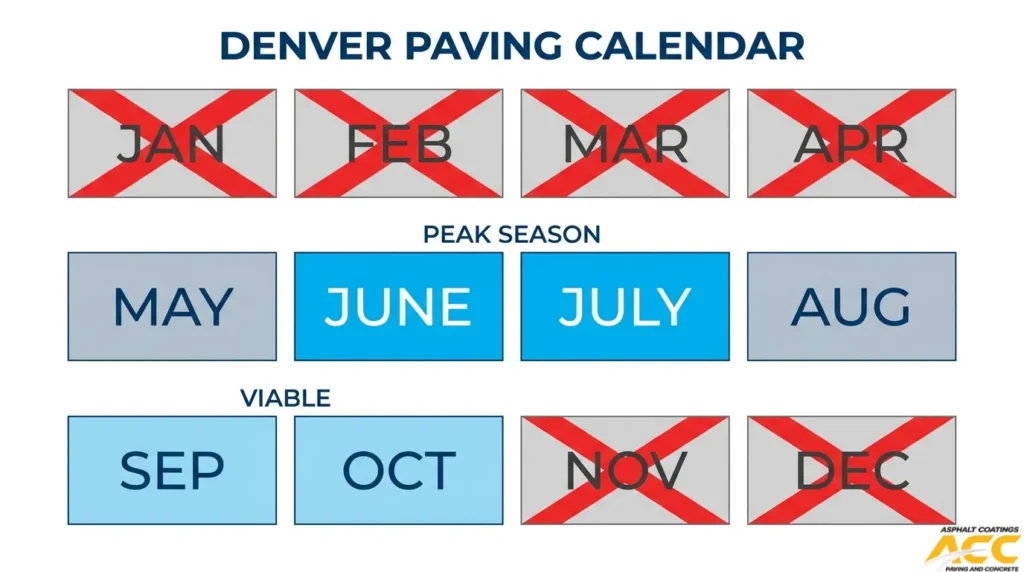
Denver’s freeze-thaw cycles compress reliable paving into warmer months because water infiltrating uncured asphalt freezes, expands, and progressively widens cracks into structural failures. Most snowfall lands between October and April, leaving May through September as the consistent dry window for subbase preparation and asphalt installation.
Optimal months vary by project type. June and July offer the fastest curing (5 to 7 days for initial set, 30 days for full cure), but contractor availability tightens sharply during peak season, requiring bookings two to three months in advance. Late spring starts leave buffer time for weather delays, while early fall remains viable if projects finish by mid-October.
Different commercial properties require tailored scheduling. Retail plazas benefit from off-peak phased closures during spring or fall. Healthcare campuses need phased plans preserving emergency access. Apartment complexes and industrial lots rely on sectional paving and nighttime work to maintain operations.
Seasonal timing also determines pavement lifespan. Properly timed installation paired with sealcoating (first application 90 days to 12 months post-paving) and crack sealing during mild temperatures builds layered protection against oxidation, moisture damage, and thermal cycling. Suboptimal timing can reduce pavement life by 20 to 40 percent.
How Does Denver’s Climate Affect the Best Time to Pave Commercial Lots?
Denver’s climate affects the best time to pave commercial lots by imposing strict seasonal constraints through freeze-thaw cycles, extreme temperature swings, and a concentrated snowfall season. The following subsections cover how each climate factor shapes paving schedules.
How Do Denver’s Freeze–Thaw Cycles Influence Paving Schedules?
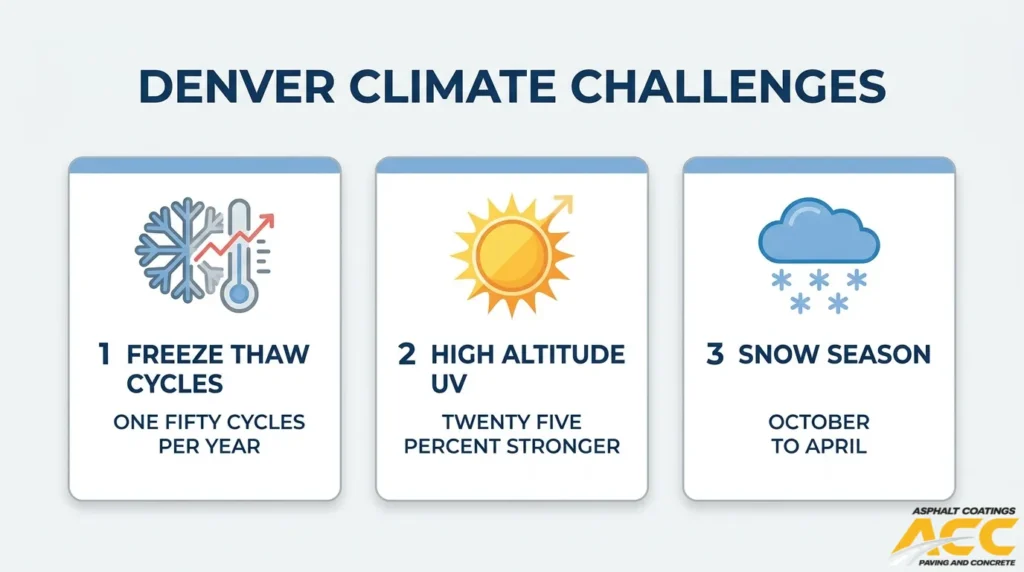
Denver’s freeze-thaw cycles influence paving schedules by compressing the reliable paving window into warmer months when freshly laid asphalt can cure without frost damage. Colorado pavement faces conditions most states never encounter, including more than 150 freeze-thaw cycles per year. These cycles occur primarily from October through May, with March and April producing the most variable conditions. Water enters small surface cracks, freezes, expands, and gradually widens the damage. Scheduling paving outside this high-risk window gives new asphalt time to fully bond and harden before winter stress begins.
How Do Temperature Ranges in Each Season Impact Asphalt Paving?
Temperature ranges in each season impact asphalt paving by directly controlling curing speed, compaction quality, and long-term durability. Summer paving allows faster curing, typically requiring 5 to 7 days for initial set and 30 days for full cure. Spring and fall paving extends that timeline to 7 to 14 days for initial set and 60 to 90 days for full curing. Winter paving should be avoided entirely, as cold temperatures prevent proper bonding.
Beyond curing, Colorado’s high-altitude UV exposure accelerates asphalt oxidation. This stronger sunlight causes asphalt surfaces to become brittle, lose flexibility, and develop surface raveling much faster than in lower-altitude regions. Proper seasonal timing ensures the binder achieves full strength before UV degradation and thermal cycling begin wearing it down. According to a 2013 study published in the Transportation Research Record (Qiao et al.), temperature factors, including both average annual temperature and seasonal variation, are the most influential variables in pavement performance.
How Does Precipitation and Snowfall Affect When You Can Pave?
Precipitation and snowfall affect when you can pave by limiting available dry days and saturating the subgrade beneath the pavement surface. According to Visit Denver, the city receives approximately 16 to 17 inches of annual precipitation, with most snowfall occurring between October and April. Moisture trapped in the base layer before or during paving weakens long-term structural integrity, especially once freeze-thaw cycling resumes. Saturated subgrade soil heaves and shifts as water expands during freezing, creating voids beneath the asphalt surface. For these reasons, successful commercial paving requires dry conditions and a fully drained subbase, conditions most consistently available from late spring through early fall.
Understanding these climate pressures helps property managers choose the right months for paving projects.
What Months Are Usually Best for Paving Commercial Lots in the Denver Metro?
The best months for paving commercial lots in the Denver Metro are May through October, with June and July offering peak conditions. Late spring, summer, and early fall each present distinct advantages depending on project scope and contractor availability.
Why Are Late Spring Months Often Ideal for Commercial Asphalt Paving?
Late spring months are often ideal for commercial asphalt paving because temperatures stabilize above the 50°F minimum while contractor schedules have not yet reached full capacity. Paving during optimal seasons, late spring through early fall, results in better compaction, faster curing, and superior long-term durability. Suboptimal seasonal timing can reduce pavement lifespan by 20 to 40 percent due to poor compaction and increased freeze-thaw susceptibility.
Late spring also gives newly paved surfaces a full summer of warm weather to cure before Colorado’s first freeze-thaw cycles arrive in October. That extended curing window is one of the most overlooked advantages of a May start date. According to Maisano Brothers Inc., completed lots still need fresh parking lot striping, ADA-compliant markings, crosswalks, arrows, and fire lane paint, so starting in late spring leaves ample time for these finishing elements.
Why Are Summer Months Typically the Peak Season for Lot Paving?
Summer months are typically the peak season for lot paving because June and July deliver optimal conditions for compaction, curing, and durability. Summer slots fill quickly as these months represent the absolute peak window for optimal paving conditions. Experienced property managers book two to three months in advance to secure contractor availability during this period.
The tradeoff is significant: while summer offers the best asphalt performance, it also creates the tightest scheduling constraints. Peak season runs from May through September, with the average lead time to bid on Denver Metro paving projects sitting at 26 days. Property managers who wait until June to start planning often find preferred contractors fully committed through September.
Can Early Fall Still Be a Good Time to Pave in the Denver Metro?
Yes, early fall can still be a good time to pave in the Denver Metro. September and early October typically maintain air temperatures above the 50°F threshold required for proper compaction. Spring and fall both offer optimal conditions for scheduling parking lot work, particularly during slower business hours.
However, fall projects carry a timing risk that summer work does not. If the first freeze-thaw cycle arrives before the new asphalt fully cures, accelerated deterioration can follow. For property managers who missed the summer window, early fall remains a strong option, but the project should be completed by mid-October at the latest to allow adequate curing time before winter conditions set in.
How Does the Type of Commercial Property Change the Ideal Paving Window?
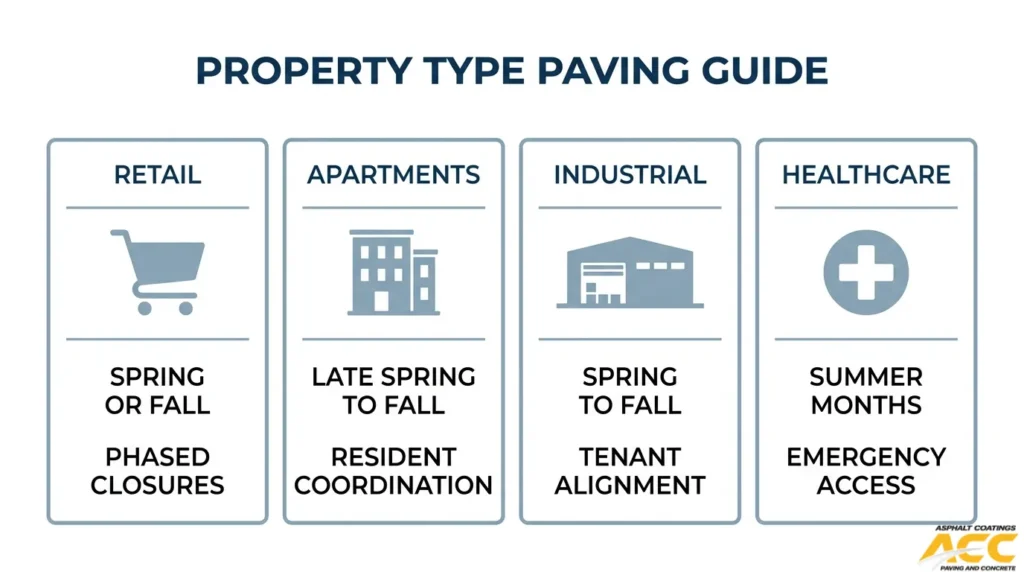
The type of commercial property changes the ideal paving window based on traffic patterns, tenant operations, and access requirements. Shopping centers need off-peak scheduling, apartments require phased resident coordination, industrial lots demand operational alignment, and healthcare campuses must maintain emergency access.
When Should Shopping Centers and Retail Plazas Schedule Paving?
Shopping centers and retail plazas should schedule paving during spring or fall, when moderate temperatures align with slower business cycles. Spring offers optimal conditions for coordinating restriping and line painting alongside paving. Fall windows between September and October allow projects to finish before winter weather sets in.
Phased closures work best for high-traffic retail environments, where closing an entire lot at once can drive customers to competitors. Scheduling work during early mornings or overnight further reduces shopper disruption. For retail properties, the paving timeline should account for tenant lease obligations and seasonal sales periods that cannot tolerate reduced parking capacity.
When Should Apartment and HOA Parking Lots Plan Asphalt Work?
Apartment and HOA parking lots should plan asphalt work during late spring through early fall, using phased strategies that keep resident access open throughout the project. Resident communication is critical; providing advance notice of section closures and alternate parking prevents frustration.
Nighttime asphalt work minimizes disruptions to businesses and traffic flow, making it an effective solution for commercial properties where daytime lots stay busy. Cooler nighttime temperatures can benefit compaction, though adequate lighting must define driving lanes and work zones for safety. ADA-compliant accessible routes, at least 3 feet wide with slip-resistant surfaces and slopes no greater than 1:12, must remain open during every phase.
When Should Industrial and Warehouse Lots Plan Their Paving Season?
Industrial and warehouse lots should plan their paving season for late spring through early fall, coordinating directly with tenant operations to minimize workflow interruptions. Heavy truck traffic and loading dock access make phased scheduling essential for these properties.
Clear communication protocols matter more on industrial sites than almost any other property type. Reputable contractors should have dedicated project managers who serve as a single point of contact and communicate potential change orders clearly and promptly. Broad initial quotes often signal that change orders will accumulate rapidly. Asking upfront about potential additional work protects both the budget and the construction timeline.
When Should Healthcare and Medical Campuses Schedule Lot Paving?
Healthcare and medical campuses should schedule lot paving during summer months when weather is most predictable, using phased plans that preserve emergency access at every stage. Ambulance lanes, patient transport routes, and quiet hours must guide every phase of the project.
At least 10% of patient and visitor parking spaces must comply with ADA requirements, including van-accessible spaces with proper clearance. Parking lot surfaces need to remain stable, slip-resistant, and properly drained throughout construction to prevent hazards for patients with mobility challenges. Of all commercial property types, healthcare campuses demand the most rigorous phasing because even brief access disruptions can affect patient safety.
With property-specific paving needs defined, the next step is confirming site and weather conditions before breaking ground.
What Weather and Site Conditions Need to Be Right Before You Pave?
The weather and site conditions that need to be right before you pave include stable air temperatures, dry subgrade soil, proper drainage, and workable ground conditions. The subsections below cover minimum temperature thresholds, moisture and drainage requirements, and traffic access considerations.
What Minimum Temperatures and Ground Conditions Are Needed for Asphalt?
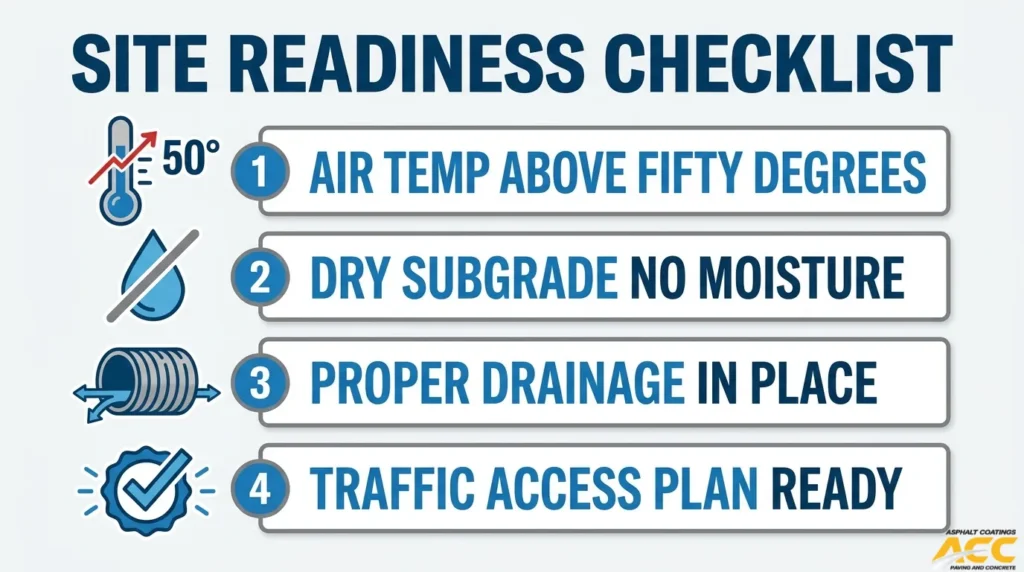
The minimum temperatures and ground conditions needed for asphalt are air and base temperatures of at least 50°F and rising, with ideal air temperatures between 60°F and 80°F. The Colorado Department of Transportation (CDOT) specifies that hot-mix asphalt must arrive at job sites between 275°F and 300°F, and during initial rolling, the mix temperature must stay between 220°F and 290°F to achieve proper density.
Ground conditions matter just as much as air temperature. Pavement temperatures below 70°F make compaction significantly more difficult, often resulting in asphalt that never reaches target density. Frozen or saturated subgrade will not support proper compaction regardless of mix temperature. For commercial lots in Denver, this effectively rules out most paving between November and March. Waiting for consistently warm, stable conditions protects the entire investment.
How Do Moisture and Drainage Conditions Affect Paving Timing?
Moisture and drainage conditions affect paving timing by determining whether the subgrade can support compaction and resist future heaving. Colorado’s soil conditions require careful subbase preparation; immediately prior to paving, the pavement subgrade should be thoroughly scarified and well-mixed to a minimum depth, and poor soil may need to be excavated and replaced with load-bearing fill such as gravel borrow.
Trapped moisture is particularly dangerous in Colorado because freeze-thaw cycles cause subgrade heaving when water is not managed through drainage and base layer design. A properly compacted base course must be in place before asphalt application. Scheduling paving after extended dry periods, rather than immediately following spring snowmelt or heavy rain, gives the subgrade time to stabilize and reduces long-term failure risk.
How Do Traffic and Access Requirements Shape the Paving Schedule?
Traffic and access requirements shape the paving schedule by dictating which sections of a lot can be closed and when. According to the U.S. Access Board, at least 10% of patient and visitor parking spaces at healthcare facilities must comply with ADA requirements, which means phased plans must maintain compliant accessible parking throughout construction.
Emergency access adds another constraint. Ambulance lanes, patient transport routes, and fire lanes must remain open at all times, so paving crews work in carefully sequenced phases. Retail and industrial properties face similar challenges: customer flow, delivery schedules, and tenant operations all influence which zones get paved first. Coordinating these logistics before mobilization prevents costly mid-project schedule changes.
With site conditions confirmed, the next step is planning your project timeline well in advance.
How Far in Advance Should Denver Property Managers Plan Paving Projects?
Denver property managers should begin planning paving projects at least 2-3 months before their target construction date. The sections below cover budgeting timelines, contractor scheduling, and lead time strategies for large or multi-phase lot projects.
When Should You Start Budgeting and Getting Paving Proposals?
You should start budgeting and getting paving proposals in late winter or early spring, roughly January through March. Since the optimal paving window in Denver runs May through September, beginning budget conversations early gives you time to collect multiple bids, compare scopes, and secure capital approval before contractor schedules tighten. Most Denver Metro asphalt paving contractors respond to initial inquiries within 24-48 hours, but the bidding process itself averages 26 days, according to Down to Bid. Starting early also allows time to coordinate ADA upgrades, striping, and sealcoating within a single project scope. Property managers who wait until April or May often find preferred contractors already committed.
When Should You Lock In a Paving Contractor’s Schedule for Peak Season?
You should lock in a paving contractor’s schedule at least 2-3 months before your preferred start date during peak season. June and July deliver the absolute best conditions for compaction, curing, and long-term durability in the Denver Metro, which makes those months the most competitive for contractor availability. Booking by March or April secures a summer slot; waiting until May risks being pushed into late season. For projects targeting September, locking in by June or early July is advisable. From experience, the property managers who secure the best crews and schedules are the ones who treat contractor booking like a reservation, not a last-minute request.
How Should You Plan Lead Time for Large or Multi‑Phase Lot Projects?
You should plan lead time for large or multi-phase lot projects by starting 6-12 months ahead of the first construction phase. Multi-phase planning allows contractors to schedule work over multiple seasons while maintaining business operations. Phases may be completed within a single paving season or spread across several years for budgeting purposes. This approach lets property managers rotate between parking areas for maintenance and repair, preventing major disruptions all at once. Prioritize scheduling paving between May and September, and confirm that each phase aligns with CDOT specifications and ADA compliance requirements. Early coordination ensures material availability, crew allocation, and phasing sequences are locked before peak season demand absorbs contractor capacity.
With project timelines established, understanding how paving methods differ by season sharpens those plans further.
How Does the Best Time to Pave Differ for New Construction vs. Mill-and-Overlay?
The best time to pave differs for new construction vs. mill-and-overlay because each method has distinct subbase, curing, and weather requirements. New construction demands longer warm-weather windows, while mill-and-overlay offers more scheduling flexibility.
When Is the Best Time to Pave New Parking Lot Construction in Denver?
The best time to pave new parking lot construction in Denver is late spring through early summer, ideally May through July. New asphalt construction involves complete subbase preparation, base course installation, and a full overlay, so the project needs an extended stretch of warm, dry weather for each phase to cure properly. Starting in late spring gives contractors enough time to complete grading and compaction before laying asphalt during peak summer conditions. Experienced property managers consistently choose March through May for restriping, which means coordinating new paving to finish before that window maximizes efficiency. Scheduling new construction earlier in the season also leaves a buffer for weather delays without pushing the project into fall.
When Is the Best Time to Do Mill-and-Overlay on Existing Commercial Lots?
The best time to do mill-and-overlay on existing commercial lots is late spring through early fall, with a wider scheduling window than new construction allows. Because milling removes only the top layer and applies a fresh surface, it skips the extensive subbase work that constrains new builds. This makes the process minimally invasive and less costly, though it remains a shorter-term solution for significantly deteriorated pavement. The existing base simply needs to be dry and stable, so any stretch of consistent 50°F-plus weather works. For most commercial properties, scheduling a mill-and-overlay in September or early October is still viable when new construction would be too risky that late in the season.
When Is the Best Time to Complete Small Asphalt Repairs Before Resurfacing?
The best time to complete small asphalt repairs before resurfacing is spring or fall, when temperatures are mild, typically between 40°F and 85°F. Crack sealing and patching require pavement temperatures of at least 40°F for proper adhesion. All cracks must be free of moisture, dirt, debris, and chemical deicers before sealing. Addressing these repairs early matters because freeze-thaw cycles cause water to infiltrate small cracks, expand during freezing, and progressively widen damage into potholes and structural failures. Completing repairs in spring, before a summer resurfacing project, gives the sealed areas time to bond fully. Neglecting small repairs before an overlay compromises the new surface from the start, so tackling them in the right temperature window protects your larger investment.
How Does Seasonal Timing Affect Asphalt Longevity and Performance?
Seasonal timing affects asphalt longevity and performance by determining how well the pavement compacts, cures, and resists environmental damage. The subsections below cover how temperature extremes influence lifespan, how curing timelines shift by season, and how proper scheduling reduces cracking.
How Does Paving in Cooler vs. Hotter Weather Affect Asphalt Lifespan?
Paving in cooler weather shortens asphalt lifespan, while paving in hotter weather extends it. Cooler conditions cause the hot-mix asphalt to lose heat rapidly, making proper compaction difficult and leaving air voids that weaken the pavement structure. Warmer temperatures allow the mix to remain workable longer, producing denser, more durable surfaces.
Expertly installed and properly maintained asphalt can last 15 to 20 years, but pavement not kept in good condition may fail within 8 to 12 years. That gap between 15 and 8 years often traces back to installation conditions. For Denver commercial lots, scheduling paving when air temperatures consistently hold above 60°F gives compaction crews the working time needed to achieve optimal density.
How Does Proper Curing Time Relate to the Season You Pave In?
Proper curing time relates directly to the season you pave in because ambient temperature controls how quickly asphalt hardens and bonds. Summer installations cure faster, typically reaching initial set within 5 to 7 days and full cure within 30 days. Spring and fall projects require 7 to 14 days for initial set and 60 to 90 days for full cure due to cooler, more variable conditions.
A 2013 study published in the Transportation Research Record found that temperature factors, including seasonal variation, are the most influential environmental factors affecting pavement performance. In Colorado, freeze-thaw cycles compound this challenge; water entering uncured surface cracks freezes, expands, and gradually widens damage into potholes and structural failures. Timing paving so the surface fully cures before the first hard freeze is one of the most consequential scheduling decisions a property manager can make.
How Does Seasonal Timing Help Reduce Cracking and Premature Deterioration?
Seasonal timing helps reduce cracking and premature deterioration by ensuring asphalt reaches full strength before facing freeze-thaw stress. Pavement installed during summer months experiences the lowest cracking rates because sustained warmth allows complete curing and tight compaction. Fall installations perform well initially, yet they risk accelerated damage if winter’s freeze-thaw cycles arrive before the surface has fully hardened.
Proper seasonal planning also creates the right window for protective maintenance. Sealcoating, for instance, requires surface temperatures between 50°F and 90°F with no moisture present, making autumn the optimal application period. Aligning both paving and sealcoating with the correct seasonal windows creates a layered defense against oxidation, moisture infiltration, and thermal cracking.
With longevity strategies established, understanding when to schedule sealcoating and crack sealing completes the maintenance picture.
When Is the Best Time of Year to Sealcoat and Crack Seal After Paving?
The best time of year to sealcoat and crack seal after paving is late spring through early fall, when temperatures stay between 50°F and 90°F. Timing depends on how long ago the asphalt was installed and current weather conditions.
When Should You Schedule the First Sealcoat After a New Asphalt Install?
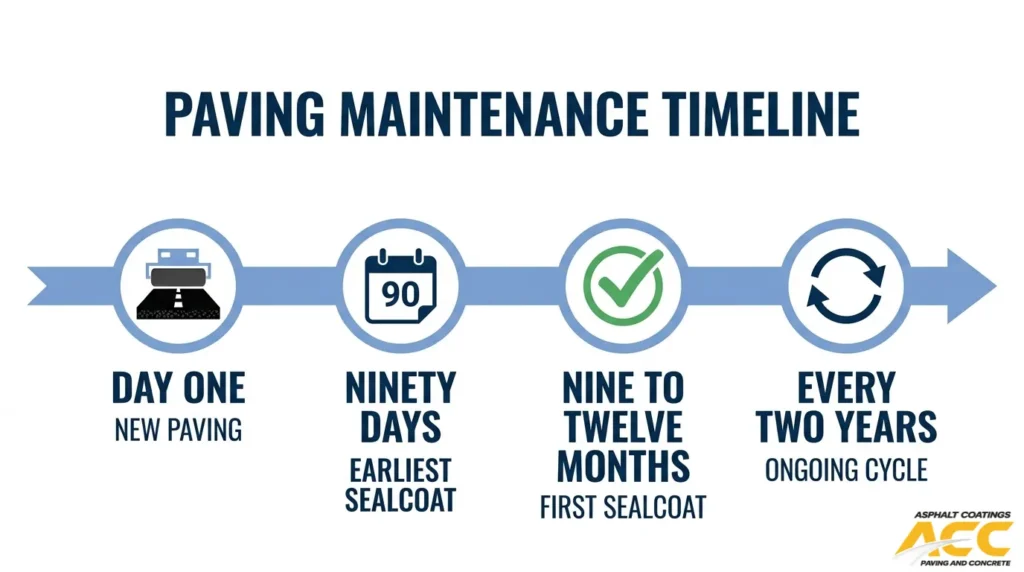
You should schedule the first sealcoat after a new asphalt install no earlier than 90 days post-paving. For optimal results in Colorado, waiting 9 to 12 months is recommended. Fresh asphalt contains oils that need time to evaporate; sealing too soon traps these chemicals, making the surface susceptible to tire marks, imprints, and premature cracking. According to NAC Supply, “the longer you wait, the stronger the pavement will be.” Even the weight of a sealcoating machine can leave permanent impressions on asphalt that has not fully cured. For commercial lots paved in summer, this timeline often means scheduling the first sealcoat the following spring or early fall.
What Time of Year Is Best for Ongoing Sealcoating in the Denver Metro?
The best time of year for ongoing sealcoating in the Denver Metro is late summer through autumn, when air temperatures hold between 50°F and 90°F. The pavement must be completely dry, with no rain in the forecast for at least two days. Moisture thins the sealer and prevents proper curing. According to Hillcrest Management, property managers should assess sealcoating needs every two years, since the ideal frequency (every two to three years) depends on traffic patterns and weather exposure. Given Denver’s UV intensity at 5,280 feet, which accelerates oxidation, staying on a consistent sealcoating cycle is one of the most cost-effective ways to extend pavement life.
When Should You Plan Crack Sealing to Protect Your Parking Lot Investment?
You should plan crack sealing when temperatures consistently rise above 50°F, typically during the spring through fall window. According to the Colorado Asphalt Pavement Association, all cracks must be free of moisture, dirt, debris, vegetation, and chemical deicers before sealing. This means early spring, right after Denver’s freeze-thaw season ends in late April or May, is often the most strategic window. Addressing cracks before the next winter cycle prevents water infiltration that would otherwise widen damage through repeated freezing and expansion. Proactive crack sealing paired with a sealcoating schedule forms the backbone of any long-term parking lot maintenance plan.
With sealcoating and crack sealing scheduled, minimizing business disruption becomes the next priority.
How Can You Minimize Business Disruption When Paving in Peak Season?
You can minimize business disruption when paving in peak season by scheduling work during off-hours, phasing the project into sections, and bundling finishing tasks like striping and ADA upgrades into a single mobilization.
When Should You Schedule Night or Off‑Hour Paving for Busy Commercial Sites?
You should schedule night or off-hour paving for busy commercial sites when daytime traffic volumes make full closures impractical. The best approach is to schedule paving times when your tenants are least busy and least likely to be affected, and communicate proactively with business owners about the timeline. Retail plazas, medical offices, and industrial facilities each have different low-traffic windows. Restaurants and retail tenants benefit from overnight work, while office parks may tolerate early morning starts. Cooler nighttime temperatures can actually aid compaction, though additional lighting and safety measures are essential for crew visibility.
How Can Phased or Sectional Paving Help Keep Your Property Open?
Phased or sectional paving keeps your property open by dividing the project into manageable stages instead of closing the entire lot at once. One of the most effective ways to reduce disruption is to phase the work rather than shutting down a full roadway or parking area. Properties with multiple lots can rotate sections across different years, redirecting traffic to unaffected areas during each phase. This approach also spreads capital expenditures across budget cycles. For most multi-lot commercial properties, phased paving is the single best strategy for balancing pavement quality with continuous operations.
When Should You Combine Paving With Line Striping and ADA Upgrades?
You should combine paving with line striping and ADA upgrades immediately after the asphalt surface is complete. Fresh lots require parking lot striping, ADA-compliant markings and access points, crosswalks, directional arrows, and fire lane paint before reopening to traffic. Bundling these tasks into one project reduces total closure time and ensures compliance from day one. According to ADA.gov, “one of six accessible parking spaces, but always at least one, must be van accessible,” with van spaces requiring 132 inches minimum width and a 60-inch access aisle. Spring and fall offer optimal restriping conditions due to moderate temperatures and faster paint cure times.
Choosing the right contractor makes these coordination strategies far more effective.
How Should You Choose a Paving Contractor for Denver’s Seasonal Conditions?
You should choose a paving contractor for Denver’s seasonal conditions by evaluating Colorado-specific experience, crew structure, and communication practices. The sections below cover essential vetting questions, crew reliability, and transparency standards.
What Questions Should You Ask About Colorado‑Specific Paving Experience?
The questions you should ask about Colorado-specific paving experience focus on climate knowledge, project management, and maintenance planning. Key questions to ask include:
- How many freeze-thaw cycles have you designed pavement systems to withstand?
- What is your experience with Denver’s high-altitude UV exposure and its effect on binder degradation?
- Do you use in-house crews or subcontract the work?
- Can you provide references from similar commercial projects completed in Colorado?
- What is your experience with phased paving projects and ADA compliance?
- What sealcoating and maintenance schedule do you recommend for Colorado’s climate?
A contractor who struggles to answer these questions likely lacks the regional expertise needed for durable results in Denver’s demanding environment.
How Does In‑House Versus Subcontracted Crews Affect Scheduling Reliability?
In-house versus subcontracted crews affects scheduling reliability through differences in quality control, communication speed, and accountability. Contractors with in-house crews provide consistent communication and direct oversight at every project phase. Subcontracted crews often introduce communication delays, inconsistent quality standards, and reduced accountability when timelines shift due to weather. When evaluating contractors, ask what percentage of work is completed by in-house employees versus subcontractors. A contractor who is challenging to work with during the estimating and planning phase will almost certainly continue to be a problem during construction. For seasonal work in Denver, where weather windows are tight, the scheduling flexibility of an in-house team is a significant advantage.
How Should Transparency and Communication Factor Into Your Timing Decision?
Transparency and communication should factor into your timing decision because Denver’s narrow paving windows leave little room for mismanaged schedules or surprise costs. Contractors should assign dedicated project managers who serve as a single point of contact and communicate potential change orders clearly before work begins. If an initial quote uses vague or overly broad terms, expect additional charges to accumulate once the project starts. At the estimate stage, ask whether the contractor anticipates any change orders or additional work not included in the original scope. Strong pre-project communication is the clearest predictor of on-time, on-budget execution during Colorado’s peak paving season.
With the right contractor selected, the next step is aligning your project timeline and phasing strategy with a team that understands Denver’s conditions.
How Should You Approach Paving Timing in the Denver Metro With Asphalt Coatings Company?
You should approach paving timing in the Denver Metro with Asphalt Coatings Company by starting the conversation early and building a phased plan around Colorado’s narrow optimal window. The sections below cover project planning and key takeaways.
How Can Asphalt Coatings Company Help You Plan and Phase Paving, Sealcoating, and Repairs?
Asphalt Coatings Company can help you plan and phase paving, sealcoating, and repairs by creating a multi-season maintenance calendar tailored to your property type. Well-maintained asphalt can last 15 to 20 years in Colorado, but reaching that lifespan requires coordinating paving, sealcoating every two to three years, and post-winter inspections that begin in late March or early April.
For occupied properties, phased scheduling is essential. Hospitals and clinics require clear emergency access at all times, with quiet hours, patient transport routes, and ambulance lanes guiding each phase. Apartment complexes and HOAs benefit from the same sectional approach, rotating lot closures so residents always have parking access.
Asphalt Coatings Company uses in-house crews across Denver and Colorado Springs, which simplifies coordination when sequencing paving, crack sealing, and sealcoating across multiple seasons. That single-source accountability is especially valuable for large properties where phasing decisions directly affect budgets and tenant satisfaction. With 39 years of experience serving Colorado’s Front Range, Asphalt Coatings Company designs maintenance plans specifically for properties facing Denver’s freeze-thaw cycles and high-altitude UV exposure, ensuring each phase aligns with both operational needs and Colorado’s climate demands.
What Are the Key Takeaways About the Best Time of Year to Pave Commercial Lots in the Denver Metro?
The key takeaways about the best time of year to pave commercial lots in the Denver Metro center on a May through September window, with June and July offering peak conditions. Ideal conditions require air temperatures above 50°F, pavement temperatures above 70°F, humidity below 75%, and minimal rain, according to Earle American Asphalt.
Denver’s climate at 5,280 feet adds urgency to seasonal timing. UV intensity runs approximately 25% higher than at sea level, accelerating binder oxidation year-round. Combined with more than 150 annual freeze-thaw cycles, pavement installed outside the optimal window faces compounding stresses that shorten its service life.
The most actionable lessons from this guide are:
- Book contractors two to three months before your target start date; average bid lead time in Denver is 26 days.
- Phase large projects across sections or seasons to maintain business operations.
- Schedule the first sealcoat 90 days to 12 months after paving, then reassess every two years.
- Coordinate line striping, ADA upgrades, and crack sealing within the same mobilization to reduce total disruption.
For most commercial properties, asphalt paving lasts between 15 and 30 years when seasonal timing, proper curing, and ongoing maintenance align. Since 1986, Asphalt Coatings Company has partnered with commercial property managers across the Front Range to deliver asphalt and concrete solutions built for longevity, combining dependable craftsmanship with transparent project management from estimate through final striping. Asphalt Coatings Company can help you build that alignment from the first site assessment through every maintenance cycle that follows.