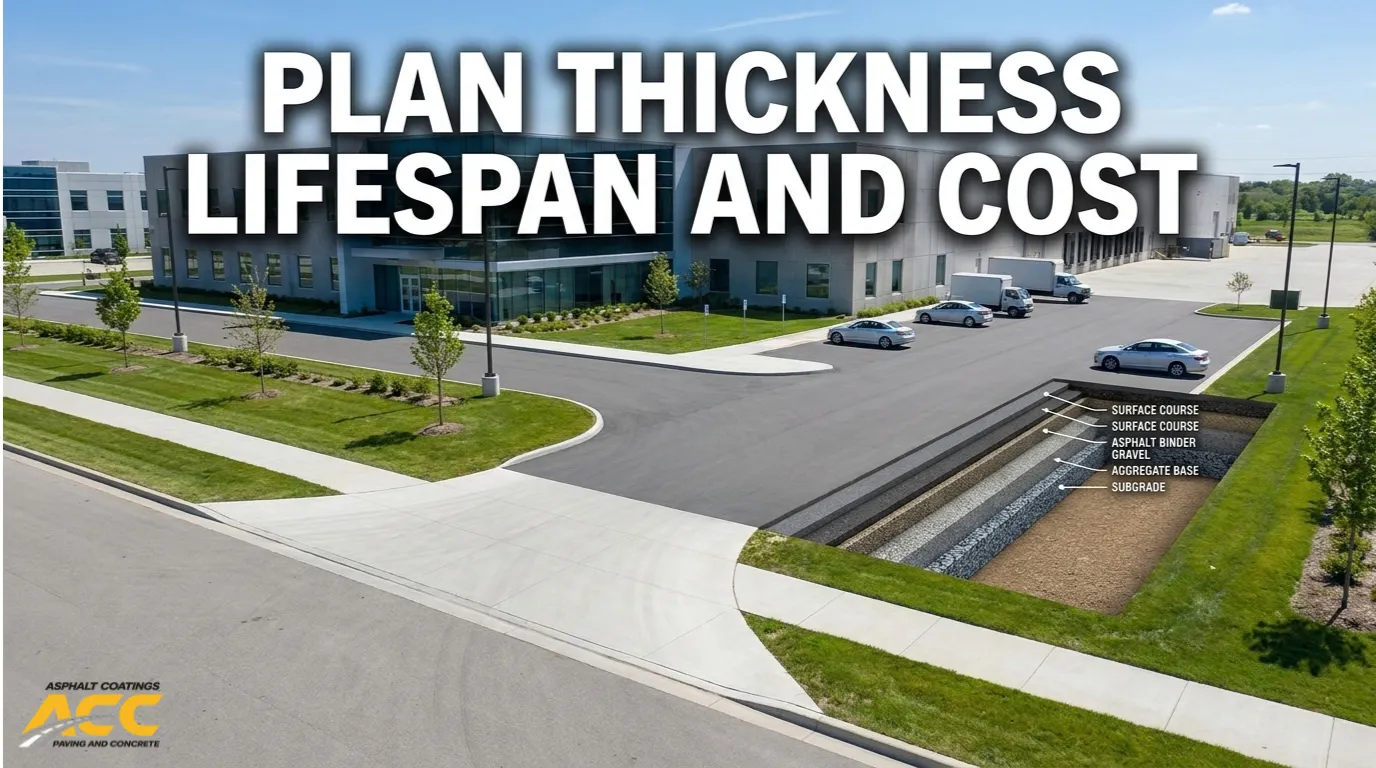
Professional commercial asphalt paving is the engineered installation of asphalt surfaces on commercial properties to deliver lasting durability, safety, and financial return. When executed by qualified contractors, it produces pavement that can perform for 20 to 30 years with proper maintenance.
This guide covers functional performance, curb appeal and property value, cost and ROI strategy, climate and environmental adaptation, safety and compliance, failure recognition and rehabilitation, contractor quality assurance, and long-term maintenance planning.
Functional benefits start at the foundation. Proper compaction, mix design, and drainage engineering prevent premature cracking, rutting, and moisture damage. These elements also eliminate trip hazards and create clear, safe traffic flow for drivers and pedestrians.
Well-installed asphalt elevates property appearance with a smooth, uniform surface that signals professional management. This visual impact supports tenant satisfaction, strengthens first impressions for customers, and helps justify higher lease rates.
Upfront investment in professional installation reduces total lifecycle cost by avoiding the steep escalation from minor crack sealing to full reconstruction. Phased paving strategies further optimize cash flow across budget cycles.
Climate-specific mix designs address freeze-thaw damage, UV oxidation at high altitude, and sustainability goals through recycled materials and permeable pavement options. Professional contractors also ensure ADA compliance, proper striping, and risk reduction that protects owners from liability.
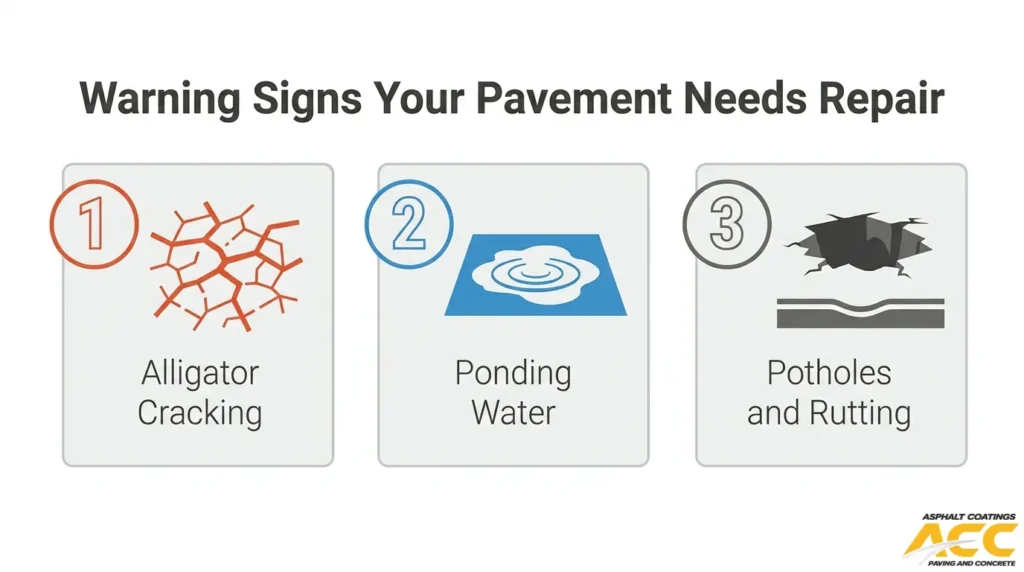
Recognizing warning signs like alligator cracking, ponding water, and deep rutting helps owners act before structural failure sets in. Choosing between overlay and reconstruction depends on base condition, and professional evaluation makes that call accurately.
Warranties, maintenance plans, and documented condition reports protect the investment over time, while vetting contractors for in-house crews and engineering rigor prevents the hidden costs of lowest-bid work.
Why Does Professional Commercial Asphalt Paving Matter for Property Owners and Managers?
Professional commercial asphalt paving matters for property owners and managers because it directly influences tenant retention, property value, safety, and long-term operating costs. According to research from University College London on Determinants of satisfaction amongst occupiers of commercial property, landlords must attract and retain occupiers to maximize rental income, and understanding which aspects of property management matter most to occupiers is essential to achieving that goal. Pavement condition is one of the first things tenants, customers, and visitors notice when they arrive at a commercial property. Cracked, uneven, or poorly graded surfaces signal deferred maintenance and create real liability exposure. Professionally installed asphalt addresses these concerns at the source by delivering a durable, code-compliant surface engineered for the specific traffic loads, drainage requirements, and climate conditions each property faces. For property managers balancing capital budgets across multiple facilities, the distinction between professional-grade paving and cut-rate work often determines whether a parking lot lasts two decades or fails within five years. The sections that follow break down the specific functional, financial, and strategic benefits that professional commercial asphalt paving delivers across every property type.
What Are the Most Important Functional Benefits of Professional Commercial Asphalt Paving?
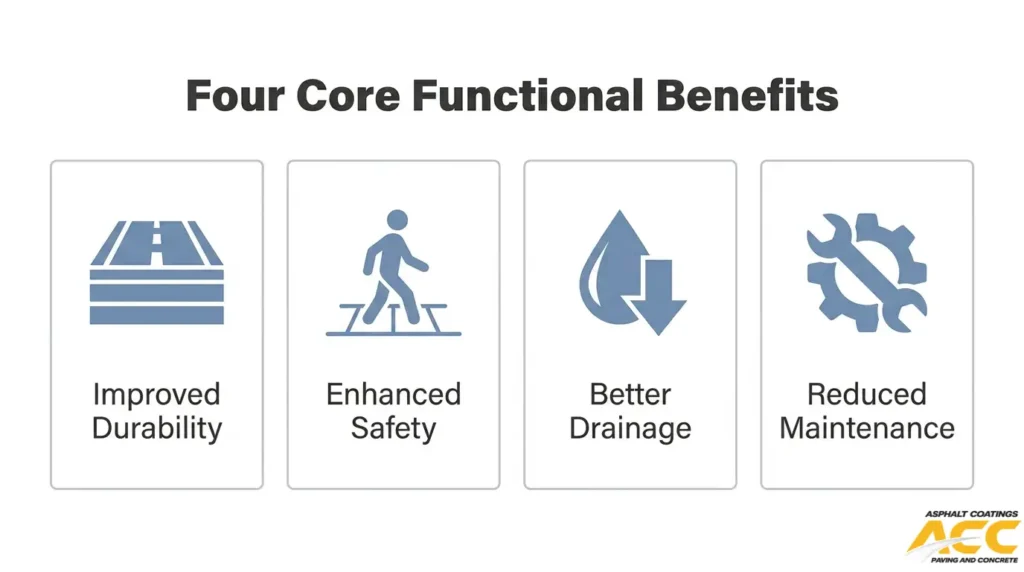
The most important functional benefits of professional commercial asphalt paving are improved durability, enhanced safety, better drainage, and reduced long-term maintenance. Each benefit compounds over the pavement’s service life.
How Does Professional Asphalt Paving Improve Pavement Durability and Lifespan?
Professional asphalt paving improves pavement durability and lifespan by controlling mix design, compaction quality, and material selection to engineering standards. According to the National Asphalt Pavement Association’s analysis of LTPP data, the average expected service life of conventional and deep-strength flexible pavements is greater than 20 years.
Compaction precision is central to this longevity. The Asphalt Institute recommends controlling compacted air voids between 3% and 7%; at 8% or higher, interconnected voids allow air and moisture to permeate the pavement, directly reducing durability. Properly trained crews with calibrated equipment hit these targets consistently, something that inexperienced installers frequently miss. For commercial properties facing heavy daily traffic, this attention to compaction is one of the single most impactful factors separating pavements that last from those that fail prematurely.
In What Ways Does Professional Paving Enhance Safety for Drivers and Pedestrians?
Professional paving enhances safety for drivers and pedestrians by delivering smooth, well-graded surfaces with clear sightlines and proper markings. Cracked, potholed, or uneven pavement creates trip hazards for pedestrians and unpredictable driving conditions. A professionally installed surface eliminates abrupt level changes that cause stumbles, vehicle damage, or loss of control.
Proper layout also matters. As OSHA’s work zone safety guidance states, drivers, workers on foot, and pedestrians must be able to see and understand the proper routes. Professional contractors design parking lots and access roads with logical traffic flow, adequate lighting provisions, and compliant striping that guides movement safely across the property.
How Does Quality Asphalt Paving Improve Drainage and Reduce Water Damage?
Quality asphalt paving improves drainage and reduces water damage through proper grading, slope design, and, where appropriate, permeable pavement options. Standing water is one of the fastest accelerators of pavement failure; it infiltrates cracks, weakens the subgrade, and causes potholes.
According to the U.S. Environmental Protection Agency, permeable pavements reduce stormwater runoff, help filter pollutants that contribute to water pollution, lower the need for road salt, and can reduce construction costs by eliminating some conventional drainage features. Even with standard asphalt, professional contractors engineer crown slopes and drainage channels that move water off the surface efficiently, preventing the ponding that degrades pavement from within.
How Does Professional Paving Reduce Long-Term Maintenance and Repair Needs?
Professional paving reduces long-term maintenance and repair needs by getting the foundation, material selection, and compaction right the first time. When these fundamentals are executed correctly, the pavement resists cracking, rutting, and moisture infiltration far longer than a poorly installed surface.
Early, low-cost interventions such as crack sealing and sealcoating become the only maintenance required for years. Conversely, deferred maintenance on substandard pavement escalates rapidly into costly overlays or full reconstruction. For most commercial property owners, investing in professional installation is the most reliable way to keep annual maintenance budgets predictable and avoid emergency repairs that disrupt tenants and customers.
With functional performance secured, the visual and financial impact of quality paving becomes equally significant.
How Does Professional Commercial Asphalt Paving Improve Curb Appeal and Property Value?
Professional commercial asphalt paving improves curb appeal and property value by creating a clean, uniform surface that signals well-managed property to tenants, customers, and investors. The following sections cover visual impact, occupant satisfaction, and rent potential.
How Does Fresh, Well-Installed Asphalt Enhance the Look of Commercial Properties?
Fresh, well-installed asphalt enhances the look of commercial properties by replacing cracked, faded surfaces with a smooth, deep-black finish that immediately communicates professionalism. Uniform edges, consistent grading, and crisp striping create a polished appearance visible from the street. For retail centers, office parks, and apartment communities, this visual upgrade shapes a visitor’s first impression before they ever walk through the door. Worn pavement with potholes and patchy repairs, by contrast, suggests neglect. Because parking lots and driveways are often the largest visible surface on a commercial property, their condition disproportionately influences how the entire site is perceived.
In What Ways Can Quality Pavement Increase Tenant and Customer Satisfaction?
Quality pavement can increase tenant and customer satisfaction by providing a smooth, safe, and visually appealing surface that makes daily access comfortable. Tenants notice when common areas are maintained to a high standard; well-compacted asphalt installed to specifications like 95% density eliminates the rough patches and standing water that frustrate drivers and pedestrians. According to the City of Liberty Lake, Washington’s 2025 Inland Northwest Regional Pavement Cut Policy, patches in roadways require compaction to 95% density and a minimum three-year warranty period to ensure lasting quality. When tenants see this level of investment in shared infrastructure, their confidence in property management grows, which directly supports lease renewals and positive word-of-mouth.
How Can Professional Asphalt Paving Help Support Higher Rents or Lease Rates?
Professional asphalt paving can help support higher rents or lease rates by elevating overall property condition, a factor landlords and investors rely on to justify premium pricing. According to BOMA International’s 2026 TOBY Criteria, high-performance building recognition programs are designed to increase asset value and tenant retention on a global basis. Well-maintained exterior surfaces, including parking areas, contribute directly to that performance standard. Properties with fresh paving, proper drainage, and ADA-compliant layouts compete more effectively for quality tenants willing to pay above-market rates. In my experience, commercial properties that invest in professional paving consistently outperform deferred-maintenance competitors during lease negotiations.
With curb appeal and value established, the next step is understanding paving’s cost and ROI advantages.
What Are the Cost and ROI Advantages of Hiring Professional Commercial Asphalt Paving Contractors?
The cost and ROI advantages of hiring professional commercial asphalt paving contractors include lower lifecycle expenses, fewer premature failures, and smarter budget allocation. The sections below cover upfront versus long-term cost comparisons, how professional installation prevents costly rework, and how phased paving optimizes cash flow.
How Do Upfront Costs Compare to Long-Term Savings With Professional Paving?
Upfront costs for professional paving are higher than budget alternatives, but long-term savings far outweigh the initial premium. Professional contractors deliver correct subgrade preparation, proper compaction, and appropriate mix design the first time, which extends pavement life and delays expensive interventions.
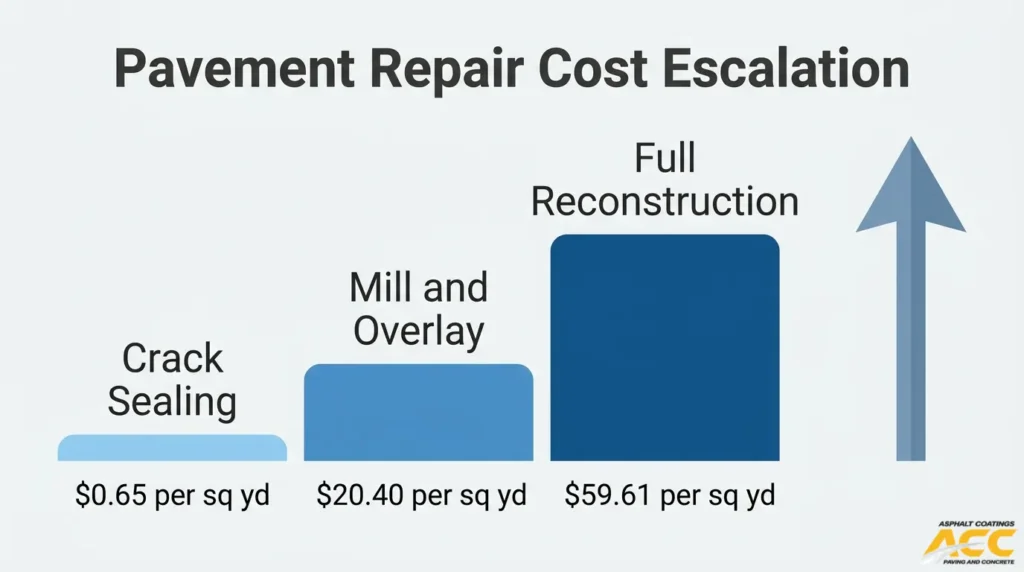
According to a City of Copperas Cove, Texas, Pavement Condition Report, crack sealing costs roughly $0.65 per square yard, mill and overlay with 20% base repair runs approximately $20.40 per square yard, and full reconstruction reaches about $59.61 per square yard. That cost escalation reveals the financial penalty of deferred quality. A properly installed commercial lot that needs only periodic crack sealing consumes a fraction of what a failed lot demands in reconstruction.
For most property managers, the calculus is straightforward: spending more on correct installation upfront is the single most effective way to minimize total cost of ownership over a pavement’s service life.
How Does Professional Installation Help Avoid Premature Failure and Costly Rework?
Professional installation helps avoid premature failure by controlling the variables that cause early deterioration, such as improper compaction, poor drainage grading, and incorrect mix selection. When any of these elements fall short, pavement degrades years ahead of schedule, triggering expensive rework.
According to the Asphalt Institute, compacted air voids must remain between 3% and 7%; at 8% or higher, interconnected voids allow air and moisture to permeate the pavement, reducing durability significantly. Experienced contractors monitor these thresholds during placement using calibrated equipment, catching problems before they become permanent defects.
Rework from premature failure typically involves mill-and-overlay or full reconstruction, both far costlier than the original installation. Investing in professional quality control at the construction stage is the most reliable insurance against that cycle.
How Can a Phased or Planned Paving Approach Optimize Budget and Cash Flow?
A phased or planned paving approach optimizes budget and cash flow by spreading capital expenditures across multiple fiscal periods while keeping the overall pavement network functional. Instead of resurfacing an entire parking lot at once, property managers can prioritize the worst sections first and schedule remaining areas in subsequent budget cycles.
This strategy also preserves tenant and customer access during construction, minimizing revenue disruption. Phased projects allow managers to align paving costs with lease renewal timelines, capital improvement budgets, or seasonal revenue peaks.
For commercial properties with large surface areas, phased planning is often the difference between a manageable annual expense and a deferred project that compounds into a full reconstruction bill.
With cost strategy established, understanding how professional paving performs under heavy commercial loads adds further context.
Why Is Professional Asphalt Paving Quality Crucial in High-Traffic Commercial and Industrial Settings?
Professional asphalt paving quality is crucial in high-traffic commercial and industrial settings because these environments subject pavement to concentrated loads, constant turning movements, and heavy daily use that standard installations cannot withstand. The following sections cover performance in truck and loading dock areas, shopping centers, apartment and HOA communities, and warehouses or business parks.
How Does Professional Paving Perform in Heavy Truck and Loading Dock Areas?
Professional paving performs in heavy truck and loading dock areas by using thicker cross-sections and stiffer mix designs engineered for repeated axle loads. Loading docks concentrate stress at turning points and standing areas where trucks idle for extended periods. Without proper structural design, the upper layers deform under sustained weight. According to the Federal Highway Administration, shallow rutting in the upper 3 to 4 inches of hot mix asphalt occurs from sideways displacement of the mix within the asphalt layer itself, not from structural failure below. Professional contractors address this by specifying polymer-modified binders, increasing compaction density, and designing pavement sections matched to anticipated truck traffic volumes. For any facility receiving daily freight, this level of engineering is not optional; it is the difference between a decade of service and premature failure within a few years.
What Are the Benefits of Professional Paving for Shopping Centers and Retail Parking Lots?
The benefits of professional paving for shopping centers and retail parking lots include smooth driving surfaces, proper drainage grading, ADA-compliant access routes, and durable striping layouts that guide high customer volumes safely. Retail lots endure constant stop-and-go traffic, cart traffic, and seasonal surges that accelerate wear in drive lanes and fire lanes. A professionally designed lot incorporates slope gradients that prevent ponding water, which protects both the pavement structure and pedestrian safety. Well-maintained surfaces also reinforce the first impression customers form before entering a store. For retail property managers, investing in professional installation reduces the frequency of patching and restriping cycles that disrupt business operations during peak shopping periods.
How Does Quality Asphalt Paving Support Apartment and HOA Communities?
Quality asphalt paving supports apartment and HOA communities by providing smooth, safe surfaces that serve residents around the clock while preserving property aesthetics. Community parking areas, drive aisles, and fire lanes handle a mix of passenger vehicles, delivery trucks, and emergency apparatus. Professionally installed pavement with proper base preparation resists the settlement and cracking that triggers resident complaints and board liability concerns. According to the Asphalt Institute, compacted air voids must be controlled between 3% and 7%; at 8% or higher, interconnected voids allow air and moisture to permeate the pavement, reducing durability. Phased paving programs allow HOA boards to spread costs across budget cycles while maintaining consistent surface quality across the community.
How Does Professional Paving Benefit Warehouses, Industrial Sites, and Business Parks?
Professional paving benefits warehouses, industrial sites, and business parks by delivering pavement structures designed for forklift traffic, loaded trailers, and continuous heavy vehicle circulation. These environments demand thicker aggregate bases and engineered mix designs matched to projected traffic levels. The Minnesota Department of Transportation specifies asphalt mixture designations based on traffic level, measured in equivalent single-axle loads (ESALs), ensuring pavement composition aligns with actual use intensity. Industrial sites also require durable transitions between interior concrete floors and exterior asphalt, along with clearly marked truck routing to protect both pavement edges and worker safety. For multi-tenant business parks, consistent pavement quality across shared drives and parking areas maintains a professional appearance that supports tenant retention.
With performance demands established across these settings, climate and environmental conditions further influence how professional paving strategies are engineered.
How Does Professional Commercial Asphalt Paving Address Climate and Environmental Conditions?
Professional commercial asphalt paving addresses climate and environmental conditions through climate-specific mix design, UV-resistant formulations, and sustainable material practices. The following sections cover freeze-thaw resilience, high-altitude UV mitigation, and environmental sustainability strategies.
Why Is It Critical to Design Asphalt Paving for Freeze-Thaw Climates?
It is critical to design asphalt paving for freeze-thaw climates because repeated freezing and thawing cycles force moisture into pavement cracks, expanding as ice and progressively breaking apart the asphalt structure. Without proper mix design, this cycle accelerates alligator cracking, pothole formation, and subgrade erosion within just a few seasons.
Professional contractors address this through several targeted strategies:
- Selecting performance-graded (PG) binders rated for low-temperature flexibility, which resist thermal cracking when pavement contracts in cold weather.
- Controlling compacted air voids within the optimal range to prevent moisture infiltration while allowing thermal expansion.
- Engineering proper drainage slopes and base layers that move water away before it can freeze beneath the surface.
For commercial properties in regions like Colorado’s Front Range, where temperatures can swing dramatically within a single day, freeze-thaw-resistant design is not optional. It is the difference between a parking lot that lasts and one that fails prematurely.
How Do High-Altitude and UV Exposure Affect Asphalt, and How Can Professionals Mitigate This?
High-altitude and UV exposure affect asphalt by accelerating oxidation of the asphalt binder, which causes the pavement surface to become brittle, fade to gray, and develop fine surface cracking. At elevations above 5,000 feet, UV intensity increases significantly, shortening the window before oxidative hardening begins.
Professionals mitigate this through a combination of approaches:
- Specifying polymer-modified binders that resist UV degradation longer than conventional asphalt cement.
- Applying sealcoating within the first few years of installation to block UV penetration and restore surface flexibility.
- Designing maintenance schedules that account for faster oxidation rates at altitude, rather than relying on timelines developed for lower-elevation regions.
Properties along Colorado’s Front Range face this dual challenge of altitude and intense sun year-round. Proactive UV protection through proper material selection and timely sealcoating is one of the most cost-effective ways to extend pavement life in these conditions.
How Can Professional Paving Reduce Environmental Impact and Support Sustainability Goals?
Professional paving can reduce environmental impact and support sustainability goals by incorporating recycled materials, permeable pavement designs, and energy-efficient production methods. According to a 2025 report from the Transportation Research Board and National Academies of Sciences, Engineering, and Medicine, the average percentage of reclaimed asphalt pavement (RAP) used in asphalt mixtures increased from 15.6 percent in 2009 to 21.9 percent in 2023.
Key sustainability benefits of professional commercial paving include:
- Reclaimed asphalt pavement (RAP) conserves virgin aggregate and binder, reducing raw material extraction and lowering production emissions.
- Permeable asphalt pavement reduces stormwater runoff, filters pollutants that contribute to water pollution, and can reduce the need for conventional drainage infrastructure and road salt, as noted by the U.S. Environmental Protection Agency.
- Warm-mix asphalt (WMA) technologies lower production temperatures, cutting fuel consumption and emissions at the plant.
For property owners pursuing green building certifications or corporate sustainability targets, specifying recycled content and permeable designs during the paving process delivers measurable environmental returns alongside long-term cost savings.
With climate-adapted design in place, the next step is ensuring your pavement also meets safety, compliance, and risk management standards.
How Does Professional Asphalt Paving Improve Safety, Compliance, and Risk Management?
Professional asphalt paving improves safety, compliance, and risk management by eliminating surface hazards, organizing traffic movement, and meeting federal accessibility standards. The following sections cover trip hazard reduction, striping and layout design, and ADA compliance requirements.
How Can Professional Paving Reduce Trip Hazards and Liability Risks?
Professional paving reduces trip hazards and liability risks by delivering smooth, level surfaces free of cracks, potholes, and uneven joints. Deteriorated pavement creates conditions where pedestrians stumble and vehicles sustain damage, exposing property owners to personal injury claims. According to the U.S. Access Board’s Chapter 5: Parking Spaces guidelines, parking spaces and access aisles cannot have changes in level other than slopes not exceeding 1:48. Professionally installed asphalt meets this grade tolerance from day one. Neglected surfaces that develop heaving or settlement quickly fall out of compliance, which shifts liability squarely onto the property owner. Proactive paving is one of the most cost-effective risk mitigation strategies a commercial property manager can implement.
How Does Proper Striping and Layout Improve Traffic Flow and Safety?
Proper striping and layout improve traffic flow and safety by giving drivers and pedestrians clear visual guidance through parking areas and drive lanes. Faded or missing markings create confusion that leads to collisions, wrong-way travel, and pedestrian conflicts. OSHA’s Work Zone Safety: Traffic Control publication states that drivers, workers on foot, and pedestrians must be able to see and understand the proper routes. Professionally applied pavement markings accomplish this through:
- High-visibility lane lines that separate opposing traffic
- Directional arrows guiding one-way circulation
- Crosswalk markings defining safe pedestrian paths
- Fire lane and no-parking zones painted to code
Well-planned layouts also maximize usable parking stalls without sacrificing safe turning radii, which directly benefits both capacity and daily operations.
How Does Professional Paving Support ADA Compliance and Accessibility Requirements?
Professional paving supports ADA compliance and accessibility requirements by constructing surfaces, slopes, and access routes that meet the 2010 ADA Standards for Accessible Design. The U.S. Department of Justice specifies that these standards set minimum scoping and technical requirements for newly designed, constructed, or altered commercial facilities to be readily accessible to individuals with disabilities. Compliance involves precise slope grading, properly dimensioned accessible parking spaces, compliant access aisles, and detectable warning surfaces at curb ramps. Non-compliant properties face federal enforcement actions, civil lawsuits, and costly retrofits. Because accessibility requirements intersect with pavement condition, surface quality, and striping accuracy, a qualified paving contractor addresses all three simultaneously.
With safety and compliance addressed, recognizing the warning signs of pavement failure helps property owners act before risks escalate.
What Are the Signs Your Commercial Property Needs Professional Asphalt Paving or Rehabilitation?
The signs your commercial property needs professional asphalt paving or rehabilitation include spreading surface cracks, potholes, persistent ponding water, and structural base failure. The sections below cover how to read these warning signs and when to choose overlay versus full reconstruction.
When Do Surface Cracks and Potholes Indicate It Is Time for Professional Paving?
Surface cracks and potholes indicate it is time for professional paving when distress patterns progress beyond isolated hairline cracking into interconnected alligator cracking or when potholes begin forming in wheel paths. According to the South Dakota Department of Transportation’s Pavement Condition Survey Guide for City Streets, pavement scoring between 40 and 31 on a 0-to-100 condition scale is classified as poor, with severe alligator cracking, missing pieces, potholes, and over 200 linear feet of cracking per 1,000 square feet. At scores below 30, rutting may exceed 3/4 inch deep.
Key thresholds that signal professional intervention:
- Alligator cracking appearing in wheel paths (score 70 to 61, still “good” but deteriorating).
- Potholes forming alongside severe interconnected cracking (score 40 to 31).
- Rutting deeper than 3/4 inch with widespread surface loss (score 30 to 21).
Waiting until cracks interconnect and potholes multiply dramatically increases repair costs and creates vehicular safety hazards. For commercial properties with daily traffic, scheduling a professional assessment at the first signs of alligator cracking is the most cost-effective decision.
How Can Drainage Problems and Ponding Water Signal Pavement Failure?
Drainage problems and ponding water signal pavement failure because standing water indicates the surface has lost its designed slope, or the underlying base has settled or eroded. When water pools for more than 48 hours after rain, it infiltrates through surface cracks and weakens the subgrade beneath the asphalt. This accelerates deterioration in a cycle: water softens the base, which causes more settling, which traps more water.
Common drainage-related warning signs include:
- Persistent puddles in the same locations after every storm.
- Visible depressions or birdbaths forming in parking areas.
- Erosion along pavement edges where water escapes laterally.
- Soft, spongy spots when walking across the surface.
These conditions often indicate that the pavement structure, not just the surface, has been compromised. Once base saturation occurs, surface treatments alone will not resolve the problem, and professional evaluation of the subgrade becomes essential.
When Is It Better to Mill and Overlay Versus Fully Rebuild a Parking Lot?
It is better to mill and overlay when the existing base remains structurally sound and distress is limited to the surface layer, while full reconstruction is necessary when the subgrade or base has failed. According to the City of Copperas Cove, Texas Pavement Condition Report, mill and overlay with 20% base repair costs approximately $20.40 per square yard, compared to $59.61 per square yard for full reconstruction.
The cost comparison across treatment levels:
| Treatment | Cost per Square Yard | When Appropriate |
| Crack sealing | $0.65 | Early-stage cracking, sound base |
| Mill and overlay with 20% base repair | $20.40 | Surface distress, mostly intact base |
| Full reconstruction | $59.61 | Base failure, deep rutting, widespread potholes |
Choosing mill and overlay when the base is still competent saves nearly two-thirds of full reconstruction costs. However, overlaying a failed base wastes the investment entirely, since the new surface will crack and settle within a few years. A professional pavement evaluation determines which approach delivers lasting results and the best return on investment.
With rehabilitation strategies identified, the next step is understanding how professional contractors ensure quality and longevity.
How Do Professional Asphalt Paving Contractors Ensure Quality and Longevity?
Professional asphalt paving contractors ensure quality and longevity through rigorous site evaluation, proper subgrade preparation, engineered mix design, and precise installation practices. The following sections break down each phase.
What Site Evaluation and Engineering Steps Do Professionals Take Before Paving?
Professionals take several site evaluation and engineering steps before paving to establish the structural and regulatory foundation for the project. These steps include:
- Surveying existing grades, slopes, and drainage patterns to identify potential water management issues.
- Conducting soil testing and geotechnical analysis to determine subgrade bearing capacity.
- Calculating anticipated traffic loads, including Equivalent Single Axle Loads (ESALs), to specify pavement thickness.
- Reviewing local code requirements, utility locations, and ADA accessibility standards.
- Producing engineered site plans with grading specifications and cross-section details.
Skipping any of these steps is one of the most common reasons commercial pavements fail prematurely. A thorough pre-paving assessment costs relatively little compared to repairing a structurally deficient parking lot two years after installation.
How Do Professionals Prepare the Subgrade and Base to Prevent Future Failures?
Professionals prepare the subgrade and base to prevent future failures by stabilizing the foundation layers beneath the asphalt surface. Weak or inconsistent subgrade support is the root cause of most structural pavement failures, including settlement, cracking, and premature rutting.
Key preparation steps include:
- Removing organic material, soft soils, and debris from the subgrade.
- Proof-rolling the subgrade to identify soft spots that need correction.
- Compacting the subgrade to specified density targets before placing aggregate base.
- Installing a properly graded aggregate base course at the engineered thickness.
- Compacting the base in controlled lifts to achieve uniform load distribution.
Each layer must meet density and grade tolerances before the next is placed. Cutting corners on subgrade work undermines every dollar spent on asphalt above it.
How Do Material Selection and Mix Design Affect Commercial Pavement Performance?
Material selection and mix design affect commercial pavement performance by determining how well the surface resists traffic loads, temperature extremes, and moisture infiltration. According to the Minnesota Department of Transportation’s 2360 Plant-Mixed Asphalt Pavement specification, asphalt mix designations include a digit indicating the Traffic Level based on ESALs (in millions), ensuring the binder grade and aggregate structure match anticipated loading conditions.
Professional contractors select mix designs based on:
- Projected traffic volume and vehicle weight classifications.
- Climate factors, including freeze-thaw frequency and UV intensity.
- ADA and accessibility requirements for surface smoothness and slope tolerances.
Using a standard residential-grade mix on a commercial loading dock or high-traffic retail lot is a recipe for early rutting and surface breakdown. The mix must be engineered for the specific application.
What Installation Practices and Compaction Standards Do Pros Follow?
The installation practices and compaction standards pros follow center on temperature control, lift thickness, and achieving target air void content. Proper compaction is the single most controllable factor determining pavement durability.
According to the Asphalt Institute, compacted air voids must be controlled between 3% and 7%. At 8% or higher, interconnected voids allow air and moisture to permeate the pavement, reducing durability. Below 3%, inadequate room for binder expansion in hot weather makes the mix plastic and unstable.
Professional crews follow these practices:
- Placing asphalt at the correct temperature range for the specified mix.
- Compacting in engineered lifts with proper roller patterns and sequences.
- Using nuclear density gauges or non-nuclear devices to verify density in real time.
- Matching joint construction methods to prevent seam failures.
Achieving consistent density across the entire mat separates professional results from work that looks good initially but deteriorates within a few seasons.
How Do Professional Asphalt Paving Warranties, Maintenance Plans, and Documentation Add Value?
Professional asphalt paving warranties, maintenance plans, and documentation add value by protecting the property owner’s investment, extending pavement life, and creating a verifiable record of condition over time. The following sections cover warranty types, maintenance planning, and documentation practices.
What Types of Warranties Do Professional Commercial Paving Contractors Offer?
The types of warranties professional commercial paving contractors offer typically include workmanship warranties, material warranties, and structural warranties. Workmanship warranties cover installation defects such as improper compaction, uneven surfaces, or premature cracking caused by contractor error. Material warranties, often backed by the asphalt supplier, address mix design failures or binder defects. Structural warranties protect against base failures and significant settling.
Warranty terms vary by contractor, scope, and project complexity. Key elements to evaluate include:
- Coverage duration, commonly ranging from one to five years
- Specific exclusions for damage caused by utility cuts, chemical spills, or neglect
- Requirements for owner-performed maintenance to keep the warranty valid
- Dispute resolution procedures and claim timelines
For commercial property managers, a clear warranty signals contractor accountability and reduces financial risk if defects emerge after project completion.
How Can a Maintenance Plan Extend the Life of a Newly Paved Lot?
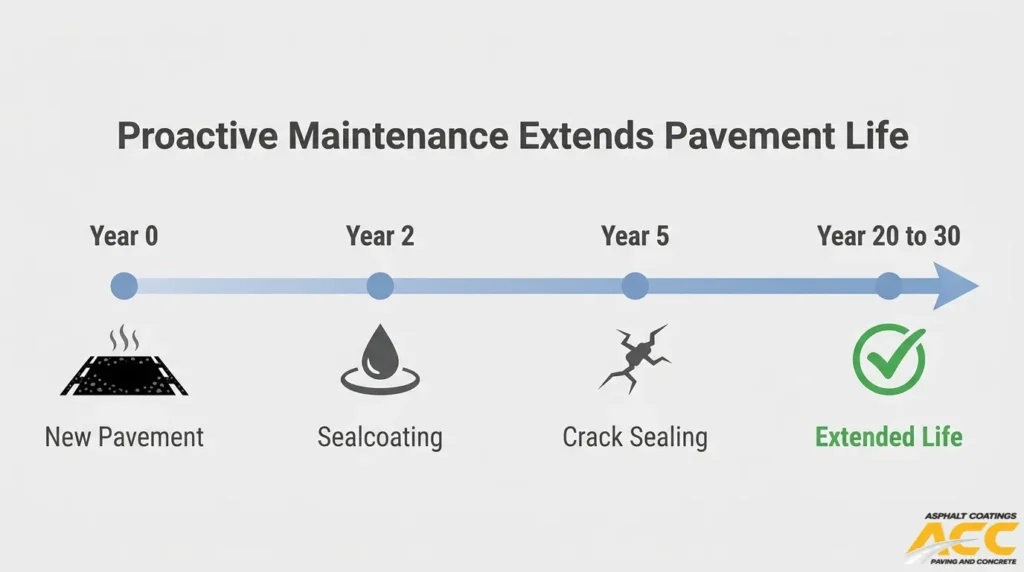
A maintenance plan can extend the life of a newly paved lot by scheduling preventive treatments before minor deterioration becomes costly structural damage. According to the American Public Works Association’s Pavement Preservation: Extending the Life of Your Pavement Network, “if appropriate treatments are applied during the early stages of deterioration, it is possible to keep good roads good with minimal investments, instead of performing costly rehabilitation treatments later in the pavement’s life when the structure has deteriorated.”
An effective plan typically includes:
- Sealcoating every two to three years to protect against UV and moisture
- Crack sealing as soon as cracks appear
- Periodic restriping to maintain safety and compliance
- Annual visual inspections to catch drainage issues and surface wear early
Proactive maintenance is one of the highest-return investments a property owner can make. Without a structured plan, small cracks compound into base failures that require full reconstruction.
Why Are Documentation, Photos, and Pavement Condition Reports Valuable for Owners?
Documentation, photos, and pavement condition reports are valuable for owners because they create an objective, time-stamped record of pavement quality at each stage of its lifecycle. This evidence supports warranty claims, tracks deterioration trends, and provides proof of proper maintenance if disputes arise with tenants, insurers, or regulatory agencies.
Key documentation elements include:
- Pre-construction photos showing existing conditions and subgrade preparation
- Compaction density test results confirming installation standards were met
- Post-installation photos establishing the baseline condition
- Periodic condition reports with pavement condition index scores and noted distresses
Property managers overseeing multiple assets benefit most from consistent reporting. When budget discussions arise, documented condition data transforms pavement decisions from guesswork into evidence-based planning.
With strong warranties, proactive maintenance, and thorough documentation in place, the next consideration is how different contractor options compare in delivering these protections.
How Should You Compare DIY, Lowest-Bid, and Professional Commercial Asphalt Paving Options?
You should compare DIY, lowest-bid, and professional commercial asphalt paving options by evaluating hidden costs, crew accountability, and the questions that reveal contractor quality. The sections below cover bid risks, crew structure, and pre-hire screening.
What Are the Hidden Risks of Choosing the Lowest Paving Bid?
The hidden risks of choosing the lowest paving bid include substandard materials, inadequate compaction, missing warranty coverage, and premature pavement failure that costs more than the original savings. Low-bid contractors often cut corners on subgrade preparation or use thinner lifts to hit their price point. When compaction falls short or mix design ignores site-specific traffic loads, cracks and rutting appear within a few years. The result is an unplanned mill-and-overlay or full reconstruction at several times the original bid price.
- Thin asphalt lifts reduce structural capacity under heavy commercial traffic.
- Skipped geotechnical evaluation leads to base failures invisible at the surface.
- No written warranty leaves the property owner absorbing all repair costs.
- Poor drainage grading causes ponding water that accelerates pavement deterioration.
For most commercial properties, a bid that seems 20% cheaper upfront can easily double in total lifecycle cost once emergency repairs begin.
Why Is In-House Crews Versus Subcontractors an Important Consideration?
In-house crews versus subcontractors is an important consideration because crew structure directly affects quality control, scheduling reliability, and accountability. When a paving contractor uses in-house crews, a single company controls every phase: subgrade preparation, material placement, compaction, and striping. This integrated chain of command makes it far easier to enforce specifications, correct issues in real time, and honor warranty commitments.
Subcontracted work, by contrast, introduces fragmented responsibility. If the subgrade crew and the paving crew belong to different companies, disputes over defect liability become common. Schedule coordination also suffers; one delayed subcontractor can stall the entire project, extending disruption to tenants and customers. Property managers should confirm crew structure before signing any contract.
Which Questions Should Property Managers Ask Before Hiring a Paving Contractor?
The questions property managers should ask before hiring a paving contractor focus on verifying experience, process, and protection. A strong vetting checklist prevents costly surprises after work begins:
- How many years of commercial paving experience does the company have?
- Does the company use in-house crews or subcontractors for paving and preparation?
- What site evaluation and geotechnical steps are included before paving starts?
- Which asphalt mix designs does the contractor recommend for the property’s specific traffic loads?
- What compaction standards and quality assurance testing will be performed?
- Does the proposal include a written warranty, and what does it cover?
- Can the contractor provide references from similar commercial properties?
- How will the project be phased to minimize disruption to tenants and daily operations?
Asking these questions before comparing bids separates qualified professionals from contractors who rely solely on price to win work. With contractor quality confirmed, related asphalt services can further extend the value of a new pavement investment.
How Do Related Asphalt Services Enhance the Benefits of Professional Commercial Paving?
Related asphalt services enhance the benefits of professional commercial paving by protecting the new surface, unifying adjacent hardscapes, and ensuring regulatory compliance in a single mobilization. The key services include sealcoating and crack sealing, concrete flatwork coordination, and integrated striping, signage, and ADA work.
How Do Sealcoating and Crack Sealing Protect and Extend New Asphalt?
Sealcoating and crack sealing protect and extend new asphalt by creating barriers against moisture, UV degradation, and oxidation before these forces compromise the pavement structure. Sealcoating applies a protective emulsion layer that slows binder deterioration, while crack sealing fills voids that would otherwise channel water into the subbase.
According to the American Public Works Association’s guidance on pavement preservation, applying appropriate treatments during the early stages of deterioration keeps good roads good with minimal investments, instead of requiring costly rehabilitation after the structure has deteriorated. Scheduling sealcoating within two to three years of installation, followed by crack sealing as hairline cracks first appear, is one of the most cost-effective maintenance sequences a property manager can adopt.
When Should Concrete Flatwork Be Coordinated With Asphalt Paving on a Property?
Concrete flatwork should be coordinated with asphalt paving whenever a property includes curbs, gutters, sidewalks, or ADA-accessible routes that tie directly into the asphalt surface. Installing both materials during the same project allows the contractor to establish correct grades, drainage slopes, and transition joints before any surface is placed.
When concrete and asphalt work are phased separately, mismatched elevations can create ponding zones and trip hazards at transition points. Coordinating both scopes under one mobilization also reduces total project cost by sharing equipment, traffic control, and crew staging. For commercial properties with loading docks, drive aisles, and pedestrian paths, this unified approach prevents the rework that comes from trying to match surfaces after the fact.
How Does Integrating Striping, Signage, and ADA Work Maximize Project Value?
Integrating striping, signage, and ADA work maximizes project value by converting a freshly paved surface into a fully functional, code-compliant parking facility without scheduling additional contractors. Striping defines traffic flow and stall count. Signage directs drivers and pedestrians. ADA-compliant elements, such as access aisles, detectable warnings, and van-accessible stalls, satisfy federal accessibility requirements.
According to the U.S. Access Board’s Chapter 5 parking guidance, parking spaces and access aisles must meet requirements for floor and ground surfaces and cannot have changes in level other than slopes not exceeding 1:48. Completing these elements immediately after paving, while layout dimensions are fresh and the surface is pristine, ensures precise compliance and avoids costly retrofit projects later.
Bundling related services into one scope sets the stage for a long-term maintenance partnership.
How Should You Approach the Benefits of Professional Commercial Asphalt Paving With Asphalt Coatings Company?
You should approach professional commercial asphalt paving with Asphalt Coatings Company as a long-term infrastructure partnership. The sections below cover how Asphalt Coatings Company’s services maximize pavement value and the key takeaways from this guide.
How Can Asphalt Coatings Company’s Paving and Maintenance Services Maximize the Value of Your Commercial Asphalt?
Asphalt Coatings Company’s paving and maintenance services maximize value by combining proper engineering, quality materials, and proactive preservation into a single-source solution. Since 1986, Asphalt Coatings Company has served Colorado’s Front Range with in-house crews specializing in commercial asphalt paving, sealcoating, crack sealing, mill-and-pave services, parking lot striping, and ADA-compliant concrete work.
This integrated approach matters because commercial pavements designed for normal traffic conditions can reach a 30-year usage period, according to a life cycle assessment by Rutgers Center for Advanced Infrastructure and Transportation. Reaching that benchmark requires the right mix design, proper compaction, and timely maintenance; skipping any step shortens pavement life and inflates costs. Asphalt Coatings Company handles subgrade preparation, installation, and ongoing preservation under one roof, so nothing falls through the cracks between separate contractors.
What Are the Key Takeaways About the Benefits of Professional Commercial Asphalt Paving?
The key takeaways about the benefits of professional commercial asphalt paving center on five actionable principles:
- Durability depends on engineering. Correct mix design, compaction control, and subgrade preparation prevent premature rutting, cracking, and structural failure.
- Early maintenance protects your investment. Sealcoating, crack sealing, and timely overlays cost a fraction of full reconstruction and can double effective pavement life.
- Safety and compliance reduce liability. Smooth surfaces, proper drainage, ADA-compliant slopes, and clear striping protect drivers, pedestrians, and property owners.
- Curb appeal drives revenue. Well-maintained asphalt increases tenant satisfaction, supports higher lease rates, and strengthens first impressions for customers.
- Contractor selection determines outcomes. In-house crews, transparent documentation, and a partnership approach consistently outperform lowest-bid and piecemeal strategies.
For property managers weighing their next paving decision, prioritizing quality over short-term savings is the single most impactful choice. Asphalt Coatings Company can help you plan, execute, and maintain commercial pavement that performs for decades across Colorado’s Front Range.