Asphalt paving is a flexible surface made from aggregates bound with bitumen, while concrete paving is a rigid composite of Portland cement, water, air, and aggregates. Each material delivers distinct advantages depending on project budget, climate, and expected use.
This guide covers material composition and installation, cost comparisons across short and long-term horizons, the pros and cons of each surface, climate and durability performance, and commercial application suitability.
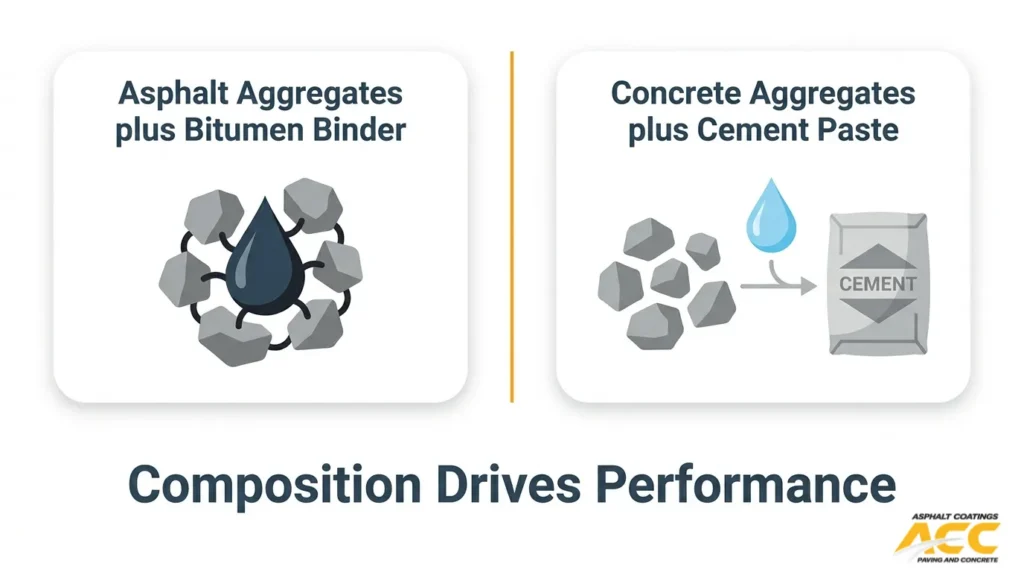
Asphalt combines crushed rock, sand, and gravel with a petroleum-based binder that allows the surface to flex under ground movement and thermal shifts. Concrete blends coarse and fine aggregates with cement paste, forming a rigid slab that distributes loads across a wider area. These compositional differences directly influence how each material is installed, how long it lasts, and what maintenance it requires.
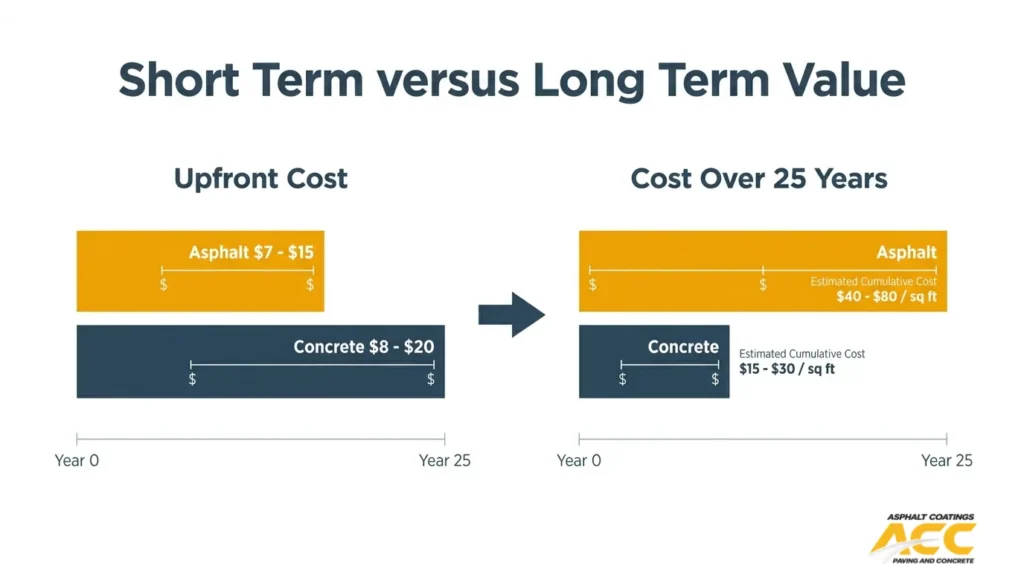
Asphalt typically costs $7 to $15 per square foot, while concrete ranges from $8 to $20. Asphalt wins on shorter investment horizons under 15 years; concrete becomes more competitive over 25-plus-year timelines as its lower maintenance frequency offsets the higher upfront price.
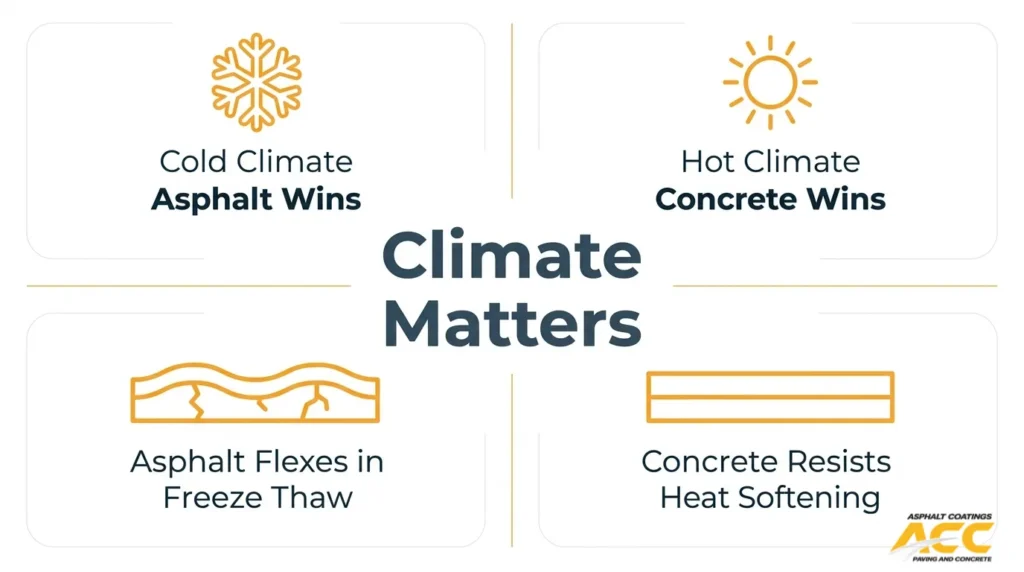
Asphalt’s flexibility makes it well suited for cold climates with freeze-thaw cycles, and its rapid curing allows surfaces to reopen within hours. Concrete resists softening in hot climates, handles sustained heavy loads without rutting, and offers stamping and staining options for properties where appearance matters.
Both materials carry distinct environmental profiles. Approximately 90% of asphalt is recycled in the U.S., while concrete’s longer service life reduces cumulative repaving cycles. Permeable versions of both surfaces help manage stormwater runoff in commercial settings.
What Is Asphalt Paving?
Asphalt paving is the process of laying a flexible pavement surface composed of aggregates bound together with bitumen. According to the European Asphalt Pavement Association (EAPA), asphalt is a mixture of aggregates, binder, and filler, where aggregates can be crushed rock, sand, gravel, or slags, and bitumen is most commonly used as the binder. A typical asphalt pavement contains approximately 95% stone, sand, and gravel aggregates, which provide the structural strength necessary to support heavy traffic weight and volume. This aggregate-dense composition makes asphalt particularly well suited for roads, parking lots, and driveways where load-bearing capacity and surface flexibility are essential. Because asphalt remains slightly flexible after curing, it absorbs minor ground movement and thermal expansion without cracking as readily as rigid alternatives. Understanding this material’s composition and behavior is key to evaluating how it compares to concrete in cost, durability, and climate performance.
What Is Concrete Paving?
Concrete paving is a construction method that uses a rigid composite of Portland cement, water, air, and aggregates to create durable, load-bearing surfaces. According to the Federal Highway Administration (FHWA), concrete consists of a paste portion (water, cement, and air) constituting 25 to 40 percent of the volume, with coarse and fine aggregates making up the remainder. This rigid structure distributes loads across a wider area than flexible pavements, which is why concrete performs well under sustained heavy traffic. Once placed, the material requires a curing period before it can handle vehicle loads. Concrete paving is commonly used for highways, commercial parking lots, sidewalks, and industrial yards where long-term structural integrity matters most.
What Are the Key Differences Between Asphalt and Concrete?
The key differences between asphalt and concrete span composition, installation, and appearance. Each material uses distinct binders and aggregates, follows a different paving timeline, and produces a unique visual result.
How Do Asphalt and Concrete Differ in Composition?
Asphalt and concrete differ in composition primarily through their binding agents. Asphalt combines aggregates (crushed rock, sand, and gravel) with bitumen, a petroleum-based binder that creates a flexible, dark surface. Concrete blends coarse and fine aggregates with Portland cement and water, forming a rigid, light-colored slab.
This compositional difference directly affects longevity. According to an industry publication by Concrete Is Better, concrete pavements have an average life expectancy of 27.5 years before requiring major repair, while asphalt pavements average 15.5 years. The flexible bitumen binder in asphalt absorbs movement but degrades faster under UV exposure and oxidation. Cement paste in concrete resists weathering longer, though it is more prone to cracking under shifting loads. For commercial property managers weighing long-term value, understanding these material foundations is essential before comparing costs or maintenance cycles.
How Does the Installation Process Compare?
The installation process for asphalt is faster and less disruptive than concrete. Asphalt can typically be laid and opened to traffic within one to two days, since compaction occurs while the material is still hot and cooling is relatively quick. Concrete requires significantly more curing time before it can bear loads.
Key installation differences include:
- Production temperature: Hot Mix Asphalt is produced between 150°C and 180°C, while concrete is mixed at ambient temperatures and hardens through a chemical hydration process.
- Curing period: Asphalt is usable within hours of cooling; concrete generally needs a full 7-day curing period, reducible to 3 days with high early-strength mixes.
- Weather sensitivity: Asphalt installation requires warm, dry conditions for proper compaction, whereas concrete pours must avoid freezing temperatures during the curing window.
For properties that cannot afford extended downtime, asphalt’s rapid turnaround is a significant operational advantage.
How Do Asphalt and Concrete Differ in Appearance?
Asphalt and concrete differ in appearance through color, texture, and design versatility. Fresh asphalt presents a smooth, deep black surface that gradually fades to gray as the bitumen binder oxidizes over time. Concrete starts as a light gray and retains a brighter, more reflective surface throughout its lifespan.
Concrete holds an advantage in decorative flexibility, with finishes that can mimic more expensive materials through stamping, staining, and exposed aggregate techniques. Asphalt offers a uniform, utilitarian look well suited to commercial parking lots and roadways where function takes priority over aesthetics. Although sealcoating can restore asphalt’s rich black appearance periodically, concrete provides more options for properties where curb appeal influences tenant or customer perception.
Beyond visual preference, installation goals and maintenance realities also shape material choice.
How Much Does Asphalt Paving Cost Compared to Concrete?
Asphalt paving costs less than concrete in most upfront comparisons, though long-term expenses shift depending on maintenance and lifespan. The following sections break down per-square-foot pricing for each material and examine which delivers lower costs over time.
How Much Does Asphalt Paving Cost Per Square Foot?
Asphalt paving costs between $7 and $15 per square foot for driveway-scale projects. For broader residential applications, homeowners typically pay between $2 and $7 per square foot, with the final price reflecting grading, base depth, and drainage work. According to Angi’s 2026 pricing data, asphalt ranges from $7 to $15 per square foot, compared to $3 to $18 per square foot for concrete.
Several factors influence where a project falls within that range:
- Subgrade preparation and grading requirements
- Asphalt thickness and base layer depth
- Site accessibility and project size
- Local material and labor market conditions
For commercial properties, costs often trend toward the higher end due to heavier-duty specifications and stricter drainage requirements.
How Much Does Concrete Paving Cost Per Square Foot?
Concrete paving costs between $8 and $20 per square foot for most residential and commercial applications. This higher baseline reflects concrete’s more labor-intensive installation process, longer curing period, and the cost of reinforcement materials like rebar or wire mesh.
Decorative finishes, including stamping and staining, push costs further toward the upper range. Site conditions also matter; projects requiring extensive subgrade work or complex grading add to the total. While concrete’s upfront price exceeds asphalt in nearly every comparable scenario, its longer service life can offset that initial premium for property owners planning to hold assets for decades.
Which Material Has Lower Long-Term Costs?
The material with lower long-term costs depends on maintenance consistency and expected service life. Asphalt requires periodic sealcoating every three to five years and occasional crack repair, but each intervention is relatively inexpensive. Concrete demands less frequent maintenance, yet individual repairs, such as slab replacement, cost significantly more when they become necessary.
UV radiation accelerates binder degradation in asphalt surfaces, which means neglecting preventive maintenance shortens pavement life and increases cumulative spending. Concrete resists UV damage better but remains vulnerable to freeze-thaw cracking, particularly in climates with harsh winters.
For commercial property owners evaluating total cost of ownership, asphalt typically wins on shorter investment horizons under 15 years, while concrete becomes more competitive over 25-plus-year timelines. Choosing between the two materials ultimately comes down to balancing upfront budget constraints against long-term maintenance planning.
What Are the Pros and Cons of Asphalt Paving?
The pros and cons of asphalt paving center on its cost efficiency, recyclability, and fast installation versus its shorter lifespan and ongoing maintenance needs. The following subsections break down specific advantages and disadvantages.
What Are the Advantages of Asphalt Paving?
The advantages of asphalt paving include lower upfront cost, faster installation, high recyclability, and easier repair. According to the European Asphalt Pavement Association (EAPA), asphalt is a mixture of aggregates, binder, and filler that can be engineered for a wide range of applications.
Key benefits include:
- Lower initial cost. Asphalt paving typically costs less per square foot than concrete, making it budget-friendly for large commercial surfaces.
- Faster installation and curing. Asphalt surfaces can be driven on within hours of placement, minimizing business disruption.
- High recyclability. Approximately 90% of asphalt is recycled through reclamation programs, and machine vision technology now characterizes Reclaimed Asphalt Pavement (RAP) particles by coating and shape to ensure structural quality in recycled mixes.
- Flexibility under stress. Asphalt flexes with minor ground movement rather than cracking, which is particularly valuable in regions with freeze-thaw cycles.
- Simpler repairs. Patching and resurfacing asphalt is straightforward, allowing targeted fixes without replacing entire sections.
For commercial property managers weighing material options, asphalt’s combination of affordability and repairability often delivers the strongest short-to-mid-term return.
What Are the Disadvantages of Asphalt Paving?
The disadvantages of asphalt paving include a shorter service life, regular maintenance demands, heat sensitivity, and limited aesthetic options.
Notable drawbacks are:
- Shorter lifespan. Asphalt surfaces generally require major intervention sooner than concrete, meaning more frequent resurfacing cycles over a property’s lifetime.
- Ongoing maintenance. Sealcoating every two to three years and periodic crack sealing are necessary to preserve surface integrity and prevent water infiltration.
- Heat susceptibility. Asphalt softens in extreme heat, which can lead to rutting under heavy loads during peak summer temperatures.
- UV degradation. Prolonged sun exposure breaks down the asphalt binder over time, causing oxidation, brittleness, and surface cracking.
- Limited design versatility. Asphalt offers fewer decorative finish options compared to concrete, which can be stamped, stained, or textured.
Despite these limitations, a well-maintained asphalt surface still delivers reliable performance for commercial properties. Understanding both sides helps property managers plan realistic maintenance budgets alongside their initial paving investment.
What Are the Pros and Cons of Concrete Paving?
The pros and cons of concrete paving center on its durability, appearance, and higher upfront investment. The sections below cover concrete’s key advantages and disadvantages.
What Are the Advantages of Concrete Paving?
The advantages of concrete paving include superior longevity, design versatility, and lower long-term maintenance frequency. Key benefits are:
- Extended lifespan. Concrete pavements have an average life expectancy of 27.5 years before requiring major repair, according to an industry publication by Concrete Is Better.
- Design flexibility. Stamping, staining, and specialized finishes allow concrete to mimic more expensive materials, giving property owners greater aesthetic control.
- Lower maintenance frequency. Concrete surfaces do not require periodic sealcoating the way asphalt does, reducing routine upkeep costs over the pavement’s service life.
- High load-bearing capacity. Rigid concrete handles sustained heavy loads without rutting, which makes it well suited for loading docks and high-traffic commercial areas.
For properties where appearance and decades of service matter most, concrete is difficult to beat.
What Are the Disadvantages of Concrete Paving?
The disadvantages of concrete paving include higher installation costs, longer curing times, and more complex repairs. Notable drawbacks are:
- Higher upfront cost. Concrete driveways typically range from $8 to $20 per square foot, compared to $7 to $15 for asphalt.
- Extended curing period. The FHWA specifies a 7-day curing period after placement for standard Portland cement concrete, which delays the time before the surface can carry traffic.
- Difficult repairs. Cracked concrete slabs often require full-panel replacement rather than simple patching, increasing both repair cost and project disruption.
- Susceptibility to salt damage. De-icing chemicals can cause surface scaling and spalling over repeated freeze-thaw cycles, a significant concern in cold-climate regions.
These trade-offs make concrete a stronger fit for long-horizon projects where owners can absorb higher initial costs. Understanding how each material handles specific climates helps refine that decision further.
How Does Each Material Perform in Different Climates?
Each material performs differently in cold and hot climates based on its flexibility, thermal properties, and resistance to temperature extremes. The sections below cover asphalt and concrete performance across both cold and hot conditions.
How Does Asphalt Perform in Cold Climates?
Asphalt performs well in cold climates because its flexible composition absorbs the expansion and contraction caused by freeze-thaw cycles. This flexibility allows asphalt pavement to shift with underlying ground movement without cracking as readily as rigid surfaces. Cold temperatures do make asphalt more brittle over time, but routine sealcoating and crack sealing can extend its winter resilience. According to the Asphalt Pavement Alliance, 99.6% of the carbon in asphalt binder is stored rather than emitted, which means maintenance treatments like recycled overlays remain a practical, low-impact cold-climate repair strategy. For regions experiencing harsh winters, asphalt’s ability to flex under thermal stress makes it a dependable choice.
How Does Concrete Perform in Cold Climates?
Concrete performs less predictably in cold climates due to its rigid structure, which resists flexing during freeze-thaw cycles. Water that penetrates surface pores or joints can freeze, expand, and cause spalling or cracking over repeated cycles. De-icing salt compounds accelerate this deterioration by increasing the number of effective freeze-thaw events within the slab. However, specialized formulations improve cold-weather durability. According to a peer-reviewed study published in Applied Sciences, roller-compacted concrete pavements demonstrate significant load-bearing capacity and resistance to traffic abrasion, with performance metrics influenced heavily by aggregate micro-texture. Air-entrained concrete mixes also help by creating microscopic voids that accommodate ice expansion internally. Despite these advances, concrete in cold climates typically demands more careful joint sealing and surface treatment than asphalt.
How Does Asphalt Perform in Hot Climates?
Asphalt performs adequately in hot climates but requires careful mix design to prevent softening. High ambient temperatures cause the bitumen binder to become more pliable, which can lead to rutting, shoving, and surface deformation under heavy traffic loads. Dark-colored asphalt also absorbs significant solar radiation, raising surface temperatures well above air temperature on peak summer days. Selecting polymer-modified binders and using coarser aggregate gradations helps resist heat-related distortion. For commercial properties in warm regions, scheduling heavy deliveries during cooler hours reduces the risk of surface damage during the first few years after installation.
How Does Concrete Perform in Hot Climates?
Concrete performs strongly in hot climates because its rigid structure resists softening and rutting under sustained high temperatures. The lighter color of concrete reflects more solar energy than asphalt, keeping surface temperatures lower and reducing heat absorption. This reflectivity can also lower ambient temperatures in surrounding areas, making concrete a practical choice for large commercial parking lots in warm regions. The primary hot-climate concern for concrete is thermal expansion at joints; without proper spacing, expanding slabs can buckle or develop pressure-related cracks. Adequate joint design and timely sealing prevent most heat-related failures. For properties facing year-round sun exposure, concrete’s dimensional stability under heat makes it a strong long-term performer.
Understanding how climate affects each material helps narrow the decision, but projected lifespan is equally important when comparing long-term value.
How Long Does Asphalt Last Compared to Concrete?
Asphalt lasts roughly half as long as concrete under comparable conditions. The sections below break down expected lifespans for each material.
What Is the Expected Lifespan of an Asphalt Surface?
The expected lifespan of an asphalt surface is 15 to 20 years with proper preventive maintenance. Several factors shorten or extend that range:
- UV exposure degrades the bitumen binder, causing oxidation and surface cracking.
- Heavy traffic loads accelerate rutting and fatigue distress.
- Chemical exposure poses a measurable risk; a study published in Cold Regions Science and Technology found that asphalt concrete exposed to sodium chloride de-icing solutions loses 15.47% of its Marshall Stability after prolonged immersion.
- Freeze-thaw cycling widens existing cracks if water infiltrates the pavement structure.
Routine sealcoating, crack sealing, and timely overlays can push asphalt well past the 15-year mark. Without that maintenance cycle, deterioration accelerates quickly, making proactive care a non-negotiable investment for commercial properties.
What Is the Expected Lifespan of a Concrete Surface?
The expected lifespan of a concrete surface is 25 to 30 years or longer before requiring major structural repair. Federally funded studies cited by the Michigan Concrete Association indicate that concrete interstate highways in the United States last an average of 2.5 times longer than asphalt highways.
Concrete’s rigid slab structure resists rutting and load deformation more effectively than flexible asphalt. Joint sealing and periodic surface treatments extend service life further, though repairs cost more when they are eventually needed. For property managers evaluating long-term investment value, concrete’s longer lifespan often offsets its higher upfront price, particularly in low-maintenance, heavy-load applications.
Understanding lifespan differences sets the stage for comparing ongoing maintenance demands.
How Do Maintenance Requirements Compare?
Maintenance requirements compare significantly between asphalt and concrete, differing in frequency, cost, and the types of treatments each material needs over its service life.
What Maintenance Does Asphalt Paving Require?
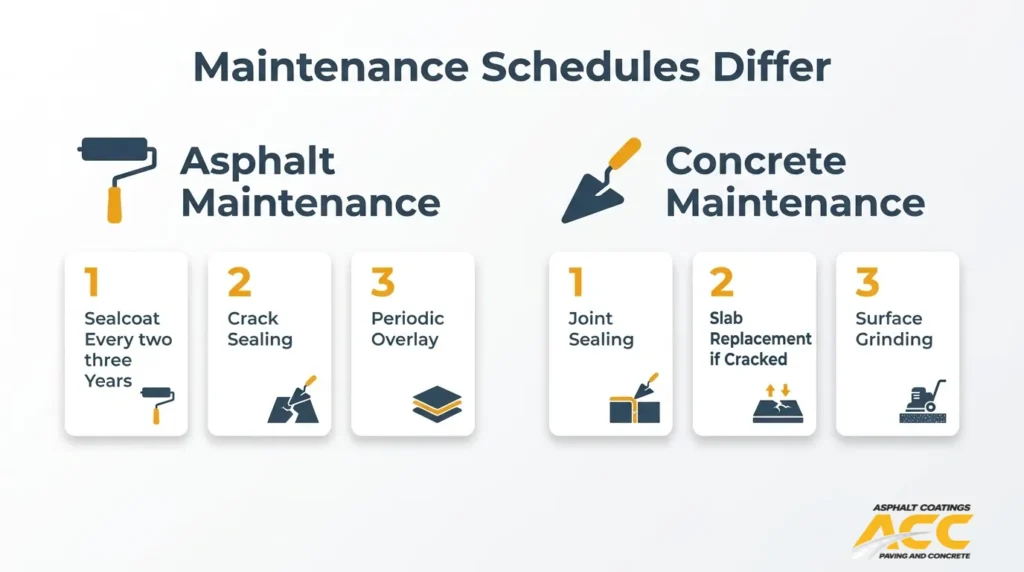
Asphalt paving requires regular preventive treatments to preserve surface integrity and extend usable life. Key maintenance tasks include:
- Sealcoating every 2 to 3 years to protect the binder from UV degradation and moisture infiltration.
- Crack sealing as soon as cracks appear, preventing water from reaching the subgrade.
- Patching and pothole repair to address localized failures before they spread.
- Periodic overlay or resurfacing when surface wear becomes widespread.
According to the Federal Highway Administration (FHWA), state agencies typically expect asphalt pavements to last at least 20 years with proper preventive maintenance. Staying ahead of small repairs is what separates a 12-year surface from a 20-year one.
What Maintenance Does Concrete Paving Require?
Concrete paving requires less frequent intervention than asphalt, though the repairs it does need tend to be more complex and costly. Primary maintenance activities include:
- Joint sealing to prevent water and debris from infiltrating expansion joints.
- Slab replacement for sections with severe cracking or settling.
- Surface grinding or diamond grinding to restore ride quality and texture.
- Spall repair to address surface flaking caused by freeze-thaw exposure.
Proper initial curing is also critical; FHWA guidelines specify a 7-day curing period after placement for standard Portland cement concrete pavements, reducible to 3 days when high early-strength mixes are used. Skipping or shortening this curing window compromises long-term durability and increases future maintenance costs.
With maintenance needs defined for both materials, comparing their suitability for high-traffic commercial environments adds further clarity.
Which Material Is Better for Commercial Parking Lots?
The better material for a commercial parking lot depends on traffic volume and load requirements. The following sections compare asphalt and concrete performance in high-traffic areas and heavy-load facilities.
Is Asphalt or Concrete Better for High-Traffic Areas?
Concrete is generally better for high-traffic areas. Rigid concrete pavement outperforms flexible asphalt pavement in economic and safety benefits with less environmental impact in certain high-traffic applications, according to a Concrete Is Better industry publication. Concrete’s rigid structure resists rutting and deformation under constant vehicle movement, while asphalt’s flexibility can lead to surface depression over time.
However, asphalt offers faster installation and reopening times, which matters when minimizing disruption to active commercial properties. For parking lots experiencing heavy freeze-thaw exposure, concrete also maintains better skid resistance when sodium chloride de-icing chemicals are applied beyond 100 freeze-thaw cycles. The right choice ultimately hinges on whether the property prioritizes long-term structural resilience or faster project turnaround with lower upfront costs.
Is Asphalt or Concrete Better for Heavy-Load Facilities?
Asphalt is often better for heavy-load facilities such as warehouses, distribution centers, and industrial yards. A typical asphalt pavement contains approximately 95% stone, sand, and gravel aggregates, which provide the structural strength necessary to absorb and distribute heavy vehicle loads without cracking. This flexibility allows asphalt to shift slightly under concentrated weight, reducing the risk of sudden structural failure.
Concrete, while extremely strong in compression, is more prone to cracking under repetitive point loads from forklifts, semi-trucks, and heavy equipment. Once a concrete slab cracks, repairs are costly and disruptive. Asphalt damage, by contrast, can be patched quickly and reopened to traffic the same day. For facilities where operational continuity and repairability matter as much as raw strength, asphalt delivers a more practical long-term solution.
Understanding how each material handles commercial demands helps clarify broader environmental trade-offs between the two.
How Do Environmental Impacts Compare?
Environmental impacts compare favorably for asphalt in recyclability, while concrete offers advantages in longevity-related resource conservation. Both materials affect urban heat, carbon emissions, and stormwater management differently.
Asphalt is one of the most recycled materials in the United States. According to the U.S. Environmental Protection Agency, approximately 90% of asphalt is recycled or disposed of through recycling programs. This high reclamation rate means old asphalt pavement re-enters new mixes, reducing virgin material extraction and landfill waste significantly.
Concrete, by contrast, has a longer service life that reduces how often repaving is needed. Fewer reconstruction cycles over decades translate to lower cumulative resource consumption for high-traffic installations. However, cement production is energy-intensive, and the carbon footprint of manufacturing Portland cement remains a concern across the construction industry.
Both surfaces contribute to the Urban Heat Island effect. Asphalt’s dark color absorbs more solar radiation initially, though reflective sealcoats can mitigate this. Concrete’s lighter surface reflects more sunlight but still reaches extreme temperatures under direct exposure. Permeable versions of both materials help manage stormwater runoff by allowing water to infiltrate rather than overwhelming drainage systems.
The EPA also reports that 99.6% of the carbon in asphalt binder is stored rather than released as greenhouse gas emissions. This carbon sequestration quality, combined with asphalt’s recyclability, makes it a strong candidate for sustainability-focused projects. For commercial property managers weighing long-term environmental responsibility, the best choice often depends on project scale, expected traffic, and local climate conditions.
Understanding these environmental trade-offs helps clarify when each material aligns with broader sustainability goals.
When Should You Choose Asphalt Over Concrete?
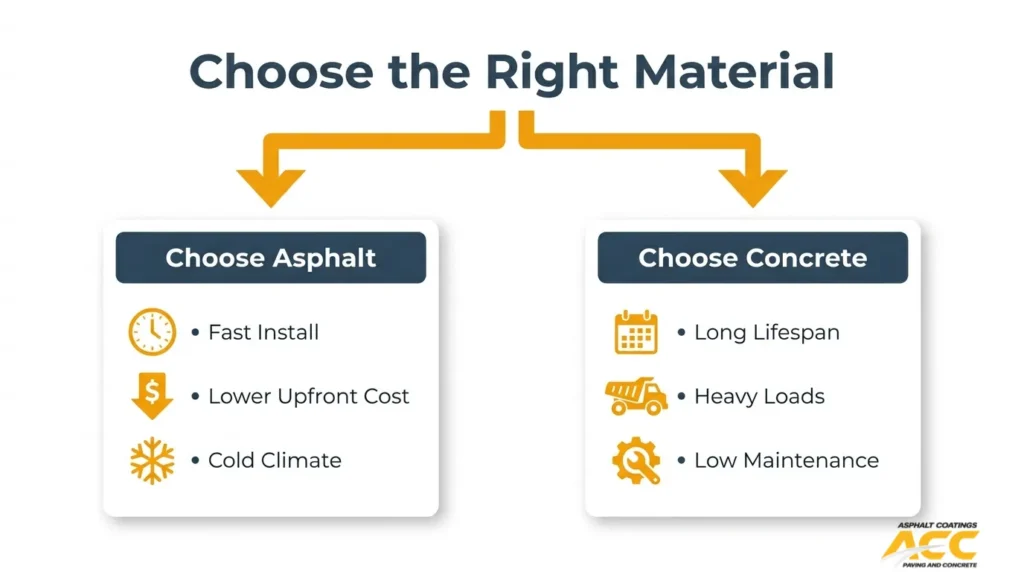
You should choose asphalt over concrete when your project demands lower upfront costs, faster installation timelines, and flexibility to handle freeze-thaw cycles. Asphalt also suits properties where future repairs need to be quick and cost-effective.
Several scenarios favor asphalt as the stronger choice:
- Budget-sensitive projects benefit from asphalt’s lower per-square-foot cost, which frees capital for other property improvements.
- Cold-climate properties perform better with asphalt because it flexes with ground movement during freeze-thaw cycles rather than cracking rigidly.
- Tight construction schedules are easier to meet since asphalt cures in days, not weeks, minimizing disruption to tenants and customers.
- High-maintenance-tolerance owners who plan for routine sealcoating every few years can extend asphalt’s service life significantly at modest cost.
- Recyclability priorities align with asphalt; approximately 90% of asphalt is recycled in the U.S., according to U.S. Environmental Protection Agency data.
For most commercial property managers weighing flexibility against longevity, asphalt delivers the best return when maintenance commitments are realistic and upfront savings matter. Understanding when concrete makes more sense completes the comparison.
When Should You Choose Concrete Over Asphalt?
You should choose concrete over asphalt when longevity, minimal maintenance, and aesthetic versatility are top priorities. Concrete suits projects where upfront investment yields decades of low-intervention performance.
Concrete is the stronger choice for properties that need to minimize lifecycle costs over 25+ years. Facilities with heavy static loads, such as loading docks and equipment staging areas, benefit from concrete’s rigid structure, which resists deformation under sustained weight. According to an industry publication by Concrete Is Better, concrete pavements have an average life expectancy of 27.5 years before requiring major repair, compared to 15.5 years for asphalt.
Properties where curb appeal matters also favor concrete. Stamped patterns, integral color, and exposed aggregate finishes allow concrete to complement architectural design in ways asphalt cannot match. For commercial settings where branding and first impressions influence tenant satisfaction or customer traffic, this design flexibility carries real value.
Concrete also performs well in scenarios involving chemical exposure. Fuel, hydraulic fluid, and oil spills degrade asphalt binder over time, while concrete resists petroleum-based chemicals more effectively. Distribution centers, fueling stations, and industrial yards often benefit from this resilience.
From a practical standpoint, choosing concrete makes the most sense when the property owner plans to hold the asset long-term and wants to avoid frequent resurfacing cycles. The higher initial cost pays off when maintenance budgets are tight and pavement disruptions carry operational consequences. Understanding these concrete-favorable scenarios helps clarify when asphalt remains the better fit.
How Should You Approach Choosing the Right Paving Material for a Commercial Property?
You should approach choosing the right paving material for a commercial property by evaluating traffic volume, climate exposure, budget, and long-term maintenance needs together. The sections below cover how professional paving services guide this decision and the key takeaways from the asphalt vs. concrete comparison.
Can Commercial Paving and Concrete Services Help With Your Project Decision?
Yes, commercial paving and concrete services can help with your project decision by assessing site-specific conditions that generic research cannot address. Experienced contractors evaluate subgrade quality, drainage patterns, expected vehicle loads, and regional climate factors before recommending a material.
Flexibility and resistance to freeze-thaw cycles rank among the top decision factors property managers search for when comparing asphalt vs. concrete for commercial properties. A qualified paving contractor translates these broad concerns into site-specific recommendations, accounting for variables like sun exposure, chemical contact from vehicles, and stormwater management requirements.
Concrete’s versatility in finishes, including stamping and staining that mimic more expensive materials, also factors into the aesthetic side of commercial project planning. Asphalt Coatings Company evaluates both functional performance and visual requirements for every commercial project, ensuring the selected material aligns with operational demands and property presentation goals.
What Are the Key Takeaways About Asphalt vs. Concrete Paving?
The key takeaways about asphalt vs. concrete paving center on matching material strengths to project priorities:
- Asphalt costs less upfront, installs faster, and performs well in cold climates with freeze-thaw exposure.
- Concrete lasts longer, handles heavy sustained loads, and offers greater design versatility.
- Both materials require ongoing maintenance, though the type and frequency differ significantly.
- Climate, traffic patterns, and budget constraints should drive the final material selection.
- Porous versions of both asphalt and concrete can reduce stormwater runoff volume in commercial settings, according to the U.S. Environmental Protection Agency.
For most commercial properties, the decision is rarely about one material being universally superior. It comes down to which material’s strengths align with the property’s specific operational demands, environmental conditions, and long-term investment strategy. Asphalt Coatings Company specializes in both asphalt paving and concrete flatwork, providing the expertise to recommend the right solution for each project.