An asphalt milling contractor is a specialized paving professional who uses cold milling machines to grind and remove deteriorated pavement to a precise depth, preparing the surface for a new asphalt overlay. This mechanical removal process restores proper grades, creates a textured bonding surface, and preserves existing drainage infrastructure.
We cover why milling is a critical first step before resurfacing, how the milling process and equipment work, the different milling types available, project costs, contractor selection, climate considerations, and long-term planning for commercial properties.
Skipping milling before an overlay risks covering structural failures like base deterioration and alligator cracking, while also raising pavement elevation above curb lines and drainage inlets. Milling eliminates these risks by cutting back to sound material and restoring the grades that keep water flowing where it belongs.
The milling process relies on rotating drums fitted with carbide teeth that achieve grade accuracy within ± 1/8 inch. Removed material becomes reclaimed asphalt pavement (RAP) with reuse rates consistently above 96%, making milling one of the most sustainable operations in commercial paving.
Four distinct milling types serve different project needs: full-depth milling for structural failures, fine and micro milling for surface corrections and thin overlays, and profile milling using 3D machine control for precision grade restoration. Costs range from $2.50 to $8.00 per square yard depending on depth, with mobilization fees adding significant expense to smaller projects.
Choosing the right contractor means verifying in-house crews, single-source milling-through-overlay capability, and documented commercial experience. Freeze-thaw cycles, UV exposure, and seasonal temperature windows all influence when milling should be scheduled, while Pavement Condition Index scores guide whether milling or full replacement is the appropriate investment.
Why Is Asphalt Milling Essential Before Resurfacing?
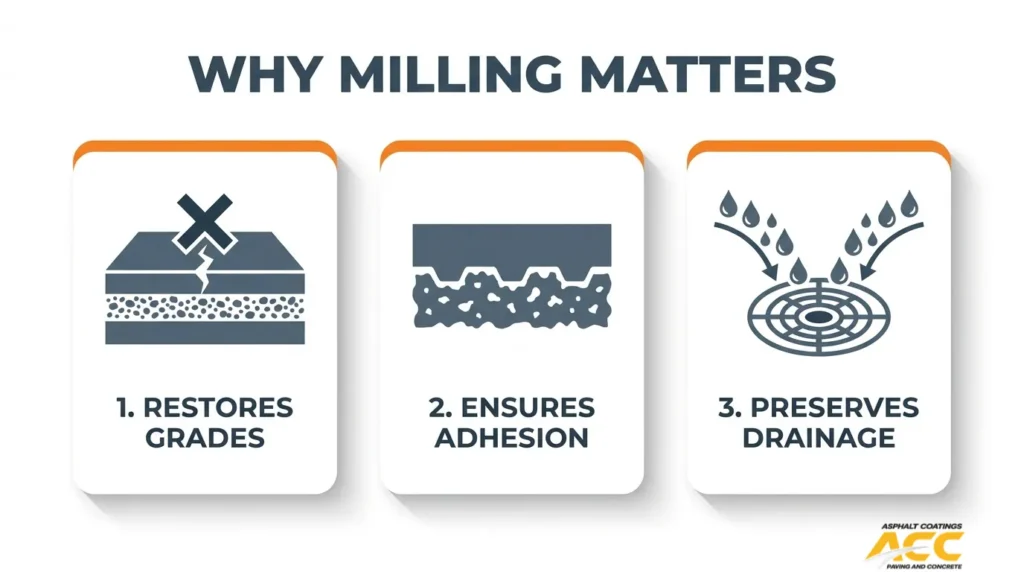
Asphalt milling is essential before resurfacing because it restores proper surface grades, ensures overlay adhesion, and preserves drainage infrastructure. The following subsections cover the risks of skipping milling, how milled surfaces bond with new asphalt, and why drainage depends on accurate grade control.
What Happens If You Overlay Without Milling First?
Overlaying without milling first creates hidden structural risks that lead to premature pavement failure. While skipping the milling step is typically 25–35% less expensive upfront, according to a 2025 property manager guide by Fix Asphalt, this approach risks covering up structural issues like alligator cracks and base failure that cause the new surface to deteriorate far sooner than expected.
Each successive overlay also raises the pavement elevation, creating mismatches with curb lines, catch basins, and adjacent concrete. For commercial properties, this means potential ADA compliance violations and ponding water at building entries. What appears to be a cost savings often doubles the total expense when the overlay fails within a few years and requires complete removal.
How Does Milling Improve Asphalt Overlay Adhesion?
Milling improves asphalt overlay adhesion by creating a rough, textured surface that mechanically bonds with the new hot-mix layer. According to research from the Purdue University Joint Transportation Research Program, surface texture improvements from milling increase the bonding coefficient between old pavement and new overlay, which is critical for preventing delamination and extending service life.
Standard milling depths for overlay preparation range from 1 to 4 inches, while full-depth milling can extend to 6 inches or more. For thinner overlays, micro-milling uses a drum with more teeth and closer spacing to produce a finer texture that enhances skid resistance. This mechanical interlock between milled and fresh asphalt is far more reliable than placing new material on a smooth, oxidized surface.
Why Does Milling Matter for Maintaining Proper Drainage?
Milling matters for maintaining proper drainage because it prevents pavement elevation from rising above existing curb lines and drainage inlets. Without milling, each overlay adds 1.5 to 2 inches of height, gradually redirecting water away from catch basins and toward building foundations, pedestrian walkways, or adjacent properties.
Accurate grade control during milling restores the original cross-slope and longitudinal grade that direct stormwater into the drainage system. This is especially critical for commercial parking lots where ADA-compliant curb reveal heights must be maintained. Neglecting this step often forces expensive retrofitting of drainage structures after resurfacing is already complete.
With proper milling established as the foundation, understanding the step-by-step process helps clarify what happens on-site.
How Does the Asphalt Milling Process Work?
The asphalt milling process works by using cold milling machines that mechanically grind and remove deteriorated pavement to a precise depth. The following sections cover the equipment involved, how depth is determined, and what happens to the removed material.
What Equipment Does a Milling Contractor Use?
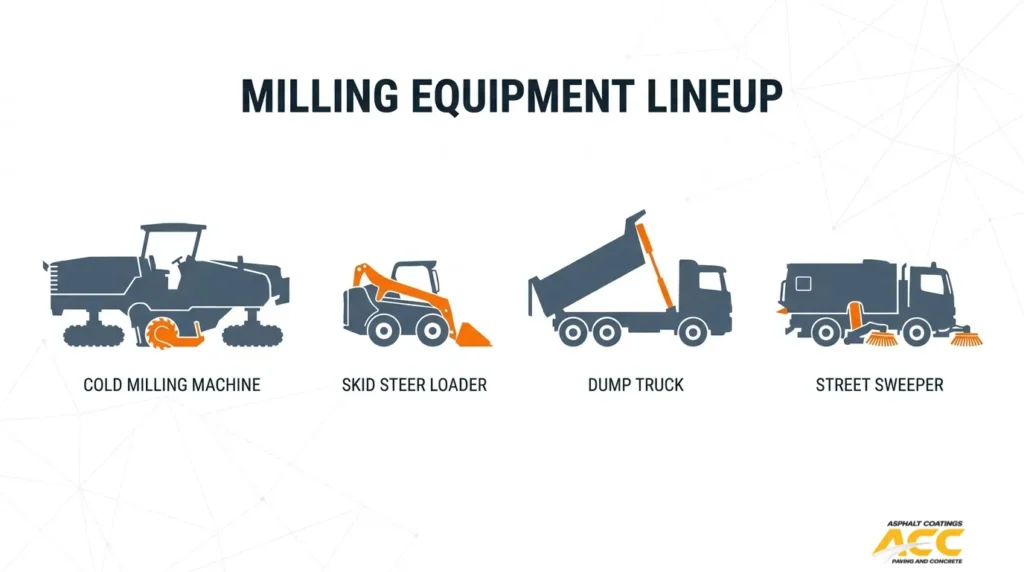
A milling contractor uses cold milling machines equipped with a rotating drum fitted with carbide teeth. These machines grind asphalt to a controlled depth while restoring the surface grade and slope. According to the Federal Highway Administration, cold milling is defined as the automatically controlled removal of pavement to a desired depth with specially designed equipment, restoring the surface to a specified grade and slope free of bumps, ruts, and other imperfections.
Beyond the milling machine itself, a typical operation includes:
- Skid steer loaders for clearing loose material from edges and confined areas.
- Dump trucks that collect milled material directly from the machine’s conveyor belt.
- A sweeper truck that cleans the milled surface before overlay placement.
For property managers evaluating bids, contractors operating their own milling equipment rather than subcontracting it typically deliver tighter schedule control and more consistent surface quality.
How Is Milling Depth Determined for Each Project?
Milling depth is determined by evaluating the pavement’s condition, the type of distress present, and the planned overlay thickness. Engineers and contractors typically consider these factors:
- Surface distress severity: Shallow cracking or rutting may require only 1 to 2 inches of removal, while extensive deterioration calls for deeper cuts.
- Overlay design thickness: The milling depth must accommodate the new asphalt layer while maintaining curb heights and drainage inlet elevations.
- Pavement structure: Core samples reveal how many layers exist and where failures originate, guiding whether a partial or full-depth cut is appropriate.
Cold milling machines achieve grade accuracy within a tolerance of ± 1/8 inch (± 3 mm), ensuring the milled surface meets design specifications before the new overlay is placed.
What Happens to the Milled Asphalt Material?
The milled asphalt material becomes reclaimed asphalt pavement (RAP), which is collected, transported, and reprocessed for reuse in new pavement mixes. Ty Johnson, a NAPA representative, stated that “asphalt mixture producers have a strong record” of recycling, with 2024 data showing nearly 100% of reclaimed material being reused.
RAP offers significant value because it contains both aggregate and asphalt binder that can be blended into new hot-mix asphalt. This recycling process reduces the demand for virgin materials, lowers project costs, and keeps millions of tons of material out of landfills each year. For commercial property owners, asking a milling contractor about their documented RAP recycling rates is a practical way to evaluate both environmental responsibility and cost efficiency.
Understanding the milling process sets the stage for comparing the specific milling types available for different project needs.
What Are the Types of Asphalt Milling?
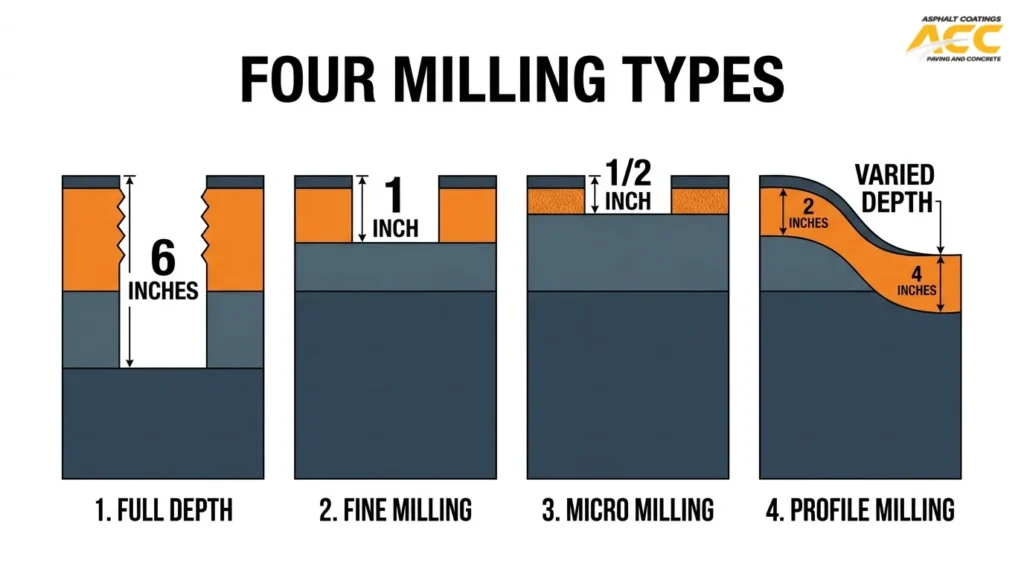
The types of asphalt milling are full-depth milling, fine milling, micro milling, and profile milling. Each type varies by cutting depth, drum tooth spacing, and intended application.
Full-Depth Milling
Full-depth milling removes the entire asphalt surface layer down to the underlying base. Cutting depths extend to 6 inches or more, making this method appropriate when the pavement structure has failed beyond what a surface correction can address. Contractors use full-depth milling to expose and evaluate the subgrade before reconstruction. This approach is the right call when alligator cracking, base failure, or severe rutting indicates that the existing pavement has no remaining structural value worth preserving.
Fine Milling
Fine milling removes a thin layer of asphalt, typically 0.5 to 1.5 inches, using a drum with tighter tooth spacing than standard milling. The closer spacing produces a smoother, more uniform surface texture. Fine milling is commonly used to correct minor surface irregularities, improve ride quality, and prepare pavement for thin overlays. Because the finished texture enhances bonding between old and new asphalt layers, it reduces the risk of delamination after resurfacing.
Micro Milling
Micro milling is a pavement preservation treatment that uses a drum with more teeth and closer spacing than standard milling to create a finer surface texture. According to a Georgia Department of Transportation report, micro milling is often used to improve skid resistance or prepare surfaces for thin overlays. The resulting texture is noticeably smoother than conventional milling, which makes it well suited for high-traffic commercial areas where ride quality and noise reduction matter. For parking lots and distribution centers, this precision pays off in both safety and surface longevity.
Profile Milling
Profile milling corrects the longitudinal and cross-slope grades of an existing pavement surface. According to the Federal Highway Administration, modern milling machines utilize 3D machine control and GPS technology to automatically establish profile grades, often using a 40-foot ski or matching shoe to reference existing pavement elevations. This precision ensures proper drainage slopes and smooth transitions at curbs, inlets, and ADA ramps. Profile milling is especially valuable on commercial properties where even minor grade deviations can cause ponding water or accessibility compliance issues.
With each milling type serving a distinct purpose, cost becomes the next practical consideration for project planning.
How Much Does Asphalt Milling Cost?
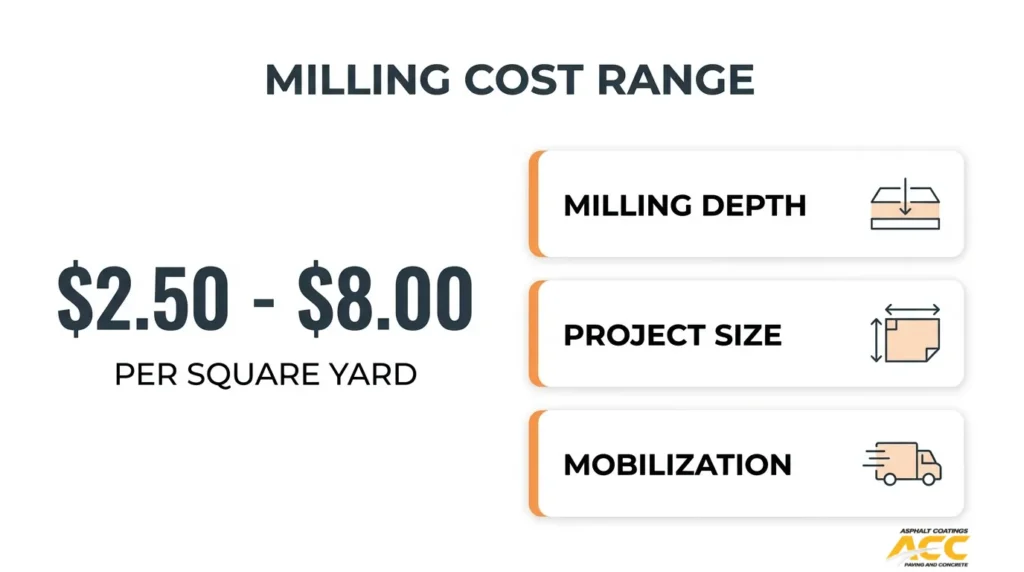
Asphalt milling cost depends on project type, milling depth, and equipment mobilization. Basic milling at 1–2 inches typically runs $2.50 to $5.00 per square yard, while medium-depth milling at 2–4 inches ranges from $5.00 to $8.00 per square yard. The following sections break down pricing for parking lots, commercial roads, and loading docks.
How Much Does Milling a Parking Lot Cost?
Milling a parking lot costs between $2.50 and $8.00 per square yard, depending on depth and lot size. A 50,000-square-foot lot milled at 2 inches falls toward the lower end of that range, while deeper cuts or lots with tight access push costs higher.
Factors that influence parking lot milling pricing include:
- Total square footage and milling depth required.
- Condition of existing pavement and presence of utility covers.
- Need for ADA-compliant grade transitions at curb ramps.
- Traffic management and phased scheduling requirements.
For most commercial parking lots, milling represents a fraction of the total resurfacing budget but delivers significant value by restoring proper drainage grades and overlay adhesion.
How Much Does Milling a Commercial Road Cost?
Milling a commercial road costs more per project than parking lot work due to higher mobilization requirements and deeper cuts. According to 2025 municipal contract data from Bountiful City Corporation, mobilization fees alone can reach $18,000 to $23,000 per project.
Additional cost factors for commercial road milling include:
- Lane-mile quantities and required milling depth.
- Traffic control plans and nighttime work premiums.
- Hauling distances for reclaimed asphalt pavement (RAP).
- Permitting and compliance with local DOT specifications.
Mobilization costs make smaller road projects disproportionately expensive per square yard. Bundling adjacent road segments into a single contract is one of the most effective ways to reduce the per-unit cost.
How Much Does Milling a Loading Dock or Drive Lane Cost?
Milling a loading dock or drive lane typically costs between $0.25 and $0.75 per square foot for the milling operation alone. Project size and equipment access are the primary cost drivers, according to HomeGuide’s 2025 pricing data.
Loading docks and drive lanes present unique challenges:
- Heavy truck traffic often requires deeper milling to address rutting.
- Confined spaces may limit equipment options, increasing labor time.
- Tight turnaround schedules minimize disruption to warehouse operations.
These smaller-footprint projects often carry higher per-square-foot rates because mobilization costs spread across fewer units. Understanding cost structure across project types helps property managers budget accurately for resurfacing prep.
What Should You Look for in an Asphalt Milling Contractor?
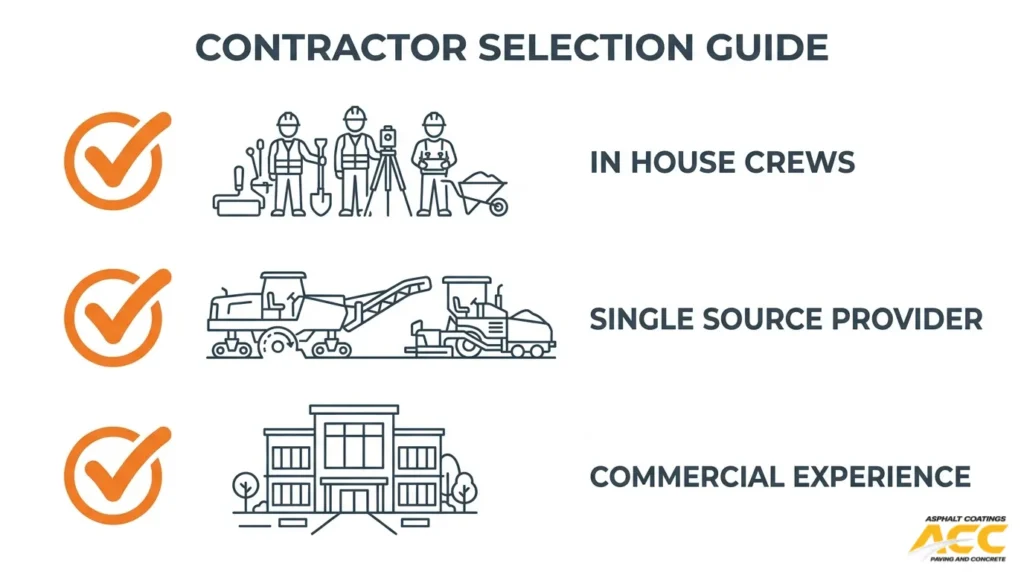
You should look for an asphalt milling contractor that operates with in-house crews, handles both milling and resurfacing, and brings verified commercial project experience.
Does the Contractor Use In-House Crews and Equipment?
Yes, the contractor should use in-house crews and equipment rather than relying on subcontractors. In-house teams provide direct quality control over milling depth accuracy, drum speed, and grade tolerances. When a contractor owns its cold milling machines, loaders, and sweepers, scheduling stays predictable and accountability remains with a single company. Subcontracted crews often introduce communication gaps that lead to inconsistent milling patterns or missed specifications. For commercial property managers, confirming that the contractor staffs its own operators is one of the most reliable indicators of project dependability.
Can the Contractor Handle Both Milling and Resurfacing?
Yes, the contractor should handle both milling and resurfacing as a single-source provider. Splitting these phases between separate companies creates coordination delays, finger-pointing over grade discrepancies, and potential warranty gaps. A contractor that mills and paves with the same team ensures the milled surface profile matches the overlay mix design. This continuity is especially critical for maintaining drainage grades and ADA-compliant transitions. Property managers benefit most when one contractor owns every phase, from initial grinding through final compaction, because it eliminates handoff risk entirely.
Does the Contractor Have Experience With Commercial Projects?
Yes, the contractor should have documented experience with commercial projects, including parking lots, loading docks, and drive lanes. Commercial milling demands higher insurance thresholds; according to Liberty Insurance’s 2025 Contractor Guide, standard paving contractors carry a $1 million general liability limit, while larger municipal or commercial projects often require coverage up to $5 million.
When vetting a contractor, ask specifically for:
- 3D machine control capabilities for precise grade establishment.
- Documented RAP recycling rates showing responsible material handling.
- Specific experience with ADA-compliant grade transitions in commercial parking lots.
- State DOT prequalification confirming technical and financial stability standards.
Contractors who lack commercial-scale experience often underestimate mobilization costs and traffic management complexity, which leads to budget overruns and extended closures. Understanding a contractor’s qualifications sets the stage for choosing between milling and full replacement.
When Is Milling a Better Option Than Full Replacement?
Milling is a better option than full replacement when the pavement structure remains sound but the surface has deteriorated. The decision depends on the severity of distress, the condition of the underlying base, and measurable pavement health indicators.
According to 2025 data from Roadwurx, Pavement Condition Index (PCI) thresholds indicate that a mill-and-overlay is appropriate when PCI drops below 60, while full-depth reclamation becomes necessary for PCI values below 45. That 15-point window between scores of 45 and 60 represents the ideal range where milling delivers the best return on investment.
Milling is typically the right choice when pavement exhibits:
- Surface-level cracking, rutting, or oxidation without base failure.
- Functional drainage grades and curb heights that need preservation.
- A stable subgrade confirmed through core sampling or deflection testing.
- Distress limited to the top 1 to 4 inches of the asphalt layer.
Full replacement becomes necessary when alligator cracking extends through the full depth, the base material has failed, or standing water indicates subgrade compromise. These conditions mean a new overlay would simply fail again over the milled surface.
For commercial property managers, understanding this distinction prevents overspending on full reconstruction when milling would suffice, and it prevents underspending on a mill-and-overlay when the base cannot support it. A qualified milling contractor can core the existing pavement to confirm whether the structure warrants milling or demands complete removal.
Knowing when to mill sets the stage for understanding how regional climate factors influence your resurfacing timeline.
How Does Climate Affect Asphalt Milling and Resurfacing?
Climate affects asphalt milling and resurfacing by dictating when damage occurs, how quickly pavement deteriorates, and which prep steps a contractor must prioritize. Freeze-thaw cycles and UV exposure are two primary climate factors that shape milling timelines and surface preparation.
How Do Freeze-Thaw Cycles Influence Milling Decisions?
Freeze-thaw cycles influence milling decisions by accelerating subsurface pavement damage that standard overlays cannot address. Moisture penetrates asphalt through surface cracks, then expands when it freezes. This repeated internal pressure degrades the pavement structure from within, creating potholes, heaving, and base instability that demand milling rather than simple resurfacing.
According to Bituminous Roadways, Inc., freeze-thaw cycles allow moisture infiltration that generates internal pressure, degrading the pavement structure and accelerating the need for milling. Properties exposed to repeated freeze-thaw seasons often require deeper milling depths to reach stable material beneath the damaged layers.
For commercial property managers, scheduling milling before spring resurfacing season is critical. Waiting too long after winter allows compromised areas to spread, increasing both project scope and cost.
How Does High-Altitude UV Exposure Impact Resurfacing Prep?
High-altitude UV exposure impacts resurfacing prep by accelerating oxidation of the asphalt binder, which causes the surface to become brittle and crack prematurely. At higher elevations, UV radiation intensity increases significantly, breaking down the flexible oils in asphalt faster than at sea level. This oxidation turns the pavement gray, stiffens the surface layer, and creates a network of fine cracks that compromise overlay adhesion.
Milling removes this oxidized, brittle layer so the new overlay bonds to structurally sound material underneath. Without milling away UV-damaged asphalt, the weakened surface acts as a debonding plane between old and new pavement. Properties at elevation should factor shorter resurfacing cycles into long-term maintenance planning, since binder degradation outpaces what lower-altitude timelines predict.
Understanding how climate drives pavement failure helps property managers time milling projects for maximum resurfacing longevity.
How Long Does an Asphalt Milling Project Take?
An asphalt milling project takes anywhere from one day for small parking areas to several weeks for large commercial properties or multi-lane roadways. Project duration depends on milling depth, total square footage, equipment size, and site accessibility. A standard commercial parking lot mill-and-overlay typically completes within two to five days, while phased projects on active properties may extend the schedule to minimize business disruption. According to research from Purdue University and the Indiana Department of Transportation, higher milling speeds increase pavement damage and surface roughness, which means experienced contractors balance pace with precision rather than rushing production. For commercial property managers, the most important scheduling factor is often not the milling itself but coordinating tenant communication, traffic control, and the overlay crew that follows immediately after. Planning these logistics in advance keeps the total project timeline predictable and prevents costly delays between milling and resurfacing.
How Should You Plan Milling and Resurfacing for a Commercial Property?
You should plan milling and resurfacing for a commercial property by aligning pavement condition assessments, contractor selection, and seasonal timing into a single coordinated strategy. Commercial parking lots typically benefit from a mill-and-overlay cycle every 12 to 20 years, depending on traffic intensity and maintenance history.
Can a Single-Source Paving Contractor Handle Milling Through Final Overlay?
Yes, a single-source paving contractor can handle milling through final overlay when that contractor maintains in-house crews, owns milling and paving equipment, and carries adequate insurance coverage. According to Liberty Insurance’s 2025 contractor guide, standard insurance thresholds for paving contractors typically include a $1 million general liability limit, with larger commercial projects often requiring coverage up to $5 million.
Consolidating milling, grading, and overlay under one contractor eliminates coordination gaps between subcontractors, reduces mobilization costs, and creates a single point of accountability for grade accuracy and material quality. For commercial property managers, this approach simplifies scheduling and keeps the project on budget.
What Are the Key Takeaways About Asphalt Milling for Resurfacing and Prep?
The key takeaways about asphalt milling for resurfacing and prep are:
- Milling preserves drainage grades, ADA-compliant curb heights, and structural integrity that overlaying alone cannot protect.
- Milled material is one of the most recycled construction products in the country, with reclaimed asphalt pavement reuse rates consistently above 96%.
- Contractor vetting should prioritize 3D machine control capabilities, documented RAP recycling rates, and verified commercial project experience.
- Seasonal timing matters: optimal air and surface temperatures for asphalt paving operations require a minimum of 50°F and rising, which narrows the scheduling window in northern and high-altitude regions.
- Planning a mill-and-overlay on a 12 to 20 year cycle, informed by regular pavement condition assessments, prevents costly emergency repairs.
Asphalt Coatings Company specializes in mill and pave services for commercial properties across Colorado’s Front Range, offering in-house crews and single-source project management from initial milling through final overlay.