Choosing between asphalt curb and concrete curb for a commercial parking lot is a system-level decision that weighs installation cost, drainage function, climate durability, service life, and regulatory compliance against each property’s specific traffic and budget conditions. Asphalt curbs are machine-extruded hot-mix edges that bond directly to asphalt pavement; concrete curbs are rigid, formed or slipformed profiles that hold dimensional stability under heavier loads and harsher exposure.
This guide covers material definitions and construction methods, installation and lifecycle cost analysis, drainage and stormwater performance, cold-climate durability, expected lifespan under commercial use, maintenance and repair planning, aesthetics and ADA compliance, and curb selection by property type.
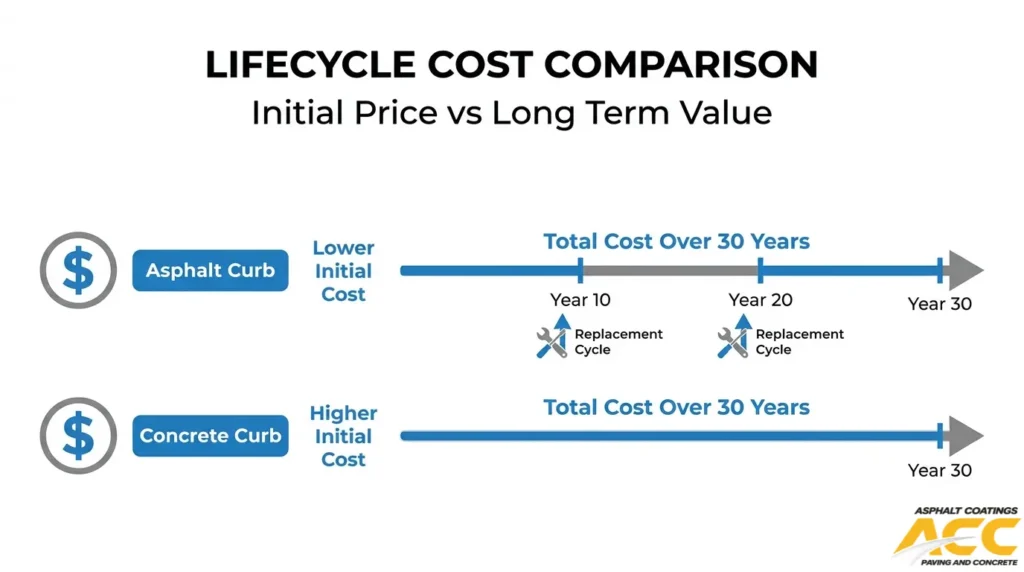
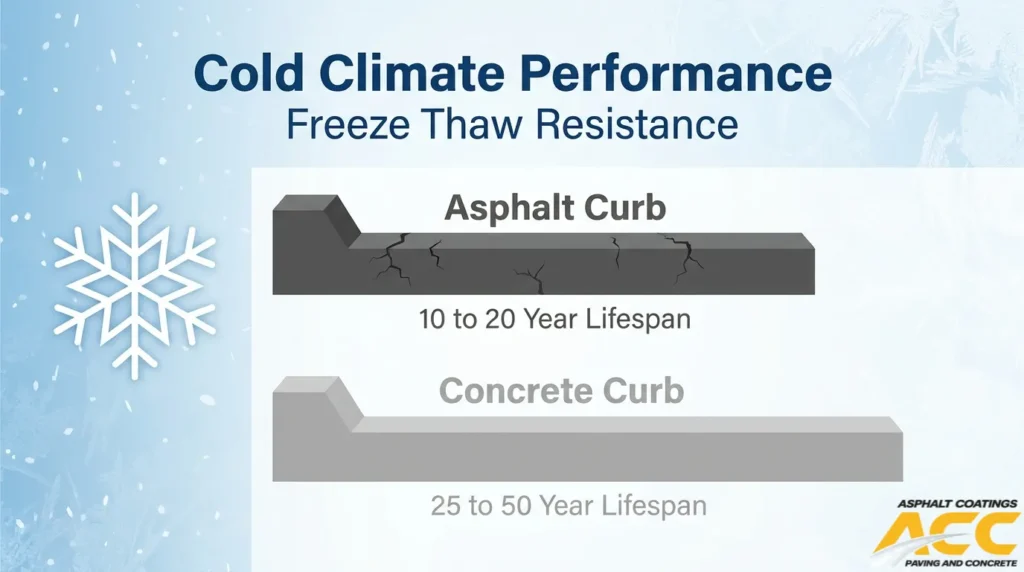
Asphalt curbs install faster and cost less per linear foot, but oxidation, freeze-thaw cycling, and snowplow contact shorten their service life to roughly 10 to 20 years. Concrete curbs carry a higher upfront price yet typically last 25 to 50 years when properly air-entrained, producing fewer replacement cycles and lower total cost of ownership.
Curb geometry directly controls how surface water reaches catch basins, inlets, and gutter pans. Concrete holds its edge profile over decades, while asphalt can soften and deform, allowing ponding and inlet bypass.
In cold climates, air-entrained concrete resists freeze-thaw scaling and deicer damage more effectively than asphalt, which loses structural integrity as binder breaks down through repeated moisture cycling.
ADA-compliant ramp slopes and flush grade-break transitions demand the dimensional precision concrete provides; asphalt ramps risk settling out of compliance over time.
Matching curb material to each zone of a commercial lot, from light-traffic stalls to heavy truck lanes, balances performance against budget across the full property lifecycle.
What Are Asphalt Curbs and Concrete Curbs in Commercial Parking Lots?
Asphalt curbs and concrete curbs are raised or formed edges installed along the perimeter and interior of commercial parking lots to control traffic, direct drainage, and define pavement boundaries. Each material offers distinct construction methods and situational advantages.
How Is an Asphalt Curb Typically Built in a Commercial Parking Lot?
An asphalt curb is typically built by machine-extruding hot-mix asphalt directly onto the prepared pavement surface. According to the Massachusetts Department of Transportation’s 2026 Standard Specifications, the HMA mixture must be placed and compacted with an engineer-approved machine capable of spreading the material true to line, grade, and the stipulated shape. A tack coat is applied between the binder course and the curb to ensure adhesion. The asphalt binder grade matches the wearing course specification, and compaction equipment sized for small areas finishes the profile. This process makes asphalt curb installation fast, often completing in a single pass without formwork or extended curing time.
How Is a Concrete Curb Typically Built in a Commercial Parking Lot?
A concrete curb is typically built using one of three methods: slipformed, fixed-form, or integral construction. Slipformed and extruded curbs are shaped by a machine that continuously extrudes wet concrete along the alignment. Fixed-form construction uses rigid molds to hold the concrete in place during curing. For extruded-form projects, contractors may use an adhesive instead of dowels, provided the pavement surface is cleaned as specified. ACI 330.1-14 covers unreinforced concrete parking lot construction, including attached and integral curbs. Concrete curb installations require curing time before they can withstand traffic loads, which adds scheduling considerations that asphalt curbs avoid.
In What Situations Are Asphalt Curbs Most Commonly Used?
Asphalt curbs are most commonly used in situations where speed of installation, budget efficiency, or pavement compatibility drives the decision. Commercial parking lots with existing asphalt pavement benefit from asphalt curbs because both materials bond and flex together under thermal movement. Temporary lot configurations, phased construction projects, and properties where curb replacement is expected within a shorter cycle also favor asphalt. According to the National Asphalt Pavement Association’s 2024 survey, more than 96 percent of reclaimed asphalt pavement is recycled back into new asphalt mixtures. This recyclability makes asphalt curbs a practical choice when future removal or reconfiguration is planned.
In What Situations Are Concrete Curbs Most Commonly Used?
Concrete curbs are most commonly used in situations requiring long-term durability, structural rigidity, or code-mandated material specifications. High-traffic commercial entries, fire lanes, loading docks, and ADA-accessible routes typically call for concrete because it resists deformation under sustained loads. Drainage infrastructure, including catch basins and gutter pans, integrates more precisely with formed concrete profiles. According to the U.S. Department of Energy’s circularity strategy report, recycled concrete is most commonly used as road base or recycled aggregate; these applications displace natural aggregate demand but do not reduce the need for new concrete in construction. For property managers planning 20-plus-year curb life with minimal intervention, concrete remains the default choice.
Understanding what each curb type is and where it fits best sets the foundation for comparing their costs, drainage performance, and lifespan.
How Do Asphalt Curb and Concrete Curb Compare on Initial Installation Cost?
Asphalt curb and concrete curb differ in initial installation cost based on project size, material and labor pricing, and mobilization logistics. The following subsections break down how each factor shapes the price gap.
How Does Project Size Affect the Cost Difference Between Asphalt Curbs and Concrete Curbs?
Project size affects the cost difference between asphalt curbs and concrete curbs by shifting the per-linear-foot price as quantities scale. Small concrete curb projects carry higher unit costs because forming, pouring, and curing a short run still requires full crew mobilization. A 2026 Cedar City blanket-contract bid priced 30-inch machine-placed concrete curb and gutter at $29.70 per linear foot for just 100 linear feet. Larger quantities spread setup costs more efficiently, which is why concrete unit prices tend to drop on bigger scopes. Asphalt curbs, placed by machine extrusion, generally scale faster because the equipment moves continuously without forming or cure delays. For commercial lots exceeding several hundred linear feet, that production speed advantage compresses the per-foot gap between the two materials.
How Do Material and Labor Costs Differ for Asphalt Curbs Versus Concrete Curbs?
https://www.concreteparking.org/curbs/materials.htmlMaterial and labor costs differ for asphalt curbs versus concrete curbs primarily in raw material expense and crew time. Concrete curb requires air-entrained mix, formwork or slipform equipment, and adequate curing time. According to the National Ready Mixed Concrete Association, concrete curb exposed to severe conditions should contain at least 5% entrained air with a maximum of 8% to survive freeze-thaw cycles and deicer salts. That specification adds material cost and quality-control labor. Asphalt curb uses the same hot-mix asphalt available on most paving jobs, reducing separate material procurement. Labor is typically faster for machine-extruded asphalt curb since no forms are set and no cure period is needed. However, concrete’s longer service life often offsets its higher upfront material and labor expense, making per-year cost the more meaningful comparison for commercial property managers.
How Do Phasing and Mobilization Influence Curb Cost on Large Commercial Sites?
Phasing and mobilization influence curb cost on large commercial sites by determining how many times crews, equipment, and materials must be staged. A single mobilization for a full-perimeter curb installation costs far less per linear foot than splitting the same footage across multiple phases to keep tenant access open. Concrete curb phasing adds complexity because each pour section needs cure time before adjacent paving or striping can proceed. Asphalt curb cools and firms quickly, allowing paving operations to follow the same day in most conditions. For multi-phase commercial projects, coordinating curb installation with lot resurfacing or reconstruction in a single mobilization is the most effective way to control both direct costs and tenant disruption.
Understanding installation cost sets the stage for evaluating which curb material delivers better value over time.
Over the Full Lifespan, Which Is More Cost-Effective: Asphalt Curb or Concrete Curb?
Concrete curb is typically more cost-effective over the full lifespan due to fewer replacement cycles and lower cumulative maintenance spending. The sections below break down maintenance cost differences, replacement cycle impacts, and how to calculate total cost of ownership.
How Do Maintenance and Repair Costs Differ Over Time for Asphalt Curbs and Concrete Curbs?
Maintenance and repair costs for asphalt curbs and concrete curbs differ primarily in frequency and intervention type. Asphalt curbs require more frequent patching, reshaping, and sealcoating because oxidation and freeze-thaw exposure degrade the binder over time. Concrete curbs need fewer routine interventions; municipalities like Northfield, Minnesota, will not replace concrete curbs unless the curb back is broken, which signals a higher damage threshold before action is required.
Over a 20-to-30-year window, asphalt curb maintenance costs accumulate through repeated small repairs, while concrete curb costs concentrate on occasional joint sealing or spot replacement. For property managers budgeting annually, asphalt curbs demand a larger recurring maintenance line item.
How Do Replacement Cycles for Asphalt Curbs Versus Concrete Curbs Impact Long-Term Budgeting?
Replacement cycles for asphalt curbs versus concrete curbs impact long-term budgeting by determining how many full removals and reinstallations a property owner funds over the lot’s life. Asphalt curbs typically require replacement sooner because freeze-thaw cycling accelerates structural decline. According to research published in Polymers (NIH/PMC) on freeze-thaw damage mechanisms in SBS asphalt mixtures, after just 15 freeze-thaw cycles, standard fiber-modified asphalt mixtures experienced splitting tensile strength damage between 38.91% and 50.71%.
Concrete curbs, properly air-entrained, resist this degradation far longer. When an asphalt curb needs two full replacements in the same period a concrete curb needs one, the upfront savings disappear. Budgeting for fewer concrete replacements generally produces a lower total expenditure.
How Should Property Managers Compare Total Cost of Ownership Between Asphalt and Concrete Curbs?
Property managers should compare total cost of ownership between asphalt and concrete curbs by calculating three components across the expected lot lifespan:
- Initial installation cost per linear foot, including mobilization and base preparation.
- Cumulative maintenance cost, factoring in patching frequency, sealcoating, and inspection labor.
- Number of full replacement cycles, multiplied by per-cycle removal and reinstallation pricing.
Adding these three figures produces the true lifecycle cost for each material. A lower installation price means little if the curb requires replacement twice as often. In most commercial scenarios, concrete curb delivers a lower total cost of ownership despite the higher day-one expense, particularly in climates with harsh winters.
Understanding lifecycle cost sets the stage for evaluating how each curb type handles drainage.
How Do Asphalt Curbs and Concrete Curbs Affect Drainage Performance in Parking Lots?
Asphalt curbs and concrete curbs affect drainage performance in parking lots through their influence on surface water flow, inlet compatibility, and freeze-thaw resilience. The following subsections cover ponding prevention, catch basin integration, and snowmelt drainage behavior.
How Does Curb Material Influence Surface Water Flow and Ponding in Parking Lots?
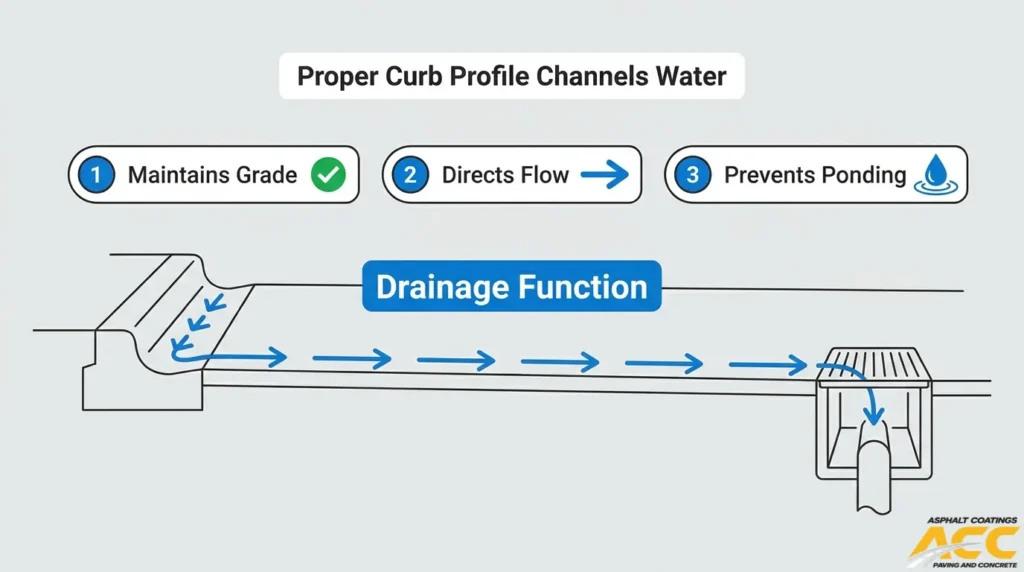
Curb material influences surface water flow and ponding in parking lots by determining how precisely the curb profile channels runoff toward drainage infrastructure. According to the Federal Highway Administration’s Hydraulic Engineering Circular No. 22, pavement drainage design involves knowledge and consideration of surface drainage, gutter flow, and inlet capacity, with these elements depending on design rainfall frequency and allowable stormwater spread.
Concrete curbs hold their formed edge profile over time, maintaining consistent gutter flow geometry. Asphalt curbs, while initially shaped to grade, can soften and deform under sustained heat or heavy wheel contact. That gradual loss of edge definition allows water to pool rather than channeling toward collection points. Proper curb height and a flush transition at grade breaks keep runoff moving predictably across the lot surface.
Which Curb Type Works Better with Catch Basins, Inlets, and Gutter Pans?
Concrete curbs work better with catch basins, inlets, and gutter pans in most commercial parking lot applications. Concrete provides a rigid, dimensionally stable interface where inlet frames and gutter pans seat flush against the curb face. According to the City of Los Angeles Street Design Manual, curb structural types depend on the proposed location, anticipated traffic, and drainage and economic considerations, with types classified as barrier or mountable and constructed through slipformed, fixed-form, or extruded methods.
Three construction methods are in general use: slipformed, fixed forms, and integral curb. Each method allows concrete to form tight, lasting joints with precast inlet structures. Asphalt curbs can settle or compress at these connection points, creating gaps that let debris accumulate and reduce inlet capture efficiency. For lots with heavy stormwater demands, concrete’s dimensional stability makes it the more reliable choice at drainage tie-in points.
How Do Asphalt and Concrete Curbs Perform With Snowmelt and Freeze–Thaw Drainage Conditions?
Asphalt and concrete curbs perform differently with snowmelt and freeze-thaw drainage conditions due to each material’s response to moisture cycling and temperature extremes. Asphalt curbs are particularly vulnerable; as reported by Texas A&M Transportation Institute (ACRP Project 09-11), asphalt surfaces begin showing signs of aging accelerated by climatic conditions, with noticeable loss of fine aggregate matrix accompanied by fading of pavement color.
This surface deterioration compromises the curb’s ability to channel snowmelt consistently. Concrete curbs, when properly air-entrained, resist freeze-thaw scaling far more effectively, maintaining their profile through repeated winter cycles. In climates with frequent freeze-thaw transitions, concrete curbs preserve drainage geometry longer, reducing the risk of meltwater ponding against building foundations or across pedestrian paths.
Understanding how each curb type handles drainage sets the stage for evaluating their cold-climate durability.
In Cold and Snowy Climates, How Do Asphalt and Concrete Curbs Hold Up?
In cold and snowy climates, asphalt and concrete curbs hold up differently due to their distinct material responses to freezing, chemical exposure, and mechanical impact. Freeze-thaw cycling, snowplow contact, and de-icing chemicals each stress these materials in unique ways.
How Do Freeze–Thaw Cycles Affect Asphalt Curbs Compared to Concrete Curbs?
Freeze-thaw cycles affect asphalt curbs by degrading the binder matrix through repeated moisture infiltration and expansion, while concrete curbs suffer surface scaling and aggregate loosening when water trapped in pores freezes. According to a study published in Polymers (NIH/PMC) on freeze-thaw damage mechanisms in SBS asphalt mixtures, after 15 cycles the splitting tensile strength of standard fiber-modified asphalt mixtures declined by 38–51%, depending on fiber type. Concrete resists this degradation more effectively when air-entrained, because the microscopic voids give expanding ice room to move without cracking the paste. Asphalt curbs, being thinner and more exposed than pavement surfaces, lose structural integrity faster under cyclic freezing. Properly specified concrete holds a clear advantage in sustained freeze-thaw environments.
How Do Snowplows and De-Icing Chemicals Impact Each Curb Type?
Snowplows and de-icing chemicals impact each curb type through both mechanical abrasion and chemical degradation. Plow blades chip and gouge asphalt curbs more readily because the softer binder wears down on contact, especially when temperatures make the material brittle. Concrete curbs resist blade impact better but face chemical vulnerability. A University of Manitoba thesis on concrete exposed to deicing chemicals found that magnesium chloride solutions produced the greatest severity of strength deterioration, with potassium acetate causing earlier onset of degradation. Calcium and magnesium chloride progressively matched or exceeded that damage with additional cycles. For property managers, this means concrete curbs need air-entrained mixes to survive chemical exposure, while asphalt curbs need more frequent physical repair after plowing seasons.
In Colorado-Style Climate Conditions, Which Curb Type Typically Lasts Longer?
In Colorado-style climate conditions, concrete curbs typically last longer than asphalt curbs. Colorado’s Front Range combines intense freeze-thaw cycling, high-altitude UV exposure, and regular de-icer application, all of which accelerate asphalt binder breakdown. The Colorado Department of Transportation’s 2023 Standard Specifications require Class B concrete for curb and gutter construction under Section 609, reflecting the state’s expectation that concrete performs more reliably under these conditions. Asphalt curbs soften in summer heat and become brittle in winter cold, narrowing their effective service window. For commercial parking lots along the Front Range, concrete curbs deliver a longer functional lifespan with fewer mid-cycle replacements. From a lifecycle perspective, paying more upfront for concrete curbs in Colorado often costs less than repeatedly rebuilding asphalt ones.
Understanding how cold-climate conditions affect curb durability sets the stage for examining expected lifespan under typical commercial use.
What Is the Expected Lifespan of Asphalt Curbs Versus Concrete Curbs?
The expected lifespan of asphalt curbs ranges from 10 to 20 years, while concrete curbs typically last 25 to 50 years under normal commercial parking lot conditions. Traffic volume, maintenance consistency, and climate exposure all shift these ranges significantly.
Under Typical Commercial Use, How Long Do Asphalt Curbs Usually Last?
Under typical commercial use, asphalt curbs usually last between 10 and 20 years. Several factors compress or extend that range:
- Asphalt binder oxidizes over time, making curbs brittle and prone to cracking and raveling.
- UV exposure and seasonal temperature swings accelerate surface deterioration, particularly in high-altitude regions.
- Routine sealcoating and crack sealing can push service life toward the upper end of the range.
- Curbs adjacent to high-turnover drive aisles wear faster than those bordering static parking stalls.
For property managers budgeting long-term, planning at least one full asphalt curb replacement within a 30-year facility lifecycle is realistic. Proactive maintenance remains the single most effective way to delay that replacement.
Under Typical Commercial Use, How Long Do Concrete Curbs Usually Last?
Under typical commercial use, concrete curbs usually last between 25 and 50 years. Properly air-entrained concrete with quality cementitious paste resists freeze-thaw cycling and deicer exposure far longer than asphalt alternatives. According to the National Ready Mixed Concrete Association, concrete curbs should contain at least 5% entrained air, with a maximum allowable of 8%, to survive many freeze-thaw cycles and deicer salt applications.
Concrete’s rigidity means it holds its profile and reveal height for decades without the gradual slumping that softens asphalt curb edges. Joint sealing and periodic inspection for spalling extend service life toward the 50-year mark. This durability advantage is why concrete curbs dominate specifications for permanent commercial infrastructure.
How Do Heavy Traffic and Truck Loading Change Curb Lifespan for Each Material?
Heavy traffic and truck loading reduce curb lifespan for both materials, though asphalt curbs are affected more severely. According to the Institute for Transportation at Iowa State University, most parking lot areas experience a smaller and lighter spectrum of traffic loadings than roadways and are intended for vehicle storage rather than moving traffic; the exceptions are access roads and truck lanes for heavy trucks delivering goods or removing waste material.
Those truck lanes and loading zones impose the greatest curb stress. Asphalt curbs in these areas can fail in under 10 years due to deformation and edge crushing under repeated heavy-axle loads. Concrete curbs resist this compressive force far better, though corner breaks and joint damage still occur at high-traffic dumpster pads and delivery aprons. Specifying concrete curbs along truck routes and asphalt curbs only in light-traffic stall areas is a practical strategy that balances cost and performance.
Understanding how long each curb material lasts helps property managers plan maintenance budgets and repair timelines.
How Do Maintenance and Repair Needs Differ for Asphalt Curbs and Concrete Curbs?
Maintenance and repair needs differ for asphalt curbs and concrete curbs in the types of damage each material develops, the ease of patching, and the point at which replacement becomes more practical than continued repairs.
What Types of Damage Are Most Common With Asphalt Curbs?
The types of damage most common with asphalt curbs are oxidation-driven cracking, raveling, and edge deterioration. Asphalt binder hardens over time as volatile compounds evaporate, which makes the curb surface brittle and prone to fracturing. Snowplow strikes accelerate this process by shearing weakened material from the curb face. Deformation is another frequent issue; softened asphalt in summer heat allows vehicle tires and turning movements to compress or reshape curb profiles. Oil and fuel spills dissolve the binder, creating localized soft spots that erode faster than surrounding material. In practice, most asphalt curb failures are progressive surface losses rather than sudden structural breaks.
What Types of Damage Are Most Common With Concrete Curbs?
The types of damage most common with concrete curbs are spalling, cracking, and joint deterioration. According to the Washington State Department of Transportation Maintenance Manual, inspectors should note any deterioration, cracking, spalling, or damage on curb elements. Freeze-thaw cycling drives moisture into micro-pores, and repeated expansion fractures the surface paste. Deicer chemicals compound this by introducing salts that accelerate scaling. Unlike asphalt, concrete does not deform under heat; instead, it cracks at stress concentration points, particularly at control joints and corners. Impact damage from snowplows or delivery trucks typically chips the curb face rather than deforming it. These failures tend to be localized, leaving adjacent sections structurally sound.
How Easy Is It to Repair or Patch Asphalt Curbs Versus Concrete Curbs?
Repairing or patching asphalt curbs is generally easier and faster than repairing concrete curbs. Asphalt patches can be applied with hot-mix material and compacted into damaged areas using small equipment, often with same-day traffic return. Concrete curb repairs require saw-cutting the damaged section, removing debris, forming the replacement segment, pouring new concrete, and curing for several days before the area reopens. This extended timeline makes concrete repairs more disruptive in active commercial lots. However, concrete patches, once cured, bond rigidly and maintain their profile longer than asphalt patches, which can soften and deform under repeated loading. For property managers weighing convenience against durability, asphalt wins on speed while concrete wins on patch longevity. Asphalt Coatings Company provides both asphalt and concrete curb repair services with in-house crews throughout Colorado’s Front Range, allowing property managers to work with a single trusted contractor regardless of which material requires attention.
When Is It Better to Replace Rather Than Repair Each Curb Type?
It is better to replace rather than repair each curb type when cumulative damage compromises the curb’s structural role or drainage function. For asphalt curbs, replacement becomes the practical choice once oxidation and traveling have degraded more than roughly half the curb profile, because patches in heavily deteriorated material fail quickly. For concrete curbs, the City of Northfield, Minnesota’s maintenance policy establishes a clear threshold: concrete curbs will not be replaced unless the curb back is broken. This reflects a broader industry principle that localized spalling and surface scaling can be managed with spot repairs, but a fractured structural core cannot. Property managers should evaluate whether repeated patching costs are approaching replacement cost per linear foot; if so, full replacement delivers better long-term value.
Understanding each material’s repair characteristics helps property managers budget accurately for ongoing lot maintenance.
How Do Aesthetics and Property Appearance Compare Between Asphalt and Concrete Curbs?
Aesthetics and property appearance differ significantly between asphalt and concrete curbs due to color, reflectance, and weathering behavior. The sections below cover first impressions, pavement marking visibility, and how each material degrades over time.
How Do Asphalt and Concrete Curbs Affect First Impressions for Tenants and Customers?
Asphalt and concrete curbs affect first impressions for tenants and customers primarily through color contrast, surface uniformity, and perceived upkeep. New asphalt curbs present a uniform dark appearance that blends with asphalt pavement, creating a seamless but low-contrast look. Concrete curbs, by contrast, offer a lighter tone that visually defines lot boundaries and landscaped areas.
According to the National Park Service, historic concrete commonly exhibits highly variable appearance, including color and finish texture, with different levels of aggregate exposure due to paste erosion. This variability means concrete curbs can look inconsistent over time without periodic cleaning. For commercial properties competing for tenants, the curb material choice sets an immediate visual tone that signals maintenance investment.
Which Curb Type Offers Better Contrast and Visibility With Pavement Markings?
Concrete curbs offer better contrast and visibility with pavement markings than asphalt curbs. The difference comes down to reflectance. According to the Rutgers Center for Green Building, new asphalt pavement has a Solar Reflectance Index (SRI) of 0, while new white Portland cement concrete can have an SRI between 86 and 100. This stark reflectance gap means yellow or white painted markings stand out sharply against concrete but can fade into asphalt’s dark surface, especially under low-light conditions.
Over time, however, asphalt surfaces lighten as aggregate becomes exposed. The National Center for Asphalt Technology at Auburn University notes that if light-colored aggregate is used in the asphalt mix, the SRI can increase over five to ten years. Still, concrete maintains a visibility advantage throughout its service life in most parking lot applications.
How Do Staining, Fading, and Raveling Differ Between the Two Curb Materials?
Staining, fading, and raveling differ between the two curb materials because asphalt and concrete degrade through distinct mechanisms. Asphalt curbs deteriorate through oxidation, which makes the binder brittle over time. According to the National Center for Pavement Preservation, oxidation leads to weathering, raveling, and cracking of the asphalt surface. Oil stains also absorb into asphalt’s porous binder, making them nearly impossible to remove completely.
Concrete curbs resist oil absorption better but are prone to efflorescence, deicing salt stains, and surface scaling. Both materials fade, though asphalt shifts from black to gray while concrete may develop uneven discoloration as paste erodes unevenly across exposed aggregate areas. For property managers, asphalt curbs demand more frequent sealcoating to maintain appearance, while concrete curbs require periodic power washing.
Understanding how each material weathers helps property managers plan maintenance budgets that protect both function and curb appeal.
How Do Asphalt and Concrete Curbs Impact ADA Compliance and Safety?
Asphalt and concrete curbs impact ADA compliance and safety through ramp slope tolerances, flush transitions, and accessible parking design. The sections below cover ramp compatibility, trip hazard liability, and curb design around accessible parking and crosswalks.
Which Curb Type Better Supports ADA Ramps and Accessible Routes?
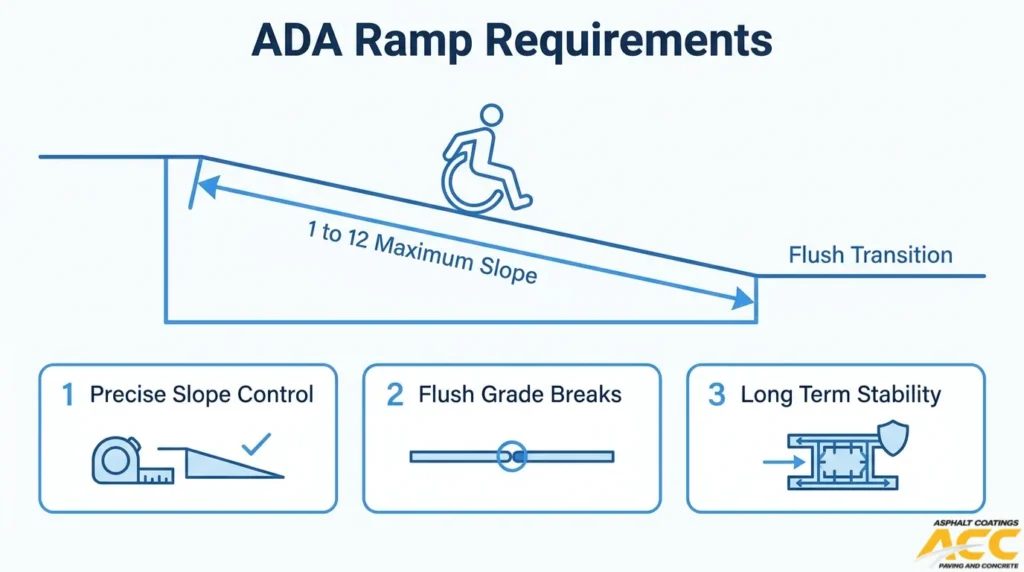
Concrete curbs better support ADA ramps and accessible routes because concrete holds precise slopes and dimensions over time. According to the U.S. Department of Justice’s 2010 ADA Standards for Accessible Design (Sections 405.2, 405.3, and 406.1), ramp runs shall have a running slope not steeper than 1:12, and cross slope shall not be steeper than 1:48.
Asphalt curb ramps can settle or deform under heat and traffic, gradually pushing slopes out of compliance. Concrete maintains its formed geometry more reliably across seasons, which is why most municipalities specify concrete for curb ramp construction. For commercial property owners, choosing concrete at ADA transition points reduces the risk of slope drift that triggers costly remediation.
How Do Curb Reveals and Transitions Affect Trip Hazards and Liability?
Curb reveals and transitions affect trip hazards and liability by creating elevation changes where pedestrians walk. Even small vertical offsets at curb edges can catch wheelchair casters, walker tips, or shoe edges, producing falls that expose property owners to premises liability claims.
According to the U.S. Access Board’s Public Right-of-Way Accessibility Guidelines (PROWAG R304.2.3), grade breaks shall not be permitted on the surfaces of curb ramp runs or landings, and surface slopes meeting at grade breaks shall be flush.For commercial properties along Colorado’s Front Range, Asphalt Coatings Company designs and installs ADA-compliant concrete curb ramps that maintain precise slopes through multiple freeze-thaw cycles, helping property owners meet accessibility requirements long-term. Asphalt curbs are more prone to edge erosion and settling, which gradually creates the grade breaks PROWAG prohibits. Concrete curbs maintain flush transitions longer, though both materials require routine inspection.
How Should Property Owners Design Curbs Around Accessible Parking and Crosswalks?
Property owners should design curbs around accessible parking and crosswalks by integrating ADA-compliant ramp geometry, detectable warning surfaces, and unobstructed access aisles into the curb layout from the start. Key design requirements include:
- Curb ramp running slopes must not exceed 1:12, and cross slopes must stay at or below 1:48.
- Access aisles adjacent to accessible parking stalls need flush curb transitions, not rolled or raised edges that block wheelchair passage.
- Crosswalk curb ramps should align with the pedestrian path of travel, not offset into traffic lanes.
Retrofitting asphalt curbs to meet these specifications is often impractical because asphalt reshaping cannot achieve the dimensional precision that ADA ramp geometry demands. Concrete is the safer material choice for these high-compliance zones, particularly at crosswalk interfaces where pedestrian safety and legal exposure intersect.
With ADA compliance addressed, choosing the right curb material for new construction depends on how all these factors, from cost to drainage to accessibility, align with the project’s specific needs.
For New Parking Lot Construction, Which Curb Type Makes the Most Sense?
For new parking lot construction, the curb type that makes the most sense depends on climate exposure, traffic patterns, and budget priorities. The following subsections cover when concrete curbs excel around asphalt pavement, when a fully asphalt solution works, and how to weigh upfront cost against long-term performance.
When Is It Smart to Install Concrete Curbs Around an Asphalt Parking Lot?
It is smart to install concrete curbs around an asphalt parking lot when durability, drainage precision, and reduced maintenance cycles are priorities. Concrete holds its profile under snowplow contact and resists deformation from sustained UV exposure far better than asphalt at curb scale. Properties in freeze-thaw climates, lots with heavy delivery traffic along perimeter lanes, and sites requiring integrated gutter pans and catch basin connections all benefit from concrete’s dimensional stability. For developers planning a 20-plus-year hold on a commercial asset, the higher initial cost of concrete curbs typically pays back through fewer replacement cycles and cleaner drainage performance over time.
When Might a Fully Asphalt Solution Be Appropriate for Curbs and Pavement?
A fully asphalt solution might be appropriate for curbs and pavement when speed, budget constraints, or phased construction timelines drive the project. Asphalt curbs can be machine-extruded in the same mobilization as the lot paving, eliminating the need for a separate concrete crew and reducing scheduling complexity. This approach suits projects with shorter intended hold periods, temporary commercial sites, or properties where future reconstruction is already anticipated. However, property owners should understand the trade-off: according to the National Center for Pavement Preservation, oxidation leads to weathering, raveling, and cracking of the asphalt pavement surface over time, and curbs made from the same material share this vulnerability. Accepting a shorter service life is the cost of that upfront simplicity.
How Should Developers Balance Upfront Budget Versus Long-Term Performance in Curb Selection?
Developers should balance upfront budget versus long-term performance in curb selection by calculating total cost of ownership rather than comparing only installation prices. A lower per-linear-foot cost for asphalt curbs loses its advantage if the curbs require patching or full replacement two or three times within the period a concrete curb would remain intact. Key factors to weigh include:
- Anticipated hold period for the property.
- Frequency and severity of freeze-thaw exposure.
- Expected delivery truck and snowplow contact along curb lines.
- Drainage infrastructure requirements, such as gutter pans and inlets.
For most commercial lots intended to serve tenants for decades, concrete curbs represent the stronger long-term investment despite the higher day-one line item.
Understanding new construction priorities sets the stage for evaluating when existing curbs should be upgraded or replaced.
For Existing Lots, When Should You Switch From Asphalt Curb to Concrete Curb or Vice Versa?
You should switch curb materials when existing curbs fail structurally, compromise drainage, or when a major resurfacing project creates a cost-efficient window. The following sections cover upgrade triggers, spot-repair scenarios, and curb strategy during reconstruction.
In What Condition Scenarios Does It Make Sense to Upgrade Asphalt Curbs to Concrete?
It makes sense to upgrade asphalt curbs to concrete when recurring failures indicate the material cannot hold up under site-specific conditions. Key upgrade triggers include:
- Asphalt curbs that crack and deform repeatedly despite multiple patch cycles.
- Curb sections near dumpster pads, loading docks, or fire lanes where heavy vehicles crush asphalt profiles.
- Drainage failure points where eroded asphalt curbs allow stormwater to bypass inlets entirely. According to a U.S. EPA analysis of stormwater infrastructure in Portland, Oregon, when curb-directed bioretention planters reach capacity, runoff continues along the curb and bypasses the system, flowing into existing storm drain inlets.
- Locations requiring ADA curb ramps, where concrete provides more precise, long-lasting grade transitions.
If asphalt curbs need replacement more than twice within a concrete curb’s single lifespan, the upgrade pays for itself.
When Can Spot Repairs of Existing Asphalt Curbs Be More Practical Than Full Replacement?
Spot repairs of existing asphalt curbs can be more practical than full replacement when damage is isolated and the surrounding curb remains structurally sound. Localized cracking, minor edge breaks, or short sections crushed by occasional overruns often respond well to hot-mix patching or machine-extruded infill.
This approach works best when:
- Damage affects less than 15 to 20 percent of total curb length.
- The lot pavement itself is in serviceable condition with no resurfacing planned.
- Drainage grades along the curb line remain intact.
Replacing individual 10- or 20-foot sections costs far less than mobilizing for a full curb removal, and it keeps tenant disruption minimal. However, if spot repairs become an annual routine, the cumulative cost signals that a material upgrade is overdue.
How Should Owners Approach Curbs During a Major Parking Lot Resurfacing or Reconstruction?
Owners should approach curbs during a major parking lot resurfacing or reconstruction as part of an integrated scope, not an afterthought. When heavy equipment is already mobilized and pavement grades are being reset, curb replacement adds minimal incremental cost compared to a standalone curb project.
During reconstruction, property managers should:
- Assess every linear foot of curb for spalling, height loss, and drainage-grade deviation.
- Evaluate whether the existing curb material matches the lot’s updated traffic patterns and stormwater plan.
- Coordinate curb type selection with inlet placement, gutter pan transitions, and ADA ramp locations.
Bundling curb work into the resurfacing contract eliminates a second mobilization and ensures curb grades align perfectly with new pavement elevations. For property managers weighing material choices during this window, consulting a contractor experienced in both asphalt and concrete systems simplifies the decision.
How Should Property Managers Decide Between Asphalt and Concrete Curbs Based on Use Case?
Property managers should decide between asphalt and concrete curbs by matching material strengths to each property’s traffic type, tenant expectations, and maintenance priorities. The following subsections break down the best curb choice for shopping centers, apartment communities, and industrial parks.
Which Curb Type Is Better for Shopping Centers and Retail Plazas?
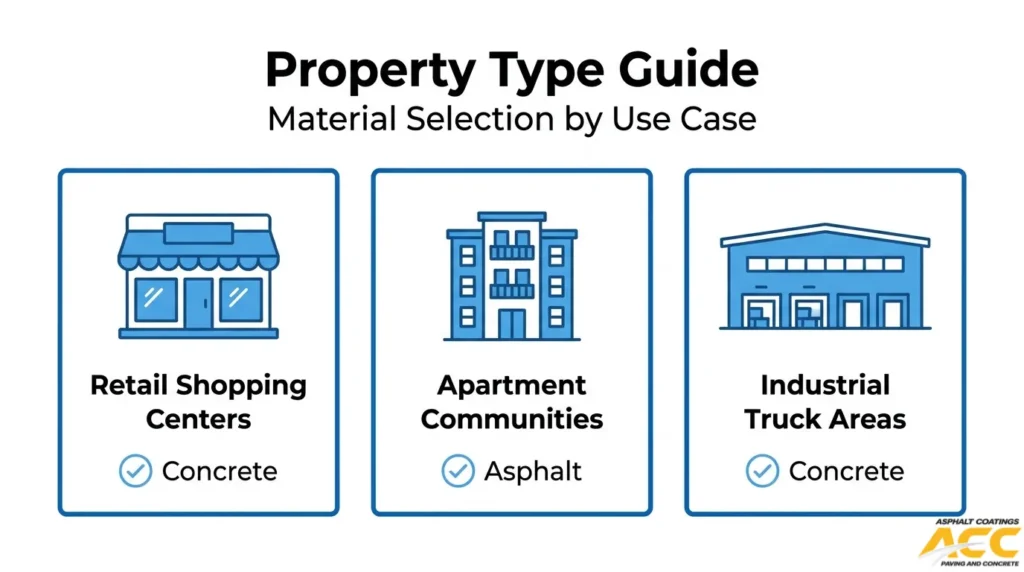
Concrete curb is better for shopping centers and retail plazas. These properties depend on polished first impressions and durable curb lines that withstand constant cart traffic, delivery trucks at loading zones, and snowplow contact along fire lanes. According to the City of Los Angeles Street Design Manual, curb type selection depends on proposed location, anticipated traffic type, and drainage and economic considerations. Retail plazas benefit from concrete’s higher visibility contrast with asphalt pavement, which helps define pedestrian pathways and ADA-compliant crossings. For property managers balancing aesthetics with longevity, concrete curbs in retail environments typically justify the higher upfront cost through fewer replacement cycles.
Which Curb Type Is Better for Apartment and Multifamily Communities?
Asphalt curb is often the better fit for apartment and multifamily communities. Resident parking areas experience lighter vehicle loads than retail or industrial sites, and budget constraints across large perimeters make asphalt’s lower per-linear-foot cost appealing. Asphalt curbs also simplify phased repairs when individual sections sustain damage from seasonal ground movement. However, high-visibility areas like main entrances and clubhouse frontage may warrant concrete curbs for a sharper appearance. Blending both materials, with asphalt in general parking loops and concrete at focal points, gives multifamily property managers an effective balance of cost control and curb appeal.
Which Curb Type Is Better for Industrial Parks and Heavy Truck Areas?
Concrete curb is better for industrial parks and heavy truck areas. Repeated turning movements from loaded trailers concentrate force on curb faces in ways that deform asphalt over time. A study from the Institute for Transportation at Iowa State University notes that truck lanes for heavy trucks delivering goods or removing waste material experience a heavier spectrum of traffic loadings than standard parking areas. Barrier-style concrete curbs resist this impact and maintain drainage grades longer under sustained heavy loads. For any loading dock, waste-removal lane, or truck court, concrete is the more reliable long-term investment.
Matching curb material to each property’s specific demands helps contractors scope the right solution from the start.
What Questions Should You Ask a Paving Contractor Before Choosing Curb Type?
You should ask a paving contractor about climate durability, warranty terms, and project phasing before choosing a curb type. These three areas reveal whether a contractor understands material performance, stands behind their work, and can protect your operations during construction.
What Should You Ask About Local Climate Performance for Each Curb Material?
You should ask about local climate performance for each curb material by requesting specific data on freeze-thaw resistance, deicer compatibility, and moisture susceptibility relevant to your region. Ask whether the contractor has installed both asphalt and concrete curbs in climates similar to yours and what failure patterns they have observed over five, ten, and fifteen years.
Key questions to raise include:
- How many freeze-thaw cycles per year does this material typically withstand before showing damage?
- What deicer products does your maintenance crew use, and how does each curb material respond to them?
- Does the proposed asphalt mix meet moisture-susceptibility thresholds for this climate zone?
- Will the concrete mix include air entrainment between 5% and 8% for severe-exposure conditions?
According to the National Ready Mixed Concrete Association, concrete curbs in severe-exposure environments should have at least 5% entrained air, with a maximum allowable of 8%, to survive freeze-thaw cycles and deicer salt applications. Any contractor who cannot speak to these specifics likely lacks the regional experience your project demands.
What Should You Ask About Warranty, Expected Lifespan, and Maintenance Plans?
You should ask about warranty, expected lifespan, and maintenance plans by requesting written documentation that separates material warranties from workmanship guarantees. A vague verbal promise is not a warranty; insist on specifics.
Essential questions include:
- What is the written warranty period for curb installation, and what does it cover?
- What is the realistic expected lifespan of each curb material under your site’s traffic and climate conditions?
- Does your company offer a maintenance plan, and what inspections or repairs does it include?
- At what condition threshold do you recommend full replacement rather than patching?
As noted by the Washington State Department of Transportation Maintenance Manual, curb inspections should document deterioration, cracking, spalling, and damage. A contractor who proactively schedules these assessments demonstrates genuine commitment to long-term curb performance rather than simply collecting the installation payment.
What Should You Ask About Phasing Work to Minimize Tenant and Customer Disruption?
You should ask about phasing work to minimize tenant and customer disruption by confirming how the contractor sequences curb installation around active parking areas, business hours, and pedestrian access routes. Commercial properties cannot afford unplanned closures that drive away customers or frustrate tenants.
Priority questions include:
- Can you phase the project so that a portion of the lot remains open at all times?
- What is your estimated timeline for each phase, and how do weather delays affect the schedule?
- Will you coordinate directly with property management and tenants on access changes?
- How does material choice affect phasing, given that asphalt curbs cure faster than concrete curbs?
Asphalt curbs generally allow faster lane reopening because hot-mix asphalt cools and sets within hours, while concrete typically requires multi-day curing before it can handle traffic loads. For properties with high daily visitor counts, this difference in turnaround time can significantly influence which curb material makes the most practical sense.
With these contractor questions answered, the final step is working with a full-service paving partner who integrates curb selection into a complete site design.
How Should You Approach Curb Decisions With a Full-Service Asphalt and Concrete Contractor?
You should approach curb decisions with a full-service asphalt and concrete contractor by treating curbs and paving as one integrated system. The sections below explain how Asphalt Coatings Company delivers that approach and summarize the key takeaways from this guide.
How Can Asphalt Coatings Help Design and Build Parking Lot Curbs and Paving as a System?
Asphalt Coatings Company helps design and build parking lot curbs and paving as a system by handling both asphalt and concrete work with in-house crews. Since 1986, Asphalt Coatings Company has served Colorado’s Front Range with commercial asphalt and concrete services, where freeze-thaw cycles and deicer exposure demand precise material selection.Concrete curbs in these conditions require an air-entrained mix with 5% to 8% entrained air to survive repeated cycling and salt applications, according to the National Ready Mixed Concrete Association. Asphalt Coatings Company coordinates curb material selection, drainage considerations, and pavement design, handling both asphalt and concrete work with in-house crews to provide single-source convenience. Working with a single contractor for both asphalt and concrete eliminates the coordination challenges that can occur when separate contractors handle curbs and paving independently.
What Are the Key Takeaways About Asphalt Curb vs Concrete Curb for Commercial Parking Lots: Cost, Drainage and Lifespan We Covered?
The key takeaways about asphalt curb vs concrete curb for commercial parking lots are:
- Asphalt curbs cost less upfront and install faster, making them practical for budget-sensitive projects or temporary lot configurations.
- Concrete curbs deliver longer service life, stronger structural definition, and better resistance to snowplow damage and heavy truck loading.
- Curb type directly affects drainage performance; barrier and mountable profiles must align with catch basins, inlets, and gutter pans to prevent ponding and curb bypass.
- Cold-climate lots benefit from air-entrained concrete curbs that withstand freeze-thaw cycles and deicer chemicals without spalling.
- ADA compliance depends on precise curb ramp slopes and flush grade breaks regardless of material.
- Choosing between asphalt and concrete curbs is not purely a material question; it is a system decision that accounts for traffic patterns, climate exposure, drainage design, and long-term maintenance budgets.
For property managers weighing these factors across a commercial site, working with a contractor experienced in both materials ensures each curb section serves the lot as a whole.