Advanced asphalt milling is the controlled cold removal of deteriorated pavement to a specified depth and profile, restoring commercial surfaces for overlay, recycling, or full reconstruction. This guide covers the milling process and advanced techniques, equipment and tooling selection, climate and environmental considerations, parking lot best practices and maintenance integration, safety and traffic management, RAP recycling and reuse, and contractor selection.
The milling process follows a defined sequence: site assessment, traffic control setup, cold planing at the target depth, material conveyance to haul trucks, surface cleaning, and grade inspection before paving. Advanced techniques such as fine-milling, profile milling, edge milling, and full-depth removal each address specific distress conditions, from minor surface ruts to structural base failure.
Equipment choices range from full-lane cold planers cutting up to 14 inches deep to compact skid-steer attachments for tight spaces around curbs and utilities. Cutting drum tooth spacing controls surface texture, while automated grade and slope systems hold precise elevations across each pass.
Climate factors including freeze-thaw damage, UV-driven binder oxidation, and temperature-sensitive scheduling windows directly shape milling depth and timing decisions. On commercial parking lots, selecting the correct removal depth for each distress level and restoring proper drainage grades before overlay placement are among the highest-impact practices for extending pavement life.
Milling also integrates with crack sealing, sealcoating, and phased reconstruction to distribute costs across budget cycles. Milled material recycled as reclaimed asphalt pavement (RAP) reduces project costs and landfill waste. Safety protocols, ADA-compliant pedestrian routing, and dust suppression protect crews and facility occupants throughout active operations.
How Does Asphalt Milling Work From Start To Finish?
Asphalt milling works from start to finish through a sequenced process of surface removal, material management, and preparation for repaving. The key steps, depth control methods, hauling logistics, and post-milling surface preparation are covered below.
What Are The Key Steps In A Typical Asphalt Milling Process?
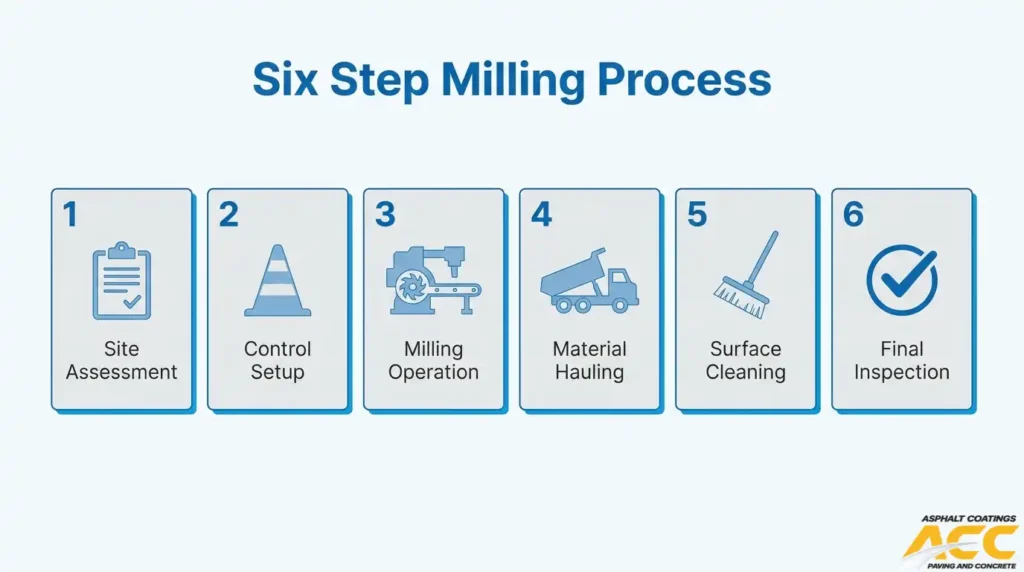
The key steps in a typical asphalt milling process are:
- Site assessment and marking identify pavement distress areas, utility covers, and target milling depths.
- Traffic control setup establishes work zones, signage, and pedestrian routing before equipment enters the site.
- Milling operation uses a cold planer to remove asphalt at the specified depth and width in controlled passes.
- Material conveyance transfers milled asphalt from the drum housing onto trucks via an integrated conveyor system.
- Surface cleaning removes loose debris and fines with power brooms or vacuum sweepers.
- Inspection and preparation verifies grade, profile, and drainage before the overlay crew mobilizes.
Each step feeds directly into the next; skipping surface cleaning or inspection compromises overlay bond strength.
How Do Milling Machines Remove Asphalt To A Precise Depth?
Milling machines remove asphalt to a precise depth by rotating a cutting drum equipped with carbide-tipped teeth against the pavement surface at a controlled speed and downward pressure. According to the Asphalt Recycling and Reclaiming Association, cold planing is the controlled cold milling of pavement to restore the surface to a specified profile, removing bumps, ruts, and other irregularities to leave a uniform textured surface.
Modern cold milling machines cover working widths from 1 ft 2 in to 14 ft 5 in and achieve working depths up to 1 ft 2 in in a single pass. Onboard grade and slope sensors continuously reference a stringline, ski, or sonic averaging beam, automatically adjusting leg height to hold the drum at the target elevation. This closed-loop feedback is what separates precision milling from simple surface grinding.
How Is Milled Material Removed, Hauled, And Managed On Site?
Milled material is removed, hauled, and managed on site through a coordinated conveyor-to-truck system. The milling machine’s front-loading or rear-loading conveyor deposits reclaimed asphalt pavement directly into haul trucks traveling alongside the machine.
Effective material management requires:
- Truck staging so loaded vehicles cycle out without stopping the milling machine.
- Inlet and manhole protection to prevent millings from entering drainage structures.
- Stockpile placement in designated areas away from active traffic lanes when on-site storage is needed.
- Sweeping behind the mill to clear fines that the conveyor misses.
Keeping haul trucks synchronized with milling speed prevents material spillage and minimizes production downtime.
How Is The Surface Prepared After Milling For New Asphalt?
The surface is prepared after milling for new asphalt by cleaning, inspecting, and applying a tack coat to ensure proper bond with the overlay. Power brooms or compressed air remove residual dust and loose aggregate from the milled profile.
Key preparation steps include:
- Grade verification using a straightedge or string line to confirm the milled surface meets specified tolerances.
- Drainage check to ensure water flows toward inlets rather than ponding in low spots.
- Tack coat application at the engineered rate to bond the existing milled surface to the new asphalt lift.
- Edge and transition inspection to confirm clean vertical faces at milling boundaries.
Thorough surface preparation is arguably the most undervalued step in the entire mill-and-pave sequence; even a perfectly milled profile will fail prematurely if debris or moisture compromises the tack coat bond.
With the milling process defined, understanding the advanced techniques available helps match the right approach to each pavement condition.
What Advanced Asphalt Milling Techniques Are Used On Commercial Properties?
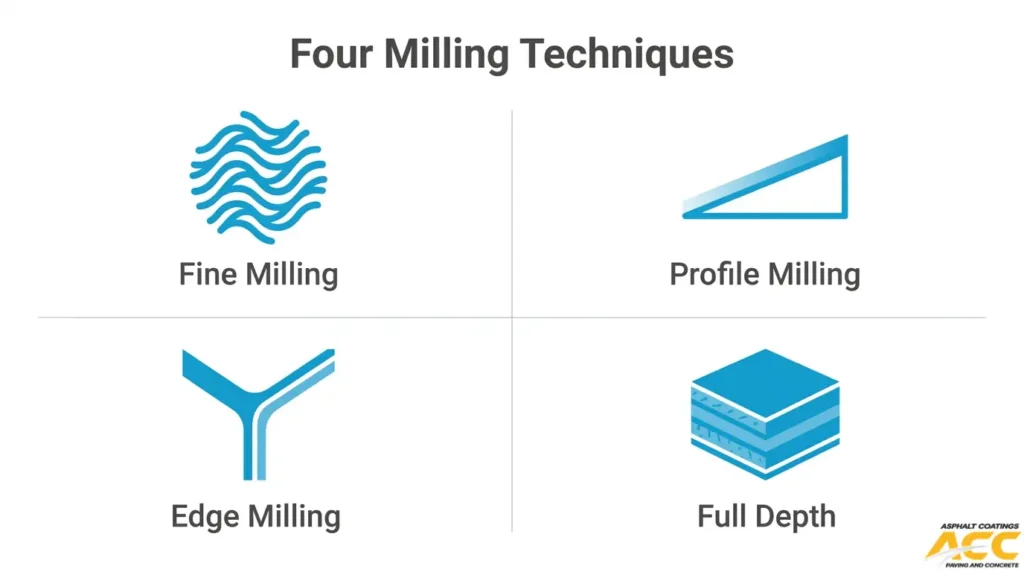
Advanced asphalt milling techniques used on commercial properties include fine-milling, profile milling, edge milling, and full-depth milling. Each method addresses a specific pavement condition, from surface smoothness to structural failure.
How Does Fine-Milling Improve Smoothness And Ride Quality?
Fine-milling improves smoothness and ride quality by using closely spaced cutting teeth to produce a uniform, low-texture surface. Standard milling drums space teeth at 5/8 in (15 mm), while fine-milling drums reduce that spacing to 5/16 in (8 mm) with approximately 300 bits. This tighter configuration removes ruts, bumps, and minor irregularities without cutting deep into the pavement structure. The resulting texture provides excellent skid resistance and a strong bonding surface for thin overlays. For commercial parking lots and access roads where vehicle comfort and noise reduction matter, fine-milling often eliminates the need for a full overlay, saving both time and material cost.
When Is Profile Milling Used To Correct Drainage And Slope Issues?
Profile milling is used to correct drainage and slope issues when the existing pavement grade has shifted, settled, or was improperly constructed. This technique removes asphalt at variable depths across the lane or lot to re-establish designed cross-slopes and longitudinal grades. Ponding water on commercial parking lots accelerates pavement deterioration, so restoring proper drainage flow is critical. Operators rely on automated grade and slope control systems to achieve precise elevation targets across the milled surface. Profile milling is particularly effective near catch basins, drive aisles, and loading areas where water pooling creates safety hazards. Correcting grade through milling avoids the added weight and cost of building up low spots with additional asphalt.
How Is Edge Milling Used Around Gutters, Curbs, And Transitions?
Edge milling is used around gutters, curbs, and transitions by employing smaller, more maneuverable milling machines that cut precisely along fixed structures. Commercial properties contain numerous obstacles, including:
- Concrete curbs and gutter pans
- Storm drain inlets and manholes
- ADA ramp transitions
- Building facades and loading dock aprons
Compact milling units can work within inches of these features without causing damage. Edge milling restores proper curb reveal height, which prevents water from sheeting over curbs into landscaping or building foundations. Clean, consistent edges also create tight joints where new asphalt meets existing concrete, reducing the infiltration points that lead to premature pavement failure.
When Is Full-Depth Milling Preferable To Traditional Overlay Approaches?
Full-depth milling is preferable to traditional overlay approaches when the pavement structure has failed beyond the surface layer. Overlay alone adds material on top of compromised base layers, which leads to recurring cracking, rutting, and settlement. Full-depth removal addresses the root cause by stripping asphalt down to the subgrade or aggregate base, allowing inspection and correction of underlying problems. This approach also maintains existing surface elevations at building entrances, dock doors, and drainage structures. According to the Federal Highway Administration, temporary traffic-control plans for projects of this scale must address pedestrian access under ADA Title II, including maintaining existing paths or establishing alternative routes when construction affects pedestrian circulation. Full-depth milling costs more upfront, but it resets the pavement’s service life rather than temporarily masking structural deficiencies.
Understanding which technique fits a given condition is the first step; selecting the right equipment and tooling determines how precisely that technique performs.
What Are The Types Of Asphalt Milling Equipment And Tooling?
The types of asphalt milling equipment and tooling range from large half-lane cold planers to compact skid-steer attachments, with cutting drums, teeth configurations, and grade control systems determining precision and surface quality.
How Do Half-Lane Milling Machines Differ From Smaller Commercial Units?
Half-lane milling machines differ from smaller commercial units in cutting width, depth capacity, and production volume. Large cold planers handle highway-scale projects requiring continuous, high-output removal across wide passes. According to Astec Industries, the Roadtec RX-900 is designed for half-lane or full-lane milling, cuts up to 14 in. deep, and offers standard widths of 7 ft 2 in., 8 ft 2 in., 12 ft, 12 ft 6 in., and 13 ft.
Smaller commercial units, by contrast, feature narrower cutting widths suited to parking lots, intersections, and confined areas. These machines are easier to transport and maneuver around curbs, islands, and utility structures. For most commercial property work, matching machine size to the project footprint prevents unnecessary mobilization costs and site disruption.
What Role Do Cutting Drums And Teeth Play In Milling Quality?
Cutting drums and teeth play a direct role in milling quality by controlling surface texture, smoothness, and material gradation. Tooth spacing on the drum determines how fine or coarse the milled surface will be:
- Standard milling teeth use 5/8 in. (15 mm) spacing with 150 bits.
- Fine-milling teeth use 5/16 in. (8 mm) spacing with approximately 300 bits.
- Micro-milling teeth use 0.2 in. (5 mm) spacing with approximately 450 to 500 bits.
A University of Houston, Center for Transportation Research report documents these configurations. Tighter tooth spacing produces smoother finishes ideal for thin overlays, while wider spacing suits bulk removal. Water sprays along the drum cool cutting teeth and suppress dust, which, as NIOSH notes, may contain respirable crystalline silica.
How Do Grade And Slope Control Systems Improve Milling Precision?
Grade and slope control systems improve milling precision by automatically adjusting cutting depth in real time to match a reference profile. These systems use sensors, sonic trackers, or stringline references to maintain consistent depth across the pass, eliminating manual guesswork. According to Caterpillar, the PM312 Cold Planer features integrated Cat Grade and Slope technology that supports cutting precision at a 48.2 in. milling width and 343 hp rated power.
Intelligent controls also support straight-line travel; Volvo’s MW500 used a Line Manager system for this purpose during its production run. Automated grade control is especially valuable on commercial parking lots where drainage slopes must be precise to prevent ponding.
When Are Compact Or Skid-Steer Mill Attachments The Best Choice?
Compact or skid-steer mill attachments are the best choice when full-size cold planers cannot access the work area or when the milling scope is small. Typical applications include:
- Removing asphalt around utility covers, catch basins, and bollards.
- Milling narrow strips along curb lines, sidewalks, and ADA ramp transitions.
- Spot repairs in tight parking lot areas between islands or near building entries.
- Small patch areas where mobilizing a large machine is not cost-effective.
These attachments mount directly to skid-steer loaders or compact track loaders already common on commercial jobsites. While production rates are lower than dedicated cold planers, the tradeoff in maneuverability and reduced mobilization cost makes them practical for targeted work. Understanding available tooling options helps property managers evaluate what contractors recommend for their specific pavement conditions.
How Do Climate And Environmental Conditions Affect Asphalt Milling?
Climate and environmental conditions affect asphalt milling by altering pavement stiffness, influencing scheduling windows, and creating community impact considerations. The following subsections cover freeze-thaw effects, high-UV exposure, temperature-driven scheduling, and strategies for reducing environmental disruption.
How Do Freeze-Thaw Cycles Influence Milling Depth And Strategy?
Freeze-thaw cycles influence milling depth and strategy by accelerating subsurface damage that standard-depth removal may not reach. When water infiltrates pavement cracks and freezes, it expands, creating voids and delamination between asphalt layers. Repeated cycling compounds this damage season after season.
According to the National Academies of Sciences, Engineering, and Medicine, temperature and moisture variation compound freeze-thaw effects on asphalt, while asphalt stiffness changes with temperature and moisture changes influence mixture performance, including stripping.
These findings mean contractors must assess damage depth carefully before selecting a milling strategy. Shallow milling may leave compromised layers intact, leading to premature failure of the new overlay. In freeze-thaw-prone regions, core sampling before milling helps identify the true extent of deterioration and determine whether full-depth removal is necessary.
What Milling Considerations Apply In High-UV Or High-Altitude Environments?
The milling considerations that apply in high-UV or high-altitude environments center on accelerated binder oxidation and reduced air density. Intense ultraviolet radiation hardens asphalt binder faster than in lower-elevation settings, making the surface layer brittle and prone to raveling. This oxidized material mills differently; it tends to fracture into finer particles rather than chunking cleanly.
At higher altitudes, thinner air also reduces cooling efficiency for cutting teeth, increasing wear rates on milling drums. Operators typically need to adjust water spray volumes and monitor tooth condition more frequently. For properties in these environments, scheduling milling during moderate temperatures helps avoid cutting through excessively brittle pavement, which can cause irregular surface profiles that complicate overlay bonding.
How Do Temperature And Moisture Conditions Affect Milling Scheduling?
Temperature and moisture conditions affect milling scheduling by defining the operational windows where equipment performs reliably and surface quality remains consistent. Cold pavement is stiffer and harder to cut, which increases fuel consumption, accelerates tooth wear, and can produce rough surface textures. Conversely, excessively hot asphalt becomes soft and may smear rather than cut cleanly.
Moisture presents a separate constraint. Rain or standing water during milling reduces the textured surface quality needed for proper overlay bonding. Wet millings also clog conveyors and complicate hauling logistics. Most contractors target dry conditions with moderate ambient temperatures, typically between 45°F and 90°F, to balance cutting efficiency with surface quality. For commercial properties, scheduling milling during seasonal dry periods minimizes weather-related delays and protects project timelines.
How Can Milling Be Done To Reduce Environmental And Community Impact?
Milling can be done to reduce environmental and community impact through targeted dust suppression, noise management, and operational timing adjustments. Key strategies include:
- Water spray systems on the cutting drum and conveyors control airborne dust at the source.
- Drum-housing enclosures and negative-pressure ventilation contain particulates within the machine.
- Scheduling milling operations during off-peak hours reduces noise disruption for adjacent businesses and residents.
- Proper conveyor containment prevents loose millings from scattering into landscaping, storm drains, or pedestrian areas.
- Recycling milled material as reclaimed asphalt pavement diverts waste from landfills and reduces the demand for virgin aggregate.
For commercial facilities surrounded by occupied buildings, these controls are not optional extras. Proactive dust and noise planning protects tenant relationships and keeps projects on track without regulatory interruptions.
With environmental factors addressed, applying milling best practices to specific commercial parking lot conditions ensures long-lasting results.
What Are Milling Best Practices For Long-Lasting Commercial Parking Lots?
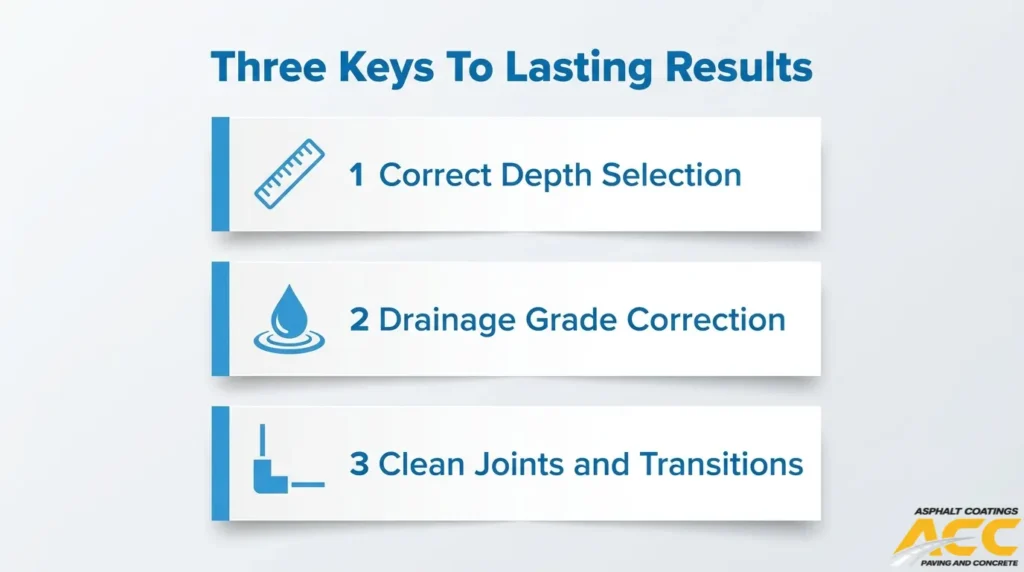
Milling best practices for long-lasting commercial parking lots include selecting the correct depth for each distress level, grading surfaces to improve drainage, managing joints and transitions cleanly, and completing quality-control checks before overlay placement.
How Should Milling Depth Be Chosen For Different Distress Levels?
Milling depth should be chosen for different distress levels by matching removal thickness to the type and severity of pavement deterioration. Surface defects such as minor rutting, oxidation, or raveling typically require shallow milling of 1 to 2 inches to remove only the worn wearing course. Moderate distress, including alligator cracking or deeper ruts that penetrate the binder course, calls for intermediate depths of 2 to 3 inches. When structural failure, base saturation, or full-depth cracking is present, full-depth milling of 3 inches or more exposes the subgrade for evaluation and repair. Coring or ground-penetrating radar before milling confirms actual layer thicknesses so the crew avoids cutting too shallow, which leaves damaged material in place, or too deep, which wastes time and material.
How Can Milling Improve Surface Drainage In Parking Lots?
Milling can improve surface drainage in parking lots by re-establishing cross slopes and correcting low spots that trap standing water. Profile milling removes high points and reshapes grades so water flows toward catch basins, curb lines, or drainage inlets instead of ponding in travel lanes or stall areas. This corrected grade also sets the stage for a uniform overlay that maintains the designed slope. According to New Jersey Department of Transportation Technology Transfer, high-performance thin overlay (HPTO) placed at 1 inch on pavement in “good condition” can more than double service life compared with application to pavement in “fair condition.” Eliminating ponding before overlay placement is one of the most cost-effective steps a property manager can take, because trapped moisture accelerates stripping and premature failure underneath even a well-designed surface course.
How Should Joints, Corners, And Transitions Be Handled During Milling?
Joints, corners, and transitions should be handled during milling by creating clean, squared edges that promote tight bond lines in the overlay. Butt joints at lane or section boundaries need vertical faces cut to the full milling depth so the new mat locks in without a feathered edge. At corners and curb returns, smaller milling attachments or saw cuts produce precise geometry that full-lane machines cannot reach. Transition tapers between milled and unmilled areas should follow a gradual slope, typically no steeper than 1 foot of run per inch of depth change, to prevent tire impact damage and ensure smooth compaction of the new lift.
What Quality-Control Checks Should Be Done Before Paving Over Milled Surfaces?
Quality-control checks that should be done before paving over milled surfaces include verifying depth, cleanliness, grade accuracy, and mix-temperature readiness. Crews should spot-check milling depth with a straightedge at multiple points to confirm uniform removal. All loose millings, dust, and debris must be cleared by power broom or air blast so tack coat bonds directly to the textured surface. Grade and cross-slope readings confirm drainage design targets are met. According to the Asphalt Institute, “Mixes must be placed and compacted before they cool to 185°F,” and agency specifications typically define the minimum acceptable temperature. Checking that the milled surface is dry and free of standing water before tack application rounds out a thorough pre-pave inspection.
With these parking-lot practices established, integrating milling into a broader maintenance strategy maximizes long-term return.
How Does Asphalt Milling Integrate With Other Pavement Maintenance Strategies?
Asphalt milling integrates with other pavement maintenance strategies by serving as a preparatory step that improves the performance of overlays, crack sealing, sealcoating, and phased reconstruction. The sections below cover when milling outperforms simple overlay, how it pairs with preventive treatments, its role in staged rebuilds, and how budget and traffic shape the approach.
When Is Milling Better Than Simple Asphalt Overlay?
Milling is better than simple asphalt overlay when the existing surface has structural distress, drainage problems, or height restrictions that a direct overlay cannot resolve. Overlaying without milling traps moisture, preserves rutting patterns, and raises the pavement elevation at curbs, manholes, and catch-basin inlets. According to the Michigan Department of Transportation, milling operations must include protection of manholes and catch-basin inlets and maintenance of adequate drainage. Milling resets proper grade, removes deteriorated material, and creates a textured bonding surface for the new lift. For commercial properties where curb reveal and ADA clearances matter, skipping the mill step often leads to premature overlay failure.
How Can Milling Be Combined With Crack Sealing And Sealcoating?
Milling can be combined with crack sealing and sealcoating by sequencing treatments so each layer addresses a different distress type. The most effective approach follows this order:
- Mill the surface to remove oxidized or cracked pavement at the appropriate depth.
- Apply crack sealant to any remaining structural cracks exposed after milling.
- Place the new asphalt overlay on the prepared, sealed surface.
- Sealcoat the finished surface after the overlay has cured, typically 90 days or more.
This layered strategy prevents reflective cracking from propagating through the new lift while the sealcoat extends oxidation resistance. Skipping crack sealing before overlay is one of the most common shortcuts that undermines long-term pavement life.
When Should Milling Be Used As Part Of A Phased Reconstruction Plan?
Milling should be used as part of a phased reconstruction plan when full removal and replacement exceeds the current budget or when traffic cannot be fully diverted. Phased plans typically mill and overlay the worst sections first, then address remaining areas in subsequent budget cycles. MDOT requires a 25-ft test section on the first day of milling at the planned machine speed and RPM, which helps calibrate depth and quality before committing to full production. This staged approach preserves serviceability between phases while distributing capital expenditures across multiple fiscal years.
How Do Budget And Traffic Requirements Influence The Milling Strategy?
Budget and traffic requirements influence the milling strategy by determining scope, depth, and scheduling. The City of Columbia benchmarks milling and overlay at $10 to $12 per square yard, compared with $1 to $2 per square yard for chip seal. That cost difference pushes budget-constrained properties toward targeted milling of high-distress areas rather than full-surface treatment.
Traffic volume dictates two critical decisions:
- Scheduling windows: High-traffic commercial lots often require night or weekend milling to minimize disruption.
- Milling depth: Heavier traffic loads demand deeper mills to remove fatigued pavement layers, while lighter-use areas may need only surface correction.
Balancing these factors early in planning prevents cost overruns and keeps facilities operational during construction.
What Safety And Traffic Management Practices Are Essential During Milling?
The essential safety and traffic management practices during milling include proper work-zone setup, dust and noise controls, ADA-compliant pedestrian routing, and strict crew safety protocols. The following sections cover each area.
How Should Work Zones Be Set Up For Milling In Active Facilities?
Work zones for milling in active facilities should be set up following the Manual on Uniform Traffic Control Devices (MUTCD), which the Federal Register recognizes as the national standard for traffic-control devices on public roads, bikeways, and private roads open to public travel. Revision 1 of the 11th Edition became effective March 5, 2026. Commercial properties require clear lane closures, advance warning signage, channelizing devices, and flaggers when milling occurs near active driveways or intersections. Staging areas for haul trucks and milling equipment should be positioned to avoid blocking emergency access. Coordinating work schedules around peak business hours reduces disruption for tenants and customers at facilities that remain open during construction.
What Dust, Noise, And Debris Controls Are Needed During Milling?
The dust, noise, and debris controls needed during milling include engineering systems on the machine itself, hearing-conservation measures, and site containment practices. Milling drums generate airborne particulates that may contain respirable crystalline silica. According to NIOSH (Centers for Disease Control and Prevention), recommended engineering controls include drum-housing and conveyor enclosures, negative air pressure ventilation, and water sprays along the drum and conveyors. OSHA’s construction noise standard (29 CFR 1926.52) requires a hearing-conservation program when exposures exceed 90 dBA-TWA. Loose millings should be swept promptly to prevent debris from migrating into storm drains or landscaped areas. Proactive dust suppression paired with proper enclosures is one of the most cost-effective ways to protect both crews and neighboring occupants.
How Should Pedestrian And ADA Routes Be Managed While Milling Occurs?
Pedestrian and ADA routes should be managed by maintaining accessible pathways throughout all milling phases. FHWA states that temporary traffic-control plans must address pedestrians, including people with disabilities, under ADA Title II. Three routing approaches apply when construction affects pedestrian access:
- Maintaining the existing pedestrian path clear of equipment and debris.
- Developing an alternative parallel path with firm, stable, and slip-resistant surfaces.
- Establishing an advance detour with compliant signage directing pedestrians around the work zone.
Temporary curb ramps, detectable warning surfaces, and adequate sidewalk width must remain available at all times. Failing to plan ADA-compliant routes exposes property owners to liability and federal compliance issues, making this a non-negotiable element of every milling project.
What Crew Safety Protocols Are Critical Around Milling Equipment?
The crew safety protocols critical around milling equipment include machine-specific training, personal protective equipment (PPE) requirements, and communication procedures. Essential protocols are:
- Completing equipment-specific lockout/tagout before any maintenance on the milling drum or conveyor.
- Requiring high-visibility vests, hard hats, steel-toed boots, hearing protection, and respiratory protection rated for silica exposure.
- Establishing hand-signal or radio communication between the milling operator, ground crew, and haul-truck drivers.
- Maintaining minimum safe distances from the rotating drum and conveyor discharge.
- Conducting daily pre-shift safety briefings that cover site-specific hazards, traffic patterns, and emergency procedures.
No crew member should operate near the milling machine without verified training on its specific model and safety systems. With these protocols in place, contractors can then focus on what happens to the milled material itself.
How Should Milled Asphalt Be Handled, Recycled, Or Reused?
Milled asphalt should be handled through crushing, screening, and blending into new hot-mix asphalt or reused as aggregate base material. The subsections below cover effective RAP recycling, on-project reuse, off-site logistics, and regulatory specifications.
How Can Reclaimed Asphalt Pavement From Milling Be Recycled Effectively?
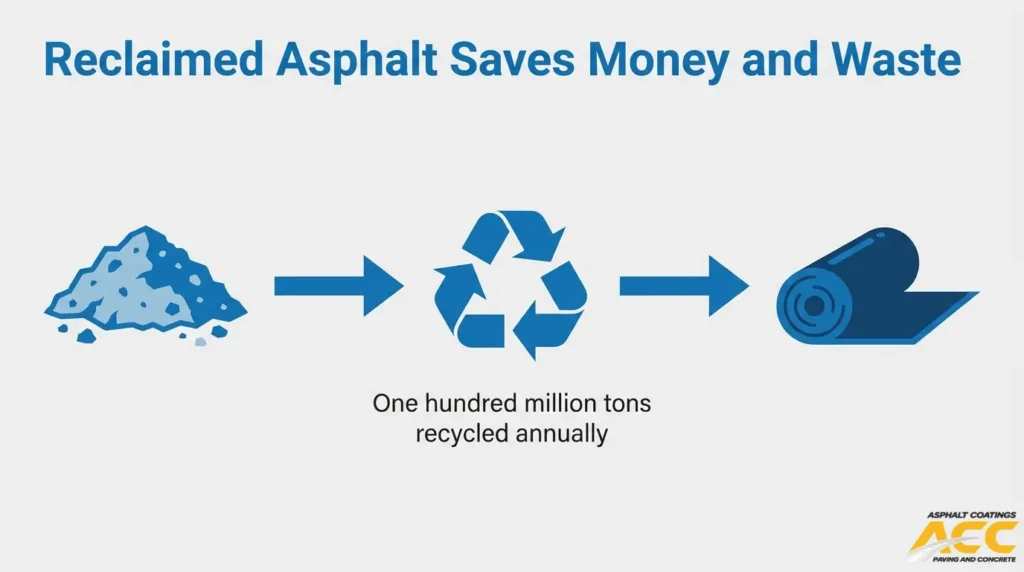
Reclaimed asphalt pavement from milling can be recycled effectively by crushing and screening the millings into graded aggregate coated by residual asphalt cement, then blending the processed RAP into new hot-mix asphalt production. According to the University of Wisconsin Recycled Materials Resource Center, properly processed RAP consists of well-graded aggregates with an asphalt-cement content typically ranging from 3% to 7% by weight.
Effective RAP recycling requires several coordinated steps:
- Stockpile millings by source to prevent contamination from differing binder grades.
- Crush and screen RAP to achieve consistent gradation before batching.
- Test asphalt-cement content and aggregate properties for each stockpile.
- Blend RAP at the plant using approved mix designs that account for the aged binder contribution.
Recycled materials remain the primary driver for reducing the asphalt industry’s carbon footprint. During the 2024 construction season, 101.4 million tons of RAP were put back into use, saving $4.7 billion compared with virgin materials. For commercial property managers, specifying RAP inclusion in overlay projects is one of the most cost-effective sustainability decisions available.
When Can Milled Material Be Reused On The Same Project?
Milled material can be reused on the same project when the RAP meets gradation and binder-quality standards required by the project’s mix design. Common on-site reuse applications include granular base or subbase fill, temporary access roads, and shoulder stabilization.
A May 2025 UC Berkeley report documented a pilot project on Interstate 40 in San Bernardino County that achieved 100% replacement of aggregate and asphalt binder using RAP combined with a recycling agent. The study included performance testing, life-cycle assessment, and early field rutting comparisons, demonstrating that high-percentage RAP mixes can perform under heavy traffic when properly designed.
On-site reuse eliminates hauling costs and accelerates timelines. However, the millings must be tested and approved before incorporation; untested material risks inconsistent compaction and premature failure.
What Factors Determine Whether To Haul, Store, Or Process RAP Off Site?
The factors that determine whether to haul, store, or process RAP off site include:
- Available site space: Projects without staging areas cannot accommodate on-site stockpiling or crushing.
- Volume of millings: Large-scale milling operations often exceed what a single project can reuse.
- Contamination risk: Millings from different pavement layers or sources require separate stockpiles to maintain quality-control integrity.
- Proximity to a hot-mix plant: Shorter haul distances reduce transportation costs and make plant processing more economical.
- Project timeline: Tight schedules may require immediate removal rather than on-site curing and testing.
When storage is necessary, stockpiles should be placed on a clean, graded pad with proper drainage to prevent moisture accumulation. Processing RAP off site at a dedicated plant typically yields the most consistent gradation and binder recovery.
How Do Regulations And Specifications Affect RAP Use In New Mixes?
Regulations and specifications affect RAP use in new mixes by establishing allowable RAP percentages, binder-ratio limits, and quality-control requirements that vary by agency and project type. Each state DOT maintains its own methodology for accommodating RAP in approved mix designs.
Key specification criteria typically include:
- Maximum allowable RAP percentage by lift location and traffic level.
- Recycled-binder ratio thresholds that trigger softer virgin binder grades.
- RAP fractionation requirements for coarse and fine stockpiles.
- Dedicated quality-control plans covering gradation, binder content, and moisture testing.
Private commercial projects may follow local municipality or state DOT specs, depending on jurisdiction. Specifying RAP inclusion early in the project design phase ensures the mix design accommodates recycled content without compromising overlay performance or warranty compliance.
Understanding RAP handling and recycling standards positions property managers to make informed decisions when selecting a qualified milling contractor.
How Do You Choose A Commercial Contractor For Asphalt Milling Work?
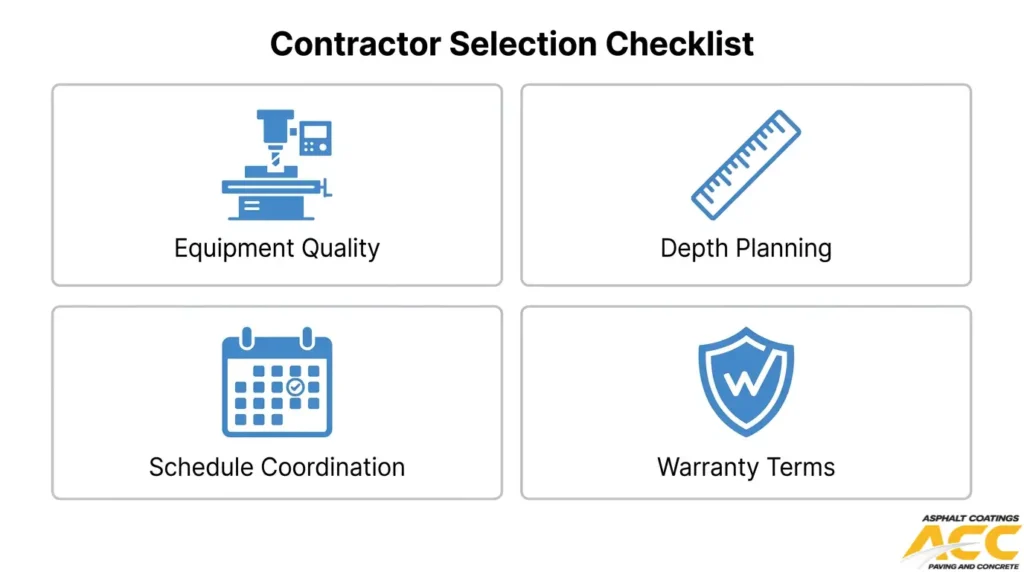
You choose a commercial contractor for asphalt milling work by verifying equipment capability, evaluating depth recommendations, confirming scheduling logistics, and reviewing warranty terms. The following subsections cover what to assess in each area.
What Experience And Equipment Should A Milling Contractor Demonstrate?
A milling contractor should demonstrate verifiable project history on commercial pavements and ownership of, or reliable access to, properly sized cold milling machines. Cold milling equipment ranges from smaller utility machines to full-lane units, and the contractor’s fleet should match your project’s scale. According to the Asphalt Recycling and Reclaiming Association, cold-planing equipment covers applications from small utility work to full-lane milling, with benefits including restored drainage, textured bonding surfaces, and reclaimed material for reuse.
Key qualifications to verify include:
- Documented experience with fine milling, profile milling, and full-depth removal on commercial parking lots or roadways.
- Ownership or lease agreements for machines with grade and slope control systems.
- Familiarity with dust-suppression and noise-control requirements.
- A trained, in-house crew rather than reliance on subcontracted operators.
Contractors who own their own equipment and employ dedicated crews tend to deliver more consistent quality because they control every variable on site.
How Can You Evaluate A Contractor’s Milling Plans And Depth Recommendations?
You can evaluate a contractor’s milling plans and depth recommendations by requesting a written scope that specifies removal depths, drum type, tooth spacing, and surface tolerances for each pavement zone. A credible plan begins with a pavement assessment that identifies distress type and severity before prescribing depth.
Ask whether the proposal distinguishes between areas needing surface correction (typically 1 to 2 inches) and areas requiring full-depth removal. The plan should also address transitions between zones of varying milling thickness, protection of manholes and catch-basin inlets, and drainage maintenance during the project. Vague or one-size-fits-all depth recommendations often signal insufficient site evaluation. If a contractor cannot explain why a specific depth was chosen for each area, that is a red flag worth acting on.
What Scheduling, Phasing, And Access Questions Should Property Managers Ask?
The scheduling, phasing, and access questions property managers should ask focus on minimizing disruption to tenants, customers, and daily operations. Commercial milling projects on active sites require a clear phasing plan that maintains vehicle circulation and pedestrian safety throughout the work.
Essential questions include:
- What is the proposed phasing sequence, and how will traffic flow be maintained during each phase?
- Will a temporary traffic-control plan be provided that addresses ADA-compliant pedestrian routing?
- What are the planned working hours, and how will noise and dust be managed during business operations?
- How will the contractor coordinate with property management on tenant notifications and access changes?
FHWA requires that temporary traffic-control plans address pedestrians, including people with disabilities under ADA Title II, using approaches such as maintaining the existing path or establishing an alternative accessible route.
How Should Warranties And Performance Standards Be Addressed For Milled Surfaces?
Warranties and performance standards for milled surfaces should be addressed in writing before work begins, with clear language defining what is covered, for how long, and under what conditions. The milling scope itself typically carries a workmanship warranty covering surface smoothness, depth accuracy, and proper drainage grades.
Request that the contract specify:
- Measurable tolerances for milling depth (commonly plus or minus 1/4 inch).
- Responsibility for correcting areas that do not meet grade or smoothness specifications.
- How the milled surface will be verified before paving, including profile checks and debris removal.
- Whether the warranty covers failures related to inadequate transitions or drainage after overlay placement.
For most commercial property managers, the contractor’s willingness to define clear performance metrics upfront is one of the strongest indicators of reliability. Vague warranty language that avoids specifics deserves scrutiny before signing.
With contractor selection criteria established, applying these standards within a complete paving and maintenance plan ensures long-term pavement performance.
How Should You Approach Advanced Asphalt Milling As Part Of A Complete Paving And Maintenance Plan?
You should approach advanced asphalt milling as one component within a coordinated paving and maintenance plan that includes sealcoating, crack sealing, and overlay scheduling. The following sections explain how professional services support milled surfaces and summarize the key practices covered throughout this guide.
How Can Commercial Paving And Sealcoating Services Support Milled Pavement Performance?
Commercial paving and sealcoating services support milled pavement performance by protecting the freshly exposed surface and extending the life of subsequent overlays. Milling alone removes damaged material, but without timely crack sealing, sealcoating, and properly engineered overlays, the restored profile remains vulnerable to moisture infiltration and oxidation.
Commercial paving contractors who provide mill and pave services, sealcoating, crack sealing with approved materials, and parking lot construction as a single-source contractor with in-house crews deliver more coordinated results. This coordinated approach ensures that milling depth, overlay design, and surface protection align within one project schedule. For commercial property managers, consolidating these services eliminates gaps between milling and protective treatments that often accelerate deterioration.
What Are The Key Takeaways About Advanced Asphalt Milling Techniques And Best Practices We Covered?
The key takeaways about advanced asphalt milling techniques and best practices are that successful outcomes depend on matching the right technique, equipment, and maintenance sequence to each project’s specific conditions. No universal formula applies to every situation. As Tim Aschenbrener, FHWA senior asphalt pavement engineer, stated: “There’s no ‘silver bullet’ for an agency to use. There’s no single answer for everyone, but by using good project selection practices, we believe every agency can find a targeted solution that is cost-effective.”
The most actionable lessons from this guide include:
- Select milling technique (fine, profile, edge, or full-depth) based on the specific distress type and required depth.
- Match cutting drum tooth spacing to the surface finish your overlay or treatment requires.
- Coordinate milling with crack sealing, sealcoating, and overlay placement to prevent exposing milled surfaces to prolonged weather.
- Reclaim and recycle milled asphalt (RAP) to reduce material costs and landfill waste.
- Implement dust, noise, and ADA-compliant traffic controls throughout every active milling zone.
Treating milling as an isolated activity, rather than a sequenced step in a broader maintenance plan, is the most common mistake property managers make. Pairing the right milling approach with prompt surface protection consistently delivers the longest pavement life at the lowest total cost.