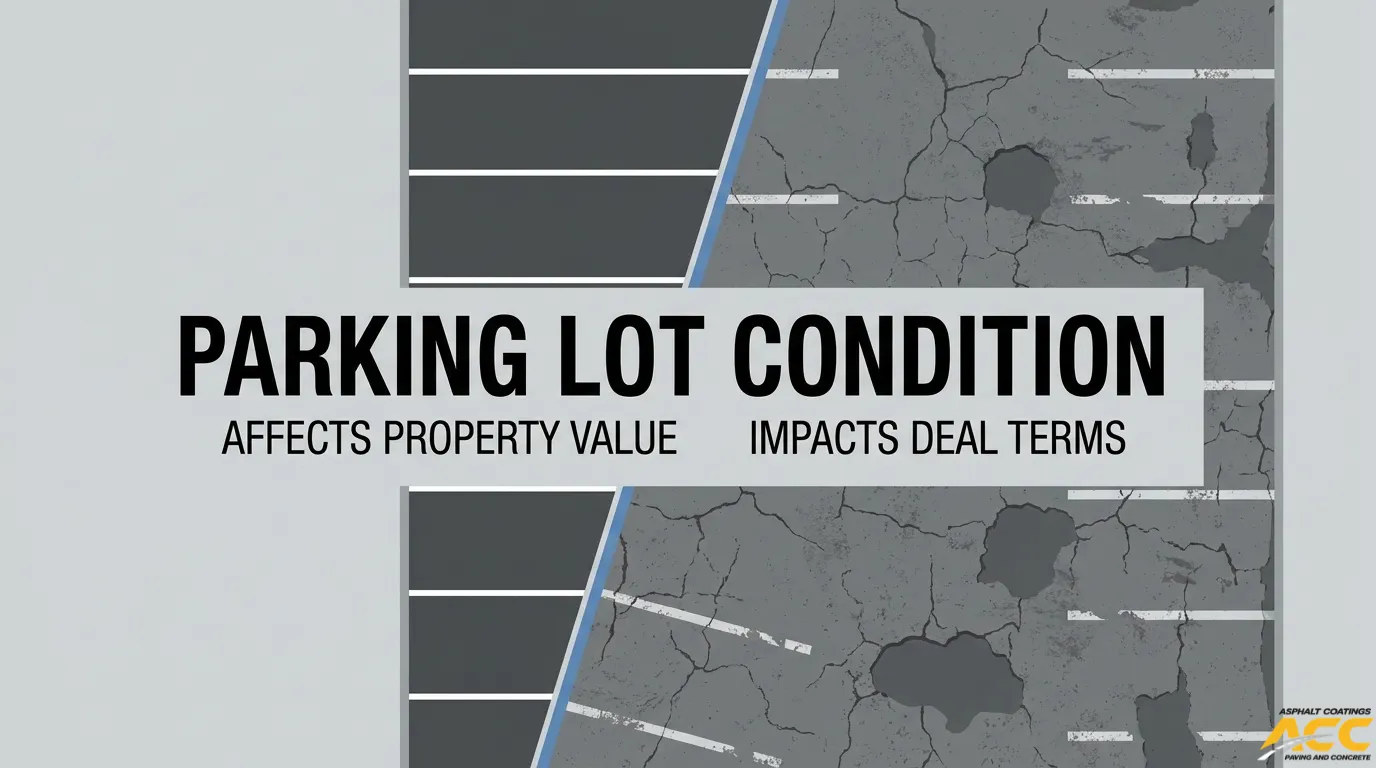
A commercial asphalt overlay is a new 1.5 to 3-inch Hot Mix Asphalt layer applied over a structurally sound existing surface, while full replacement removes the entire pavement system down to the subgrade and rebuilds it with a new 4 to 6-inch structure.
This guide covers the definitions and decision criteria for each approach, detailed cost breakdowns by lot size, lifespan expectations across traffic levels and climates, long-term annualized cost comparisons, and the site preparation and ADA compliance factors that shape your final choice.
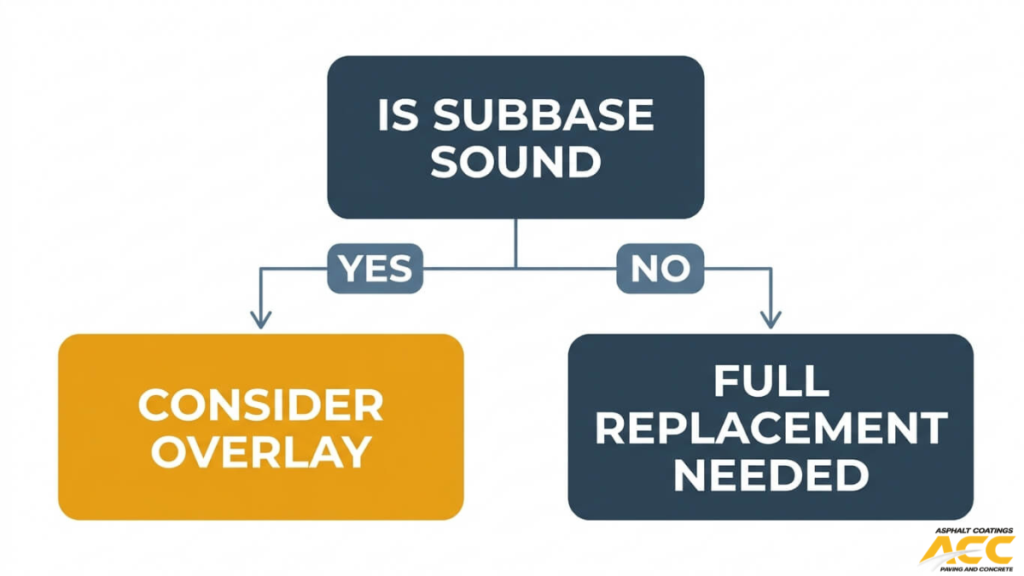
Overlays suit commercial parking lots with cosmetic surface wear, isolated minor cracking, and a stable subbase. When less than 25% to 35% of the surface shows structural distress, resurfacing preserves functional infrastructure at a fraction of tear-out cost. Full replacement becomes necessary when base failure is widespread, drainage grading is compromised, or multiple prior overlays have already raised the surface beyond usable tolerances.
Colorado overlay pricing averages $1.55 per square foot for material, while full-depth replacement runs $3.00 to $7.00 per square foot depending on site conditions and thickness. Small lots pay more per square foot due to mobilization costs; large industrial projects exceeding 50,000 square feet benefit from economies of scale that compress pricing significantly.
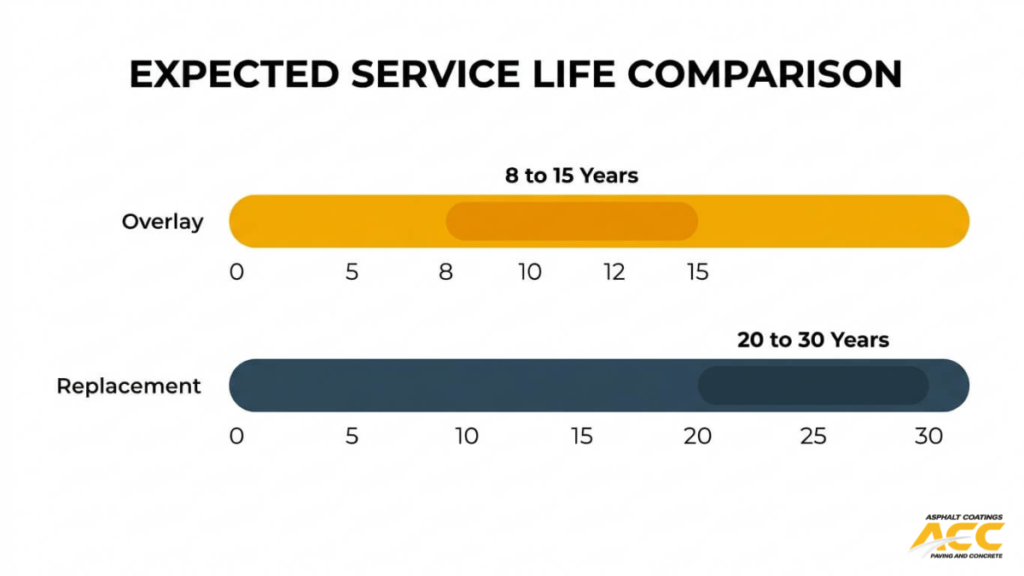
Overlays last 8 to 15 years on well-maintained surfaces, dropping to 7 to 10 years in high-traffic retail environments. Full replacement delivers 20 to 30 years of service life with consistent sealcoating. Colorado’s freeze-thaw cycles and high-altitude UV radiation shorten both timelines, making preventive maintenance and accurate condition assessment critical before committing to either approach.
Each option carries different implications for ADA slope compliance, site preparation scope, and annualized cost per year, all of which factor into the right decision for your property.
What Is a Commercial Asphalt Overlay?
A commercial asphalt overlay is the application of a new layer of Hot Mix Asphalt (HMA), typically 1.5 to 3 inches thick, over an existing pavement surface that remains structurally sound. Rather than tearing out the old surface entirely, this process bonds fresh material directly to the existing asphalt, restoring ride quality and extending usable life at a fraction of full replacement cost.
HMA used in commercial overlays is a precise mixture of approximately 95% stone, sand, and gravel bound together by 5% asphalt cement, according to the National Asphalt Pavement Association (NAPA). This composition gives the material its load-bearing strength and flexibility.
Before an overlay is placed, contractors often perform asphalt milling, a preparatory process that removes a specific thickness of the existing surface. Milling maintains proper drainage gradients and curb reveal heights so the new layer integrates seamlessly with surrounding infrastructure, including curbs, catch basins, and building entrances.
The success of any commercial overlay depends on the condition underneath. Existing cracks must be sealed and soft areas repaired to prevent reflective cracking from migrating upward into the fresh surface. When the subbase is stable and surface distress is limited to cosmetic wear, an overlay delivers renewed performance without the cost, disruption, or timeline of a complete tear-out. Understanding what qualifies a pavement for this approach starts with knowing how it compares to full replacement.
What Is a Full Commercial Asphalt Replacement?
A full commercial asphalt replacement is the complete removal and rebuilding of a pavement system from the subgrade up. This process addresses deep structural failures that overlays cannot fix.
Full-depth asphalt replacement requires the complete removal of the existing asphalt layers and often the underlying base material to address deep structural failures before installing a new pavement system. According to the Illinois Asphalt Pavement Association, this involves installing a new 4 to 6-inch pavement structure once the failed material is excavated.
The process typically follows a specific sequence:
- Existing asphalt and compromised base material are demolished and hauled away.
- The exposed subgrade is inspected, regraded, and compacted to proper density.
- New aggregate base layers are installed and compacted in lifts.
- Fresh Hot Mix Asphalt (HMA) is placed at the specified thickness, usually 4 to 6 inches for commercial applications.
For heavy-duty commercial areas such as loading docks and truck drive lanes, a minimum asphalt thickness of 4 inches is recommended to support high-axle loads. Replacement also provides the opportunity to correct drainage problems, adjust grading, and bring the entire lot into current ADA compliance, something an overlay placed over an existing profile cannot achieve.
From a practical standpoint, full replacement is the only viable path when the subbase has failed. No amount of new surface material will perform correctly on an unstable foundation. Property managers who invest in replacement gain a completely new pavement structure with a reset service life, rather than a cosmetic fix layered over hidden deterioration.
Understanding when replacement becomes necessary depends on the condition of your existing pavement, which the next sections cover in detail.
When Should You Choose an Overlay Instead of Full Replacement?
You should choose an overlay instead of full replacement when the existing pavement has cosmetic surface wear, minor isolated cracking, or a structurally sound subbase that does not warrant full removal. Budget limitations also favor an overlay.
Is an Overlay the Right Choice When Surface Damage Is Only Cosmetic?
Yes, an overlay is the right choice when surface damage is only cosmetic. Oxidation, minor raveling, and shallow surface wear affect appearance without compromising the pavement’s structural capacity. A new 1.5 to 3-inch layer of Hot Mix Asphalt applied over the existing surface restores ride quality and curb appeal at a fraction of full replacement cost. According to The Pavement Group, a commercial asphalt overlay involves applying this new HMA layer over an existing surface that remains structurally sound. Cosmetic-only damage is the ideal overlay scenario because the underlying base still distributes loads properly, so removing it would waste functional infrastructure.
Can You Overlay Asphalt That Has Minor Alligator Cracking?
Yes, you can overlay asphalt that has minor alligator cracking, but only when the affected area is small and isolated. According to The Surface Masters, overlays are not recommended when more than 25% to 35% of the total pavement surface exhibits significant structural distress or subgrade failure. Alligator cracking signals fatigue in the base layers; when confined to a limited zone, a contractor can mill and patch that section before placing the overlay. However, if interconnected cracking spreads across large portions of the lot, the subbase has likely failed and an overlay will only mask the problem temporarily. For most commercial properties, a professional core sample clarifies whether localized repair plus overlay is viable.
Should You Choose an Overlay When the Subbase Is Still Structurally Sound?
Yes, you should choose an overlay when the subbase is still structurally sound. A stable base layer is the single most important prerequisite for overlay success. According to Pinnacle Paving, a professionally installed asphalt overlay typically provides a functional lifespan of 8 to 15 years when supported by a stable subbase and regular maintenance. Proper site preparation, including crack sealing and soft-spot repair, prevents reflective cracking from migrating through the new surface. When the foundation performs well, tearing it out only adds unnecessary cost and project downtime.
Is an Overlay Appropriate When Budget Constraints Limit a Full Tear-Out?
Yes, an overlay is appropriate when budget constraints limit a full tear-out, provided the existing pavement meets structural requirements. Overlay costs run significantly lower than full-depth replacement, making resurfacing a practical option for property managers who need to extend pavement life without a major capital outlay. Although the service life of an overlay is shorter, the industry consensus confirms that overlays carry a lower upfront cost while still delivering years of functional performance. For commercial properties where the subbase is sound, allocating the savings toward sealcoating and crack maintenance maximizes the return on a budget-conscious approach.
Understanding when an overlay fits your situation helps, but recognizing when full replacement becomes unavoidable is equally critical.
When Does a Commercial Parking Lot Require Full Replacement?
A commercial parking lot requires full replacement when structural damage extends beyond the surface into the base or subgrade. The scenarios below cover widespread base failure, severe drainage problems, excessive overlays, and extensive pothole erosion.
Does Widespread Base Failure Mean You Need Full Replacement?
Yes, widespread base failure means you need full replacement in most cases. Alligator cracking, characterized by interconnected cracks resembling reptile skin, is a definitive indicator of structural fatigue and subbase failure that an overlay cannot permanently fix. When load-related distress has compromised the aggregate base across large areas, a new surface layer simply inherits the instability beneath it.
According to The Surface Masters, overlays are not recommended when more than 25–35% of the total pavement surface exhibits significant structural distress or subgrade failure. Once a parking lot crosses that threshold, full-depth removal and base reconstruction become the only path to a lasting repair. Patching isolated sections may buy time, but scattered base failure signals a systemic problem that demands a complete tear-out.
Should You Replace Asphalt With Severe Drainage or Grading Problems?
Yes, you should replace asphalt with severe drainage or grading problems when overlaying would worsen water accumulation. Proper drainage depends on precise surface grades, and adding material on top of a poorly graded lot raises elevation without correcting the underlying slope deficiencies. Standing water accelerates subgrade erosion, particularly in climates with freeze-thaw cycles where trapped moisture expands and fractures the pavement structure from below.
Full replacement allows contractors to regrade the subbase and establish correct drainage slopes from the foundation up. ADA-compliant parking areas require a maximum slope of 2% in all directions, a specification that often cannot be met by layering new asphalt over existing grade failures. Replacement is the practical choice when drainage problems cause water to consistently pool in travel lanes or near building foundations.
Is Full Replacement Necessary When Multiple Overlays Already Exist?
Yes, full replacement is necessary when multiple overlays already exist on a commercial parking lot. Each successive overlay adds height, which reduces curb reveal, raises the surface above adjacent structures, and compromises drainage transitions at catch basins and building entries. Most commercial lots can support one, sometimes two overlays before the accumulated thickness creates more problems than it solves.
Milling can remove some material to maintain elevation, but it cannot address the bonding weaknesses between stacked layers. Over time, delamination between old and new lifts creates voids that trap moisture and accelerate deterioration. For lots already carrying two or more overlay layers, a full tear-out and new 4 to 6-inch pavement system, as described by the Illinois Asphalt Pavement Association, restores proper elevations and structural integrity.
Do Extensive Potholes and Subgrade Erosion Require a Tear-Out?
Yes, extensive potholes and subgrade erosion require a tear-out when damage is widespread rather than isolated. Potholes form when water infiltrates the base, weakens the subgrade soil, and causes the surface to collapse under traffic loads. A few scattered potholes can be patched, but when they keep recurring across the lot, the pattern indicates systemic subgrade failure rather than localized wear.
Subgrade erosion undermines the entire pavement structure, making surface-level repairs temporary at best. Full-depth replacement removes the compromised layers, allows proper compaction of new base material, and eliminates the void spaces that caused the original failures. For commercial properties with heavy truck traffic or frequent loading operations, this structural reset is essential to achieving the 20 to 30-year service life that full replacement provides.
Understanding when replacement is unavoidable helps property managers plan budgets and timelines before damage compounds.
How Much Does a Commercial Asphalt Overlay Cost?
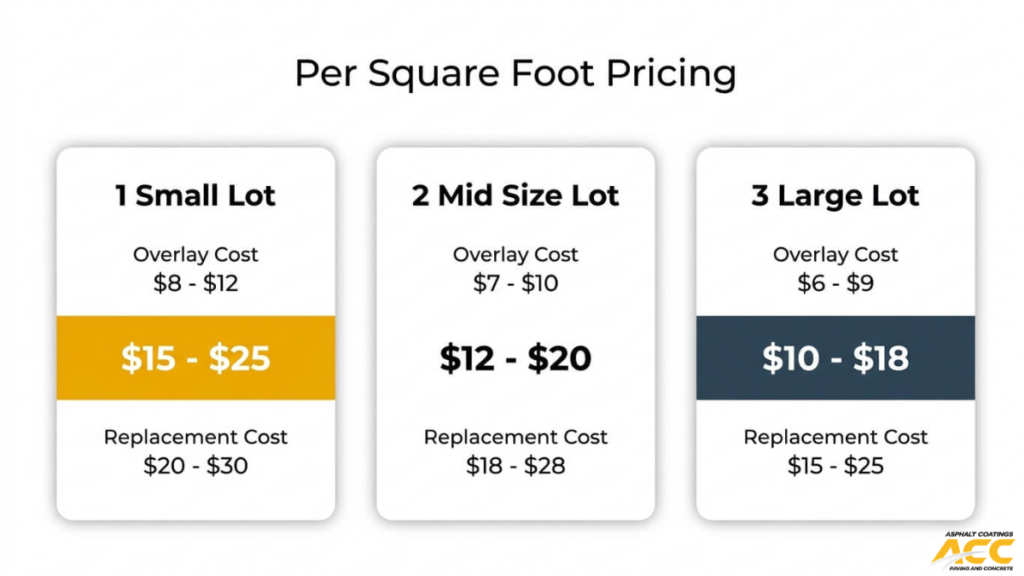
A commercial asphalt overlay costs between $1.00 and $3.00 per square foot depending on lot size, surface preparation needs, and project scale. The sections below break down pricing for small commercial lots, mid-size shopping center lots, and large industrial parking areas.
How Much Does an Overlay Cost for a Small Commercial Parking Lot?
An overlay for a small commercial parking lot typically costs $1.45 to $1.64 per square foot for the asphalt material alone. According to ProMatcher, the Colorado market average for a 2-inch asphalt overlay on a commercial parking lot is $1.55 per square foot. Surface preparation, including cleaning and minor patching, adds an estimated $1.00 to $2.00 per square foot to the base material cost. For a 5,000-square-foot lot, total project costs generally fall between $12,000 and $18,000. Smaller lots lack the economies of scale that reduce per-square-foot pricing on larger projects, which makes thorough condition assessment even more critical before committing to an overlay.
How Much Does an Overlay Cost for a Mid-Size Shopping Center Lot?
An overlay for a mid-size shopping center lot costs roughly $2.50 to $3.50 per square foot when combining material and preparation expenses. A typical shopping center lot of 20,000 to 40,000 square feet generates total overlay budgets between $50,000 and $140,000. Preparation costs remain a significant variable because high-traffic retail surfaces often require more extensive crack sealing and patching before the new Hot Mix Asphalt layer is placed. Fluctuating crude oil prices also affect asphalt material costs in Colorado, making timing a factor worth discussing with your contractor. For most mid-size retail properties, an overlay delivers strong return on investment compared to full replacement when the existing subbase is structurally sound.
How Much Does an Overlay Cost for a Large Industrial Parking Area?
An overlay for a large industrial parking area costs $1.00 to $3.00 per square foot. According to C&C Super Seal, large-scale industrial projects exceeding 50,000 square feet benefit from mobilization and material economies of scale that reduce per-square-foot pricing to this range. A 100,000-square-foot industrial lot could see total overlay costs between $100,000 and $300,000 depending on thickness requirements and site conditions. Heavy-duty areas such as loading docks and truck lanes may require thicker asphalt sections, pushing costs toward the higher end. For properties of this scale, the cost savings over full replacement are substantial, making overlay the preferred strategy when structural integrity allows it.
Understanding overlay pricing by lot size helps frame the next question: what does full commercial asphalt replacement cost?
How Much Does Full Commercial Asphalt Replacement Cost?
Full commercial asphalt replacement costs $3.00 to $7.00 per square foot, with total project budgets scaling by lot size, site preparation needs, and pavement thickness.
How Much Does Full Replacement Cost for a Small Commercial Lot?
Full replacement for a small commercial lot (5,000 to 10,000 square feet) typically costs $15,000 to $70,000. According to Angi, full-depth commercial asphalt paving in the Denver metropolitan area ranges from $3.00 to $7.00 per square foot depending on site preparation and thickness requirements. Small lots often land at the higher end of that per-square-foot range because mobilization costs, equipment transport, and crew setup are spread across fewer square feet. Projects requiring full subgrade reconstruction or thicker sections for dumpster pads push totals further upward. For properties like small office parks or churches, getting a detailed site assessment before budgeting prevents unexpected cost overruns.
How Much Does Full Replacement Cost for a Mid-Size Commercial Lot?
Full replacement for a mid-size commercial lot (10,000 to 50,000 square feet) typically costs $30,000 to $350,000. At this scale, per-square-foot pricing begins to moderate as equipment and crew mobilization costs distribute across a larger area. Shopping centers and apartment complexes in this range often require 4-inch minimum thickness in high-traffic zones such as loading docks and drive lanes, which increases material volume significantly. Additional line items that affect mid-size budgets include:
- Subgrade excavation and recompaction
- Drainage corrections and grading adjustments
- ADA-compliant access aisle construction
- Restriping and signage reinstallation
Mid-size projects represent the sweet spot where competitive bidding from experienced contractors yields the most meaningful cost differences.
How Much Does Full Replacement Cost for a Large Industrial Lot?
Full replacement for a large industrial lot (50,000 square feet or more) typically costs $150,000 to $350,000 and above. Material economies of scale reduce per-square-foot costs at this volume. A case study published by Concrete Is Better documented a St. Louis Park parking lot project at approximately $5.00 per square foot total, which achieved an excellent condition rating with no subsequent repairs needed. Large industrial sites, however, face cost variables that smaller projects avoid: extensive hauling of demolished material, deeper subgrade stabilization for heavy-axle truck traffic, and phased construction to maintain partial site access. These factors can push per-square-foot pricing toward the upper end of the $3.00 to $7.00 range even with volume advantages.
With replacement costs established, understanding how overlay and replacement compare on a per-year basis clarifies long-term value.
How Long Does an Asphalt Overlay Last on a Commercial Property?
An asphalt overlay on a commercial property lasts 8 to 15 years with proper installation and maintenance. The actual lifespan depends on traffic volume, vehicle weight, and climate exposure, which the following sections break down by scenario.
How Long Does an Overlay Last on a Low-Traffic Office Park Lot?
An overlay lasts 12 to 15 years on a low-traffic office park lot. Office parks generate primarily light passenger vehicle traffic with predictable, low-frequency turning movements, which places minimal mechanical stress on the asphalt surface. According to Pinnacle Paving, a professionally installed asphalt overlay typically provides a functional lifespan of 8 to 15 years when supported by a stable subbase and regular maintenance. Office parks consistently reach the upper end of that range because the pavement rarely endures heavy axle loads. Routine sealcoating every three to five years further extends performance by slowing oxidation and keeping moisture out of the surface layer. For property managers overseeing office complexes, an overlay represents one of the most cost-effective pavement strategies available.
How Long Does an Overlay Last on a High-Traffic Retail Parking Lot?
An overlay lasts 7 to 10 years on a high-traffic retail parking lot. According to We Love Paving, the increased stress from frequent turning movements and heavy loads in retail environments reduces overlay life expectancy to this shortened range. Shopping centers experience constant stop-and-go traffic, delivery truck access, and concentrated wear near entrances and drive aisles. These repetitive stresses accelerate surface fatigue faster than what office parks or low-volume lots experience. Crack sealing and sealcoating on a disciplined schedule can push performance closer to the 10-year mark, but retail property managers should plan for resurfacing sooner than managers of lighter-use facilities.
How Long Does an Overlay Last in Freeze-Thaw Climates Like Colorado?
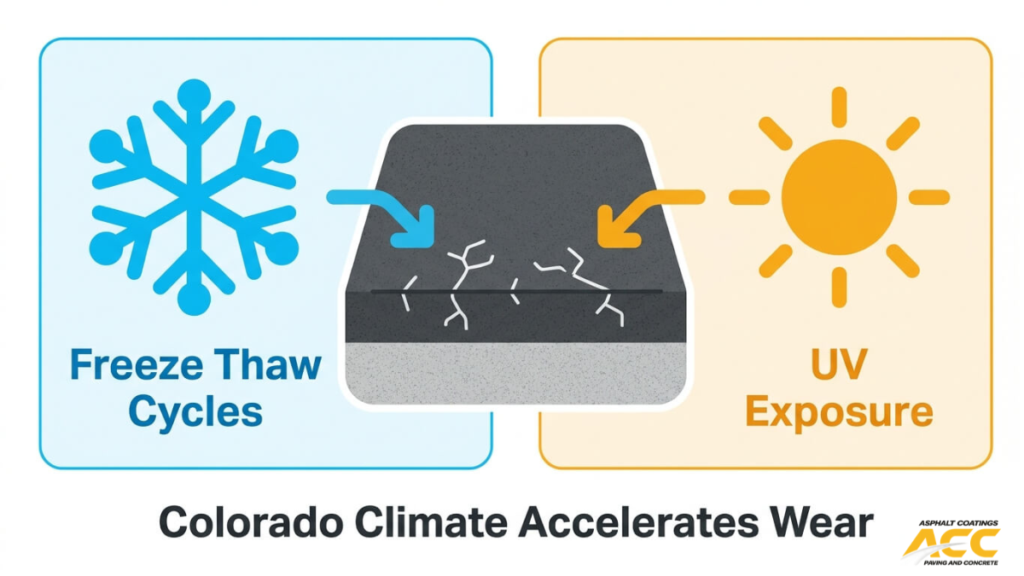
An overlay lasts 8 to 12 years in freeze-thaw climates like Colorado, depending on elevation, maintenance frequency, and sun exposure. Colorado’s Front Range climate subjects asphalt to extreme freeze-thaw cycles where water enters microfractures and expands upon freezing, exerting mechanical stress that widens cracks from within. A 2024 study published in Theoretical and Applied Fracture Mechanics (ScienceDirect) found that coupled damage from high-intensity UV radiation at high altitudes and frequent freeze-thaw cycling significantly accelerates brittle failure in asphalt concrete. These dual forces shorten overlay performance compared to milder climates. Proactive crack sealing before winter and consistent sealcoating remain the most effective defenses against Colorado’s harsh conditions.
With overlay lifespans established, understanding full replacement longevity completes the comparison.
How Long Does Full Asphalt Replacement Last on a Commercial Property?
Full asphalt replacement lasts 20 to 30 years on a commercial property when properly maintained. Homeowners can consult our guide on when to repave their driveway to compare residential lifespan expectations. Homeowners can consult our guide on when to repave their driveway to compare residential lifespan expectations. Actual longevity depends on traffic volume, load intensity, and regional climate conditions.
How Long Does a Full Replacement Last on a Low-Traffic Commercial Lot?
A full replacement lasts toward the upper end of the 20 to 30 year range on a low-traffic commercial lot. Office parks, medical centers, and church parking areas generate fewer turning movements and lighter axle loads, which significantly reduces surface wear. According to Asphalt Inc, full-depth asphalt replacement offers a service life of 20 to 30 years, provided the pavement is sealcoated every 3 to 5 years to protect against oxidation. With minimal heavy-vehicle stress and a consistent sealcoating schedule, low-traffic lots routinely reach 25 to 30 years before requiring major intervention. For property managers budgeting long-term capital expenditures, this makes full replacement one of the strongest investments in pavement infrastructure.
How Long Does a Full Replacement Last on a High-Traffic Commercial Lot?
A full replacement lasts closer to 15 to 20 years on a high-traffic commercial lot. Retail centers, distribution warehouses, and shopping plazas subject pavement to constant turning movements, delivery truck loads, and stop-and-start braking stress. These forces accelerate surface fatigue and subbase compaction far faster than standard passenger vehicle traffic. Heavy-duty areas like loading docks require a minimum asphalt thickness of 4 inches to withstand high-axle loads, according to OneCrew. Even with proper thickness and sealcoating, the compounding mechanical stress of daily commercial operations shortens effective service life. Prioritizing crack sealing and timely spot repairs in high-wear zones is essential to pushing these lots beyond the 20 year mark.
How Long Does a Full Replacement Last in Colorado’s Front Range Climate?
A full replacement lasts approximately 15 to 25 years in Colorado’s Front Range climate, depending on maintenance consistency. The region’s extreme freeze-thaw cycles force water into microfractures, where it expands upon freezing and widens cracks from within. According to a study published in ScienceDirect (Theoretical and Applied Fracture Mechanics), coupled damage from high-intensity UV radiation at high altitudes and frequent freeze-thaw cycling significantly accelerates brittle failure and fracture behavior in asphalt concrete. This dual assault, UV degradation from above and freeze-thaw pressure from below, can shorten pavement life by several years compared to milder climates. Sealcoating every 3 to 5 years and prompt crack sealing are non-negotiable for Colorado property managers who want full replacement to reach its maximum lifespan.
Understanding replacement longevity by scenario helps when comparing it against overlay cost per year.
How Do Overlay and Replacement Compare in Long-Term Cost per Year?
Overlay and replacement compare in long-term cost per year by dividing total project expense by expected service life, which often reveals that replacement delivers a lower annualized cost despite higher upfront spending. The comparison depends on initial price, lifespan, and maintenance frequency.
To illustrate, consider a 20,000-square-foot commercial parking lot using Colorado pricing data. According to ProMatcher, a 2-inch asphalt overlay in the Colorado market averages $1.55 per square foot, while full-depth replacement ranges from $3.00 to $7.00 per square foot in the Denver metropolitan area, as reported by Angi.
| Cost Factor | Overlay | Full Replacement |
| Upfront Cost per Sq Ft | $1.55 (avg.) | $3.00 to $7.00 |
| Total Cost (20,000 sq ft) | ~$31,000 | $60,000 to $140,000 |
| Expected Lifespan | 8 to 15 years | 20 to 30 years |
| Annualized Cost | ~$2,067 to $3,875/yr | ~$2,000 to $7,000/yr |
At the midpoint of each range, an overlay at $31,000 lasting 12 years costs roughly $2,583 per year. A replacement at $100,000 lasting 25 years costs approximately $4,000 per year. However, this simple calculation misses a critical factor: overlay cycles compound. A property needing two overlays over 25 years spends $62,000 total, potentially approaching the cost of one replacement that lasts the full period.
Maintenance costs also shift the equation. Full-depth replacement, when sealcoated every 3 to 5 years, maintains structural integrity across its full service life. Overlays in high-traffic retail environments may last only 7 to 10 years, according to We Love Paving, which compresses the replacement cycle further and increases cumulative spending.
For most commercial property managers, the lowest annualized cost comes from matching the investment to the pavement’s structural condition. Overlaying a sound subbase remains the most cost-efficient short-term strategy, but when base failure exists, spending more upfront on replacement almost always wins the long-term cost-per-year calculation.
Understanding annualized costs becomes even more important when Colorado’s climate accelerates pavement deterioration.
How Do Freeze-Thaw Cycles and UV Exposure Affect Your Decision?
Freeze-thaw cycles and UV exposure affect your overlay vs. replacement decision by accelerating pavement deterioration, making full replacement more likely in high-altitude climates. These environmental stressors determine how quickly each option degrades and which investment delivers better long-term value.
Colorado’s Front Range climate subjects asphalt to extreme freeze-thaw cycles where water enters microfractures and expands upon freezing, exerting mechanical stress that widens cracks. This repetitive expansion and contraction compromises overlays faster than full-depth installations because thinner asphalt layers have less structural mass to absorb the strain. When moisture penetrates the bond between an overlay and the existing surface, delamination follows within just a few seasons.
High-altitude UV radiation compounds the problem. According to a 2024 study published in Theoretical and Applied Fracture Mechanics (ScienceDirect), coupled damage from high-intensity UV radiation at high altitudes and frequent freeze-thaw cycles significantly accelerates brittle failure and fracture behavior of asphalt concrete. The asphalt binder oxidizes faster at elevation, losing flexibility and becoming prone to thermal cracking. Once brittleness sets in, even minor freeze-thaw events produce disproportionate damage.
For commercial property managers weighing overlay against replacement, this dual exposure changes the math considerably:
- Overlays in freeze-thaw climates lose 2 to 5 years of expected service life compared to mild-climate installations.
- Full-depth replacement, with its 4 to 6-inch pavement system, better resists moisture infiltration at the subbase level.
- Sealcoating every 3 to 5 years protects against UV-driven oxidation and extends either option’s lifespan.
- Properties above 5,000 feet elevation face intensified UV degradation year-round.
For most Colorado commercial lots, overlooking these climate factors is the single most expensive planning mistake. An overlay that would last 12 years in a temperate region may only deliver 8 years here, narrowing the cost advantage over replacement significantly. Full replacement becomes the stronger investment when existing pavement already shows climate-related distress, such as transverse cracking or surface raveling from binder oxidation.
Proper site preparation strategies can mitigate some of these effects for either option.
What Site Preparation Steps Differ Between an Overlay and Replacement?
The site preparation steps differ between an overlay and replacement center on scope: overlays preserve the existing base and focus on surface correction, while replacements demolish everything down to the subgrade. Key differences include milling, crack repair, base excavation, and drainage regrading.
How Is an Existing Surface Prepared for an Overlay?
An existing surface is prepared for an overlay through milling, crack sealing, and spot repair of soft areas. Asphalt milling removes a specific thickness of the existing surface to maintain drainage gradients and curb reveal heights before the new layer is applied, according to American Paving. All existing cracks must be sealed and soft spots patched to prevent reflective cracking in the new Hot Mix Asphalt. The existing base remains in place, which significantly reduces labor, equipment time, and material hauling compared to full removal. Surface cleaning to remove debris and loose aggregate completes the preparation. For commercial properties with otherwise sound structural integrity, this streamlined process is one of the most practical advantages an overlay offers over a tear-out.
What Demolition and Base Work Does Full Replacement Require?
Full replacement requires complete demolition of the existing asphalt layers and, in most cases, removal of the underlying base material. According to the Illinois Asphalt Pavement Association, this process addresses deep structural failures before installing a new 4 to 6-inch pavement system. Site preparation includes:
- Sawcutting pavement edges to create clean removal boundaries.
- Excavating and hauling away old asphalt and compromised aggregate base.
- Inspecting and regrading the exposed subgrade for proper compaction and slope.
- Installing new aggregate base material to engineered thickness specifications.
- Verifying drainage flow before paving begins.
This level of base work is necessary when subgrade erosion, failed aggregate, or severe settling makes the existing foundation unreliable. The added excavation and material replacement account for much of the cost difference between the two approaches.
Why Does Surface Preparation Add Cost to Both Options?
Surface preparation adds cost to both options because each method demands specialized equipment, labor, and materials beyond the asphalt itself. For overlays, cleaning and minor patching adds an estimated $1.00 to $2.00 per square foot to the base material cost, according to Denver Asphalt Service. Full replacements carry higher preparation expenses due to demolition equipment, hauling fees, subgrade compaction, and new aggregate installation. Restriping is also required after either approach; for a 50,000-square-foot lot, restriping alone typically runs $3,000 to $6,000. Many property managers underestimate these ancillary preparation costs when comparing overlay and replacement bids. Understanding the factors that affect asphalt construction costs early prevents unexpected overruns and ensures accurate cost-per-square-foot comparisons
Understanding how preparation affects project scope makes it easier to evaluate how each option impacts ADA compliance requirements.
How Does Each Option Affect ADA Compliance for Your Parking Lot?
Each option affects ADA compliance for your parking lot differently because overlays add surface height that can alter slopes and access aisle grades, while full replacement allows complete regrading to meet current standards. Key factors include slope tolerances, space dimensions, and restriping requirements.
ADA Standards for Accessible Design require car-accessible parking spaces to be at least 96 inches wide with an adjacent access aisle of at least 60 inches, according to ADA.gov. An asphalt overlay adds 1.5 to 3 inches of material on top of the existing surface, which can push cross-slopes beyond the maximum 2% (1:50) grade that ADA-compliant parking areas must maintain in all directions for stable wheelchair movement. When existing grades already sit near that threshold, even a thin overlay risks creating non-compliant slopes at accessible spaces, curb ramps, and pathways of travel.
Full replacement eliminates this concern. Because the existing pavement and base are removed entirely, contractors can regrade the subbase to achieve precise drainage slopes while keeping accessible routes within ADA tolerances. This is especially valuable for older lots originally built before current accessibility standards took effect.
Regardless of which option you choose, restriping is mandatory after the work is complete. Parking lot restriping for a 50,000 square foot lot typically costs between $3,000 and $6,000, according to Byrne & Jones. Fresh striping ensures accessible spaces, van-accessible aisles, and loading zones meet current dimensional requirements.
For property managers weighing overlay against replacement, the ADA question often becomes the deciding factor. If an overlay cannot maintain compliant slopes without costly milling adjustments, full replacement delivers a more reliable path to accessibility. Planning ADA compliance into your paving project from the start prevents expensive rework and potential liability down the road.
How Should You Plan Commercial Asphalt Work With an Experienced Paving Contractor?
You should plan commercial asphalt work with an experienced paving contractor by requesting a site evaluation, reviewing pavement condition data, and discussing both overlay and replacement options before committing to a scope of work.
Can a Colorado Commercial Paving Specialist Help You Choose Between Overlay and Replacement?
Yes, a Colorado commercial paving specialist can help you choose between overlay and replacement by conducting a thorough site assessment that goes beyond surface appearance. An experienced contractor evaluates subbase integrity, drainage conditions, existing pavement thickness, and distress patterns to determine which approach delivers the best long-term value. As civil engineer John Harvey, PhD, P.E., of the University of California Pavement Research Center notes, “PCI is a simple, effective communication tool, but when used alone it is insufficient for choosing the right strategy at the right time.” Asphalt Coatings Company brings 39 years of Colorado Front Range experience to every commercial project, pairing pavement condition analysis with knowledge of local freeze-thaw and UV challenges to recommend the right solution.
What Are the Key Takeaways About Commercial Asphalt Overlay vs. Replacement Cost and Lifespan?
The key takeaways about commercial asphalt overlay vs. replacement cost and lifespan are:
- Overlays cost roughly $1.45 to $1.64 per square foot in Colorado and last 8 to 15 years with proper maintenance.
- Full replacement ranges from $3.00 to $7.00 per square foot and delivers a 20 to 30 year service life when sealcoated every 3 to 5 years.
- Overlay works best when the existing subbase is structurally sound and less than 25% of the surface shows significant distress.
- Full replacement is necessary when base failure, severe drainage problems, or multiple prior overlays compromise structural integrity.
- Colorado’s freeze-thaw cycles and high-altitude UV exposure accelerate deterioration, making contractor expertise and preventive maintenance essential for either option.
Choosing the right path starts with a professional site evaluation from a contractor who understands your property’s specific conditions.