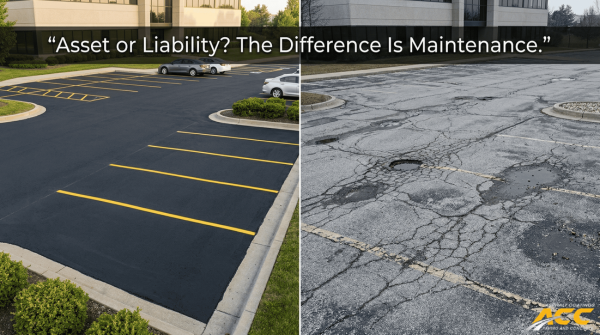
Asphalt pavement is a functional asset that protects property value, ensures safe access, and supports daily operations; yet every asphalt surface has a tipping point where accumulated damage turns that asset into a financial and legal burden.
This guide covers the deterioration factors that push pavement past that tipping point, the property value and cost consequences of neglect, the role of timely maintenance in preserving commercial surfaces, the most common structural failures that create liability, and the unique environmental challenges Colorado’s climate presents.
Traffic loading, weather exposure, and oxidation work together to break down asphalt binder and pavement structure over time. Fatigue cracking from repeated vehicle loads, rutting from material displacement, and raveling from aggregate loss are the primary distress types that signal a surface is losing structural integrity.
Neglected pavement directly reduces property value and increases operational costs. Poorly maintained parking lots and driveways lower curb appeal, discourage tenants and customers, and expose property owners to premises liability claims when trip hazards go unaddressed.
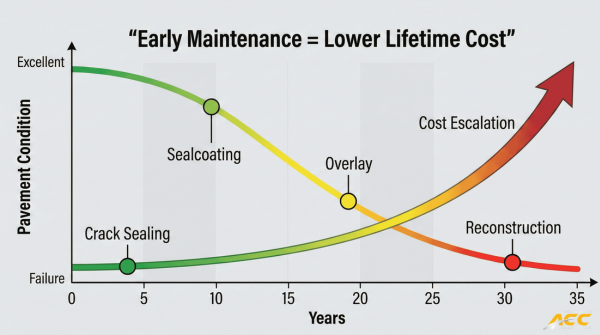
Proactive maintenance anchored to measurable condition thresholds keeps pavement above the critical point where preventive treatments lose cost effectiveness and major rehabilitation becomes unavoidable. Regular inspection, crack sealing, and sealcoating extend surface life at a fraction of reconstruction costs.
Structural failures like alligator cracking, deep potholes, and poor surface drainage create the conditions most likely to trigger injury claims and insurance complications, shifting pavement from a managed asset to an active liability.
Colorado’s freeze-thaw cycles, de-icing salt exposure, and wide temperature swings accelerate every form of pavement distress, making regionally informed maintenance schedules essential for protecting both pavement condition and property investment.
What Factors Can Cause Asphalt to Shift from an Asset to a Liability?
The factors that can cause asphalt to shift from an asset to a liability include heavy traffic loading, weather exposure, and deferred maintenance. Fatigue cracking, rutting, and surface deterioration each accelerate this transition when left unaddressed.
How Does Heavy Traffic Play a Role in Asphalt Deterioration?
Heavy traffic plays a role in asphalt deterioration by applying repeated loads that cause cumulative structural damage over time. According to the Federal Highway Administration (FHWA), fatigue cracking, also called alligator cracking, is the principal structural distress in asphalt pavements, resulting from fatigue damage caused by repeated traffic loading. Rutting compounds this problem as repeated loading systematically compresses and displaces material, reducing pavement thickness and creating surface depressions. Heavier vehicles inflict disproportionate harm; the fourth power law indicates that doubling an axle’s weight causes 16 times greater pavement wear. For commercial properties with frequent delivery trucks or heavy equipment, this exponential relationship means pavement designed for light use can fail years ahead of schedule.

What Impact Does Weather Have on Asphalt’s Long-Term Performance?
Weather has a significant impact on asphalt’s long-term performance through UV oxidation, moisture infiltration, and temperature cycling. Prolonged sun exposure hardens the binder, making surfaces brittle and crack-prone. Rainfall seeps into these weakened areas, and when temperatures drop, trapped water expands and widens existing damage. The FHWA’s Long-Term Pavement Performance (LTPP) database, containing research-quality data from more than 2,500 pavement sections across the United States and Canada, confirms that environmental factors are a primary driver of pavement deterioration alongside age and traffic. Properties in climates with wide temperature swings face compounding damage each season, making weather arguably the most persistent threat to pavement longevity.
Are There Maintenance Warning Signs That Indicate a Liability Issue?
There are several maintenance warning signs that indicate a liability issue, such as raveling, widespread cracking, standing water, and uneven surfaces. Raveling, the wearing away of the pavement surface through dislodging of aggregate particles, often signals that the asphalt binder has broken down due to oxidation. The Pavement Condition Index (PCI), a standardized numerical rating between 0 and 100 developed through ASTM D6433, provides an objective measure of surface condition. Key warning signs to monitor include:
- Interconnected cracking patterns resembling alligator skin.
- Loose aggregate or a rough, pebbly surface texture.
- Visible depressions or ruts in wheel paths.
- Ponding water that no longer drains properly.
Catching these signs early determines whether a property owner faces a routine maintenance expense or a full-scale liability problem, and understanding the financial consequences makes the case for timely action even clearer.

How Can Neglected Asphalt Affect Property Value and Operational Costs?
Neglected asphalt can affect property value and operational costs by reducing curb appeal, increasing repair expenses, and creating legal exposure. The sections below cover financial risks, tenant experience, and liability complications.
What Are the Financial Risks of Ignoring Asphalt Repairs?
The financial risks of ignoring asphalt repairs include escalating rehabilitation costs, reduced property value, and budget overruns from emergency fixes. According to Iowa State University’s Center for Transportation Research and Education, initial costs account for 55–75% of total lifecycle costs for asphalt pavement, with maintenance and rehabilitation costs distributed across the service life depending on initial design and rehabilitation timing. When minor issues like crack filling are deferred, they compound into structural failures requiring full-depth reconstruction. Properly restored parking lots increase property values by up to 15% while delivering returns through enhanced tenant retention. Delaying preventive work past the optimal maintenance window often doubles or triples eventual repair spending, making reactive budgeting one of the costliest mistakes property managers make.
How Might Poorly Maintained Asphalt Impact Tenant or Customer Experience?
Poorly maintained asphalt impacts tenant or customer experience by signaling neglect before anyone enters the building. Cracked, potholed surfaces create an immediate negative impression that influences leasing decisions and customer return rates. A 2025 Saluda Hill analysis found that professionally maintained landscapes, including pavement condition, can boost commercial property values by up to 15%. Smooth, level pavement also improves accessibility for customers with mobility limitations and reduces vehicle damage complaints. For commercial properties, the parking lot is often the first and last touchpoint a visitor encounters. Failing to maintain that surface communicates indifference toward tenant and customer safety, which quietly erodes occupancy and foot traffic over time.
Can Failing Asphalt Lead to Legal or Insurance Complications?
Yes, failing asphalt can lead to legal and insurance complications. Property owners owe a heightened duty of care to business visitors under premises liability law. According to legal guidance published on Avvo, injured parties may hold owners liable for damages caused by improperly maintained or hazardous pavement conditions, such as uneven surfaces and potholes. Insurance carriers may also increase premiums or deny claims when documented maintenance records are absent. Trip-and-fall lawsuits involving deteriorated parking lots frequently result in settlements that far exceed the cost of timely repairs. Maintaining proper records and scheduling proactive maintenance are among the most effective strategies for reducing both legal exposure and insurance risk.
With financial, experiential, and legal consequences now clear, understanding the role of timely maintenance becomes essential.
Why Is Timely Asphalt Maintenance Critical for Commercial Properties?
Timely asphalt maintenance is critical for commercial properties because pavement deteriorates along a predictable curve, and acting before conditions cross key thresholds prevents costly rehabilitation. Regular inspections and proactive care strategies make the difference.
What Are Best Practices for Regular Asphalt Inspection?
Best practices for regular asphalt inspection include scheduled visual surveys, standardized condition scoring, and documented tracking of distress progression. NAPA’s Asphalt Paving Handbook provides comprehensive guidance on pavement preservation and lifecycle management, establishing industry benchmarks for inspection protocols.
Effective commercial inspection programs should cover:
- Walking the entire surface to identify cracking patterns, rutting, and drainage issues.
- Scoring pavement condition using the PCI scale standardized through ASTM D6433.
- Documenting findings with photographs and measurements for year-over-year comparison.
- Scheduling inspections at least twice annually, ideally in spring and fall.
A pavement that drops below PCI 57 crosses the threshold where preventive measures become less cost-effective and major rehabilitation becomes necessary. Catching distress early, while scores remain above this critical point, keeps maintenance budgets predictable. In my experience, property managers who treat inspections as routine rather than reactive consistently avoid the most expensive repair scenarios.
How Does Proactive Care Extend the Lifespan of Asphalt Surfaces?
Proactive care extends the lifespan of asphalt surfaces by addressing minor distresses before they compound into structural failures. Sealcoating, crack sealing, and timely patching each slow the oxidation and moisture infiltration that accelerate deterioration.
Advances in materials science further support longevity. According to a Federal Highway Administration report, polymer modification of asphalt binders has increasingly become the norm in designing optimally performing pavements, with polymers significantly increasing high-temperature performance. Warm mix asphalt technologies also enable production at lower temperatures compared to traditional hot mix, extending construction seasons and reducing environmental impact during repairs.
Asphalt Coatings Company has implemented these layered maintenance strategies across Colorado’s Front Range commercial properties since 1986, using in-house crews to ensure consistent quality and timeline adherence for property managers overseeing multiple locations.
For commercial properties carrying heavy traffic loads, this layered approach is not optional; it is the most reliable way to protect a significant capital investment. With the right inspection and care plan in place, the next step is recognizing specific failure types that create liability.
What Are the Most Common Asphalt Failures That Turn It into a Liability?
The most common asphalt failures that turn it into a liability include structural cracking, potholes, and poor surface drainage. Each creates hazards that expose property owners to legal and financial risk.
What Types of Cracking and Potholes Signal Underlying Structural Issues?
The types of cracking and potholes that signal underlying structural issues include fatigue (alligator) cracking, longitudinal cracking, and progressive potholes that deepen over time. According to the Federal Highway Administration, fatigue cracking is the principal structural distress in asphalt pavements, resulting from fatigue damage caused by repeated traffic loading.
These failures indicate problems below the surface, not just cosmetic wear:
- Alligator cracking reveals subbase failure or inadequate pavement thickness.
- Longitudinal cracks along wheel paths suggest load-related stress beyond the pavement’s design capacity.
- Potholes form when cracked areas allow moisture infiltration, weakening the subgrade until the surface collapses.
Once cracking progresses to the pothole stage, the pavement has moved well past preventive maintenance territory. For commercial property owners, these distresses represent both a trip-and-fall hazard and a clear signal that rehabilitation or reconstruction is overdue.
How Does Surface Drainage Influence Liability Risks?
Surface drainage directly influences liability risks by determining whether water flows safely off pavement or pools in areas where it accelerates deterioration and creates hazards. In premises liability cases, business visitors are offered the utmost duty of care by the property owner, which makes standing water on a parking lot or walkway a significant legal exposure.
Poor drainage compounds asphalt failure in several ways:
- Ponding water infiltrates cracks and softens the subgrade, accelerating pothole formation.
- Standing water creates slip-and-fall hazards for pedestrians, especially during freezing conditions.
- Inadequate grading channels runoff toward building foundations, risking structural water damage.
Proper drainage design, including correct cross-slopes, functional catch basins, and clear flow paths, is not optional for commercial properties. Neglecting drainage turns a manageable maintenance issue into a compounding liability that affects both pavement longevity and occupant safety.
With common failures identified, understanding how Colorado’s specific environmental conditions accelerate these issues becomes essential.
How Do Environmental Conditions Unique to Colorado Impact Asphalt Lifespan?
Environmental conditions unique to Colorado shorten asphalt lifespan through repeated freeze-thaw cycling, aggressive de-icing chemical exposure, and intense UV radiation at altitude. The following sections cover how freeze-thaw cycles degrade pavement structure and how winter maintenance practices compromise asphalt integrity.
In What Ways Do Freeze-Thaw Cycles Accelerate Pavement Degradation?
Freeze-thaw cycles accelerate pavement degradation by forcing trapped water to expand inside small cracks each time temperatures drop below freezing. This repeated expansion generates internal pressure that progressively widens cracks, loosens aggregate bonds, and destabilizes the pavement structure.
Colorado’s Front Range experiences dozens of freeze-thaw transitions per season, making this mechanism particularly destructive. According to a Science Direct study on asphalt performance in freeze-thaw environments, rutting, fatigue cracking, and low-temperature cracking are the major distresses responsible for pavement degradation in these climates, leading to significant performance decline. The safety consequences are equally severe; the Colorado State Patrol reported 5,337 accidents in snowy or icy conditions in a single year.
For property managers, even hairline cracks left unsealed before winter can become structural failures by spring. Polymer-modified asphalt binders offer improved viscoelasticity under varying temperature conditions, which helps resist this cycle, but no material eliminates the need for proactive crack sealing before freeze season begins.

How Does De-Icing Salt or Snow Removal Affect Asphalt Integrity?
De-icing salt and snow removal affect asphalt integrity by accelerating chemical breakdown of the binder and causing physical surface damage. Salt dissolves into brine that penetrates cracks, where it strips the bond between asphalt binder and aggregate particles. When that brine refreezes, it compounds the mechanical stress from freeze-thaw cycling.
Mechanical snow removal creates additional problems:
- Plow blades catch raised edges of existing cracks, peeling away surface material.
- Repeated scraping accelerates raveling, especially on older oxidized surfaces.
- Heavy equipment compresses weakened areas into depressions and early-stage potholes.
With 39 years of experience navigating Colorado’s freeze-thaw cycles, Asphalt Coatings Company designs preventive maintenance schedules specifically for Front Range properties, timing crack sealing and sealcoating work to maximize protection before the winter season begins
With Colorado’s environmental stressors clearly identified, addressing asphalt liabilities requires professional solutions.
How Should You Address Asphalt Liabilities Using Professional Installation, Repair, and Sealcoating?
You should address asphalt liabilities by investing in professional installation, timely repairs, and scheduled sealcoating before deterioration crosses the threshold into safety and legal risk. The following sections cover how these services prevent liability and summarize the key takeaways from this article.
Can Asphalt Installation, Repair, or Sealcoating Services Help Prevent Liability Issues?
Yes, asphalt installation, repair, and sealcoating services can help prevent liability issues by maintaining structural integrity and surface safety before minor distresses escalate. Proper installation establishes correct drainage, compaction, and thickness from the start, reducing the likelihood of premature cracking or rutting that creates trip-and-fall hazards. Timely crack sealing and patching address isolated damage before water infiltration undermines the subgrade. Sealcoating restores the protective binder layer that oxidation gradually strips away, preserving flexibility and reducing cracking susceptibility. For commercial property owners, this proactive approach is far more cost-effective than reactive repairs or defending against premises liability claims. Asphalt Coatings Company specializes in these services across Colorado’s Front Range, using in-house crews and CDOT-approved materials to keep commercial pavements safe.

What Are the Key Takeaways About When Asphalt Stops Being an Asset and Becomes a Liability We Covered?
The key takeaways about when asphalt stops being an asset and becomes a liability are rooted in understanding that deterioration is inevitable, but preventable neglect accelerates the transition. Heavy traffic loading, freeze-thaw cycles, UV exposure, and poor drainage all compound over time. According to research published through Springer Link, asphalt oxidation is an age-related distress where the bituminous binder loses volatile components, becoming harder and more brittle while increasing cracking susceptibility. Recognizing warning signs early, maintaining a proactive inspection schedule, and investing in preservation services before pavement condition drops below critical thresholds protects both property value and legal standing. The most important lesson is simple: every dollar spent on prevention saves significantly more in rehabilitation, reconstruction, and liability exposure.