Planning asphalt repairs around peak business hours is the process of scheduling pavement maintenance to align with low-traffic windows, protecting revenue, tenant relationships, and customer safety throughout the project.
This guide covers the business risks of poorly timed repairs, peak traffic patterns across commercial property types, repair urgency assessment, scheduling strategies that maintain parking access, tenant and customer communication, Colorado weather constraints, and contractor selection.
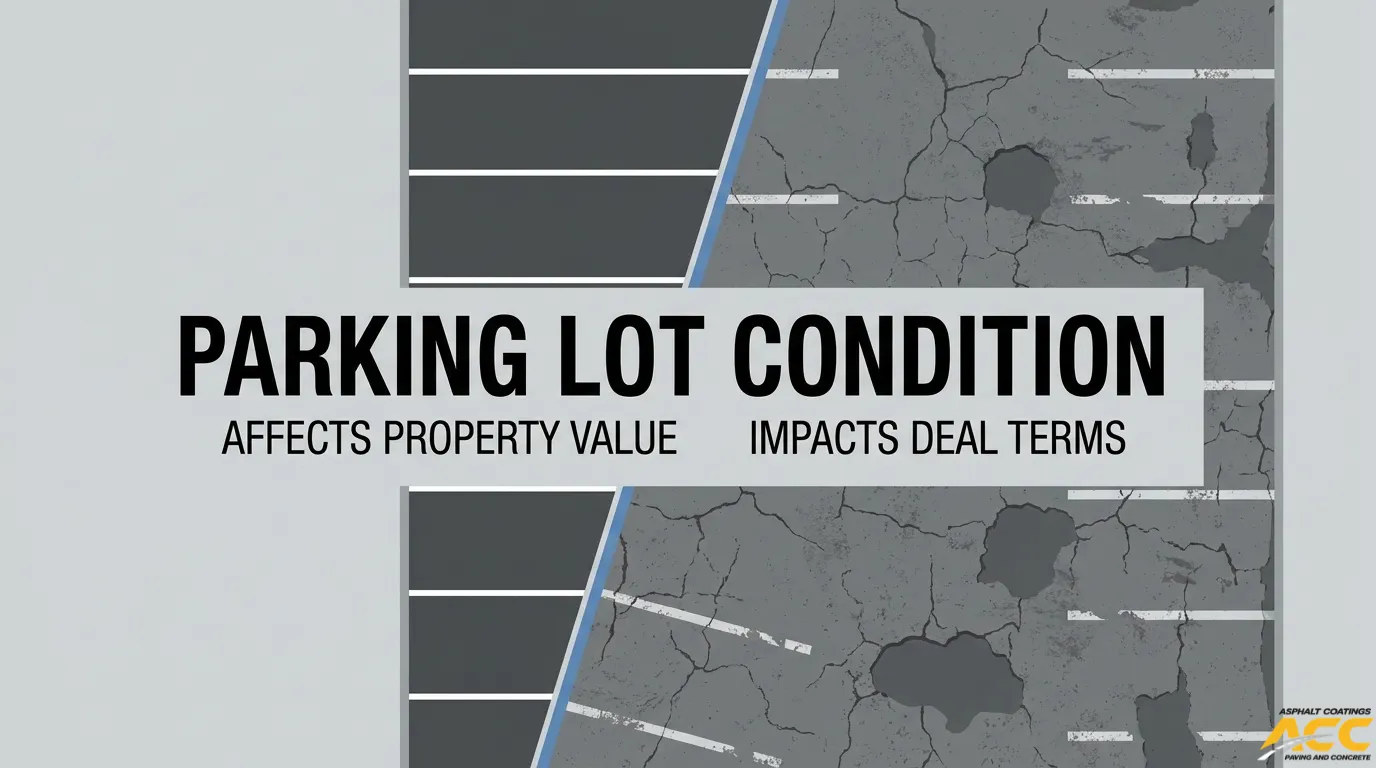
Poorly timed repairs carry measurable financial consequences. Degraded parking lot conditions can reduce customer traffic by up to 20%, and active repair zones during busy periods expose property managers to slip-and-fall claims that average $30,000 to $50,000 for minor injuries alone.
Peak traffic varies sharply by property type. Medical offices generate higher trip rates per square foot than shopping centers, while industrial facilities operate on multi-shift schedules with no single quiet window. Matching repair timing to each property’s actual traffic data is essential.
Not every pavement issue demands the same urgency. Deep potholes near building entrances require same-day patching, while hairline cracks with no structural compromise can be batched into planned off-peak maintenance cycles.
Phased lot sectioning, night and weekend scheduling, early morning prep, and staggered multi-day timelines each keep at least half the parking area open during active work. Clear communication starting two to three weeks before repairs begin prevents the tenant friction that derails projects.
Colorado’s freeze-thaw cycles and high-altitude curing demands compress the viable repair season to roughly late April through early October, making contractor flexibility and in-house crew availability critical factors in keeping projects on schedule.
Why Does Scheduling Asphalt Repairs Around Peak Hours Matter?
Scheduling asphalt repairs around peak hours matters because poorly timed work directly reduces revenue, strains tenant relationships, and creates liability exposure. The following sections cover customer traffic loss, tenant friction, and legal risks tied to active repair zones.
How Do Poorly Timed Repairs Affect Customer Traffic?
Poorly timed repairs affect customer traffic by blocking parking access and creating visual deterrents that drive visitors to competitors. When heavy equipment occupies a lot entrance during midday rushes or weekend shopping windows, customers often leave rather than navigate around construction barriers.
According to AceCo Pavement Maintenance, poor parking lot conditions can reduce customer traffic by up to 20%, potentially costing a business generating $50,000 monthly approximately $10,000 in lost revenue. That loss compounds over multi-day projects when no phasing plan keeps stalls available.
For property managers overseeing retail centers or medical offices, even a single poorly scheduled repair day during peak hours can erode the goodwill built over months of consistent tenant occupancy.
How Can Unexpected Closures Impact Tenant Relations?
Unexpected closures impact tenant relations by disrupting daily operations without giving businesses time to adapt staffing, deliveries, or customer communications. Tenants who learn about parking lot shutdowns the morning work begins lose trust in property management quickly.
Commercial lease agreements often include expectations around reasonable access. When repairs block loading zones, ADA-accessible routes, or primary entrances without advance coordination, tenants face direct revenue losses they associate with management failure, not contractor scheduling. Best practices call for notifying tenants, staff, and customers two to three weeks in advance using signage, emails, and social media to preserve these relationships.
Proactive scheduling, even for urgent patches, signals that a property manager values tenant operations as much as pavement condition.
What Liability Risks Arise From Active Repair Zones During Busy Periods?
Liability risks from active repair zones during busy periods include slip-and-fall injuries, vehicle damage claims, and ADA compliance violations. Open trenches, loose gravel, and unmarked detours create hazardous conditions that multiply when foot and vehicle traffic are at their highest.
According to i3 International, average settlements for minor slip-and-fall injuries range from $30,000 to $50,000, while serious cases regularly exceed $100,000. Insurance premiums can then rise 25 to 50 percent following a single bodily injury claim, often persisting for three to five years.
Key liability concerns during peak-hour repairs include:
- Pedestrians navigating unmarked construction zones near storefronts.
- Vehicles encountering uneven surfaces or freshly milled pavement without proper signage.
- Wheelchair users lose accessible pathways when ADA routes are blocked without compliant detours.
Scheduling repairs during off-peak windows is one of the most effective ways to reduce this exposure. Understanding each property type’s busiest hours helps determine the safest repair windows.
What Are the Peak Business Hours for Different Commercial Properties?
Peak business hours vary significantly across commercial property types, from midday retail surges to round-the-clock industrial operations. Understanding these patterns for retail centers, office parks, warehouses, medical facilities, and restaurants is essential for scheduling asphalt repairs with minimal disruption.

Retail Shopping Centers
Retail shopping centers experience peak business hours primarily during midday and evening periods, typically from 11 a.m. to 7 p.m. on weekdays and throughout weekend afternoons. According to the Institute of Transportation Engineers (ITE), shopping centers (ITE Code 820) generate an average PM peak hour trip rate of 3.40 per 1,000 square feet of gross floor area, creating concentrated vehicle and pedestrian traffic that makes daytime repairs highly disruptive.
Early morning windows before 9 a.m. offer the most practical scheduling opportunity. For property managers overseeing multi-tenant retail lots, even brief midday closures can ripple across every storefront’s daily revenue.
Office Parks and Corporate Campuses
Office parks and corporate campuses concentrate peak business hours during weekday morning and evening commutes, roughly 7:30 to 9 a.m. and 4 to 6 p.m. Lunchtime, between 11:30 a.m. and 1 p.m., creates a secondary traffic spike as employees move vehicles or leave for errands.
Weekend and holiday scheduling works best for these properties, since occupancy drops dramatically outside the standard Monday-through-Friday workweek. Midday repairs between commute windows are also viable if phased sectioning keeps enough parking accessible. Corporate tenants tend to be more tolerant of planned disruptions than retail customers, provided communication is clear and advance notice is given.
Industrial and Warehouse Complexes
Industrial and warehouse complexes often operate on extended or multi-shift schedules, with peak hours driven by loading dock activity and shift changes rather than a single daytime window. Early morning receiving (6 to 10 a.m.) and late afternoon outbound shipping (2 to 6 p.m.) typically generate the heaviest truck traffic.
Facilities running 24-hour operations present a unique challenge. Repair scheduling must target the lowest-volume shift, which often falls on weekends or between shift rotations. Heavy vehicle loads also mean freshly repaired asphalt sections need adequate curing time before trucks resume access, making overnight work particularly effective for these properties.
Medical Facilities and Urgent Care Centers
Medical facilities and urgent care centers generate peak business hours that span most of the standard workday, from approximately 8 a.m. to 5 p.m. According to ITE data, medical-dental office buildings (ITE Code 720) produce an average PM peak hour trip rate of 3.93 per 1,000 square feet of gross floor area, which is higher than shopping centers.
Urgent care centers extend this window into evening hours, sometimes until 8 or 9 p.m. Accessibility requirements add another layer of complexity; ADA-compliant pathways must remain open at all times. Weekend mornings and overnight windows offer the safest scheduling options for these sensitive environments.
Restaurants and Hospitality Properties
Restaurants and hospitality properties experience peak business hours in distinct clusters tied to meal service and guest check-in cycles. Restaurants see surges during lunch (11 a.m. to 2 p.m.) and dinner (5 to 9 p.m.), while hotels concentrate activity around afternoon check-in and morning checkout. ITE data shows business hotels (ITE Code 312) generate a PM peak hour trip rate of just 0.31 per room, significantly lower than retail or medical properties.
This lower trip intensity gives hotels more scheduling flexibility. Restaurants, however, need repairs completed well before service begins, making early morning the only reliable window. For mixed-use hospitality properties, coordinating around both dining and lodging cycles requires careful phased planning to avoid guest-facing disruption.
With peak hours mapped across property types, the next step is determining which pavement issues demand immediate attention.
How Do You Assess Which Repairs Can Wait and Which Are Urgent?
You assess which repairs can wait and which are urgent by evaluating safety risk, liability exposure, and the rate of deterioration. The subsections below cover prioritizing potholes and trip hazards during business hours, scheduling crack sealing for off-peak windows, and identifying failures that demand immediate action.

How Do You Prioritize Potholes and Trip Hazards During Business Hours?
You prioritize potholes and trip hazards during business hours by ranking them according to pedestrian exposure and depth severity. Any pothole deeper than 1.5 inches in a high-traffic walkway or parking aisle presents an immediate trip-and-fall risk that justifies same-day patching, even during operating hours.
According to the Strategic Highway Research Program (SHRP), pothole patching is generally performed either as an emergency repair under harsh conditions or as routine maintenance scheduled for warmer, drier periods. For commercial properties, this means shallow surface defects in low-traffic zones can be flagged and batched for scheduled maintenance. However, defects near building entrances, ADA ramps, or fire lanes cannot wait. The financial stakes reinforce this approach: average slip-and-fall settlements range from $30,000 to $50,000 for minor injuries alone. Prioritizing pedestrian volume and defect severity keeps both customers safe and repair crews focused where it matters most.
When Should Crack Sealing Be Scheduled Off-Peak Instead?
Crack sealing should be scheduled off-peak when the cracks pose no immediate trip hazard and the pavement remains structurally sound. Linear cracks under a quarter-inch wide, with no edge deterioration or water infiltration, are strong candidates for evening, weekend, or early-morning scheduling.
This preventive treatment works best when applied during optimal curing conditions between 50°F and 85°F, which often aligns with midday temperatures. Scheduling the application itself for off-peak hours while allowing curing during the warmer part of the day balances business access with repair quality. Crack sealing is one of the most cost-effective strategies within a broader preventive asphalt maintenance program because it prevents water from reaching the subgrade, where freeze-thaw cycles cause far more expensive structural damage. The key distinction is straightforward: if a crack is not catching heels or wheels, it can be routed into a planned maintenance cycle rather than treated as an emergency.
What Pavement Failures Require Immediate Repair Regardless of Timing?
Pavement failures that require immediate repair regardless of timing include structural collapses, deep utility-trench settlements, alligator cracking with loose fragments, and any defect that exposes the subgrade to standing water. These conditions worsen rapidly and create serious safety hazards.
The Pavement Condition Index (PCI), a numerical score from 0 to 100 defined under ASTM D6433, provides an objective framework for this assessment. Surfaces scoring below 40 typically exhibit interconnected structural failures that accelerate under traffic loading. Choosing between patching vs. full-depth repair at this stage determines whether the fix holds or fails. Waiting even a few days allows water penetration, subgrade erosion, and pothole expansion that can multiply repair costs significantly. When fragments are loose enough to become projectiles under vehicle tires, or when standing water signals a failed drainage path beneath the surface, timing concerns become secondary to preventing property damage and injury claims.
Understanding which repairs demand immediate action helps property managers allocate budgets and coordinate effectively with their paving contractor.
What Scheduling Strategies Minimize Disruption During Peak Hours?
Scheduling strategies that minimize disruption during peak hours include phased lot sectioning, night and weekend work, early morning preparation, and staggered multi-day project timelines.
How Does Phased Lot Sectioning Keep Parking Available?
Phased lot sectioning keeps parking available by dividing the project area into 2 to 4 zones so that work progresses in one zone while the remaining zones stay open. According to Expert Asphalt, this approach ensures at least 50% of the parking area remains accessible to customers and employees throughout the repair process.
Property managers should map zones based on traffic flow and tenant proximity, closing the lowest-traffic section first. Temporary striping and clear directional signage guide drivers to open zones without confusion. Each zone is fully completed, including curing, before the crew advances to the next section. For property managers planning a full resurface, this phased approach is the foundation of how to repave a parking lot without losing daily revenue.

When Should You Schedule Night or Weekend Repair Work?
You should schedule night or weekend repair work when your property’s peak traffic occurs during standard business hours and the scope allows for off-hours completion. Retail shopping centers, medical offices, and restaurants benefit most from this approach because their customer volume concentrates between mid-morning and early evening.
Night work suits smaller-scope tasks, such as pothole patching and crack sealing, that can be completed within a single shift. Weekend scheduling works well for larger phases that need extended cure time before Monday traffic returns. One important consideration: asphalt achieves optimal results when ambient temperatures are between 50°F and 85°F, so summer nights often provide the best off-hours conditions.
How Does Early Morning Prep Reduce Midday Downtime?
Early morning prep reduces midday downtime by completing non-disruptive tasks before customers arrive. Site setup, equipment staging, barricade placement, and material delivery can all happen before business hours begin.
When crews arrive at 5:00 or 6:00 a.m. to handle preparation, the actual paving or patching starts immediately once the work window opens. This eliminates the hour or two of setup that would otherwise consume prime business hours. The result is a shorter active disruption window during the day, with most visible, noisy, or space-restricting work concentrated into fewer midday hours. For properties with predictable morning lulls, this strategy reclaims significant productive time.
Can Staggering Multi-Day Projects Across Business Cycles Help?
Yes, staggering multi-day projects across business cycles can help reduce cumulative disruption significantly. A standard commercial paving project typically takes three to five days, according to The Pavement Group, and scheduling those days around a property’s weekly rhythm prevents back-to-back closures during high-traffic periods.
For example, a retail center might schedule paving on Tuesday and Wednesday, skip Thursday and Friday when weekend shoppers begin arriving, then resume the following Monday. This gives tenants recovery days between active construction phases. Aligning repair days with naturally slower business cycles preserves customer access when it matters most.
With scheduling strategies selected, clear communication ensures tenants and customers know what to expect.
How Should You Communicate Repair Schedules to Tenants and Customers?
You should communicate repair schedules through a combination of advance written notices, clear on-site signage, and direct coordination with each affected tenant. The sections below cover notification timelines, wayfinding during active repairs, and multi-tenant coordination strategies.
How Far in Advance Should Stakeholders Be Notified?
Stakeholders should be notified 2 to 3 weeks before asphalt repairs begin. According to industry best practices compiled by Expert Asphalt, effective project communication includes notifying tenants, staff, and customers through signage, emails, and social media within that 2 to 3 week window.
Notification should happen in stages:
- 2 to 3 weeks out: Send written notices via email and posted letters detailing project scope, affected areas, and estimated timelines.
- 1 week out: Follow up with reminders that include specific parking restrictions and alternate access routes.
- Day before: Place physical signage at all affected entrances confirming the start date.
Starting early gives businesses time to adjust deliveries, staffing, and customer-facing operations. For property managers overseeing multi-day projects, staggered reminders prevent surprises that erode tenant trust.

What Signage and Wayfinding Keeps Traffic Flowing During Repairs?
Signage and wayfinding that keeps traffic flowing during repairs includes ADA-compliant directional signs, barricades with clear detour markings, and temporary parking indicators placed at every decision point. Advance notice timelines paired with proper signage standards are critical for minimizing business disruption and ensuring ADA-compliant wayfinding during construction phases, as noted by The Pavement Group.
Effective on-site wayfinding requires:
- Bright, high-contrast directional signs at lot entrances and key turning points.
- Temporary ADA-accessible path markings when sidewalks or ramps are blocked.
- Barricades that channel vehicles away from active zones without creating dead ends.
- Updated signage each day if phased repairs shift to a new zone.
Pedestrian safety deserves as much attention as vehicle flow. Overlooking accessible routes during repairs is one of the most common and preventable compliance gaps property managers face.
How Should Property Managers Coordinate With Multiple Tenants?
Property managers should coordinate with multiple tenants by establishing a single point of contact, holding a pre-construction meeting, and distributing a shared project timeline that maps repair phases to each tenant’s operating hours.
Key coordination steps include:
- Designate one liaison between the paving contractor and all tenants to centralize updates and prevent conflicting information.
- Hold a pre-project meeting where each tenant identifies their peak hours, delivery windows, and critical access needs.
- Share a phased schedule showing which parking zones close on which days, so tenants can plan staffing and redirect customers.
- Provide daily progress updates through email or a group text thread to flag any timeline changes immediately.
Properties with mixed-use tenants, such as medical offices alongside retail shops, often have conflicting peak hours. Addressing those conflicts in a single planning session before work starts is essential to minimize tenant disruption and prevent mid-project disputes that delay completion.
With communication plans in place, weather conditions become the next critical factor in finalizing your repair schedule.
What Role Does Weather Play in Scheduling Commercial Asphalt Repairs?
Weather plays a central role in scheduling commercial asphalt repairs by defining when work can start, how long curing takes, and how durable the finished surface will be. Colorado’s freeze-thaw cycles and high-altitude conditions create unique constraints covered below.
How Do Colorado Freeze-Thaw Cycles Narrow the Repair Window?
Colorado freeze-thaw cycles narrow the repair window by limiting viable paving days to periods when temperatures consistently stay between 50°F and 85°F. Water expands by over 9% when frozen, and this repeated expansion destabilizes subgrade integrity, making repairs performed outside stable conditions prone to premature failure.
According to the Colorado Asphalt Pavement Association (CAPA), the Colorado DOT determined that reconstructing a roadway in poor condition costs approximately 8 times what it costs to maintain it in good condition. That multiplier underscores why scheduling repairs within the narrow warm-weather window matters so much. Missed maintenance during the viable season leads to accelerated deterioration over winter, compounding both cost and disruption the following year.
For most commercial properties, this means the practical repair season runs roughly from late April through early October, depending on elevation. Selecting the best time to pave within that window maximizes both asphalt durability and scheduling flexibility.
How Does High-Altitude Curing Time Affect Scheduling Flexibility?
High-altitude curing time affects scheduling flexibility by extending the hours a freshly paved surface needs before it can handle traffic. Complete asphalt curing typically takes eight to twelve hours under standard conditions, but according to research by Scott Shuler via Colorado State University, low temperatures and high relative humidity common at altitude push that timeline further.
Diurnal temperature swings above 6,000 feet regularly exceed 40°F even in summer months. A surface laid during a warm afternoon may face near-freezing overnight temperatures before it fully cures, weakening the bond. Property managers should account for these swings by scheduling paving early in the day, allowing maximum warm-hour curing time before evening temperatures drop.
This climate reality makes contractor experience with Colorado conditions essential when building repair timelines that protect both pavement quality and business operations.
How Does Choosing the Right Asphalt Contractor Affect Scheduling?
Choosing the right asphalt contractor affects scheduling by determining how flexibly and reliably repair work aligns with your business operations. The following subsections cover why in-house crews provide tighter scheduling control and which questions to ask about timelines and phasing.
Why Do In-House Crews Offer More Scheduling Control Than Subcontractors?
In-house crews offer more scheduling control than subcontractors because the contractor directly manages labor, equipment, and timelines without relying on third-party availability. When a paving company subcontracts its field work, schedule changes require coordination across separate organizations, often introducing delays that ripple into peak business hours.
A contractor with dedicated crews can shift start times to early mornings, nights, or weekends based on your property’s traffic patterns. Subcontracted teams, by contrast, juggle commitments to multiple general contractors simultaneously, which limits their willingness to accommodate off-peak scheduling requests. For property managers overseeing occupied commercial lots, this distinction often determines whether repairs stay on schedule or disrupt tenants. Single-source contractors who control every phase, from subgrade preparation through striping, eliminate the handoff gaps that cause costly downtime.
What Should You Ask a Contractor About Project Timelines and Phasing?
You should ask a contractor about project timelines and phasing to confirm they can execute repairs without closing your entire lot during operating hours. According to Expert Asphalt, key questions for property managers include asking about a contractor’s experience with phased construction and ability to work during off-peak hours, such as nights and weekends.
Specific questions to prioritize include:
- Can you divide the lot into zones so at least 50% of parking remains accessible throughout the project?
- What is your realistic start-to-finish timeline, including cure time before reopening each section?
- Do you use your own crews, or will subcontractors handle any portion of the work?
- How do you adjust scheduling if weather delays push work into high-traffic periods?
- Will you provide a written phasing plan with daily milestones before work begins?
Contractors who answer these questions with specifics rather than generalities tend to deliver projects that stay within the agreed schedule. With contractor expectations defined, the next step is applying these strategies through a structured partnership.
How Can Commercial Asphalt Services Help You Plan Repairs Without Disrupting Business?
Commercial asphalt services help you plan repairs without disrupting business by combining phased scheduling, off-peak work windows, and proactive communication into a single coordinated strategy. The following sections cover how a partnership-driven contractor simplifies this process and the essential takeaways for property managers.
Can Asphalt Coatings Company’s Partnership Approach Simplify Scheduling for Property Managers?
Yes, Asphalt Coatings Company’s partnership approach can simplify scheduling for property managers by providing a single point of coordination from initial assessment through project completion. With in-house crews rather than subcontractors, Asphalt Coatings Company maintains direct control over project timelines, phasing sequences, and shift scheduling. This means property managers work with one team that understands their tenant mix, peak traffic patterns, and Colorado’s narrow seasonal repair windows.
Asphalt Coatings Company designs phased construction plans that keep parking areas accessible, coordinates night and weekend work when needed, and handles tenant notification timelines. For property managers juggling multiple stakeholders, having a contractor that treats scheduling as a collaborative process, not a rigid timeline, eliminates the back-and-forth that delays projects and frustrates tenants.
What Are the Key Takeaways About Planning Asphalt Repairs Around Peak Business Hours?
The key takeaways about planning asphalt repairs around peak business hours center on timing, communication, and proactive maintenance. According to data from AceCo Pavement Maintenance, poor parking lot conditions can reduce customer traffic by up to 20%, potentially costing a $50,000-per-month business roughly $10,000 in lost revenue.
Property managers should walk away with these priorities:
- Schedule repairs during confirmed off-peak windows based on your property type’s actual traffic data, not assumptions.
- Use phased lot sectioning to maintain at least 50% parking availability throughout the project.
- Notify tenants, staff, and customers two to three weeks before work begins using signage, email, and social media.
- Factor Colorado’s freeze-thaw cycles and high-altitude curing requirements into your seasonal repair calendar.
- Choose a contractor with in-house crews and documented experience in phased commercial construction.
Delaying repairs to avoid short-term disruption almost always creates larger, costlier problems. The most effective approach treats asphalt maintenance as a planned investment, not an emergency reaction.