A long-term pavement management plan is a data-driven strategy for maintaining and preserving pavement assets through scheduled inspections, preventive treatments, and budgeted repairs rather than reactive fixes. It shifts spending toward early interventions that extend surface life and reduce total cost of ownership.
This guide covers pavement condition assessment, environmental and traffic factors that drive deterioration, preventive maintenance best practices, performance tracking, and contractor partnership.
Condition assessment forms the foundation of every management plan. Standardized scoring methods rate pavement on a 0-to-100 scale based on visible distress types, severity, and extent; that objective baseline determines which sections need attention first and what treatments they require.
Environmental and load factors dictate how quickly pavement degrades. Freeze-thaw cycles force moisture into cracks where expansion widens damage, while heavy or repeated traffic loads accelerate structural fatigue. Understanding these forces helps us select the right materials and design thicknesses from the start.
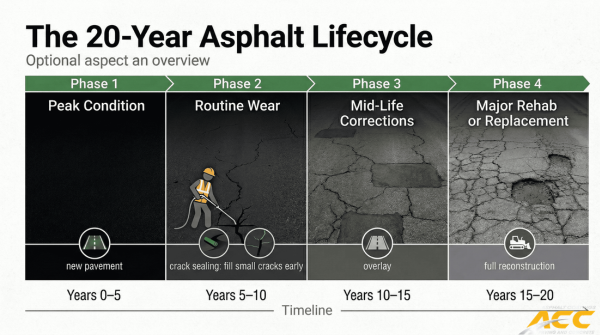
Preventive maintenance is where the largest cost savings occur. Timely sealcoating, crack sealing, and striping protect sound pavement at a fraction of the cost of full resurfacing or reconstruction, keeping surfaces above the condition threshold where deterioration accelerates.
Tracking performance through key indicators and scheduled plan reviews ensures that budgets, timelines, and treatment selections stay aligned with actual field conditions as they change year over year.
Partnering with an experienced commercial contractor brings specialized equipment, materials expertise, and consistent execution to every phase of the plan, from initial survey through long-term maintenance cycles.
What is a pavement management plan and why is it important?
A pavement management plan is a structured, data-driven strategy for maintaining pavement assets over time. It helps property owners reduce costs, extend pavement life, and prioritize repairs. The sections below explain how this plan benefits property owners and what goals it serves.
How does a pavement management plan help property owners and managers?
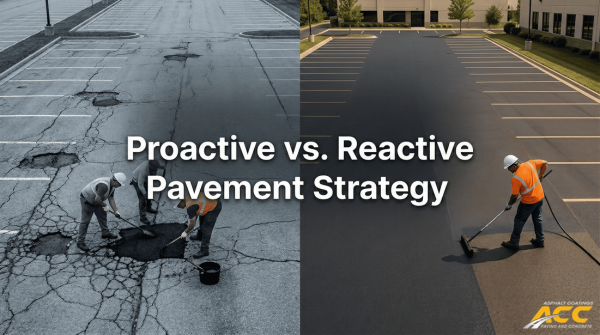
A pavement management plan helps property owners and managers by replacing reactive, emergency-driven repairs with a proactive maintenance strategy that lowers long-term costs and preserves asset value. Rather than waiting for potholes or surface failures to dictate spending, a structured plan uses objective condition data to guide decisions.
The foundation of this approach is standardized condition assessment. According to ASTM International, the Pavement Condition Index (PCI) provides a numerical rating from 0 (failed) to 100 (excellent) based on visual surveys of distress types, severity, and quantity.
Key benefits for property owners and managers include:
- Lower lifetime maintenance costs through well-timed preventive treatments.
- Objective, repeatable condition data that supports budget planning.
- Reduced risk of unexpected pavement failures and emergency repairs.
- Enhanced property appearance, which protects commercial property values.
For commercial property managers overseeing parking lots, access roads, or loading areas, this level of planning is one of the most practical ways to protect a significant infrastructure investment.
What are the primary goals of a pavement management plan?
The primary goals of a pavement management plan are to maximize pavement lifespan, minimize total maintenance costs, and ensure safe, functional surfaces for users. Every element of the plan works toward these objectives.
Specific goals include:
- Extending pavement service life by scheduling preventive maintenance at optimal intervals.
- Allocating limited budgets to the repairs that deliver the greatest return.
- Establishing a consistent inspection and documentation process for all pavement assets.
- Shifting spending from costly reconstruction toward affordable, routine treatments such as sealcoating and crack sealing.
These goals give property owners a clear framework for protecting pavement assets year after year. With goals defined, the next step is understanding the key components that make a pavement management plan work.
What are the key components of a comprehensive pavement management plan?
The key components of a comprehensive pavement management plan are condition assessment data, a prioritized repair strategy, and a long-term budget. Each component works together to shift maintenance from reactive fixes to a proactive system.
What data should be collected to assess pavement condition?
The data collected to assess pavement condition should include distress type, distress severity, and distress quantity for every pavement section. The Pavement Condition Index (PCI) is the most widely accepted method for organizing this data, providing a numerical rating from 0 to 100 where 100 represents the best possible condition and 0 represents the worst.
According to ASTM International’s standard practice ASTM D6433, PCI surveys follow a standardized visual inspection process for roads and parking lots, ensuring consistency across different locations and over time.
The PCI rating scale categorizes pavement condition as follows:
| (PCI) Range | Pavement Condition Rating | Pavement Distress Description |
| 85–100 | Good | No significant distress present |
| 70–85 | Satisfactory | Minor distresses; ride quality unaffected |
| 55–70 | Fair | Noticeable signs of aging and distress |
| 40–55 | Poor | Significant distresses affecting safety |
| 25–40 | Very Poor | Severe deterioration requiring major rehabilitation |
| 0–25 | Failed | Complete reconstruction needed |
Software systems like PAVER, developed by the Department of Defense and supported by Colorado State University, use PCI data to predict deterioration and optimize fund allocation.
How do you prioritize repairs and maintenance in a pavement management plan?
You prioritize repairs and maintenance in a pavement management plan by ranking pavement sections based on condition severity, treatment cost-effectiveness, and traffic impact. Sections scoring in the “fair” PCI range (55–70) are often the highest priority for preventive treatments because intervening at this stage costs far less than rehabilitating pavement that has declined further.
Preventive maintenance treatments applied at the optimal time extend service life and help avoid costly reconstruction. Pavement management software like PAVER can model deterioration curves for each section, making it possible to identify which investments deliver the greatest return before conditions worsen beyond economical repair.
What is the role of budgeting in a long-term pavement management strategy?
The role of budgeting in a long-term pavement management strategy is to align available funding with projected maintenance needs across the full lifecycle of the pavement network. Without a structured budget, organizations default to worst-first spending, which consumes resources on emergency repairs while neglecting preventive work that would deliver far greater savings.
Effective budgets account for annual preventive maintenance, periodic rehabilitation, and eventual reconstruction. By forecasting costs over multiple years using condition data and deterioration models, property managers can phase expenditures strategically rather than absorbing large, unplanned capital outlays. This financial discipline is what separates a true management plan from a simple repair list.
With budgeting frameworks established, the next step involves assessing your pavement’s current conditions.
How do you assess current pavement conditions and identify issues?
You assess current pavement conditions by conducting systematic inspections and documenting every visible distress. The following subsections cover the inspection types needed and the common problems to record.
What types of inspections are needed to evaluate pavement health?
The types of inspections needed to evaluate pavement health include visual walk-through surveys, Pavement Condition Index (PCI) assessments, and structural evaluations. Visual inspections identify surface-level distresses like cracking, rutting, and raveling. PCI surveys, standardized under ASTM D6433, assign a numerical score from 0 to 100 based on distress type, severity, and quantity.
Beyond surface assessments, core sampling and deflection testing reveal subsurface issues that visual methods cannot detect. Drainage evaluations should also be performed to identify areas where water pooling accelerates deterioration.
For the most reliable results, inspections should follow a consistent schedule, typically annually, so condition trends become visible over time. This regularity turns isolated data points into actionable performance curves that inform maintenance timing and budget allocation.
Which common pavement problems need to be documented?
The common pavement problems that need to be documented include:
- Alligator cracking: Interconnected cracking caused by structural fatigue or base failure.
- Longitudinal and transverse cracking: Linear cracks from thermal cycling or poor joint construction.
- Potholes: Localized depressions where surface material has broken away, often from moisture infiltration.
- Rutting: Permanent deformation in wheel paths caused by traffic loading.
- Raveling: Loss of aggregate from the surface, indicating binder degradation.
- Drainage deficiencies: Standing water or inadequate slope that accelerates all other distress types.
Each distress should be recorded with its location, severity level, and extent. Photographic documentation paired with GPS coordinates makes future comparisons straightforward. Catching minor distresses early is critical; small cracks left unsealed allow moisture penetration that, particularly during freeze-thaw cycles, can escalate into potholes and base failures within a single season.
With conditions thoroughly documented, the next step is understanding the factors that drive pavement deterioration over time.
What factors influence pavement performance and lifespan?
The factors that influence pavement performance and lifespan include environmental conditions, traffic volume, and load weight. The sections below examine how Colorado’s climate and vehicle traffic accelerate deterioration.
How do environmental conditions like freeze-thaw cycles impact pavement in Colorado?
Environmental conditions like freeze-thaw cycles impact pavement in Colorado by accelerating cracking, pothole formation, and structural breakdown. Colorado’s climate, characterized by frequent freeze-thaw cycles, intense sun exposure, and significant snowfall, presents unique challenges that necessitate specialized design and maintenance strategies.
The freeze-thaw cycle is the most damaging climatic factor for asphalt in the state. Moisture penetrates small cracks, freezes, expands, and widens those cracks into potholes and alligator cracking. Denver experiences approximately 40 freeze-thaw cycles annually, which is why specialized asphalt mix designs incorporating polymer modifiers are used to enhance flexibility and cracking resistance.
Beyond structural damage, poorly maintained pavements also affect property perception. A study by the California Department of Transportation found that adverse environmental effects from highways, exacerbated by poor pavement conditions, reduced abutting property values by an average of 4.5%. For commercial property managers, accounting for Colorado’s environmental stressors in a pavement management plan is not optional; it is the single most important variable in predicting long-term pavement costs.

What effect do traffic volume and load have on pavement deterioration?
Traffic volume and load have a direct effect on pavement deterioration by compressing the subgrade, fatiguing the asphalt surface, and accelerating structural distress. For commercial properties experiencing heavy traffic loads—such as distribution centers, retail parking lots, or industrial facilities—partnering with contractors experienced in Colorado-specific design standards helps ensure pavements are engineered to withstand both traffic stress and environmental factors from the outset.
The CDOT 2024 Pavement M-E Design Manual provides detailed procedures for designing pavements that can withstand Colorado’s traffic loads alongside its climate demands. Local municipalities, such as the City of Colorado Springs and Pueblo County, maintain their own pavement design criteria manuals that reference CDOT standards.
Proactive management makes the financial case clear: the FHWA has found that every $1 spent on preventive maintenance saves between $6 and $10 in future rehabilitation costs. For high-traffic commercial properties like distribution warehouses and shopping centers, factoring load data into a pavement plan prevents premature failure and protects the overall investment.

With these performance factors identified, the next step is implementing preventive maintenance strategies.
What are best practices for preventive pavement maintenance?
Best practices for preventive pavement maintenance include regular sealcoating, timely crack sealing, and scheduling major repairs before deterioration accelerates. These strategies protect pavement surfaces, extend service life, and deliver significant cost savings over time.
How does regular sealcoating and striping extend pavement life?
Regular sealcoating and striping extend pavement life by shielding asphalt surfaces from UV radiation, moisture infiltration, and chemical exposure. Sealcoating restores a protective barrier that slows oxidation and prevents small cracks from forming. Striping maintains clear traffic flow patterns, which reduces concentrated wear in unintended areas.
Together, these treatments are far less expensive than rehabilitation. According to the FHWA’s 2021 Life-Cycle Cost Analysis Primer, evaluating all costs over a pavement’s full lifespan, including maintenance and rehabilitation, demonstrates that low-cost preventive treatments applied at the right time yield the greatest long-term savings. For most commercial properties, scheduling sealcoating every two to three years is one of the simplest ways to avoid premature resurfacing.
What role does crack sealing play in maintenance planning?
Crack sealing plays a central role in maintenance planning by stopping water from penetrating the pavement structure. When moisture enters cracks and reaches the subbase, it weakens the foundation and accelerates deterioration, particularly during freeze-thaw cycles.
Addressing cracks early, while they remain narrow and isolated, prevents them from spreading into potholes or alligator cracking. When selecting a crack sealing contractor, property managers should verify the use of CDOT-approved materials, which are specifically formulated to perform in Colorado’s challenging climate conditions and ensure maximum treatment effectiveness. Waiting too long allows minor distresses to compound, pushing pavements past the point where affordable surface treatments remain viable.
When should you schedule major repairs or resurfacing?
You should schedule major repairs or resurfacing when preventive treatments can no longer restore adequate pavement condition. Once a pavement’s PCI drops below the “fair” range, surface treatments like sealcoating provide diminishing returns, and structural rehabilitation becomes necessary.
Sustainable practices can also reduce the cost and environmental impact of these larger projects. Recycled asphalt pavement (RAP) can cut carbon emissions by up to 50%, according to the Federal Highway Administration, making resurfacing projects both economically and environmentally efficient. Timing major work during warmer months ensures proper material curing and compaction. Proactive scheduling based on condition data, rather than waiting for failures, keeps lifecycle costs manageable.
With preventive strategies established, tracking performance over time ensures your plan stays effective.
How should you track progress and adjust your pavement management plan over time?
You should track progress and adjust your pavement management plan over time by monitoring key performance indicators and scheduling regular plan reviews. The sections below cover which metrics matter most and how frequently updates should occur.
What key performance indicators help monitor effectiveness?
The key performance indicators that help monitor effectiveness include Pavement Condition Index scores, maintenance cost per square foot, and the ratio of preventive to reactive spending. PCI scores provide a standardized 0-to-100 rating that reveals whether your network is improving or declining year over year. Tracking cost trends alongside condition data shows whether your budget allocation is producing measurable results.
Additional KPIs worth monitoring include:
- Number of emergency or unplanned repairs per year.
- Average pavement age at first major rehabilitation.
- Percentage of the network maintained above a target PCI threshold.
- User complaints or safety incidents related to pavement condition.
Consistent KPI tracking transforms subjective impressions into objective evidence. Without these metrics, property managers often default to reactive decision-making, which costs significantly more over time.
How often should a pavement management plan be reviewed and updated?
A pavement management plan should be reviewed and updated at least annually, with a comprehensive reassessment every three to five years. Annual reviews allow you to compare actual spending against budgeted amounts, document completed treatments, and adjust priorities based on the latest PCI survey data. According to the FHWA, an analysis period of at least 35 years is recommended for life-cycle cost analysis studies, which reinforces the need for consistent long-term tracking rather than one-time planning.
Major updates every three to five years should account for changes in traffic patterns, evolving budget constraints, and new treatment technologies. Unexpected events, such as severe weather damage or significant changes in property use, should also trigger an immediate plan revision. The most effective plans are living documents that evolve with the pavement network they manage.
With a structured tracking system in place, partnering with an experienced contractor ensures each adjustment translates into action.
How should you approach long-term pavement planning with a commercial asphalt and concrete contractor?
You should approach long-term pavement planning with a commercial asphalt and concrete contractor by selecting a partner with lifecycle expertise, preventive maintenance capabilities, and sustainable practices. The following sections cover how Asphalt Coatings Company supports this process and the key takeaways for building your plan.
Can paving, sealcoating, and concrete services from Asphalt Coatings Company help with long-term pavement management?
Yes, paving, sealcoating, and concrete services from Asphalt Coatings Company can help with long-term pavement management. Asphalt Coatings Company provides a full scope of commercial services, including asphalt paving, sealcoating, crack sealing, concrete flatwork, and parking lot striping, all performed by in-house crews with 39 years of Colorado-specific expertise.
Effective long-term pavement management shifts organizations from reactive repairs to proactive, preventive strategies. Asphalt Coatings Company supports this transition by offering the range of treatments a lifecycle approach demands. According to the FHWA, Life-Cycle Cost Analysis should span at least 35 years and account for initial construction, maintenance, rehabilitation, and user costs.

Sustainable options are also evolving. Recycled asphalt pavement can cut carbon emissions by up to 50%, and permeable pavements help manage stormwater runoff. Asphalt Coatings Company serves commercial properties across Colorado’s Front Range, combining professional expertise with dependable craftsmanship to protect pavement investments.
What are the key takeaways about building a long-term pavement management plan?
The key takeaways about building a long-term pavement management plan center on proactive strategy, data-driven decisions, and consistent professional maintenance. The most actionable lessons from this guide include:
- A standardized condition assessment, such as the Pavement Condition Index, forms the foundation of every effective plan.
- Preventive maintenance treatments like sealcoating and crack sealing cost far less than major rehabilitation when applied at the right time.
- Environmental factors, especially Colorado’s freeze-thaw cycles, must shape both material selection and maintenance scheduling.
- Budgeting with a lifecycle perspective ensures resources target the treatments that deliver the greatest return.
- Regular plan reviews and performance tracking keep your strategy aligned with actual pavement conditions.
- Partnering with a commercial contractor that offers comprehensive services simplifies execution across every phase.
Prioritizing prevention over reaction is the single most impactful decision a property manager can make. With the right plan and the right contractor, commercial pavements remain safe, functional, and cost-effective for decades.